Inattentional Blindness

Luke 10:25-37

Have you ever experienced inattentional blindness?   Sometimes it’s called familiarity blindness or perceptual blindness.  Almost everyone has experienced it at one time or another—that condition where you are so familiar with something that you actually stop seeing it.  The upshot of it is that the next time you do take a hard look at that familiar whatever it is, you see all kinds of things that you hadn’t noticed before.  

In my office at home I have a black and white photograph of my grandparents—my mother’s mom and dad.  That picture was taken the year I was born, so I’ve been seeing it my entire life.  My grandmother, the woman in that picture, died nine days after my first birthday, so a lot of my impression of her came from that photograph.  As a kid, I always thought she must have been kind of stern and austere—that was how the picture struck me.  But one day I took a moment to look at it again from a slightly different angle and I realized that she is actually smiling ever so slightly, and her eyes look very loving, gentle and understanding.  Now that I was really looking at her picture, I also realized that there was something strikingly familiar about her eyes, and then it dawned on me that I was seeing my mother’s eyes in this picture of her mother.  That smile, those gentle eyes had always been there in the photograph, but I hadn’t seen them because of inattentional blindness.

I think it’s fair to say that many of us have a kind of perceptual blindness with the parables of Jesus in general and this one we call The Good Samaritan in particular.  Several years ago I read a remarkable book by Amy-Jill Levine called Short Stories by Jesus.  Dr. Levine is a Jewish Professor of New Testament studies, and in this amazing book she revisits the parables of Jesus to help us understand how the first-century Jews who first heard these stories understood and interpreted them. 

Short Stories by Jesus helped me realize that I had a bad case of familiarity blindness where the parables of Jesus are concerned.  The fact is, when we put aside what we think we know about the parables and try to hear them the same way the original audience heard them, we begin to hear these familiar stories in an entirely new way.

For instance, in the very first line of the dialogue that leads up to this story about a man robbed and beaten by bandits there are two details that I never paid much attention to, but they really are kind of important because of the way they frame the rest of the story.  

“An expert in the law stood up to test Jesus.”  

The first thing to notice is that it’s a lawyer asking the question.  Luke’s original readers would have understood that this is not just your everyday scribe, this is a person with expertise in both religious and civil law.  He knows the scriptures.  And he’s testing Jesus.  He’s using a trick question as he tries to trap Jesus in a mistake of some kind.

But Jesus turned the tables on him with a trick question of his own, then amplified it with an even more important question. “What is written in the Law?” he asked the lawyer.  “How do you read it?” Some translations render that second question as “What do you read there?” but “How do you read it?” is a better translation.

That first question, “What is written in the Law,” was a red herring.  Torah, the Law, doesn’t say anything at all about eternal life.  The Law of Moses is not interested in life after death but it is vitally concerned with how we live here and now.  The really important question, though, is the second one Jesus asks the lawyer: How do you read it?   That question is just as important for us today as it was then.  Maybe even more so.  How do you read it?  What preconceptions to you bring with you when you read the scriptures?  How do you read it?

The lawyer knew that there was no good answer to the first question—the Torah doesn’t say anything about inheriting eternal life—but he felt like he needed to say something, so he responded to Jesus by quoting a mashup of the Shema from Deuteronomy and the Golden Commandment from Leviticus: “You shall love the Lord your God with all your heart, and with all your soul, and with all your strength, and with all your mind; and your neighbor as yourself.”  “That’s correct,” said Jesus, “Do that and you will live.”

The bottom line, here, is love.  Love God, and love your neighbor as you love yourself.  Do that and you will live.  Love is the key to an abundant and fulfilled life.

It sounds so simple.  The problem, though, is that this commandment to love is all-inclusive, and there are some people we really just don’t want to love.

I think the lawyer in this story is honest enough to realize that about himself.  He knows there are some people—you know, “those people”—that he will never love, and he suspects that this is true for everyone standing there listening to Jesus.  

Luke says he wanted to justify himself.  He wanted to make himself look right in the eyes of all those listening.  But he also wanted to maybe find a loophole.  Surely Jesus can’t mean that he has to love everybody, because, you know, there are some people—thosepeople—who have clearly demonstrated that they are not on our side—they are not worthy of our love.  Are we supposed to love them?  

So he asks another question:  “Well… who is my neighbor?”

In the context of law, the question about who is a neighbor has legal merit.  After all, good fences make good neighbors.  But in the context of love the question is irrelevant.  

Jesus wants to take this beyond the law. 

So Jesus redirects with a story.

A man travelling on the road from Jerusalem down to Jericho is violently assaulted by robbers.  They don’t just rob him, they strip him and beat him so badly that he’s half dead. So there he is, naked and half dead at the side of the road.  A priest happens by and does nothing to help the poor victim who is lying there bleeding.  He passes by on the other side of the road.  He gives the wounded man a wide berth.  Next a Levite comes by.  He also passes by on the other side of the road and does nothing to help the wounded stranger.

At this point, the people originally listening to Jesus tell this story would have been shocked and the lawyer had to be wondering where this was going.  For them, it was unthinkable that a priest and a Levite would pass by without helping.  The Law is very clear on this.  They are required to help!  That would be their duty according to the law, and it would take precedence over any other duty or obligation.  Even if the wounded man turned out to be dead, they had a responsibility to care for his body.  That was the law.

The people listening to Jesus were shocked.  But they were about to be utterly scandalized.  Because the hero of the story that Jesus is telling turns out to be… a Samaritan.  

It’s hard for us to imagine how much the Jews hated the Samaritans.  And vice versa.  The antagonism between Jews and Samaritans went back centuries and was all the more intense because they were so closely related.  

We traditionally call this parable the story of the Good Samaritan, but in the minds of those who were listening to Jesus, the words “good” and “Samaritan” would never find themselves in the same sentence.  It was an oxymoron.  Samaritans were the enemy.   The people listening to Jesus as he tells this story might have thought, “If I were the man in the ditch, I would rather die than admit that I was saved by a Samaritan.”  In their minds, Samaritans were something less than fully human.  

So how did things get to be so antagonistic between the Jews and the Samaritans?  Where did all that bad feeling come from?  

Well, centuries before Jesus, in the time of Jacob, Samaria was called Shechem, and it was a Prince of Shechem who raped Jacob’s daughter, Dinah.  In the time of the Judges, the false judge Abimelech, who murdered all his rivals, came from Shechem.  For a time, Shechem became part of the united kingdom of Israel under David and Solomon.  But after Solomon died, the Northern Kindom of Israel—which had been Shechem—broke away and a kind of low-grade civil war broke out that continued for generations.  When the Assyrians swept in and conquered the Northern Kingdom which was now called both Israel and Ephraim, they brought in people from other conquered kingdoms to resettle and then renamed the land Samaria after the capital city.  That’s also when the people of Judah began to refer to Samaritans with a kind of racial slur, calling them “the people with 5 fathers.”  But the thing that the people of Judah found absolutely unforgiveable forever and ever amen, was that when they returned to Jerusalem after their time of captivity in Babylon, Sanballat, the governor of Samaria, joined forces with other people in the region and attacked them to try to stop them from  rebuilding the city wall and the temple.

For their part, the Samaritans called themselves the Shamerim, meaning “guardians” or “observers” of the Law.  They had built their own temple on Mt. Gerizim and they had their own version of Torah, which they insisted was the “true” version.  They believed that only Torah—their Torah, of course—contained the word of God and they did not include the Psalms and other writings, or the books of the prophets among the books they regarded as holy.

For Jews, Samaritans were the ultimate “other,”  so for Jesus to cast the Samaritan as the benevolent hero was almost beyond belief.  It would be like an ultra-orthodox Jew being saved by a Hamas Palestinian.  To bring it closer to home, it might be like one of the Proud Boys being saved by someone wearing a Black Lives Matter tee shirt.  

Who would it be for you?  Who is that ultimate “other” who, in your mind, only just barely qualifies as a real person?  Who is it who, in your mind, seems to be so radically different from you that there’s really no point in even talking to them?  Or maybe there’s someone who sees you that way.  How would you feel if it was one of those people who pulled you out of the ditch?

The lawyer had asked Jesus, “Who is my neighbor?”  Jesus reframed his question.  Jesus wants us to understand that the question is not “who” merits my love or even “from whom” should I expect love.  As Amy-Jill Levine wrote, “The issue for Jesus is not the ‘who,’ but the ‘what,’ not the identity but the action.”  Love—loving God, loving your neighbor, loving yourself—is revealed in action.  Love does not exist in the abstract; it must be enacted.

The Priest and the Levite did not act in love even though their law and duty commanded that they should.  

Shortly before he was assassinated, the Rev. Dr.Martin Luther King, Jr. preached a sermon on this parable.  He had an interesting explanation for why the priest and the Levite did not stop to help the wounded man at the side of the road.  “I’m going to tell you what my imagination tells me,” said Dr. King.  “It’s possible these men were afraid… And so the first question that the priest and the Levite asked was, ‘If I stop to help this man, what will happen to me?’ … But then the Good Samaritan came by, and he reversed the question:  ‘If I do not stop to help this man, what will happen to him?”

The Samaritan gave first aid to the man at the side of the road.  He put him on his donkey and took him to the nearest inn where he could receive more help.  He paid the innkeeper two days wages to take care of the wounded man and then gave him a promise that amounted to a blank check.  “Take care of him,” he said, “and when I come back, I will repay you whatever you spend.”

“Which of these three,” Jesus asked the lawyer, “was a neighbor to the man who fell into the hands of the robbers?”  

The lawyer couldn’t even bring himself to say, ‘the Samaritan.’  He couldn’t let the word sit in his mouth.  That’s how much the Jews despised Samaritans.  I imagine there was a long pause before the lawyer finally said, “The one who showed him mercy.”

Mercy.  It’s an important detail here at the end of the parable,  a well-chosen word.  In both Greek and Hebrew, the word we translate as mercy can also mean “kindness.”  It is a covenant word in Hebrew.  Hesed.  It signifies a shared bond of common humanity in the eyes of and under the Law of God.  It is an acknowledgement that we “are of the same kind.”  

The Samaritan showed mercy.  Kindness, a word that takes us back to the prophet Micah:  “God has told you, O Mortal, what is good.  And what does the Lord require of you but to do justice, and to love kindness…mercy…kindness, and to walk humbly with your God.”

“Go and do likewise,” said Jesus to the lawyer.  Go and do likewise Jesus says to us.  

In our country today, we find ourselves living in a culture scarred by cycles of division, antagonism, generations of animosity, racism and conflict and even violence.  In this parable, Jesus is telling us that these spirals of perpetual antagonism can be broken with kindness.  The question that Jesus wants us to wrestle with is this: Can we learn to treat even our enemies, the “Samaritans” in our lives, in ways that acknowledge their humanity? Can we dare to see them in ways that acknowledge their potential to do good?  Can we can bind the wounds of those “others” and dare to imagine that they would do the same for us?    

When we encounter each other on the road full of bandits and other dangers, will we be blinded to each other by our familiar stereotypes, or will we find the courage and imagination to step outside of the roles we’ve cast for each other so we can give and receive kindness and be the good neighbor?  

Yes, this is a parable about helping those in need.  That’s what good neighbors do.  But more than that, it is a story about learning to see our common humanity in those we have always been tempted to dehumanize.  

Do justice. Love kindness—we are of the same kind.  Walk humbly with God.

Image: The Good Samaritan by Stephen Sawyer; http://www.art4god.com

A Different Kind of Fire

James 3:1-12; Mark 8:27-38

It has been a stressful week in Springfield, Ohio.  A middle school was closed on Friday and two elementary schools were evacuated because of bomb threats.  Yesterday, three medical facilities in Springfield were targeted with more bomb threats.  The police have beefed up their staffing because racist threats of violence against Springfield’s Haitian immigrant community have been circulating and there is concern that these threats could escalate into actual violence.[1]  

Things were already a bit uneasy in Springfield, a mostly blue-collar city of about 60,000 residents.  The city’s manufacturing economy was hit hard by the Covid shutdown and economic renewal, while steady, has been moving more slowly than they had hoped.  Over the past few years about 15,000 Haitian immigrants have been drawn to the city by new factory jobs and relatively affordable housing, but some of the longtime residents, mostly white, have been antagonistic to the newcomers, accusing them of driving up housing costs and straining city services.

All of this came to a head last week when a neo-Nazi group fabricated a story about the Haitian immigrants kidnapping and eating their neighbors’ household pets.  This racially inflammatory story moved from the social media platform Telegram to X where it was picked up by Vice-Presidential candidate J.D. Vance who repeated it as part of a verbal jab Vice President Harris even though the story had already been debunked by the mayor of Springfield and police officials.  When former President Trump repeated the story during Tuesday night’s presidential debate, the lie about immigrants eating cats and dogs immediately became the source of countless jokes and memes, but the people of Springfield aren’t laughing, especially not the Haitian community.  Some of them are afraid to leave their homes.

“How great a forest is set ablaze by such a small fire!  And the tongue is a fire,” we read in the chapter three of James.  “The tongue is placed among our members as a world of iniquity; it stains the whole body, sets on fire the cycle of life, and is itself set on fire by hell —a restless evil, full of deadly poison.  With it we bless the Lord and Father, and with it we curse people, made in the likeness of God.”

Words have power.

This week we observed a horrible anniversary, the commemoration of an event that upended our world and set enormous changes in motion.  Coming, as it did, on the day after an important presidential election debate, this anniversary was overlooked by many, but in many ways the explosive shock of that day is still reverberating throughout our nation and the world.

It was twenty-three years ago, September 11, 2001, when terrorists violently assaulted our religious, social, economic, and political structures by crashing three planes into the World Trade Towers and the Pentagon.  Analysts think that the fourth plane, which was heroically brought down by its passengers, was intended to crash into the US Capitol building or the White House. 

The heinous action of the terrorists was born in words. It was a statement, a word of hatred, self-righteousness, religious piety and vitriol, but its inarticulate message was incinerated in the flames and destruction of its violence.  How great a forest is set ablaze by a small fire.

Words have power.

In the aftermath of that violent act, a lawyer sat down at his computer and wrote a sentence, a 60 word run-on sentence that blurred the line between war and peace, a sentence that led us into the longest war this country has ever known.  On September 18, 2001, that 60-word sentence was adopted by both houses of Congress and signed into law as the Authorization for Use of Military Force.

Words have power.

In the Gospel lesson from two weeks ago, some Pharisees and scribes gave Jesus a bad time because his disciples didn’t wash their hands before eating.  So Jesus said to the crowd, “Listen and understand:  it is not what goes into the mouth that defiles a person.  It’s what comes out of the mouth that defiles.  What comes out of the mouth gets its start in the heart. It’s from the heart that we vomit up evil arguments, murders, adulteries, fornications, thefts, lies, and racism.  That’s what pollutes.”

Words have power.

In last week’s Gospel lesson, Jesus traveled to the region of Tyre and Sidon.  The people of Israel had a low opinion of the people of Sidon and Tyre, an opinion rooted in a long history of animosity between the two regions.  When a woman from the area asked Jesus to free her daughter from a demon, Jesus insulted her.  “It’s not right to give the children’s food to the dogs,” he said.  He called her a dog.  You have to wonder why he would say such a thing.  

Did Jesus, the same Jesus who was criticized for hanging out with tax collectors and “sinners,” the same Jesus who crossed all kinds of boundaries to embrace all kinds of outcasts, the same Jesus who touched lepers! did this Jesus trek all the way to the heart of Sidon just to insult this poor woman with a racial slur?

Yes.  Yes he did. Jesus schlepped all the way to Sidon to create a teaching moment that his disciples and all his followers forever after would not forget.  Words have power.  Especially the ugly ones.

In that moment with that desperate woman, Jesus said aloud what his disciples were thinking.  He wanted them to hear the ugliness of their attitudes out loud.  He led them to the neighborhood of “those people,” the ones who they think are inferior, the ones who they think are cursed.  The ones who, in their understanding, God doesn’t much care for. 

I am not for one moment suggesting that the disciples in particular or Jews in general were xenophobic.  I’m suggesting that almost all of us are to one degree or another.   We humans have a bad tendency to “other” each other.  And we do it with our words.

Words have power.  Words have consequences.

It’s not what goes into the mouth that pollutes, it’s what comes out of the mouth.  It’s from the heart that we vomit up lies, blasphemies, bigotries, othering and racism.  That’s what pollutes us.  That’s what poisons us generation after generation.  

Our words have power.  

At the beginning of the Gospel of Mark, Jesus begins his campaign to change the world with an announcement.  He proclaims that the Reign of God is arriving.  Everything that happens in Mark’s gospel pivots around that opening announcement:  The reign of God, the dominion of God, the commonwealth of God’s justice and mercy, the kingdom of God—is arriving.  

The announcement, itself, the very language of it, has power.  Jesus doesn’t announce that the Kingdom of God has arrived, but that it is within reach.  The message is that even though Jesus, the Christ has arrived to inaugurate the reign of God, it’s not a done deal.  And maybe it never will be.  The language Jesus uses tells us that the kingdom may always be a work in progress.  

In chapter 8 of Mark, smack in the middle of the gospel, the disciples come to an inflection point, a crossroads.  Mark wants us to understand that if we follow Jesus and try to live his Way, at some point their inflection point will become our crossroads, too.  And it will all hang on a word.  Because words have power.

Jesus asks his disciples, “Who do people say that I am?”  It’s an easy question.  What’s the buzz?  What’s the word out there in the crowd?  What do the polls say?

They told him that some people thought of him as John the Baptist.  Others thought of him as Elijah.  They all pretty much agreed that at the very least he was a prophet.  

At this point, the question Jesus is asking is theoretical.  The words are speculative.  The question and the answers are all in the realm of rumor.  It’s about what people are thinking.  It’s a head question and the answers are all nothing more than opinion.

But words have power.  When Jesus redirects the question and asks his disciples point blank, “Who do you say that I am, he puts them on the spot.  Suddenly the question becomes visceral.  And so do all possible answers.  Words have power.  And that power becomes action.

The geographic location where Jesus asks this question is speaking its own words of power.  They are in Gentile territory just outside Caesarea Phillipi, a city famous as a center of pagan worship, most notably worship of the god Pan—a very sexy and earthy deity.  They are at the edge of a city that was reconstructed by and named for the Tetrarch Phillip, the sycophant son of the ruthless Herod the Great.  In an effort to curry favor with his Roman overlords, Phillip also dedicated the city to Caesar, the Roman Emperor, a dictator who claimed to be divine.  On top of all that, Caesarea Phillipi was the place where the Roman legions took their R&R.   And when those same Roman legions marched into Palestine to put down Jewish rebellion, they launched their campaigns from Caesarea Phillipi. 

Here, in a place that confronted the disciples with pagan gods and stared them down with the brute force of its political and military might, here is where Jesus asked them—and asks us—his pointed question:  “Who do you say that I am?”  In the face of the allure of mythical nature religion and all the idols that seduce us, in the face of intimidating political power, in the face of the addictive efficiency of brute force, in the face of a world noisy with rumor and gossip and inuendo, Jesus asks “Who do you say that I am?”

Peter said, “You are the messiah.  The Christ.”  Is that your answer, too?  What does that word mean to you?  Messiah.  Christ.  What consequences come with that word, that identity?

Jesus, apparently, did not like the way Peter and the others interpreted that word.  Messiah.  He told them not to say it.  He told them not to talk about him in those terms.  He didn’t deny that he was the Messiah, but he knew that they were thinking of Messiah in terms of political power.  Coercive clout.  Military might.  Maybe he was worried that they might be thinking of doing something rash and violent—the first century equivalent of  flying planes into Rome’s symbolic towers.  

So he told them to keep quiet.  

Then he told them about the cross.  He told them that if they really were his disciples there would be a cross for them, too. 

Peter didn’t like what Jesus was saying.  Peter was thinking of Messiah as a righteous general who would lead a holy army into a holy war, but Jesus was telling him he wasn’t willing to play that role, that pitting violence against violence was not the way to bring about a world of nonviolence.  So Peter argued with Jesus right there in front of everybody.  

How often do we argue with Jesus because he won’t play the role we want him to play?  How often are we looking for a Messiah who will kick tail and take names and step in and fix everything?  That seems to be what Christian Nationalism is all about, but if Jesus wasn’t willing to do it then, why does anyone think he would be willing to do it now?

In Mark’s gospel, acknowledging Jesus as Christ, living life as a follower of Jesus, means standing in opposition to both the religious and political systems that enrich and empower some while simultaneously creating a permanent underclass of the oppressed and disadvantaged.  The first readers of Mark understood that Jesus was asking for a total commitment to his nonviolent revolution, his transformation and restructuring of the world to bring it into conformity with God’s vision.  

Jesus is still asking that of us.  But he wants us to understand that there are consequences for standing against the powers.  He also, however, wants us to understand that there are consequences for not doing it, for continuing to play along with all the forces of business as usual. 

“What good will it be if you play the game and get everything you want, the whole world even, but lose your soul?  Your very self?  What are you going to get in exchange for selling off your soul in little pieces?  What’s the going rate for that internal eternal essence that makes you uniquely and creatively you?  What’s the market price for the image of God in you? What good will it be at the end of the day if you’re surrounded by every comfort but you’ve lost everything that makes you really you, everything in you that shines with the likeness of God? 

Be careful how you answer.  Words have power.  


[1] ABC News, September 14, 2024

Crossing to the Other Side

Mark 4:35-41

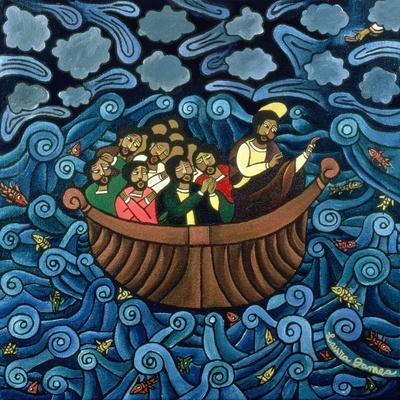
  On that day, when evening had come, he said to them, “Let us go across to the other side.” And leaving the crowd behind, they took him with them in the boat, just as he was. Other boats were with him. A great windstorm arose, and the waves beat into the boat, so that the boat was already being swamped. But he was in the stern, asleep on the cushion; and they woke him up and said to him, “Teacher, do you not care that we are perishing?” He woke up and rebuked the wind, and said to the sea, “Peace! Be still!” Then the wind ceased, and there was a dead calm. He said to them, “Why are you afraid? Have you still no faith?” And they were filled with great awe and said to one another, “Who then is this, that even the wind and the sea obey him?”

It’s been about three years now since the Covid 19 pandemic retreated enough so that we could begin to gather again in church and other public places.  We spent fifteen months secluded in our homes because a kind of life-storm rose up unexpectedly and caught us off guard and unprepared, a storm created by a virus that flew in from the other side of the world.  That storm has mostly receded now, although we are still dealing with occasional waves,  and maybe it’s just me, but even though it has been three years, it still feels like we haven’t really returned to normal, or at least what normal used to be.

In some ways that’s good.  There was a lot about our old “normal” that needed to be improved.  But in other ways, it’s not at all good.  It feels as if we are still locked into a heightened state of anxiety, and since anxiety always wants a target, we seem sometimes to be taking it out on each other, especially in our politics.

We lost a lot during the pandemic.  Social connections were lost or  strained. Some of our common understanding of how society is supposed to work was lost.  The Church, unable to gather in person in our usual places of worship, lost members in a decline that had already been underway but was exacerbated by the enforced restrictions and now shows no signs of slowing or reversing.  And, of course, millions of lives were lost throughout the world.  

Ever since Covid, we have been sailing through choppy waters toward the shore of a new and unknown reality.  It feels to me that we are somewhat like the disciples in the boat after Jesus calmed the storm.  The storm has stopped, but we are still sitting in the middle of the lake in the dark, bailing out our boat.

Today’s Gospel lesson from Mark lifts up some important things for us to think about as we sail toward a future we can’t really see.  And let’s face it, we’re not going to simply sail back into the way things used to be.  Too much was changed in those 15 months of isolation and these three years of recovery.  

In Mark’s telling of this story of the storm on the sea,  Jesus and his disciples set out in the evening, of all things, to sail across the Sea of Galilee.  A great windstorm blew up and the boat was being swamped.  We know it was a serious storm because even the fishermen who were out on this water all the time were frightened. Through all of this, Jesus was soundly asleep on a cushion in the stern of the boat.  Finally, the disciples cried out, “Teacher, do you not care that we are perishing?!?” That’s when Jesus woke up, then got up and rebuked the storm.  The sea became dead calm, and the disciples, dumbfounded by this new dimension of his power and abilities, were left wondering just who Jesus really is.

When we read or hear these stories, these episodes from the life and ministry of Jesus, it’s natural for us to ask ourselves, “Okay, what does that mean for me or for us?”  It’s always good to try to  imagine how the original listeners heard these gospel stories if we’re able, but we also hope there’s something in the story that we can take home with us, some lesson that fits our lives right here and right now.  That’s why we do this little exercise of preaching and teaching with the gospel every week.

With this particular story, it has been far too tempting for far too long to personalize it a little too much.  And I confess I’ve been as guilty as any preacher out there in doing this.  That sermon goes something like this:  “When storms arise in your life, just remember that Jesus is in the boat with you…even if he’s taking a nap at the moment.  He has the power to quiet the storm.  Maybe he’s asking you, ‘Why are you afraid?  Where’s your faith, pal?’  Muster up some courage.  Maybe it’s your turn to stand up and tell whatever  storm is swamping your boat, ‘Peace!  Be still.’”  

I have preached that sermon.

Listen, there are probably worse ways to go with this story.  We’ve all had moments in our lives when we’ve wanted to join the disciples in yelling, “Teacher, don’t you care that we’re perishing?!?”  I know I’ve been there a few times.  But the fact is, there is something greater at stake in this story than a bromide to help us face our fears.  There is something greater at stake here not just for them in their time, but for us in our time.  But to know what that is, we have to range beyond the boundaries of these six verses.

From the very beginning of the Gospel of Mark, Jesus has been announcing that the kingdom of God is imminent.  Actually, imminent is not quite the right word.  The Greek word is engikken.  It’s often translated as “has come near,” but there is an even greater sense of immediacy in the word than that.  Think of it as a train coming into the station.  It’s not all the way into the station yet but the engine has already reached the edge of the platform.  That’s the sense of it.  The kingdom of God’s engine has already reached the platform of our lives.  The train is engikken.  Get ready to board.

Everything Jesus says and does in the Gospel of Mark is said and done to demonstrate the power and presence of this new reality he calls the kingdom of God or, as Diana Butler Bass calls it, the Commonwealth of God’s justice and mercy.  He is not just telling people about this kingdom, he is showing them what it looks like and how it acts.  When Jesus calls the disciples, he is recruiting them to build a new community, a Beloved Community, based on the ideals and principles of “The Way,” which is another name Mark uses for the kingdom of God.  

Another thing to understand about the Gospel of Mark is that everything that happens in this Gospel is heavily weighted with myth and symbolism.  That’s not to say that the events the gospel depicts didn’t happen, but that it is important to pay attention to how Mark is describing and using these events and what kind of language he is using as he tells the story of Jesus.  

We need to ask questions.  What other scriptural connections does Mark make—or expect us to be making?  What apocalyptic expectations and understandings are at  work in the culture of Mark’s time?  What mythic stories are at work in the background as Mark tells the story of Jesus?  What cultural boundaries and expectations are being crossed?  If we don’t catch all these clues, then we might not get the point Mark is trying to make. We’ll get some other point instead.

When we see the disciples and Jesus set off from the shore in a boat in the evening, Mark wants us to be nervous.  We’re supposed to remember that in their mythic understanding the sea is the home of Chaos and Destruction.  Dread, unpredictable, cosmic forces hide in its depths and the only thing that could tame it at creation was the Spirit of God hovering over it.  That they are setting out as night falls with the intention of crossing all the way to the other side—well, if we were Mark’s first readers or listeners we would know they’re heading for trouble.

As the story unfolds, Mark assumes that somewhere in the back of our minds we are maybe remembering Psalm 107: “Some went down into the sea in boats…then they cried to the Lord in their trouble, and he delivered them from their distress; he made the storm be still, and the waves were hushed.” (107:23,39)  When we read that Jesus was asleep on a cushion in the stern of the boat, Mark wants us to remember how Jonah slept as his boat was about to break up in a mighty tempest. (Jonah 1:4, 10).  Mark puts all these things together so that we will understand that this storm that the disciples face out there on the sea of Chaos is not just a metaphor for the troubles of life.  This is a Cosmic storm.  Their boat is being assailed by cosmic forces.  Something wants to stop them.  Some great elemental power wants very much to keep them from getting to the other side of the lake.  But what?  And why?

To understand that, it’s important to understand why Jesus wanted to cross the lake in the first place.  

The Sea of Galilee was also called Lake Gennesaret or Lake Tiberias depending on who was talking about it.  It served as a clear geographic boundary between the territories of Philip and Agrippa in the tetrarchy of Palestine when the Emperor Augustus divided up the region between the sons of Herod the Great, and it continued to serve as a clear social boundary between the Jews of Galilee on the south side and the Hellenized Jews and Gentiles of various nationalities throughout the Decapolis on the north side. 

Why did Jesus want to go to the other side of the lake?  Quite simply because that’s where the gentiles were.  

Jesus was fighting other-ism.  Racism.  He wanted his new beloved community to embrace everyone—Jew, Gentile, people of all nationalities and types, people who had differences in how they worshipped. So he took his mission of proclamation, healing, exorcism and teaching across the sea to invite those “other” people to be part of “the Way.” He also wanted to teach his disciples that in the kingdom of God there simply is no room for such nonsense as racial exclusion or historical segregation or anything like that.  In the kingdom of God no one can call anyone else unclean.  Or unwelcome.  

That storm that rose up against them is symbolic of all the storms that rise up to resist our attempts at opening our hearts and minds to reconciliation and renewal.  It was the elemental malicious something in our world and in the human heart that wants to keep us forever sorted in our caste systems and historic animosities, that force that resists healing and unifying humanity.  And I want you to notice something here:  The words that Jesus spoke to stifle that storm are the words of exorcism.  Most of our translations make those words prettier than they actually are, but they are the same words that Jesus spoke when he cast out the demon in Mark 1:25.  “Peace.  Be still.”  Okay, sure.  But that’s a very mild translation.  The full force of the words in the Greek text is more like “Silence!  Shut up!  I muzzle you!”  

Maybe  this is how we need to speak to racism.  Maybe this is how we need to speak to Jim Crow laws and race-baiting and race-driven gerrymandering.  Maybe this is how we need to speak to racial slurs and jokes and microaggressions and all the derogatory language of bigotry.

Maybe we need to speak this clearly and bluntly to the forces that try to dissuade and discourage us from reaching out to make new bonds of friendship.  Maybe this is how we need to speak to those voices who keep dragging up tradition and history as reasons to preserve symbols of hatred and monuments to violence in public displays.  Maybe this is the plain kind of speech we need to use with those who continue to pursue paths of prejudice that have done nothing but separate us and poison us against each other.  Maybe instead of trying to be reasonable and persuasive against such divisive winds it’s time to simply say, “Stop right there!  I will not listen to hate.  I will not let you keep us from getting to the other shore.  I will not let you stop us from including everyone in the Beloved Community.”

During the pandemic, we had fifteen months of enforced separation, an imposed time to sit apart and consider all the things that are dividing us.  We had fifteen months to witness as more than a million people died from a disease that could have been curtailed much more easily and much more quickly if we had been more unified.  

We had 15 months to watch as unreasonable political forces and conspiracy theory voices assaulted the foundations of our democracy and truth, itself.  We had 15 months to see racial tensions repeatedly exacerbated by hate and violence and lamentable systemic conditioning.  

We had fifteen months to sit apart in our homes and miss each other and think about what it means to be friends, to be church, to be disciples of Jesus, to be people of The Way.  

And now the doors have been open for three years.  The storm has subsided.  We’ve been back together for some time now.  We get to be “us” again.  But there are people “not like us” across the road, across town, across the lake, on the other side of the sea of chaos. And Jesus is still saying, “Let’s go across to the other side.”  

Yes, storms will almost certainly rise up.  The elemental malicious  something will try to stop us.  But Christ is in the boat with us, and Christ has given us the words to silence bigotry.

“Christ sleeps in the deepest selves of all of us,” said Frederick Buechner, “and whatever we do in whatever time we have left, wherever we go, may we in whatever way we can call on him as the fishermen did in their boat to come awake within us and to give us courage, to give us hope, to show us, each one, our way. May he be with us especially when the winds go mad and the waves run wild, as they will for all of us before we’re done, so that even in their midst we may find peace…we may find Christ.”

image © Laura James

Thought Pollution

Matthew 15:21-28

Are there stories or sayings in the Bible that make you uncomfortable?  This story of Jesus and the Canaanite woman has really bothered me for a long time, mostly because at first reading Jesus come off as a bit of a jerk.   

But here’s the thing:  I think this story is supposed to be disturbing.  It’s supposed to bother us.  This story is begging us to do our homework, because we won’t even begin to understand what Jesus is up to here unless we dig into some history and social context.  I’m pretty sure that Jesus was aiming for a particular reaction from his disciples and I think he wants that same reaction from us.  But for us to get to the “aha moment” here, we really need to go back.  Way back.  All the way back to Noah.

But before we set the Wayback Machine for Noah, let’s go back to what happened just before Jesus encountered this bothersome and determined Canaanite woman. 

At the end of the previous chapter, after a stormy night on the lake where Jesus walked on water and Peter tried to, they landed at the little town of Gennesaret.  As always, a crowd gathered and Jesus started teaching.  But before he got very far some Pharisees and scribes started to give him a bad time because his disciples didn’t wash their hands before eating.  So Jesus tells the crowd to gather round then says, “Listen and understand:  it is not what goes into the mouth that defiles a person.  It’s what comes out of the mouth that defiles.”  This offended the Pharisees.  And it probably offended them even more when Jesus called them blind guides of the blind.  

But Peter wanted to hear more about what goes into the mouth versus what comes out.  I really like how Eugene Peterson rendered this bit of dialogue in The Message:

“Peter said, ‘I don’t get it. Put it in plain language.’

“Jesus replied, “You too? Are you being willfully stupid?  Don’t you know that anything that is swallowed works its way through the intestines and is finally defecated?  But what comes out of the mouth gets its start in the heart. It’s from the heart that we vomit up evil arguments, murders, adulteries, fornications, thefts, lies, and cussing.  That’s what pollutes. Eating or not eating certain foods, washing or not washing your hands—that’s neither here nor there.’”

So keep all that in mind—those things that come out of the heart by way of the mouth to pollute life—keep all that in the back of your mind because suddenly the story shifts and in one brief sentence Jesus walks about fifty miles to the region of Tyre and Sidon.

Why?  Why Tyre and Sidon?  Did he just want to put some distance between himself and the Pharisees and scribes?  Why does he suddenly head off for Gentile territory?  Why, of all places, Sidon?

Well to answer that, we go all the way back to Noah.  

After Noah left the ark he planted a vineyard.  He grew some grapes and made some wine.  And then he got drunk and fell asleep naked in his tent.  Like you do.  Noah’s son, Ham, wandered by, noticed that his father was naked, and covered him up which actually seems like a pretty decent thing to do.  But when Noah woke up things got weird. He was furious that Ham saw him in such a state, so he cursed Ham with a curse that would apply to all of his descendants.  

They took cursing very seriously in those days, especially being cursed by your father.  Being cursed was devastating.  It was the opposite pole of blessing.  A blessing could give you a bright vision of your future and a big dose of optimism to help make it come true.  A curse would make your life a living nightmare. It would haunt you and hang over you like a shadow.  

So Ham was cursed.  And so was his son, Canaan.  And so was Canaan’s son, Sidon.  And on down the line.

Sidon, Noah’s grandson, inheritor of the curse, ended up having a lot of sons and grandsons and great-grandsons and so on until Sidon became a great nation.  And because Sidon’s territory butted right up against Israel, and because  the two nations were somewhat less than friendly, the nation of Sidon shows up fairly often in the history and scriptures of Israel.  

In the Book of Judges, the Sidonians conquer and oppress the Israelites.  King Solomon married several Sidonian women who then induced him to worship their goddess, Ashtoreth.  King Ahab married a Sidonian Princess.  You’ve probably heard of her.  Her name was Jezebel and she caused all kinds of trouble, especially when she kept trying to kill the prophet Elijah.  Jeremiah, Ezekiel and Isaiah all predicted judgment and doom for Sidon because of their idolatry.  When the Assyrians and later the Babylonians conquered Israel, they launched their ships from Tyre and their armies from Sidon.  

For devout and even slightly patriotic Jews, the region of Tyre and Sidon was not a friendly place.  In their eyes, the people there were cursed.

So why did Jesus go there?  

Jesus went there to put some distance between himself and the Pharisees and scribes.  Physical distance, cultural distance, and historical distance.  And also to make a point about God’s love and grace.  But we’ll get to that.

They had no sooner arrived than a woman ran up and started screaming at them. The NRSV and other translation say she shouted, which sounds slightly nicer, but the Greek word Matthew uses is ekrazen which has a sense of both screaming and crying.  It’s a very emotional word.  

So this Canaanite woman—Mark specifies that she was Syrophoenician—comes rushing up to them and with tears and wailing pleads with Jesus to free her daughter from a demon that is  tormenting her.  “Have mercy on me, Lord, Son of David; my daughter is tormented by a demon!”  Kyrie eleison. 

And Jesus . . . ignores her.  

So she starts to plead with the disciples and pesters them to do something.  And no matter how they try to put her off, she won’t give up.  Because she’s a Mom.  A good Mom.  So finally they come to Jesus and beg him to intervene. “Send her away!” they said.  “She’s driving us crazy!”  

And this is where Jesus says the first thing that makes him sound like a jerk.  Jesus turns to this desperate woman who is frantic with fear for her demon-assaulted daughter and says, “I was sent only to the lost sheep of Israel.”

What!!???  Jesus! What the…???

But she comes and kneels down in front of him and begs him.  “Lord, help me.”  

And this is where Jesus doubles down and says something truly ugly, something that makes him sound like a complete bigot.  “It’s not right to take the children’s food and throw it to the dogs.”

He calls her a dog.  

And there is no way to translate that that takes away any of the sting and insult.


How does this make any sense at all?  Did Jesus, the same Jesus who was criticized for hanging out with tax collectors and “sinners,” the same Jesus who crossed all kinds of boundaries to embrace all kinds of outcasts, the same Jesus who touched lepers! did this Jesus trek all the way to the heart of Sidon just to insult this poor woman with a racial slur?

Yes.  Yes he did. Jesus schlepped all the way to Sidon to create a teaching moment that his disciple and all his followers forever after would not forget.

In this moment with this desperate woman, Jesus is saying aloud what his disciples are thinking.  He wants them to hear the ugliness of their attitudes out loud.  He has led them to the neighborhood of “those people,” the ones who they think are inferior, the one who they think are cursed.  The ones who, in their understanding, God doesn’t much care for. 

I am not for one moment suggesting that the disciples in particular or Jews in general were xenophobic.  I’m suggesting that almost all of us are to one degree or another.   We humans have a bad tendency to “other” each other.

Jesus wants us to hear what our othering attitudes sound like to someone on the receiving end.  He wants us to hear the ugliness of even our most benign bigotries expressed out loud in the presence of someone who is “not one of us,” not our clan, not our race, not of our culture or religion or denomination or neighborhood. Someone who doesn’t speak our language.  He wants us to hear what overt othering sounds like to someone we are prepared to dislike or disregard or even hate for no reason at all except for a long-nurtured history of othering and mistrust handed down through the generations.  He wants us to hear just how brutal inherited ill will can really be.  He wants us to understand that it has consequences.

It’s not what goes into the mouth that pollutes, it’s what comes out of the mouth. What comes out of the mouth comes from the heart. It’s from the heart that we vomit up evil arguments, murders, adulteries, fornications, thefts, lies, blasphemies, bigotries, othering and racism.  That’s what pollutes us.  That’s what poisons us generation after generation.  

“It’s not right to take the children’s food and throw it to the dogs,” said Jesus.  “Yes Lord, she said, but even the dogs get to eat the scraps that fall from their master’s table.” “Woman, great is your faith!” said Jesus. “Let it be done for you as you wish.” And her daughter was healed instantly.

Such faith.  Such amazing faith to let herself be ignored then insulted and degraded all in the hope of some kind of help for her daughter, all for a scrap from the table of God’s healing love and grace.  All for a lesson that far too many of us still seem all to reluctant to learn.  

Shock Treatment

Mark 7:24-30

Wendy Kelly is the owner of a thriving Human Resources consulting firm, Kelly’s HR Services in West Palm Beach, Florida.  She has helped hundreds of people find meaningful employment, a job she does with special sensitivity because she vividly remembers her own experience the first time she applied for a “real” job.   

She was responding to an ad for a receptionist in a medical practice.  She arrived early and sat in the waiting room with the other applicants, mostly young Black women, who were waiting to be interviewed.  Wendy remembers listening as the hiring manager, one of the doctors in the practice, called the candidates in one-by-one for their interviews:  Keisha,  La Quitta, Otishia, Tishia.  Wendy watched as one after another the women went in for what was, at most, a five minute interview with the doctor.

Finally the doctor called her name. “Wendy Kelly.”  Then he added,  “Finally a person whose name I can pronounce.”  Then as Wendy approached, he looked at her in surprise and said, “I thought you were white.”  He didn’t take her resume and simply laid her application on the stack with all the others on his desk.   He asked her a few perfunctory questions, but it really wasn’t much of an interview.  She could tell that he wanted to cut it short and move on.  Wendy left with mixed emotions.  She still wanted the job.  But would she be able to work for someone who, she had realized, was a racist?

Fast forward a number of years.  Wendy was working as a Senior Manager in a well-known management company.  She had been asking for a raise for about a year but her raise kept being postponed even though she was handling some of the company’s most important clients.  One day a new woman was hired to work on Wendy’s team.  Even though this new worker would report directly to her, Wendy had not had any say in her hiring.  

When the new woman had been there about a week, one of Wendy’s co-workers on another team asked her, “Did you see what they’re paying Sonia?”  Wendy was shocked to discover that Sonia, this new person who reported to her, was being paid $11,000 more than she was.  Naturally, she was furious.  She headed straight for her manager to tell him what she had learned and to demand that something be done.   “Wendy, I am sorry,” he said.  “I have been trying to get you a raise, but it is being shot down. This is wrong.”  When Wendy asked him, “Is this because I’m black?” he had no response.[1]

Racism takes many forms, and it’s not always as blatant as Klansmen marching in the streets or redlining of neighborhoods.  Racism has insinuated itself into our culture in ways we don’t even see.  But we need to see it.  If we’re going to change it, we need to face it.  “Not everything that is faced can be changed,” said James Baldwin, “but nothing can be changed until it is faced.”   

Racism isn’t going to disappear until we have named it in all its names and unraveled it from all the ways it has woven itself into the fabric of our lives.  Racism isn’t going to stop being a blight on our  present and a shadow over our future until we acknowledge and confront its shameful past.  Racism isn’t going to disappear until we learn to silence all the voices it speaks with, especially the racist voices and ideas that live inside us, that keep popping into our heads even against our will because we grew up in a racist world and a racist culture.  “Ours is not the struggle of one day, one week, or one year,” said John Lewis.  “Ours is not the struggle of one judicial appointment or presidential term. Ours is the struggle of a lifetime, or maybe even many lifetimes, and each one of us in every generation must do our part.”

Racism, bigotry, prejudice—whatever you want to call it—is an insidious and foul fact of life.  We’re far too familiar with it here in America, but it raises its ugly head in one form or another in every human society.  

Every group of humans seems to have a culturally built-in opinion that some other group of humans is somehow inferior or dangerous or maybe even not really human.  

Bigotry has played an enormous role in history.  It has negatively impacted politics, economics, and even religion. “At the heart of racism,” wrote Friedrich Otto Hertz, “is the religious assertion that God made a creative mistake when He brought some people into being.”

Even Jesus seems to have been tainted with a hint of bigotry.  At least at first glance.  When a Syrophoenician woman in Tyre came to him begging for help, asking him to free her daughter from an unclean spirit that was tormenting her,  Jesus replied, “Let the children be fed first, for it is not fair to take the children’s food and throw it to the dogs.”  

His response was perfectly in keeping with the attitudes of his culture.  That’s how Jews thought about Gentiles.  The Babylonian Talmud states, “As the sacred food was intended for men, but not for the dogs, the Torah was intended to be given to the Chosen People, but not to the Gentiles.”[2]

“Let the children be fed first, for it is not fair to take the children’s food and throw it to the dogs.”  It’s shocking to hear that kind of bigotry coming from Jesus.  And I would like to suggest that that is exactly why he said it. 

In the Gospel of Mark, Jesus begins his ministry by announcing that the Reign of God is arriving.  He then embodies that ministry by healing people, freeing them from demonic or other spiritual oppression, and gathering a diverse community of followers to teach them what Mark calls The Way.  He includes outcasts, like tax collectors and “sinners” in that community.  And then, to make it clear that this Beloved Community, this Companionship of the Way, is for all people, he starts repeatedly taking his disciples across the Sea of Galilee to the other side, to where the Gentiles are so he can proclaim the reign of God to them, too, and bring God’s healing to them, too, and invite them as well to join in the Companionship of the Way.  

Shortly before this episode in Tyre, deep in the heart of Phoenician Gentile territory—shortly before he said that shocking, bigoted thing to this woman, he had fed a multitude including Gentiles.  In Gentile territory.  He gave bread to the Gentiles—the bread of his teaching, the bread of healing, and real bread to feed their physical hunger.  To use the ugly language of their cultural bigotry, he had already thrown bread to the dogs.

He had made it clear in every way he could that Gentiles are included in the Beloved Community, the Companionship of the Way. He had made it clear that the Reign of God embraces everyone.  Period.

When Jesus says this ugly thing, when he for all intents and purposes calls this woman and her daughter dogs—and okay, the word in the Greek means “little dogs,” puppies—but is that really any better?—when he calls them dogs, he’s really just voicing what his disciples are thinking.  Because that’s what their culture has taught them to think about Gentiles—these other people from this other culture, these non-Jews.  

I think he wants them to hear how ugly, how ungodly that kind of thinking is, how dehumanizing those words are.   I think he knows that they will be taken aback to hear him say such a thing because it’s exactly the kind of thing he would not usually say.

Sometimes we have to hear our own less than loving thoughts and ideas come out of someone else’s mouth before we can really hear how offensive, destructive or poisonous they might be.  Sometimes we have to be shocked by hearing our own bigotry coming from someone else.  And it’s especially powerful and shocking if it’s not consistent with what that other person would usually say.  

Jesus said an ugly, bigoted thing that day in Tyre.  I don’t think he wants us to excuse it or minimize it or explain it away.  I think he wants us to hear it in all its ugliness.  I think he wants to shock us into listening more closely to hateful, offensive and divisive words and ideas that have been culturally implanted in our own thoughts…that even, sometimes, come out of our own mouths.  I think he wants to shock us into doing the long, hard work of completely and utterly rooting out racism starting with our own hearts and minds.  Even if it takes lifetimes.  


[1] Is This Because I’m Black?,  Wendy Kelley, TLNT Online Journal, August 5, 2020

[2] Mark; The Augsburg Commentary, Donald Juel; p. 108

Image by UK artist Michael Cook

Cross to the Other Side

Mark 4:35-41

  On that day, when evening had come, he said to them, “Let us go across to the other side.” 36 And leaving the crowd behind, they took him with them in the boat, just as he was. Other boats were with him. 37 A great windstorm arose, and the waves beat into the boat, so that the boat was already being swamped. 38 But he was in the stern, asleep on the cushion; and they woke him up and said to him, “Teacher, do you not care that we are perishing?” 39 He woke up and rebuked the wind, and said to the sea, “Peace! Be still!” Then the wind ceased, and there was a dead calm. 40 He said to them, “Why are you afraid? Have you still no faith?” 41 And they were filled with great awe and said to one another, “Who then is this, that even the wind and the sea obey him?”

Welcome back!  Welcome back to the world!  Welcome back to gathering together!  Welcome back to seeing each other’s faces without masks—well in most cases anyway. Welcome back to church in church!  Welcome back to life as almost normal.  Almost.  

I think today’s Gospel lesson from Mark is a good one for us to think about as we sail into a new reality.  And let’s face it, we’re not going to simply sail back into our old reality.  Too much has changed in the past 15 months.  

In today’s Gospel lesson, Jesus and his disciples set out in the evening, of all things, to sail across the Sea of Galilee.  A great windstorm blows up and the boat is being swamped.  We know it’s a serious storm because even the fishermen who are out on this water all the time are frightened. Through all of this, Jesus is sleeping soundly on a cushion in the stern of the boat. Finally, the disciples cry out, “Teacher, do you not care that we are perishing?!?” At that point, Jesus gets up, rebukes the storm, the sea becomes dead calm, and the disciples are left wondering just who Jesus is, now that they’ve seen this new dimension of his power and abilities.

When we read or hear these stories, these episodes from the life and ministry of Jesus, it’s natural for us to ask ourselves, “Okay, what does that mean for me or for us?”  Yes, we’re also supposed to try hear it in its original context if we’re able, but we also hope there’s something in the story that we can take home with us, some lesson that fits our lives right here and right now.  That’s why we do this little exercise with the Gospel every week.

With this particular story, it has been far too tempting for far too long to personalize it a little too much.  And I confess I’ve been as guilty as any preacher out there in doing this.  That message goes something like this:  “When storms arise in your life, just remember that Jesus is in the boat with you…even if he’s taking a nap at the moment.  He has the power to quiet the storm.  Maybe he’s asking you, ‘Why are you afraid?  Have you still no faith?’  Muster up some courage.  Maybe it’s your turn to stand up and tell your storm, ‘Peace!  Be still.’”  I have preached that sermon.

Listen, there are probably worse ways to go with this story.  We’ve all had moments in our lives when we’ve wanted to join the disciples in yelling, “Teacher, don’t you care that we’re perishing?!?”  I know I’ve been there a few times.  But the fact is, there is something greater at stake in this story than a bromide to help us face our fears.  There is something greater at stake here not just for them in their time, but for us in our time.  But to know what that is, we have to range beyond the boundaries of these six verses.

From the very beginning of the Gospel of Mark, Jesus has been announcing that the Kingdom of God is imminent.  Actually, imminent is not quite the right word.  The Greek word is engikken.  It’s often translated as “has come near,” but there is an even greater sense of immediacy in the word.  Think of it as a train coming into the station.  It’s not all the way into the station yet but the engine has already reached the edge of the platform.  That’s the sense of it.  The kingdom of God’s engine has already reached the platform.  Get ready to board.

Everything Jesus says and does in the Gospel of Mark is said and done to demonstrate the power and presence of this new reality he calls the kingdom of God.  He is not just telling people about the kingdom, he is showing them what it looks like and how it acts.  When Jesus calls the disciples, he is recruiting them to build a new community, a Beloved Community, based on the ideals and principles of “The Way,” which is another name Mark uses for the kingdom of God.  

Another thing to understand about the Gospel of Mark is that everything that happens in the Gospel is heavily weighted with myth and symbolism.  That’s not to say that the events in the Gospel didn’t happen, but that it is important to pay attention to how Mark is describing and using them as he tells the story of Jesus, and what kind of language he is using.  We need to ask questions.  What other scriptural connections does he make—or expect us to be making?  What apocalyptic expectations and understandings are at  work in their culture?  What mythic stories are at work in the background as he tells the story of Jesus?  What cultural boundaries and expectations are being crossed?  If we don’t catch all these clues, then we might not get the point Mark is trying to make. We’ll get some other point instead.

When we see the disciples and Jesus set off from the shore in a boat in the evening, Mark wants us to be nervous.  We’re supposed to remember that in their mythic understanding the sea is the home of Chaos and Destruction.  Dread, unpredictable, cosmic forces hide in its depths and the only thing that could tame it at creation was the Spirit of God hovering over it.  That they are setting out as night falls with the intention of crossing all the way to the other side—well, if we were Mark’s first readers or listeners we would know they’re heading for trouble.

As the story unfolds, Mark assumes that somewhere in the back of our minds we are maybe remembering Psalm 107: “Some went down into the sea in boats…then they cried to the Lord in their trouble, and he delivered them from their distress; he made the storm be still, and the waves were hushed.” (107:23,39)  When we read that Jesus was asleep on a cushion in the stern of the boat, Mark wants us to remember how Jonah slept as his boat was about to break up in a mighty tempest. (Jonah 1:4, 10).  Mark puts all these things together so that we will understand that this storm that the disciples face out there on the sea of Chaos is not just a metaphor for the troubles of life.  This is a Cosmic storm.  They are pitted against cosmic forces.  Some great elemental power wants very much to keep them from getting to the other side of the lake.  But what?  And why?

To understand that, it’s important to understand why Jesus wanted to cross the lake in the first place.  

The Sea of Galilee, was also called Lake Gennesaret or Lake Tiberias.  It depended on who was talking about it.  It served as a clear geographic boundary between the territories of Philip and Agrippa in the tetrarchy when the Emperor Augustus divided up the region between the sons of Herod the Great, and it continued to serve as a clear social boundary between the Jews of Galilee on the south side and the Hellenized Jews and Gentiles of various nationalities of the Decapolis on the north side. 

Why did Jesus want to go to the other side of the lake?  Quite simply because that’s where the gentiles were.  

Jesus was fighting racism.  He wanted his new kingdom community to embrace everyone—Jew, Gentile, people of all nationalities and types.  People who had differences in how they worshipped. So he took his mission of healing and exorcism and teaching across the sea to invite them to be part of “the way.” He also wanted to teach his disciples that in the kingdom of God there simply is no room for such nonsense as racial division or historical division or anything like that.  In the kingdom of God no one can call anyone else “unclean.”  

That storm that rose up against them was symbolic of all the storms that rise up to resist our attempts at reconciliation and renewal.  It was the elemental, cosmic something in our world that wants to resist healing and unifying humanity.  And I want you to notice something here.  The words that Jesus speaks to that storm are the words of exorcism.  Most of our translations make those words prettier than they actually are, but they are the same words that Jesus speaks when he casts out the demon in Mark 1:25.  “Peace.  Be still.”  Sure.  But the full force of the words is more like “Silence!  Shut up!  I muzzle you!”  

Maybe  this is how we need to speak to racism.  Maybe this is how we need to speak to the forces that try to dissuade and discourage us from reaching out to each other to make new bonds of friendship.  Maybe this is how we need to speak to those voices who keep dragging up tradition and history as reasons to preserve symbols of hatred and violence in public display.  Maybe this is the plain kind of speech we need to use with those who continue to pursue paths that have done nothing but separate us and poison us against each other.  Maybe instead of trying to be reasonable and persuasive against such divisive winds it’s time to simply say, “Silence!  I muzzle you. I will not let you speak hate.  I will not let you keep us from getting to the other shore.  I will not let you stop us from building the Beloved Community.”

We have had fifteen months to sit apart and consider all the things that are dividing us.  We have had fifteen months to witness as 600,000 people have died from a disease that could have been curtailed much more easily and much earlier if we had been more  unified.  We have had 15 months to watch as unreasonable political forces have assaulted the foundations of our democracy and truth, itself.  We have had 15 months to see racial tensions repeatedly exacerbated by hate and violence and unfortunate systemic conditioning.  We have had fifteen months to sit apart in our homes and miss each other and think about what it means to be friends, to be church, to be disciples of Jesus, to be people of The Way.  

And now the doors are open.  We’re back together.  We get to be “us” again.  But there are people “not like us” across the road, across town, across the lake.  And Jesus is saying, “Let’s go across to the other side.”  So how about it?  Shall we take this boat out for a ride?

You’ve Got To Be Taught

Matthew  15:10-28

In 1953, the year I was born, during the height of McCarthyism and the Red Scare, a Broadway musical touring in Atlanta got the people of Georgia so upset that some state legislators introduced a bill to outlaw any entertainment having, in their words, “an underlying philosophy inspired by Moscow.”  What really got them going was one particular song in the musical.  State Representative David C. Jones said that a song justifying interracial marriage was implicitly a threat to the American way of life.  Oscar Hammerstein replied wryly that he was surprised by the idea that “anything kind and humane must necessarily originate from Moscow.” 

The musical that caused such a fuss was Rogers and Hammerstein’s South Pacific and the song that ignited such political and social anger was You’ve Got To Be Carefully Taught. 

You’ve got to be taught to hate and fear
You’ve got to be taught from year to year
It’s got to be drummed in your dear little ear
You’ve got to be carefully taught

You’ve got to be taught to be afraid
Of people whose eyes are oddly made
And people whose skin is a diff’rent shade
You’ve got to be carefully taught

You’ve got to be taught before it’s too late
Before you are six or seven or eight
To hate all the people your relatives hate
You’ve got to be carefully taught

When I was about 10 or so my aunt and uncle adopted a mixed race baby boy.  This was a highly unusual thing for a white couple to do in the early 1960s, especially in the kind of rural areas where my uncle and aunt served as Pastor and Church Organist.  

That baby, Jon, was a truly beautiful child with café-au-lait skin, curly brown hair tinged with blond, and the most unusual blue-green eyes.  I remember, though, that at the big family summer gatherings some of my mom’s and my aunt’s cousins would act a little differently around him—not exactly hostile, but a little stiff and stand-offish.  I wondered if it might be because he was adopted, but my little sister was adopted, too, and nobody treated her like that.  Nobody gave her sidelong glances and muttered little comments when they thought my mom and dad weren’t looking or close enough to hear.  

Then one day one of my second cousins, one of the kids my age, cleared up the mystery.  A bunch of us were playing by the barn and Jon wasn’t with us.  I don’t remember exactly why.  What I do remember is that my second cousin said some pretty ugly things about Jon and “his” kind of people.  I remember him using the “N” word to talk about Jon.  Our cousin.

You’ve got to be taught to hate and fear
You’ve got to be taught from year to year
It’s got to be drummed in your dear little ear
You’ve got to be carefully taught

“Listen and understand,” said Jesus.  “It is not what goes into the mouth that defiles a person, but it is what comes out of the mouth that defiles.  What comes out of the mouth proceeds from the heart, and this is what defiles. For out of the heart come evil intentions… These are what defile a person.”

And when those things come out of someone’s mouth, they tend to go right into someone’s ears.  Like, say, a child’s.

What is it about the human mind that makes it so easy to absorb negative, awful, malicious, even untrue things, and so hard to purge those things when you learn better?  Why is it so easy to pick up biases and prejudices and bigotries and so hard to unlearn them?

When my second cousin used that ugly, racist word to describe our other cousin it was there in his vocabulary with all the hideous ideas behind it because he had learned it somewhere.  It was a word he had heard his dad use while talking to other Kansas farmers.

Kurt Stroh, a K-4 teacher and librarian from Grand Rapids wrote in his blog a few years ago about something he observed on a trip to the movies:

“My wife and I decided to go to see The Greatest Showman. It was an afternoon showing and there were quite a few kids in the theater. In fact, there was a lady with her two kids, who looked to be 8-10 years old, sitting right next to us. As always, there were previews prior to the movie. In one of the previews, the teenage boy character was coming out to his parents. The family on the screen was having a loving, understanding conversation. The lady next to us loudly ordered her kids, ‘plug your ears…now!’ The kids looked confused, but did as they were told. Sadly, it didn’t end there. A minute or so later, when it looked as if the boy character might kiss another boy character, the lady actually reached over and covered her kids’ eyes. Ears plugged, eyes covered, she was bound and determined to make sure that her kids did not witness this preview…and quite honestly, make sure those around her knew exactly how she felt.

   As the feature movie started, I couldn’t help but notice that the eyes and ears of the children were not covered during violence. They were not covered during hatred. They were not covered during infidelity. In addition to being angry, my heart broke for these kids. They were being taught to be judgmental …carefully taught to hate.”

You’ve got to be taught before it’s too late
Before you are six or seven or eight
To hate all the people your relatives hate
You’ve got to be carefully taught

It’s so hard to unlearn the hate, especially when it doesn’t feel like hate, when you just grew up with it, when it’s part of your culture, the way of your people.  

It’s a constant struggle to silence the vocabulary, those ugly words that float up in your mind, those words you wish you had never heard in the first place, those unkind names for all those other people who are “those other people.”  

It’s a constant internal cleansing to flush out all those insidious bigoted ideas that infested your thinking before you were old enough and smart enough to prevent them.

It’s work. 

It’s work worth doing.  It’s work that makes you healthier and makes the world a healthier place.  But it’s still work.  You have to think about what you’re saying.  You have to think about what you’re thinking.  You have to think about how you’re thinking.

And sometimes, when you’re tired or distracted or both, you forget to do that thinking.  You forget to do the work.  And that’s when your culture, the unedited voices in your head and heart, the voices you grew up with, might suddenly pop up and do the talking for you.

I suspect that maybe something like that is what’s happening with Jesus when the Canaanite woman comes to him and begs him to heal her daughter.

He’s tired from travelling.  He’s in foreign territory.  She keeps shouting and won’t go away.  When he finally does respond to her, he’s abrupt and more than a little rude:

“I was sent only to the lost sheep of the house of Israel.”  But she came and knelt before him, saying, “Lord, help me.”  He answered, “It is not fair to take the children’s food and throw it to the dogs.”

For a moment he’s not the Jesus we’re used to.  For a moment he’s not the Jesus who feeds multitudes, heals everyone within reach, chastises Pharisees for their rigid piety, and welcomes all comers.  

For a moment he’s just another Jewish man talking down to a Canaanite woman, one culture and gender speaking disdainfully to the other.  

“What comes out of the mouth proceeds from the heart, and this is what defiles.”  Had he forgotten his own words?

“It is not fair to take the children’s food and throw it to the dogs.”

But she knows he’s better than this.  She knows she deserves better than this.

She said, “Yes, Lord, yet even the dogs eat the crumbs that fall from their masters’ table.”  Then Jesus answered her, “Woman, great is your faith! Let it be done for you as you wish.” And her daughter was healed instantly.

It takes work to change the heart.  Sometimes it even takes confrontation.   Sometimes someone has to hold a mirror up to you if you won’t hold it up to yourself.

Sometimes you need to be reminded of your own words. 

It takes work to flush out the bigotry we grow up with and replace it with a broader love and understanding.  It takes work to see the ways the world around us is trying to normalize the ugliness and division and keep us from making our own hearts more expansive.  We may not always get it right.  We may have lapses.  But it’s work worth doing.

After all, what comes out of the mouth proceeds from the heart.

Make a Wish

Make a wish—

If you could make one wish, not for yourself, but for the world, what would it be? If you could make one wish for your significant other, your spouse, your kids, your grandkids, all your friends and neighbors and family, for your town, for your state, for your country, for the world—what would it be? What would you wish for?

How many of you would wish for Peace? That’s a pretty good wish. I think that’s what most people in the world want. Almost everybody wants to live in a world where we don’t have to worry about violence erupting around us at any moment. There aren’t too many people who actually enjoy conflict, and those who do usually end up getting some kind of professional help or incarceration, whichever comes first—although some seem to go into politics. A good debate is okay. Fighting not so much. Sometimes opposition can help us sharpen and clarify what we’re thinking or planning, but opposition can be friendly. It doesn’t have to disintegrate into aggression. Competition has it’s benefits. It can bring out the best in us, it can even be fun when you know it’s part of a game. But it’s pretty destructive as a lifestyle. Debate, opposition, competition, they all have their place but they can all too easily degenerate into conflict if we don’t learn how to rein them in. And we have to rein them in if we’re going to have peace.

What does it take to make peace? What does it take to remove the seeds of conflict? If you’re going to wish for peace, aren’t there other things you need to wish for first?

If you want peace, wouldn’t you first have to wish away greed? Wouldn’t you have to eliminate coveting? Wouldn’t you have to find a way to short-circuit the human tendency to always want more, even if it means that someone else gets less? Wouldn’t we have to find a way to fill that endlessly hungry place in the human heart that never feels like it has enough? Wouldn’t you have to remove the desire to keep score by means of money and possessions and status symbols? Wouldn’t you, in fact, have to eliminate the desire to keep score at all? And wouldn’t you need to find a way to take away the fear of running out of money before you run out of life?

And what about Tribalism? Wouldn’t we need to wish that away if we’re going to have peace? How about our tendency to be fiercely territorial? Wouldn’t we have to tone down nationalism? Wouldn’t we need to develop a healthier kind of patriotism, pride in our country that’s rooted in a deep respect for all that’s good and reveres the price that others have paid to create and sustain and maintain that goodness but at the same time a patriotism that isn’t blind to our faults and defensive about our shortcomings? And wouldn’t we need to open our eyes to what’s good and worth celebrating in other countries and cultures, in other histories? Shouldn’t we wish for all that if we’re going to wish for peace?

For peace to happen, what would we have to do with religion? Wouldn’t every religion have to dial back their tendency to insist that they’re the only ones—that we’re the only ones—who get it right, who understand God, who really get Jesus? Wouldn’t we have to learn to find some peace in our own ranks with the idea that our voice is a valuable and important instrument in the symphony, but it’s not the only instrument playing the music of heaven? Wouldn’t we all, for the love of God in whom we live and move and have our being, for the love of God who is among us and within us and beyond us, for the love of God who transcends all knowing and yet is more intimate with us than our most dearly beloved fellow passengers on this earth—shouldn’t we learn, for the love of God, to practice some sincere humility in our God talk? Shouldn’t we wish for understanding and cooperation between religions if we’re going to wish for peace?

To have peace, wouldn’t we have to first get rid of every last vestige of racism so that nobody feels put upon simply because of their color? Wouldn’t we have to acknowledge the existence of our own latent or not-so-latent bigotries?  Wouldn’t we all have to purge ourselves of all those lingering internal voices and habits and conditioning that want to assert that some people are better or even more human than others simply by virtue of the color of their skin?  Wouldn’t we have to acknowledge that some of us have blithely and blindly lived lives of privilege simply because of the color of our skin while others have had to develop stringent habits of caution for the same reason in another color?  Wouldn’t we have to take a hard look at the painful history of racism and not simply suppress it deep in our collective psyche if we want to be healed of it? If you want to have peace, wouldn’t you have to wish away all those ugly words we have used to describe each other when the other doesn’t look like us? To have peace, wouldn’t we have to wish for something the opposite of color blindness—a what?—a celebration of color? a gratitude for color? a love of color in every shade of humanity? Shouldn’t we wish for that if we’re going to wish for peace?

If we really want peace, if that’s our deepest, truest wish, wouldn’t we have to first wish away sexism and paternalism and patriarchy and every other ism and archy that wants to maintain systems in which half the human race has more value, more power, more rights, more freedom than the other half simply because of gender, as if that’s some kind of accomplishment? If we really want peace, doesn’t it mean that we have to discard archaic and primitive structures of our societies and cultures and religions that not only have outlived their usefulness, but that were, in fact, never really useful at all, structures that evolved simply because one half of humanity was generally more capable of physically dominating and subduing and forcing its will on the other half? Isn’t it time, for the sake of peace, for us to take a step above our cousins the chimpanzees in this particular matter? If we really want peace, should we not wish first for real parity between the sexes?

And doesn’t our endless focus on differing sexualities undermine our quest for peace? Doesn’t the fact that someone is always ready to hate or censure or exclude or diminish someone else because of who they are attracted to or who they love or even because they are still trying to understand who they are kind of get in the way of peaceful coexistence? Aren’t we all children of God even if some have different love interests? Just because some men wandering through Judea 4000 year ago found certain things distasteful, are we bound to their prejudices forever? They also didn’t care for shrimp, barbequed ribs and pulled pork and we seem to have got past that okay. So wouldn’t it be a step toward peace if we could all just stop worrying about sexuality and realize that in God’s creation it seems to come in a variety of flavors?

If we’re going to wish for peace, wouldn’t it make sense to also wish that there would not be so many weapons at large in the world and that they were not so readily at hand?

If we’re going to wish for peace shouldn’t we first wish away hunger and homelessness? Don’t people fight for food and shelter?  Wouldn’t you be tempted to if you didn’t have it? If we’re going to wish for peace shouldn’t we first wish for health and healthcare? And should we not wish for equal access to systems and medicines and technologies that heal and sustain life? If we’re going to have peace, shouldn’t we eliminate the possibility of people ruining their financial health just to maintain their physical health?

If we’re going to wish for peace, shouldn’t we first wish for justice? When the people are chanting “no justice, no peace” in the streets, isn’t it more than a slogan?  Isn’t it a prophetic voice calling us to make the rough places plain and the crooked straight so that peace has a straight and easy pathway to our hearts, our homes, our communities, our nation and our world?  If we’re going to wish for peace, don’t we first have to wish for equity and fairness and level playing fields? If we’re going to have peace, don’t we first need to eliminate injustice and replace it with restorative justice? In fact, isn’t justice the one word that encompasses everything we need to have peace?

Of course, there is another way. You can simply eliminate everyone who doesn’t see things the way you do. You can eliminate everyone who doesn’t look like you or think like you or worship like you or vote like you or love like you or contribute as much to society as you think you do, or isn’t the same sex as you, everyone who you think is competing with you simply because they want the same basic necessities that you want. In the end, if you’re really diligent, you would, in fact, eliminate everyone who is not you.

How peaceful would that be?