John 8:31-36
“Out of love for the truth and from a desire to elucidate it, the Reverend Father Martin Luther, Master of Arts and Sacred Theology, and ordinary lecturer therein at Wittenberg, intends to defend the following statements and to dispute on them in that place. Therefore he asks that those who cannot be present and dispute with him orally shall do so in their absence by letter. In the name of our Lord Jesus Christ, Amen.”
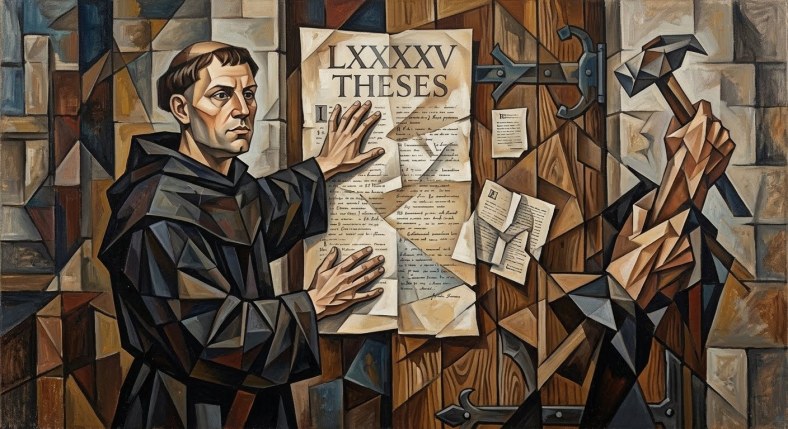
This was the introduction to the 95 Theses which Martin Luther nailed to the door of the Wittenberg University Chapel on Wednesday, October 31, 1517. We sometimes think that nailing the 95 Theses to the door of the church was an act of rebellion, and in retrospect it was powerfully symbolic, but it was actually a normal practice. The church door served as a kind of bulletin board for the academic community. If you wanted to propose a debate, that’s where you posted the notice, along with the propositions you wanted to discuss.
Luther didn’t intend for the 95 Theses to be a manifesto for rebellion. He had no idea that his challenge to the practice of selling indulgences would spark a revolutionary movement that would sweep across Europe leading to enormous changes in religion, politics, education, and everyday life, but once that movement started, he gave himself to it body and soul because he was committed to the truth of the Gospel and the love of Christ.
The truth quite literally set him free from the heavy-handed authority of Rome—the Pope excommunicated him—but the truth also bound him to the proclamation of salvation by God’s grace through faith and to the authority of God’s word in the scriptures.
Out of love for the truth and from a desire to elucidate it…
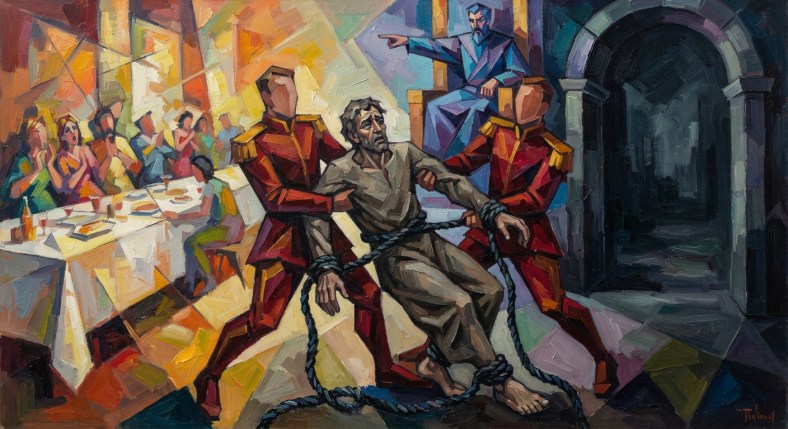
According to the Gospel of John, when Jesus was on trial before Pontius Pilate, Pilate then asked him, “What is truth?”
In some respects that seems like an almost ridiculous question. We know what truth is. We learn about truth almost as soon as we learn to talk. Sadly, that’s also when we learn to lie, because we learn pretty quickly that the truth may reveal things that we would prefer to keep hidden. We learn very early on that sometimes truth has consequences that we would like to avoid, and that those consequences might be unpleasant or even painful.
Truth, the dictionary tells us, is the true or actual state of a matter. Something is true when it conforms with reality. To put it another way, reality determines what is true.
Truth means that my desires or imagination do not have the final word in determining what reality is and what it is not.
There are twenty-seven verses in the gospels that contain the word truth. Twenty-one of those verses are in the Gospel of John where truth is not only a central theme, it is anchored in and identified with the person of Jesus. In John 1:14 we read, “the Word became flesh and lived among us, and we have seen his glory, the glory as of a father’s only son, full of grace and truth.” Three verses later, John puts aside the figurative language of the Word to make it clear who he is talking about: “The law indeed was given through Moses; grace and truth came through Jesus Christ.”
When Jesus sat discussing theology with the Samaritan Woman at Jacob’s Well, he told her that “true worshipers will worship the Father in spirit and truth.” In chapter 14, not long after he has told Thomas that he, himself, is “the way, the truth, and the life,” Jesus refers to the Holy Spirit as “the Spirit of truth” and in chapter 16 he tells his disciples that “when the Spirit of truth comes, he will guide you into all the truth.” In chapter 17, as he prays for the disciples, Jesus asks that they would be sanctified and consecrated in truth.
“For this I was born,” Jesus told Pilate, and for this I came into the world, to testify to the truth. Everyone who belongs to the truth listens to my voice.”
In today’s Gospel reading from chapter 8 of John’s gospel, we see a hint that some of those who were listening to Jesus were unsure about continuing to follow him. Some scholars think that this passage may hint at some tension between Jewish and Gentile believers or between Judean and Galilean followers of Jesus in the community where this gospel was written, and John, the writer, is calling both sides back to the middle ground of the truth they had found in the person and teaching of Jesus.
“Jesus said to the Judeans who had believed in him, ‘If you continue in my word—if you remain faithful to my teachings—then you are truly my disciples. And you will come to know the truth. And the truth will set you free.” When they protested that they were descendants of Abraham and had never been enslaved by anyone—apparently they forgot about their own history with Babylon and Egypt—Jesus went on to make it clear that he was talking about the truth setting them—and us—free from our slavery to sin.
But how does the truth set us free from sin?
Martin Luther defined sin as the state of being curved in on the self. Sin is when I put my preferences, my desires, my ideas, my plans, my goals above and before everyone and everything else. Sin is me, me, me, me, me taken to the extent that it harms or disenfranchises or marginalizes or disempowers or diminishes or neglects you, you, you, you, you. Sin creates a false reality, an illusion centered on my desires, my fears, my imagination—the way I want things to be. And that illusion is seductive and captivating. It ensnares. It enslaves. It makes me believe that I am the center of the universe, that what I think or believe or even just what I want very, very badly to be true is what is real.
Truth disabuses me of that illusion.
Once again: Truth means that my desires or imagination do not have the final word in determining what is reality and what is not.
We are currently struggling through a time when truth is endangered in our culture. There’s nothing new about that. People have always preferred to put their own spin on facts that confront their biases or preconceived ideas. People throughout history have taken refuge in denial when events or outcomes don’t fit the way they wanted things to happen or give them the results they wanted. What’s new is how widespread this devaluation of the truth has become.
When lies and spin become so prevalent that they begin to undermine any common understanding of basic facts, the world becomes a more dangerous place. When people refuse to accept observable facts, when there is no longer the common cultural ground of truth based on fact, then there is no longer a starting point for discussion or compromise. There is no way to move past confrontation and opposed binary positions that divide us. When people lift up conspiracy theories and “alternative facts” as justification for their actions or opinions then we stand on the precipice of political violence.
Sadly, we have seen too many clear examples of that in the last few years. It has become the sin of our society.
Sin convinces me that I stand apart from the rest of humanity. But the truth, the fact, is that I am deeply and intimately connected to the rest of humanity and, in fact, to all of creation. Standing apart is an illusion. Rugged individualism is a destructive myth—destructive because it undermines and negates the relationships that keep us alive in every sense of the word.
“We must all overcome the illusion of separateness,” said Richard Rohr. “It is the primary task of religion to communicate not worthiness but union, to reconnect people to their original identity ‘hidden with Christ in God’ (Colossians 3:3). The Bible calls the state of separateness ‘sin.’ God’s job description is to draw us back into primal and intimate relationship. As 1 John 3:2 reminds us, ‘My dear people, we are already children of God; what we will be in the future has not yet been fully revealed, and all I do know is that we shall be like God.’”
As followers of Jesus, we are called to live in the imitation of Christ. We are called to observe what God is doing all the time and everywhere and then do the same. We are called to be generous because God is generous. We are called to be creative because God is creative. We are called to embrace diversity because God revels in diversity so much that no two things are exactly alike in the entire universe. But above and beyond everything else, we are called to love. Because God loves. God is love. And, as Richard Rohr has said, God does not love us if and when we change. God loves us so that we can change.
That is grace—the grace that makes us whole, the grace that heals us, the grace that reunites us, the grace that saves us.
Claim it. Revel in it. Believe it. Embrace it.
It’s the truth…and it’s the only thing that can set us free.