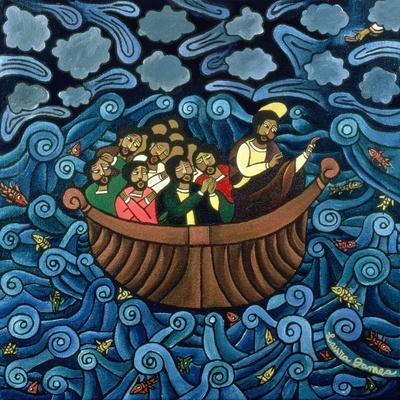
Crossing to the Other Side

Mark 4:35-41

  On that day, when evening had come, he said to them, “Let us go across to the other side.” And leaving the crowd behind, they took him with them in the boat, just as he was. Other boats were with him. A great windstorm arose, and the waves beat into the boat, so that the boat was already being swamped. But he was in the stern, asleep on the cushion; and they woke him up and said to him, “Teacher, do you not care that we are perishing?” He woke up and rebuked the wind, and said to the sea, “Peace! Be still!” Then the wind ceased, and there was a dead calm. He said to them, “Why are you afraid? Have you still no faith?” And they were filled with great awe and said to one another, “Who then is this, that even the wind and the sea obey him?”

It’s been about three years now since the Covid 19 pandemic retreated enough so that we could begin to gather again in church and other public places.  We spent fifteen months secluded in our homes because a kind of life-storm rose up unexpectedly and caught us off guard and unprepared, a storm created by a virus that flew in from the other side of the world.  That storm has mostly receded now, although we are still dealing with occasional waves,  and maybe it’s just me, but even though it has been three years, it still feels like we haven’t really returned to normal, or at least what normal used to be.

In some ways that’s good.  There was a lot about our old “normal” that needed to be improved.  But in other ways, it’s not at all good.  It feels as if we are still locked into a heightened state of anxiety, and since anxiety always wants a target, we seem sometimes to be taking it out on each other, especially in our politics.

We lost a lot during the pandemic.  Social connections were lost or  strained. Some of our common understanding of how society is supposed to work was lost.  The Church, unable to gather in person in our usual places of worship, lost members in a decline that had already been underway but was exacerbated by the enforced restrictions and now shows no signs of slowing or reversing.  And, of course, millions of lives were lost throughout the world.  

Ever since Covid, we have been sailing through choppy waters toward the shore of a new and unknown reality.  It feels to me that we are somewhat like the disciples in the boat after Jesus calmed the storm.  The storm has stopped, but we are still sitting in the middle of the lake in the dark, bailing out our boat.

Today’s Gospel lesson from Mark lifts up some important things for us to think about as we sail toward a future we can’t really see.  And let’s face it, we’re not going to simply sail back into the way things used to be.  Too much was changed in those 15 months of isolation and these three years of recovery.  

In Mark’s telling of this story of the storm on the sea,  Jesus and his disciples set out in the evening, of all things, to sail across the Sea of Galilee.  A great windstorm blew up and the boat was being swamped.  We know it was a serious storm because even the fishermen who were out on this water all the time were frightened. Through all of this, Jesus was soundly asleep on a cushion in the stern of the boat.  Finally, the disciples cried out, “Teacher, do you not care that we are perishing?!?” That’s when Jesus woke up, then got up and rebuked the storm.  The sea became dead calm, and the disciples, dumbfounded by this new dimension of his power and abilities, were left wondering just who Jesus really is.

When we read or hear these stories, these episodes from the life and ministry of Jesus, it’s natural for us to ask ourselves, “Okay, what does that mean for me or for us?”  It’s always good to try to  imagine how the original listeners heard these gospel stories if we’re able, but we also hope there’s something in the story that we can take home with us, some lesson that fits our lives right here and right now.  That’s why we do this little exercise of preaching and teaching with the gospel every week.

With this particular story, it has been far too tempting for far too long to personalize it a little too much.  And I confess I’ve been as guilty as any preacher out there in doing this.  That sermon goes something like this:  “When storms arise in your life, just remember that Jesus is in the boat with you…even if he’s taking a nap at the moment.  He has the power to quiet the storm.  Maybe he’s asking you, ‘Why are you afraid?  Where’s your faith, pal?’  Muster up some courage.  Maybe it’s your turn to stand up and tell whatever  storm is swamping your boat, ‘Peace!  Be still.’”  

I have preached that sermon.

Listen, there are probably worse ways to go with this story.  We’ve all had moments in our lives when we’ve wanted to join the disciples in yelling, “Teacher, don’t you care that we’re perishing?!?”  I know I’ve been there a few times.  But the fact is, there is something greater at stake in this story than a bromide to help us face our fears.  There is something greater at stake here not just for them in their time, but for us in our time.  But to know what that is, we have to range beyond the boundaries of these six verses.

From the very beginning of the Gospel of Mark, Jesus has been announcing that the kingdom of God is imminent.  Actually, imminent is not quite the right word.  The Greek word is engikken.  It’s often translated as “has come near,” but there is an even greater sense of immediacy in the word than that.  Think of it as a train coming into the station.  It’s not all the way into the station yet but the engine has already reached the edge of the platform.  That’s the sense of it.  The kingdom of God’s engine has already reached the platform of our lives.  The train is engikken.  Get ready to board.

Everything Jesus says and does in the Gospel of Mark is said and done to demonstrate the power and presence of this new reality he calls the kingdom of God or, as Diana Butler Bass calls it, the Commonwealth of God’s justice and mercy.  He is not just telling people about this kingdom, he is showing them what it looks like and how it acts.  When Jesus calls the disciples, he is recruiting them to build a new community, a Beloved Community, based on the ideals and principles of “The Way,” which is another name Mark uses for the kingdom of God.  

Another thing to understand about the Gospel of Mark is that everything that happens in this Gospel is heavily weighted with myth and symbolism.  That’s not to say that the events the gospel depicts didn’t happen, but that it is important to pay attention to how Mark is describing and using these events and what kind of language he is using as he tells the story of Jesus.  

We need to ask questions.  What other scriptural connections does Mark make—or expect us to be making?  What apocalyptic expectations and understandings are at  work in the culture of Mark’s time?  What mythic stories are at work in the background as Mark tells the story of Jesus?  What cultural boundaries and expectations are being crossed?  If we don’t catch all these clues, then we might not get the point Mark is trying to make. We’ll get some other point instead.

When we see the disciples and Jesus set off from the shore in a boat in the evening, Mark wants us to be nervous.  We’re supposed to remember that in their mythic understanding the sea is the home of Chaos and Destruction.  Dread, unpredictable, cosmic forces hide in its depths and the only thing that could tame it at creation was the Spirit of God hovering over it.  That they are setting out as night falls with the intention of crossing all the way to the other side—well, if we were Mark’s first readers or listeners we would know they’re heading for trouble.

As the story unfolds, Mark assumes that somewhere in the back of our minds we are maybe remembering Psalm 107: “Some went down into the sea in boats…then they cried to the Lord in their trouble, and he delivered them from their distress; he made the storm be still, and the waves were hushed.” (107:23,39)  When we read that Jesus was asleep on a cushion in the stern of the boat, Mark wants us to remember how Jonah slept as his boat was about to break up in a mighty tempest. (Jonah 1:4, 10).  Mark puts all these things together so that we will understand that this storm that the disciples face out there on the sea of Chaos is not just a metaphor for the troubles of life.  This is a Cosmic storm.  Their boat is being assailed by cosmic forces.  Something wants to stop them.  Some great elemental power wants very much to keep them from getting to the other side of the lake.  But what?  And why?

To understand that, it’s important to understand why Jesus wanted to cross the lake in the first place.  

The Sea of Galilee was also called Lake Gennesaret or Lake Tiberias depending on who was talking about it.  It served as a clear geographic boundary between the territories of Philip and Agrippa in the tetrarchy of Palestine when the Emperor Augustus divided up the region between the sons of Herod the Great, and it continued to serve as a clear social boundary between the Jews of Galilee on the south side and the Hellenized Jews and Gentiles of various nationalities throughout the Decapolis on the north side. 

Why did Jesus want to go to the other side of the lake?  Quite simply because that’s where the gentiles were.  

Jesus was fighting other-ism.  Racism.  He wanted his new beloved community to embrace everyone—Jew, Gentile, people of all nationalities and types, people who had differences in how they worshipped. So he took his mission of proclamation, healing, exorcism and teaching across the sea to invite those “other” people to be part of “the Way.” He also wanted to teach his disciples that in the kingdom of God there simply is no room for such nonsense as racial exclusion or historical segregation or anything like that.  In the kingdom of God no one can call anyone else unclean.  Or unwelcome.  

That storm that rose up against them is symbolic of all the storms that rise up to resist our attempts at opening our hearts and minds to reconciliation and renewal.  It was the elemental malicious something in our world and in the human heart that wants to keep us forever sorted in our caste systems and historic animosities, that force that resists healing and unifying humanity.  And I want you to notice something here:  The words that Jesus spoke to stifle that storm are the words of exorcism.  Most of our translations make those words prettier than they actually are, but they are the same words that Jesus spoke when he cast out the demon in Mark 1:25.  “Peace.  Be still.”  Okay, sure.  But that’s a very mild translation.  The full force of the words in the Greek text is more like “Silence!  Shut up!  I muzzle you!”  

Maybe  this is how we need to speak to racism.  Maybe this is how we need to speak to Jim Crow laws and race-baiting and race-driven gerrymandering.  Maybe this is how we need to speak to racial slurs and jokes and microaggressions and all the derogatory language of bigotry.

Maybe we need to speak this clearly and bluntly to the forces that try to dissuade and discourage us from reaching out to make new bonds of friendship.  Maybe this is how we need to speak to those voices who keep dragging up tradition and history as reasons to preserve symbols of hatred and monuments to violence in public displays.  Maybe this is the plain kind of speech we need to use with those who continue to pursue paths of prejudice that have done nothing but separate us and poison us against each other.  Maybe instead of trying to be reasonable and persuasive against such divisive winds it’s time to simply say, “Stop right there!  I will not listen to hate.  I will not let you keep us from getting to the other shore.  I will not let you stop us from including everyone in the Beloved Community.”

During the pandemic, we had fifteen months of enforced separation, an imposed time to sit apart and consider all the things that are dividing us.  We had fifteen months to witness as more than a million people died from a disease that could have been curtailed much more easily and much more quickly if we had been more unified.  

We had 15 months to watch as unreasonable political forces and conspiracy theory voices assaulted the foundations of our democracy and truth, itself.  We had 15 months to see racial tensions repeatedly exacerbated by hate and violence and lamentable systemic conditioning.  

We had fifteen months to sit apart in our homes and miss each other and think about what it means to be friends, to be church, to be disciples of Jesus, to be people of The Way.  

And now the doors have been open for three years.  The storm has subsided.  We’ve been back together for some time now.  We get to be “us” again.  But there are people “not like us” across the road, across town, across the lake, on the other side of the sea of chaos. And Jesus is still saying, “Let’s go across to the other side.”  

Yes, storms will almost certainly rise up.  The elemental malicious  something will try to stop us.  But Christ is in the boat with us, and Christ has given us the words to silence bigotry.

“Christ sleeps in the deepest selves of all of us,” said Frederick Buechner, “and whatever we do in whatever time we have left, wherever we go, may we in whatever way we can call on him as the fishermen did in their boat to come awake within us and to give us courage, to give us hope, to show us, each one, our way. May he be with us especially when the winds go mad and the waves run wild, as they will for all of us before we’re done, so that even in their midst we may find peace…we may find Christ.”

image © Laura James

Thought Pollution

Matthew 15:21-28

Are there stories or sayings in the Bible that make you uncomfortable?  This story of Jesus and the Canaanite woman has really bothered me for a long time, mostly because at first reading Jesus come off as a bit of a jerk.   

But here’s the thing:  I think this story is supposed to be disturbing.  It’s supposed to bother us.  This story is begging us to do our homework, because we won’t even begin to understand what Jesus is up to here unless we dig into some history and social context.  I’m pretty sure that Jesus was aiming for a particular reaction from his disciples and I think he wants that same reaction from us.  But for us to get to the “aha moment” here, we really need to go back.  Way back.  All the way back to Noah.

But before we set the Wayback Machine for Noah, let’s go back to what happened just before Jesus encountered this bothersome and determined Canaanite woman. 

At the end of the previous chapter, after a stormy night on the lake where Jesus walked on water and Peter tried to, they landed at the little town of Gennesaret.  As always, a crowd gathered and Jesus started teaching.  But before he got very far some Pharisees and scribes started to give him a bad time because his disciples didn’t wash their hands before eating.  So Jesus tells the crowd to gather round then says, “Listen and understand:  it is not what goes into the mouth that defiles a person.  It’s what comes out of the mouth that defiles.”  This offended the Pharisees.  And it probably offended them even more when Jesus called them blind guides of the blind.  

But Peter wanted to hear more about what goes into the mouth versus what comes out.  I really like how Eugene Peterson rendered this bit of dialogue in The Message:

“Peter said, ‘I don’t get it. Put it in plain language.’

“Jesus replied, “You too? Are you being willfully stupid?  Don’t you know that anything that is swallowed works its way through the intestines and is finally defecated?  But what comes out of the mouth gets its start in the heart. It’s from the heart that we vomit up evil arguments, murders, adulteries, fornications, thefts, lies, and cussing.  That’s what pollutes. Eating or not eating certain foods, washing or not washing your hands—that’s neither here nor there.’”

So keep all that in mind—those things that come out of the heart by way of the mouth to pollute life—keep all that in the back of your mind because suddenly the story shifts and in one brief sentence Jesus walks about fifty miles to the region of Tyre and Sidon.

Why?  Why Tyre and Sidon?  Did he just want to put some distance between himself and the Pharisees and scribes?  Why does he suddenly head off for Gentile territory?  Why, of all places, Sidon?

Well to answer that, we go all the way back to Noah.  

After Noah left the ark he planted a vineyard.  He grew some grapes and made some wine.  And then he got drunk and fell asleep naked in his tent.  Like you do.  Noah’s son, Ham, wandered by, noticed that his father was naked, and covered him up which actually seems like a pretty decent thing to do.  But when Noah woke up things got weird. He was furious that Ham saw him in such a state, so he cursed Ham with a curse that would apply to all of his descendants.  

They took cursing very seriously in those days, especially being cursed by your father.  Being cursed was devastating.  It was the opposite pole of blessing.  A blessing could give you a bright vision of your future and a big dose of optimism to help make it come true.  A curse would make your life a living nightmare. It would haunt you and hang over you like a shadow.  

So Ham was cursed.  And so was his son, Canaan.  And so was Canaan’s son, Sidon.  And on down the line.

Sidon, Noah’s grandson, inheritor of the curse, ended up having a lot of sons and grandsons and great-grandsons and so on until Sidon became a great nation.  And because Sidon’s territory butted right up against Israel, and because  the two nations were somewhat less than friendly, the nation of Sidon shows up fairly often in the history and scriptures of Israel.  

In the Book of Judges, the Sidonians conquer and oppress the Israelites.  King Solomon married several Sidonian women who then induced him to worship their goddess, Ashtoreth.  King Ahab married a Sidonian Princess.  You’ve probably heard of her.  Her name was Jezebel and she caused all kinds of trouble, especially when she kept trying to kill the prophet Elijah.  Jeremiah, Ezekiel and Isaiah all predicted judgment and doom for Sidon because of their idolatry.  When the Assyrians and later the Babylonians conquered Israel, they launched their ships from Tyre and their armies from Sidon.  

For devout and even slightly patriotic Jews, the region of Tyre and Sidon was not a friendly place.  In their eyes, the people there were cursed.

So why did Jesus go there?  

Jesus went there to put some distance between himself and the Pharisees and scribes.  Physical distance, cultural distance, and historical distance.  And also to make a point about God’s love and grace.  But we’ll get to that.

They had no sooner arrived than a woman ran up and started screaming at them. The NRSV and other translation say she shouted, which sounds slightly nicer, but the Greek word Matthew uses is ekrazen which has a sense of both screaming and crying.  It’s a very emotional word.  

So this Canaanite woman—Mark specifies that she was Syrophoenician—comes rushing up to them and with tears and wailing pleads with Jesus to free her daughter from a demon that is  tormenting her.  “Have mercy on me, Lord, Son of David; my daughter is tormented by a demon!”  Kyrie eleison. 

And Jesus . . . ignores her.  

So she starts to plead with the disciples and pesters them to do something.  And no matter how they try to put her off, she won’t give up.  Because she’s a Mom.  A good Mom.  So finally they come to Jesus and beg him to intervene. “Send her away!” they said.  “She’s driving us crazy!”  

And this is where Jesus says the first thing that makes him sound like a jerk.  Jesus turns to this desperate woman who is frantic with fear for her demon-assaulted daughter and says, “I was sent only to the lost sheep of Israel.”

What!!???  Jesus! What the…???

But she comes and kneels down in front of him and begs him.  “Lord, help me.”  

And this is where Jesus doubles down and says something truly ugly, something that makes him sound like a complete bigot.  “It’s not right to take the children’s food and throw it to the dogs.”

He calls her a dog.  

And there is no way to translate that that takes away any of the sting and insult.


How does this make any sense at all?  Did Jesus, the same Jesus who was criticized for hanging out with tax collectors and “sinners,” the same Jesus who crossed all kinds of boundaries to embrace all kinds of outcasts, the same Jesus who touched lepers! did this Jesus trek all the way to the heart of Sidon just to insult this poor woman with a racial slur?

Yes.  Yes he did. Jesus schlepped all the way to Sidon to create a teaching moment that his disciple and all his followers forever after would not forget.

In this moment with this desperate woman, Jesus is saying aloud what his disciples are thinking.  He wants them to hear the ugliness of their attitudes out loud.  He has led them to the neighborhood of “those people,” the ones who they think are inferior, the one who they think are cursed.  The ones who, in their understanding, God doesn’t much care for. 

I am not for one moment suggesting that the disciples in particular or Jews in general were xenophobic.  I’m suggesting that almost all of us are to one degree or another.   We humans have a bad tendency to “other” each other.

Jesus wants us to hear what our othering attitudes sound like to someone on the receiving end.  He wants us to hear the ugliness of even our most benign bigotries expressed out loud in the presence of someone who is “not one of us,” not our clan, not our race, not of our culture or religion or denomination or neighborhood. Someone who doesn’t speak our language.  He wants us to hear what overt othering sounds like to someone we are prepared to dislike or disregard or even hate for no reason at all except for a long-nurtured history of othering and mistrust handed down through the generations.  He wants us to hear just how brutal inherited ill will can really be.  He wants us to understand that it has consequences.

It’s not what goes into the mouth that pollutes, it’s what comes out of the mouth. What comes out of the mouth comes from the heart. It’s from the heart that we vomit up evil arguments, murders, adulteries, fornications, thefts, lies, blasphemies, bigotries, othering and racism.  That’s what pollutes us.  That’s what poisons us generation after generation.  

“It’s not right to take the children’s food and throw it to the dogs,” said Jesus.  “Yes Lord, she said, but even the dogs get to eat the scraps that fall from their master’s table.” “Woman, great is your faith!” said Jesus. “Let it be done for you as you wish.” And her daughter was healed instantly.

Such faith.  Such amazing faith to let herself be ignored then insulted and degraded all in the hope of some kind of help for her daughter, all for a scrap from the table of God’s healing love and grace.  All for a lesson that far too many of us still seem all to reluctant to learn.  

What You Do Not Know

John 4:5-42

The story of Jesus meeting the Samaritan woman at Jacob’s Well is one of the most beloved stories in the gospels, and the Samaritan woman, herself has become a treasured figure of faith and devotion in several Christian traditions throughout the world.  In the Eastern Orthodox Churches, she is called Saint Photine or Photini, and is regarded as equal to the apostles.  Their tradition says that after her meeting with Jesus she continued to make disciples for Jesus and was eventually martyred at Carthage.  The Roman Catholic Church calls her Saint Photina and asserts that she was martyred at Rome after convincing Emperor Nero’s daughter to become a follower of Jesus.  In the Russian and Ukrainian Orthodox traditions, she is called Svetlana, which means “shining one” or “luminescent one.”  In Oaxaca and other parts of Mexico she is called La Samaratina, and on her feast day, which they celebrate on the fourth Sunday in Lent, churches, schools and businesses give sweet fruit drinks or sweetly flavored water to people passing by on the street in memory of the drink of water she gave to Jesus and the living water he became for her.

As beloved as this story is, though, it begins with something of a mystery:  Why did Jesus suddenly decide to leave the Judean countryside to return to Galilee?  And why did he go through Samaria?

At the beginning of chapter four we read that when Jesus learned that the Pharisees had heard that he was attracting and baptizing more disciples than John the Baptist, Jesus suddenly decided to leave Judea and return to Galilee.  You get the sense that he is worried that he and his disciples are suddenly a little too prominent on the Pharisees’ radar.  Some think that this was about the time when Herod had had John the Baptist arrested—the Gospel of John isn’t clear about that—and Jesus may have thought he would be next.  For whatever reason, Jesus decided rather abruptly to withdraw to his home base in Galilee.  

“He left Judea and started back to Galilee.  But he had to go through Samaria.”  That’s how it reads in the NRSV.  There is an implication in the Greek text that for some reason it was necessary for him to go through Samaria, that something compelled him to go that way.  It adds to the feeling that he was under some kind of pressure, but we’re not told what that was.  

Going through Samaria was the shortest and most direct route to Galilee from Judea, but most Jews avoided taking that road if at all possible, preferring instead to take the long way around Samaria through Perea, the region that’s often referred to in the gospels as “beyond the Jordan.”  

Perea was a Jewish territory with a fairly significant Roman presence.  The road through Perea was heavily patrolled and more travelled, so even though it was a much longer route, it was usually considered a safer way to go.  But the primary advantage of this route for most Jews was that you did not have to go through Samaria.  Instead, you skirted along the eastern side of it.  Which was good.  Because no decent Jew wanted to go through Samaria or deal with Samaritans if it was at all possible to avoid it. 

Jews hated Samaritans.  And Samaritans hated Jews.  Their feud had been going on for more than 900 years when Jesus decided to take the Samaritan road to Galilee.  It had all started with the death of King Solomon.   Jeroboam led the northern territories of Israel in a revolt against Solomon’s son, Rehoboam.  The end result of the brief civil war was that the kingdom which had been united under David and Solomon became two kingdoms: Israel in the north and Judah in the south.  

Two hundred years later, the Assyrians attacked Israel and Judah refused to come their aid.  The Assyrians quickly conquered the northern kingdom and renamed it Samaria after the region’s capital city.  The Assyrians took many of the Israelites into captivity, divided them into small groups, then exported them to resettle other conquered areas.  At the same time, they brought in conquered peoples from Babylon, Cuthah, Ava, Hamath, and Sepharvaim to resettle the territory of Israel. That is why the Jews of Judah sometimes called Samaritans “the people with 5 fathers.”  It was a kind of racial slur.  You can read all about it in 2 Kings 17.

Two centuries and two empires later, when the Jews returned from captivity in Babylon under the leadership of Ezra and Nehemiah in 538 BCE, the Samaritans were ready to welcome them back, but the Jews despised the Samaritans for their lack of ethnic purity.  Remember that racial slur about the 5 fathers?  

The Samaritans offered to help rebuild the Jerusalem temple, but the Judean leaders rejected their help because they weren’t “pure” enough.  You can read about that in Ezra 4.  That rejection turned a potential reunification into bitter political opposition and outright hostility.  As a response to the rejection of their help in building the Jerusalem temple, Sanballat, the Persian-appointed governor of Samaria, decided to build a temple on Mt. Gerizim.  And that’s when the rift between the Jews and the Samaritans became the unbridgeable Grand Canyon of feuds.  

When Alexander the Great conquered all of Palestine, relations  between Jews and Samaritans continued to deteriorate.  The Samaritans tended to cooperate with their Greek overlords while the Jews tended to resist them.  Then in 108 BCE, when the Jews had finally won their independence in the Maccabean revolt, John Hyrcanus, the high priest and new ruler of the Jews, destroyed the Samaritan temple on Mt. Gerizim and ravaged Samaria as a punishment for having allied themselves with the Seleucid Greek rulers.  

The Jews and Samaritans were not just separated by politics and racism, though, but also by religion, even though they both claimed to worship YHWH.  The Jews of Judah continued to insist that sacrifices could only be offered in the temple in Jerusalem.  The Samaritans had never really accepted that idea even in the time of Solomon.  During their history they had had altars at Shechem, Bethel, Shiloh and other places but they regarded Mt. Gerizim as the holiest site.  The Samaritans had their own version of Torah that differed in several places from the Jews’ version.  The Samaritans had their own version of Messiah, whom they call the Taheb, the restorer, a prophet who will carry the staff of Moses as a sign of his authority.   They believed that the Taheb will come from the tribe of Joseph.  The Jews, on the other hand, believed that Messiah would come from the tribe of Benjamin and the line of David.

Even under the iron fist and enforced peace of the Romans, the animosity between Jews and Samaritans continued.  As an example of revenge being served cold, around the time of the birth of Jesus, a band of Samaritans profaned the Jerusalem temple by scattering human bones across the floor of the sanctuary.  

All of that history and animosity is in the background when Jesus sits down at Jacob’s well in the middle of a hot afternoon.

When Jesus asks the Samaritan woman for a drink of water at Jacob’s Well he is crossing just about every line imaginable in their world, lines of sexism, racism, political hostility and historical animosity.  That’s why she responds to him with some surprise and asks, “How can you—a Jew—ask me, a Samaritan woman for water to drink?”  The NRSV then adds in parentheses, “For Jews have nothing in common with Samaritans.”  That translation is a monument to understatement.  The translation by Eugene Peterson in The Message may not be as accurate, but it captures the feeling a lot better when it says, “Jews in those days wouldn’t be caught dead talking to Samaritans.”

Jews wouldn’t be caught dead talking to Samaritans, and Samaritans would be caught dead talking to Jews.  Men wouldn’t be caught dead talking to unaccompanied women, and an unaccompanied woman wouldn’t be caught dead talking to a man.  But there they are, both of them crossing the lines.  And talking to each other.

“If you knew the generosity of God and who I am,” said Jesus, “you would be asking me for a drink, and I would give you living water.”  It sounds almost like flirting.

“Okay, Mister,” she says, playing along, “but this well is deep and you don’t have a bucket, so where does this ‘living water’ come from?  Are you better than our ancestor, Jacob, who dug this well and drank from it and watered his cattle from and handed it down to us?” 

“Everyone who drinks this water will be thirsty again,” said Jesus.  “Anyone who drinks the water I give will never thirst again. The water I give will be a spring within, a gushing fountain of endless life.”

Blaise Pascal said that there is a God-shaped hole in every human heart, an emptiness that only God can fill, a thirst that only the Spirit can quench.  Whether we know how to name it or not, there is a yearning for the living water of Christ in the arid wells of our souls, a cistern waiting to be filled by the love and life of God.

Jesus and Photina talked some more about her living situation.  Jesus knew all about her and told her the facts of her life but he didn’t judge her.  He just continued to talk with her and in the midst of their conversation she realized that he was a prophet.  So she asked him the big question, the question that had separated Jews from Samaritans for hundreds of years.

“I see you’re a prophet!” she said.  “So tell me this: Our ancestors worshiped God at this mountain, but you Jews insist that Jerusalem is the only place for worship, right?”

“Believe me, woman,” said Jesus, “the time is coming when that won’t matter.  You will worship the Father neither here at this mountain nor there in Jerusalem.  You Samaritans worship what you do not know; we worship what we do know, because salvation is from the Jews.  But the time is coming—it has already come—when genuine worshipers will worship the Father in spirit and in truth.  That’s the kind of people the God is seeking.  God is spirit, and those who worship God must worship in spirit and in truth.”

I think of Jesus saying this every time I hear someone say they’re “spiritual but not religious.”  You worship what you do not know, we worship what we know.  What matters in the end is that we are connecting with God and with each other in spirit and pursuing truth.  

When the disciples came back they were shocked to see him talking to this Samaritan woman because he was crossing all the lines and breaking all the rules.  For her part, the woman ran back to her village and invited all her neighbors to come hear Jesus and talk with him.  She wanted them to meet the prophet who knew everything about her but didn’t judge her, the man who was willing to cross all the lines and break all the rules for a conversation, the man told her that God doesn’t care which mountain you’re praying on as long as you’re putting your true heart and your true spirit into your prayer.

It’s easy to fall into the rhythms of old beliefs and assumptions.  It’s easy to get stuck in old, unexamined patterns of hatred and antagonism.  In our world today we have all kinds of ways to separate ourselves from each other.  We have no shortage of isms that draw hard lines and build daunting barriers between us.  We have religious commitments that keep us looking at each other with suspicion.  We have all kinds of political commitments that keep us glaring at each other as opponents.  But in the end, the only way we’re ever going to move forward is to cross all the lines and have a conversation.  That’s the only way we’re ever going to get anywhere.

Jesus took the road through Samaria.  He walked right past the old wounds of politics and racism and religious separatism and sexism to sit down beside an ancient well where he and the Samaritan woman could drink deeply from the sweet water of respect and conversation. 

And the end of the story is the best part. At the end of the story, the Samaritans of that village, the ancient enemies of his people, asked him to stay so they could talk some more.  In spirit.  And truth.

Familiarity Blindness

Luke 10:25-37

Note: This sermon was preached in 2 parts which are combined here.

Have you ever experienced familiarity blindness?   A lot of us develop familiarity blindness with one thing or another—that condition where you know something so well that you actually stop seeing it.  The upshot of it is that the next time you do take a hard look at that familiar whatever it is, you see all kinds of things that you hadn’t noticed before.  

In my office at home I have a black and white photograph, a portrait of my grandparents—my mother’s mom and dad.  That picture was taken the year I was born, so I’ve been seeing it my entire life.  My grandmother, the woman in that picture, died nine days after my first birthday, so a lot of my impression of her came from that photograph.  As a kid, I always thought she must have been kind of stern and austere—that was how the picture struck me.  But the other day, I took a moment to look at it again from a slightly different angle, and I realized that she is  actually smiling ever so slightly, and her eyes look very loving, gentle and understanding.  Now that I was really looking at her picture, I also realized that there was something strikingly familiar about her eyes, and then it suddenly dawned on me that I was seeing my mother’s eyes in this picture of her mother.  That smile, those gentle eyes had always been there in the photograph, but I hadn’t seen them because of familiarity blindness.

I think it’s fair to say that many of us have a kind of familiarity blindness with the parables of Jesus in general and this one in particular, and I shared with you last week how Dr. Amy-Jill Levine’s amazing book, Short Stories by Jesus, helped me see this familiar story in a new way.

We talked last week about the lawyer who tries to trap Jesus into saying something that can be used against him.  We talked about his trick question about inheriting eternal life and how Jesus turned the tables with a trick question of his own but amplified it with an even more important question when he asked, “What is written in the Law?  How do you read it?” 

That first question, “what is written in the Law,” was a red herring.  Torah, the Law, doesn’t say anything at all about eternal life.  The Law of Moses isn’t interested in life after death but it is vitally concerned with how we live here and now.  The really important question is the second one Jesus asks the lawyer: How do you read it?   That question is just as important for us today as it was then.  Maybe even more so.

The lawyer responded to Jesus by quoting a mashup of the Shema from Deuteronomy and the Golden Commandment from Leviticus: “You shall love the Lord your God with all your heart, and with all your soul, and with all your strength, and with all your mind; and your neighbor as yourself.”  “That’s correct,” said Jesus, “Do that and you will live.”

The bottom line is love.  Love God, and love your neighbor as you love yourself.  Do that and you will live.  Love is the key to an abundant life.

It sounds simple.  The problem, though, is that this commandment to love is all inclusive, and there are some people we really don’t want to love.

I think the lawyer in this story is honest enough to realize that about himself.  He knows there are some people—you know, “those people”—that he will never love, and he suspects that this is true for everyone standing there listening to Jesus.  Luke says he wanted to justify himself.  He wanted to make himself look right in the eyes of all those listening.  But he also wanted to maybe find a loophole.  Surely Jesus can’t mean that he has to love everybody, because, you know, there are some people—those people—who have clearly demonstrated that they are not on our side.  Are we supposed to love them?  

So he asks another question:  “And who is my neighbor?”

In the context of law, the question about who is a neighbor has legal merit.  After all, good fences make good neighbors.  But in the context of love it’s irrelevant.  

So Jesus redirects with a story.

A man travelling on the road from Jerusalem down to Jericho is violently assaulted by robbers.  They don’t just rob him, they strip him and beat him so badly that he’s half dead.  So there he is half dead at the side of the road.  A priest happens by and does nothing to help the poor victim who is lying there bleeding.  He passes by on the other side of the road.  He gives the wounded man a wide berth.  Next a Levite comes by.  He also passes by on the other side of the road and does nothing to help the wounded stranger.

At this point, those listening to Jesus tell this story are shocked and the lawyer has to be wondering where this is going.  For them, it’s unthinkable that a priest and a Levite would pass by without helping.  The Law is very clear on this.  They are required them to help!  That would be their duty and it would take precedence over any other duty or obligation.  Even if the wounded man turned out to be dead, they had a responsibility to care for his body.  

The people listening to Jesus would have been shocked.  But they are about to be utterly scandalized.  Because the hero of the story turns out to be a Samaritan.  

It’s hard for us to imagine how much the Jews hated the Samaritans.  And vice versa.  There antagonism between these two peoples went back centuries and was all the more intense because they were so closely related.  

We traditionally call this parable the story of the Good Samaritan, but in the minds of those who were listening to Jesus, the words “good” and “Samaritan” would never go together.  It was an oxymoron.  Samaritans were the enemy.   The people listening to Jesus as he tells this story might have thought, “If I were the man in the ditch, I would rather die than admit that I was saved by a Samaritan.”  In their minds, Samaritans were something less than fully human.  

So how did things get to be that way between the Jews and the Samaritans?  Well, centuries before Jesus, in the time of Jacob, Samaria was called Shechem, and it was a Prince of Shechem who raped Jacob’s daughter, Dinah.  In the time of the Judges, the false judge Abimelech, who murdered all his rivals, came from Shechem.  For a time, Shechem became part of the united kingdom of Israel under David and Solomon, but after Solomon died, the Northern Kindom of Israel—which had been Shechem—broke away and a kind of low-grade civil war broke out that continued for generations.  When the Assyrians conquered the Northern Kingdom which was now called both Israel and Ephraim, they brought in people from other conquered kingdoms to resettle and then renamed the land Samaria after the capital city.  That’s also when the people of Judah began to refer to Samaritans with a kind of racial slur,  calling them “the people with 5 fathers.”  But the thing that the people of Judah found absolutely unforgiveable forever and ever amen, was that when they returned to Jerusalem after their time of captivity in Babylon, Sanballat, the governor of Samaria, joined forces with other people in the region and attacked them to try to stop them from  rebuilding the city wall and the temple.

For their part, the Samaritans called themselves the Shamerim, meaning “guardians” or “observers” of the Law.  They had built their own temple on Mt. Gerizim and they had their own version of Torah, which they insisted was the “true” version.  They believed that only Torah—their Torah, of course—contained the word of God and they did not include the writings and the prophets among the books they regarded as holy.

For Jews, Samaritans were the ultimate “other.”  For Jesus to cast the Samaritan as the benevolent hero was almost beyond belief.  It would be like an ultra-orthodox Jew being saved by a Hamas Palestinian.  To bring it closer to home, it would be like someone wearing a Black Lives Matter shirt being saved by someone wearing the Confederate stars and bars and a red MAGA baseball cap.  

Who would it be for you?  Who is that ultimate “other” who, in your mind, only just barely qualifies as a real person?  Who is it who, in your mind, seems to be so radically different from you that there’s really no point in even talking to them?  Or maybe there’s someone who sees you that way.  How would you feel if it was one of those people who pulled you out of the ditch?

The lawyer had asked Jesus, “Who is my neighbor?”  Jesus reframed his question.  Jesus wants us to understand that the question is not “who” merits my love or even “from whom” should I expect love.  As Amy-Jill Levine wrote, “The issue for Jesus is not the ‘who,’ but the ‘what,’ not the identity but the action.”  Love—loving God, loving your neighbor, loving yourself—is revealed in action.  Love does not exist in the abstract; it must be enacted.

The Priest and the Levite did not act in love even though their law and duty commanded that they should.  In his sermon on this parable shortly before he was assassinated, Martin Luther King, Jr. had an explanation for why they did not help:  “I’m going to tell you what my imagination tells me.  It’s possible these men were afraid… And so the first question that the priest and the Levite asked was, ‘If I stop to help this man, what will happen to me?’ … But then the Good Samaritan came by, and he reversed the question:  ‘If I do not stop to help this man, what will happen to him?”

The Samaritan gave first aid to the man at the side of the road.  He put him on his donkey and took him to the nearest inn where he could receive more help.  He paid the innkeeper two days wages to take care of the wounded man and then gave him a promise that amounted to a blank check.  “Take care of him,” he said, “and when I come back, I will repay you whatever you spend.”

“Which of these three,” Jesus asked the lawyer, “was a neighbor to the man who fell into the hands of the robbers?”  The lawyer couldn’t even bring himself to say, ‘the Samaritan.’  I imagine there was a long pause before the lawyer finally said, “The one who showed him mercy.”

Mercy.  It’s an important detail here at the end of the parable,  a well-chosen word.  In both Greek and Hebrew, the word we translate as mercy can also mean “kindness.”  It is also a covenant word in Hebrew.  It signifies a shared bond of common humanity in the eyes of and under the Law of God.  It is an acknowledgement that we “are of the same kind.”  The Samaritan showed mercy.  Kindness, a word that takes us back to the prophet Micah:  “God has told you, O Mortal, what is good.  And what does the Lord require of you but to do justice, and to love kindness…mercy…kindness, and to walk humbly with your God.”

“Go and do likewise,” said Jesus to the lawyer.  And to us. 

In our country today, we find ourselves living in a culture scarred by cycles of division, antagonism, conflict, and even violence.  In this parable, Jesus is telling us that these spirals of perpetual antagonism can be broken with kindness.  The question that Jesus wants us to wrestle with is this: Can we learn to treat even our enemies, the “Samaritans” in our lives, in ways that acknowledge their humanity?  Can we dare to see them in ways that acknowledge their potential to do good?  Can we can bind the wounds of those “others” and dare to imagine that they would do the same for us?    

When we encounter each other on the road full of bandits and other dangers, will we be blinded to each other by our familiar stereotypes, or will we step outside of the roles we’ve cast for each other to show kindness and be the good neighbor?  

Shock Treatment

Mark 7:24-30

Wendy Kelly is the owner of a thriving Human Resources consulting firm, Kelly’s HR Services in West Palm Beach, Florida.  She has helped hundreds of people find meaningful employment, a job she does with special sensitivity because she vividly remembers her own experience the first time she applied for a “real” job.   

She was responding to an ad for a receptionist in a medical practice.  She arrived early and sat in the waiting room with the other applicants, mostly young Black women, who were waiting to be interviewed.  Wendy remembers listening as the hiring manager, one of the doctors in the practice, called the candidates in one-by-one for their interviews:  Keisha,  La Quitta, Otishia, Tishia.  Wendy watched as one after another the women went in for what was, at most, a five minute interview with the doctor.

Finally the doctor called her name. “Wendy Kelly.”  Then he added,  “Finally a person whose name I can pronounce.”  Then as Wendy approached, he looked at her in surprise and said, “I thought you were white.”  He didn’t take her resume and simply laid her application on the stack with all the others on his desk.   He asked her a few perfunctory questions, but it really wasn’t much of an interview.  She could tell that he wanted to cut it short and move on.  Wendy left with mixed emotions.  She still wanted the job.  But would she be able to work for someone who, she had realized, was a racist?

Fast forward a number of years.  Wendy was working as a Senior Manager in a well-known management company.  She had been asking for a raise for about a year but her raise kept being postponed even though she was handling some of the company’s most important clients.  One day a new woman was hired to work on Wendy’s team.  Even though this new worker would report directly to her, Wendy had not had any say in her hiring.  

When the new woman had been there about a week, one of Wendy’s co-workers on another team asked her, “Did you see what they’re paying Sonia?”  Wendy was shocked to discover that Sonia, this new person who reported to her, was being paid $11,000 more than she was.  Naturally, she was furious.  She headed straight for her manager to tell him what she had learned and to demand that something be done.   “Wendy, I am sorry,” he said.  “I have been trying to get you a raise, but it is being shot down. This is wrong.”  When Wendy asked him, “Is this because I’m black?” he had no response.[1]

Racism takes many forms, and it’s not always as blatant as Klansmen marching in the streets or redlining of neighborhoods.  Racism has insinuated itself into our culture in ways we don’t even see.  But we need to see it.  If we’re going to change it, we need to face it.  “Not everything that is faced can be changed,” said James Baldwin, “but nothing can be changed until it is faced.”   

Racism isn’t going to disappear until we have named it in all its names and unraveled it from all the ways it has woven itself into the fabric of our lives.  Racism isn’t going to stop being a blight on our  present and a shadow over our future until we acknowledge and confront its shameful past.  Racism isn’t going to disappear until we learn to silence all the voices it speaks with, especially the racist voices and ideas that live inside us, that keep popping into our heads even against our will because we grew up in a racist world and a racist culture.  “Ours is not the struggle of one day, one week, or one year,” said John Lewis.  “Ours is not the struggle of one judicial appointment or presidential term. Ours is the struggle of a lifetime, or maybe even many lifetimes, and each one of us in every generation must do our part.”

Racism, bigotry, prejudice—whatever you want to call it—is an insidious and foul fact of life.  We’re far too familiar with it here in America, but it raises its ugly head in one form or another in every human society.  

Every group of humans seems to have a culturally built-in opinion that some other group of humans is somehow inferior or dangerous or maybe even not really human.  

Bigotry has played an enormous role in history.  It has negatively impacted politics, economics, and even religion. “At the heart of racism,” wrote Friedrich Otto Hertz, “is the religious assertion that God made a creative mistake when He brought some people into being.”

Even Jesus seems to have been tainted with a hint of bigotry.  At least at first glance.  When a Syrophoenician woman in Tyre came to him begging for help, asking him to free her daughter from an unclean spirit that was tormenting her,  Jesus replied, “Let the children be fed first, for it is not fair to take the children’s food and throw it to the dogs.”  

His response was perfectly in keeping with the attitudes of his culture.  That’s how Jews thought about Gentiles.  The Babylonian Talmud states, “As the sacred food was intended for men, but not for the dogs, the Torah was intended to be given to the Chosen People, but not to the Gentiles.”[2]

“Let the children be fed first, for it is not fair to take the children’s food and throw it to the dogs.”  It’s shocking to hear that kind of bigotry coming from Jesus.  And I would like to suggest that that is exactly why he said it. 

In the Gospel of Mark, Jesus begins his ministry by announcing that the Reign of God is arriving.  He then embodies that ministry by healing people, freeing them from demonic or other spiritual oppression, and gathering a diverse community of followers to teach them what Mark calls The Way.  He includes outcasts, like tax collectors and “sinners” in that community.  And then, to make it clear that this Beloved Community, this Companionship of the Way, is for all people, he starts repeatedly taking his disciples across the Sea of Galilee to the other side, to where the Gentiles are so he can proclaim the reign of God to them, too, and bring God’s healing to them, too, and invite them as well to join in the Companionship of the Way.  

Shortly before this episode in Tyre, deep in the heart of Phoenician Gentile territory—shortly before he said that shocking, bigoted thing to this woman, he had fed a multitude including Gentiles.  In Gentile territory.  He gave bread to the Gentiles—the bread of his teaching, the bread of healing, and real bread to feed their physical hunger.  To use the ugly language of their cultural bigotry, he had already thrown bread to the dogs.

He had made it clear in every way he could that Gentiles are included in the Beloved Community, the Companionship of the Way. He had made it clear that the Reign of God embraces everyone.  Period.

When Jesus says this ugly thing, when he for all intents and purposes calls this woman and her daughter dogs—and okay, the word in the Greek means “little dogs,” puppies—but is that really any better?—when he calls them dogs, he’s really just voicing what his disciples are thinking.  Because that’s what their culture has taught them to think about Gentiles—these other people from this other culture, these non-Jews.  

I think he wants them to hear how ugly, how ungodly that kind of thinking is, how dehumanizing those words are.   I think he knows that they will be taken aback to hear him say such a thing because it’s exactly the kind of thing he would not usually say.

Sometimes we have to hear our own less than loving thoughts and ideas come out of someone else’s mouth before we can really hear how offensive, destructive or poisonous they might be.  Sometimes we have to be shocked by hearing our own bigotry coming from someone else.  And it’s especially powerful and shocking if it’s not consistent with what that other person would usually say.  

Jesus said an ugly, bigoted thing that day in Tyre.  I don’t think he wants us to excuse it or minimize it or explain it away.  I think he wants us to hear it in all its ugliness.  I think he wants to shock us into listening more closely to hateful, offensive and divisive words and ideas that have been culturally implanted in our own thoughts…that even, sometimes, come out of our own mouths.  I think he wants to shock us into doing the long, hard work of completely and utterly rooting out racism starting with our own hearts and minds.  Even if it takes lifetimes.  


[1] Is This Because I’m Black?,  Wendy Kelley, TLNT Online Journal, August 5, 2020

[2] Mark; The Augsburg Commentary, Donald Juel; p. 108

Image by UK artist Michael Cook