To Open Our Eyes

A Sermon for the 4th Sunday in Lent – March 22, 2020

John 9:1-41

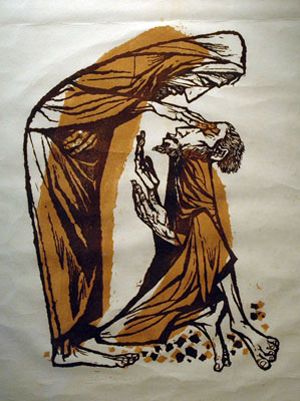
Today’s gospel text is another long one from the Gospel of John—John 9:1-41.  It’s the story of Jesus healing a man born blind and the reaction that the Pharisees have to that healing.  Like last week, with the story of Jesus meeting the Samaritan woman at the well, rather than read the text then give you a sermon,  I think it will be a better use of our time together to take the text in pieces with commentary in between.

So first, a bit of background about the Gospel of John.  John’s gospel is layered with symbolism and themes that repeat.  One of those themes is light.  We see this theme played out sometimes in subtle ways.  Nicodemus comes to Jesus by night, in darkness.  He’s afraid of being seen by his fellow Pharisees.  Also, even though he is a religious teacher, he’s not very quick to pick up what Jesus is trying to teach.  He’s in the dark.  In contrast to Nicodemus, the Samaritan woman at the well meets Jesus in the broad light of day.  She’s open and honest in her conversation.  She doesn’t care who sees her talking with him.  She is quick to discern that there is something unique about him and quick to invite others to “come and see.”

Light is also used in John specifically to describe Jesus as the light of creation, the light of the cosmos, the light of the world.   For instance in John 1 in that beautiful, poetic prologue we read:

John 1.4

In him was life, and the life was the light of all people.  5 The light shines in the darkness, and the darkness did not overcome it.  [Another way to translate did not overcome it is has not understood it.]

Time and again in the Gospel of John religious leaders and authorities fail to understand Jesus.  They’re standing in the presence of the light but they’re in the dark.

As the light of the world, Jesus does two things.  First, he shines as the light of judgment.  He, himself, becomes the standard that separates good from evil.

John 3.19

And this is the judgment, that the light has come into the world, and people loved darkness rather than light because their deeds were evil.  20 For all who do evil hate the light and do not come to the light, so that their deeds may not be exposed.  21 But those who do what is true come to the light, so that it may be clearly seen that their deeds have been done in God.”

The second thing Jesus does as the light of the world is that he enables those who believe in him and who receive the Holy Spirit to seeSeeing is another theme in John’s gospel, and it’s only natural that it is so directly tied to Jesus as the light.  But seeing as it is used in this gospel is not merely seeing as we do in everyday life, but seeing with a deeper insight and, more specifically, seeing the Reign or Sovereignty of God not just as a future promise, but as a present reality when Christ is present.  To put it another way, when Jesus, the light of the world is with us, the Kingdom of God is with us, and we can see it!  It’s happening now!  But to see it and experience it, you need the presence of Christ and the presence of the Spirit which make you a new creation.  As Jesus said to Nicodemus in John 3:3,

 “Very truly, I tell you, no one can see the kingdom of God without being born from above.”

And then there is yet another way that seeing is used in this gospel, and that is to see others as Jesus sees them.  Jesus sees and notices things and persons that others overlook or he sees them before others see them.  And that is where today’s gospel begins.  John, chapter 9, verse 1:

As he walked along, he saw a man blind from birth. 

It’s Jesus that sees him first.  And this is a man who is probably accustomed to being overlooked.  He was a beggar.  He was used to being ignored.  But Jesus notices him.  And because Jesus notices him, the disciples notice him, too.

2 His disciples asked him, “Rabbi, who sinned, this man or his parents, that he was born blind?”

Isn’t it interesting that for the disciples this man becomes not as person in need of assistance or even a person to simply get to know, but a fulcrum for theological debate.  And isn’t it so very human to want to fix blame for things like this?  Who sinned?  Why did this happen?  Who’s to blame?  What went wrong?  Clearly, in their thinking, he’s being punished by God, so why?

I’ve done a little, not retranslating, exactly, but I’ve changed the punctuation in the next part because there is no punctuation in the Greek text.  The NRSV reads 3 Jesus answered, “Neither this man nor his parents sinned; he was born blind so that God’s works might be revealed in him.  4 We must work the works of him who sent me while it is day; night is coming when no one can work.  5 As long as I am in the world, I am the light of the world.” The words “he was born blind” are not in the Greek, so I’m not sure why the NRSV translators put them in there.  And the implication of that translation is that God arranged for the man the man to be born blind so that Jesus could come along years later and fix him. But if you take out that phrase that’s not in the Greek and change the punctuation it reads very differently.

John 9:3-5  Jesus answered, “Neither this man nor his parents sinned.  But in order that the works of God might be revealed in him, we must work the works of him who sent me while it is day.  Night is coming when no one can work.  As long as I am in the world, I am the light of the world.”

Do you hear the difference?  Jesus is saying, “Nobody sinned.  He’s not being punished.  His parents aren’t being punished.  Stuff happens.  Let’s stop wasting time with that nonsense and let’s get on with the work God sent us to do while we have time to do it!  Daylight’s a wastin’!  Night is coming!  I’m here.  I’m the light of the world.  Let’s get rid of this little bit of darkness.”

6 When he had said this, he spat on the ground and made mud with the saliva and spread the mud on the man’s eyes,  7 saying to him, “Go, wash in the pool of Siloam” (which means Sent). Then he went and washed and came back able to see. 

So the man was healed.  His eyes were opened and he could see.  That was his physical healing.  But can you imagine how much his spirit, his heart, his soul were healed when he heard Jesus say, “Neither this man nor his parents sinned.”  Can you imagine what it meant to him to hear those words?

8 The neighbors and those who had seen him before as a beggar began to ask, “Is this not the man who used to sit and beg?”  9 Some were saying, “It is he.” Others were saying, “No, but it is someone like him.” He kept saying, “I am the man.”  10 But they kept asking him, “Then how were your eyes opened?”  11 He answered, “The man called Jesus made mud, spread it on my eyes, and said to me, ‘Go to Siloam and wash.’ Then I went and washed and received my sight.”  12 They said to him, “Where is he?” He said, “I do not know.”

 13  They brought to the Pharisees the man who had formerly been blind.  14 Now it was a sabbath day when Jesus made the mud and opened his eyes.  15 Then the Pharisees also began to ask him how he had received his sight. He said to them, “He put mud on my eyes. Then I washed, and now I see.”  16 Some of the Pharisees said, “This man is not from God, for he does not observe the sabbath.” But others said, “How can a man who is a sinner perform such signs?” And they were divided.  17 So they said again to the blind man, “What do you say about him? It was your eyes he opened.” He said, “He is a prophet.”

Now here’s the thing.  It’s not really a violation of the Sabbath laws to heal someone on the Sabbath even though Jesus repeatedly gets in hot water for doing so.  It just feels like work the Pharisees, so they don’t like it.  But in this particular instance they have something of a case.  A little bit of one, because Jesus made a paste of mud, and that looks like kneading, as in kneading dough. And that, according to the Mishnah Shabbat is one of the 39 tasks forbidden on the Sabbath.

18  The Jews did not believe that he had been blind and had received his sight until they called the parents of the man who had received his sight 19 and asked them, “Is this your son, who you say was born blind? How then does he now see?”  20 His parents answered, “We know that this is our son, and that he was born blind;  21 but we do not know how it is that now he sees, nor do we know who opened his eyes. Ask him; he is of age. He will speak for himself.”  22 His parents said this because they were afraid of the Jews; for the Jews had already agreed that anyone who confessed Jesus to be the Messiah would be put out of the synagogue.  23 Therefore his parents said, “He is of age; ask him.”

Isn’t it interesting what fear and anxiety does to people.  Here are these parents who have seen their son healed, their son who has been blind his whole life, but they’re not celebrating.  They’re not looking for Jesus so they can thank him.  They’re nervous.  They don’t want their status changed.  They don’t want their lives changed.  They don’t want to be put out of the synagogue.  They don’t want to be noticed.  They don’t want to be seen.

24  So for the second time they called the man who had been blind, and they said to him, “Give glory to God! We know that this man is a sinner.”  25 He answered, “I do not know whether he is a sinner. One thing I do know, that though I was blind, now I see.”  26 They said to him, “What did he do to you? How did he open your eyes?”  27 He answered them, “I have told you already, and you would not listen. Why do you want to hear it again? Do you also want to become his disciples?”  28 Then they reviled him, saying, “You are his disciple, but we are disciples of Moses.  29 We know that God has spoken to Moses, but as for this man, we do not know where he comes from.”  30 The man answered, “Here is an astonishing thing! You do not know where he comes from, and yet he opened my eyes.  31 We know that God does not listen to sinners, but he does listen to one who worships him and obeys his will.  32 Never since the world began has it been heard that anyone opened the eyes of a person born blind.  33 If this man were not from God, he could do nothing.”  34 They answered him, “You were born entirely in sins, and are you trying to teach us?” And they drove him out.

I love how the Formerly Blind Man answers the Pharisees.  Sometimes we think we have to figure out everything about God and what God is doing and be able to answer all the hard questions.  He doesn’t fall into that trap.  And he doesn’t let them control the dialogue.  He just tells them what he does know.  And I like to think that when he says, “Do you also want to become his disciples?” he is asking the question in earnest—an invitation to grace in the face of hostility.

35  Jesus heard that they had driven him out, and when he found him, he said, “Do you believe in the Son of Man?”  36 He answered, “And who is he, sir? Tell me, so that I may believe in him.”  37 Jesus said to him, “You have seen him, and the one speaking with you is he.”  38 He said, “Lord, I believe.” And he worshiped him.  39Jesus said, “I came into this world for judgment so that those who do not see may see, and those who do see may become blind.”  40 Some of the Pharisees near him heard this and said to him, “Surely we are not blind, are we?”  41 Jesus said to them, “If you were blind, you would not have sin. But now that you say, ‘We see,’ your sin remains.

In the chapter before this story, in chapter 8 verse 12, Jesus said, “I am the light of the world. Whoever follows me will never walk in darkness but will have the light of life.”

In this time of Corona virus and self-quarantine, it’s easy to feel like we’re all in the dark, like we’re all flying a little bit blind.  But we have the light of life to help us see that God is still at work in the world and in our lives.  So here’s mud in your eye—the kind that heals.  May the light of Christ shine on you and in you and through you so that not only you can see, but so that others can see by the light that shines through you.

In Jesus’ name.  Amen.


Let's Call Her Grace

Sermon for the 3rd Sunday in Lent, March 15, 2020

John 4:5-42

We’re going to do things a little differently this morning.  Instead of reading the gospel lesson then preaching a sermon, today will be something a little more like a Bible study/sermon.  For one thing, it’s a very long gospel reading, in fact it includes the single longest conversation Jesus has with anyone in the gospels.  So it makes some sense to combine the sermon or teaching with the reading.

If you were a 1st century Jewish or Samaritan Christian, almost everything that happens in today’s gospel would be unexpected.  It’s a story full of surprises.  So I would invite you to try to hear it that way—as a 1st century Jewish or Samaritan Christian—and I’ll begin by filling in some background to help you do that.

The first thing that’s unexpected in today’s gospel is that Jesus breaks a social distancing barrier.  He decides to go through Samaria to get back to Galilee from Jerusalem.  True, it’s the shortest way, but Judean and Galilean Jews would almost always take the longer way along the Jordan to avoid going through Samaria because, quite simply, Jews hated Samaritans and Samaritans hated Jews.  I’ll explain why in a minute.  So, it’s unexpected that Jesus decides to go through Samaria. 

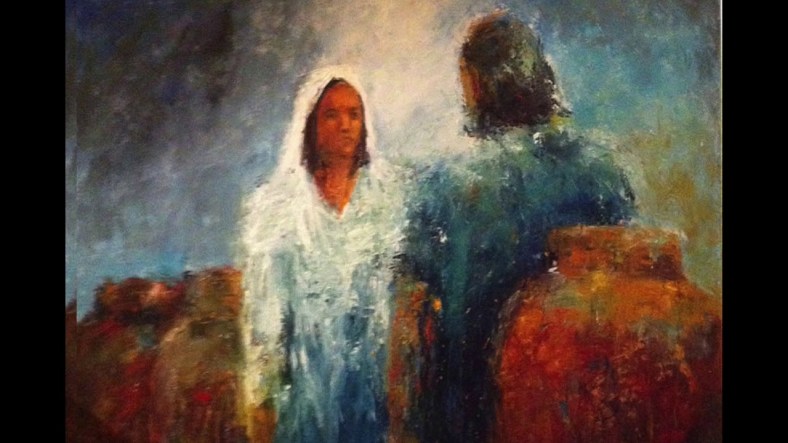
The second thing that’s unexpected comes when Jesus meets the Samaritan woman at the well.  If you’re a 1st century Jew or Samaritan, you heard stories all your life about men meeting women at a well.  Moses meets Zipporah at a well… and they end up getting married.  Abraham sends his servant to find a wife for Isaac and he finds Rebecca drawing water at a well.  Jacob meets Rachel at a well… and they get married, eventually.  So when you hear a story about a man meeting a woman at a well, your expectation is that it’s going to end with a wedding.  But this one, it turns out, is not—although marriage gets discussed in the dialogue– so if you’re a 1st century Jewish Christian hearing this story told for the first time, when Jesus says, “Go get your husband,” and the woman says, “I have no husband,” you might think it’s going to go that way.

The third thing that’s unexpected if you’re a 1st century Jewish or Samaritan Christian is that this conversation Jesus has at the well at Sychar, the single longest conversation Jesus has in all the gospels, a conversation that touches on history, worship, and theology, is not only with a woman, but with a Samaritan woman. 

My friend and colleague, Pastor Kirsten Moore pointed out to me the other day that social distancing is an important element in this story.  That’s a thing we’ve heard a lot about lately.  Social distancing.  Mostly we’re hearing about it in the context of the Corona virus and how it’s important to allow adequate space between yourself and any persons near you if you’re in a public place.  But there are all kinds of social distancing.  Racism is a kind of social distancing.  Homophobia is a kind of social distancing.  Hatred of or fear of or dislike of other people for superficial reasons like skin color or sexuality or religion or country of origin is a kind of social distancing.  It comes in lots of forms.

Remember, Jews don’t like Samaritans and Samaritans don’t like Jews and the reasons are buried in their history.  There’s a Grand Canyon of social distance between them.  And here’s why.

Under King David and King Solomon, Israel’s territory reached from deep into the Sinai Peninsula in the south all the way up to the Euphrates River in the north in what is now Syria.  It was Israel’s golden age.  When Solomon died, sometime around 930 BCE and his son, Rehoboam became king, leaders of the northern tribes led by Jeroboam broke away from the southern tribes of Judah and Benjamin in brief civil war.  They resented centralized government in Jerusalem, but they also resented centralized worship and sacrifice only being allowed at the temple in Jerusalem.  The end result of that civil war was a divided nation and a divided religion:  The Kingdom of Judah in the south with its worship center at the temple in Jerusalem, and the Kingdom of Israel in the north with worship centers at Shiloh, Bethel, Shechem, and elsewhere.

In 720 BCE the Kingdom of Israel was conquered by the Assyrians.  

  • The Assyrians resettled other conquered peoples in Israel’s territory and carted off the Israelites to resettle other conquered lands as slaves laborers
  • Later, when Assyria had fallen, Israelite returnees often intermarried with the people who had been resettled in their lands
  • That’s why Judeans called them “the people with 5 fathers”

Then in 600 BCE the Kingdom of Judah was conquered by the Babylonians.

  • In 597 – the first Judean people were first deported to Babylon in captivity
  • When Babylon fell to Cyrus the Persian and Darius the Mede and the Judeans were allowed to return to Jerusalem, Ezra – ordered Judean men who had stayed behind in Judah to “put aside” their non-Jewish wives and children
  • When Ezra and Nehemiah began to rebuild the temple, the Samaritans opposed and interfered with its reconstruction
  • Judeans had Torah, prophets, writings and were expecting a Messiah who would be prophetic but primarily a military leader.
  • Samaritans – their own version of Torah – no prophets, no writings.  Expecting a Messiah who would be a prophet like Moses.
  • Each side believed that they had preserved the “true religion”
  • Each side blamed the other for not being there when the enemy came.

So all of this is in the background when Jesus sits down beside Jacob’s well after a long morning of walking on the dusty road.  

[Jesus] came to a Samaritan city called Sychar, near the plot of ground that Jacob had given to his son Joseph.  6 Jacob’s well was there, and Jesus, tired out by his journey, was sitting by the well. It was about noon.

7  A Samaritan woman came to draw water, and Jesus said to her, “Give me a drink.”  

8 (His disciples had gone to the city to buy food.)  

  • It’s interesting that “Give me a drink” is imperative

9 The Samaritan woman said to him, “How is it that you, a Jew, ask a drink of me, a woman of Samaria?” (Jews do not share things in common with Samaritans.)

Jesus answered her, “If you knew the gift of God, and who it is that is saying to you, ‘Give me a drink,’ you would have asked him, and he would have given you living water.”  

11 The woman said to him, “Sir, you have no bucket, and the well is deep. Where do you get that living water?  12 Are you greater than our ancestor Jacob, who gave us the well, and with his sons and his flocks drank from it?”  

  • “living water”=running water  but she seems to grasp the hint that he may be talking about something more
  • This text, by the way, stands in contrast with Nicodemus from last week’s lesson
    • Nicodemus comes at night and did not want to be seen– this woman meets Jesus in the middle of the day and doesn’t care who sees her.  Nicodemus, a teacher, is not quick to grasp what Jesus is talking about.  This Samaritan woman catches on pretty quickly.

13 Jesus said to her, “Everyone who drinks of this water will be thirsty again,  14 but those who drink of the water that I will give them will never be thirsty. The water that I will give will become in them a spring of water gushing up to eternal life.”  15 The woman said to him, “Sir, give me this water, so that I may never be thirsty or have to keep coming here to draw water.” 

  • “to draw water” – there is a double meaning here.  She’s thirsty for meaningful conversation.

16  Jesus said to her, “Go, call your husband, and come back.”  17 The woman answered him, “I have no husband.” Jesus said to her, “You are right in saying, ‘I have no husband’;  18 for you have had five husbands, and the one you have now is not your husband. What you have said is true!”  

  • Too often because of the “five husbands” comment this woman has been painted in commentaries and sermons as something of a loose woman with disreputable moral character, but there is nothing in the text to actually indicate that.  There are all kinds of reasons she isn’t necessarily a “loose woman”—
    • Her husbands could have simply died.  Life expectancy for men was about 35 yrs.  Life was hard and simple infections could be deadly.
      • If her husband died, she may have been required to enter into a Leverate marriage, the Levitical requirement that if her husband died she had to marry his brother and if he died she had to marry the next brother, and so on.  The Sadducees actually posed a hypothetical situation to Jesus in Mark 12 where a woman ended up married to 7 brothers because they kept dying. 
    • Divorce was easy for men.  All a man had to do was issue a certificate and say, “I divorce you.” So it’s not hard to imagine multiple marriages base on that alone.
    • The word translated as “husband” is andra – It can mean husband but its more basic meaning is simply “man” – she could be living with a male relative and might have lived with other male relatives.

19 The woman said to him, “Sir, I see that you are a prophet.  20 Our ancestors worshiped on this mountain, but you say that the place where people must worship is in Jerusalem.”  21 Jesus said to her, “Woman, believe me, the hour is coming when you will worship the Father neither on this mountain nor in Jerusalem.  22 You worship what you do not know; we worship what we know, for salvation is from the Jews.  23 But the hour is coming, and is now here, when the true worshipers will worship the Father in spirit and truth, for the Father seeks such as these to worship him.  24 God is spirit, and those who worship him must worship in spirit and truth.”

  • She moves to one of the primary tension points –What is the proper place for worship?  This is a theological discussion, showing keen intellect and curiosity.
  • Jesus essentially says, the time is coming when that will be a moot point
    • The Gospel of John was written well after the destruction of the temple
      • BUT this story is remembered from before that
  • You worship what you do not know, we worship what we know
    • Jesus could be saying, “You’ve had Torah, we’ve had the prophets to fill in and interpret Torah.”
      • “for salvation is from the Judeans” – Prophets had said Messiah would come from the line of David, a Judean line from the tribe of Benjamin;  Samaritans, having an oral tradition of Messiah but only Torah and no prophetic tradition had no more concrete information.  Jesus is defending the Judean tradition even as he says that much of it is coming to a close.
  • Those who worship must worship in Spirit and Truth
    • As I stand here today in an all-but-empty church and you watch at home and we worship by way of electronic media, this is so important to remember. God doesn’t care as much about where we are as about the state of our hearts and minds.  Lord God may we always worship in Spirit and Truth—even when it is by unusual means and in unexpected places.

25 The woman said to him, “I know that Messiah is coming” (who is called Christ). “When he comes, he will proclaim all things to us.”  26 Jesus said to her, “I am he, the one who is speaking to you.”

  • We don’t get her immediate reaction to his statement.  But…
  • “Messiah will proclaim all things to us.”  Keep that in mind.

They get interrupted.

27  Just then his disciples came. They were astonished that he was speaking with a woman, but no one said, “What do you want?” or, “Why are you speaking with her?”

28 Then the woman left her water jar and went back to the city. She said to the people,  29 “Come and see a man who told me everything I have ever done! He cannot be the Messiah, can he?”  30 They left the city and were on their way to him. 

  • Do you see the connection between “He will proclaim all things to us” and  “He told me everything I have ever done!”?  For her this is the proof that he is the prophetic Messiah promised to their people.
  • Base on that, she becomes the first evangelist – she goes and tells others and they come to meet Jesus for themselves.

31  Meanwhile the disciples were urging him, “Rabbi, eat something.”  32 But he said to them, “I have food to eat that you do not know about.”  33 So the disciples said to one another, “Surely no one has brought him something to eat?”  34Jesus said to them, “My food is to do the will of him who sent me and to complete his work.  35 Do you not say, ‘Four months more, then comes the harvest’? But I tell you, look around you, and see how the fields are ripe for harvesting.  36The reaper is already receiving wages and is gathering fruit for eternal life, so that sower and reaper may rejoice together. 37 For here the saying holds true, ‘One sows and another reaps.’  38 I sent you to reap that for which you did not labor. Others have labored, and you have entered into their labor.” 

  • There’s a whole sermon in those 7 verses.  But it boils down to this:
    • There is strength and sustenance in doing God’s will
    • There is a world waiting to hear about Christ
    • So how do we do that in this time of Covid-19?

39  Many Samaritans from that city believed in him because of the woman’s testimony, “He told me everything I have ever done.”  40 So when the Samaritans came to him, they asked him to stay with them; and he stayed there two days.  41 And many more believed because of his word.  42 They said to the woman, “It is no longer because of what you said that we believe, for we have heard for ourselves, and we know that this is truly the Savior of the world.”

This amazing woman who met Jesus at the well is never named, but let’s call her Grace, after all, there is so much grace in this story.

It’s a story about what can happen when we dare to cross boundaries—to build a bridge across our social distancing–with grace and courtesy and curiosity, with open hearts and open minds.

In spite of the historic hatred between their two peoples, they speak to each other with courtesy and grace… and they listen to each other.

He doesn’t pigeonhole her, she doesn’t stereotype him.

They reach across the distance of accidental geography and sad history, arbitrary cultural restrictions and hide-bound traditions to have a conversation that changed the lives of people around them and, if we will listen carefully, can still change our lives today.

So don’t be shy.  Talk to that other person, those other people who are so very much not you or your kind.  You may be Christ to them.  They may be Christ to you.  You won’t know until you talk to them.

And be willing to listen.  Listen to the truth of your own life without being defensive.  Open your eyes to who it is speaking to you.  Take the living water that Christ is pouring out for you.  Worship in Spirit and Truth.  Feed on doing the work of God.  Go and tell others. 

In Spirit and Truth, in Jesus’ name.  Amen.

Waiting

“The extraordinary thing that is about to happen is matched only by the extraordinary moment just before it happens. Advent is the name of that moment.”– Frederick Buechner, Advent

Waiting.  It’s about waiting.  It’s about holding your breath as you pause for what’s coming.  It’s about remembering to breathe so you’re awake to see it arrive.  It’s about closing your eyes so you can hold on to the dream of what is possible, what might be.  It’s about opening your eyes to the beauty and pain and joy and sorrow and harshness and gentleness and passion and peace of everything that already is and everything about to unfold.  It is the excited pins and needles of anticipation.  It is the queasy uneasiness of suspense. Waiting.  We live in a season of waiting.

waiting“The thing I love most about Advent is the heartbreak. The utter and complete heartbreak.” –Jerusalem Jackson Greer; A Homemade Year: The Blessings of Cooking, Crafting, and Coming Together

Yearning.  Feel the yearning.  Let yourself fall into it for a moment.  Wallow in it for a moment.  Let it break your heart that the world is not yet made whole.  Let it break your heart that the promise is not fulfilled.  Let your eyes well with unshed tears for all the tears shed in this world. Stare hard at the reality that our species seems to be forever a painful work in progress. Feel the weighty disappointment of our failure to be what God made us to be and balance it on the sharp pinpoint of the promise we, all of us, feel—the promise of what we could be, the promise of what we’re supposed to be.  Let yourself feel that deep knowing that things are not now as they are intended to be. Let it break your heart.  Then understand that it is through the broken heart that God enters the world.  It is through the broken heart that the promise is revived.  It is through the broken heart that the vision of what should be moves forward toward what will be.  It is through today’s broken heart that we see tomorrow’s vision of the world God is calling us to build together.  It is the light aglow in the broken heart that illuminates the faces of those around us whose hearts are also breaking.  It is in the yearning of the broken heart that we find the Advent of Emmanuel, God With Us.

“Advent is the time of promise; it is not yet the time of fulfillment. We are still in the midst of everything and in the logical inexorability and relentlessness of destiny.…Space is still filled with the noise of destruction and annihilation, the shouts of self-assurance and arrogance, the weeping of despair and helplessness. But round about the horizon the eternal realities stand silent in their age-old longing. There shines on them already the first mild light of the radiant fulfillment to come. From afar sound the first notes as of pipes and voices, not yet discernable as a song or melody. It is all far off still, and only just announced and foretold. But it is happening, today.”–Alfred Delp; Advent of the Heart: Seasonal Sermons and Prison Writings, 1941-1944

 Arriving.  But not yet.  Almost.  Get ready. It’s coming.  It’s arriving.  But we are still in the midst of everything and in the logical inexorability and relentlessness of destiny.  Keep moving toward the moment.  Keep moving toward the encounter.  Keep still in the not-yetness of it all.  Decorate. Decorate your house.  Decorate your heart.  Decorate your language.  Decorate your greetings, your symbols, your understanding.  Decorate your soul—from decoratusin the old poetic Latin that still connects our thoughts and words with those who decorated before us, who handed down their most important and enduring ornaments.  Decorare – the verb that tells us to adorn, to beautify, to embellish.  From decus—to make fit, to make proper so that we might be ready with decorum.  And yes, we need to decorate.  Yes, we need to fill the space around us, to fill our homes, our souls, our hearts with brighter things to see, more solid and enduring visions than the shadow parade of destruction and annihilation.  We need to fill our ears with more stirring melodies than shouts of self-assurance and arrogance, songs that lift the heart above the drone of lamentation, the weeping of despair and helplessness.  We need to keep moving toward the music and the light.  We need to lift our eyes to that first mild light of radiant fulfillment to come.  We need to fill our ears with the first notes of pipes and voices no matter how faint and far they may seem.  We need to hum and sing and play the old familiar songs that move our hearts to that softer, readier place where the True Song will be born.  We need to light the ancient candles one at a time to guide our steps down the corridor of waiting, the pathway of arrival.  We need to bring each flame to the heart until the soul is aglow with the depth of its meaning and power.  We need to reignite the flame of Hope to show us our way through the numbing fog of sameness.  We need to internalize the flame of Peace to quiet our anxieties and give us patience. We need to swallow whole the flame of Joy to whet our appetite for the feast to come.  We need to embody the flame of Love to warm us as we journey together, to show us again that we are walking arm in arm and our fates are intertwined, to illuminate the purpose of life, to lead us to the Light of the World.

“For outlandish creatures like us, on our way to a heart, a brain, and courage, Bethlehem is not the end of our journey but only the beginning – not home but the place through which we must pass if ever we are to reach home at last.”–Frederick Buechner, The Magnificent Defeat

 Arrive.  But understand in your arriving that even after the meaningful journey of Advent we don’t arrive at Christmas.  Christmas arrives to us.  The Gift comes to meet us on the road to take us to a place we could never attain on our own. We celebrate.  We ponder. We dance and revel in the laughing lights of Hope and Peace and Joy and Love that we carried with us, that brought us to this place.  We gaze amazed at the Gift before us, almost comically humble and plain, artlessly displayed and wiggling inside its wrappings, laid out on a bed of straw in a manger, and yet more artistically subtle, more beautiful and precious than the Magi gifts of gold, frankincense and myrrh.  And if you take a moment to think about what this Gift really is, what this baby really means to the world and what this baby means to you, in particular, you may just hear the voice of Emmanuel saying, “Now the journey begins in earnest.  Be not afraid.  I am with you.”

Tonight’s the Night the World Begins Again

I’ve been thinking about some Christmas gifts…and by that I mean some of the gifts that Christmas gives us.

It’s a season of giving – yes, it’s over-commercialized –but in the right spirit that can help us develop a habit and spirit of generosity.  And that’s a gift.

The months leading up to Christmas are a good time to practice delayed gratification.  Don’t buy that now…Christmas is coming.   I know I need to practice that sometimes.  So that’s a gift.

For some it’s a change of habit just to be thinking about what to get for other people, thinking more about others—who they are, what they need.  It can feel like an obligation but it can become a healthy, joyful, even life-giving habit.  That’s a gift.

At Christmastime we are intentional about asking people what they want.  That’s a good exercise for keeping us from being “curved in upon the self.”

Christmas, itself, is a gift.  It’s a change of focus.  It comes with some built-in themes that are important.  Giving.  Receiving. Gathering.  Family.  Peace. Hope.  Joy.  Love. Remembering.  Birth.  The Presence of God.  Wonder.

I don’t know about you, but I  really need the gift of Christmas, itself, this year. It’s been that kind of year.

I need to be reminded to stop and breathe and think about giving and receiving and gathering and family.  I need time to stop and remember.

I need to let words like hope and peace and light fill up my soul for awhile.

I need a time to stop and listen to songs about beauty and joy and angels and promises fulfilled…and God showing up in surprising ways and surprising places.

I need the wonder of it all.

I need the songs.  I especially need the songs and carols… because the music goes straight to my heart and heals me and rekindles my hope and my joy and my faith faster than words alone can ever do. “Those who sing pray twice,” said Martin Luther.

Do you have a favorite Christmas song or carol? Is there one—or maybe there are several?—that touch you in some particularly powerful way?

There are a lot of Christmas songs and carols that I dearly love and I listen to them over and over and over again.  But there’s one Christmas song in particular I keep coming back to these past few Christmases.  And this year, especially, I’ve been listening to it a lot.  In fact I’ve been listening to it off and on all year long.

It’s fairly recent—it came out in 2005, so by Christmas Song standards it’s almost brand new.  It’s called Better Days by the Goo Goo Dolls, written by John Rzeznik.  Yeah, I know.  Goo Goo Dolls.  Silly name, but a great band.  And a powerful song.  Listen to these words:

And you asked me what I want this year

And I try to make this kind and clear

Just a chance that maybe we’ll find better days


‘Cause I don’t need boxes wrapped in strings

And designer love and empty things

Just a chance that maybe we’ll find better days

Better days.  When all is said and done, isn’t that what we all want?  For ourselves, for our families and friends?  For….  Everyone? Better days.

I need some place simple where we could live

And something only you can give

And that’s faith and trust and peace while we’re alive

Those are some pretty good gifts we can give to each other.  For Christmas.  For every day.  And the song is right… we’ll only have faith and trust and peace while we’re alive if we give those things to each other.  Faith.  Trust.  Peace.  But the song knows we need something else if we’re going to be able to give each other faith and trust and peace…

And the one poor child who saved this world

And there’s ten million more who probably could

If we all just stopped and said a prayer for them

The one poor child who saved this world. That’s why we’re here tonight. That’s what we’re here to celebrate. But we’re also here to be reminded that because of that child, Jesus, Emmanuel, God With Us, we have the example and the power to save the world together.  God came in person to give us what we need so we can give each other the gifts of faith and trust and peace.

 I wish everyone was loved tonight

And we could somehow stop this endless fight

Just a chance that maybe we’ll find better days

The thing is, everyone is loved tonight—loved by God, at least.  But they don’t all know it and they certainly don’t all feel it.  If they did, if they all felt loved, if we all felt loved, maybe it would stop the endless fight that seems to be the curse of the human race.  But the only way for that to happen is if we take the love God gives us and let it be real and meaningful in our lives.  And then give it to each other in real and meaningful ways.

Brené Brown said,  “Jesus comes to show us what love looks like.  God is love.  But God knows that if God just comes down and says I am love and I want you to love each other, we’re going to go straight to hearts and unicorns.  We know it’s difficult and we don’t like difficult, so we’re going to romanticize it.  Hearts and unicorns.  But love is difficult.  So Jesus comes to show us how to do it.  He comes to show us that love doesn’t tolerate shaming.  Love doesn’t exclude people because they’re different.  Love reaches out and touches and embraces all the people we don’t want to touch or embrace. Love does the hard work.  Love does the hard things.”

But there’s something else that God shows us about love by coming as a baby, by coming, especially, as a poor baby.  Right at the beginning—Jesus shows us, God shows us, that love is willing to be vulnerable.  Love is willing to let down all its defenses.

When you think of all the ways that God could have come to us–all the ways we imagined throughout history that God would come to us—most of that imagery is all about power and royalty and thunder and smoke and lightning.  And then God shows up as a baby.  A poor baby. In a poor country.  A homeless baby.  A migrant born on the road on a journey his parents were forced to take.  A refugee baby forced to flee for his life.

One poor child who saved the world.

I haven’t quoted the refrain that runs through the song.  It’s repeated twice between the verses, but the song ends with it, too.  It’s both a promise and a call to action:

So take these words and sing out loud

‘Cause everyone is forgiven now

‘Cause tonight’s the night the world begins again

Take these words and sing out loud.  That’s the call to action.

‘Cause everyone is forgiven now.  That’s the promise. It’s also another great gift of Christmas.  In this baby, who is God With Us, we have a chance to start over with a clean slate.

In this baby, who is love itself coming to us in its most human and dependent and vulnerable form, we can find forgiveness and we can learn to give forgiveness— and if we can forgive and be forgiven, if we can let go of old hurts and forgive others, then we really can give each other the gifts of faith and trust and peace while we’re alive.  And then there really is a chance that maybe we’ll find better days.

So take these words and sing out loud,

‘Cause everyone is forgiven now.

And tonight’s the night the world begins again.


Tonight’s the night the world begins again.

A Two-Edged Sword

If you want to do violence in the world, you will always find the weapons.  If you want to heal, you will always find the balm.  With Scripture, we’ve been entrusted with some of the most powerful stories ever told.  How we harness that power, whether for good or evil, oppression or liberation, changes everything.–Rachel Held Evans

“All scripture,” we read in 2 Timothy 3:16, “is inspired by God and is useful for teaching, for reproof, for correction, and for training in righteousness, so that everyone who belongs to God may be proficient.”  That’s how it appears in the NRSV.  The problem is, that’s not exactly what it says in the original Greek.  There are, in fact, some missing words in the Greek and, of course the syntax is different. The original, literally translated, would read, “Every writing God-breathed and useful for teaching for reproof for correction for training in righteousness…”  That’s rather confusing, even in the Greek, and you can see that how this gets translated depends in part on making your best guess at some missing words, deciding where to put them, and making a few punctuation decisions. There are also some important word translation choices.  Writings, for instance, became scripture in most translations, a much more weighted word with implications that shift the meaning of the whole passage.  The great Greek scholar Richmond Lattimore, translated this passage this way: “Every writing that is divinely inspired is also useful for…”  Right at the beginning of the sentence is an enormous difference in meaning between the two translations.

This is a pivotal passage because Christians of almost every stripe will refer to the Bible as The Word of God and will appeal to its authority. We call it the Word of God but we often mean very different things when we say that.  We all have different hermeneutics—the lenses through which we read and interpret the Bible.  We read a text through the filter of our own life experience and a host of presumptions about the Bible on the whole and the text itself.  The same thing happens when we use a biblical text “for teaching, for reproof, for correction, and for training in righteousness” or, far too often, to bolster our position in some dispute.  We often fall into the habit of eisegesis, interpreting and using a text according to our own agenda, bias, or presuppositions instead of using it in a way that is faithful to its context and faithful to our faith.  When that happens, we are abusing one of the great gifts God has given us—and that the Church historically gave itself.

Recently, for example, Romans 13:1-7 was cited by our US Attorney General as a way to counter some of the significant opposition he and the administration have been facing in their policy that has separated immigrant children from their families.  “Let every person be subject to the governing authorities; for there is no authority except from God, and those authorities that exist have been instituted by God.”  That seems pretty clear and straightforward.  Except, like so many things in the Bible, it’s simply not as cut and dried as it looks on first glance.

Remember, this was written by St. Paul, a man who had spent significant time in jail for disturbing the peace and for civil disobedience, so clearly he believed that conscience trumped the legal system. He was also a man who frequently relied on the “get out of jail free” card of his Roman citizenship.  He could afford to encourage obedience to the law because, as a Roman citizen, he could appeal to have his case heard and re-heard all the way up to the Emperor if necessary.  Not everyone who read his letter had that option—nor do they today. Remember, too, that he’s writing to people who had been involved in tumultuous riots not too many years before (c.49), riots so disruptive that Emperor Claudius expelled all Christians and Jews from Rome for a time.  So he’s basically telling them to keep calm and stay under the radar because “the governing authorities” are still looking for an excuse to nail you.  Don’t give it to them.

But ignoring all that, even if you take Romans 13:1-7 strictly at face value, when it’s pulled out of its context and used as a blanket instruction to always obey all authority then you’re missing the point of the chapter and, indeed, of the entire letter to the Romans.  “Owe no one anything except to love one another; for the one who loves another has fulfilled the law…Love does no wrong to a neighbor; therefore love is the fulfilling of the law.”  Clearly Paul has a higher ethic in mind than simple blind obedience to human law. Love can do no wrong to a neighbor. If you find yourself stuck between law and love, go with love.  It might break human law, but it’s the heart of the law and ethic of Christ.

This is not the only problematic verse in the Bible that can have powerful and dangerous consequences when misused, but it is one that has been abused most frequently.  In our own history it has been used in numerous unsavory ways, most notably in the subjugation of native peoples and in perpetuating slavery.  The Anchor/Yale Bible Dictionary has this to say about this passage: “The Apostle Paul’s admonition to “be subject to the governing authorities” on the grounds that “those authorities that exist have been instituted by God” has caused much needless suffering and much misery even in the 20th century. This passage seems to lend support to any existing government, regardless of how tyrannical or how corrupt, and any governmental policy, however repressive or unjust. This passage has been invoked by Christians to put down revolt, support war, and justify genocide. In fact, many Christians in Hitler’s Germany appealed to this text as the decisive biblical warrant for obedience to the Nazi regime. And it has been regret over the Church’s alignment with the Nazi regime that has forced a reconsideration of these verses, particularly by German biblical scholars.

            “Again, a careful reading of the text along with an awareness of the historical context is essential for understanding this problem passage. It must be noted that Paul does not say “obey” or “disobey” governing authorities. He instead speaks of “being subject”, which can include disobedience.” (©1992, Anchor/Yale Bible Dictionary, p. 288)

 We all may mean something different when we say that the Bible is the Word of God, but what we mean when we say it will determine how we use these sacred texts—for good or for evil. We should remember that the Bible, itself, says that Jesus is the Word of God who became flesh and dwelt among us. (John 1)  For those of us who call ourselves Christians, Jesus should be our hermeneutic, our lens for reading, interpreting and understanding the words of scripture.  And he was executed for challenging authority.

Hesitant to Enter the Endless Understanding

“Remember, mystery isn’t something that you cannot understand—it is something that you can endlessly understand! There is no point at which you can say, ‘I’ve got it.’ Always and forever, mystery gets you!” –Richard Rohr, The Divine Dance

I was at the Paul Simon farewell tour concert at the Hollywood Bowl a couple weeks ago, along with my family. Go ahead, take a moment to envy us. I’ll wait. I’ve been to some truly amazing concerts by some truly inspiring performers in my life, but this one topped them all. Really. That’s not just hyperbole. It’s true that his voice is not quite what it once was, though not at all bad for a 76 year old guy singing in such a wide variety of styles. But you don’t really think much about his vocal quality because he still has that astonishing and unique combination of intimacy and energy, humility and confidence that just draw you in to him and the music. Well, I could go on. And on and on. Because Paul Simon is in my not-at-all-humble opinion the very best songwriter and lyricist of my lifetime and I’ll be more than happy to defend that assertion if you’d like to quibble. But I digress.

Part of what made this concert so powerful was the amazing musicians who were performing with him on stage: Vincent Nguini, the impressive Nigerian guitarist; Mark Stewart, the astonishing multi-instrumentalist from New York; yMusic, the avant-garde string ensemble… the horns, the percussionists…I’m telling you, that was a killer band up there on the stage with him. And as they played together all the music of the decades of his life as a songwriter—his songs with South American roots, his songs with African roots, his songs that floated up out of the Louisiana bayou and cemeteries of New Orleans, and even a few of his old original 60s folkish songs, I couldn’t help but reflect on the decades of his musical journey, the path of his creativity, and how he had taken so many of us along for the ride with him.

I found myself remembering back to the first time I saw him in concert. It was November 15, 1969 at the Long Beach Arena. I confess, I had to look up the date, but I can close my eyes and still see and hear moments of that concert. It was Simon and Garfunkel, then and they were near the apex of their popularity as a duo. For the first two thirds of the evening they sang all the popular songs we all knew and loved from the albums we all already owned. Paul played guitar. I think a pianist and a couple of string players accompanied them on a few songs. Then Paul said they would like to introduce some new songs from their new album that was about to be released. With that a drum kit, a bass amp and a couple of electric guitar amps were rolled onto the stage along with some other percussion instruments, and an assortment of new musicians stepped up and plugged in to this new group of instruments. This did not look like Simon and Garfunkel folkish music. This looked like Rock. And some people started to boo.

Hard to believe, but more than a few people started to boo. I thought of that as I watched Paul Simon perform all these decades later accompanied by two electric guitars, a bass, a full horn section, an accordion, a zydeco organ, a very full percussion section including two large drum kits—I thought of those people who booed all those years ago and wondered if any of them were with us on this night to celebrate where the journey of music had taken him. I wondered if they regretted booing him in 1969. I wondered if they even remembered.

On that night in 1969, when the people booed, he simply smiled and said, “Now, now, give it a chance. I think you’ll like it.” And then they played Cecilia. And then El Condor Pasa. Then Keep the Customer Satisfied, and Baby Driver… and when they played Bridge Over Troubled Water there wasn’t a dry eye in the arena. And from then on they could do no wrong.  And I think we began to get an inkling that their music, his music, was going to take us in a new direction.  And behold, it was good.

NEW YORK, NY – JANUARY 20: Paul Simon performs onstage during The Nearness Of You Benefit Concert at Frederick P. Rose Hall, Jazz at Lincoln Center on January 20, 2015 in New York City. (Photo by Ilya S. Savenok/Getty Images)

When we love the old familiar songs so dearly it is sometimes hard to allow room in our hearts and minds for the new songs. Mary Chapin Carpenter once quipped at a concert that she wanted to break some songs out of “new song jail.” I think this same dynamic can apply to our theological thinking. Sometimes we’re reluctant to hear the melodies of our beliefs rearranged and played by different instrumentation, to different rhythms. We’ve lived so long with words like “grace,” and “atonement,” and “Trinity,” and “Incarnation,” and even “Creation” that they can sometimes trigger within us a neuro-theological version of Name That Tune. Just hearing the word activates a mental shortcut to an old recording of a belief structure and it’s enough to know it’s there even if we haven’t actually payed any attention to it in ages. And yet, if we dare to listen what some unexpected voices are singing on these themes, we might hear the ancient songs come alive and dance in a whole new way that reinvigorates our faith and our lives. And if you don’t like the new arrangements…well the old cantatas will still always be there.

“Music is forever; music should grow and mature with you, following you right on up until you die.” –Paul Simon

The same can be said for theology.

How Are You Translating?

For this is how God loved the world—all of it, everything: God gave God’s unique son so that everyone who trusts into him need not be destroyed but may have eternal life. For God did not send this son into the world to judge the world, but so that the world might be made whole through him. – John 3:16-17 (my translation)

I know.  That’s not the way your Bible says it.  It’s not the way my Bibles say it, either.  I have several.  It goes with the job.  No, that’s not the way it reads in your Bible or mine, but it is a perfectly legitimate translation from the ancient Greek text.

So how does it sound to you, this word about the Word in different words?  Does “trust into him” make you pause?  Before you mentally substituted the more familiar “believe in him” did you stop to think about the difference?  What do you mean when you say “believe?”  Is there a difference between believing as intellectual affirmation versus trusting?  Can you believe in someone but still not trust them with your life?  What’s the difference between in and into?  Subtle, that one.  But doesn’t in sound more like stasis, something settled, while into is more of an ongoing process?  Why do so many translations say condemn when the Greek word most frequently means to judge.  True, it can mean condemn, but why leap to that?  Oh, and saved.  Such an interesting, interesting word.  Sozo in Greek.  It can mean to be rescued, to be made safe, to be removed from danger, but its oldest meaning is to be healed, to be made whole.

So how do you prefer to hear it?  Heard one way it can be about God’s plan for fire insurance of the eternal kind. Heard another way it can be a message about God’s intervention to heal this world, all of us and everything else.  Which translation speaks to you?

How are you translating the world around you?  How are you translating the other people you encounter in life?  How are you translating yourself?

“Love one another as I have loved you,” says Jesus, later in the Gospel of John.  He makes it a commandment of all things.  Really loving each other involves learning to really hear each other and see each other. David Augsburger wrote, “Being heard is so close to being loved that for the average person, they are almost indistinguishable.” To love you, I need to hear you.  To love me, you need to hear me.  We need to translate each other accurately.  To do that we each need to know something about how the other person is translating the world and interpreting their experience.

We are not looking at the world through the same eyes or hearing it through the same ears, but if, when we disagree, we stop to ask why we are seeing and hearing things so differently—if we take the first step in translating each other—then we’re taking the first steps in loving each other.  If nothing else, paying close attention to those around us can teach us all kinds of interesting things, even when they are not being particularly relational. “I learned silence from the talkative and tolerance from the intolerant and kindness from the unkind,” wrote Khalil Gibran.  And that’s love, too.

gethsemane_thumb11
After your feet have been washed
and the perfect meal’s been served
and all has been said that need saying,
will you be staying?

Thursdays are so busy.
There’s still so much we must get through.
But tomorrow will be worse,
so may your host make one request of you?

Could you stay with me a little while?
Would you pray with me for just a while?
A little while?

I know a little garden
up on a hillside, set apart,
where we can share all our troubles,
heart to heart.

I know it’s late.  You’re tired.
Frankly, so am I.
But tonight I need your moral support
because tomorrow there’s a harder hill to climb.

So will you stay with me for just a while?
Please– pray with me a little while…
a little while.

After your feet have been washed
and the perfect meal’s been served
and all has been said that needs saying,
will you be staying–
will you be praying
with me
for just a little while?


Thursday Night

Easter in a Dying Church (1996)

They come because they have always come…

2015-12-13-Nearly-empty-churchand on this day of days,

not to pass through the beckoning door,

not to let their careful footsteps drum

old echoes from the wooden floor

would deny the pattern of their ways

and all the times that they have come before.

They sit where they have always sat…

each in the customary pew,

with room enough for all,

even for the visiting few

who do not hear the sweet, unearthly voices

singing Alleluia in memories so loud;

room enough for those who do not recall

the passings, the accidents, the choices

which have thickened the witnessing cloud

and left this sparse, embodied remnant of the hosts

surrounded by their ghosts.

They come to meet where they have always met…

to taste the wine with a beloved friend

who has faded from sight

but still shares the cup in the world without end,

to break bread with the cherished spouse

who, though swallowed by the light,

still prays beside each member of this house,

to meet children, uncles, sisters, mothers,

cousins, aunts, fathers, brothers,

in soul or body distanced from their common place—

to allow for them a sanctioned space.

They come to be seen with the unseen…

to testify to the most revered of their presumptions:

that before and beyond here and now

the empty tomb

leaves a hole in all assumptions.

The Gift

The little boy stopped in his tracks and pulled his mother’s hand tight to his chest.  His father, catching up to them, stopped and rested a hand on the boy’s shoulder.  The fog of the boy’s breath sparkled for a moment with a halo from the streetlamp before vanishing into the cold night air, and his glistening eyes reflected a kaleidoscope of colors from countless lights on the amply decorated houses competitively decked out for the season.  A passable version of Jingle Bells wafted down the street from a group of not-too-bad carolers but was soon overwhelmed by an odd assortment of recorded music pouring out of various holiday displays, some sacred, some not so much.

The thing that had stopped the boy as he skipped down the street was not the seemingly endless cascade of colored light nor one of the comical inflated cartoon characters in Santa hats, nor even the impressive electric train set and miniature Alpine village filling an entire front yard.  The thing that stopped him stone still there on the cold December sidewalk was an old-fashioned crèche, a simple manger scene.

Compared to all the other neighborhood displays the crèche was almost embarrassingly understated.  There were no shepherds or angels or magi in this tableau, just Mary, Joseph and the baby Jesus.  Their figures, though, were particularly well crafted and cunningly lit.  They looked so real that one had to do a double-take to make sure that they were, in fact, sculptures and not human actors holding a pose.  The figures looked decidedly Middle-Eastern and even, if such a thing is possible, a bit dislocated in time, as if they had been transported to this sanitary American cul de sac from a dusty, distant, Palestinian past. But perhaps the thing that was most arresting was the way they looked at you if you stood just where the boy and his parents were standing.

Mary is usually depicted with her hands on her heart as she ponders her child in the manger.  Joseph, too, is most often shown gazing at the baby.  But this scene was different.  The boy, the mother, the father almost felt as if they had intruded, as if they had inadvertently stumbled into something serious and secret and would now have to be initiated into its mysteries.  Joseph seemed to be giving them a stare of careful appraisal and assessment as he looked directly into their eyes. “Can you handle this?  Can you treasure this precious thing you did not ask for, this responsibility, this honor, this gift that will give you everything and also demand everything? Can you stay with him when it would be easier to walk away?” he seemed to be asking.  Mary, too, gazed intently, unblinking, into their eyes and seemed to be asking, “Do you understand the weight of this gift?  Do you even begin to understand what you have here? Do you know what is happening here? Do you know who he is?  Will you let him show you who you are?”

And then there was the baby.  How to describe this baby?  He, too, seemed to be looking straight into their souls, but in his face there were no questions.  There was instead an indescribable mix of innocence and wisdom.  There was promise and foreshadowing.  There was the shining hint of divinity and the burbling drool of humanity.  There was life, organic and messy, full of merriment and ecstasy and pain and tears and plain everydayness.  There was light, revealing, illuminating, probing, warming, piercing and soothing, burning and healing.  There was love, gentle and compassionate, fierce and yearning, ruthless and gracious. Love in all its purest shades.  Love in all its joy.  Love in all its anguish.  There was all that in that baby face and something else.  Deep in those eyes was God’s own Yes.

They stood transfixed at the crèche for what seemed like a long time—a moment out of time—one small family regarding another across and through time, still-life speaking to life in a held breath of stillness, until the not-too-bad carolers drew near and broke through the little family’s reverie with  tidings of comfort and joy that were a just a bit rushed and ever so slightly out of tune.

A few minutes later, without much thinking about it, the boy, the mother and the father found themselves in their car making their way home.   The father drove a little more slowly than usual as they rolled across the familiar bumps and dips of familiar streets.  The boy watched the reflections of Christmas lights dance and swirl across the windows of passing cars.  And the mother’s eyes were focused on something only she could see as she softly hummed Silent Night.