Who Are You in the Story?

Luke 13:1-9

A 7.4 earthquake in Fukushima, Japan killed four people on Wednesday.  

In Florida wildfires damaged more than a dozen homes.  

Sixty homes were buried in a mudslide in northern Peru.  

Wildfires in Eastland, Texas destroyed a church and killed a sheriff’s deputy who was attempting to rescue a family trapped by the blaze.  

Two people were hospitalized after nine mobile homes were destroyed by a tornado in southern Alabama. 

Nine people were killed on a rural road in West Texas on Tuesday when a pickup truck driven by a 13-year-old boy blew a tire, crossed the center line and crashed head-on into a van carrying members of the University of the Southwest Golf Team.

Ten people were killed when a tropical cyclone hit Mozambique with sustained winds up to 118 miles per hour.

Eight people have died as a result of extensive flooding in and around Sydney, Australia and throughout New South Wales. 

Nobody knows exactly how many people have been killed in Ukraine so far, but the New York Times estimated that more than 7,000 Russian soldiers have died and more than a million Ukrainians have been displaced.

On top of all that, Covid is still sending an estimated 2,000 people a day to hospitals here in the United States.

There is no shortage of tragedy in our world.  On any given day, any given week, horrible things happen to people.  And when horrible things happen, one of our first instincts is to look for somewhere to lay the blame.

Sometimes it’s easy to pinpoint the source of the tragedy and fix the blame on the responsible party or parties.  I think we could all agree on who is primarily culpable for the slaughter and destruction in Ukraine.  But knowing who to blame and knowing the motives behind their aggression only makes the carnage more horrible.

It isn’t always easy to decide who or what is to blame for a tragedy.  Sometimes—far too often—we blame the victims.  What were those people in Peru thinking when they built their houses on an unstable hillside?  People in Alabama know they live in tornado alley so why would any of them choose to live in a mobile home park?

Some people blame God when horrible things happen.  When a horrendous earthquake killed more than 100,000 people in Haiti in 2010, Evangelist Pat Robertson said that God was punishing the people of Haiti because in 1804 they had made a deal with the devil to drive out their French colonial overlords.  He didn’t say why God waited 106 years to exact this punishment.  Robertson also claimed that Hurricane Katrina, which devastated New Orleans and killed more than 1800 people, was God’s punishment for allowing abortion, gay rights, and other liberal policies to continue in the U.S. 

We might think Robertson’s ideas are Loony Tunes, but a surprising number of people still see the world that way.  The idea that calamity is God’s punishment for sin is as old as humanity.  In the Book of Job, when Job is afflicted with one heartbreak after another, the three friends who come to offer him moral support yammer on for days insisting that Job must have offended God in some way.  When Job resolutely insists that he is innocent, their response is pretty much, “Well you must have done something!”  In the end, though, God puts an end to their speculation about what Job might or might not have done. “Who is this that darkens counsel by words without knowledge?” says God. “Where were you when I laid the foundations of the earth?  Go on, tell me if you’re so smart.”   The message in the end is that, while God may have allowed Job to suffer, God didn’t cause Job’s troubles.

While Jesus was on his way to Jerusalem, some people brought up the issue of some Galileans whom Pilate had killed mingling their blood with their sacrifices.   Why were they talking to Jesus about this?  Were they thinking he would be scandalized by it?  Did they think he would be shocked that Pilate would not only kill these Galileans but would also profane their sacrifice?  Did they think that maybe, since he was also a Galilean, he might be angry enough to join the zealots who were fighting against Rome?   Or did they simply want him to share his thoughts on why God would do this or allow it to happen?  Was God punishing those Galileans for some reason?  Was their sin really so awful that they deserved to die that way?  

So Jesus asks them, “Do you think that because these Galileans suffered in this way they were worse sinners than all other Galileans?  No, I tell you; but unless you repent, you will all perish as they did.  Or those eighteen who were killed when the tower of Siloam fell on them—do you think that they were worse offenders than all the others living in Jerusalem?  No, I tell you; but unless you repent, you will all perish just as they did.”

Do you think God or Karma or the universe was punishing these Galileans because they were worse sinners than everyone else in Galilee?  No.  That’s not how it works.  And those eighteen who were killed when the tower collapsed—do you think they were snuffed out because they were the most awful people in Jerusalem?  No.  God doesn’t work that way.  But… unless you repent, you will all perish just as they did.  

What did he mean by that?  Repent is such a ponderous and dreary word. It’s all about regret and contrition. The Greek word, though, metanoia, is full of possibility.  It means a change of heart, a change of mind, a change of viewpoint, a change of direction.  Metanoia might start with contrition, but it doesn’t end there.  Metanoia is a way forward.  

Jesus is telling them, “Unless you change the way you see and understand life, unless you change the way you see and understand God and how God works, you’re all going to be lost the same as they were.  Death can sneak up on you or catch you by surprise, and when it does, you’ve lost your opportunity to embrace the life and love of God and for that matter, the life and love of humanity.  You’ve lost your opportunity to do justice and love kindness and walk humbly with God and humankind and the rest of creation.  You’ve lost your opportunity to make a positive difference in the world.

To bring home the point, he told them a parable.  A story.  “A man had a fig tree planted in his vineyard; and he came looking for fruit on it and found none.  So he said to the gardener, ‘Look,  for three years now I have come looking for fruit on this fig tree, and still I find none.  Cut it down! Why should it be wasting the soil?’  The gardener replied, “Sir, leave it alone for another year.  I’ll dig around it and put manure on it.  Maybe it will bear fruit next year.  But if not, then you can cut it down.’”

A lot of us were taught in Sunday School to read parables as allegories.  So if we did that with this parable, the land owner would be God the Father and the tree would be some unproductive person who is not doing anything to improve the world, and the gardener who wants to spare the tree and work with it would be Jesus.

Reading the parable that way has some merit, but it also has some problems.  “Allegorical readings,” wrote Amy-Jill Levine, “can speak to eternal truths and ultimate longings.  Yet…such readings rarely produce a challenge and rarely offer a surprise; rather, they confirm standard Christian views.  A second problem with the traditional allegories…is that they cannot convey what a parable would have meant to its original audience.  Allegories require keys, so that readers know that the elements given in the tale correspond to very particular elements on the outside.  As these allegories were developed much later, that original audience would not have had the key.”[1]

How would you hear this parable if, instead of treating it as an allegory, you put yourself into the story?  What would you hear if you were to sit inside the parable, put on its characters for a moment and let them speak to you and through you?  What questions would this parable prompt you to ask yourself if you let it be more than a simple morality tale?  

For instance:  Am I like the absentee landowner?  Have I kept my distance from those places and moments where life and death actually happen and avoided getting my hands dirty?  Have I been pronouncing judgment from the sidelines?  Have I been seeing the value of things only in terms of whether or not they are productive in some measurable, consumable, marketable way?  Have I been looking a life through the lens of cost/benefit analysis, weighing how people and other living things consume resources and take up time and space?  Do I need to be persuaded to see possibilities, to extend a little patience and grace?  

Am I like the tree?  Am I failing in some way to nurture and nourish others?  Am I holding on to space and resources that could be used more productively to sustain others?  Am I willing to change or let myself be changed, to “repent,” to take the path of metanoia so I can learn to bring more love, joy, peace, patience, kindness, generosity, faithfulness, and gentleness into the world around me?  Am I taking life—being alive—for granted and neglecting the gift that God has given me to be present and aware and alive in this world?

Am I like the gardener?  Am I willing to get my hands deep into the dirt and manure of life if it will bring someone else some grace, give someone else a chance to grow and bloom and become what they were made to be?   Am I willing to give time and energy and love and hope to help someone else thrive?

Why do horrible things happen?  Jesus is not going to answer that question…  because “Why?” is not a life-giving question.  Jesus is not going to play the blame game, because placing blame doesn’t heal anyone or help the survivors.  Instead, Jesus tells us a story to remind us that life is both precious and precarious, and time is not on our side.  He reminds us that there are forces at work in the world which, like the land owner, would cuts us down without  hesitation or remorse.  But his story also reminds us that the force of love and life is also in the world, a force that is willing to go elbow deep in manure to give us a chance to grow and thrive and bear good fruit.  

Fred Rogers once said to his television friends in Mr. Rogers’ Neighborhood, “When I was a boy and I would see scary things on the news, my mother would say to me, ‘Look for the helpers.  You will always find people who are helping.’”

The Russian invasion of Ukraine has been disheartening and depressing.  Hearing Vladimir Putin talk openly of using nuclear weapons is too scary to think about.  So this week I’ve been taking Mr. Rogers’ advice.  I’ve been looking for the helpers.  This week I’ve noticed some extraordinary things people have done to help the people of Ukraine survive their nightmare.  

  • Border guards, volunteers and ordinary people have lined the sides of the wooden pedestrian bridge across the Tisza river with stuffed animals and toys so that refugee children crossing from Ukraine into Romania could, as one volunteer put it, “enter the country with a nice thought.” 
  • An organization called Deaf Bridge, which had been working in Ukraine to help establish church ministries for deaf and hearing impaired, has quickly shifted to helping deaf people in Ukraine find shelter and escape routes.  Also, since deaf people can’t hear air raid sirens, they been teaching them to look for visual cues and paring them with hearing persons so that they can know when danger is imminent.
  • Polish parents have been leaving baby strollers in Poland’s railway stations for refugee parents to use when they arrive with their babies in their arms and their childcare necessities in a backpack.
  • Volunteers are arriving in Poland from all over the world to work with World Central Kitchen which is not only providing food for refugees but also for Ukrainian cities where food is in short supply.  In his nightly post on Facebook, Steve Givot, an American volunteer, wrote, “Today, my little group from Ohio, Idaho, Portugal, Canada, and the UK peeled an enormous quantity of potatoes and cored/sliced an ungodly amount of apples (for baby food).  I won’t go into details, but we were told that we fed 7000 people in Przemsyl and at the border, and we prepped food to be cooked in Lviv, Ukraine for another 30,000 people. Not a typo: 30,000.  The volunteers are from everywhere in Europe, the US/Canada, and one from Japan. They show up, and they work. Some for a few days, some for longer.” 

Life is both precious and precarious.  Horrible things do happen.  There is always someone who is ready to cut down the tree.  But there is also always someone who is ready to try to save it, someone who is willing to dig around the roots and even sink their hands into the muck to give it another chance at life.  So… who are you in the story?


[1] Short Stories by Jesus, Amy-Jill Levine, p.128

Nobody Here But Us Chickens

Luke 13:31-35

When some Pharisees came to tell Jesus that he should get outta Dodge because Herod wanted to kill him, Jesus made it clear that he wasn’t going to let the Pharisees or Herod disrupt his mission.  “Go and tell that fox for me,” said Jesus,  “Listen, I am casting out demons and performing cures today and tomorrow, and on the third day I finish my work.  Then I’ll be on my way.”  I wonder if those Pharisees were brave enough to actually go back to Herod with what Jesus had said. 

Calling someone a fox was not a compliment.  Today if you call someone a fox you usually mean they’re pretty good looking, but it meant something very different in those days.  A fox, in both Greek and rabbinic literature, was what you called someone who was crafty, sinister,  dishonest. Herod would not like being called a fox, and we should remember here that Herod was dangerous.  He had already killed Jesus’s cousin, John the Baptist.   The Pharisees were saying that he wanted to kill Jesus, too.  So maybe calling him unflattering names wasn’t the safest thing to do. 

But Jesus had even more to say in his message for Herod.  “Tell that fox I’m casting out demons and performing cures today and tomorrow, and on the third day I finish my work.  On the third day I’ll be on my way to Jerusalem because it’s unthinkable for a prophet to be killed anywhere else.”  

Maybe it’s just me, but I hear Jesus being a little bit snide here.  Just a little.  Getting in a dig. “Hey Herod, come see me, buddy.  Those demons that have been making you act like such a putz?   I can get rid of those for you and heal your shrunken heart at the same time.  But don’t think about it too long.  I’ll only around for a couple of days, then I’m on my way to Jerusalem because that’s where prophets go to be killed.  Sorry, I know you wanted to murder me here, but that job has been reserved for someone higher up the food chain.” 

Well, maybe that’s not the tone of voice Jesus was using, but he was making it clear that he was not afraid of Herod, the man who had killed his cousin.  He wasn’t going to let a threat from Herod stop him from healing people and freeing them from whatever was bedeviling them.  

So, Jesus sent the Pharisees back with a message.  And because he had mentioned Jerusalem, it got him thinking about where he was headed and what was waiting for him there.  “Jerusalem, Jerusalem.  The city that kills the prophets and stones those who are sent to it!  How often have I wanted to gather your children together like a hen gathering her chicks under her wings.  And you were not willing.”  

I hear such sadness in these words.  A lament.  It’s heartbreaking to hear the yearning in the heart of God expressed this way.  It’s painful to think of all the times God has reached out in love to gather and guide and protect, but like rebellious adolescents (which is a pretty apt description of humanity on the whole) we have turned away.  

Jerusalem, Jerusalem, The city that kills the prophets.  The city that stones the messenger.  Jesus calls out Jerusalem, but his words apply to any place, every place where people refuse to hear plain-spoken truth if it isn’t the “truth” they want to hear.    “Jerusalem, Jerusalem.  Long Beach, Long Beach.  America, America.  Russia, Russia.  Humanity, Humanity.  How many times have I wanted to pull you all together in one protective and loving embrace, but you would not let me.” 

Like a hen gathering her chicks when danger threatens, when a hawk is circling overhead, when a fox or weasel is slinking around nearby—this is how God has yearned to protect us from all the craziness that we throw at each other in this world.  

Like a mother hen.  

When we talk about God helping and protecting us, I don’t think the go-to animal image for most of us would be a chicken.  When the prophet Hosea was telling the people how angry God was with them, he said God was going to come at them like a lion or a leopard.  God, he said, was going to come down on them like an enraged mother bear who’s been robbed of her cubs. (Hosea 13:7-8)  Yeah!  Hosea is talking about Angry God, here, but I think that’s what most of us want Protective God to be like, too.  When we feel threatened, I think most of us want Angry Bear God to show up.  But no, says Jesus.  That’s not how God does things.  God will not be a predator on our behalf.  But God, Jesus, will put himself between us and whatever predatory trouble is coming at us.  God, Jesus, will take the first and hardest hit.

Barbara Brown Taylor said, “Jesus won’t be king of the jungle in this or any other story.  What he will be is a mother hen who stands between the chicks and those who mean to do them harm.  She has no fangs, no claws, no ripping muscles.  All she has is her willingness to shield her babies with her own body.  If the fox wants them, he will have to kill her first.”

Mother Hen God is no chicken.  When the fangs and claws come after her defenseless brood, she doesn’t run away.  She puts her whole self between the danger and her babies.  That, said Jesus, is what I’ve wanted to do for you always and everywhere.

But we won’t let him.  

The longer I live, the more I am convinced that there are really only two essential forces at work in this world:  fear and love.  That’s it.  They come in a lot of different guises, but it’s really only the two.  Fear, forever resisting the full, transformative power of love.  Love, forever trying to mitigate the destructive power of fear. 

Greed, lust, rage, hate, violence, blind ambition, exclusion, a thirst for power—those things are all born in fear.  Grace, forgiveness, courage, generosity, helping, healing, peacemaking, goodness—those things are all rooted in love.  

The militant Jesus imagined by Christian Nationalism, the Jesus who looks like Rambo, is an expression of fear.  But that’s not the Jesus of the gospels.

We will never be done with fighting and war until we conquer our fear.  We won’t be able to get on with the practical work of building a sustainable and peaceful humanity until we rid ourselves of the fear that spawns violence.  “Violence,” said Martin Luther King, “is impractical because it is a descending spiral ending in destruction for all. It is immoral because it seeks to humiliate the opponent rather than win their understanding: it seeks to annihilate rather than convert. Violence is immoral because it thrives on hatred rather than love. It destroys community and makes brotherhood impossible. It leaves society in monologue rather than dialogue. Violence ends up defeating itself.”

“Darkness cannot drive out darkness,” he said. “Only light can do that.  Hate cannot drive out hate.  Only love can do that.”  Fear cannot drive out fear.  Only love can do that, too.

“There is no fear in love,” says 1 John 18, “but perfect love casts out fear.”  

When fear starts to stalk us like a fox, when pain or disruption seem to be aimed right at us, Jesus wants us to know that there is a safe place under the shelter of God’s wings where we can catch our breath and be still while we wait for trouble to pass.

“In you my soul takes refuge;” said the Psalmist.  “In the shadow of your wings I will take refuge until the storms pass by.”  May we all learn to be willing to place ourselves under the protecting wings of Christ.  May we all learn to embody Christ’s love that lifts us up and out of fear.  And just as we have found shelter under metaphorical wings of Jesus, when trouble threatens may we be loving enough and brave enough to spread out our wings to shelter others.  May we all be as brave as a mother hen.

That Reasonable Voice

Luke 4:1-13;  Matthew 4:1-11

————-

By the end of the third day his hunger pangs began to fade.  He had fasted before and expected this, and thanked God for this small blessing that made the discipline easier.  A little easier.  But he knew, too, that his craving for food could come roaring back unexpectedly, that his body’s impulse to survive would mean that no stray lizard or bug or mouse or even scorpion would be safe from his appetite unless he harnessed his will and tuned his physical hunger to the feast of his spirit. 

He had fasted many times for a day, several times for three days, and once even for seven days.  He knew what to expect and how to prepare for such fasts.  But this time was different.  Very different.  He had not prepared for this fast.  He had been led to it… led here, to this parched, eerie, yet providential place in the wilderness.  Led by a dove.  A snow-white dove who had fluttered down out of nowhere, out of everywhere, out of heaven to land on his dripping, baptized shoulder and nuzzle his cheek, then raised its face to the sunlight, eyes closed, head cocked and listening for a moment before taking wing and beckoning him to follow. 

            By the fourth day he had realized that here in the wilderness it would be very easy to lose track of the days, so every morning when the first light began to tinge the sky he made a mark on the sandstone face of the wadi with a sharp stone to count the days.  Then he would splash water on his face and his head and drink a sip from the small, clear pool that seemed to almost miraculously refill itself every night from a tiny trickle of stream.  He supposed there must be a spring somewhere uphill or, perhaps a larger oasis.  But this place and this water were enough for him, this small gash in the hillside with its pool and its single scrub tree and its long view across the desert.  

            And the days went by, each one like the day before.  Every morning the splash of water on his face—and with each splash hearing again, so fresh in his memory, that voice he had heard from heaven at his baptism:  “You are my son. The beloved.  I am well pleased with you.”  And he would stop and raise his wet face to the sky as the water from the pool mingled with his tears of joy.  And he would stand still like that until he felt the sunlight on his face.

He would recite the morning prayer as the sun crested the horizon.  Then he would sit, lean back against the canyon wall,  and pray.  And meditate.  And listen.  Listening to his body.  Listening to his breath.  Listening to the sounds of the wilderness.  Listening to the earth.  Listening to the night sky.  Listening for God.  And he would watch.  Watching the dust devils dance across the desert.  Watching the plants sway and bend in the wind.  Watching, sometimes, the endless dance of predator and prey, things hunting and things hunted.  Watching things rest.  Watching the stars move across the night.  Watching the moon slip through its phases.  Watching his own dreams.

            By the tenth day he would have had no clear idea of how long he had been there if it had not been for the marks he made on the wadi wall.  By the twentieth day he hardly moved.

He had vivid dreams when he slept and vivid visions when he meditated so that day and night began to blend together.   He began to slip fluidly from one state of consciousness to another with little or no space in between, from wakeful alertness to vision to dream so that it all seemed as one to him.  His thoughts and his prayers blended into a single thing, a constant conversation with God who had affirmed him at the Jordan.   He thought, he prayed about creation.  He thought, he prayed about humanity.  He thought, he prayed about his mission.  He prayed for clarity.  And when clarity came to him he sat with it and examined it, too, in his thoughts, his prayers.

            And often, often the devil would come to him.  To test.  To tempt.  To assault with phantasms of the imagination.  To ask leading questions.  To challenge.

            On the very first night he heard the maniacal gibbering of hungry hyenas prowling through the darkness not far from him and a great shadow of fear came moving up the wadi toward him.  But he just kept gazing at the stars and sang aloud from Isaiah, “The Lord is my light and my salvation.  Whom shall I fear?  The Lord is the stronghold of my life. Of whom shall I be afraid?”  And in the face of his smile and his song,  the fear evaporated.  And as the hyenas moved off into the darkness their gibbering sounded more like laughter.  But the devil didn’t give up

            Often the devil would come with questions.  Usually the same questions or accusations or challenges repeated ad nauseum…  

     Are you really the Son of God?  What does that even mean?  

     This mission of yours, is it really worth it?  

     Are they even worth saving?  And what makes you think you can do it?  

     You don’t think people are really going to understand what you’re trying to teach them, do you? 

     You know how this turns out, don’t you?

     Why are you even doing this…this fasting, this mission… any of it?   

Constant seeds of doubt insinuated, whispered in the spaces between his own thoughts in a voice that sounded almost like his own or like the Spirit.  Almost, but not quite.  

            He would sit and listen, sometimes marveling at the devil’s persistence but in the end he would tire of it and simply say, quoting Isaiah again, “The Lord called me before I was born.  In my mother’s womb he named me. The Lord said I will give you as a light to the nations that my salvation may reach to the end of the earth.”  And then the devil would leave him for a while. 

            On the fortieth day his body’s reserves were utterly spent.  He knew that one way or another this day would be the end of his fast.  He had seen angels in the night.  Or had he dreamed them?  He had often sensed them nearby like the hyenas.

            As the first light of morning seeped into the sky he had no strength to move the few steps to the pool for a splash of water and a drink.  Still, when the edge of the sun blushed across the horizon he managed to croak out the morning prayer of his people:

Blessed is the One who spoke and the world came to be. Blessed is the One!

Blessed is the One who continually authors creation.  Blessed is the One whose word is deed:  blessed is the One who is compassionate towards the world; blessed is the One who is compassionate toward all creatures. Blessed is the One who rewards the reverent.  Blessed is the One who exists for all time.  Blessed is the One who redeems and saves.

As he finished the prayer a large dust devil came spiraling lazily toward him and as it reached the apron of the hill released a tendril to blow its hot, gritty breath into his canyon, into his face.   And in that tendril of wind came the voice.  That voice so much like his own, so much like the Spirit, but not, insinuating itself between his thoughts. That voice with its poisonous seeds of doubt.  That horrible voice.  That reasonable voice.  

Why are you starving yourself?  You’ve fasted for forty days.  You’ve made your point.  You can’t do anyone any good if you die of starvation out here in the wilderness.  If you are the Son of God, command this stone to become a loaf of bread.

And there it is, he thought.  Two things.  Three things.  But so cleverly hidden in that reasonable little speech.  If you are the Son of God… this evil wants me to doubt not just myself, but God.  God who proclaimed me the beloved Son.  And then this evil suggests that I should prove my identity.  Prove it to whom?  To myself? To God?  To this voice of evil, this hot wind blowing through the canyon, through the delirium of my hunger?  And it would have me deny my humanity.  Hunger is part of being human.  Yes, I could change the stone to bread, but others cannot.  Others must make do with the resources at hand or go without.  So the last thing evil suggests might be the worst. Command the stone to become bread.  Turn your back on your humanity.  And make the stone something it is not.  Refuse to see it for what it is.  Ignore its worth and value and history as a stone.  Coerce creation to satisfy my hunger.  Do violence to this thing God has made and to the workings and patterns God set at work in the world so that I can take a shortcut to feeding myself?  Simply because I can?  No.

And then, because it would not do to simply say it in his thoughts, because, oddly, he wanted the stone to hear it, too, he said it aloud in his starved, parched voice…  

“One does not live by bread alone.”

No sooner were the words out of his mouth than he slipped into a vision.  He was floating high above the world looking down on all its gleaming cities, its mountains and valleys, forests, farms and deserts and seas.  An angel of light was beside him but there was something not quite right about either the angel or the light.  It was a dark kind of light.  And the angel wore a mask.  And from behind the mask came the voice.  To the ears of his spirit it still sounded reasonable, but it also sounded imperious.  And hollow.

“Look at this world, these kingdoms.  This is what you came for, isn’t it?  Isn’t that the promise?  That you will be king of kings and lord of lords, that your kingdom will rule over all others?  Well,  I will give you authority over all of them right now, all the glory that comes from them, because it has all been given over to me and I can give it to anyone I choose.  All you have to do is worship me.  Bow down to me and it’s all yours.”

He looked down at the world for a long moment and thought of the difficult, painful path that lay ahead of him if he stayed obedient to the plan.  He knew there was some truth in what the devil said.  This malevolence did seem to have sway over so much of what happened in the world and for a moment the devil’s caustic words echoed in his soul.  “It’s all been given over to me.”  But then he thought, By whom?  Who gave it over to you?  People gave it over to you.  People you tricked.  People you seduced with your reasonable, poisonous premises and your false promises.  I’m here to win it back one person at a time because it was never rightfully yours to begin with.  And again you try to tempt me with a shortcut.  But it only shows how much you misunderstand.  I did not come to seize power.  I came to give love.  And you can’t order people to love.  You can’t coerce love.  If I took your path I would be just another dictator.  And worship you?  As we stand in this place between heaven and earth in your sickly, false light?  You clearly do not know me.  And then, to bring the vision back to earth, he said aloud…

“It is written, Worship the Lord your God and serve only him.”

And again his words, the words of Scripture, broke the spell and the scene shifted.  But instead of bringing him back to the reality of the canyon, he found himself standing on the highest point of the temple with the devil standing beside him robed like a priest, his face behind a veil.  And from behind the veil came that voice, that reasonable voice.

“I don’t know why you insist on making things so difficult for yourself.  I’m not clear on what your plan is, holy man, but whatever you’re trying to accomplish, you’re going to need followers.   You’re going to have to persuade a lot of people to believe in you, to trust you.  You seem to believe that you’re the Son of God, so you’re going to need them to believe it, too.  I suppose you could do a miracle here and there,  turn up your charisma a bit, impress a few people at a time.  But why not just do something big and dramatic?  There is a scriptural warrant for it, too.  If you are the Son of God, just throw yourself down from here, for it is written, ‘He will command his angels concerning you, to protect you.’  And it’s also written, ‘On their hands they will bear you up so that you will not so much as bruise your foot against a stone.’”

And there it is again, he thought.  That challenge.  If you are the Son of God.  Prove it.  And it occurred to him that he was making the devil uneasy.  No, he thought, I don’t need to prove anything.  God doesn’t need to prove anything.  You are my son.  You are beloved.  I am well pleased.  I did hear God’s voice.  I did follow the Spirit.  And I did it out of love.  And those who follow me will do so out of love.  And yes, it will be hard.  And yes, they will miss the point, over and over again.  They will get it wrong.  They will make mistakes.  But that’s what forgiveness is for.  And impressing people, even with angels catching me in midair, won’t convince them to keep following when things get really difficult.  Only love can carry them through those dark valleys, those dark days, and admiration and astonishment are not the same thing as love.  No, this is just another shortcut and one that would be short lived, at that.   And then, as he stood atop the temple, without looking at the thing in the priest’s robes, he said aloud…

“You shall not put the Lord your God to the test.”

And as he said it, he suddenly realized why the Spirit had led him out here into the wilderness to be tested in the first place.  The challenge, he realized, was not to see if he was capable of being the Son of God.  That was a given.  The challenge was to see if he was able to also be fully human.  The challenge was to see if he was able to experience and feel and endure in the same way as those he had come to save.

The hot wind stopped.  There was a moment, a breath, a hesitation, and then a cool breeze filled the canyon.  He opened his eyes and saw angels regarding him with that odd mix of concern and joy and wonder that seems to be their perpetual expression.  He closed his eyes, he wasn’t sure for how long, and when he opened them again, a traveling merchant was beside him, urging him to take some bread.  He smiled and laid his hand fondly on the warm stone beside him as he said a prayer of thanks.

When you hear that reasonable voice that insinuates itself between your thoughts, that entices you to take the shortcut, the easy way, remember to listen not just to what it offers, but to what it asks for in return… and most importantly, what it asks you to deny.

A Failure of Faithfulness

On Thursday the world stood aghast as Russia attacked Ukraine.  Over the past several weeks, as the rhetoric of war increased and Russian troop numbers grew along Ukraine’s borders, commentators speculated on what Putin’s motives might be for imposing the horror of war on the world yet again. Most have noted that Putin sees Ukraine’s alliance with NATO and the United States as a threat to Russia.  Some have flagged Putin’s bizarre comments about cleansing Ukraine of Nazis.  Almost no one, however, has mentioned that Putin is driven, at least in part, by a religious motive that he sees as a mandate from history.

In the late 10th century, more than a thousand years ago, the pagan Grand Prince Vladimir of Kyiv united the Kyiv Rus peoples of Belarus, Russia and Ukraine into a single nation.  Believing that a single religion would help unite the people, in 987 he sent emissaries to observe all the major religions of the countries that bordered on his territory.  His emissaries found Islam, as practiced by the Bulgar Muslims, distasteful and joyless.  They also noted that Islam prohibited both alcohol and pork which made it a non-starter.  As Vladimir, himself, said, “Drinking is the joy of all the Rus!”  The envoys found Judaism interesting but Vladimir was troubled by the fact that the Jews had lost possession of their homeland.  The emissaries returning from Germany reported that the Roman Catholic worship they had witnessed was boring, unintelligible, and uninspiring.  But the emissaries returning from Constantinople had a different impression of Christianity altogether.  They had witnessed the Divine Liturgy at Hagia Sophia in all its splendor, and they reported to Vladimir that the worship they had experienced was so beautiful and impressive that they couldn’t tell if they were in heaven or on earth.  

Based on their reports, Vladimir converted to Orthodox Christianity and was baptized in 988, after which he brought his people into the Byzantine church through a mass baptism.  He then married a Christian imperial princess to help secure peaceful relations with other Orthodox countries.  Under Vladimir’s leadership, Kyiv not only became a prosperous and peaceful city and trade center, it also became the heart of a new Christian empire.   Working outward from Kyiv, Vladimir established churches, monasteries, courts, schools,  and civic programs to care for the poor.  In his lifetime he came to be known as Vladimir the Great.  When he died he was canonized as Saint Vladimir, his memory celebrated by Eastern Orthodox Christians, Roman Catholics, Anglicans, and Byzantine Rite Lutherans.  

Kyiv grew and prospered until the mid-13th century when repeated attacks from Mongols and rival Rus princes began to splinter the entire region.  Many of the Rus people of Ukraine fled north and east, taking their Orthodox faith with them, notably to Moscow, where they established a Russian Orthodox Church.  Under the Czars, the Russian Orthodox church became enormously wealthy and powerful,  so much so that the Patriarch of Constantinople authorized a Patriarch for Moscow.  While the Ukrainian faithful of the Orthodox church were now under the religious authority of the Patriarch of Moscow, they never forgot that their Orthodox Church originated in Kyiv.  Kyiv was, in a sense, their Jerusalem.

The establishment of a Patriarch in Moscow led to centuries of political and religious tension between Ukraine and Russia.  That tension became acute during the Soviet era when Politburo restrictions on religious practices were not applied evenly from region to region.  Rival Orthodox church bodies sprang up in Ukraine, some choosing to resist Communism while others chose to cooperate with Moscow.  When the Soviet Union collapsed, several different Orthodox church bodies existed in Ukraine but only one of them was closely tied to Moscow.

In 2018, two of those Ukrainian churches and a few of the Moscow-leaning Orthodox parishes joined to create a newly unified Orthodox Church of Ukraine, a fully independent church body that is not under the authority of Moscow.  Since then the Orthodox Church of Ukraine has been firmly established in the ancient seat of Orthodoxy in Kyiv.

Vladimir Putin and the Russian Orthodox church hierarchy were not happy about this.  They had appropriated a thousand years of Kyiv’s church history as their own, even going so far as to erect a gigantic statue of Vladimir the Great—Saint Vladimir—outside the Kremlin.  They vigorously protested the re-establishment of the Ukraine Orthodox Church, but they became absolutely incensed when the Ecumenical Patriarch of Constantinople recognized the Orthodox Church of Ukraine as an independent body. 

Putin has closely allied himself with the Russian Orthodox church, painting himself as one of that church’s staunchest proponents.  Under Putin’s leadership the religious and civil freedoms of non-Orthodox Christians and people of other faiths have been seriously restricted.  On the flip side, the Russian Orthodox church has been unabashedly pro Putin, standing by him as he enhanced his power, stifled opposition, revised the constitution, and curtailed the freedoms and civil liberties of the Russian people.  The Russian Orthodox Church, including close deputies of the Patriarch were involved in crafting the 2017 law that decriminalized domestic violence in Russia.  The Church was also instrumental in the creation of the 2013 “gay propaganda” law that has been used to persecute LGBTQ persons in Russia.  

Putin and Patriarch Kirill of the Russian Orthodox Church have both indicated that they think the Patriarch of Constantinople has moved too much toward the West and many of its values.  They have also accused the Orthodox Church of Ukraine of being too Western and “liberal” and have hinted that Russia will lead the Orthodox world in a “correction.”

Putin sees himself as not merely a political leader, but also a renewer of true Orthodoxy.  By erecting the statue of Saint Vladimir outside the Kremlin, Putin was laying claim to the weight of Eastern Orthodox tradition and assuming validation for both his political and religious aspirations.  As church historian and theologian Diana Butler Bass said, “There should be no doubt that Putin sees himself as a kind of Vladimir the Great II, a candidate for sainthood who is restoring the soul of Holy Mother Russia.  The Ukrainians, on the other hand, would like to remind the Russians that they were the birthplace of both Orthodoxy and political unity in Eastern Europe.”

“The Conflict in Ukraine,” says Bass, “is all about religion and what kind of Orthodoxy will shape Eastern Europe and other Orthodox communities around the world (especially in Africa).  Religion. This is a crusade, recapturing the Holy Land of Russian Orthodoxy, and defeating the westernized (and decadent) heretics who do not bend the knee to Moscow’s spiritual authority.”   This is a conflict over who is going to control the geographical home, the “Jerusalem” of the Eastern Orthodox church—Moscow or Constantinople.

In Putin’s eyes, this is a Holy War—which is such an oxymoron.  There has never in the history of the world been anything holy about any war.  Ever.  

This attack against Ukraine is just another bloody, stupid, heartbreaking, destructive example of humans dressing up their anger, bloodlust, greed and ambition in robes of piety and pretended righteousness.  

This is just another example of humanity utterly failing to learn from our mistakes.  This is just another example of people who call themselves Christian utterly failing to get the point of who Jesus is and what he is about.

When Peter, James, and John saw Jesus transfigured on the mountain with the shining glory of his divinity radiating from him as he stood between Moses and Elijah, God spoke directly to them from the cloud that surrounded them.  Things might have looked foggy, standing there in the cloud of God, but the words God spoke were crystal clear.  “This is my Son, my Chosen; listen to him.”

Listen to him.

Three words.  A clear and simple instruction.  

Listen to him.

So much of the world’s history is a story of conflict, devastation and bloodshed because far too often ambitious people who have claimed to be Christian, who have claimed to be followers of Jesus, have failed in the one task that is central, that is most important for every Christian.  They have failed to listen to Jesus.

We all fail to do that from time to time—all of us to one degree or another.  We put our own agendas and ambitions, even our religious affiliation ahead of the words and calling of Christ.  The most arrogant even go so far as to think we can make God’s reign come on earth as it is in heaven by using the tools of politics and violence when Jesus called us to always pursue the path of love, non-violence and peace.  

And now war has come to the world once again.  

War has come to the world because once again a man who claims to be a Christian, a follower of Jesus, has refused to listen to Jesus.

And when we fail to listen to Jesus, we also tend to fail in respecting each other’s boundaries.  

May God forgive us for our failure to listen.  May God remind us that, as the book of James says, our anger does not produce God’s righteousness.  Most of all, may God teach us to listen to Jesus and find our way back to the path of peace, the place of shalom.

In Jesus’ name.

While There Is Still Time

1 Kings 17:17-24; Acts 9:36-42; Luke 7:11-17

“What if you wake up some day, and you’re 65 or 75, and you never got your memoir or novel written; or you didn’t go swimming in warm pools and oceans all those years because your thighs were jiggly and you had a nice big comfortable tummy; and you were just so strung out on perfectionism and people-pleasing that you forgot to have a big juicy creative life of imagination and radical silliness and staring off into space like when you were a kid?  It’s going to break your heart.”  That arresting thought is from Anne Lamott who has an uncanny way of getting right to the heart of things.

In our traditional Confession of Sin we confess that we have sinned by things we’ve done and by things left undone.  I’ve been thinking a lot this week about things left undone.  I’ve got a list as long as my arm.  I’ve been thinking about things undone because it was brought home to me this week in the starkest way possible that we have no guarantees about being able to get to it later—that thing we really want or need to do or say.

When I opened A Women’s Lectionary on Monday morning to take my first look at the texts assigned for today, the 7th Sunday after Epiphany,  my heart sank a little.  I suppose that’s a strange reaction to three stories about resurrection, three stories about someone being raised from the dead, but honestly, it just felt like the Holy Spirit was getting all up in my face.  Mocking me a little, even.  

Here’s the thing—I had just learned on Saturday that Joe, one of my oldest and closest friends, was on hospice care.  His Significant Other, Allison, had contacted me with this news, and asked me if I could come see him and pray with him while there was still time. 

While there was still time.

On Monday morning Allison suggested that 3 o’clock would be a good time to come see Joe.   That left me with several hours to fill so I turned my attention back to the texts for Sunday.  But I couldn’t concentrate.  It felt so incongruous to be thinking about biblical accounts of resurrection while at the same time trying to prepare myself mentally and spiritually to anoint my friend and pray for him as he passed from life into life.  

Over the years, I have stood in the room with Death more times than I can remember.  It’s part of what we do as pastors.  We accompany people to the door between this life and life eternal.  We give them a last anointing to remind them that they are in God’s protective care and if they’re able to receive it, one last taste of the eucharist to remind them that they are part of the communion of saints on both sides of that door.  More often than you might think, we give them permission to let go, to fall upward and outward into the grace of God and the beauty of what comes next.  

I deeply trust the promises of our faith.  I deeply trust that, as St. Paul said, if we have been united with Jesus Christ in a death like his then we will certainly be united with him in a resurrection like his. (Romans 6:2).  I trust what Paul says in Romans 8—that the law of the Spirit of life in Christ Jesus has set us free from the law of sin and death, and that nothing can separate us from the love of God in Christ Jesus our Lord.  I believe that life is eternal and love is immortal and death is only a horizon at the limit of our sight.  I believe that death is not the end of the story, but rather the opening of a new chapter in a far more amazing story.  I deeply believe these things, so I’ve always been able to stand in the presence of death with my pastoral tools and a certain degree of confidence.

This time, though, was different.  This time it was Joe, my long-time friend who was dying, my friend with whom I had worked in the recording studio as we produced commercials and jingles and even a recorded version of the Bible in those years before I became a pastor.  This time it was Joe who, because he was my friend, drove long miles from Huntington Beach to Riverside every Sunday for four years to play keyboards for our little start-up congregation.  This time it was Joe, who had performed with me and others in our impromptu band and with whom I had had deeply personal conversations over the course of decades.  

As I stood there beside his bed and anointed him for the journey we will all eventually take, I felt the poverty of my words and a profound sense of loss.  I began to realize that, while Joe was about to enter another dimension of life altogether, I was about to enter a world without him in it.  He wouldn’t be there for long lunches of fish tacos and conversation.  He wouldn’t be only a phone call away anymore.  I began to feel the space of him, the shape of the place he held in my life, and I know it was like that for everyone else who was in the room as he died.

Richard Rohr has said that “to hold the full mystery of life is always to endure its other half, which is the equal mystery of death and doubt.  To know anything fully is always to hold that part of it which is still mysterious and unknowable.”  I could tell you that after forty plus years as friends I knew Joe well, but honestly, there is always more to know.  There is always more to know about each and every one of us.  We participate in the life and love of God, so there is no bottom to that well that is Joe.  Or you.  Or me.

We place so much emphasis on trying to understand things…and people.  It’s one way we try to protect ourselves from pain and disruption.  The truth is, though, that some of the most important things in life are mysterious and unknowable.  They can only be experienced.  The great mysteries—life, death, love, God, our own souls, friendship—these are things that go beyond understanding.  They are mysteries that must be entered into, embraced, endured, journeyed through, carried, danced with, and wrestled with, all the while knowing that our understanding of these things will always be partial at best.  Now we see dimly. 

These mysteries are our teachers.  Death, in particular, can teach us more about the value of life and love and our need for each other than anything else. 

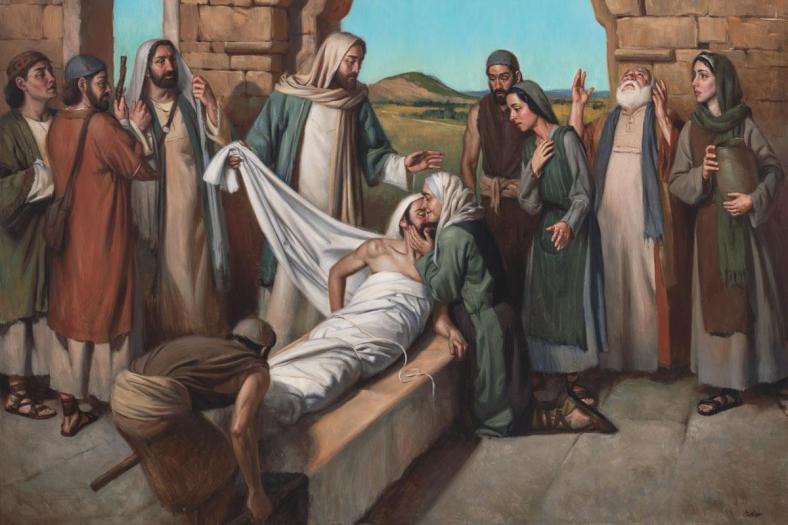
And in an odd way, that brings us back to the three resurrection stories in this week’s readings.  The thing each of these resurrection stories have in common is that the dead person was raised back to life for the benefit of someone else.  That applies to every resurrection story in the Bible, by the way, including the resurrection of Jesus.  The dead person is raised for the benefit of others.  That means that these stories are all about God’s compassion for those who are left behind. 

For the widow of Zarephath in 1 Kings who had been allowing the prophet Elijah to stay in her home, her son was her social security.  It would be his duty to provide for her in her old age, and without him she might become destitute.  That’s just how the world worked in those days.  The same thing holds true for the widow in Nain in the gospel of Luke.  When Jesus raised her dead son to life, he was actually saving two lives.   

The raising of Tabitha in the Book of Acts is a little different, but it’s still a story of someone being raised for the benefit of others.  The text tells us that Tabitha “was abundant in good works and benevolent giving.”  She was a woman of means and her little Christian community in Joppa depended on her generosity.  When Peter restored her to life, he was also restoring the community that depended on her.

We don’t always realize how dependent we are on each other.  “Don’t it always seem to go that you don’t know what you’ve got ‘til it’s gone?”

“You will lose someone you can’t live without, and your heart will be badly broken,” said Anne Lamott, “and the bad news is that you never completely get over the loss of your beloved.  But this is also the good news.  They live forever in your broken heart that doesn’t seal back up.  And you come through.  It’s like having a broken leg that never completely heals perfectly—that still hurts when the weather gets cold, but you learn to dance with the limp.”  

We all will go through that kind of loss at one time or another if we haven’t already.  We all, if we’ve loved at all well, learn to dance with a limp.  But more importantly, we learn to lean on each other and support each other as we walk each other home.  

Death is never very far away.  But God’s compassion is always right there embracing us.  If we’re even half awake, Death teaches us to really appreciate life—our own lives and everyone else’s.  That’s grace.  Death tells us to use the time while we have it,  to go ahead and go swimming in warm pools and oceans, to dive in and have a big juicy creative life of imagination and radical silliness and staring off into space.  Death reminds us that Christ has given us life in all its fullness and the promise of resurrection.  And each other.  Christ has given us each other.  Death is telling us to do the loving things not yet done and say the loving things not yet said.  While there is still time. 

God’s Agenda

God’s Priority List

Luke 4:16-27

At one time or another, I think we’ve all wanted something from God.  I think we’ve all had that one thing we wish God would do for us.  Or maybe even a list of things.  Or maybe in a moment of doubt we’ve just wanted God to show us some small sign to reassure us that God really is with us and on our side.  A lot of these wishes, especially the smaller ones, go unspoken.  But when we’re honest with ourselves—and with God—I think almost all of us have that something we’d like to see God do for us.

I suspect that there was something like that at work in the hearts of the people who came to hear Jesus in the synagogue at Nazareth.  They had heard great stories about their hometown boy made good—stories about healings and exorcisms.  They had heard that he spoke with authority, eloquence and wisdom.  Some people were already calling him a prophet.  So when his hometown people came to hear him speak in his hometown synagogue, it was only natural that they brought their hopes and expectations—their unspoken wish lists—with them.  And when Jesus read the passage from Isaiah that starts with The Spirit of the Most High is upon me, it must have just heighted their expectations.

They knew that passage from Isaiah.  I’m sure many of them were silently saying the words with him as Jesus read them.  God has anointed me to proclaim good news to those who are poor.  God sent me to preach liberation to those who are captives and recovery of sight to those who are blind, to liberate those who are oppressed.  To proclaim the year of the Most High’s favor.  They knew those words.  And the way Jesus was speaking them, it sounded like a proclamation he was making about himself.  And then, as if to remove any doubt, the moment he sat down to teach he said Today this scripture has been fulfilled in your hearing.

He owned the prophecy.  He claimed it.  

I can imagine a buzz of excited conversation in the synagogue.  People’s hopes were high.  Hard to believe this is Joseph’s son.  Remember that time he got separated from the caravan coming back from Jerusalem and his parents couldn’t find him for three days?  But look at him now!

Luke doesn’t tell us everything Jesus said as he was teaching.  But at some point he must have said something that they heard as a criticism.  Maybe he said something about their failure to fully embrace the kin-dom of God and help bring it about on earth as it is in heaven.  Maybe he criticized their lack of imagination or their unwillingness to take any risks on behalf of what God was trying to accomplish.  Maybe he criticized their hopes that God was going to fulfill their wish list, when Isaiah wanted them to understand that they were being invited to fulfill God’s wish list and that the Spirit could empower them to do it.

Somewhere in there, also, Jesus made it clear that the miracle shop was closed for the day.  He wasn’t going to do any exorcisms or healings.  It was the Sabbath, after all, and doing works of power—healing, exorcisms, that kind of thing, was better left to another day if wasn’t urgent.  It’s a bit ironic, really, because at other times in other places people got upset with him for healing and casting out demons on the Sabbath.  And isn’t that just human nature in a nutshell.  There’s always someone who’s looking for a reason to be upset.  

Jesus watched their expressions change as the shadow of disappointment and irritation fell across their faces.  He could see that his criticisms didn’t sit well with them.  He could see that they were starting to formulate their own criticism of him in response.  So he beat them to it. Of course you’ll all quote me this proverb, “Doctor, cure yourself!” and you’ll all say, do the things here in your hometown that we heard you did in Capernaum!  

We shouldn’t be too hard on the people of Nazareth.  I think we might have felt the same way.  Don’t we deserve a few miracles, too?  Come on, Jesus, this is your hometown!  We knew you when!  You’re one of us!

Jesus was a master at reading the human heart.  He could hear all the words that weren’t being said.  He could feel their sense of entitlement.  So he reminded them that neither he nor God were bound by their expectations.  He reminded them that there were times and stories in their own tradition when their prophets brought the power of God to others, to “outsiders,” even though there were needs and wish lists right here at home.  Truly I tell you, no prophet is accepted in their hometown.  But I speak truth to you all, there were many widows in Israel in the days of Elijah, when the heavens were closed three years and six months, and there was a sever famine over all the land.  Yet, Elijah was sent to none of them, rather to Zarephath in Sidon, to a widow woman.  And there were also many lepers in Israel in the time of the prophet Elisha, and none of them was cleansed except Naaman the Syrian.

That was the spark that set them off.  They felt they were being disrespected.  It was a slap in the face!  It offended their sense of privilege.  Jesus was one of them, after all.  If anyone had a right to experience his amazing works of power, they did.  They should come first.

And here’s the thing.  Jesus was not telling them that he didn’t love them or that God didn’t love them.  Jesus was not telling them that God wasn’t going to meet their needs.  He was just reminding them that God had already set an agenda, and that God’s agenda was his agenda, too.  He was reminding them that long ago God had spoken through Isaiah to tell them that those who were hurting the most would be attended to first.  He was reminding them that his mission was to proclaim good news to the poor, liberation for captives, recovery of sight for the blind, and liberation for the oppressed.   That was his first order of business.  

They didn’t like to hear Jesus so bluntly telling them that their wishes were not God’s top priority.  It confronted their sense of privilege, and they exploded in rage.  They shoved him out to the edge of town and were going to throw him off the cliff.  And that’s when he finally did a small miracle for them, though I doubt if they saw it that way.  He stopped them from doing something that would have scarred their consciences and damaged their souls for the rest of their lives.  He passed through the midst of them and went on his way, leaving them standing there as the anger and adrenaline seeped out of them.

We love to be told how much God loves us.  We love to be reminded of all the ways that God has provided for us and is looking out for us.  And we usually don’t mind being told that God loves others, too, although we sometimes bristle when we’re told that God loves and cares for people we don’t much like.  Anne Lamott said, “You can safely assume that you’ve created God in your own image when it turns out that God hates all the same people you do.”

And that was part of the problem in Nazareth.  The god in their heads, the god in their hearts ran headlong into the God of their scriptures when Jesus began teaching them what that beloved passage from Isaiah really meant.  God’s favor does not privilege home or nation, but it does prioritize those who are hurting most.

There’s an old story about a little girl who was outside playing with her two brothers when she fell and scraped her knee.  Her mom heard her crying and ran outside, scooped her up and brought her in to the bathroom to clean and dress her wounds, and while her mom was sticking a big Band-Aid on her knee, the little girl asked, “Mom, which one of the three of us do you love the most?”  Her mom looked at her for a moment, then kissed her forehead and said, “Whichever one needs me the most.”

We all want to hear good news.  But the ones who need it most are the poor.  We would all like to be liberated from one thing or another, but the ones who need it most are those who are really held captive.  We all would like to see the world more clearly.  But the ones who need it most are blind in one way or another.  We all would like more autonomy, more real freedom and justice in one way or another.  But the ones who need it most are people who are actually oppressed. 

Over the past few years as protestors responded to the alarming number of incidents of black people being killed in circumstances that highlight the racism inherent in much of American life, the slogan Black Lives Matter began appearing at protests and on social media.  When that slogan, Black Lives Matter, first appeared, a lot of white people responded with All Lives Matter.  

All Lives Matter.  Well, yes, that’s true, of course.  But it’s beside the point.  All Lives do Matter, but it isn’t All Lives who are dealing with profiling and bigotry and discrimination.  It isn’t All Lives dealing with the heritage of neighborhood redlining that creates ghettos and a kind of economic bondage that perpetuates poverty.  It isn’t All Lives who need to have The Talk with their children about how to stay safe and come home alive if you get pulled over by the police because your tail light is out.  Saying Black Lives Matter is necessary because Black Lives have too often and for too long been treated as if they don’t matter.  We can’t say All Lives matter until we’ve made it clear that Black Lives are included in the All.

Many white people have reacted negatively to Black Lives Matter.  They have responded from the blindness of White Privilege, and it upsets them to have someone suggest that such a thing as White Privilege even exists.  They may be quick to point out that their lives don’t feel privileged, that they have had their struggles, too.  What they say is true, but it’s beside the point.  White privilege doesn’t mean your life hasn’t been hard.  It just means that the color of your skin isn’t one of the things that makes it harder.

When Jesus had finished reading that powerful passage from Isaiah, The Spirit of the Most High is upon me.  God has anointed me… he followed the reading by saying Today this scripture has been fulfilled in your hearing.  Those last three words are important.  

In your hearing.  Are we still hearing him?  He was announcing that he had come to restore vibrance and equity to our world.  He was announcing that he was going to start where his attention and love and transformative power were needed most.  If we are his followers, then we have the same mission.  In our baptism we have received the Holy Spirit, too.  If we stand with Jesus then we, too, should say, the Spirit of the Most High is upon us. God has anointed us to proclaim good news to those who are poor.  God is sending us to preach liberation to those who are captives and recovery of sight to those who are blind. God is calling us to liberate those who are oppressed.  God is calling us to announce that now is the time of God’s favor.  The kin-dom of God is within reach.

Now is the time of God’s favor.  Now is the time to change the world.  Now is the time for liberty and justice and fairness for all… starting with those who need it most.   

The Wine of Celebration

John 2:1-12

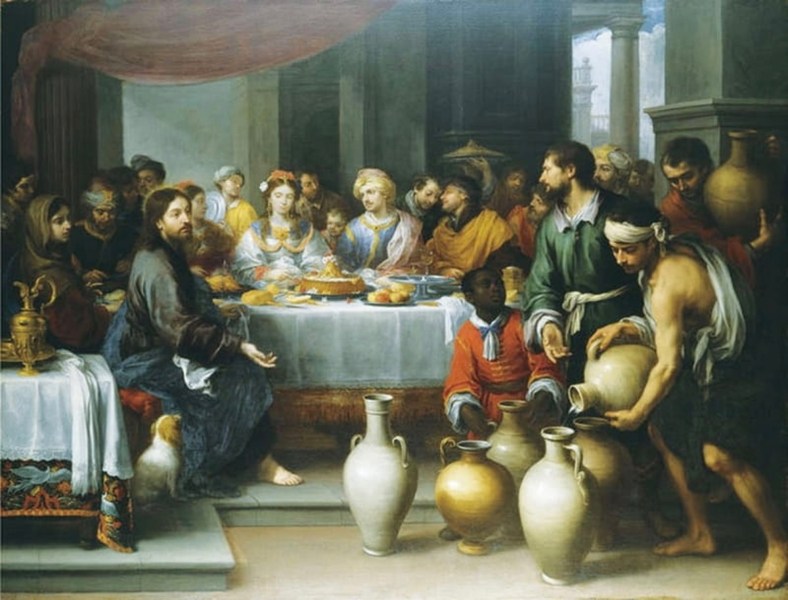
When Jesus’ mother comes to him during the wedding at Cana and tells him that the hosts have run out of wine,  Jesus says, “What concern is that to you and me?”  It’s really kind of funny to think of Jesus saying this to his mother.  “What does that have to do with us, Mom?”   I don’t know about you, but sometimes that’s how I feel when I read certain stories in the gospels, especially miracle stories.  My first thought at first glance is often, “Okay…but what does that have to do with you and me?”

Jesus turning water into wine at the wedding at Cana is often described as his first miracle.  But that’s not the word that the Gospel of John uses.  John’s gospel says it was the first of his signs.  Signs point to something.  Signs tell you that some kind of action is required or they alert you to something up ahead.  If you see a red octagonal sign, you put on the brakes.  If you see a sign that looks like a pointy-headed snake, a fat line that curves back and forth leading to a triangular arrowhead, you slow your roll because the sign has told you that you’re entering a stretch of road with tight curves. 

We refer to the sacraments as signs.  They are not symbols.  They don’t represent something else or invite us to think of something else.  The sacraments are signs of God’s presence and grace here and now.  They require action.  They require us to experience something.  Take and eat.  Drink this, all of you.  Put your head over the font or under the water and receive the Holy Spirit, then begin a whole new life in Christ and in the community of faith.  Right here.  Right now.   

When Jesus turned water into wine at the wedding at Cana, John’s gospel says it was the first of his signs.  The miracle itself, miraculous as it is, is not really what we’re supposed to looking at.  It’s pointing to something else.  So what are we supposed to see? What action is required in response?   What is being revealed about Jesus, and what deeper reality is Jesus revealing?  And is there maybe  something about us being revealed, too, in this miracle, this sign?

The word grace appears only four times in the gospels, all four times in the prologue to the gospel of John.  “And the Word became flesh and lived among us, and we have seen his glory, the glory as of a father’s only son, full of grace and truth.”  (John 1.14)  “From his fullness we have all received, grace upon grace. The law indeed was given through Moses; grace and truth came through Jesus Christ. (1:16-17).  Why does the word grace appear only in the prologue and not anywhere else in John’s gospel?  Professor Karoline Lewis suggests that if we take the Incarnation seriously, then once the Word becomes flesh, “the rest of John’s gospel shows you what grace tastes like, looks like, smells like, sounds like, feels like.”  

Jesus’ signs don’t just tell us what abundant grace is.  They show us.  Turning water into wine is a revelation, a revealing, of grace.  

In Jesus’ time wedding celebrations usually lasted a week and were essentially drinking parties.  There would be lots of food and lots of wine.  Friends and family might contribute food, but the wine was provided by the families of the bride and groom.  Running out of wine would be a huge embarrassment. It would indicate poor planning or poor finances or both.  

We can guess from little details that Jesus probably had some kind of family connection with the couple being married.  Jesus’ mother and brothers were there (2:12) and Mary seems to be comfortable giving orders to the servants, so maybe she was acting in some kind of semi-official capacity.  Maybe she was the wedding coordinator.  Whatever her relationship may have been, she was concerned for the reputation of the couple and the family.  For the couple, running out of wine would mean that their married life was off to a bad start.  The family would become the talk of the town, and not in a good way.  Jesus literally saved them all.  From embarrassment.

The guests were almost certainly poor people.  At least the majority would have been.  Most of the people Jesus knew were poor people, especially at this stage of his ministry.  These were people who worked in fields and vineyards, or fished, or tended livestock, or cut and hauled stones for Roman buildings.  These are folks whose lands have been plundered by ancient Palestine’s version of Big Agriculture—absentee landowners who did none of the work and kept most of the money.  Weddings were one of the few times these people could put all their troubles behind them and celebrate life.  A wedding was a time to drink, and sing and tell stories and dance.  But it would all be cut short if the wine ran out.  

The celebration was in full swing but it was all about to crash like a balloon being popped.  And then Jesus stepped in.  Grace stepped in.  Six stone jars full of water suddenly became wine.  One hundred twenty gallons of wine.  The best wine.  Exquisite wine.  Wine that would have cost them years of their wages.  Jesus turned water into wine so the celebration could continue.  

There was enough wine for everyone and then some.  There was abundance.  And everyone shared in it.  It wasn’t Pinot Noir for the better dressed and Rosé in a box for the rest.  Everyone, from the most prominent guest to the most humble  was served the best wine.  

This sign from Jesus doesn’t just tell us what abundant grace is, it shows us.  “From his fullness we have all received grace upon grace.”  Abundant grace—it tastes like the best wine when you’re expecting the cheap stuff…or even just water.  Abundant grace feels like being suddenly rescued from the worst kind of embarrassment.  Abundant grace looks like all your favorite foods spread out at a banquet.  Abundant grace sounds like music that gets in your bones and moves you with its happy rhythm and makes you dance before you even realize your body is swaying and your feet are tapping.  Abundant grace smells like baking bread and cake and wonderful sauces and fresh strawberries spread out at the buffet.  

Abundant grace fills you so full of life and joy and relief that you want everyone to have it.  You just have to share it.  Taste and see the goodness!

“Grace,” said Robert Capon, “is the celebration of life, relentlessly hounding all the non-celebrants in the world. It is a floating, cosmic bash shouting its way through the streets of the universe, flinging the sweetness of its cassations to every window, pounding at every door in a hilarity beyond all liking and happening, until the prodigals come out at last and dance, and the elder brothers finally take their fingers out of their ears.” 

In the eleventh chapter of 1 Corinthians, St. Paul scolds the Corinthians because when they gather together for their Agape feast, some of the more well-off persons are treating it as if it’s their own private picnic.  They have plenty of food and drink for themselves but they’re not sharing it.  Paul tells them that if they think their gathering is just about eating and drinking, then they should eat and drink at home because they’ve missed the point.  Then Paul reminds them that Jesus, on the night he was betrayed, broke bread and passed it out to everyone, then did the same with the wine.  When he said, “This is my body,” he was indicating that everyone who was sharing that bread with him was united to him, that they now would be the Body of Christ.  It’s not just the eating and drinking.  It’s also the sharing.  It’s the connecting of your life to mine and our lives to his.  It’s the unity.  So chew on that for a bit.  

Jesus turned water into a copious abundance of wine.  Embarrassment was averted. Joy was refueled.  That is what grace looks like.

What do the signs of Jesus point to?  Resurrection.  Life in all its fullness.  Joy—Christ’s joy in us so that our joy may be complete.  Light.  And Love. Grace upon grace.

And what does that have to do with you and me?  Well… we are the ones who get to drink this all in.  We are the ones who are still at the wedding, drinking the wine of celebration.  The best wine.  From his fullness we have all received—and are still receiving—grace  upon grace… so much grace that it has to spill out of us and overflow to others.  We are the ones who get to invite others to the abundant feast where the table is always full and the wine never ends.  That’s what all the signs of Jesus point to.  

The Speed of Life

The path is so familiar, so routine, so customary that her very shoes seem to know the way, which is a good thing since her mind seems to be off on a walk of its own.  Her steps are middling slow, but her thoughts, in her careful, sorting way, are occupied with speed.  Speed of light.  Speed of life.

Sixty-six thousand six hundred fifty-nine.  She thinks it in words but sees it in her mind’s eye as a number: 66,659.  Ever since she heard that number on the radio this morning it has loomed before her, driving out every other thought.  The speaker on the radio—an astronomer? an astrophysicist?—he threw out the number so casually as if it was something everyone already knew.  “Well,” he said, “we’re all moving around the sun at 66,659 miles per hour, so one way or another we’re making progress.”  And they had laughed, the astronomer and the radio host.  And what was that other number?  One thousand forty.  “Don’t forget,” said the astronomer, “that the earth is also rotating on its axis at 1,040 miles an hour at the equator, so nobody really gets to stand still.”

She stands still, or as still as she can given that she is moving around the sun at such a horrendous speed.  Her unfocused eyes do not see the sharp dazzles of sunlight glinting on the bay or the sleek ketch making its way toward the open sea or the pelican diving for an anchovy, or the other walkers on the path or their happy, eager dogs reading the scents that dodge about in the breeze.  She is a million miles away watching her lovely blue-green planet spinning like a dervish, singing itself through space in an endless elliptical tarantella with the sun as she, herself, chases it through space, racing to catch up as it speeds away from her.

The sun wraps her in light, warm and welcoming this close to the solstice, penetrating her long sleeves and wide-brimmed hat, teasing out memories.  You used to let me touch you the sun seems to say.  You used to lie on the beach and bathe in my light.  But that was before the ozone layer had thinned.  That was before skin cancer.  That was before.  That’s the problem with moving through space at 66,659 miles an hour she thinks.  In no time at all it’s all gone by.  In no time at all your ride is over.  She lifts her eyes to the horizon but the sights of the bay on this beautiful, nearly summer day are invisible to her.

She sees a face, that dearly beloved face she misses most, and her breath catches in her throat.  She sees that face she loves in all the ages she had known and loved it.  She sees it young and radiant, framed by chestnut hair, thick and full. She sees it older, rounder, accented by the soft lines of character and hair the color of steel.  She sees it old, thin, worn and weathered, the hair a cirrus cloud of wispy snow.  She sees the old dog they both loved so much, just for a moment out on the path ahead of her, looking back, smiling, then turning to amble on ahead.  She sees old friends, family, companions standing off in the distance, all of them swallowed by the light.

Surrounded by a great cloud of witnesses.  World without end. Amen.  The words come echoing up from the sanctuary of her memories, attached to half-forgotten melodies, rising from the pages of long-disused hymnals.  Oh, Jesus, must it all go by so fast?  Does it ever stop? she wonders.  And suddenly, despite the fact that the whole earth on which she stands is hurtling through space at 66,659 miles an hour, she truly is perfectly still.  No…she realizes, that’s not quite right.  I am not still, she thinks, I have stepped into stillness.  Stillness was waiting for me.  Stillness was waiting for me to stop running through life at 66,659 miles an hour.

And for the first time in this long day that has moved by so fast, she sees what’s in front of her and around her and above her and under her feet.  She sees the path, the friendly dogs, the smiling, chatting walkers, the boats, the birds, the trees, the grass, the sky of this real and present world.  She feels the sunlight on her face.  She feels the caress of the breeze and the gentle kiss of salt in the air.  She sees it, feels it, smells it, tastes it all in a clearer light, everything sharp and distinct, suffused with the Presence of the moment.  And she realizes that this moment is eternal.  That all moments are eternal.  That life is eternal.  She sees that everything and everyone she has ever loved has, indeed, gone on ahead and is, simultaneously, thanks to some divine relativity or theological quantum twist right there beside her.  She takes a deep breath and lets out a sigh of both intense longing and profound peace, and calls out to the old dog that only she can see, “Hang on, buddy.  I’ll catch up.”

Filling the Brackets

Luke 3:21-23, 31-38

Every week I send out the texts for the coming Sunday to our online worship production team.   A few days ago, Bob Siemer sent me an email saying he wanted to confirm a couple of things.  One of the things he wanted to confirm, in his words was, “You really are going to read the genealogy as part of the Gospel text (yawn).”

Well, I have to confess that when I first glanced at the gospel text that Wilda Gafney has given us for this week in the Women’s Lectionary, I felt pretty much the same as Bob.  Yawn.  But then I took a closer look at what Professor Gafney had done in translating this text from Luke.  When I looked more closely, I noticed the brackets.  

Luke and Matthew each give us a genealogy of Jesus.  For what it’s worth their genealogies don’t entirely agree, but each of them felt it was important to give us a picture of Jesus’s family tree.  Matthew starts with Abraham then takes the lineage forward in time until he gets to Jesus.  Luke starts with Jesus then takes the lineage backwards until he gets to Adam. And Eve.  Except that Luke didn’t mention Eve.  Or Ruth.  Or Rahab.  Or Tamar. Or Leah. Or Rebekah.  Or Sarah.  And that’s where Professor Gafney’s brackets come in.  In every instance in Luke’s genealogy where the women ancestors are known from the Old Testament stories that feature them, Wilda Gafney has inserted their names in brackets.  

Even though Luke doesn’t mention their names, these women whose names are in the brackets are also part of the human heritage of Jesus.  Their stories are part of his life just as much as the men who are named.  In some instances, their stories are more interesting than the men who are noted as their husbands, and yet they just got written out of the story when Luke was naming the ancestors of Jesus.

All this got me thinking…  How well do I know my own ancestors?  I have spent a bit of time on the website familysearch.org and have followed the my patrilineal line back to Sir Roger John Beckham, an English nobleman who lived from 1350 to 1386.  But I realized when I thought about Wilda Gafney’s brackets in Luke’s genealogy of Jesus that there is an enormous part of my own gene pool that I have entirely overlooked.  I haven’t filled in the empty brackets in my own heritage.

Nancy Ida Curtis.  Susan Elizabeth Casey.  Priscilla Phoebe Whiteley.  Rachel Ellen Daniels.  Harriet Owen.  Nancy Jane Moody.  Edith Elizabeth Davidson.  Emma Malmgren.  Hanna Maria Carlson.  Karolina Aurora Andersdotter.

I am directly descended from these women, yet most of their names were new to me.  I didn’t know about them until I traced things back through my grandmothers instead of my grandfathers.  My surname may have traveled down the line through my forefathers, but every bit of my mitochondrial DNA came from my foremothers.  If I don’t know about them, I know less than half of my own story.

It isn’t news that our culture and our church have been dominated by a male perspective since…well, forever.  History in general and church history in particular has been told primarily as a story of men.  Faithful, devout, and sometimes heroic men.  But from the very beginning there were also faithful, devout and sometimes heroic women, too.  It’s just that their presence and their roles have often been overlooked, which is really odd when you consider the fact that it was women who stuck by Jesus at the crucifixion.  It was women who first experienced the empty tomb.  It was women who first encountered the risen Jesus and it was women who first announced the resurrection to the men.  Who were in hiding.

In Sunday School and Bible studies we learn about King David.  And if we’re willing to read a little more deeply, we’ll learn about David’s great grandmother, Ruth.  Ruth was not even Jewish.  She was a Moabite.  But she loved her mother-in-law and stuck with her even after her husband died. She traveled back to Israel with her mother-in-law and became loyal to Israel’s God and three generations later her great-grandson became the king of Israel.  Luke tells us that Jesus was of the house and lineage of David.  This is his Jewish bona fides.  But if Jesus was of the house and lineage of David, King of Israel, then he was also of the house and lineage of Ruth, a woman of Moab.

The story becomes richer and more interesting when you follow the women.  Ruth married Boaz.  His mother was Rahab, a Canaanite woman.  She was the prostitute who hid the Israelite spies in her house in Jericho when Joshua was first preparing to attack the city.  She helped the spies escape by lowering them over the city wall in a basket.   The Jewish Women’s Archive (www.jwa.org) describes Rahab as “a woman triply marginalized—a Canaanite, woman, and prostitute [who]  moves to the center as bearer of a divine message and herald of Israel in its new land… She is remembered in Jewish tradition as the great proselyte, as ancestress of kings and prophets, and, in the New Testament, as ancestress of Jesus.” 

Why don’t we learn more about these fascinating women of the Old Testament?  Why don’t we know more about Deborah and Huldah and Hannah and Abigail, just four of the seven women prophets?   Did you know there were seven women prophets?

Why don’t we pay more attention to the astonishing women in the New Testament? How did we lose the story of Joanna, also known as Junia?  St. Paul refers to her as an apostle,[1]after all!  She travelled with Jesus and helped support his ministry.  She was a witness to both the crucifixion and the resurrection.  She crossed paths with and corresponded with Paul. Some scholars think she may even be the author of the Letter to the Hebrews.

Lydia of Phillipi, Phoebe of Cenchrae, Chloe of Corinth, Priscilla of Pontus, Thecla of Iconium.  All these women were partners in ministry with the Apostle Paul but we know so very little about them. 

We read and learn about St. Augustine, a great theologian and Doctor of the Church, but it was his mother, St. Monica, who steered him toward the church when he wanted nothing to do with it, then kept him in constant prayer, and finally  introduced him to St. Ambrose who could answer all his questions.

We celebrate Saint Patrick’s day every year, but why don’t we have parades for St. Brigid of Kildare, the mother saint of Ireland?  She founded several convents and monasteries, including Kildare which was a community where men and women could live together with equal status and equal responsibilities.  She had a tremendous influence on Celtic theology and Celtic liturgy. Because she oversaw several monasteries, she was regarded as a bishop.  Believing that the arts were an important expression of faith and devotion, she established a school of the arts at Kildare.  Much of what we know as classic Celtic art and illumination was either preserved or created by her artisans.

Why don’t we know more about Kassia of Constantinople?  She was a Byzantine-Greek composer, hymn writer and poet.  She is the only woman whose music is included in the Byzantine liturgy.

Why don’t we see more about St. Scholastica of Nursia in the church history books?  Her brother, St. Benedict, gets a lot of ink for establishing the Benedictine order and writing the Rule of Benedict, but she did the same thing at the same time establishing the Benedictine order of nuns.

Katharina von Bora, the wife of Martin Luther is fairly well known, as she should be.  But why don’t we hear more about Argula von Grumbach, the Bavarian noblewoman and writer who promoted and defended Luther and Melancthon with her essays, letters and poems?  Why do we not know more about how she challenged the University of Ingolstatdt’s faculty when they arrested a student on the charge of being “Lutheran?”

With all the Norwegian Lutherans, why don’t we hear more about Lady Inger Ottesdotter Romer, the powerful Norwegian noblewoman who promoted and financed the Lutheran Reformation in Norway and helped usher the Reformation into all of Scandinavia?

I could do this all day—naming women who have had a tremendous role in the scriptures and in the history of the church of Jesus Christ.  I could spend the rest of my life inserting brackets into the story of the Church.

I don’t know if we will ever be able to undo all the damage of patriarchy.  I doubt that we’ll ever be able to insert all the brackets that are needed to truly balance the history and understanding of our faith.  But I know we should try.

We say that Jesus is both fully human and fully divine.  One of the great things about that is that when we look at his human lineage we see a few people who were devout and heroic, but we also see a good number who were flawed and feckless.  In other words, human.   In the list of Jesus’s forebears, it was often the women, the people in the brackets who were the strongest, smartest, and most heroic.  Their strength and wit was part of the human heritage of Jesus.  They were part of who he would become and who he is.

Luke takes his genealogy of Jesus all the way back to Adam and notes that Adam was the child of God.  But so was Eve.  If we’re not listening to and learning the stories of all our grandmothers and mothers and sisters in our long lineage of faith, then we are learning less than half of the story.  

The 27th of January, just a few days ago, was the day the Church commemorates Lydia, Dorcas, and Phoebe.  In observing that commemoration, Guy Erwin wrote this:

It’s fitting, after a day in which we commemorated three male leaders of the early church, that today we think about three extraordinary women mentioned in scripture as important in their Christian communities. Within the social conventions of the ancient Mediterranean world, the public role of women was more circumscribed than that of men, but that didn’t prevent them wielding considerable influence, and even exercising some power within communities. Of course class and economic status intersect; wealth made women both freer and more restricted, as social convention often mattered most to the elite.

Lydia and Dorcas are both mentioned in the Acts of the Apostles: Lydia as a wealthy matron, active in her community in Macedonia; Dorcas as a helper of the poor in Joppa. Phoebe, who was part of a congregation near Corinth, is referred to by Paul with great respect. Historians know that what we know about the past is strongly shaped by who recorded the events and people, and that it’s important to look beyond that for other signs of those who are missing from or less regarded in the narrative. That’s often the case with the women in these stories. But we also don’t know much about many of the people on the sidelines, even the three male saints from yesterday.

The point for me is that it isn’t just the principals in the story, but the whole community that is part of the Christian story—not just those with names, but all the saints both named and unnamed. The story belongs to all of us, believers of every kind. We’re still making church history every day, and we stand in line with Lydia, Dorcas, and Phoebe. 

We stand in line with Lydia, Dorcas and Phoebe.  We are joined in communion with Kassia and Scholastica and Argula and Inger…and all the saints, named and unnamed.  The story belongs to us now.  Let’s try to live it and tell it in such a way that no one in the future will need to insert any brackets.


[1] Romans 16.7

Plague

Thoughts Along the Way…

In the year 165, Roman soldiers returning from their victory over the Parthians brought an unwelcome guest home with them.  As they battled the Parthians and camped in the borderlands, many of them contracted a highly contagious and lethal virus.  It began to decimate their ranks as they marched homeward.  The disease was probably smallpox and it spread through the empire like wildfire. It claimed the life of the emperor, Lucius Verus, in 169.  His co-regent, Marcus Aurelius also contracted the disease but survived.

That first Roman pandemic came to be known as the Antonine Plague and it lasted the better part of 20 years, sweeping across the empire in surges and waves.  Medical historians think there were at least two variants of the virus.  At its height, it is estimated that the plague was causing 5,000 deaths a day.  When it broke out again in 189, Cassius Dio documented a death toll of 2,000 a day.   Over a 23 year period, the Antonine plague claimed somewhere between 7 and 10 percent of the entire population.  In the army and in the densely packed cities, the rate was between 13 and 15 percent.  Cassius Dio wrote that caravans of carts loaded with bodies could be seen leaving the city every day, taking the dead to the countryside for burial or burning.

Needless to say, a plague with such a devastating mortality rate had a tremendous impact on every aspect of life in the Roman world.  Civic building projects, one of the primary engines of the Roman economy, came to a complete halt between 166 and 180.  On the other hand, Marcus Aurelius, in an effort to curry favor with the gods, sank enormous amounts of money into rebuilding and refurbishing the temples and monuments of the pagan deities of Rome.  On the whole, though, the empire’s economy tanked.  People avoided crowds.  Marketplaces languished.  Supply systems became disrupted and often there would be shortages of food and other goods.  There was a chronic shortage of workers, even slaves.  The mortality rate was so high in the army that Marcus Aurelius ordered the drafting of slaves and gladiators to fill the ranks.  Since the plague didn’t spare Patricians, their numbers thinned so much that the emperor decreed that the sons of freed slaves could fill administrative positions that had previously been reserved for the higher born. 

Christian communities changed, too.  For one thing, they began to grow in size at a steady pace.  People living in fear and confronted by mortality were much more ready to consider options in their understanding of things divine.  People also noticed that the Christians cared for each other when illness struck.  That was an attractive feature in an empire with no official provision for health care.  As they grew, the Christian communities became better organized and more cohesive.  Communication between communities increased as elders and bishops wrote to other elders and bishops about church practice and understanding of scriptures.  Infant and child baptism, which had been rare, became more common and widespread as anxious parents sought to ensure the eternal well-being of their children.  

The Antonine Plague changed everything in the Roman world.  As it dragged on, year after year, wave after wave, surge after surge people wondered if things would ever go back to the way they had been before.  And while things did eventually return to something more like normal, too many things had changed for their world to ever again be what it had been before the plague. 

Structures and functions of government had changed.  The military had changed.  The status of many people had changed.  Commerce had changed.  Christianity was more present, stronger, and more well-represented in the social mix of the empire.  None of these changes could have been imagined when the virus first marched in Rome with the homecoming soldiers. 

In this third year of our pandemic with Covid 19, I think it’s important to take stock of how this virus has changed us.  I think it’s important for us to make note of how living in a pandemic has changed our economy, changed our politics, changed out basic institutions, and challenged our infrastructure and supply chains.  Those things all affect us, and not just in practical ways.  Those changes can have a profound effect on how we understand our lives and how we live them.  

It’s also important to assess the impact that Covid has had on us psychologically and spiritually.  Especially spiritually.  How has it changed us?  How has it changed the way we respond to news and truth we don’t want to hear?  This virus has taken the lives of more than 860,000 of us in the U.S. alone.  How has it changed the way we value—or don’t value—life, especially the lives of others, the lives of people we don’t know or are not close to?  

In describing the meaning of the commandment You Shall Not Kill, Martin Luther wrote this: “We are to fear and love God, so that we neither endanger nor harm the lives of our neighbors, but instead help and support them in all of life’s needs.”  How are we doing with that?  In a time of pandemic when some rebel against the simple measures of wearing a mask properly, getting vaccinated, and avoiding in-person gatherings in enclosed spaces,  I think we need to take Luther’s understanding more to heart.  Are we doing everything we can so that we neither endanger nor harm the lives of our neighbors?   On some future day when the Covid pandemic is over, what will we think of the way we handled ourselves and our relationships in our own time of plague?