Love Story

I came across the best love story on Facebook this week, and I just had to pass it along to you.  A reporter was interviewing a man who had managed to get himself and his family out of Mariupol during the Russian bombing.  Here’s what he said:

“I left the bomb shelter and saw a car with keys in the ignition near the store.  I watched it for two hours, waited for the owner.  When the owner didn’t show up, I didn’t wait.  I took my family, got in the car and drove to Vinnitsa to stay with relatives.  I found a phone number in the glove compartment and called the owner:

“‘Sorry,’ I said, “I stole your car.  Saved my family.’

‘Thank God!’ he said. ‘Don’t worry, I have four cars.  I took my family out in my Jeep.  The rest of the cars I filled with fuel and left in different places with the keys in the ignition and the number in the glove compartment.  I received calls back now from all the cars.  There will be peace.  See you.  Take care of yourself.’”

As I said, it’s a love story.  Leaving those cars behind, gassed up and ready to go  with the keys in the ignition so that other people, strangers, could escape the hellish bombing of their city—that was an act of love.  That was God made manifest.  

“I give you a new commandment,” said Jesus, “that you love one another.  Just as I have loved you, you also should love one another.  By this everyone will know that you are my disciples, if you have love for one another.”

It isn’t doctrine that marks us as disciples of Jesus.  It isn’t our intellectual assent or understanding of the faith.  It isn’t embracing particular ideas about atonement or grace or the nature of Christ.  It isn’t our righteousness or our moral stance on hot-button issues.  It isn’t even “accepting Jesus into our hearts,” whatever that might mean.  “By this everyone will know you are my disciples,” said Jesus, “—if you have love for one another.” 

When Jesus was asked which of the commandments was the most important, he went straight to love.  “You shall love the Lord your God with all your heart, mind, soul and strength.  And love your neighbor as yourself.  There are no greater commandments.  On these two commandments hang all the law and the prophets. Do this and you will live.”[1]

When some of the people in Corinth got all wrapped up in their charismatic gifts and started to take a kind of overweening pride in their spirituality, St. Paul wrote to them with a word of caution:

“If I speak in the tongues of mortals and of angels, but do not have love, I am a noisy gong or a clanging cymbal.  And if I have prophetic powers, and understand all mysteries and all knowledge—if I have so much faith that I can move mountains, but do not have love, I am nothing.  If I give away all my possessions—even if I give up my body as a martyr—but do not have love, I gain nothing.”

A few years later, Paul said in his letter to the Christians in Rome:

Owe no one anything, except to love one another; for the one who loves another has fulfilled the law.  The commandments, “You shall not commit adultery; You shall not murder; You shall not steal; You shall not covet”; and any other commandment, are summed up in this word.  “Love your neighbor as yourself.”  Love does no wrong to a neighbor; therefore, love is the fulfilling of the law.

Paul’s descriptions of love in 1 Corinthians and Romans are excellent and instructive.  But they’re also rather passive.  When Jesus talked about love, he seems to have had something more active in mind.  Often when he talked about love, he would combine it with action.  “I say to you, love your enemies and pray for those who persecute you.”[2]  “Love your enemies and do good to those who hate you.”[3] When a lawyer tried to find a loophole in the commandment to love your neighbor by asking, “And who is my neighbor?” Jesus responded with a story about a Samaritan who rescues a traveler who had been left for dead after being beaten up by bandits.  Clearly, loving your neighbor involves action.  Love also involves generosity.  The Gospel of John tells us that God so loved the world that God gave God’s unique son to us.  Giving is an act of love.

All people are called to love, not just Christians, but followers of Jesus have been commanded to love so that we can be known as his disciples.   Love is supposed to be the thing that identifies us. Love is what we’re supposed to be all about…but how do you that?  Especially, how do you do that part about loving your enemies—or even just people you don’t particularly like?

You may already know that the ancient Greek language in which the New Testament was written had four different words for love: agape, eros, philia, and storge.  Storge was a word used to describe duty to family and country—think of it as patriotism.   Philia is friendship.  It meant a lot to call someone your friend in the ancient world.  True friendship, then and now, is a kind of love.  Eroswas the most commonly used word for love in the ancient world.  Our word erotic comes from eros, but properly understood there’s a lot more to it than that.  

Agape is the word for love that’s used most often in the New Testament.  Agape is a love that is unconditional.  It has no motive other than to seek the well-being of the beloved.  It can be spontaneous, but usually it is decisional—you simply decide that you are going to love that other person or those other people.  Period.  Agape is indifferent to any kind of reward and it doesn’t seek reciprocity— agape doesn’t ask to be loved in return.  Agape is the simple yet profound recognition that giving of yourself is a worthy and good thing to do.  It is an unconditional willing of good.  Agape loves the beloved for their own sake, whether they are worthy and deserving or not.

Eros, on the other hand, speaks of desire and longing.  Eros seeks to possess what we find valuable but not to covet or desire a person at the expense of overall well-being.  Edward Vacek defined erosas “loving the beloved for our own sake.”[4]  Plato thought that eros was the pathway to God.  His reasoning went like this:  I see a beautiful person or thing and I desire them or it, but if I look beyond the person or thing I find that what I am really desiring is beauty.  But beauty is truth, so if I look beyond beauty, I find that what I really desire is truth.  But truth comes from God, so what I am really desiring is God.  

Ilia Delio reaffirms that the heart of eros is passion or desire.  “Eros,” she writes,  “is that ineffable longing that stretches beyond oneself for the sake of oneself.”  She goes on to suggest that eros and agape aren’t so much in contrast with each other as related to each other and that philia—friendship—is the thread between them.  In philia a person gives themselves over to the relationship.  Philia is expressed in camaraderie and companionship, in life together in community.  Edward Vacek says that philia “may be the most cosmic form of love because it is based on mutuality, reciprocity, and cooperation—with the purpose of promoting overall well-being.”  That’s how the Quakers understood it, which is why they officially called themselves The Society of Friends.

Agape is the word for love that’s used most frequently in the New Testament, but there are moments when philia comes into the text to give love a meaning that is broader and deeper.  Jesus brings agape and philia together in John 15:13 when he says, “No one has greater love than this, to lay down one’s life for one’s friends.”  No one has greater agape than to lay down one’s life for one’s philon—those who are loved with the deep bond of philia.  He goes on to say, “You are my friends (philia/philon) if you do what I command you.”  And what did Jesus command?—that we should love one another with agape love as he has loved us.  

So how do you love—how do you obey the command to love?  Well to start with, it helps to realize that the kind of love Jesus commands doesn’t have to involve any warm, fuzzy emotions.  You can decide that you will unconditionally will and work for goodness for others without expecting anything to come back to you.  You can decide to love with agape.  That’s the starting point.

But agape can be a poor kind of love if it doesn’t bloom into something more than just a decision.  If it remains simply a decisional kind of love, it can become rote, individualistic, non-mutual, and even task-oriented.  Yes, agape is patient and kind, it’s not envious or boastful or arrogant or rude, it does not insist on its own way, it rejoices in truth, it bears all things, believes all things, hopes all things, endures all things, and doesn’t quit—agape has all those qualities that St. Paul pointed out to the Corinthians.  But agape can be all that and a bag of chips and still not be warm enough to bloom into a real relationship.  Love, complete and healthy love at work in a community of faith, starts with a good base of agape, but mixes in a good dose of philia, friendship, and even a dash of eros, to keep us longing for God, for each other, and for the beauty of our relationships.

From the beginning of creation, God has been pouring love into the universe and calling us into relationship.  Love is the force that brings quantum waves together to form hydrogen atoms and hydrogen atoms together to form stars.  Love is the force that drives evolution, overcoming entropy to continually transform biological life into higher, more complex, more aware forms of life—forms capable of loving.  We are commanded to love because it is intentional love that identifies us as followers of Jesus, but even more importantly, because love is what God has been using throughout all time to transform the all of creation.  When we reflect that love back to God and to each other, we participate in God’s formative and transformative work.  

Pierre Teilhard de Chardin wrote, “The day will come when, after harnessing the ether, the winds, the tides, gravitation, we shall harness for God the energies of love.  And on that day, for the second time in the history of the world, humanity  will have discovered fire.”

Love is patient and kind.  Love does bear all things and believe all things and hope all things, and endure all things.  But love goes beyond that.  Love puts gas in the car and leaves the keys in the ignition so that beloved strangers can escape to new life.  Love promises there will be peace.  

May the Spirit ignite in all of us the bright flame of God’s transforming love.


[1] Mark 12:28-34; Matthew 22:36-40; Luke 10:25-28

[2] Matthew 5:43

[3] Luke 6:27

[4] Edward Collins Vacek, Love, Human and Divine: The Heat of Christian Ethics, 1994, pp. 157-158; as quoted by Ilia Delio, The Unbearable Wholeness of Being, Orbis Books, 2013, p.42

Of Mothers and Vineyards

It’s Mother’s Day today, so naturally, I’ve been thinking about my mom.  My mom told me once that I’d never amount to much because I procrastinate too much.  I said, “Oh yeah?  Well just you wait.”  

I’ll never forget one Mother’s Day—we had a big family meal at Mom and Dad’s house but right after dinner Mom kind of disappeared.  I found her in the kitchen getting ready to wash a sink full of dirty dishes.  I said, “Mom, it’s Mother’s Day!  Go sit down and relax.  You can do the dishes tomorrow.”

I bought my mom a mug that said, “Happy Mother’s Day from the World’s Worst Son.”  I forgot to give it to her.  

Mothers often put their own needs last.  You know you’re a mom when you understand why Mama Bear’s porridge was too cold.

I love the recipe for Iced Coffee that one mom posted on Twitter.  She wrote, “Have kids…Make coffee…Forget you made coffee…Find coffee…Put it in the microwave…Forget you put it in the microwave…Drink it cold.”

Mother’s Day was first proposed by feminist activists after the Civil War.  They originally envisioned it as a day of peace to honor and support mothers who had lost sons and husbands to the carnage of the war.  The most well-known of these women was the abolitionist, Julia Ward Howe, who wrote The Battle Hymn of the Republic. In 1870, she issued a Mothers Day Proclamation calling for mothers of all nationalities to band together to promote the “amicable settlement of international questions.”  She envisioned a day where women from all over the world would meet to discuss ways to achieve world peace.  In that proclamation she wrote:

“Arise, then, women of this day!  Arise all women who have hearts, whether our baptism be that of water or of tears!…We women of one country will be too tender of those of another country to allow our sons to be trained to injure theirs.  From the bosom of the devastated earth a voice goes up with our own.  It says “Disarm, Disarm!  The sword of murder is not the balance of justice.”

Another early proponent of Mothers Day was the education activist and community organizer, Ann Maria Reeves Jarvis.  She was very active in her Methodist congregation and in 1876, during her closing prayer for her Sunday School class,  she said, “I hope and pray that someone, sometime, will found a memorial Mothers Day, commemorating her for the matchless service she renders to humanity in every field of life. She is entitled to it.”  Her daughter, Anna Maria Jarvis, never forgot her mother’s prayer, and on May 10, 1908, three years after her mother’s death, Jarvis held a memorial ceremony to honor her mother and all mothers at Andrews Methodist Episcopal Church in Grafton, West Virginia.  That church is now a historic landmark known as the International Mother’s Day Shrine.

Anna Jarvis continued lobbying to make Mothers Day an official holiday in the United States.  By 1911 Mothers Day was being observed in every state, and in 1914, President Woodrow Wilson signed a proclamation officially designating the second Sunday in May as Mothers Day. 

And here’s an odd but important note:  originally there was no apostrophe in Mother’s Day.  Julia Howe, Ann Reeves Jarvis, and Anna Jarvis all envisioned it as a day to honor all mothers.  Plural.  But the greeting card industry, the florists, and the candy makers quickly individualized it and idealized it, and began promoting it as a day for you to honor your mother.  In their advertising, Mothers Day (plural/all mothers) quickly became Mother’s Day with an apostrophe, as in your mother’s day (singular/possessive).  Needless to say, the idea of it being a day to promote international peace pretty much vanished with the arrival of that apostrophe.

Ann Jarvis, who had worked so hard to make Mother’s Day a national observance, ended up hating it. The holiday became so commercialized, that in 1943 she tried to organize a petition to rescind Mother’s Day, but her efforts went nowhere.  Frustrated, and literally at her wits’ end, Anna Jarvis died in 1948 in a sanitarium, her medical bills paid, ironically, by a consortium of people in the floral and greeting card industries.

Anna Jarvis wasn’t the only one who has problems with Mother’s Day.  Anne Lamott’s column a few days ago began this way: “This is for those of you who may feel a kind of sheet metal loneliness on Sunday, who had an awful mother, or a mother who recently died, or wanted to be a mother but didn’t get to have kids, or had kids who ended up breaking your hearts…”  Lamott goes on to acknowledge many of the ways that this Greeting Card holiday can be painful for many women…and also for many children.

Most pastors I know are ambivalent at best when it comes to Mother’s Day.  It’s something of a minefield for us.  We don’t dare let it go unmentioned, but at the same time we are very aware of those women in our congregations who for one reason or another will be feeling that “sheet metal loneliness” that Anne Lamott describes.

On the plus side, though, Mother’s Day does give us an opportunity to highlight issues that women face in a world and culture that still operates with far too much patriarchal dominance and oppression, often in ways that men don’t even see.

One of the issues that comes up every year around Mother’s Day is the question of whether or not stay-at-home moms should be paid.  This question has been highlighted by the pandemic when so many women found it necessary to become stay-at-home moms and had to take on the extra duties of tutoring or teaching their kids.  CBS News reported that during the pandemic, more that 12 million women lost jobs and more than 2 million voluntarily left the workforce altogether. 

There are some very good arguments for creating a basic income for the stay-at-home mom… or the stay-at-home dad, for that matter.  At its most basic level, such a stipend would remind us that parenting is a valuable job and that the community as a whole benefits from it being done well.  The question then becomes how much should the stay-at-home mom be paid, and the answers to that are all over the lot.  One economist totted up the “jobs” that a stay-at-home mom does, multiplied by the minimum wage and came up with $18,000 per year.  Insure.com did the same math for the 18 or so jobs a mom takes on during the day, used a more livable hourly rate, and came up with $126,000 per year.  Salary.com’s annual Mom Salary Survey from May of 2021, said that moms should be paid $184,820 per year.   Clearly,  the marketplace recognizes that parenting is valuable.

Parenting is valuable, but one of the problems with Mother’s Day is that it reinforces a cultural expectation that puts the weight of parenting primarily on Mom.  That’s unfair to Mom and limits a child’s experience because even SuperMom can’t really do it alone.  As the old African proverb reminds us, it takes a village to raise a child.  “My main gripe with Mother’s Day,” writes Anne Lamott, “is that it feels incomplete and imprecise.  The main thing that ever helped mothers was other people mothering [their children], including aunties and brothers; a chain of mothering that keeps the whole shebang afloat. I am the woman I grew to be partly in spite of my mother, who unconsciously raised me to self-destruct; and partly because of the extraordinary love of her best friends, my own best friends’ mothers, and from surrogates, many of whom were not women at all but gay men. I have loved them my entire life, including my mom, even after their passing.”

Raising children is a community affair.   It should be done with an eye on what’s best for the community.  We lose sight of that too often.  We think good parenting means raising kids who will share our cherished internal family values.  That’s good as far as it goes, but the child really needs to be prepared for the time when they will leave home to enter the world on their own.  They need to be prepared to not just make a valuable contribution to the community, but to be a positive contribution to the community.  Parents need to remember that their children are not just a gift that God gives to them, but a gift that they, in turn, give to the world.  We need to send our children into the world equipped with empathy, wisdom, patience and understanding, and developing those attributes requires more influence than any one parent can provide. 

Jesus told a story in chapter 20 of the Gospel of Matthew about a man who went to the marketplace one morning to hire some workers, and before sending them out to work in his vineyard, he made a verbal contract with them to pay them the basic daily wage of one denarius.  A few hours later, he went to the marketplace again and hired some more workers and said, “I will pay you whatever is right.”  He went to the marketplace three more times during the day to hire more workers, the last time just an hour before sunset, and each time he told those workers that he would pay them “whatever is right.”  At the end of the day when all the workers lined up to receive their pay, he paid the workers who had only been in the field for an hour a denarius, the whole day’s wage.  Naturally, the workers who have been working since sunrise figured they were in for one heck of a bonus, but when it was their turn to be paid, the man paid them, too, a denarius, the daily wage.  They were upset about this and groused about it. “These latecomers only worked an hour and you’ve made them equal to us even though we were out here in the heat all day!”  The landowner responds, “Friend, I am doing you no wrong;  didn’t you agree with me for the usual daily wage? I chose to give the latecomers the same as you.  Am I not allowed to do what I choose with what belongs to me?  Or are you envious because I am generous?”

This parable makes a lot of people squirm, mostly because we tend to feel slighted on behalf of those workers who were out in the hot sun all day.  On the flip side, we tend not to feel any joy on behalf of the one-hour workers who got what amounts to an amazing bonus.  I think we feel all this because we lose sight of what this parable is all about and our focus is in the wrong place.  

This is not just a story about wages—how much should the fieldworker get paid per hour or how much should the stay-at-home mom be paid—this is a story about what’s best for the community.  Jesus starts the story by saying “The kingdom of heaven is like…”  The context is bigger than the owner of the vineyard or the workers.  The owner of the vineyard understands that he is not just paying workers to harvest his grapes on his property, rather, he is providing a means of support for the whole community.  He understands that by paying the one-hour worker the full wage, he is creating one less beggar in the marketplace, preserving that person’s dignity, and helping to feed that worker’s family for days.  He understands that by paying all the workers the same wage he is sending the message that they are all equally vested in the good of the community.  Even the worker who complained noted “you made them equal to us.”  The landowner understands that his wealth, his resources are not just for his own personal benefit or his family’s, but are meant to be used to make the whole community healthier and stronger.  I suppose you could say he’s “mothering” the community.

And that brings us back around to the original intent for Mothers Day.  It was intended to be something to strengthen the community and bring peace to the world.  This Mothers Day, I invite you to do just that.

Water is Life

Two headlines grabbed my attention on Thursday morning.  The first one, in the LA Times said, “With less water, Southland will see browner landscape. Officials are imposing limits that could get even more strict.”  The second headline was from The Week and said, “Ocean animals face potential mass extinction from climate change, according to a new study in the journal Science.”  That headline was followed by a synopsis that said, “Rising temperatures and declining oxygen levels are cooking, starving and suffocating marine life.  Unless humanity takes swift action to curb fossil fuel use and other planet-warming activities, climate-fueled die-offs could rival the demise of the dinosaurs, research shows.”

It was an interesting juxtaposition.  Both stories were about water and climate change.  The first story emphasized how the drought is going to affect the aesthetic preferences of humans in Southern California.  With the new water use restrictions, our green lawns will be fading to brown.  People are not happy about that.  The second story was about how creatures that live in water are threatened with extinction because the emission of greenhouse gases from human industries and transportation has warmed their environment too much.  I would like to think that people aren’t happy about that, either.

Water is life.  That’s true for every living creature on earth.  Somewhere between 20% to 80% of all the earth’s creatures live in water.  The number is uncertain because no one really knows how many species live in the depths of the oceans.  Their need for water is obvious.  It’s their habitat.  But land creatures need water too.  Water is an essential element in all kinds of organic processes.  We have never found any living organism that can flourish in a completely dry environment.

71% of the earth’s surface is covered by water—332.5 million cubic miles of water—but that water only accounts for 0.02% of the planet’s total mass.  97% of the earth’s water is salt water in the oceans.  Only 3% is fresh water.

2.5% of the earth’s fresh water is unavailable because it’s locked up in glaciers, polar ice caps, the atmosphere, or soil.  Or it’s highly polluted.  Or it lies too far below the earth’s surface to be extracted at an affordable cost.  It the end, only 0.5%–one half of one percent—of the earth’s water is available fresh water, the water we drink, the water we use to water our lawns and gardens.  If the world’s total water supply was 100 liters (26 gallons), our usable supply of fresh water would be only about 3 ml (about half a teaspoon).

In ways you probably haven’t thought of, you are a water creature.  The human body—your body—is 60% water on average.[1]  Your brain and heart are 73% water and your lungs are about 83% water.  Your skin is 64% water, your muscles and kidneys are 79% water, your blood is 90% water, and your eyes are 95% water.  Even your bones are 31% water.  You can go a month or more without food, but the average person would die after only 2 to 4 days without water.  

Water is life.  Water is life because it has unique properties that make life possible.  It is the only natural substance where all three physical states—liquid, solid and gas—occur naturally on earth.  Water is the universal solvent. That means that it can carry other elements and compounds.  Your blood is 90% water but that water carries sodium, potassium, iron, and all the other minerals and nutrients your body needs.

Water is life.  And water is holy.   

Water is mentioned 478 times in the Bible:  

The primordial waters of Creation with the Spirit hovering above them.

The waters of the Flood.

The wells where relationships were formed, where Rebekah is brought to Isaac, where Jacob meets Leah and Rachel, where Moses meets Zipporah.

The waters of the Red Sea which Moses parted to reveal a pathway to freedom.

The waters of salvation which Isaiah speaks about and invites everyone to drink: “You will drink from the wells of salvation; Ho, all you who thirst, come to the water.”

The waters of justice that Amos calls us to produce: “Let justice roll down like waters and righteousness like an ever-flowing stream!”

The waters of the Jordan where Jesus was baptized by John, where the Spirit descended upon him like a dove and the voice of God proclaimed “This is my son, the Beloved.”

The waters of Galilee where fishermen were called to follow Jesus and became disciples of the Way, waters that Jesus sailed across and walked upon.

The waters of the well in Samaria where Jesus asked a Samaritan woman for a drink, talked with her about worship and told her that he could give her living water.

The waters of the Mediterranean that Paul sailed across to carry the gospel of Christ to the Gentiles and diaspora Jews in far places. 

The waters of the River of Life in Revelation, bright as crystal, flowing from the throne of God where the Spirit echoes the words of Isaiah and says “Come, let everyone who is thirsty come.  Let anyone who wishes take the water of life as a gift.”

Water is sacred.  

In his baptism, Christ was immersed in the waters of the world.  When we were baptized, the water we were submerged in or sprinkled with was a sign that we are immersed in the love and life of the triune God but also in the waters of Creation, the waters of the world.

What does it say about us when our way of life on this planet leads directly to the death and extinction of our fellow God-created creatures who live within the sacred life-giving waters of the earth?  

What does it say about us when our own trash pollutes the waters we rely on to such a degree that now our own bodies are tainted with microplastics?  

When we are claimed by the waters of baptism, we enter into a Covenant with certain declarations and promises.  We reject sin.  We renounce all the forces that defy God.  We renounce the powers of this world that rebel against God.  We renounce the ways of sin that draw us away from God.  We promise to “serve all people, following the example of Jesus,” and to “strive for justice and peace in all the earth.”  

In the waters of baptism we pledge our allegiance to the Kin-dom of God.  We volunteer to stand against evil and its power in the world and to live in the Way of Christ.  We vow to stand for justice, to be peacemakers working for God’s shalom.  We pledge to reject all types of violence, coercion, domination and oppression,  and to care for and protect all of Creation with fierce love. 

I’m pretty sure he would never claim to be speaking as a follower of Jesus in the Covenant of baptism, but Joaquin Phoenix, interestingly, captured much of what our baptismal covenant is all about in his Academy Award acceptance speech in 2020.  Here’s part of what he said:

“I think the greatest gift is the opportunity to use our voice for the voiceless… I think at times we feel or are made to feel that we champion different causes.  But for me, I see commonality.  I think, whether we’re talking about gender inequality or racism or queer rights or indigenous rights or animal rights, we’re talking about the fight against injustice.

“We’re talking about the fight against the belief that one nation, one people, one race, one gender, one species, has the right to dominate, use and control another with impunity.

“I think we’ve become disconnected from the natural world.  Many of us are guilty of an egocentric world view, and we believe that we’re the center of the universe.  We go into the natural world and we plunder it for its resources…

“We fear the idea of personal change, because we think we need to sacrifice something; to give something up.  But human beings at our best are so creative and inventive, and we can create, develop and implement systems of change that are beneficial to all sentient beings and the environment… I think that’s when we’re at our best: when we support each other.  Not when we cancel each other out for our past mistakes, but when we help each other to grow.  When we educate each other; when we guide each other to redemption.

“When he was 17, my brother [River] wrote this lyric.  He said: “run to the rescue with love and peace will follow.”

In our covenant with God and the earth, we are called, as Joaquin Phoenix said, to be a voice for the voiceless.  Water has many voices—the thunder of a waterfall, the waves that lap against a boat or crash against the shore, the burbling of a stream, the splash of a puddle, the rushing flow from a tap or shower head.  Water has many voices, but the world has forgotten how to listen to them.  We need to speak for the waters.

We need to speak for the waters because the waters have spoken for us.  Every drink of water is a reminder of how God provides for us.  Every time we shower or bathe, Christ is in, with, and under the waters that cleanse us, singing about our baptism, giving us a sign to remind us that we are immersed in the life and love of the Father, Son and Holy Spirit.  When we wade or swim, the waters that embrace us are a sign of our inclusion in this wet and wonderful God-made world.  Water is our intimate connection to the natural world. All the waters of our life tie us to the well-being of the earth and all its creatures.  The waters remind us that we are water creatures, too.  

In the Canticle of Brother Sun and Sister Moon, St. Francis sang, “Praised be you, my Lord, through Sister Water who is so useful, humble, precious, and pure.”

May God teach us to love Sister Water.  May the Spirit that hovered over the waters of Creation, empower us to conserve and care for the water that sustains us and all life.  May Jesus, by the Living Water of his word keep us in harmony with the water that flows in our veins.  May the One who made us continually remind us that we have a kinship with water and all the creatures that live and move and have their being in water.  

We humans have brought distress to the waters of our world.  May we, as people of faith, be inspired to “run to the rescue with love,” trusting that peace will follow.

In Jesus’ name.


[1] The actual number varies from 45% to 75%.  Body composition varies according to gender and fitness level and amount of fatty tissue.

The Days of Our Lives

I was reading through the Book of Genesis, as one does, when a repeated phrase in chapter 5 made me pause. The phrase was “all the days of” as in “Thus all the days of Seth were nine hundred twelve years.”  As I noted, the phrase gets repeated: “all the days of Enosh;”  “all the days of Kenan,”  and so on.  Adam, Seth, Enosh, Kenan, Mahalalel, Jared, Enoch, Methuselah, Lamech—each of them was given lots and lots of days, according to Genesis 5,  but after telling us how many years of days they lived, each account ends with a stark “and he died.”  Well, except for Enoch, but he was a special case.  

Apparently God thought this kind of longevity was excessive.  Right out of the chute in chapter 6 we read, “Then the Lord said, “My spirit shall not abide in mortals forever, for they are flesh; their days shall be one hundred twenty years.”  It looks like that was meant to be an upper limit and not a prescription for everybody because almost nobody actually gets that old.  The longest verified human lifespan in recent times is that of Jeanne Louise Calment of France (1875–1997).  Genesis would say the days of Jeanne Louise were one hundred twenty-two years and 164 days; and she died.  So she got a couple of bonus years on top of the 120.  Good for her. 

In Psalm 90 that upper limit gets a few more years lopped off.  “The days of our life are seventy years, perhaps 80 if we are strong,” we read in verse 10.   Tradition says that Psalm 90 was written by Moses.  If so, then Moses was in a pretty dark mood that day. It’s not a happy Psalm, Psalm 90, and the curtailed life span is the least of its gloominess.  Oy.

The point of all this is that our days on this earth are numbered.  Frankly, I’m okay with that, even though I’m indisputably closer to the end than to the beginning.  C’est la vie, as Jeanne Louise would say if she were still here.  I’m okay with going on to what comes next, especially since I’m pretty sure that time will be experienced in a very different way—if we experience it at all. It’s all in God’s hands, so it’s all good.

Here’s what’s not good and what I’m not okay with: if we don’t clean up our act, then life on earth, at least life as we know it, is in real trouble.  If we don’t make some major changes starting yesterday, then our days as a species are numbered…and we’ll take a lot of other species with us.  Scientists are already calling our age the Anthropocene. They give names like that to bygone eras of mass extinction.  Anthropocene.  From anthropos, the Greek word for human.  When they call this current era the Anthropocene, they are saying that this is the era in which humanity has caused the extinction of massive numbers of other species.  Not our proudest moment.

I don’t care so much about my own personal extinction.  Don’t get me wrong, I’m not in any hurry to shuffle off this mortal coil, but I’m also not worried about it.  It will come when it comes.  On the other hand, I care quite a lot about the threat of extinction to the various biomes of this beautiful planet, and all the other creatures that share the earth with us.  I quite like dogs,  for instance.  And cats and horses and frogs and dolphins and owls and even crows.  And octopuses, who, it turns out, are quite smart!  They didn’t have a say in the damage we’ve created with our massive carbon footprints.  They weren’t given a vote when our plastics were swept into the waters of the world.  I rather suspect they would have objected.  Strenuously.  I also care quite a lot about my children and grandsons and their potential progeny.  I would like for them to live in a world at least as nice as the one I’ve lived in.

Helen Caldicott once wrote, “We didn’t inherit the earth from our parents, we have borrowed it from our children.”   She has a really good point.  We did inherit some things from our parents, especially attitudes and habits that can have a profound effect on what the world will be like when we hand it over to those who come after us.  It would do us all a world of good if we treated the world as if we were renting it from the future and wanted to return it in better shape than when we entered it so we can get our security deposit back.

We are Easter people.  We believe that God can and will give all of creation a new birth, a resurrection life.  But let’s leave the timing of that up to God, shall we?  Killing the planet simply because we believe that God can un-kill it would not reflect well on us.  It’s not a good look and it will upset our grandkids.

There is a lot of amazing work being done to develop new energy and transportation sources as quickly as possible (see https://www.sciencedaily.com/news/matter_energy/batteries/.)  The world of science and technology has finally realized that we’re on a pretty serious deadline here and that there’s more at stake than impressing their colleagues.  There is really is hope for the future.  It’s slim, but it’s there.  We can help is if we all figure out how we can conserve and contribute less to the problem.  You’re all using LED lightbulbs, right?  

Your days and my days are numbered, but let’s do what we can to make sure that the world God loves (John 3:16) has a much longer and healthier run.

Back to the Dirt

Genesis 1:26-31; 2:1-15

When I was a kid, almost every summer we would travel back to Kansas, Missouri and Arkansas to see my aunts and uncles and cousins.  One of the things that was always a treat when we were at my grandparents’ dairy farm in the Ozarks of Arkansas was the fresh vegetables from my grandmother’s garden.  The soil in that garden was a rich, black humus the color of chocolate cake, and it produced the juiciest tomatoes, the fattest cucumbers, the most savory okra, and the sweetest sweet corn I’ve every tasted.  Those vegetables spoiled me, and I’ve been disappointed with grocery store produce ever since.  

My grandmother and my aunts were expert vegetable gardeners.  They knew when to plant, when to weed, and the perfectly ripe moment for picking.  Their skills brought the vegetables to the table.  But it was the soil that made them delicious.

Genesis tells us that God formed the first human out of “the dust of the earth.”  The Hebrew word for “human,” adam, is derived from the word for earth: adamah.  The word we translate as dust, ‘afar, can mean any loose dirt.  I like to imagine that the “loose dirt” we’re made of is not dry desert dust but the dark, chocolate-cake soil made rich and fertile from eons of composting as the ground organically recycled the fallen leaves and stems of earlier seasons and renewed itself.  I like to imagine that we humans were made from humus.

Humus and human come from the same root word in Latin.  Our language itself gives us a clue that we are intimately connected to the earth.  In recent generations, though, we’ve often lost sight of that connection.  We have separated ourselves from the earth in far too many ways, and that separation has affected both our health as a species and the health of the world.  

Humility is another word that comes from humus.  Douglas Kindschi, the Director of the Kaufman Interfaith Institute wrote: “Fully understanding who we are requires the realization that we are part of the earth, the soil, the humus, to which we will return.  It is only by God’s grace that we have life.”  We didn’t create our species.  We didn’t create the amazing world that sustains us.  If we all disappeared tomorrow, the planet wouldn’t miss us; if anything, it would breathe a sigh of relief.  It is only by God’s grace that we have life.  We need to be humble enough to remember that.  When life is over, the stuff we are made of will return to the earth.

Did you know that the smell of humus elicits a physiological response in humans?  Breathing in the scent of Mother Earth stimulates the release of the hormone oxytocin.  That’s the same hormone that promotes bonding between a mother and her child.  It’s the same hormone that helps us bond with our dogs and cats and other pets.[1]  Clearly, we were made to feel a bond with the earth, but it’s hard to keep that bond strong when we live our lives primarily indoors and cover so much of the ground with asphalt and concrete.  I can’t help but wonder what would happen if we all went outside once a day, scooped up a big handful of humus, and deeply inhaled the aroma of it.  Maybe we would treat our planet a lot better if we did that—if we reminded ourselves in some physical, ceremonial way that we are bonded to the earth.

“Being human,” said Richard Rohr, “means acknowledging that we’re made from the earth and will return to the earth.  We are earth that has come to consciousness.”  We are earth that has come to consciousness, but we have been destructively unconscious in the way we have been treating the earth.  We take the earth so much for granted.  We forget that the very ground we stand on is a mystic wonder of theology and physics and a biological and chemical marvel.  It is the stuff from which life arises.

One afternoon when the philosopher Brian Austin came home from hiking with his family, he found himself contemplating the mud that was stuck to his boots and he realized that “the mud, still glistening with the mist that makes dust come to life, harbors mysteries as magnificent as the mountains.  From that mud, from its carbon, nitrogen, hydrogen, oxygen, and assorted metals, a child can be woven.  The atoms in that mud, the same kinds of atoms that comprise my children and you and me, have existed for billions of years…This mud is spectacular, and we believe that God made it so.  This mud is rich, pregnant with possibility…To see ourselves as made of the same stuff that rests under our boots as we journey a mountain path is no insult to human dignity, no affront to the image of God in us; it is rather a reminder of the majesty of inspired mud, a reflected majesty that gives us but one more fleeting glimpse of the blinding brilliance of the maker of the mud.”

If we are going to repair the damage we’ve done to the earth, we need to learn to love the mud.  And the dust.  And the clay and the sand and the stone and the water.  We need to relearn how to love all the plants and animals—“the fish of the sea, the birds of the air, the cattle and all the wild animals of the earth, and every creeping thing that creeps upon the earth.”  We need to relearn how intricate, complex, balanced and beautiful our amazing planet really is.  We need to cherish more deeply the air that fills our lungs, the water that cleans us and quenches our thirst, and the dirt that feeds us.  We need to rekindle our sense of wonder.  

If we learn to listen to Genesis in the right frame of mind and heart, those first two chapters have a lot of wisdom that can help us restore our relationship with this beautiful world.  In those first two chapters there is a lot we can learn about God, about ourselves, about the earth, and about our relationship with God and the earth.  Genesis tells us that this world was made for us and we were made for this world.  Genesis tells us that we were made in the image and likeness of God, but that the stuff we are made of comes right out of the dirt.  We like the idea of being in the image and likeness of God—but we get carried away sometimes and act like we are God.  We need to pay more attention to the part about the dirt.

Genesis tells us to make ourselves at home—to be fruitful and multiply and fill up the earth.  Well that job’s done.  It’s full.  But we keep filling it up more which is hard on the earth and hard on us.

Genesis tells us to subdue the earth, to learn how the earth works so we can use its rhythms and systems to produce what we need in due season and with due care.  But God didn’t tell us to completely subjugate the earth, to bleed out its resources until its life-generating abilities are depleted.

Genesis tells us to have dominion over the fish of the sea and the birds of the air and over every living thing that moves upon the earth.  But God wasn’t telling us we could erase their habitats, destroy them in their dens, and hound them to extinction.  We were given permission for a certain amount of domestication, not for eradication.

We share this beautiful world with all the rest of God’s creatures.  It belongs to them as much as it does to us.  They, too, are made from the stuff of earth and stars.  God’s life is in them as much as it is in us.  The earth and all its creatures (including us) belong to God.  “The earth is the Lord’s and all that is in it, the world, and those who live in it,” says Psalm 24.  “O Lord, how manifold are your works!  In wisdom you have made them all; the earth is full of your creatures,”  says Psalm 104.  Your creatures.  We may have “dominion” in the sense that we are the species most capable of manipulating our environment and impacting all the other living things on the planet, but that greater ability means we have more responsibility to take care of the species that don’t have any way to protect themselves from us and the changes we make.

If we’re serious about doing a better job of living in harmony with the earth and all God’s creatures, this is where Genesis can guide us yet again, especially if we pay closer attention to the original language.  Genesis 2:15 tells us “The Lord God took the man and put him in the garden of Eden to till it and keep it;” that’s how it reads in the New Revised Standard Version.  The word that’s translated as “till” is ‘ovd in Hebrew.  It means to work or to serve.  The word that’s translated as “keep” is shomr.  It means to watch over or to preserve.  So let’s try this translation:  “The Lord God took the humans and put them in the garden of Eden to care for it, watch over it, and preserve it.”  We were made to care for the earth.

Sometimes we say that God has called us to be good stewards of creation.  That’s a good idea as far as it goes.  The concept of stewardship is good for reminding us that the earth belongs to God and not us.  But the idea of stewardship also has some problems.  When we think of ourselves as stewards, we tend to see ourselves as somehow set apart from and above creation instead of seeing ourselves within creation.  Stewardship depicts the relationship of humans to other creatures as vertical with us above and them below.  It depicts us as caretakers of creation, which is good, but it doesn’t acknowledge all the ways that creation cares for us!  We need to remember that we are creatures, too.  We need to remember that we are also embedded in and interconnected with the earth and all God’s other creatures.  We are part of the community of creation.

Archbishop Justin Welby, the Archbishop of Canterbury said, “As people of faith, we don’t just state our beliefs — we live them out. One belief is that we

find purpose and joy in loving our neighbours. Another is that we are charged by our creator with taking good care of … creation. The moral crisis of climate change is an opportunity to find purpose and joy, and to respond to our creator’s charge. Reducing the causes of climate change is essential to the life of faith.”[2]

Reducing the causes of climate change is essential to the life of faith.  Frankly, we’ve reached a stage where reducing the causes of climate change is essential to life.  Period.  As UN Secretary-General António Gutteres said recently, we’re living in a 5-alarm fire.  As people of faith, we need to do whatever we can to put out the fire and repair the damage.

One of the great theological ideas that Saint Francis reawakened in the church is the understanding that Christ is revealed in creation.  Luther was thinking along these same lines when he said that Christ is in, with, and under the water of baptism and the bread and wine of the eucharist, but Francis was thinking of Christ’s presence even more broadly and deeply.  This is another reason why care for the earth is not just a nice idea; for followers of Jesus, it’s an imperative.  We have been called to see and experience Christ not just at the table and the font, not even just in the community of faith, but in all the world around us.  

Franciscan theologian Ilia Delio describes Christ in creation this way:  “Where is the risen Christ?  Everywhere and all around us—in you, your neighbor, the dogwood tree outside, the budding grape vine, the ants popping up through the cracks.  The whole world is filled with God, who is shining through even the darkest places of our lives.  To ‘go to church’ is to awaken to this divine presence in our midst and respond in love with a yes: Your life, O God, is my life and the life of the planet. We have an invitation to go to church in a new way, by praying before the new leaves budding through the dormant trees or the wobbly flowers by the side of the road pushing through the solid earth… [With Francis of Assisi], we too can sing with the air we breathe, the sun that shines upon us, the rain that pours down to water the earth.  And we can cry with those who are mourning, with the forgotten, with those who are suffering from disease or illness, with the weak, with the imprisoned.  We can mourn in the solidarity of compassion but we must live in the hope of new life. For we are Easter people, and we are called to celebrate the whole earth as the body of Christ.  Every act done in love gives glory to God: a pause of thanksgiving, a laugh, a gaze at the sun, or just raising a toast to your friends at your virtual gathering.  The good news?  “He is not here!”  Christ is everywhere, and love will make us whole.”[3]

Love will make us whole.  Love of God.  Love of our neighbor.  Love of ourselves.  And love of the earth.  Richard Rohr once said, “The only way I know how to love God is to love the things that God loves.”  Well, in Christ, God has already shown us how much God loves the world.  It’s time we showed our love, too.  In Jesus’ name.


[1] This idea is beautifully expressed in Braiding Sweetgrass: Indigenous Wisdom, Scientific  Knowledge, and the Teachings of Plants by Robin Wall Kimmerer.

[2] Season of Creation 6, Introduction by Archbishop Justin Welby

[3] The Hours of the Universe: Reflections on God, Science, and the Human Journey; Ilia Delio, OSF, Ph.D., as quoted in Daily Meditations from the Center for Action and Contemplation

Nice People and Organ Music

There’s a little ordeal we clergy persons go through every year as we prepare for Easter—well many of us do, anyway.  Every year, as Easter approaches, we make ourselves a little bit crazy by submitting to a completely unnecessary and utterly self-imposed state of anxiety over the Easter Sermon.  For some, the anxiety doesn’t get to them until Holy Week, but many have been anxious for the whole preceding month.  Some started to feel the stress  right after Ash Wednesday and embraced it as a useful way to keep from being inappropriately happy during Lent.  Some started fretting about their Easter sermon the day after Christmas.  Those preachers will start worrying about their Christmas sermon tomorrow morning.

See, the thing is, we want the Easter Sermon to be perfect.  We want it to be so persuasive and so eloquent that those of you who came to church believing that Jesus Christ has risen from the dead will have your faith renewed, and that those of you who came in doubting the resurrection will be moved to rethink your doubts.  In short, we want it to do the impossible, and we want it so badly that sometimes all our words get in the way of the only One who cando the impossible.  We forget sometimes that our main job is to stand to the side and say, “Oh, hey!  Look what God just did!  I thought that was impossible, but there it is!  Christ is risen!”

Ted Peters, one of my favorite seminary professors, once told us that a pastor really only has two jobs: proclaim the gospel and love the people.  I think he’s absolutely right about that, but it doesn’t apply just to pastors.  Every friend of Jesus has those same two jobs:  proclaim the good news and love the people.  And you can’t really do one without the other.  Not well, anyway.  If you want to proclaim God’s Good News in any truly meaningful way, you have to love those who will be hearing it.  You have to have some idea of what, exactly, will be good news for them in their lives.  

We don’t all come to church on Easter morning for the same reason or in the same state of mind and heart.  All kinds of things happen in the world that can afflict us and affect us in different ways, and even the most devoutly faithful persons might show up to church on Easter morning in a less than fervent state of faith.

In 2008, Garrison Keillor wrote about an Easter Sunday when he arrived at church in a less than fervent state of faith.  He wrote:

“I came to church as a pagan this year, though wearing a Christian suit and white shirt, and sat in a rear pew with my sandy-haired gap-toothed daughter whom I would like to see grow up in the love of the Lord, and there I was, a skeptic in the henhouse, thinking weaselish thoughts.

“This often happens around Easter. God, in His humorous way, sometimes schedules high holy days for a time when your faith is at low tide, a mud flat strewn with newspapers and children’s beach toys, and while everyone else is all joyful and shiny among the lilies and praising up a storm, there you are, snarfling and grumbling. Which happened to me this year. God knows all about it so I may as well tell you.

“Holy Week is a good time to face up to the question: Do we really believe in that story or do we just like to hang out with nice people and listen to organ music? There are advantages, after all, to being in the neighborhood of people who love their neighbors. If your car won’t start on a cold morning, you’ve got friends.”

I’m happy to say that Garrison Keillor decided that he really does believe in the story.  It happens that he also likes to hang out with nice people and listen to organ music, so it’s a win-win for him.  And for me, too.  I have, in the past, had that Easter Sunday morning when I showed up for church asking myself if I really believed in the story.  And, though I wasn’t quite feeling it on that one Easter Sunday, I came through that time on the other side of the question, quite clear in my own mind that, yes, I do believe that Jesus was raised from the dead.  

Now I could give you all kinds of reasons why I think the resurrection of Jesus is a historical fact—why I think that it really happened.  I could take you through all four gospel accounts and point out how, despite all their differences, they are amazingly consistent in the main points of the story.  I could take you to chapter 15 of First Corinthians, the earliest written testimony to the resurrection, where St. Paul points out that the resurrected Jesus appeared to more than 500 people at one time plus all the disciples and even to Paul, himself.  I could point out that during centuries of sometimes vicious persecution, the followers of Jesus were stubbornly consistent in asserting that Jesus had been raised even when making that claim could get them imprisoned, tortured and executed.  I have preached that Easter sermon before, and while it’s good for getting discussion started and might encourage someone to reexamine and even trust the historical evidence, in the end, believing the historical evidence is not quite the same as believing in the risen Christ.

In the end, I have to tell you that I believe that Christ is risen because I, too, have seen the living Christ.  No, I have not had a visionary experience like the one that converted Persecutor Saul into Apostle Paul.  I have not experienced the risen Jesus the same way Mary Magdalen did when she mistook him for the gardener outside the empty tomb on that first Easter morning, or like Thomas did when Jesus invited him to touch his wounded hands and feet and side.  Nevertheless, I have met the resurrected, living Christ.

I have felt Christ’s presence in prayer and worship and meditation.  I have encountered the risen Christ in unexpected moments of generosity with people on the street or in the parking lot of a convenience store.  I have felt Christ guiding me as I studied the scriptures, history, and even psychology.  Most frequently, though, I have experienced the presence of the risen Christ in the community of faith.  I have experienced the love of Jesus, the peace of Jesus, the profound presence of Jesus through living many years among faithful friends who cared for me and prayed for me and opened their hearts and lives to me. 

N.T. Wright wrote, “Jesus’s resurrection is the beginning of God’s new project not to snatch people away from earth to heaven but to colonize earth with the life of heaven. That, after all, is what the Lord’s Prayer is about.  The resurrection completes the inauguration of God’s kingdom. . . . It is the decisive event demonstrating that God’s kingdom really has been launched on earth as it is in heaven. The message of Easter is that God’s new world has been unveiled in Jesus Christ and that you’re now invited to belong to it.”

You may not have realized it, but when you walked through the church doors this morning, you were walking into an outpost of God’s kingdom, a place—a community—where we are doing our best to bring heaven to earth and show each other God’s love in Christ.  God’s new world has been unveiled in Jesus Christ and you’re invited to belong to it.

So if you came to church on this Easter morning with some doubt or skepticism, you came to the right place.  You will be surrounded here by nice people who will respect your uncertainty, because we’ve all felt it at one time or another.  These nice people really do want to show you and the rest of the world the love and presence of the living Christ.  Some may even use words.  Also, there’s organ music!

Welcome to the kingdom of God.  The door is open.  And we’re all invited because…

Christ is risen.

Christ in the Seed

There was a seed that lay asleep under a thin blanket of soil until one day when the rains had softened the earth and the sun had warmed it, the shell of the seed cracked. It sent out slender roots to anchor itself firmly in the ground, then sent a green spike rising  up out of the dirt, unfolding its grassy blades as its transformed heart stretched upward, reaching for the sun.  And when it had reached just the right height, it crowned itself with a cluster of kernels, 30, 40, 50 seeds huddled together in a head of wheat, seeds identical to what the seed, itself, had been before it had been laid to sleep beneath the soil.  With nothing more than water, soil, sunshine and the imperative to grow, the seed reproduced itself fifty times over. 

Christ is in the seed.  Christ is in the soil.  Christ is in the rain.  Christ is in the sunshine.  Christ is in the growing.  Christ is in the roots and blades of the stalk, and in the nutrients gathered from soil and sun.  Christ is in the clustered seeds that crown the stalk.  And on that warm day when the sun turns the green to gold, Christ is in the harvesting and the threshing.  

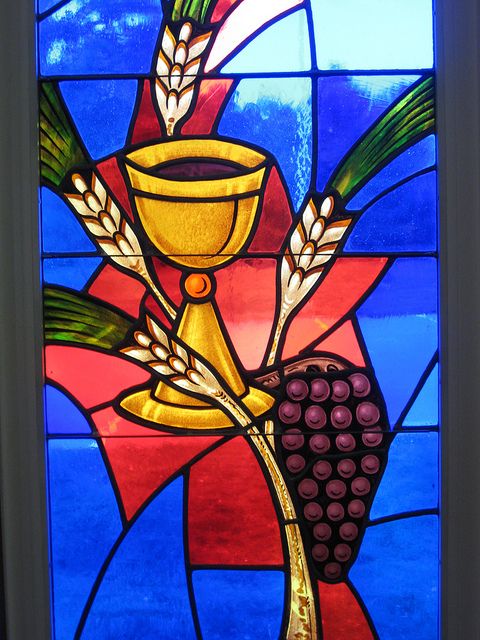
Christ is in the crushing when the amber grains are ground to powdery flour.  Christ is in the transformation when the flour is mixed with water then kneaded into dough.  Christ is in the heat of the baking.  Christ is in the bread, in the breaking, in the sharing, in the eating.  

Christ is in the invitation to the table.  Christ is in the gathering itself.  Christ is in the crossing of all the social boundaries that so often keep us apart. 

Christ is in the gathering.

Christ’s table is for everyone.  On the night Jesus was betrayed even Judas was at the table with Christ.  Even his betrayer received the bread and wine.  Levi the tax collector was there.  So were the Galilean fishermen, Peter, Andrew, James, and John, the sons of thunder. Simon the Zealot was there.  Mary Magdalen and Joanna and Mary, his mother were there.  People who would not have known each other except that he brought them together were gathered as companions, sharing bread, sharing his presence, trying to understand things they didn’t know how to hear.  

When Jesus, the Christ, broke the bread and began to pass it around the table he looked deeply into the faces of his friends and family and said, “This is my body.”  He was telling him that he was in the wheat and the grape and the rich earth which brought them to life.  He was telling them that he was in the transformation that turned seeds in the earth into bread and wine.  He was telling them that the life they were taking into themselves to sustain their own lives was life that had flowed from him.  

He was telling them that they were being filled with his life so that they could now  be his hands, his feet, his eyes and ears, his voice, and his heart to carry his love and forgiveness and message to the world.  He was telling them that they were assembled, united in him, as a body.  He was telling them that now they would be his body.  

He is still saying all of that to all of us.  When we hear the words, “This is my body, this is my blood,” he is telling us that we are the new covenant that carries his presence and forgiveness and love as an antidote to all the pain that’s forever being inflicted in the world.  Jesus is uniting us to be Christ in the world, to bring life and light into a world overwhelmed with death and shadow.

In him was life and that life is the light of all people.  

Taste and see the goodness of the Lord.  Life is in the bread and the wine.  The call to serve each other is in the bread and the wine.  Grace and forgiveness are in the bread and the wine, reminding us that goodness and transformation can come even from things that have been crushed. Companionship is in the bread and the wine.  Love is in the bread and the wine, nurturing us and sustaining us and empowering us to be Christ in the world…

in Jesus’ name.

The Words of Jesus from the Cross

Luke 23:34

Jesus is the soul of forgiveness.  He teaches us to pray, “forgive us our sins as we forgive those who sin against us.”  When he healed the paralytic, he told him his sins were forgiven.  He tells us, “Do not judge so you will not be judged; do not condemn so you will not be condemned, but forgive and you will be forgiven.”  Seventy times seven he told us to forgive.  But he, himself, has nothing to be forgiven for, except, perhaps for telling the truth in a world where truth is a very dangerous thing.  And on this dark afternoon, when they have humiliated him in a kangaroo court,  when they have condemned him with lies and false accusations,  when they have paraded him before puppet magistrates who washed their hands of his fate, when soldiers have spat in his face, beat him with their fists, whipped him within an inch of death, forced him to carry the instrument of his own torture up the hill, then driven iron spikes into his wrists and feet to fasten him to the cross… when they have done all this and hung him out to die in an agony of slow suffocation, the first words he utters from the cross are, “Father, forgive them, for they know not what they do.”  It is a fitting motto for our human race.  It is a prayer that should always be on our lips.  “Father, forgive us.  We know not what we do.”

Luke 23:43

Two thieves are being crucified with Jesus, one on either side of him.  One of them mocks him saying, “If you are the Christ, save yourself and us.”  The other, with a finer sense of justice, rebukes the first thief.  “We’re here because we’re guilty,” he says.  “But this man has done nothing to deserve this.”  Then, perhaps sensing that some deeper power is at work in this dark moment, he says, “Jesus, remember me when you come into your kingdom.”  We cannot guess what it costs Jesus to reply.  We cannot begin to imagine what kind of pain he endures as he pushes all his weight against the spike in his feet so that he might raise himself enough to gather his breath and speak.  But that’s what he does.  And when he speaks, he speaks a promise.  Could there be any greater grace than this?  Could there be any greater grace than for a condemned, dying person to hear him say, “Truly I say to you, today you will be with me in paradise.”

John 19:26

Jesus did not begin his ministry of preaching and teaching until he was 30 years old.   It has been suggested that this is may have been because Joseph had died, and Jewish custom would have expected that Jesus should provide for his widowed mother until his thirtieth birthday.  After that, he was free to pursue his own way.  He had probably taken care of her for years.  And now, from the cross, as he gasps for every breath and slowly bleeds out his life, he takes care of her again.  Seeing his disciple, John, standing next to his mother he creates for them both a new relationship.  He makes John his mother’s guardian and protector.   Tradition tells us that Mary stayed with John until she died some years later in John’s house in Ephesus.  John and Mary cared for each other faithfully the rest of their earthly days because, from the cross, Jesus now says, “Woman, behold your son.  John, behold your mother.”

Mark 15:34

We say that God is omniscient–– that God knows everything.  And why not?  God made the heavens and the earth–– the cosmos, the universe.  God made human beings.  God knows us inside and out, for in some mysterious way, we are made in God’s own image.  God reads the human heart and knows all its longings and desires, its pain and fear.  God is the supreme psychologist.  But there was one thing God did not know.  God did not know what it felt like to be human.  God did not know what it felt like to experience human frailty, human hunger, human stress and tension, human depression, human joys, human warmth, human fear––the whole gamut of human feelings as we experience them in our sensitive human bodies.  God understood all these things, but God had not felt them.  That is why God became human in Jesus Christ; so that God might truly know everything.  In Jesus, God experienced every human emotion and feeling as humans experience them, and one of the darkest things that God learned, one of the most painful things that Jesus experienced, is what it feels like to be utterly alone–– what it feels like when all your friends have deserted.  Jesus learned, God learned, what it feels like when it seems that even God has abandoned you.   

Here is a great and powerful mystery:  Because of this moment on the cross, God is with us even when we feel utterly Godforsaken.  At some time in each of our lives we have cried out in anguish–– because, at some dark moment in every human life we have, every one of us, felt utterly abandoned and hung out to dry.   The words of the Psalmist have echoed in our souls through all the centuries of our existence.  Anyone who doubts that Jesus was fully human, anyone who wants to think of him as a purely spiritual being somehow removed from human pain needs only listen to these words to see how wrong that picture is.  Jesus knows the darkest fear that lurks in every human breast.  Jesus knows despair.  He cries out the eternal question in a voice so loud it reverberates and bounces  through all of heaven and earth, through all of human history, and in our own fearful hearts:   “Eli, Eli, lema sabachtani?”  My God, My God… why have you forsaken me?   And now, there is only one thing left for God to learn, and that lesson is very near.  Now God will learn what it feels like to die.

John 19:28

He has been bleeding for hours.  The fluids in his body are rampaging in a frenzied attempt to cushion deep bruises and clot gaping wounds.  The scourging, alone–– being whipped with a barbed flail that has made the white of his ribs visible through his back–– the scourging alone is enough to make serious demands on his body’s reserves of water.  And now there are the nails and the fight against gravity, and his body’s valiant attempt to protect his heart, liver and kidneys.  And now, the one who told the woman at the well that he was living water–– that no one who drank of that living water would ever thirst, the one who transformed the waters of chaos into waters of adoption in his baptism, the one who changed water into wine so his friends would not be embarrassed at their wedding, the one who spoke all water into existence–– he begs for a single drink.  They bring him vinegar on a sponge when he whispers, “I thirst.”

Luke 23:46

It’s nearly over now.  Jesus is a strong man.  A carpenter.  A construction worker.  He is a strong-spirited man, filled, in fact, with the Holy Spirit.  But his human spirit can only endure so much.  It is time to give up the ghost.  Time to let go.  There is only one person in the universe whom he can trust with his very life as he lets that life go.  And so he gives himself up to that One, saying, “Father, into your hands I commend my spirit.”

John 19:30

It’s over now.  There is no fight left in him.  No will to survive.  No will at all, except the will to complete his mission.  To suffer, and in his suffering to absorb all suffering.  To die, and in his death, to absorb all death.  And now that is done.  The light of the world is extinguished.  And in the eerie darkness that has descended over him, over everyone and everything, he finds the strength to whisper three last words as his life bleeds away:  “It is finished.”

Extravagant Love

John 12:1-8

Shah Jahan, the Fifth Mughal emperor of India, was so deeply in love with his 3rd wife, that when she died in 1631 he spent the equivalent of a billion dollars to create a final resting place for her, an exquisite mausoleum that would speak to the world of the grace and beauty of the woman who was laid to rest within its walls.  He called it the Taj Mahal, naming it after his beloved wife. It has inspired lovers for centuries and is now designated as a world heritage site.  

When Amytis, the daughter of the king of Media, was sent to the flat and arid desert kingdom of Babylon to cement the political alliance between the two kingdoms, she became terribly homesick for the mountains and forests of her homeland.  Her husband, Nebuchadnezzar II, the king of Babylon, thought she might feel more at home if she had a garden.  So he created one for her, the legendary Hanging Gardens of Babylon.  Out of love for her, he created a place in the desert where she could be surrounded by lush greenery, and his extravagant monument to his love for her came to be revered as one of the seven wonders of the ancient world.

History is filled with extravagant acts of love and devotion—Queen Victoria’s legendary decades of mourning for Prince Albert; Lucille Ball refusing to be part of  I Love Lucy, a show named for her, unless her husband Desi Arnaz played her husband on the show; Joe DiMaggio sending roses to adorn the grave of Marilyn Monroe several times a week for decades—those were all inspiring and extravagant acts of love.  But the most famous act of devotion in history happened one night at a private dinner in the little town of Bethany on the outskirts of Jerusalem. 

Six days before the Passover, Jesus and his disciples came to Bethany to dine at the home of Lazarus, Mary and Martha.  While they were dining, Mary began to anoint Jesus’s feet with a very expensive aromatic oil made from spikenard.  She not only massaged the ointment into his tired feet, she dried them with her hair. 

This has to be one of the most evocative and sensual moments in the whole Bible.  This scene in the Gospel of John engages all our senses.  The soothing balm of the ointment being lovingly and gently massaged into the skin of Jesus’s feet by tender and sensitive hands. The silken touch of Mary’s long, dark hair caressing his feet as she dries them.  And the aroma.  The fragrance, John tells us, filled the house—the fragrance of spikenard.  Earthy.  Spicy.  Musky.  Soothing.  Hypnotic. Even in ancient times, the scent of spikenard was used as aromatherapy to dispel anxiety and stress.  It was even used to treat melancholia—what we call depression.  The ancients believed that it’s scent could transport you out of your thoughts or worries or sadness into a state of tranquility, peace and well-being.

When Mary rubbed this exotic, expensive ointment onto Jesus’s feet, her lovely, extravagant act of devotion, kindness and love was probably exactly what Jesus needed at that moment.  The tender massaging of his feet after so many, many months of walking the stony and dusty roads of Galilee, the Decapolis, and Judah probably felt like a little bit of heaven.  After all the road-weary days and nights surrounded by sweaty disciples and jostling crowds the soothing fragrance that was filling every corner of the house was probably the nicest aroma he had smelled in a very long time.  That moment of just plain niceness as Mary focused all her attention on doing something pleasant for him, something that would speak her love for him better than any words—that moment would be his last moment of peace, intimacy and tenderness before his crucifixion.

Sadly, that moment was interrupted.  

“Why wasn’t this ointment sold and the money given to the poor?” asked Judas.  “This stuff is worth what…three hundred denarii?  That’s the better part of a year’s wages for a laborer.  There are better ways to use that much money than slathering it on his feet.”

The Gospel of John tells us that Judas wasn’t really concerned about the poor at all but was angling for a way to get some of that cash into his own pockets.  And maybe that’s true.  But to be fair, spikenard ointment really was very, very expensive.  It’s made from a plant in the honeysuckle family that grows in the Himalayas of Nepal, India and China.  It was costly to make it and even more costly to transport it.

All four gospels tell the story of this deeply personal encounter, but they tell it in different ways.  In Matthew and Mark the dinner is held at the home of Simon the Leper and the woman who lavishes both expensive ointment and intimate attention on Jesus is not named.  In Luke the dinner is held at a Pharisee’s house.  Once again the woman is not named, but then neither is their host, the Pharisee.  One thing that all versions of this story have in common, though, is that someone is indignant about the attention and the expense being lavished on Jesus.  In Matthew and Mark, it’s all the disciples who complain about the expense of the ointment.  All of them chime in about how the money could have been given to the poor.  “Why was this ointment wasted in this way?” they say in Mark.  “Why this waste?” in Matthew.

Waste.  Her extravagant care for Jesus, her loving attention—they see it as wasteful.    

Why is it that some of us are so uncomfortable with extravagant expressions of love and devotion? What is it about moments of intimate caring that get some of us up on our high horse and turns us into critics?  What is it about lavish gestures of affection that suddenly turns some of us into outspoken proponents of philanthropy for the anonymous poor?  

I don’t usually quote Friedrich Nietzsche, but there is something he wrote that seems particularly appropriate here.  He said, “The certain prospect of death could sweeten every life with a precious and fragrant drop of levity—and now you strange apothecary souls have turned it into an ill-tasting drop of poison that makes the whole of life repulsive.”

Mary had bought this expensive ointment to anoint Jesus’s body after his death.  But she loved him so much that she couldn’t bear the thought that he wouldn’t get to experience its healing and soothing properties while he was still alive. So she opened the alabaster jar and anointed Jesus with it while he was still alive to sweeten his last hours and days “with a precious and fragrant drop of levity.”  She brought lightness to counter the heaviness of those final days.

Life is both precious and precarious.  Death is a foregone conclusion; it’s only the timing that’s uncertain.  So why do we not live every moment of every day with “a precious and fragrant drop of levity?”  Why do we not find more ways to express our love for each other?

Why do we back away from extravagance?  We should be accustomed to it.  At least, we should be if we’re paying attention.  “If the landscape reveals one certainty,” wrote Annie Dillard, “it is that the extravagant gesture is the very stuff of creation.  After the one extravagant gesture of creation in the first place, the universe has continued to deal exclusively in extravagances, flinging intricacies and colossi down aeons of emptiness, heaping profusions on profligacies with ever-fresh vigor.  The whole show has been on fire from the word go.”

Mary was extravagant in her love for Jesus.  Jesus was extravagant in his love for the world.  And God has been extravagant in love poured out into all of creation.  

“There is a time for risky love,” said Max Lucado.  There is a time for extravagant gestures.  There is a time to pour out your affections on one you love.  And when it comes—seize it, don’t miss it.” 

May the extravagant love of Christ fill our hearts and give us courage to extravagantly love each other.  In Jesus’ name.

Unresolved Melody

Luke 15:1-3, 11b-32

When I was seven years old, not long after we moved to California from Kansas City, a little black dog showed up at our door one night, whimpering on the front porch and scratching on the door to be let inside.  This adorable and pugnacious little Pekingese/Cocker mix of a dog didn’t have a collar or tags, and this was decades before microchips, so we had no idea where he came from or who his people might be.  We ran an ad in the paper and I went door-to-door for several blocks asking if anyone had lost their little black dog, but nobody claimed him. 

So we did.  We named him Barney. We got him his shots and tags, and he officially became our dog.

We loved Barney, and I’m pretty sure he loved us, too.  He would sleep curled up next to me in my bed.  He would snuggle up next to us on the couch when we were reading or watching TV.  He gave us lots of little dog kisses.  He loved to pull my sister and me up and down the sidewalk on our roller skates.  And he rode patiently in the car with us as we made the long car trip every summer back to Kansas, Missouri and Arkansas to see family.  He was in almost every way a perfect family dog.  But Barney had one bad habit.  An impulse, really.  If anyone left the back gate or the screen door open, he would be off like a shot, running as fast as his little legs would carry him, launching himself out into the world to have an adventure.  A few times he was gone for several days before some kind soul took him in and then called us to come pick him up.  

When Barney took off on one of his adventures, I’m sure it never crossed his little canine mind that we were heartbroken and worried sick about him.  And when he came home nothing was ever really resolved.  Dogs are very capable of showing regret, but Barney never did.  There was always a risk that he would take off and go exploring again.  It was just in his nature.  Some dogs are like that.  And so are some people.

We are all happier when people—and dogs—color within the lines.  We all secretly think that the world would be a better, happier place if everyone stayed in their lane and lived by the rules and boundaries as we know and understand them.  But the plain truth is that not everyone does.  Some people have different, looser ideas of what is acceptable and what is not.  Some dogs just want to see what else is out there.

Some Pharisees and scribes were grumbling because Jesus was hanging out with and sharing meals with “tax collectors and sinners.”  They didn’t think it was appropriate for Jesus to be making friends with people who were not socially acceptable by their standards, and they told him so.  But Jesus didn’t respond directly to their criticism.  Instead, he told them a story.

“There was a man,” he said, “who had two sons.”  We all know this story.  We call it The Prodigal Son, although a better title might be The Two Brothers, or even The Over-Indulgent Father.  Amy-Jill Levine suggests that it could be called The Parable of the Absent Mother.  That puts a different spin on things, doesn’t it?   And it fits, since this is really a story about family dynamics.

Whatever title we use, we know this story so well that I wonder if we really listen to it.  There is a lot going on in this parable that could, maybe should, make us uneasy.  We assume that it’s about sinning, repenting, and forgiving.  But is it?  Or are we imposing our traditional understanding and ideas on this story and ignoring the ancient culture that heard it first, a culture that saw things very differently?

Was it a great sin for the younger son to ask his father for his inheritance?  Jewish law did not prohibit asking for your inheritance, so while it might have been considered foolish, it wouldn’t have been seen as a sin—at least not by the first century Jews who were listening to Jesus as he told this story.

Does the father sin by giving away half of his estate to the younger son?  Deuteronomy 21 says that the oldest son should inherit a double portion, but by the first century it was considered perfectly allowable for a man to divide his estate any way he saw fit.  So while the father’s actions in this parable could also be seen as prodigious foolishness, no one would think he was sinning.  In some circumstances he might even have been seen as prudent.  In The Wisdom of Ben Sirach, Ben Sirach counseled, “When the days of your life reach their end, at the time of your death distribute your property.”  Is the father in this parable, perhaps, nearing the end of his days?  Would that explain why he so readily indulges his son’s unusual request?  The wording in the New Revised Standard Version says that the father “divided his property,” but the wording in the original Greek text says that he “divided his life.”  How should we hear that—not that he is giving half his money or property, but half his life to this younger son?

After asking for his inheritance, the prodigal son doesn’t leave immediately.  “A few days later” he gathers up his things and leaves.  Jesus doesn’t say what happened during those few days.  Did the father try to talk his son out of leaving?  Did the older brother step in and try to talk some sense into him?  The story doesn’t say.  We don’t even know if he said goodbye.  

What the story does tell us is that he went far away—to a far country—somewhere out beyond the boundaries of Jewish law, somewhere far beyond the boundaries and expectations of the home and community he grew up in.  In that far-away place, out beyond the familiar restrictions of home and community, he squandered his wealth with reckless living.  When his money was gone and famine hit the land, nobody helped him.  He managed to find a job feeding pigs, but it didn’t pay anything and he was so hungry that he thought about eating the seed pods that he was feeding to the pigs.  Amy-Jill Levine points out that there’s a proverb from the rabbinic commentary Leviticus Rabbahthat says, “When Israelites are reduced to eating carob pods, they repent.”

This is the point in the story where this reckless young man decided that it was better to go home and eat crow than to starve to death in a pig stye.  Jesus, telling the story, says he came to himself.  He admitted to himself that he was not living the dream, having his best life.  He also seemed to realize that if he was going to go home, some sort of apology might be in order.  So as he walked the long way home, he rehearsed a little speech: “Father, I have sinned against heaven and before you; I am no longer worthy to be called your son; treat me like one of your hired hands.”

Now this might sound like he’s repenting, but is it real repentance or is it conniving?  He already knows that his dad is inclined to be extravagantly generous.  And notice this:  he not going to ask to be restored to the full status of being a son, but he’s not volunteering to be a slave, either.  He’s planning to ask his dad to treat him like one of the hired laborers.  They get paid.  When you read his little speech carefully, he still sounds pretty self-absorbed.  There’s no remorse for how he has treated his dad or his brother.  His confession that he has sinned is generic at best.  Basically, as David Buttrick put it, what the prodigal is really saying to himself is, “I’ll go to Daddy and sound religious.”

He has rehearsed his little speech, but he never got to deliver all of it.  Before he even got all the way home, “while he was still far off” his father saw him and was filled with compassion.  His father ran to him, put his arms around him, kissed him, then started issuing orders.  “Get him some clean clothes!  Put a signet ring on his finger!  Get the barbeque going, and let’s celebrate!  My son was dead and is alive again!  He was lost and is found!”

And now the story shifts focus.  The older brother comes in from mowing hay all day in the hot sun and is surprised to find that there is a party going on because his younger brother has returned home.  This makes him mad, so angry that he refuses to go in the house.  His father comes out to plead with him, to beg him to come in and join the party.  And that’s when we learn that the relationship that is most damaged in this story is the connection between the father and the elder brother.  The older brother unleashes a tirade of pent-up resentment, and as he spews out his bitterness over years of being neglected and overlooked, the father realizes that it’s his older son who is truly “lost” to him.   For years the older brother has worked hard to be “the good son.”  For years he has been faithful to the family values.  For years he has faithfully contributed to the success and wealth of the family.  It’s clear from his outburst that he has a pretty low opinion of his younger brother, but it’s even more clear that his anger is directed primarily at his father.

In response to this flood of anger, all the father can do is try to reassure his eldest son that their bond endures.  “Child,” he says, “you are always with me.  All that I have is yours.  But we had to celebrate and rejoice because your brother was dead and has come to life; he was lost and has been found.”  And that’s where Jesus ends the story.

As I said earlier, we have a long tradition of assuming that this parable is about sinning, repenting, and forgiving.  But is it?  As I read it again, I can’t help but notice that nothing in this story gets resolved.  It’s like a melody in the key of C that ends with a G7 chord.  Everything feels suspended.  The younger son never really expresses any remorse or sorrow, in fact no one in this family expresses any regret for the ways they’ve hurt each other.  The father gins up a party to celebrate the return of his younger son, but did you notice that he never actually speaks to him?  He does speak to his oldest son, but the story ends with the two of them still standing outside the house, outside the celebration.  

This parable leaves us with questions hanging in the air.  Will the two brothers reconcile?  Can the father repair his relationship with his oldest, neglected son?  Can he even persuade him to come into the house, to join the party?  Will the prodigal son stay and work for the good of the family, or will he be out the door again when someone leaves the gate or the screen door open?

When all is said and done, if it’s not about repentance and forgiveness, then what is Jesus trying to teach us with this parable?

In Short Stories by Jesus, her outstanding book on the parables, Amy-Jill Levine says that this parable actually guides us with straightforward advice: “Recognize that the one you have lost may be right in your own household.  Do whatever it takes to find the lost and then celebrate with others, both so that you can share their joy and so that the others will help prevent the recovered from ever being lost again.  Don’t wait until you receive an apology; you may never get one.  Don’t wait until you can muster the ability to forgive; you may never find it.  Don’t stew in your sense of being ignored, for there is nothing that can be done to retrieve the past.

“Instead, go have lunch.  Go celebrate and invite others to join you.  If the repenting and forgiving come later, so much the better.  And if not, you still will have done what is necessary.  You will have begun a process that might lead to reconciliation.  You will have opened a second chance for wholeness.”[1]


[1] Short Stories by Jesus, Amy-Jill Levine, p.69