Lifted Up

Mark 1:29-39

“He came and took her by the hand and lifted her up.  Then the fever left her, and she began to serve them.”  Two simple sentences.  And like so much of Mark’s gospel, a surprising amount of action in surprisingly few words. 

After preaching with authority on the Sabbath at the synagogue at Capernaum, then casting out an unclean spirit from a man who interrupted him, Jesus was ready for a break.  So he went to the house of his new disciples, Peter and Andrew.  It happened that Peter’s mother-in-law is sick and in bed with a fever.  They told Jesus about her right away and Jesus went in to see her.

And here is where the translation maybe is not our friend.  “He took her by the hand” sounds much gentler than what it says in the original language.  Kratésas it says in the Greek.  Kratéo is the verb.  It’s not a tender word.  It means to grasp firmly or strongly.  

He grasped her firmly and then it says he “lifted her up.”  Which is fine.  But again, something is lost in translation.  The verb Mark used is egeiro.  It’s the same word Jesus will use when he raises Jairus’ daughter from the dead and says, “Little girl, get up!”  It’s the same word the angel will use to tell the women that Jesus is not in the empty tomb because he is raised up—egeiro.  

So maybe this isn’t quite the gentle scene I had always imagined.  Maybe this is a scene full of strength and energy and power.  Jesus grasped her strongly, firmly by the hand—and hand, by the way, could mean anywhere from her fingertips to her elbow—Jesus grasped her firmly and raised her.  

And the fever left her.

And she began to serve them.

It’s tempting to get a little upset about that last part—she began to serve them.  After all, she’s just been sick with a fever.  And now here are all these guys who come traipsing into the house and because of the expectations of the society they live in, she jumps out of her sickbed to rustle up some dinner for them.  Oh, and by the way, does anybody care that it’s still the Sabbath?

Some commentators have pointed out that she would be happy to serve them because, in a culture where roles are clearly defined, she could now resume her place as matriarch of the household along with all the social currency that comes with that.

That interpretation about her immediately resuming her social position and role is all perfectly fine and no doubt played some part in her rising immediately to serve, but there’s also something going on in the language that deserves a moment of attention.  It’s a little thing.  But, as I’ve been learning, Mark often uses these subtle little things to make big points.  In this case it has to do with the word “served.”  The Greek word in question is the verb diakoneo.  It does mean “to serve” and it is often used in the context of serving food and drink, but it also has another layer of meaning, particularly in Mark’s gospel.

Here’s how Ched Myers explains it in his book, Say to This Mountain: Mark’s Story of Discipleship—

“Peter’s mother-in-law is the first woman to appear in Mark’s narrative.  We are told that upon being touched by Jesus, “she served him(1:31).  Most commentators, steeped in patriarchal theology, assume that this means she fixed Jesus dinner.  However the Greek verb “to serve,” diakoneo (from which we get our word “deacon”)_ appears only two other times in Mark.  One is in 10:45—“The Human One came not to be served but to serve”—a context hardly suggesting meal preparation.

“Mark describes women ‘who, when Jesus was in Galilee, followed him, and served him, and…came up to Jerusalem with him’ (15:41).  This is a summary statement of discipleship:  from beginning (Galilee) to end (Jerusalem) these women were true followers who, unlike the men (see 10:32-45) practiced servanthood.”

So here is Peter’s mother-in-law—sadly we don’t know her name—but Mark identifies her service with a word that implies that there is a sacred aspect to her serving, a holiness that springs not from her sense of duty or social propriety, but from her faith.  

She is a deacon.  

In Mark’s gospel, the men surrounding Jesus are often argumentative and a little dense.  But the women, though not mentioned often, are astute and faithful.  

Astute and faithful women have kept the ministry of Jesus alive and well in this world for more than 20 centuries.  

Think of the women mentioned in the Gospel of Luke who travelled with Jesus and financially supported Jesus and the disciples.  Luke tells us that Mary Magdalene, and Joanna, the wife of Herod’s steward Chuza, and Susanna, and many others provided for them out of their resources.  

Some of these women came to be called the Myrrh Bearers because after Jesus was crucified, they were the ones who went to the tomb to anoint his body.  Because they went one last time to serve him in that way, they ended up being the first ones to hear the good news of the resurrection.

Mary Magdalen was known to be particularly close to Jesus and was regarded as an Apostle by many among the early followers of Jesus until patriarchy asserted itself, suppressed her influence, and sullied her reputation in the 6th century by spreading the story that she had been a prostitute.  But it was Mary Magdalen who, according to the Gospel of John, first encountered the risen Jesus.  It was Mary Magdalen who first proclaimed his resurrection, making her the first evangelist.

Another Mary who was part of this group of women disciples, was Mary, the wife of  Cleopas.  Tradition tells us that her husband was the brother of Joseph, Jesus’ foster father, so she was Jesus’ aunt, and sister-in-law of Jesus’ mother, Mary.  She, too, was a Myrrh Bearer and is probably the unidentified person traveling with Cleopas on the road to Emmaus in chapter 24 of Luke’s gospel. That means that she was also one of the first witnesses to the resurrection.

Joanna, the wife of Herod’s steward, Chuza, is someone we know a little more about.  We see her later identified in the letters of the Apostle Paul where he uses her Roman name, Junia.  In Romans 16:7, Paul says that she is prominent among the Apostles and that she knew Christ before he did.   Junia was a remarkable person, a woman disciple of Jesus who travelled with him in his ministry,  and continued in ministry as an Apostle, travelling as far as Rome for the cause of the gospel.  Some scholars have suggested that she might be the author of the Letter to the Hebrews.

Priscilla and her husband Aquila are mentioned six times in the New Testament.  Four of those times, Priscilla is mentioned first before Aquila, and it’s clear that she is a full partner in their work together for the sake of the gospel.  Priscilla and Aquila are also traditionally listed among the 70 that Jesus sent out on a mission.  Priscilla, who is sometimes called Prisca, her more formal name, was one of the first women preachers in the church.   Acts 18:24-28 tells us that she, along with Aquila, instructed Apollos in the faith.  Some scholars speculate that Prisca may be the author of the Epistle to the Hebrews.

Phoebe was an overseer and deacon in the Church at Cenchreae.   St. Paul referred to her in Romans 16 as a deacon and a patron of many.  This is the only place in the New Testament where a woman was referred to with both of those titles. Diakonos kai prostateis.  A chief, a leader, a guardian, a protector.  St. Paul had such trust in her that he provided her with credentials so that she could serve as his emissary to Rome, and deliver his letter to them—that letter we know as the Epistle to the Romans.

Lydia of Thyatira, was a wealthy merchant of purple cloth, who welcomed St. Paul and his companions into her home at Philippi where, after listening to Paul’s teaching, she became a devoted follower of Jesus.  In doing so, she helped Paul establish the church at Philippi, the first church in continental Europe.

In that church at Philippi were two women, Euodia and Syntyche who were serving in positions of pastoral leadership.  At some point they got into a disagreement, and in his letter to the Philippians, Paul urges them to “be of the same mind in the Lord” so that their disagreement doesn’t split the church.  In calling them to unity, he notes that they have “struggled beside me in the work of the gospel.”  They were his full partners in ministry in that city.

Jesus took Peter’s mother-in-law in his firm grip and raised her up.  And she began to serve.  She became a deacon.  She began making sure things got done.  Making sure ministry happened.  And it’s the women who have been making sure things get done and ministry happens ever since.

Yesterday we celebrated the installation of a new pastor at Christ Lutheran Church in Long Beach.  If you include the long-term interim ministry of Pastor Laurie Arroyo, then Pastor Nikki Fielder is the fourth or fifth woman to serve Christ Lutheran as pastor.  Another woman, Pastor Jennie Chrien, preached at Pastor Nikki’s installation, and a third woman, our bishop, Brenda Bos, presided.  For several years now, the presiding bishop of our denomination has been a woman, Bishop Elizabeth Eaton.  Having women serve in these important roles in the church has become so normal that it’s hardly worth noting.  But it wasn’t always so.

It was only fifty-four years ago, a time still in living memory for many of us, that our denomination began to ordain women to the ministry of Word and Sacrament.  To be pastors.  On the one hand, it seemed then—and to some people it still seems—like a bold and progressive thing to do.  But when you look at the witness of the New Testament itself and what we have learned about the roles that women played in the earliest years of the church…well let’s just say that our historically recent ordination of women was shamefully long overdue.

I think of the women I’m indebted to in my ministry.  I think of my beloved spouse, Meri, who has always challenged me to look deeper than tradition in my understanding and practice of faith.  I think of all the women teachers I’ve had, like Dr. Martha Ellen “Marty” Stortz, professor of Church history, who opened my eyes to the rich goldmine of our heritage.  I think of the women scholars and writers I turn to for thought-provoking insights in theology and biblical studies, women like Debi Thomas, Barbara Brown Taylor, Rachel Held Evans, Roberta Bondi, Diana Butler Bass, Nadia Bolz-Weber, Heather Anne Thiessen, and Amy-Jill Levine.  I think of my women clergy colleagues who are so amazing and indispensable as we puzzle our way through the week’s texts and the week’s issues, and our life together in the church.

I think of the women in our congregations who make things happen.  Without whom things would not happen.  The Tabithas, the Junias, the Priscillas, the Marys, the Pheobes. The Myrrh Bearers.  The Apostles in our midst.

I think of them all.  And I am so grateful.

Jesus has grasped them by the hand and raised them up.  And they have served.  Showing the presence of Christ and proclaiming the kin-dom of God, or as Diana Butler Bass calls it, “the commonwealth of God’s justice and mercy.”  

Jesus has raised them up and we are all richer for it. 

Jesus grasped them firmly by the hand and raised them up.

Because that’s what Jesus does.

He reaches into our fevered immobility and raises us up out of the sickbed of patriarchy and our fearful status quo.  He frees us from the illness of coersive social conventions and oppressive patterns of business-as-usual so we can serve each other, so we can take care of each other and lift up others in meaningful ways that show the world what the commonwealth of God’s justice and mercy looks like and how it works.  

He raises us up so we can live together and work together, so we can use our unique abilities and gifts in a beloved community where, as Paul said in Galatians, “there is no longer Jew or Greek; there is no longer slave or free; there is no longer male and female;” and we can add there is no longer gay or straight or queer or trans, “for all of you are one in Christ Jesus.”

He raises us up so we can show each other the healing love of Christ as we serve each other and work together to make the reign of God a reality on earth as it is in heaven.  In Jesus’ name.
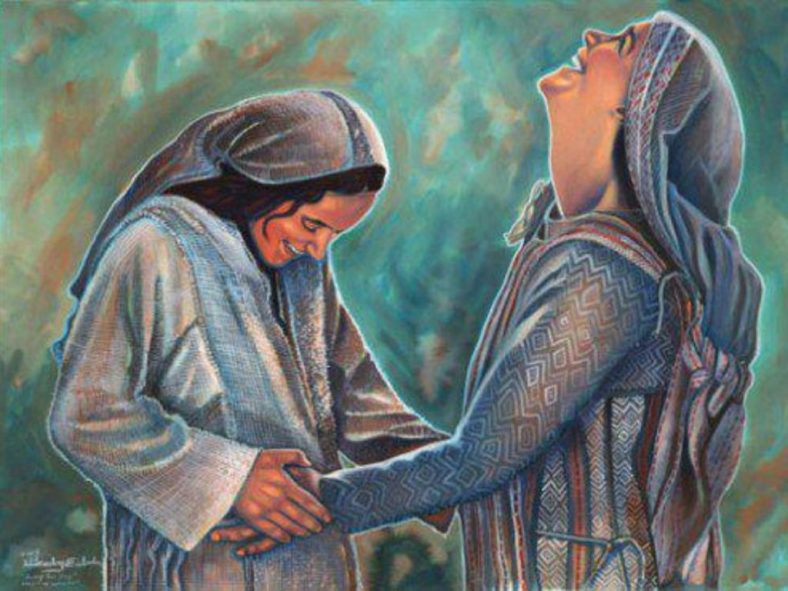
Mothers of Reconciliation

Luke 1:39-45

Do you have any favorite relatives, favorite cousins, aunts, uncles?  If you found it necessary to make yourself scarce for a while, do you have a relative you know you could go stay with who wouldn’t judge you and would maybe even be glad to see you?  

Immediately after Gabriel told Mary that she was to be the mother of Jesus, Mary decided to get out of town.  Nazareth was a small town, and a small town is not always the friendliest place for a not-yet-married mother-to-be.  People talk.  And when they don’t have all the facts, they tend to invent them, often with an unkind or salacious spin.  So, the Gospel of Luke tells us, “Mary set out in those days and went in a hurry to a town in the hill country of Judah.”  In a hurry, with haste, Mary went to stay with her older, loving, wise, nonjudgmental relative, Elizabeth, who also happened to be miraculously pregnant.

If someone told you that you that you could only have one of the four gospels to read and study for the rest of your life, the Gospel of Luke would not be a bad choice.  Luke has a good sense for drama and he tells the story of Jesus in very human terms.  

Luke anchors his version of the Good News in history.  After a brief introduction, his narrative begins with the words, “In the days of Herod, king of Judea…”  He tells us that Jesus is born during the reign of Augustus Caesar, when Quirinius is governor of Syria overseeing the collection of the first census and poll tax.  He wants us to have historical context, not so much so we can pin events down to exact dates, but rather to give us a political, social, and cultural backdrop as he stages the story of Jesus.

Another reason to consider Luke if you could have only one gospel is that political and economic justice are important themes in Luke.  Jesus inaugurates his ministry in Luke’s gospel by reading in the synagogue from Isaiah 61, using Isaiah’s poetry to make it clear that his proclamation of God’s reign is all about good news for the poor, healing, justice and liberation (Luke 4).  Subversion of the dominant paradigm is insinuated between the lines.

In Luke’s gospel, the Holy Spirit is named more often and more directly and plays a more visible role than in Matthew and Mark and John.  Jesus tells more stories in Luke.  Some of our favorite and best-known parables are found only in Luke.  And Luke uses scripture from the Tanakh, the Old Testament, in subtle ways to link the story of Jesus to his ancestors, because when all is said and done, Luke understands that Jesus is the crowning glory of generations of his people and his family; his story is the ultimate chapter of a long continuous narrative about the trials, triumphs, and brokenness of God’s people.    

But if you only get to have one gospel, maybe the best reason to choose Luke is the women.  Women play a larger role in Luke and speak more in Luke than in any of the other three gospels.  And the things they say are prophetic. 

When Mary meets with Elizabeth, even their names are telling part of the story and linking them to the heritage of their people and a family tradition of liberation and new order.  The name Mary is a diminutive form of Miriam.  The name comes from the same root as myrrh and has multiple meanings:  bitter, beloved, rebellious.  Miriam in Exodus was a prophet, sister of Moses.  According to a tradition[1], when Pharaoh’s army was about to overtake the Israelites, Moses held out his staff and his hand to part the Red Sea, but Miriam is the one who led the people through the parted waves, calling the women to follow her, the women in turn then calling their men to follow them as they raised their tambourines and sang and danced her way across the dry path between the walls of water.   The name Elizabeth is a form of Elisheba from El shava, meaning “God is my oath.”  Elisheba was also part of the Exodus story.  As the wife of Aaron she became the mother of all the priestly line of Israel.  When Mary and Elizabeth meet, it is a meeting of generations of priesthood and prophecy, but in a marvelous twist the mother with the priestly name will bear a child who will become a prophet, and the mother with the name of a prophet will bear a child who will be later be called, “a high priest in the order of Melchizedek.”[2]

And where are the men in all this?  Absent or silent.  Elizabeth’s husband, Zechariah the priest, has been silenced because he did not believe the angel Gabriel when Gabriel told him that Elizabeth would bear a child.  He will not speak again until his son John is circumcised.  And Joseph, Mary’s betrothed?  The surrogate father of Jesus barely appears at all in Luke’s gospel. He is named only four times and never speaks.  And Luke gives the distinct impression, reading between the lines, that Joseph stayed behind in Nazareth while Mary went to see Elizabeth.  Luke tells us that when the order for the census came, “Joseph also went from the town of Nazareth in Galilee to Judea, to the city of David called Bethlehem…”[3]  The implication is that he stopped by the house of Elizabeth and Zechariah “in a town in the hill country of Judah” to pick up Mary on his way to Bethlehem.

The men are silent, but the women speak.  Oh do they speak.  When Elizabeth heard Mary’s greeting, the baby leaped in her womb and Elizabeth was filled with the Holy Spirit.  Elizabeth exclaimed with a loud cry, “Blessed are you among women, and blessed is the fruit of your womb.”  A loud cry.  Krauge megale it says in the Greek.  A very loud shout.  Elizabeth’s words are included in the prayer of the rosary, but I’ve never heard them shouted.  Hail Mary, full of grace, the Lord is with you.  BLESSED ART THOU AMONG WOMEN AND BLESSED IS THE FRUIT OF YOUR WOMB…

No, it’s not usually said that way. But wouldn’t it be wonderful if it was—to remind us of the great joy Elizabeth feels when she is filled with the Holy Spirit and recognizes the child that her young relative is carrying in her womb.  She speaks prophecy.  She speaks profound blessing.  Why should that be merely whispered or mumbled?  These are words of joy for the whole community of humanity!

This is a story of women proclaiming the Word of God.  This is a story of a family living out God’s power and presence.  God builds community, peoples, nations from proclamation and from families.  

Sadly, far too often proclamation is misguided and families are dysfunctional.  Too much of our story as a human family is a story of anger, disruption, fracture, and violence.  Maybe because the men have been doing most of the talking.  Too much history and not enough herstory. The descendants of Abraham fighting the descendants of Abraham—the children of Sarah and the children of Hagar locked in hostility for generations.  The descendants of one race locked in a vicious spiral of fear of and hatred for other races when we are all related in the human race, when we are all family.

These two women who meet in this unnamed town in the hills of Judah, these two women who rejoice loudly and prophesy in each other’s presence, these two women are the mothers of reconciliation and renewal.  Their sons will enter a fractured world of unreconciled peoples to bring a call for change and a vision for peace and understanding . God will use this family to bring healing and renewal to all families—to the whole human family—if we can learn how to listen. 

The son of Elizabeth will preach repentance, metanoia, a summons to change course.  The child of Mary will proclaim a direction for that change of course, a vision of the reign of God, a new way of being, a way of embracing our heritage and responsibility as children of God and siblings in humanity.  One will embody God’s call to be transformed.   One will embody God’s power of recreation and renewal.

These two women are family.  Their sons, these cousins, enter the world to remind us that we are all family, all related, all our stories intertwined.  Mary and Elizabeth remind us that God speaks and works through families even if it’s the slow work of generations.  Mary and Elizabeth remind us that God speaks and works through women to heal the world.  They are the mothers of John and Jesus.  They are chosen by God to be the mothers of renewal and reconciliation.


[1] Exodus 14-15

[2] Hebrews 5:10

[3] Luke 2:4

Painting by Corby Eisbacher @ArtByCorby

Message Received

Matthew 10:40-42

I’ve been thinking a lot about Eric.  I remember how Eric was attracted by the crowd one Sunday evening when we were doing Stories, Songs, and Supper.  I was pretty sure when I first saw him that he was homeless although to be fair, his clothes were cleaner and neater than most in that condition.  

He stood at the church door and asked what was happening as he saw people gathering, greeting each other, laughing, and we told him, “It’s a thing we do called Stories, Songs, and Supper.  We share a meal then sing a bunch of old familiar songs, then someone tells a story, then we sing a little more.”  We invited him to come in and join us.  So he did.

While he was eating he told us a bit about himself—he had a gift of gab—then after supper he helped clear the tables.  He joined right in with the singing and he had a pretty decent voice.  Somewhere in the midst of all that let it be known in his own gregarious way that joining with us that evening was a particular treat for him because it happened to be his birthday.  So we all sang Happy Birthday to him.  At the end of the evening, as he was leaving, he asked if he could borrow a book from the book table in the fellowship hall.  He took a novel and promised to return it.

The next Sunday, Eric was there for Sunday morning worship.  Soon he was participating in Adult Education classes and Bible study.  He joined in with one of our small groups in the work they were doing with Lutheran Social Services.  In almost no time Eric had become an important member of our little family of faith. 

We welcomed Eric into our lives and Eric welcomed us into his.  And we were all richer for it.

“Whoever welcomes you welcomes me, and whoever welcomes me welcomes the one who sent me,” said Jesus in the tenth chapter of Matthew.  This is the same gospel in which Jesus later says, “I was hungry and you fed me, I was thirsty and you gave me something to drink, I was a stranger and you welcomed me… Truly I tell you, just as you did it to one of the least of these who are members of my family, you did it to me.”

Christ often comes to us in ways we’re not expecting.  When we welcome the unexpected stranger, or graciously accept a welcome when we are the unexpected stranger, we experience the presence and grace of God in new and enriching ways.

I remember one dreary afternoon when the sky was the color of lead and the rain was relentless.  The light coming in my office window had unconditionally surrendered to winter and my mood matched the weather.  Suddenly I heard this bright, jazzy music coming from downstairs.  I ran down the stairs and there in the Fellowship Hall was Eric, pounding out boogie-woogie on the old out-of-tune piano.  Who knew?  He had come in to the hall to get out of the rain and the mood had come on him to just sit down and play.  He apologized for disturbing me and I told him, “No apologies necessary!  You brought light into a gloomy day! Keep playing.”

“Whoever welcomes a prophet in the name of a prophet will receive a prophet’s reward; and whoever welcomes a righteous person in the name of a righteous person will receive the reward of the righteous.”

We learned a lot from Eric.  We learned a little about life on the streets.  We learned more than we wanted to know about our neighbors’ attitudes toward the homeless.  We learned how the police and the justice system in our city respond to those who are experiencing homelessness.  We learned about our own attitudes toward those living rough.  Most of all, though, we experienced an energy and vitality that’s been missing since he left us.  All this because we welcomed one gregarious man into our party on his birthday.

As I read the scriptures and the history of the Church, I see a story where the Holy Spirit is always trying to open the door of welcome wider.  Sadly, though, every time the Spirit pushes the door open wider, there are more than a few trying to close it.  

God made a covenant with Abraham and told him that his descendants would be a blessing to all nations, but then his descendants tried to make it a “descendants only” club. 

Jesus welcomed “tax collectors and sinners” to his fellowship table but the Pharisees were scandalized and critical.  How could he be from God if he associated with such people?  Then down through the years, even the followers of Christ, people calling themselves by his name, would make all kinds of gateway tests of belief and morality to decide who was worthy of coming to Christ’s table.

When the Church was barely up and running Peter, under the direction of the Holy Spirit, baptized Cornelius and his household, Roman gentiles.  In response, James and the other Apostles back at headquarters in Jerusalem had a tizzy fit and raised all kinds “who gave you permission” questions.  

St. Paul placed women in the pastorate and leadership ranks of the congregations he established (Junia, Julia, Prisca, Lydia, Euodia, Scyntyche), but before he was cold in his grave other patriarchal hands were editing his writing (1 Cor. 14:34-36) while still others borrowed his name to write  the women out of their jobs (1 Timothy 2).  

Not exactly welcoming.

This month in the ELCA we celebrate the 50th anniversary of a change in wording in the bylaws of the Lutheran Church in America and the American Lutheran Church, two of the predecessor bodies of the ELCA.  Fifty years ago they voted to change the word “man” to the word “person” in their bylaws, thereby opening the door for the ordination of women. 

Fifty years later, women clergy often struggle with challenges that male clergy do not.  They deal with sexual harassment, disrespect, and often lower pay due to gender-based discrimination.  Some congregations still refuse to call a woman as pastor even when there are no other candidates.  The saddest part of that is that in doing so these congregations are depriving themselves of the gifts these talented women bring with them, gifts that could revitalize and renew them.  

When I think of the women pastors I know, I feel a tremendous hope and confidence for the future of the church.  If anyone can lead us to a brighter day, they can.

“Whoever welcomes a prophet in the name of a prophet will receive a prophet’s reward; and whoever welcomes a righteous person in the name of a righteous person will receive the reward of the righteous; and whoever gives even a cup of cold water to one of these little ones in the name of a disciple—truly I tell you, none of these will lose their reward.”

Eric taught us this lesson well: When we welcome the unexpected guest, we receive unexpected gifts. 

Fifty years ago the Spirit moved to open the door wider so that the church could receive the bountiful gifts that women bring through ordained service.  Eleven years ago the Spirit opened the door wider again when the ELCA voted to allow the ordination of LGTBQ persons.  And the church is richer for their ministry.

Today we stand at the edge of a tidal shift in our culture in regard to race, economic structures, and societal systems.  The Holy Spirit is pushing the door open yet again and maybe, maybe even pushing down the walls.  Church will be different.  There are new prophetic voices to hear.  New righteous persons to receive.  New gifts being given.  The only question is, will we welcome them?

In Jesus’ name.