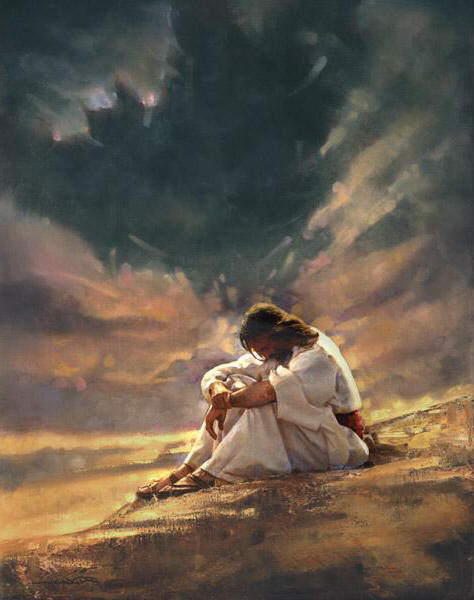
That Reasonable Voice

Luke 4:1-13 (NRSV)

  Jesus, full of the Holy Spirit, returned from the Jordan and was led by the Spirit in the wilderness, where for forty days he was tempted by the devil. He ate nothing at all during those days, and when they were over, he was famished.  The devil said to him, “If you are the Son of God, command this stone to become a loaf of bread.”  Jesus answered him, “It is written, ‘One does not live by bread alone.’” 

  Then the devil led him up and showed him in an instant all the kingdoms of the world.  And the devil said to him, “To you I will give their glory and all this authority; for it has been given over to me, and I give it to anyone I please.  If you, then, will worship me, it will all be yours.”   Jesus answered him, “It is written,

         ‘Worship the Lord your God,

                  and serve only him.’” 

  Then the devil took him to Jerusalem, and placed him on the pinnacle of the temple, saying to him, “If you are the Son of God, throw yourself down from here,  for it is written,

         ‘He will command his angels concerning you, to protect you,’

and

         ‘On their hands they will bear you up,

                  so that you will not dash your foot against a stone.’” 

Jesus answered him, “It is said, ‘Do not put the Lord your God to the test.’”  When the devil had finished every test, he departed from him until an opportune time.

————-

By the end of the third day the constant ache of his empty belly began to fade.  He had fasted before and expected this, and gave thanks for this small blessing that made the discipline easier.  A little easier.  But he knew, too, that his craving for food could come roaring back unexpectedly, that his body’s impulse to survive would mean that no stray lizard or bug or mouse or even a scorpion would be safe from his appetite unless he harnessed his will and tuned his physical hunger to the feast of his spirit.  

He had fasted many times for a day, several times for three days, and once even for seven days.  He knew what to expect and how to prepare for such fasts.  But this time was different.  Very different.  He had not prepared for this fast.  He had been led to it.  Led here, to this parched, eerie, yet providential place in the wilderness by a dove.  A snow-white dove who had fluttered down out of nowhere, out of everywhere, out of heaven to land on his dripping, baptized shoulder and nuzzle his cheek, then raised her face to the sunlight, eyes closed and perfectly still as she listened for a moment to the whispering wind before taking wing and beckoning him to follow. 

         On his fourth day in the wilderness, he realized that it would be very easy to lose track of the days altogether, so every morning when the first light began to tinge the sky he made a mark with a sharp stone to count the days on the sandstone face of the cleft where sheltered in the wadi.  Then he would splash water on his face and his head and drink a sip from the small, clear pool, barely more than a puddle, that seemed to almost miraculously refill itself every night from a tiny trickle that dribbled out of the rocks.  He supposed there must be a spring somewhere uphill, or perhaps a larger oasis.  But this place and this water were enough for him, this small gash in the hillside with its pool and its single scrub tree and its long, unobstructed view across the desert.  

         And the days went by, each one like the day before.  Every morning the splash of water on his face—and with each splash hearing again, so fresh in his memory, that voice he had heard from heaven as he rose out of the waters of his baptism:  “You are my son. You are loved.  I am so pleased with you.”  Now, as the sunlight began to chase the shadows into the deeper recesses of the dry canyon, he would stop and raise his wet face to the sky as the water he had splashed on his face mingled with his tears of joy.  He would stand still like that, wet face raised to the sky, until the sunlight and warming air dried his cheeks.

As the sun began to shine full on his face, he would retreat to the shade, lean back against the canyon wall, and pray.  And meditate.  And listen.  Listening to his body.  Listening to his breath.  Listening to the sounds of the wilderness.  Listening to the earth.  Listening to the night sky.  Listening for God.  And he would watch.  Watching the dust devils dance across the desert.  Watching the plants sway and bend in the wind.  Watching, sometimes, the endless dance of predator and prey, things hunting and things hunted.  Watching things rest.  Watching the stars move across the night.  Watching the moon slip through its phases.  Watching his own dreams.

         By the tenth day he would have had no clear idea of how long he had been there without the marks he made every morning on the sandstone wall.  By the twentieth day he hardly moved.

He had vivid dreams when he slept and vivid visions when he meditated so that day and night began to blend together and he began to slip fluidly from one state of consciousness to another with little or no space in between, from wakeful alertness to vision to dream so that it all seemed as one to him.  His thoughts and his prayers blended into a single thing, a constant conversation with God who had affirmed him at the Jordan.  He would think, then pray for the earth.  He would think, then pray about humanity.  He would think, then pray about his mission.  He prayed for clarity.  And when clarity came to him he sat with it and examined it, too, in his thoughts and his prayers.

         And often, often the devil would come to him.  To test.  To tempt. To assault with phantasms of the imagination.  To ask leading questions.  To challenge.

         On the very first night he had  heard the maniacal gibbering of hungry hyenas prowling through the darkness not far from him and a great shadow of fear came moving up the wadi toward him.  But he just kept gazing at the stars and sang aloud from Isaiah, “The Lord is my light and my salvation.  Whom shall I fear?  The Lord is the stronghold of my life. Of whom shall I be afraid?”  And in the face of his smile and his song, the fear evaporated, and the gibbering of the hyenas as they moved off into the darkness sounded like laughter.  But the devil didn’t give up

         Often the devil would come with questions.  Usually the same questions or accusations or challenges repeated ad nauseum…  

     Are you really the Son of God?  What does that even mean?  

     This mission of yours, is it really worth it? 

     How will you save them?  Are they even worth saving?  And what makes you think you can do it?  

     You don’t think people are really going to understand what you’re trying to teach them, do you? 

     You know how this turns out, don’t you?

     Why are you even doing this…this fasting, this mission… any of it?   

     Over and over again, these questions.  Constant seeds of doubt insinuated, whispered in the spaces between his own thoughts in a voice that sounded almost like his own or like the Spirit.  Almost.  But not quite.  

         He would sit and listen, sometimes marveling at the devil’s persistence but in the end he would tire of it and simply say, quoting Isaiah again, “The Lord called me before I was born.  In my mother’s womb he named me. The Lord said I will give you as a light to the nations that my salvation may reach to the end of the earth.”  And then the devil would leave him.  For a while. 

         On the fortieth day his body’s reserves were utterly spent.  He knew that one way or another this day would be the end of his fast.  He had seen angels in the night.  Or had he dreamed them?  He had often sensed them nearby like the hyenas.

         As the first light of morning seeped into the sky he had no strength to move the few steps to the pool for a splash of water and a drink.  Still, when the edge of the sun blushed across the horizon he managed to croak out the morning prayer his parents had taught him so many years ago:

Blessed is the One who spoke and the world came to be. Blessed is the One!

Blessed is the One who continually authors creation.  Blessed is the One whose word is deed:  blessed is the One who is compassionate towards the world; blessed is the One who is compassionate towards all creatures. Blessed is the One who rewards the reverent.  Blessed is the One who exists for all time.  Blessed is the One who redeems and saves.

As he finished the prayer a large dust devil came spiraling lazily toward him and as it reached the apron of the hill it released a tendril to blow its hot, gritty breath into his canyon, into his face.   And in that tendril of dry, dusty wind came the voice—that voice so much like his own, so much like the Spirit, but not, insinuating itself between his thoughts.  That voice with its poisonous seeds of doubt.  That horrible voice.  That reasonable voice.  

Why are you starving yourself, Son of Man?  Forty days without food is a bit excessive, don’t you think?  You’ve made your point.  You can’t do any good for anybody if you die of starvation out here in the wilderness.  So…if you are the Son of God, command this stone to become a loaf of bread.

And there it is, he thought.  Two things.  No, three things.  But so cleverly hidden in that reasonable little speech.  If you are the Son of God… this evil wants me to doubt not just myself, but God.  God who proclaimed me the beloved Son.  And then this evil suggests that I should prove my identity.  Prove it to whom?  To myself? To God?  To this voice of evil, this hot wind blowing through the canyon, through the delirium of my hunger?  This thing would have me deny my humanity.  Hunger is part of being human.  Yes, I could change the stone to bread, but others cannot.  Others must make do with the resources at hand or go without.  So the last thing evil suggests might be the worst.  Command the stone to become bread.  Turn your back on your humanity.  This thing would have me deny what I am and also make the stone something it is not.  Refuse to see it for what it is.  Ignore its worth and value and history as a stone.  Coerce creation to satisfy my hunger.  Do violence to this thing God has made and to the workings and patterns God set at work in the world so that I can take a shortcut to feed myself?  Simply because I can?  No.

And then, because it would not do to simply say it in his thoughts, because, oddly, he wanted the stone to hear it, too, he said it aloud in his starved, parched voice…  

One does not live by bread alone.

No sooner were the words out of his mouth than he was caught up in a vision. He was floating high above the world looking down on all its gleaming cities, its mountains and valleys, forests, farms and deserts and seas.  An angel of light was beside him but there was something not quite right about either the angel or the light.  It was a dark kind of light.  And the angel wore a mask.  And from behind the mask came the voice.  To the ears of his spirit it still sounded reasonable, but it also sounded imperious.  And hollow.

Look at this world, Son of Man, these kingdoms.  This is what you came for, isn’t it?  Isn’t that the promise?  That you will be king of kings and lord of lords, that your kingdom will rule over all others? I will give you authority over all of them right now, all the glory that comes from them, because it has all been given over to me and I can give it to anyone I choose.  All you have to do is worship me.  Bow down to me and it’s all yours.

He looked down at the world for a long moment that felt like forever.  He looked and thought of the difficult, painful path that lay ahead of him if he was to continue in the way he knew was right.  He knew there was some truth in what the devil said.  Evil  did seem to have sway over so much of what happened in the world and for a moment the devil’s caustic words echoed in his soul.  It’s all been given over to me.  But then he thought, By whom?  Who gave it over to you?  People gave it over to you.  People you tricked.  People you seduced with your reasonable, poisonous propositions and your false promises.  I’m here to win it back one person at a time because it was never rightfully yours to begin with.  And again you try to tempt me with a shortcut.  But it only shows how much you misunderstand.  I did not come to seize power.  I came to give love.  And you can’t order people to love.  You can’t coerce love.  If I took your path I would be just another dictator.  And worship you?  As we stand in this place between heaven and earth in your sickly, false light?  You clearly do not know me.  And then, to bring the vision back to earth, he said aloud…

It is written, Worship the Lord your God and serve only him.

Instantly, his vision shifted with a vertiginous twist. But instead of being returned to the canyon, he found himself standing on the highest point of the temple with the devil standing beside him robed like a priest, his face behind a veil.  And from behind the veil came that voice, that reasonable voice.

I don’t know why you insist on making things so difficult for yourself.  I’m not clear on what your plan is, holy man, but whatever you’re trying to accomplish, you’re going to need followers.  You’re going to have to persuade a lot of people to believe in you, to trust you.  You seem to believe that you’re the Son of God, so you’re going to need them to believe it, too.  I suppose you could do a miracle here and there, turn up your charisma a bit, impress a few people at a time.  But why not just do something big and dramatic?  And there is a scriptural warrant for this. If you are the Son of God, just throw yourself down from here, for it is written, He will command his angels concerning you, to protect you.  And it’s also written, On their hands they will bear you up so that you will not so much as bruise your foot against a stone.

And there it is again, he thought.  That challenge.  If you are the Son of God.  Prove it.  It occurred to him that he was making the devil uneasy.  No, I don’t need to prove anything, he thought.  God doesn’t need to prove anything.  You are my son.  You are loved.  I am so pleased.  I did hear God’s voice.  I did follow the Spirit.  And I did it out of love.  And those who follow me will do so out of love.  And yes, it will be hard.  And yes, they will miss the point, over and over again.  They will get it wrong.  They will make mistakes.  But that’s what forgiveness is for.  And impressing people, even with angels catching me in midair, won’t convince them to keep following when things get really difficult.  Only love can do that.  Only love can carry them through those dark valleys, those dark days.  Admiration, being amazed, is not the same thing as love.  No, this is just another shortcut and one that would be short lived, at that.   

And then, as he stood atop the temple, without looking at the thing in the priest’s robes, he said aloud…

You shall not put the Lord your God to the test.

And the hot wind stopped.  There was a moment, a breath, and a cool breeze filled the canyon.  He opened his eyes and saw an angel smiling at him.  He closed his eyes.  And when he opened them again, there was a traveling peddler beside him, urging him to drink some water and take a bite of bread.  He smiled and laid his hand fondly on the warm stone beside him as he said a prayer of thanks.

When you hear that reasonable voice that insinuates itself between your thoughts—and you will—that voice that entices you to take the shortcut, that voice that tempts you to discount your own humanity and the bond you share with others, that voice that thirsts for power, status and wealth at the expense of the rest of the world, take time to listen very carefully. Listen not just to what it offers, but to what it will take from you in return.  Listen not just to what it promises to give you or make you, listen to what it will cost you.  And what it will make you deny.

The Big If

One of my first courses in seminary was an overview of Martin Luther’s life and writings taught by the late, great Dr. Timothy Lull.  

Luther frequently wrote or spoke about his battles with the devil so it was natural that we ended up in a lively discussion in class one morning about Luther’s understanding of evil and Satan.  During that discussion, one of my classmates asked, “Dr. Lull, do you believe in Satan.”  The room was suddenly silent as Dr. Lull paused and looked out the window, deep in thought.  Finally, he turned back to us and said, “No.  I don’t believe in Satan.  But let me explain.  Luther tells us that to say ‘I believe’ is the same as saying ‘I trust.’  I save the words ‘I believe’ for God.  I believe in God.  I trust God.  I would never trust anything opposed to God.  Now, if you want to ask me if I think there is a personal force or entity at work in the world that is bent on evil, a force or entity who is opposed to God and all that God is doing, a force or entity who seeks to undermine and destroy us and the rest of creation, well, I think a good argument could be made that such a force or entity does exist.  But I would never trust it.  I would never believe in it.”

Every year on the first Sunday in Lent, the gospel text is always about, or at least contains, the story of Jesus being tested by Satan in the wilderness.  Mark’s version of the testing of Jesus reads almost like an afterthought, sandwiched between Jesus’ baptism and the beginning of his revolutionary proclamation of the kingdom of God in Galilee.  Matthew and Luke, on the other hand, flesh out the  temptation of Jesus in great detail which includes dialogue between Jesus and Satan and the specific temptations Jesus faced and how he responded.

I suppose the idea behind this focus on temptation is that when we look again at how Jesus responded to temptation we are better prepared to acknowledge and wrestle with our own demons and temptations during this long 40-day season of getting our spiritual houses in order.  It also confronts us with an opportunity to give some serious thought to what we think about evil—what we think it is and how we think it works.

Evil is opportunistic and insidious, but it’s not stupid.  It plays on desires we already have even if we’re not fully aware of them.   It lures us with things that we think will make us whole in some way.  And it finds its opportunities by either prodding us to question our sense of self-worth or by pumping up our egos to inflate our sense of self-worth.

Eric Berne, the Canadian psychologist who created Transactional Analysis, had a theory that by age 5 most of us have developed a “core story” about who we are and our inherent worth.  For far too many people, that story is kind of shaky and not all that positive.  One of the gifts of baptism is that in baptism we are given a new core story.  We are given an identity to live up to, an identity that grounds us and sustains us. As we are immersed into the life and love of the triune God, we hear the same words proclaimed over us that the voice of God proclaimed to Jesus at his baptism:  this is my beloved child.  You are God’s beloved child.

Evil wants us to doubt our identity as children of God…or at least to not remember it or think about it.  When we forget that identity, evil can get a foothold in our psyches by eroding our sense of self.  The very first words the tempter says to Jesus in the wilderness are, “If you are the Son of God…”  That’s a very big “if” and it’s loaded with insinuations.  The tempter is trying to get Jesus to doubt his identity or, failing that, to make too much of it.

Martin Luther once shared in a sermon how his sense of self-worth was assailed as he lay awake in the middle of the night: 

“When I awoke last night, the Devil came and wanted to debate with me; he rebuked and reproached me, arguing that I was a sinner. To this I replied: Tell me something new, Devil! I already knew that perfectly well; I have committed many a solid and real sin. Indeed there must be good honest sins–not fabricated and invented ones–for God to forgive for His beloved Son’s sake, who took all my sins upon Him so that now the sins I have committed are no longer mine but belong to Christ.”[1]

In  Life of the Beloved: Spiritual Living in a Secular World, Henri Nouwen wrote: 

“Over the years, I have come to realize that the greatest trap in our life is not success, popularity, or power, but self-rejection. Success, popularity, and power can indeed present a great temptation, but their seductive quality often comes from the way they are part of the much larger temptation to self-rejection. When we have come to believe in the voices that call us worthless and unlovable, then success, popularity, and power are easily perceived as attractive solutions. The real trap, however, is self-rejection. As soon as someone accuses me or criticizes me, as soon as I am rejected, left alone, or abandoned, I find myself thinking, ‘Well, that proves once again that I am a nobody.’ … [My dark side says,] I am no good… I deserve to be pushed aside, forgotten, rejected, and abandoned. 

Self-rejection is the greatest enemy of the spiritual life because it contradicts the sacred voice that calls us the “Beloved.” Being the Beloved constitutes the core truth of our existence.” 

You are God’s beloved child.  

Is that how you understand the core of your existence?  Or are there voices in your life, maybe even internal voices, that don’t want you to believe that you are seen and loved by God?

The word devil comes from the Greek word diabolos which means “the slanderer.”  When the tempter says to Jesus, “If you are the Son of God…” there is a kind of slander in that little word “if.”  It’s the same slander that comes to us in the voice of our self-doubt.  We hear it saying things like, “You’re not really a child of God.  You’re not really much of anything, are you?”  When that kind of voice gets in our heads we start wanting to prove ourselves, especially if we can do so without really doing anything “wrong.”

The thing that’s so insidious about the temptations the devil lays before Jesus, the thing that’s so insidious about most temptations and a good deal of outright evil, is that these things often look like good things on the face of it.  In fact, evil is often a good thing done in the wrong way or at the wrong time or for the wrong reasons.

What’s wrong with turning stones into bread?  Wouldn’t that be a great way to feed the hungry?  But to do that, you would have to do violence to creation.  You would have to coerce the stone into becoming something other than what God made it to be, something of an entirely different nature.  And to do that, you would have to separate yourself from creation.  You would have to stand apart from creation so you can impose your will upon it.  It’s true that later in Matthew’s gospel account Jesus will feed 5000 people with a few loaves and fish, but he doesn’t turn them into something other than loaves and fish to do it.

What’s wrong with trusting the scriptures so devoutly that you’re willing to believe that angels will catch you when you plunge off the temple parapet?  But where is the love in a shortcut like that?  How would that build relationships that become the foundation of God’s commonwealth of justice and mercy?  How would that be anything but another demonstration of power in a world that is already much too much infatuated with power?

What’s wrong with the King of kings and the Lord of lords assuming control over all the nations of the world?  Isn’t that exactly what the Book of Revelation says will happen at the Great Conclusion?  But how would that be done?  What would happen to free will in the process?  What kind of violence would resist that singular authority being imposed and how many would be lost before all the dust settled?  How would seizing and wielding imperious authority teach the world to deconstruct all the soul-crushing oppression of imperialism?

For Jesus to have done any of these things would have been a denial of his humanity.  Yes, he was and is the Son of God.  But he also was a son of humanity. His favorite title for himself was “the Son of Man” which can be better translated as “The Human One.”  If he had taken the slanderer’s bait to prove his divinity, he would have separated himself from his humanity.

Jesus was able to resist temptation because he had a firm understanding of who he was.  He believed the voice of God that proclaimed him to be God’s beloved son.  He also believed in the essential goodness of his humanity so he was unwilling to separate himself from humanity.  In the end, in the full confidence of both his divine authority and his essential human goodness, he simply ordered the tempter to go away. And the devil departed from him.  

Jesus trusted God.  Jesus believed in God.  Jesus met the devil face to face.  But he didn’t believe in him.  So when you are assailed by that insidious voice that wants you to forget your basic human goodness and God’s divine embrace of you as a beloved child,  be like Jesus.  Just tell that voice to go away.


[1] Heiko Oberman, Luther: Man between God and the Devil, p.105-6

That Reasonable Voice

Luke 4:1-13;  Matthew 4:1-11

————-

By the end of the third day his hunger pangs began to fade.  He had fasted before and expected this, and thanked God for this small blessing that made the discipline easier.  A little easier.  But he knew, too, that his craving for food could come roaring back unexpectedly, that his body’s impulse to survive would mean that no stray lizard or bug or mouse or even scorpion would be safe from his appetite unless he harnessed his will and tuned his physical hunger to the feast of his spirit. 

He had fasted many times for a day, several times for three days, and once even for seven days.  He knew what to expect and how to prepare for such fasts.  But this time was different.  Very different.  He had not prepared for this fast.  He had been led to it… led here, to this parched, eerie, yet providential place in the wilderness.  Led by a dove.  A snow-white dove who had fluttered down out of nowhere, out of everywhere, out of heaven to land on his dripping, baptized shoulder and nuzzle his cheek, then raised its face to the sunlight, eyes closed, head cocked and listening for a moment before taking wing and beckoning him to follow. 

            By the fourth day he had realized that here in the wilderness it would be very easy to lose track of the days, so every morning when the first light began to tinge the sky he made a mark on the sandstone face of the wadi with a sharp stone to count the days.  Then he would splash water on his face and his head and drink a sip from the small, clear pool that seemed to almost miraculously refill itself every night from a tiny trickle of stream.  He supposed there must be a spring somewhere uphill or, perhaps a larger oasis.  But this place and this water were enough for him, this small gash in the hillside with its pool and its single scrub tree and its long view across the desert.  

            And the days went by, each one like the day before.  Every morning the splash of water on his face—and with each splash hearing again, so fresh in his memory, that voice he had heard from heaven at his baptism:  “You are my son. The beloved.  I am well pleased with you.”  And he would stop and raise his wet face to the sky as the water from the pool mingled with his tears of joy.  And he would stand still like that until he felt the sunlight on his face.

He would recite the morning prayer as the sun crested the horizon.  Then he would sit, lean back against the canyon wall,  and pray.  And meditate.  And listen.  Listening to his body.  Listening to his breath.  Listening to the sounds of the wilderness.  Listening to the earth.  Listening to the night sky.  Listening for God.  And he would watch.  Watching the dust devils dance across the desert.  Watching the plants sway and bend in the wind.  Watching, sometimes, the endless dance of predator and prey, things hunting and things hunted.  Watching things rest.  Watching the stars move across the night.  Watching the moon slip through its phases.  Watching his own dreams.

            By the tenth day he would have had no clear idea of how long he had been there if it had not been for the marks he made on the wadi wall.  By the twentieth day he hardly moved.

He had vivid dreams when he slept and vivid visions when he meditated so that day and night began to blend together.   He began to slip fluidly from one state of consciousness to another with little or no space in between, from wakeful alertness to vision to dream so that it all seemed as one to him.  His thoughts and his prayers blended into a single thing, a constant conversation with God who had affirmed him at the Jordan.   He thought, he prayed about creation.  He thought, he prayed about humanity.  He thought, he prayed about his mission.  He prayed for clarity.  And when clarity came to him he sat with it and examined it, too, in his thoughts, his prayers.

            And often, often the devil would come to him.  To test.  To tempt.  To assault with phantasms of the imagination.  To ask leading questions.  To challenge.

            On the very first night he heard the maniacal gibbering of hungry hyenas prowling through the darkness not far from him and a great shadow of fear came moving up the wadi toward him.  But he just kept gazing at the stars and sang aloud from Isaiah, “The Lord is my light and my salvation.  Whom shall I fear?  The Lord is the stronghold of my life. Of whom shall I be afraid?”  And in the face of his smile and his song,  the fear evaporated.  And as the hyenas moved off into the darkness their gibbering sounded more like laughter.  But the devil didn’t give up

            Often the devil would come with questions.  Usually the same questions or accusations or challenges repeated ad nauseum…  

     Are you really the Son of God?  What does that even mean?  

     This mission of yours, is it really worth it?  

     Are they even worth saving?  And what makes you think you can do it?  

     You don’t think people are really going to understand what you’re trying to teach them, do you? 

     You know how this turns out, don’t you?

     Why are you even doing this…this fasting, this mission… any of it?   

Constant seeds of doubt insinuated, whispered in the spaces between his own thoughts in a voice that sounded almost like his own or like the Spirit.  Almost, but not quite.  

            He would sit and listen, sometimes marveling at the devil’s persistence but in the end he would tire of it and simply say, quoting Isaiah again, “The Lord called me before I was born.  In my mother’s womb he named me. The Lord said I will give you as a light to the nations that my salvation may reach to the end of the earth.”  And then the devil would leave him for a while. 

            On the fortieth day his body’s reserves were utterly spent.  He knew that one way or another this day would be the end of his fast.  He had seen angels in the night.  Or had he dreamed them?  He had often sensed them nearby like the hyenas.

            As the first light of morning seeped into the sky he had no strength to move the few steps to the pool for a splash of water and a drink.  Still, when the edge of the sun blushed across the horizon he managed to croak out the morning prayer of his people:

Blessed is the One who spoke and the world came to be. Blessed is the One!

Blessed is the One who continually authors creation.  Blessed is the One whose word is deed:  blessed is the One who is compassionate towards the world; blessed is the One who is compassionate toward all creatures. Blessed is the One who rewards the reverent.  Blessed is the One who exists for all time.  Blessed is the One who redeems and saves.

As he finished the prayer a large dust devil came spiraling lazily toward him and as it reached the apron of the hill released a tendril to blow its hot, gritty breath into his canyon, into his face.   And in that tendril of wind came the voice.  That voice so much like his own, so much like the Spirit, but not, insinuating itself between his thoughts. That voice with its poisonous seeds of doubt.  That horrible voice.  That reasonable voice.  

Why are you starving yourself?  You’ve fasted for forty days.  You’ve made your point.  You can’t do anyone any good if you die of starvation out here in the wilderness.  If you are the Son of God, command this stone to become a loaf of bread.

And there it is, he thought.  Two things.  Three things.  But so cleverly hidden in that reasonable little speech.  If you are the Son of God… this evil wants me to doubt not just myself, but God.  God who proclaimed me the beloved Son.  And then this evil suggests that I should prove my identity.  Prove it to whom?  To myself? To God?  To this voice of evil, this hot wind blowing through the canyon, through the delirium of my hunger?  And it would have me deny my humanity.  Hunger is part of being human.  Yes, I could change the stone to bread, but others cannot.  Others must make do with the resources at hand or go without.  So the last thing evil suggests might be the worst. Command the stone to become bread.  Turn your back on your humanity.  And make the stone something it is not.  Refuse to see it for what it is.  Ignore its worth and value and history as a stone.  Coerce creation to satisfy my hunger.  Do violence to this thing God has made and to the workings and patterns God set at work in the world so that I can take a shortcut to feeding myself?  Simply because I can?  No.

And then, because it would not do to simply say it in his thoughts, because, oddly, he wanted the stone to hear it, too, he said it aloud in his starved, parched voice…  

“One does not live by bread alone.”

No sooner were the words out of his mouth than he slipped into a vision.  He was floating high above the world looking down on all its gleaming cities, its mountains and valleys, forests, farms and deserts and seas.  An angel of light was beside him but there was something not quite right about either the angel or the light.  It was a dark kind of light.  And the angel wore a mask.  And from behind the mask came the voice.  To the ears of his spirit it still sounded reasonable, but it also sounded imperious.  And hollow.

“Look at this world, these kingdoms.  This is what you came for, isn’t it?  Isn’t that the promise?  That you will be king of kings and lord of lords, that your kingdom will rule over all others?  Well,  I will give you authority over all of them right now, all the glory that comes from them, because it has all been given over to me and I can give it to anyone I choose.  All you have to do is worship me.  Bow down to me and it’s all yours.”

He looked down at the world for a long moment and thought of the difficult, painful path that lay ahead of him if he stayed obedient to the plan.  He knew there was some truth in what the devil said.  This malevolence did seem to have sway over so much of what happened in the world and for a moment the devil’s caustic words echoed in his soul.  “It’s all been given over to me.”  But then he thought, By whom?  Who gave it over to you?  People gave it over to you.  People you tricked.  People you seduced with your reasonable, poisonous premises and your false promises.  I’m here to win it back one person at a time because it was never rightfully yours to begin with.  And again you try to tempt me with a shortcut.  But it only shows how much you misunderstand.  I did not come to seize power.  I came to give love.  And you can’t order people to love.  You can’t coerce love.  If I took your path I would be just another dictator.  And worship you?  As we stand in this place between heaven and earth in your sickly, false light?  You clearly do not know me.  And then, to bring the vision back to earth, he said aloud…

“It is written, Worship the Lord your God and serve only him.”

And again his words, the words of Scripture, broke the spell and the scene shifted.  But instead of bringing him back to the reality of the canyon, he found himself standing on the highest point of the temple with the devil standing beside him robed like a priest, his face behind a veil.  And from behind the veil came that voice, that reasonable voice.

“I don’t know why you insist on making things so difficult for yourself.  I’m not clear on what your plan is, holy man, but whatever you’re trying to accomplish, you’re going to need followers.   You’re going to have to persuade a lot of people to believe in you, to trust you.  You seem to believe that you’re the Son of God, so you’re going to need them to believe it, too.  I suppose you could do a miracle here and there,  turn up your charisma a bit, impress a few people at a time.  But why not just do something big and dramatic?  There is a scriptural warrant for it, too.  If you are the Son of God, just throw yourself down from here, for it is written, ‘He will command his angels concerning you, to protect you.’  And it’s also written, ‘On their hands they will bear you up so that you will not so much as bruise your foot against a stone.’”

And there it is again, he thought.  That challenge.  If you are the Son of God.  Prove it.  And it occurred to him that he was making the devil uneasy.  No, he thought, I don’t need to prove anything.  God doesn’t need to prove anything.  You are my son.  You are beloved.  I am well pleased.  I did hear God’s voice.  I did follow the Spirit.  And I did it out of love.  And those who follow me will do so out of love.  And yes, it will be hard.  And yes, they will miss the point, over and over again.  They will get it wrong.  They will make mistakes.  But that’s what forgiveness is for.  And impressing people, even with angels catching me in midair, won’t convince them to keep following when things get really difficult.  Only love can carry them through those dark valleys, those dark days, and admiration and astonishment are not the same thing as love.  No, this is just another shortcut and one that would be short lived, at that.   And then, as he stood atop the temple, without looking at the thing in the priest’s robes, he said aloud…

“You shall not put the Lord your God to the test.”

And as he said it, he suddenly realized why the Spirit had led him out here into the wilderness to be tested in the first place.  The challenge, he realized, was not to see if he was capable of being the Son of God.  That was a given.  The challenge was to see if he was able to also be fully human.  The challenge was to see if he was able to experience and feel and endure in the same way as those he had come to save.

The hot wind stopped.  There was a moment, a breath, a hesitation, and then a cool breeze filled the canyon.  He opened his eyes and saw angels regarding him with that odd mix of concern and joy and wonder that seems to be their perpetual expression.  He closed his eyes, he wasn’t sure for how long, and when he opened them again, a traveling merchant was beside him, urging him to take some bread.  He smiled and laid his hand fondly on the warm stone beside him as he said a prayer of thanks.

When you hear that reasonable voice that insinuates itself between your thoughts, that entices you to take the shortcut, the easy way, remember to listen not just to what it offers, but to what it asks for in return… and most importantly, what it asks you to deny.

With Beasts and Angels

Mark 1:9-15

The first time I ever slept out under the stars I was in Cub Scouts.  Scouts go camping.  It’s what they do.  So when our little Cub den was still brand new, it was decided that the dads and the boys should go on a campout.  I think the moms were the ones who decided that.  And so it came to pass that one Friday afternoon in mid May a gaggle of excited boys and their job-frazzled dads made their way to O’Neill Regional Park in the wild foothills of Orange County.  

The dads, in their wisdom, had decided that, since it was May and there was no rain in the forecast, tents were not necessary.  So when it was time for bed we simply rolled out our sleeping bags on top of tarps and climbed in.  The boys, of course, were sent to bed before the dads who stayed up for quite a while, talking and smoking around the campfire.  

I remember lying there in my bag looking up through twisted oak branches into the night sky.  It was a clear night, moonless, vast and deep, with no clouds between us and the stars, and as I lay there, bundled in my bag, I became uncomfortably aware that there was no roof above me and no walls around me.  What had seemed like a fun idea when we were just talking about it was turning out to be a little bit scary.  Not that I would ever admit that.

I could hear the dads talking quietly over by the campfire.  But I could hear other things, too.  Things rustling in the trees and the scrub.  I knew I was supposed to be sleeping, but I was wide awake with worries and questions too big and too frightening for my eight-year-old mind under that deep, moonless sky. 

Finally, I heard the conversation at the campfire breaking up and the dads saying goodnight.  And then my dad was climbing into his bag next to mine.  “Dad?”  I said.  

“Are you still awake?” he asked.  

“Yeah.  Dad, can I ask you something?” 

“What?”  

“Are there wild animals here?” 

There was a long pause and I was about to ask him again but he quietly said, “Um hm.  Yep.”

“Well like…what kind?”

“Oh… coyotes, bears, bobcats, mountain lions, racoons, possums, skunks.”

“Coyotes, bears and mountain lions?”

“Look, you don’t need to worry about bears or coyotes or mountain lions.  They don’t like to get too close to people in groups.  We’re okay.  They won’t bother us.  Okay?”

“Okay.”  

“Now make sure you tuck in that corner of your sleeping bag.  You don’t want a snake or a scorpion crawling in with you in the middle of the night.  Now goodnight.  Go to sleep.”

Jesus was in the wilderness 40 days, tested by Satan; and he was with the wild beasts; and angels waited on him.  I wonder what kind of noises he heard in the night.

When Jesus rises out of the waters of the Jordan at his baptism, he is a new person.  Not merely a new person, but a new kind of person.  The Spirit has descended into him—that’s what it says in Greek, into him—so he is possessed by the Spirit.  The voice of the Holy One has declared his identity: “You are my Son, the Beloved.  With you I am well pleased.”  From this moment on, Jesus is a new kind of human, a new creation.  From this moment on in Mark’s gospel, he will refer to himself as the Human One, or as we used to translate it, the Son of Man.  

St. Paul described Jesus as the first-born of a new humanity.  In 1 Corinthians 15, he refers to Jesus as the “last Adam.”  In 2 Corinthians 5:17, Paul made it clear that inclusion in this new humanity is extended to all of us who are baptized into Christ.  He writes, “If anyone is in Christ, there is a new creation: everything old has passed away; see, everything has become new!”

The identity declared to Jesus in his baptism is extended to you and to me in our baptism.  When we are baptized, the Spirit is imparted to us and we, too, hear the words, “You are God’s child.  You are beloved. God is pleased with you.”  And in that word and by that Spirit we are made a new creation.

So if I’m new, why is it that on so many days I feel so old?

Well, I think it’s because of what comes next.

“And the Spirit immediately drove him out into the wilderness.  He was in the wilderness forty days, tempted by Satan; and he was with the wild beasts.”  

The Spirit immediately threw him out into the wilderness where he was tested by the Adversary. The opposition.  

The word that’s translated as “tempted,” peirazō, can also be translated as “tested.”  Tested and tempted aren’t necessarily the same thing.  A temptation may be a test, but a test doesn’t have to be a temptation.  Testing may be done to try to learn the nature of someone or something.  To assess their character.  To take their measure. Temptation is an effort to lead someone into sin.  It’s true that in Matthew and Luke he is clearly being tempted.  But here in Mark I get the sense that something more subtle is going on, which is why I think Mark doesn’t go into details.

Mark says he was tested by Satan.  Satan as a Hebrew noun means “adversary.”  As a verb it means “to oppose” or “to be hostile.”  So Jesus, the New Human, fresh from his baptism, was thrown into the wilderness by the Spirit to be challenged by the opposition.  I don’t think we need to dwell too much on how that opposition appeared to him, because I think sometimes we face it, too.

Forty days is a long time to be in the wilderness.  Forty days is a long time to be alone with your thoughts.   I think we can imagine at least some of the voices Jesus may have heard because we hear them too.  You know the ones.  The ones that catch you off guard when you’re tired and vulnerable. The ones that sneak in between  your thoughts.  The ones that ask, “Are you really a child of God?  Are you really beloved?  If God is so well-pleased with you, why are you having such a rough time here?”

There’s nothing you can do with those voices except confront them.  Don’t try to debate them.  Whenever Martin Luther was challenged by these voices, which was apparently fairly often, he would just make the sign of the cross over himself and simply state, “I am a baptized child of God.”  Sometimes he would add, “Now go away and leave me alone.”  One time he did throw an ink pot at the shadow bedeviling him, but that makes a huge mess, so I don’t recommend it.

After you come to terms with those voices that challenge your identity as a child of God, after you’ve anchored that piece of your self-understanding in quiet confidence, the Adversary may come at you with the big, hanging question.  “Okay.  You really are a child of God.  You really are beloved.  So now what?  What are you going to do about it?”

I think that might have been the thing that tested Jesus most during those 40 days: the Now What question, thinking about how he was going to live out his identity as the Human One, thinking about how and when and where he was going to exercise his power so that his work opposing power didn’t become all about power. 

Sometimes, like Jesus, we find ourselves thrown into the wilderness.  Most often we don’t choose to be there.  Stuff happens.  Opposition happens.  Pain happens.  Illness happens.  Accidents happen.  Death happens.  Pandemics happen.  Suddenly, we’re in the wilderness and we hear wild beasts in the night.

But the wilderness can be where we learn what it really means to be God’s children.  Sometimes the hard, flinty places of life are where we realize that being loved by God doesn’t necessarily mean we’ll always be comfortable.  These are the places where we learn to trust.  But learning to trust takes time.  It takes practice, learning to sit through the night wrapped in love you can’t feel from a God you can’t see providing a kind of protection you don’t understand. 

You can only learn that when you feel vulnerable.  You can only learn that in the wilderness.  You can only learn that where the wild beasts are, real and metaphorical.

Mark is the only one of the gospel writers who notes that Jesus “was with the wild beasts.”  I’ve read interesting interpretations of that line.  Some think it’s a reference to the book of Daniel where the kings of the nations are represented as wild beasts.  So maybe this line suggests that Jesus was considering how to confront political authority. Could be.  Some have wondered if Mark is suggesting that Jesus was having an experience something like a Native American vision quest.  

These are interesting ideas and they have their merits.  But I wonder if it isn’t just that there really were wild beasts.

Even today there are still leopards and hyenas in the Judean wilderness.  In Jesus’ day there were also lions, bears and cheetahs.  So in addition to confronting The Adversary in whatever form The Adversary happened to take, maybe Jesus was also coming to terms with the predatory creatures of the wilderness.  Perhaps Jesus in the wilderness was finding some kind of relationship with those beasts, reminding them and himself that they shared a connection with God and that they had no reason to fear each other.

Howard Thurman said it this way in Disciplines of the Spirit: “To Jesus, God was Creator of life and the living substance, the Living Stream upon which all things moved, the Mind containing time, space, and all their multitudinous offspring. And beyond all these, He was Friend and Father.”  Perhaps, like Saint Francis, Jesus saw these wild beasts as brothers and sisters.

I remember one night lying in a tent in Ngorongoro Preserve in Tanzania.  I wasn’t afraid, exactly, but I was a little nervous, because I knew that outside the tent there were wild animals.  I knew they were there because I had seen them as we drove through the Preserve that day.  Elephants. Leopards.  Baboons.  Lions.  Wildebeest.  Hyenas.  It didn’t help my nervousness any that I could hear the gibbering of a pack of hyenas not too far from our camp.  And, of course, as I was lying there thinking of the thousand and one ways to die by animal, I realized that nature was calling in a more personal way and I really needed to go to the latrine. Which was at the other end of our camp.  Well, I put on my shoes, and left the tent and did what needed doing, praying all the way.

When I got back to my tent, I stopped and stood outside, looking out into the African night, and listening.  The hyenas were still gibbering, but it didn’t sound as menacing.  It really did sound kind of like laughter.  I could hear the soft rumbling and shuffling from a small family of elephants about a hundred yards away from us.  It was an almost friendly sound.  Somehow, as I had prayed my way to the latrine and back, my anxiety about the wild beasts in the dark had disappeared.

I saw something move out of the corner of my eye and turned to see one of our guides sitting on duffle bags in the back of the supply truck with a rifle resting across his lap.  He smiled and waved, then pointed at me and laid his face against the back of his folded hands in the universal gesture for sleep.  “Go back to bed,” he said without words. “I got this.”

“And the angels waited on him.”  There were angels with Jesus in the wilderness.  There always are.   Even in the valley of shadows, in the places with wild beasts, in the times and places of hunger and anxiety—even in the wilderness,  God’s messengers show up.  They come in all kinds of different ways and in unexpected forms.  And we don’t always recognize them.  But they come.

Do you recognize your angels?  Do you know them when they minister to you, when they show up bearing the love of God in some tangible form?  Do you recognize them when they remind you that you are God’s beloved child and that you are not alone in the time of testing, in the night full of wild beasts? 

Throughout our journey of Lent and beyond, may we walk with Christ.  May these 40 days remind us of what it means to be a new creation.  May we realize that God is also present in the wilderness of our challenges—when the Adversary in whatever form opposes us, may we remember that we, too, have been filled with the Spirit and heard the voice that proclaims us beloved.  When we hear the sounds of wild things all around us, may we remember that they, too, are created by God and loved by God.  And when we need it most, may we be waited on by angels.

In Jesus’ name.