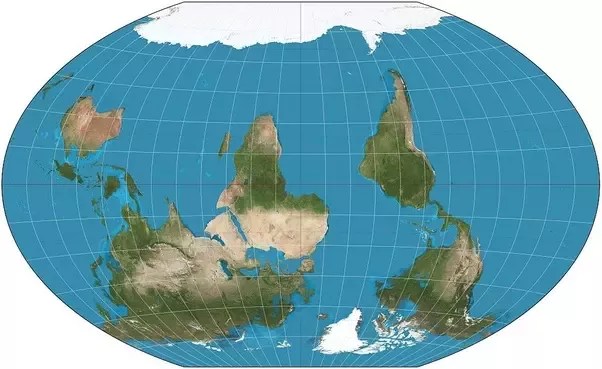
Turning the World Upside Down

There is an episode in seventeenth  chapter of Acts that tells the story of how Paul and Silas were arrested in Thessalonica because their preaching in the synagogue had resulted in a number of influential converts which upset the old guard and gatekeepers so much that, according to the text, they hired local ruffians to stir up a small riot, then blamed Paul and Silas for the fracas. When they dragged Paul and Silas before the city authorities this was their accusation: “These are the men who are turning the world upside down… They are all acting contrary to the decrees of the emperor, saying that there is another king named Jesus.”

Turning the world upside down.  Getting into “good trouble.” Acting contrary to custom and law.  Claiming that they answer to a higher authority named Jesus.

For a very long time this was the portrait of the Church:  faithful people turning the world upside down, banding together in beloved community to worship and to take care of each other as a sign that God’s love was at work in them in the name of Jesus.  When the empire was cruel, they protested with prayer and patience and, often, by being its victims so that the empire’s cruelty would be on full display.  When the empire showed no compassion, they provided the missing safety nets, feeding the hungry, sheltering the homeless, binding up wounds, caring for the sick even in times of plague.  

In a world that lionized strength, they were led by the Spirit who had said through the Apostle Paul, “My grace is sufficient for you, for power is made perfect in weakness.”(1 Cor. 12:9)  In a era driven by wealth, they bowed to the one who had said, “Blessed are you who are poor for yours is the kingdom of God.” (Luke 6:20)  In a world where their faith and fellowship was declared illegal and their ideas branded as subversive, they quietly grew in numbers and strength.

And then something happened.  After three centuries of being illegal, three centuries of subverting the dominant paradigm, three hundred years of quiet protest as the alternative realm within the empire’s domain, three hundred years of living and practicing their faith sometimes quite literally underground, they did, indeed, turn the world upside down. 

The emperor became one of them.  Flavius Valerius Constantinus, also known as Constantine the Great, became a Christian.

And suddenly priorities changed.  Suddenly it became vitally important for followers of Jesus to clarify what they believed so they could make sure that all these churches in all these cities in this vast empire were seeing things the same way, were talking about God the same way, and were teaching the same things.  Because now it was the empire’s church.  

In 325, the emperor called for a great council to meet.  Bishops came from all corners of the empire.  After intense debate the Doctrine of the Trinity was established as the first official doctrine of the official catholic (universal) Church.  A Creed was written to ensure allegiance to what the Council had decided was the true faith.

In a blink of history’s eye, the focus of the followers of Jesus shifted.  Now the emphasis was more on what people believed and less on what they were doing.  Now the weight was more on what the faithful thought about Jesus and not as much on how they followed him.  Now the more organic ecclesia, the beloved community of those living in companionship with Jesus, became the organized Church.

Almost overnight the world had turned the Church upside down.  And while the empire adopted some of the values of the Church, much more did the Church fall in line with the empire.

And so it has been, more or less, for seventeen centuries. 

Now we live in a time of crisis.  We are still recovering from a pandemic where more than a million persons in our country and nearly seven million world-wide have died from the Corona virus.  Economic tensions are high. Political tensions are higher, and sociological tensions are higher still.  Empire is unstable within and without.  And the Church…

If you were to judge by what you see in the media, it would look like the Church is fading into invisibility and irrelevance except for a few noisy, high-profile segments who get all the wrong kinds of attention.  It’s true that membership numbers are shrinking.  It’s true that there are fewer congregations in all denominations.  It might look like the world has turned the Church upside down to such an extent that it’s all spilling out and becoming empty.

But I think it would be a mistake to believe that.  I think, if you look closely and in the right places, especially in the margins of society, you’ll see something else happening.  I think what you’ll see is that the Church is being quietly reformed, reshaped and repositioned so it can get back to the business of following Jesus more than just intellectually believing in Jesus.  I think, if you can learn to see it, you’ll see that the Church is being reshaped to proclaim the kin-dom of heaven by showing examples of that kin-dom at work on earth as it is in heaven.

I think, if you look closely, you’ll find followers of Jesus standing firm in the protests against racism.  You’ll find followers of Jesus working to protect voting rights.  You’ll find followers of Jesus feeding the hungry and trying to stop evictions during a time of quarantine.  You’ll find followers of Jesus in the courts trying to overturn wrongful convictions. 

If you look, you’ll find people like Steve Taylor making movies like Blue Like Jazz that show people wrestling with issues of faith instead of immersing themselves in an unsustainable certainty.  If you listen you’ll find music from followers of Jesus like Carrie Newcomer and poetry and prose from people like Parker Palmer and Ann Lamott who show us how to reach deep into our souls and touch the hearts of others without off-putting piety.  If you look If you look beyond the historic antagonism between science and theology, you’ll find people like Ilia Delio writing a new kind of groundbreaking theology rooted in a cosmic interpretation of evolution and quantum physics.   If you look, you’ll find followers of Jesus in every walk of life bringing light into the shadows and healing into the brokenness of the world.

If you look, I think you’ll find that the followers of Jesus are being repositioned so we can get back to doing what we did in the beginning…turning the world upside down.
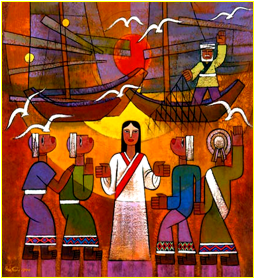
Out of Our Minds (and into our hearts)

Matthew 4:12-23

Today’s gospel reading is Matthew’s version of Jesus calling the fishermen.  It sounds like a simple enough story:  Jesus is in Capernaum, and as he walks along the shore of the Sea of Galilee he spots the fishermen, Peter, Andrew, James and John and calls out to them, “Come, follow me and I will make you fish for people.”  Immediately they left their nets, their boats and their families and followed Jesus to begin their new life as disciples.  

The sermons we spin around this story often focus on a few key elements.  We talk about how amazingly charismatic Jesus is; obviously the Holy Spirit is powerfully present in him if all he has to do is say, “follow me” to get salty old fishermen to leave their boats and hit the road with him.  We talk about the power and importance of his invitation, and point out that Jesus is inviting us to come and follow him, too.  And then we usually finish up with an exhortation to “evangelism,” by which we mean prodding you all to invite your friends and family and neighbors to come to church.  Sometimes we even give you talking points or sample phrases you can use when you invite others to come to church.

There’s nothing wrong with any of that.  It’s all good stuff.  The charisma of Jesus was obviously off the charts—so off the charts that we still feel the pull of his personality more than two thousand years later.  The call to follow him is still compelling and life changing.  And inviting others to come and join us, especially when we extend that invitation because we know that being part of our community would enrich their lives, is both a duty and a joy.  

But what if instead of inviting people to come to church we invited them to be part of our subversive movement?  Can you imagine taking your next door neighbor aside and saying in a low voice, “Listen…there’s a group of us who are working behind the scenes to change things.  We’re talking politics, economics, social and cultural dynamics, personal values—all of it.  We’re talking about a quiet revolution.  The world’s a mess and we’ve got a nonviolent way to fix it.  We think you could help.  We’re having a meeting on Sunday morning.  Come hear us out and see what you think.”

That is, in fact, the kind of invitation Jesus was issuing when he called out to Peter, Andrew, James and John. There’s a lot more going on in today’s gospel than meets the eye, and to get the full impact of it we need to look at a bit of history so we can try to hear it the way the people in Matthew’s community of Jesus followers originally heard it.  

So let’s start at the beginning.

Now when Jesus heard that John had been arrested, he withdrew to Galilee. (4:12)  John the Baptist had been preaching and baptizing at the Jordan River, issuing a call for the nation to embrace a life of righteousness.  He had gathered a significant following, and when he began to directly target Herod Antipas with his preaching, Antipas was afraid he would lead a revolt, so he had John arrested and thrown into prison.  Matthew seems to be asserting here that the arrest of John was the cue for Jesus to begin his ministry in earnest.  

He left Nazareth and made his home in Capernaum by the sea, in the territory of Zebulun and Naphtali, so that what had been spoken through the prophet Isaiah might be fulfilled. (4:13-14)  Matthew quotes the words of Isaiah from a time five hundred years earlier when the territories of Naphtali and Zebulun were under the oppressive thumb of the Assyrians.  Isaiah was reminding the people in those territories that God had not forgotten them.  He told them that a light would dawn to lead them out of the darkness of their oppression. Fast forward 500 years, and Matthew is telling his community of Jesus followers, who are also living under the thumb of an oppressive empire, that Isaiah’s words apply to them, too, that Jesus is the light who will lead them out of their dark night of oppression.  

To begin his ministry in earnest, Jesus left Nazareth in the hill country and “withdrew” to Galilee to make his home in Capernaum.  This was a strategic decision.  Nazareth was just a small village.  Economically it was dependent on the constant construction projects in the Roman garrison city of Sepphoris only four miles away.  It wasn’t a likely place for attracting followers, and starting a movement in the Roman army’s back yard, especially a movement dedicated to confronting imperial and religious oppression, a movement that proclaimed an alternative way of life and called it the kingdom of God, would have brought immediate and crushing consequences.  

Galilee, on the other hand, was in many ways the ideal place to start.  Galilee was the breadbasket of the region, ringed by Hellenistic cities that were dependent on its farms for their food supply.  But despite the overall wealth of the region, there was a current of seething dissatisfaction in Galilee.  Tenant farmers paid as much as 50% of their crops to absentee landlords.  On top of that there were heavy Roman taxes and tithes to the temple in Jerusalem.  Very little money ended up in the pockets of the people doing the actual work, and most farmers were living at a subsistence level.  This led to work stoppages, occasional uprisings, and organized banditry throughout the region.

It wasn’t much better for the fishermen in the Sea of Galilee.  Rome claimed ownership of the sea and all that was in it, so Rome took a hefty cut of every catch.  Fishermen had to be licensed—another income stream for the empire and drain on the workers.  Often fishermen were employed by someone who owned a license and wages were determined by the size of the catch.  On top of that there was the cost of nets, net weights and boats.  The boats were made of cedar imported from Lebanon and were in constant need of repair, another cost that came out of the fisherman’s pockets.  

The tension between the urban lifestyle of the cities and the rural lifestyle of those in the farm lands was acute.  The difference in values was significant.  The economic distance between the haves and the have-nots was extreme.  And one of the most important pivot points in all that tension was the small city of Capernaum.

Capernaum—not so big as to be a real urban center, not so small as to be a mere country village—was the first town in Herod Antipas’ territory after you crossed the border from Herod Philip’s territory.  It was a toll station where taxes were collected.  It had a Roman presence, but not a large Roman presence.  It was Hellenized, but not too Hellenized.  It was important enough that important things could be started there, and out of the way enough that those important things could have a chance to grow before being noticed by the powers that be.  It was the perfect place for Jesus to begin his work.

 From that time Jesus began to proclaim, “Repent, for the kingdom of heaven has come near.” (4:17)  This is the same message that was the centerpiece of John’s preaching, so Jesus is picking up where John left off.  There are a couple of important translation notes to pay attention to here, though.  The first is the word “repent.”  “Repent” is a pretty poor translation of the Greek word metanoiete.  Metanoiete is a compound word composed of two Greek words, meta, meaning “beyond,” and nous, meaning mind.  A literal translation would be “go beyond your mind.”  The English word “repent” has moralistic overtones suggesting a change in behavior or changing your actions, but  Jesus is calling for a far more comprehensive change, a change in the way you think, in the way you see the world, in the way you approach the world and in the way you understand your place in the world.  

The second word that needs retranslating is the Greek word engiken, as in the kingdom of heaven is engiken.  This word is usually translated as “at hand” or “has come near” or something similar, but the sense of the word is more imminent than that.  My favorite way to translate it is “in reach.”  The kingdom of heaven is in reach.  It describes something so close you can almost touch it.  If you make a little effort it’s reachable.

So putting all this together, the message that both John and Jesus were proclaiming so urgently was, “Change your thinking—get out of your head and into your heart!  The kingdom of heaven, the shalom of God, is in reach!  It’s on your doorstep!  It’s doable!”  

As he walked by the Sea of Galilee, he saw two brothers, Simon, who is called Peter, and Andrew his brother, casting a net into the sea—for they were fishermen.  And he said to them, “Follow me, and I will make you fish for people.” (4:18-19)  I don’t usually borrow from one gospel to interpret something in another gospel.  The four gospels were written at different times and at different places, and originally each stood more or less on its own.  But I think an exception is warranted here.  If you remember last week’s gospel from John 1:29-42, Andrew and Peter met with Jesus near where John was baptizing.  John’s account says that they spent a long afternoon with him.  It makes sense to me that the encounter on the seashore is not their first meeting; they would have already spent time with Jesus and listened to him teaching about the better way of life he called the kingdom of heaven or the kingdom of God.  So when he called out to them, “Come, follow me,” they had been waiting for his summons and were ready to follow.  

When Jesus says, “I will make you fish for people,” this is an echo of the Hebrew prophets that they would have known well.  The prophets used fishing as a metaphor for both salvation and judgement.  In Jeremiah 16:16 we find a prophesy of both rescue and retribution, promising that the people in captivity will be brought home: I am now sending for many fishermen, says the LORD, and they shall catch them.  

Amos 4:2 promises that wealthy elites who have abused the poor will be caught like fish and brought to judgement: 

The Lord GOD has sworn by his holiness:

                  The time is surely coming upon you,

         when they shall take you away with hooks,

                  even the last of you with fishhooks.

Jesus borrows this metaphor when he calls the fishermen, James, John, Andrew and Peter, but he is “fishing” them out of the waters of their normal life in order to save them.   He is “catching” them to lead them into a new kind of health and wholeness in a beloved community with new values and a new way of being.  He is “hooking” them into a movement to create an alternative to the systems that keep so many ground down in poverty.  It will involve political confrontation, but not violence.  It will involve a change in the understanding of their religion, but not apostasy.  It will be the new thing God had long promised.

“The best criticism of the bad,” said Richard Rohr, “is the practice of the better.”  Jesus started a movement, a quiet revolution, not by merely criticizing all the wrongs of the world, but by modeling a better way.

In an oppressive world that was tearing itself apart, Jesus called the fishermen and the tax collector and the builder and the tanner and all kinds of other people to follow him into a new way of life.  He called them and he calls us to live in a beloved community set apart from the business-as-usual world.  He calls us to live in cooperation instead of competition.  He calls us all to change our thinking—to be a little bit out of our minds and very much into our hearts—so we can enter into the shalom of God and change the world.