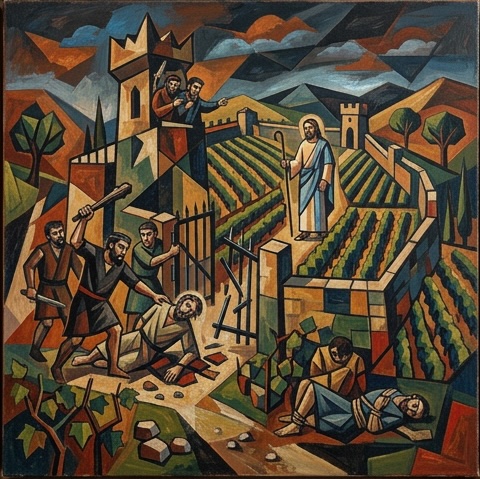
Matthew 21:33-46
Our gospel text for this Sunday is often called The Parable of the Wicked Tenants, in fact that exact title appears in many of our Bibles. Which can be a bit problematic. Traditional titles inserted in our Bibles tend to skew our reading in a particular direction. These long-established titles tell us a lot about how these stories have been historically interpreted, but they don’t always point us to the actual point that Jesus was trying to make. A lot of years and a lot of cultural changes stand between us and the original telling of the stories.
Still, having said all that, The Parable of the Wicked Tenants is actually a pretty accurate title for this particular short story by Jesus because the tenants in this story really are pretty horrible.
From the moment Jesus entered Jerusalem he was headed for a showdown. The chief priests and temple authorities had been installed in their offices by the Roman authorities and rather openly collaborated with the Empire’s agenda. These supposed guardians of the nation’s spiritual health and tradition came to challenge Jesus while he was teaching in the temple and Jesus did not back down from the confrontation. As the heat became more intense in their back-and-forth, Jesus borrowed imagery from the prophet Isaiah to impeach their performance as spiritual leaders and as the advocates of justice for the people.
A man planted a vineyard, he said. He put a fence around it. He dug a winepress. He built a watchtower. He made a big investment in the land to make sure that the vineyard had everything a good, productive vineyard was supposed to have. Then he leased it to tenants and went away. When harvest time came, he sent his agents to the tenants to collect his share of the produce. But the tenants beat up his agents. The even killed one of them. The landowner sent more agents but the tenants abused them, too. Finally he sent his son. But the tenants killed him, too, figuring that they could then just take over the vineyard and claim ownership. “So,” said Jesus, “when the owner of the vineyard comes, what will he do to those tenants?” “He will put those wretches to a miserable death,” said the chief priests. “That’s right,” said Jesus. “The kingdom of God will be taken away from you and will be given to a people who produce its fruits.” And that’s when it dawned on them that this little story was about them. Awkward.
This parable has been interpreted in some pretty unfortunate ways throughout the last two thousand years, so let’s begin by clarifying what it is NOT about. This is not an antisemitic story in any way, shape or form. This is not a story about how the Jewish people are being supplanted in God’s affections by Christian Gentiles. This is not a story about God abandoning the Jewish people.
The indictment in this parable is against the temple leadership who had collaborated with the Roman authorities in oppressing the people, and the temple authorities who heard Jesus tell this story understood that right away. “When the chief priests and the Pharisees heard his parable,” Matthew tells us, “they realized that he was speaking about them. They wanted to arrest him, but they feared the crowds, because they regarded him as a prophet.”
I have no doubt that the temple authorities recognized this parable right away as an echo of Isaiah’s Song of the Vineyard. And I imagine that the ending of that passage from Isaiah would have been ringing in their ears in a pretty uncomfortable way: “For the vineyard of the LORD of hosts is the house of Israel and the people of Judah are his cherished garden; he expected justice but saw bloodshed; righteousness, but heard a cry of distress.[1]”
Jesus told this parable in the temple to confront the temple authorities about their failures as stewards of the offices that God had given them. It is a story told in a particular time and place to a particular audience for a particular reason. But like all good parables, it has traveled well through time and through cultural and political changes, and like all good parables it still speaks pointedly to situations where people are failing to live up to their responsibilities.
Nine years ago this parable came up in the lectionary one week after the mass shooting in Las Vegas where 59 people were killed and more than 500 were injured. On that Sunday this parable spoke to the epidemic of gun violence in our country. I could not avoid preaching on that since friends and family members of people in our congregation were among the wounded. The parables of Jesus still speak directly to our times, our troubles and our lives.
It’s tempting right now to let this parable speak to our current political situation here in the United States and especially to the failures of our different branches of government to perform their constitutional duties and stay in their constitutional lanes. It’s tempting to draw parallels between the temple leadership that had angered and disappointed Jesus and our own elected and appointed officials who have been failing to form a more perfect union, and establish justice, and insure domestic tranquility, and provide for the common defense (not offense, you’ll note), and especially failing to promote the general welfare and secure the blessings of liberty to ourselves and our posterity. But you don’t need me to tell you that We the People and those we’ve elected are not living up to what God has told us is good. The prophet Micah told us a long ago what God expects. Sadly, there are any number of ways in which we are not doing a very good job of doing justice and loving kindness and walking humbly with our God.[2]
This Parable of the Wicked Tenants really does speak to our current political climate in ways that should make us stop and take stock. But I can’t help but think that God may also be inviting us to use this parable as a lens to take a close look at a very different topic this week.
Today, October 4, marks the end of the Season of Creation, the annual ecumenical observance that runs from September 1st to October 4th. During this season, Christians all over the world unite in prayer, action and advocacy to protect the environment. This year’s theme has been “Living Water” and the focus has been on the importance of water and all the ways our water supplies have become endangered.
Today is also the feast day of St. Francis of Assisi, the patron saint of animals and birds and ecology and environment. St. Francis had a deep reverence of nature and in his Canticle of Brother Sun and Sister Moon he depicted all of creation praising God. Brother Sun and Sister Moon and the stars of heaven praise God for making them bright, precious and fair. Brothers Wind and Air cherish all that God had made. Sister Water praises God by being useful, humble, precious and pure. Brother Fire, who is beautiful, playful, robust and strong praises God by bringing light to the night. And then there is our Sister, Mother Earth who sustains and governs us, producing varied fruits with colored flowers and herbs.
I would like to suggest that, in honor of St. Francis and the Season of Creation, we try to hear this Parable of the Wicked Tenants in a very different way. Let’s go with the allegory and say that the landowner who planted a vineyard is God. But then let’s say, on this feast day of St. Francis and the last day of the Season of Creation, that the beloved vineyard that God has planted is the whole earth. And now let’s imagine that we humans are the tenants in the parable, the tenants who abuse the landowner’s messengers and try to steal the land and all the produce.
It kind of tracks, does it not?
Genesis 2 tells us that the human was created from the earth. In Hebrew, Genesis calls that human ha’adamah—literally “of the earth” or earth man. God then placed the earth man in the garden to till it and keep it. That’s how the NRSV translates the instructions. But eved, the Hebrew word that we translate as “till” really has a connotation not so much of digging and weeding but more of serving and preserving the land. And shamar, the word our Bibles translate as “keep” really means to guard and protect. So in Genesis 2, God instructs humanity to serve, preserve and protect the land. We see these instructions repeated and expanded throughout the Torah. Explicit laws are given for protecting and serving creation and preserving it.
The Hebrew scriptures go on to remind us that the land does not belong to us; it belongs to God. Psalm 24 reminds us explicitly that “The earth is the LORD’S and all that is in it, the world, and those who live in it.” We seem sometimes to have forgotten that.
In 1962 a marine biologist named Rachel Carson published a book entitled Silent Spring which almost overnight launched the modern environmental movement. She was primarily concerned with how our use of chemical pesticides was poisoning water supplies and killing birds, fish and other animals, but her book helped others realize that various kinds of pollution were also seriously damaging our earth, our only home. In Silent Spring she said, “We stand now where two roads diverge. But unlike the roads in Robert Frost’s familiar poem, they are not equally fair. The road we have long been traveling is deceptively easy, a smooth superhighway on which we progress with great speed, but at its end lies disaster. The other fork of the road — the one less traveled by — offers our last, our only chance to reach a destination that assures the preservation of the earth.”[3]
We have had scientists warning us for a long time that our industrial and extractive way of life is damaging the planet.
In the early 1800s the German naturalist, Alexander von Humboldt who wrote about the interconnectedness of natural systems and documented regional environmental and climate damage caused by reckless deforestation.
In the 1850s and 1860s American scientist Eunice Foote and Irish physicist John Tyndall discovered and measured the heat-trapping physics of carbon dioxide and laid the scientific groundwork for understanding atmospheric warming.
In 1896, Svante Arrhenius, a Swedish scientist, published a landmark paper that calculated how changes in atmospheric carbon dioxide would impact ground temperatures through the greenhouse effect. The scientists started telling us a long time ago that we were heading for trouble.
Human-caused global warming has already increased Earth’s temperature by roughly 1.1° to 1.4° Centigrade. Heat waves have become more frequent, longer lasting and more intense. Larger and more frequent wildfires have increased respiratory illnesses. Pollen cycles have been altered which has a negative effect on both pollinators and crops and also makes more misery for persons who suffer from allergies. Higher temperatures have accelerated evaporation and disrupted precipitation patterns creating more frequent and more severe flooding in some areas and longer-lasting drought in other areas leaving billions of people facing water anxieties and agricultural stress.
Official government data undercounts heat-related fatalities, but statistical models and independent investigations by Boston University and NPR estimate that extreme heat contributes to roughly 9,000 deaths annually in the United States.
The oceans have been absorbing more carbon emissions which has led to ocean acidification and coral bleaching that threatens marine biodiversity. Unpredictable weather, extreme downpours and severe droughts damage crop yields, destabilize food supplies and heighten global hunger. Melting glaciers and thermal expansion are raising sea levels, threatening coastal infrastructure, contaminating freshwater with salt, and making storm surges more dangerous and damaging. The “Super El Niño” is just warming up.
And as if to illustrate just how dangerous all of this has already become, last week a small shark was seen swimming through the streets of Surf City, New Jersey as a result of tidal surge flooding.
The Intergovernmental Panel on Climate Change[4] has stated, “The scientific evidence is unequivocal: climate change is a threat to human wellbeing and the health of the planet. Any further delay in concerted global action will miss the brief, rapidly closing window to secure a livable future.”
It’s already bad and it’s going to get worse unless we start taking meaningful steps to turn things around. And now we have the additional threat of Artificial Intelligence with data centers monopolizing far too much of our fresh water.
Listen to a parable. There was a landowner who planted a vineyard. It was a good vineyard with everything that was needed for a good and fruitful life. But the tenants… the tenants were not mindful of their responsibilities. So what will the owner of the vineyard do to those tenants? What will they do to themselves if they don’t take responsibility for their actions and their way of life?
“We have lived by the assumption that what was good for us would be good for the world,” said the late Wendell Berry. “We have been wrong. We must change our lives, so that it will be possible to live by the contrary assumption that what is good for the world will be good for us. . . We must recover the sense of the majesty of the creation and the ability to be worshipful in its presence. For it is only on the condition of humility and reverence before the world that our species will be able to remain in it.”[5]
[1] Hebrew: Tza’aqah—a cry of distress, wailing, weeping
[2] Micah 6:8. Note: the Hebrew hesed can be translated as either kindness or mercy.
[3] Carson, Rachel; Silent Spring
[4] Science.NASA.gov
[5] Wendell Berry, The Long-Legged House


