Whatever We Ask

Mark 10:35-45

“Whoever wishes to become great among you must be your servant, and whoever wishes to be first among you must be a slave of all. For the Son of Man came not to be served but to serve, and to give his life a ransom for many.”

There was an interesting picture that popped up here and there on social media a few years ago.  It was a picture of a middle-aged man washing dishes in a restaurant kitchen, which isn’t all that unusual, except in this particular picture, the man who was washing the dishes was Rock and Roll Hall of Famer Jon Bon Jovi, the front man for the very successful rock band, Bon Jovi. 

Back in 2011 Jon and his wife Dorothea wanted to do something to help hungry people, but they didn’t want it to be just another food pantry or soup kitchen.  Food banks and soup kitchens do good work, but they also tend to isolate poor people from everyone else or spotlight them—and not in a good way.   

Jon and Dorothea decided to open a restaurant where payment is optional so that folks who cannot afford a restaurant meal can dine right alongside those who can.  They called their restaurant JBJ Soul Kitchen and it has now expanded to three locations.  

The menu at JBJ has no prices.  You select what you like and are encouraged to make a suggested donation, but if you are unable to donate, you are invited to participate in what they call “volunteer opportunities,” which usually means working in the kitchen in one way or another.  When he’s not on tour, Jon Bon Jovi himself often stops in to volunteer as a waiter or cook or dishwasher.  

During the pandemic, as you might imagine, JBJ Soul Kitchen had to change its ways of operating.  In an interview in 2020, Jon said, “Due to the pandemic, we couldn’t have any volunteers work.  But we still had mouths to feed.  So Dorothea and I worked five days a week for two months before we went to Long Island and opened a food bank that fed 6,000 people a month there.”  

Whoever wishes to become great among you must be your servant, and whoever wishes to be first among you must be a slave of all.

There is a YouTube channel where, every night of the week, you’ll find one of the richest, most successful women in the world sitting on her bed in her pajamas reading a children’s book.  The very famous  lady in her PJs is none other than Dolly Parton, and her YouTube program, Goodnight with Dolly, is targeted toward preschoolers, because children who have someone read to them on a regular basis develop their own reading skills earlier and more easily.  

Dolly understood that not every parent has free time to sit and read with their kids, especially single parents.  And not all parents read well enough, themselves, to provide their kids with that important head start.  In fact, that was the case with Dolly’s own father who started working while still very young and as a result never learned to read or write.  So Dolly Parton decided that, in honor of her father, she would help as many kids as possible develop those very necessary pre-reading and early reading abilities.

Goodnight with Dolly is the newest venture in Dolly Parton’s long-time campaign for literacy.  In 1995, she launched the Imagination Library in Sevier County, her home county in East Tennessee, to inspire a love of reading by giving one free children’s book every month to every child in the county from age two until they start school.  With the help of local community partners, the Imagination Library has now spread throughout the United States, United Kingdom, Canada, Australia, and Ireland.  Nearly two million kids are now registered in the Imagination Library, and the organization has given away more than 254 million books.  Even so, there are still kids who haven’t been reached.  So Dolly Parton sits on her bed in her pajamas and reads to the kids whose parents aren’t available or aren’t able to read to them.

Whoever wishes to become great among you must be your servant, and whoever wishes to be first among you must be a slave of all.

The Disciples James and John came to Jesus and said, “Teacher, we want you to do for us whatever we ask of you.”  When he asked them what that might be, they said, “Let one of us sit at your right hand and one at your left when you come into your glory.”  

It’s interesting that Jesus didn’t chastise them even a little for asking something so audacious.  He simply told them that they didn’t really understand what they’re asking.  He hinted at the ordeal he would soon endure when he asked them,  “Are you able to drink the cup that I drink, or be baptized with the baptism that I am baptized with?”  They answered just a little too quickly:  “We are able,”  and it seems pretty clear that they didn’t really know what they were signing up for.

We shouldn’t be too hard on James and John.  To their credit, they really did have faith.  They truly believed that Jesus really could give them what they wanted.  They believed that he would soon “come into his glory.”  They just didn’t understand what that meant.  It didn’t occur to them that he was talking about the cross.

A lot of us have come to Jesus at one time or another saying, “I want you to give me whatever I ask of you.”  A lot of people have thought that this is really the essence of praying.  Jesus, please give me what I ask for.  And a lot of us have asked at one time or another to be put in positions of authority and prestige—right seat or left seat, either one is okay as long as we have a seat next to the throne. . .or at least at the table.  We want that position that gives us the authority to fix all those things that other people are messing up.  We have ambition.

Jesus didn’t rebuke James and John for their ambition.  But the other disciples did.  So Jesus had to remind all of them of what he had been saying all along.  You want to be a leader?  Fine!  Good!  Now, can you be a servant?

Whoever wishes to become great among you must be your servant, and whoever wishes to be first among you must be slave of all.

When Boris Baranov was appointed to the position of Shift Supervisor at the powerplant where he worked, he was given significant authority over some of the plant’s operations.  Along with that authority, of course, came some extra responsibilities.  Boris never dreamed, though, that saving most of Europe from becoming a nuclear wasteland would be one of those responsibilities.  But that’s exactly what happened one day when something seriously malfunctioned during his shift at the Chernobyl Nuclear Power Station, the powerplant where Boris worked. 

On April 26, 1986 one of the four reactors at Chernobyl exploded releasing 400 times more radioactive fallout than the bomb dropped on Hiroshima in 1945. Two workers were killed instantly.  Another 29 would die from radiation burns or poisoning over the next few months.  

All the fires were extinguished within six hours, but now there was a risk of an even larger explosion—an explosion that would be many times more devastating.  

Several days after they thought that everything was under control, they discovered that the reactor in unit 4 had continued to melt down. Below the reactor was a thick concrete slab and below the slab was a large pool of water which was normally used to cool the reactor.  

The core of the badly damaged reactor was now melting its way through the concrete slab.  If it were to reach the water, it would create an gargantuan steam explosion with a force of 3 to 5 megatons.  The enormous cloud of radioactive steam and ash that would have risen into the wind from that explosion would have made much of Europe uninhabitable for 500,000 years. 

To prevent the explosion, the water under the reactor had to be drained, which could only be accomplished by manually turning the right valves which were in the basement.  That would have been simple enough except that the basement was flooded with radioactive water from putting out the fires.  

Boris Baranov, the shift supervisor, Valeri Bespalov, the senior engineer, and mechanical engineer Alexei Ananenko volunteered to wade into the flooded basement and turn the valves.  Their brave and selfless act of service saved millions of lives.

Whoever wishes to become great among you must be your servant, and whoever wishes to be first among you must be a slave of all.

There’s nothing wrong with ambition.  Jesus didn’t rebuke James and John for their ambition.  He even affirmed that they would, in the end, drink from his “cup” and be immersed in his “baptism.”  But he wanted them to understand that ambition for ambition’s sake can lead to responsibilities you’re not prepared for, challenges you haven’t even begun to imagine.  

James and John wanted to be great, to sit in positions of prestige and authority.  And in the end, in a way, they got what they asked for.  According to tradition, after ten or twelve years proclaiming the gospel in Palestine alongside his brother John and the rest of the disciples,  James took the gospel to Spain.  In the end, when he returned to Jerusalem, he was killed by Herod Agrippa.  

John, according to tradition, took the gospel to Ephesus where he had a long life serving others and teaching them the way of Jesus.  James and John found direction for their ambition.  But along the Way they had to learn a very hard lesson. 

Whoever wishes to become great among you must be your servant, and whoever wishes to be first among you must be a slave of all.

In a matter of days now, we will have a very important national election.  The votes you cast in this election will be among the most important votes of your lifetime.  I cannot tell you whom you should vote for, but I will ask you to consider this:  who, among these candidates, has a history of seeking power out of sheer ambition, and who has a record of public service?  Who is seeking power for the sake of having power, and who is seeking a more powerful way to serve?  

Whoever wishes to become great among you must be your servant, and whoever wishes to be first among you must be a slave of all.  Please bear that in mind as you vote, then vote accordingly. . . and prayerfully. 

Lifted Up

Mark 1:29-39

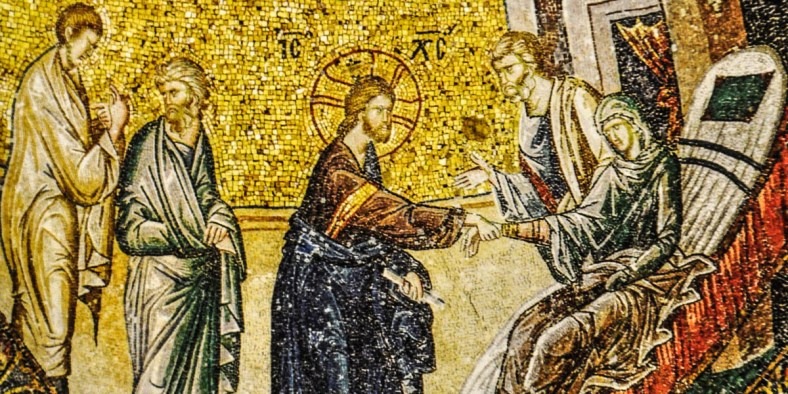
“He came and took her by the hand and lifted her up.  Then the fever left her, and she began to serve them.”  Two simple sentences.  And like so much of Mark’s gospel, a surprising amount of action in surprisingly few words. 

After preaching with authority on the Sabbath at the synagogue at Capernaum, then casting out an unclean spirit from a man who interrupted him, Jesus was ready for a break.  So he went to the house of his new disciples, Peter and Andrew.  It happened that Peter’s mother-in-law is sick and in bed with a fever.  They told Jesus about her right away and Jesus went in to see her.

And here is where the translation maybe is not our friend.  “He took her by the hand” sounds much gentler than what it says in the original language.  Kratésas it says in the Greek.  Kratéo is the verb.  It’s not a tender word.  It means to grasp firmly or strongly.  

He grasped her firmly and then it says he “lifted her up.”  Which is fine.  But again, something is lost in translation.  The verb Mark used is egeiro.  It’s the same word Jesus will use when he raises Jairus’ daughter from the dead and says, “Little girl, get up!”  It’s the same word the angel will use to tell the women that Jesus is not in the empty tomb because he is raised up—egeiro.  

So maybe this isn’t quite the gentle scene I had always imagined.  Maybe this is a scene full of strength and energy and power.  Jesus grasped her strongly, firmly by the hand—and hand, by the way, could mean anywhere from her fingertips to her elbow—Jesus grasped her firmly and raised her.  

And the fever left her.

And she began to serve them.

It’s tempting to get a little upset about that last part—she began to serve them.  After all, she’s just been sick with a fever.  And now here are all these guys who come traipsing into the house and because of the expectations of the society they live in, she jumps out of her sickbed to rustle up some dinner for them.  Oh, and by the way, does anybody care that it’s still the Sabbath?

Some commentators have pointed out that she would be happy to serve them because, in a culture where roles are clearly defined, she could now resume her place as matriarch of the household along with all the social currency that comes with that.

That interpretation about her immediately resuming her social position and role is all perfectly fine and no doubt played some part in her rising immediately to serve, but there’s also something going on in the language that deserves a moment of attention.  It’s a little thing.  But, as I’ve been learning, Mark often uses these subtle little things to make big points.  In this case it has to do with the word “served.”  The Greek word in question is the verb diakoneo.  It does mean “to serve” and it is often used in the context of serving food and drink, but it also has another layer of meaning, particularly in Mark’s gospel.

Here’s how Ched Myers explains it in his book, Say to This Mountain: Mark’s Story of Discipleship—

“Peter’s mother-in-law is the first woman to appear in Mark’s narrative.  We are told that upon being touched by Jesus, “she served him(1:31).  Most commentators, steeped in patriarchal theology, assume that this means she fixed Jesus dinner.  However the Greek verb “to serve,” diakoneo (from which we get our word “deacon”)_ appears only two other times in Mark.  One is in 10:45—“The Human One came not to be served but to serve”—a context hardly suggesting meal preparation.

“Mark describes women ‘who, when Jesus was in Galilee, followed him, and served him, and…came up to Jerusalem with him’ (15:41).  This is a summary statement of discipleship:  from beginning (Galilee) to end (Jerusalem) these women were true followers who, unlike the men (see 10:32-45) practiced servanthood.”

So here is Peter’s mother-in-law—sadly we don’t know her name—but Mark identifies her service with a word that implies that there is a sacred aspect to her serving, a holiness that springs not from her sense of duty or social propriety, but from her faith.  

She is a deacon.  

In Mark’s gospel, the men surrounding Jesus are often argumentative and a little dense.  But the women, though not mentioned often, are astute and faithful.  

Astute and faithful women have kept the ministry of Jesus alive and well in this world for more than 20 centuries.  

Think of the women mentioned in the Gospel of Luke who travelled with Jesus and financially supported Jesus and the disciples.  Luke tells us that Mary Magdalene, and Joanna, the wife of Herod’s steward Chuza, and Susanna, and many others provided for them out of their resources.  

Some of these women came to be called the Myrrh Bearers because after Jesus was crucified, they were the ones who went to the tomb to anoint his body.  Because they went one last time to serve him in that way, they ended up being the first ones to hear the good news of the resurrection.

Mary Magdalen was known to be particularly close to Jesus and was regarded as an Apostle by many among the early followers of Jesus until patriarchy asserted itself, suppressed her influence, and sullied her reputation in the 6th century by spreading the story that she had been a prostitute.  But it was Mary Magdalen who, according to the Gospel of John, first encountered the risen Jesus.  It was Mary Magdalen who first proclaimed his resurrection, making her the first evangelist.

Another Mary who was part of this group of women disciples, was Mary, the wife of  Cleopas.  Tradition tells us that her husband was the brother of Joseph, Jesus’ foster father, so she was Jesus’ aunt, and sister-in-law of Jesus’ mother, Mary.  She, too, was a Myrrh Bearer and is probably the unidentified person traveling with Cleopas on the road to Emmaus in chapter 24 of Luke’s gospel. That means that she was also one of the first witnesses to the resurrection.

Joanna, the wife of Herod’s steward, Chuza, is someone we know a little more about.  We see her later identified in the letters of the Apostle Paul where he uses her Roman name, Junia.  In Romans 16:7, Paul says that she is prominent among the Apostles and that she knew Christ before he did.   Junia was a remarkable person, a woman disciple of Jesus who travelled with him in his ministry,  and continued in ministry as an Apostle, travelling as far as Rome for the cause of the gospel.  Some scholars have suggested that she might be the author of the Letter to the Hebrews.

Priscilla and her husband Aquila are mentioned six times in the New Testament.  Four of those times, Priscilla is mentioned first before Aquila, and it’s clear that she is a full partner in their work together for the sake of the gospel.  Priscilla and Aquila are also traditionally listed among the 70 that Jesus sent out on a mission.  Priscilla, who is sometimes called Prisca, her more formal name, was one of the first women preachers in the church.   Acts 18:24-28 tells us that she, along with Aquila, instructed Apollos in the faith.  Some scholars speculate that Prisca may be the author of the Epistle to the Hebrews.

Phoebe was an overseer and deacon in the Church at Cenchreae.   St. Paul referred to her in Romans 16 as a deacon and a patron of many.  This is the only place in the New Testament where a woman was referred to with both of those titles. Diakonos kai prostateis.  A chief, a leader, a guardian, a protector.  St. Paul had such trust in her that he provided her with credentials so that she could serve as his emissary to Rome, and deliver his letter to them—that letter we know as the Epistle to the Romans.

Lydia of Thyatira, was a wealthy merchant of purple cloth, who welcomed St. Paul and his companions into her home at Philippi where, after listening to Paul’s teaching, she became a devoted follower of Jesus.  In doing so, she helped Paul establish the church at Philippi, the first church in continental Europe.

In that church at Philippi were two women, Euodia and Syntyche who were serving in positions of pastoral leadership.  At some point they got into a disagreement, and in his letter to the Philippians, Paul urges them to “be of the same mind in the Lord” so that their disagreement doesn’t split the church.  In calling them to unity, he notes that they have “struggled beside me in the work of the gospel.”  They were his full partners in ministry in that city.

Jesus took Peter’s mother-in-law in his firm grip and raised her up.  And she began to serve.  She became a deacon.  She began making sure things got done.  Making sure ministry happened.  And it’s the women who have been making sure things get done and ministry happens ever since.

Yesterday we celebrated the installation of a new pastor at Christ Lutheran Church in Long Beach.  If you include the long-term interim ministry of Pastor Laurie Arroyo, then Pastor Nikki Fielder is the fourth or fifth woman to serve Christ Lutheran as pastor.  Another woman, Pastor Jennie Chrien, preached at Pastor Nikki’s installation, and a third woman, our bishop, Brenda Bos, presided.  For several years now, the presiding bishop of our denomination has been a woman, Bishop Elizabeth Eaton.  Having women serve in these important roles in the church has become so normal that it’s hardly worth noting.  But it wasn’t always so.

It was only fifty-four years ago, a time still in living memory for many of us, that our denomination began to ordain women to the ministry of Word and Sacrament.  To be pastors.  On the one hand, it seemed then—and to some people it still seems—like a bold and progressive thing to do.  But when you look at the witness of the New Testament itself and what we have learned about the roles that women played in the earliest years of the church…well let’s just say that our historically recent ordination of women was shamefully long overdue.

I think of the women I’m indebted to in my ministry.  I think of my beloved spouse, Meri, who has always challenged me to look deeper than tradition in my understanding and practice of faith.  I think of all the women teachers I’ve had, like Dr. Martha Ellen “Marty” Stortz, professor of Church history, who opened my eyes to the rich goldmine of our heritage.  I think of the women scholars and writers I turn to for thought-provoking insights in theology and biblical studies, women like Debi Thomas, Barbara Brown Taylor, Rachel Held Evans, Roberta Bondi, Diana Butler Bass, Nadia Bolz-Weber, Heather Anne Thiessen, and Amy-Jill Levine.  I think of my women clergy colleagues who are so amazing and indispensable as we puzzle our way through the week’s texts and the week’s issues, and our life together in the church.

I think of the women in our congregations who make things happen.  Without whom things would not happen.  The Tabithas, the Junias, the Priscillas, the Marys, the Pheobes. The Myrrh Bearers.  The Apostles in our midst.

I think of them all.  And I am so grateful.

Jesus has grasped them by the hand and raised them up.  And they have served.  Showing the presence of Christ and proclaiming the kin-dom of God, or as Diana Butler Bass calls it, “the commonwealth of God’s justice and mercy.”  

Jesus has raised them up and we are all richer for it. 

Jesus grasped them firmly by the hand and raised them up.

Because that’s what Jesus does.

He reaches into our fevered immobility and raises us up out of the sickbed of patriarchy and our fearful status quo.  He frees us from the illness of coersive social conventions and oppressive patterns of business-as-usual so we can serve each other, so we can take care of each other and lift up others in meaningful ways that show the world what the commonwealth of God’s justice and mercy looks like and how it works.  

He raises us up so we can live together and work together, so we can use our unique abilities and gifts in a beloved community where, as Paul said in Galatians, “there is no longer Jew or Greek; there is no longer slave or free; there is no longer male and female;” and we can add there is no longer gay or straight or queer or trans, “for all of you are one in Christ Jesus.”

He raises us up so we can show each other the healing love of Christ as we serve each other and work together to make the reign of God a reality on earth as it is in heaven.  In Jesus’ name.

And She Began to Serve

Mark 1:29-39

“He came and took her by the hand and lifted her up.  Then the fever left her, and she began to serve them.”  Two simple sentences.  And like so much of Mark’s gospel, a surprising amount of action in surprisingly few words. 

After preaching with authority in the synagogue at Capernaum, then casting out an unclean spirit from a man who interrupted him, Jesus is ready for a break.  So he goes to the house of his new disciples, Peter and Andrew.  It happens that Peter’s mother-in-law is sick.  She’s in bed with a fever.  They tell Jesus about her right away and Jesus goes to her.

And here is where the translation maybe is not our friend.  “He took her by the hand” sounds much gentler than what it says in the original language.  Kratésas it says in the Greek.  Kratéo is the verb.  It’s not a tender word.  It means to grasp firmly or strongly.  

And then it says he “lifted her up.”  Which is fine.  But again, something is lost in translation.  The verb Mark used is egeiro.  It’s the same word Jesus will use when he raises Jairus’ daughter from the dead and says, “Little girl, get up!”  It’s the same word the angel will use to tell the women that Jesus is not in the empty tomb because he is raised up—egeiro.  

So maybe this isn’t quite the gentle scene I had always imagined.  Maybe this is a scene full of strength and energy and power.  Jesus grasped her strongly, firmly by the hand and raised her.  

Then the fever left her.

And she began to serve them.

It’s tempting to get a little upset about that last part—she began to serve them.  After all, she’s just been sick with a fever.  And now here are all these guys who come traipsing into the house and because of the expectations of the society they live in, she jumps out of her sickbed to rustle up some dinner for them.  Oh, and by the way, does anybody care that it’s still the Sabbath?

Some commentators have pointed out that she would be happy to do this because in a culture where roles are clearly defined she could now resume her place as matriarch of the household along with all the social currency that comes with that.

But again, there’s something going on in the language that deserves a moment of attention.  It’s a little thing.  But, as I’ve been learning, Mark often uses these subtle little things to make big points.  In this case, it has to do with the word “serve.”  Here’s how Ched Myers explains it in his book, Say to This Mountain: Mark’s Story of Discipleship—

“Peter’s mother-in-law is the first woman to appear in Mark’s narrative.  We are told that upon being touched by Jesus, “she served him(1:31).  Most commentators, steeped in patriarchal theology, assume that this means she fixed Jesus dinner.  However the Greek verb “to serve” (from which we get our word “deacon”_ appears only two other times in Mark.  One is in 10:45—“The Human One came not to be served but to serve”—a context hardly suggesting meal preparation.

“Mark describes women ‘who, when Jesus was in Galilee, followed him, and served him, and…came up to Jerusalem with him’ (15:41).  This is a summary statement of discipleship:  from beginning (Galilee) to end (Jerusalem) these women were true followers who, unlike the men (see 10:32-45) practiced servanthood.”

So here is Peter’s mother-in-law—sadly we don’t have her name—but Mark identifies her service with a word that implies that there is a sacred aspect to her serving, a holiness that springs not from her sense of duty, but her faith.  She is a deacon.  

In Mark’s gospel, the men surrounding Jesus are often argumentative and a little dense.  But the women, though not mentioned often, are astute and faithful.  

I’ve been thinking about this a lot this week.  This week we had a graveside service for Barbara, one of those astute and faithful women who have kept the ministry of Jesus alive and well in this world for more than 20 centuries.  As I conducted her service I was wearing one of the stoles she wove for me on her loom, and it made me think of Tabitha who we read about in the book of Acts.  She was much loved by her community in Joppa, and when they summoned Peter to pray for her, they showed him all the tunics and other clothing she had made for people.

I thought of the women mentioned in the Gospel of Luke who travelled with Jesus and supported Jesus and the disciples financially.  Mary Magdalene, and Joanna, the wife of Herod’s steward Chuza, and Susanna, and many others, Luke says, who provided for them out of their resources.  

These women came to be called the Myrrh Bearers because they were the ones who went to the tomb to anoint Jesus’ body after the crucifixion, but found it empty.

Mary Magdalen was known to be particularly close to Jesus and was regarded as an Apostle by many in the early church until patriarchy asserted itself, suppressed her influence, and sullied her reputation by spreading the story that she had been a prostitute.  But it was Mary Magdalen, according to the Gospel of John, who first encountered the risen Jesus.  It was Mary Magdalen who first proclaimed his resurrection, making her the first evangelist.

Another Mary who was part of this group of women disciples, was Mary, the wife of  Cleopas.  If tradition is correct, her husband was the brother of Joseph, Jesus’ foster father, so she was the sister-in-law of Jesus’ mother, Mary.  She, too, was a Myrrh Bearer and is probably the unidentified person traveling with Cleopas on the road to Emmaus in chapter 24 of Luke’s gospel, making her one of the first witnesses to the resurrection.

Joanna, the wife of Herod’s steward, Chuza is someone we know a little more about.  We see her later identified in the letters of the Apostle Paul where he uses her Roman name, Junia.  Paul says she is prominent among the Apostles and that she knew Christ before he did (Romans 16:7).   In Junia we see someone remarkable, a woman disciple of Jesus who travelled with him in his ministry,  and continued in ministry as an Apostle, travelling as far as Rome for the cause of the gospel.

Priscilla and her husband Aquila are mentioned six times in the New Testament.  Priscilla is mentioned first four of those times, and it’s clear that she is a full partner in their work together for the sake of the gospel.  Tradition includes them among the 70 that Jesus sent out on a mission in the Gospel of Luke.  Priscilla, also called Prisca, her more formal name, has always been considered one of the first women preachers in the church.  We read in Acts 18:24-28 that she, along with Aquila, instructed Apollos in the faith.  There is even a theory that she is the author of the Epistle to the Hebrews.

Phoebe was an overseer and deacon in the Church at Cenchreae.   St. Paul referred to her in Romans 16 as a deacon and a patron of many.  This is the only place in the New Testament where a woman was referred to with both those titles. Diakonos kai prostateis.  A chief, a leader, a guardian, a protector.  St. Paul had such trust in her that he provided her with credentials so that she could serve as his emissary to Rome, and deliver his letter to them—that letter we know as the Epistle to the Romans.

Lydia of Thyatira, was a wealthy merchant of purple cloth, who welcomed St. Paul and his companions into her home at Phillipi and became a convert.  In doing so, she helped to establish the church at Phillipi, the first church in continental Europe.

In that church at Philippi were two women, Euodia and Syntyche who were serving in positions of pastoral leadership.  At some point they got into a disagreement. In his letter to the Philippians, Paul urges them to “be of the same mind in the Lord” so that their disagreement doesn’t split the church.  In calling them to unity, he notes that they have “struggled beside me in the work of the gospel.”

Jesus took Peter’s mother-in-law in his firm grip and raised her up.  And she began to serve.  She became a deacon.  She began making sure things got done.  Making sure ministry happened.  And it’s the women who have been making sure things get done and ministry happens ever since.

Fifty years ago, our denomination began to ordain women to the ministry of Word and Sacrament.  To be pastors.  On the one hand, it seemed then—and to some people it still seems—like a bold and progressive thing to do.  But when you look at the witness of the New Testament itself and what we have learned about the roles that women played in the earliest years of the church…well let’s just say that it was shamefully long overdue.

I think of the women I’m indebted to in my ministry.  I think of all the women teachers I’ve had, like Dr. Martha Ellen “Marty” Stortz, professor of Church history who opened my eyes to the rich goldmine of our heritage.  I think of the women scholars and writers I turn to for thought-provoking insights in theology and biblical studies.  Women like Debi Thomas, Barbara Brown Taylor, Rachel Held Evans, Roberta Bondi, Nadia Bolz-Weber, and Amy-Jill Levine.  I think of my women clergy colleagues who are so amazing and indispensable as we puzzle our way through the week’s texts and the week’s issues, and life in the church.

I think of the women in our congregation who make things happen.  Without whom things would not happen.  The Tabithas, the Junias, the Priscillas, the Marys, the Pheobes. The Myrrh Bearers.  The Apostles in our midst.

I think of them all.  And I am so grateful.

Jesus has grasped them by the hand and raised them up.  And they have served.  Showing the presence of Christ and proclaiming the kin-dom of God.  And we are all richer for it.