Scattering Seeds

Mark 4:26-34

With what can we compare the kingdom of God…  

What do you think of when you hear or read that phrase: the kingdom of God?  I think it’s hard for us to really grasp what Jesus was talking about when he talked about the kingdom of God not only because he described it in metaphors and parables, but because a kingdom, itself, is a thing entirely outside of our experience for almost all of us.

Most of us think of kingdoms in terms of either physical territory or fairy tales, but clearly Jesus is talking about something that transcends mere physical boundaries and is a lot more real than fairy tales.  A kingdom can simply be a territory ruled over by a king or queen, but it can also mean a sphere of authority or rule, and that might be closer to what Jesus is getting at:  the rule of God.  The authority of God.  But even that is something most of us can’t relate to too well because we have never lived under the authority of a monarch or a lord or a master, and those monarchies that are still active in our world are either almost entirely symbolic or wildly dysfunctional or utterly dictatorial.  And I don’t think we want to attribute any of those qualities to God.

Also, words like authority and rule can have a coercive edge to them, and the kingdom, as Jesus describes it, seems to be much more about influence, persuasion and cooperation.  It’s more organic.  It’s something that grows in us and around us and among us.  

I have often used the phrase “kin-dom of God” for that reason—to try to capture some of the cooperative, love-based nature of God’s sovereign rule as Jesus describes it in the beatitudes and parables.  Diana Butler Bass has called it the Commonwealth of God’s justice and mercy, and I think that might be even more in the right direction.  Maybe.  But it’s also important to remember that the kingdom of God is not a democracy.  God is sovereign.  God’s rule is absolute.  Fortunately for us, so is God’s love, and that love is the very fabric of this thing Jesus is trying to describe as “the kingdom of God.”  The kin-dom of God.  The Commonwealth of God’s kindness.

When Jesus told these parables, and thirty-some years later when Mark wrote them down, trouble was brewing in Galilee and Judah and pretty much throughout all of Palestine.  Landowners were putting pressure on tenant farmers for rents they could barely pay.  Scribes from the temple in Jerusalem were demanding a crushing and complex levy of tithes from those same farmers.  Herod Antipas was demanding taxes from the landowners because Rome was demanding taxes from him.  Unemployment was high.  Bandits roamed the highways.  Soldiers patrolled everywhere.  Rome’s colonial government was heavy-handed and oppressive to the point of brutality.  People wanted a heavenly anointed messiah to step in and fix things before they exploded—or maybe to light the fuse and set off the explosion that everyone felt was coming. It’s no wonder that the disciples kept asking Jesus, “Is this the time when you will bring in the kingdom?”

Jesus kept trying to tell them and all the crowds following him, “No, the kingdom of God is not like that.  It’s not what you’re thinking.  It won’t do any good to simply replace one coercive external system with another one even if the ruler is God!”  

The change has to be internal.  It has to be organic.  Seeds have to be planted.  Human hearts and minds have to be changed. It’s not about imposing a new kind of law and order.  It’s about implanting a new kind of love and respect.  That’s what will fix the world.

“The kingdom of God is as if someone would scatter seed on the ground, and would sleep and rise night and day, and the seed would sprout and grow, he does not know how.”

For generations we had a family farm in Kansas—my  mother’s family farm—where we grew winter wheat.  Winter wheat is planted in late September or early October, depending on the weather.  Not long after it’s planted, it starts to sprout.    Beautiful little shoots that look like blades of grass start to poke their heads up out of the soil.  And then just as they’re getting started, the cold hits them.  And it looks like it’s killed them.  They slump back down to the dirt and go dormant, and they’ll just lie there all through the winter.  The ground will freeze.  Snow will drift and blanket over them.  And there’s nothing you can do.  

All winter long you go about your business.  You sleep and rise night and day.  And then you get up one spring morning and notice that the weather is a bit warmer, and the snow is patchy or mostly gone, and you look out the window to see that you suddenly have a field full of beautiful green wheat starting to rise up out of the ground.  It’s an amazing thing to see, and if you have half a sense of wonder, you thank God for the natural everyday miracle of it and marvel at it for at least a moment before you get on with your chores.  

The kingdom of God is like that, says Jesus.  It is seeds scattered on the earth.  Seeds of ideas and vison. And sometimes it looks like they’ve died.  Or been crushed.  Or been frozen out or buried.  Or simply forgotten.  But they are still there, just waiting for their moment.  

The kingdom of God is seeds of ideas and vision and understanding.  They are ideas about fairness and justice and cooperation.  They are an understanding about fuller and more generous ways to love each other and take care of each other.  The kingdom is a resolve to make a world that is healthier for everyone.  It’s a resolution to embrace God’s vision for how the world is supposed to work—a world where everyone is housed and everyone is fed and everyone can learn and everyone is safe and everyone is free to be their true self.  The kingdom is a determination to repair the damage we’ve done and restore creation so that we and all the creatures who share this world with us can breathe clean air and have clean water.

The kingdom of God, the rule of God, the reign of God, the kin-dom of God, the Commonwealth of God’s justice and mercy is a commitment to let justice roll down like water and to show each other kindness and to walk humbly with God and with each other.  It is a continual correction of our vision so we keep learning how to see the image and likeness of God in each other—in each and every face we face so that racism and classism and every other kind of ism evaporate from the earth.  It is the seed of courage taking root in our hearts and minds so that we learn not to be afraid of something or someone simply because it or they are different from us or from what we know or what we expect or what we are used to.

“With what can we compare the kingdom of God, or what parable will we use for it?,” said Jesus.  “It is like a mustard seed, which, when sown upon the ground, is the smallest of all the seeds on earth; yet when it is sown it grows up and becomes the greatest of all shrubs, and puts forth large branches, so that the birds of the air can make nests in its shade.”

The mustard seed!  That tiny seed that produces the most egalitarian, most democratic of plants!  That’s what God’s kingdom is like.  It freely and bounteously shares itself and all that it has.  Given half a chance it spreads itself everywhere.  The mustard plant doesn’t care if you are rich or poor.  You don’t have to buy one.  It will come to you and give you and your family food and medicine and spices for your cuisine and healing oils for what ails you.  A most amazing, versatile and humble plant.  And it starts as just a little tiny seed.

The kingdom of God is the planting of seeds. The seeds don’t have to be eloquent preaching or brilliant explanations of theology—probably better most of the time if they’re not.  “Preach the gospel at all times,” said St. Francis. “When necessary, use words.”  At a time when the city of Assisi was a rough and dangerous place, Francis would walk through the town from the top of the hill to the bottom and say as he went, “Good morning, good people!”  When he got to the bottom of the hill he would turn to the brother who accompanied him and say, “There.  I have preached my sermon.”  What he meant was he planted a seed—he had reminded the people that the day was good and that they had it in themselves to be good people.

The seeds of the kingdom may be little acts of habit, like bowing your head for a moment to say grace before a meal in a restaurant, even if you don’t say it out loud.  That simple thing might remind those around you to pause, to be thankful, to remember all the connections that bring food to our tables, to remember the goodness of the earth and the sweat of the farmers, to remember the presence of God.

The seeds of the kingdom might be small acts of kindness.  When Oscar Wilde was being brought down to court for his trial, feeling more alone and abandoned than he had ever felt in his life, he looked up and saw an old acquaintance in the crowd.  Wilde later wrote, “He performed an action so sweet and simple that it has remained with me ever since.  He simply raised his hat to me and gave me the kindest smile that I have ever received as I passed by, handcuffed and with bowed head. Men have gone to heaven for smaller things than that. It was in this spirit, and with this mode of love, that the saints knelt down to wash the feet of the poor, or stooped to kiss the leper on the cheek. I have never said one single word to him about what he did … I store it in the treasure-house of my heart … That small bit of kindness brought me out of the bitterness of lonely exile into harmony with the wounded, broken, and great heart of the world.”

The seeds of the kingdom might be a word of affirmation and encouragement when it’s needed most.  Helen Mrsola was teaching ninth graders new math years ago.  They were struggling with it.  The atmosphere in the classroom was becoming more tense and irritable every day.  So one Friday afternoon Helen decided to take a break from the lesson plan.  She told her students to write down the name of each of their classmates on a piece of paper, then to also write down something nice about that student.  She collected the papers, and over the weekend Helen compiled a list for each student of what the other students had written. On Monday, she gave each student a paper with list of what the other students liked about them.  The atmosphere in the class changed instantly; her students were smiling again. Helen overheard one student whisper, “I never knew that I meant anything to anyone!” 

Years later, a number of the students, all young adults now, found themselves together again at a school function.  One of them came up to Helen and said, “I have something to show you.”  He opened his wallet and carefully pulled out two worn pieces of notebook paper that had obviously been opened and folded and taped many times.  It was the list of things his classmates liked about him.  “I keep mine in my desk at work,” said another classmate.  Another classmate pulled hers out of her purse, saying she carried it with her everywhere she went.  Still another had placed his in his wedding album.

The kingdom of God.  The rule of God.  The reign of God.  The kin-dom of God.  The Commonwealth of God’s kindness. . . 

To what shall we compare it?

It’s like seeds scattered on the earth, says Jesus.  It’s like mustard seeds.  Seeds of righteousness.  Seeds of justice. Seeds of vision.   Seeds of help.  Seeds of hope.  Seeds of mercy.  Seeds of peace.  Seeds of affirmation.  Seeds of goodness.  Seeds of kindness.   Seeds of love.  

You don’t know how they grow.  But oh, they do grow.

On earth as in heaven.

About Those Weeds…

Matthew 13:24-30, 36-43

He put before them another parable: “The kingdom of heaven may be compared to someone who sowed good seed in his field;  25 but while everybody was asleep, an enemy came and sowed weeds among the wheat, and then went away.  26 So when the plants came up and bore grain, then the weeds appeared as well.  27 And the slaves of the householder came and said to him, ‘Master, did you not sow good seed in your field? Where, then, did these weeds come from?’  28 He answered, ‘An enemy has done this.’ The slaves said to him, ‘Then do you want us to go and gather them?’  29 But he replied, ‘No; for in gathering the weeds you would uproot the wheat along with them.  30 Let both of them grow together until the harvest; and at harvest time I will tell the reapers, Collect the weeds first and bind them in bundles to be burned, but gather the wheat into my barn.’” 

36  Then he left the crowds and went into the house. And his disciples approached him, saying, “Explain to us the parable of the weeds of the field.”  37 He answered, “The one who sows the good seed is the Son of Man;  38 the field is the world, and the good seed are the children of the kingdom; the weeds are the children of the evil one,  39 and the enemy who sowed them is the devil; the harvest is the end of the age, and the reapers are angels.  40 Just as the weeds are collected and burned up with fire, so will it be at the end of the age.  41 The Son of Man will send his angels, and they will collect out of his kingdom all causes of sin and all evildoers,  42 and they will throw them into the furnace of fire, where there will be weeping and gnashing of teeth.  43 Then the righteous will shine like the sun in the kingdom of their Father. Let anyone with ears listen!

In 1965, William Youngdahl, the pastor of Augustana Lutheran Church in Omaha, Nebraska became convinced that racism was a pernicious evil, a spiritual cancer destroying the soul of America.  As he thought about how he might address this in his parish, it dawned on him that most of the people in his all-white congregation simply didn’t know any black people—that many had never had an actual conversation with a black person.  Youngdahl thought that a logical first step in confronting racism and white supremacy would be for white people and black people to simply meet and talk to each other.  To introduce the idea to his community, he invited youth from the nearly all-black Calvin Memorial Presbyterian Church to join in worship with his all-white congregation.  That went reasonably well so he prepared to move to the next step in his plan which was to ask couples from his congregation to have dinner at the homes of couples from the Presbyterian congregation.  That’s when polite smiles faded and attitudes surfaced.  He quickly discovered that while the Presbyterians were willing, the members of his own congregation were resistant, passively at first, then more actively so.  At first they simply said they didn’t think people would be comfortable dining at the homes of their black hosts.  Then they said they didn’t think “our people” were quite ready for such a big step.  The more Youngdahl encouraged them to try the idea, the more his Council and other members of the congregation found reasons to object.  They began to accuse him of being divisive and revolutionary.  In the end, they forced him out of his position as pastor.  They saw him as a weed in their field.[1]

It seems that there always people eager to pull the weeds… or at least what they think are the weeds.  

“In Matthew’s day and in every generation,” wrote Robert Smith, “it takes little talent to finger members of the community who look like bad seed.  Where do they come from?  It is easy to lose confidence in the way God runs the universe.”[2]  

The weed Jesus refers to in this parable is almost certainly darnel, lolium temulentum, a poisonous grain that looks so much like wheat that it’s also called “false wheat.”  It’s easy to mistake it for wheat and vice versa if you’re not trained to spot the differences, especially when the plants are just beginning to grow.

Jesus says to let the weeds grow.  The reapers will take care of them when the time comes.  But almost from the beginning the church seems to have not been listening to that particular instruction.

The word “heresy” has cropped up rather frequently in the history of the church.  It comes from the Latin haresis which means “a school of thought or philosophical sect.”  The Latin comes from the Greek heiresis which means “to take or choose for oneself.” In Greek debate it was used to describe “a differing opinion.”  In church use, the conventional meaning of heresy is “a belief or opinion that is contrary to orthodox doctrine.”  Historically in the church, however, heresy”seems to have meant, “Look!  Here’s a weed!  Quick, let’s pull it!”

In 431, at the Council of Ephesus, the teachings of the British Monk and theologian, Pelagius, were condemned as heresy.  Fortunately for Pelagius, he had died in 418 or he might have been in for a rough time, not that he hadn’t been roughed up a bit while alive.  After all, you don’t go toe-to-toe with powerful bishops like Augustine and Jerome without getting a few bruises to your reputation…or your body.  Theologians fought dirty in those days.  And what was the great sin of Pelagianism?  Pelagius had dared to question St. Augustine’s idea of Original Sin, the idea that all of humanity was perpetually wounded by Adam’s sin.  Augustine said that from birth we are in bondage to sin and cannot free ourselves. No, said Pelagius, we are born innocent.  True, we are born into a world where sin is nearly inescapable, but we have the gift of free will which is one of the gifts of grace!  We can choose to move toward the love of Christ and Christ’s grace brings us the rest of the way in.  No, said Augustine, our human will is entirely degraded.  The human will is not free.  Pelagius is a heretic.

On the 6th of July in 1415, Jan Hus, a Czech academic theologian,  philosopher and priest was burned at the stake as a heretic for condemning indulgences and crusades.  He had also advocated, like Wycliffe before him, that the scriptures should be translated into the languages of the common people so that everyone could read them for themselves. 

On May 30, 1431, Joan of Arc was burned at the stake for heresy and cross dressing.  The church’s case for heresy was weak and Joan answered the inquisition’s questions with pious intelligence. But they had her dead to rights on the charge of dressing like a man.  It didn’t help her cause that she was an inspiring military leader and no slouch as a military strategist.

In 1521, Martin Luther was condemned as a heretic and sentenced to death for his widely circulated writings suggesting church reform.  Some of the reforms he advocated had been proposed by Jan Hus a hundred years earlier.  Luther had developed a large popular following and his denunciation of indulgences hit the church right in the wallet.  Fortunately, because he was under the protection of the powerful Duke Frederick the Wise, the death sentence was never implemented.

In 1633, Galileo Galilei was declared a heretic and forced to recant his assertion that the earth moves around the sun and not the other way around.  He died under house arrest 9 years later.  He was vindicated 359 years later in 1992 when Pope John Paul II admitted that Galileo was right, the earth does move around the sun.  A mere 8 years after that the Church issued a formal apology.  Galileo was unable to attend.

In his book Parables of the Kingdom, Robert Farrrar Capon reminds us that the enemy doesn’t have any real power over goodness. The wheat is already sown.  The reign of God is already in the world and there’s nothing the enemy can do about it.  But, “he can sucker the forces of goodness into taking up arms against the confusion he has introduced, to do his work for him. That is why he goes away after sowing the weeds. He has no need to hang around. Unable to take positive action anyway–having no real power to muck up the operation–he simply sprinkles around a generous helping of darkness and waits for the children of light to get flustered enough to do the job for him.”

All these heretics, all these persons with differing views, were seen in their time as weeds in the field.  Some were pulled and burned, ignoring the advice of Jesus: Let both of them grow together until the harvest.  He tells those who are eager to yank up the weeds that they’re likely to pull up the wheat, too.  Jesus also leaves a cautionary question hanging in the air, a question that echoes through this parable and our history: What makes you so sure you know the difference between darnel and wheat? 

Today, Pelagius is being reevaluated. A fair number of theologians are thinking that maybe he wasn’t entirely wrong and maybe Augustine wasn’t entirely right.  Jan Hus is regarded as a martyr whose ideas planted seeds that flourished in the Reformation.  Joan of Arc has been canonized as a saint and nobody much cares that she wore pants.  Martin Luther is acknowledge as a titanic figure who not only ignited the Reformation but set the stage for the Enlightenment.  Galileo opened our minds to the notion that religious dogma should not stand in opposition to empirical observations.  

Persons and ideas that were thought to be weeds in the field turned out to be wheat.

Let both of them grow together until the harvest; and at harvest time I will tell the reapers, Collect the weeds first and bind them in bundles to be burned, but gather the wheat into my barn.

Do not judge and you will not be judged.  Don’t be in such a hurry to yank those ideas or persons you think are weeds out of God’s field.  Grow and let grow.  In Jesus’ name.


[1] For a thought-provoking look at this story see the documentary A Time For Burning by William Jersey.  Available on YouTube

[2] Augsburg Commentary on the New Testament: Matthew; Robert H. Smith, 1998, p.178

Sowing Generosity

Matthew 13:1-9, 18-23

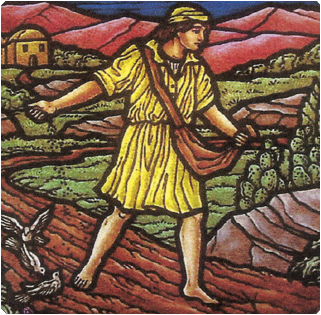
Listen!  A sower went out to sow.

Karsten Lundring is an alum of California Lutheran University who really loves his alma mater.  Karsten attends every CLU football game and when the Kingsmen score he throws out handfuls of Jolly Rancher candies to the crowd in the stands.  Some of those candies fall through the bleachers and land on the ground.  Some are caught by people who are dieting or diabetic so they get passed along to someone else.  Sometimes people catch the orange ones but they just don’t like the orange ones, only the red ones so they give them away.  Some are caught by fans of the opposing team.  But a lot of the candies are caught by hungry children and CLU fans who are enjoying excitement of the touchdown and are delighted to celebrate with a taste of something sweet.[1]

A sower went out to sow.  

Jesus doesn’t usually explain his parables, but because his disciples pestered him about it he explained this one.  Well, partly.  He explained about the ground where the seeds landed.  The different places where the seeds end up serve as analogies for the different people who will hear the message that Jesus and his disciples are proclaiming, the announcement that the reign of God is about to begin.  Some will get it, some won’t.  Pick your reason.  Some are too shallow or too self-involved.  Some are too busy.  Some are too worried.  Some are misguided by their own misconceptions—these are all things that can keep the domain of God from really taking root in your life or, to put it another way, that can keep you from taking root in the domain of God.  

We have an natural habit when we read the parables of asking “What does this mean?” Please explain this.  We want to read them all as allegories—sometimes they are, sometimes they’re not.  We want to translate the analogies, to solve the riddle and walk away from the parable knowing The Point.  But Jesus tells parables not so that we can ask questions of them and arrive at some moral maxim like an Aesop’s fable, but so that the parable can ask questions of us.  Jesus tells parables to help us see the world, ourselves and God differently.  

When I’ve preached or taught on this Parable of the Sower in the past, I’ve always focused on the soil since that’s the part that Jesus explains.  My sermons were usually some version of “What Kind of Soil Are You?” with sometimes a side order of “What Are You Going To Do To Become More Productive Soil?” 

If you ever heard me preach one of those sermons, I apologize.  I messed the point.  I also missed the point.  Don’t get me wrong.  It’s always a good thing to be looking at what we can do to let the love and life of God take deeper root in our lives.  It’s always good to pay attention to how our faith or lack of it is manifested in the lives we lead.  But that’s not the point of this parable.  There are other parables for that.  The fig tree in the vineyard comes to mind.

Parables ask us questions, and as I sat with this parable and listened to it again, the question it was asking me was “What do you see here that you haven’t seen before?”  Jesus is giving his disciples some answers, but not all the answers.  There’s more to see here.  And then I saw two things that made it a whole new story for me.

The first was this:  the soil can’t change itself.  It is what it is.  The pathway is going to be the pathway as long as people are walking on it.  The rocks are going to be the rocks.  Thorn bushes don’t uproot themselves.  

Jesus is telling his disciples and “anyone with ears” who will listen to not make themselves crazy trying to talk people into signing up for the reign of heaven if they’re just not ready to do that.  Just sow the seed.  Go out and announce it: the Domain of God is within reach.  Live it.  Be it.  Those who are ready will get it, and it will surprise you how many of them there are.  As for the rest, let the Holy Spirit work on them.  Rocks can be moved or worn down.  Pathways can be rerouted or tilled and fertilized.  Thorn bushes can be removed in any number of ways.  But right now that’s not your job.  Leave the Holy Spirit and the circumstances of life to soften them up.  You sow the seed.

The second thing I saw that absolutely turned this into a new story for me is this: this is a story of unbridled abundance and generosity.  There is no shortage of seed.  The sower throws it everywhere with no regard whatsoever about where it’s landing.  The word of the kingdom, as Jesus calls it in his explanation to the disciples, is an endless resource and when it lands with someone who hears and understands it, it reproduces itself even more abundantly. 

God has created this world to be a world of abundance and generosity.  As Gandhi said, this world has enough for everyone’s need, but not for everyone’s greed.  The earth itself participates in the generosity of God. The generosity of God was spoken in the word of creation.  The word of the kingdom is a word of perpetual regeneration.  Genesis.  Generation.  Regeneration.  The creative love of God is grounded in Generosity.  

“God writes the gospel not in the Bible alone, but on trees and flowers and clouds and stars,”  wrote Martin Luther, and surely God’s message of generosity and abundance is written in every harvest and planting.  

I remember being on our family wheat farm in Kansas once in the spring when the new wheat was standing bright green and knee-high in the fields.  I looked out and saw a family of deer grazing on the new shoots down by the creek.  I asked my mother’s cousin, Frank, if we shouldn’t maybe do something to shoo them away.  He just smiled and said, “Oh there’s plenty for them and us.  We’ll share it.”  

There was good soil there in Kansas where my family grew wheat.  The harvest was plentiful.  There’s good soil for the word of the kingdom, the domain of God, in many, many hearts out in the world.  Many people are already living in the heart of the kingdom whether they know it or not, living lives of generosity that produce more generosity in others.

When Michelle Brenner was furloughed from her job at a menswear store in Gig Harbor, Washington, because of the Corona virus, she was, naturally, upset, so she went home and made herself a big pan of lasagna using her grandmother’s recipe.  Nothing works like comfort food to soothe the soul.  Michelle realized that if her grandmother’s lasagna was making her feel better, it might lift other people’s spirits, too, so she posted on Facebook, “Hello favorite friends… if any of you want some fresh, homemade, no calorie-counting lasagna, let me know and I will gladly prepare it.”

A few requests trickled in—a retired neighbor, an out of work friend… Then Michelle took it on herself to deliver a few pans of lasagna to hospital workers and first responders, a few struggling single parents and others she knew of who were just scraping by. Word began to spread.  Soon she had so many requests that making homemade lasagna for others had become her full-time job.  When the president of the Gig Harbor Sportsman’s Club got wind of Michelle’s mission, he offered to let her use their commercial kitchen which had been closed because of Covid-19.  Three months later she’s still at it.  So far she has given away more than 1200 pans of homemade lasagna, although she’s lost track of the exact number.

Michelle initially used her $1200 stimulus check to pay for lasagna ingredients but that money was soon gone.  Fortunately, without being asked, people began to contribute what they could.  Some would give a dollar.  One person gave $100.  Somebody set up a Facebook fundraiser for her that raised $10,000.  All in all, people have given about $22,000 to the woman who is now known affectionately as The Lasagna Lady.  Every penny goes into lasagna while Michelle, herself, gets by on unemployment insurance. 

“It’s a pan of love,” says Michelle. “A lot of the people I make lasagna for have lost their jobs, and this is my way of saying, ‘I understand and I’m here for you.’ ”

When Jesus explained the Parable of the Sower to his disciples he said, “As for what was sown on good soil, this is the one who hears the word and understands it, who indeed bears fruit and yields, in one case a hundredfold, in another sixty, and in another thirty.”  Or 1200 pans of lasagna. 

I don’t know where Michelle Brenner heard the good news of the kingdom of heaven, the good news of God’s abundance and generosity.  I don’t know if she ever attended any church or is part of any faith.  Maybe she learned it from the earth itself.  Maybe it was layered between the noodles and the meat and the sauce and the cheese in her grandmother’s lasagna recipe.  I don’t know where or how she learned it, but she learned it.  And she’s passing along.

And a sower goes out to sow.

In Jesus’ name.  Amen.


[1] Thanks to Pastor Kirsten Moore, Calvaray Lutheran Church, Rio Linda, California for this story.