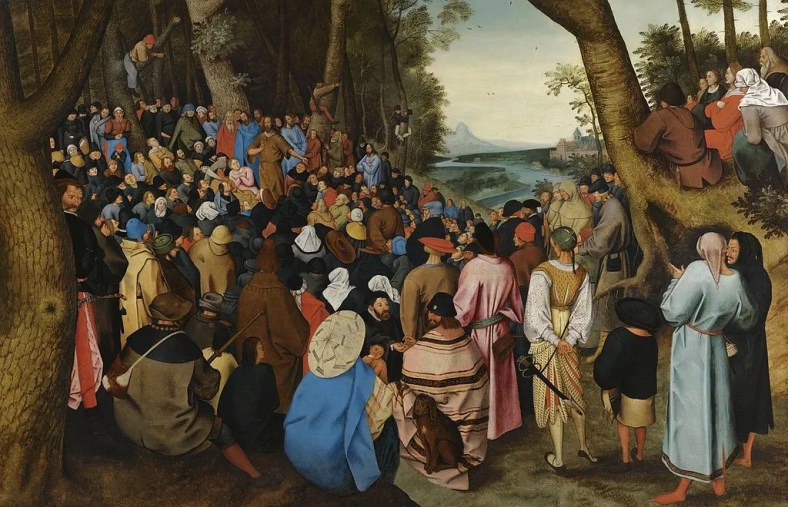
The Song of John

Matthew 3:1-11

Do you know about Wassailing?  Maybe you’ve heard the old Christmas season song that still gets some airplay this time of year:

Wassail! Wassail! All over the town,

Our toast it is white and our ale it is brown;

Our bowl it is made of the white maple tree;

With a wassailing bowl, we’ll drink to thee.

That song originated in Gloucestershire in the 18th century, but the tradition of wassailing in Great Britain goes back to ancient times.

  Most people today associate Wassailing with Christmas Caroling, and indeed there is a very old tradition called House Wassailing that is very much like Caroling.  You probably know the song Here We Come A-Caroling:

Here we come a-caroling among the leaves so green,

Here we come a-wandering so fair to be seen.

That song was originally Here We Come A-Wassailing and sometimes it is still sung that way.

In that old tradition of House Wassailing, the servants and tenants of wealthy landowners or wealthy townspeople would prepare a large bowl of Christmas Punch made from cider or ale and on Twelfth Night, January 5th, the last night of the Season of Christmas, they would gather outside the door of their landlord, sing a song to the good health and prosperity of their lords and ladies, and offer them a cup of punch to drink to their health.  In return, the lords and ladies would give the wassailers gifts of various kinds, fruit cakes, figgy puddings, and maybe even a year-end bonus of a few coins.

The Wassail song was a kind of Christmas blessing which you can still hear in the chorus of the familiar carol:

Love and joy come to you

And to you your wassail too;

And God bless you and send you

A Happy New Year

God send you a Happy New Year.

So, door-to-door Christmas Caroling evolved from House Wassailing.  But House Wassailing arose from an even older tradition called Orchard Wassailing which may have been brought to England by Danish Vikings.

The word Wassail comes from ves heill, which is Old Norse for “Be healthy!”  The Saxon version in Old English was Vas Hael, with the same meaning.  Be healthy. 

In the parts of ancient Britain where fruit trees were grown for producing cider, the ancient Saxons would go out into their orchards during the deep days of winter and sing to the sleeping trees to wake them up and bless them and encourage them to produce good and bountiful fruit in the coming year. 

Our gospel text for this Second Sunday in Advent is Matthew’s version of the story of John the Baptist preaching and baptizing at the Jordan—the well-known “you brood of vipers” text.  It occurred to me that what John was doing in the wilderness by the Jordan was something like Orchard Wassailing—singing the people awake so they could produce good fruit for the coming kingdom.   And since I had the wassailing songs in my head, I began to play with what it might have sounded like if John had actually brought his message to the people in poetry or song.

When John Came A-Wassailing

In the fifteenth year of the sovereign rule of Emperor Tiberius,

a time of great oppression by the ruthless and imperious,

the Song of God fell into John, the son of Zechariah,

and he sang it out so strongly they thought he might be Messiah.

But he said, “No, I am not the one you all have been expecting.

I’m just the voice that sings out where our paths are intersecting.

I’m not worthy to receive him or to tie his sandal thong!

He’s the Maker of all Music.  I sing just one simple song.”

Like a-wassailing in the orchard to wake the cider trees,

the song of John cut through their pride and brought them to their knees.

As he showed them stark reality they began to realize

that the dream of God might now unfold before their very eyes.

So he sang them to the river, saying time was of the essence,

and immersed them in the cleansing flow of mercy and repentance.

His song filled up the wilderness with a tune to cleanse the heart

and wash away pretenses, and make hubris fall apart.

He sang, “Children of the covenant, you children of the promise,

you children of the circumstance and times that are upon us, 

all you questing, anxious seekers, all you folk both awed and flawed,

are you ready to stand naked in the searching gaze of God?

“All you tax-collecting schemers, all you servants of the sword,

all you noble trees and saplings in the orchard of the Lord,

sure, your roots go deep as Abraham and you’re clothed in your tradition,

but that’s not enough to save you on your pathway to perdition.

“O you brood of sneaky vipers, O you children of the snake,

Who warned you of the wrath to come? Who told you what’s at stake?

Did you think that life was something you could skate through or could fake?

Well, my sleeping trees of Zion, it’s time for you to wake.”

Then in dismay the people cried, “John, tell us what to do!

If our heritage means nothing is our fate left up to you?”

He said, “No that’s not in my hands, but it is somewhat in yours,

for the Winnower we’ve waited for is at the threshing floor.

“So now’s the time to change your ways, to make a course correction.

Now’s the time to turn around and go a new direction.

It’s time to change your heart and mind, not out of paranoia,

but because you’ve been immersed in the streams of metanoia.

“So give away your extra coat to the person who is shivering,

and give up half your sandwich to that hungry kid who’s quivering,

Don’t take more than what is rightful, do not lie, extort or cheat,

for the Winnower is coming and he’ll sift your soul like wheat.

“Look, the time has come to bear the fruit of new life and repentance

or you’ll reap the judgment that you’ve sown, you’re shaping your own sentence.

Even now the axe is at the root, even now your options dwindling,

so will you produce good cider?  Or will you be so much kindling?

“For the One who fashions every soul finds a use for each and all.

Will you be the cordial in the cup or the fire that warms the hall?

Will you be the sweet aroma drawing others to the table

or dissipate as so much smoke in a cautionary fable?

“And I know this all sounds frightening—to be assessed, appraised and weighed—

Every one of us has cause to fear, yet I sing, ‘Be not afraid!’

For the one who does the winnowing, the one who does the sifting,

Is the Soul of Grace and Love and Life, the Giver of all gifting.

“And I’m simply here to tell you in this wild and holy place

you have a chance to be made new, a chance to live in grace,

for the one who does the winnowing does not come to condemn

but to glean the seeds of love and good and make them grow again.

“So this song that sounds so ominous, it really is Good News!

for the God of second chances hopes that you will not refuse

to change your heart and mind and ways and show it by your fruits

with more loving and more honest and more generous pursuits.

The Word who will evaluate has not come to condemn

but to find the goodness in your soul and make it shine again,

for the one who does the winnowing, the one who does the sifting,

Is the Soul of Grace and Love and Life, the Giver of all gifting.

_____________

May the candles of Advent—Hope, Peace, Joy and Love—light our way to whole and healthy lives in a whole and healthy world. 

Vas Hael.

Tonight’s the Night the World Begins Again

I’ve been thinking about some Christmas gifts…and by that I mean some of the gifts that Christmas gives us.

It’s a season of giving – yes, it’s over-commercialized –but in the right spirit that can help us develop a habit and spirit of generosity.  And that’s a gift.

The months leading up to Christmas are a good time to practice delayed gratification.  Don’t buy that now…Christmas is coming.   I know I need to practice that sometimes.  So that’s a gift.

For some it’s a change of habit just to be thinking about what to get for other people, thinking more about others—who they are, what they need.  It can feel like an obligation but it can become a healthy, joyful, even life-giving habit.  That’s a gift.

At Christmastime we are intentional about asking people what they want.  That’s a good exercise for keeping us from being “curved in upon the self.”

Christmas, itself, is a gift.  It’s a change of focus.  It comes with some built-in themes that are important.  Giving.  Receiving. Gathering.  Family.  Peace. Hope.  Joy.  Love. Remembering.  Birth.  The Presence of God.  Wonder.

I don’t know about you, but I  really need the gift of Christmas, itself, this year. It’s been that kind of year.

I need to be reminded to stop and breathe and think about giving and receiving and gathering and family.  I need time to stop and remember.

I need to let words like hope and peace and light fill up my soul for awhile.

I need a time to stop and listen to songs about beauty and joy and angels and promises fulfilled…and God showing up in surprising ways and surprising places.

I need the wonder of it all.

I need the songs.  I especially need the songs and carols… because the music goes straight to my heart and heals me and rekindles my hope and my joy and my faith faster than words alone can ever do. “Those who sing pray twice,” said Martin Luther.

Do you have a favorite Christmas song or carol? Is there one—or maybe there are several?—that touch you in some particularly powerful way?

There are a lot of Christmas songs and carols that I dearly love and I listen to them over and over and over again.  But there’s one Christmas song in particular I keep coming back to these past few Christmases.  And this year, especially, I’ve been listening to it a lot.  In fact I’ve been listening to it off and on all year long.

It’s fairly recent—it came out in 2005, so by Christmas Song standards it’s almost brand new.  It’s called Better Days by the Goo Goo Dolls, written by John Rzeznik.  Yeah, I know.  Goo Goo Dolls.  Silly name, but a great band.  And a powerful song.  Listen to these words:

And you asked me what I want this year

And I try to make this kind and clear

Just a chance that maybe we’ll find better days


‘Cause I don’t need boxes wrapped in strings

And designer love and empty things

Just a chance that maybe we’ll find better days

Better days.  When all is said and done, isn’t that what we all want?  For ourselves, for our families and friends?  For….  Everyone? Better days.

I need some place simple where we could live

And something only you can give

And that’s faith and trust and peace while we’re alive

Those are some pretty good gifts we can give to each other.  For Christmas.  For every day.  And the song is right… we’ll only have faith and trust and peace while we’re alive if we give those things to each other.  Faith.  Trust.  Peace.  But the song knows we need something else if we’re going to be able to give each other faith and trust and peace…

And the one poor child who saved this world

And there’s ten million more who probably could

If we all just stopped and said a prayer for them

The one poor child who saved this world. That’s why we’re here tonight. That’s what we’re here to celebrate. But we’re also here to be reminded that because of that child, Jesus, Emmanuel, God With Us, we have the example and the power to save the world together.  God came in person to give us what we need so we can give each other the gifts of faith and trust and peace.

 I wish everyone was loved tonight

And we could somehow stop this endless fight

Just a chance that maybe we’ll find better days

The thing is, everyone is loved tonight—loved by God, at least.  But they don’t all know it and they certainly don’t all feel it.  If they did, if they all felt loved, if we all felt loved, maybe it would stop the endless fight that seems to be the curse of the human race.  But the only way for that to happen is if we take the love God gives us and let it be real and meaningful in our lives.  And then give it to each other in real and meaningful ways.

Brené Brown said,  “Jesus comes to show us what love looks like.  God is love.  But God knows that if God just comes down and says I am love and I want you to love each other, we’re going to go straight to hearts and unicorns.  We know it’s difficult and we don’t like difficult, so we’re going to romanticize it.  Hearts and unicorns.  But love is difficult.  So Jesus comes to show us how to do it.  He comes to show us that love doesn’t tolerate shaming.  Love doesn’t exclude people because they’re different.  Love reaches out and touches and embraces all the people we don’t want to touch or embrace. Love does the hard work.  Love does the hard things.”

But there’s something else that God shows us about love by coming as a baby, by coming, especially, as a poor baby.  Right at the beginning—Jesus shows us, God shows us, that love is willing to be vulnerable.  Love is willing to let down all its defenses.

When you think of all the ways that God could have come to us–all the ways we imagined throughout history that God would come to us—most of that imagery is all about power and royalty and thunder and smoke and lightning.  And then God shows up as a baby.  A poor baby. In a poor country.  A homeless baby.  A migrant born on the road on a journey his parents were forced to take.  A refugee baby forced to flee for his life.

One poor child who saved the world.

I haven’t quoted the refrain that runs through the song.  It’s repeated twice between the verses, but the song ends with it, too.  It’s both a promise and a call to action:

So take these words and sing out loud

‘Cause everyone is forgiven now

‘Cause tonight’s the night the world begins again

Take these words and sing out loud.  That’s the call to action.

‘Cause everyone is forgiven now.  That’s the promise. It’s also another great gift of Christmas.  In this baby, who is God With Us, we have a chance to start over with a clean slate.

In this baby, who is love itself coming to us in its most human and dependent and vulnerable form, we can find forgiveness and we can learn to give forgiveness— and if we can forgive and be forgiven, if we can let go of old hurts and forgive others, then we really can give each other the gifts of faith and trust and peace while we’re alive.  And then there really is a chance that maybe we’ll find better days.

So take these words and sing out loud,

‘Cause everyone is forgiven now.

And tonight’s the night the world begins again.


Tonight’s the night the world begins again.

Hesitant to Enter the Endless Understanding

“Remember, mystery isn’t something that you cannot understand—it is something that you can endlessly understand! There is no point at which you can say, ‘I’ve got it.’ Always and forever, mystery gets you!” –Richard Rohr, The Divine Dance

I was at the Paul Simon farewell tour concert at the Hollywood Bowl a couple weeks ago, along with my family. Go ahead, take a moment to envy us. I’ll wait. I’ve been to some truly amazing concerts by some truly inspiring performers in my life, but this one topped them all. Really. That’s not just hyperbole. It’s true that his voice is not quite what it once was, though not at all bad for a 76 year old guy singing in such a wide variety of styles. But you don’t really think much about his vocal quality because he still has that astonishing and unique combination of intimacy and energy, humility and confidence that just draw you in to him and the music. Well, I could go on. And on and on. Because Paul Simon is in my not-at-all-humble opinion the very best songwriter and lyricist of my lifetime and I’ll be more than happy to defend that assertion if you’d like to quibble. But I digress.

Part of what made this concert so powerful was the amazing musicians who were performing with him on stage: Vincent Nguini, the impressive Nigerian guitarist; Mark Stewart, the astonishing multi-instrumentalist from New York; yMusic, the avant-garde string ensemble… the horns, the percussionists…I’m telling you, that was a killer band up there on the stage with him. And as they played together all the music of the decades of his life as a songwriter—his songs with South American roots, his songs with African roots, his songs that floated up out of the Louisiana bayou and cemeteries of New Orleans, and even a few of his old original 60s folkish songs, I couldn’t help but reflect on the decades of his musical journey, the path of his creativity, and how he had taken so many of us along for the ride with him.

I found myself remembering back to the first time I saw him in concert. It was November 15, 1969 at the Long Beach Arena. I confess, I had to look up the date, but I can close my eyes and still see and hear moments of that concert. It was Simon and Garfunkel, then and they were near the apex of their popularity as a duo. For the first two thirds of the evening they sang all the popular songs we all knew and loved from the albums we all already owned. Paul played guitar. I think a pianist and a couple of string players accompanied them on a few songs. Then Paul said they would like to introduce some new songs from their new album that was about to be released. With that a drum kit, a bass amp and a couple of electric guitar amps were rolled onto the stage along with some other percussion instruments, and an assortment of new musicians stepped up and plugged in to this new group of instruments. This did not look like Simon and Garfunkel folkish music. This looked like Rock. And some people started to boo.

Hard to believe, but more than a few people started to boo. I thought of that as I watched Paul Simon perform all these decades later accompanied by two electric guitars, a bass, a full horn section, an accordion, a zydeco organ, a very full percussion section including two large drum kits—I thought of those people who booed all those years ago and wondered if any of them were with us on this night to celebrate where the journey of music had taken him. I wondered if they regretted booing him in 1969. I wondered if they even remembered.

On that night in 1969, when the people booed, he simply smiled and said, “Now, now, give it a chance. I think you’ll like it.” And then they played Cecilia. And then El Condor Pasa. Then Keep the Customer Satisfied, and Baby Driver… and when they played Bridge Over Troubled Water there wasn’t a dry eye in the arena. And from then on they could do no wrong.  And I think we began to get an inkling that their music, his music, was going to take us in a new direction.  And behold, it was good.

NEW YORK, NY – JANUARY 20: Paul Simon performs onstage during The Nearness Of You Benefit Concert at Frederick P. Rose Hall, Jazz at Lincoln Center on January 20, 2015 in New York City. (Photo by Ilya S. Savenok/Getty Images)

When we love the old familiar songs so dearly it is sometimes hard to allow room in our hearts and minds for the new songs. Mary Chapin Carpenter once quipped at a concert that she wanted to break some songs out of “new song jail.” I think this same dynamic can apply to our theological thinking. Sometimes we’re reluctant to hear the melodies of our beliefs rearranged and played by different instrumentation, to different rhythms. We’ve lived so long with words like “grace,” and “atonement,” and “Trinity,” and “Incarnation,” and even “Creation” that they can sometimes trigger within us a neuro-theological version of Name That Tune. Just hearing the word activates a mental shortcut to an old recording of a belief structure and it’s enough to know it’s there even if we haven’t actually payed any attention to it in ages. And yet, if we dare to listen what some unexpected voices are singing on these themes, we might hear the ancient songs come alive and dance in a whole new way that reinvigorates our faith and our lives. And if you don’t like the new arrangements…well the old cantatas will still always be there.

“Music is forever; music should grow and mature with you, following you right on up until you die.” –Paul Simon

The same can be said for theology.

A Quiet Place

Thoughts Along the Way…

I stood there on a beautiful green hillside, standing just at the edge of the shade made by a canopy erected for the occasion, my guitar slung over my shoulder, my fingers on the strings poised to play. But no music came to my fingers. I had led the procession up the hill from the hearse, carrying my service book, walking ahead of the pall bearers who carried that beautiful walnut casket, a work of art with its satin finish, carrying within it the mortal remains of an even more beautiful and complex work of art, God’s own handiwork, God’s baptized child, our friend and companion on the journey, John.

The casket was settled gently on the stand above the grave. The pall bearers removed their white gloves and took their places amid the others gathered for the words and rites that would commend our John’s life into God’s hands and commit his body to the earth. As Sandy, John’s widow, had requested, I was going to play something on the guitar, some music to speak to our souls before the words to speak to our hearts. So there I stood with my guitar, ready to play, people looking at me, some expectantly, some with peace, some with encouragement, some with a plea or yearning for something I could only guess at, and all I could think about for a moment in that moment was the noise.

Huge earth movers were shaping new hillsides for new graves a few hillsides away, their giant diesel engines growling across the landscape. Just beyond them a crew in a helicopter was doing something undoubtedly important to the power lines held aloft on their giant towers that always look to me like the Martian monsters from H.G. Wells’ War of the Worlds. C.S. Lewis once described the Kingdom of Hell as The Kingdom of Noise. I think that’s a pretty apt description. This was supposed to be a quiet, peaceful moment in a quiet, peaceful place where we could all let a bit of gentle music and words of promise carry us to the edges of our own deep wells of thought and feeling. But how could I begin to cut through all that noise? What is an acoustic guitar against the growl of earth movers and the whopping of a helicopter?

I must have looked as if I was waiting for a signal, and maybe I was. Sandy looked at me, smiled and nodded, and I realized in that moment that if this was not going to be the quiet place in the world that I was hoping for, that I thought it should be, that I had expected, then I was going to have to find a quiet place in me. The music would have to come from a quiet place in me and I would have to trust that somehow the quiet would be powerful enough to cut through the noise.

I closed my eyes and listened. Blest Be the Tie That Binds was flowing from my fingers, and when I looked up, I could tell that others could hear it, too. The melody then rewove itself into Just As I Am and as I played, unconscious of my playing, I let those notes full of grace speak to my own heart. Without a pause my fingers moved into Simple Gifts, the old Shaker tune that promises us that “When true simplicity is gained, to bow and to bend we will not be ashamed, to turn, to turn ‘twill be our delight, till by turning, turning, we come round right.”

Somehow, the quiet cut through the noise. Somehow the melodies of unity, grace and simplicity pierced the wall of mechanized cacophony that had seemed so overwhelming. Somehow people heard it all the way to the edges of the crowd. “Not by might, not by power, but by my Spirit,” says the Lord. And in all truth, the Spirit was my amplifier in that moment.

I won’t pretend to tell you that the music wafting from my guitar carried everyone to a place where they were prepared to truly hear the power and truth of all those words of hope and promise we speak as we lay our loved ones to rest. But it carried me to a quiet place where I could speak those words with faith, confidence, and something akin to joy.

So very, very often the world seems to be doing its very best to bury our better, deeper thoughts and feelings in a coffin of noise. So very, very often the thing we need most, long for most is simply a quiet place to think and feel and, depending on the situation, speak aloud to ourselves where it is quiet enough to hear our own voices. Sometimes we desperately need to get away to a quiet place. But since the world won’t often let us do that, we need to find that quiet place inside us. There is strength there. There is beauty there. There is power and grace and love there. And music.

Pro Gloria Dei,

Pastor Steve