The Hard Stuff

Luke 6:27-38

Have you ever been reading along in your Bible and you come across something you wish Jesus had just not said?

Love your enemies.

Do good to those who hate you.  

Bless those who curse you.

Pray for those who abuse you.

Turn the other cheek.

If someone takes your coat, give them your shirt, too.

Give something to everyone who asks.

This is the hard stuff.  This is the part that’s difficult.  It’s all so counter-intuitive.  Jesus is asking us to behave in a way that is diametrically opposed to our instincts.

It would be very easy to ignore this teaching of Jesus, to just forget he ever said it, or find ways to explain it away.  In fact we do that a lot.  Ignore the parts we don’t like.

We might say that Jesus is setting up an impossible ideal here that forces us to admit our sin and brokenness so that we admit our need for God’s forgiveness and grace. David Lose calls that the “Lutheran option.”  It’s good, sound theology as far as it goes, but it lets us off the hook.  It keeps us from taking these new rules of engagement that Jesus gives us seriously or thinking that they could actually be applied.

Another way to dismiss these difficult expectations is that we could just say that Jesus is being idealistic and naïve.  

Actually, that’s one thing we absolutely can NOT say.  Jesus, and the people listening to him were far from naïve.  They were well-acquainted with the frustration of not responding to undeserved violence, aggression and oppression,  but they were also were painfully aware of the cost of revenge and retaliation.  

In the year 6 CE, when Jesus was about 10 years old,[1] Roman authorities installed a new governor over the province of Judea.  When this new governor, Coponius, tried to impose new taxes on the region, including the new Census tax which everyone in the empire was required to pay, a large rebellion broke out led by Judas the Galilean.  The rebellion spread until Quirinius, the governor of Syria stepped in to impose order.  You may remember Quirinius from Luke’s Christmas story in chapter 2.  Under Quirinius’ orders, Roman soldiers razed the city of Sepphoris, a rebel stronghold just a three miles from Nazareth where Jesus grew up.  After Sepphoris was burned to the ground, the Romans rounded up Judas and two thousand Galileans and crucified them.  

This example of Roman authority and order maintained by violence was still fresh in the memories of the people gathered with Jesus on that hillside by the sea.  I think it’s safe to say that the Galileans listening to Jesus, those people living under the watchful eyes of their Roman overlords and their wealthy collaborators, heard his words a little differently than we hear them twenty centuries later.

It’s important for us to understand that Jesus was not calling oppressed and abused people to be doormats, to simply roll over passively and take whatever abuse was being dished out.  When Jesus said, “If anyone strikes you on the cheek, offer the other also;  and if anyone takes away your coat, give them your shirt, too,” he was teaching his followers a way to do radical non-violent resistance.  

In his book Violence and Nonviolence in South Africa, Jesus’ Third Way, Walter Wink pointed out that when Jesus said to turn the other cheek he wasn’t talking about a fistfight, he was talking about a backhand slap that was the normal way of admonishing inferiors.  As Wink explained, “Masters backhanded slaves; husbands, wives; parents, children; men, women; Romans, Jews. We have here a set of unequal relations, in each of which retaliation would be suicidal. The only normal response would be cowering submission.

It is important to ask who Jesus’ audience is. In every case, Jesus’ listeners are not those who strike, initiate lawsuits or impose forced labor, but their victims (“If anyone strikes you…would sue you…forces you to go one mile…”). There were among his hearers people who were subjected to these very indignities, forced to stifle their inner outrage at the dehumanizing treatment meted out to them by the hierarchical system of caste and class, race and gender, age and status, and as a result of imperial occupation.”

Wink goes on to explain that, odd as it may sound, in the body language and social ritual of the first century, turning the other cheek would be a way of asserting equality in the relationship and maintaining one’s dignity.  A backhanded slap was a gesture of rebuke or punishment directed at someone of lower status.  Striking the other cheek would require the use of an open hand which would be seen in their society as acknowledging equality.  The open-handed slap was the way one Roman or patrician challenged someone of equal status.

When Jesus tells his followers to give their shirt if someone takes their coat, that, too, is a kind of nonviolent resistance based on public shaming.  If you owed a rich person money and were unable to pay, the law would allow him to take your coat as collateral against the loan.  Giving your shirt, too, would dramatize how unfair the law is and how heartless your creditor is for taking advantage of such a law.  Most men wore nothing more than a simple shirt or tunic belted at the waist under a coat or robe. Making a creditor take his shirt in addition to his coat would leave a man standing in the street in his loincloth but it would shame the creditor whose impatience and greed would leave someone so exposed.

Luke doesn’t include this, but in Matthew’s rendition of nonviolent resistance Jesus says, “If anyone forces you to go one mile, go also the second mile.”  The Roman law of impressment said that a Roman soldier could order a Jew to carry his heavy pack, but only for one mile.  At the end of the mile, Jesus says to go another mile  if you are the Jew impressed into this service, because by going the extra mile you assume control of the situation.  You assert a measure of equality and preserve your dignity, and you just might get the soldier in trouble with his superiors if they’re paying attention.

When Jesus tells us to confront violence with nonviolence, he invites us to be creative.  In 2020, the racist right-wing group The Proud Boys tore down the Black Lives Matter Banner at Metropolitan African Methodist Episcopal Church in Washington D.C. and spray painted racist and violent graffiti on the church.  The church sued the Proud Boys, a group that Wikipedia describes as “an American far-right, neofascist militant organization” and won a judgment of $2.8 million in damages.  When the Proud Boys refused to pay, the court awarded control of the Proud Boys’ trademark to the church which effectively stripped them of their name.  The Proud Boys can no longer use their name or trademarked logo without permission of the church.  The church “turned the other cheek” and won an important symbolic victory in the process.

With his guidance on how we should treat each other, Jesus is inviting us into a new world, a world that has very different values and operates on laws that are contrary to what we’re used to.  The world Jesus invites us to inhabit is grounded in shalom, a peace based on respect and on recognition of our mutual humanity.   In this world we realize that striking back when we’re struck merely perpetuates or accelerates the cycle of violence.

This doesn’t mean that we give evil and aggression a free pass.  WE are still called to confront evil when we see it and speak out against injustice.  But we do not fight violence with violence. Instead, we meet evil and aggression with creativity and love, a creativity that either defuses the evil or shows the world what it really is, and a love that remembers that the aggressor or perpetrator is also someone who God loves.

The people who live in this world of shalom know that forgiveness breaks all the patterns of cause and effect that prolong and propagate disharmony between persons and peoples.   

The people who live in this world – this world that Jesus calls The Kingdom of God, the Commonwealth of God’s justice and kindness—the people who live in this world know that love is not just a means to an end or a nicety of life, but love is the source and goal of life itself.  It is the fountain from which morality and justice flow naturally like waters from a spring.  The people who live in this Realm of God know that the reason we fail so often to establish a healthy morality without moralizing, the reason we fail so often to establish restorative justice without the soul-damaging poison of retribution, is that we have failed first to love.

So is this a new set of commandments Jesus is giving us?  Or is it a promise?  Are these laws?  Or is this an invitation?

These instructions from Jesus sound almost impossible when we hear them from the standpoint of everyday life and our culture’s instinctive response.  But they sound very different when you hear them as a promise of how life can be.  They sound very different when you hear them as an invitation to develop new instincts and live a different kind of life.

You are invited to live in the Realm of God’s love, the Commonwealth of God’s justice and kindness, where people love their enemies and do good even to those who hate them.  Where they respond to curses with blessings.  

If we can live as a citizens of this different world, our reward will be great and we will be children of the Most High, for God is just as kind to the ungrateful and the wicked as to those who are trying to not be ungrateful and wicked.  

That’s the world we are invited into.  That’s the way we are asked to live.  It isn’t easy.  We fail often.  But, forgive and you will be forgiven. 

“Do not judge, and you will not be judged; do not condemn, and you will not be condemned. Forgive, and you will be forgiven;  give, and it will be given to you. A good measure, pressed down, shaken together, running over, will be put into your lap; for the measure you give will be the measure you get back.”

That’s the promise.  And you are invited.  Starting now.

In Jesus’ name.


[1] Scholars are uncertain about the year of Jesus’ birth, but both Matthew and Luke note that Herod the Great was still alive when Jesus was born.  Herod died in 4 BCE.

Priorities

Luke 4:21-30

At one time or another, I think we’ve all wanted something from God.  I think we’ve all had that one thing we wish God would do for us.  Or maybe even a list of things.  Or maybe, in a moment of doubt, we’ve just wanted God to show us some small sign to reassure us that God really is with us and on our side.  

A lot of these wishes, especially the smaller ones, go unspoken.  But when we’re honest with ourselves—and with God—I think almost all of us have that something we’d like to see God do for us.  I know I would like to have my hearing back.  And my hair.

I suspect that there was something like that going on in the hearts of the people who came to hear Jesus when he preached in the synagogue at Nazareth.  They had heard great stories about their hometown boy who had wandered off into the world to became a prophet—stories about healings and exorcisms.  They had heard that he spoke with authority, eloquence and wisdom.  So when his hometown people came to hear him speak in his hometown synagogue, it was only natural that they brought their hopes and expectations—their unspoken wish lists—with them.  And when Jesus read that well-known, passage from Isaiah that starts with The Spirit of the Most High is upon me, it probably raised their expectations even higher.

They knew that passage from Isaiah.  I’m sure many of them were silently saying the words with him as Jesus read them.  God has anointed me to proclaim good news to those who are poor.  God sent me to preach liberation to those who are held captive and recovery of sight to those who are blind, to liberate those who are oppressed.  To proclaim the year of the Most High’s favor.  They knew those words.  And the way Jesus was speaking them, it must have sounded like a proclamation he was making about himself.  And then, as if to remove any doubt, the moment he sat down to teach he said Today this scripture has been fulfilled in your hearing.

He owned the prophecy.  He claimed it.  

Luke hints at the buzz of excited conversation rippling through the synagogue.  People’s hopes were high, but so was their caution.  Hard to believe this is Joseph’s sonThere was always something different about that boy.Remember that time he got separated from the caravan coming home from Jerusalem?  But look at him now!

Luke doesn’t tell us everything Jesus said as he was teaching that day in the synagogue in Nazareth, but it’s clear from Luke’s account that after a positive and congenial start, Jesus said something that upset them.

Maybe he criticized the way they understood and interpreted Torah and the prophets.  Maybe he said something about their failure to fully embrace the Commonwealth of God’s justice and kindness in their community.  Maybe he suggested that God wanted them to help make the kin-dom of God a reality on earth as it is in heaven, and that the Spirit could empower them to do it.  Maybe he criticized their lack of imagination or their unwillingness to take any risks on behalf of what God was trying to accomplish.  Maybe he criticized them because their hearts and minds were so full of their own cherished hopes and wishes but also their fears and self-protection that they couldn’t take in God’s invitation to help create a healthier, saner world.

Maybe the thing that upset them was that he told them that the miracle shop was closed for the day, that he wasn’t going to do any exorcisms or healings.  It was the Sabbath, after all, and doing works of power—healing, exorcisms, that kind of thing, was better left for another day if wasn’t urgent, which was more than a little ironic, really, when you remember all the other times in other places where people got upset with Jesus for doing exactly that—healing and casting out demons on the Sabbath. It’s weird that they got upset with him for obeying the law.  

Richard Rohr says that if you don’t deal with your own anxiety, disappointment and pain you’re going to end up spilling it all over  everyone else. And isn’t that just human nature in a nutshell.  Seems like some people are always looking for a reason to get upset.   

Jesus watched their expressions change as the shadow of disappointment and irritation fell across their faces.  He could see that his criticisms didn’t sit well with them.  He could see that they were starting to formulate their own criticism of him in response.  So he beat them to it. Of course you’ll all quote me this proverb, “Doctor, cure yourself!” and you’ll all say, why won’t you do the things here in your hometown that we heard you did in Capernaum!?

We shouldn’t be too hard on the people of Nazareth.  I think we might have felt the same way.  Don’t we deserve a few miracles, too?  Come on, Jesus, this is your hometown!  We knew you when!  You’re one of us!

Jesus was a master at reading the human heart.  He could hear all the words that weren’t being said.  He could feel their sense of entitlement.  So he reminded them that neither he nor God were bound by their expectations.  He reminded them that there were times and stories in their own history when their prophets brought the power of God’s benevolence to “outsiders,” even though there were plenty of needs and wish lists right there at home.  

Truly I tell you, he said, no prophet is accepted in their hometown.  But I speak truth to you all, there were many widows in Israel in the days of Elijah, when the heavens were closed three years and six months, and there was a sever famine over all the land.  Yet, Elijah was sent to none of them, rather to Zarephath in Sidon!—much detested Sidon!—to  a widow woman.  And there were also many lepers in Israel in the time of the prophet Elisha, and none of them was cleansed except Naaman the Syrian.

And that was the spark that set them off.  They felt they were being disrespected.  It was a slap in the face!  Jesus had offended their sense of privilege.  He was one of them, after all.  If anyone had a right to experience whatever amazing power of God was working through him, they did.  They should come first.

And here’s the thing—Jesus was not telling them that he didn’t love them or that God didn’t love them.  Jesus was not telling them that God wasn’t going to meet their needs.  He was just reminding them that God had already set an agenda, and that God’s agenda was his agenda, too.  He was reminding them that long ago God had spoken through Isaiah to tell them that those who were hurting the most would be attended to first.  

He was reminding them that his mission was to proclaim good news to the poor in a world designed to perpetuate poverty.  He had come to proclaim freedom for political prisoners and prisoners of war.  He had come to bring recovery of sight for those who had lost their ability to see the truth.  He had come to bring liberation for those whom life had backed into a corner and were having the life squeezed out of them.   That was his first order of business.  

They didn’t like to hear Jesus telling them so bluntly that their particular wishes and needs were not God’s top priority.  It confronted their sense of privilege, so they exploded in rage.  They shoved him out to the edge of town and were going to throw him off the cliff.  

And that’s when, finally, a small miracle did happen, though I doubt if they saw it that way.  He stopped them from doing something that would have scarred their consciences and damaged their souls for the rest of their lives.  He passed through the midst of them and went on his way, leaving them standing there as the anger and adrenaline seeped out of them.

Diana Butler Bass has suggested that maybe there were some in that angry crowd who had not lost their minds in rage and that maybe these people helped clear a way so he could “walk through the midst of them,” and be on his way.  I really like to think that’s what happened.  I find hope in that—the idea that even when the whole world is going crazy and pushing us to the edge of the cliff, there are still some sane and concerned folks helping to make a pathway through the madness.  I need to believe that’s true.

We love to be told how much God loves us.  We love to be reminded of all the ways that God has provided for us and is looking out for us.  And we usually don’t mind being told that God loves others, too, although we sometimes bristle when we’re told that God loves and cares for people we don’t much like.  Anne Lamott said, “You can safely assume that you’ve created God in your own image when it turns out that God hates all the same people you do.”

And that might have been part of the problem in Nazareth, too.  The god in their heads, the god in their hearts, the me first/us first god ran headlong into the God of their scriptures when Jesus began teaching them what that beloved passage from Isaiah really means.  God’s favor does not privilege home or nation, but it does prioritize those who are hurting most.  Whoever they are and wherever they’re from.

We all want to hear good news.  But the ones who need it most are the poor.  We would all like to be set free from one thing or another, but the ones who need it most are those who are really being held captive.  We all would like to see the world more clearly.  But the ones who need it most are the ones who are blinded in one way or another.  We all would like more autonomy, more real freedom and justice in one way or another.  But the ones who need it most are people who are actually oppressed and marginalized. 

When George Floyd was killed in May of 2020, protestors responded with demonstrations to bring attention to the alarming number of black people being killed in incidents that highlight the racism inherent in much of American life.  The slogan Black Lives Matter began appearing at protests and on social media.  When that slogan, Black Lives Matter, first appeared, a lot of white people responded on social media and elsewhere with All Lives Matter.  

All Lives Matter.  Well, yes, that’s true.  Of course all lives matter.  But that’s beside the point.  All Lives do Matter, but it isn’t All Lives who are dealing with profiling and bigotry and discrimination.  It isn’t All Lives dealing with the heritage of neighborhood redlining that creates ghettos and a kind of economic bondage that perpetuates poverty.  It isn’t All Lives who need to have The Talk with their children about how to stay safe and come home alive if you get pulled over by the police because your tail light is out.  Saying Black Lives Matter is necessary because Black Lives have too often and for too long been treated as if they don’t matter.  We can’t say All Lives matter until we’ve made it clear that Black Lives are included in the All.

Today, we also could be, and maybe should be saying Immigrant Lives matter.  And Gay Lives matter.  And Trans Lives matter.  Because these are also people who are often treated as if their lives don’t matter.  

Many white people reacted negatively to Black Lives Matter because they were reacting from the blindness of White Privilege, and it upset them to have someone suggest that such a thing as White Privilege even exists.  They may be quick to point out that their lives don’t feel privileged, that they have had their struggles, too.  And what they say is true, but it’s beside the point.  White privilege doesn’t mean your life hasn’t been hard.  It just means that the color of your skin isn’t one of the things that has made it hard. 

When Jesus had finished reading that powerful passage from Isaiah, The Spirit of the Most High is upon me.  God has anointed me… he followed the reading by saying Today this scripture has been fulfilled in your hearing.  Literally, in your ears. 

Those last three words are so important.  

In your hearing.  In your ears.  Are we still hearing him?  

He was announcing that he had come to restore vibrance and equity to our world, and inviting us to participate.  He was announcing that he was going to start where his attention and love and transformative power were needed most.  If we are his followers, then we have the same mission.  In our baptism we have received the Holy Spirit, too.  If we stand with Jesus then we, too, should say, the Spirit of the Most High is upon me.  Upon us. God has anointed us to proclaim good news to those who are poor.  God is sending us to preach liberation to those who are captives and recovery of sight to those who are blind. God is calling us to liberate those who are oppressed.  God is calling us to announce that now is the time of God’s favor; the kin-dom of God, the Commonwealth of God’s justice and kindness is within reach.

I think it’s fair to say that the current political climate makes our job more difficult. The restorative love of Christ is needed in so many places and so many ways.  

It may not look like it, but now is the time of God’s favor.  Now is the time to change the world—and our current circumstances simply illustrate just how desperately and thoroughly the world needs to be changed.  Now is the time for love to be liberally applied in a culture that has been stewing in anger, division and outright hate.  Love is the antidote.  Now is the time for us to love the world and our nation with patience and kindness.  Now is the time for us to love without arrogance or rudeness or irritability or hidden self-serving agendas.  Now is the time for us to speak truth to power in love.  

Now is the time of God’s favor, the time for liberty and justice and fairness for all…starting with those who need it most.

Out of Love for the Truth

John 8:31-36

“Out of love for the truth and from a desire to elucidate it, the Reverend Father Martin Luther, Master of Arts and Sacred Theology, and ordinary lecturer therein at Wittenberg, intends to defend the following statements and to dispute on them in that place.  Therefore he asks that those who cannot be present and dispute with him orally shall do so in their absence by letter.  In the name of our Lord Jesus Christ, Amen.”

This was the introduction to the 95 Theses which Martin Luther nailed to the door of the Wittenberg University Chapel on Wednesday, October 31, 1517.   We sometimes think that nailing the 95 Theses to the door of the church was an act of rebellion, and in retrospect it was powerfully symbolic.  But it was actually a normal practice.  The church door served as a kind of bulletin board for the academic community.  If you wanted to propose a debate, that’s where you posted the notice with the propositions to be discussed.

Luther did not intend for the 95 Theses to be a manifesto for rebellion.  He had no idea that his challenge to the practice of selling indulgences would spark a revolutionary movement that would sweep across Europe bringing enormous changes in religion, politics, education, and everyday life, but once that movement started, he gave himself to it body and soul because he was committed to the truth of the Gospel and the love of Christ. 

The truth quite literally set him free from the heavy-handed authority of Rome—the Pope excommunicated him.  But the truth also bound him to the proclamation of salvation by God’s grace through faith and to the authority of God’s word in the scriptures.

Out of love for the truth and from a desire to elucidate it…  

According to the Gospel of John, when Jesus was on trial before Pontius Pilate he stated, “For this I came into the world, to testify to the truth. Everyone who belongs to the truth listens to my voice.”  In response, Pilate asked him, “What is truth?”  

In some respects that seems like an almost ridiculous question.  We know what truth is.  We learn about truth almost as soon as we learn to talk.  Sadly, that’s also when we learn to lie, because we learn pretty quickly that the truth may reveal things we would like to keep hidden.  We learn very early on that sometimes truth has consequences that we would like to avoid, and that those consequences might be unpleasant or even painful.  

Truth, the dictionary tells us, is the true or actual state of a matter.  Something is true when it is in conformity with reality.  We say a thing is true when it is a verified or indisputable fact.  The truth reflects actuality or actual existence.  When we say a thing is a basic truth, we mean that it is an obvious or accepted or provable fact.  

Truth means that my desires or imagination do not have the final word in determining what is reality and what is not.

There are twenty-seven verses in the gospels that contain the word truth.  Twenty-one of those verses are in the Gospel of John where truth is not only a central theme, it is anchored in and identified with the person of Jesus.  In John 1:14 we read, “the Word became flesh and lived among us, and we have seen his glory, the glory as of a father’s only son, full of grace and truth.”  Three verses later, John puts aside the figurative language of the Word to make it clear who he is talking about: “The law indeed was given through Moses; grace and truth came through Jesus Christ.”

When Jesus sat discussing theology with a Samaritan Woman at Jacob’s Well, he told her that “true worshipers will worship the Father in spirit and truth.”  This suggests that truth is a vital element in our connection to God.

In chapter 14, not long after Jesus has told Thomas that he, himself, is “the way, the truth, and the life,” Jesus refers to the Holy Spirit as “the Spirit of truth” and in chapter 16 he tells his disciples that “when the Spirit of truth comes, he will guide you into all the truth.”  In chapter 17, as he prays for the disciples, Jesus asks that they would be sanctified or consecrated in truth.

“For this I was born,” Jesus told Pilate, “and for this I came into the world, to testify to the truth.  Everyone who belongs to the truth listens to my voice.” (John 18:37)

In today’s Gospel reading from chapter 8 of John’s gospel, we see a hint that some of those who were listening to Jesus were unsure about continuing to follow him.  Some scholars think that this passage is indicative of tension between Jewish followers of Jesus and Gentile believers in the community where this gospel was written, and that John, the writer, is calling both sides back to the middle ground of the truth found in the person and teaching of Jesus.  

“Jesus said to the Jews who had believed in him, ‘If you continue in my word—if you remain faithful to my teachings, then you are truly my disciples.  And you will come to know the truth.  And the truth will set you free.”  When they protested that they were descendants of Abraham and had never been enslaved by anyone—apparently they forgot about their own history with Babylon and Egypt—Jesus went on to make it clear that he was talking about the truth setting them—and us—free from our slavery to sin.  

But how does the truth set us free from sin?  

René Girard would suggest that truth sets us free from endless mimetic rivalries which are always based in falsehood, fantasy or desire.  Sin is the endless stream of little contests and competitions that we create against each other which escalate, eventually, into big and violent contests.  Truth can free us from this because truth has no bias.  Just as God is the ground of all being, truth is the ground of reality, the neutral acknowledgment of the way things are.  Sin wants to create a different reality or to act as if life is happening in a different reality with different rules.

Martin Luther defined sin as being curved in on the self.  Sin is when I put my preferences, my desires, my ideas, my plans, my goals above and before everyone and everything else.  Sin is me, me, me, me, me taken to the extent that it harms or disenfranchises or marginalizes or disempowers or diminishes or neglects you, you, you, you, you or them, them, them, them, them.  Sin creates a false reality, an illusion centered on my desires, my fears, my imagination.  And that illusion is seductive and captivating.  It ensnares.  It enslaves.  It makes me believe that I am the center of the universe, that what I think or believe or even just what I want very, very badly to be true is what is real.

Truth disabuses me of that illusion.

Once again: Truth means that my desires or imagination do not have the final word in determining what is real and what is not.

We are currently struggling through a time when truth is endangered in our culture.  There’s nothing new about that.  People have always preferred to put their own spin on facts that confront their biases or preconceived ideas or desires.  People throughout history have taken refuge in denial when events or outcomes don’t fit the way they wanted things to happen or the results they wanted.  What’s new is how widespread and militant this devaluation of the truth has become.  

When lies and spin become so prevalent that they begin to undermine any common understanding of basic facts, the world becomes a more dangerous place.  When people refuse to accept observable facts, when there is no longer the common cultural ground of truth based on fact, then there is no longer a starting point for discussion or compromise.  There is no way to move past confrontation and opposed binary positions that divide us.  When people lift up conspiracy theories and “alternative facts” as justification for their actions or opinions then we stand on the precipice of political violence.  

Sadly, we have seen clear examples of that lately.  It has become the sin of our society fed by the polarity of our politics.

The proliferation of misinformation and outright lies in our political and social conversation has become so common and problematic that our ELCA Conference of Bishops recently issued a joint statement to address the problem. These are the opening lines of their statement:

We know that the power of truth is greater than the power of deceit.

We, the members of the Conference of Bishops of the Evangelical Lutheran Church in America, speak with one voice to condemn the hateful, deceptive, violent speech that has too readily found a place in our national discourse. We lament the ways this language has led to hate-fueled action. We refuse to accept the ongoing normalization of lies and deceit. We recommit ourselves to speaking the truth and pointing to the one who is truth. 

We refuse to accept the ongoing normalization of lies and deceit.  We recommit ourselves to speaking the truth.   To do otherwise is sin.

Sin convinces me that I stand apart from the rest of humanity.  But the truth, the fact, is that I am deeply and intimately connected to the rest of humanity and, in fact, to all of creation.  Standing apart is an illusion.  Rugged individualism is a destructive myth—destructive because it undermines and negates the relationships that keep us alive in every sense of the word.

“We must all overcome the illusion of separateness,” said Richard Rohr.  “It is the primary task of religion to communicate not worthiness but union, to reconnect people to their original identity “hidden with Christ in God” (Colossians 3:3). The Bible calls the state of separateness ‘sin.’ God’s job description is to draw us back into primal and intimate relationship.”

As followers of Jesus, we are called to live in the imitation of God.  We are called to observe what God is doing all the time and everywhere and then do the same.  We are called to be generous because God is generous.  We are called to be creative because God is creative.  We are called to embrace diversity because God revels in diversity so much that no two things are exactly alike in the entire universe.  But above and beyond everything else, we are called to love.  “Love,” said St. Paul, “does not rejoice in unrighteousness, it rejoices in the truth.” (1 Cor 13:6)  Untruth is corrosive to love.  Lies and deception undermine and chip away at love until it disappears.  But truth reinforces love and makes it stronger.  There’s a reason we talk about “true” love.

We are called to love because God loves.  God is love.  Richard Rohr has said, God does not love us if and when we change.  God loves us so that we can change. That is the essence of grace—the grace that makes us whole, the grace that heals us, the grace that reunites us, the grace that saves us and leads us into the truth.  Truth is where all grace begins.

At the conclusion of their statement, the ELCA Bishops gave us some good practical advice to help us ensure that our lives, thoughts, speech and actions are anchored in grace and truth:

We find courage in our collegiality and implore the members of the Evangelical Lutheran Church in America, as well as our partners and friends, to join us as we:

  • Pledge to be vigilant guardians of truth, refusing to perpetuate lies or half-truths that further corrode the fabric of our society.
  • Commit to rigorous fact-checking, honoring God’s command to “test everything; hold fast to what is good” (1 Thessalonians 5:21).
  • Reject the use of humor that normalizes falsehood, remembering that our speech should “always be gracious” (Colossians 4:6).
  • Boldly advocate for the marginalized and oppressed, emulating Christ’s love for the least among us.
  • Courageously interrupt hate speech, standing firm in the knowledge that all are created in God’s image.
  • Lean in with curiosity, engage with those who think differently and “put the best construction on our neighbor’s action” (Luther’s explanation of the Eighth Commandment).
  • Amplify voices of truth.

Emboldened by the Holy Spirit, may we resist deception and lift up the truth that all members of humanity are created in the image of God.

On this Sunday, we celebrate a Reformation began with the words, “Out of love for the truth…”.  May we resist the sin of deception and live with a commitment to truth that continues to reform and refresh our faith, our lives and our world.  In the name of the Way and the Truth and the Life.

Whatever We Ask

Mark 10:35-45

“Whoever wishes to become great among you must be your servant, and whoever wishes to be first among you must be a slave of all. For the Son of Man came not to be served but to serve, and to give his life a ransom for many.”

There was an interesting picture that popped up here and there on social media a few years ago.  It was a picture of a middle-aged man washing dishes in a restaurant kitchen, which isn’t all that unusual, except in this particular picture, the man who was washing the dishes was Rock and Roll Hall of Famer Jon Bon Jovi, the front man for the very successful rock band, Bon Jovi. 

Back in 2011 Jon and his wife Dorothea wanted to do something to help hungry people, but they didn’t want it to be just another food pantry or soup kitchen.  Food banks and soup kitchens do good work, but they also tend to isolate poor people from everyone else or spotlight them—and not in a good way.   

Jon and Dorothea decided to open a restaurant where payment is optional so that folks who cannot afford a restaurant meal can dine right alongside those who can.  They called their restaurant JBJ Soul Kitchen and it has now expanded to three locations.  

The menu at JBJ has no prices.  You select what you like and are encouraged to make a suggested donation, but if you are unable to donate, you are invited to participate in what they call “volunteer opportunities,” which usually means working in the kitchen in one way or another.  When he’s not on tour, Jon Bon Jovi himself often stops in to volunteer as a waiter or cook or dishwasher.  

During the pandemic, as you might imagine, JBJ Soul Kitchen had to change its ways of operating.  In an interview in 2020, Jon said, “Due to the pandemic, we couldn’t have any volunteers work.  But we still had mouths to feed.  So Dorothea and I worked five days a week for two months before we went to Long Island and opened a food bank that fed 6,000 people a month there.”  

Whoever wishes to become great among you must be your servant, and whoever wishes to be first among you must be a slave of all.

There is a YouTube channel where, every night of the week, you’ll find one of the richest, most successful women in the world sitting on her bed in her pajamas reading a children’s book.  The very famous  lady in her PJs is none other than Dolly Parton, and her YouTube program, Goodnight with Dolly, is targeted toward preschoolers, because children who have someone read to them on a regular basis develop their own reading skills earlier and more easily.  

Dolly understood that not every parent has free time to sit and read with their kids, especially single parents.  And not all parents read well enough, themselves, to provide their kids with that important head start.  In fact, that was the case with Dolly’s own father who started working while still very young and as a result never learned to read or write.  So Dolly Parton decided that, in honor of her father, she would help as many kids as possible develop those very necessary pre-reading and early reading abilities.

Goodnight with Dolly is the newest venture in Dolly Parton’s long-time campaign for literacy.  In 1995, she launched the Imagination Library in Sevier County, her home county in East Tennessee, to inspire a love of reading by giving one free children’s book every month to every child in the county from age two until they start school.  With the help of local community partners, the Imagination Library has now spread throughout the United States, United Kingdom, Canada, Australia, and Ireland.  Nearly two million kids are now registered in the Imagination Library, and the organization has given away more than 254 million books.  Even so, there are still kids who haven’t been reached.  So Dolly Parton sits on her bed in her pajamas and reads to the kids whose parents aren’t available or aren’t able to read to them.

Whoever wishes to become great among you must be your servant, and whoever wishes to be first among you must be a slave of all.

The Disciples James and John came to Jesus and said, “Teacher, we want you to do for us whatever we ask of you.”  When he asked them what that might be, they said, “Let one of us sit at your right hand and one at your left when you come into your glory.”  

It’s interesting that Jesus didn’t chastise them even a little for asking something so audacious.  He simply told them that they didn’t really understand what they’re asking.  He hinted at the ordeal he would soon endure when he asked them,  “Are you able to drink the cup that I drink, or be baptized with the baptism that I am baptized with?”  They answered just a little too quickly:  “We are able,”  and it seems pretty clear that they didn’t really know what they were signing up for.

We shouldn’t be too hard on James and John.  To their credit, they really did have faith.  They truly believed that Jesus really could give them what they wanted.  They believed that he would soon “come into his glory.”  They just didn’t understand what that meant.  It didn’t occur to them that he was talking about the cross.

A lot of us have come to Jesus at one time or another saying, “I want you to give me whatever I ask of you.”  A lot of people have thought that this is really the essence of praying.  Jesus, please give me what I ask for.  And a lot of us have asked at one time or another to be put in positions of authority and prestige—right seat or left seat, either one is okay as long as we have a seat next to the throne. . .or at least at the table.  We want that position that gives us the authority to fix all those things that other people are messing up.  We have ambition.

Jesus didn’t rebuke James and John for their ambition.  But the other disciples did.  So Jesus had to remind all of them of what he had been saying all along.  You want to be a leader?  Fine!  Good!  Now, can you be a servant?

Whoever wishes to become great among you must be your servant, and whoever wishes to be first among you must be slave of all.

When Boris Baranov was appointed to the position of Shift Supervisor at the powerplant where he worked, he was given significant authority over some of the plant’s operations.  Along with that authority, of course, came some extra responsibilities.  Boris never dreamed, though, that saving most of Europe from becoming a nuclear wasteland would be one of those responsibilities.  But that’s exactly what happened one day when something seriously malfunctioned during his shift at the Chernobyl Nuclear Power Station, the powerplant where Boris worked. 

On April 26, 1986 one of the four reactors at Chernobyl exploded releasing 400 times more radioactive fallout than the bomb dropped on Hiroshima in 1945. Two workers were killed instantly.  Another 29 would die from radiation burns or poisoning over the next few months.  

All the fires were extinguished within six hours, but now there was a risk of an even larger explosion—an explosion that would be many times more devastating.  

Several days after they thought that everything was under control, they discovered that the reactor in unit 4 had continued to melt down. Below the reactor was a thick concrete slab and below the slab was a large pool of water which was normally used to cool the reactor.  

The core of the badly damaged reactor was now melting its way through the concrete slab.  If it were to reach the water, it would create an gargantuan steam explosion with a force of 3 to 5 megatons.  The enormous cloud of radioactive steam and ash that would have risen into the wind from that explosion would have made much of Europe uninhabitable for 500,000 years. 

To prevent the explosion, the water under the reactor had to be drained, which could only be accomplished by manually turning the right valves which were in the basement.  That would have been simple enough except that the basement was flooded with radioactive water from putting out the fires.  

Boris Baranov, the shift supervisor, Valeri Bespalov, the senior engineer, and mechanical engineer Alexei Ananenko volunteered to wade into the flooded basement and turn the valves.  Their brave and selfless act of service saved millions of lives.

Whoever wishes to become great among you must be your servant, and whoever wishes to be first among you must be a slave of all.

There’s nothing wrong with ambition.  Jesus didn’t rebuke James and John for their ambition.  He even affirmed that they would, in the end, drink from his “cup” and be immersed in his “baptism.”  But he wanted them to understand that ambition for ambition’s sake can lead to responsibilities you’re not prepared for, challenges you haven’t even begun to imagine.  

James and John wanted to be great, to sit in positions of prestige and authority.  And in the end, in a way, they got what they asked for.  According to tradition, after ten or twelve years proclaiming the gospel in Palestine alongside his brother John and the rest of the disciples,  James took the gospel to Spain.  In the end, when he returned to Jerusalem, he was killed by Herod Agrippa.  

John, according to tradition, took the gospel to Ephesus where he had a long life serving others and teaching them the way of Jesus.  James and John found direction for their ambition.  But along the Way they had to learn a very hard lesson. 

Whoever wishes to become great among you must be your servant, and whoever wishes to be first among you must be a slave of all.

In a matter of days now, we will have a very important national election.  The votes you cast in this election will be among the most important votes of your lifetime.  I cannot tell you whom you should vote for, but I will ask you to consider this:  who, among these candidates, has a history of seeking power out of sheer ambition, and who has a record of public service?  Who is seeking power for the sake of having power, and who is seeking a more powerful way to serve?  

Whoever wishes to become great among you must be your servant, and whoever wishes to be first among you must be a slave of all.  Please bear that in mind as you vote, then vote accordingly. . . and prayerfully. 

The Scandal of False Opposition

Mark 9:38-50

In George Eliot’s wonderful book, Middlemarch, Dorothea Brooke asks a question that I keep coming back to over and over again.  “What do we live for,” she asks, “if it’s not to make life less difficult for each other?”  

That’s a powerful question, and if you take nothing else home with you today, I hope you take that.  I hope you let that question live with you.  What do we live for, if it’s not to make life less difficult for each other?

It seems like so often in life too many of us go out of our way to do just the opposite.  We make life more difficult, more challenging, more contentious, often without even intending to.  

In the ninth chapter of Mark, there’s a moment when the disciples made life more difficult for someone and they wanted Jesus to approve what they had done.  John, the disciple, came to Jesus and said, “Teacher, we saw someone casting out demons in your name, and we tried to stop him because he was not following us.”   

Think about that for a minute.  Someone was freeing people from spiritual oppression or possession—in the name of Jesus, no less—and they tried to stop him.  Because…?  Because he was not part of their group.  In the eyes of the disciples he wasn’t properly authorized to use the name of Jesus, I guess.

The way Jesus responded to this probably surprised his disciples, and  I can’t help but think he was maybe just a little bit exasperated when he told them, “Don’t stop him!  No one who does a deed of power in my name will be able soon afterward to speak evil of me.  Whoever is not against us is for us!  If someone does something as simple as giving you a cup of water in the name of Christ which you bear, they’re helping, not hurting.  Nobody loses God’s favor for helping others.”

That seems pretty clear, but Jesus has more to say.  He really wants them—and us—to be more aware of this human habit we have of creating opposition where there isn’t any, just like the disciples did when they told the non-disciple to stop casting out demons in Jesus’ name because he wasn’t a member of the Disciple Club.  

“If any of you cause one of these little ones who believe in me to sin,” said Jesus, “it would be better for you if a great millstone were hung around your neck and you were thrown into the sea.”  That’s how his words are translated in the Updated Edition of the NRSV and in a number of other English translations.  In some translations, he says, “If you cause one of these little ones to stumble…” which is a more accurate translation but still doesn’t really give us the whole sense of what Jesus is talking about.

The Greek word in question here is skandalise.  In its most common sense, it means to cause someone to stumble or to trip someone.  It comes from the word skandalon which gives us our English word scandal, but it’s not an exact equivalent.  A skandalon is a stumbling block or a trip wire.  It’s something that trips you up, slows you down, stops you, or springs a trap.   

The late René Girard said that in Mark’s Gospel this term is being used by Jesus in a very particular way to describe a very common dynamic in our relationships with each other.  He said that we “scandalize” each other in any number of ways by creating almost endless small rivalries which lead to blaming and scapegoating.  

I saw an short stick-figure animation the other day that was a perfect example of this.  The first character said, “Dang.  I spilled orange juice all over myself.  You never tighten the lid properly.” “Never?” said the other character.  “You’re saying I always, in every instance in my entire life, fail to screw the lid all the way down?”  “Yes.  The orange juice, the milk, the aspirin bottle… you never put the cap on right.”  “Well maybe the real problem is that you insist on shaking things without checking to make sure the cap is secure.”

Sound familiar?  They are “scandalizing” each other.

René Girard said that all these little contests of will are the “scandals” that Jesus is referring to and that we “scandalize” each other all the time in any number of ways, often without even noticing it.  These “scandals” create tension and anxiety in our relationships and they can escalate if they’re not addressed right away.  We carry that anxiety and tension out into the world with us where it joins in the great cloud of everyone else’s anxiety and tension.  

Think of road rage.  It may start with something small, one car not letting another merge into a lane, or one car cutting in front of another, but as we’ve seen far too often, with the wrong people in the wrong mood on the wrong day it can quickly escalate into something violent that puts everyone on the road at risk.

We scandalize others and are scandalized by others, colliding with each other in what Girard calls a cycle of mimetic rivalry which we keep reflecting back and forth at each other. Eventually, says Girard, our mimetic rivalry becomes contagious and our anxiety can all too easily become a kind of violent potential energy looking for a place to land, or, more specifically, a designated victim who will be the scapegoat that releases the tension.

We fall into this mimetic rivalry naturally enough, but there are forces in our world that encourage it for their own profit.  Politicians and certain news organizations, for instance, often manufacture or exaggerate a problem to serve as the target of our anxieties so they can then portray themselves as the ones who have the solutions—solutions which almost always involve scapegoating someone else.

This was the dynamic Hitler was using when he convinced the German people that the Jews were the source of their problems.  This is the dynamic some of our own politicians are using when they stir up antagonism toward immigrants, or even the other party.   

“If one of you scandalizes one of these little ones who believe in me, the ones with less power or resources or stature, it would be better for you if a great millstone—the Greek actually says the millstone of a donkey, a millstone so large you need a donkey to turn it—it would be better for you if a great millstone were hung around your neck and you were thrown into the sea,” said Jesus.  In other words, if you do something inadvertently or intentionally that traps someone else into a cycle of mimetic rivalry, especially if it’s someone with less social currency than you have, you’re sinking yourself and that other person into a very deep sea of trouble.

Jesus wants us to know that it starts in our bodies.  He wants us to understand that this mimetic rivalry is a very physical thing.  

“If your hand scandalizes you, cut it off.  It’s better for you to enter life maimed than to have two hands and go to Gehenna.  If your foot trips you up, cut it off; it is better for you to enter life lame than to have two feet and to be thrown into Gehenna.  And if your eye scandalizes you, pluck it out.  It is better for you to enter the kingdom of God with one eye than to have two eyes and be thrown into Gehenna where the worm never dies and the fire is never quenched.  I’ll say more about Gehenna in a moment.

Now let’s be clear.  Jesus is not advocating that we maim ourselves in any way.  A lot of people are really troubled by this passage, and a lot of pastors hate to preach on it.  One pastor asked his adult Sunday School class to think about which Sunday would be good for inviting their friends to church and one woman said, “Any Sunday except pluck-your-eye-out Sunday.”

She has a point.  It’s a scary text and it could put people off.  But it’s important to remember that Jesus is using hyperbole here.  He uses these very graphic images to hammer home the point.  The cycle of mimetic conflict begins in your body.  If your hand reaches for things that don’t belong to you, teach it to open up in gratitude for the things you do have.  If your hand all-too-easily balls itself into a fist, teach it to relax and reach out to others with understanding and compassion.  Metaphorically cut off that angry hand and give yourself one that’s peaceful.  If your foot keeps stepping into trouble, give yourself a foot that knows a better path.  If it keeps ending up in your mouth, well that’s a different problem, but maybe give yourself a more patient tongue.  If your eye keeps looking at others with inappropriate desire, retrain it to look on the world with genuine love and appreciation.

Mimetic rivalry and mimetic desire begin in your body.  And your body can be trained.  And healed.

Thich Nat Hanh, the great spiritual teacher once said, “My anger lives in my body but it will do no harm if I do not direct it at anyone.  When you say something really unkind, when you do something in retaliation, your anger increases.  You make the other person suffer, and he will try hard to say or to do something back to get relief from his suffering.  That is how conflict escalates.  I would not look upon anger as something foreign to me that I have to fight…I have to deal with my anger with care, with love, with tenderness, with nonviolence.”

 If we don’t learn to stop this scandalizing that we fall into all too easily, the penalty is pretty severe.  And it’s self-inflicted.  “Better for you to enter the kingdom of God with one eye than to have two eyes and be thrown into Gehenna, where the worm never dies and the fire is never quenched.”

Many of our translations say “thrown into hell,” but the Greek word here is Gehenna, not Hades or Sheol, and it is a very specific place.  Gehenna was the nickname of the Valley of Hinnom, a ravine running along the south side of Jerusalem.  It was believed to be cursed because, allegedly, children had been sacrificed to the Canaanite god Moloch there in one of the darker chapters of Israel’s history.  In the time of Jesus, this ravine, Gehenna, had become the city dump.  In addition to all kinds of refuse, corpses of animals were dumped there as were the bodies of criminals and nameless beggars. 

Jesus is telling us that if we keep scandalizing each other, if we don’t teach ourselves to escape these mimetic cycles of antagonism and anxiety, we will be sending ourselves to the trash heap, and I suppose that is a kind of hell.  The mimetic repetitive cycle where we keep mirroring our anxieties off each other, this scandalizing is the worm that never dies and the fire that is never quenched.  

But there is a way out.  “Everyone will be salted with fire,” said Jesus.  “Have salt in yourselves, and be at peace with one another.”  Salt, in his time, was medicine.  It was the number one antibiotic.  Salt was used to treat infection.  And it burned like fire, but it worked.  Salt also transforms things.  If you put salt in your food as you’re cooking, it doesn’t just season it, it changes the chemical composition of it because salt is a mineral, not a seasoning.  It transforms the food and makes it something different.  “Have salt in yourselves,” said Jesus.  “Burn out this contagious infection of antagonism so you can be at peace with one another.  Be transformed.”

Be at peace.  Be at peace with each other and with yourself.  Do your best to lower the temperature and reduce the anxiety around you.  And the anxiety within you.  “Be kind,” said author Wendy Mass.  “Everyone you meet is fighting a battle you know nothing about.”  

Be kind.  Greet the world with an expansive and welcoming attitude—not one of exclusion or antagonism or defensiveness.  Help people whenever and however you can.  Or at the very least, don’t be a stumbling block when you see someone else helping people. 

After all, what do we live for, if it’s not to make life less difficult for each other?  Especially if we can do it in the name of Jesus.

Crossing to the Other Side

Mark 4:35-41

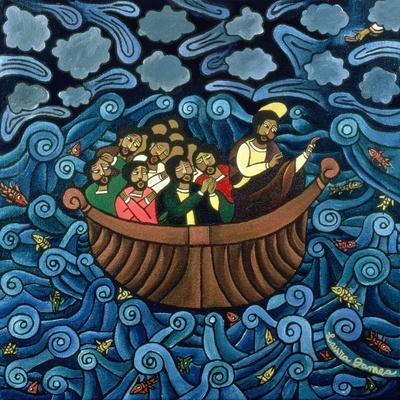
  On that day, when evening had come, he said to them, “Let us go across to the other side.” And leaving the crowd behind, they took him with them in the boat, just as he was. Other boats were with him. A great windstorm arose, and the waves beat into the boat, so that the boat was already being swamped. But he was in the stern, asleep on the cushion; and they woke him up and said to him, “Teacher, do you not care that we are perishing?” He woke up and rebuked the wind, and said to the sea, “Peace! Be still!” Then the wind ceased, and there was a dead calm. He said to them, “Why are you afraid? Have you still no faith?” And they were filled with great awe and said to one another, “Who then is this, that even the wind and the sea obey him?”

It’s been about three years now since the Covid 19 pandemic retreated enough so that we could begin to gather again in church and other public places.  We spent fifteen months secluded in our homes because a kind of life-storm rose up unexpectedly and caught us off guard and unprepared, a storm created by a virus that flew in from the other side of the world.  That storm has mostly receded now, although we are still dealing with occasional waves,  and maybe it’s just me, but even though it has been three years, it still feels like we haven’t really returned to normal, or at least what normal used to be.

In some ways that’s good.  There was a lot about our old “normal” that needed to be improved.  But in other ways, it’s not at all good.  It feels as if we are still locked into a heightened state of anxiety, and since anxiety always wants a target, we seem sometimes to be taking it out on each other, especially in our politics.

We lost a lot during the pandemic.  Social connections were lost or  strained. Some of our common understanding of how society is supposed to work was lost.  The Church, unable to gather in person in our usual places of worship, lost members in a decline that had already been underway but was exacerbated by the enforced restrictions and now shows no signs of slowing or reversing.  And, of course, millions of lives were lost throughout the world.  

Ever since Covid, we have been sailing through choppy waters toward the shore of a new and unknown reality.  It feels to me that we are somewhat like the disciples in the boat after Jesus calmed the storm.  The storm has stopped, but we are still sitting in the middle of the lake in the dark, bailing out our boat.

Today’s Gospel lesson from Mark lifts up some important things for us to think about as we sail toward a future we can’t really see.  And let’s face it, we’re not going to simply sail back into the way things used to be.  Too much was changed in those 15 months of isolation and these three years of recovery.  

In Mark’s telling of this story of the storm on the sea,  Jesus and his disciples set out in the evening, of all things, to sail across the Sea of Galilee.  A great windstorm blew up and the boat was being swamped.  We know it was a serious storm because even the fishermen who were out on this water all the time were frightened. Through all of this, Jesus was soundly asleep on a cushion in the stern of the boat.  Finally, the disciples cried out, “Teacher, do you not care that we are perishing?!?” That’s when Jesus woke up, then got up and rebuked the storm.  The sea became dead calm, and the disciples, dumbfounded by this new dimension of his power and abilities, were left wondering just who Jesus really is.

When we read or hear these stories, these episodes from the life and ministry of Jesus, it’s natural for us to ask ourselves, “Okay, what does that mean for me or for us?”  It’s always good to try to  imagine how the original listeners heard these gospel stories if we’re able, but we also hope there’s something in the story that we can take home with us, some lesson that fits our lives right here and right now.  That’s why we do this little exercise of preaching and teaching with the gospel every week.

With this particular story, it has been far too tempting for far too long to personalize it a little too much.  And I confess I’ve been as guilty as any preacher out there in doing this.  That sermon goes something like this:  “When storms arise in your life, just remember that Jesus is in the boat with you…even if he’s taking a nap at the moment.  He has the power to quiet the storm.  Maybe he’s asking you, ‘Why are you afraid?  Where’s your faith, pal?’  Muster up some courage.  Maybe it’s your turn to stand up and tell whatever  storm is swamping your boat, ‘Peace!  Be still.’”  

I have preached that sermon.

Listen, there are probably worse ways to go with this story.  We’ve all had moments in our lives when we’ve wanted to join the disciples in yelling, “Teacher, don’t you care that we’re perishing?!?”  I know I’ve been there a few times.  But the fact is, there is something greater at stake in this story than a bromide to help us face our fears.  There is something greater at stake here not just for them in their time, but for us in our time.  But to know what that is, we have to range beyond the boundaries of these six verses.

From the very beginning of the Gospel of Mark, Jesus has been announcing that the kingdom of God is imminent.  Actually, imminent is not quite the right word.  The Greek word is engikken.  It’s often translated as “has come near,” but there is an even greater sense of immediacy in the word than that.  Think of it as a train coming into the station.  It’s not all the way into the station yet but the engine has already reached the edge of the platform.  That’s the sense of it.  The kingdom of God’s engine has already reached the platform of our lives.  The train is engikken.  Get ready to board.

Everything Jesus says and does in the Gospel of Mark is said and done to demonstrate the power and presence of this new reality he calls the kingdom of God or, as Diana Butler Bass calls it, the Commonwealth of God’s justice and mercy.  He is not just telling people about this kingdom, he is showing them what it looks like and how it acts.  When Jesus calls the disciples, he is recruiting them to build a new community, a Beloved Community, based on the ideals and principles of “The Way,” which is another name Mark uses for the kingdom of God.  

Another thing to understand about the Gospel of Mark is that everything that happens in this Gospel is heavily weighted with myth and symbolism.  That’s not to say that the events the gospel depicts didn’t happen, but that it is important to pay attention to how Mark is describing and using these events and what kind of language he is using as he tells the story of Jesus.  

We need to ask questions.  What other scriptural connections does Mark make—or expect us to be making?  What apocalyptic expectations and understandings are at  work in the culture of Mark’s time?  What mythic stories are at work in the background as Mark tells the story of Jesus?  What cultural boundaries and expectations are being crossed?  If we don’t catch all these clues, then we might not get the point Mark is trying to make. We’ll get some other point instead.

When we see the disciples and Jesus set off from the shore in a boat in the evening, Mark wants us to be nervous.  We’re supposed to remember that in their mythic understanding the sea is the home of Chaos and Destruction.  Dread, unpredictable, cosmic forces hide in its depths and the only thing that could tame it at creation was the Spirit of God hovering over it.  That they are setting out as night falls with the intention of crossing all the way to the other side—well, if we were Mark’s first readers or listeners we would know they’re heading for trouble.

As the story unfolds, Mark assumes that somewhere in the back of our minds we are maybe remembering Psalm 107: “Some went down into the sea in boats…then they cried to the Lord in their trouble, and he delivered them from their distress; he made the storm be still, and the waves were hushed.” (107:23,39)  When we read that Jesus was asleep on a cushion in the stern of the boat, Mark wants us to remember how Jonah slept as his boat was about to break up in a mighty tempest. (Jonah 1:4, 10).  Mark puts all these things together so that we will understand that this storm that the disciples face out there on the sea of Chaos is not just a metaphor for the troubles of life.  This is a Cosmic storm.  Their boat is being assailed by cosmic forces.  Something wants to stop them.  Some great elemental power wants very much to keep them from getting to the other side of the lake.  But what?  And why?

To understand that, it’s important to understand why Jesus wanted to cross the lake in the first place.  

The Sea of Galilee was also called Lake Gennesaret or Lake Tiberias depending on who was talking about it.  It served as a clear geographic boundary between the territories of Philip and Agrippa in the tetrarchy of Palestine when the Emperor Augustus divided up the region between the sons of Herod the Great, and it continued to serve as a clear social boundary between the Jews of Galilee on the south side and the Hellenized Jews and Gentiles of various nationalities throughout the Decapolis on the north side. 

Why did Jesus want to go to the other side of the lake?  Quite simply because that’s where the gentiles were.  

Jesus was fighting other-ism.  Racism.  He wanted his new beloved community to embrace everyone—Jew, Gentile, people of all nationalities and types, people who had differences in how they worshipped. So he took his mission of proclamation, healing, exorcism and teaching across the sea to invite those “other” people to be part of “the Way.” He also wanted to teach his disciples that in the kingdom of God there simply is no room for such nonsense as racial exclusion or historical segregation or anything like that.  In the kingdom of God no one can call anyone else unclean.  Or unwelcome.  

That storm that rose up against them is symbolic of all the storms that rise up to resist our attempts at opening our hearts and minds to reconciliation and renewal.  It was the elemental malicious something in our world and in the human heart that wants to keep us forever sorted in our caste systems and historic animosities, that force that resists healing and unifying humanity.  And I want you to notice something here:  The words that Jesus spoke to stifle that storm are the words of exorcism.  Most of our translations make those words prettier than they actually are, but they are the same words that Jesus spoke when he cast out the demon in Mark 1:25.  “Peace.  Be still.”  Okay, sure.  But that’s a very mild translation.  The full force of the words in the Greek text is more like “Silence!  Shut up!  I muzzle you!”  

Maybe  this is how we need to speak to racism.  Maybe this is how we need to speak to Jim Crow laws and race-baiting and race-driven gerrymandering.  Maybe this is how we need to speak to racial slurs and jokes and microaggressions and all the derogatory language of bigotry.

Maybe we need to speak this clearly and bluntly to the forces that try to dissuade and discourage us from reaching out to make new bonds of friendship.  Maybe this is how we need to speak to those voices who keep dragging up tradition and history as reasons to preserve symbols of hatred and monuments to violence in public displays.  Maybe this is the plain kind of speech we need to use with those who continue to pursue paths of prejudice that have done nothing but separate us and poison us against each other.  Maybe instead of trying to be reasonable and persuasive against such divisive winds it’s time to simply say, “Stop right there!  I will not listen to hate.  I will not let you keep us from getting to the other shore.  I will not let you stop us from including everyone in the Beloved Community.”

During the pandemic, we had fifteen months of enforced separation, an imposed time to sit apart and consider all the things that are dividing us.  We had fifteen months to witness as more than a million people died from a disease that could have been curtailed much more easily and much more quickly if we had been more unified.  

We had 15 months to watch as unreasonable political forces and conspiracy theory voices assaulted the foundations of our democracy and truth, itself.  We had 15 months to see racial tensions repeatedly exacerbated by hate and violence and lamentable systemic conditioning.  

We had fifteen months to sit apart in our homes and miss each other and think about what it means to be friends, to be church, to be disciples of Jesus, to be people of The Way.  

And now the doors have been open for three years.  The storm has subsided.  We’ve been back together for some time now.  We get to be “us” again.  But there are people “not like us” across the road, across town, across the lake, on the other side of the sea of chaos. And Jesus is still saying, “Let’s go across to the other side.”  

Yes, storms will almost certainly rise up.  The elemental malicious  something will try to stop us.  But Christ is in the boat with us, and Christ has given us the words to silence bigotry.

“Christ sleeps in the deepest selves of all of us,” said Frederick Buechner, “and whatever we do in whatever time we have left, wherever we go, may we in whatever way we can call on him as the fishermen did in their boat to come awake within us and to give us courage, to give us hope, to show us, each one, our way. May he be with us especially when the winds go mad and the waves run wild, as they will for all of us before we’re done, so that even in their midst we may find peace…we may find Christ.”

image © Laura James

Scattering Seeds

Mark 4:26-34

With what can we compare the kingdom of God…  

What do you think of when you hear or read that phrase: the kingdom of God?  I think it’s hard for us to really grasp what Jesus was talking about when he talked about the kingdom of God not only because he described it in metaphors and parables, but because a kingdom, itself, is a thing entirely outside of our experience for almost all of us.

Most of us think of kingdoms in terms of either physical territory or fairy tales, but clearly Jesus is talking about something that transcends mere physical boundaries and is a lot more real than fairy tales.  A kingdom can simply be a territory ruled over by a king or queen, but it can also mean a sphere of authority or rule, and that might be closer to what Jesus is getting at:  the rule of God.  The authority of God.  But even that is something most of us can’t relate to too well because we have never lived under the authority of a monarch or a lord or a master, and those monarchies that are still active in our world are either almost entirely symbolic or wildly dysfunctional or utterly dictatorial.  And I don’t think we want to attribute any of those qualities to God.

Also, words like authority and rule can have a coercive edge to them, and the kingdom, as Jesus describes it, seems to be much more about influence, persuasion and cooperation.  It’s more organic.  It’s something that grows in us and around us and among us.  

I have often used the phrase “kin-dom of God” for that reason—to try to capture some of the cooperative, love-based nature of God’s sovereign rule as Jesus describes it in the beatitudes and parables.  Diana Butler Bass has called it the Commonwealth of God’s justice and mercy, and I think that might be even more in the right direction.  Maybe.  But it’s also important to remember that the kingdom of God is not a democracy.  God is sovereign.  God’s rule is absolute.  Fortunately for us, so is God’s love, and that love is the very fabric of this thing Jesus is trying to describe as “the kingdom of God.”  The kin-dom of God.  The Commonwealth of God’s kindness.

When Jesus told these parables, and thirty-some years later when Mark wrote them down, trouble was brewing in Galilee and Judah and pretty much throughout all of Palestine.  Landowners were putting pressure on tenant farmers for rents they could barely pay.  Scribes from the temple in Jerusalem were demanding a crushing and complex levy of tithes from those same farmers.  Herod Antipas was demanding taxes from the landowners because Rome was demanding taxes from him.  Unemployment was high.  Bandits roamed the highways.  Soldiers patrolled everywhere.  Rome’s colonial government was heavy-handed and oppressive to the point of brutality.  People wanted a heavenly anointed messiah to step in and fix things before they exploded—or maybe to light the fuse and set off the explosion that everyone felt was coming. It’s no wonder that the disciples kept asking Jesus, “Is this the time when you will bring in the kingdom?”

Jesus kept trying to tell them and all the crowds following him, “No, the kingdom of God is not like that.  It’s not what you’re thinking.  It won’t do any good to simply replace one coercive external system with another one even if the ruler is God!”  

The change has to be internal.  It has to be organic.  Seeds have to be planted.  Human hearts and minds have to be changed. It’s not about imposing a new kind of law and order.  It’s about implanting a new kind of love and respect.  That’s what will fix the world.

“The kingdom of God is as if someone would scatter seed on the ground, and would sleep and rise night and day, and the seed would sprout and grow, he does not know how.”

For generations we had a family farm in Kansas—my  mother’s family farm—where we grew winter wheat.  Winter wheat is planted in late September or early October, depending on the weather.  Not long after it’s planted, it starts to sprout.    Beautiful little shoots that look like blades of grass start to poke their heads up out of the soil.  And then just as they’re getting started, the cold hits them.  And it looks like it’s killed them.  They slump back down to the dirt and go dormant, and they’ll just lie there all through the winter.  The ground will freeze.  Snow will drift and blanket over them.  And there’s nothing you can do.  

All winter long you go about your business.  You sleep and rise night and day.  And then you get up one spring morning and notice that the weather is a bit warmer, and the snow is patchy or mostly gone, and you look out the window to see that you suddenly have a field full of beautiful green wheat starting to rise up out of the ground.  It’s an amazing thing to see, and if you have half a sense of wonder, you thank God for the natural everyday miracle of it and marvel at it for at least a moment before you get on with your chores.  

The kingdom of God is like that, says Jesus.  It is seeds scattered on the earth.  Seeds of ideas and vison. And sometimes it looks like they’ve died.  Or been crushed.  Or been frozen out or buried.  Or simply forgotten.  But they are still there, just waiting for their moment.  

The kingdom of God is seeds of ideas and vision and understanding.  They are ideas about fairness and justice and cooperation.  They are an understanding about fuller and more generous ways to love each other and take care of each other.  The kingdom is a resolve to make a world that is healthier for everyone.  It’s a resolution to embrace God’s vision for how the world is supposed to work—a world where everyone is housed and everyone is fed and everyone can learn and everyone is safe and everyone is free to be their true self.  The kingdom is a determination to repair the damage we’ve done and restore creation so that we and all the creatures who share this world with us can breathe clean air and have clean water.

The kingdom of God, the rule of God, the reign of God, the kin-dom of God, the Commonwealth of God’s justice and mercy is a commitment to let justice roll down like water and to show each other kindness and to walk humbly with God and with each other.  It is a continual correction of our vision so we keep learning how to see the image and likeness of God in each other—in each and every face we face so that racism and classism and every other kind of ism evaporate from the earth.  It is the seed of courage taking root in our hearts and minds so that we learn not to be afraid of something or someone simply because it or they are different from us or from what we know or what we expect or what we are used to.

“With what can we compare the kingdom of God, or what parable will we use for it?,” said Jesus.  “It is like a mustard seed, which, when sown upon the ground, is the smallest of all the seeds on earth; yet when it is sown it grows up and becomes the greatest of all shrubs, and puts forth large branches, so that the birds of the air can make nests in its shade.”

The mustard seed!  That tiny seed that produces the most egalitarian, most democratic of plants!  That’s what God’s kingdom is like.  It freely and bounteously shares itself and all that it has.  Given half a chance it spreads itself everywhere.  The mustard plant doesn’t care if you are rich or poor.  You don’t have to buy one.  It will come to you and give you and your family food and medicine and spices for your cuisine and healing oils for what ails you.  A most amazing, versatile and humble plant.  And it starts as just a little tiny seed.

The kingdom of God is the planting of seeds. The seeds don’t have to be eloquent preaching or brilliant explanations of theology—probably better most of the time if they’re not.  “Preach the gospel at all times,” said St. Francis. “When necessary, use words.”  At a time when the city of Assisi was a rough and dangerous place, Francis would walk through the town from the top of the hill to the bottom and say as he went, “Good morning, good people!”  When he got to the bottom of the hill he would turn to the brother who accompanied him and say, “There.  I have preached my sermon.”  What he meant was he planted a seed—he had reminded the people that the day was good and that they had it in themselves to be good people.

The seeds of the kingdom may be little acts of habit, like bowing your head for a moment to say grace before a meal in a restaurant, even if you don’t say it out loud.  That simple thing might remind those around you to pause, to be thankful, to remember all the connections that bring food to our tables, to remember the goodness of the earth and the sweat of the farmers, to remember the presence of God.

The seeds of the kingdom might be small acts of kindness.  When Oscar Wilde was being brought down to court for his trial, feeling more alone and abandoned than he had ever felt in his life, he looked up and saw an old acquaintance in the crowd.  Wilde later wrote, “He performed an action so sweet and simple that it has remained with me ever since.  He simply raised his hat to me and gave me the kindest smile that I have ever received as I passed by, handcuffed and with bowed head. Men have gone to heaven for smaller things than that. It was in this spirit, and with this mode of love, that the saints knelt down to wash the feet of the poor, or stooped to kiss the leper on the cheek. I have never said one single word to him about what he did … I store it in the treasure-house of my heart … That small bit of kindness brought me out of the bitterness of lonely exile into harmony with the wounded, broken, and great heart of the world.”

The seeds of the kingdom might be a word of affirmation and encouragement when it’s needed most.  Helen Mrsola was teaching ninth graders new math years ago.  They were struggling with it.  The atmosphere in the classroom was becoming more tense and irritable every day.  So one Friday afternoon Helen decided to take a break from the lesson plan.  She told her students to write down the name of each of their classmates on a piece of paper, then to also write down something nice about that student.  She collected the papers, and over the weekend Helen compiled a list for each student of what the other students had written. On Monday, she gave each student a paper with list of what the other students liked about them.  The atmosphere in the class changed instantly; her students were smiling again. Helen overheard one student whisper, “I never knew that I meant anything to anyone!” 

Years later, a number of the students, all young adults now, found themselves together again at a school function.  One of them came up to Helen and said, “I have something to show you.”  He opened his wallet and carefully pulled out two worn pieces of notebook paper that had obviously been opened and folded and taped many times.  It was the list of things his classmates liked about him.  “I keep mine in my desk at work,” said another classmate.  Another classmate pulled hers out of her purse, saying she carried it with her everywhere she went.  Still another had placed his in his wedding album.

The kingdom of God.  The rule of God.  The reign of God.  The kin-dom of God.  The Commonwealth of God’s kindness. . . 

To what shall we compare it?

It’s like seeds scattered on the earth, says Jesus.  It’s like mustard seeds.  Seeds of righteousness.  Seeds of justice. Seeds of vision.   Seeds of help.  Seeds of hope.  Seeds of mercy.  Seeds of peace.  Seeds of affirmation.  Seeds of goodness.  Seeds of kindness.   Seeds of love.  

You don’t know how they grow.  But oh, they do grow.

On earth as in heaven.

The Dawn of a New Day in the Middle of the Night

John 3:1-17

Nicodemus came to Jesus by night.  Some have suggested that Nicodemus came to see Jesus at night because he didn’t want to be seen talking to Jesus.  The Gospel of John tells us that Nicodemus was a Pharisee and an archon, a leader or ruler of the people and a highly respected teacher.  He was also fairly wealthy.  He had standing in the community as a righteous man, blessed by God, so he had a reputation to protect, and he was putting all that at risk by meeting with a man who many of his fellow Pharisees regarded as a troublemaker.  

Nicodemus came to see Jesus at night because it was less risky.  Nicodemus came at night so he could avoid the crowds.   Nicodemus came at night because it would be easier to have an open and honest conversation away from the judging eyes and oppositional expectations of his fellow Pharisees.  That’s how this meeting of the minds is often framed, and, in fact, that might all be true.  But there is more going on here that we might miss if we simply accept this very practical and prosaic explanation then go charging ahead to our favorite verses later in this passage.  I’m looking at you, John 3:16.

Nicodemus came to Jesus by night.  Night, nyx in the Greekmeans darkness.  Nicodemus came in darkness.  Figuratively, night can be symbolic of blindness, especially spiritual blindness. Metaphorically, night can also mean a state of incomplete or defective spiritual understanding.  But night is also a time for revelations, especially in dreams.  

The dynamic tension between light and darkness is an important recurring theme in the Gospel of John.  One of the first things this gospel says about Jesus, the Logos, is, “In him was life, and the life was the light of all people.  The light shines in the darkness, and the darkness has not understood it.” (John 1:3-4)  Later, in chapter 3, we will read that light has come into the world but people loved darkness. . . “For all who do evil hate the light and do not come to the light so that their deeds may not be exposed.  But those who do what is true come to the light, so that it may be clearly seen that their deeds have been done in God.” (John 3:19-21)

Nicodemus came to Jesus by night.  He came in the darkness of an incomplete or faulty understanding of God and how God works and what God was doing in the world.  No judgment there.  If we’re honest, we’re all in the dark to one degree or another.  But he came into the light of Jesus, who could illuminate and broaden his understanding.

Nicodemus came to Jesus by night… and night has yet one more meaning that might surprise us.  For the Jews, the new day begins at sunset.  That means that night is the beginning of a new day.

When Nicodemus sat down with Jesus, it was, for him, the beginning of a new day.  He was moving out of darkness and into the light.  Nicodemus reminds us that faith is a process.  He reminds us that understanding unfolds by degrees.

The first thing Nicodemus said to Jesus when they sat down to talk was, “Rabbi, we know that you are a teacher who has come from God; for no one can do these signs that you do apart from God.” It’s kind of sad, really, but in our time and our culture, when we see a greeting like that we think it’s just flattery, and our first impulse is to hold onto our wallets.  But Nicodemus wasn’t trying to schmooze Jesus.  He was simply stating his confusion.  It’s as if he was saying, “Look, I can see that you have a direct connection to God, but you are just so different from what we’re used to, from what we expect.”

His confusion and doubt notwithstanding, Nicodemus showed Jesus great respect. He called him rabbi and acknowledged not just the powerful things Jesus had done, but the source of his power.  Nicodemus acknowledged the relationship Jesus shared with the one he called Father, though he couldn’t possibly have understood the true nature of that relationship.

But then, who does?  Oh, we have no shortage of doctrinal formulas and illustrations now to describe that relationship—relationships, really, because the Holy Spirit is part of that eternal dance of love we call the Trinity.  But when you get right down to it, who can really understand the relationship between the Maker, the Christ and the Spirit?  Saint Augustine said that trying to understand the Trinity is like trying to pour the ocean into a seashell.  

We recite the illustrations and restate the formulas and then think that because we found some language to corral it, we understand the mystic communion of love that is God.  But our language, itself, betrays our lack of real understanding.  In naming them Father, Son, and Spirit, or Creator, Redeemer and Sustainer we insert a separateness between them and ascribe roles for each person which is the antithesis of their relationship, their existence, their being, their unity, where they cannot and will not be separate.    

Frederick Buechner described the Trinity as the Mystery Beyond us, the Mystery Among us, and the Mystery Within us—and it’s all one deep and eternal Mystery that gives us life, the Mystery in which we live and move and have our being.  The best we can do is enter into the Mystery and experience it—and understand that we will never completely understand.  

Right now we stand at a perilous moment in our history.  Our planet, our only home, is sick from pollution that we released into the air we breathe and the waters that sustain us.  Our economies are dominated by greed.  There are political forces at work in our country and our world that are bent on authoritarianism and oligarchy.  At the same time there are those who want to flex their moralizing muscles to invade everyone’s privacy and codify what you may or may not do with your own body, or tell you who you may or may not love, or even deciding what you may or may not be allowed to read.  Ironically, some of these power-hungry people call themselves Christian.  And let’s not forget our seemingly relentless fear of anyone who is different, a fear that endlessly reasserts itself in unreasoned hatred and violence.  And on that note, I would be remiss if I didn’t note that yesterday marked the 4th anniversary of the death of George Floyd. 

The world is a mess, and it seems sometimes that all of creation is crying out to the heavens saying, “I can’t breathe!”

Fortunately for us, God’s love and grace is patient and kind and the Holy Spirit, the Breath of Life, continues to draw us into the dance of Trinity.  The Mystery Within us leads us to the Mystery Among us who forever points us to the Mystery Beyond us.  In the light of Christ our eyes are opened to see the promise of the new day, the possibility and promise of the Reign of God—the Commonwealth of God’s justice and kindness—becoming a reality on earth as it is in heaven.  

When the Spirit draws us into the perichoresis, the circle dance of love that is God, it’s like being born anew, being born from above, and it can happen to us at any age.  

Love can change us.  Love can change us as individuals, it can change us as a people, it can change us as a nation, and it can change the world.

When we are captivated by God’s love for the world, for all of creation.  We see each other and the world with new eyes, we hope with a hope that is greater and deeper than our practical assessments allow, and we love with a love that’s beyond our capacity.  

This is how God has loved the cosmos—the world—all of it, everything: God gave God’s unique son so that everyone who lovingly trusts him need not be destroyed or lost in the endless waves of chaos but may instead have eternal life.  God did not send Christ into the world to judge the world, but so that the world might be healed and made whole through him.  

That’s what love does.  Love heals.  Love unites.  Love makes things whole.  That’s the point.  God loves.  God loves everything God has made.  The dance of Trinity embraces all of creation and says that it is good.  

Jesus reminds us repeatedly that the Reign of God—the Commonwealth of God’s justice and kindness—is in reach.  It’s doable.  The Spirit, in love, is calling us to embrace God’s vision of a whole and healthy world and to join the work of making it our reality.

As the Spirit draws us to the light and love of Christ, in the middle of the night may we find the dawn of a new day.  

(S)mothered in Prayer

John 17:6-19

It’s Mother’s Day today, so naturally, I’ve been thinking about my mom.  I bought my mom a mug that said, “Happy Mother’s Day from the World’s Worst Son.”  I forgot to give it to her.

I’ll never forget one Mother’s Day—we had a big family meal at Mom and Dad’s house but right after dinner Mom kind of disappeared.  I found her in the kitchen getting ready to wash a sink full of dirty dishes.  I said, “Mom, it’s Mother’s Day!  Go sit down and relax.  You can do the dishes tomorrow.”

My mom told me once that I’d never amount to much because I procrastinate too much.  I said, “Oh yeah?  Well just you wait.”  

Mother’s Day was first proposed by feminist activists after the Civil War.  They originally envisioned it as a day of peace to honor and support mothers who had lost sons and husbands to the carnage of the war.  

  In 1914, President Woodrow Wilson signed a proclamation officially designating the second Sunday in May as Mothers Day.

And here’s an odd but important note:  originally there was no apostrophe in Mother’s Day.  Julia Howe and Anna Jarvis envisioned it as a day to honor allmothers.  Plural.  But the greeting card industry, the florists, and the candy makers quickly figured out a way to monetize the holiday.  They individualized it and idealized it, and began promoting it as a day for you to honor your mother.  In their advertising, Mothers Day (plural/all mothers) quickly became Mother’s Day with an apostrophe, as in your mother’s day (singular/possessive).  Needless to say, the idea of it being a day to promote international peace pretty much vanished with the arrival of that apostrophe.

Mother’s Day became so commercialized that in 1943, Ann Jarvis, one of the women who had lobbied long and hard to make it a national holiday, tried to organize a petition to rescind Mother’s Day, but her efforts went nowhere.  Frustrated, and literally at her wits’ end, Anna Jarvis died in 1948 in a sanitarium.  Her medical bills, ironically, were paid by a consortium of people in the floral and greeting card industries.

Mother’s Day is one of those holidays that can be a great joy for some and a cringe-worthy day for others.  In her annual Mother’s Day column Anne Lamott wrote: “This is for those of you who may feel a kind of sheet metal loneliness on Sunday, who had an awful mother, or a mother who recently died, or wanted to be a mother but didn’t get to have kids, or had kids who ended up breaking your hearts…”  Lamott went on to acknowledge many of the ways that this Greeting Card holiday can be painful for many women…and also for many children.

Most pastors I know are ambivalent at best when it comes to Mother’s Day.  It’s something of a minefield for us.  We don’t dare let it go unmentioned, but at the same time we are very aware of those in our congregations who for one reason or another will be feeling that “sheet metal loneliness” that Anne Lamott described.

I said at the beginning of all this that I have been thinking about my mom.  One of the great gifts she gave me was that she taught me to pray.  She insisted that we give thanks before our meals and she sat next to me and listened as I prayed at bedtime.  Sometimes she would pray with me.  She also taught me that I could pray anytime and anywhere because God is always with me and always listening.

I was thinking of her as I read through the so-called High Priestly Prayer that Jesus prayed for his disciples in John 17, and it occurred to me that Jesus is “mothering” his disciples in this prayer as he prays for their safety and protection.

I’ve been blessed to know many people who are disciplined, devoted and powerful in their prayer life.  I’ve also known quite a few who find prayer daunting and mystifying. 

Robert McAfee Brown said that prayer, for many, is like a foreign land.  “When we go there, we go as tourists.  Like most tourists, we feel uncomfortable and out of place.  Like most tourists, we therefore move on before too long and go somewhere else.”

If you’ve ever felt even a little bit uncomfortable or awkward about praying, if you’ve ever felt like a “tourist in a foreign land” when you pray, you might be able to find some comfort in the prayer Jesus prays here in the 17th chapter of John.  

Jesus is clearly praying from the heart here.  He knows the end is near.  There is a lot to say and not much time left to say it.  He prays for protection for these friends who have been his travel companions and students for three years and are heading into more difficulty than they can begin to imagine.  He prays for their unity.  That has to be comforting for them, and there is comfort here for us, too, because his request for protection and unity for his followers travels down through the ages to include us here and now.  But there is something else in this prayer that might make us more at ease in our own prayers.

Jesus rambles.  I mean no disrespect or sacrilege when I say that.  In this prayer, Jesus rambles.  We could, of course, ascribe that rambling to the writer of the Gospel.  But we can’t deny it.  In this wonderful, passionate, heartfelt prayer for the unity and protection of his disciples, Jesus rambles.  A bit.

I, for one, find that very comforting.  Because I ramble in my prayers.  Often.   I talk to God a lot, and it’s a rare blue day when I come into the conversation with all my thoughts completely organized.  I suppose there are people who do, but that’s just not my personality type.  

Over the years of my ministry I’ve been asked a number of times to teach a class or workshop on prayer.  I confess it always catches me by surprise.  Part of me wants to say, “How do you not know how to pray?”  But I realized years ago that a lot of people think there is a proper method for praying and they suspect they’re not doing it right.  Or they think that if they learn some secret formula for prayer they have a better chance of their prayers being answered the way they want them answered.  

Here’s the thing.  Prayer is not that complicated.   There really aren’t any secrets.

Billy Graham said that prayer is simply a two-way conversation with God.  And since God doesn’t talk all that much, that means that you can simply share your thoughts and feelings with God.  That’s prayer.  You don’t have to kneel or fold your hands—although if doing that helps you pray, then by all means do so.  

If you’re the kind of person who likes more structure than that, you can try the ACTS model for prayer.  A-C-T-S.  A for Adoration, C for Confession, T for Thanksgiving, S-for Supplication.  

Start by telling God all the wonderful things you’re seeing and experiencing and how much you love God for filling the world with such goodness.  When’s the last time you said, “I love you” to God?  You might be surprised at how much that simple act can change you.  

So, Adoration.  Then Confession.  Take a moment for a little introspection and Confess your mistakes and shortcomings.  You don’t have to beat yourself up.  Don’t dwell on them, just acknowledge them.  And remember: God is in the forgiveness business.

Follow that by Thanking God for all that’s good in your life, all the ways you’ve been protected and cared for, for the food on your table, for, well, everything that makes your life livable.  Meister Eckhart said, “If the only prayer you ever say in your life is thank you, that will be enough.” 

After you’ve said “thank you,” then you can ask for things.  That’s the time for Supplication. Unless it’s an emergency, of course.  If someone or something is bleeding or broken—and that includes your heart—you can lead with Supplication.

Adoration, Confession, Thanksgiving, Supplication.  ACTS.  The nice thing about this model is that it keeps you from hitting up God with your requests before you’ve even said a proper hello.  It keeps us from treating God like Santa Claus or a celestial vending machine.

The point of prayer, after all, is not to get things from God or keep giving God your wish list. Remember, Jesus told us, “Your Father knows what you need before you ask.” (Matthew 6:8)  The real point of prayer is to develop and deepen your relationship with God.  “Prayer,” said Theresa of Avila, “is nothing else than being on terms of friendship with God.”  Henri Nouwen said, “Prayer is the most concrete way to make our home in God.”  Richard Rohr suggested, “What if instead of prayer, we used the word communing?  When you’re communing with someone, it isn’t long before you’re loving them.”

As for doing it right…there are as many ways to pray as there are people praying.  “Those who sing pray twice,” said Martin Luther.  So singing is an option.  So is dancing.  You can pray while walking.  You can pray while exercising.  Saint Ignatius said, “Bodily exercise, when it is well ordered, is also prayer and pleasing to our Lord.”  So there you go!  Pray while you’re at the gym!  

Back before I lost most of my hearing I used to lose myself in improvising on my guitar and I would offer that time to God as a kind of prayer.  Kelsey Grammer said, “Prayer is when you talk to God.  Meditation is when you’re listening.  Playing the piano allows you to do both at the same time.”  I think most musicians have had that kind of experience.  There are times in music when you experience a  holy presence that goes beyond words.  You can experience that even when you’re just listening if you really immerse yourself in the music.

“The Glory of God is the human being fully alive;” said Irenaeus, “the life of a human being is the vision of God.”  So if you’re singing or you’re dancing or riffing on your bagpipes, let that flow to the perichoresis of the ever-dancing Holy Trinity as a communion of Adoration, Confession, Thanksgiving and Supplication.  Let that activity speak for your heart and don’t worry about impressing God with churchy-sounding words and phrases.  “In prayer,” said Gandhi, “it is better to have a heart without words than words without heart.”  Or as Martin Luther put it, “The fewer the words, the better the prayer.” In fact, some of the best prayers you will ever pray will be when you sit in silence in the presence of God who speaks in silence.

And don’t worry about whether you should address God as Father, or Jesus, or Spirit, or Lord.  It’s all one to the Three-in-One.  When you speak to one of them you speak to all three.  In my own prayer life, I have begun using the Jewish tradition of addressing God as HaShem, which means “the Name.”  For me it’s a way to remain deeply personal with God and at the same time honor the holiness of God.

Prayer is a powerful way to center yourself in difficult times.  Adolfo Perez Esquivel, the artist and sculptor who won the Nobel Peace Prize in 1980 for organizing and leading the opposition to Argentina’s military dictatorship said, “For me it is essential to have the inner peace and serenity of prayer in order to listen to the silence of God, which speaks to us, in our personal life and the history of our times, of the power of love.”  Such an extraordinary thing—to find through prayer the strength and resolve to love in the face of brutal opposition.  

“Prayer,” said Myles Monroe, “is our invitation to God to intervene in the affairs of the world.”   “Prayer is not an old woman’s idle amusement,” said Gandhi.  “Properly understood and properly applied, it is the most potent instrument of action.”  “To clasp the hands in prayer,” said Karl Barth, “is the beginning of an uprising against the disorder of the world.”

Prayer is a powerful tool for difficult times.  We tend to turn to it automatically in times of crisis. But we shouldn’t wait for a crisis to turn to God.  As I said earlier, the main purpose of prayer is to deepen and strengthen our relationship with God.  “The moment you wake up each morning, all your wishes and hopes for the day rush at you like wild animals,” wrote C.S. Lewis.  “And the first job each morning consists in shoving it all back; in listening to that other voice, taking that other point of view, letting that other, larger, stronger, quieter life come flowing in.”  

That, in the end, is what prayer is all about:  letting that other, larger, stronger, quieter life come flowing in.  And letting our lives flow more deeply into the life of God in whom we live, and move, and have our being.

And that brings us back around to the original intent for Mothers Day.  It was intended to be something to strengthen the community and bring peace to the world.  This Mothers Day, I invite you, through your prayers, to do just that.

*Image © Alima Newton

What the World Needs Now

John 15:9-17

“What the world needs now is love, sweet love.  It’s the only thing that there’s just too little of.”  Jackie DeShannon was absolutely right when that song reached the top of the charts back in 1965.  And the Beatles were right, too, when they had a megahit with All You Need Is Love in 1967.  But Jesus said it first.  A long time before John Lennon and Paul McCartney or Burt Bacharach and Hal David.

Love is a powerful force.  It creates relationships.  It can overcome fear and hate.  Love is what created the universe.  It can sometimes transform things instantaneously, but more often it builds and changes things slowly.  Over time. Because love is patient and kind.

Love can improve your health.  It can even make you more successful, although that is entirely a side-effect.

In 1938, during the Great Depression, a group of doctors at Harvard Medical School began a long-term study to determine what factors contributed most to long-term health and well-being in men.  The Study of Adult Development has been ongoing for more than 80 years now.  Once selected, participants are followed for the rest of their lives.  They fill out a questionnaire every other year covering their physical and mental health, financial status, relationship status, and general level of happiness.  Every five years some of the men are selected at random for more in-depth study.  

Some of the findings in the study haven’t been all that surprising.  For instance, they’ve verified that alcoholism is destructive.  It has been the primary cause of divorce among study participants and it strongly correlates with neurosis and depression.  So, no big surprise there.  But here’s one that is surprising:  financial success depends more on warm relationships than on intelligence. In fact “warm relationships” play a huge role in lifetime satisfaction, wealth, and well-being.

A warm childhood relationship with your mother makes a difference long into adulthood:

  • Men who had warm childhood relationships with their mothers earned considerably more per year than men whose mothers were uncaring.
  • Men who had poor childhood relationships with their mothers were much more likely to develop dementia in later life.
  • In professional life, a man’s boyhood relationship with his mother—but not with his father—was associated with greater effectiveness at work.

But a warm relationship with your father is important, too. Warm childhood relationships with fathers correlated with:

  • Lower rates of adult anxiety.
  • Greater enjoyment of vacations.
  • Increased life satisfaction at age 75.

When George Vaillant, the former director of the Study, was interviewed by The Atlantic, his main conclusion was that “warm relationships” throughout life had a greater positive influence on “life satisfaction” than anything else—greater than money, greater than achievement, greater than acquisition and accumulation of things.  Warm relationships, he said, were the greatest predictor of happiness.  By far.  “Put differently,” Vaillant says,  “The study shows happiness is love. Full stop.”[1]  When a Canadian broadcaster suggested that his statement was overly broad and sentimental, Vaillant looked down at his data then looked up and replied,  “The answer is L-O-V-E.”[2]

“As the Father has loved me, so I have loved you,” said Jesus.  “Abide in my love. If you keep my commandments, you will abide in my love, just as I have kept my Father’s commandments and abide in his love.”

The word “love” here is agape which is a particular kind of love.  This isn’t a sentimental or emotional love, although it can develop into warm feelings.  But agape doesn’t start that way.  Agape is a decision.  It starts in the head before it moves to the heart.  Madeleine L’Engle described it this way:  “Agape love is…profound concern for the well-being of another, without any desire to control that other, to be thanked by that other, or to enjoy the process.”   

Dr. Martin Luther King said, “Agape does not begin by discriminating between worthy and unworthy people, or any qualities people possess.  It begins by loving others for their own sakes… Therefore, agape makes no distinction between friend and enemy; it is directed toward both. It is redemptive goodwill for all people.  It is a love that asks nothing in return.  It is an overflowing love…And when you rise to love on this level, you begin to love people not because they are likeable, but because God loves them.”   

When Saint Paul writes that Love is patient and kind, that love is not envious or boastful or arrogant or rude, that it doesn’t insist on its own way, that love it is not irritable or resentful, that it does not rejoice in wrongdoing, but rejoices in the truth…when he writes that love bears all things, believes all things, hopes all things, endures all things, when he writes that love never quits, he is describing agape.  

When Jesus says, “As the Father has loved me, so I have loved you,” that’s the kind of love he is talking about, the decision to act for the well-being of others.  So what about those warm feelings that can have such a positive effect?  Well, agape love may start in your head as a decision, but it often moves to the heart because when you love with agape love, you make yourself vulnerable.  That’s part of the decision.  That’s why, right after Jesus reminds his disciples that he loves them, he goes on to call them his friends.

“Abide in my love,” says Jesus.  Most of us don’t use the word “Abide” too often.  The Greek word that’s at work here is meno, which means to stay, to remain, to continue, to continue to exist.  It’s in the imperative form here, so Jesus says it as a command.  Continue to exist in my love.  Stay in my love.

There are two ways to think about that.  One is that Jesus surrounds us with his love and commands us to stay inside the parameters of that love as we act and interact with each other and the world.  This might be what Saint Paul means when he talks about being “in Christ.”  

The other way to understand it is to see that our lives have been infused with the love of Jesus and we are now commanded to continue to regenerate that love for those around us, to keep spreading it out into the world.  Both understandings work.  Both keep the love of God flowing.  And Jesus assures us that if we keep the commandment to love, we will continue to abide, to exist, within the love of God.

“I have said these things to you,” said Jesus, “so that my joy may be in you, and that your joy may be complete.” This statement always catches me by surprise.  

I’ll be honest, I don’t usually think of Jesus as joyful.  You certainly don’t see him depicted that way very often in the gospels.  We see him arguing with scribes and Pharisees or impatient with his disciples when they’re being dense. We see his generosity, especially when he’s healing.  We see his power when he’s casting out demons, there’s certainly something energetic about that.  But joyful?  

When you think about it, the episodes of cranky or serious Jesus that we see depicted in the gospels are brief and they’re probably very much the exception rather than the rule.  We do see him dining with tax collectors and sinners.  Those were probably fun times.  He does tell the occasional joke—you know, a camel through the eye of a needle?  And joy would explain why huge crowds came to see him.  Joy is attractive!  Joy is charismatic!

So Jesus commands us to continue to exist in his agape love so that his joy may be in us and so that our joy may be complete.  And then to make it crystal clear that he’s serious about this—joyfully serious—he makes love a commandment.  “This is my commandment, that you love one another as I have loved you.”

As I have loved you.    

“No one has greater love than this,” continues Jesus, “to lay down one’s life for one’s friends.”  He’s referring to the cross here, of course, hinting at just how far he will go to demonstrate his agape love for all of us.  He will lay down his physical life.

But he might be referring to even more if we dive down below the surface.  The word that’s translated as “life” here is psyche.  It means living soul, inner self, mind.  It can also mean what we refer to as “ego.”  Richard Rohr has said that in order to learn how to fully and truly love we have to learn how to get our egos out of the way.  No one has greater love than this, to lay down one’s ego for one’s friends.

“Authentic Christianity,” says Rohr, “is not so much a belief system as a life-and-death system that shows you how to give away your life, how to give away your love, and eventually how to give away your death.  Basically, how to give away—and in doing so, to connect with the world, with all other creatures, and with God…Here the primary language is unlearning, letting go, surrendering, serving others, and not the language of self-development—which often lurks behind our popular notions of salvation.[4]

Paul Tillich once wrote about meeting a Swedish woman who had spent time in a prison camp for giving aid and comfort to prisoners and orphans during World War I.  He found in her a personification of that “greater love.”  “It is a rare gift to meet a human being in whom love – this means God – is so overwhelmingly manifest,” he wrote. “It undercuts theological arrogance as well as pious isolation. It is more than justice and greater than faith or hope. It is the very presence of God in the form of a human being. For God is love. In every moment of genuine love we are dwelling in God and God in us.”

When you let God’s love flow through you, you begin to love, as John Duns Scotus says, things in themselves and for themselves, and not for what they do for you.  That’s when you begin to love your spouse.  That’s when you begin to really love others—when you start seeing them detached from you or what they do for you or how they make you look or what they can get for you. 

When we love, we manifest God.  It’s as simple as that.  As it says in Ephesians, “I pray that you may be strengthened in your inner being with power through his Spirit and that Christ may dwell in your hearts through faith as you are being rooted and grounded in love.  I pray that you may have the power to comprehend, with all the saints, what is the breadth and length and height and depth and to know the love of Christ that surpasses knowledge, so that you may be filled with all the fullness of God.”[1]

When you love things and people in themselves, you are looking out at the world with the eyes of God.  When you look out from those eyes, you see that it’s not about you.  And you will see things that will give you joy.  Simple things will make you happy. Reality will start giving you joy, inherently.  And you will start overcoming the gap between you and everything else.

Abide in Christ’s love.  Be a friend of Jesus.  Build those warm relationships in the world.  So that Christ’s joy may be in you.  And your joy may be complete.


[1] Ephesians 3:16-19