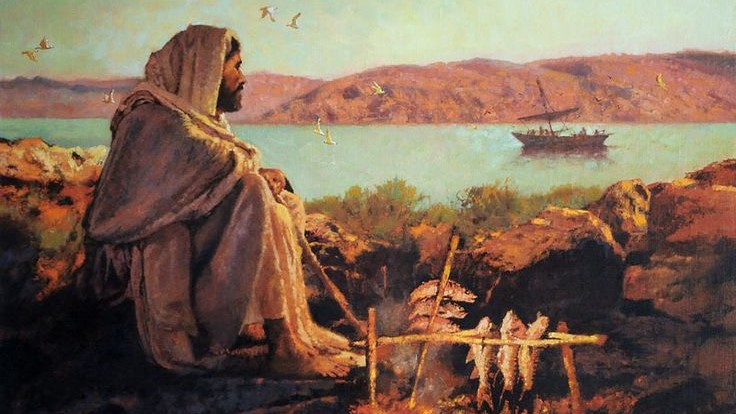
What Kind of Kingdom?

Luke 23:33-43

Today is the last Sunday of the church year, Christ the King Sunday or Reign of Christ Sunday.  This is a fairly new addition to the church calendar—it was added only 100 years ago—and frankly, not everyone is happy about it.  

In 1925, the world was trying desperately to put itself back together in the aftermath of World War I and it wasn’t going well.  Pope Pius XI was gravely concerned by the growing tide of secularism and ultra-nationalism in Germany, Italy and elsewhere, and, of course, the rise of Communism in Russia.  In response he issued an encyclical called Quas Primas—“That Which is First.” Interestingly, it can also be read as a question, “What is First?”.  In this encyclical, he established The Solemnity of Our Lord Jesus Christ, King of the Universe or, as it came to be commonly known, the Feast of Christ the King.  

Pope Pius was trying to restate and reinforce the idea of the sovereignty of Christ over, well, everything.  He wanted to make it clear that our deepest and most profound allegiance should be to Jesus Christ above and beyond every other allegiance.  But in doing it in this way, was he, maybe, missing the point of what Jesus was actually saying when he talked about the kingdom of God?

The image of Christ as King is problematic for us in a number of ways.  First of all, it’s hard for us to relate to even the idea of a king.  There aren’t very many real monarchs left in the world, and most of the ones who are still here wield a power that is primarily symbolic or ceremonial.  As a case in point, King Charles III ascended to the throne of Great Britain three years ago after the long reign of his mother, Queen Elizabeth, but neither the world nor Great Britain have seen any significant changes in the governance of the United Kingdom as a result.  That’s because whatever power the throne still has is very strictly circumscribed by a democratic parliament. 

Another problem with the imagery of Christ the King is that, unfortunately, Christianity doesn’t have a very good track record with kings.  Too often in history Christianity has found itself either colluding with or coopted by the oppressive forces of empire instead of the liberating and restorative teaching of Jesus and the movement of the Holy Spirit.

In her book A Beautiful Year: 52 Meditations on Faith, Wisdom and Perseverance,  Diana Butler Bass said, “The word king is so problematic.  It is wedded to social privilege and pyramids of wealth and power and invested with centuries of inequities and fairy-tale fantasies.”[1]  Our experience of kings stands in stark contrast to the egalitarian vision Jesus was describing when he announced that the basilea of God was within reach.

Basilea.  That’s the Greek word in the gospels that we translate as kingdom.  It’s a word that the empire used to describe the domain of Caesar and also the territory governed by Herod and other client kings.  And even as Jesus was proclaiming the arrival of the basileaof God, it was a word that was both too small and too loaded to really capture the new reality that Jesus was describing.

The word Kingdom implies boundaries. Boundaries imply limitations and location.  You are either inside or outside.  Even the synonyms for kingdom make it sound territorial. 

The word Kingdom also implies power, usually and especially coercive power. Constantine and later Christian emperors and kings readily embraced the concept of the Kingdom of Christ because it was an image they could use in exercising their own power.  They could claim that they were appointed by Christ and were ruling under his authority, which meant that they could spin just about anything they did as justifiable because they were acting on Christ’s behalf.  Convert people at the point of the sword or by torture?  No problem.  We’re doing it for Jesus.  

Today, Christian Nationalism and other authoritarian movements appropriate the language of Christ the King to imagine Jesus as a muscular monarch, kicking tail and taking names.  Under the auspices of Christ the King, they want to establish a restrictive theocracy, but in embracing that idea they completely miss the new reality that Jesus was calling us to embrace.

Kingdom, realm, reign, sovereignty—none of these terms are really a good fit for what Jesus was describing when he announced that the basilea tou theou –which we translate as The Kingdom of God—is arriving, is at hand, is within reach. 

George Orwell was a guy who knew a thing or two about language and how we use, abuse, twist and misuse it.  Orwell said, “There is a huge dump of worn-out metaphors which have lost all evocative power and are merely used because they save people the trouble of inventing phrases for themselves.”[2]

Christ the King is one of those worn-out metaphors.  We keep using it because we haven’t come up with a better phrase to describe the vision of God’s all-pervading influence that Jesus was proclaiming or a way to describe our belief that God in Christ is the ultimate power that moves the universe through love, compassion, creativity, grace and cooperation.  

On the plus side, Christ the King does make us ask ourselves some important questions. What do we mean when we say that Christ is sovereign?  How do we understand the kingdom of God, the reign of God?  How do we understand the power of God?  How do we understand power in general?  How do we use power?  Do our values reflect the values of empire or the values of Jesus?  What kind of kingdom do we belong to?  And what do we do when our allegiance to Christ and the values of Jesus are in conflict with the values and practices of the other powers that hold sway in our lives?

The kingdom of God, as Jesus described it, was and is a resistance movement.  To say that Christ is king is a resistance claim.  It is a challenge to the way power is coercively used most of the time in our world.  Jesus is a different kind of king.  The crucifixion is his coronation.  He surrenders to the coercive power of empire to show us its naked violence, but also to show us the greater power of love and nonviolence.

Pontius Pilate understood that Jesus was all about resisting the empire’s coercive power but also the empire’s imagery.  When Pilate asked Jesus straight out, “Are you the king of the Jews?” Jesus simply replied, “You say so.  Those are your words.”[3]  The soldiers crucifying Jesus mocked him saying, “If you are the king of the Jews, save yourself!” Pilate mocked both Jesus and the Jewish people by having a board nailed above his head with the inscription, “This is the King of the Jews.”  These were people who understood power in only one way.  Control.  Coercion.  Power over.

But the reign of God that Jesus was describing is a cooperative world.  The reign of God doesn’t force itself on anyone or try to control anyone.  Christ, as king, pervades, persuades, encourages, nudges and asks us to live up to a vision of our better selves. 

 The commonwealth of God’s justice and kindness is a world where generosity, grace, compassion and mercy prevail.  It is a world driven by and governed by love.  It is a world where everyone’s needs are met and no one goes hungry.  It is a kingdom that opens pathways through every kind of border, boundary and barrier.  It is a world where the only control is self-control.  Its central values are to do justice, to love kindness, and to walk humbly with God. Its only law is love: love God, and love your neighbor as yourself.  

The kingdom that Jesus was describing is a world moving toward the vision of Isaiah when we will beat our swords into plowshares and our spears into pruning hooks, when nation shall not lift up sword against nation nor shall they study war anymore.[4]  The kingdom that Jesus proclaimed is the world where God walks with us as Ezekiel envisioned, a world where God shepherds us, where Christ seeks out the lost and brings back the strays, where through us, Jesus binds up the injured and strengthens the weak and feeds us all with justice.[5]

The reign of God is a realm in which the poor are blessed and the hungry are filled and those who mourn are comforted.  It is the world Mary envisioned in the Magnificat when she sang, “He has shown strength with his arm; he has scattered the proud in the thoughts of their hearts. He has brought down the powerful from their thrones, and lifted up the lowly; he has filled the hungry with good things, and sent the rich away empty.”[6]

Yes, God exercises power.  But not the way we usually think of power. God’s power is all about empowering you.  God is about giving power rather than holding onto it.  God gives power to us so that we can love and care for the world more fully and effectively. Together.  “The greatest manifestation of the power of God,” said Bishop Yvette Flunder, “comes when we work together to find ways to be together and do justice together and love together and stand together.”  

The kingdom of God is all of us together.

 “Jesus did not establish an institution,” wrote Bishop Michael Curry, “though institutions can serve his cause. He did not organize a political party, though his teachings have a profound impact on politics. Jesus did not even found a religion. No, Jesus began a movement, fueled by his Spirit, a movement whose purpose was and is to change the face of the earth from the nightmare it often is into the dream that God intends.”

Today is Christ the King Sunday.  It is a day when we use the “worn out metaphor” of kingly power to try to open the doors and windows of our hearts, minds and souls to the empowering love of God through Jesus Christ.  It is a day when we acknowledge both that God in Christ is the ultimate power and that we need to redefine how we understand and use power.  It is a day when we are asked to declare that our deepest and most profound allegiance is to Jesus Christ above and beyond every other allegiance.  It is a day that challenges us to walk in the Way of Jesus so that we can help to bring God’s vision of a whole, healthy, loving and cooperative world into reality on earth as it is in heaven.

Today is the day we volunteer to change the face of the earth from the nightmare it so often is into the dream that God intends.  In the name of Christ the King.


[1] Diana Butler Bass; “Christ the King”; A Beautiful Year: 52 Meditations on Faith, Wisdom, and Perseverance

[2] Politics and the English Language, 1946. 

[3] Luke 23:3

[4] Isaiah 2:4; Micah 4:3

[5] Ezekiel 34:15-16

[6] Luke 1:46-55

Faith Without B.S. (Bogus Stuff)

Isaiah 1:1, 10-20; Genesis 15:1-6; Hebrews 11:1-4, 8-16; Luke 12:32-40

A pastor was just about to begin his sermon one Sunday when he was handed a note.  He unfolded the paper, looked at it a moment, then said to the congregation, “This says there will be no B.S. tomorrow.”  He paused for a long moment then said, “I’m pretty sure that means Bible Study, but I have to confess that for just a moment there I thought, ‘Oh, that would be nice.’”

Wouldn’t it be nice to have a day scheduled for no B.S.—no Bogus Stuff?  

In the alternate first reading for this morning from chapter one of Isaiah, Isaiah takes the people to task for their Bogus Stuff.  He tells the people quite plainly, “God doesn’t want your bull.”  Well, what he actually says is:  

10 Hear the word of the LORD, you rulers of Sodom!

Listen to the teaching of our God, you people of Gomorrah!

11 What to me is the multitude of your sacrifices? says the LORD;  I have had enough of burnt offerings of rams and the fat of fed beasts; I do not delight in the blood of bulls, or of lambs, or of goats. 

12   When you come to appear before me,  who asked this from your hand? Trample my courts no more.

13 Bringing offerings is futile; incense is an abomination to me. New moon and sabbath and calling of convocation— I cannot endure solemn assemblies with iniquity.

14 Your new moons and your appointed festivals my soul hates; they have become a burden to me, I am weary of bearing them.

15 When you stretch out your hands, I will hide my eyes from you; even though you make many prayers, I will not listen; your hands are full of blood.

Somewhere along the way, the people had substituted the practice of their religion for the ethics of their faith.  They had fallen into the habit of thinking that as long as they performed the right rituals and offered the right sacrifices, as long as they celebrated certain festivals and observed certain holy days in the calendar, then everything would be okay between them and God.  

But Isaiah tells them in plain language, “No.  God thinks all of that is B.S.  Bogus Stuff.  God doesn’t want your bull…or your ram or your goat.”  So what does God want?

Wash yourselves;” says Isaiah, “make yourselves clean; remove the evil of your doings from before my eyes; cease to do evil, learn to do good; seek justice, rescue the oppressed, defend the orphan, plead for the widow.”[1]

The texts assigned for today are all about faith.  They tell us what faith is and what it is not.  

Isaiah makes it clear that faith is not simply worship.  It is not liturgical worship or praise worship or any other form of worship.  Faith may move you to worship God.  Worship is one way to express your faith.  But it is not a substitute for faith.  And worship without faith is meaningless.

Faith is not mere belief.  Faith does not mean you accept or give your intellectual assent to certain propositions or truths about God, about Jesus, about the Holy Spirit.  Faith is not creeds or doctrine or dogma.  Those are tools that may help guide our faith in the same way a map can help you get somewhere you want to go.  But the map is not the journey.  It’s a depiction of the path others have traveled before you.   

So what is faith?

“Faith,” said Martin Luther, “is God’s work in us, that changes us and gives new birth from God… It kills the Old Adam and makes us completely different people.  It changes our hearts, our spirits, our thoughts and all our powers. It brings the Holy Spirit with it. Yes, it is a living, creative, active and powerful thing, this faith… Faith is a living, bold trust in God’s grace, so certain of God’s favor that it would risk death a thousand times trusting in it.”[2]

Faith is trusting God.  That’s Martin Luther’s definition. And that’s not always as easy as it sounds because God’s ways are not our ways and God’s timetable is certainly not our timetable.

Abram trusted God, but that didn’t stop him from complaining.  He had left his home in Ur to find a new homeland that God had promised.   Everywhere he went in the new land he prospered.  He acquired vast parcels of property.  His flocks increased.  Local kings respected and feared him so much that they tried to recruit him as an ally in their territorial wars.  He could have built his own city, but Abram continued to live in a tent because God had told him to keep moving.  But when  long years had passed and he and Sarah had not been blessed with children, Abram complained.

So God took Abram outside to look up into the night sky.  “Look up into the sky and count the stars if you can,” said God.  “If I can make that, do you really think giving you descendants will be a problem?”

Genesis tells us that Abram trusted God, and God regarded Abram as righteous because of his faith.

Faith is trust in God.  

When Jesus was on the road with his disciples announcing that the reign of God, the kin-dom of God is in reach, his followers started to worry about all the things one worries about in daily life.  Jesus turned to them and said, “A person is a fool to store up earthly wealth but not have a rich relationship with God.  That is why I tell you not to worry about everyday life—whether you have enough food to eat or enough clothes to wear. For life is more than food, and your body more than clothing.  Look at the ravens. They don’t plant or harvest or store food in barns, for God feeds them. And you are far more valuable to God than any birds!  Can all your worries add a single moment to your life?  And if worry can’t accomplish a little thing like that, what’s the use of worrying over bigger things?

    “Look at the lilies and how they grow. They don’t work or make their clothing, yet Solomon in all his glory was not dressed as beautifully as they are.  And if God cares so wonderfully for flowers that are here today and thrown into the fire tomorrow, he will certainly care for you. Why do you have so little faith?

   “So don’t be afraid, little flock.  For it gives your Father great happiness to give you the kingdom.”[3]

Faith is trusting God as we follow the Spirit-driven yearning of our hearts toward the better world that Jesus described for us.  It is trust that carries us through this in-between life—living between what life and the world are now and what we hope and dream life and the world will be as we work to transform them.  Faith is a holy restlessness.  A longing.  A hunger.  A desire.  Faith is not a destination, it is the road, the journey.

“Faith,” wrote Debi Thomas, “is the audacity to undertake a perilous journey simply because God asks us to — not because we know ahead of time where we’re going.  Faith is the itch and the ache that turns our faces towards the distant stars even on the cloudiest of nights.  Faith is the willingness to stretch out our imaginations and see new birth, new life, new joy — even when we feel withered and dead inside.  Faith is the urgency of the homeless for a true and lasting home — a home whose architect and builder is God.”[4]

Faith is a holy dissatisfaction with the world as it is.   Faith wants to tear down walls and build bigger tables.  Faith wants to open the doors wider so more can come to the feast.  Faith trusts that there will always be enough for everyone.  Faith trusts that Love is not diminished but multiplied when it’s shared.  Faith shows the reality of what we hope for; it is the evidence of things we cannot see except in our Spirit-inspired imaginations.

When we stand to recite the Creed on Sunday mornings, we begin with the words, “I believe, ” which is the common English translation of the Latin word Credo.  In his book The Heart of Christianity, the late Marcus Borg reminded us that Credo has a richer, deeper meaning than what we are typically thinking when we say, “I believe.” 

Credo does not mean ‘I hereby agree to the literal-factual truth of the following statements.’  Rather, its Latin roots combine to mean ‘I give my heart to.’ . . .As the giving of one’s heart, credo means ‘I commit my loyalty to,’ ‘I commit my allegiance to.’

  “Thus, when we say credo at the beginning of the Creed, we are saying, ‘I give my heart to God.’  And who is that?  Who is the God to whom we commit our loyalty and allegiance?  The rest of the creed tells the story of the one to whom we give our hearts: God as the maker of heaven and earth, God as known in Jesus, God as present in the Spirit. . . 

  “Most simply, ‘to believe’ means ‘to love.’  Indeed, the English words ‘believe’ and ‘belove’ are related.  What we believe is what we belove.  Faith is about beloving God.”

Faith is about trusting God, but more than that, faith is about loving God.  “The only way I know how to love God,” said Richard Rohr, “is to love what God loves.”

Jesus tells us to trust God, to love God, and to travel light.  He tells us to free ourselves from excess everything and give to those in need.  Where your treasure is, he says, that’s where your heart will be.  So, let your heart go out to all those other children of God in the world around you.  Love God.  And love your neighbor as you love yourself.  Be dressed for service.  Keep your lamps burning.  And be ready.  The kin-dom of God is so close…and we don’t want to let Bogus Stuff keep us from getting there.

Have no fear, little flock.  It is your Father’s great pleasure to give you the Kingdom.


[1] Isaiah 1:16-17

[2] An excerpt from “An Introduction to St. Paul’s Letter to the Romans,” Luther’s German Bible of 1522 by Martin Luther, 1483-1546

Translated by Rev. Robert E. Smith from DR. MARTIN LUTHER’S VERMISCHTE DEUTSCHE SCHRIFTEN. Johann K. Irmischer, ed. Vol. 63 Erlangen: Heyder and Zimmer, 1854), pp.124-125. [EA 63:124-125]

[3] Luke 12:22-32 (NLT)

[4] Debi Thomas, Called to Restlessness, Journey With JesusAugust 7, 2022

Inattentional Blindness

Luke 10:25-37

Have you ever experienced inattentional blindness?   Sometimes it’s called familiarity blindness or perceptual blindness.  Almost everyone has experienced it at one time or another—that condition where you are so familiar with something that you actually stop seeing it.  The upshot of it is that the next time you do take a hard look at that familiar whatever it is, you see all kinds of things that you hadn’t noticed before.  

In my office at home I have a black and white photograph of my grandparents—my mother’s mom and dad.  That picture was taken the year I was born, so I’ve been seeing it my entire life.  My grandmother, the woman in that picture, died nine days after my first birthday, so a lot of my impression of her came from that photograph.  As a kid, I always thought she must have been kind of stern and austere—that was how the picture struck me.  But one day I took a moment to look at it again from a slightly different angle and I realized that she is actually smiling ever so slightly, and her eyes look very loving, gentle and understanding.  Now that I was really looking at her picture, I also realized that there was something strikingly familiar about her eyes, and then it dawned on me that I was seeing my mother’s eyes in this picture of her mother.  That smile, those gentle eyes had always been there in the photograph, but I hadn’t seen them because of inattentional blindness.

I think it’s fair to say that many of us have a kind of perceptual blindness with the parables of Jesus in general and this one we call The Good Samaritan in particular.  Several years ago I read a remarkable book by Amy-Jill Levine called Short Stories by Jesus.  Dr. Levine is a Jewish Professor of New Testament studies, and in this amazing book she revisits the parables of Jesus to help us understand how the first-century Jews who first heard these stories understood and interpreted them. 

Short Stories by Jesus helped me realize that I had a bad case of familiarity blindness where the parables of Jesus are concerned.  The fact is, when we put aside what we think we know about the parables and try to hear them the same way the original audience heard them, we begin to hear these familiar stories in an entirely new way.

For instance, in the very first line of the dialogue that leads up to this story about a man robbed and beaten by bandits there are two details that I never paid much attention to, but they really are kind of important because of the way they frame the rest of the story.  

“An expert in the law stood up to test Jesus.”  

The first thing to notice is that it’s a lawyer asking the question.  Luke’s original readers would have understood that this is not just your everyday scribe, this is a person with expertise in both religious and civil law.  He knows the scriptures.  And he’s testing Jesus.  He’s using a trick question as he tries to trap Jesus in a mistake of some kind.

But Jesus turned the tables on him with a trick question of his own, then amplified it with an even more important question. “What is written in the Law?” he asked the lawyer.  “How do you read it?” Some translations render that second question as “What do you read there?” but “How do you read it?” is a better translation.

That first question, “What is written in the Law,” was a red herring.  Torah, the Law, doesn’t say anything at all about eternal life.  The Law of Moses is not interested in life after death but it is vitally concerned with how we live here and now.  The really important question, though, is the second one Jesus asks the lawyer: How do you read it?   That question is just as important for us today as it was then.  Maybe even more so.  How do you read it?  What preconceptions to you bring with you when you read the scriptures?  How do you read it?

The lawyer knew that there was no good answer to the first question—the Torah doesn’t say anything about inheriting eternal life—but he felt like he needed to say something, so he responded to Jesus by quoting a mashup of the Shema from Deuteronomy and the Golden Commandment from Leviticus: “You shall love the Lord your God with all your heart, and with all your soul, and with all your strength, and with all your mind; and your neighbor as yourself.”  “That’s correct,” said Jesus, “Do that and you will live.”

The bottom line, here, is love.  Love God, and love your neighbor as you love yourself.  Do that and you will live.  Love is the key to an abundant and fulfilled life.

It sounds so simple.  The problem, though, is that this commandment to love is all-inclusive, and there are some people we really just don’t want to love.

I think the lawyer in this story is honest enough to realize that about himself.  He knows there are some people—you know, “those people”—that he will never love, and he suspects that this is true for everyone standing there listening to Jesus.  

Luke says he wanted to justify himself.  He wanted to make himself look right in the eyes of all those listening.  But he also wanted to maybe find a loophole.  Surely Jesus can’t mean that he has to love everybody, because, you know, there are some people—thosepeople—who have clearly demonstrated that they are not on our side—they are not worthy of our love.  Are we supposed to love them?  

So he asks another question:  “Well… who is my neighbor?”

In the context of law, the question about who is a neighbor has legal merit.  After all, good fences make good neighbors.  But in the context of love the question is irrelevant.  

Jesus wants to take this beyond the law. 

So Jesus redirects with a story.

A man travelling on the road from Jerusalem down to Jericho is violently assaulted by robbers.  They don’t just rob him, they strip him and beat him so badly that he’s half dead. So there he is, naked and half dead at the side of the road.  A priest happens by and does nothing to help the poor victim who is lying there bleeding.  He passes by on the other side of the road.  He gives the wounded man a wide berth.  Next a Levite comes by.  He also passes by on the other side of the road and does nothing to help the wounded stranger.

At this point, the people originally listening to Jesus tell this story would have been shocked and the lawyer had to be wondering where this was going.  For them, it was unthinkable that a priest and a Levite would pass by without helping.  The Law is very clear on this.  They are required to help!  That would be their duty according to the law, and it would take precedence over any other duty or obligation.  Even if the wounded man turned out to be dead, they had a responsibility to care for his body.  That was the law.

The people listening to Jesus were shocked.  But they were about to be utterly scandalized.  Because the hero of the story that Jesus is telling turns out to be… a Samaritan.  

It’s hard for us to imagine how much the Jews hated the Samaritans.  And vice versa.  The antagonism between Jews and Samaritans went back centuries and was all the more intense because they were so closely related.  

We traditionally call this parable the story of the Good Samaritan, but in the minds of those who were listening to Jesus, the words “good” and “Samaritan” would never find themselves in the same sentence.  It was an oxymoron.  Samaritans were the enemy.   The people listening to Jesus as he tells this story might have thought, “If I were the man in the ditch, I would rather die than admit that I was saved by a Samaritan.”  In their minds, Samaritans were something less than fully human.  

So how did things get to be so antagonistic between the Jews and the Samaritans?  Where did all that bad feeling come from?  

Well, centuries before Jesus, in the time of Jacob, Samaria was called Shechem, and it was a Prince of Shechem who raped Jacob’s daughter, Dinah.  In the time of the Judges, the false judge Abimelech, who murdered all his rivals, came from Shechem.  For a time, Shechem became part of the united kingdom of Israel under David and Solomon.  But after Solomon died, the Northern Kindom of Israel—which had been Shechem—broke away and a kind of low-grade civil war broke out that continued for generations.  When the Assyrians swept in and conquered the Northern Kingdom which was now called both Israel and Ephraim, they brought in people from other conquered kingdoms to resettle and then renamed the land Samaria after the capital city.  That’s also when the people of Judah began to refer to Samaritans with a kind of racial slur, calling them “the people with 5 fathers.”  But the thing that the people of Judah found absolutely unforgiveable forever and ever amen, was that when they returned to Jerusalem after their time of captivity in Babylon, Sanballat, the governor of Samaria, joined forces with other people in the region and attacked them to try to stop them from  rebuilding the city wall and the temple.

For their part, the Samaritans called themselves the Shamerim, meaning “guardians” or “observers” of the Law.  They had built their own temple on Mt. Gerizim and they had their own version of Torah, which they insisted was the “true” version.  They believed that only Torah—their Torah, of course—contained the word of God and they did not include the Psalms and other writings, or the books of the prophets among the books they regarded as holy.

For Jews, Samaritans were the ultimate “other,”  so for Jesus to cast the Samaritan as the benevolent hero was almost beyond belief.  It would be like an ultra-orthodox Jew being saved by a Hamas Palestinian.  To bring it closer to home, it might be like one of the Proud Boys being saved by someone wearing a Black Lives Matter tee shirt.  

Who would it be for you?  Who is that ultimate “other” who, in your mind, only just barely qualifies as a real person?  Who is it who, in your mind, seems to be so radically different from you that there’s really no point in even talking to them?  Or maybe there’s someone who sees you that way.  How would you feel if it was one of those people who pulled you out of the ditch?

The lawyer had asked Jesus, “Who is my neighbor?”  Jesus reframed his question.  Jesus wants us to understand that the question is not “who” merits my love or even “from whom” should I expect love.  As Amy-Jill Levine wrote, “The issue for Jesus is not the ‘who,’ but the ‘what,’ not the identity but the action.”  Love—loving God, loving your neighbor, loving yourself—is revealed in action.  Love does not exist in the abstract; it must be enacted.

The Priest and the Levite did not act in love even though their law and duty commanded that they should.  

Shortly before he was assassinated, the Rev. Dr.Martin Luther King, Jr. preached a sermon on this parable.  He had an interesting explanation for why the priest and the Levite did not stop to help the wounded man at the side of the road.  “I’m going to tell you what my imagination tells me,” said Dr. King.  “It’s possible these men were afraid… And so the first question that the priest and the Levite asked was, ‘If I stop to help this man, what will happen to me?’ … But then the Good Samaritan came by, and he reversed the question:  ‘If I do not stop to help this man, what will happen to him?”

The Samaritan gave first aid to the man at the side of the road.  He put him on his donkey and took him to the nearest inn where he could receive more help.  He paid the innkeeper two days wages to take care of the wounded man and then gave him a promise that amounted to a blank check.  “Take care of him,” he said, “and when I come back, I will repay you whatever you spend.”

“Which of these three,” Jesus asked the lawyer, “was a neighbor to the man who fell into the hands of the robbers?”  

The lawyer couldn’t even bring himself to say, ‘the Samaritan.’  He couldn’t let the word sit in his mouth.  That’s how much the Jews despised Samaritans.  I imagine there was a long pause before the lawyer finally said, “The one who showed him mercy.”

Mercy.  It’s an important detail here at the end of the parable,  a well-chosen word.  In both Greek and Hebrew, the word we translate as mercy can also mean “kindness.”  It is a covenant word in Hebrew.  Hesed.  It signifies a shared bond of common humanity in the eyes of and under the Law of God.  It is an acknowledgement that we “are of the same kind.”  

The Samaritan showed mercy.  Kindness, a word that takes us back to the prophet Micah:  “God has told you, O Mortal, what is good.  And what does the Lord require of you but to do justice, and to love kindness…mercy…kindness, and to walk humbly with your God.”

“Go and do likewise,” said Jesus to the lawyer.  Go and do likewise Jesus says to us.  

In our country today, we find ourselves living in a culture scarred by cycles of division, antagonism, generations of animosity, racism and conflict and even violence.  In this parable, Jesus is telling us that these spirals of perpetual antagonism can be broken with kindness.  The question that Jesus wants us to wrestle with is this: Can we learn to treat even our enemies, the “Samaritans” in our lives, in ways that acknowledge their humanity? Can we dare to see them in ways that acknowledge their potential to do good?  Can we can bind the wounds of those “others” and dare to imagine that they would do the same for us?    

When we encounter each other on the road full of bandits and other dangers, will we be blinded to each other by our familiar stereotypes, or will we find the courage and imagination to step outside of the roles we’ve cast for each other so we can give and receive kindness and be the good neighbor?  

Yes, this is a parable about helping those in need.  That’s what good neighbors do.  But more than that, it is a story about learning to see our common humanity in those we have always been tempted to dehumanize.  

Do justice. Love kindness—we are of the same kind.  Walk humbly with God.

Image: The Good Samaritan by Stephen Sawyer; http://www.art4god.com

A People Possessed

Luke 8:26-39; Mark 5:1-10

So, one day Jesus decided to take his disciples on a little trip across the lake.  Why?  Because that’s where the Gentiles and Hellenized Jews lived—you know, those “other” people—and Jesus wanted them to know about the kingdom of God, too.  He wanted his disciples to understand that the Commonwealth of God’s justice and kindness is not just for Judeans and Galileans.  It’s for everyone.  So they set out across the lake. But no sooner had their boat touched the shore than they were accosted by a naked demon-possessed man who apparently already knew who Jesus was.  “When he saw Jesus, he cried out and fell down before him, shouting, ‘What do you want with me, Jesus, Son of the Most High God?  I beg you, do not torment me.’”  

Just to be clear, there is no record of Jesus ever tormenting anyone, although he has been known to make people uncomfortable with very pointed questions—the kind of questions that can make your soul itch.  So maybe that’s what the demoniac was afraid of.

Jesus paused the exorcism and asked the demon his name.  “Legion,” said the man, “for many demons had entered him.”

Legion.    In a Jewish story that was written in Greek, that Latin word sticks out like a bowling ball on a tennis court.  Legion.  It had only one meaning in their world at that time—a  division of Roman soldiers.  And that gives us a clue that, while this is an exorcism story and a miracle story, it is also a political story—a story about how the oppressive practices of the Roman occupation drove this poor man insane and caused his community to live under a cloud of fear.  

Living under a system where the Romans and the local nobility and the wealthy got the first and the best and the most of everything and got richer on the backs of the poor people who did all the work and took all the risks was more than this poor soul could take.  He didn’t dare to speak out against the multiple injustices that shadowed their daily life because doing so would bring swift and brutal punishment from the soldiers who patrolled the streets, punishment that would be directed not only at him but also at his neighbors.  With no safe outlet for his rage and his pain, he turned them inward on himself.

The late Paul Hollenbach put it this way: “The tension between his hatred for his oppressors and the necessity to repress this hatred in order to avoid dire recrimination drove him mad. He retreated to an inner world where he could symbolically resist Roman domination.”  By casting out the demon, said Hollenbach, Jesus “brought the man’s and the neighborhood’s hatred of the Romans out into the open, where the result could be disaster for the community.”[1]

This is not just a story about how Jesus brought peace to a tormented man in ancient times, it is also very much a story for us in our time.   In an editorial remembrance of Minnesota State Representative Melissa Hortman and her husband Mark who were killed last week in a political assassination, ELCA pastor and author Angela Decker wrote, “American democracy, borne in slavery, enriched in colonialism and genocide, tested in ill-advised overseas wars, is now writhing and twisting, beset by internal illness and self-inflicted wounds.”[2]

If that assessment seems too harsh, consider these events from just this month:

  • On June 8, disregarding the authority and advice of Governor Newsome and Mayor Bass, President Trump deployed 2,000 National Guard troops to Los Angeles to quell “riots” which were, in reality, mostly peaceful protests against the administration’s continuing raids on undocumented immigrants by Immigration and Customs officers. On June 10, the president deployed 700 U.S. Marines to Los Angeles in violation of the 10th Amendment to the Constitution and the Posse Comitatus Act which forbids the use of the military for domestic law enforcement.  On June 17, he deployed an additional 2,000 National Guard troops.  According to The Guardian, these troops “have told friends and family members they are deeply unhappy about the assignment and worry their only meaningful role will be as pawns in a political battle they do not want to join.”[3]
  • On June 10, New Jersey Congresswoman LaMonica McIver was arrested and indicted for interfering with ICE officers who were arresting Newark Mayor Ras Baraka outside a federal immigration detention facility in her state.  Both Congresswoman McIver and Mayor Baraka were there as part of to their official duties.
  • On June 13, United States Senator Alex Padilla was wrestled to the floor and handcuffed by security officers when he tried to ask Homeland Security Secretary Kristi Noem a question at her press conference.
  • On June 17, New York City Comptroller Brad Lander, who is also a candidate for mayor, was arrested by ICE agents at a Manhattan immigration court while escorting a defendant out of the courtroom.  He had come to the court in an effort to observe hearings and promote legal services for immigrants.
  • On June 14, Flag Day, Minnesota State Representative Melissa Hortman and her husband Mark were shot and killed by a man posing as a police officer.  Their assailant then drove to the home of State Senator John Hoffman and shot him and his wife, Yvette.  Fortunately, they survived.  Later that same day, the president would watch a poorly attended military parade while more than five million people attended No Kings protests all across the country to protest the policies of his administration.
  • June 12 marked the 9th anniversary of the Pulse Nightclub mass shooting in Orlando, Florida in which 49 people were killed and another 68 were injured.
  • June 17 was the 10th anniversary of the racially motivated killing of 9 people who were attending a Bible study at Mother Emmanuel AME Church in Charleston, South Carolina.  
  • In a related note, as of June 20, there have been 37 mass shootings in the US this month alone, bringing the total to 199 so far for the year.

Now add on to all of that the rising international tensions which threaten to involve us, the ongoing war between Russia and Ukraine and the increasingly violent conflict between Israel and Iran—which as of yesterday afternoon with the bombing of Iran ordered by President Trump now actually does involve us—and  it’s no wonder that politics is having a profoundly negative effect on our collective sense of well-being and our understanding of who we are as a people. 

According to the American Psychological Association, political polarization and a seemingly endless series of national crises have become a significant source of stress for the American people and that stress is taking its toll.  Seventy-seven percent, nearly 8 in 10 adults, report that worrying about the future of our country has become a serious source of anxiety causing symptoms that range from insomnia to depression.  Forty-one percent, nearly 2 in 5 adults, have considered moving to a different country.   

As I read the Gospel for this week with all these things echoing in my heart, I couldn’t help but think that we, the good old US of A, we are the demon-possessed man. We are the man made crazy by fears and anxieties and bigotry and scapegoating.  We are the man howling among the tombs and battering ourselves with blind rage and unreasoned hatreds.

We are the man with a hopelessly divided mind, made bipolar and schizophrenic by a cacophony of opposing inner voices—entrenched political parties with no common ground—conservatives vs. liberals and ne’er the twain shall meet even in the cause of common sense, putting our party identity and our ideology ahead of everything else that’s supposed to define us, making even our faith subservient to our chosen place on the ideological spectrum. 

We are so blinded by the ideological lenses we wear that we see only what we want to see. And since our biases rarely completely align with or truly resonate with the Gospel, our cognitive dissonance creates the first and most stubborn degree of our madness.

Oh, we have our moments of clarity.  But then the rage wells up in us and we explode in violence.

For most of us the violence doesn’t go beyond rhetoric and posturing, but words and attitude can open the door for those who would turn it into horribly tangible violence, death and destruction.

Even among the most enlightened among us, our suppressed  racism, or our discomfort with sexualities that are different from our own, or our anxieties about other religions—all these things creep out in unguarded words or microaggressions, or, most often, simply in awkward silence—a failure to speak, a silence which gives permission to the violence that is always waiting to happen.  We breed the craziness.

We cloak our prejudices in our religions or our patriotism. We project our own disquiet, our own fears and anxieties and hatred onto the most vulnerable and marginalized, scapegoating them with some reasonable sounding rationale to support our bigotry and give us permission to treat them horribly.  We are so blinded by our own warped and fearful reasoning that we can’t see children of God standing right in front of us—especially if the color of their skin or their language or their religion or their sexuality isn’t the same as ours.

We are caught in an epic struggle between love and hate, a struggle that is almost entirely of our own making.

Can you see that if you’re not actively and passionately on the side of love then you are at least passively on the side of hate? 

Can you see that if you are not actively generating the transformational light of cultural metanoia—a radical change of heart and mind—then you are passively brooding in a moonless night of cultural assumptions?

And can you see that we are not just the bedeviled man raving among the tombs?  We are also the craven townspeople afraid of our own shadows, afraid to stand against the madness even as we recognize the insanity of our own inconsistencies.   We penalize the voices that cry out against injustice.  We lock them up and bind them with chains, both real and metaphorical, even though we know, deep down, that silencing them will not bring us peace.

And even when God works a miracle and restores one of us to our senses we respond with more anxiety because that is just so different from our usual experience, and because anxiety has become our go-to reaction for almost everything.

Can we find a way out of all this madness?

Can we learn how to put aside our politics, our ideologies, our biases and prejudices?  Can we learn how to silence the less savory internal voices of our childhood, our inclination for self-protection, our fear of the “other,” our anxiety about a constantly changing world—can we put aside our own demons long enough to see the person in front of us as someone who God deeply loves and cares for?

Can we learn to see each other the way Jesus sees us? 

Instead of a woman with an unsavory reputation, can we learn to see a daughter of God who has been beaten down by the world and had to make desperate choices in order to survive?  Instead of an unhoused nutjob venting his rage on the corner or among the tombs can we learn to see a son of God bedeviled and enslaved by the legion insanity and heartlessness of the world around him?

Can we learn to see that in Christ we are all children of God, that in Christ there is no Jew or Greek, slave or free, male or female, gay or straight or trans or bi—no documented or undocumented?   No us or them?

Can you see that we are all going to have to learn to see differently?

No, we can’t afford to be stupid. No we can’t afford to be blind to real threats.  But can you see that first we are going to have to learn to recognize and deal with the real threats that arise from our own hearts and minds and souls?

Can we learn how to stop listening to all the voices that divide us and pit us against each other? Can we find the heart to switch off the news channels and radio voices and web feeds and political voices that want to tell us how awful or dangerous those other people are, who want to tell us that “they” are not the real “us”?

Can all of us, each of us, muster enough humility to have at least one “come to Jesus” moment so he can remove the lenses of our preconceptions and cast our demons into the sea of God’s love?

Can you see that the only way out of our madness is for us to learn to love our neighbors with the love of Christ?  Can you see that the love exemplified and perpetually renewed by Jesus—whether you know that’s where it comes from or not—is our only hope of ever being able to sit down with each other calmly and in our right minds?

If we can learn to see each other the way Jesus sees us, then maybe we can live to see the promise of Isaiah 32 fulfilled:

Then everyone who has eyes will be able to see the truth,

                  and everyone who has ears will be able to hear it.

         Even the hotheads will be full of sense and understanding.

                  Those who stammer will speak out plainly.

         In that day ungodly fools will not be heroes.

                  Scoundrels will not be respected.[4]

Hasten the Day, Lord Jesus.


[1] Hollenbach, P.; Jesus, Demoniacs, and Public Authorities; 1981, JAAR, p. 573; quoted in Meyers, Ched; Binding the Strong Man, p. 192

[2] Minnesota Star Tribune, June 19, 2025

[3] https://www.theguardian.com/us-news/2025/jun/12/los-angeles-national-guard-troops-marines-morale

[4] Isaiah 32:3-5, Contemporary English Version

Love Story

I came across one of the best love stories of all time three years ago when Russia invaded Ukraine.  A man who had managed to get himself and his family out of Mariupol during the Russian bombing told a reporter that they owed their escape to a stranger.  Here’s what he told the reporter:

I left the bomb shelter and saw a car with keys in the ignition near the store.  I watched it for two hours, waited for the owner.  When the owner didn’t show up, I didn’t wait.  I took my family, got in the car and drove to Vinnitsa to stay with relatives.  I found a phone number in the glove compartment and called the owner:

“Sorry,” I said, “I stole your car.  Saved my family.”

“’Thank God!’” he said.  ‘Don’t worry, I have four cars.  I took my family out in my Jeep.  The rest of the cars I filled with fuel and left in different places with the keys in the ignition and the number in the glove compartment.  I received calls back now from all the cars.  There will be peace.  See you.  Take care of yourself.’”

As I said, it’s a love story.  Leaving those cars behind, gassed up and ready to go  with the keys in the ignition so that other people, strangers, could escape the hellish bombing of their city—that was an act of love.  That was God showing up in person.  

“I give you a new commandment,” said Jesus, “that you love one another.  Just as I have loved you, you also should love one another.  By this everyone will know that you are my disciples, if you have love for one another.”

It is not our adherence to doctrine that marks us as disciples of Jesus.  It is not our intellectual assent or understanding of the faith.  Embracing particular ideas about atonement or grace or the nature of Christ is not what identifies us as disciples of Jesus.  We are not known as his followers because of our righteousness or our moral stance on hot-button issues.  It isn’t even “accepting Jesus into our hearts,” whatever that might mean, that tells the world that we are devoted to him.  

“By this everyone will know you are my disciples,” said Jesus, “—if you have love for one another.” 

When Jesus was asked which of the commandments was the most important, he went straight to love.  “You shall love the Lord your God with all your heart, mind, soul and strength.  And love your neighbor as yourself.  There are no greater commandments.  On these two commandments hang all the law and the prophets. Do this and you will live.”[1]

When some of the people in Corinth got all wrapped up in their charismatic gifts and started to take a kind of conceited pride in their spirituality, St. Paul wrote to them with a word of caution:

“If I speak in the tongues of mortals and of angels, but do not have love, I am a noisy gong or a clanging cymbal.  And if I have prophetic powers, and understand all mysteries and all knowledge—if I have so much faith that I can move mountains, but do not have love, I am nothing.  If I give away all my possessions—even if I give up my body as a martyr—but do not have love, I gain nothing.”

A few years later, Paul had more to say about love in his letter to the Christians in Rome:

Owe no one anything, except to love one another; for the one who loves another has fulfilled the law.  The commandments, “You shall not commit adultery; You shall not murder; You shall not steal; You shall not covet”; and any other commandment, are summed up in this word.  “Love your neighbor as yourself.”  Love does no wrong to a neighbor; therefore, love is the fulfilling of the law.

Paul’s descriptions of love in 1 Corinthians and Romans are excellent and instructive.  But they’re also rather passive.  When Jesus talked about love, he seems to have had something more active in mind.  Often when he talked about love, he would combine it with action.  “I say to you, love your enemies and pray for those who persecute you.”[2]  “Love your enemies and do good to those who hate you.”[3] When a lawyer tried to find a loophole in the commandment to love your neighbor by asking, “Well, who is my neighbor?” Jesus responded with a story about a Samaritan who rescues a traveler who had been beaten up by bandits and left for dead.  Clearly, loving your neighbor involves action.  Love also involves generosity.  The Gospel of John tells us that God so loved the world that God gave God’s unique child to us.  Giving is an act of love.

All people are called to love, not just Christians, but followers of Jesus have been commanded to love so that we can be known as his disciples.   Love is supposed to be the thing that identifies us.  Love is what we’re supposed to be all about…but how do you that?  Especially, how do you do that part about loving your enemies—or even just people you don’t particularly like?

You may remember that the ancient Greek language in which the New Testament was written had four different words for love: agape, eros, philia, and storge.  Storge was a word used to describe duty to family and country—think of it as patriotism.   Philia is friendship.  It meant a lot to call someone your friend in the ancient world.  True friendship, then and now, is a kind of love.  Eros was the most commonly used word for love in the ancient world, at least by writers, poets and philosophers.  Our word eroticcomes from eros, but properly understood there’s a lot more to it than that.  

Agape is the word for love that’s used most often in the New Testament.  Agape is a love that is unconditional.  It has no motive other than to seek the well-being of the beloved.  It can be spontaneous, but usually it is decisional—you simply decide that you are going to love that other person or those other people.  Period.  Agape is indifferent to any kind of reward and it doesn’t seek reciprocity— agape doesn’t ask to be loved in return.  Agapeis the simple yet profound recognition that giving of yourself is a worthy and good thing to do.  It is an unconditional willing of good.  Agape loves the beloved for their own sake, whether they are worthy and deserving or not.

Eros, on the other hand, speaks of desire and longing.  Eros seeks to possess what we find valuable but not to covet or desire a person at the expense of overall well-being.  Edward Collins Vacek defined eros as “loving the beloved for our own sake.”[4]  

Plato thought that eros was a pathway to God.  His reasoning went like this:  I see a beautiful person or thing and I desire them or it, but if I look beyond the person or thing I find that what I am really desiring is beauty.  But what makes beauty beautiful is truth, so if I look beyond beauty, I find that what I really desire is truth.  But truth comes from God, so what I am really desiring is God.  

Ilia Delio reaffirms that the heart of eros is passion or desire.  “Eros,” she writes,  “is that ineffable longing that stretches beyond oneself for the sake of oneself.”  She goes on to suggest that eros and agape aren’t so much in contrast with each other as related to each other and that philia—friendship—is the thread between them.  In philia a person gives themselves over to the relationship.  Philia is expressed in camaraderie and companionship, in life together in community.  In his book Love, Human and Divine: The Heart of Christian Ethics, Edward Collins Vacek says that philia “may be the most cosmic form of love because it is based on mutuality, reciprocity, and cooperation—with the purpose of promoting overall well-being.”  That’s how the Quakers have always understood it, which is why they officially called themselves The Society of Friends.

Agape is the word for love that’s used most frequently in the New Testament, but there are moments when philia comes into the text to give love a meaning that is broader and deeper.  Jesus brings agape and philia together in John 15:13 when he says, “No one has greater love than this, to lay down one’s life for one’s friends.”  No one has greater agapethan to lay down one’s life for one’s philon—those friends who are loved with the deep bond of philia.  He goes on to say, “You are my friends (philia/philon) if you do what I command you.”  And what did Jesus command?—that we should love one another with agape love as he has loved us.  

So how do we love—how do we obey the command to love?  Well to start with, it helps to realize that the kind of love Jesus commands doesn’t have to involve any warm, fuzzy emotions.  You can decide that you will unconditionally envision and work for goodness for others without expecting anything to come back to you.  You can decide to love with agape.  That’s the starting point.

But agape can be a poor kind of love if it doesn’t bloom into something more than just a decision.  If it remains simply a decisional kind of love, it can become rote, individualistic, non-mutual, and even task-oriented.  Yes, agape is patient and kind, it is not envious or boastful or arrogant or rude, it does not insist on its own way, it rejoices in truth, it bears all things, believes all things, hopes all things, endures all things, and does not quit—agape has all those qualities that St. Paul pointed out to the Corinthians.  But agape can be all that and a bag of chips and still not be warm enough to bloom into a real relationship.  And God is always inviting and nudging us into relationships.  Love, complete and healthy love at work in a community of faith, starts with a good base of agape, but mixes in a good dose of philia, friendship, and even a dash of eros, to keep us longing for God, for each other, and for the beauty of our relationships.

From the beginning of creation, God has been pouring love into the universe and calling us into relationship.  Love is the force that brings quantum waves together to form hydrogen atoms and then brings hydrogen atoms together to form stars.  Love is the force that drives evolution, overcoming entropy to continually transform biological life into higher, more complex, more aware forms of life—forms capable of loving.  Pierre Teilhard de Chardin wrote, “If there were no internal propensity to unite, even at a prodigiously rudimentary level — indeed in the molecule itself — it would be physically impossible for love to appear higher up, with us, in hominized form. . . . Driven by the forces of love, the fragments of the world seek each other so that the world may come into being.”

Love is the motive of creation and the engine of evolution.

We are commanded to love because it is intentional love that identifies us as followers of Jesus, but even more importantly, because love is what God has been using throughout all time to shape and transform the whole of creation.  When we reflect love back to God and to each other in meaningful and tangible ways, we are participating in God’s formative and transformative work.  

Teilhard de Chardin also said, “The day will come when, after harnessing the ether, the winds, the tides, gravitation, we shall harness for God the energies of love.  And on that day, for the second time in the history of the world, humanity will have discovered fire.”

Love is patient and kind.  Love does bear all things and believe all things and hope all things, and endure all things.  But love goes beyond that.  Love, real love, becomes action.  

Love joins the picket lines and protests to stand against injustice and to protect the rights of those whose rights are being violated.  Love speaks for those who have been silenced.  Love writes letters to senators and representatives urging them to protect medical care and food programs for the people who rely on those services to survive.   Love rescues.  Love saves.  Love speaks truth to power.  

Love puts gas in the car and leaves the keys in the ignition so that beloved strangers can escape to a new life.  Love promises there will be peace.  

May the Spirit ignite in all of us the bright flame of God’s transforming and saving love in the name of Jesus.


[1] Mark 12:28-34; Matthew 22:36-40; Luke 10:25-28

[2] Matthew 5:43

[3] Luke 6:27

[4] Edward Collins Vacek, Love, Human and Divine: The Heat of Christian Ethics, 1994, pp. 157-158; as quoted by Ilia Delio, The Unbearable Wholeness of Being, Orbis Books, 2013, p.42

The Big Fish of Civil Disobedience

John 21:1-19

The Gospel of John comes to a very satisfying conclusion at the end of Chapter 20.  In that chapter, the resurrected Jesus encounters Mary Magdalene by the empty tomb.   In the evening of that same day he appears to the disciples who were huddling in fear in the upper room.  Jesus greets them with a benediction of peace and breathes on them to bestow the Holy Spirit which will empower them for the work that lies ahead.  A week after that, he appears to Thomas to address his doubts.  The final words of chapter 20 feel like a conclusion:  “Now Jesus did many other signs in the presence of his disciples that are not written in this book.  But these are written so that you may continue to believe that Jesus is the Christ, the Son of God, and that through believing you may have life in his name.” 

The end. 

Except it’s not.

Just as you’re about to close the book, the narrator starts up again in chapter 21 saying,  “After these things Jesus showed himself again to the disciples by the Sea of Tiberias, and he showed himself in this way.”  And what comes next is a fishing story.  Which is a little strange since fishing is not mentioned even once anywhere else in the entire Gospel of John.  

The final chapter of John, chapter 21, is a bit odd in a number of ways.  There is a general consensus among scholars that this chapter was added to the gospel at a later date, some say as much as 20 years after the original ending.  Since John was the last of the gospels, most likely written sometime around 90 CE depending on who you ask, that would mean that this epilogue was written sometime around 110 CE or thereabout. 

This epilogue, this fishing story, is not a story meant to inspire evangelism, although it has often been preached that way.  It’s not a story meant to affirm and reinforce the bodily resurrection of Jesus, although it has often been preached that way, too.  This is a story about civil disobedience.

So what was going on in the world and in the communities of Jesus people around that time that made it feel necessary to add this chapter?   And why does this chapter take them so suddenly back to Galilee?  And why are they going fishing?

To answer these questions, we need to revisit a little bit of history.

Jesus began his ministry in Galilee and that’s where he called his first disciples.  The writer of John seems to assume that we already know that Peter and Andrew and James and John were fishermen who fished in the Sea of Galilee before meeting Jesus.  John assumes we already know the story of how they dropped their nets and left their boats when Jesus walked by and said, “Follow me and I will teach you to fish for people.”  But if we didn’t know those stories from Matthew, Mark and Luke, we would not learn them from John because John’s gospel hasn’t been at all interested in fishing.  Until now.  In the epilogue.

Fishing was an important industry in the empire and it was heavily controlled.[1]  By law, the emperor owned every body of water in the empire and all the fish in those waters. Every last one of them.  It was illegal to fish without a license and those licenses were expensive.  Most fishing was done by family cooperatives who pooled their money to buy the license and the boats and nets.  You could make a living but you wouldn’t get rich because about 40% of the catch went for taxes and fees.  And you were probably making payments on the boat, too.  After the fish were caught they would be carted or carried by boat to a processing center where the fish would be salted and dried or pickled, except for the large fish.  I’ll come back to the large fish in a moment. 

The most important processing center on the Sea of Galilee was just down the road from Capernaum in the town of Tarichaea.  The Hebrew name for that town was Magdala Nunayya, which means Tower of Fish.  Just a side note here: Magdalameans tower, so Mary Magdalene means Mary the Tower, which tells us something about her status among the apostles.  Herod Antipas wanted to curry favor with the emperor Tiberias, so in the year 18 CE he established a city three and a half miles away from Tarichaea which he named Tiberias in honor of the emperor.  

Herod built piers and fish processing facilities then invited people from all over the empire to come live in Tiberias and work in its fishing industry.  Gentile pagans flocked to the town looking for employment on the Sea of Galilee which these newcomers now called the Sea of Tiberias.  Almost overnight the Jewish family coop fishing businesses that had sustained people like Peter and Andrew and James and John found themselves in stiff competition with state-sponsored foreign fishermen from all over the empire, and the wealthy fish-processing town of Tarichaea/Magdala Nunayya began rapidly losing money to Herod’s processing plants in the city of Tiberias.  

One of the consequences of all this was that opposition to Roman occupation and Herod’s administrative oversight began to intensify in Galilee, and Tarichaea became a hotbed of resistance. Eventually, that resistance became a revolt and a full-blown war.

In the year 70, the Roman general Titus completely leveled Tarichaea.  The Galilean fishing industry would have been completely destroyed, but the people of the city of Tiberias took an oath of loyalty to the emperor, so they were allowed to continue catching and processing fish in the Sea of Tiberias.  That same year, Titus sacked Jerusalem and destroyed the temple but the resistance to Rome’s heavy-handed power never entirely melted away.  The fishing community of Galilee continued to harbor a core of that resistance that core of the resistance movement.

All of this is in the background of Chapter 21, this epilogue to the Gospel of John.  This chapter was written about 80 years after the crucifixion and resurrection of Jesus and for most of those 80 years Rome had been at war with the Jews which meant they were also at war with the Christians because as far as Rome was concerned, the Christians were just another Jewish sect, a sect which the Roman Senate had declared to be an “illegal superstition.”  That declaration opened the door for persecution of Christians under Nero and Domitian and later emperors.  

So back to the original question: what was going on in the world and in the communities of Jesus people around that time that made it feel necessary to add this chapter?   In the year 112, Pliny the Younger who was serving as governor of Bithynia and Pontus wrote to Trajan, the emperor, and asked, “I have some people who have been accused of being Christians.  What do you want me to do with them?”   Trajan wrote back and said, “Well, don’t go hunting for them, but if someone is accused of being a Christian, just ask them to renounce their faith, take an oath of loyalty to the Emperor, and offer sacrifices to the gods of Rome.  If they do that, let them go.  If not, execute them.”  

This was not an easy time to be devoted to Jesus—not that it had ever been easy.  But now, if a neighbor publicly accused you of being a Christian you had a very hard choice to make.  On top of that, the seemingly endless war that Rome was waging on Jews who showed the least bit of activism kept popping up in hot spots, and as far as Rome was concerned Christians were just another kind of Jews, which, to be fair, was often true since many Christians were Jews who followed Jesus.  On top of all that, these early Jesus people had expected Christ to return at any minute to overthrow the Empire of Rome and replace it with the kingdom of God, but that had not happened yet.  The original Apostles were all gone to their reward and the People of the Way were losing hope and direction.  What do we do?  How do we continue?  How do we live in the life-giving Way of Jesus in the face of an oppressive and dehumanizing Empire?

Chapter 21 acknowledges the presence of the empire right away.   After these things Jesus showed himself again to the disciples by the Sea of Tiberias.  Only the Gospel of John refers to the Sea of Galilee as the Sea of Tiberias.  That name is used nowhere else in the New Testament.  That’s the empire’s name for this body of water.  It’s a reminder that the Emperor claims ownership of this sea which plays such a large role in the story of our faith.  The emperor is in the story.  But the writer of this chapter is telling us right from the top that even where the empire claims sovereignty, Jesus shows up to challenge that claim with a quiet but firm counter claim.   

Gathered there together were Simon Peter, Thomas called the Twin, Nathanael of Cana in Galilee, the sons of Zebedee, and two others of his disciples. Simon Peter said to them, “I am going fishing.” They said to him, “We will go with you.”  This naming of the disciples is a roll call of the companions of Jesus who established Christ-following communities throughout the empire.  This is a reminder to all those followers of Jesus and his apostles that we are all in the same boat even if the empire claims to own the sea.  

So they go fishing all night.  But they don’t catch anything.  Frustrating. Disheartening.  And doesn’t life in the church feel just like that sometimes.  You do everything you know how to do and you get bupkis. 

And that’s when they spot Jesus standing on the beach, waiting for them.  They don’t recognize him right away.  People usually don’t recognize the risen Christ right away. The disciples don’t recognize him until they follow his instructions, drop their net on the right side of the boat and then haul in so many fish that they can’t even lift the net into the boat.  That’s when they recognize him.  

When they got to the beach they found Jesus cooking some fish and bread over a charcoal fire and he invited them to breakfast.  It’s easy to go right past that, but it’s important not to miss it.  Jesus is already cooking a fish.  Jesus already has one of the emperor’s fish.  Jesus is engaged in an act of civil disobedience.  And he’s about to make it an even bigger act of civil disobedience.  “Bring some of the fish that you have just caught,” he tells them.  So Simon Peter hauled the net ashore and found it was full of large fish.  A hundred fifty-three large fish.  

A hundred fifty-three fish is impressive.  But the thing that would have been really impressive to the first people who read or heard this story was that they were large fish.  Regular fish were sent to the processor to be processed.  Large fish, however, were wrapped and put on ice and shipped off for the tables of the wealthy and nobility and even for the emperor, himself.  Large fish, the emperor’s large fish, were not for consumption by common fishermen on the beach.  But Jesus has other ideas.  “Bring me some of the fish you have caught and come have breakfast.”

Jesus is making a statement.  The sea does not belong to the emperor.  The sea belongs to God.  The fish do not belong to the emperor.  The fish belong to all God’s people.  In God’s economy the first and biggest and best of the world’s abundance does not automatically go to the wealthy and powerful. In God’s economy the abundant provision of the earth is for everyone. Jesus appropriates the emperor’s fish, large fish fit for the emperor’s own table, and creates a feast for his disciples, for the people who did the hard work of fishing. 

After a nice reunion breakfast of roasted fish and bread, Jesus turned to Simon Peter and said, “Simon son of John, do you love me more than these?”  The word “these” makes Jesus’ question hauntingly ambiguous.  Does he mean more than these friends of ours, these other disciples?  Does he mean “these things?”—do you love me more than your boats and your nets and your life as a fisherman?  What are “these”?  Maybe it’s all of the above.

Jesus asks Peter this “do you love me” question three times, and in the Greek text there is an interesting play on words using two different words for love, agape and phileo.  Jesus asks Peter if he loves him with an agape love, the decisional, self-sacrificing love that puts the needs of the beloved first.  Peter responds with phileo,the deep bond of brotherly love and friendship.  Both words mean love and scholars note that they were often used interchangeably, but they’re not exactly synonyms and subtle nuances in meaning can flavor a conversation the way subtle differences in spices can change the flavor of a stew.  There is tension in this conversation between Peter and Jesus, and that tension is emphasized by the subtle differences in the words each one uses for love.

Jesus repeats the question a second time and Peter repeats his answer.  But the third time, Jesus asks the question differently, using the word for love that Peter has been using:  “Simon son of John, do you love me like a brother?”  That stings.  Peter feels hurt, and you can feel the heat when he says, “Lord, you know everything.  You know that I love you.”  

This tense dialogue with Peter, with its play between agape and phileo, echoes a moment from the final teaching Jesus shared with his disciples on the night he was betrayed.   As he sat at the table relaying his parting thoughts he said, “This is my commandment, that you love one another (agape) as I have loved you. No one has greater love than this, to lay down one’s life for one’s friends (philon).  You are my friends if you do what I command you.” (John 15:12-14)  

That was the same night when Peter denied Jesus three times.  Now, Jesus asks Peter three times to affirm his love and friendship, and three times he commands Peter to lead and care for those who will follow in the Way of Christ.  Feed my lambs.  Shepherd my sheep.  Feed my sheep.  With these words, Jesus reinstates Peter as a disciple.

Jesus wasn’t just speaking to Peter.  Jesus was speaking to all his followers in every age.

Do you love me?  Feed my lambs.  Shepherd my sheep.  Take care of people.  Do justice, love kindness and walk humbly with God.  Help the helpless and stand with the hopeless.  Protect the vulnerable.  Feed the hungry.  Protest injustice.  Embrace diversity, equity and inclusion, even if it breaks the rules of empire.  

Follow me.  You are my friends if you do what I command you.  The risen Jesus speaks these words to Peter as both a challenge and an invitation.   That challenge and invitation extends to anyone willing to follow Christ and be a disciple of the Way.  That challenge and invitation extends to you and to me.  And sometimes the abundant life in Christ and the feast of love and joy requires a little civil disobedience. 


[1] Hanson, K.C., The Galilean Fishing Economy and the Jesus Tradition; Biblical Theology Bulletin 27 (1997), 99-111.  

In, With, and Under

It’s a simple thing.  You take a bit of bread and a sip of wine.  But it’s not just bread and wine.  It is nutrition for the soul where spirit and matter intersect.  Christ is in the bread.  Christ is in the wine. You are taking Christ into yourself.  The body of Christ becomes your body and you become part of the body of Christ. The blood of Christ becomes your blood and your blood flows through the body of Christ. You are being empowered and equipped to be Christ’s hands and feet and eyes and ears, to speak Christ’s love and forgiveness and grace.  In that bit of bread and taste of wine you are united as one with all the others who have shared in this sacrament in every age. In that bit of bread and that taste of wine you are drawn back to that last supper that Jesus shared with his disciples.  In that bit of bread and taste of wine you are also being drawn into tomorrow.  

This is the eucharist, literally “the good gift,” the sacrament of communion.  This is the sacrament that signifies our unity as followers of Jesus.  And ironically, sadly, it has been the pivot point of many of Christianity’s most intense  disagreements. 

Over the centuries church leaders and theologians have excommunicated each other over their different understandings of just exactly how Jesus is present or if Jesus is present in that bit of bread and taste of wine.  Ulrich Zwingli, the Swiss reformer said that Christ isn’t really present.  The sacrament, he said, is only a “remembrance.”  Martin Luther insisted that Christ truly is present “in, with, and under” the bread and the wine.  Legend says he was so adamant about this that while arguing with Zwingli he carved it into a table top: “corpus meum est”—“this is my body.”   Luther and Zwingli excommunicated each other.  And the Pope excommunicated them both.  Calvin later said that Christ is present, but only spiritually.  No one was quite sure what to make of that.

And I think all of this makes Jesus weep.

One of the very first social boundaries that Jesus crossed was the boundary of table fellowship. The Pharisees criticized him roundly for it.  In their day, who you ate with was important. Table fellowship determined your social status.  It had implications beyond that.  In a culture where the ideas of “clean” and “unclean” or “acceptable” and “unacceptable” were important social constructs that could have serious implications for how your life was going to go,  who you shared a table with and who invited you to their table was a huge thing.  Dining with the right people could open doors and make your reputation.  Dining with the wrong people could close those doors and besmirch your name even if you had done nothing wrong.  So when the Pharisees talk about Jesus eating with tax collectors and sinners, it’s not a compliment; it’s an accusation.  But Jesus did it to make a point.  In the Commonwealth of God’s justice and kindness, everyone is welcome at the table.  In the kingdom of God everyone is “acceptable.”  Everyone.

On the night he was betrayed, even Judas was at the table.  Even his betrayer received the bread and wine.  Levi the tax collector sat beside Simon the Zealot.  Simon Peter the Galilean fisherman sat beside Thomas the builder.  They’re not mentioned by name, but it’s probably safe to assume that Mary Magdalene was there, and Joanna, and Mary, his mother.  The point is, there were people gathered around that table who might not have been acceptable in the “polite” company of the Pharisees, or maybe even in each other’s company if Jesus wasn’t there as their host.

When Jesus breaks the bread and begins to pass it around the table, I can’t help but wonder if he isn’t looking at the faces of all his friends as he says, “this is my body.”   Is he, maybe, thinking, “You—this eclectic group who would never in a million years have come together on your own, you all together, each of whom would be an outcast somewhere—you, this companionship—this is my body.  You people sharing this bread are the ones who will carry on my Christ-ness, my Christ presence in the world.  Take me into yourselves the way you take in the bread and the wine.  Take in my teaching, my way of being, my love, my spirit, my grace, my unity with God, my way of seeing—swallow me whole so you can be my hands and feet and voice, so I will still be present in the world.”

True faith is a continuing metanoia and metamorphosis, and God gives us examples in everyday life.  Seed is buried in the earth then sprouts up green to stand in the sun and ripen with heads of grain which are crushed and ground.  They change in form to become flour, which changes in form again when bound with water then changes in form yet again when baked to become bread.  

We come to the Way of Jesus as individuals.  As we take up the work of Christ we are changed in form.  Our habits, impulses and priorities change.  We are infused with the Holy Spirit. We are bound together in the water of baptism, then baked into a community through life and service together. 

This is my body.  For you.

That same night, we’re told in John’s gospel,  Jesus had washed their feet.  “You call me Teacher and Master,” he said.  “And you’re right, I am.  But if I, your Master and Teacher have washed your feet, you should wash one another’s feet.  And in case you’re a little slow on the uptake, what I’ve just done was to give you an example.  I want you to serve each other.  More than that, I want you to love each other.  I’m giving you a new commandment: you must love one another just as I have loved you.  That’s how people will know you’re my disciples—if you have love for one another.”

And these things, too, are in that bit of bread and that sip of wine.  

The call to serve is there—in, with and under the bread and the wine.   Love is there—in, with and under the bread and the wine.  Grace and forgiveness are there—in, with and under the bread and the wine. The Word of Creation is there—in, with and under the bread and the wine.  

Christ is there—in, with, and under the bread and wine—the way Christ is present in all of Creation.

Life in all its fullness is there in a bit of bread and a taste of wine if you open your heart and mind to take it in.

What Does Love Look Like?

John 12:1-8

Love does a lot of hard work.  What I mean is that our English word, love, carries a heavy load and covers a lot of territory that ranges from a fondness for things and persons to deep attachment to ideas and ideals.  We talk of love to describe emotions ranging from infatuation and romance to the bonds of commitment in marriage.  We use the word love to talk about our family relationships and our favorite sports teams.  We talk about books and movies and songs we love.  We say we love our country to declare our patriotism.  

We talk a lot about love in the church, which is appropriate since the word loveappears 185 times in the New Testament.  That’s just over a third of the 540 references to love in the entire Bible.  John 3:16 tells us that Jesus was given to the world as a gift of God’s love.  Jesus commanded us to love each other and also told us to love our enemies.  He affirmed that the greatest commandment is to love God with all our heart, soul, mind and strength and to love our neighbor as ourselves.  He told us that people would recognize us as his disciples by our love for one another.  And he said there was no greater love than to give up your life for your friends.

As I said, our English word love covers a lot of territory, which makes it vulnerable to misuse and misinterpretation.  The New Testament, however, was originally written in Greek, a language that has four different words for love, each one with its own sphere of meaning, but the New Testament only uses two of those words.  

Philos describes a friendship love, a deep bond of affection characterized by mutual respect, shared interests and companionship.  Philos (philei) is the word used in John 16:27 when Jesus says, “The Father himself loves you because you have loved me.”  God has befriended us because we befriended Jesus.  Philos is the love word Paul uses in Romans 12:10 when he writes, “Love one another with mutual affection.”

The New Testament use of Philos, or Phileo in its verb form, is a reminder that part of our call as followers of Christ is to befriend each other and live together in a deep bond of friendship.  Philos is an important kind of love. But the most commonly used Greek New Testament word for love is agape.  

Agape is the highest form of love.  It is a pure, selfless, unconditional love that desires the highest good for another. This is the love St. Paul is talking about in 1 Corinthians 13 when he writes, “Love is patient.  Love is kind. Love is not envious or boastful or arrogant.  It does not insist on its own way.”  And so on.  Agape is the love word Jesus uses when he gives us a new commandment to love one another, and it’s the word the writer of 1 John uses to tell us that God is love.

It’s interesting to think about these different words for love and it’s useful to note which word is being used when we try to more fully understand something we’re reading in the Bible.  But no matter which word you use, unless we embody it, love remains just an intellectual exercise or an immaterial emotion.  Love, to be real,  must be enacted.  

God is love—the most powerful and creative force in the universe.  Ilia Delio, a Franciscan theologian and evolutionary biologist wrote, “Divine love exists when God becomes God within us—it is a potential energy that must be activated to demonstrate its power.”  

God is love, a pure, selfless, unconditional love that desires the highest good for us and for all of creation, a potential energy that must be activated in us to demonstrate its power.  Love must be embodied to activate its power.  But what does that look like?

Six days before the Passover, Jesus and his disciples came to Bethany to dine at the home of Lazarus, Mary and Martha.  While they were dining, Mary began to anoint Jesus’s feet with a very expensive aromatic oil made from spikenard.  She not only massaged the ointment into his tired feet, she dried his feet with her hair.  

This is one of the most evocative and sensual moments in the whole Bible.  And it’s also a very clear depiction of what embodied love looks like.  

This scene in the Gospel of John engages all our senses.  The soothing balm of the ointment being lovingly and gently massaged into the skin of Jesus’s feet by tender and sensitive hands. The silken touch of Mary’s long, dark hair caressing his feet as she dries them.  And the aroma.  The fragrance, John tells us, filled the house—the fragrance of spikenard.  Earthy.  Spicy.  Musky.  Soothing. Hypnotic.  In ancient times, the scent of spikenard was used as aromatherapy to dispel anxiety and stress.  It was even used to treat melancholia—what we call depression.  The ancients believed that it’s scent could transport you out of your thoughts or worries or sadness into a state of tranquility, peace and well-being.

When Mary rubbed this exotic, expensive ointment onto Jesus’s feet, her lovely, extravagant act of devotion, kindness and love was probably exactly what Jesus needed at that moment.  The tender massaging of his feet after so many, many months of walking the stony and dusty roads of Galilee, the Decapolis, and Judah probably felt like a little bit of heaven.  After all the road-weary days and nights surrounded by sweaty disciples and jostling crowds the soothing fragrance that was filling every corner of the house was probably the nicest aroma he had smelled in a very long time.  That moment of just plain niceness as Mary focused all her attention on doing something pleasant for him, something that would speak her love for him better than any words—that moment would be the last time anyone showed him kindness and concern for his wellbeing.  It was his last moment of peace, intimacy and tenderness before his crucifixion.  

Sadly, that moment was interrupted.  

“Why wasn’t this ointment sold and the money given to the poor?” asked Judas. “This stuff is worth what…three hundred denarii?  That’s the better part of a year’s wages for a laborer.  There are better ways to use that much money than slathering it on his feet.”

Judas comes across as one of those people who know the price of everything and the value of nothing.  The Gospel of John tells us that he wasn’t really concerned about the poor at all but was angling for a way to get some of that cash into his own pockets.  And maybe that’s true.  But to be fair, spikenard ointment really was very, very expensive.  It’s made from a plant in the honeysuckle family that grows in the Himalayas of Nepal, India and China.  It was costly to make it and even more costly to transport it.

All four gospels tell the story of this deeply personal encounter, but they tell it in different ways and different settings.  One thing that all versions of this story have in common, though, is that someone is indignant about the attention and the expense being lavished on Jesus.  In Matthew and Mark, it’s all the disciples who complain about the expense of the ointment.  All of them chime in about how the money could have been given to the poor.  “Why was this ointment wasted in this way?” they say in Mark.  “Why this waste?” in Matthew.

Waste.  Her extravagant care for Jesus, her loving attention—they see it as a waste.    

Why is it that some of us are so uncomfortable with extravagant expressions of love and devotion?  What is it about moments of intimate caring that gets some of us up on our high horse and turns us into critics?  

I don’t usually quote Friedrich Nietzsche, but there is something he wrote that seems particularly appropriate here.  He said, “The certain prospect of death could sweeten every life with a precious and fragrant drop of levity.”

Mary had bought this expensive ointment to anoint Jesus’s body after his death.  But she loved him so much that she couldn’t bear the thought that he wouldn’t get to experience its healing and soothing properties while he was still alive. So she opened the alabaster jar and anointed him with it while he was still alive to sweeten his last hours and days “with a precious and fragrant drop of levity.”  She brought lightness to counter the heaviness of those final days.  And only a few days later, Jesus would follow her example as he washed his disciples’ feet at the last supper.

Life is both precious and precarious.  Death is a foregone conclusion; it’s only the timing that’s uncertain.  So why do we not live every moment of every day with “a precious and fragrant drop of levity?”  Why do we not find more ways to express our love for each other?

Why do we back away from extravagant gestures of love?  We should be accustomed to them if we’re paying any attention at all.  Annie Dillard said, “If the landscape reveals one certainty, it is that the extravagant gesture is the very stuff of creation.  After the one extravagant gesture of creation in the first place, the universe has continued to deal exclusively in extravagances, flinging intricacies and colossi down aeons of emptiness, heaping profusions on profligacies with ever-fresh vigor.  The whole show has been on fire from the word go.”

Mary was extravagant in her love for Jesus.  Jesus was extravagant in his love for the world.  God has been extravagant in love poured out into all of creation.  And God is calling us to embody and enact extravagant love for each other.

So what does that look like?  What does extravagant love look like in your life?  What does it look like in your work?  What does it look like in our community? What does it look like in our nation, especially in a time of political and economic turmoil and disruption?  How do we embody extravagant love?

Last Monday evening, Senator Cory Booker stood on the floor of the Senate and began to speak. Citing the example of the late Representative John Lewis, a man who, as Senator Booker said “loved his country even when his country didn’t love him back,” Senator Booker said, “Tonight, I rise with the intention of getting in some good trouble. I rise with the intention of disrupting the normal business of the United States Senate for as long as I am physically able.  I rise tonight because I believe, sincerely, that our country is in crisis.”

 I don’t know how Senator Booker’s 25 hour speech looked to you, but I saw it as a powerful act of love.  

Senator Booker set aside partisanship and conventional patriotic rhetoric to speak from his heart about how the recent disruptions and brokenness of our political and economic systems are affecting people’s individual lives.  He talked about real people.  He shared what people had been telling him in phone calls and meetings.  He shared their fear and pain from letters they had written to him.  He didn’t just speak of an ambiguous, amorphous love for the nation, he spoke out of his love for its people.

In that speech he said, “These are not normal times in America, and they should not be treated as such. This is our moral moment. This is when the most precious ideas of our country are being tested…. Where does the Constitution live, on paper or in our hearts? . . . In this democracy, the power of people is greater than the people in power.”

I don’t usually get this political in my sermons, but I have to say that Senator Booker is right.  These are not normal times in our country.  This is a moral moment for the nation which means it’s also a moral moment for the church.  If our faith means anything, it means that now is a time to stand up for those who are abused and oppressed, for those who are living in fear of losing their health care or their livelihood.  This is a moral moment for us. 

Where does the love of Christ live?  On the paper pages of scripture?  In our heads as an ideal?  Or in our hearts…and hands…and voices…and feet?

Yesterday, more than millions of people took to the streets to protest the policies and practices of the Trump administration.  They protested on behalf of immigrants who have been deported and imprisoned without due process.  They protested on behalf of the people who have been swept up off the street and disappeared.  They protested on behalf of all the people whose jobs were suddenly eliminated and all those whose healthcare is threatened.  They protested against a regime that prioritizes tax advantages for billionaires and oligarchs over the everyday needs of everyday people.  They protested out of love.

Dorothy Day said, “God is Love. Love casts out fear. Even the most ardent revolutionist, seeking to change the world, to overturn the tables of the money changers, is trying to make a world where it is easier for people to love, to stand in that relationship with each other of love. We want with all our hearts to love, to be loved.”

God is love, a pure, selfless, unconditional love that desires the highest good for us and for all of creation, a potential energy that must be activated in us to demonstrate its power.  But what does that look like in your life?   Pierre Teilhard de Chardin wrote, “Someday, after mastering the winds, the waves, the tides and gravity, we shall harness for God the energies of love, and then, for a second time in the history of the world, [we] will have discovered fire.”

Nobody Here But Us Chickens

Luke 13:31-35

When some Pharisees came to tell Jesus that he should get outta Dodge because Herod wanted to kill him, Jesus made it clear that he wasn’t going to let the Pharisees or Herod disrupt his mission.  “Go and tell that fox for me,” said Jesus,  “Listen, I am casting out demons and curing people today and tomorrow, and on the third day I finish my work.  Then I’ll be on my way.”  I wonder if those Pharisees were brave enough to actually go back to Herod with what Jesus had said.  I bet they did.  There’s something about human nature that just loves to stir the pot.

Calling someone a fox was not a compliment in those days.  Today if you call someone a fox you usually mean they’re pretty good looking, but it meant something very different in those days.  A fox, in both Greek and rabbinic literature, was what you called someone who was crafty, sinister,  dishonest, greedy, self-obsessed… Remind you of anyone in power these days?  Herod would not like being called a fox, and we should remember here that Herod was dangerous.  He had already killed Jesus’s cousin, John the Baptist.  The Pharisees were saying that he wanted to kill Jesus, too.  So maybe calling him unflattering names wasn’t the safest thing to do. 

But Jesus had even more to say in his message for Herod.  “Tell that fox I’m casting out demons and curing folks today and tomorrow, and on the third day I finish my work.  On the third day I’ll be on my way to Jerusalem because it’s unthinkable for a prophet to be killed anywhere else.”  

Maybe it’s just me, but I hear Jesus being a little bit snide here.  Just a little.  Getting in a dig. “Hey Herod, come see me, buddy.  Those demons that have been making you act like such a putz?   I can get rid of those for you and heal your shrunken heart at the same time.  But don’t think about it too long.  I’ll only around for a couple more days, then I’m on my way to Jerusalem because that’s where prophets go to be killed.  Sorry, I know you wanted to murder me here, but that job is scheduled for elsewhere and is reserved for someone higher up the food chain.” 

Well, maybe that’s not the tone of voice Jesus was using, but he was making it clear that he was not afraid of Herod, the man who had killed his cousin.  He wasn’t going to let a threat from Herod stop him from healing people and freeing them from whatever was bedeviling them.  

So, Jesus sent the Pharisees back with a message.  And because he had mentioned Jerusalem, it got him thinking about where he was headed and what was waiting for him there.  And that made him sad.  “Jerusalem, Jerusalem.  The city that kills the prophets and stones those who are sent to it!  How often have I wanted to gather your children together like a hen gathering her chicks under her wings.  And you were not willing.”  

I hear such sadness in these words.  A lament.  It’s heartbreaking to hear the yearning in the heart of God expressed this way.  It’s painful to think of all the times God has reached out in love to gather and guide and protect, but like rebellious adolescents (which is a pretty apt description of humanity on the whole) we have turned away.  

Jerusalem, Jerusalem, The city that kills the prophets.  The city that stones the messenger.  Jesus calls out Jerusalem, but his words apply to any place, every place where people refuse to hear plain-spoken truth if it isn’t the “truth” they want to hear.  “Jerusalem, Jerusalem. Washington, Washington.  America, America.  Russia, Russia.  Humanity, Humanity.  How many times have I wanted to pull you all together in one protective and loving embrace, but you would not let me.” 

Like a hen gathering her chicks when danger threatens, when a hawk is circling overhead, when a fox or weasel is slinking around nearby—this is how God has yearned to protect us from all the craziness that we throw at each other in this world.  

Like a mother hen.  

When we talk about God helping and protecting us, I don’t think the go-to animal image for most of us would be a chicken.  When the prophet Hosea was telling the people how angry God was with them, he said God was going to come at them like a lion or a leopard.  God, he said, was going to come down on them like an enraged mother bear who’s been robbed of her cubs. (Hosea 13:7-8)  Yeah!  Hosea is talking about Angry God, here, but I think that’s what most of us want Protective God to be like, too.  When we feel threatened, I think most of us want Angry Bear God to show up.  But no, says Jesus.  That’s not how God does things.  God will not be a predator on our behalf.  But God, Jesus, will put himself between us and whatever predatory trouble is coming at us.  God, Jesus, will take the first and hardest hit.

Barbara Brown Taylor said, “Jesus won’t be king of the jungle in this or any other story.  What he will be is a mother hen who stands between the chicks and those who mean to do them harm.  She has no fangs, no claws, no ripping muscles.  All she has is her willingness to shield her babies with her own body.  If the fox wants them, he will have to kill her first.”

Mother Hen God is no chicken.  When the fangs and claws come after her defenseless brood, she doesn’t run away.  She puts her whole self between the danger and her babies.  That, said Jesus, is what I’ve wanted to do for you always and everywhere.

But we won’t let him.  

The longer I live, the more I am convinced that there are really only two essential forces at work in this world:  fear and love.  That’s it.  They come in a lot of different guises, but it’s really only the two.  Fear, forever resisting the full, transformative power of love.  Love, forever trying to mitigate the destructive power of fear. 

Greed, lust, rage, hate, violence, blind ambition, racism, exclusion, a thirst for power, revenge—those things are all born in fear.  Grace, forgiveness, courage, generosity, helping, healing, peacemaking, goodness—those things are all rooted in love.  

The militant Jesus imagined by Christian Nationalism, the Jesus who looks like Rambo, is just fear creating a macho theological puppet.  It might look tough and invulnerable, but that’s not the Jesus of the gospels.

We will never be done with fighting and war until we conquer our fear,” said Martin Luther King. “We won’t be able to get on with the practical work of building a sustainable and peaceful humanity until we rid ourselves of the fear that spawns violence.  Violence is impractical because it is a descending spiral ending in destruction for all. It is immoral because it seeks to humiliate the opponent rather than win their understanding: it seeks to annihilate rather than convert. Violence is immoral because it thrives on hatred rather than love. It destroys community and makes brotherhood impossible. It leaves society in monologue rather than dialogue. Violence ends up defeating itself.”

“Darkness cannot drive out darkness,” he said. “Only light can do that.  Hate cannot drive out hate.  Only love can do that.”  Fear cannot drive out fear.  Only love can do that, too.

“There is no fear in love,” says 1 John 18, “but perfect love casts out fear.”  

When fear starts to stalk us like a fox, when pain or disruption seem to be aimed right at us, Jesus wants us to know that there is a safe place under the shelter of God’s wings where we can catch our breath and be still while we wait for trouble to pass or gather our strength to resist it.

“In you my soul takes refuge;” said the Psalmist.  “In the shadow of your wings I will take refuge until the storms pass by.”  May we all learn to be willing to place ourselves under the protecting wings of Christ.  May we all learn to embody Christ’s love that lifts us up and out of fear.  And just as we have found shelter under metaphorical wings of Jesus, when trouble threatens, may we be loving enough and brave enough to spread out our wings to shelter others.  May we all be as brave as a mother hen.

Lent and the American Sadness

Lent came early for me this year.  Lent came early for a lot of us.  It started back in November and has hung like a cloud over Advent, Christmas and Epiphany.  Shrove Tuesday was just another day because we had been unwillingly shriven for weeks and there was nothing left to shrive.   Ash Wednesday was an anticlimax due to all the actual and figurative ash that had already been blown in our faces.  Our foreheads were already marked with deep creases of concern and unpleasant astonishment. 

I realized as I puttered around my kitchen this morning that I have been feeling a bone deep exhaustion since the election.  My wise and reflective friend Phil said, “It seems like everything is a slug, doesn’t it? And when you think it can’t get any worse, well, there you go. It’s an odd feeling to feel depression brought on by national politics and experience the unexpected sensation of visceral anger.”  He hit the nail on the head.

I’ve been feeling—a lot of us have been feeling—an enervating, soul draining gloominess.  Phil called it depression, but out of respect for those who suffer from genuine clinical depression, I’m going to call it sadness.  It’s a sadness born in disillusionment, a melancholy arising from the realization that so many of my fellow Americans do not share the values that I always assumed were bedrock for us as a people and that a staggering number of us not only couldn’t see a psychopathic grifter for what he is but actually have embraced his greedy narcissism as a kind of virtue to be emulated. 

It’s a sadness arising from the realization that we as a country are deeply broken.  Our systems are compromised and corrupted by money and the persons now in power are busy undermining the safeguards and mechanisms that would give us some way to curtail their abuse of power.  Worse, they are dismantling the systems and structures we will need to rebuild and restore once their top heavy regime collapses.

And it will collapse.  History has taught us that despotism, after being horribly powerful for a time, always collapses.  Always. Government of any kind requires the consent of the governed, and by that standard a growing number of us are well on the way to being ungovernable.  

It helps me to name this sadness, because with sadness you can name what is making you sad.  But now comes the tricky part.  I need to turn this sadness into a particular kind of anger.  A fierce, loving anger.  Anger brings energy, and we need energy to confront the destruction of our democracy and our values.  But it has to be a loving anger.  Like I said, it’s tricky.  It’s not easy to hold love and anger in the same heart.

I’ve never liked the expression, “hate the sin but love the sinner.”  Those using the phrase have too often been quick to demonize and dehumanize persons who are inherently different in some way and too slow to show any kind of love or understanding. “Hate the sin but love the sinner” has too often been used to lay a thin veneer of piety over deep seated bigotry.  In this case, though, I think it’s appropriate.  Hate the sin of greed.  Hate the avarice for power.  Hate the disrespect of the people who are daily assaulting diversity, equity and inclusion.  Hate the bigotry, the racism, the willful ignorance and general obtuseness of the people who are all too gleefully pulling apart the carefully constructed framework of civil rights and the organs of generosity that have been our pathway to and our hope for a better country and a better world.  Hate the shortsighted economics that treats persons like inventory.  Hate the binary politics that divides us into us and them, that sneers at cooperation and makes everything a competition.  

Hate the sin, but love the sinner.  That’s the hard part.  Love the sinner.  Yes, even the misanthropic billionaire.  Pray for him.  God has been in the transformation business for a long time with some very surprising results.  Some have been world changing.  Pray, too, for the president with the bad hair who can’t seem to get his bronzer right.  It’s a long shot, but there may be a Road to Damascus in his future, too.  So pray.  Then act.  Go to the protest.  Write and call your representatives until they’re annoyed with you.  Boycott the business that are funding our destruction.  Let them know you are boycotting them and why.  Do justice, love kindness, walk humbly with God, as we work out our own salvation with fear and trembling.