John 11:1-45
There is a lot going on in our Gospel text for the 5th Sunday in Lent and much of it isn’t immediately apparent in a first reading. On top of that, some of the more intriguing aspects of this text don’t really lend themselves easily to preaching but they are still worthy of consideration for a fuller experience of the text. As it happens, I am not preaching this week, so I thought I would share with you some of the things happening in this gospel lesson that you might not hear about in your pastor’s sermon this week.
So let’s start at the beginning.
John 11:1 Now a certain man was ill, Lazarus of Bethany, the village of Mary and her sister Martha. 2 Mary was the one who anointed the Lord with perfume and wiped his feet with her hair; her brother Lazarus was ill. 3 So the sisters sent a message to Jesus, “Lord, he whom you love is ill.”
The majority of scholars think that John was the last of the gospels to be written. They generally place the writing of John somewhere around 90 CE to as late as 110 CE. There is, however, a small but important minority who believe that John may have been the earliest of the gospels. The late John A.T. Robinson of Cambridge was the most prominent proponent of this view. In his 1985 book The Priority of John, he argued that John may have been written as early as the 50s or 60s CE, making the gospel contemporary with the Apostle Paul’s letters. George van Kooten, also of Cambridge has proposed that John was written around 65 CE and that Luke later used John as a source. Klaus Berger, Barbara Shellard, James Charlesworth, Mark Matson, and Peter Hofrichter have also argued for an earlier dating of John.
Many of these scholars point to the accuracy of the descriptions of Jerusalem in the Gospel of John. This accuracy, combined with present-tense language (e.g., “Now in Jerusalem by the Sheep Gate there is a pool, called in Hebrew Beth-zatha, which has five porticoes”, John 5:2) suggests that the gospel was written before these structures were destroyed by the Romans in 70 CE. These scholars also point out that in John, unlike the other gospels, there is no specific mention of the destruction of the temple which leads to speculation that the gospel was written before that devastating event.
One of the most intriguing theories behind the early authorship of John is that Lazarus of Bethany is, himself, the primary source of the gospel and is “the beloved disciple” referred to later in John 13:23, 19:26, and 21:7. Ben Witherington III[1] is the most prominent proponent of this theory. He has suggested that Lazarus wrote his memoirs which served as a kind of first draft of the gospel. Those memoirs were later expanded and elaborated upon by someone from the Johannine community or, perhaps by John of Patmos.
One of the key arguments for this theory is that the Gospel states repeatedly that Jesus loved Lazarus (11:3, 5, 36), and Lazarus is the only male figure in the Gospel explicitly described as one whom Jesus loved. The Greek word for love that used in these verses is philos, a love that indicates not only the decisional “love one another” love of agape, but the affectionate love of deep friendship. The proponents of this theory also point out that “the other disciple” of John 18:15, which is a rewording for “the beloved disciple,” resides in Judea and is known by the High Priest, unlike John, the Galilean fisherman.
So if you entertain for a moment the idea that Lazarus, himself, is the person originally telling this story, does it sound any different to you? Does it come alive for you in a different way?
After Jesus heard that Lazarus was ill, “though Jesus loved Martha and her sister and Lazarus, after having heard that Lazarus was ill, he stayed two days longer in the place where he was.” Why? Why did he hesitate to go to Bethany to heal his friend?
If we roll back a bit in the story we are reminded that Jesus had just been in Jerusalem, two miles away from Bethany. After healing Celidonius (the man born blind) in chapter 9, he had been confronted by the Pharisees in a religious argument that became increasingly heated. When Jesus said, “The Father and I are one” (10:30), his antagonists picked up stones to stone him. At that point, Jesus and his disciples had retreated to the Jordan where John had been baptizing and continued to teach and preach from there. Since his opponents were on the verge of killing him, it’s understandable that he isn’t in a hurry to rush back to their neighborhood. This point is brought home in verse 8 after he says, “Let’s go to Judea again.” “The disciples said to him, ‘Rabbi, the Jews[2] were just now trying to stone you, and are you going there again?’”
And now the writer of John recapitulates the theme of light and darkness that has been woven through this gospel from the very beginning with light representing belief, faith, and trust, and darkness representing unbelief, fear, and doubt. Now Jesus will expand the theme to include death and life expressed as falling asleep and being awakened. Jesus answered, “Are there not twelve hours of daylight? Those who walk during the day do not stumble because they see the light of this world. 10But those who walk at night stumble because the light is not in them.” 11 After saying this, he told them, “Our friend Lazarus has fallen asleep, but I am going there to awaken him.”
John 11: 9 Jesus answered, “Are there not twelve hours of daylight? Those who walk during the day do not stumble because they see the light of this world. 10But those who walk at night stumble because the light is not in them.” 11 After saying this, he told them, “Our friend Lazarus has fallen asleep, but I am going there to awaken him.”
The disciples, always a beat or two behind the conductor, don’t quite get what Jesus is saying so he spells it out in plain language for them…and for us. “Lazarus is dead,” he tells them. And then he says a rather odd thing. “For your sake I am glad I was not there, so that you may believe. But let us go to him.” I confess that this “for your sake” comment sounds to me like the redactor’s high Christology shining through the fabric of the original story. This is one of several examples in this gospel where it’s clear that a writer thinks Jesus was omniscient and knew what was going on always and everywhere including in everyone’s secret thoughts. And maybe he was. But that idea puts a lot of strain on the “fully human” part of the Chalcedonian formula[3].
One last little observation before we move on to part two of the story. I have a deep affection for the disciple Thomas because of verse 16. “Thomas, who was called the Twin, said to his fellow disciples, ‘Let us also go, that we may die with him.’” Thomas. The same Thomas who becomes Doubting Thomas in chapter 20 for very reasonable reasons is, here, Brave Thomas. Loyal Thomas. You gotta love that. Well, I do anyway.
And now we come to the part of the story where some recent biblical scholarship not only sheds some new light on the text but could give us some insight into an important (and sad) shift in the apostolic dynamics of early Christianity. This is the part of the story where Jesus and his disciples arrive at Bethany. Martha runs to greet him and he has an important conversation with her, important because statements of faith are made that will later become doctrinal, important because Martha professes that Jesus is “the Messiah[4], the Son of God, the one coming into the world.”
But what if Martha wasn’t in the original text?
A few years ago, a graduate student at Duke University named Elizabeth Schrader was examining Papyrus 66, one of the oldest and most complete manuscripts of the Gospel of John, in fact one of the oldest surviving manuscripts of any New Testament text. She noticed that in that manuscript the name “Mary” was often erased and changed to either “Martha” or “the sisters.”[5] She went on to discover that these same peculiarities around the names of Mary and Martha occurred in Codex Alexandrinus and other ancient manuscripts. In fact, she found that one in five manuscripts of John 11 have some irregularity concerning Martha.
Some scholars have dismissed her findings, insisting that these irregularities are merely scribal errors. Others have acknowledged these textual oddities but suggest that they were an attempt to harmonize the Gospel of John with the Mary and Martha of Luke 10, but Luke 10 is set in a Galilean village and John 11 is clearly set in Bethany in Judea, so that solution is problematic.
Elizabeth Schrader is now Elizabeth Schrader Polczer (she got married) and is an assistant professor at Villanova University. She is convinced, with good evidence, that the earliest circulating copies of the Gospel of John only contained Mary in chapter 11 and that Martha was inserted by a later patriarchal hand to minimize the importance of Mary Magdalene. This would mean that it is Mary, not Martha, who says, “Lord, if you had been here my brother would not have died. But even now I know that God will give you whatever you ask of him.” It means that it is Mary, not Martha, who hears Jesus say, “I am the resurrection and the life. Those who believe in me, even though they die, will live, and everyone who believes in me will never die. Do you believe this?” It means it is Mary, not Martha, who says to Jesus, “Yes, Lord, I believe that you are the Messiah, the Son of God, the one coming into the world.”
So what does it matter if it was Mary making this important confessional statement and not Martha? Why does it matter if someone inserted Martha into the text? Either way it is a woman in the Gospel of John who makes that very important confessional statement that Jesus is the Christ/Messiah, and not, as in the synoptic gospels, Peter. That’s no small thing. It shakes the ground of patriarchy for a woman to make that statement. But maybe the earthquake isn’t quite as big if it’s Martha saying it. To understand why that makes a difference it’s important to know that from the earliest days of the Church, Mary of Bethany was understood to be the same Mary we also know as Mary Magdalene.
Elizabeth Schrader Polczer thinks that Martha was deliberately inserted into the text of John 11 during the mid second century to undermine the apostolic authority of and importance of Mary Magdalene at a time when patriarchy was reasserting itself.
Mary Magdalene was a prominent leader in the earliest days of Christianity. She was widely recognized as the apostle to the apostles because she was the first witness to the resurrection and was instructed by Jesus to carry the news to the rest of the disciples. The canonical gospels emphasize her role as a faithful witness and acknowledge that she was first to proclaim the resurrection but some non-canonical texts, such as The Gospel of Mary, portray her as a primary spiritual leader with unique visionary insights and a deeply personal relationship with Jesus. Her status as an apostle was equal to that of the male apostles and her status as a leader in the Jesus movement rivaled that of Peter’s. Unfortunately, a movement with a woman in such a prominent position of leadership did not play well in the frankly patriarchal and oppressive Roman world and it wasn’t long before that patriarchy began to assert itself in the churches.
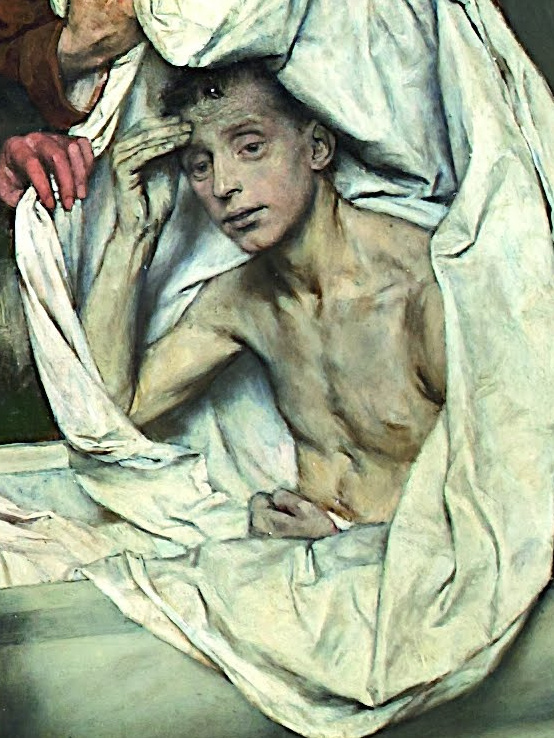
Anyway…. Mary led Jesus to the cave where Lazarus was entombed. He weeps. His feelings are intense. (There is a lot of emotion in this entire text and not all of it comes through in our English translations.). He orders the people to take away the stone sealing the tomb. “Martha” points out, “Lord, already there is a stench because he has been dead for four days,” but they take the stone away and unseal the tomb. Jesus prays then cries out in a loud voice, “Lazarus, come out!” “The dead man came out, his hands and feet bound with strips of cloth and his face wrapped in a cloth. Jesus said to them, “Unbind him, and let him go.”
That last part is important. Jesus calls on the community to unbind the resurrected Lazarus. Resurrection isn’t complete without the cooperation of the community. Persons raised to new life need the cooperation of the community to unbind them and free them to live that new life. Persons who are working the 12 steps need the cooperation of the community to see them and to help them keep on keeping on. They need the cooperation of the community to believe that they really are working hard to live a new life and that they want to keep living a new life. Persons released from prison who are trying to live a new life by the rules of society need the community to unbind them from the shroud of suspicion and mistrust. Persons who have made grave errors in relationships need the community to unbind them with forgiveness so they can live a new mistake-free life.
So, to recap…. Jesus is the resurrection and the life. And maybe Lazarus, himself, wrote the first draft of this amazing and emotional story. And maybe Martha was never really in the story. And maybe, “Unbind him and let him go” has a deeper meaning that we should carry with us like a mantra and apply liberally in daily life.
[1] Witherington is not alone in supporting this theory. Other proponents include Frederic Balz (The Mystery of the Beloved Disciple), Vernard Eller, Rudolf Steiner, Pierson Parker, Alan Rudnick.
[2] “The Jews” when used this way in John refers to the specific group of hyper-religious and pious opponents of Jesus and not to the Jewish people as a whole. It’s important to remember that Jesus and his disciples were also Jews.
[3] In 451 CE, the Council of Chalcedon established as doctrine the idea that Jesus Christ was one person existing in two natures, divine and human, “without confusion, without change, without division, without separation.” The fact that it’s doctrine hasn’t stopped anyone from arguing about how, exactly, that works.
[4] The Greek text here says “the Christ.”
[5] For more on the Mary/Martha textual conundrum see Manuscript Mystery in Biblical Archeology https://www.biblicalarchaeology.org/daily/biblical-topics/bible-interpretation/manuscript-mystery/
Image: The Raising of Lazarus by Eduard von Gebhardt
 Thoughts Along the Way