How Far Will You Go?

Luke 14:26-33

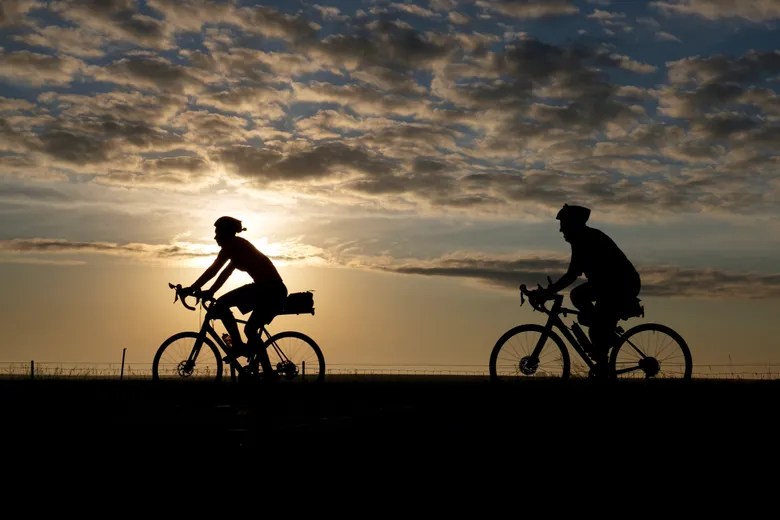
In the summer of 1972, when I was 19, my best friend, Mackay, and I decided that it would be all kinds of fun to ride our bicycles from Long Beach, California to Ensenada, Mexico.  And so one sunny morning in June, we set off pedaling down the Pacific Coast Highway with sleeping bags and a few other necessities strapped to our bikes. 

The miles flew by through Seal Beach, Huntington Beach and Newport Beach.  The hills of Laguna slowed us down a bit more than we had anticipated, but it was still too early for lunch when we reached San Clemente, so we decided to push on and have lunch in Oceanside.  But at the south end of San Clemente, we ran into a very big obstacle that we had not planned on.  Camp Pendleton Marine Base.  

We knew we wouldn’t be able to ride through Pendleton on the freeway, but we thought we could ride through the base on the old highway, which, according to our maps, still ran alongside the freeway.  The very nice Marine guard at the entrance to the base told us that that was not going to happen–  because the old highway was long gone.  

After some begging and pleading and a few choruses of “Gosh, We’ve Ridden All This Way,” he got on the phone and managed to get permission for us to ride through the base.   He sketched out a map for us and gave us very strict instructions to stay on the route he had outlined for us,  making it clear that straying off that route could have grave consequences, including but not limited to death, dismemberment or being imprisoned.  

An hour and a half later, we were utterly lost on a winding dirt road when a very perturbed Marine officer in a jeep came roaring up to us and asked us what the H-E-DOUBLE-Q we thought we were doing.  He also told us that we were perilously close to a live-fire range, then threatened to throw us in the stockade or make us enlist or both before finally deciding to guide us down to the southern end of the base.  He sent us off with a warning that if we ever set foot or bicycle tire on the base again there would be dire consequences unless, of course, we were in a Marine uniform.  

We had lost a lot of time on the confusing roads of Pendleton, so we powered through Oceanside and into San Diego without stopping for lunch.  Then came the ordeal of getting through San Diego on surface streets which proved to be far more complicated and took much longer than we had planned.  And just so you know, not even the military had GPS yet in those days, so we were at the mercy of outdated gas station roadmaps.  

The sun was getting ready to call it a day by the time we crossed the border into Tijuana.  We grabbed a couple of tacos from a taco cart then raced the sun for the last 14 miles to Rosarito Beach where we camped for the night.

The rest of the trip was pretty uneventful.  The ride from Rosarito to Ensenada on the old road up across the mountain—the only way bicycles were allowed to go—was a challenging but beautiful ride.  After a night in Ensenada, we turned around and headed for home.  

We spent the night at Rosarito Beach again, had a good breakfast at the cantina, then set out for the border.  We made good speed and got to Tijuana at about three in the afternoon which gave us plenty of time to make it to Silver Strand State Beach in San Diego where we were planning to pitch our tent for the night.

And that’s when we ran into another obstacle we hadn’t planned on.  There were three long lines of cars waiting to cross the border into California.  We rode our bikes up between the lines of cars to the state line expecting that the border guard would just wave us through—after all, where would a couple of guys on bicycles hide anything?   But the guard at the border wasn’t having it.  He gave us a lecture about trying to cut the line then told us to go all the way back to the end of the line.  Two hours later after standing in the heat astride our bicycles and breathing exhaust fumes from all the cars, we finally got back to the border where the same guard just waved us across without even asking for our I.D.   

At that point, we pulled over to the side of the road and took stock of where we were and what lay ahead of us.  We were exhausted, hot and sweaty.  Our legs were trembling and aching.  We didn’t even want to think about trying to get through Pendleton again.  What we wanted most was a good shower, a long, cold drink and a good meal. What we wanted was to be home.  

The bicycle ride that we had thought would be all kinds of fun had turned out to be all kinds of challenging.  Our stamina had evaporated in the exhaust fumes and unrelenting sunshine while we waited at the border.  We were fresh out of  possibility.  Our ride was over.  We made our way to the airport and, grateful for small miracles, managed to snag seats on a flight back to Long Beach.  

“Who would build a tower without first figuring out how much it’s going to cost?” asked Jesus.  “What king would go to war without first figuring out if he has a chance of winning?”  Who would ride a bicycle to Ensenada without making sure that they could actually get there and back?

Luke tells us that large crowds were traveling with Jesus as he made his way toward Jerusalem.  They had been watching him heal people.  They had been listening to him as he taught them about the kingdom of God and how radically different it is from the empire of Caesar.   The crowd was drawn to him.  They liked him.  They liked the different world he described, the better world that he told them is possible.  A lot of them were probably wondering what it might be like to be part of his inner circle—to be his disciple.

But there’s a big difference between being a fan and being a disciple.  

Jesus wanted to make it clear to the crowd that becoming a disciple means putting him and the kingdom of God first.  Jesus wanted them to understand that  becoming a disciple means you join him in making the kingdom of God, the commonwealth of God’s justice and kindness, a reality on earth as it is in heaven.  And Jesus wants us to understand that the other kingdoms of this world are going to resist you when you do that.  

The kingdom of family may be perfectly happy for you to be a fan of Jesus, even for you to embrace some of the things he teaches.  But they may not be so happy when you start giving away time and resources that they feel they have a claim to.  “Whoever comes to me and does not hate father and mother, wife and children, brothers and sisters, yes, and even life itself, cannot be my disciple,” said Jesus.  And no, he did not mean a disciple has to have some kind of intense animosity toward family, but he did mean that you, as a disciple, have to be willing to turn away from them, to let them go, when what they want is trying to pull you away from where Jesus is leading you.

The kingdoms, the empires of this world will resist you when you become a disciple of Jesus and set to work in earnest to make God’s reign a reality in your life and in the world.  

The kingdom of consumerism will sneer at you for not having the newest, shiniest, most fashionable, most advanced everything—clothes, gadgets, house, car or whatever when you, as a disciple of Jesus, learn to be satisfied with what you have and to give away what you don’t really need. 

The kingdom of capitalism will call you a socialist or maybe even a communist when you, as a disciple of Jesus, insist that those who have more should contribute to the well-being of those who have less.  When you remind them, as Jesus did, that God did not intend for the bountiful resources of the earth to enrich only a few, they will call you a radical and try to silence you.

The empire of power will oppose you when, as a disciple of Jesus, you stand up for the powerless, take the side of the marginalized and speak for the voiceless.  They will combat you when you  work to liberate the oppressed, fight for the dispossessed and lobby to set the captives free.  When you, as a disciple of Jesus, insist that all people are equal and beloved in God’s sight so the opportunities and benefits of life together in a civil society should be equal, too, regardless of race or gender or color or sexuality or country of origin.  They will call you a trouble-maker and try to put a stop to you…one way or another.

“Whoever does not carry the cross and follow me cannot be my disciple,” said Jesus, and those people in the crowd, especially the wannabe disciples, knew he wasn’t just using hyperbole.  They knew that the cross he was talking about wasn’t a metaphor.  He was telling them there would be a real cross with real nails and real pain…because when you try to establish the reign of God in the midst of the empire of coercive power, coercive power will try to stop you.  Brutally.  

If you want to be my disciple, says Jesus, then stop and think about what that might cost you.  There’s no shame if you can’t go that far.  There’s no shame if you just want to follow in the crowd and listen from a safer distance.  But you should know, eventually that won’t be enough.  

Eventually the Word of God will bring you to a place where either you will summon up the stamina and will to finish the ride… or call it quits.  Eventually either the vision of the kingdom of God will become all-consuming for you, or you will dismiss it as a nice but unobtainable ideal—or maybe some kind of prize in the afterlife if you are nice enough to qualify.

Traveling with Jesus sounds like all kinds of fun.  And it does have its rewards.  There are healings along the way.  He’s a marvelous teacher and the Way of life he envisions is beautiful.  He loves you and isn’t shy about making that known.   Jesus loves the crowd… but not everyone in the crowd is ready to go all the way to discipleship.  

Lots of people can ride a bicycle.  Comparatively few can ride it all the way to Ensenada and back.

How far will you go?

Scattering Seeds

Mark 4:26-34

With what can we compare the kingdom of God…  

What do you think of when you hear or read that phrase: the kingdom of God?  I think it’s hard for us to really grasp what Jesus was talking about when he talked about the kingdom of God not only because he described it in metaphors and parables, but because a kingdom, itself, is a thing entirely outside of our experience for almost all of us.

Most of us think of kingdoms in terms of either physical territory or fairy tales, but clearly Jesus is talking about something that transcends mere physical boundaries and is a lot more real than fairy tales.  A kingdom can simply be a territory ruled over by a king or queen, but it can also mean a sphere of authority or rule, and that might be closer to what Jesus is getting at:  the rule of God.  The authority of God.  But even that is something most of us can’t relate to too well because we have never lived under the authority of a monarch or a lord or a master, and those monarchies that are still active in our world are either almost entirely symbolic or wildly dysfunctional or utterly dictatorial.  And I don’t think we want to attribute any of those qualities to God.

Also, words like authority and rule can have a coercive edge to them, and the kingdom, as Jesus describes it, seems to be much more about influence, persuasion and cooperation.  It’s more organic.  It’s something that grows in us and around us and among us.  

I have often used the phrase “kin-dom of God” for that reason—to try to capture some of the cooperative, love-based nature of God’s sovereign rule as Jesus describes it in the beatitudes and parables.  Diana Butler Bass has called it the Commonwealth of God’s justice and mercy, and I think that might be even more in the right direction.  Maybe.  But it’s also important to remember that the kingdom of God is not a democracy.  God is sovereign.  God’s rule is absolute.  Fortunately for us, so is God’s love, and that love is the very fabric of this thing Jesus is trying to describe as “the kingdom of God.”  The kin-dom of God.  The Commonwealth of God’s kindness.

When Jesus told these parables, and thirty-some years later when Mark wrote them down, trouble was brewing in Galilee and Judah and pretty much throughout all of Palestine.  Landowners were putting pressure on tenant farmers for rents they could barely pay.  Scribes from the temple in Jerusalem were demanding a crushing and complex levy of tithes from those same farmers.  Herod Antipas was demanding taxes from the landowners because Rome was demanding taxes from him.  Unemployment was high.  Bandits roamed the highways.  Soldiers patrolled everywhere.  Rome’s colonial government was heavy-handed and oppressive to the point of brutality.  People wanted a heavenly anointed messiah to step in and fix things before they exploded—or maybe to light the fuse and set off the explosion that everyone felt was coming. It’s no wonder that the disciples kept asking Jesus, “Is this the time when you will bring in the kingdom?”

Jesus kept trying to tell them and all the crowds following him, “No, the kingdom of God is not like that.  It’s not what you’re thinking.  It won’t do any good to simply replace one coercive external system with another one even if the ruler is God!”  

The change has to be internal.  It has to be organic.  Seeds have to be planted.  Human hearts and minds have to be changed. It’s not about imposing a new kind of law and order.  It’s about implanting a new kind of love and respect.  That’s what will fix the world.

“The kingdom of God is as if someone would scatter seed on the ground, and would sleep and rise night and day, and the seed would sprout and grow, he does not know how.”

For generations we had a family farm in Kansas—my  mother’s family farm—where we grew winter wheat.  Winter wheat is planted in late September or early October, depending on the weather.  Not long after it’s planted, it starts to sprout.    Beautiful little shoots that look like blades of grass start to poke their heads up out of the soil.  And then just as they’re getting started, the cold hits them.  And it looks like it’s killed them.  They slump back down to the dirt and go dormant, and they’ll just lie there all through the winter.  The ground will freeze.  Snow will drift and blanket over them.  And there’s nothing you can do.  

All winter long you go about your business.  You sleep and rise night and day.  And then you get up one spring morning and notice that the weather is a bit warmer, and the snow is patchy or mostly gone, and you look out the window to see that you suddenly have a field full of beautiful green wheat starting to rise up out of the ground.  It’s an amazing thing to see, and if you have half a sense of wonder, you thank God for the natural everyday miracle of it and marvel at it for at least a moment before you get on with your chores.  

The kingdom of God is like that, says Jesus.  It is seeds scattered on the earth.  Seeds of ideas and vison. And sometimes it looks like they’ve died.  Or been crushed.  Or been frozen out or buried.  Or simply forgotten.  But they are still there, just waiting for their moment.  

The kingdom of God is seeds of ideas and vision and understanding.  They are ideas about fairness and justice and cooperation.  They are an understanding about fuller and more generous ways to love each other and take care of each other.  The kingdom is a resolve to make a world that is healthier for everyone.  It’s a resolution to embrace God’s vision for how the world is supposed to work—a world where everyone is housed and everyone is fed and everyone can learn and everyone is safe and everyone is free to be their true self.  The kingdom is a determination to repair the damage we’ve done and restore creation so that we and all the creatures who share this world with us can breathe clean air and have clean water.

The kingdom of God, the rule of God, the reign of God, the kin-dom of God, the Commonwealth of God’s justice and mercy is a commitment to let justice roll down like water and to show each other kindness and to walk humbly with God and with each other.  It is a continual correction of our vision so we keep learning how to see the image and likeness of God in each other—in each and every face we face so that racism and classism and every other kind of ism evaporate from the earth.  It is the seed of courage taking root in our hearts and minds so that we learn not to be afraid of something or someone simply because it or they are different from us or from what we know or what we expect or what we are used to.

“With what can we compare the kingdom of God, or what parable will we use for it?,” said Jesus.  “It is like a mustard seed, which, when sown upon the ground, is the smallest of all the seeds on earth; yet when it is sown it grows up and becomes the greatest of all shrubs, and puts forth large branches, so that the birds of the air can make nests in its shade.”

The mustard seed!  That tiny seed that produces the most egalitarian, most democratic of plants!  That’s what God’s kingdom is like.  It freely and bounteously shares itself and all that it has.  Given half a chance it spreads itself everywhere.  The mustard plant doesn’t care if you are rich or poor.  You don’t have to buy one.  It will come to you and give you and your family food and medicine and spices for your cuisine and healing oils for what ails you.  A most amazing, versatile and humble plant.  And it starts as just a little tiny seed.

The kingdom of God is the planting of seeds. The seeds don’t have to be eloquent preaching or brilliant explanations of theology—probably better most of the time if they’re not.  “Preach the gospel at all times,” said St. Francis. “When necessary, use words.”  At a time when the city of Assisi was a rough and dangerous place, Francis would walk through the town from the top of the hill to the bottom and say as he went, “Good morning, good people!”  When he got to the bottom of the hill he would turn to the brother who accompanied him and say, “There.  I have preached my sermon.”  What he meant was he planted a seed—he had reminded the people that the day was good and that they had it in themselves to be good people.

The seeds of the kingdom may be little acts of habit, like bowing your head for a moment to say grace before a meal in a restaurant, even if you don’t say it out loud.  That simple thing might remind those around you to pause, to be thankful, to remember all the connections that bring food to our tables, to remember the goodness of the earth and the sweat of the farmers, to remember the presence of God.

The seeds of the kingdom might be small acts of kindness.  When Oscar Wilde was being brought down to court for his trial, feeling more alone and abandoned than he had ever felt in his life, he looked up and saw an old acquaintance in the crowd.  Wilde later wrote, “He performed an action so sweet and simple that it has remained with me ever since.  He simply raised his hat to me and gave me the kindest smile that I have ever received as I passed by, handcuffed and with bowed head. Men have gone to heaven for smaller things than that. It was in this spirit, and with this mode of love, that the saints knelt down to wash the feet of the poor, or stooped to kiss the leper on the cheek. I have never said one single word to him about what he did … I store it in the treasure-house of my heart … That small bit of kindness brought me out of the bitterness of lonely exile into harmony with the wounded, broken, and great heart of the world.”

The seeds of the kingdom might be a word of affirmation and encouragement when it’s needed most.  Helen Mrsola was teaching ninth graders new math years ago.  They were struggling with it.  The atmosphere in the classroom was becoming more tense and irritable every day.  So one Friday afternoon Helen decided to take a break from the lesson plan.  She told her students to write down the name of each of their classmates on a piece of paper, then to also write down something nice about that student.  She collected the papers, and over the weekend Helen compiled a list for each student of what the other students had written. On Monday, she gave each student a paper with list of what the other students liked about them.  The atmosphere in the class changed instantly; her students were smiling again. Helen overheard one student whisper, “I never knew that I meant anything to anyone!” 

Years later, a number of the students, all young adults now, found themselves together again at a school function.  One of them came up to Helen and said, “I have something to show you.”  He opened his wallet and carefully pulled out two worn pieces of notebook paper that had obviously been opened and folded and taped many times.  It was the list of things his classmates liked about him.  “I keep mine in my desk at work,” said another classmate.  Another classmate pulled hers out of her purse, saying she carried it with her everywhere she went.  Still another had placed his in his wedding album.

The kingdom of God.  The rule of God.  The reign of God.  The kin-dom of God.  The Commonwealth of God’s kindness. . . 

To what shall we compare it?

It’s like seeds scattered on the earth, says Jesus.  It’s like mustard seeds.  Seeds of righteousness.  Seeds of justice. Seeds of vision.   Seeds of help.  Seeds of hope.  Seeds of mercy.  Seeds of peace.  Seeds of affirmation.  Seeds of goodness.  Seeds of kindness.   Seeds of love.  

You don’t know how they grow.  But oh, they do grow.

On earth as in heaven.

Entertaining Angels

Hebrews 13:1-2, 15-16; Luke 14:7-14

“Let mutual love continue.  Do not neglect to show hospitality to strangers, for by doing that some have entertained angels without knowing it.”  (Hebrews 13:1-2, NRSV)

“The next time you put on a dinner, don’t just invite your friends and family and rich neighbors, the kind of people who will return the favor.  Invite some people who never get invited out, the misfits from the wrong side of the tracks.”  (Luke 14:12, The Message)

These texts this week reminded me of Eric.  I think about him a lot.  Eric showed up one Sunday night when we were doing Stories, Songs and Supper.  He stood at the church door and asked what was happening as he saw people gathering, greeting each other, laughing, and we told him, “It’s a thing we do called Stories, Songs, and Supper.  We share a meal then sing a bunch of old familiar songs, then someone tells a story, then we sing a little more.”  We invited him to come in and join us.  So he did.

I was pretty sure he was homeless, although to be fair, his clothes were neater and cleaner than most of the other unhoused people who came to the church.  Eric had a gift of gab and while we were eating he told us a bit about himself.  That’s when he told us that this dinner was special for him because it was his birthday.  So we all sang Happy Birthday to him.  After supper, he helped to clear the tables, then joined us in the sanctuary for the singing and storytelling. 

Eric showed up for worship the next Sunday morning and also joined in our Adult Education class.  He joined in with one of our small groups in the volunteer work they were doing with Lutheran Social Services.  In almost no time Eric became an important member of our little family of faith at Gloria Dei.

 “Do not neglect to show hospitality to strangers,” we read in Hebrews, “for by doing that some have entertained angels without knowing it.”

Well,  Eric was no angel…but then again, maybe he was.  In ancient times the word angel had a double meaning.  It could refer to a supernatural being who served God, or it could simply mean a messenger.   Eric was, in and of himself, a message to us—a gift to us all at the little church with a big heart.

We learned a lot from Eric.  We learned a little about life on the streets.  We learned more than we wanted to know about our neighbors’ attitudes toward the unhoused.  We learned how the police and the justice system in our city respond to those who are experiencing homelessness.  We learned about our own attitudes toward those living rough.  Most of all, though, we experienced an energy and vitality that’s been missing since he left us.  All this because we welcomed one gregarious man into our party on his birthday.

“The next time you put on a dinner,” said Jesus,  “don’t just invite your friends and family and rich neighbors, the kind of people who will return the favor.  Invite some people who never get invited out, the misfits from the wrong side of the tracks.  You’ll be—and experience—a blessing. They won’t be able to return the favor, but the favor will be returned—oh, how it will be returned!—at the resurrection of God’s people.” (Luke 14:12-14, The Message

“You will be—and you will experience—a blessing.”  Eric taught us just how true that is.

Jesus loved sharing meals with people.  Think about all the stories in the gospels that involve eating!  Jesus distributed food to multitudes.  Jesus dined with Simon the Tanner and Zacchaeus.  And, of course, there was that last Passover meal with his disciples.  After the resurrection he broke bread with the Emmaus travelers and cooked fish on the beach for the disciples.  Jesus shared a table with Pharisees even though some Pharisees had criticized him for sharing a table with “the wrong kind of people.”  “This fellow eats with tax collectors and sinners!”  There are so many Jesus stories that revolve around eating that some have suggested that his primary work was organizing dinner parties. 

Sharing the table—issuing a wide and inclusive invitation—this was one of the ways Jesus embodied the kingdom of God. 

“The gospel,” wrote Rachel Held Evans, “doesn’t need a coalition devoted to keeping the wrong people out.  It needs a family of sinners, saved by grace, committed to tearing down the walls, throwing open the doors, and shouting, ‘Welcome!  There’s bread and wine.  Come eat with us and talk.’ This isn’t a kingdom for the worthy, it’s a kingdom for the hungry.”

In the earliest days of what we now think of as the Church, many—maybe most—groups of Jesus followers were dinner-party groups—they organized their fellowship and worship around sharing a table, and everyone brought what they could to the banquet.  We see hints of this in 1 Corinthians 11 when St. Paul chastises the Corinthians for bringing their divisions to the table, but even more sternly for failing to make sure that the have-nots were included in the celebration when the haves were feasting.

“When you meet together,” he wrote, “you are not really interested in the Lord’s Supper.  For some of you hurry to eat your own meal without sharing with others. As a result, some go hungry while others get drunk.  What? Don’t you have your own homes for eating and drinking?  Or do you really want to disgrace God’s church and shame the poor? What am I supposed to say? Do you want me to praise you? Well, I certainly will not praise you for this!” (1 Cor 11:20-22, NLT)

The practice of early Christianity was centered around the table.  When it worked it was egalitarian, transformative, and beautiful.  When it didn’t it descended into another bad example of classism.  But the evidence suggests that most of the time and in most places it worked.  

The table of Christ was the one place in their world where they were all equal.  It was the one place where it didn’t matter if you lived in a mansion or sheltered under the eaves of the town hall.  It was the one place where it didn’t matter if you were a slave or a free person.  It was the one place where it didn’t matter if you were male or female—at least not in those earliest days of the Jesus followers.  

At the table of Christ, all were equal and all shared in what was brought to the supper—but most especially, all shared in the bread and the wine of Christ’s presence.

In his book The Forgotten Creed: Christianity’s Original Struggle against Bigotry, Slavery, and Sexism, Stephen J. Patterson has recovered what is believed to be the earliest baptismal creed of the Jesus followers:

“For you are all children of God in the Spirit.

There is no Jew or Greek,

there is no slave or free,

there is no male and female;

for you are all one in the Spirit.”

If that sounds familiar, it’s because St. Paul quotes this creed in his letter to the Galatians with a slight twist at the end.  Instead of saying “for you are all one in the Spirit,” Paul writes, “for you are all one in Christ Jesus.” (Galatians 3:28)

“The creed’s basic claim,” writes Patterson, “is that baptism exposes the follies by which most of us live, defined by the other, who we are not.  It declares the unreality of race, class, and gender: there is no Jew or Greek, no slave or free, no male and female.  We may not all be the same, but we are all one, each one a child of God.” 

In Journey With Jesus this week, Dan Clendenin described how a friend of his daughter wanted to invite everyone in her church to her wedding but the budget wouldn’t allow it.  So instead of having a fancy wedding meal for just a few family and close friends, they got the police to block off the main street in downtown Waco, Texas.  Guests danced in the streets and ate ice cream from a Baskin Robbins ice cream cart.  The wedding cake was under the gazebo in the park and they cut small pieces so everyone could get a taste.  The groom, a pastor, had worked a lot with homeless people and many of them showed up for the wedding,  then helped to clean up the streets afterward.  The little African-American girl who lived next door to the bride brought her mother and her grandfather along to the wedding.  The grandfather quickly became the center of attention as he danced to the street music and soon the college girls were lining up to dance with him.  Passers-by strolling on the street were invited to join in the party.  And everyone was welcomed as an honored guest.

This is what the kingdom of God looks like.  A celebration that’s open to everyone.

It’s a family of sinners, saved by grace, tearing down the walls, throwing open the doors, and shouting, “Welcome!  There’s bread and wine.  Come eat with us and talk.

This is what the church of Jesus is supposed to be about:  radical hospitality.   

A kingdom for the hungry.

So let mutual love continue. 

But don’t forget to show hospitality to strangers.

Who knows… they just might be angels.

image © Hyatt Moore

He Is Going Ahead Of Us

Martin Luther once spent three days in a deeply gloomy mood because of something that had gone wrong.  On the third day his wife, Katie, came downstairs dressed in mourning clothes.  “Who died?” asked Martin.  “God,” replied Katie.  Luther rebuked her, saying, “What do you mean, God is dead? God cannot die.” “Well,” she replied, “the way you’ve been acting I was sure he had!”

The thing is, God did die once, and Martin Luther would be the first to tell you that.  God, in Jesus the Christ, was crucified, died and was buried.  And on the third day rose again.  That’s what we’re celebrating this morning:  the resurrection of Jesus from the dead.

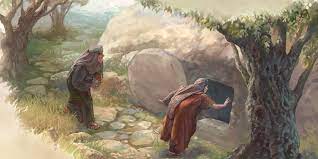
The four gospels each tell the story of the resurrection a little differently.  Those differences really shouldn’t bother us too much.  Each writer was writing to a different audience and relying on different sources.  On the main points, though, they are remarkably consistent.  Jesus was crucified.  He was thoroughly and decidedly dead.  His body was not properly prepared for burial when he was laid in the tomb because the Sabbath did not allow enough time for that.  The tomb was sealed with a large stone.  On the third day the women of his company came to prepare his body and found the stone removed and the tomb empty.  They were addressed by an ethereal messenger (or two?) who informed them that Jesus had risen as he told them he would.  On these things all the gospels agree.

The Gospel of Matthew’s resurrection account is the most theatrical.  There’s an earthquake and an angel comes down to roll the stone away from the tomb which is already empty.  The angel then sits on the stone.  Matthew says that the soldiers guarding the tomb “shook and became like dead men.” The astonished women who had come to prepare the body of Jesus witness all this and later encounter the risen Jesus as they rush to tell the disciples what they have seen.  

Luke’s description of the resurrection is more subdued, but the story continues beyond the empty tomb to describe encounters with the risen Jesus on the road to Emmaus and in the upper room where the disciples have been laying low.  

John’s account is probably the best known and best loved with its touching description of the encounter between Mary and Jesus when she mistakes him for the gardener then realizes who he is when he speaks her name.  

It’s not surprising that in years when the Gospel of Mark comes up in the lectionary cycle, most preachers opt to go with the Gospel of John instead. The resurrection account in Mark is so haunting.  So uncomfortable.  The angel—or young man dressed in a white robe—is there in the empty tomb.  He makes the announcement we expect to hear: “Do not be alarmed; you are looking for Jesus of Nazareth, who was crucified. He has been raised; he is not here. Look, there is the place they laid him.”  And then he adds, “But go, tell his disciples and Peter that he is going ahead of you to Galilee; there you will see him, just as he told you.” 

So far so good.  But it’s the ending that leaves us off balance. 

“So they went out and fled from the tomb, for terror and amazement had seized them; and they said nothing to anyone, for they were afraid.” That’s the original ending of the resurrection account in the Gospel of Mark, in fact, it’s the original end of the whole gospel.  

That ending is so disconcerting that by the late 3rd or early 4th century someone decided to add on a section.  These unknown editors wanted the ending of Mark, the oldest and earliest of the gospels, to be more consistent with the other three gospels and, frankly, happier.

But Mark had his reasons for ending the resurrection account and the gospel the way he did.  

Jesus, in the Gospel of Mark, has come to proclaim that the kingdom of God is beginning, that it is time for it to become a reality and not just a dream of the prophets.  In his teaching, in his sermons, in his healings and his exorcisms, he teaches his followers to confront the social structures, political structures, the religious structure that oppress and exclude people.  More than that he invites his disciples to begin to build an alternative way of life built on inclusiveness, generosity and equality.

When Jesus is crucified, it looks like all this has come to an end.  But now an empty tomb leaves questions hanging in the air.

It’s as if Mark is saying, “Christ is risen!  What are you going to do about it?  What are you going to do with that news?”

He has gone ahead of you to Galilee.  Back to where all this began.  Are you willing to go meet him where he is?  Are you willing to go back to the beginning?  Are you willing to start over?  Are you committed to building the kingdom of God on earth as it is in heaven?

N.T. Wright wrote, “Jesus’s resurrection is the beginning of God’s new project not to snatch people away from earth to heaven but to colonize earth with the life of heaven. That, after all, is what the Lord’s Prayer is about.  The resurrection completes the inauguration of God’s kingdom. . . . It is the decisive event demonstrating that God’s kingdom really has been launched on earth as it is in heaven. The message of Easter is that God’s new world has been unveiled in Jesus Christ and that you’re now invited to belong to it.”  

One of the important themes in the Gospel of Mark is “let those who have eyes, see.”  Jesus, in Mark, is forever trying to get his disciples to understand what they are seeing him do and hearing him say.  Now he wants them and us to understand what it means that he has been resurrected.

If death cannot hold Christ, then it cannot hold you, either.  Not forever.  God is, by nature, eternal.  We were created in the image of God, so we share in that divine nature (2 Peter 1:4).  God is love (1 John 4:16), and the Holy Spirit has planted the love of God in our hearts (Romans 5:5, 8:9).  Christ is in, with, and under every fiber of our lives.  Life is eternal, love is immortal.  Because Christ rose, we, too shall rise.  “For if we have been united with him in a death like his, we will certainly be united with him in a resurrection like his (Romans 6:5).”  That is  what his resurrection means for us.

We have all been through a year like nothing we’ve ever experienced before.  Because of the pandemic, we’ve faced trials and challenges no one anticipated.  Our way of life was radically changed.  We have laid dear friends and family into the hope that springs eternal, trusting in this promise of resurrection.

Now, with the vaccines and the virus numbers going in the right direction, people are talking about getting “back to normal.”  But wouldn’t it be better for us to be talking about resurrection?  Wouldn’t it be better for us to talk—not about resuming our old life—but about new life, and what that will look like and be like, and how we will do it, and how it will be different?

Jesus rose to new life.  We are being invited to rise to new life, too. He is going ahead of us, back to the starting point and inviting us to follow, and to join him in the continuing work of building the kingdom of God.  

Christ is risen!  We have a chance to start over!  What are you going to do about it?

In Jesus’ name.

The Time is Ripe

Mark 1:14-20

Pepleirotai ho Kairos.  “The time is fulfilled,” says Jesus as he begins his ministry in Galilee.  The word for time here in Mark’s original Greek text is kairos, the word you would use to say the time is right.  It’s the right moment.  Kairos.  It’s the word used to say that a fruit is ripe or that someone arrived just in the nick of time.  There’s another Greek word for time: chronos.  Think chronology.  That’s the word we use to say that the time will be  six o’clock in the morning when the alarm goes off.  But the word here in Mark 1:15 is kairos.  The time is fulfilled, says Jesus to the people of the Galilee.  The time is full.  The time is ripe.

Who are these people he’s speaking to as he moves through Galilee?  The Galilee was one of the richest areas in Palestine.  It was the breadbasket of the region, rich in wheat and barley and oats, and also with olive groves, vineyards, and orchards.  Dried fish from the Sea of Galilee provided the primary source of protein for the region and helped to feed both Caesar’s and Herod’s armies.  But for all this, the majority of the people were poor.  A system of high rents paid to wealthy absentee landowners, heavy taxes paid to Herod or Rome, and heavy tithes paid to the religious system of the temple guaranteed that most of the people lived in a perpetual cycle of poverty.  These were people who had lived for generations under someone else’s heavy hand.

Pepleirotai ho Kairos.  “The time is fulfilled,” proclaims Jesus to these people and to people of every time and place who have lived or are living under systems that hold them down, push them to the margins, pick their pockets, and crush their hopes and dreams.  The time is fulfilled.  You’ve waited long enough.  Enough is enough.  The time is ripe.   

 “The kin-dom of God has come near,” he tells them.  It is arriving.  It is in reach.  It is imminent.  It is doable.  And then he says this: “Repent and believe the good news.”

Do you remember what I said about “repent” a few weeks ago?  

Repentance.  In English it’s a smudged and leaden word filled with regret and contrition. Repentance is a stinging backside, bruised knees and hunched shoulders.  I suggest we ban it and replace it with the Greek word: Metanoia.  Metanoia is climbing out of a dank hole into the sunlight.  Metanoia is being freed from the nasty habits that ruin your health and suck the life out of your wallet.  Metanoia is putting on new glasses with the right prescription and realizing that you had only been seeing a third of the details and half the colors in the world.  Metanoia  is shoes that fit right, have cushy insoles, perfect arch support, and take the cramp out of your lower back.  Metanoia is thinking new thoughts and behaving in new ways.  Metanoia is a change of mind, a change of heart, a change of life, a new direction.  

“Metanoiete!” Jesus says.  He says it in the imperative, as a command.  Put on those new glasses and those better shoes.  See the world in a better, clearer way.  Walk into the world in a new way that doesn’t cause pain for you or anyone around you.  Think about the world in a new way.  Think about yourself in a new way.  Think about your neighbor in a new way.  Think about who might be your neighbor in a new way.

“And believe the good news!”  Pisteuete! Another imperative.  Another command.  Believe!  It’s not a request to accept the idea, to consider it thoughtfully, to mull it over.  It’s a command to believe it, to trust it, to act on it, to base your life on the good news that the kin-dom of God, the reign of God is within reach.

That, according to Jesus, is the gospel.  That is the good news.  The kin-dom of God is immanent.  The kin-dom of God is arriving on earth as it is in heaven.

And notice this:  He doesn’t say a word here about receiving him into your heart and making him your personal Lord and Savior.  He doesn’t say anything here about being saved.  He doesn’t say anything here about forgiveness or atonement.  There is nothing spiritual in his language here at all.  When he says “Believe the good news!” it is a call to action.

“Believe” in Mark’s gospel is not a sit-and-think word.  “Believe” is a get-up-and-do word. 

In this gospel Jesus is on the move and calls others to move with him.  As he passes along the seashore he calls Peter and Andrew and James and John and they drop their nets to follow him.  He teaches as he moves.  

He calls us where we are and in the same imperative voice says, “Come!  Follow me and I’ll teach you how to bring others along!”  

He calls us to travel with him.  To work with him.  There is so much to be done.  There is an old world to dismantle and a new world to build.  The kin-dom of God is within reach.  The kin-dom of God is arriving.  

If we can see him with eyes refocused by metanoia, if we can hear him with ears opened by metanoia, if we can be freed from our preconceived ideas and learn to believe him with a trust and faith transformed by a metanoia of heart and mind, then we can begin to see the kin-dom take root and grow like a garden spreading across the desert.  

And this isn’t just “me” work that Jesus is calling us to do.  This isn’t just about saving your own soul, although, “the one who endures to the end will be saved,” said Jesus.[1]  But there’s a lot to do before we get there.  

This is “us” work.  Building the kin-dom of God requires all hands on deck.  It requires unity.  As President Biden said in his Inaugural address, “It requires the most elusive of all things in a democracy: Unity. Unity. Uniting to fight the foes we face: anger, resentment, hatred, extremism, lawlessness, violence, disease, joblessness and hopelessness.”

He was talking about healing our country of the divisions that have been tearing us apart, but the same thing applies to making the kin-dom of God a reality on earth as it is in heaven, something we pray for every time we pray the prayer Jesus taught us. 

“History, faith and reason show the way, the way of unity,” said President Biden. “We can see each other not as adversaries, but as neighbors. We can treat each other with dignity and respect. We can join forces, stop the shouting and lower the temperature. For without unity, there is no peace — only bitterness and fury. No progress — only exhausting outrage.”

At the founding of this country our founders gave us a vision to strive for: “We, the people…in order to form a more perfect union, establish justice, ensure domestic tranquility, provide for the common defense, promote the general welfare, and secure the blessings of liberty for ourselves and our posterity…”  That has always sounded to me a lot like the kin-dom of God.  It’s collective.  We the people—all of us want to form a more perfect union.  That’s ongoing work.  All of us want to establish justice.  That’s ongoing work.  All of us want to ensure domestic tranquility.  Is this not merely the country, but the world we all want to live in?  A world where everyone’s well-being is secured by the solemn word and promise of everyone else?  A world in conformity with God’s own vision of equity and justice?

This is the collective work we are called to, the work of the kin-dom, the work of taking care of each other, the work of loving our neighbor as ourselves.

“So we lift our gazes not to what stands between us, but what stands before us,” said Amanda Gorman, our inspiring, young poet laureate.  

“We close the divide because we know to put our future first,

we must first put our differences aside. 

We lay down our arms 

so we can reach out our arms to one another, 

we seek harm to none 

and harmony for all.

we will raise this wounded world 

into a wondrous one,

We’ve braved the belly of the beast, 

we’ve learned that quiet isn’t always peace 

and the norms and notions of what just is, 

isn’t always justice.

We will not march back to what was 

but move to what shall be

we will not be turned around 

or interrupted by intimidation 

because we know our inaction and inertia 

will be the inheritance of the next generation, 

our blunders become their burden. 

But one thing is certain: 

if we merge mercy with might and might with right, 

then love becomes our legacy 

and change our children’s birthright.

There is always light 

if only we’re brave enough to see it, 

if only we’re brave enough to be it.”[2]

Pepleirotai ho Kairos. The time is ripe. The kin-dom of God is in reach.  It always has been.  Metanoiete.  Change direction, and believe the good news.  In Jesus’ name.


[1] Mark 13:13

[2] The Hill We Climb (edited) Amanda Gorman, from President Biden’s Inauguration

Make Believe

It’s only a paper moon, sailing over a cardboard sea, but it wouldn’t be make believe if you believed in me.—Paper Moon, 1933

Make believe. Those two words have been sticking in my head ever since I read this excerpt last week from Wishful Thinking by Frederick Buechner:

“You make believe that the tasteless wafer and 
cheap port are his flesh and blood. You make believe that by
 swallowing them you are swallowing his life into your life and 
that there is nothing in earth or heaven more important for 
you to do than this.
 It is a game you play because he said to play it. ” Do this 
in remembrance of me.” Do this. Play that it makes a difference. Play that it makes sense. 
If it seems a childish thing to do, do it in remembrance that 
you are a child.” Continue reading “Make Believe”