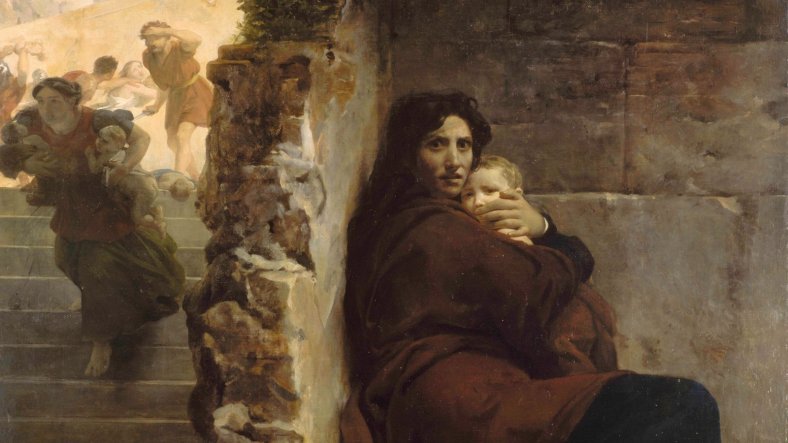
Matthew 2.13-23
There is a shadow that hangs over Christmas, a shadow that has dimmed the joy and wonder of the Incarnation since Christ was born. It is the shadow of King Herod and all the Herods since Herod. It is the shadow of all the authoritarians, past and present, who in their greed and their lust for power and their violent fear of losing power have sometimes made God’s great gift of life almost unlivable for some and distressingly unstable for the rest of us who simply want to live and let live—or, better than that, live and help others live.
Let’s talk about Herod the Great. He is known for his massive building projects that transformed ancient Judea. He expanded the temple mount and began an ambitious renovation of the temple in Jerusalem. He also built the Antonia Fortress on the temple mount to garrison troops and quell dissent. He fortified the port city of Caesarea Maritima and he built almost impregnable fortresses at Masada, Machaerus, Cypros, Alexandrium and Herodium—a city he named for himself by the way. He also built for himself a lavish palace in Jerusalem and a winter palace in Jericho.
Herod was quite the real estate developer. But he was also violent, self-centered, deeply paranoid and he ruled with an iron fist. At the beginning of his reign he secured his position as Rome’s client king of Judea by having his chief rival assassinated. He sent his first wife, Doris, and their young son into exile so he could marry Mariamne I, the Hasmonean princess whose brother he had just assassinated. He used secret police to spy on opponents and dissidents and used his private bodyguard of 2,000 soldiers to remove his enemies from the country—and sometimes from the land of the living. He replaced the Sadducee priests of the temple with outsiders from Babylonia and Alexandria so he could have greater control over the temple’s operations and treasury. He accused his sons Alexander and Aristobulus of treason and executed them. And he accused his wife, Mariamne, of adultery and executed her because she stopped sleeping with him.
Herod’s ambition, greed and paranoia cast a shadow over all of Judea. And now, in our gospel text for this first Sunday in the Season of Christmas the shadow of Herod’s insecurity falls across the small town of Bethlehem, six miles south of Jerusalem.
The Magi, who may have been Zoroastrian Astrologers from Persia, had followed a star to Jerusalem looking for the newly born King of the Jews but they made the mistake of stopping by Herod’s palace to ask for directions. Herod asked them to report back on their way home and tell him where the child was “so I may go and pay him homage.” But the Magi were warned in a dream that Herod’s intentions were anything but benevolent, so they “left for their own country by another road.” When Herod saw that he had been tricked by the magi, he was so furious and fearful of being usurped by a baby that he killed all the children in and around Bethlehem who were two years old or under.
How deranged do you have to be, how fearful and insecure do you have to be to murder every single infant and toddler in a small town?
Fortunately, an angel had warned Joseph about Herod in a dream and the holy family escaped to Egypt. Jesus, Mary and Joseph became refugees.
Think about that for a minute. Jesus was a refugee.
Jesus, Emmanuel, God With Us, Jesus, the Word made flesh through whom all things came into being, Jesus in whom the fullness of God was pleased to dwell… became a refugee fleeing from political violence.
United Nations Statistics[1] tell us that as of the end of June this year, 117.3 million people in our world had been forced to flee their homes due to persecution, conflict, violence, or human rights violations. Among those, 42.5 million are classified as refugees, meaning they fled to another country. Another 67.8 million people were displaced within the borders of their own countries. There are 8.42 million seeking asylum and another 4.4 million stateless people—persons with no nationality and no access to basic rights such as education, health care, employment and freedom of movement. What it all boils down to is that right now 1 in every 70 people on Earth has been forced to flee their home.
According to Refugee Council USA[2], more than 100,000 refugees were resettled in the United States in 2024. Almost 30% of those refugees, 29,483, were Christians from the 50 countries on the Open Doors World Watch List[3] which are noted for severe persecution of Christians. Since January of this year, by Executive Order of the President, refugees and immigrants from most of those 50 countries are severely restricted or banned entirely from entering the United States and the Administration is planning to review the status of more than 200,000 who are already here.
Once again, a reminder: Jesus was a refugee. And since Bethlehem is a Palestinian city, we in this so-called Christian nation have to face the awkward fact that Jesus, Mary and Joseph would not be allowed to take refuge here in the United States under our current administration’s policies.
Clearly the shadow of Herod and all the Herods since Herod is still hanging over Christmas.
This story of the magi, foreigners who traveled a great distance to find the child heralded by the stars, and Herod, the despotic king who felt so threatened that he murdered all the toddlers and infants in Bethlehem—this story only appears in the Gospel of Matthew. The four gospels speak to each other and inform each other, but only Matthew has this story of star-guided faith juxtaposed with murderous malevolence.
Only Matthew has the story of the holy family fleeing to Egypt as refugees, and I can’t help but think about why Matthew made a point of including this story in his narrative of the birth of Messiah. I suspect it might be because Matthew is written for a community living in diaspora, a community of Jewish Jesus followers living far from their homeland. I think we can safely assume that some in that community, maybe most, were refugees who had fled from the violence of the Romans when the legions of Titus destroyed Jerusalem and the temple, the heart of their homeland and the center of their religion. These displaced people in this refugee community of faith would have found comfort in hearing that Jesus had also been a refugee whose family fled from political violence. They would have felt an additional bond of common experience with their messiah.
Only Matthew tells us the story of Jesus becoming refugee shortly after his birth. And, not coincidentally, only Matthew has Jesus, not long before his death, telling us the criteria for the last judgment.
In Matthew 25[4], Jesus tells us, “When the Son of Man comes in his glory, and all the angels with him, then he will sit on the throne of his glory. All the nations will be gathered before him, and he will separate them one from another as a shepherd separates the sheep from the goats, and he will put the sheep at his right hand and the goats at the left.” It’s important to note, here, that it is nations being judged. Not individual persons—at least not in this passage.
Jesus tells us up front the criteria by which our nations are being judged. The final test, it turns out, is a practicum. “I was hungry and you gave me food. I was thirsty and you gave me something to drink. I was a stranger and you welcomed me. I was naked and you gave me clothing. I was sick and you took care of me. I was in prison and you visited me…Truly I tell you, just as you did it (or did not do it) to the least of these who are members of my family, you did it to me.” The nations that have fed the hungry and brought water to the thirsty, clothing to the naked, health care to the sick, the nations that have welcomed the stranger—these nations inherit the kingdom. The nations that did not practice these basic caregiving duties of our common humanity are accursed and relegated to the eternal fire prepared for the devil and all his angels.
So, what will be the judgment for a nation that cuts off medical aid to people around the world and even makes it unaffordable for its own citizens? What will be the judgment for a nation that stops food aid to dependent people in other lands and curtails food assistance for its own citizens? What will be the judgment for a nation that fills its streets with masked and armed agents who kidnap immigrants and deport them without a hearing or a trial? What will be the judgment for a nation that closes its doors to refugees who are fleeing from violence and oppression?
I was a stranger and you welcomed me. Or not.
This jarring story of Herod’s violence contrasts so starkly with the promise of Christmas but it is a reminder that Jesus was born into a world where the only peace was the coercive peace of oppression and violence. It is a reminder that the fears of Herod and all the Herods since Herod still cast a shadow over the world, a reminder that the authoritarians of the world still use fear and violence to intimidate us into compliance and to deafen us to the voices of our better angels.
There is a shadow that hangs over Christmas but there is also a light that pierces through that shadow, a light that shines through the darkness of our fears, even though the darkness has never understood it. Christmas means that hope is born and reborn always and everywhere. The refugee child fleeing to Egypt carries that hope in his very name. “You shall name him Jesus,” the angel said to Joseph, “for he will save his people from their sins.”[5]
May Jesus save us from our sins and from our fears, which is much the same thing.
May hope, peace, joy and love united in the light of Christ’s love and forgiveness carry us through all the shadows that fall across our days and remind us that, in all things, God is with us. May we remember that when we welcome the stranger we are welcoming Christ…in Jesus’ name.
[1] https://www.unhcr.org/us/about-unhcr/overview/figures-glance
[2] RCUSA.org
[3] https://www.opendoorsus.org/en-US/persecution/countries/?gad_source=1&gad_campaignid=22299634978&gbraid=0AAAAAqQP2OoSNK2Y9Hy6YyEtzNPjZFa0n&gclid=Cj0KCQiAr5nKBhCpARIsACa_NiM6yxnM8W84_SmibZdQg8KOkMZJDXGSwuA1fjT2DDA4JZNmQQhb9M0aAvVXEALw_wcB
[4] Matthew 25:31-45
[5] Matthew 1:21



 Thoughts Along the Way