The Blessing of Ritual and the Ritual of Blessing

Luke 2:22-49

Welcome to the Sunday of Colliding Traditions!  Today, December 31, is the seventh day of Christmas—seven swans a-swimming—and also the first Sunday of Christmas.  And in the secular calendar it’s New Year’s Eve.

People throughout the world have all kinds of interesting rituals and traditions for welcoming in the new year.  Meri and I have a tradition of eating shrimp on New Year’s Eve.  It seems to work for us, so I was glad to learn that a number of Asian cultures think eating shrimp on New Year’s Eve or New Year’s Day brings good luck.  Other cultures, however, think eating shrimp brings bad luck because shrimp swim backward—away from the good fortune that’s heading your way.  The same goes for lobster.  

In Ecuador people set fire to effigies at midnight on New Year’s Eve.  These effigies  are stuffed with paper containing brief descriptions of bad situations people want to escape or undesirable things or even photographs of things they would like to be rid of.  And it’s important that the effigy be burned completely or the bad situations will return.  

In the Philippines people try to use as many round things as possible as they celebrate the new year—round food, round clothing, round candies.  The round things represent coins so this ritual is a way to encourage the New Year to bring them greater wealth.

In Denmark people save up old plates all year then hurl them against the front doors of their friends’ houses on New Year’s Eve in a ritual that is supposed to bring good fortune. I have no idea how or why that’s supposed to work.

In Spain people begin to pop grapes into their mouths as the clock begins to strike 12.  The goal is to get 12 grapes into your mouth—one with each chime of the clock—to ensure good luck for every month of the new year.

Buddhists in Japan literally ring in the new year, not with 12 chimes of the clock, but by ringing a bell 108 times.  They believe this ritual banishes all human sin.  In Japan it is also considered good luck to be smiling or laughing as you enter the new year.

In Germany many people enjoy a traditional meal of Silvesterkarpfen (New Year’s Carp) on New Year’s Eve.  It is considered good luck to keep a scale from the carp in your wallet throughout the year to bring wealth and good fortune.  But be careful that the scale doesn’t slip out when you reach for your cash because removing the scale removes the good luck.

In Mexico, Bolivia, Brazil and other parts of Central and South America, the color of your underwear is very important on New Year’s Eve.  Red or pink is for those who hope to find love in the new year.  Yellow or gold ensures prosperity.  Green is for hope and white is for peace.  If you want to really ensure that this charm works, make sure your New Year’s skivvies are brand new.

Rituals and traditions shape us.  Even the odd ones.  Especially the odd ones. They tell us who we are and where we fit in the world.  Joseph Campbell said that in our rituals we enact and participate in our myths, the central and formative stories that shape us as a people. When you participate in a ritual, he said, “your consciousness is being re-minded of the wisdom of your own life.” 

“When the time came for their purification according to the law of Moses, they brought him up to Jerusalem to present him to the Lord.”  Forty days after his birth, Mary and Joseph brought Jesus to the temple in accordance with the rituals and tradition of their people.  Mary came for the rite of purification which required the sacrifice of a lamb or, if the family could not afford a lamb, two turtledoves or young pigeons were offered.  Jesus, as a first-born child, was being presented to be consecrated to God.  Both these rituals were in keeping with Torah, the holy teachings that define what is required of the people of the covenant.  These rituals help define what it means to be Jewish. 

Luke is reminding us here that Jesus was Jewish.  Luke reminds us that the life of Jesus was shaped and enriched from the very beginning by rituals and traditions that were part of the covenant of his people.  He reminds us that Jesus grew up in a house where it was understood that they lived in a special relationship with God and with the people of God, a relationship that came with both blessings and obligations.

In addition to the rite of purification and the rite of dedication which Luke refers to here in passing, Luke also gives us a more specific example of another Jewish tradition, the tradition of blessing.

Luke tells us that about an old man named Simeon who was righteous and devout, and that the Holy Spirit had revealed to Simeon that he would not die until he had seen the Lord’s Messiah.  When Simeon saw Jesus in the temple, he understood that God’s promise to him had been fulfilled.  “Guided by the Spirit,” Simeon took the baby Jesus in his arms and praised God for keeping the promise.

The words Simeon spoke here have been part of my own formative tradition.  We used to say them or sing them in the old King James language at the close of almost every worship service when I was growing up:  “Lord, now lettest thou thy servant depart in peace, according to thy word: for mine eyes have seen thy salvation, which thou hast prepared before the face of all people; a light to lighten the Gentiles, and the glory of thy people Israel.”

When I was a boy those words sounded like magic.  Listening to them, repeating them, I began to fall in love with the music and richness and power of language.

Simeon gave thanks to God that he had lived to see God’s salvation with his own eyes.  And as he spoke his thanks, he also spoke words of blessing over the child.  

As he gazed at the baby in his arms he had a vision of the child’s future.  He said that the baby would become a light for revelation to the gentiles, that he would become the glory of Israel.  He told Mary that her son was destined for the falling and the rising of many in Israel and that he would be a sign that would be opposed so that the inner thoughts of many would be revealed.  Then, as he lifted his eyes from the face of the baby to the face of his mother, he saw something of her future, too.

Frederick Buechner captured this moment in all its tenderness and heartbreak: “What he saw in her face was a long way off, but it was there so plainly he couldn’t pretend. ‘A sword will pierce through your soul, he said.

“He would rather have bitten off his tongue than said it, but in that holy place he felt he had no choice. Then he handed her back the baby and departed in something less than the perfect peace he’d dreamed of all the long years of his waiting.”

Simeon wasn’t the only person to speak a blessing over Jesus that day.  Anna, an aged widow who was also a prophet was also in the temple and when she saw the baby Jesus, “she began to praise God and to speak about the child to all who were looking for the redemption of Jerusalem.”

Anna and Simeon spoke words of blessing over the baby Jesus.  They looked into the future on his behalf and spoke what they saw for him.  With their words they set a course for him, or at the very least described their hopes for him.

We seem to have lost the tradition of blessing.  We still have the word, but we seldom have the words.  We say “God bless you” or even just “bless you” as if that was the whole thing when it is barely the beginning of a real blessing.  We have lost the art of speaking goodness to and for each other, of using our words to call up goodness and identity and destiny into the present moment and project them into future.   

I wonder what might happen if we began this new year with a blessing.  What kind of healing and wholeness might we bring to the world if we learned to speak our hopes for each other and acknowledge the gifts we see in each other?  

I invite you to try an experiment this New Year.  I invite you to learn how to bless.  I invite you to bless your children, your home, your loved ones and your friends.  I invite you to speak goodness into the world.

So… I’ll go first.  Receive a blessing, a benediction:

As this old year ends, your pains and frustrations will be transformed into wisdom. You will see a way forward with unfinished business. Fear and anxiety will have no hold on you.  Throughout this new year, you will walk in the path of peace and joy.  By your calm presence, you will be a blessing to all around you, and especially to those who are troubled in mind, heart or spirit.  You will shine with the love of Christ and carry with you the peace of God which passes all understanding.  You will walk in the Way of Jesus and speak goodness into the world in his name.

Amen.

The Gift

A Moment in the Lights of Christmas

The little boy stopped in his tracks and pulled his mother’s hand tight to his chest.  His father, catching up to them, stopped and rested a hand on the boy’s shoulder.  The fog of their breath, illuminated for a moment by the streetlamp, sparkled briefly like a halo before vanishing into the crisp night air, and the boy’s wide and glistening eyes reflected a kaleidoscope of colors from countless lights on the ostentatiously decorated houses.  A passable version of Jingle Bells wafted down the street from a group of not-too-bad carolers but was soon overwhelmed by an odd assortment of recorded music pouring out of various holiday displays, some sacred, some not so much.

The thing that had stopped the boy as he skipped down the street was not the seemingly endless cascade of colored light nor one of the comical inflated cartoon characters in Santa hats, nor even the impressive electric train set and miniature Alpine village filling an entire front yard.  The thing that stopped him stone still there on the cold December sidewalk was an old-fashioned crèche, a simple manger scene.

Compared to all the other neighborhood displays the crèche was almost embarrassingly understated.  There were no shepherds or angels or magi in this tableau, just Mary, Joseph and the baby Jesus.  Their figures, though, were particularly well crafted and cunningly lit.  They looked so real that one had to do a double-take to make sure that they were, in fact, sculptures and not human actors holding a pose.  The figures looked decidedly Middle-Eastern and even, if such a thing is possible, a bit dislocated in time, as if they had been transported to this sanitary American cul de sac from a dusty, distant, Palestinian past. But perhaps the thing that was most arresting was the way they looked at you if you stood just where the boy and his parents were standing.

Mary is usually depicted with her hands on her heart as she ponders her child in the manger.  Joseph is most often shown gazing at the baby.  But this scene was different.  As they stared at the tableau of the holy family, the boy, the mother, the father almost felt as if they had intruded, as if they had inadvertently stumbled into something serious and secret and would now have to be initiated into its mysteries.  Joseph seemed to be giving them a stare of careful appraisal and assessment as he looked directly into their eyes. “Are you a friend or a foe? Can you handle this?  Can you treasure this precious thing you did not ask for, this responsibility, this honor, this gift that will give you everything and also demand everything? Can you stay with him when it would be easier to walk away?” he seemed to be asking.  Mary, too, gazed intently, unblinking, into their eyes and seemed to be asking, “Do you understand the weight of this gift?  Do you even begin to understand what you have here? Do you know what is happening here? Do you know who he is?  Will you let him show you who you are?”

And then there was the baby.  How to describe this baby?  He, too, seemed to be looking straight into their souls, but in his face there were no questions.  There was instead an indescribable mix of innocence and wisdom.  There was promise and foreshadowing.  There was the shining hint of divinity and the burbling drool of humanity.  There was life, organic and messy, full of merriment and ecstasy and pain and tears and plain everydayness.  There was light, revealing, illuminating, probing, warming, piercing and soothing, burning and healing.  There was love, gentle and compassionate, fierce and yearning, ruthless and gracious. Love in all its purest shades.  Love in all its joy.  Love in all its anguish.  There was all that in that baby face and something else.  Deep in those eyes was God’s own Yes.

They stood transfixed at the crèche for what seemed like a long time—a moment out of time—one small family regarding another across and through time, still-life speaking to life in a held breath of stillness, until the not-too-bad carolers drew near and broke through the little family’s reverie with  tidings of comfort and joy that were a just a bit rushed and ever so slightly off key.

A few minutes later, without much thinking about it, the boy, the mother and the father found themselves in their car making their way home.   The father drove a little more slowly than usual as they rolled across the familiar bumps and dips of familiar streets.  The boy watched the reflections of Christmas lights dance and swirl across the windows of passing cars.  And the mother’s eyes were focused on something only she could see as she softly hummed Silent Night.

What Are You Looking For?

John 1:29-42

“What are you looking for?”  

These are the first words that Jesus speaks in the Gospel of John:

What are you looking for?  

Jesus asks this question to two of John the Baptist’s disciples who have followed him away from the crowd, but I think the reason the Gospel of John places that pointed question here at the very beginning of the story is because Jesus is asking us that question, too.  

What are you looking for?

The Gospel of John is all about the meaning, the mystery and the significance of Jesus, and before we really launch into its rich symbolic imagery and mythic language, this gospel wants us to examine our preconceptions, our needs, and our desires.  Before you can embark on the quest, you have to know what you are seeking.

What are you looking for?  

There is a hidden implication in this question.  It’s as if John is saying, “You will find the Jesus you’re looking for, but who is that for you?  What need, what emptiness do you want him to fill?  Who do you want Jesus to be?”  

Before we hear Jesus asking this pointed question, the prologue of John’s gospel has already prepared us to see Jesus as the cosmic Christ, the Word of God through whom all things were created, who “became flesh and dwelled among us.”  John the Baptist has already said that Jesus is “the Lamb of God who takes away the sin of the world.”  The Baptist goes on to say, “I myself have seen and have testified that this is the Son of God.”

Later in John’s gospel Jesus will call himself the Human One.  Still later in John, Jesus will identify himself with a series of “I am” statements:  I am the bread of life (6:35); I am the light of the world (8:12); I am the doorway/gateway/entrance (10:7); I am the good shepherd (10:11,24); I am the resurrection and the life (11:25); I am the way, the truth and the life (14:6); I am the true vine (15:1).  

The language of John’s gospel is cryptic and powerfully symbolic.  It begs for interpretation. But be careful; interpretation can easily become misinterpretation, especially when we lay our preconceived ideas and biases over the text. 

So what are you looking for?  

Who do you think Jesus is?  

Who do you want Jesus to be?

Some are looking for Jesus the King of kings, the ultimate authority figure.  Some are looking for Jesus the final scapegoat, the sacrifice who pours out his life blood as an offering to heal our relationship with God.  Some are looking for Jesus to be their wisdom teacher, their guru, their spiritual guide.  Some are seeking Jesus the mystic who unlocks the secrets of the universe.  Some are looking for Jesus the revolutionary who will confront the oppressive and unholy alliance of religion and empire.  Some are looking for Jesus as Emmanuel, God with us, our companion in a sacred way of life.  Some are desperately looking for Jesus the healer.  

It’s easy to grab a few words from the Bible and make them say pretty much whatever you want them to say.  It’s easy to grab a few words about Jesus and make him be whatever you want him or need him to be.  We all do it. 

So what are you looking for?   You will find him—the Jesus you want or need most.  The imagery and proof text for your vision of Jesus is somewhere in the scriptures.  But context is everything and Jesus the Christ is bigger and more complex than all our dreams or desires or understanding. 

You will find the Jesus you’re looking for, but be careful that you don’t miss the Jesus you’re not looking for, the Jesus who is just maybe the one you really need most.

After spending an afternoon with Jesus, Andrew ran to tell Simon Peter, his brother, “We have found the Messiah!”  And he was right…for a given understanding of Messiah.  But did Andrew, on that first afternoon, understand Messiah the way Jesus understood Messiah?

We tend to read the scriptures through the lens of confirmation bias.  We see what we expect to see, but we don’t always see what’s actually there.  John the Baptist called Jesus the Lamb of God who takes away the sin of the world, so many assume that John was identifying Jesus as the final sacrifice to atone for our sins.  But look again.

The lamb was not the animal used as a sacrifice for atonement.  On the Day of Atonement, the high priest sacrificed a bull for his own sins and two goats for the sins of the people.  And yeah, you could say that Jesus is the GOAT—the Greatest Of All Time—but that’s not the same thing.  John called him the lamb of God.  The lamb was the Passover sacrifice.  Its blood was painted above the door of the house to shield the people from the angel of death.  Its flesh was eaten to sustain them in their escape from oppression.  Lambs were a symbol of purity and the fragility of life. Lambs are quiet but can also be playful.  

John says that Jesus is the lamb who takes away the sin of the world.  Sin. Singular. Not sins, plural. And yes, it could very well be used as a collective singular, but let’s play with it as a singular sin for a moment.  If the world has one central singular sin, what would that be?  

Sin has often been defined as breaking God’s laws or disobeying God.  Martin Luther defined sin as “being curved in upon the self.” Certainly there are many ways in which we all are curved in upon ourselves, and Jesus can and does turn our focus outward to our neighbor and our world.  But does taking away the sin of the world involve more than that?

In his book Engaging God’s World, Cornelius Plantinga Jr. defines sin as a culpable disturbance of shalom.  Shalom is the peace of God.  Shalom is the natural order of balance and harmony in creation and in society.  Rob Bell wrote, “Shalom is how God wants things to be.  Shalom is peace with yourself, with your neighbor, with the earth and with God.”[1]  

Sin is whatever disrupts the peace and harmony God desires for the world.  The sin of the world is the disruption of God’s shalom.  

Jesus, if we follow him and listen to him, takes away the disruption of shalom.  He can lead us into healthier relationships with our neighbors and our earth.  

This is the Jesus Dr. Martin Luther King Jr. saw in the gospels:  Jesus as the one who restores shalom.  You can see this Jesus portrayed in Dr. King’s sermons, in his speeches, and in his prayers.  In one of his most poignant prayers, Dr. King prayed, “Dearest Jesus, come and sit with us today.  Show us the lies that are still embedded in the soul of America’s consciousness.  Unmask the untruths we have made our best friends.  For they seek our destruction.  And we are being destroyed, Lord.  Reveal the ways the lies have distorted and destroyed our relationships.  They break your shalom daily.  Jesus, give us courage to embrace the truth about ourselves and you and our world.  Truth: we are all made in your image.  Truth: you are God; we are not.  You are God; money is not.  You are God; jails, bombs and bullets are not.  And Jesus, give us faith to believe: Redemption of people, relationships, communities and whole nations is possible!  Give us faith enough to renounce the lies and tear down the walls that separate us with our hands, our feet, and with our votes.”[2]

Dr. King’s dream was the promised shalom of God.  

The kingdom that Jesus proclaimed was the promised shalom of God.  

That’s what I’m looking for.  

What are you looking for?


[1] Rob Bell, What is the Bible?; p.260

[2] Lewis Baldwin, Never Leave Us Alone: The Prayer Life of Martin Luther King Jr.

Dear Pontius Pilate

Dear Pontius Pilate

John 18:33-38a

Dear Pontius Pilate,

I have spent much of this week reviewing a single moment from your life, to be specific, your brief interrogation of Jesus of Nazareth.  Surely you remember it.

One of the advantages I have, looking at this moment twenty one centuries after the fact, is that I know things you could not possibly have known. You could not have known, for instance, that this moment when Jesus stood before you was, in fact, a pivotal moment in the history of all humanity.  I’m sure that to you he just looked like another troublemaker and the whole business seemed needlessly tiresome.  As he stood in front of you awaiting judgment, with his overeager accusers prodding you from the wings and insisting on his execution, how could you possibly have known that your decision either way would have repercussions that would change the course of history?  I wonder…if you had known how monstrously important your moment with Jesus really was, would it have changed your decision? Would you have taken more time to think about it?  To make your choice?

After your exchange with him about whether or not he was a king or had made any claim to be a king—an issue which, it seems, was left somewhat unresolved—Jesus said something that was both intriguing and a bit enigmatic.  He said, “For this I was born, and for this I came into the world, to bear witness to the truth. Everyone who belongs to the truth listens to my voice.” 

That last part is a little tricky in translation—that’s one of the problems with reviewing things centuries after they happened.  Details can become blurred.  Languages don’t always translate precisely.  Words and phrases seldom bring their cultural context with them when they plunge into a new language.  Did Jesus say “everyone who belongs to the truth” or “everyone who is of the truth” or “out of the truth” or “from the truth”?  All these are reasonable and acceptable translations of that potent little Greek word ek.  The differences in meaning are subtle, but not unimportant.  The choices we make in how we choose to hear it carry weight.  Personally, I like belongs.  It reminds me that truth, even as a philosophical concept, is bigger than I am.  Truth is my master, I am truth’s servant.  This means, of course, that I must be very careful that it’s not my own subjective version of truth or my wishful thinking version of truth that I am serving.  I have to be careful that I haven’t bound myself in service to a propaganda version of truth.  I belong to truth.  It owns me.  So I listen to the voice of Jesus.

You asked a simple question in response to Jesus.  Well that’s not quite true.  It’s not a simple question at all.  It is, in point of fact, a question that has kept various philosophers, theologians, and even scientists awake at night for two millennia.   Three small words in our language, also in your language, and also the ancient Greek that handed the question down to us:

Quid est veritas?  What is truth?

Were you being cynical when you asked that, my dear Prefect?  Or did you ask it, as Frederick Buechner suggests, with a lump in your throat?  Is this a question that had kept you awake at night, also?  Or had you dismissed the whole idea of objective truth after so many years on the judgment seat hearing people give competing versions of “the truth”?  

Did it occur to you for even an instant, my dear Pontius Pilate, that the truth was standing right in front of you as you asked the question?  Did it occur to you that the truth was not an idea or philosophical concept, but rather a person?

The truth was standing right in front of you, Prefect.  I don’t say that out of piety.  I don’t say it to be in conformity with the holy writings that arose from his followers in the years after your time with him.  I don’t say it merely to resonate with his own words when he said, “I am the way, the truth, and the life.”  I say it, dear Pontius Pilate, because it is true. Objectively true. The answer to your question, the truth, was standing right in front of you.

Here is the truth that you were not seeing, my dear Pontius, as Jesus stood before you in silence with his hands tied and his fate all but sealed:

Heaven was confronting empire.  

As you faced each other, it was more than Jesus of Nazareth fronting Pontius Pilate of Rome.  In you, Prefect, was all the relentless and violent might of the empire spilled down through its systems of hierarchy and bureaucracy.   In you was oppression and military organization used ruthlessly to maintain efficiency, protect investment, and continue the empire’s  domination.  All that might and power and agenda was condensed into your title, Prefect.  And in that moment with Jesus, all the authority of that title was condensed into your word, your yes or your no.  

Across from you was Jesus, unadorned humanity in the image and likeness of God.  Challenging your word of imperial authority, your yes or no, was the yes of life,  the yes of creation, the yes of generosity, the yes who spoke light into the shadowy hearts of all humanity.  Creation, life, the light of understanding, love, which is the presence of the divine, grace and her twin sister mercy, equity and her twin sister justice—these things have always been opposed to empire, and Jesus of Nazareth embodied all this as he stood facing you in silence.  Standing before you was one in whom the fullness of God was pleased to dwell.  

All the natural flow and goodness of earth and heaven was standing before the empire’s paranoid, overzealous, and slightly incompetent middle management, waiting for a decision.  

But so was everyday life.

The truth came before you, Pontius, in plain clothes.  Truth came to you as one of the invisible people you passed without seeing as you rode your chariot through the city.  Truth came before you already roughed up and mistreated by those with less authority but more fear, anger, and frustration.  Truth stood before you as one of the little people.

Truth came as a workman turned rabbi, a teacher who was trying to open the eyes and widen the embrace of his people—of all people—a teacher who was trying to give us a larger vision of how life could be with real justice and real fairness and real concern for persons.  He was trying to show us how life could be in a kin-dom of God where we love our neighbors as ourselves.  

The truth stood before you armed only with words and a vision, the most powerful tools humanity has ever known.  But words and vision have always found themselves contesting swords and spears because empire knows that words and vision are inevitably its undoing. 

Heaven confronted empire, Prefect, and heaven came armed with nothing but truth, words, and vision. 

“What is truth?” you asked.  Can you see now, my dear Marcus Pontius Pilatus, that truth is not an idea, nor merely empirically proven facts?  Can you see yet that truth is a person?  All of us stand in that truth one way or another.  And empire will always have trouble seeing that.  The light shines in the darkness, but the darkness has never understood it.  

Truth was staring you in the face, Prefect.  

Know that truth, Pontius, and the truth will make you free.  

Crazy Bread

John 6:56-69

When you think about it objectively, religion is kind of strange.  The whole idea of it, if you step back and look at it from a certain perspective, is just king of odd.  The idea that if we meet regularly and perform certain rituals and pray a certain way and sing certain songs in a certain way, somehow God, the almighty, all powerful, omniscient Maker of the Universe, will like us better or come closer to us or overlook our bad behavior or give us things—that whole idea is, on the face of it, kind of bizarre.  And yet, that seems to be the way a great number of people understand God and church and faith and religion in general.  

Years ago, the late George Carlin had a very funny routine about all this.  I’m going to change one or two of his words because I don’t want to say them in church, but here’s what he said:

“When it comes to [bull puckey], big-time, major league [bull puckey], you have to stand in awe of the all-time champion of false promises and exaggerated claims, religion. No contest. No contest. Religion. Religion easily has the greatest [bull puckey] story ever told. Think about it. Religion has actually convinced people that there’s an invisible man living in the sky who watches everything you do, every minute of every day. And the invisible man has a special list of ten things he does not want you to do. And if you do any of these ten things, he has a special place, full of fire and smoke and burning and torture and anguish, where he will send you to live and suffer and burn and choke and scream and cry forever and ever ’til the end of time!

“But He loves you. He loves you, and He needs money! He always needs money! He’s all-powerful, all-perfect, all-knowing, and all-wise, somehow just can’t handle money! Religion takes in billions of dollars, they pay no taxes, and they always need a little more. Now, you talk about a good [bull puckey] story.” 

I have to tell you, if I thought for half a minute that God was anything like that, I’d be an atheist, too.  And the sad fact is, that this is exactly how a lot of religion and the Christian faith is presented and represented.  You think I’m exaggerating?  Go watch religious TV for a day and get back to me.  The picture you get is that God is distant, generally ticked off and inclined to be cranky, and it’s a good thing Jesus is there as our go-between because he keeps talking the Father down when he’s just itching to wipe us out altogether.  Except that in a lot of these “Christian” broadcasts, they think Jesus, himself, is going to come back any minute now  to settle our hash.  

Yikes!  He’s making a list, checking it twice, and you better believe he knows who’s naughty and who’s nice.  That’s not God!  That’s Santa Claus—and not in a fun way.  That’s Zeus throwing thunderbolts from Olympus!    

Richard Rohr said, “Jesus did not come to change God’s mind about us.  Jesus came to change our minds about God.  God did not need Jesus to die on the cross to decide to love humanity. God’s love was infinite from the first moment of creation; the cross was just Love’s dramatic portrayal in space and time.”[1]  

Instead of responding to our violence with more violence, God, in Jesus, endured our violence and responded with grace, love, forgiveness and resurrection.  Jesus came to give us a new understanding of who God is and how God is at work in the world so we could have a fresh start in our relationship with God and with each other.

If God and Jesus are not punishing, vindictive, or violent, then we have no excuse for being that way.  Ever.  

Jesus is the human face of the Cosmic Christ—the nexus where spirit and matter intersect.  The Gospel of John[2] tells us that “all things came into being through him.”  In Colossians we see it spelled out a different way.  “He is the image of the invisible God, the firstborn of all creation; for in him all things in heaven and on earth were created, things visible and invisible…—all things have been created through him and for him. He himself is before all things, and in him all things hold together.[3]

This is not an invisible, cranky old Sky Man watching from a distance.  This is not Zeus or Santa Claus keeping score to determine rewards and punishments.  This is God who has poured the divine self into all of creation to infuse everything with love and goodness.  This is Christ in, with, and under not only the bread and wine of the table, but all things.  In him all things hold together.

In other words, there’s more than meets the eye in everything you see or touch.  There’s more than meets the eye in everything.  Period.  As it says in Ephesians, Christ is in all and through all.[4]

It’s like Crazy Bread at little Caesar’s.  If you just glance at it, you’ll just see breadsticks.  If you pick one up, though, you’ll find it kind of slippery because it’s slathered in butter and dusted with granules of Parmesan.  And if it happens to be a piece of stuffed Crazy Bread, the minute you bite into it you’ll discover a surprise because it’s filled with melted mozzarella.  There’s more to it than meets the eye.  If you pass it up because you think it’s just a breadstick, you’ll miss the surprise. You’ll miss the experience.

When Jesus was teaching in the synagogue at Capernaum, he said, “Those who eat my flesh and drink my blood abide in me, and I in them. Just as the living Father sent me, and I live because of the Father, so whoever eats me will live because of me. This is the bread that came down from heaven, not like that which your ancestors ate, and they died. But the one who eats this bread will live forever.”[5]  

He wanted us to understand that he is incarnate, God is incarnate, in all things. The world is full of the life and light of Christ.  Yes, Christ is absolutely present in the bread and wine of communion.  But also in the soil where the wheat grew, and in the stalk of the plant and in the grains that were ground into flour.  He wants us to understand that he was incarnate in the vine and the grape and the yeast that ferments it into wine.  He wants us to understand that he is present in our coming together at the table in the same way he is present when water that bonds with flour to make dough, creating a new thing altogether—a thing that is still water and flour but also something different, something greater, something more.  He wants us to understand that he is present in the trials and troubles we share the same way he is present in the fire and heat that bakes the bread.  He wants us to understand that “taste and see the goodness of the Lord”[6] is more than a poetic metaphor—it’s an invitation to open our eyes and broaden our understanding so we can see Christ, so we can begin to see that in him all things hold together.  It’s an invitation to hold all life more dearly—not just ours, all life—because in him was life, and life is the light of humanity[7].  And by that light we understand that the life of Christ is infused into all living things and the planet itself.  By that life we participate in the eternal cycle of life, death, and resurrection—like the grains of wheat that fall to the earth and die but rises again in the fullness of a new existence.

“The words I have spoken,” said Jesus, “are spirit and life.”[8]  He went on to acknowledge that some people had difficulty with what he was saying.  Some took him far too literally when he talked about eating his flesh and blood.  They were offended.  They didn’t understand that it was his words that carried spirit and life.  They didn’t understand that he was the Word—the Word that became incarnate, embodied, living among us full of grace and truth.  The things he said didn’t fit the context of their religion—or at least not as they understood their religion.  So they turned away.

As I said at the beginning, religion is an odd thing.  It can help us understand or it can get in the way of our understanding.  It can open our hearts and minds, or it can close them.  It’s important to remember that Jesus didn’t come to give us a religion.  He came to show us the love of God in person.  He came so that we may have life in all its abundance.[9]


[1] A Nonviolent Atonement (At-One-Ment); Fr. Richard Rohr, Center for Action and Contemplation; 10/12/16

[2] John 1:3 ff

[3] Colossians 1:15 ff

[4] Ephesians 1:23; 4:6

[5] John 6:56 ff

[6] Psalm 34:8

[7] John 1:3

[8] John 6:63

[9] John 10:10

Questions in the Key of Rock

Matthew 16:13-20

What was it like for them I wonder?  What was it like for the disciples traveling from place to place with Jesus?  Did Simon the Zealot argue with Matthew the tax collector every step of the way?  Who assigned the chores when they camped somewhere?  Was Jesus responsible for all that or did he delegate that job to someone else?  How many of them were there?  Was it  just Jesus and the 12 when they were on the road or were there more?  At one point Jesus sends out 70 on a mission; were they all part of the touring company or did that larger group stay behind at Capernaum?  Luke’s gospel mentions a number of women; did they travel with Jesus, too?   

Have you ever been to a place that both frightened and fascinated you?  A place that filled you with both awe and maybe a little bit of dread?

About ten years ago I was backpacking in the Sierras above Sequoia when we came around the bend of the trail onto a broad, open space of bald granite like a great, slightly sloping observation platform.  The view was nothing short of stunning.  In front of us the cliff dropped away into a yawning canyon that opened into an expansive valley.  Off to the north we could see all the way to Half Dome in Yosemite.  It felt like we were standing quite literally on the edge of the world.

As I said, the view was stunning.  And part of me wanted to stay there as long as possible just to soak it all in and marvel at the beauty of it all.  But another part of me was mindful of the sloping granite beneath my feet, some of it loose and chipped and slippery beneath my boots.  I was a good safe distance from the edge where the granite curved over then plunged into the emptiness, but I couldn’t help noticing that there was nothing that one might be able to grab onto if one happened to find oneself sliding toward trouble,  because, you know, life is uncertain.  Teenagers horse around.  People stumble.  And even geology hiccups from time to time.  A slight fear of heights makes you think about these things. 

So I was fascinated, but also a bit uneasy.

I imagine that’s how the disciples felt when they came to Caesarea Philippi.  

Fascinated but uneasy.

They’re in foreign territory, a little more than twenty-five miles from the Galilee.  They’ve walked there, of course.  And now here they are, good Jews, every one of them, standing on the hill overlooking the city, and the most dominant buildings they see are the temple to the god Pan and the temple to the emperor.  The divine Caesar.  

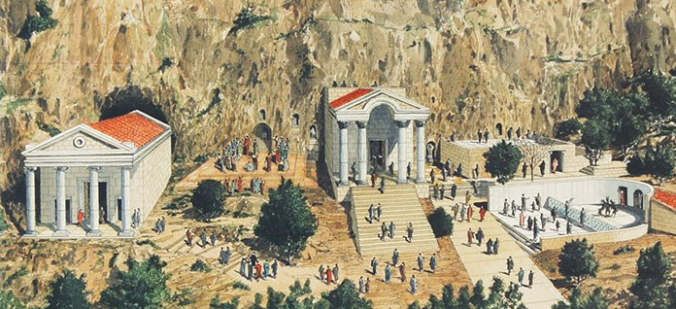
The temple to Pan was built around the entrance to a natural cave called Pan’s grotto.  It was also called the Gate to Hades.  Pan was regarded as a fertility god.  The pagans believed that the fertility gods slept through the winter in Hades then reemerged in the spring to bring new life to the world.  They believed that this grotto was Pan’s passageway to and from Hades, the realm of the dead.  Inside the grotto there was also a gushing spring—it was gushing in ancient times but now it’s barely a trickle—that was one of the sources for the Jordan river. 

What did the disciples think as they were looking at this assortment of temples to these other gods, these gods who were not their God, even a temple to the emperor—and the administrative buildings of the tetrarchy?   What did the disciples feel as they stood in this place confronted by the structures of religion and politics, but not their religion or their politics?

Did the ground feel, maybe, a little slippery under their feet?   Did they wonder if their nervousness might be the influence of Pan?  After all fear is Pan’s weapon; the word panic comes from Pan’s name.

And it’s here, confronted by strange powers—strange religion and strange government—that Jesus asks his first important question:  “Who do people say that the Son of Man is?”

Why would he ask that here?  Why now?  Why not back in Galilee where he’s been doing most of his teaching and working wonders?  Why now in this foreign place?  Is he trying to distract them from feeling so out of place?  Is he showing them what they’ll be up against later when they take the message of the kin-dom out into the wider world?  

“Who do people say that the Son of Man is?”

The disciples make it clear that people are impressed with Jesus.  They identify him with the pillars of righteousness and prophetic justice in their tradition:  John the Baptist, Elijah, Jeremiah, one of the other prophets.  They understand that Jesus is someone who is somehow extraordinary.  But how, exactly?

Who do people say that Jesus is?  It’s still an important question for us.  

If you’re going to be a follower of Jesus, a representative of Jesus, you need to know how the rest of the world sees and understands Jesus, how they describe him, because that’s where conversation begins.  Who do they say he is?  You need to know that before you can make a good case for who you say he is.  

I imagine that Jesus thought a moment about their answers to his first question before he asked the next question: “But who do you say that I am?”

“You,” said Simon Peter, “are the Christ, the Son of the living God.”  

The Christ.  The Messiah.  The Anointed One.  I can’t help but wonder how Simon Peter understood his own words.

In his Commentary on Matthew my professor, the late Robert H. Smith wrote: “As the reality of the Son overwhelms mind and senses, people try to get a handle on him by fitting him into some convenient slot like prophet.  However, the Christ or Messiah is not a prophet but the goal of prophecy, not another promiser but the inaugurator of the promised time.  As Son of the living God his is the bearer of the presence of God and acts in the place of God, not as a renewer of old traditions, but as agent of God’s fresh creative work, bringer of new heavens and a new earth.”[1]

Who do you say that Jesus is?

Do you call him the Christ, the Messiah?  Do you understand him to be not merely a prophet but the goal of prophecy?  The one who was prophesied? 

Is he for you the Son of the living God?  Does he bear the presence of God in your life?  Do you see him not as the renewer of old traditions, but as the agent of God’s fresh creative work, the bringer of new heavens and a new earth?

Or has he become for you the centerpiece of old traditions?  Do the titles of Christ and Son of God simply echo memorized lines from the creeds that get repeated without much thought? 

Jesus is asking us the same question he asked Peter, James, John and the others as they stood overlooking the monuments built to idols and government:  “Who do you say that I am?”

We hear that question as we stare out into a world devoted to those same distractions and others even more powerful:  “Who do you say that I am?”

And it’s oh, so tempting for us to leap straight to the answer we memorized, the answer we have heard all our lives, without really thinking about the question or what our answer means. 

If you, like Peter, confess that Jesus is the Christ, the Son of the Living God, then you are also acknowledging that you have been invited to be part of his church, the ekklesia established on the bedrock of that confession.  You are acknowledging that you have been called to participate in Christ’s fresh, creative work of making the kin-dom of heaven a reality on earth as it is in heaven.  You are acknowledging that you have been invited to be part of the beloved community and to live by the ethic of grace and generosity that guides that community. 

In 1989, President George Bush was entering St. John’s Episcopal Church to attend Sunday worship when he was stopped by a homeless man, William Wallace Brown, Jr. who simply asked the president to pray for him.  President Bush  replied, “No. Come inside with us and pray for yourself.”  From that day on William Wallace Brown, Jr. attended church faithfully. He would sit in the pews in his street-dirty clothes alongside the rich and powerful and always put a dollar in the offering plate even when that dollar was all he had.

William Wallace Brown had been invited to come in to the beloved community, to encounter Jesus, the Christ, the Son of the Living God.  And to him that meant everything.

This community, this church built on the confession that Jesus is the Christ, is, in Robert Smith’s words, “well founded, not by human authority or ingenuity only, but by the exalted Jesus, Son of the living God.  This Jesus is not a figure of the past alone.  He is still present in the midst of the community, not as unseen observer only but with his authority and teaching.”[2]  

I would add that Jesus is still present with his love and compassion, and that these keys of the kin-dom will unlock the power in us to change the world.

In Jesus’ name.


[1] Robert H. Smith, The Augsburg Commentary on the New Testament: Matthew, pp.198-199; Augsburg Publishing House, 1989

[2] Ibid, 202-203

A Nation Possessed

Last week was very difficult for me, as it was for a great many of us. I get up early on Sunday mornings, so the very first thing I saw when I turned on my computer at 4 a.m. was the news of the massacre in Orlando. It was still an unfolding story when I saw it; the body count was still being estimated. I confess that I was at a loss as to what to do with that horrible news at that early hour.

For a number of reasons I didn’t mention Orlando in worship that morning. The biggest reason was that I was pretty sure that few, if any, of the people attending would have heard the news yet and I didn’t want such horribly shocking news to cast a pall over worship and especially not over our farewell to two much-loved members who were moving across the country. Also, I needed time to process it before trying to deal with it pastorally and theologically.

By Monday morning Orlando was the stark lens through which I was seeing the whole world. I was filled with a deep sadness tinged by more than a little anger. In an effort to shift gears I clicked over to read a sermon written by my friend and colleague, Pastor Jennie Chrien who serves in Oxnard.   Her sermon was on the same lectionary text I had preached on the day before but she had taken a very different approach from mine. In addressing the Gospel of Luke’s account of the woman who washes and anoints Jesus’ feet (Luke 7:36-8:3), she had focused on the moment when Jesus turns to Simon the Pharisee and says, “Do you see this woman?” From that simple question Jennie had built an eloquent, powerful and moving sermon.

That important question, “Do you see?” wouldn’t leave me alone, jangling up against the ragged wound of Orlando as I turned my attention to the Gospel text for the coming week, the story of Jesus’ encounter with the wild, demon-possessed Gerasene man running naked among the tombs (Luke 8:26-39). I was also remembering anew the horror from almost exactly a year before when a crazy young white supremacist murdered 9 African Americans after sitting through Bible study with them.

Do you see? The question still hangs in the air.

As I read the Gospel for the week with all these things echoing in my heart, I realized that we, the good old US of A, we are the demon-possessed man. We are the man made crazy by fears and anxieties and bigotry and scapegoating. We are the man made crazy by blind rage and unreasoned hatreds.

We are the man with a hopelessly divided mind, made bipolar and schizophrenic by a cacophony of opposing inner voices—entrenched political parties with no common ground—conservatives vs. liberals and ne’er the twain shall meet on any common ground of common sense, putting our party identity or our ideology ahead of everything else that’s supposed to define us, making even our faith subservient to our chosen place on the ideological spectrum. We are so blinded by the ideological lenses we wear that we see only what we’ve decided in advance that we want to see. And since our biases rarely completely align with or truly resonate with the Gospel we hear and profess, our cognitive dissonance creates the first degree of our madness.

Do you see? Do you really see?

Oh, we have our moments of clarity but then the rage wells up in us and we explode in violence.

For most of us it’s just a violence of rhetoric and attitude, but it opens the door and for those who would turn it into a horribly tangible violence of death and destruction. Even among the most enlightened among us, our racism or our discomfort with sexualities that are different from our own our anxieties about those other religions—all these things creep out in unguarded words and give permission to the violence that is always waiting to happen. We breed the craziness.

Do you see?

We cloak our prejudices in our religions. We project our own craziness, our own fears and anxieties and hatred onto the most vulnerable and marginalized then drum up a sacred text or two to support our bigotry and give us permission to treat them horribly.We are so blinded by our own interpretation of our religions that we can’t see children of God standing right in front of us.

Do you see? Do you see that more than a little of our craziness comes from being caught in the middle of an epic struggle between love and hate?

Do you see that if you’re not actively and passionately on the side of love then you are at least passively on the side of hate? Do you see that if you are not generating light then you are opening the door to darkness?

Do you see that we are not just the crazy man among the tombs? Do you see that we are also the craven townspeople afraid of our own shadows. We recognize our own craziness and try to lock it up, to bind it with chains but we know, deep down that that’s not going to work.

Do you see that even when God works a miracle and restores one of us to our senses we respond with more anxiety because that is just so different from our usual experience?

Do you see a way out of all this?

Do you see how Jesus sees? Can you see the way Jesus sees? Can you put aside your politics, your ideology, your biases and prejudices, the less savory voices of your childhood, your inclination for self-protection, your fear of the “other,” your anxiety about a constantly changing world—can you put aside your own demons long enough to see the person in front of you?

Do you see how Jesus sees? Do you see that Jesus doesn’t see a prostitute washing his feet but a woman beaten down by the world who has had to make horrible choices in order to survive? Do you see that Jesus doesn’t see a crazy man running amok among the tombs but a human being bedeviled and enslaved by the legion craziness of the world?

Do you see that in Christ we are all children of God through faith, that in Christ there is no longer Jew or Greek, slave nor free, male or female, gay or straight or trans or bi, us or them?

Do you see that Jesus is our common ground even with our Muslim brothers and sisters? Yes, we understand Jesus very differently, but he is a central voice in both or our traditions and if we’re ever going to find peace with each other, Jesus, not Abraham, is our most likely common ground.

Do you see? Do you see that we are all going to have to learn to see differently?

No, we can’t afford to be stupid. No we can’t afford to be blind to real threats. But do you see that we are going to have to first recognize and deal with the real threats that arise from our own hearts and minds and souls?

Do you see that we’re going to have to stop listening to all the voices that divide us and pit us against each other? Do you see that we’re going to have to switch off the news channels and radio voices and web feeds and political voices that want to tell us how awful those “others” are, who want to tell us that “they” are not the real “us”?

Do you see that we’re going to have to really listen to Jesus—not the Old Testament—not even Paul, but Jesus—if we’re ever going to be freed from our own demons, our own contagious craziness?

Do you see that we are all of us, each of us, going to have to have at least one “come to Jesus” moment if we’re ever going to be freed from our demons?  Or to put it a more scriptural and Lutheran way, do you see that we are all, each of us, going to have to take off the lenses of our preconceptions and put down our guard long enough so that Jesus can come to us and cast our demons into the sea of God’s love?

Do you see? Can you see? Do you see that love—the love of Christ, the love exemplified and perpetually renewed by Jesus whether you know that’s where it comes from or not, is our only hope of ever being able to sit with each other calmly and in our right minds?

Do you see?

The Penalty For Neglect

Thoughts Along the Way…

For the past 2 years our congregation has been enjoying a Sunday morning Adult Ed class called Occupy the Gospels. It has been an enlightening and stimulating study and discussion that has taken all of us who participated into a deeper level of understanding of why each gospel is so different from the others and just what each of the gospels is all about. We’ve done a close reading of each gospel examining such questions as who was it originally written for, what kinds of stresses and pressures were they dealing with in that community, why does Jesus say things one way in this gospel but differently in another gospel, and so on.

If you’re going to call yourself a Christian, a follower of Jesus, an apprentice of Jesus, it’s important to be deeply familiar with what Jesus said and did. In his tract How Christians Should Regard Moses, Martin Luther suggested that we are not really properly equipped to understand the rest of the Bible unless we first come to a clear understanding of the gospels.

One advantage of doing a close reading together in a group is that very often others will spot things you haven’t seen before or ask questions that hadn’t occurred to you. I honestly couldn’t tell you how many times I’ve been through the gospels, but in our class together I was frequently seeing new things or seeing them from a different perspective than I had before. And sometimes that new little thing I saw would sit with me for weeks and make me rethink a lot of other things about my faith and my understanding of my faith.

Here’s a case in point. The 25th chapter of Matthew has always been important to me. I’ve even sometimes called myself a “Matthew 25” Christian. This chapter is the only place in the gospels where Jesus, himself, describes the final judgment, where the “sheep” are separated from the “goats,” and the criteria are not at all what a lot of people expect. He doesn’t say a word about what you believe or don’t believe. There is no mention of whether or not you accepted him as your personal Lord and Savior or invited him into your heart or any of those other popular ideas that some people think are the doorway to being “saved.” Nope. Nothing like that at all. No statement of creed. No tally of church attendance. Not a bit of it. Instead, the final exam is all about one thing and one thing only: how well did you take care of people who were in need?

34 Then the king will say to those at his right hand, ‘Come, you that are blessed by my Father, inherit the kingdom prepared for you from the foundation of the world; 35 for I was hungry and you gave me food, I was thirsty and you gave me something to drink, I was a stranger and you welcomed me, 36 I was naked and you gave me clothing, I was sick and you took care of me, I was in prison and you visited me.’

A few years ago I realized that the “sheep” in this text, the people who did these good things and are being rewarded and inheriting the kingdom, are quite surprised to find that they are, in fact, the Grand Prize Winners! They didn’t know that by taking care of those in need they were also taking care of Jesus, himself. They just did it because it was the right thing to do.

Rereading this text in our class a few weeks ago, though, I was suddenly hit between the eyes by yet another little epiphany. Words I had read maybe hundreds of times before suddenly hit me in a way I just had not thought of before. And this time it was the flip side of the coin. This time it was the “goats,” who got my attention– you know, the ones who did not feed the hungry or visit the sick or give a drink to the thirsty, the ones who ignored those in need, or worse, went out of their way to do nothing for them.

41 Then he will say to those at his left hand, ‘You that are accursed, depart from me into the eternal fire prepared for the devil and his angels; 42 for I was hungry and you gave me no food, I was thirsty and you gave me nothing to drink…

These are the words that hit me like a ton of bricks: “You that are accursed, depart from me into the eternal fire prepared for the devil and his angels.” I confess, I’m not real big on the idea of Hell and eternal punishment. I like to think that God’s grace trumps everything in the end. On the other hand, the punishment motif crops up several times in the Gospel of Matthew, so in this gospel, at least, it is kind of unavoidable. But seeing that the “goats” get punished wasn’t the thing that arrested me. It was that they were being consigned to a punishment prepared for the devil and his angels. In other words, the failure to take care of those in need is not merely a “failure” or sin of oversight. It is something far worse. It is evil. If the punishment is the measure of its severity as a sin, then the failure to care for those in need is demonic.

I think the ramifications of this are huge. Jesus, as I read it here, is saying that any actions on our part that deprive those in need of food, water, clothing, shelter or medical care, actions that deprive the imprisoned of hope and comfort, actions that alienate the stranger– such actions are evil, even demonic; the punishment is the measure of the crime.

At our little congregation, the little church with a big heart, we have much to be proud of in the ways we have fulfilled the positive side of this equation. We have been wonderfully generous in feeding, clothing and providing for those in need. Our benevolence is extraordinary, and I am so proud, as their pastor, of this congregation’s generosity in spirit and in practice. I know and trust that we will keep up the good work that leads us into God’s presence.

But think about those “goats.” As you read the headlines or watch the news, as you watch what our elected officials are voting for or against, what they are funding or not funding, remembering that they do all this in our name as our representatives, think about those “goats.” Think about the final exam as Jesus describes it. Think about how Jesus sees it. Are we on the road to inherit the Kingdom? Or are we stumbling toward that place prepared for the devil and his angels?

Pro Gloria Dei

Pastor Steve