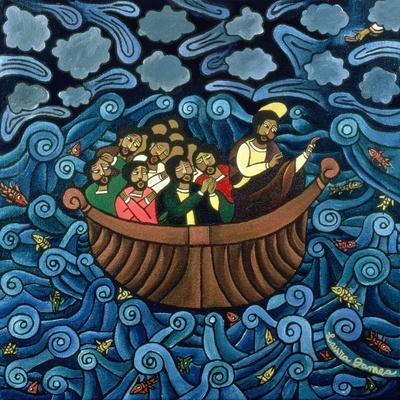
(S)mothered in Prayer

John 17:6-19

It’s Mother’s Day today, so naturally, I’ve been thinking about my mom.  I bought my mom a mug that said, “Happy Mother’s Day from the World’s Worst Son.”  I forgot to give it to her.

I’ll never forget one Mother’s Day—we had a big family meal at Mom and Dad’s house but right after dinner Mom kind of disappeared.  I found her in the kitchen getting ready to wash a sink full of dirty dishes.  I said, “Mom, it’s Mother’s Day!  Go sit down and relax.  You can do the dishes tomorrow.”

My mom told me once that I’d never amount to much because I procrastinate too much.  I said, “Oh yeah?  Well just you wait.”  

Mother’s Day was first proposed by feminist activists after the Civil War.  They originally envisioned it as a day of peace to honor and support mothers who had lost sons and husbands to the carnage of the war.  

  In 1914, President Woodrow Wilson signed a proclamation officially designating the second Sunday in May as Mothers Day.

And here’s an odd but important note:  originally there was no apostrophe in Mother’s Day.  Julia Howe and Anna Jarvis envisioned it as a day to honor allmothers.  Plural.  But the greeting card industry, the florists, and the candy makers quickly figured out a way to monetize the holiday.  They individualized it and idealized it, and began promoting it as a day for you to honor your mother.  In their advertising, Mothers Day (plural/all mothers) quickly became Mother’s Day with an apostrophe, as in your mother’s day (singular/possessive).  Needless to say, the idea of it being a day to promote international peace pretty much vanished with the arrival of that apostrophe.

Mother’s Day became so commercialized that in 1943, Ann Jarvis, one of the women who had lobbied long and hard to make it a national holiday, tried to organize a petition to rescind Mother’s Day, but her efforts went nowhere.  Frustrated, and literally at her wits’ end, Anna Jarvis died in 1948 in a sanitarium.  Her medical bills, ironically, were paid by a consortium of people in the floral and greeting card industries.

Mother’s Day is one of those holidays that can be a great joy for some and a cringe-worthy day for others.  In her annual Mother’s Day column Anne Lamott wrote: “This is for those of you who may feel a kind of sheet metal loneliness on Sunday, who had an awful mother, or a mother who recently died, or wanted to be a mother but didn’t get to have kids, or had kids who ended up breaking your hearts…”  Lamott went on to acknowledge many of the ways that this Greeting Card holiday can be painful for many women…and also for many children.

Most pastors I know are ambivalent at best when it comes to Mother’s Day.  It’s something of a minefield for us.  We don’t dare let it go unmentioned, but at the same time we are very aware of those in our congregations who for one reason or another will be feeling that “sheet metal loneliness” that Anne Lamott described.

I said at the beginning of all this that I have been thinking about my mom.  One of the great gifts she gave me was that she taught me to pray.  She insisted that we give thanks before our meals and she sat next to me and listened as I prayed at bedtime.  Sometimes she would pray with me.  She also taught me that I could pray anytime and anywhere because God is always with me and always listening.

I was thinking of her as I read through the so-called High Priestly Prayer that Jesus prayed for his disciples in John 17, and it occurred to me that Jesus is “mothering” his disciples in this prayer as he prays for their safety and protection.

I’ve been blessed to know many people who are disciplined, devoted and powerful in their prayer life.  I’ve also known quite a few who find prayer daunting and mystifying. 

Robert McAfee Brown said that prayer, for many, is like a foreign land.  “When we go there, we go as tourists.  Like most tourists, we feel uncomfortable and out of place.  Like most tourists, we therefore move on before too long and go somewhere else.”

If you’ve ever felt even a little bit uncomfortable or awkward about praying, if you’ve ever felt like a “tourist in a foreign land” when you pray, you might be able to find some comfort in the prayer Jesus prays here in the 17th chapter of John.  

Jesus is clearly praying from the heart here.  He knows the end is near.  There is a lot to say and not much time left to say it.  He prays for protection for these friends who have been his travel companions and students for three years and are heading into more difficulty than they can begin to imagine.  He prays for their unity.  That has to be comforting for them, and there is comfort here for us, too, because his request for protection and unity for his followers travels down through the ages to include us here and now.  But there is something else in this prayer that might make us more at ease in our own prayers.

Jesus rambles.  I mean no disrespect or sacrilege when I say that.  In this prayer, Jesus rambles.  We could, of course, ascribe that rambling to the writer of the Gospel.  But we can’t deny it.  In this wonderful, passionate, heartfelt prayer for the unity and protection of his disciples, Jesus rambles.  A bit.

I, for one, find that very comforting.  Because I ramble in my prayers.  Often.   I talk to God a lot, and it’s a rare blue day when I come into the conversation with all my thoughts completely organized.  I suppose there are people who do, but that’s just not my personality type.  

Over the years of my ministry I’ve been asked a number of times to teach a class or workshop on prayer.  I confess it always catches me by surprise.  Part of me wants to say, “How do you not know how to pray?”  But I realized years ago that a lot of people think there is a proper method for praying and they suspect they’re not doing it right.  Or they think that if they learn some secret formula for prayer they have a better chance of their prayers being answered the way they want them answered.  

Here’s the thing.  Prayer is not that complicated.   There really aren’t any secrets.

Billy Graham said that prayer is simply a two-way conversation with God.  And since God doesn’t talk all that much, that means that you can simply share your thoughts and feelings with God.  That’s prayer.  You don’t have to kneel or fold your hands—although if doing that helps you pray, then by all means do so.  

If you’re the kind of person who likes more structure than that, you can try the ACTS model for prayer.  A-C-T-S.  A for Adoration, C for Confession, T for Thanksgiving, S-for Supplication.  

Start by telling God all the wonderful things you’re seeing and experiencing and how much you love God for filling the world with such goodness.  When’s the last time you said, “I love you” to God?  You might be surprised at how much that simple act can change you.  

So, Adoration.  Then Confession.  Take a moment for a little introspection and Confess your mistakes and shortcomings.  You don’t have to beat yourself up.  Don’t dwell on them, just acknowledge them.  And remember: God is in the forgiveness business.

Follow that by Thanking God for all that’s good in your life, all the ways you’ve been protected and cared for, for the food on your table, for, well, everything that makes your life livable.  Meister Eckhart said, “If the only prayer you ever say in your life is thank you, that will be enough.” 

After you’ve said “thank you,” then you can ask for things.  That’s the time for Supplication. Unless it’s an emergency, of course.  If someone or something is bleeding or broken—and that includes your heart—you can lead with Supplication.

Adoration, Confession, Thanksgiving, Supplication.  ACTS.  The nice thing about this model is that it keeps you from hitting up God with your requests before you’ve even said a proper hello.  It keeps us from treating God like Santa Claus or a celestial vending machine.

The point of prayer, after all, is not to get things from God or keep giving God your wish list. Remember, Jesus told us, “Your Father knows what you need before you ask.” (Matthew 6:8)  The real point of prayer is to develop and deepen your relationship with God.  “Prayer,” said Theresa of Avila, “is nothing else than being on terms of friendship with God.”  Henri Nouwen said, “Prayer is the most concrete way to make our home in God.”  Richard Rohr suggested, “What if instead of prayer, we used the word communing?  When you’re communing with someone, it isn’t long before you’re loving them.”

As for doing it right…there are as many ways to pray as there are people praying.  “Those who sing pray twice,” said Martin Luther.  So singing is an option.  So is dancing.  You can pray while walking.  You can pray while exercising.  Saint Ignatius said, “Bodily exercise, when it is well ordered, is also prayer and pleasing to our Lord.”  So there you go!  Pray while you’re at the gym!  

Back before I lost most of my hearing I used to lose myself in improvising on my guitar and I would offer that time to God as a kind of prayer.  Kelsey Grammer said, “Prayer is when you talk to God.  Meditation is when you’re listening.  Playing the piano allows you to do both at the same time.”  I think most musicians have had that kind of experience.  There are times in music when you experience a  holy presence that goes beyond words.  You can experience that even when you’re just listening if you really immerse yourself in the music.

“The Glory of God is the human being fully alive;” said Irenaeus, “the life of a human being is the vision of God.”  So if you’re singing or you’re dancing or riffing on your bagpipes, let that flow to the perichoresis of the ever-dancing Holy Trinity as a communion of Adoration, Confession, Thanksgiving and Supplication.  Let that activity speak for your heart and don’t worry about impressing God with churchy-sounding words and phrases.  “In prayer,” said Gandhi, “it is better to have a heart without words than words without heart.”  Or as Martin Luther put it, “The fewer the words, the better the prayer.” In fact, some of the best prayers you will ever pray will be when you sit in silence in the presence of God who speaks in silence.

And don’t worry about whether you should address God as Father, or Jesus, or Spirit, or Lord.  It’s all one to the Three-in-One.  When you speak to one of them you speak to all three.  In my own prayer life, I have begun using the Jewish tradition of addressing God as HaShem, which means “the Name.”  For me it’s a way to remain deeply personal with God and at the same time honor the holiness of God.

Prayer is a powerful way to center yourself in difficult times.  Adolfo Perez Esquivel, the artist and sculptor who won the Nobel Peace Prize in 1980 for organizing and leading the opposition to Argentina’s military dictatorship said, “For me it is essential to have the inner peace and serenity of prayer in order to listen to the silence of God, which speaks to us, in our personal life and the history of our times, of the power of love.”  Such an extraordinary thing—to find through prayer the strength and resolve to love in the face of brutal opposition.  

“Prayer,” said Myles Monroe, “is our invitation to God to intervene in the affairs of the world.”   “Prayer is not an old woman’s idle amusement,” said Gandhi.  “Properly understood and properly applied, it is the most potent instrument of action.”  “To clasp the hands in prayer,” said Karl Barth, “is the beginning of an uprising against the disorder of the world.”

Prayer is a powerful tool for difficult times.  We tend to turn to it automatically in times of crisis. But we shouldn’t wait for a crisis to turn to God.  As I said earlier, the main purpose of prayer is to deepen and strengthen our relationship with God.  “The moment you wake up each morning, all your wishes and hopes for the day rush at you like wild animals,” wrote C.S. Lewis.  “And the first job each morning consists in shoving it all back; in listening to that other voice, taking that other point of view, letting that other, larger, stronger, quieter life come flowing in.”  

That, in the end, is what prayer is all about:  letting that other, larger, stronger, quieter life come flowing in.  And letting our lives flow more deeply into the life of God in whom we live, and move, and have our being.

And that brings us back around to the original intent for Mothers Day.  It was intended to be something to strengthen the community and bring peace to the world.  This Mothers Day, I invite you, through your prayers, to do just that.

*Image © Alima Newton

What the World Needs Now

John 15:9-17

“What the world needs now is love, sweet love.  It’s the only thing that there’s just too little of.”  Jackie DeShannon was absolutely right when that song reached the top of the charts back in 1965.  And the Beatles were right, too, when they had a megahit with All You Need Is Love in 1967.  But Jesus said it first.  A long time before John Lennon and Paul McCartney or Burt Bacharach and Hal David.

Love is a powerful force.  It creates relationships.  It can overcome fear and hate.  Love is what created the universe.  It can sometimes transform things instantaneously, but more often it builds and changes things slowly.  Over time. Because love is patient and kind.

Love can improve your health.  It can even make you more successful, although that is entirely a side-effect.

In 1938, during the Great Depression, a group of doctors at Harvard Medical School began a long-term study to determine what factors contributed most to long-term health and well-being in men.  The Study of Adult Development has been ongoing for more than 80 years now.  Once selected, participants are followed for the rest of their lives.  They fill out a questionnaire every other year covering their physical and mental health, financial status, relationship status, and general level of happiness.  Every five years some of the men are selected at random for more in-depth study.  

Some of the findings in the study haven’t been all that surprising.  For instance, they’ve verified that alcoholism is destructive.  It has been the primary cause of divorce among study participants and it strongly correlates with neurosis and depression.  So, no big surprise there.  But here’s one that is surprising:  financial success depends more on warm relationships than on intelligence. In fact “warm relationships” play a huge role in lifetime satisfaction, wealth, and well-being.

A warm childhood relationship with your mother makes a difference long into adulthood:

  • Men who had warm childhood relationships with their mothers earned considerably more per year than men whose mothers were uncaring.
  • Men who had poor childhood relationships with their mothers were much more likely to develop dementia in later life.
  • In professional life, a man’s boyhood relationship with his mother—but not with his father—was associated with greater effectiveness at work.

But a warm relationship with your father is important, too. Warm childhood relationships with fathers correlated with:

  • Lower rates of adult anxiety.
  • Greater enjoyment of vacations.
  • Increased life satisfaction at age 75.

When George Vaillant, the former director of the Study, was interviewed by The Atlantic, his main conclusion was that “warm relationships” throughout life had a greater positive influence on “life satisfaction” than anything else—greater than money, greater than achievement, greater than acquisition and accumulation of things.  Warm relationships, he said, were the greatest predictor of happiness.  By far.  “Put differently,” Vaillant says,  “The study shows happiness is love. Full stop.”[1]  When a Canadian broadcaster suggested that his statement was overly broad and sentimental, Vaillant looked down at his data then looked up and replied,  “The answer is L-O-V-E.”[2]

“As the Father has loved me, so I have loved you,” said Jesus.  “Abide in my love. If you keep my commandments, you will abide in my love, just as I have kept my Father’s commandments and abide in his love.”

The word “love” here is agape which is a particular kind of love.  This isn’t a sentimental or emotional love, although it can develop into warm feelings.  But agape doesn’t start that way.  Agape is a decision.  It starts in the head before it moves to the heart.  Madeleine L’Engle described it this way:  “Agape love is…profound concern for the well-being of another, without any desire to control that other, to be thanked by that other, or to enjoy the process.”   

Dr. Martin Luther King said, “Agape does not begin by discriminating between worthy and unworthy people, or any qualities people possess.  It begins by loving others for their own sakes… Therefore, agape makes no distinction between friend and enemy; it is directed toward both. It is redemptive goodwill for all people.  It is a love that asks nothing in return.  It is an overflowing love…And when you rise to love on this level, you begin to love people not because they are likeable, but because God loves them.”   

When Saint Paul writes that Love is patient and kind, that love is not envious or boastful or arrogant or rude, that it doesn’t insist on its own way, that love it is not irritable or resentful, that it does not rejoice in wrongdoing, but rejoices in the truth…when he writes that love bears all things, believes all things, hopes all things, endures all things, when he writes that love never quits, he is describing agape.  

When Jesus says, “As the Father has loved me, so I have loved you,” that’s the kind of love he is talking about, the decision to act for the well-being of others.  So what about those warm feelings that can have such a positive effect?  Well, agape love may start in your head as a decision, but it often moves to the heart because when you love with agape love, you make yourself vulnerable.  That’s part of the decision.  That’s why, right after Jesus reminds his disciples that he loves them, he goes on to call them his friends.

“Abide in my love,” says Jesus.  Most of us don’t use the word “Abide” too often.  The Greek word that’s at work here is meno, which means to stay, to remain, to continue, to continue to exist.  It’s in the imperative form here, so Jesus says it as a command.  Continue to exist in my love.  Stay in my love.

There are two ways to think about that.  One is that Jesus surrounds us with his love and commands us to stay inside the parameters of that love as we act and interact with each other and the world.  This might be what Saint Paul means when he talks about being “in Christ.”  

The other way to understand it is to see that our lives have been infused with the love of Jesus and we are now commanded to continue to regenerate that love for those around us, to keep spreading it out into the world.  Both understandings work.  Both keep the love of God flowing.  And Jesus assures us that if we keep the commandment to love, we will continue to abide, to exist, within the love of God.

“I have said these things to you,” said Jesus, “so that my joy may be in you, and that your joy may be complete.” This statement always catches me by surprise.  

I’ll be honest, I don’t usually think of Jesus as joyful.  You certainly don’t see him depicted that way very often in the gospels.  We see him arguing with scribes and Pharisees or impatient with his disciples when they’re being dense. We see his generosity, especially when he’s healing.  We see his power when he’s casting out demons, there’s certainly something energetic about that.  But joyful?  

When you think about it, the episodes of cranky or serious Jesus that we see depicted in the gospels are brief and they’re probably very much the exception rather than the rule.  We do see him dining with tax collectors and sinners.  Those were probably fun times.  He does tell the occasional joke—you know, a camel through the eye of a needle?  And joy would explain why huge crowds came to see him.  Joy is attractive!  Joy is charismatic!

So Jesus commands us to continue to exist in his agape love so that his joy may be in us and so that our joy may be complete.  And then to make it crystal clear that he’s serious about this—joyfully serious—he makes love a commandment.  “This is my commandment, that you love one another as I have loved you.”

As I have loved you.    

“No one has greater love than this,” continues Jesus, “to lay down one’s life for one’s friends.”  He’s referring to the cross here, of course, hinting at just how far he will go to demonstrate his agape love for all of us.  He will lay down his physical life.

But he might be referring to even more if we dive down below the surface.  The word that’s translated as “life” here is psyche.  It means living soul, inner self, mind.  It can also mean what we refer to as “ego.”  Richard Rohr has said that in order to learn how to fully and truly love we have to learn how to get our egos out of the way.  No one has greater love than this, to lay down one’s ego for one’s friends.

“Authentic Christianity,” says Rohr, “is not so much a belief system as a life-and-death system that shows you how to give away your life, how to give away your love, and eventually how to give away your death.  Basically, how to give away—and in doing so, to connect with the world, with all other creatures, and with God…Here the primary language is unlearning, letting go, surrendering, serving others, and not the language of self-development—which often lurks behind our popular notions of salvation.[4]

Paul Tillich once wrote about meeting a Swedish woman who had spent time in a prison camp for giving aid and comfort to prisoners and orphans during World War I.  He found in her a personification of that “greater love.”  “It is a rare gift to meet a human being in whom love – this means God – is so overwhelmingly manifest,” he wrote. “It undercuts theological arrogance as well as pious isolation. It is more than justice and greater than faith or hope. It is the very presence of God in the form of a human being. For God is love. In every moment of genuine love we are dwelling in God and God in us.”

When you let God’s love flow through you, you begin to love, as John Duns Scotus says, things in themselves and for themselves, and not for what they do for you.  That’s when you begin to love your spouse.  That’s when you begin to really love others—when you start seeing them detached from you or what they do for you or how they make you look or what they can get for you. 

When we love, we manifest God.  It’s as simple as that.  As it says in Ephesians, “I pray that you may be strengthened in your inner being with power through his Spirit and that Christ may dwell in your hearts through faith as you are being rooted and grounded in love.  I pray that you may have the power to comprehend, with all the saints, what is the breadth and length and height and depth and to know the love of Christ that surpasses knowledge, so that you may be filled with all the fullness of God.”[1]

When you love things and people in themselves, you are looking out at the world with the eyes of God.  When you look out from those eyes, you see that it’s not about you.  And you will see things that will give you joy.  Simple things will make you happy. Reality will start giving you joy, inherently.  And you will start overcoming the gap between you and everything else.

Abide in Christ’s love.  Be a friend of Jesus.  Build those warm relationships in the world.  So that Christ’s joy may be in you.  And your joy may be complete.


[1] Ephesians 3:16-19

To Know By Heart

John 10:11-18

You are one of a kind.  Even if you have an identical twin there is a lot about you that is unique.  Your fingerprints are unique, of course, but did you know that your toeprints are, too?  Your voiceprint is also unique and can be used to identify you.  The patterns in the irises of your eyes are yours and yours alone, and so are the patterns of the blood vessels in your retinas.  Your gait when you walk is uniquely yours and can be used to pick you out from a crowd.  You can be singled out from a multitude of other people online by patterns in the way you type on your keyboard or move your mouse, a little trick that’s been used, apparently, in espionage.  But here’s a new one—at least it was new to me.  Did you know you have a distinctive cardiac signature?   That’s right.  Your heart beats in a way that is unique to you and can’t be disguised.  The Pentagon has recently developed a laser-based tool called Jetson that can read your cardiac signature through your clothes from 200 meters away.  So now if somebody says they know your heart you might want to ask exactly what they mean by that.

“I know my own and my own know me,” said Jesus, “just as the Father knows me and I know the Father.”   Jesus knows your heart, although clearly not in the same way that the Pentagon’s invasive new toy does.  More importantly, though, we know the heart of Jesus.  We know he loves us and he cares for us enough to lay down his life for us.

Jesus calls himself the Good Shepherd.  I wonder how many of us really understand what he means by that.  I think what comes to mind for a lot of us when we hear “Good Shepherd” is a kind of greeting card image or something from a stained glass window.  We picture Jesus looking pristine in a white robe with a gentle, pure white lamb draped across his shoulders.  Gentle Jesus, meek and mild.  But that image is a far cry from what the people listening to Jesus on that long-ago day in Jerusalem would have been picturing when Jesus described himself as the Good Shepherd.

When Jesus was talking to people two thousand years ago in Galilee and Judea, he used metaphors that were part of their everyday lives.  Many of these metaphors also echoed their scriptures and history.  That’s one of the things that made him such an effective teacher, but it also made him controversial sometimes.  

Even people who had never been outside of Jerusalem’s walls knew about shepherds.  They were a common sight.  They had all seen shepherds bringing sheep into the city for the markets and for sacrifices in the temple.  

The Shepherd was also an image from their faith heritage.  Joseph, one of the 12 sons of Jacob, had been a shepherd.  Jacob worked as a shepherd for Laban so he could marry Rachel and Leah who had also tended sheep.  Zipporah, the wife of Moses, had tended flocks with her sisters.  Moses tended sheep before God called him to lead his people out of Egypt.  King David started out as a shepherd.  

The prophets spoke of the kings and religious leaders or Israel as shepherds—sometimes good, but sometimes not so much.  The prophet Jeremiah wasn’t pulling any punches when he wrote, “Woe to the shepherds who destroy and scatter the sheep of my pasture! says the Lord.  Therefore thus says the LORD, the God of Israel, concerning the shepherds who shepherd my people: It is you who have scattered my flock and have driven them away, and you have not attended to them. So I will attend to you for your evil doings, says the LORD.”

God was regarded as the ultimate shepherd and, through the prophets, often spoke of the people of Israel as “my flock.”   In Psalm 80, the Psalmist cries out, “Give ear, O Shepherd of Israel, you who lead Joseph like a flock! You who are enthroned upon the cherubim, shine forth!”  And, of course, there is Psalm 23 where David sings of his reliance on God with the words, “The Lord is my shepherd.”

When Jesus called himself the Good Shepherd, it brought a particular image to mind for those listening to him, but it wasn’t stained glass and greeting cards.  There was nothing particularly pristine in their picture of a shepherd.  They knew that shepherding was a very physical, dirty, and smelly job.  But they also knew that good shepherds were strong and  brave and tough when they had to be to protect the sheep.  When David was still young, he told  King Saul that he was tough enough to take on Goliath because, as a shepherd in the field, he had already killed a bear and a lion.  

At night, when a shepherd would bring the sheep in from the pasture into the safety of the fold, he would recline across the opening of the sheepfold, making his own body the gate of the sheep pen, a barrier between the sheep and any predators or thieves, so that anything or anyone that tried to get at the sheep would have to do it across his body.

Often several shepherds would bring multiple flocks into a large sheepfold for the night.  When it was time to lead them out again to pasture in the morning, each shepherd would simply start calling out to their sheep with a call that was familiar to their own flock.  Each flock knew their own shepherd’s distinct voice and would follow him and only him out to pasture.  So again, when Jesus says, “My sheep know my voice,” he is using a metaphor that’s familiar to all his listeners.  

So why is Jesus using this powerful image in that time and place?  He’s in the precincts of the temple.  He is already in hot water for healing on the sabbath, bringing sight to a man born blind.  This is all happening during the Feast of the Dedication, Hannukah, the feast that commemorates the rededication of the temple after the victory of the uprising led by Judas Maccabeus over Antiochus Epiphanes in 164 BCE.  Judas Maccabeus was a national hero, someone whom the Jews thought of, historically, as a good shepherd.  The temple was the place that more than any other symbolized the people’s covenant relationship with God.  So with all that as background, the Pharisees and temple authorities are listening to Jesus very carefully.  And what Jesus says is, to their ears, very provocative.

“I am the Good Shepherd,” says Jesus.  Just what is he saying?  Is he comparing himself to Moses?  To David? To Judas Maccabeus? Was he comparing himself to their great prophets and kings, the revered political and military leaders or the past, the heroes who had freed them from their oppressors and enemies? 

Was Jesus equating himself with God, the ultimate Good Shepherd?   Just what did he mean when he said, “I am the Good Shepherd.” They had to be wondering.  

And then he said this: “I have other sheep that do not belong to this fold. I must bring them also, and they will listen to my voice. So there will be one flock, one shepherd.”  Who was he talking about?  Could he be talking about gentiles?  Was he talking about bringing them into the covenant?  Into the temple?  This was both unsettling and provocative to the Pharisees and temple authorities.

Who would those other sheep be for us today?  Who are those who are “not of this sheepfold”—or not of this church, maybe?—who Jesus intends to bring into the flock?

“There will be one flock,” said Jesus.  One flock.  One shepherd.  None of the artificial distinctions we’re so fond of making.  No us.  No them.  The Good Shepherd has gone outside the sheepfold to call in all the sheep who know his voice.  All of them.  All of us.  Are we ready to be one big happy flock with sheep we don’t know? Even if some of them have different kinds of wool?  One flock.  One shepherd.

“I know my own and my own know me.”   I wonder about that statement.  Is it always that straightforward?  Especially the second part—“my own know me”?  The other day I saw a video on Facebook that made me really think about what happens when the sheep don’t really know the shepherd, when they’re not really attuned to the shepherd’s voice.  

The video was shot by a man who was taking a nice leisurely hike through a forest in France.  As he came around a bend in the trail he saw a woman in red shorts jogging toward him and behind her was a fairly sizable flock of sheep.  When she got up to the man, who captured all this on his phone, she stopped to talk to him and the sheep came to a full stop behind her.  He asked her if she always led her sheep through the forest and she told him that they were, in fact, not her sheep.  These sheep had all just been milling around near the beginning of the trail and when she jogged by them, they all just turned and began jogging along right behind her.  When she stopped, they stopped.  When she ran, they ran.  When she finished explaining this to the man, she started jogging back down the trail and the sheep swept past him, the whole flock, running along behind the woman they had mistaken for their shepherd. 

“I know my own and my own know me.”  We think we know our Shepherd, but sometimes we make mistakes.  Sometimes we go jogging off behind other shepherds.  

I know I’ve sometimes been misled into following other voices.  It’s easy to follow the voice of politics or partisanship or moralism or prestige or money.  It’s easy to get caught up by voices that try to flock us together around national or racial or cultural or generational or religious identity.  

It’s easy to follow someone who looks like they know where they’re going or sounds like they know what they’re doing.  It’s easy to be misled out into a forest  full of unseen dangers.  

It’s easy, sometimes, to think you’re following the Good Shepherd when it’s actually someone else mimicking his voice or borrowing his name for their own purposes.  We all saw those “Jesus” signs at the January 6th Capitol Insurrection.  I’m pretty sure that wasn’t really the Good Shepherd inspiring that activity.  We’ve all seen politicians standing in front of churches or holding up Bibles to buttress their authority or polish their image

“My own know me,” said Jesus.  Well, with practice, yes.  I think that’s our never-ending homework—to keep listening, to keep learning to hear the voice of the Good Shepherd in a world that so noisy with other voices, to discern the voice of Christ above all the pretenders and the racket and the misguided or misleading “shepherds” that try to distract us.  

“My own know me.”  Maybe Jesus states this so positively, so affirmatively, so that we have to take it as a goal and not make a liar out of him.  “My own know me.”  Okay, Jesus.  I will do everything I can to make that’s true, to make sure I know you.  

But that first part—that part where Jesus says “I know my own,” –-that’s where the good news is for us.  Even when we have wandered off through the forest following the wrong voice or our own stubborn inclinations, Jesus still knows us. Jesus still says to us, You belong to me.  You are mine.  I know you.  I know your going out and your coming in.  I know your fingerprints and your toeprints and the pattern of your irises.  I know your heart.  I have your cardiac signature.  You are mine.

There will be one flock.  One shepherd…who knows the heart of each and every one of us.  A Shepherd who has laid down his life for us.  That’s the Shepherd we can follow.  That’s the voice we can trust. 

Something to Chew On

3rd Sunday of Easter

Every year there are certain things we look for in the early Spring, certain signs that tell us we are entering the season of Easter.  There may or may not be one last big snowfall in the mountains.  We may or may not get soaked by El Niño rains.  The dandelions may or may not suddenly show up in our front lawns and the lilies may or may not bloom in time for our Easter morning services.  But one thing you can absolutely count on as Easter approaches is that there will be a rash of articles showing up in our newspapers, our magazines and on social media debating whether or not Jesus actually rose from the dead.

In 1999, Marcus Borg and N.T. Wright collaborated on a book called The Meaning of Jesus: Two Visions.  In an Easter season interview that same year with National Public Radio’s Chris Roberts, the two well-respected scholars summarized their very different understandings of the Resurrection.  

Marcus Borg said, “I do believe in the Resurrection of Jesus. I’m just skeptical that it involved anything happening to his corpse… The truth of Easter really has nothing to do with whether the tomb was empty on a particular morning 2,000 years ago or whether anything happened to the corpse of Jesus. I see the truth of Easter as grounded in the Christian experience of Jesus as a living spiritual reality of the present.”

N.T. Wright responded by saying, “When [the early followers of Jesus] believed in Resurrection, they were talking about what we would call some kind of embodiment. A disembodied Resurrection is a contradiction in terms…We can be completely confident on Easter day that the things we’re saying in church are true. For the very good reason that, historically speaking, it’s actually impossible to explain the rise of early Christianity without it.” [1]

I have to tell you that I really resonate with what Borg says about the truth of Easter being grounded in the Christian experience of Jesus as a living spiritual reality of the present.  Yes.  That should be the Easter experience we carry with us every single day—Jesus as a living spiritual reality alive in our own physical bodies.  

But when all is said and done, I think that Wright is right.  We must explain why the earliest Christians believed in Jesus Christ’s bodily Resurrection and risked hostility and danger to rapidly spread the message that he had been raised from the dead and appeared to them in person.  

People have had doubts about the Resurrection of Jesus from the very beginning, and one of the things I really appreciate about the New Testament is that these early witnesses to the Resurrection take those doubts seriously and meet them head on.  

The original ending of the Gospel of Mark, the earliest of the gospels written sometime around 69 or 70 C.E. during the height of the Jewish rebellion against Rome, plays on that doubt.  The gospel ends with the women finding the tomb empty except for a young stranger clothed in white who tells them that Jesus is risen and that they are to meet him in Galilee.  They run away terrified, which leaves the reader hanging, but also leaves us with the implied message that the risen Christ is out there in the world and we need to go find him. (16:8)

The Gospel of Matthew ends with the disciples doubting even as Jesus gives them the Great Commission.  In Matthew 28:16-17 we read, “Now the eleven disciples went to Galilee, to the mountain to which Jesus had directed them.  When they saw him, they worshiped him, but they doubted.” 

In the Gospel of Luke when the risen Jesus appears suddenly in the midst of the disciples in the upper room, they believe they are seeing a ghost, so Jesus says to them, “’Why are you frightened, and why do doubts arise in your hearts?  Look at my hands and my feet; see that it is I myself. Touch me and see, for a ghost does not have flesh and bones as you see that I have.’  And when he had said this, he showed them his hands and his feet.  Yet for all their joy they were still disbelieving and wondering.”  To prove he is really physically, bodily there, he asks for something to eat.  Because ghosts don’t eat.

The Gospel of John, of course, gives us the story of Thomas who refuses to believe that Jesus is risen until he sees him with his own eyes and touches him with his own hands.  Thomas has become a paradigm for reasonable doubt but also for confession of the faith.  He is the one who first bows down before Jesus and says, “My Lord and my God.”

But the very earliest testimony to the Resurrection comes from the Apostle Paul, and he, too, directly addresses those who doubt.  In 1 Corinthians 15, written about 15 years before the Gospel of Mark, Paul wrote: “I handed on to you as of first importance what I in turn had received: that Christ died because of our sins . . . and that he was buried and that he was raised on the third day . . .  and that he appeared to Cephas, then to the twelve.  Then he appeared to more than five hundred brothers and sisters at one time, most of whom are still alive, though some have fallen asleep.  Then he appeared to James, then to all the apostles. Last of all, as to one untimely born, he appeared also to me. For I am the least of the apostles, unfit to be called an apostle, because I persecuted the church of God.” 

Paul testified to his own encounter with the risen Jesus, and to the experience of a surprising number of others.  It’s almost as if he is saying, “If you don’t believe me, fine.  There are lots of others who have seen him, too.  Go ask one of them.”  

Paul goes on to speak to the doubt that some in Corinth are experiencing when he writes, “Now if Christ is proclaimed as raised from the dead, how can some of you say there is no resurrection of the dead?  If there is no resurrection of the dead, then Christ has not been raised,  and if Christ has not been raised, then our proclamation is in vain and your faith is in vain.  We are even found to be misrepresenting God, because we testified of God that he raised Christ . . . If for this life only we have hoped in Christ, we are of all people most to be pitied.  But in fact Christ has been raised from the dead, the first fruits of those who have fallen asleep.”

N.T. Wright wrote, “In the New Testament Gospels’ depiction, the risen Jesus was no ghost, disembodied spirit or vision. Jesus did not have a merely resuscitated corpse but a body with uncanny new properties, yet a physical body nonetheless.”

In that resurrected body, which was the same but not quite the same as the body he died in, Jesus cooked fish on the beach for his friends.  He left footprints on the dusty road to Emmaus as he walked, unrecognized, beside his friends and opened their minds to understand the scriptures so that they could see that everything that had happened to him was in perfect continuity with what God had been doing all along.  They recognized him when he broke bread with his wounded hands.

In his resurrected body with uncanny new properties, he appeared behind locked doors and offered his wounds for inspection.  He ate a piece of broiled fish to prove he wasn’t a ghost, and in so doing, as Debi Thomas wrote, he turned their trauma into communion.

We need the Resurrection.  We need an embodied Jesus because we are embodied.  I love how Debi Thomas expressed this:  

“I know that it might be unfashionable to ‘need’ the resurrection.  Isn’t this the criticism so often leveled at Christians?  That our faith is a crutch, an opiate, a refusal to face the harsher aspects of reality?  But here, too, I will bear witness and insist that I need Jesus’s bodily resurrection precisely because I, too, am embodied.  As the ancient Psalmists and prophets so beautifully describe it, my spiritual life is inseparable from my physical one: my heart melts like wax, my throat grows parched, my bones go out of joint, my tears cover my pillow, and my groans, sighs, and moans reach wordlessly for God.  Every experience I have of the holy is grounded in my body.

“And so I need a Savior with a body like mine — a body that adores, worships, and celebrates, but also a body that fails, ages, aches, breaks, and dies.  A body that carries wounds and scars, visible and invisible, fresh and faded.  A body that is profoundly and often terrifyingly vulnerable to forces beyond my ability to mitigate or control.  A body that is, for the most part, defenseless against injury, violence, illness, injustice, and cruelty.  A body that might die — as Jesus himself died — too soon, out of season, away from loved ones, in random, inexplicable, cruelly traumatic circumstances too frightening to contemplate.  I need a God who resurrects bodies.”[2] 

I know I need Resurrection.  Ten years ago when I was diagnosed with prostate cancer I found myself confronting my mortality, especially since both my mom and my dad died of cancer.  My surgeon assured me that my chances of coming through the surgery and radiation were probably good.  Don’t you love the language doctors use once the “C” word has been spoken?  You hear the word “probably” a lot.  The point is, once the word “Cancer” has been spoken, it sharpens your focus.  Things that had been theoretical either become the life raft you cling to or they get discarded.  I realized during that time that, while I’m willing to entertain and discuss all kinds of ideas and theories about Resurrection, for me personally a psychological or philosophical understanding isn’t enough to carry the weight of my hopes and fears.  I need something with some bones in it, some skin on it.  And I’m not alone in that.

I have seen a lot of death in my decades as a pastor.  I have accompanied people up to death’s door and held their hand as they crossed the threshold.  Resurrection is what has given many of them the courage to walk peacefully and fearlessly through that door.  And Resurrection is what has given me the courage and confidence to walk through the valley of the shadow with them.

And that’s the point.  Resurrection gave the earliest followers of Jesus the courage to risk hostility and danger so they could carry on his work of proclaiming that there was a better way to live, a better way to be community, a way to live in the commonwealth of God’s kindness and justice.

Jesus was a real physical person who was tortured to death in a first-century lynching.  The state and the religious authorities colluded to crucify him, to physically destroy him and in so doing to destroy his opposition to their power.  His crucifixion was a political statement.  What they failed to see and understand, though, was that in Jesus there was a power and authority that dwarfed any power or authority they imagined they had over him.

For that reason,  nothing less than a bodily resurrection would do to nullify their violence and call their power into question.  It was his physical body they killed.  It would have to be his physical body that would proclaim their work undone.  

The resurrection of Jesus was God’s way of saying that violence will not have the last word.  Pain will not have the last word.  Fear will not have the last word.  Anger will not have the last word. Disease will not have the last word.  Suffering will not have the last word.  Death will not have the last word.

The Resurrection of Jesus was God’s way of saying that love, grace, forgiveness, kindness, hope and faith—these things will have the last word.  

The resurrection was God affirming that Life will have the last word.  

And will be the last word. 

Through Jesus Christ, our Lord.


[1] The Resurrection of Jesus; Religion and Ethics Newsweekly; NPR/PBS, March 26, 1999

[2] Embodied; Debi Thomas, http://www.journeywithjesus.net; April 11, 2021

The Final Truth

John 12:20-33

As some of you know, I used to be a musician.  But I don’t listen to music anymore.  I can’t, really, since I have lost so much of my hearing. Music just doesn’t sound the same to me, and it’s frustrating because I know what it’s supposed to sound like.  So I don’t listen to music anymore.  Except in my memory.  

I do have a very good memory for music, and I can still hear a lot of pieces quite well in my mind’s ear, so to speak.  And in my dreams.  I dream in music a lot.  Sometimes in my dreams I hear pieces I wrote.  Sometimes I compose new pieces.  And quite often in my dreams I hear favorite pieces that have been part of the soundtrack of my life.  When that happens, I usually figure that it’s a kind of message from me to me, something my subconscious wants to tell me or remind me of.  Or… it could be the Holy Spirit.  Just saying.

The other morning, as I was still in that lovely place between sleeping and waking—you know, that place where you’re no longer fully asleep but you’re not really awake yet either—while I was still in that dreamy place, my mental mixtape began to play the song Nightingale by Judy Collins, a song that has always had a special place in my heart.  Joshua Rifkin’s orchestration of that song and Judy Collins’ voice are simply exquisite.  But her lyrics—her lyrics in that song are nothing short of profound.

Jacob’s heart bent with fear,

Like a bow with death for its arrow;

In vain he searched for the final truth

To set his soul free of doubt.

Over the mountains he walked,

With his head bent searching for reasons;

Then he called out to God

For help and climbed to the top of a hill.

Wind swept the sunlight through the wheat fields,

In the orchard the nightingale sang,

While the plums that she broke with her brown beak

Tomorrow would turn into songs.

Then she flew up through the rain

With the sun silver bright on her feathers.

Jacob put back his frowns and sighed and walked

Back down the hill.

God doesn’t answer me and

He never will.

As I lay there in bed, slowly waking up while the words and music of Nightingale faded, I thought about how often we are like poor Jacob in that song, our hearts bent with fear, searching in vain for some final truth that will set our souls free of doubt. 

I thought of how often, like Jacob, we walk across the beauty of God’s creation with our heads bent down as we search for some kind of enlightenment in the dark recesses of our own reasoning. 

Or maybe on our phones.  

I imagined Jacob calling out to God for help as he climbed to the top of the hill.  I thought of him watching the wind sweep the sunlight through the wheat fields, how he heard the nightingale sing from the orchard then watched as she flew up through the rain with the sun silver bright on her feathers.  

Lying in my bed, half awake, I thought about how Jacob, in the song, saw and heard all that beauty… and utterly failed to see or hear God’s presence, the answer to his prayer, the final truth that could set his soul free of doubt.

And as I rested in the gentle beauty of that music and the powerful imagery of those lyrics, I suddenly found myself thinking about those Greeks in the Gospel of John who wanted to see Jesus.

Now among those who went up to worship at the festival were some Greeks. They came to Philip, who was from Bethsaida in Galilee, and said to him, “Sir, we wish to see Jesus.”  (John 12:20-21)

We don’t really know anything about the Greeks who made this request.  Were they Greek proselytes preparing to convert to Judaism?  Were they tourists who had come to see the temple?  After all, it was one of the wonders of the world at that time, and what better time to see it than during one of Israel’s most important festivals?  Had they heard that Jesus could work miracles and were maybe hoping to see one for themselves?  Were they interested in becoming disciples?  

Those are all possibilities, but I can’t help but think that maybe they wanted to have some kind of philosophical discussion with Jesus.  Greeks, after all, had a reputation of being philosophical by nature.  As St. Paul noted in 1 Corinthians, “Jews ask for signs and Greeks desire wisdom.”  So maybe that’s what they were looking for.  Maybe they wanted some time with Jesus the teacher of wisdom.  Maybe they were looking for the final truth to set their souls free of doubt.

We don’t really know anything about these Greeks or their motives.  But we surely can understand their request: We would like to see Jesus.  

I would like to see Jesus. Wouldn’t you?  Oh, I know I see him all the time in a Matthew 25 kind of way.  I see him in people in need.  I see him in people enduring injustice.  I see him in people pushed to the margins.  I see him in people whose lives are disrupted by religion or politics or violence or war or the economics of greed.  I see him.  

I do.  

And I see him in a 1 Corinthians 12, Body-of-Christ kind of  way, too.  I see him in the kindness of friends and strangers.  I see him in the ways we support each other and lift each other up and work together to dial up the love and grace and dial down the anger and fear and hate.  

I see Jesus in you.  

I see Jesus in you and that keeps me going.

But sometimes I would like to see Jesus the way Philip and Andrew saw him.  Face to face.  Wouldn’t you?

A few years ago, on the website Journey with Jesus, Debi Thomas wrote,  “I know what it’s like to want Jesus in earnest — to want his presence, his guidance, his example, and his companionship.  I know what it’s like to want — not him, but things from him: safety, health, immunity, ease.  I know what it’s like to want a confrontation — a no-holds-barred opportunity to express my disappointment, my sorrow, my anger, and my bewilderment at who Jesus is compared to who I want him to be.”[1]  

It stings to read that, but it’s so honest.  “I know what it’s like to want—not him, but things from him.”  It makes me think of that African American spiritual we sing sometimes, I Want Jesus to Walk With Me.  “I want Jesus to walk with me; all along my pilgrim journey, Lord, I want Jesus to walk with me;  In my trials, Lord, walk with me; when my heart is almost breaking, Lord, I want Jesus to walk with me;  When I’m in trouble, Lord, walk with me; when my head is bowed in sorrow, Lord, I want Jesus to walk with me.”

I want to see Jesus.  I want Jesus to walk with me.  But am I ready to walk with him? That, right there, is a pivot point of spiritual growth.  Why do I want to see Jesus?  How do I want to see Jesus?  Do I want to see Jesus because I want something from him?  Do I want to see Jesus because my faith is wavering?  Do I want Jesus to tell me some final truth to set my soul free from doubt?

Am I willing to let Jesus be the final truth that sets my soul free of doubt?

Do I want to see Jesus because I want to surrender to him?  Do I want to see Jesus so I can follow him and serve him?  

Those are the kinds of questions we need to ask ourselves when we feel that powerful yearning to see Jesus.  And let’s be clear.  There are no wrong answers here… except dishonest answers.  

We don’t know why those Greeks at the Festival wanted to see Jesus.  What we do know is that as soon as Philip and Andrew came to Jesus with their request, Jesus began to talk about the cost of discipleship and about his own coming death.  

We might be singing “I want Jesus to walk with me,” but Jesus responds with, “Fine.  Walk with me. But this is where I’m going. You might not like it.”

When Peter and Andrew told Jesus that the Greek visitors wanted to meet him, Jesus answered, “Time’s up. The time has come for the Son of Man to be glorified.’”[2]  That’s how Eugene Peterson paraphrased it in The Message Bible.  Time’s up. 

The time for sightseeing is over.  The time for spectator discipleship is over.  Now the Human One will be glorified.  Glorified.  As in martyred.  As in putting the cost of God’s love on full display.

“Listen carefully,” he says. “Unless a grain of wheat is buried in the ground, dead to the world, it is never any more than a grain of wheat. But if it is buried, it sprouts and reproduces itself many times over.  In the same way, anyone who holds on to life just as it is destroys that life. But if you let it go, reckless in your love, you’ll have it forever, real and eternal.”[3]  

Jesus is telling his disciples, then and now, a message that disciples are always reluctant to hear.  If you cling to your life just the way it is, you will destroy it.  If you loosen your grip on life as you know it, if you let go of it in reckless love, you’ll have it forever.  

Reckless love.  Reckless love of God.  Reckless love of yourself.  Reckless love of others.  Reckless love is eternal.  Reckless love is the final truth.  

“If any of you wants to serve me, then follow me,” said Jesus. 

We would like to see Jesus.  But do we want to see him so we can serve him?  Do we want to see him so we can learn to be better followers?  Are we willing to be buried…like seeds…so we can grow into something more amazing than we can even begin to imagine?  

The language that Jesus uses here as he talks to the Greek visitors and his disciples and the crowd and us is all imagery and metaphor. The time has come to be glorified. When a seed is planted.  When I am lifted up.  But all that poetic language is euphemism for the horrifying reality of the cross.  Are we willing to go there to see Jesus?

Beginning next Sunday we will observe again the events of Holy Week, a week that builds to the brutal torture and crucifixion of Jesus on Good Friday.  Attendance at worship on Good Friday is always low.  We want to see Jesus…but we don’t want to see Jesus on the cross.  We don’t want to see Jesus die, especially not in such an ugly, helpless, bloody and brutal way.

We don’t want to see Jesus willingly take on the hatred, the contempt, the violence, even the sheer indifference of this world—taking it all into his own body.  We want to see Jesus, but we don’t want to see Jesus there.  Like that.  

We want to see Jesus in a hundred other ways—muscular super-hero Jesus, miracle-worker Jesus, wisdom Jesus, justice radical Jesus (my personal favorite), social worker Jesus, American Jesus wrapped in a flag.  But Jesus on the cross?

That’s where reckless love takes Jesus.  That’s what he is saying in all that poetic language.  The seed will be buried and dead to the world.

If we want to see Jesus, really see Jesus, we need to look to the cross… because that’s where, in reckless love, he opens his heart and his arms to you.  

And me.  

And the whole world.  

And that’s the final truth.


[1] Debi Thomas, Journey With Jesus, 14 March 2021

[2] The Message, John 12:23

[3] The Message, John 12:24-25

[4] The Message, John 12:26

Pardon Our Disruption

Numbers 21:4-9; John 3:14-21

Such an intriguing story in the Book of Numbers.  The people of Israel are on the road between Mt. Hor and the Gulf of Aqaba.  They’re complaining.  Again.  This time they’re not happy with the food.  It’s always something.  Anyway, the people grumbled, so the Lord sent poisonous snakes among them, and many Israelites were bitten and died.  That’s how the Israelites tell the story.

Nobody ever tells the story from the snakes’ point of view.  I mean, look at it from their perspective. They were all just slithering around, minding their own snaky business in Snake Land when suddenly the whole nation of Israel showed up with all their arguments, grumbling and complaints and pitched camp right on top of them, driving tent pegs down into their dens, breaking their eggs, chasing them with sticks, throwing rocks at them, hacking at them with swords… So yeah, they bit a few of them.  They were just trying to defend themselves.  They weren’t trying to kill anybody.  Why would they?  The Israelites were too big to eat…at least for those kinds of snakes.  

The text tells us that Moses prayed to the Lord to make the snakes go away.  But maybe the leader of the snakes also prayed to the Lord to make the people go away.  Maybe the leader of the snakes suggested that the Lord could tell Moses to put a big bronze snake up on a pole to remind the people that they were in snake territory, and that the snakes were there first thank you very much, so they should be careful where they were poking around and pitching their tents.  

Well, that’s not the way we get the story in the Book of Numbers, but then snakes never were any good at public relations, and they don’t come off too well in the Bible as a rule.  Still, it’s interesting that in this particular instance, even in the Moses version of the story, God is using the snakes to accomplish God’s business and that includes healing cranky, ungrateful people from snakebite… which they wouldn’t have got bit in the first place if they hadn’t been cranky and ungrateful and gone poking about looking for something else to eat when there wasn’t anything kosher out there to begin with.

So, the moral of that story is be grateful for what you have, even if you’re a little tired of it.  And leave the snakes alone.  

Many, many, many, many, many years later, this story would come up again when Jesus sat down one night with a Pharisee named Nicodemus.  Jesus was trying to help Nicodemus understand some very basic things about living in the love of God.  This was difficult for Nicodemus because he was a very smart and knowledgeable person.  A teacher, in fact.  He knew the sacred writings of Israel backwards and forwards and upside down, but the things Jesus was saying mystified him.  He had a lot to unlearn.  The way he understood things got in the way of him comprehending things…if you know what I mean.  

Jesus was trying to help Nicodemus learn how to see and enter and experience the kingdom of God.  The Commonwealth of God’s justice and kindness.  Nicodemus was trying hard to get his head around it, but what he really needed to do was to put his whole heart into it.  

Nicodemus needed another pathway into the mystery.

“It’s like this,” said Jesus.  “Remember when Moses lifted up that bronze snake in the wilderness?  It’s like that, Nicodemus.  The Human One will also be lifted up.  And in the same way that people were healed when they looked to that bronze snake gleaming in the sun, they’ll be healed when they look to the Human One, only they’ll be healed of something much more deadly than snake venom.

“Have you ever wondered, Nicodemus, what kind of magic was at work in that bronze snake on that pole in the desert.  It was a powerful magic, stronger than any other kind of magic.  When people looked at that snake on the pole, the light flashing off of it pierced their hearts and reminded them that they had complained against Moses and against God.  They had been in a desert, in a land of no food and no water, and God had provided for them!  But they were ungrateful.  There was poison in their hearts and it came out in their words.  The snakes biting them was a kind of metaphor for the way they had been treating each other.  And Moses.  And God.

“When they looked at that bronze snake glinting in the desert sun, they could see a very unflattering image of themselves.  They could taste the bitterness of their ingratitude and the venom of their complaining.  It made them stop and think.  It made them remember all the ways that God had been taking care of them.  They repented.  And they were healed, because they also saw that God loved them enough to put up with them long enough to transform them.  They could stop being snakes, metaphorical or otherwise.  The magic, the power that flowed from that snake on the pole was God’s forgiveness and God’s love and God’s vision of a better way to be. 

“But people forget, Nicodemus.  The lessons they’ve learned don’t always carry over from one generation to the next even when they’re written down and kept in the book of memories. 

“And now the whole world is snakebit, Nicodemus.  People believe they are walking always and everywhere under the dark night of God’s judgment.  They don’t see that they have been always and everywhere in the bright light of God’s love.  They’re perishing.  Their souls are dying because they can’t let themselves believe they are loved.

“Listen, Nicodemus.  God loves the world so much that God has given God’s unique Son so that whoever trusts and follows him won’t perish, won’t fade into an everlasting death and nothingness, but will instead live forever in the light of God’s love.  

“You think God is about judgment, Nicodemus?   I’ll tell you about judgment.  God wants to bring everyone and everything, even the snakes, into the light of God’s love.  But some don’t want to come.  Some want to stay in the dark.  Some want to keep living in the deep shadows of hatred and fear, and us versus them.  Some have a greedy hunger in them that wouldn’t be satisfied if they swallowed the whole world.  Some think they are the whole world and don’t have room in their hearts for anyone or anything else.  They think they’re all that and a bag of chips.  Some, Nicodemus, many really, want to keep judging others, because it’s the only way they can make themselves feel like they have any value, so they just keep living in the shadow of judgment…and the shadow of their own fears.

“But the Son of God is not here to judge, Nicodemus.  The Son is here to make people whole.  To save them from self-destruction.  To lead people out of the shadows.

“The world has forgotten how lovely it is, Nicodemus.  The Son of God has come to help the world remember, to relearn its beauty and its kindness.  

“The world has forgotten that when God created everything God said it was good.  All of it.  Everyone.  Even the snakes.

“The Son of God has come to help people remember Original Goodness.[1]

“When they see the Human One lifted up, Nicodemus, they will be reminded of all the ugly things that happen in a snakebit world.  They will be reminded of how the venom in their own hearts and souls can wound and kill.  And then they will remember they weren’t made that way.  Then they will see the love of God.  They will see that the Son came out of love, not out of need.  And the love of God will transform them.  They will step back into the light of God’s love.”

All of that is what Jesus was trying to get Nicodemus to  understand.  And us.  It’s what he would like us to understand, too.

When you think about it, all of this is about disruption. 

The Israelites disrupted the generally sleepy life of the snakes when they pitched camp in their territory. The snakes disrupted the grumbly and quarrelsome life of the Israelites when they started biting them.  God and Moses disrupted the poisonous dynamics of fear and dissatisfaction when they set up the snake on a pole.  Nicodemus disrupted Jesus’ quiet evening when he dropped by at night for a private interview.  In his conversation with Nicodemus, Jesus disrupted our understanding of theology and the scriptures, especially our understanding of how judgment works.  Or doesn’t.

God works through disruptions to transform things and people. 

Sometimes life is disrupted by things that are completely beyond our control.

March 10, is the anniversary of the Long Beach earthquake of 1933, a disruption that killed 115 to 120 people and caused an estimated $40 million in damage.  That would be more than $800 million today.  Two hundred thirty school buildings were either destroyed or declared unsafe for use.  Out of that disruption, though, came new standards for building safety, including specific codes for school buildings.  New methods of government assistance for disaster response and reconstruction were instituted, too, as people realized that these kinds of resources were needed when damage was too widespread or extensive to expect a city to be able to recover and rebuild on its own.  Essentially, we found new ways to take care of each other.  To love each other.

That disruption has faded into the history books, but there is another disruption that we’re all too aware of, one that is still disrupting our lives in some ways.  

Four years ago this previous week was our last week of “normal” life as our lives were disrupted by the devastating pandemic of Covid 19.

For more than a year we lived in isolation, unable to worship in church together, unable to gather in our sanctuaries.  Our buildings.  But we never stopped being church.  The disruption of the pandemic made being church more difficult in some ways, but it also transformed us in some important ways, too.  Like all disruptions, it taught us more about who we are and invited us to think about who we want to be, who we are called to be, as we move forward.

The Israelites weren’t the same people when they left the land of the snakes.  They complained less and were more grateful.  Life-as-usual had been disrupted.

Nicodemus wasn’t the same person when the sun rose the next morning as he was when he had sat down with Jesus in the dark of night before.  He had begun to understand both God’s love and God’s judgment differently.  Everything he knew, everything he understood had been disrupted. You might say he was being reborn.

We aren’t the same people we were four years ago.  All the patterns of our lives have been disrupted.  In a time when need and circumstances required us to stay physically apart you would think we would have made every effort to find ways to pull together, but all too often, as a nation at least, we let the polarity of our dysfunctional politics pull us farther apart.  We have seen the damage caused by the venom of our fears and anger.  But we have also heard the voice of Christ calling us together and helping us relearn our loveliness,  reminding us of our Original Goodness. 

We have seen the serpent lifted up in the desert.  But also the cross lifted at calvary.  Through earthquake or pandemic, climate disruption or politics…even snakes…  God’s love still flows to carry us through it all.  Together.  The only question is this: will we let ourselves be healed and transformed so we can build something new, or will we just keep biting each other?

In Jesus’ name.


[1] Genesis 1:31

The Big If

One of my first courses in seminary was an overview of Martin Luther’s life and writings taught by the late, great Dr. Timothy Lull.  

Luther frequently wrote or spoke about his battles with the devil so it was natural that we ended up in a lively discussion in class one morning about Luther’s understanding of evil and Satan.  During that discussion, one of my classmates asked, “Dr. Lull, do you believe in Satan.”  The room was suddenly silent as Dr. Lull paused and looked out the window, deep in thought.  Finally, he turned back to us and said, “No.  I don’t believe in Satan.  But let me explain.  Luther tells us that to say ‘I believe’ is the same as saying ‘I trust.’  I save the words ‘I believe’ for God.  I believe in God.  I trust God.  I would never trust anything opposed to God.  Now, if you want to ask me if I think there is a personal force or entity at work in the world that is bent on evil, a force or entity who is opposed to God and all that God is doing, a force or entity who seeks to undermine and destroy us and the rest of creation, well, I think a good argument could be made that such a force or entity does exist.  But I would never trust it.  I would never believe in it.”

Every year on the first Sunday in Lent, the gospel text is always about, or at least contains, the story of Jesus being tested by Satan in the wilderness.  Mark’s version of the testing of Jesus reads almost like an afterthought, sandwiched between Jesus’ baptism and the beginning of his revolutionary proclamation of the kingdom of God in Galilee.  Matthew and Luke, on the other hand, flesh out the  temptation of Jesus in great detail which includes dialogue between Jesus and Satan and the specific temptations Jesus faced and how he responded.

I suppose the idea behind this focus on temptation is that when we look again at how Jesus responded to temptation we are better prepared to acknowledge and wrestle with our own demons and temptations during this long 40-day season of getting our spiritual houses in order.  It also confronts us with an opportunity to give some serious thought to what we think about evil—what we think it is and how we think it works.

Evil is opportunistic and insidious, but it’s not stupid.  It plays on desires we already have even if we’re not fully aware of them.   It lures us with things that we think will make us whole in some way.  And it finds its opportunities by either prodding us to question our sense of self-worth or by pumping up our egos to inflate our sense of self-worth.

Eric Berne, the Canadian psychologist who created Transactional Analysis, had a theory that by age 5 most of us have developed a “core story” about who we are and our inherent worth.  For far too many people, that story is kind of shaky and not all that positive.  One of the gifts of baptism is that in baptism we are given a new core story.  We are given an identity to live up to, an identity that grounds us and sustains us. As we are immersed into the life and love of the triune God, we hear the same words proclaimed over us that the voice of God proclaimed to Jesus at his baptism:  this is my beloved child.  You are God’s beloved child.

Evil wants us to doubt our identity as children of God…or at least to not remember it or think about it.  When we forget that identity, evil can get a foothold in our psyches by eroding our sense of self.  The very first words the tempter says to Jesus in the wilderness are, “If you are the Son of God…”  That’s a very big “if” and it’s loaded with insinuations.  The tempter is trying to get Jesus to doubt his identity or, failing that, to make too much of it.

Martin Luther once shared in a sermon how his sense of self-worth was assailed as he lay awake in the middle of the night: 

“When I awoke last night, the Devil came and wanted to debate with me; he rebuked and reproached me, arguing that I was a sinner. To this I replied: Tell me something new, Devil! I already knew that perfectly well; I have committed many a solid and real sin. Indeed there must be good honest sins–not fabricated and invented ones–for God to forgive for His beloved Son’s sake, who took all my sins upon Him so that now the sins I have committed are no longer mine but belong to Christ.”[1]

In  Life of the Beloved: Spiritual Living in a Secular World, Henri Nouwen wrote: 

“Over the years, I have come to realize that the greatest trap in our life is not success, popularity, or power, but self-rejection. Success, popularity, and power can indeed present a great temptation, but their seductive quality often comes from the way they are part of the much larger temptation to self-rejection. When we have come to believe in the voices that call us worthless and unlovable, then success, popularity, and power are easily perceived as attractive solutions. The real trap, however, is self-rejection. As soon as someone accuses me or criticizes me, as soon as I am rejected, left alone, or abandoned, I find myself thinking, ‘Well, that proves once again that I am a nobody.’ … [My dark side says,] I am no good… I deserve to be pushed aside, forgotten, rejected, and abandoned. 

Self-rejection is the greatest enemy of the spiritual life because it contradicts the sacred voice that calls us the “Beloved.” Being the Beloved constitutes the core truth of our existence.” 

You are God’s beloved child.  

Is that how you understand the core of your existence?  Or are there voices in your life, maybe even internal voices, that don’t want you to believe that you are seen and loved by God?

The word devil comes from the Greek word diabolos which means “the slanderer.”  When the tempter says to Jesus, “If you are the Son of God…” there is a kind of slander in that little word “if.”  It’s the same slander that comes to us in the voice of our self-doubt.  We hear it saying things like, “You’re not really a child of God.  You’re not really much of anything, are you?”  When that kind of voice gets in our heads we start wanting to prove ourselves, especially if we can do so without really doing anything “wrong.”

The thing that’s so insidious about the temptations the devil lays before Jesus, the thing that’s so insidious about most temptations and a good deal of outright evil, is that these things often look like good things on the face of it.  In fact, evil is often a good thing done in the wrong way or at the wrong time or for the wrong reasons.

What’s wrong with turning stones into bread?  Wouldn’t that be a great way to feed the hungry?  But to do that, you would have to do violence to creation.  You would have to coerce the stone into becoming something other than what God made it to be, something of an entirely different nature.  And to do that, you would have to separate yourself from creation.  You would have to stand apart from creation so you can impose your will upon it.  It’s true that later in Matthew’s gospel account Jesus will feed 5000 people with a few loaves and fish, but he doesn’t turn them into something other than loaves and fish to do it.

What’s wrong with trusting the scriptures so devoutly that you’re willing to believe that angels will catch you when you plunge off the temple parapet?  But where is the love in a shortcut like that?  How would that build relationships that become the foundation of God’s commonwealth of justice and mercy?  How would that be anything but another demonstration of power in a world that is already much too much infatuated with power?

What’s wrong with the King of kings and the Lord of lords assuming control over all the nations of the world?  Isn’t that exactly what the Book of Revelation says will happen at the Great Conclusion?  But how would that be done?  What would happen to free will in the process?  What kind of violence would resist that singular authority being imposed and how many would be lost before all the dust settled?  How would seizing and wielding imperious authority teach the world to deconstruct all the soul-crushing oppression of imperialism?

For Jesus to have done any of these things would have been a denial of his humanity.  Yes, he was and is the Son of God.  But he also was a son of humanity. His favorite title for himself was “the Son of Man” which can be better translated as “The Human One.”  If he had taken the slanderer’s bait to prove his divinity, he would have separated himself from his humanity.

Jesus was able to resist temptation because he had a firm understanding of who he was.  He believed the voice of God that proclaimed him to be God’s beloved son.  He also believed in the essential goodness of his humanity so he was unwilling to separate himself from humanity.  In the end, in the full confidence of both his divine authority and his essential human goodness, he simply ordered the tempter to go away. And the devil departed from him.  

Jesus trusted God.  Jesus believed in God.  Jesus met the devil face to face.  But he didn’t believe in him.  So when you are assailed by that insidious voice that wants you to forget your basic human goodness and God’s divine embrace of you as a beloved child,  be like Jesus.  Just tell that voice to go away.


[1] Heiko Oberman, Luther: Man between God and the Devil, p.105-6

Listen

Mark 9:2-9; Matthew 17:1-9; Luke 9:28-36

Have you ever sung in a choir or played in an orchestra?  If you have, you’ve probably had a moment when you realized that you were, for all intents and purposes, part of one large instrument.  Your voice in the choir was like one pipe in an organ.  You were part of a single, large organic instrument comprised of many voices, all being played by the director or conductor.  It’s a wonderful experience to be part of something like that, to know that you’re part of something large and beautiful and organic which, if it’s done right, can, in its magical way, completely transport people.  It’s a humbling feeling to know that you are helping to bring this powerful yet transitory thing into the world, a thing composed only of sound, a thing that was not in the world before the conductor raised their baton and will vanish when they cut off the last note and its echoes die in the hall.  

It’s an amazing experience.  And it all works beautifully as long as everyone learns their part.  And they all follow the conductor.  And they all play or sing the same piece.  All it takes for things to start to unravel, though, is for someone to decide they’re not happy with the conductor.  Little rebellions lead to great ones.  It can start with something as minor as the woodwinds rushing the conductor’s beat.  It could end with the disgruntled first trumpet player playing Trumpet Voluntary in the middle of Mozart’s Requiem. 

That seems to be Peter’s problem when Jesus tells him what lies ahead for them in Jerusalem.  He’s not happy with the conductor.  He had been traveling with Jesus for a while now.  He had watched him feed multitudes of people.  He had seen him walk on the sea.  He had watched Jesus cast out demons and heal people.  So when Jesus asked, “Who do you say that I am?” Peter naturally replied, “You are the Messiah!”  It seemed like the obvious answer.  After all, who else could do all those things?  But Jesus was cautious with Peter’s answer.  In all three synoptic gospels he sternly ordered his disciples not to tell people that he is the Messiah.  “No Messiah talk.  Are we clear?”

That didn’t sit well with Peter.  And then Jesus started to tell his disciples and everybody else that he was going to go to Jerusalem to speak truth to power at the corner of Religion and Politics.  He told them that the Powers That Be were going to reject him and abuse him.  He told them that he would be crucified.  And that on the third day he would rise again.  

No one wanted to hear that.  That’s crazy talk. Peter could not bring himself to sing along with that chorus.  He would not.  He took Jesus aside and rebuked him.  

Think about that a minute.  Peter rebuked Jesus.  And apparently the other disciples were kind of half-way behind Peter on this one.  Both Mark and Matthew write that Jesus turned and rebuked Peter saying, “Get behind me, Satan! You’re not setting your mind on divine things but on human things.”

Jesus had a few more things to say to his disciples and the crowd about what it takes to be a disciple—namely, a willingness to take up the cross.  But Peter and the disciples were silent.

Peter rebuked Jesus.  Jesus rebuked Peter.

And then silence.  Six days of silence.

It’s easy to miss that.  Things move fast in the gospels.  Jesus moves quickly from one thing to the next.  The phrase “and immediately” occurs frequently in Mark’s gospel.  But not here.  

Six days later.  Six days of tension between Jesus and Peter?  Six days of anxiety for the disciples?  The gospels don’t say.  The gospels are silent.  And maybe Jesus and the disciples were, too.

Finally, Jesus decided that Peter needed a “come to Jesus” meeting.  Or a come with Jesus moment.  So he asked Peter, James and John to come with him up the mountain.

And there on the mountain they saw him transfigured—shining white and radiant, light within and light without.   They see who their teacher really is inside his humanity.  They saw Moses and Elijah, the law-bringer and the great prophet, the two most important figures in the history of their people, appear with Jesus and converse with him.  

Peter, whose default mode seems to be talk-first-think-later, babbled out, “Lord, it’s a good thing that we’re here!  Let’s make three shelters, one for you, one for Moses, one for Elijah…”  The gospels tell us he didn’t know what he was saying because he was terrified.  Well you would be, wouldn’t you.  

And then all of a sudden there was a cloud throwing a shadow over them.  All the brightness was dimmed.  And a voice came out of the cloud and said, “This is my Son, the Beloved.  Listen to him.”

And as suddenly as it all started, it was over.  There was no one there but Jesus.  And as they headed back down the mountain he told them not to tell anyone about what they had seen until “after the Son of Man has risen from the dead.”  

It took a lot to get through to Peter.  It took six days of silence and a hike up the mountain.  It took seeing Jesus talking with Moses and Elijah as he was shining like the sun.  It took hearing the voice of God speaking to him from a cloud saying, “This is my Son.  The Beloved.  Listen to him!” 

That’s what it took to get Peter to play the same tune and follow the conductor.

What does it take for us?

There have always been people who try to bend Jesus to their agenda instead of bending themselves to the Way of Jesus.  There have always been people who call themselves Christian who don’t seem to actually listen much to Jesus.

For a long time now we have seen a strain of pseudo-Christianity in this country and around the world that has little to do with the teaching of Jesus as we encounter him in the gospels.  It is based on triumphalism and a theology of glory.  It worships and celebrates power and ignores the call to enter the into world’s trials and suffering as Christ entered into our trials and suffering.  It walks hand-in-hand with extreme nationalism and, often, racism.  It sees baptism as a get out of hell free card and not as a way of life in the beloved community.  It has co-opted the name Christian and Christian language and symbols, but it has not learned to do justice, to love kindness or to walk humbly with God.  It has not learned to love the neighbor as oneself. 

So many, like Peter, want a militant messiah.  But that’s not the way God does things.  That’s not the way of Jesus.

Six days before their trip up the mountain, after Peter rebuked Jesus and Jesus rebuked him back, Jesus had this to say to the crowd that had been gathered around them:  “If any want to become my followers, let them deny themselves and take up their cross and follow me.  For those who want to save their life will lose it, and those who lose their life for my sake, and for the sake of the gospel, will save it.  For what will it profit you to gain the whole world and forfeit your life?  Indeed, what can they give in return for your life?”

Jesus was not giving a recruitment speech designed to conjure the rewards and glories of conquest and victory.  He was issuing a realist’s invitation to a subversive movement where participation could have deadly consequences.  He was calling them, and is calling us still, to confront the powers and systems that diminish and oppress and marginalize and antagonize and lie to people wherever we find those powers and systems.  

Following Jesus can be dangerous.  Listening to him can put you at odds with family and friends.  It can complicate your life.  But your life will be meaningful. 

Jesus wanted to make it clear that he was not a white-horse-sword-in-hand messiah.  He wanted his disciples and everyone else to understand that his way of confronting injustice and oppression was to free people from its weight, heal their wounds, and then simply stand in front of the things that assailed them and speak the truth.  That was the music he was bringing.  That was the song he wanted the world to sing with him.  Peter didn’t like that song at all.  He wanted the White Horse and Sword Cantata.  

So six days later, Jesus took him up the mountain to show him who he was really arguing with. So Peter could see him shine like the sun.  And so he could hear the voice of heaven telling him to shut up and listen.

Sometimes we all need to be reminded that Jesus leads and we follow, that he’s the conductor and we’re the players in the orchestra and singers in the choir.  Sometimes we all need to go up the mountain to be reminded of who Jesus is inside his humanity.  Sometimes we all need to be reminded of those words from the cloud: “This is my Son.  The Beloved.  Listen to him.”  

Especially those last words.  

“Listen to him.”

Art: Transfiguration © Chris Brazelton, Artmajeur

Lifted Up

Mark 1:29-39

“He came and took her by the hand and lifted her up.  Then the fever left her, and she began to serve them.”  Two simple sentences.  And like so much of Mark’s gospel, a surprising amount of action in surprisingly few words. 

After preaching with authority on the Sabbath at the synagogue at Capernaum, then casting out an unclean spirit from a man who interrupted him, Jesus was ready for a break.  So he went to the house of his new disciples, Peter and Andrew.  It happened that Peter’s mother-in-law is sick and in bed with a fever.  They told Jesus about her right away and Jesus went in to see her.

And here is where the translation maybe is not our friend.  “He took her by the hand” sounds much gentler than what it says in the original language.  Kratésas it says in the Greek.  Kratéo is the verb.  It’s not a tender word.  It means to grasp firmly or strongly.  

He grasped her firmly and then it says he “lifted her up.”  Which is fine.  But again, something is lost in translation.  The verb Mark used is egeiro.  It’s the same word Jesus will use when he raises Jairus’ daughter from the dead and says, “Little girl, get up!”  It’s the same word the angel will use to tell the women that Jesus is not in the empty tomb because he is raised up—egeiro.  

So maybe this isn’t quite the gentle scene I had always imagined.  Maybe this is a scene full of strength and energy and power.  Jesus grasped her strongly, firmly by the hand—and hand, by the way, could mean anywhere from her fingertips to her elbow—Jesus grasped her firmly and raised her.  

And the fever left her.

And she began to serve them.

It’s tempting to get a little upset about that last part—she began to serve them.  After all, she’s just been sick with a fever.  And now here are all these guys who come traipsing into the house and because of the expectations of the society they live in, she jumps out of her sickbed to rustle up some dinner for them.  Oh, and by the way, does anybody care that it’s still the Sabbath?

Some commentators have pointed out that she would be happy to serve them because, in a culture where roles are clearly defined, she could now resume her place as matriarch of the household along with all the social currency that comes with that.

That interpretation about her immediately resuming her social position and role is all perfectly fine and no doubt played some part in her rising immediately to serve, but there’s also something going on in the language that deserves a moment of attention.  It’s a little thing.  But, as I’ve been learning, Mark often uses these subtle little things to make big points.  In this case it has to do with the word “served.”  The Greek word in question is the verb diakoneo.  It does mean “to serve” and it is often used in the context of serving food and drink, but it also has another layer of meaning, particularly in Mark’s gospel.

Here’s how Ched Myers explains it in his book, Say to This Mountain: Mark’s Story of Discipleship—

“Peter’s mother-in-law is the first woman to appear in Mark’s narrative.  We are told that upon being touched by Jesus, “she served him(1:31).  Most commentators, steeped in patriarchal theology, assume that this means she fixed Jesus dinner.  However the Greek verb “to serve,” diakoneo (from which we get our word “deacon”)_ appears only two other times in Mark.  One is in 10:45—“The Human One came not to be served but to serve”—a context hardly suggesting meal preparation.

“Mark describes women ‘who, when Jesus was in Galilee, followed him, and served him, and…came up to Jerusalem with him’ (15:41).  This is a summary statement of discipleship:  from beginning (Galilee) to end (Jerusalem) these women were true followers who, unlike the men (see 10:32-45) practiced servanthood.”

So here is Peter’s mother-in-law—sadly we don’t know her name—but Mark identifies her service with a word that implies that there is a sacred aspect to her serving, a holiness that springs not from her sense of duty or social propriety, but from her faith.  

She is a deacon.  

In Mark’s gospel, the men surrounding Jesus are often argumentative and a little dense.  But the women, though not mentioned often, are astute and faithful.  

Astute and faithful women have kept the ministry of Jesus alive and well in this world for more than 20 centuries.  

Think of the women mentioned in the Gospel of Luke who travelled with Jesus and financially supported Jesus and the disciples.  Luke tells us that Mary Magdalene, and Joanna, the wife of Herod’s steward Chuza, and Susanna, and many others provided for them out of their resources.  

Some of these women came to be called the Myrrh Bearers because after Jesus was crucified, they were the ones who went to the tomb to anoint his body.  Because they went one last time to serve him in that way, they ended up being the first ones to hear the good news of the resurrection.

Mary Magdalen was known to be particularly close to Jesus and was regarded as an Apostle by many among the early followers of Jesus until patriarchy asserted itself, suppressed her influence, and sullied her reputation in the 6th century by spreading the story that she had been a prostitute.  But it was Mary Magdalen who, according to the Gospel of John, first encountered the risen Jesus.  It was Mary Magdalen who first proclaimed his resurrection, making her the first evangelist.

Another Mary who was part of this group of women disciples, was Mary, the wife of  Cleopas.  Tradition tells us that her husband was the brother of Joseph, Jesus’ foster father, so she was Jesus’ aunt, and sister-in-law of Jesus’ mother, Mary.  She, too, was a Myrrh Bearer and is probably the unidentified person traveling with Cleopas on the road to Emmaus in chapter 24 of Luke’s gospel. That means that she was also one of the first witnesses to the resurrection.

Joanna, the wife of Herod’s steward, Chuza, is someone we know a little more about.  We see her later identified in the letters of the Apostle Paul where he uses her Roman name, Junia.  In Romans 16:7, Paul says that she is prominent among the Apostles and that she knew Christ before he did.   Junia was a remarkable person, a woman disciple of Jesus who travelled with him in his ministry,  and continued in ministry as an Apostle, travelling as far as Rome for the cause of the gospel.  Some scholars have suggested that she might be the author of the Letter to the Hebrews.

Priscilla and her husband Aquila are mentioned six times in the New Testament.  Four of those times, Priscilla is mentioned first before Aquila, and it’s clear that she is a full partner in their work together for the sake of the gospel.  Priscilla and Aquila are also traditionally listed among the 70 that Jesus sent out on a mission.  Priscilla, who is sometimes called Prisca, her more formal name, was one of the first women preachers in the church.   Acts 18:24-28 tells us that she, along with Aquila, instructed Apollos in the faith.  Some scholars speculate that Prisca may be the author of the Epistle to the Hebrews.

Phoebe was an overseer and deacon in the Church at Cenchreae.   St. Paul referred to her in Romans 16 as a deacon and a patron of many.  This is the only place in the New Testament where a woman was referred to with both of those titles. Diakonos kai prostateis.  A chief, a leader, a guardian, a protector.  St. Paul had such trust in her that he provided her with credentials so that she could serve as his emissary to Rome, and deliver his letter to them—that letter we know as the Epistle to the Romans.

Lydia of Thyatira, was a wealthy merchant of purple cloth, who welcomed St. Paul and his companions into her home at Philippi where, after listening to Paul’s teaching, she became a devoted follower of Jesus.  In doing so, she helped Paul establish the church at Philippi, the first church in continental Europe.

In that church at Philippi were two women, Euodia and Syntyche who were serving in positions of pastoral leadership.  At some point they got into a disagreement, and in his letter to the Philippians, Paul urges them to “be of the same mind in the Lord” so that their disagreement doesn’t split the church.  In calling them to unity, he notes that they have “struggled beside me in the work of the gospel.”  They were his full partners in ministry in that city.

Jesus took Peter’s mother-in-law in his firm grip and raised her up.  And she began to serve.  She became a deacon.  She began making sure things got done.  Making sure ministry happened.  And it’s the women who have been making sure things get done and ministry happens ever since.

Yesterday we celebrated the installation of a new pastor at Christ Lutheran Church in Long Beach.  If you include the long-term interim ministry of Pastor Laurie Arroyo, then Pastor Nikki Fielder is the fourth or fifth woman to serve Christ Lutheran as pastor.  Another woman, Pastor Jennie Chrien, preached at Pastor Nikki’s installation, and a third woman, our bishop, Brenda Bos, presided.  For several years now, the presiding bishop of our denomination has been a woman, Bishop Elizabeth Eaton.  Having women serve in these important roles in the church has become so normal that it’s hardly worth noting.  But it wasn’t always so.

It was only fifty-four years ago, a time still in living memory for many of us, that our denomination began to ordain women to the ministry of Word and Sacrament.  To be pastors.  On the one hand, it seemed then—and to some people it still seems—like a bold and progressive thing to do.  But when you look at the witness of the New Testament itself and what we have learned about the roles that women played in the earliest years of the church…well let’s just say that our historically recent ordination of women was shamefully long overdue.

I think of the women I’m indebted to in my ministry.  I think of my beloved spouse, Meri, who has always challenged me to look deeper than tradition in my understanding and practice of faith.  I think of all the women teachers I’ve had, like Dr. Martha Ellen “Marty” Stortz, professor of Church history, who opened my eyes to the rich goldmine of our heritage.  I think of the women scholars and writers I turn to for thought-provoking insights in theology and biblical studies, women like Debi Thomas, Barbara Brown Taylor, Rachel Held Evans, Roberta Bondi, Diana Butler Bass, Nadia Bolz-Weber, Heather Anne Thiessen, and Amy-Jill Levine.  I think of my women clergy colleagues who are so amazing and indispensable as we puzzle our way through the week’s texts and the week’s issues, and our life together in the church.

I think of the women in our congregations who make things happen.  Without whom things would not happen.  The Tabithas, the Junias, the Priscillas, the Marys, the Pheobes. The Myrrh Bearers.  The Apostles in our midst.

I think of them all.  And I am so grateful.

Jesus has grasped them by the hand and raised them up.  And they have served.  Showing the presence of Christ and proclaiming the kin-dom of God, or as Diana Butler Bass calls it, “the commonwealth of God’s justice and mercy.”  

Jesus has raised them up and we are all richer for it. 

Jesus grasped them firmly by the hand and raised them up.

Because that’s what Jesus does.

He reaches into our fevered immobility and raises us up out of the sickbed of patriarchy and our fearful status quo.  He frees us from the illness of coersive social conventions and oppressive patterns of business-as-usual so we can serve each other, so we can take care of each other and lift up others in meaningful ways that show the world what the commonwealth of God’s justice and mercy looks like and how it works.  

He raises us up so we can live together and work together, so we can use our unique abilities and gifts in a beloved community where, as Paul said in Galatians, “there is no longer Jew or Greek; there is no longer slave or free; there is no longer male and female;” and we can add there is no longer gay or straight or queer or trans, “for all of you are one in Christ Jesus.”

He raises us up so we can show each other the healing love of Christ as we serve each other and work together to make the reign of God a reality on earth as it is in heaven.  In Jesus’ name.

I Will Make You Fishers (of/for/on behalf of) People

Mark 1:14-20

Note: Yesterday I read a terrific reflection by Diana Butler Bass based on this same text. In that reflection she took the phrase that has typically been translated as “the kingdom of God” and retranslated it as “the commonwealth of God’s mercy and justice.”  This is, I think, by far the best shorthand understanding of what Jesus was describing and what the original Greek text was trying to convey with the phrase basilea tou theou.  So I appropriated it. After reading DBB’s reflection I went back into my own manuscript to change the kingdom of God to the commonwealth of God’s mercy and justice.  

(singing) “I will make you fishers of men, fishers of men, fishers of men.  I will make you fishers of men if you fol-low me.” 

How many of you learned that song in Sunday School oh so many years ago?  It was a good way to remember the story of Jesus calling Peter and Andrew and James and John who just dropped everything and went with Jesus when he invited them to follow him.  Our Sunday School teacher or pastor always made of point of reminding us that we are invited to follow Jesus, too.  

That song and the gospel text come with a promise—the promise that Jesus will make us “fishers of men” if we follow him.  Well, it used to say “men.”  Which was never really accurate since the Greek word in the Mark is anthropon, which really means humans.  Or humanity.  Basically all people in general.  But singing “I will make you fishers of all people in general” takes some of the bounce out of the music.

This happy little song reminded us in a very simple way that Jesus wants us to be “fishing” for people which we usually understood as a kind of recruitment evangelism.  The unstated understanding is that there is supposed to be something really magnetic—one might even say charismatic— about us as persons filled with the Spirit, as people who love Jesus, as people who find joy and comfort and strength and wholeness in our communities of faith— that we are imbued with a grace so graceful that it makes others want to jump into our boat and join the party.  In other words, Jesus was calling us to be the bait that would bring others into the nets of the church, or get them to jump into the boat with us, where they, too, might come to believe in Jesus and be saved.  

But what if we got it wrong?   Or maybe we didn’t get it wrong so much as we misplaced the emphasis.  Or maybe we just failed to fully understand what Jesus was asking of us.

Historically we—and by “we” I mean the Church—we have focused on believing in Jesus and on trying to convince others to believe in Jesus.  And that’s not a bad thing.  Far from it.  But “believe” is a tricky word for us in our time and in our culture.  For us, “believe” is often a head word.  We use it to describe what we think or, sometimes, what we feel.  On Sunday mornings we recite a Creed that restates the important things we believe about God.  But I think that for too much of our history our belief has stayed mostly in our heads.  And in our churches.  We crafted a whole religion around what we believe when what Jesus has been inviting us into is a whole new way of living—a whole new kind of life, a whole new way of being in the world, a whole new way of being human.  And being whole.

Did you notice in the beginning of today’s gospel what Jesus asks people to believe in, what he asks them and us to trust?

“Jesus came to Galilee proclaiming the good news of God and saying, ‘The time is fulfilled, and the kingdom of God has come near; repent, and believe in the good news.’”  (Mark 1:14-15, NRSV)

That’s how the New Revised Standard Version translates it.  But I think Eugene Peterson’s translation in The Message better captures the power and urgency of what Jesus is saying:

Jesus went to Galilee preaching the Message of God: ‘Time’s up! God’s kingdom is here. Change your life and believe the Message.’”

Change your life and believe the message.  

Jesus calls us to believe that God’s realm, God’s commonwealth of justice and mercy, God’s ethics, God’s way of life… is here.  It’s do-able.  It is in reach.  And how do we get there?  We follow him.  Jesus will lead us into that way of living and being.  Our eyes and hearts and minds are opened to the kingdom of God not by believing certain things about Jesus,  but by following him.

There is only one time in all the Gospels where Jesus asks anyone to believe in him—and even that is open to interpretation and translation.

In John 14:1 after Jesus has told his disciples at the last supper “where I’m going you cannot follow” and Peter objects that he will follow him anywhere, Jesus says, “Do not let your hearts be troubled.  Believe in God.  Believe also in me.”  But that could also be translated as “Trust God and trust me.”  In fact, Eugene Peterson in The Message Bible translates that passage as “Don’t let this throw you.  You trust God, don’t you?  Trust me.”

Now it’s true that Jesus does say a number of positive things in the gospels, particularly in John, about people who believe in him—or trust him—and the narrative of the Gospel of John talks a lot about believing in Jesus.  But when Jesus, himself, is proclaiming the good news, he is not out there announcing that people should believe in him.

One time in all the gospels he says, “Believe in me.”  Twenty-two times he says, “Follow me.”  Twenty-two times.  The fact is, it’s not until his disciples have been following him for quite a while that they begin to really believe in him as the Son of God, as the Messiah.  

We in the church have tried for so long to persuade people to believe in Jesus. Maybe we should focus more on inviting them to follow Jesus—with us, of course—and trust that belief will come in due time.

Follow me.  Live the way I live.  Learn to see the way I see and think the way I think. And love the way I love.

And as we think about what Jesus is saying here about believing and following, it is important to remember that all this comes at the beginning of the Gospel of Mark. This is the gospel written with the Jewish uprising against the Roman Empire clearly in the background.  This is the gospel where Jesus is a nonviolent revolutionary who appropriates the empire’s language to announce his own Good News, his own declaration of victory.  This is where Jesus issues the invitation to enter into a new kind of kingdom. 

When Jesus proclaims that the kingdom of God is in reach, he is not speaking metaphorically.  He is calling for a spiritual transformation, but that is just the beginning because Jesus is also calling for social, political and economic transformation.  The commonwealth of God’s justice and mercy does not operate by the same rules as the empire.

Jesus calls out to these Galilean fishermen and says, “Follow me, and I will make you become (literally) fishers of people.”  The translation here is a little tricky because the preposition is implied.  It could be “I will make you become fishers ofpeople,” or “fishers for people,” or even “fishers on behalf of people.”  But any way you translate it, Jesus is issuing a not-so-subtle invitation to Peter and Andrew and James and John to throw off the yoke of Rome.

In The Galilean Fishing Economy and the Jesus Tradition, K.C. Hanson explained that Simon, Andrew, James and John were only semi-independent.  The Galilean fishing industry was very tightly controlled by the Roman Empire.  Caesar owned every body of water in the empire.  Fishing was state-regulated.  Fishermen had to pay a hefty fee to join a syndicate.  Most of what was caught in the Sea of Galilee was dried and exported at a regulated price and heavily taxed, and it was illegal to catch even one fish outside this system.

So how does it sound now… “Follow me and I will make you Fishers for people.”? Especially when you remember that this is in the context of Jesus proclaiming that the Basilea, the commonwealth of God’s mercy and justice is happening now? 

“I will make you Fishers for People.  For your fellow human beings.  Not just for the empire.  Not just for the elite, the wealthy, the powerful, the 1%. 

And of course Jesus uses a fishing metaphor to issue this commanding invitation because he’s talking to fishermen.  

If he was talking to the builders at Sephora what would he have said?  “Follow me and I will teach you to build for the people.”  What would he say to you?  To the artist, “Follow me and paint the vision of God’s realm.”  To the doctor and the nurse and the therapist, “Follow me and heal broken bodies and souls.”  To the educator, “Follow me and help awaken minds and hearts to the wonders of God’s creation and the beauty of what God is doing in the world.”  

Debie Thomas wrote, “To all of us: ‘Follow me and I will make you…” This is a promise to cultivate us, not to sever us from what we love.  It’s a promise rooted in gentleness and respect—not violence and coercion.  It’s a promise that when we dare to let go, the things we relinquish might be returned to us anew, enlivened in ways we couldn’t have imagined on our own.”

Follow me, said Jesus.

Follow me and I will make you the you that you were meant to be

for the good of all God’s people.

Barbara Brown Taylor reminds us that this is a miracle story.  These Galilean fishermen don’t drop everything and “immediately” follow Jesus because of their extraordinary courage.  They do it because of who it is that calls them.

Jesus makes it possible for them.  Jesus captivates them with his vision and his presence and his words…and the Holy Spirit.  In the same way Jesus can make it possible for us.

Last week we took time to remember Dr. Martin Luther King, Jr, a man who clearly followed Jesus as he led and inspired others to keep reaching for that better reality called the kingdom of God—the commonwealth of God’s mercy and justice.  In a speech at Riverside Church in New York City, exactly one year before he was assassinated, he said this:

Our only hope today lies in our ability to recapture the revolutionary spirit and go out into a sometimes hostile world declaring eternal hostility to poverty, racism, and militarism. With this powerful commitment we shall boldly challenge the status quo and unjust mores and thereby speed the day when every valley shall be exalted, and every mountain and hill shall be made low, and the crooked shall be made straight and the rough places plain . . .Now let us begin. Now let us rededicate ourselves to the long and bitter — but beautiful — struggle for a new world.

Maybe it’s time to take it again from the top…

The Good News, the Triumphant Announcement of God:

The wait is over.  The moment is ripe… Time’s up!  The Reign, the Realm, the Kingdom of God, the Dominion of God—the commonwealth of God’s justice and mercy—is within reach.

So change your direction, change your mind, change your life…

And trust that good news.

Believe it.