Someone The Light Shines Through

Back in the bad old days, there was a dismal little mill town where just about everything was owned by two miserly old brothers who were not interested in much of anything except making money.  They owned the mill where the people worked, they owned the houses the workers lived in, they owned the only store in town, in fact the only thing that the brothers did not own in that town was the church.  

The pastor of the church was a good-hearted man, and it troubled him deeply to see the people of his parish struggling to survive on their meager wages, so he frequently sent letters to the two miserly old brothers asking them to use their wealth to improve the life of their workers, the people of the town.

Now it happened that one of the brothers died and the pastor was summoned to the brothers’ mansion to plan for the funeral.  As he sat down across from the surviving brother, he noticed that the old penny-pincher had a pile of letters neatly stacked in front of him.  The old man laid his hand on the stack of letters, looked the pastor in the eye and said, “Pastor, I’ll give the town everything you ever asked for in these letters if you’ll say in my brother’s eulogy that he was a saint.”  

Now the pastor was a very truthful man, and he wasn’t sure how he would be able to do this, but the needs of the town were great and the old miser had offered him a way to meet those needs.  So on the day of the funeral, the pastor stood up in the pulpit, prayed silently for a moment, then said, “The man in this casket was a miserly skinflint, a greedy, mean-spirited thief who cheated his workers out of what they were owed so he could line his own pockets.  He was, all-in-all, a miserable excuse for a human being…  But compared to his brother, he was a saint.”

On this All Saints Sunday, it seems appropriate to take a moment not just to remember the saints who have gone before us, but to think about what it is to be a saint.

A little girl went to church with her grandparents one Sunday in a huge, old, stone church with lots of beautiful stained glass windows.  The little girl asked her grandmother, “Who are all those people in the windows?  “Oh, those are saints,” said her grandmother.  “There’s Saint Teresa, and Saint Mary, Saint Peter, Saint Paul, Saint John…”  When she got home she told her mom and dad all about grandma and grandpa’s magnificent old church with the beautiful windows depicting all the saints.  Her dad, curious about how much she understood, asked her, “What is a saint?”  She thought for a minute then replied, “A saint is somebody the light shines through.”

I think that’s the best definition of a saint that I’ve ever heard:  A saint is someone the light shines through.

Someone delving through the archives of the town of Milford, Connecticut discovered the minutes from a town meeting in 1640.  Among the other items of town business, this was recorded for posterity: “Voted that the earth is the Lord’s and the fullness thereof; Voted that the earth is given to the Saints; Voted that we are the Saints.”

I’m not sure how the people of Milford understood it in 1640, but there is a lot of truth in what they were saying.  We are the saints.  Or at least we’re supposed to be.  We are called to be the people the light shines through.  That, at least, is how St. Paul used the term. 

When he addressed his letter to the followers of Jesus in Rome he wrote, “To all who are in Rome, loved by God and called to be saints…”  His letter to the Jesus followers in Corinth begins in a similar way: “To the church of God that is in Corinth, to those who are sanctified in Christ Jesus, called to be saints…”  His greeting to the Philippians is only slightly different: “To all the saints in Christ Jesus who are in Philippi, with the bishops and deacons: Grace to you and peace from God our Father and the Lord Jesus Christ.”

I really love the way Eugene Peterson translated the opening of 1 Corinthians in The Message Bible: “I send this letter to you in God’s church at Corinth, Christians cleaned up by Jesus and set apart for a God-filled life.”

It makes a lot of sense to me to think of saints as people who are being “cleaned up by Jesus and set apart for a God-filled life.”  

The Greek word for “saints” is hagiois.  It literally means “the holy ones” or “sacred ones,” persons who are consecrated and dedicated to serving God.   In the early church, saints weren’t just people who were particularly pious or “saintly” or canonized by the church.  The saints included all the followers of Jesus, everyone who was dedicated to living in the Way of Jesus in the beloved community.  You don’t have to read very far in Paul’s letters to the Corinthians to realize that those “saints” were still very much in the process of being “cleaned up by Jesus. ” But Paul still regarded them as saints—a people set apart to show the world what the kin-dom of God, the commonwealth of God’s justice and kindness, could look like.

Saints are people who are awake to, or at least awakening to the love of God, so they try to live a “Christian” life—a life characterized by its integrity with the teaching of Jesus, a life glowing with the love that flows from Christ, a life of compassion consistent with the compassion of Jesus—in short, saints are people who are trying to live a life of deep relationship with Jesus.  And with each other.

“The Christian life,” wrote Marcus Borg, “is about a relationship with God that transforms us into more compassionate beings. The God of love and justice is the God of relationship and transformation. . . . The Christian life is not about believing or doing what we need to believe or do so that we can be saved. Rather, it’s about seeing what is already true — that God loves us already — and then beginning to live in this relationship.  It is about becoming conscious of and intentional about a deepening relationship with God. 

“The Christian life is not about pleasing God the finger-shaker and judge,” he continued. “It is not about believing now or being good now for the sake of heaven later.  It is about entering a relationship in the present that begins to change everything now.  Spirituality is about this process: the opening of the heart to the God who is already here.”[1]  

Saints are people who are learning to open their hearts.  

Saints are people who understand that life and love are bigger than what we see.   It’s tempting to think of the company of saints, the communion of saints as our own little church, especially if we spend a lot of our time and energy focused on the life of our congregation with all its joys and challenges.  But it’s also important to remember that the Church of Jesus Christ, the Community of Faith, the Company of Saints is bigger than we can see.  It’s important to remember that it has outposts in surprising places and manifests itself in surprising ways, that it stretches across time and space in ways that go far beyond our doors, beyond our local streets, beyond our county, state and nation.  It goes beyond our time and connects us to all the saints who have gone before us and all who will come after.

The Letter to the Hebrews reminds us that we are surrounded by a great Cloud of Witnesses.  We profess in the creed that we believe in the Communion of Saints.  In a way that transcends both our vision and our understanding, those who have gone before us gather with us around the bread and the cup.

Stop and think for a moment of those who surround you this morning… the people who are present with you today in your heart and mind, who are present in faith…

In The Sacred Journey, Frederick Buechner wrote:

“How they do live on… and how well they manage to take even death in their stride because although death can put an end to them right enough, it can never put an end to our relationship with them. Wherever or however else they may have come to life since, it is beyond a doubt that they live still in us. 

“ Who knows what ‘the communion of saints’ means, but surely it means more than just that we are all of us haunted by ghosts because they are not ghosts, these people we once knew, not just echoes of voices that have years since ceased to speak, but saints in the sense that through them something of the power and richness of life itself not only touched us once long ago, but continues to touch us. 

In my last year of seminary, I had a profound mystical experience of the Communion of Saints.  I was attending Easter morning worship at a little Lutheran Church in Oakland that had been rebuilt in 1907 after the great San Francisco earthquake of 1906.  As I sat waiting for the service to begin, I found myself thinking of all the generations of people who had been part of that community of faith over the years.  I imagined them singing old, familiar hymns, clothed in their austere Sunday Best during the years of the Great Depression.  I imagined soldiers and sailors in uniform during World War II.  I imagined kids in bell-bottoms and beads during the ‘60s.  In my imagination I could see them all, clothed in the style of their times, singing the Easter hymns decade after decade.  As I looked around, I couldn’t help but notice all the older people who sat alone, and I was suddenly struck that each of them had someone beside them—someone invisible to the sight of the eyes, but not to the sight of their hearts.  I had a powerful sense that the saints from all those eras were gathered around the altar and in the sparsely filled pews.  When I got back to my seminary apartment, I wrote a poem while the experience was still fresh in my mind.

Easter in a Dying Church (1996)

They come because they have always come…

and on this day of days, 

not to pass through the beckoning door,

not to let their careful footsteps drum

old echoes from the wooden floor

would deny the pattern of their ways

and all the times that they have come before.

They sit where they have always sat…

each in the customary pew, 

with room enough for all, 

even for the visiting few  

who do not hear the sweet, unearthly voices

singing Alleluia in memories so loud;

room enough for those who do not recall 

the passings, the accidents, the choices 

which have thickened the witnessing cloud

and left this sparse, embodied remnant of the hosts

surrounded by their holy ghosts.

They come to meet where they have always met…

to taste the wine with a beloved friend

who has faded from sight 

but still shares the cup in the world without end,

to break bread with the cherished spouse

who, though swallowed by the light,

still prays beside each member of this house,

to meet children, uncles, sisters, mothers, 

cousins, aunts, fathers, brothers,

in soul or body distanced from their common place—

yet present in this sacred space.

They come to be seen with the unseen…

to testify to the most revered of their presumptions:

that before and beyond here and now

the empty tomb 

leaves a hole in all assumptions.

May we all continue to be cleaned up by Jesus.  May we all become people the light shines through until that day comes when we become completely transparent in the great cloud of witnesses.

May we be saints…for the sake of the kin-dom of God.


[1] The Heart of Christianity, Marcus Borg

Out of Love for the Truth

John 8:31-36

“Out of love for the truth and from a desire to elucidate it, the Reverend Father Martin Luther, Master of Arts and Sacred Theology, and ordinary lecturer therein at Wittenberg, intends to defend the following statements and to dispute on them in that place.  Therefore he asks that those who cannot be present and dispute with him orally shall do so in their absence by letter.  In the name of our Lord Jesus Christ, Amen.”

This was the introduction to the 95 Theses which Martin Luther nailed to the door of the Wittenberg University Chapel on Wednesday, October 31, 1517.   We sometimes think that nailing the 95 Theses to the door of the church was an act of rebellion, and in retrospect it was powerfully symbolic.  But it was actually a normal practice.  The church door served as a kind of bulletin board for the academic community.  If you wanted to propose a debate, that’s where you posted the notice with the propositions to be discussed.

Luther did not intend for the 95 Theses to be a manifesto for rebellion.  He had no idea that his challenge to the practice of selling indulgences would spark a revolutionary movement that would sweep across Europe bringing enormous changes in religion, politics, education, and everyday life, but once that movement started, he gave himself to it body and soul because he was committed to the truth of the Gospel and the love of Christ. 

The truth quite literally set him free from the heavy-handed authority of Rome—the Pope excommunicated him.  But the truth also bound him to the proclamation of salvation by God’s grace through faith and to the authority of God’s word in the scriptures.

Out of love for the truth and from a desire to elucidate it…  

According to the Gospel of John, when Jesus was on trial before Pontius Pilate he stated, “For this I came into the world, to testify to the truth. Everyone who belongs to the truth listens to my voice.”  In response, Pilate asked him, “What is truth?”  

In some respects that seems like an almost ridiculous question.  We know what truth is.  We learn about truth almost as soon as we learn to talk.  Sadly, that’s also when we learn to lie, because we learn pretty quickly that the truth may reveal things we would like to keep hidden.  We learn very early on that sometimes truth has consequences that we would like to avoid, and that those consequences might be unpleasant or even painful.  

Truth, the dictionary tells us, is the true or actual state of a matter.  Something is true when it is in conformity with reality.  We say a thing is true when it is a verified or indisputable fact.  The truth reflects actuality or actual existence.  When we say a thing is a basic truth, we mean that it is an obvious or accepted or provable fact.  

Truth means that my desires or imagination do not have the final word in determining what is reality and what is not.

There are twenty-seven verses in the gospels that contain the word truth.  Twenty-one of those verses are in the Gospel of John where truth is not only a central theme, it is anchored in and identified with the person of Jesus.  In John 1:14 we read, “the Word became flesh and lived among us, and we have seen his glory, the glory as of a father’s only son, full of grace and truth.”  Three verses later, John puts aside the figurative language of the Word to make it clear who he is talking about: “The law indeed was given through Moses; grace and truth came through Jesus Christ.”

When Jesus sat discussing theology with a Samaritan Woman at Jacob’s Well, he told her that “true worshipers will worship the Father in spirit and truth.”  This suggests that truth is a vital element in our connection to God.

In chapter 14, not long after Jesus has told Thomas that he, himself, is “the way, the truth, and the life,” Jesus refers to the Holy Spirit as “the Spirit of truth” and in chapter 16 he tells his disciples that “when the Spirit of truth comes, he will guide you into all the truth.”  In chapter 17, as he prays for the disciples, Jesus asks that they would be sanctified or consecrated in truth.

“For this I was born,” Jesus told Pilate, “and for this I came into the world, to testify to the truth.  Everyone who belongs to the truth listens to my voice.” (John 18:37)

In today’s Gospel reading from chapter 8 of John’s gospel, we see a hint that some of those who were listening to Jesus were unsure about continuing to follow him.  Some scholars think that this passage is indicative of tension between Jewish followers of Jesus and Gentile believers in the community where this gospel was written, and that John, the writer, is calling both sides back to the middle ground of the truth found in the person and teaching of Jesus.  

“Jesus said to the Jews who had believed in him, ‘If you continue in my word—if you remain faithful to my teachings, then you are truly my disciples.  And you will come to know the truth.  And the truth will set you free.”  When they protested that they were descendants of Abraham and had never been enslaved by anyone—apparently they forgot about their own history with Babylon and Egypt—Jesus went on to make it clear that he was talking about the truth setting them—and us—free from our slavery to sin.  

But how does the truth set us free from sin?  

René Girard would suggest that truth sets us free from endless mimetic rivalries which are always based in falsehood, fantasy or desire.  Sin is the endless stream of little contests and competitions that we create against each other which escalate, eventually, into big and violent contests.  Truth can free us from this because truth has no bias.  Just as God is the ground of all being, truth is the ground of reality, the neutral acknowledgment of the way things are.  Sin wants to create a different reality or to act as if life is happening in a different reality with different rules.

Martin Luther defined sin as being curved in on the self.  Sin is when I put my preferences, my desires, my ideas, my plans, my goals above and before everyone and everything else.  Sin is me, me, me, me, me taken to the extent that it harms or disenfranchises or marginalizes or disempowers or diminishes or neglects you, you, you, you, you or them, them, them, them, them.  Sin creates a false reality, an illusion centered on my desires, my fears, my imagination.  And that illusion is seductive and captivating.  It ensnares.  It enslaves.  It makes me believe that I am the center of the universe, that what I think or believe or even just what I want very, very badly to be true is what is real.

Truth disabuses me of that illusion.

Once again: Truth means that my desires or imagination do not have the final word in determining what is real and what is not.

We are currently struggling through a time when truth is endangered in our culture.  There’s nothing new about that.  People have always preferred to put their own spin on facts that confront their biases or preconceived ideas or desires.  People throughout history have taken refuge in denial when events or outcomes don’t fit the way they wanted things to happen or the results they wanted.  What’s new is how widespread and militant this devaluation of the truth has become.  

When lies and spin become so prevalent that they begin to undermine any common understanding of basic facts, the world becomes a more dangerous place.  When people refuse to accept observable facts, when there is no longer the common cultural ground of truth based on fact, then there is no longer a starting point for discussion or compromise. There is no way to move past confrontation and opposed binary positions that divide us.  When people lift up conspiracy theories and “alternative facts” as justification for their actions or opinions then we stand on the precipice of political violence.  

Sadly, we have seen clear examples of that lately.  It has become the sin of our society fed by the polarity of our politics.

The proliferation of misinformation and outright lies in our political and social conversation has become so common and problematic that last year our ELCA Conference of Bishops issued a joint statement to address the problem. These are the opening lines of their statement:

We know that the power of truth is greater than the power of deceit.  We, the members of the Conference of Bishops of the Evangelical Lutheran Church in America, speak with one voice to condemn the hateful, deceptive, violent speech that has too readily found a place in our national discourse. We lament the ways this language has led to hate-fueled action. We refuse to accept the ongoing normalization of lies and deceit. We recommit ourselves to speaking the truth and pointing to the one who is truth. 

We refuse to accept the ongoing normalization of lies and deceit.  We recommit ourselves to speaking the truth.   To do otherwise is sin.

Sin convinces me that I stand apart from the rest of humanity.  But the truth, the fact, is that I am deeply and intimately connected to the rest of humanity and, in fact, to all of creation.  Standing apart is an illusion.  Rugged individualism is a destructive myth—destructive because it undermines and negates the relationships that keep us alive in every sense of the word.

“We must all overcome the illusion of separateness,” said Richard Rohr.  “It is the primary task of religion to communicate not worthiness but union, to reconnect people to their original identity “hidden with Christ in God” (Colossians 3:3). The Bible calls the state of separateness ‘sin.’ God’s job description is to draw us back into primal and intimate relationship.”

As followers of Jesus, we are called to live in the imitation of God.  We are called to observe what God is doing all the time and everywhere and then do the same.  We are called to be generous because God is generous.  We are called to be creative because God is creative.  We are called to embrace diversity because God is revealed in diversity and revels in diversity so much that no two things are exactly alike in the entire universe.  But above and beyond everything else, we are called to love.  “Love,” said St. Paul, “does not rejoice in unrighteousness, it rejoices in the truth.” (1 Cor 13:6)  Untruth is corrosive to love.  Lies and deception undermine and chip away at love until it disappears.  But truth reinforces love and makes it stronger.  There’s a reason we talk about “true” love.

We are called to love because God loves.  God is love.  Richard Rohr has said, God does not love us if and when we change.  God loves us so that we can change. That is the essence of grace—the grace that makes us whole, the grace that heals us, the grace that reunites us, the grace that saves us and leads us into the truth.  Truth is where all grace begins.

At the conclusion of their statement, the ELCA Bishops gave us some good practical advice to help us ensure that our lives, thoughts, speech and actions are anchored in grace and truth:

We find courage in our collegiality and implore the members of the Evangelical Lutheran Church in America, as well as our partners and friends, to join us as we:

  • Pledge to be vigilant guardians of truth, refusing to perpetuate lies or half-truths that further corrode the fabric of our society.
  • Commit to rigorous fact-checking, honoring God’s command to “test everything; hold fast to what is good” (1 Thessalonians 5:21).
  • Reject the use of humor that normalizes falsehood, remembering that our speech should “always be gracious” (Colossians 4:6).
  • Boldly advocate for the marginalized and oppressed, emulating Christ’s love for the least among us.
  • Courageously interrupt hate speech, standing firm in the knowledge that all are created in God’s image.
  • Lean in with curiosity, engage with those who think differently and “put the best construction on our neighbor’s action” (Luther’s explanation of the Eighth Commandment).
  • Amplify voices of truth.

Emboldened by the Holy Spirit, may we resist deception and lift up the truth that all members of humanity are created in the image of God.

On this Sunday, we celebrate a Reformation that began with the words, “Out of love for the truth…”.  May we resist the sin of deception and live with a commitment to truth that continues to reform and refresh our faith, our lives and our world.  In the name of the Way and the Truth and the Life.

Limping Toward Understanding

Genesis 32:22-31; 2 Timothy 3:14-4:5; Luke 18:1-8

Sooner or later you have to face the music.  If you don’t, it just gets louder.  

After stealing his brother Esau’s birthright, Jacob ran away to Paddam-Aram in Mesopotamia because Esau had threatened to kill him.  In Paddam-Aram, Jacob went to work for his Uncle Laban, his mother’s brother, and married Laban’s two daughters, Rachel and Leah, his cousins—which was a thing people did in those daya.  And still do in some places.  I was surprised to learn that first cousin marriage is legal in 18 states, including California!

Jacob ended up staying with Laban for twenty years, but after twenty years they had had enough of each other.  Whatever trust Jacob and Laban had had for each other had eroded, and Laban’s sons felt like Jacob was somehow cheating them out of their inheritance because he had developed a tricky little breeding program that resulted in him owning more livestock than their father.  

So Jacob packed up his wives, his children and his livestock and headed for home in Canaan, hoping that his brother, Esau, might have forgotten about the stolen birthright, or at least maybe cooled off a bit in the twenty years he had been gone.

As Jacob, with all his family and servants and flocks and baggage drew closer to Edom where Esau was living, he sent messengers ahead to tell Esau that he was coming.  The message he sent was kind of humble brag with an implication that he could make it worth Esau’s while if Esau could bring himself to forgive and forget the whole birthright business.  

Esau sent the messengers back with a simple message of his own:  I’m coming to meet you.  Actually, what the messengers said to Jacob was, “Esau is coming to meet you… and he has four hundred men with him.”  

By now Jacob and his retinue had come to the ford of the Jabbok river, a kind of point of no return.  He knew that he either had to face his brother now or turn around and keep running forever.  He sent his wives and children across the river, then stayed on the other side to pray.  And this is where Jacob’s story gets abruptly strange.

The text simply says, “Jacob was left alone; and a man wrestled with him until daybreak.”  Who was this man?  Where did he come from?  Who started the fight?  Genesis doesn’t tell us, but Jacob figured it out.  When the night of wrestling was over, when the stranger had let him go and blessed him, as Jacob was limping away he named the place Peniel, saying, “I have seen God face to face, and yet my life is preserved.”

Jacob wrestled with his conscience.  Jacob wrestled with his history.  Jacob wrestled with his guilt and shame.  Jacob wrestled with his fear.  

And Jacob wrestled with God.  Jacob wrestled with God, then limped away with a new name:  Israel.  Which means wrestles with God.  Jacob limped away with a new identity and a new understanding of himself…and a new understanding of God.

Have you ever wrestled with God?  Have you ever sat up late into the night trying to come to terms with your own life?  Have you ever lost sleep because your mind won’t let go of questions about evil and injustice?  Have you ever lain awake with your own grief wondering where God is or how God could have allowed such pain?  Have you ever tried to distance yourself from the consequences of your own actions but God keeps putting them in front of you?  Have you ever felt like God has just been giving you a smackdown that’s making you limp through life?

I’ve wrestled with God in all these ways at one time or another.  I think most of us wrestle with God or at one time or another… one way or another.   I think that’s part of being human.  And I think it’s how God helps us get rid of the false gods we carry in our heads—the Santa Clause god, the Zeus god, the Old-Man-in-the-Sky god, the Rambo god, the God-is-All-About-Me god.  

These days I tend to wrestle with God through the scriptures in a way that has both deepened my faith and challenged it.  I’ll give you an example, but you may not like it.  You may even think I’m a bit of a heretic.

Our second reading for this 19th Sunday after Pentecost in Cycle C of the Revised Common Lectionary comes from 2nd Timothy.  I will confess to you right here and now that I don’t particularly like the Pastoral Epistles.  I don’t like it that they are pseudepigrapha—works written under the signature of the Apostle Paul but really authored by someone else.  It doesn’t help that they were written well after the apostolic era, very late in the first century or early in the second, but if that objection was going to cause me to completely ignore them then I would also have to ignore the Gospel of John for the same reasons, and I’m not going to do that because I love the Gospel of John.  

The thing that I dislike the most is that the letters to Timothy reassert Patriarchy with a capital P and relegate women to silence.  This is completely contrary to St. Paul who lifted up the ministries of women like Junia, Priscilla, Lydia, Chloe, Euodia, and Syntychae. Paul considered them his partners in the Gospel.  He even called Junia an apostle.  

I dislike the tone of these epistles.  I dislike it that they spill all kinds of words about behavior and rules and say precious little about faith.  I don’t care for the subtext of us versus them, which hints at a binary, rigid, closed, and legalistic community which stands in stark contrast to the open arms and heart of Jesus and the grace that Paul preached so consistently.  

We wrestle with God when we wrestle with the scriptures.  And just as with Jacob at the Jabbok, it is always God who starts the wrestling match.  I told you some of the reasons I don’t much care for the Pastoral Epistles.  But I keep wrestling with them.  I keep wrestling with them because I trust that in some way they convey the word of God—there is something in there that God wants me to learn or come to terms with.  These books of the Bible present an obstacle for me, but faith, as Richard Rohr says, is not for overcoming obstacles, it’s for experiencing them… all the way through.

The parable of the widow and the judge in today’s Gospel reading, Luke 18:1-8, is another piece of scripture I wrestle with.  

Scholars think that when the author of Luke sat down to write he had a copy of Mark’s gospel, and a document with assorted sayings of Jesus, and also a collection of Jesus stories and parables that none of the other gospel writers had.  This story of the widow and the judge most likely comes from that unique material since it doesn’t appear in any of the other gospels.  

There are hints here that Luke, himself, didn’t quite know what to do with this parable, but he felt it should be included, so he sandwiched it in between Jesus talking about the Parousia—the End Times and Second Coming—and the parable of the Pharisee and the Tax Collector.  

The parable of the widow and the judge sounds authentic.  As Amy-Jill Levine says, it sounds like a Jesus story, but as she also notes, there is something about Luke’s introduction that doesn’t quite fit.  He seems to be domesticating a story that’s more than a little disturbing, especially if you take away Luke’s framing of the parable.  In other words, Luke’s introduction—”Jesus told them a parable about their need to pray always and not to lose heart”—doesn’t really capture the punch of this story.  And once again, it doesn’t help that many of our translations soften the hard edge of the original language.

How does it sound to you when you hear it this way?  “In a certain city there was a judge who did not fear God and had no regard for other people.  There was a widow in that city and she kept coming to him and saying, ‘Avenge me against my adversary.’  He didn’t want to at the time, but later he said to himself, ‘Even though I do not fear God or respect other people, on account of the trouble this widow causes, I will avenge her so that in the end she won’t beat me up.”

“Avenge me against my adversary.”  That’s what the widow actually says in the Greek text and that has a lot more edge to it than, “Grant me justice against my opponent.”   “I will avenge her so that she doesn’t beat me up.”  That’s what the judge says in the Greek text.  He uses a phrase borrowed from boxing which has a lot more punch to it than “I will grant her justice, so that she may not wear me out by continually coming.”

If we listen to the force of the original language, the widow is not seeking justice, she is seeking revenge.  The judge is not making an unbiased ruling in her favor in order to see justice done; he is being coerced with a threat of violence.  So… is this really a parable about our need to pray always and not lose heart?  Or is something else going on here?

In Luke 12:57-59, Jesus advised that one should try to settle things before going to court because the judge might rule against you and you could end up in prison.  The people who first heard Jesus tell this story knew that judges were not always fair, that courts could not always be relied on for justice.  

“The parable proper,” writes Amy-Jill Levine, “ends with the judge’s decision and so it ends as a story about corruption, violence, and vengefulness… Has the widow made the judge ‘just’ by convincing him to rule in her favor, or has she corrupted him?  What would the widow’s opponent think?   What do we think?”[1]

If we take out Luke’s framing of this parable we hear a very different story—a story with an unsettling ending.  Is it possible that this is really a cautionary tale about unvarnished human nature and unmitigated self-interest?  What feeling do we carry away if the last words that Jesus says to close the story of the vengeful widow and the unjust judge are, “Listen to what the unjust judge says. When the Son of Man comes, will he find faith on earth?” Period.  The end.  

The Greek word that is translated as “faith” can also be translated as trust.  So how does it sound, this parable about vengeance, coercion and corruption, if we hear Jesus saying, “When the Son of Man comes, will he find trust on earth?”  

In a time like ours when trust is thin on the ground, when the institutions we have always trusted to maintain order and fairness are often coerced and corrupted to suit the interests of a few powerful people, when forces and systems we trusted to protect us are turned against us, that question rings with a new urgency.  

When the Son of Man comes, will he find trust on earth?

When we wrestle with God through the scriptures, we may not always end up in a comfortable place.  We may end up limping away, pursued by a difficult question or a reflection of ourselves that we don’t much care for.  But with a little faith, or trust, we might find ourselves limping toward a new understanding of the scriptures, of God, of ourselves—and maybe even a better understanding of what it really means to do justice, to love kindness, and to walk humbly with God.  


[1] Short Stories by Jesus, Amy-Jill Levine, p.235

Song of Anger, Song of Faith

Habakkuk 1:1-4; 2:1-4;  Psalm 37:1-9; Luke 17:5-10

In January of 1949, Pete Seeger sat down at the piano with his friend, Lee Hays, and plunked out a song he was working on.  Hays liked it and they massaged the lyrics together.  A year later, they recorded the song on Charter Records with their group, The Weavers.  They only sold maybe a thousand copies and never got any airplay, but that didn’t surprise them because Seeger and Hays were both blacklisted by the McCarthyism craziness that was making life impossible for so many artists and others.   People suspected that the song had some kind of communist message because, as Seeger said, “In 1949 only ‘Commies’ used words like ‘peace’ and ‘freedom.’  

Somehow the song made its way down to South America where it became fairly popular and local groups created different versions of it. Twelve years later, Peter, Paul and Mary recorded it and it became a top-ten hit.  The next year, 1963, Trini Lopez recorded a version with a Latin vibe that landed at number 3 on the charts.[1]   

Suddenly the song was everywhere.  People were singing it in coffee houses and cocktail lounges.  Folk groups were singing it at Hootenannies.  Teenagers who only knew four guitar chords were singing it in church.  I know, because I was one of them.  

The song was originally titled, “The Hammer Song,” but is more commonly known by its first line: “If I Had a Hammer.”  

I thought of that song this week when I was reading our first reading from Habakkuk because the first line of the chorus is  “I’d sing out danger, I’d sing out a warning…”  That’s exactly what poor Habakkuk had been trying to do as the mighty Chaldean army drew ever closer to Jerusalem.  He saw his beloved nation beset from without by forces bent on conquest and colonization, and beset from within by denial and corruption.

I think we’ve all felt like Habakkuk at one time or another.  His words are so honest, his feelings so raw, his anger so palpable, and he doesn’t buffer any of it with any false piety.

O LORD, how long shall I cry for help,

                  and you will not listen?

         Or cry to you “Violence!”

                  and you will not save?

         Why do you make me see wrong-doing

                  and look at trouble?

         Destruction and violence are before me;

                  strife and contention arise.

         So the law becomes slack

                  and justice never prevails.

         The wicked surround the righteous—

                  therefore judgment comes forth perverted.[2]

Some scholars think that Habakkuk was a temple prophet, a Levite who also served as one of the temple musicians.  If so, he spent his days singing and composing psalms of praise for worship.  But now songs of praise and worship aren’t speaking to him anymore…or speaking for him.  He’s angry with God.  He sees the world falling apart.  He sees that his society is corrupted.  He sees that the enemy is coming and his country won’t be able to withstand them.  He feels like God isn’t paying attention.  So instead of a psalm of praise, he composes a song of rage and lament.  He sings out danger.  He sings out a warning.

In his frustration with God, Habakkuk finally says, “You know what?  I’ve said all I can say. I’m just going to go up in the tower and wait and watch.  You’ve heard my complaint, God, so what do you have to say about all this?”

Habakkuk stood in the tower and waited for God to respond.  I can’t help but wonder if another song came into Habakkuk’s mind while he was up there waiting and watching on the rampart.  He surely would have been familiar with Psalm 37, a psalm which tradition says was written by King David when he was an old man.  The answer God finally gives Habakkuk seems to resonate with that Psalm 37’s advice: 

Do not fret because of the wicked;

                  do not be envious of wrongdoers,

         for they will soon fade like the grass,

                  and wither like the green herb.[3]

When God finally spoke to Habakkuk, God gave him neither advice nor a pep talk.  Instead, God gave Habakkuk a task list. Habakkuk recorded God’s instructions by adding another verse to his song:

Then the LORD answered me and said:

         Write the vision;

                  make it plain on tablets,

                  so that a runner may read it.

         For there is still a vision for the appointed time;

                  it speaks of the end, and does not lie.

         If it seems to tarry, wait for it;

                  it will surely come, it will not delay.

         Look at the proud!

                  Their spirit is not right in them,

                  but the righteous live by their faith.[4]

Remember the vision.  Write it down.  Make it visible.  Make it plain and simple so that even someone running by can grasp it.  The righteous will live by faith.

When life seems precarious and frustrating, it’s tempting to worry if our faith is going to do us any good.  When the world seems to be trying to tear itself apart, it’s tempting to wonder if I have enough faith to fix even one small piece of it.  But God tells us to keep moving toward the vision, the new reality, the kin-dom that God is working to create.  God reminds us that even when it looks like God is absent, God is not only present but is deeply engaged in the process of making things new.  God tells us, “Don’t worry about having enough faith.  It’s your faith that’s telling you there is a problem.  Start with that.”

Joy J. Moore of Luther seminary said, “Habakkuk speaks to me.  I hear him saying, ‘I have enough faith to believe that things aren’t right, things are not the way they’re supposed to be—and enough faith to watch and see what you’re going to do, God.’  In days like these, I need those words.”

In days like these we all need those words.  Write down the vision.  Keep it in front of you.  Make it simple so even someone in a hurry can read it and carry it with them.    

While they were on their way to Jerusalem, Jesus had reminded his disciples that there were consequences for wounding or misleading others.  In the next breath, though, he told them that they needed to be generous with forgiveness.  “If someone sins against you seven times in one day but repents seven times then you must forgive them seven times.” Forgiving so freely must have sounded like an insurmountable challenge to the disciples because they responded by saying, “Increase our faith!”[5]

I think we’ve all had that moment too.  We’ve all had our Habakkuk moment where we wonder if God is seeing the wrongs that we’re seeing and we’ve had our disciple moment when we have felt that if we just had more faith we could maybe live in the healing and mending way that Jesus is asking of us.

But what is faith?  Is it belief?  Is it power?  Is it obedience?  Is it humility?  Is it quantifiable?

“If you had faith the size of a mustard seed,” said Jesus, “you could say to this mulberry tree, ‘Be uprooted and planted in the sea,’ and it would obey you.”  What is he saying behind the hyperbole?

Faith equals trust said Martin Luther.  “Faith is a living, bold trust in God’s grace, so certain of God’s favor that you would stake your life on it a thousand times.”  

Faith is confidence.  Faith is acting on your trust with confidence that God is faithful and trustworthy.  Paul Tillich said that faith, when you see it, will look a lot like courage.

Faith isn’t just a feeling.  Faith isn’t even just believing.  Faith is doing what God has asked us to do, being bold enough and courageous enough to participate in what God is creating.  Faith isn’t quantifiable.  It’s not a noun.  It’s a verb.

Faith isn’t interested in accolades and trophies, because faith is motivated by love and captivated by hope.

“Who among you,” said Jesus, “would say to your slave who has just come in from plowing or tending sheep in the field, ‘Come here at once and take your place at the table’?  Would you not rather say to him, ‘Prepare supper for me, put on your apron and serve me while I eat and drink; later you may eat and drink’?  Do you thank the slave for doing what was commanded?  So you also, when you have done all that you were ordered to do, say, ‘We are worthless slaves; we have done only what we ought to have done!’”

I think Jesus may have said this tongue-in-cheek—it’s unlikely that any of his disciples had any slaves—but his point was clear.  “When you’ve done all that you’ve been told to do” then you’ve done what you were supposed to do.  

We try to keep people from stumbling and pick them up when they do because that’s our job—as  followers of Jesus and as a decent human beings.  We forgive and keep on forgiving because Jesus told us to, and because we know that forgiveness is the starting point for healing and restoration of relationships.  Faith isn’t interested in accolades and trophies, because faith is captivated by the vision of the kin-dom of God, the commonwealth of God’s justice and kindness.

Sometimes we sing the song of Habakkuk because the brokenness of the world just seems so overwhelming.  Sometimes we are reluctant to take on the work of embracing God’s vision, of building the commonwealth of justice and kindness, because we feel ill-equipped, like we just don’t have the tools.   

In his autobiography, How Can I Keep From Singing, Pete Seeger talked about the message of The Hammer Song.  “The message,” he said, “was that we have got tools and we are going to succeed. This is what a lot of spirituals say: we will overcome. I have a hammer. The last verse didn’t say ‘But there ain’t no hammer, there ain’t no bell, there ain’t no song, but honey, I got you.’ We could have said that! The last verse says ‘I have a hammer, and I have a bell, I have a song.’ Here it is. ‘It’s the hammer of justice, it’s the bell of freedom, the song of love.’ No one could take these away.”

We have the tools we need to fix the world.  We have the vision of God’s kin-dom.  We have the hammer of justice and the bell of freedom.  We have the song of love between our brothers and our sisters and our non-binary siblings all over this land.

We just need to have faith…and even the littlest bit of faith is enough to change the world.


[1] Hammer Recalled;  Richard Harrington, The Washington Post, Feb. 1, 1983

[2] Habakkuk 1:1-4 (NRSV)

[3] Psalm 37:1-2

[4] Habakkuk 2:1-4

[5] Luke 17:1-10

The Joy of Reconnecting

Luke 15:1-10

We have seen an alarming increase in violence in our country this year, especially in the last few months.  As of this week there have been 47 school shootings in the U. S.[1]  On top of that the strained remainder of our national equilibrium has been rocked by two political assassinations. 

I really don’t want to dwell on this situation.  I doubt if I could tell you anything you don’t already know.  I don’t have any words that could shed new light on our violence problem and I am all too aware that even when our words are written or spoken with the best intentions they can generate a lot of heat that enflames without bringing any light of healing.  I will say this, though.  I think part of the problem is that we, as a people, have been losing our joy.  And we’ve been losing our joy because we’ve been losing our overall sense of connection with each other.  

We sequester ourselves into like-minded cloisters, sifting ourselves into righteous versus unrighteous, clean versus unclean, and then we snipe at each other from our guarded hilltops, each group using its own specialized vocabulary to describe the wrongness of the others who are not us.  There’s nothing new about this.  It’s a dynamic as old as humanity itself.  

So how do we recapture our joy?  How do we reconnect when the connection has been broken?

Well, if we’re following the example of Jesus, we tell a story.

So this one time, some Pharisees and religion teachers were getting all cranky because Jesus was having way too much fun with the wrong crowd.  Tax collectors and known sinners—you know, those people who color outside the lines where the religious boundaries are concerned—these kinds of people kept coming to listen to him and he didn’t shoo them away or disrespect them or anything.  On the contrary, he would welcome them and invite them to join the discussion!  Sometimes he would even break bread with them.  Basically, he treated them like they were all old friends at a reunion.

This didn’t sit well with the holier-than-thou guardians of propriety.  They didn’t think associating with “those people” was appropriate for a well-known rabbi, especially one with such a growing following.  They thought he should be setting an example for the rabble.  Well, he actually was setting an example, it just wasn’t the one they wanted him to set.   So they were grumbling about him.

Jesus overheard all their crabby comments, of course.  He thought about calling them out on their snooty attitude, but what good would that do?  It would just make them defensive and even more stand-offish when what he really wanted was for them to loosen up and join the party.  So he tried to reframe their thinking with a couple of hypothetical scenarios.  Parables.  He told them some parables.

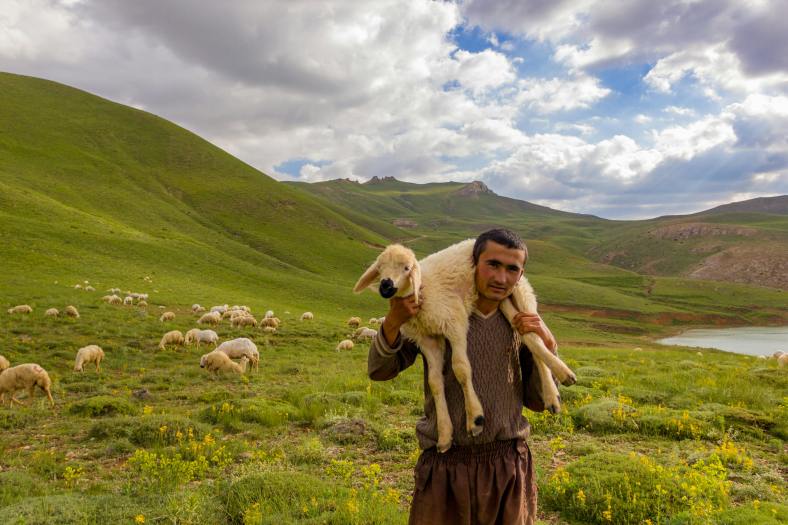
“Suppose a guy has a hundred sheep,” he said, “and one of them wanders off and gets lost.  “Won’t he leave the other ninety-nine in the wilderness to go search for the one that is lost until he finds it?  And when he finds it, he will joyfully carry it home on his shoulders.  And when he gets home, he will call all his friends and neighbors and say, ‘Rejoice with me because I have found my lost sheep!’  It’s like that.  There is more joy in heaven over one lost soul’s rescued life than over ninety-nine righteous people who don’t need rescuing.

“Or how about this—suppose a woman has ten silver coins on her necklace and she loses one.  Won’t she light a lamp and sweep the entire house and get down on her hands and knees to sweep under furniture and look in every nook and cranny until she finds it?  And when she does find it, she’ll call all her neighbors and friends and say, ‘Rejoice with me!  I’ve found my lost drachma!  It’s just like that!” said Jesus.  “There is joy and celebration among God’s angels when even one lost soul returns to God!”     

Now I am absolutely sure that some of the people listening to Jesus spin these hypotheticals were chuckling, and I am just as sure that some of them were scratching their heads because there is some obvious craziness in these little stories.  Leave ninety-nine sheep in the wilderness while you go off searching for one?  Who would do that?  And sheep don’t repent.  Coins don’t repent.  And is it really repentance?  The sheep didn’t do anything to help himself be found—he didn’t wander home all sheepish about being lost.  The silver coin didn’t roll itself across the floor to rejoin the other nine coins on the necklace. 

Or are these stories allegories maybe?  Is the shepherd God?  But does God leave ninety-nine obedient sheep at risk in the wilderness to go find the one that wandered off?  Maybe. But that does raise questions, especially if you’re one of the ninety-nine.  

So maybe God is like the reckless shepherd who puts everything at risk to find the one lost sheep.  Maybe God is like the woman who drops everything and lights a lamp and cleans house until she finds that one lost silver drachma.  Maybe.

Or maybe something else is going on here.  Sheep and coins don’t repent—at least not the way we usually understand repentance.  They don’t apologize.  They don’t have a change of mind or a change of heart.   

But what if Jesus is giving us a new definition of repentance?  What if repentance is not about clearing some kind of moral bar?  What if it’s not about moral rectitude or moral correction?  What if repentance is about being brought back to where you fit in God’s grand design, being brought back into the community and communion?  What if repentance is about crossing all those artificial barriers we put up between each other, those barriers that divide us into opposing camps?

Maybe repentance is about being brought back together.  Maybe it’s about reconnecting.[2]

That would explain this other thing.  Did you notice how many times Jesus mentions joy in these two little stories?  Five times!  The shepherd carries the sheep joyfully!  He calls out to his neighbors to rejoice with me!  Jesus says there is joy in heaven when a lost soul is reconnected with the community.  The woman who finds her lost coin calls out to her neighbors rejoice with me!  And once again, Jesus says there is joy in the presence of God’s angels when even one lost soul is reunited with companions.  It’s all about the joy!

Jesus wanted the Pharisees to understand that they were missing out on the joy!  He wanted them to understand that there is joy in making connections with people you might ordinarily be reluctant to associate with.  There is joy when we step out of our clique or private club of like-minded associates to go out and meet the wider world.  

Matt Harding is a guys who knows all about that joy.  

Matt was living the dream.  He was working as a Video Game Developer, creating new games for Activision, one of the biggest companies in the business.  He was kicking around ideas for a new game with his team one day, when somebody suggested, “Let’s do a ‘shoot-em-up’ game.  Those are very popular.”  Matt said sarcastically, “Sure.  How about Destroy all Humans?[3]  Matt was being facetious, but the boss liked the idea and gave the game a green light. And that’s when Matt quit.  “I didn’t want to spend two years of my life writing a game about killing everyone,” he said.  

Now Matt had time on his hands, and a fair bit of savings, so he decided to see the world. One day in Saigon, Matt was in kind of a goofy mood so he did this funny little dance in front of a restaurant, which his travel buddy caught on video.  It gave them a good laugh, so they decided that they would do this everywhere they were going on their trip around the world. 

When they got home, they cut together all these fun little clips to create a three minute video of Matt dancing in all kinds of interesting places all over the world.  And that would have been the end of it, except that Matt’s sister uploaded the video to this new thing on the internet called YouTube™.     

Dancing Matt became an internet phenomenon almost overnight.  So Matt decided to go out into the world and do it again, only this time he would invite people to dance with him.  And dance they did.  Over a period of about 15 years he recorded and posted six Dancing Matt videos which have brought joy to people all over the world.  You can find all of them at www.wheretheheckismatt.com

When NPR asked Matt what he had learned as he danced through the world, he said, “Here’s what I can report back: People want to feel connected to each other. They want to be heard and seen, and they’re curious to hear and see others from places far away.  

I share that impulse. It’s part of what drives me to travel.”

In her TED talk about Vulnerability, Brené Brown said, “A deep sense of love and belonging is an irreducible need of all people.  We are biologically, cognitively, physically, and spiritually wired to love, to be loved, and to belong.  When those needs are not met, we don’t function as we were meant to.  We break.  We fall apart.  We numb.  We ache.  We hurt others.  We get sick.”

Right now our country is in a grumbling mood…and so is much of the rest of the world. We are not functioning as we were meant to.  We have found too many ways to separate ourselves from each other.  We have turned too many people into “those people,” the ones we don’t want to be seen with.  As a result, we’re missing the joy.  We’re missing the celebration.

We need to repent, not with apologies or penance, but by reconnecting.  We need to find our way back into where we fit with each other in God’s grand design.  We need to find our way back into community and communion.  We need to bring ourselves back together.  And maybe even dance with strangers.  Because that’s where the joy is.


[1] CNN

[2] Special Thanks to Prof. Matt Skinner and Sermon Brainwave for this perspective.

[3] Destroy All Humans is in its 7th version and is available on multiple platforms.  Clearly there’s money in nihilism.

How Far Will You Go?

Luke 14:26-33

In the summer of 1972, when I was 19, my best friend, Mackay, and I decided that it would be all kinds of fun to ride our bicycles from Long Beach, California to Ensenada, Mexico.  And so one sunny morning in June, we set off pedaling down the Pacific Coast Highway with sleeping bags and a few other necessities strapped to our bikes. 

The miles flew by through Seal Beach, Huntington Beach and Newport Beach.  The hills of Laguna slowed us down a bit more than we had anticipated, but it was still too early for lunch when we reached San Clemente, so we decided to push on and have lunch in Oceanside.  But at the south end of San Clemente, we ran into a very big obstacle that we had not planned on.  Camp Pendleton Marine Base.  

We knew we wouldn’t be able to ride through Pendleton on the freeway, but we thought we could ride through the base on the old highway, which, according to our maps, still ran alongside the freeway.  The very nice Marine guard at the entrance to the base told us that that was not going to happen–  because the old highway was long gone.  

After some begging and pleading and a few choruses of “Gosh, We’ve Ridden All This Way,” he got on the phone and managed to get permission for us to ride through the base.   He sketched out a map for us and gave us very strict instructions to stay on the route he had outlined for us,  making it clear that straying off that route could have grave consequences, including but not limited to death, dismemberment or being imprisoned.  

An hour and a half later, we were utterly lost on a winding dirt road when a very perturbed Marine officer in a jeep came roaring up to us and asked us what the H-E-DOUBLE-Q we thought we were doing.  He also told us that we were perilously close to a live-fire range, then threatened to throw us in the stockade or make us enlist or both before finally deciding to guide us down to the southern end of the base.  He sent us off with a warning that if we ever set foot or bicycle tire on the base again there would be dire consequences unless, of course, we were in a Marine uniform.  

We had lost a lot of time on the confusing roads of Pendleton, so we powered through Oceanside and into San Diego without stopping for lunch.  Then came the ordeal of getting through San Diego on surface streets which proved to be far more complicated and took much longer than we had planned.  And just so you know, not even the military had GPS yet in those days, so we were at the mercy of outdated gas station roadmaps.  

The sun was getting ready to call it a day by the time we crossed the border into Tijuana.  We grabbed a couple of tacos from a taco cart then raced the sun for the last 14 miles to Rosarito Beach where we camped for the night.

The rest of the trip was pretty uneventful.  The ride from Rosarito to Ensenada on the old road up across the mountain—the only way bicycles were allowed to go—was a challenging but beautiful ride.  After a night in Ensenada, we turned around and headed for home.  

We spent the night at Rosarito Beach again, had a good breakfast at the cantina, then set out for the border.  We made good speed and got to Tijuana at about three in the afternoon which gave us plenty of time to make it to Silver Strand State Beach in San Diego where we were planning to pitch our tent for the night.

And that’s when we ran into another obstacle we hadn’t planned on.  There were three long lines of cars waiting to cross the border into California.  We rode our bikes up between the lines of cars to the state line expecting that the border guard would just wave us through—after all, where would a couple of guys on bicycles hide anything?   But the guard at the border wasn’t having it.  He gave us a lecture about trying to cut the line then told us to go all the way back to the end of the line.  Two hours later after standing in the heat astride our bicycles and breathing exhaust fumes from all the cars, we finally got back to the border where the same guard just waved us across without even asking for our I.D.   

At that point, we pulled over to the side of the road and took stock of where we were and what lay ahead of us.  We were exhausted, hot and sweaty.  Our legs were trembling and aching.  We didn’t even want to think about trying to get through Pendleton again.  What we wanted most was a good shower, a long, cold drink and a good meal. What we wanted was to be home.  

The bicycle ride that we had thought would be all kinds of fun had turned out to be all kinds of challenging.  Our stamina had evaporated in the exhaust fumes and unrelenting sunshine while we waited at the border.  We were fresh out of  possibility.  Our ride was over.  We made our way to the airport and, grateful for small miracles, managed to snag seats on a flight back to Long Beach.  

“Who would build a tower without first figuring out how much it’s going to cost?” asked Jesus.  “What king would go to war without first figuring out if he has a chance of winning?”  Who would ride a bicycle to Ensenada without making sure that they could actually get there and back?

Luke tells us that large crowds were traveling with Jesus as he made his way toward Jerusalem.  They had been watching him heal people.  They had been listening to him as he taught them about the kingdom of God and how radically different it is from the empire of Caesar.   The crowd was drawn to him.  They liked him.  They liked the different world he described, the better world that he told them is possible.  A lot of them were probably wondering what it might be like to be part of his inner circle—to be his disciple.

But there’s a big difference between being a fan and being a disciple.  

Jesus wanted to make it clear to the crowd that becoming a disciple means putting him and the kingdom of God first.  Jesus wanted them to understand that  becoming a disciple means you join him in making the kingdom of God, the commonwealth of God’s justice and kindness, a reality on earth as it is in heaven.  And Jesus wants us to understand that the other kingdoms of this world are going to resist you when you do that.  

The kingdom of family may be perfectly happy for you to be a fan of Jesus, even for you to embrace some of the things he teaches.  But they may not be so happy when you start giving away time and resources that they feel they have a claim to.  “Whoever comes to me and does not hate father and mother, wife and children, brothers and sisters, yes, and even life itself, cannot be my disciple,” said Jesus.  And no, he did not mean a disciple has to have some kind of intense animosity toward family, but he did mean that you, as a disciple, have to be willing to turn away from them, to let them go, when what they want is trying to pull you away from where Jesus is leading you.

The kingdoms, the empires of this world will resist you when you become a disciple of Jesus and set to work in earnest to make God’s reign a reality in your life and in the world.  

The kingdom of consumerism will sneer at you for not having the newest, shiniest, most fashionable, most advanced everything—clothes, gadgets, house, car or whatever when you, as a disciple of Jesus, learn to be satisfied with what you have and to give away what you don’t really need. 

The kingdom of capitalism will call you a socialist or maybe even a communist when you, as a disciple of Jesus, insist that those who have more should contribute to the well-being of those who have less.  When you remind them, as Jesus did, that God did not intend for the bountiful resources of the earth to enrich only a few, they will call you a radical and try to silence you.

The empire of power will oppose you when, as a disciple of Jesus, you stand up for the powerless, take the side of the marginalized and speak for the voiceless.  They will combat you when you  work to liberate the oppressed, fight for the dispossessed and lobby to set the captives free.  When you, as a disciple of Jesus, insist that all people are equal and beloved in God’s sight so the opportunities and benefits of life together in a civil society should be equal, too, regardless of race or gender or color or sexuality or country of origin.  They will call you a trouble-maker and try to put a stop to you…one way or another.

“Whoever does not carry the cross and follow me cannot be my disciple,” said Jesus, and those people in the crowd, especially the wannabe disciples, knew he wasn’t just using hyperbole.  They knew that the cross he was talking about wasn’t a metaphor.  He was telling them there would be a real cross with real nails and real pain…because when you try to establish the reign of God in the midst of the empire of coercive power, coercive power will try to stop you.  Brutally.  

If you want to be my disciple, says Jesus, then stop and think about what that might cost you.  There’s no shame if you can’t go that far.  There’s no shame if you just want to follow in the crowd and listen from a safer distance.  But you should know, eventually that won’t be enough.  

Eventually the Word of God will bring you to a place where either you will summon up the stamina and will to finish the ride… or call it quits.  Eventually either the vision of the kingdom of God will become all-consuming for you, or you will dismiss it as a nice but unobtainable ideal—or maybe some kind of prize in the afterlife if you are nice enough to qualify.

Traveling with Jesus sounds like all kinds of fun.  And it does have its rewards.  There are healings along the way.  He’s a marvelous teacher and the Way of life he envisions is beautiful.  He loves you and isn’t shy about making that known.   Jesus loves the crowd… but not everyone in the crowd is ready to go all the way to discipleship.  

Lots of people can ride a bicycle.  Comparatively few can ride it all the way to Ensenada and back.

How far will you go?

Entertaining Angels

Hebrews 13:1-2, 15-16; Luke 14:7-14

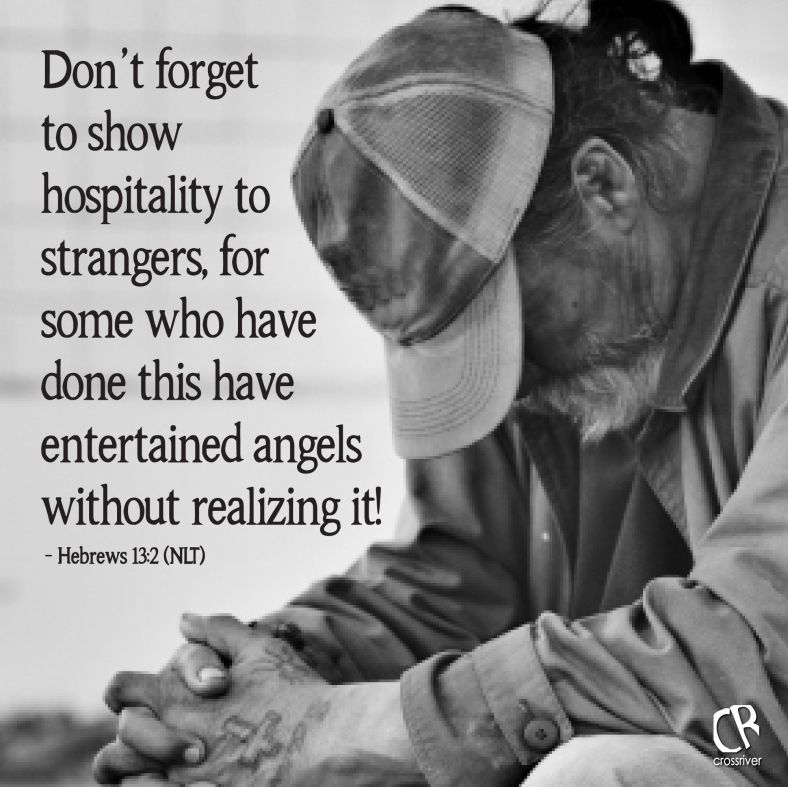
“Let mutual love continue.  Do not neglect to show hospitality to strangers, for by doing that some have entertained angels without knowing it.”  (Hebrews 13:1-2, NRSV)

“The next time you put on a dinner, don’t just invite your friends and family and rich neighbors, the kind of people who will return the favor.  Invite some people who never get invited out, the misfits from the wrong side of the tracks.”  (Luke 14:12, The Message)

Every time I read these texts I think of Eric.  Eric showed up one Sunday night when we were doing Stories, Songs and Supper at Gloria Dei Lutheran Church where I served as pastor for 12 years.  He stood at the church door and asked what was happening as he saw people gathering, greeting each other, laughing, and we told him, “It’s a thing we do called Stories, Songs, and Supper.  We share a meal then sing a bunch of old familiar songs, then someone tells a story, then we sing a little more.”  We invited him to come in and join us. So he did.

I was pretty sure he was unhoused, although to be fair, his clothes were neater and cleaner than most of the other unhoused people who came by the church.  Eric had a gift of gab and while we were eating he told us a bit about himself then told us that this dinner was special for him because it was his birthday.  So we all sang Happy Birthday to him.  After supper, he helped to clear the tables, then joined us in the sanctuary for the singing and storytelling.  

I was more than a little surprised when Eric showed up for our Adult Ed class the next Sunday morning and stayed for worship.  The following Saturday, he joined in with one of our small groups in the volunteer work we were doing with Lutheran Social Services.  

Eric kept showing up for just about everything we were doing at church and in almost no time he became an important part of our little family of faith at Gloria Dei.

 “Do not neglect to show hospitality to strangers,” Hebrews tells us, “for by doing that some have entertained angels without knowing it.”

Well,  Eric was no angel.  But then again, maybe he was.  In ancient times the word angelhad a double meaning.  It could refer to a supernatural being who served God, or it could simply mean a messenger.   Eric was, in and of himself, a message to us—a gift to us all at the little church with a big heart.

We learned a lot from Eric.  We learned a little about life on the streets.  We learned more than we wanted to know about our neighbors’ attitudes toward the unhoused.  We learned how the police and the justice system in our city respond to those who are experiencing homelessness.  We learned about our own attitudes toward those living rough.  Most of all, though, we experienced an energy and vitality that stayed with us for a long time after he left us.  All this because we welcomed one gregarious man into our party on his birthday.

“The next time you put on a dinner,” said Jesus,  “don’t just invite your friends and family and rich neighbors, the kind of people who will return the favor.  Invite some people who never get invited out, the misfits from the wrong side of the tracks.  You’ll be—and experience—a blessing. They won’t be able to return the favor, but the favor will be returned—oh, how it will be returned!—at the resurrection of God’s people.” (Luke 14:12-14, The Message

“You will be—and you will experience—a blessing.”  Eric taught us just how true that is.

Jesus loved sharing meals with people.  Think about all the stories in the gospels that involve eating!  Jesus distributed food to multitudes.  Jesus dined with Simon the Tanner and Zacchaeus.  And, of course, there was that last Passover meal with his disciples.  After the resurrection he broke bread with the Emmaus travelers and cooked fish on the beach for the disciples.  Jesus shared a table with Pharisees even though some Pharisees had criticized him for sharing a table with “the wrong kind of people.”  “This fellow eats with tax collectors and sinners!” they said. There are so many Jesus stories that revolve around eating that some have suggested that his primary work was organizing dinner parties.  

Sharing the table—issuing a wide and inclusive invitation—this was one of the ways Jesus embodied the commonwealth of God’s justice and kindness, the kin-dom of God. 

“The gospel,” said Rachel Held Evans, “doesn’t need a coalition devoted to keeping the wrong people out.  It needs a family of sinners, saved by grace, committed to tearing down the walls, throwing open the doors, and shouting, ‘Welcome!  There’s bread and wine.  Come eat with us and talk.’ This isn’t a kingdom for the worthy, it’s a kingdom for the hungry.”

In the earliest days of what we now think of as the Church, many—maybe most—groups of Jesus followers looked like and operated like dinner-party groups—they organized their fellowship and worship around sharing a table, and everyone brought what they could to the banquet.  We see hints of this in 1 Corinthians 11 when St. Paul chastises the Corinthians for bringing their divisions to the table, but even more sternly for failing to make sure that the have-nots were included in the celebration when the haves were feasting.

“When you meet together,” he wrote, “you are not really interested in the Lord’s Supper. For some of you hurry to eat your own meal without sharing with others. As a result, some go hungry while others get drunk.  What? Don’t you have your own homes for eating and drinking?  Or do you really want to disgrace God’s church and shame the poor? What am I supposed to say? Do you want me to praise you? Well, I certainly will not praise you for this!” (1 Cor 11:20-22, NLT)

The practice of early Christianity was centered around the table.  When it worked it was egalitarian, transformative, and beautiful.  When it didn’t, it descended into another bad example of classism.  But the evidence suggests that most of the time and in most places it worked.  

The table of Christ was the one place in their world where they were all equal.  It was the one place where it didn’t matter if you lived in a mansion or a shack or  sheltered under the eaves of the town hall.  It was the one place where it didn’t matter if you were a slave or a free person.  It was the one place where it didn’t matter if you were male or female—at least not in those earliest days of the Jesus communities.  

At the table of Christ, all were equal and all shared in what was brought to the supper—but most especially, all shared in the bread and the wine of Christ’s presence.

In his book The Forgotten Creed: Christianity’s Original Struggle against Bigotry, Slavery, and Sexism, Stephen J. Patterson has recovered what is believed to be the earliest baptismal creed of the Jesus movement:

“For you are all children of God in the Spirit.

There is no Jew or Greek,

there is no slave or free,

there is no male and female;

for you are all one in the Spirit.”

If that sounds familiar, it’s because St. Paul quotes this creed in his letter to the Galatians with a slight twist at the end.  Instead of saying “for you are all one in the Spirit,” Paul writes, “for you are all one in Christ Jesus.” (Galatians 3:28)

“The creed’s basic claim,” writes Patterson, “is that baptism exposes the follies by which most of us live, defined by the other, who we are not.  It declares the unreality of race, class, and gender: there is no Jew or Greek, no slave or free, no male and female.  We may not all be the same, but we are all one, each one a child of God.”  

In the weekly journal Journey With Jesus, Dan Clendenin described how his daughter’s friend wanted to invite everyone in her church to her wedding but the budget wouldn’t allow it.  So instead of having a fancy wedding meal for just a few family and close friends, they got the police to block off the main street in downtown Waco, Texas.  Guests danced in the streets and ate ice cream from a Baskin Robbins ice cream cart.  The wedding cake was under the gazebo in the park and they cut small pieces so everyone could get a taste.  The groom, a pastor, had worked a lot with unhoused people and many of them showed up for the wedding,  then helped to clean up the streets afterward.  The little African-American girl who lived next door to the bride brought her mother and her grandfather along to the wedding.  The grandfather quickly became the center of attention as he danced to the street music and soon the college girls were lining up to dance with him.  Passers-by strolling on the street were invited to join in the party.  And everyone was welcomed as an honored guest.

This is what the kingdom of God looks like.  A celebration that’s open to everyone.

It’s a family of sinners, saved by grace, tearing down the walls, throwing open the doors, and shouting, “Welcome!  There’s bread and wine.  Come eat with us and talk.

This is what the church of Jesus is supposed to be about:  radical hospitality.   

A kingdom for the hungry.

So let mutual love continue.  

And don’t forget to show hospitality to strangers.

Who knows… they just might be angels.

If Not Now, When?

Luke 13:10-17

Here’s a quick recap of today’s Gospel lesson.  One Sabbath day Jesus is teaching in the synagogue when he sees a woman who has been bent over double for 18 years.  Jesus calls her over to him and says, “Woman, you are released from your weakness.  He lays his hands on her, and instantly she stands up straight, and starts praising God.  But not everybody is happy about this. Now the leader of the synagogue is the one who is getting all bent out of shape.  He thinks healing and/or being healed on the Sabbath is a violation of the law.  “Now is not the time,” he says.  “Come back some other day.”

Why is it that no matter what good thing you’re doing or trying to do, somebody is going to get bent out of shape about it?

When the whole country was bent out of shape with the Great Depression of the 1930s, President Franklin D. Roosevelt tried to straighten things out with a whole package of programs called The New Deal.  This package included the Works Progress Administration to provide jobs in a country where 24.9% of the workforce was unemployed and those lucky enough to have kept their jobs had seen their income cut by 42.5%.  The New Deal package also included Social Security to provide a guaranteed minimum income for retired workers or those too disabled to work.  

The well-off people of Roosevelt’s own social class opposed the New Deal.  They said that it was Socialism and un-American.  They said that putting people to work with the WPA would put the government in competition with private industry.  Other critics, like Huey Long, said the New Deal  didn’t go far enough or do enough.  Voices from a number of quarters said it was too expensive for a country suffering through a depression.  “Now is not the time,” they said.

When President Dwight D. Eisenhower decided to champion the interstate highway system, his critics called it “another ascent into the stratosphere of New Deal jitterbug economics.”  People who were concerned about the stability of the post-war economy said that the country simply could not afford it.  “Now is not the time,” they said.

When President John F. Kennedy declared in his State of the Union address in 1962 that we were going to go to the moon and take on other ambitious goals “not because they are easy but because they are hard” and because they would “organize and measure the best of America’s energies and skills,” he summed up his challenge by asking, “If not now, then when?  If not us, then by whom?”

“If not now, when?  If not us, then who?”  

I can imagine Jesus saying that to the synagogue leader who is upset with him for healing the woman who had been bent over for 18 years by “a spirit of weakness.” 

“You hypocrites!” he says. “You’ll untie your donkey on the Sabbath, you’ll let your ox out of its stall on the Sabbath and lead it out for water, but you don’t think this daughter of Abraham,  your sister, should be released from her bondage on the Sabbath?  What, 18 years bent over in pain isn’t long enough for you?  Now is not the time?  Well, if not now, when?”

“This woman, a daughter of Abraham,” he said “has been held in bondage by Satan for eighteen years.  Isn’t it right that she be released, even on the Sabbath?”  

Held in bondage by Satan.  The implication of what Jesus was saying was that anyone who would oppose her being freed from the “spirit of weakness” that had been keeping her bent over would be collaborating with Satan.  

There’s something evil about prolonging someone’s pain when you have the means and opportunity to provide relief.  

There’s something evil about prolonging someone’s bondage when you have the means and opportunity to set them free.  

More than 100 million people in this country are now dealing with some degree of medical debt.[1]  Eighty percent[2] of those with medical debt had medical insurance when the debt was incurred but found that their insurance did not cover the expensive treatment, meds or procedures they needed.  An estimated 550,000 people will file for bankruptcy this year because of medical debt.[3]  And it’s about to get worse, far worse, because the Great Big Beautiful Bill that congress just passed guts Medicaid which was the medical insurance 72 million people in this country have relied on.  The Congressional Budget Office estimates that somewhere between 8 million and 24 million will lose their coverage either partially or entirely.  All of them will lose some financial security.  Some will lose their homes.  

This is what happens when we are all in bondage to a for-profit medical system.  But when we talk about Medicare for all or some other form of universal health care like the kind every other industrialized country in the world provides for their citizens, the insurance companies all say in unison, “We can’t afford it.  The economy won’t sustain it.  Now is not the time.”  

There’s something evil about prolonging someone’s pain when you have the means and opportunity to provide relief.  

There’s something evil about prolonging someone’s bondage when you have the means and opportunity to set them free.  

We seem to be perpetually caught between factions that want to bring healing to our over-heating planet and forces who are worried about the costs and the changes that would come with fixing the problems we have caused.   As we talk about funding new infrastructure for producing renewable energy, as we talk about ways to make more electric vehicles and make them more affordable so we can reduce the pollution that produces global warming and climate change, as we talk about creating more and better mass transit, there is a chorus of voices saying, “It’s too expensive.  The economy won’t support it.  The technology is not all there yet.  Now is not the time.”

When we talk about how we can address the lingering and malignant nastiness of racism, and antisemitism, we run headlong into people who want to remove the books and curricula that teach about these things from our libraries and schools.  They don’t want their children to feel bad about the way their forbears treated people who were different from themselves.  They don’t want their children to know about our legacy of slavery, and they really don’t want them to know how de-humanizing and violent slavery really was.  They don’t want them to know about Jim Crow laws and segregation.  They don’t want them to know about all the ways that racism is still making life difficult to impossible for people of color.  “They’re just children,” they say.  They’re too young to be exposed to those things.  Now is not the time.”  

Well if not now, when?  If they don’t learn about the ugly hate and violence of our shared past, how will our children know not to make the same horrible mistakes in the future?  How will they understand the hate and violence they still see today?  

And what about the Black children and Brown children and Jewish children and Muslim children who are still living with the challenge of all that racism.  The redlining may be gone on the map but the neighborhoods it created linger on along with their diminished opportunities and services and quality of life.  These children of God have been held in bondage for centuries.  Isn’t it right that they be released?  Isn’t it right that they be freed from the things that have bent their lives out of shape?  Isn’t it right that in the name of Jesus and in the name of our common humanity we should stretch out our hands and help them stand up straight…even on the Sabbath?  If not now, when?  If not us, then who?

How will our children understand how destructive and wrong it is to treat others as something less than human, something less than children of God, something less than their siblings in Christ if they don’t learn about it when they’re still young enough to have some empathy?  How will they understand the brokenness of the world they are inheriting from us if we don’t teach them about the mistakes we’ve made?

Yes, they will feel bad about it.  Yes, it will make them sad.  That’s the point.  That’s how they will be moved to do better.  

Those who don’t want to see us address racism and antisemitism and all the other destructive and violent isms that are tearing our country and our world apart try to disparage and belittle those of us who are trying to create awareness and change things for the better.  They try to dismiss us by saying we’re “woke.”  They say it like it’s a bad thing.  

Do you know what woke means?  It’s a term that originated in the Black community.  Woke means you are awakened to the needs of others.  Woke means you are well-informed, thoughtful, compassionate, humble and kind.  Woke means you are eager to make the world a better place for all people.  Woke means you are aware of the systems we live in and how they can produce unequal opportunities and outcomes.

Jesus told us to be woke.  He told us repeatedly to stay awake.  Jesus told us to read the signs of the times.  Jesus told us to pray for God’s reign of love and respect to become a reality on earth as it is in heaven.  

Jesus himself ran headlong into that all-too-human propensity to defend the status quo.  He was continually challenged by people who were upset because he didn’t play by the rules. “There are six days of the week for working.  Come on those days to be healed, not on the Sabbath.”  But Jesus didn’t think anyone should have to wait for healing or to be set free from bondage.  Not even on the Sabbath.

Today’s Gospel tells us that the things Jesus said to the synagogue leader shamed his enemies.  Nobody likes to be shamed.  But sometimes that’s what it takes to humble us.  Sometimes that’s what it takes for us to learn.  Sometimes that’s what it takes to wake us up.

There is so much that needs the healing, freeing and restoring touch of Christ in our world.  There are so many who need to be freed by the love of God.  When we follow Jesus, we are choosing to do these things “not because they are easy, but because they are hard.”  When we follow Jesus, we are choosing “to organize and measure the best of our energies and skills” for the healing of our relationships, our communities and our world.  When we follow Jesus we are choosing to let the shame of our history move us in a better direction, to follow a more generous and loving Way through our present time and into the future.  When we follow Jesus we are choosing to help a society that is bent out of shape to stand up straight.  

If not now, then when?  If not us, then who?


[1] Consumer Financial Protection Bureau, 2024

[2] Cornell ILR, Scheinman Institute

[3] Ibid

Burning Down The World

Luke 12:49-56

“I have come to throw fire upon the earth, and how I wish it were already ablaze!”  Wow!  This is not “Jesus meek and mild” talking.  This is Jesus under stress.  This is Jesus who sees the cross bearing down on him.  This is Jesus impatient with everyone misinterpreting and misunderstanding him or just plain being dense.  This is Jesus on fire!    

Where did that idea—Jesus meek and mild—where did that idea even come from anyway? Is Jesus gentle?  Often.  Is Jesus compassionate?  Absolutely.  Always.  But meek and mild?  Not in my Bible. 

“I came to set the world on fire and how I wish it was already blazing!”  From the very beginning of his ministry Jesus has been announcing that the kingdom of God, the Commonwealth of God’s justice and mercy, is arriving.  A new reality is breaking into the old world order.  

Jesus did not come to maintain or reinforce the status quo.  He came to show us the heart of God and to share God’s vision of the world as God intended it to be.  He came to transform the world by transforming us. 

Jesus knew that life would be difficult for those who choose to follow him.  He knew that living in the stream of God’s love, proclaiming the radical equality and openness of God’s kindness, freely offering mercy and forgiveness, standing up for the oppressed, speaking for the voiceless, standing in solidarity with the poor and marginalized—he knew that this would create friction in a world that operated by other standards.  He knew that sometimes that friction would begin at home.

Jesus was a realist— he knew that the alternate and better reality he was proclaiming, his Good News initiating the reign of God, was going to cause division— not because he was unclear about it, but because this fire of transformation was going to bring a never-ending cycle of change.  And most people don’t like change.  He knew that conflict would be inevitable because God was entrusting this world-transforming, never-ending mission to everyday human beings— to us— and even on our best days, even when we’re filled with and empowered by the Holy Spirit, even when we think we’re seeing and hearing Jesus as clearly as possible, we can and will find things argue about.  

The church started arguing when it was still basking in the warm afterglow of the flames of Pentecost. Peter argued with James about including Gentiles in the family of faith.  Paul and Peter butted heads over authority and practice.  Paul and Barnabas argued over whether or not John Mark could travel with them and ended up going their separate ways.  In Phillipi, an argument between two important women pastors, Euodia and Syntyche, threatened to sink the congregation so Paul had to plead with them in his letter to the Phillipians, “Please, because you belong to the Lord, settle your disagreement.”  

“Do you think that I have come to bring peace to the earth?” said Jesus. “No, I tell you, but rather division!”

Jesus was so prophetic when he talked about the ways we separate ourselves from each other but I wonder if he ever imagined just how divided we would become.  There are 40 different church bodies in North America, in the US and Canada, that call themselves Lutheran.  There are 45,000 church bodies in the world that call themselves Christian.  And all of them have separated themselves from some other church body at some point in history.  Honestly, I think this makes Jesus weep.

The vision of the kingdom is that we are supposed to build bigger tables, not higher walls.  We’re supposed to open our doors wider, not close them against people who disagree with us.  The message of Jesus is that we’re supposed to embrace each other with love, not take intransigent stands in opposition to each other because of the way we interpret the Eucharist or the way we baptize or how we translate a few things here and there.

Whenever we take our eyes off of Christ and start focusing on other, lesser things— whenever we let those other, lesser things become more important than living in the way of Jesus, we end up fighting and going our separate ways.  When we get heated up about doing the right rite rightly or deciding who is and who is not acceptable in the body of Christ, whenever we start to think that we know who God does and does not like, whenever we start to think that our way is the only right way to read the Bible— whenever we start to think that following Jesus is about preserving the good old days and the good old ways instead of opening the door to the new thing that the Holy Spirit is doing,  the fire between us can flare out of control and become divisive and destructive.  

“I have come to throw fire upon the earth, and how I wish it were already ablaze!” said Jesus.  Here in Southern California we are all too familiar with the destruction and devastation caused by fire.  We know all too well that fire can kill and destroy.  It can turn everything to ashes, soot, and pain. 

But fire can also bring us light and warmth.  Fire can clear the ground and enrich the soil to make way for new life.  There are trees who need fire for their seeds to germinate.  Fire can cleanse and refine and temper things.  

Martin Luther reminded us that “The Word of God comes, whenever it comes, to change and renew the world.” Jesus, the living Word of God, has thrown fire upon the earth, a fire of transformation that brings a never-ending cycle of change. Change can create tension if we’re not all changing in the same way or in the same direction, and tension can generate a lot of heat— but not always a lot of light.  

Change is going to continue because Christ has brought a transforming fire to the earth, a fire that has been burning for more than 2000 years.  For two millennia Jesus has been changing us and changing the world but we haven’t always handled it well.  When we align the story of our life together and the stories of our individual lives with the story of Christ, things move forward with light and warmth and energy.  When our stories diverge, the fire between us can burn us.

“Yet they meet as well as diverge, our stories and Christ’s,” said Frederick Buechner, “and even when they diverge, it is his they diverge from, so that by his absence as well as by his presence in our lives we know who he is and who we are and who we are not.

“We have it in us to be Christs to each other and maybe in some unimaginable way to God too — that’s what we have to tell finally. We have it in us to work miracles of love and healing as well as to have them worked upon us. We have it in us to bless with him and forgive with him and heal with him and once in a while maybe even to grieve with some measure of his grief at another’s pain and to rejoice with some measure of his rejoicing at another’s joy almost as if it were our own. And who knows but that in the end, by God’s mercy, the two stories will converge for good and all, and though we would never have had the courage or the faith or the wit to die for him any more than we have ever managed to live for him very well either, his story will come true in us at last. And in the meantime, this side of Paradise, it is our business (not like so many peddlers of God’s word but as men and women of sincerity) to speak with our hearts (which is what sincerity means) and to bear witness to, and live out of, and live toward, and live by, the true word of his holy story as it seeks to stammer itself forth through the holy stories of us all.”[1]

We align the story of our life together and the stories of our individual lives with the story of Jesus.  When all is said and done it’s important to remember that the story of Jesus is a love story.  He throws fire upon the earth to burn away everything that is not love, to clear the ground and enrich the soil so the seeds of love can germinate and we can grow into “little Christs” for each other.

If there must be fire between us, let it be the fire of love.

In the name of Jesus.


[1] A Room Called Remember; Frederick Buechner

Faith Without B.S. (Bogus Stuff)

Isaiah 1:1, 10-20; Genesis 15:1-6; Hebrews 11:1-4, 8-16; Luke 12:32-40

A pastor was just about to begin his sermon one Sunday when he was handed a note.  He unfolded the paper, looked at it a moment, then said to the congregation, “This says there will be no B.S. tomorrow.”  He paused for a long moment then said, “I’m pretty sure that means Bible Study, but I have to confess that for just a moment there I thought, ‘Oh, that would be nice.’”

Wouldn’t it be nice to have a day scheduled for no B.S.—no Bogus Stuff?  

In the alternate first reading for this morning from chapter one of Isaiah, Isaiah takes the people to task for their Bogus Stuff.  He tells the people quite plainly, “God doesn’t want your bull.”  Well, what he actually says is:  

10 Hear the word of the LORD, you rulers of Sodom!

Listen to the teaching of our God, you people of Gomorrah!

11 What to me is the multitude of your sacrifices? says the LORD;  I have had enough of burnt offerings of rams and the fat of fed beasts; I do not delight in the blood of bulls, or of lambs, or of goats. 

12   When you come to appear before me,  who asked this from your hand? Trample my courts no more.

13 Bringing offerings is futile; incense is an abomination to me. New moon and sabbath and calling of convocation— I cannot endure solemn assemblies with iniquity.

14 Your new moons and your appointed festivals my soul hates; they have become a burden to me, I am weary of bearing them.

15 When you stretch out your hands, I will hide my eyes from you; even though you make many prayers, I will not listen; your hands are full of blood.

Somewhere along the way, the people had substituted the practice of their religion for the ethics of their faith.  They had fallen into the habit of thinking that as long as they performed the right rituals and offered the right sacrifices, as long as they celebrated certain festivals and observed certain holy days in the calendar, then everything would be okay between them and God.  

But Isaiah tells them in plain language, “No.  God thinks all of that is B.S.  Bogus Stuff.  God doesn’t want your bull…or your ram or your goat.”  So what does God want?

Wash yourselves;” says Isaiah, “make yourselves clean; remove the evil of your doings from before my eyes; cease to do evil, learn to do good; seek justice, rescue the oppressed, defend the orphan, plead for the widow.”[1]

The texts assigned for today are all about faith.  They tell us what faith is and what it is not.  

Isaiah makes it clear that faith is not simply worship.  It is not liturgical worship or praise worship or any other form of worship.  Faith may move you to worship God.  Worship is one way to express your faith.  But it is not a substitute for faith.  And worship without faith is meaningless.

Faith is not mere belief.  Faith does not mean you accept or give your intellectual assent to certain propositions or truths about God, about Jesus, about the Holy Spirit.  Faith is not creeds or doctrine or dogma.  Those are tools that may help guide our faith in the same way a map can help you get somewhere you want to go.  But the map is not the journey.  It’s a depiction of the path others have traveled before you.   

So what is faith?

“Faith,” said Martin Luther, “is God’s work in us, that changes us and gives new birth from God… It kills the Old Adam and makes us completely different people.  It changes our hearts, our spirits, our thoughts and all our powers. It brings the Holy Spirit with it. Yes, it is a living, creative, active and powerful thing, this faith… Faith is a living, bold trust in God’s grace, so certain of God’s favor that it would risk death a thousand times trusting in it.”[2]

Faith is trusting God.  That’s Martin Luther’s definition. And that’s not always as easy as it sounds because God’s ways are not our ways and God’s timetable is certainly not our timetable.

Abram trusted God, but that didn’t stop him from complaining.  He had left his home in Ur to find a new homeland that God had promised.   Everywhere he went in the new land he prospered.  He acquired vast parcels of property.  His flocks increased.  Local kings respected and feared him so much that they tried to recruit him as an ally in their territorial wars.  He could have built his own city, but Abram continued to live in a tent because God had told him to keep moving.  But when  long years had passed and he and Sarah had not been blessed with children, Abram complained.

So God took Abram outside to look up into the night sky.  “Look up into the sky and count the stars if you can,” said God.  “If I can make that, do you really think giving you descendants will be a problem?”

Genesis tells us that Abram trusted God, and God regarded Abram as righteous because of his faith.

Faith is trust in God.  

When Jesus was on the road with his disciples announcing that the reign of God, the kin-dom of God is in reach, his followers started to worry about all the things one worries about in daily life.  Jesus turned to them and said, “A person is a fool to store up earthly wealth but not have a rich relationship with God.  That is why I tell you not to worry about everyday life—whether you have enough food to eat or enough clothes to wear. For life is more than food, and your body more than clothing.  Look at the ravens. They don’t plant or harvest or store food in barns, for God feeds them. And you are far more valuable to God than any birds!  Can all your worries add a single moment to your life?  And if worry can’t accomplish a little thing like that, what’s the use of worrying over bigger things?

    “Look at the lilies and how they grow. They don’t work or make their clothing, yet Solomon in all his glory was not dressed as beautifully as they are.  And if God cares so wonderfully for flowers that are here today and thrown into the fire tomorrow, he will certainly care for you. Why do you have so little faith?

   “So don’t be afraid, little flock.  For it gives your Father great happiness to give you the kingdom.”[3]

Faith is trusting God as we follow the Spirit-driven yearning of our hearts toward the better world that Jesus described for us.  It is trust that carries us through this in-between life—living between what life and the world are now and what we hope and dream life and the world will be as we work to transform them.  Faith is a holy restlessness.  A longing.  A hunger.  A desire.  Faith is not a destination, it is the road, the journey.

“Faith,” wrote Debi Thomas, “is the audacity to undertake a perilous journey simply because God asks us to — not because we know ahead of time where we’re going.  Faith is the itch and the ache that turns our faces towards the distant stars even on the cloudiest of nights.  Faith is the willingness to stretch out our imaginations and see new birth, new life, new joy — even when we feel withered and dead inside.  Faith is the urgency of the homeless for a true and lasting home — a home whose architect and builder is God.”[4]

Faith is a holy dissatisfaction with the world as it is.   Faith wants to tear down walls and build bigger tables.  Faith wants to open the doors wider so more can come to the feast.  Faith trusts that there will always be enough for everyone.  Faith trusts that Love is not diminished but multiplied when it’s shared.  Faith shows the reality of what we hope for; it is the evidence of things we cannot see except in our Spirit-inspired imaginations.

When we stand to recite the Creed on Sunday mornings, we begin with the words, “I believe, ” which is the common English translation of the Latin word Credo.  In his book The Heart of Christianity, the late Marcus Borg reminded us that Credo has a richer, deeper meaning than what we are typically thinking when we say, “I believe.” 

Credo does not mean ‘I hereby agree to the literal-factual truth of the following statements.’  Rather, its Latin roots combine to mean ‘I give my heart to.’ . . .As the giving of one’s heart, credo means ‘I commit my loyalty to,’ ‘I commit my allegiance to.’

  “Thus, when we say credo at the beginning of the Creed, we are saying, ‘I give my heart to God.’  And who is that?  Who is the God to whom we commit our loyalty and allegiance?  The rest of the creed tells the story of the one to whom we give our hearts: God as the maker of heaven and earth, God as known in Jesus, God as present in the Spirit. . . 

  “Most simply, ‘to believe’ means ‘to love.’  Indeed, the English words ‘believe’ and ‘belove’ are related.  What we believe is what we belove.  Faith is about beloving God.”

Faith is about trusting God, but more than that, faith is about loving God.  “The only way I know how to love God,” said Richard Rohr, “is to love what God loves.”

Jesus tells us to trust God, to love God, and to travel light.  He tells us to free ourselves from excess everything and give to those in need.  Where your treasure is, he says, that’s where your heart will be.  So, let your heart go out to all those other children of God in the world around you.  Love God.  And love your neighbor as you love yourself.  Be dressed for service.  Keep your lamps burning.  And be ready.  The kin-dom of God is so close…and we don’t want to let Bogus Stuff keep us from getting there.

Have no fear, little flock.  It is your Father’s great pleasure to give you the Kingdom.


[1] Isaiah 1:16-17

[2] An excerpt from “An Introduction to St. Paul’s Letter to the Romans,” Luther’s German Bible of 1522 by Martin Luther, 1483-1546

Translated by Rev. Robert E. Smith from DR. MARTIN LUTHER’S VERMISCHTE DEUTSCHE SCHRIFTEN. Johann K. Irmischer, ed. Vol. 63 Erlangen: Heyder and Zimmer, 1854), pp.124-125. [EA 63:124-125]

[3] Luke 12:22-32 (NLT)

[4] Debi Thomas, Called to Restlessness, Journey With JesusAugust 7, 2022