
Have you ever noticed how many things come in threes? Our constitution, for instance, give us a government of, by and for the people, with three balanced and equal branches, the executive, the legislative and the judicial. Well, they’re supposed to be balanced and equal.
Our lives depend on the environmental threesome of land, water and air. The plants that feed us are dependent on the trio of soil, rain and sunlight. Native Americans learned long ago to plant a triplet of crops together corn, beans and squash. They called them the Three Sisters because they worked together in a way that made all three healthier and more robust. The corn provided a natural pole for the beans to climb. The beans fixed nitrogen into the soil to fertilize the corn and squash, and the squash spread out its leaves and vines around the roots of the corn and beans to provide shade and preserve moisture in the soil.
Our planet is composed of three kinds of rock: igneous, sedimentary, and metamorphic and the elements that compose the stuff of the universe come to us in a triad of solid, liquid and gas. The nearly infinite variety of colors we see are all built from the three primary colors, red, blue and yellow.
We describe our passage through the day as a journey through morning, noon and night, and as we drive through the city streets our stopping and going is controlled by a troika of green, yellow and red lights. When we’re on the go, we often refuel with the gastronomic trinity of fast food—a burger, fries and a shake, then we decide who will pay the bill with a quick game of rock, paper, scissors.
When we relate to each other thoughtfully, we realize that the human person we’re conversing with is a complex triplex of intellect, physicality and emotion. Freud tells us that our psyches are a gordian knot of id, ego and superego. And in broader, more ancient terms we understand ourselves as body, mind and spirit.
Jesus told us that he is the Way, the Truth and the Life, and St. Paul told us that Faith, Hope and Love abide, which are the three things we need most as we confront the evil triad of greed, sexism and racism.
Aristotle said that everything that comes in threes is perfect. Omnes trium perfectum, a statement that may have had some influence on the bishops of the early Church who gathered at the Council of Nicaea.
Today is Trinity Sunday, the one day in the Church year dedicated to a doctrine, the first doctrine adopted by the Church, the doctrine that tells us that God the Father, Jesus Christ and the Holy Spirit exist eternally as three persons but also as one God. In his book, The Divine Dance, the Trinity and Your Transformation, Richard Rohr says that the Trinity is the fundamental reality of the universe, a perfect balance of union and differentiation, and a model for human relationships—God for us, God alongside us, God within us.
It’s not always easy to wrap our heads around this idea. Martin Luther once said that denying the Trinity might imperil your soul but trying to understand it could imperil your sanity. The truth is that the infinite God cannot be boxed into our very finite minds. The limitless God cannot be corralled by our limited understanding. “’Circling around’ is all we can do,” says Richard Rohr. “Our speaking of God is a search for similes, analogies, and metaphors. All theological language is an approximation, offered tentatively in holy awe. That’s the best human language can achieve. We can say, ‘It’s like—it’s similar to…,’ but we can never say, ‘It is…’ because we are in the realm of beyond, of transcendence, of mystery. And we must—absolutely must—maintain a fundamental humility before the Great Mystery. If we do not, religion always worships itself and its formulations and never God.”[1]
The Holy Trinity, the unity of the Father, the Son and the Holy Spirit, three distinct persons living as one God, is not a puzzle to be solved. It’s a mystery in which to immerse ourselves. Frederick Buechner described the Trinity as the Mystery beyond us, the Mystery among us, and the Mystery within us. You don’t solve mysteries, you explore them. You enter into them. You participate in them. Maybe instead of calling this day Trinity Sunday, we should call it Mystery Sunday.
Richard Rohr said that when something is a mystery, especially when it’s a God mystery, that doesn’t mean it can’t be understood, it means that it can be understood endlessly. There is always more to see. There is always more to relate to. There is always more to understand. There are always new steps in the dance.
And it is a dance—or at least that’s, historically, one of the best descriptions we’ve ever had of the Trinity. But how did we come to have the Doctrine of the Trinity in the first place? There is no passage in the Bible that specifically describes or defines God as Trinity, though there are some passages that hint at it. The closest we come to a full statement of Trinitarian theology is at the end of Matthew when Jesus tells his disciples to baptize new disciples in the name of the Father, the Son and the Holy Spirit. And St. Paul ends his second letter to the Corinthians with Trinitarian language when he says, “The grace of the Lord Jesus Christ, the love of God and the union of the Holy Spirit be with all of you.” As my colleague Heather Anne Thiessen once said, the Trinity isn’t spelled out in scripture, but it’s there in kit form.
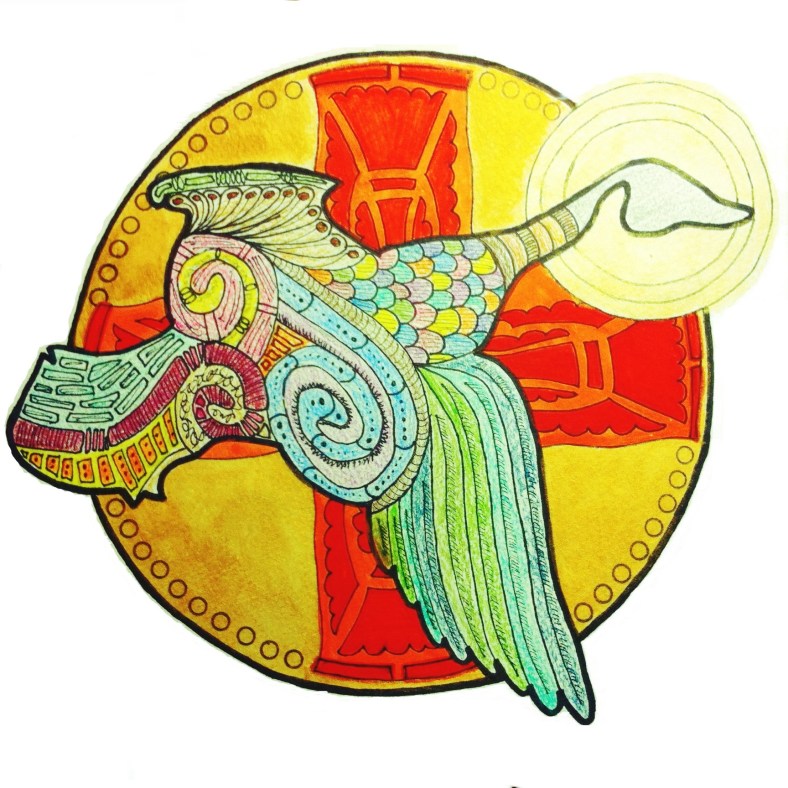
Early followers of Jesus had a problem. Like the Jews—and remember, the very first followers of Jesus were Jews—these early Jesus followers believed that there is only one God. But they also believed—or at least most of them did—that Jesus was divine and that he was somehow completely one with God whom he called Abba or Father. On top of that, they had received the Holy Spirit—the very breath of God, who they also experienced as a divine person because the Spirit often seemed to exist and act independently of Jesus and Abba. At the baptism of Jesus, though, all three seemed to have been present: Jesus coming up out of the water, the Spirit, descending in the form of a dove, and Abba, speaking like thunder. So how do you reconcile three divine persons but hang onto the idea that there is only one God?
Well, you don’t, said one group of Jesus people. These people were called Arians because the main proponent of their theology was Arius of Alexandria. The Father is God, said Arius. Jesus, the Son is a slightly lesser god. He was created by the Father in the first millisecond of creation and all his authority and power comes from the Father, but he is separate in substance and stature. And the Spirit is a slightly lesser god than Jesus, the Son, and also of an ever-so-slightly lower stature and substance. What the Arians were saying, more or less, is that there are really three gods and, while they are eternally united, the Father is the first and most important God, the one with all the power and authority.
Hang on a minute, said the Trinitarians. Jesus said, “The Father and I are one. You who have seen me have seen the Father.”[2] He also said, “All authority in heaven and on earth has been given to me.”[3] After the resurrection, Jesus breathed the Holy Spirit into the disciples. The Spirit is in his breath. It’s his Spirit that flows in us. When the prophets would say, “The Spirit of the Lord is upon me” they were talking about the Father’s Spirit. So, the Three have to be One. But they are also Three. And they are still One. Three persons, One God.
This disagreement the Trinitarians and the Arians had started to become violent and threatened to completely and irreparably divide the church which had only recently really begun to come together in a meaningful way. So 1700 years ago last month, in May of the year 325, the Emperor Constantine, who had recently declared himself to be a follower of Christ, decided that this question had to be settled for the good of the Church and the good of the empire. He called for a Council and ordered all the bishops to meet at Nicaea to debate the matter. After much argument, Constantine declared that the Trinitarians had won the debate and ordered the bishops to formulate an official statement to describe the Doctrine of the Trinity.
This was the very first official doctrine of the whole Church, by the way, and the bishops and presbyters argued heatedly over the words they would use. They argued about whether the Father and the Son were made of the same substance (as if anybody could possibly know that) and whether they had the same nature. They knew they were standing at the edge of an enormous Truth about God and they felt it was vitally important to get all the details exactly right even though there was no possible way for them to know or even see all the details. In some ways, they were like children who stand on the beach and think they can fully describe the breadth and depth and power of the ocean and all the life contained in it.
The bishops created the first draft of what we now know as the Nicene Creed and decided that adherence to this statement of faith would determine if someone was a true Christian or not. Ironically, their very useful insight about the all-loving, all-relating God who exists eternally in the expansive community and relationship of the Trinity led them to formulate a faith statement that would be used to exclude people from the community and the embrace of the Church.
The doctrine of the Trinity continued to confuse a lot of earnest Christians, and, truth be told, it was not universally accepted everywhere even though the Emperor had declared it to be the official stance of the church. For many people it was just too confusing to figure out how one plus one plus one could equal one. Fortunately, about 50 years after Nicaea, the Cappadocian Fathers, Basil, the bishop of Caesarea, his younger brother, Gregory, the bishop of Nyssa, and Gregory Nazianzen, the patriarch of Constantinople came up with a better description of how the three persons of the Trinity exist as one God.
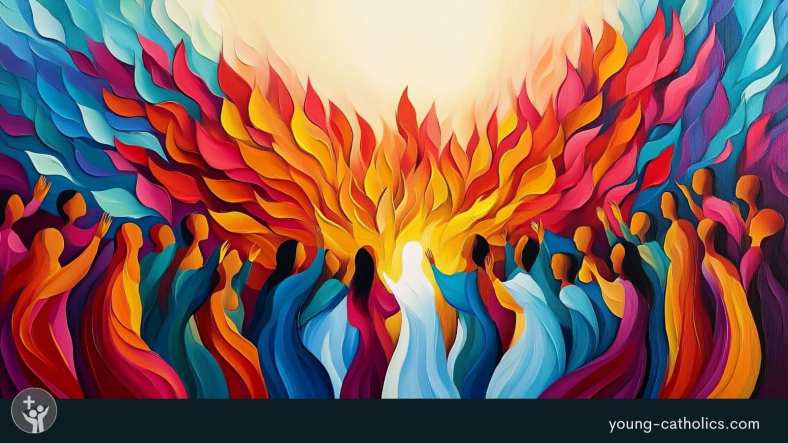
The model they used was a circle dance, and the fancy theological name they gave their idea is perichoresis, a Greek word which more or less literally means circle dance. The Father, the Son, and the Holy Spirit, they said, exist as one in an eternal circle dance of love. The Trinity is an eternal, joyful, radiant manifestation of love, loving, and being loved. The love that endlessly flows between, in and through the Father, Son and Holy Spirit creates and sustains the universe.
One of the beautiful things about this idea is that there is no hierarchy in it. The Father, Son and Holy Spirit are equal in their eternal love for each other and for their creation, which includes us. Another wonderful thing about this idea is that it describes God as always in motion. God as a verb, and not as a static noun, exists as an endless flow of love. But perhaps the most powerful thing about this idea, at least as far as we are concerned, is that we are invited into their dance. We are invited to participate in the endless flow of love, loving, and being loved. The Holy Spirit, who dwells within us, carries us into the loving embrace of the Father and the Son and invites us to learn the steps of the dance.
We are called to embody this trinitarian flow of love, loving and being loved to carry it out into the world, loving God, loving our neighbor and being humble and vulnerable enough to let ourselves be loved.
In the name of God the Father, in the authority and authenticity of Jesus, and in the power of the Spirit, we are called to practice in what the late Walter Brueggemann called prophetic imagination. As we are embraced by the wholeness and balance of the Trinity, we are called to speak out, to proclaim the inbreaking of the kingdom of God, to speak truth to power, and to live out God’s definition of goodness—to do justice and to love kindness and to walk humbly with God and with each other.
In his book Interrupting Silence: God’s Command to Speak Out, Walter Brueggeman said, “The church has a huge stake in breaking the silence, because the God of the Bible characteristically appears at the margins of established power arrangements, whether theological or socioeconomic and political.” He went on to say, “Since we now live in a society—and a world—that is fitfully drifting toward fascism, the breaking of silence is altogether urgent. In the institutional life of the church, moreover, the breaking of silence by the testimony of the gospel often means breaking the silence among those who have a determined stake in maintaining the status quo.”
We are called to remind the world that God is inherently just. God’s justice is inseparable from the love, kindness and grace that flows endlessly in the circle dance of the Three-in-One, and from the Triune God to us and through us. If we live in the trinitarian flow of love, loving and being loved, we cannot remain silent and inactive in a hurting world.
[1] Richard Rohr, The Divine Dance: The Trinity and Your Transformation
[2] John 10:30; John 14:9
[3] Matthew 28:18



 Thoughts Along the Way