The Light of Hope

The Light of Hope

Luke 21:25   

There will be signs in the sun, the moon, and the stars and on the earth distress among nations confused by the roaring of the sea and the waves.  People will faint from fear and foreboding of what is coming upon the world, for the powers of the heavens will be shaken.  Then they will see ‘the Son of Man coming in a cloud’ with power and great glory.  Now when these things begin to take place, stand up and raise your heads, because your redemption is drawing near.”

  Then he told them a parable: “Look at the fig tree and all the trees;  as soon as they sprout leaves you can see for yourselves and know that summer is already near.  So also, when you see these things taking place, you know that the kingdom of God is near.  Truly I tell you, this generation will not pass away until all things have taken place.  Heaven and earth will pass away, but my words will not pass away.

 “Be on guard so that your hearts are not weighed down with dissipation and drunkenness and the worries of this life and that day does not catch you unexpectedly,  like a trap. For it will come upon all who live on the face of the whole earth.  36 Be alert at all times, praying that you may have the strength to escape all these things that will take place and to stand before the Son of Man.”

Four years ago on the first Sunday in Advent, the Centers for Disease Control reported that 270,000 Americans had died from Covid 19.  That was 270,000 empty seats at the Thanksgiving table, enough people to fill every seat in Dodger Stadium five times.  By the end of December, that number had climbed to 350,831[1].  All in all, in the first four years of the pandemic more than 1.2 million Americans died.  Thanks to vaccines, increased awareness and improved health practices, only 43,360 people have died from Covid in the US this year.  But that is 43,000 reminders that the virus can still be a deadly threat.

Because of general economic disparity in our country, 47.4 million people live in households experiencing food insecurity.  17.9% of households with children under 18 were food insecure in 2024.  That’s actually a huge improvement over four years ago when 56% of such households were food insecure, but it still represents 14 million children who are at risk of going to bed hungry every night in a country that has more than enough resources to ensure that everyone has enough to eat.[2]  And sadly, it almost goes without saying that rates of food insecurity are higher  among people of color and in single-parent households headed by women.

Because of the high cost and shortage of housing, more than 25% of renters in California spend more than 50% of their income on housing, and more than 160,000 experience homelessness on any given night.

On the other side of the world, Israel’s war against Hamas has degenerated from a justifiable defense into genocide in Gaza and the violence has expanded into Lebanon.  Russia’s aggressive war against Ukraine has become more dire as Russia has deployed a new nuclear capable hypersonic missle.  

Turning back to home, here in the US we are living in a time of political tension and uncertainty which our recent election has exacerbated as we brace ourselves for what comes next.

In so many ways and for so many of us, this is a grim and precarious time.  The words of Isaiah ring in us like a bell:

O that you would tear open the heavens and come down,

          so that the mountains would quake at your presence—  

          When you did awesome deeds that we did not expect,

          you came down, the mountains quaked at your presence.[3]

Like the people of Israel in Isaiah’s day, we find ourselves crying out in fear and frustration.  O God, why won’t you do for us the kinds of things you did in the past?  Where’s our parting of the sea?  Where is our manna falling from the sky?   Where is our just and prophetic leadership?  Where is the “righteous Branch for David” that Jeremiah promised, the one who will “execute justice and righteousness in the land?”[4]

This feels like a grim and precarious time.  But then, it was a grim and precarious time for the people of Judah when Jeremiah spoke that promise.  It was a grim and precarious time when Isaiah begged God to break open the heavens and come down.  The people of the covenant were suffering under the harsh oppression of Babylon.  They wanted the same kind of divine intervention that so many of us are longing for right now.

It was a grim and precarious time when Jesus sat on the Mount of Olives and shared his apocalyptic vision of the temple’s destruction with his disciples. The people were chafing under the harsh and authoritarian governance of Rome.  And it was a grim and precarious time for Jesus, himself,  and for his disciples, even though at that moment the disciples seemed obtusely unaware of just how much danger they were facing.

As we read the story in the synoptic gospels of Mark, Matthew and Luke, Jesus is telling his disciples about the coming time of turmoil just days before Judas betrays him and he is crucified.  And it’s also a very perilous time when the writer of Mark, the earliest Gospel, records all this.  Biblical scholar Ched Myers has suggested that Mark was writing his account during the Jewish revolt against Rome, the rebellion that ended with the destruction of Jerusalem and the temple.  There is a haunting and prophetic prescience when Jesus says,

“But in those days, after that suffering,

         the sun will be darkened,

                  and the moon will not give its light, 

         and the stars will be falling from heaven,

                  and the powers in the heavens will be shaken.”

Luke expands on Mark’s words and broadens the reach of the calamity when he writes:

“There will be signs in the sun, the moon, and the stars and on the earth distress among nations confused by the roaring of the sea and the waves.  People will faint from fear and foreboding of what is coming upon the world, for the powers of the heavens will be shaken.   

These words of Jesus take on new weight on the first Sunday of Advent when you think of them being spoken during a time of violent political oppression, a time when any hint of opposition to the empire’s political or social order is quickly and decisively squashed.  These words have a sharper edge when you think of them being written down and preserved while the streets of the city are filled with the noise and bloodshed of battle between Roman soldiers and Jewish partisans, or when you think of the followers of Jesus being tortured and persecuted by the agents of the empire.  

Beware.  Stay alert.  Stay awake.  The advice Jesus gives is practical.  Keep your eyes open.  Don’t fall for false messiahs and conmen.  Don’t make yourself crazy trying to figure out God’s timetable because only God knows.  It’s going to be a bumpy ride.  There will be trying times.  Stay awake.

Advent is a time for pragmatism and preparation. 

Advent is a time to walk into the turmoil and the pain of life with your eyes wide open.  In an age and a season when it is all too easy to live in denial, when we would love to jump straight to Christmas, Advent calls us to take a hard look at the world around us.  Advent calls us to see the world as it really is, to see ourselves as we really are, to open our eyes to things that we maybe don’t want to see, to listen to things we might prefer not to hear.  Advent calls us to be realistic…about the world and about ourselves. 

In 1952, as the Korean War was dragging on and the Cold War between the United States and the Soviet Union was becoming more intense, William and Annabeth Gay wrote a haunting and profound hymn that, to my mind, perfectly captures the spirit of Advent for our age.  The title that Annabeth gave it is Carol of Hope, but you might know it by its first line which is how it’s titled In most hymnals, a line that sounds anything but hopeful:  Each Winter As the Year Grows Older.[5]

Each winter as the year grows older, 

we each grow older, too.  

The chill sets in a little colder; the verities we knew

seem shaken and untrue.

When race and class cry out for treason, 

when sirens call for war, 

they overshout the voice of reason and scream till we ignore

 all we held dear before.

Yet I believe beyond believing that life can spring from death,

that growth can flower from our grieving, 

that we can catch our breath

and turn transfixed by faith.

So even as the sun is turning to journey to the north,

the living flame, in secret burning, 

can kindle on the earth

and bring God’s love to birth.

O Child of ecstasy and sorrows, O Prince of peace and pain,

brighten today’s world by tomorrow’s,

renew our lives again;

Lord Jesus, come and reign!

Advent calls us to be realistic about the shadow side of life, to mark where we’ve not only grown older but colder, to notice where the verities we knew seem shaken and untrue.  Advent calls us to identify those voices that overshout the voice of reason so we can be more attentive to reason and to the Prince of peace and pain.  

But Advent doesn’t simply ask us to dwell in gloom and shadows.  Advent also calls us to bring light—four lights to restore brightness and health to a self, a nation, a world stumbling in murky clouds of doubt and fear—four lights to prepare the way for the true light of Christ. 

And the first light is Hope.

“Genuine hope is not blind optimism,” said Jürgen Moltmann.  “It is hope with open eyes, which sees the suffering and yet believes in the future.” And perhaps Barack Obama was thinking of Moltmann when he said, ““Hope is not blind optimism. It’s not ignoring the enormity of the task ahead or the roadblocks that stand in our path. It’s not sitting on the sidelines or shirking from a fight. Hope is that thing inside us that insists, despite all evidence to the contrary, that something better awaits us if we have the courage to reach for it, and to work for it, and to fight for it. Hope is the belief that destiny will not be written for us, but by us, by the men and women who are not content to settle for the world as it is, who have the courage to remake the world as it should be.”

Hope is that thing inside us that insists, despite all evidence to the contrary, that something better awaits us.

“The very least you can do in your life is figure out what you hope for,” wrote Barbara Kingsolver. “And the most you can do  is live inside that hope.  Not admire it from a distance but live right in it, under its roof.”[6]

On this first Sunday of Advent, as we begin a new year in the calendar of the Church, we light the candle of Hope.  If the sun is darkened and the moon will not give its light and the stars seem to be falling, light the candle of hope.

If we are suffering now because of politics and war and the erosion of truth and trust, Saint Paul reminds us that, “suffering produces endurance,  and endurance produces character, and character produces hope,  and hope does not disappoint us, because God’s love has been poured into our hearts through the Holy Spirit that has been given to us.”[7]  “If we hope for what we do not see,” he said, “we wait for it with patience.”[8]

So if it looks like the sun has been darkened and the moon won’t shine and the stars are falling and the world is more or less metaphorically ending, in the spirit of Advent, let’s be realistic and honest about it.  Let’s stay awake and aware.  And then let’s light a candle of Hope.  Because Hope is that thing inside us that insists, despite all evidence to the contrary, that something better awaits us.

May the God of hopefill you with all joy and peace in believing, so that you may abound in hopeby the power of the Holy Spirit.[9]


[1] CDC National Center for Health Statistics;  2020 Final Death Statistics: Covid 19 as an Underlying Cause of Death vs. contributing Cause

[2] Food Research and Action Center https://frac.org/news/usdafoodsecurityreportsept2024

[3] Isaiah 64:1-2

[4] Jeremiah 33:14-16

[5] Each Winter As the Year Grows Older, William Gay, 1920-2008;

  Tune: Carol of Hope, Annabeth Gay, 1925-2020;  Evangelical Lutheran Worship, #252

[6] Barbara Kingsolver, Animal Dreams

[7] Romans 5:4-5

[8] Romans 8:25

[9] Romans 15:13

…And the Life

John 11:1-45

If you look at a full moon when it’s rising, sometimes it looks much closer and larger than usual.  The curvature of the earth at the horizon seems to magnify it, and it may look yellowish or have a tinge of orange as its light is filtered through layers of moisture or dust or pollution in the atmosphere.  If you see it rise during the day, it may look illusory and distant, a faded disc projected against a fathomless blue sky.  If you see the full moon through a telescope, you suddenly see it as a world in its own right and not merely as Earth’s bright companion.  You see its long story spelled out in craters and mountain ridges.  Sharp outcroppings of rock hint at moments of violent upheaval and plains of dust speak of eons of silence and solitude.  But if you are holding the hand of someone you love as you watch the full moon rise, it looks like a different thing altogether.  It becomes a benevolent entity from heaven full or romance, mystery, and poetry riding across the field of stars just for you and your love.

Sometime reading the scriptures is like looking at the moon.  So much of what you see depends on where you stand,  who your reading companions are, what clouds you’re looking through and what lenses are clarifying or distorting your understanding, and what you’re looking for to begin with.  

I read two very well written and well-reasoned articles by noted scholars earlier this week that helped me see this familiar story of the raising of Lazarus in a new way.  These articles made a strong case that Lazarus was the actual author of the Gospel we know as John.[1]  That idea has had me reading this week’s gospel in a different light, reading it as if it might be a memoir.  

One of the things you notice when reading John is that for much of the gospel Jesus seems to be slightly aloof or distant.  As one scholar puts it, he seems to be walking two feet above the ground.  But when you get to chapter 11, suddenly everything is very down to earth and the emotions come spilling out.  This chapter has all the feels.  It’s not hard to imagine that this is Lazarus telling his own story.  

The story starts out with a certain distance, but it quickly becomes more immediate, more personal, more emotional.  The disciples were fearful about returning the Judea because they knew that there was a certain contingency among the Jewish elders who wanted to find a way to eliminate Jesus.  When Thomas says, “Let us also go, that we may die with him” it feels a bit like nervous bravado.   

We’re told that Lazarus has already been in the tomb for four days when Jesus finally arrives.  The Jews believed that the spirit stayed near the body for three days after death.  This is a way of telling us that Lazarus was well and truly dead.  This will be reinforced toward the end of the story when Jesus asks them to remove the stone that sealed the tomb.  Martha says, “Lord, there is already a stench because he’s been in there for four days!”  I love the way the King James version puts this:  “Lord, he stinketh!”

When Martha runs out to meet Jesus, the first thing she says to him sounds almost like an accusation: “Lord, if you had been here, my brother would not have died.”  Mary will say the same thing to him just a few verses later.

How many times have we felt that way?  

Where were you, Jesus?  Why weren’t you here when life was falling apart, when worse came to worst and everything went to hell in a handbasket?  What was so important that you couldn’t be here when we needed you most?  What kind of friend are you?  

When we are grieving, the littlest thing can trigger us to spill our pain all over everyone around us, especially on those closest to us.

“Jesus,” said Martha, “if you had been here my brother would not have died.”  But then she catches herself.  She takes a breath and says, “But even now I know that God will give you whatever you ask of him.”  Martha is hinting very broadly that she expects him to do something.  God will give you whatever you ask… so ask already!  That’s what’s hanging in the air.

But Jesus is reluctant.  “Your brother will rise again,” he says.  And it feels like he would maybe have preferred for things to stop right there.  It feels like he’s reluctant to say or promise anything more, as if he’s hesitant to promise any immediate relief for their grief.

Martha hears his reluctance but prods him further:  “I know that he will rise again in the resurrection on the last day.”  I know he’ll rise again.  Eventually.  Everybody knows that.  But her unspoken question is still hanging in the air:  I know he will rise again on the last day, but what are you going to do right now?”  And haven’t we all felt like that, too, when we’ve lost someone we love?

Jesus said to her, “I am the resurrection and the life. Those who believe in me, even though they die, will live, and everyone who lives and believes in me will never die. Do you believe this?”  She said to him, “Yes, Lord, I believe that you are the Christ, the Son of God, the one coming into the world.”

It’s important to say a word here about what it means to believe.  In our world, in our time, we often use the word believe as a synonym for think.  It tends to be a cerebral word for us.  But in their world and their time, it was a much more visceral word.  You believed things in your guts, not in your head.  The essential meaning was trust.  Jesus is saying, “Those who trust me to the depths of their guts, even if they die, they will still live, and those who live with that kind of trust in me will never die.”  And then he asks Martha, “Do you have that kind of visceral faith and trust in me?”  

When Martha says, “Yes, Lord, I believe that you are the Christ, the Son of God, the one coming into the world,” what she is saying is not, “Yes, I intellectually accept the idea that you have a unique relationship with God.”  What she is saying is, “Yes, I trust to the depth of my very being that you are the Christ, the Son of God, the one we’ve waited for throughout all of history.  That understanding of who you are, Jesus, is part of who I am.  It flows in my veins.”

When Mary came out to meet Jesus, she fell at his feet.  The NRSV says she knelt at his feet, but the Greek text is more emotional and expressive than that.  It says she fell at his feet.  Her grief is so acute that she collapses at his feet.  And she echoes Martha’s words.  If you had been here, my brother would not have died.

Jesus sees her weeping.  Jesus sees the people who came with her weeping.  And he gets caught up in their pain.  The Greek text says that he was deeply moved in his spirit and greatly distressed.  He was agitated.  He was a wreck.  He asked them where they had laid his friend to rest.  And then he began to weep.

Jesus wept.  Jesus wept because he loved his friend and felt the pain of his death.  Jesus wept for Mary and Martha’s pain and the grief of everyone around him.  Jesus wept for all the pain and loss we experience in the world.  Jesus wept out of frustration.  Jesus wept because he knew that restoring Lazarus to life would be the thing that would set his own painful death in motion.

When Jesus came to the tomb he was greatly agitated and disturbed.  The Greek word that’s used here, embriómenos, indicates an emotional mix of deep frustration and anger.  It’s another one of those deeply visceral words.

Jesus was angry at death.  Jesus was angry at loss and pain.

 He told them to take away the stone that sealed the tomb and then he prayed in a way that allowed those around him to listen in on his conversation with the Father.  “Father, I thank you for having heard me.  I know that you always hear me, but I have said this for the sake of the crowd standing here, so that they may believe that you sent me.”

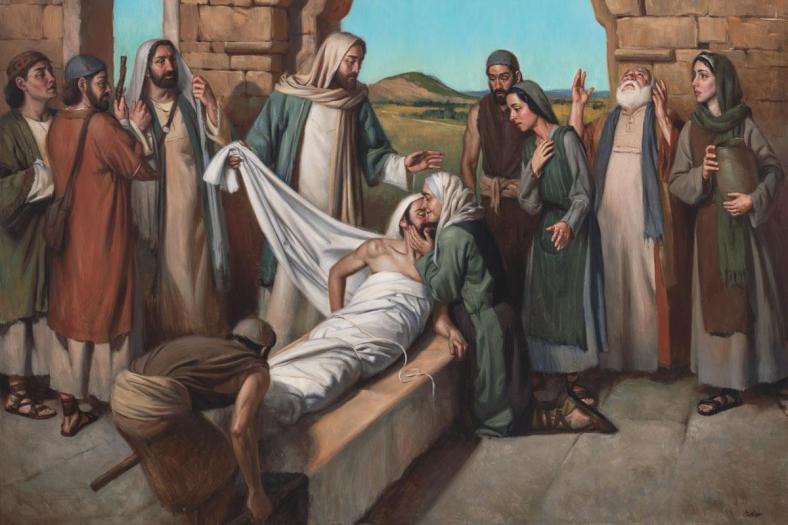
When he had said this, he cried with a loud voice, “Lazarus, come out!”  Lazarus came out, his hands and feet bound with strips of cloth and his face wrapped in a cloth. Jesus said to them, “Unbind him, and let him go.”

“I am the resurrection and the life,” said Jesus.  We tend to put the emphasis on resurrection, but the real promise is life.  Life in all its fullness.  Life eternal.

“In him was life, and that life was the light of all humanity.” (1:4)  Jesus, the light of the world, called Lazarus out of the darkness of death and into the light of life.  In chapter 10, the chapter that leads into this story,  Jesus said, “My sheep hear my voice.  I know them, and they follow me.”  Lazarus heard the voice of the Good Shepherd and followed him out of death into life. 

When we weep, Jesus weeps with us.  But weeping is not the end of the story.  Ever.  The Good shepherd calls us out of death and into life in all its fullness.


[1] http://benwitherington.blogspot.com/2007/01/was-lazarus-beloved-disciple.html

While There Is Still Time

1 Kings 17:17-24; Acts 9:36-42; Luke 7:11-17

“What if you wake up some day, and you’re 65 or 75, and you never got your memoir or novel written; or you didn’t go swimming in warm pools and oceans all those years because your thighs were jiggly and you had a nice big comfortable tummy; and you were just so strung out on perfectionism and people-pleasing that you forgot to have a big juicy creative life of imagination and radical silliness and staring off into space like when you were a kid?  It’s going to break your heart.”  That arresting thought is from Anne Lamott who has an uncanny way of getting right to the heart of things.

In our traditional Confession of Sin we confess that we have sinned by things we’ve done and by things left undone.  I’ve been thinking a lot this week about things left undone.  I’ve got a list as long as my arm.  I’ve been thinking about things undone because it was brought home to me this week in the starkest way possible that we have no guarantees about being able to get to it later—that thing we really want or need to do or say.

When I opened A Women’s Lectionary on Monday morning to take my first look at the texts assigned for today, the 7th Sunday after Epiphany,  my heart sank a little.  I suppose that’s a strange reaction to three stories about resurrection, three stories about someone being raised from the dead, but honestly, it just felt like the Holy Spirit was getting all up in my face.  Mocking me a little, even.  

Here’s the thing—I had just learned on Saturday that Joe, one of my oldest and closest friends, was on hospice care.  His Significant Other, Allison, had contacted me with this news, and asked me if I could come see him and pray with him while there was still time. 

While there was still time.

On Monday morning Allison suggested that 3 o’clock would be a good time to come see Joe.   That left me with several hours to fill so I turned my attention back to the texts for Sunday.  But I couldn’t concentrate.  It felt so incongruous to be thinking about biblical accounts of resurrection while at the same time trying to prepare myself mentally and spiritually to anoint my friend and pray for him as he passed from life into life.  

Over the years, I have stood in the room with Death more times than I can remember.  It’s part of what we do as pastors.  We accompany people to the door between this life and life eternal.  We give them a last anointing to remind them that they are in God’s protective care and if they’re able to receive it, one last taste of the eucharist to remind them that they are part of the communion of saints on both sides of that door.  More often than you might think, we give them permission to let go, to fall upward and outward into the grace of God and the beauty of what comes next.  

I deeply trust the promises of our faith.  I deeply trust that, as St. Paul said, if we have been united with Jesus Christ in a death like his then we will certainly be united with him in a resurrection like his. (Romans 6:2).  I trust what Paul says in Romans 8—that the law of the Spirit of life in Christ Jesus has set us free from the law of sin and death, and that nothing can separate us from the love of God in Christ Jesus our Lord.  I believe that life is eternal and love is immortal and death is only a horizon at the limit of our sight.  I believe that death is not the end of the story, but rather the opening of a new chapter in a far more amazing story.  I deeply believe these things, so I’ve always been able to stand in the presence of death with my pastoral tools and a certain degree of confidence.

This time, though, was different.  This time it was Joe, my long-time friend who was dying, my friend with whom I had worked in the recording studio as we produced commercials and jingles and even a recorded version of the Bible in those years before I became a pastor.  This time it was Joe who, because he was my friend, drove long miles from Huntington Beach to Riverside every Sunday for four years to play keyboards for our little start-up congregation.  This time it was Joe, who had performed with me and others in our impromptu band and with whom I had had deeply personal conversations over the course of decades.  

As I stood there beside his bed and anointed him for the journey we will all eventually take, I felt the poverty of my words and a profound sense of loss.  I began to realize that, while Joe was about to enter another dimension of life altogether, I was about to enter a world without him in it.  He wouldn’t be there for long lunches of fish tacos and conversation.  He wouldn’t be only a phone call away anymore.  I began to feel the space of him, the shape of the place he held in my life, and I know it was like that for everyone else who was in the room as he died.

Richard Rohr has said that “to hold the full mystery of life is always to endure its other half, which is the equal mystery of death and doubt.  To know anything fully is always to hold that part of it which is still mysterious and unknowable.”  I could tell you that after forty plus years as friends I knew Joe well, but honestly, there is always more to know.  There is always more to know about each and every one of us.  We participate in the life and love of God, so there is no bottom to that well that is Joe.  Or you.  Or me.

We place so much emphasis on trying to understand things…and people.  It’s one way we try to protect ourselves from pain and disruption.  The truth is, though, that some of the most important things in life are mysterious and unknowable.  They can only be experienced.  The great mysteries—life, death, love, God, our own souls, friendship—these are things that go beyond understanding.  They are mysteries that must be entered into, embraced, endured, journeyed through, carried, danced with, and wrestled with, all the while knowing that our understanding of these things will always be partial at best.  Now we see dimly. 

These mysteries are our teachers.  Death, in particular, can teach us more about the value of life and love and our need for each other than anything else. 

And in an odd way, that brings us back to the three resurrection stories in this week’s readings.  The thing each of these resurrection stories have in common is that the dead person was raised back to life for the benefit of someone else.  That applies to every resurrection story in the Bible, by the way, including the resurrection of Jesus.  The dead person is raised for the benefit of others.  That means that these stories are all about God’s compassion for those who are left behind. 

For the widow of Zarephath in 1 Kings who had been allowing the prophet Elijah to stay in her home, her son was her social security.  It would be his duty to provide for her in her old age, and without him she might become destitute.  That’s just how the world worked in those days.  The same thing holds true for the widow in Nain in the gospel of Luke.  When Jesus raised her dead son to life, he was actually saving two lives.   

The raising of Tabitha in the Book of Acts is a little different, but it’s still a story of someone being raised for the benefit of others.  The text tells us that Tabitha “was abundant in good works and benevolent giving.”  She was a woman of means and her little Christian community in Joppa depended on her generosity.  When Peter restored her to life, he was also restoring the community that depended on her.

We don’t always realize how dependent we are on each other.  “Don’t it always seem to go that you don’t know what you’ve got ‘til it’s gone?”

“You will lose someone you can’t live without, and your heart will be badly broken,” said Anne Lamott, “and the bad news is that you never completely get over the loss of your beloved.  But this is also the good news.  They live forever in your broken heart that doesn’t seal back up.  And you come through.  It’s like having a broken leg that never completely heals perfectly—that still hurts when the weather gets cold, but you learn to dance with the limp.”  

We all will go through that kind of loss at one time or another if we haven’t already.  We all, if we’ve loved at all well, learn to dance with a limp.  But more importantly, we learn to lean on each other and support each other as we walk each other home.  

Death is never very far away.  But God’s compassion is always right there embracing us.  If we’re even half awake, Death teaches us to really appreciate life—our own lives and everyone else’s.  That’s grace.  Death tells us to use the time while we have it,  to go ahead and go swimming in warm pools and oceans, to dive in and have a big juicy creative life of imagination and radical silliness and staring off into space.  Death reminds us that Christ has given us life in all its fullness and the promise of resurrection.  And each other.  Christ has given us each other.  Death is telling us to do the loving things not yet done and say the loving things not yet said.  While there is still time.