Have you noticed that the Church calendar and the secular calendar often seem to be at odds with each other? The secular calendar flat-out ignores some rather important Church holidays. You don’t see many Ash Wednesday greeting cards in the store. And nobody’s playing Maundy Thursday carols for weeks before that important day. I’ve never seen a Pentecost Fireworks display. I mean, that one would be a natural, wouldn’t you think?
Even when the secular calendar does tip its metaphorical hat to Church festivals it does so in a decidedly worldly way. St. Patrick’s Day could be a terrific day to ponder Celtic Spirituality but its sacred possibilities have been paraded out of awareness and drowned in a flood of green beer. All Hallows Eve would be very meaningful as a meditative pause to reflect on what we’ve learned and what we have been given by the faithful who came before us, but that singular opportunity was long ago surrendered to the immensely popular pagan festival and Halloween has never missed a trick or treat since.
Christmas and Easter are the most prominent stars of the Church calendar, of course, but between Santa Claus, the Grinch, Rudolph and the Easter Bunny the not-Church culture sometimes seems to have forgotten the origins of these beloved holidays. In our secular society the Miracle on 34th Street has eclipsed the Miracle in Bethlehem. So it goes.
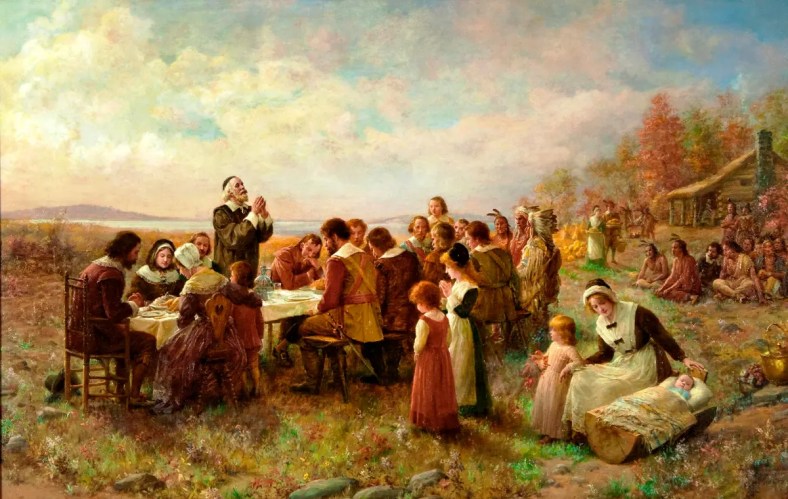
There is one holiday, however, where things were turned the other way around, sort of—a secular holiday that was given a patently religious backstory. Thanksgiving.
The traditional Thanksgiving story that we all learned as kids told of the grateful, faithful Christian Pilgrims who took a day to share a feast with their Native American friends whose good will and knowledge of this strange new land had helped them survive a harsh first year. That story anchored the day in faith, cooperation and good will. All good things.
Unfortunately, that pious story was, like so many things we learned when we were younger…embellished. A lot. The Pilgrims did hold a 3-day gathering to celebrate a successful harvest in the Fall of 1621, and they did invite a few friendly members of the Wampanoag tribe to join them.
In the 1830s the idea for a Fall feast of Thanksgiving became popular throughout New England, and organizers reframed the Pilgrim gathering of 1621 as a precedent for a broader observance and celebration. Those same organizers borrowed the name “Thanksgiving” from a proclamation by John Winthrop, the governor of the Massachusetts Bay Colony, who proclaimed a Day of Thanksgiving in 1637 to celebrate the Mystic Massacre, in which English colonists and allied Native forces attacked and burned a Pequot village, resulting in the deaths and enslavement of hundreds of Pequot men, women, and children. That’s why, in 1970, Native American leaders designated Thanksgiving as a National Day of Mourning for indigenous peoples.
As long as we’re deconstructing popular history here, we should probably also note, for what it’s worth, that the Plymouth Rock Pilgrims did not come to the New World for religious freedom. They had that in Holland. They came here to establish a theocracy in which there was a lot of religion but not much personal freedom. They were staunch Calvinist Separatists, after all. Heavy on the staunch.
But don’t let all this debunking unstuff your turkey. Thanksgiving is still a good idea. A GREAT idea. Abraham Lincoln certainly thought so. That’s why he declared it a national holiday in 1863.
It’s a good thing for us to take a day to remind ourselves about the power of gratitude. It’s a good thing to take a day to remember all the ways that God has been good to us. It’s a good thing to take a day to simply be thankful that we have survived another year, even if it’s been a tough year. God is good and the stories of our own lives remind us of God’s goodness when we take time to reflect on them.
“Gratitude unlocks the fullness of life,” said Melody Beattie. “It turns what we have into enough, and more. It turns denial into acceptance, chaos to order, confusion to clarity. It can turn a meal into a feast, a house into a home, a stranger into a friend.”
David Steindl-Rast, the Benedictine monk who founded Grateful.org said, “Everything is a gift. The degree to which we are awake to this truth is a measure of our gratefulness, and gratefulness is a measure of our aliveness.”
In her book Grateful: the Subversive Practice of Giving Thanks, Diana Butler Bass wrote, “Gratitude is resilience of sorts, the defiance of kindness in the face of anger, of connection in the face of division, and of hope in the face of fear…Gratitude empowers us. It makes joy and love possible.”
“Gratitude is not about stuff,” she continued. “Gratitude is the emotional response to the surprise of our very existence, to sensing that inner light and realizing the astonishing sacred, social, and scientific events that brought each one of us into being. We cry out like the psalmist, ‘I am fearfully and wonderfully made!’
“Gratitude is, however, more than just an emotion,” she went on to say. “It is also a disposition that can be chosen and cultivated, an outlook toward life that manifests itself in actions—it is an ethic.”
Anne Lamott is a little more plainspoken about gratitude in her book Help, Thanks, Wow: The Three Essential Prayers. “Gratitude” she writes, “begins in our hearts and then dovetails into behavior. It almost always makes you willing to be of service, which is where the joy resides. It means that you are willing to stop being such a jerk. When you are aware of all that has been given to you, in your lifetime and the past few days, it is hard not to be humbled, and pleased to give back.”
“Most humbling of all,” she writes, “is to comprehend the lifesaving gift that your pit crew of people has been for you, and all the experiences you have shared, the journeys together, the collaborations, births and deaths, divorces, rehab, and vacations, the solidarity you have shown one another. Every so often you realize that without all of them, your life would be barren and pathetic. It would be Death of a Salesman, though with e-mail and texting.”
“Giving thanks,” said Garrison Keillor, “is the key to happiness.”
In my own experience, I’ve learned that grateful people tend to be friendlier and kinder people. So by all means let us be thankful. “Enter his gates with thanksgiving, and his courts with praise. Give thanks to God, bless his name,” says the Psalmist (100:4). It’s a wonderful way to end the Church year and begin a new one. Because gratitude unlocks the fullness of life. And being thankful is the key to happiness.



 Thoughts Along the Way