What Does Love Look Like?

John 12:1-8

Love does a lot of hard work.  What I mean is that our English word, love, carries a heavy load and covers a lot of territory that ranges from a fondness for things and persons to deep attachment to ideas and ideals.  We talk of love to describe emotions ranging from infatuation and romance to the bonds of commitment in marriage.  We use the word love to talk about our family relationships and our favorite sports teams.  We talk about books and movies and songs we love.  We say we love our country to declare our patriotism.  

We talk a lot about love in the church, which is appropriate since the word loveappears 185 times in the New Testament.  That’s just over a third of the 540 references to love in the entire Bible.  John 3:16 tells us that Jesus was given to the world as a gift of God’s love.  Jesus commanded us to love each other and also told us to love our enemies.  He affirmed that the greatest commandment is to love God with all our heart, soul, mind and strength and to love our neighbor as ourselves.  He told us that people would recognize us as his disciples by our love for one another.  And he said there was no greater love than to give up your life for your friends.

As I said, our English word love covers a lot of territory, which makes it vulnerable to misuse and misinterpretation.  The New Testament, however, was originally written in Greek, a language that has four different words for love, each one with its own sphere of meaning, but the New Testament only uses two of those words.  

Philos describes a friendship love, a deep bond of affection characterized by mutual respect, shared interests and companionship.  Philos (philei) is the word used in John 16:27 when Jesus says, “The Father himself loves you because you have loved me.”  God has befriended us because we befriended Jesus.  Philos is the love word Paul uses in Romans 12:10 when he writes, “Love one another with mutual affection.”

The New Testament use of Philos, or Phileo in its verb form, is a reminder that part of our call as followers of Christ is to befriend each other and live together in a deep bond of friendship.  Philos is an important kind of love. But the most commonly used Greek New Testament word for love is agape.  

Agape is the highest form of love.  It is a pure, selfless, unconditional love that desires the highest good for another. This is the love St. Paul is talking about in 1 Corinthians 13 when he writes, “Love is patient.  Love is kind. Love is not envious or boastful or arrogant.  It does not insist on its own way.”  And so on.  Agape is the love word Jesus uses when he gives us a new commandment to love one another, and it’s the word the writer of 1 John uses to tell us that God is love.

It’s interesting to think about these different words for love and it’s useful to note which word is being used when we try to more fully understand something we’re reading in the Bible.  But no matter which word you use, unless we embody it, love remains just an intellectual exercise or an immaterial emotion.  Love, to be real,  must be enacted.  

God is love—the most powerful and creative force in the universe.  Ilia Delio, a Franciscan theologian and evolutionary biologist wrote, “Divine love exists when God becomes God within us—it is a potential energy that must be activated to demonstrate its power.”  

God is love, a pure, selfless, unconditional love that desires the highest good for us and for all of creation, a potential energy that must be activated in us to demonstrate its power.  Love must be embodied to activate its power.  But what does that look like?

Six days before the Passover, Jesus and his disciples came to Bethany to dine at the home of Lazarus, Mary and Martha.  While they were dining, Mary began to anoint Jesus’s feet with a very expensive aromatic oil made from spikenard.  She not only massaged the ointment into his tired feet, she dried his feet with her hair.  

This is one of the most evocative and sensual moments in the whole Bible.  And it’s also a very clear depiction of what embodied love looks like.  

This scene in the Gospel of John engages all our senses.  The soothing balm of the ointment being lovingly and gently massaged into the skin of Jesus’s feet by tender and sensitive hands. The silken touch of Mary’s long, dark hair caressing his feet as she dries them.  And the aroma.  The fragrance, John tells us, filled the house—the fragrance of spikenard.  Earthy.  Spicy.  Musky.  Soothing. Hypnotic.  In ancient times, the scent of spikenard was used as aromatherapy to dispel anxiety and stress.  It was even used to treat melancholia—what we call depression.  The ancients believed that it’s scent could transport you out of your thoughts or worries or sadness into a state of tranquility, peace and well-being.

When Mary rubbed this exotic, expensive ointment onto Jesus’s feet, her lovely, extravagant act of devotion, kindness and love was probably exactly what Jesus needed at that moment.  The tender massaging of his feet after so many, many months of walking the stony and dusty roads of Galilee, the Decapolis, and Judah probably felt like a little bit of heaven.  After all the road-weary days and nights surrounded by sweaty disciples and jostling crowds the soothing fragrance that was filling every corner of the house was probably the nicest aroma he had smelled in a very long time.  That moment of just plain niceness as Mary focused all her attention on doing something pleasant for him, something that would speak her love for him better than any words—that moment would be the last time anyone showed him kindness and concern for his wellbeing.  It was his last moment of peace, intimacy and tenderness before his crucifixion.  

Sadly, that moment was interrupted.  

“Why wasn’t this ointment sold and the money given to the poor?” asked Judas. “This stuff is worth what…three hundred denarii?  That’s the better part of a year’s wages for a laborer.  There are better ways to use that much money than slathering it on his feet.”

Judas comes across as one of those people who know the price of everything and the value of nothing.  The Gospel of John tells us that he wasn’t really concerned about the poor at all but was angling for a way to get some of that cash into his own pockets.  And maybe that’s true.  But to be fair, spikenard ointment really was very, very expensive.  It’s made from a plant in the honeysuckle family that grows in the Himalayas of Nepal, India and China.  It was costly to make it and even more costly to transport it.

All four gospels tell the story of this deeply personal encounter, but they tell it in different ways and different settings.  One thing that all versions of this story have in common, though, is that someone is indignant about the attention and the expense being lavished on Jesus.  In Matthew and Mark, it’s all the disciples who complain about the expense of the ointment.  All of them chime in about how the money could have been given to the poor.  “Why was this ointment wasted in this way?” they say in Mark.  “Why this waste?” in Matthew.

Waste.  Her extravagant care for Jesus, her loving attention—they see it as a waste.    

Why is it that some of us are so uncomfortable with extravagant expressions of love and devotion?  What is it about moments of intimate caring that gets some of us up on our high horse and turns us into critics?  

I don’t usually quote Friedrich Nietzsche, but there is something he wrote that seems particularly appropriate here.  He said, “The certain prospect of death could sweeten every life with a precious and fragrant drop of levity.”

Mary had bought this expensive ointment to anoint Jesus’s body after his death.  But she loved him so much that she couldn’t bear the thought that he wouldn’t get to experience its healing and soothing properties while he was still alive. So she opened the alabaster jar and anointed him with it while he was still alive to sweeten his last hours and days “with a precious and fragrant drop of levity.”  She brought lightness to counter the heaviness of those final days.  And only a few days later, Jesus would follow her example as he washed his disciples’ feet at the last supper.

Life is both precious and precarious.  Death is a foregone conclusion; it’s only the timing that’s uncertain.  So why do we not live every moment of every day with “a precious and fragrant drop of levity?”  Why do we not find more ways to express our love for each other?

Why do we back away from extravagant gestures of love?  We should be accustomed to them if we’re paying any attention at all.  Annie Dillard said, “If the landscape reveals one certainty, it is that the extravagant gesture is the very stuff of creation.  After the one extravagant gesture of creation in the first place, the universe has continued to deal exclusively in extravagances, flinging intricacies and colossi down aeons of emptiness, heaping profusions on profligacies with ever-fresh vigor.  The whole show has been on fire from the word go.”

Mary was extravagant in her love for Jesus.  Jesus was extravagant in his love for the world.  God has been extravagant in love poured out into all of creation.  And God is calling us to embody and enact extravagant love for each other.

So what does that look like?  What does extravagant love look like in your life?  What does it look like in your work?  What does it look like in our community? What does it look like in our nation, especially in a time of political and economic turmoil and disruption?  How do we embody extravagant love?

Last Monday evening, Senator Cory Booker stood on the floor of the Senate and began to speak. Citing the example of the late Representative John Lewis, a man who, as Senator Booker said “loved his country even when his country didn’t love him back,” Senator Booker said, “Tonight, I rise with the intention of getting in some good trouble. I rise with the intention of disrupting the normal business of the United States Senate for as long as I am physically able.  I rise tonight because I believe, sincerely, that our country is in crisis.”

 I don’t know how Senator Booker’s 25 hour speech looked to you, but I saw it as a powerful act of love.  

Senator Booker set aside partisanship and conventional patriotic rhetoric to speak from his heart about how the recent disruptions and brokenness of our political and economic systems are affecting people’s individual lives.  He talked about real people.  He shared what people had been telling him in phone calls and meetings.  He shared their fear and pain from letters they had written to him.  He didn’t just speak of an ambiguous, amorphous love for the nation, he spoke out of his love for its people.

In that speech he said, “These are not normal times in America, and they should not be treated as such. This is our moral moment. This is when the most precious ideas of our country are being tested…. Where does the Constitution live, on paper or in our hearts? . . . In this democracy, the power of people is greater than the people in power.”

I don’t usually get this political in my sermons, but I have to say that Senator Booker is right.  These are not normal times in our country.  This is a moral moment for the nation which means it’s also a moral moment for the church.  If our faith means anything, it means that now is a time to stand up for those who are abused and oppressed, for those who are living in fear of losing their health care or their livelihood.  This is a moral moment for us. 

Where does the love of Christ live?  On the paper pages of scripture?  In our heads as an ideal?  Or in our hearts…and hands…and voices…and feet?

Yesterday, more than millions of people took to the streets to protest the policies and practices of the Trump administration.  They protested on behalf of immigrants who have been deported and imprisoned without due process.  They protested on behalf of the people who have been swept up off the street and disappeared.  They protested on behalf of all the people whose jobs were suddenly eliminated and all those whose healthcare is threatened.  They protested against a regime that prioritizes tax advantages for billionaires and oligarchs over the everyday needs of everyday people.  They protested out of love.

Dorothy Day said, “God is Love. Love casts out fear. Even the most ardent revolutionist, seeking to change the world, to overturn the tables of the money changers, is trying to make a world where it is easier for people to love, to stand in that relationship with each other of love. We want with all our hearts to love, to be loved.”

God is love, a pure, selfless, unconditional love that desires the highest good for us and for all of creation, a potential energy that must be activated in us to demonstrate its power.  But what does that look like in your life?   Pierre Teilhard de Chardin wrote, “Someday, after mastering the winds, the waves, the tides and gravity, we shall harness for God the energies of love, and then, for a second time in the history of the world, [we] will have discovered fire.”
Unresolved Melody

Luke 15:1-3, 11b-32

When I was seven years old, not long after we moved to California from Kansas City, a little black dog showed up at our door one night, whimpering on the front porch and scratching on the door to be let inside.  This adorable and pugnacious little Pekingese/Cocker mix of a dog didn’t have a collar or tags, and this was decades before microchips, so we had no idea where he came from or who his people might be.  We ran an ad in the paper and I went door-to-door for several blocks asking if anyone had lost their little black dog, but nobody claimed him. 

So we did.  We named him Barney. We got him his shots and tags, and he officially became our dog.

We loved Barney, and I’m pretty sure he loved us, too.  He would sleep curled up next to me in my bed.  He would snuggle up next to us on the couch when we were reading or watching TV.  He gave us lots of little dog kisses.  He loved to pull my sister and me up and down the sidewalk on our roller skates.  And he rode patiently in the car with us as we made the long car trip every summer back to Kansas, Missouri and Arkansas to see family.  He was in almost every way a perfect family dog.  But Barney had one bad habit.  An impulse, really.  If anyone left the back gate or the screen door open, he would be off like a shot, running as fast as his little legs would carry him, launching himself out into the world to have an adventure.  A few times he was gone for several days before some kind soul took him in and then called us to come pick him up.  

When Barney took off on one of his adventures, I’m sure it never crossed his little canine mind that we were heartbroken and worried sick about him.  And when he came home nothing was ever really resolved.  Dogs are very capable of showing regret, but Barney never did.  There was always a risk that he would take off and go exploring again.  It was just in his nature.  Some dogs are like that.  And so are some people.

We are all happier when people—and dogs—color within the lines.  We all secretly think that the world would be a better, happier place if everyone stayed in their lane and lived by the rules and boundaries as we know and understand them.  But the plain truth is that not everyone does.  Some people have different, looser ideas of what is acceptable and what is not.  Some dogs just want to see what else is out there.

Some Pharisees and scribes were grumbling because Jesus was hanging out with and sharing meals with “tax collectors and sinners.”  They didn’t think it was appropriate for Jesus to be making friends with people who were not socially acceptable by their standards, and they told him so.  But Jesus didn’t respond directly to their criticism.  Instead, he told them a story.

“There was a man,” he said, “who had two sons.”  We all know this story.  We call it The Prodigal Son, although a better title might be The Two Brothers, or even The Over-Indulgent Father.  Amy-Jill Levine suggests that it could be called The Parable of the Absent Mother.  That puts a different spin on things, doesn’t it?   And it fits, since this is really a story about family dynamics.

Whatever title we use, we know this story so well that I wonder if we really listen to it.  There is a lot going on in this parable that could, maybe should, make us uneasy.  We assume that it’s about sinning, repenting, and forgiving.  But is it?  Or are we imposing our traditional understanding and ideas on this story and ignoring the ancient culture that heard it first, a culture that saw things very differently?

Was it a great sin for the younger son to ask his father for his inheritance?  Jewish law did not prohibit asking for your inheritance, so while it might have been considered foolish, it would not have been seen as a sin—at least not by the first century Jews who were listening to Jesus as he told this story.

Does the father sin by giving away half of his estate to the younger son?  Deuteronomy 21 says that the oldest son should inherit a double portion, but by the first century it was considered perfectly allowable for a man to divide his estate any way he saw fit.  So while the father’s actions in this parable could also be seen as prodigious foolishness, no one would think he was sinning.  In some circumstances he might even have been seen as prudent.  In The Wisdom of Ben Sirach, Ben Sirach counseled, “When the days of your life reach their end, at the time of your death distribute your property.”  Is the father in this parable, perhaps, nearing the end of his days?  Would that explain why he so readily indulges his son’s unusual request?  The wording in the New Revised Standard Version says that the father “divided his property,” but the wording in the original Greek text says that he “divided his life.”  How should we hear that—not that he is giving half his money or property, but half his life to this younger son?

After asking for his inheritance, the prodigal son doesn’t leave immediately.  “A few days later” he gathers up his things and leaves.  Jesus doesn’t say what happened during those few days.  Did the father try to talk his son out of leaving?  Did the older brother step in and try to talk some sense into him?  The story doesn’t say.  We don’t even know if he said goodbye.  

What the story does tell us is that he went far away—to a far country—somewhere out beyond the boundaries of Jewish law, somewhere far beyond the boundaries and expectations of the home and community he grew up in.  In that far-away place, out beyond the familiar restrictions of home and community, he squandered his wealth with reckless living.  When his money was gone and famine hit the land, nobody helped him.  He managed to find a job feeding pigs, but it didn’t pay anything and he was so hungry that he thought about eating the seed pods that he was feeding to the pigs.  Amy-Jill Levine points out that there’s a proverb from the rabbinic commentary Leviticus Rabbah that says, “When Israelites are reduced to eating carob pods, they repent.”

This is the point in the story where this reckless young man decided that it was better to go home and eat crow than to starve to death in a pigsty.  Jesus, telling the story, says he came to himself.  He admitted to himself that he was not living the dream and having his best life.  He also seemed to realize that if he was going to go home, some sort of apology might be in order.  So as he walked the long way home, he rehearsed a little speech: “Father, I have sinned against heaven and before you; I am no longer worthy to be called your son; treat me like one of your hired hands.”

Now this might sound like he’s repenting, but is it real repentance or is it conniving?  He already knows that his dad is inclined to be extravagantly generous.  And notice this:  he not going to ask to be restored to the full status of being a son, but he’s not volunteering to be a slave, either.  He’s planning to ask his dad to treat him like one of the hired laborers.  They get paid.  When you read his little speech carefully, he still sounds pretty self-absorbed.  There’s no remorse for how he has treated his dad or his brother.  His confession that he has sinned is generic at best.  Basically, as David Buttrick put it, what the prodigal is really saying to himself is, “I’ll go to Daddy and sound religious.”

He has rehearsed his little speech, but he never got to deliver all of it.  Before he even got all the way home, “while he was still far off” his father saw him and was filled with compassion.  His father ran to him, put his arms around him, kissed him, then started issuing orders.  “Get him some clean clothes!  Put a signet ring on his finger!  Get the barbeque going, and let’s celebrate!  My son was dead and is alive again!  He was lost and is found!”

And now the story shifts focus.  The older brother comes in from mowing hay all day in the hot sun and is surprised to find that there is a party going on because his younger brother has returned home.  This makes him mad, so angry that he refuses to go in the house.  His father comes out to plead with him, to beg him to come in and join the party.  And that’s when we learn that the relationship that is most damaged in this story is the connection between the father and the elder brother.  The older brother unleashes a tirade of pent-up resentment, and as he spews out his bitterness over years of being neglected and overlooked. That’s when the father realizes that it’s his older son who is truly “lost” to him.  For years the older brother has worked hard to be “the good son.”  For years he has been faithful to the family values.  For years he has faithfully contributed to the success and wealth of the family.  It’s clear from his outburst that he has a pretty low opinion of his younger brother, but it’s even more clear that his anger is directed primarily at his father.

In response to this flood of anger, all the father can do is try to reassure his eldest son that their bond endures.  “Child,” he says, “you are always with me.  All that I have is yours.  But we had to celebrate and rejoice because your brother was dead and has come to life; he was lost and has been found.”  

And that’s where Jesus ends the story.

As I said earlier, we have a long tradition of assuming that this parable is about sinning, repenting, and forgiving.  But is it?  As I read it again, I can’t help but notice that nothing in this story gets resolved.  It’s like a melody in the key of C that ends with a G7 chord.  Everything feels suspended.  The younger son never really expresses any remorse or sorrow, in fact no one in this family expresses any regret for the ways they’ve hurt each other.  The father gins up a party to celebrate the return of his younger son, but did you notice that he never actually speaks to him?  He does speak to his oldest son, but the story ends with the two of them still standing outside the house, outside the celebration.  

This parable leaves us with questions hanging in the air.  Will the two brothers reconcile?  Can the father repair his relationship with his oldest, neglected son?  Can he even persuade him to come into the house, to join the party?  Will the prodigal son stay and work for the good of the family, or will he be out the door again when someone leaves the gate or the screen door open?

When all is said and done, if it’s not about repentance and forgiveness, then what is Jesus trying to teach us with this parable?

In Short Stories by Jesus, her outstanding book on the parables, Amy-Jill Levine says that this parable actually guides us with straightforward advice: “Recognize that the one you have lost may be right in your own household.  Do whatever it takes to find the lost and then celebrate with others, both so that you can share their joy and so that the others will help prevent those who have been recovered from ever being lost again.  Don’t wait until you receive an apology; you may never get one.  Don’t wait until you can muster the ability to forgive; you may never find it.  Don’t stew in your sense of being ignored, for there is nothing that can be done to retrieve the past.

“Instead, go have lunch.  Go celebrate and invite others to join you.  If the repenting and forgiving come later, so much the better.  And if not, you still will have done what is necessary.  You will have begun a process that might lead to reconciliation.  You will have opened a second chance for wholeness.”[1]


[1] Short Stories by Jesus, Amy-Jill Levine, p.69

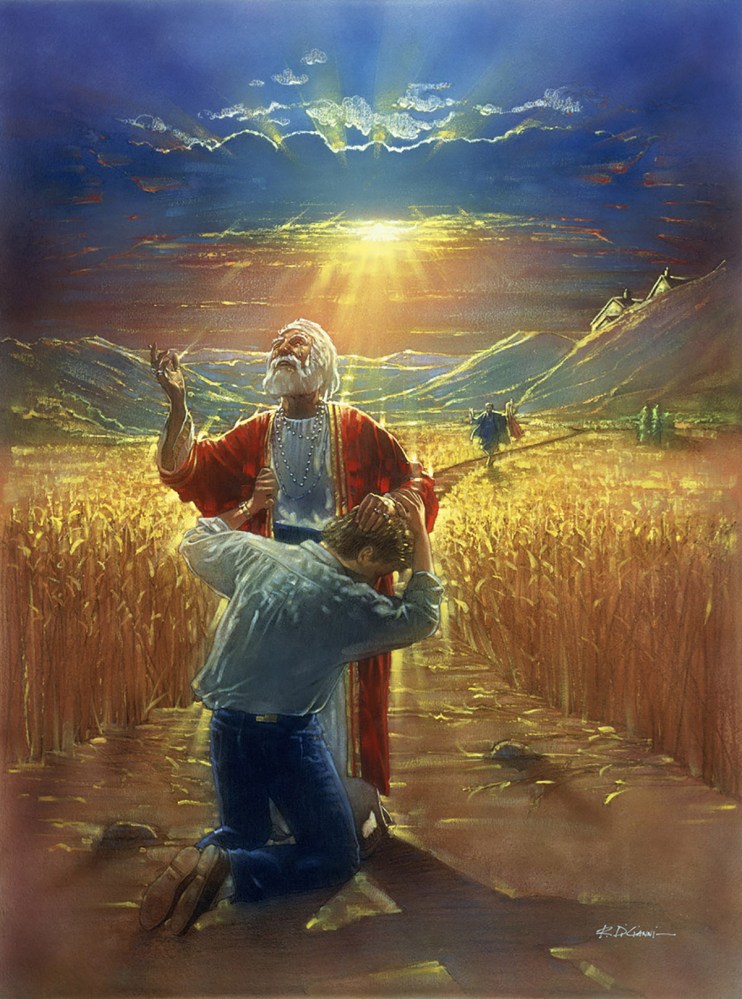
Painting by Ron DiCianni

Stuff Happens

Stuff Happens

Ten weeks ago 16,255 homes, businesses and other buildings were destroyed and 29 people died in the Palisades and Eaton fires here in Southern California. 

Last weekend, a deadly series of storms across the US South and Midwest leveled homes and businesses and killed 42 people.  Wildfires swept across Oklahoma and destroyed 400 homes.  In Kansas, a dust storm led to a highway pileup involving at least 50 vehicles in which 8 people were killed.

Four weeks ago, 68 people were killed when heavy rains in the Philippines caused a landslide that destroyed a gold-mining village.  Another 51 are still missing and presumed dead.

Twenty-six people were killed when a train was hijacked by a militant group in Pakistan, and a fire in a nightclub in North Macedonia left 59 people dead.

Last Saturday, under orders of the President, US Immigration & Customs deported hundreds of Venezuelans to a brutal prison in El Salvador in defiance of a court order instructing them to turn the planes around.  As a result, many legal experts are saying that our country is now in a full-blown constitutional crisis.

There is no shortage of tragedy in our world.  On any given day, in any given week, horrible things happen to people.  And when horrible things happen, one of our first instincts is to look for somewhere to lay the blame.

Sometimes it’s easy to pinpoint the source of the tragedy and fix the blame on the responsible party or parties.  I think we could all agree on who is primarily culpable for the slaughter and destruction in Ukraine.  But knowing who to blame and knowing the motives behind their aggression only makes the carnage more horrible.

It isn’t always easy to decide who or what has caused a tragedy.  Sometimes—far too often—we blame the victims.  What were those people in the Philippines thinking when they built their houses on an unstable hillside?  

Some people blame God when horrible things happen.  When a horrendous earthquake killed more than 100,000 people in Haiti in 2010, evangelist Pat Robertson said that God was punishing the people of Haiti because in 1804 they had made a deal with the devil to drive out their French colonial overlords.  He didn’t say why God waited 106 years to exact this punishment.  Robertson also claimed that Hurricane Katrina, which devastated New Orleans and killed more than 1800 people in 2005, was God’s punishment for allowing abortion, gay rights, and other liberal policies to continue in the U.S. 

We might think Robertson’s ideas are Loony Tunes, but a surprising number of people still see the world that way.  The idea that calamity is God’s punishment for sin is as old as humanity.  In the Book of Job, when Job is afflicted with one heartbreak after another, the three friends who come to offer him moral support yammer on for days insisting that Job must have offended God in some way.  When Job resolutely insists that he is innocent, their response is pretty much, “Well you must have done something!”  In the end, though, God puts an end to their speculation about what Job might or might not have done. “Who is this that darkens counsel by words without knowledge?” says God. “Where were you when I laid the foundations of the earth?  Go on, tell me if you’re so smart.”   The message in the end is that, while God may have allowed Job to suffer, God didn’t cause Job’s troubles.

While Jesus was on his way to Jerusalem, some people brought up the issue of some Galileans whom Pilate had killed mingling their blood with their sacrifices.  It’s important to note that this wasn’t just Pilate being randomly cruel and bloodthirsty, although he was certainly capable of that.  The Galileans in question were almost certainly executed for being resistance fighters in the endless underground campaign against Rome’s occupation.  

So why was the crowd asking Jesus about this?  Were they thinking he would be scandalized by it?  Did they think he would be shocked that Pilate would not only kill these Galileans but would also profane their sacrifice?  Did they think that maybe, since Jesus was also a Galilean, he might be angry enough to join the zealots who were fighting against Rome?  Or did they simply want him to share his thoughts on why God would do this or allow it to happen?  Was God punishing those Galileans for some reason?  Was their sin really so awful that they deserved to die that way?  

So Jesus asks them, “Do you think that because these Galileans suffered in this way they were worse sinners than all other Galileans?  No, I tell you; but unless you repent, you will all perish as they did.  Or those eighteen who were killed when the tower of Siloam fell on them—do you think that they were worse offenders than all the others living in Jerusalem?  No, I tell you; but unless you repent, you will all perish just as they did.”

Stuff happens.  Do you think God or Karma or the universe was punishing the people of Pacific Palisades and Altadena because they were worse sinners than everyone else in California?  No.  That’s not how it works.  And those forty-two who were killed by tornadoes—do you think they were snuffed out because they were the most awful people in that part of the country?  No.  God doesn’t work that way.  But… unless you repent, you will all perish just as they did.  

What did Jesus mean by that?  Repent is such a ponderous and dreary word. It’s all about regret and contrition. The Greek word, though—metanoia, the word that we translate as “repent”—that word is full of possibility.  Metanoia means a change of heart, a change of mind, a change of viewpoint, a change of direction.  Metanoia might start with contrition, but it doesn’t end there.  Metanoia is always a way forward.  

Jesus is telling them, “Unless you change the way you see and understand life, unless you change the way you see and understand God and how God works, you’re all going to be lost the same as they were.  You’ll die in your ignorance.  Death can sneak up on you or catch you by surprise, and when it does, you’ve lost your opportunity to embrace the life and love of God and for that matter, the life and love of humanity.  You’ve lost your opportunity to do justice and love kindness and walk humbly with God and humankind and the rest of creation.  You’ve lost your opportunity to make a positive difference in the world.

To bring home the point, he told them a parable.  A story.  “A man had a fig tree planted in his vineyard; and he came looking for fruit on it but he didn’t find any.  So he said to the gardener, ‘Look,  for three years now I have come looking for fruit on this fig tree, and still I find none.  Cut it down! Why should it be wasting the soil?’  The gardener replied, “Sir, leave it alone for another year.  I’ll dig around it and put manure on it.  Maybe it will bear fruit next year.  But if not, then you can cut it down.’”

A lot of us were taught in Sunday School to read parables as allegories.  So if we did that with this parable, the land owner would be God and the fig tree would be some unproductive person who is not doing anything to improve the world, and the gardener who wants to spare the tree and work with it would be Jesus.  That’s the Sunday School explanation.

Reading the parable that way has some merit, but it also has some problems.  “Allegorical readings,” said Amy-Jill Levine, “can speak to eternal truths and ultimate longings. Yet…such readings rarely produce a challenge and rarely offer a surprise; rather, they confirm standard Christian views.  A second problem with the traditional allegories…is that they cannot convey what a parable would have meant to its original audience.  Allegories require keys, so that readers know that the elements given in the tale correspond to very particular elements on the outside.  As these allegories were developed much later, that original audience would not have had the key.”[1]

How would you hear this parable if, instead of treating it as an allegory, you put yourself into the story?  What would you hear if you were to sit inside the parable, put on its characters for a moment and let them speak to you and through you?  What questions would this parable prompt you to ask yourself if you let it be more than a simple morality tale?  

For instance:  Am I like the absentee landowner?  Have I avoided getting my hands dirty by keeping my distance from those places and moments where life and death actually happen?  Have I been pronouncing judgment from the sidelines?  Have I been seeing the value of things only in terms of whether or not they are productive in some measurable, consumable, marketable way?  Have I been looking at life through the lens of cost/benefit analysis, weighing how people and other living things consume resources and take up time and space?  Do I need to be persuaded to see possibilities, to extend a little patience and grace?  Do I need to show some empathy?

Am I like the fig tree?  Am I failing in some way to nurture and nourish others?  Am I holding on to space and resources that could be used more productively to sustain others?  Am I throwing shade over someone else’s life and preventing them from growing or fulfilling their potential?  Am I willing to change or let myself be changed, to “repent,” to take the path of metanoia so I can learn to bring more love, joy, peace, patience, kindness, generosity, faithfulness, and gentleness into the world around me?  Am I taking life—being alive—for granted and neglecting the gift that God has given me to be present and aware and alive in this amazing God-filled world?

Am I like the gardener?  Am I willing to get my hands deep into the dirt and manure of life if it will bring someone else some grace, give someone else a chance to grow and bloom and become what they were made to be?   Am I willing to give time and energy and sweat and love and hope to help someone else thrive?

Why do horrible things happen?  Jesus is not going to answer that question…  because “Why?” is not a life-giving question.  Jesus is not going to play the blame game, because placing blame doesn’t heal anyone or help the survivors.  Instead, Jesus tells us a story to remind us that life is both precious and precarious, to remind us that we are interconnected and our choices affect each other, and to remind us that time is not on our side.  He reminds us that there are forces at work in the world which, like the land owner, would cut us down without hesitation or remorse.  But his story also reminds us that the force of love and life is also in the world, a force that is willing to go elbow deep in muck and manure to give us a chance to grow and thrive and bear good fruit.  

Fred Rogers once said to his television friends in Mr. Rogers’ Neighborhood, “When I was a boy and I would see scary things on the news, my mother would say to me, ‘Look for the helpers.  You will always find people who are helping.’”

I was reminded of Mr. Rogers’ good advice the other day when I read about the group of masons that has banded together to form Save the Tiles.  These volunteers are racing against the clock to rescue valuable Batchelder and other historic ceramic tiles from Altadena homes destroyed by the Eaton fire before the Army Corps of Engineers bulldozes the burned out houses to the ground.  The group is using their special skills to retrieve the tiles and return them to the owners of the burned homes so the owners can use them in the construction of their new homes.   

Look for the helpers.

When Russia invaded Ukraine three years ago we saw a steady stream of stories about violence, destruction and devastation.  But there were also stories about the extraordinary things people did to help the people of Ukraine survive their nightmare.  

Border guards, volunteers and ordinary people lined the sides of the wooden pedestrian bridge across the Tisza river with stuffed animals and toys so that refugee children crossing from Ukraine into Romania could, as one volunteer put it, “enter the country with a nice thought.” 

An organization called Deaf Bridge, which had been working in Ukraine to help establish church ministries for deaf and hearing impaired people, quickly shifted to helping deaf people in Ukraine find shelter and escape routes.  Also, since deaf people can’t hear air raid sirens, they taught them to look for visual cues and paired them with hearing persons so that they would know when danger was imminent.

Polish parents left baby strollers in Poland’s railway stations for refugee parents to use when they arrived with their babies in their arms and their childcare necessities in a backpack.

Volunteers arrived in Poland from all over the world to work with World Central Kitchen which is still providing food for refugees and also for Ukrainian cities where food is in short supply.  

Life is both precious and precarious.  Horrible things do happen on a daily basis.  We are living in a difficult time and it feels like the ground is shifting under our feet.  There is always someone who is all too ready to cut down the tree.  

But there is also always someone who is ready to try to save it, someone who is willing to stand up to those who wield the axe, someone who is willing to dig around the roots and even sink their hands into the muck to give it another chance at life.  

So who, in this story, are you?


[1] Short Stories by Jesus, Amy-Jill Levine, p.128

That Reasonable Voice

Luke 4:1-13 (NRSV)

  Jesus, full of the Holy Spirit, returned from the Jordan and was led by the Spirit in the wilderness, where for forty days he was tempted by the devil. He ate nothing at all during those days, and when they were over, he was famished.  The devil said to him, “If you are the Son of God, command this stone to become a loaf of bread.”  Jesus answered him, “It is written, ‘One does not live by bread alone.’” 

  Then the devil led him up and showed him in an instant all the kingdoms of the world.  And the devil said to him, “To you I will give their glory and all this authority; for it has been given over to me, and I give it to anyone I please.  If you, then, will worship me, it will all be yours.”   Jesus answered him, “It is written,

         ‘Worship the Lord your God,

                  and serve only him.’” 

  Then the devil took him to Jerusalem, and placed him on the pinnacle of the temple, saying to him, “If you are the Son of God, throw yourself down from here,  for it is written,

         ‘He will command his angels concerning you, to protect you,’

and

         ‘On their hands they will bear you up,

                  so that you will not dash your foot against a stone.’” 

Jesus answered him, “It is said, ‘Do not put the Lord your God to the test.’”  When the devil had finished every test, he departed from him until an opportune time.

————-

By the end of the third day the constant ache of his empty belly began to fade.  He had fasted before and expected this, and gave thanks for this small blessing that made the discipline easier.  A little easier.  But he knew, too, that his craving for food could come roaring back unexpectedly, that his body’s impulse to survive would mean that no stray lizard or bug or mouse or even a scorpion would be safe from his appetite unless he harnessed his will and tuned his physical hunger to the feast of his spirit.  

He had fasted many times for a day, several times for three days, and once even for seven days.  He knew what to expect and how to prepare for such fasts.  But this time was different.  Very different.  He had not prepared for this fast.  He had been led to it.  Led here, to this parched, eerie, yet providential place in the wilderness by a dove.  A snow-white dove who had fluttered down out of nowhere, out of everywhere, out of heaven to land on his dripping, baptized shoulder and nuzzle his cheek, then raised her face to the sunlight, eyes closed and perfectly still as she listened for a moment to the whispering wind before taking wing and beckoning him to follow. 

         On his fourth day in the wilderness, he realized that it would be very easy to lose track of the days altogether, so every morning when the first light began to tinge the sky he made a mark with a sharp stone to count the days on the sandstone face of the cleft where sheltered in the wadi.  Then he would splash water on his face and his head and drink a sip from the small, clear pool, barely more than a puddle, that seemed to almost miraculously refill itself every night from a tiny trickle that dribbled out of the rocks.  He supposed there must be a spring somewhere uphill, or perhaps a larger oasis.  But this place and this water were enough for him, this small gash in the hillside with its pool and its single scrub tree and its long, unobstructed view across the desert.  

         And the days went by, each one like the day before.  Every morning the splash of water on his face—and with each splash hearing again, so fresh in his memory, that voice he had heard from heaven as he rose out of the waters of his baptism:  “You are my son. You are loved.  I am so pleased with you.”  Now, as the sunlight began to chase the shadows into the deeper recesses of the dry canyon, he would stop and raise his wet face to the sky as the water he had splashed on his face mingled with his tears of joy.  He would stand still like that, wet face raised to the sky, until the sunlight and warming air dried his cheeks.

As the sun began to shine full on his face, he would retreat to the shade, lean back against the canyon wall, and pray.  And meditate.  And listen.  Listening to his body.  Listening to his breath.  Listening to the sounds of the wilderness.  Listening to the earth.  Listening to the night sky.  Listening for God.  And he would watch.  Watching the dust devils dance across the desert.  Watching the plants sway and bend in the wind.  Watching, sometimes, the endless dance of predator and prey, things hunting and things hunted.  Watching things rest.  Watching the stars move across the night.  Watching the moon slip through its phases.  Watching his own dreams.

         By the tenth day he would have had no clear idea of how long he had been there without the marks he made every morning on the sandstone wall.  By the twentieth day he hardly moved.

He had vivid dreams when he slept and vivid visions when he meditated so that day and night began to blend together and he began to slip fluidly from one state of consciousness to another with little or no space in between, from wakeful alertness to vision to dream so that it all seemed as one to him.  His thoughts and his prayers blended into a single thing, a constant conversation with God who had affirmed him at the Jordan.  He would think, then pray for the earth.  He would think, then pray about humanity.  He would think, then pray about his mission.  He prayed for clarity.  And when clarity came to him he sat with it and examined it, too, in his thoughts and his prayers.

         And often, often the devil would come to him.  To test.  To tempt. To assault with phantasms of the imagination.  To ask leading questions.  To challenge.

         On the very first night he had  heard the maniacal gibbering of hungry hyenas prowling through the darkness not far from him and a great shadow of fear came moving up the wadi toward him.  But he just kept gazing at the stars and sang aloud from Isaiah, “The Lord is my light and my salvation.  Whom shall I fear?  The Lord is the stronghold of my life. Of whom shall I be afraid?”  And in the face of his smile and his song, the fear evaporated, and the gibbering of the hyenas as they moved off into the darkness sounded like laughter.  But the devil didn’t give up

         Often the devil would come with questions.  Usually the same questions or accusations or challenges repeated ad nauseum…  

     Are you really the Son of God?  What does that even mean?  

     This mission of yours, is it really worth it? 

     How will you save them?  Are they even worth saving?  And what makes you think you can do it?  

     You don’t think people are really going to understand what you’re trying to teach them, do you? 

     You know how this turns out, don’t you?

     Why are you even doing this…this fasting, this mission… any of it?   

     Over and over again, these questions.  Constant seeds of doubt insinuated, whispered in the spaces between his own thoughts in a voice that sounded almost like his own or like the Spirit.  Almost.  But not quite.  

         He would sit and listen, sometimes marveling at the devil’s persistence but in the end he would tire of it and simply say, quoting Isaiah again, “The Lord called me before I was born.  In my mother’s womb he named me. The Lord said I will give you as a light to the nations that my salvation may reach to the end of the earth.”  And then the devil would leave him.  For a while. 

         On the fortieth day his body’s reserves were utterly spent.  He knew that one way or another this day would be the end of his fast.  He had seen angels in the night.  Or had he dreamed them?  He had often sensed them nearby like the hyenas.

         As the first light of morning seeped into the sky he had no strength to move the few steps to the pool for a splash of water and a drink.  Still, when the edge of the sun blushed across the horizon he managed to croak out the morning prayer his parents had taught him so many years ago:

Blessed is the One who spoke and the world came to be. Blessed is the One!

Blessed is the One who continually authors creation.  Blessed is the One whose word is deed:  blessed is the One who is compassionate towards the world; blessed is the One who is compassionate towards all creatures. Blessed is the One who rewards the reverent.  Blessed is the One who exists for all time.  Blessed is the One who redeems and saves.

As he finished the prayer a large dust devil came spiraling lazily toward him and as it reached the apron of the hill it released a tendril to blow its hot, gritty breath into his canyon, into his face.   And in that tendril of dry, dusty wind came the voice—that voice so much like his own, so much like the Spirit, but not, insinuating itself between his thoughts.  That voice with its poisonous seeds of doubt.  That horrible voice.  That reasonable voice.  

Why are you starving yourself, Son of Man?  Forty days without food is a bit excessive, don’t you think?  You’ve made your point.  You can’t do any good for anybody if you die of starvation out here in the wilderness.  So…if you are the Son of God, command this stone to become a loaf of bread.

And there it is, he thought.  Two things.  No, three things.  But so cleverly hidden in that reasonable little speech.  If you are the Son of God… this evil wants me to doubt not just myself, but God.  God who proclaimed me the beloved Son.  And then this evil suggests that I should prove my identity.  Prove it to whom?  To myself? To God?  To this voice of evil, this hot wind blowing through the canyon, through the delirium of my hunger?  This thing would have me deny my humanity.  Hunger is part of being human.  Yes, I could change the stone to bread, but others cannot.  Others must make do with the resources at hand or go without.  So the last thing evil suggests might be the worst.  Command the stone to become bread.  Turn your back on your humanity.  This thing would have me deny what I am and also make the stone something it is not.  Refuse to see it for what it is.  Ignore its worth and value and history as a stone.  Coerce creation to satisfy my hunger.  Do violence to this thing God has made and to the workings and patterns God set at work in the world so that I can take a shortcut to feed myself?  Simply because I can?  No.

And then, because it would not do to simply say it in his thoughts, because, oddly, he wanted the stone to hear it, too, he said it aloud in his starved, parched voice…  

One does not live by bread alone.

No sooner were the words out of his mouth than he was caught up in a vision. He was floating high above the world looking down on all its gleaming cities, its mountains and valleys, forests, farms and deserts and seas.  An angel of light was beside him but there was something not quite right about either the angel or the light.  It was a dark kind of light.  And the angel wore a mask.  And from behind the mask came the voice.  To the ears of his spirit it still sounded reasonable, but it also sounded imperious.  And hollow.

Look at this world, Son of Man, these kingdoms.  This is what you came for, isn’t it?  Isn’t that the promise?  That you will be king of kings and lord of lords, that your kingdom will rule over all others? I will give you authority over all of them right now, all the glory that comes from them, because it has all been given over to me and I can give it to anyone I choose.  All you have to do is worship me.  Bow down to me and it’s all yours.

He looked down at the world for a long moment that felt like forever.  He looked and thought of the difficult, painful path that lay ahead of him if he was to continue in the way he knew was right.  He knew there was some truth in what the devil said.  Evil  did seem to have sway over so much of what happened in the world and for a moment the devil’s caustic words echoed in his soul.  It’s all been given over to me.  But then he thought, By whom?  Who gave it over to you?  People gave it over to you.  People you tricked.  People you seduced with your reasonable, poisonous propositions and your false promises.  I’m here to win it back one person at a time because it was never rightfully yours to begin with.  And again you try to tempt me with a shortcut.  But it only shows how much you misunderstand.  I did not come to seize power.  I came to give love.  And you can’t order people to love.  You can’t coerce love.  If I took your path I would be just another dictator.  And worship you?  As we stand in this place between heaven and earth in your sickly, false light?  You clearly do not know me.  And then, to bring the vision back to earth, he said aloud…

It is written, Worship the Lord your God and serve only him.

Instantly, his vision shifted with a vertiginous twist. But instead of being returned to the canyon, he found himself standing on the highest point of the temple with the devil standing beside him robed like a priest, his face behind a veil.  And from behind the veil came that voice, that reasonable voice.

I don’t know why you insist on making things so difficult for yourself.  I’m not clear on what your plan is, holy man, but whatever you’re trying to accomplish, you’re going to need followers.  You’re going to have to persuade a lot of people to believe in you, to trust you.  You seem to believe that you’re the Son of God, so you’re going to need them to believe it, too.  I suppose you could do a miracle here and there, turn up your charisma a bit, impress a few people at a time.  But why not just do something big and dramatic?  And there is a scriptural warrant for this. If you are the Son of God, just throw yourself down from here, for it is written, He will command his angels concerning you, to protect you.  And it’s also written, On their hands they will bear you up so that you will not so much as bruise your foot against a stone.

And there it is again, he thought.  That challenge.  If you are the Son of God.  Prove it.  It occurred to him that he was making the devil uneasy.  No, I don’t need to prove anything, he thought.  God doesn’t need to prove anything.  You are my son.  You are loved.  I am so pleased.  I did hear God’s voice.  I did follow the Spirit.  And I did it out of love.  And those who follow me will do so out of love.  And yes, it will be hard.  And yes, they will miss the point, over and over again.  They will get it wrong.  They will make mistakes.  But that’s what forgiveness is for.  And impressing people, even with angels catching me in midair, won’t convince them to keep following when things get really difficult.  Only love can do that.  Only love can carry them through those dark valleys, those dark days.  Admiration, being amazed, is not the same thing as love.  No, this is just another shortcut and one that would be short lived, at that.   

And then, as he stood atop the temple, without looking at the thing in the priest’s robes, he said aloud…

You shall not put the Lord your God to the test.

And the hot wind stopped.  There was a moment, a breath, and a cool breeze filled the canyon.  He opened his eyes and saw an angel smiling at him.  He closed his eyes.  And when he opened them again, there was a traveling peddler beside him, urging him to drink some water and take a bite of bread.  He smiled and laid his hand fondly on the warm stone beside him as he said a prayer of thanks.

When you hear that reasonable voice that insinuates itself between your thoughts—and you will—that voice that entices you to take the shortcut, that voice that tempts you to discount your own humanity and the bond you share with others, that voice that thirsts for power, status and wealth at the expense of the rest of the world, take time to listen very carefully. Listen not just to what it offers, but to what it will take from you in return.  Listen not just to what it promises to give you or make you, listen to what it will cost you.  And what it will make you deny.

The Hard Stuff

Luke 6:27-38

Have you ever been reading along in your Bible and you come across something you wish Jesus had just not said?

Love your enemies.

Do good to those who hate you.  

Bless those who curse you.

Pray for those who abuse you.

Turn the other cheek.

If someone takes your coat, give them your shirt, too.

Give something to everyone who asks.

This is the hard stuff.  This is the part that’s difficult.  It’s all so counter-intuitive.  Jesus is asking us to behave in a way that is diametrically opposed to our instincts.

It would be very easy to ignore this teaching of Jesus, to just forget he ever said it, or find ways to explain it away.  In fact we do that a lot.  Ignore the parts we don’t like.

We might say that Jesus is setting up an impossible ideal here that forces us to admit our sin and brokenness so that we admit our need for God’s forgiveness and grace. David Lose calls that the “Lutheran option.”  It’s good, sound theology as far as it goes, but it lets us off the hook.  It keeps us from taking these new rules of engagement that Jesus gives us seriously or thinking that they could actually be applied.

Another way to dismiss these difficult expectations is that we could just say that Jesus is being idealistic and naïve.  

Actually, that’s one thing we absolutely can NOT say.  Jesus, and the people listening to him were far from naïve.  They were well-acquainted with the frustration of not responding to undeserved violence, aggression and oppression,  but they were also were painfully aware of the cost of revenge and retaliation.  

In the year 6 CE, when Jesus was about 10 years old,[1] Roman authorities installed a new governor over the province of Judea.  When this new governor, Coponius, tried to impose new taxes on the region, including the new Census tax which everyone in the empire was required to pay, a large rebellion broke out led by Judas the Galilean.  The rebellion spread until Quirinius, the governor of Syria stepped in to impose order.  You may remember Quirinius from Luke’s Christmas story in chapter 2.  Under Quirinius’ orders, Roman soldiers razed the city of Sepphoris, a rebel stronghold just a three miles from Nazareth where Jesus grew up.  After Sepphoris was burned to the ground, the Romans rounded up Judas and two thousand Galileans and crucified them.  

This example of Roman authority and order maintained by violence was still fresh in the memories of the people gathered with Jesus on that hillside by the sea.  I think it’s safe to say that the Galileans listening to Jesus, those people living under the watchful eyes of their Roman overlords and their wealthy collaborators, heard his words a little differently than we hear them twenty centuries later.

It’s important for us to understand that Jesus was not calling oppressed and abused people to be doormats, to simply roll over passively and take whatever abuse was being dished out.  When Jesus said, “If anyone strikes you on the cheek, offer the other also;  and if anyone takes away your coat, give them your shirt, too,” he was teaching his followers a way to do radical non-violent resistance.  

In his book Violence and Nonviolence in South Africa, Jesus’ Third Way, Walter Wink pointed out that when Jesus said to turn the other cheek he wasn’t talking about a fistfight, he was talking about a backhand slap that was the normal way of admonishing inferiors.  As Wink explained, “Masters backhanded slaves; husbands, wives; parents, children; men, women; Romans, Jews. We have here a set of unequal relations, in each of which retaliation would be suicidal. The only normal response would be cowering submission.

It is important to ask who Jesus’ audience is. In every case, Jesus’ listeners are not those who strike, initiate lawsuits or impose forced labor, but their victims (“If anyone strikes you…would sue you…forces you to go one mile…”). There were among his hearers people who were subjected to these very indignities, forced to stifle their inner outrage at the dehumanizing treatment meted out to them by the hierarchical system of caste and class, race and gender, age and status, and as a result of imperial occupation.”

Wink goes on to explain that, odd as it may sound, in the body language and social ritual of the first century, turning the other cheek would be a way of asserting equality in the relationship and maintaining one’s dignity.  A backhanded slap was a gesture of rebuke or punishment directed at someone of lower status.  Striking the other cheek would require the use of an open hand which would be seen in their society as acknowledging equality.  The open-handed slap was the way one Roman or patrician challenged someone of equal status.

When Jesus tells his followers to give their shirt if someone takes their coat, that, too, is a kind of nonviolent resistance based on public shaming.  If you owed a rich person money and were unable to pay, the law would allow him to take your coat as collateral against the loan.  Giving your shirt, too, would dramatize how unfair the law is and how heartless your creditor is for taking advantage of such a law.  Most men wore nothing more than a simple shirt or tunic belted at the waist under a coat or robe. Making a creditor take his shirt in addition to his coat would leave a man standing in the street in his loincloth but it would shame the creditor whose impatience and greed would leave someone so exposed.

Luke doesn’t include this, but in Matthew’s rendition of nonviolent resistance Jesus says, “If anyone forces you to go one mile, go also the second mile.”  The Roman law of impressment said that a Roman soldier could order a Jew to carry his heavy pack, but only for one mile.  At the end of the mile, Jesus says to go another mile  if you are the Jew impressed into this service, because by going the extra mile you assume control of the situation.  You assert a measure of equality and preserve your dignity, and you just might get the soldier in trouble with his superiors if they’re paying attention.

When Jesus tells us to confront violence with nonviolence, he invites us to be creative.  In 2020, the racist right-wing group The Proud Boys tore down the Black Lives Matter Banner at Metropolitan African Methodist Episcopal Church in Washington D.C. and spray painted racist and violent graffiti on the church.  The church sued the Proud Boys, a group that Wikipedia describes as “an American far-right, neofascist militant organization” and won a judgment of $2.8 million in damages.  When the Proud Boys refused to pay, the court awarded control of the Proud Boys’ trademark to the church which effectively stripped them of their name.  The Proud Boys can no longer use their name or trademarked logo without permission of the church.  The church “turned the other cheek” and won an important symbolic victory in the process.

With his guidance on how we should treat each other, Jesus is inviting us into a new world, a world that has very different values and operates on laws that are contrary to what we’re used to.  The world Jesus invites us to inhabit is grounded in shalom, a peace based on respect and on recognition of our mutual humanity.   In this world we realize that striking back when we’re struck merely perpetuates or accelerates the cycle of violence.

This doesn’t mean that we give evil and aggression a free pass.  WE are still called to confront evil when we see it and speak out against injustice.  But we do not fight violence with violence. Instead, we meet evil and aggression with creativity and love, a creativity that either defuses the evil or shows the world what it really is, and a love that remembers that the aggressor or perpetrator is also someone who God loves.

The people who live in this world of shalom know that forgiveness breaks all the patterns of cause and effect that prolong and propagate disharmony between persons and peoples.   

The people who live in this world – this world that Jesus calls The Kingdom of God, the Commonwealth of God’s justice and kindness—the people who live in this world know that love is not just a means to an end or a nicety of life, but love is the source and goal of life itself.  It is the fountain from which morality and justice flow naturally like waters from a spring.  The people who live in this Realm of God know that the reason we fail so often to establish a healthy morality without moralizing, the reason we fail so often to establish restorative justice without the soul-damaging poison of retribution, is that we have failed first to love.

So is this a new set of commandments Jesus is giving us?  Or is it a promise?  Are these laws?  Or is this an invitation?

These instructions from Jesus sound almost impossible when we hear them from the standpoint of everyday life and our culture’s instinctive response.  But they sound very different when you hear them as a promise of how life can be.  They sound very different when you hear them as an invitation to develop new instincts and live a different kind of life.

You are invited to live in the Realm of God’s love, the Commonwealth of God’s justice and kindness, where people love their enemies and do good even to those who hate them.  Where they respond to curses with blessings.  

If we can live as a citizens of this different world, our reward will be great and we will be children of the Most High, for God is just as kind to the ungrateful and the wicked as to those who are trying to not be ungrateful and wicked.  

That’s the world we are invited into.  That’s the way we are asked to live.  It isn’t easy.  We fail often.  But, forgive and you will be forgiven. 

“Do not judge, and you will not be judged; do not condemn, and you will not be condemned. Forgive, and you will be forgiven;  give, and it will be given to you. A good measure, pressed down, shaken together, running over, will be put into your lap; for the measure you give will be the measure you get back.”

That’s the promise.  And you are invited.  Starting now.

In Jesus’ name.


[1] Scholars are uncertain about the year of Jesus’ birth, but both Matthew and Luke note that Herod the Great was still alive when Jesus was born.  Herod died in 4 BCE.

Do Not Be Afraid

Luke 5:1-11

What would it take for you to walk away from everything?  What would move you to walk out of your life and into a whole new existence with no guarantees and no clear idea of what kind of life you were about to begin?

The story of Jesus calling the fishermen, Peter, Andrew, James and John, is in all three synoptic gospels, but Luke’s telling of the story is significantly different from Matthew and Mark’s version.  In Mark and Matthew the story we get is pretty bare bones:  Jesus is walking along the shore of the Sea of Galilee when he sees Peter and Andrew and James and John fishing.  Jesus says, “Follow me,” and they do.  They drop their nets and follow.  Just like that. And all the blank spaces and unanswered questions are left to our imagination.  

The gospel writers each have their own reasons for telling the story the way they do.  Mark moves quickly past the fishermen because in Mark, Jesus is always on the move—”on the way” is the expression Mark uses.  There are demons that need casting out and people to be healed and all of it happens on the road.  Also, the writer of Mark gives the impression that he’s not all that fond of Peter and the others, so he moves past them pretty quickly.  

Matthew doesn’t spend any more time than necessary on Jesus recruiting the fishermen because there is Torah waiting to be reinterpreted by Jesus and five sermons to be preached and besides, everybody already knows that story.  

Luke, though, Luke is a storyteller.  Luke thinks the details are important.  Luke likes the narrative to flow smoothly.  

Matthew and Mark give the impression that Jesus was more or less a stranger to Peter and the others when he called them to follow, a dynamic that makes their following him look all the more miraculous.  In Luke, though, we see that Jesus and Peter had crossed paths before.  Jesus had already been teaching in the synagogue at Capernaum, so Peter had heard him there.  And Jesus had been to Peter’s house where he healed Peter’s mother-in-law of a fever.  This makes it easier to understand why Peter doesn’t object when Jesus helps himself to Peter’s boat and tells him to push off a little bit from the shore to create a little space between them and the crowd.  

In Luke’s telling of the story, Peter had already seen Jesus cast out demons and heal people, both at the synagogue and at his own house.  And he had also been listening to Jesus teaching the crowd while he cleaned his nets.  So now, there they were, just the two of them, Peter and Jesus in Peter’s boat while Jesus finished speaking to the crowd.  

Can you imagine what Peter was feeling?  Sit still with it a moment and imagine yourself sitting next to this teacher who speaks with authority in the synagogue, who makes Torah and the Prophets come alive, this exorcist who speaks to demons and casts them out, this man who can heal with a touch of his hand, this man, Jesus, sitting next to you in your boat while the water gently laps against the sides.  

And now he tells you to head out into deep water and let down your nets.   And you hesitate.   You’re tired.  You tell him you worked all night and didn’t catch so much as a sardine.  But it’s Jesus telling you to do this, so you drag on the oars and row out to deeper water.  You figure you’ll humor him.  You’ll drop your nets in the water and after they’ve sat there a few minutes you’ll pull them back up and row home for some overdue sleep.  

But when you start to pull up your nets, they’re heavy.  So heavy you’re afraid you’ll lose your grip.  And as you pull the net closer to the surface you see the water boiling with fish, so many fish that you know you won’t be able to lift them into the boat by yourself.  You yell out for your partners to come help you, and the four of you work hard, feverishly, until your muscles ache and you’re covered in sweat.  And when it’s all over you’ve filled two boats with so many fish that they’re close to being swamped.  

And that’s when you stop.  And you look at Jesus…who is holding you in his steady gaze.  And you suddenly realize that you are in the presence of holiness, that something…someone transcendent is there in your boat with you and all those fish.  And all you can think of is how unworthy you are, how unclean and imperfect you feel in the presence of this man, Jesus, who radiates wholeness and goodness.  You realize that he sees you, he really sees who and what you are in a way that makes you see yourself through his eyes, and it brings you to your knees.

And then he says the only thing that could put you on your feet again.  Do not be afraid, he says, in a voice that dissipates all anxiety.  Do not be afraid.  From now on you will be catching people.

“When they had brought their boats to shore,” Luke tells us, “they left everything and followed him.

They left everything.  Have you ever thought about what that entailed, what all that ‘everything’ included?  Fishing in first century Galilee was a cash-intensive business and usually involved whole families.  In the Roman world, Caesar owned every body of water, so Caesar owned the lake they fished in and all the fish in the lake.  That meant that you had to pay Caesar for a license to catch his fish in his lake.  It was illegal to catch even one fish without that license.  Since the lake was in the territory controlled by Herod Antipas, Antipas administered the collection of fees, which included a tax to pay for his management services.  The actual management was done by a broker/tax collector who would grant your license, collect your license fees and also collect the tax on your catch.  Your catch would be processed—salt dried or pickled—by a separate business, a fish processor who charged a percentage of the catch.  And there was another tax on the processed fish as it was sent to market through the broker.  Boats were expensive and were often leased with monthly payment plans.  Nets were in constant need of repair.  In good seasons you might hire extra help.  To cover all these expenses it was common for two or more families to join together in a syndicate.  That seems to be the case that we see with the Yonah family and the Zebedee family in the gospels.  All of that financial obligation and responsibility and all the people whose lives were supported by the business, all of that was part of the ‘everything’ that the fishermen left behind to follow Jesus.

Do not be afraid.  

In Learning to Walk in the Dark, Barbara Brown Taylor wrote, “The only real difference between Anxiety and Excitement was my willingness to let go of Fear.”  When you hear Jesus say, “Do not be afraid,” it’s like an exorcism.  Something lets go of you… and you let go of it.  And that’s when all bets are off and the future is wide open.  

Do not be afraid.

The story of the miraculous catch of fish is only in Luke.  There is a similar story in the epilogue of the Gospel of John, but it appears at the end, not at the beginning.  In both instances, though, the astonishing bounty of fish helps to motivate Peter to follow Jesus or, in the case of John’s gospel, to get back to work of showing people the kingdom of God.

Luther Seminary Professor Rolf Jacobson said that the miraculous catch of fish is an example of the holy breaking into our mundane everyday world.  It is that, but it seems to me that it might be more accurate to see this as an example of Jesus helping people to look up from the mundane everydayness of the world to see that it is already holy, to see that they have been surrounded by holiness their entire lives, to see that they live and move and have their being in a world that is infused with God’s presence, God’s provision, God’s love in every small detail.

As I read the gospels, sometimes it seems like Jesus was walking through a different world than the rest of us.  What he was teaching all those people on the shore while Peter mended his nets was how to see and how to live in that different, healthier, more whole world, the world as he saw it, a world of goodness and kindness and loving connection, a world he called the kingdom of God, the Commonwealth of God’s justice and mercy.  He was living all day every day in that holiness, that all-pervasive Presence of the Holy One.  He embodied it.  With this astonishing catch of fish, he helped Peter and the others understand that God would take care of them, he helped them see that there was a possibility for another way of life, a different kind of life altogether, and he was opening the door for them to step into it.

So they left everything.  And followed him.  To begin the work of making the kingdom of God an everyday reality on earth as it is in heaven.  To catch people—to capture their imaginations and teach them to see the world Jesus sees.

That’s the work the followers of Jesus have been doing for more than two millennia now, and there’s a long list of people from Augustine and Ambrose to Albert Schweitzer and Martin Luther King and millions whose names are unknown who have left everything and faced every danger to proclaim Christ’s vision of the kingdom and to show us what it looks like in action.  

It’s work that never ends because there will always be Caesars who want to own everything and make the rest of us pay just to be alive.  There are always those who want to erase the good work we’ve done and the good work we’re planning because they think that it weakens the iron grip of their control… or even simply because it undermines their Social-Darwinist understanding of how the world works.  There are always those who don’t like mercy and kindness because they see life as a competition and not as a cooperative venture.  There are always those who think that some lives are more worthy than others, that some people are intrinsically more valuable and some are intrinsically worthless, so there will always be a need for us to remind them that, as Jesus sees us, every last one of us is a beloved child of God.

When Caesar tries to eliminate diversity, equity and inclusion, the followers of Jesus remind the world that God’s loving embrace includes everyone and rejoices in their differences and talents.  When wealthy, ambitious, Caesar wannabes try to tarnish the reputation of helpful people and organizations like Lutheran Social Services, the followers of Jesus remind them that we encounter Jesus, himself, in serving the hungry, the unhoused, the differently abled, the dependent and the immigrant.

“In Judaism,” said Rabbi Lord Jonathan Sacks, “faith is not acceptance but protest against the world that is in the name of the world that is not yet but ought to be.”  It’s the same for the followers of Jesus.  Christ is calling us to leave the boat of mundane habit and self-protection to step onto the path of active, activist faith, to be the light that shines faithfully as we push back the gathering darkness of the world that is and show the way to the world that is not yet but ought to be. 

Do not be afraid.  

In Your Hearing

Luke 4:14-21

I was fortunate to have Dr. Timothy Lull as one of my advisors in seminary.  Tim drilled it into us that, because the things Martin Luther did and said in his ministry were always in response to real world situations—a  habit Luther learned from Jesus who was also always addressing real world situations—our ministry, and especially our preaching, should always speak to what is really happening in the world and in the Church.  Tim had a saying to help us remember this:  The world sets the agenda.

The world sets the agenda.

Well this week the world gave us a very full agenda.  So much agenda that it borders on chaos.  At a time like this, it’s tempting to preach something benign about how much God loves us, then step to the side and wait for this time of transition to pass.  It’s tempting.  But that is not our calling as followers of Jesus.  The world sets the agenda, yes.  But Christ speaks to that agenda.

So here is a not brief enough glance at the agenda the world gave us this week.

Monday was Martin Luther King Day.  It’s always inspiring to take time to remember Dr. King’s work for civil rights and to hear again his prophetic words of vision, hope, liberation and aspiration.  It’s a day to embrace our diversity and see how our differences are gifts that make us stronger as a people and as a nation. It’s a day dedicated to helping us remember our better angels, a day to recommit ourselves to the principle that all persons are created equal and to reaffirm our goal of establishing greater equality and equity in our nation because, as Dr. King said, “Injustice anywhere is a threat to justice everywhere.”  

Monday was also Inauguration Day and President Trump began his new term in office with a flurry of Executive Orders.  The Washington Post said he “flooded the zone.”  With one order, he declared a state of emergency at our southern border and authorized federal troops to patrol the border.  He initiated new immigration raids and authorized Immigration and Customs Enforcement officers to invade churches, schools and other places of sanctuary while searching for undocumented immigrants.  He also shut down the Biden Administration’s asylum program, dashing the hopes of immigrants waiting in line in Mexico for their applications to be legally processed.  

But the President was just getting started, and before the day was out he would have issued a variety of other executive orders to set Project 2025 in motion.  One order ended Diversity, Equity and Inclusion programs in all federal institutions.  In another order with the cumbersome title of Defending Women from Gender Ideology Extremism and Restoring Biological Truth in the Federal Government he said this: “It is the policy of the United States to recognize two sexes, male and female.  These sexes are not changeable and are grounded in fundamental and incontrovertible reality.” 

On Tuesday, the President attended the National Prayer Service at Washington National Cathedral.  It was a beautiful interfaith worship service with speakers from several different faith traditions culminating in a thoughtful and grace-filled sermon by Episcopal Bishop Mariann Edgar Budde.  In that sermon, she talked about our need for true unity.  “Unity,” she said, “is a way of being with one another that encompasses and respects our differences, that teaches us to hold multiple perspectives and life experiences as valid and worthy of respect.  That enables us in our communities and in the halls of power to genuinely care for one another.  Even when we disagree.”  

It was a carefully crafted sermon, respectful, powerful, and deeply rooted in the teaching and ministry of Jesus.  This was especially true at the end of the sermon when she addressed the President directly saying, “Let me make one final plea. Mr. President.

“Millions have put their trust in you. And as you told the nation yesterday you have felt the providential hand of a loving God. In the name of our God, I ask you to have mercy upon the people in our country. And we’re scared now. There are gay, lesbian and transgender children in Democratic, Republican and independent families – some who fear for their lives. And the people who pick our crops and clean our office buildings, who labor in poultry farms and meatpacking plants, who wash the dishes after we eat in restaurants, and work the night shifts in hospitals, they may not be citizens or have the proper documentation, but the vast majority of immigrants are not criminals. They pay taxes and are good neighbors. They are faithful members of our churches and mosques, synagogues … and temples.

“I ask you to have mercy, Mr. President, on those in our communities whose children fear that their parents will be taken away. And that you help those who are fleeing war zones and persecution in their own lands to find compassion and welcome here.

“Our God teaches us that we are to be merciful to the stranger for we were all once strangers in this land. May God grant us the strength and courage to honor the dignity of every human being; to speak the truth to one another in love. and walk humbly with each other and our God. For the good of all people in this nation and the world.”

Mr. Trump and Vice President Vance were clearly not pleased with Bishop Budde’s sermon, and . . .  

On Wednesday, Mr. Trump demanded an apology from Bishop Budde.  When Time Magazine asked her about the president’s demand for an apology, she said bluntly, “I’m not going to apologize for asking for mercy for others.”

Also on Wednesday, our Evangelical Lutheran Church in America Bishops of Region 1 issued a joint statement in response to the President’s executive orders on immigration.  In that statement they said, “We believe that every human being, regardless of their country of origin or legal status, is created in the image of God and has inherent dignity and worth. This foundational truth compels us to approach the issue of immigration with compassion and a commitment to the common good.  Scripture repeatedly instructs us to love our neighbor and show the stranger hospitality. God commands the people of Israel, “The foreigner residing among you must be treated as your native-born. Love them as yourself” (Leviticus 19:34). . .The Lutheran tradition emphasizes both mercy and justice. Justice requires everyone, including immigrants, to be treated fairly and equitably. While upholding the rule of law is important, it must not be done in ways that dehumanize or exploit vulnerable people.”  They had a great deal more to say and I invite you to look online for their full statement.

On Thursday, while unhappy MAGA extremists continued to demonize and even threaten Bishop Budde, another Episcopal priest, closer to home, brought a measure of grace and healing to those who have lost so much in our recent wildfires.  Father Mel Soriano performed a Blessing of the Ashes in Altadena at the site of the home he and his husband, Stephen had lost to the Eaton fire.  Raising his hands over the ruins of his neighborhood he said, “Let love rise once again from these ashes. Make the bonds of family and community stronger than ever. Though the fire has consumed 

businesses, worship spaces, parks, and homes, the fire has not taken away hope. The fire has not taken away kindness. The fire has not taken away your presence among us. For we know you are here beside us on this Camino. We entrust our future into your hands, knowing that you make all things new. In Christ’s name, we pray. Amen.”  

On Friday, the Church responded to the world’s agenda once again as the ELCA bishops of Region 2 issued a joint statement addressing Mr. Trump’s Executive Order on sexuality.  Their statement was prefaced by Galatians 3:28: In Christ there is no longer Jew or Greek, no slave or free, no male or female, for in Christ you are all one.  “Dear friends in Christ,” they wrote, “This week the President of the United States declared there are only two genders: male and female. We write today to say something which we would not think needed to be said: The president does not get to dictate human gender classification. The law does not get to dictate gender classification. Even the apostle Paul, almost two thousand years ago, knew that human-imposed definitions, such as ethnicity, social class, oppressor’s titles or gender were not valid. Because of the unifying work of Jesus Christ, all human labels no longer apply.”  The Bishops’ statement had much more to say including selected quotes from the ELCA social statement on human sexuality.  Again, I encourage you to find their statement online and read it for yourself.

And now, here we are on Sunday, and I think it’s God’s own sense of serendipity, or maybe God’s own sense of humor, that the week that began with edicts restricting the language of sex and gender should end, and a new week begin, on Reconciling in Christ Sunday, the Sunday when we celebrate Christ’s wide, inclusive love of Lesbian, Gay, Bi, Trans and Queer persons and the wonderful ways they enrich the Church.  I think it’s also the work of the Holy Spirit that while last week began with an unrestrained rollout of the President’s Project 2025 agenda, this week begins with Jesus announcing his agenda as recorded in our gospel text in Luke.

When he came to Nazareth, where he had been brought up, he went to the synagogue on the Sabbath day, as was his custom. He stood up to read, and the scroll of the prophet Isaiah was given to him. He unrolled the scroll and found the place where it was written:

         “The Spirit of the Lord is upon me,

                  because he has anointed me

                           to bring good news to the poor.

         He has sent me to proclaim release to the captives[1]

                  and recovery of sight to the blind,

                           to set free those who are oppressed[2],

         to proclaim the year of the Lord’s favor.”

The poor receive good news.  Prisoners of war and prisoners of circumstances are released.  People’s blinders are removed to open up their vision and understanding.  People in dire circumstances are set free.  Now is the time.

After he read this passage from Isaiah, Jesus rolled up the scroll.  Luke tells us that “the eyes of all in the synagogue were fixed on him” when he said, “Today this scripture has been fulfilled in your hearing.”  

Fulfilled in your hearing.  What an interesting phrase.  The Greek actually says in your ears.  Is Jesus telling them that he is the fulfillment of Isaiah’s messianic prophesy?  It’s usually understood that way.  But could he also be telling them—telling us—that this is our mission, our agenda, too?   

Christ’s agenda is our agenda.  His mission has come to us as the body of Christ. The Spirit of the Lord is upon us, given to us in our baptism.  The Lord has anointed us to create a world, a culture that is good news for the poor.  The Lord has anointed us to liberate those who are held captive by all kinds of circumstances in all kinds of bondage.  The Lord has anointed us to open the eyes of those who can’t see the truth or those who have lost their vision of a better, more hopeful world and more joyful life, those whose vision is distorted by others who filter what they see through biased lenses.  The Lord has anointed us to set people free from dire circumstances and oppressive language and systems that don’t want to allow them to be their true selves.  Today.  Now is the acceptable time.  The right time.

The world is setting the agenda.  It’s trying to steamroll people into rigid conformity.  Personally, I don’t find that very compatible with the agenda of Jesus. 

So, which agenda will you choose?  Which agenda will be fulfilled in our hearing  . . . in Jesus’ name?


[1] αἰχμαλώτοις – the word specifically refers to prisoners of war or political prisoners

[2] τεθραυσμένους– literally ‘those who are choked,’ persons in dire circumstances or living under oppressive foreign rule

So What?

Luke 3:15-22

So.  This is the Sunday when we observe that one thousand nine hundred ninety-five years ago, give or take, Jesus was baptized by John in the Jordan River.  And I confess that on this Sunday when wildfires are still raging across Southern California, when our eyes are still watering from the smoke in the air, when our vision is still blurred with tears for all the homes and land destroyed and lives lost, when our hearts are still breaking for friends and family—for all the people who have had to evacuate, who have had to flee in terror as fire roared toward them—I confess that my first response to the baptism of Jesus in this week of catastrophe on a Sunday when the fires are still raging and homes and lives are still in peril–my first response to the baptism of Jesus is: so what?

So what if Jesus was baptized?  So what if a voice from heaven proclaimed him as the divine, beloved child of God with whom God was well pleased?  What does that have to do with me?  With us?  How does that help us at a time when our neighborhoods are on fire and our lives are filled with fear and anxiety and desperation?

One thousand nine hundred ninety-five years ago, more or less, Jesus was baptized.  What does this mean?  Where is the good news in that ancient fact in the face of the very real and present danger we are facing right now?

Where is the Good News?  

Well maybe—stay with me here– maybe it’s right where it has  always been.  Maybe it’s right in front of us, in the water and in the Word.  

The baptism of Jesus is depicted in all four gospels.  Sort of.  The Gospel of John alludes to baptism of Jesus but never actually describes him being baptized.  My favorite version of the Baptism of Jesus is in the Gospel of Matthew.  In Matthew, Jesus has no sooner waded into the water when John and Jesus start arguing.  That’s just so human.  In Matthew’s telling of the story, John didn’t want to baptize Jesus.  Matthew tells us that John “would have prevented him.”  It didn’t feel right to John.  It didn’t feel appropriate.  For him to baptize Jesus seemed upside down and backwards.  “I need to be baptized by you!” he tells Jesus.  

need to be baptized by you.  That’s an interesting choice of words.  It implies that John thought he was lacking something that Jesus could give him.  What could that be?

Jesus finally persuaded John to go ahead and baptize him when he said, “Let it be so now; for it is proper for us in this way to fulfill all righteousness.”  Basically, Jesus was telling John, “let’s go ahead with this because it’s the right thing to do.”

Why is it the right thing to do?  John’s baptism was a baptism of repentance for the forgiveness of sin[1].  But Jesus didn’t have any sin that he needed to repent of, did he?  So why was it the right thing for him to do?  How did his baptism “fulfill all righteousness”?

Preachers like to use the baptism of Jesus as a springboard to talk about the meaning of our baptism and the gifts that baptism bestows on us.  I’ll admit that that’s what I’ve preached about on this Sunday for many, many years.  But this year I think something else needs our attention.

Don’t get me wrong.  It’s always useful to take some time to remember our baptism and think about what it means and how we are living out our lives in the covenant of baptism.  But this year, as fires rage around us and life seems perilous and precarious, I have found myself thinking about the baptism of Jesus a little differently.  This year I find myself wondering what it meant for him.  What was he showing us?  What did he want us to see?  What did he want us to learn?

The word “baptism” comes from the Greek verb baptizein which means “to dip,” or “to plunge or to immerse.”[2] When we are baptized, the water that is poured over us is a sign that we are immersed into the life and love of the triune God, that we are plunged into the eternal perichoresis, the eternal circle dance of love that flows between the Father, the Son and the Holy Spirit.  But Jesus was already fully immersed in the life and love of the Trinity, so what did plunging into the water signify for him?  What was he immersing himself in?

I can’t help but think that what baptism signified for Jesus was not his immersion into the life of God, but his immersion into the life of humanity.  

With the Holy Spirit descending like a dove and the voice from heaven proclaiming that Jesus is heaven’s divine and pleasing child, it’s easy to get so caught up in the divinity of Jesus that we overlook how very human this moment is.  Jesus was already immersed in his divinity.  Here at the river, with water up to his chest, he was plunging into his humanity.

Jesus immersed himself into an existence where water is a necessity of life that can cleanse you and sustain you and quench your thirst, but it can also flood your home, sweep away your crops and livestock and drown you.

Jesus immersed himself into a life where fire can refine metals and give you light in the dark and warm your home and bake your bread and cook your meals, but it can also burn down your house and ravage your fields and orchards.  It can obliterate whole cities. It can burn you with the worst kind of pain.  And it can kill you. 

Jesus immersed himself into a human life in a body that was strong and beautiful, a body that could embrace the warm comfort of companions and smell the sweet and uplifting aromas and taste all the delicious flavors and see all the beautiful horizons and hear the music of the birds, a body that could feel joy and compassion and tenderness.  But it was also a vulnerable body, a body that could be wounded and injured,  a body that could smell the stink and feel the sharp edges and experience all the not-so-pleasant sensations of the world, a body that could feel anxiety and fear and pain.  A body that, in the end, could die.

Jesus immersed himself into all that it means to be human, the good and the bad. His baptism was more than an act of divine solidarity; it was a validation of deeply human unity.  He was showing us that he was one of us.  

But he wasn’t just immersing himself in us.

One thousand nine hundred ninety-five years ago, or thereabouts, Jesus was immersed in the waters of the Jordan, a river whose waters had been evaporated from the seas and transported in clouds before falling on the hills as snow and rain, a river that swept minerals and seeds and soil down from the mountains to enrich the land below, a river that carried away the effluent of people, cattle and animals as it flowed past villages and fields and farms and towns, a river filled with life and with a life of its own.  Jesus was immersed not only into the life of humanity, but into the life of the world itself, the life of the planet. 

And maybe that’s the Good News, on this Sunday when fires are still endangering our lives and so many things we hold dear are in jeopardy.  Maybe the Good News for us in the baptism of Jesus is that Christ is immersed in our lives and we are immersed in the life of Christ, but also that Christ is immersed in the life of the world.  Maybe, if we open our eyes and minds and hearts, we can trust that Jesus is with us, in, with and under all our heartbreaks and joys, our fears and our relief.  Maybe we can learn to trust him and hear his voice speaking a word of promise from Isaiah: 

“When you pass through the waters, I will be with you, and the rivers will not overwhelm you.  When you walk through fire you shall not be burned and the flame shall not consume you… for I am the Lord, your God…you are precious in my sight and honored and I love you.  Do not be afraid, for I am with you.”[2]


[1] Matthew 3:11

[2] Isaiah 43:2, 4, 5

And the Logos Became Flesh

John 1:1-18

I have a confession.  I deeply and truly love Christmas, but the sheer enormity of it leaves me flummoxed.   I’m not talking about all the shopping or all the bustle and preparation at home and at church.  I’m not even grumping about the over-the-top commercialism or all the different greeting card interpretations of the “true meaning” which can put you in a psychological sugar coma if you try to swallow them all at once.   

I’m talking about the daunting task of trying to convey a genuine and meaningful understanding of The Incarnation, the idea that the mystery we call God, the Maker of All Things Seen and Unseen, came to us as one of us—the idea that God “became flesh and lived among us” from gestation to birth to death as a particular person in a particular place and in a particular time so that we could begin to more fully understand that God is with us in all persons, in all creatures, in all creation, and at all times.

That thought, that idea, that reality that we call The Incarnation is so enormous and mind-boggling that it’s really tempting to retreat into the less cosmic halo of ideas that hover around that manger in Bethlehem, ideas like innocence and love personified and new beginnings.  Those are all good, true and valuable things.  They are meaningful parts of the package.  But the goodness, truth, new beginnings and love we see in that holy child become even more potent when we begin to truly understand what God is doing in that manger in Bethlehem.

When the early followers of Jesus began to write down their understanding of who Jesus was and what he was about, when they began to explain what they meant when they called him Christ—Christos—the anointed one, it’s clear that they saw him as something more than just a great spiritual teacher or religious leader.   You don’t have to read very far in these early writings to discover that these followers of Jesus thought there was something of cosmic importance about him.  Early on they called him the Son of God but that description didn’t seem to be enough for some of them.  It didn’t seem to fully capture the cosmic fullness of what they had experienced in Jesus the Christ.  

“He is the reflection of God’s glory and the exact imprint of God’s very being, and he sustains all things by his powerful word,” said the writer of Hebrews.[1]  “He is the image of the invisible God, the firstborn of creation,” we read in Colossians, “for in him all things in heaven and on earth were created, things visible and invisible…all things have been created through him and for him…for in him all the fullness of God was pleased to dwell, and through him God was pleased to reconcile to himself all things, whether on earth or in heaven…”[2]

Late in the first century, a writer we’ve come to know as John sat down to write his account of Jesus.  He wasn’t interested in creating just another chronicle of the life of Jesus as others had done; he wanted to explore the meaning of Jesus.  He wanted to make it clear that Jesus the Christ was not someone who could be defined, contained or constrained by geography or time or even philosophy, because the God of all geography and time and philosophy was and is somehow present in him.  

John began his gospel like this:

In the beginning was the Word, and the Word was with God, and the Word was God.  He was in the beginning with God.  All things came into being through him, and without him not one thing came into being.  What has come into being in him was life, and that life was the light of all humanity.  The light shines on in the darkness, and the darkness has not understood it…. And the Word became flesh and lived among us, and we gazed on his glory, glory as of the only Son from the Father, full of grace and truth.

The language of this prologue is pure poetry.  But it’s also philosophy.  And in a strange, farsighted way, John was brushing up against physics.  

The Greek word we translate as “Word” is logos.  Logos was a word that ancient philosophers loved to play with and because of that we have numerous ways to translate it.  One of the oldest meanings of logos was story or narrative.  Where does your mind go if you hear In the beginning was the story, and the story became flesh and lived among us?  

Logos could also mean content or reason or statement.  Other philosophical meaningsincluded, orderideablueprintprimordial templateprimal thought, or intention.  

Logos became flesh and lived among us.  The metaphysical became physical.  If that sounds too esoteric, consider quantum physics.  

 Energy moves through quantum fields as abstract mathematical wave functions.  When wave functions are observed, they tend to collapse into particles.  Particles continually move through patterns in a kind of quantum dance, always moving toward closeness, joining, partnering, combining.  Fermions dance with bosons.  Neutrinos, muons, gluons, leptons and quarks assemble themselves into protons, neutrons and electrons which assemble themselves into atoms which assemble themselves into molecules we call elements.  Hydrogen and carbon molecules dance together to form the four essential organic compounds: nucleic acids, proteins, lipids and carbohydrates.  And out of all of this comes life.  The Word, the Story, the Pattern, the Intention, the Thought becomes flesh and dwells among us.  

The great British astrophysicist James Jeans wrote: “The universe begins to look more like a great thought than a great machine.  Mind no longer appears as an accidental intruder into the field of matter; we are beginning to suspect that we ought rather to hail it as a creator and governor of the realm of matter… We discover that the universe shows evidence of a designing or controlling power that has something in common with our own minds.”[3]

This is The Incarnation.  The great Thought of God expressed in the whole universe condensed itself into a singular human life and lived among us.  And why would God do that?  

Love.

Teilhard de Chardin saw love as the driving force of the universe.  “For Teilhard, love is a passionate force at the heart of the Big Bang universe, the fire that breathes life into matter and unifies elements center to center; love is deeply embedded in the cosmos, a ‘cosmological force.’”[4]

God is Love, we read in 1 John.  “God is love, and those who abide in love abide in God, and God abides in them.”

Love became flesh and lived among us.  And still lives among us.  And within us.  And around us.  And beyond us.  

Love…God… was not content to be an abstract idea or a mere sentiment.  God, the Author of Life, the One in whom we live and move and have our being is Love with a capital L.  Love Personified.  And Love is all about relationship.  Christmas is when God, the Love that founded the universe, showed up as one of us in order to show us in person just how much we are loved and in order to teach us to love each other more freely and completely. 

Love became flesh and lived among us so that we might learn to love God with all our heart, mind, soul and strength and love our neighbors as ourselves.  

Love didn’t come to us as a king or potentate to lord it over us.  Love came as a poor baby among a poor and oppressed people far from the centers of privilege and power in order to show us that “the fire that breathes life into matter and unifies elements center to center,” is alive in and breathing life into all of us and wants to unify us with each other center to center and heart to heart.  And to all who receive him, who believe in his name, he gives power to become children of God.[5]

It’s an enormous idea, this thing called Christmas, this Incarnation.  This idea that the Word became flesh encompasses everything we see and everything we don’t see.  It speaks in poetry then carries us into the depths of philosophy and physics.  It warms the heart and boggles the mind.  It is, quite literally everything.  And the beating heart of it is love.

To even begin to understand the Incarnation, we have to open our minds and our hearts.  As another early follower of Jesus wrote: “I pray that you may have the power to comprehend, with all the saints, what is the breadth and length and height and depth, and to know the love of Christ that surpasses knowledge, so that you may be filled with all the fullness of God.”[6]

Merry Christmas


[1] Hebrews 1:3

[2] Colossians 1:15

[3] James Jeans, The Mysterious Universe, as quoted by Ilia Delio, The Unbearable Wholeness of Being, p. 40

[4] Ilia Delio, ibid., p.43

[5] John 1:12

[6] Ephesians 3:18-19

Out of Love for the Truth

John 8:31-36

“Out of love for the truth and from a desire to elucidate it, the Reverend Father Martin Luther, Master of Arts and Sacred Theology, and ordinary lecturer therein at Wittenberg, intends to defend the following statements and to dispute on them in that place.  Therefore he asks that those who cannot be present and dispute with him orally shall do so in their absence by letter.  In the name of our Lord Jesus Christ, Amen.”

This was the introduction to the 95 Theses which Martin Luther nailed to the door of the Wittenberg University Chapel on Wednesday, October 31, 1517.   We sometimes think that nailing the 95 Theses to the door of the church was an act of rebellion, and in retrospect it was powerfully symbolic.  But it was actually a normal practice.  The church door served as a kind of bulletin board for the academic community.  If you wanted to propose a debate, that’s where you posted the notice with the propositions to be discussed.

Luther did not intend for the 95 Theses to be a manifesto for rebellion.  He had no idea that his challenge to the practice of selling indulgences would spark a revolutionary movement that would sweep across Europe bringing enormous changes in religion, politics, education, and everyday life, but once that movement started, he gave himself to it body and soul because he was committed to the truth of the Gospel and the love of Christ. 

The truth quite literally set him free from the heavy-handed authority of Rome—the Pope excommunicated him.  But the truth also bound him to the proclamation of salvation by God’s grace through faith and to the authority of God’s word in the scriptures.

Out of love for the truth and from a desire to elucidate it…  

According to the Gospel of John, when Jesus was on trial before Pontius Pilate he stated, “For this I came into the world, to testify to the truth. Everyone who belongs to the truth listens to my voice.”  In response, Pilate asked him, “What is truth?”  

In some respects that seems like an almost ridiculous question.  We know what truth is.  We learn about truth almost as soon as we learn to talk.  Sadly, that’s also when we learn to lie, because we learn pretty quickly that the truth may reveal things we would like to keep hidden.  We learn very early on that sometimes truth has consequences that we would like to avoid, and that those consequences might be unpleasant or even painful.  

Truth, the dictionary tells us, is the true or actual state of a matter.  Something is true when it is in conformity with reality.  We say a thing is true when it is a verified or indisputable fact.  The truth reflects actuality or actual existence.  When we say a thing is a basic truth, we mean that it is an obvious or accepted or provable fact.  

Truth means that my desires or imagination do not have the final word in determining what is reality and what is not.

There are twenty-seven verses in the gospels that contain the word truth.  Twenty-one of those verses are in the Gospel of John where truth is not only a central theme, it is anchored in and identified with the person of Jesus.  In John 1:14 we read, “the Word became flesh and lived among us, and we have seen his glory, the glory as of a father’s only son, full of grace and truth.”  Three verses later, John puts aside the figurative language of the Word to make it clear who he is talking about: “The law indeed was given through Moses; grace and truth came through Jesus Christ.”

When Jesus sat discussing theology with a Samaritan Woman at Jacob’s Well, he told her that “true worshipers will worship the Father in spirit and truth.”  This suggests that truth is a vital element in our connection to God.

In chapter 14, not long after Jesus has told Thomas that he, himself, is “the way, the truth, and the life,” Jesus refers to the Holy Spirit as “the Spirit of truth” and in chapter 16 he tells his disciples that “when the Spirit of truth comes, he will guide you into all the truth.”  In chapter 17, as he prays for the disciples, Jesus asks that they would be sanctified or consecrated in truth.

“For this I was born,” Jesus told Pilate, “and for this I came into the world, to testify to the truth.  Everyone who belongs to the truth listens to my voice.” (John 18:37)

In today’s Gospel reading from chapter 8 of John’s gospel, we see a hint that some of those who were listening to Jesus were unsure about continuing to follow him.  Some scholars think that this passage is indicative of tension between Jewish followers of Jesus and Gentile believers in the community where this gospel was written, and that John, the writer, is calling both sides back to the middle ground of the truth found in the person and teaching of Jesus.  

“Jesus said to the Jews who had believed in him, ‘If you continue in my word—if you remain faithful to my teachings, then you are truly my disciples.  And you will come to know the truth.  And the truth will set you free.”  When they protested that they were descendants of Abraham and had never been enslaved by anyone—apparently they forgot about their own history with Babylon and Egypt—Jesus went on to make it clear that he was talking about the truth setting them—and us—free from our slavery to sin.  

But how does the truth set us free from sin?  

René Girard would suggest that truth sets us free from endless mimetic rivalries which are always based in falsehood, fantasy or desire.  Sin is the endless stream of little contests and competitions that we create against each other which escalate, eventually, into big and violent contests.  Truth can free us from this because truth has no bias.  Just as God is the ground of all being, truth is the ground of reality, the neutral acknowledgment of the way things are.  Sin wants to create a different reality or to act as if life is happening in a different reality with different rules.

Martin Luther defined sin as being curved in on the self.  Sin is when I put my preferences, my desires, my ideas, my plans, my goals above and before everyone and everything else.  Sin is me, me, me, me, me taken to the extent that it harms or disenfranchises or marginalizes or disempowers or diminishes or neglects you, you, you, you, you or them, them, them, them, them.  Sin creates a false reality, an illusion centered on my desires, my fears, my imagination.  And that illusion is seductive and captivating.  It ensnares.  It enslaves.  It makes me believe that I am the center of the universe, that what I think or believe or even just what I want very, very badly to be true is what is real.

Truth disabuses me of that illusion.

Once again: Truth means that my desires or imagination do not have the final word in determining what is real and what is not.

We are currently struggling through a time when truth is endangered in our culture.  There’s nothing new about that.  People have always preferred to put their own spin on facts that confront their biases or preconceived ideas or desires.  People throughout history have taken refuge in denial when events or outcomes don’t fit the way they wanted things to happen or the results they wanted.  What’s new is how widespread and militant this devaluation of the truth has become.  

When lies and spin become so prevalent that they begin to undermine any common understanding of basic facts, the world becomes a more dangerous place.  When people refuse to accept observable facts, when there is no longer the common cultural ground of truth based on fact, then there is no longer a starting point for discussion or compromise.  There is no way to move past confrontation and opposed binary positions that divide us.  When people lift up conspiracy theories and “alternative facts” as justification for their actions or opinions then we stand on the precipice of political violence.  

Sadly, we have seen clear examples of that lately.  It has become the sin of our society fed by the polarity of our politics.

The proliferation of misinformation and outright lies in our political and social conversation has become so common and problematic that our ELCA Conference of Bishops recently issued a joint statement to address the problem. These are the opening lines of their statement:

We know that the power of truth is greater than the power of deceit.

We, the members of the Conference of Bishops of the Evangelical Lutheran Church in America, speak with one voice to condemn the hateful, deceptive, violent speech that has too readily found a place in our national discourse. We lament the ways this language has led to hate-fueled action. We refuse to accept the ongoing normalization of lies and deceit. We recommit ourselves to speaking the truth and pointing to the one who is truth. 

We refuse to accept the ongoing normalization of lies and deceit.  We recommit ourselves to speaking the truth.   To do otherwise is sin.

Sin convinces me that I stand apart from the rest of humanity.  But the truth, the fact, is that I am deeply and intimately connected to the rest of humanity and, in fact, to all of creation.  Standing apart is an illusion.  Rugged individualism is a destructive myth—destructive because it undermines and negates the relationships that keep us alive in every sense of the word.

“We must all overcome the illusion of separateness,” said Richard Rohr.  “It is the primary task of religion to communicate not worthiness but union, to reconnect people to their original identity “hidden with Christ in God” (Colossians 3:3). The Bible calls the state of separateness ‘sin.’ God’s job description is to draw us back into primal and intimate relationship.”

As followers of Jesus, we are called to live in the imitation of God.  We are called to observe what God is doing all the time and everywhere and then do the same.  We are called to be generous because God is generous.  We are called to be creative because God is creative.  We are called to embrace diversity because God revels in diversity so much that no two things are exactly alike in the entire universe.  But above and beyond everything else, we are called to love.  “Love,” said St. Paul, “does not rejoice in unrighteousness, it rejoices in the truth.” (1 Cor 13:6)  Untruth is corrosive to love.  Lies and deception undermine and chip away at love until it disappears.  But truth reinforces love and makes it stronger.  There’s a reason we talk about “true” love.

We are called to love because God loves.  God is love.  Richard Rohr has said, God does not love us if and when we change.  God loves us so that we can change. That is the essence of grace—the grace that makes us whole, the grace that heals us, the grace that reunites us, the grace that saves us and leads us into the truth.  Truth is where all grace begins.

At the conclusion of their statement, the ELCA Bishops gave us some good practical advice to help us ensure that our lives, thoughts, speech and actions are anchored in grace and truth:

We find courage in our collegiality and implore the members of the Evangelical Lutheran Church in America, as well as our partners and friends, to join us as we:

  • Pledge to be vigilant guardians of truth, refusing to perpetuate lies or half-truths that further corrode the fabric of our society.
  • Commit to rigorous fact-checking, honoring God’s command to “test everything; hold fast to what is good” (1 Thessalonians 5:21).
  • Reject the use of humor that normalizes falsehood, remembering that our speech should “always be gracious” (Colossians 4:6).
  • Boldly advocate for the marginalized and oppressed, emulating Christ’s love for the least among us.
  • Courageously interrupt hate speech, standing firm in the knowledge that all are created in God’s image.
  • Lean in with curiosity, engage with those who think differently and “put the best construction on our neighbor’s action” (Luther’s explanation of the Eighth Commandment).
  • Amplify voices of truth.

Emboldened by the Holy Spirit, may we resist deception and lift up the truth that all members of humanity are created in the image of God.

On this Sunday, we celebrate a Reformation began with the words, “Out of love for the truth…”.  May we resist the sin of deception and live with a commitment to truth that continues to reform and refresh our faith, our lives and our world.  In the name of the Way and the Truth and the Life.