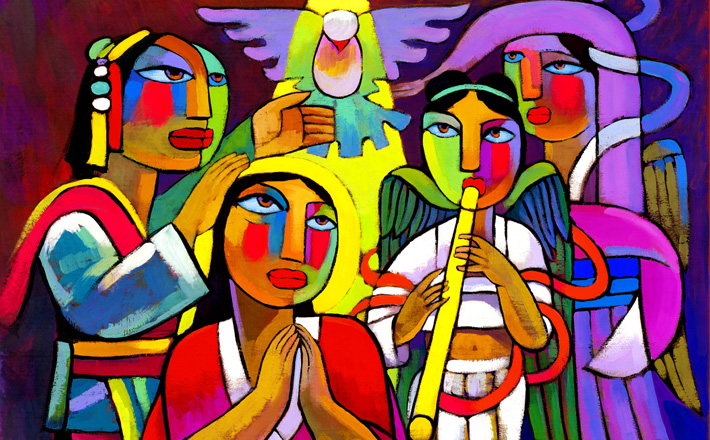
So What?

Luke 3:15-22

So.  This is the Sunday when we observe that one thousand nine hundred ninety-five years ago, give or take, Jesus was baptized by John in the Jordan River.  And I confess that on this Sunday when wildfires are still raging across Southern California, when our eyes are still watering from the smoke in the air, when our vision is still blurred with tears for all the homes and land destroyed and lives lost, when our hearts are still breaking for friends and family—for all the people who have had to evacuate, who have had to flee in terror as fire roared toward them—I confess that my first response to the baptism of Jesus in this week of catastrophe on a Sunday when the fires are still raging and homes and lives are still in peril–my first response to the baptism of Jesus is: so what?

So what if Jesus was baptized?  So what if a voice from heaven proclaimed him as the divine, beloved child of God with whom God was well pleased?  What does that have to do with me?  With us?  How does that help us at a time when our neighborhoods are on fire and our lives are filled with fear and anxiety and desperation?

One thousand nine hundred ninety-five years ago, more or less, Jesus was baptized.  What does this mean?  Where is the good news in that ancient fact in the face of the very real and present danger we are facing right now?

Where is the Good News?  

Well maybe—stay with me here– maybe it’s right where it has  always been.  Maybe it’s right in front of us, in the water and in the Word.  

The baptism of Jesus is depicted in all four gospels.  Sort of.  The Gospel of John alludes to baptism of Jesus but never actually describes him being baptized.  My favorite version of the Baptism of Jesus is in the Gospel of Matthew.  In Matthew, Jesus has no sooner waded into the water when John and Jesus start arguing.  That’s just so human.  In Matthew’s telling of the story, John didn’t want to baptize Jesus.  Matthew tells us that John “would have prevented him.”  It didn’t feel right to John.  It didn’t feel appropriate.  For him to baptize Jesus seemed upside down and backwards.  “I need to be baptized by you!” he tells Jesus.  

need to be baptized by you.  That’s an interesting choice of words.  It implies that John thought he was lacking something that Jesus could give him.  What could that be?

Jesus finally persuaded John to go ahead and baptize him when he said, “Let it be so now; for it is proper for us in this way to fulfill all righteousness.”  Basically, Jesus was telling John, “let’s go ahead with this because it’s the right thing to do.”

Why is it the right thing to do?  John’s baptism was a baptism of repentance for the forgiveness of sin[1].  But Jesus didn’t have any sin that he needed to repent of, did he?  So why was it the right thing for him to do?  How did his baptism “fulfill all righteousness”?

Preachers like to use the baptism of Jesus as a springboard to talk about the meaning of our baptism and the gifts that baptism bestows on us.  I’ll admit that that’s what I’ve preached about on this Sunday for many, many years.  But this year I think something else needs our attention.

Don’t get me wrong.  It’s always useful to take some time to remember our baptism and think about what it means and how we are living out our lives in the covenant of baptism.  But this year, as fires rage around us and life seems perilous and precarious, I have found myself thinking about the baptism of Jesus a little differently.  This year I find myself wondering what it meant for him.  What was he showing us?  What did he want us to see?  What did he want us to learn?

The word “baptism” comes from the Greek verb baptizein which means “to dip,” or “to plunge or to immerse.”[2] When we are baptized, the water that is poured over us is a sign that we are immersed into the life and love of the triune God, that we are plunged into the eternal perichoresis, the eternal circle dance of love that flows between the Father, the Son and the Holy Spirit.  But Jesus was already fully immersed in the life and love of the Trinity, so what did plunging into the water signify for him?  What was he immersing himself in?

I can’t help but think that what baptism signified for Jesus was not his immersion into the life of God, but his immersion into the life of humanity.  

With the Holy Spirit descending like a dove and the voice from heaven proclaiming that Jesus is heaven’s divine and pleasing child, it’s easy to get so caught up in the divinity of Jesus that we overlook how very human this moment is.  Jesus was already immersed in his divinity.  Here at the river, with water up to his chest, he was plunging into his humanity.

Jesus immersed himself into an existence where water is a necessity of life that can cleanse you and sustain you and quench your thirst, but it can also flood your home, sweep away your crops and livestock and drown you.

Jesus immersed himself into a life where fire can refine metals and give you light in the dark and warm your home and bake your bread and cook your meals, but it can also burn down your house and ravage your fields and orchards.  It can obliterate whole cities. It can burn you with the worst kind of pain.  And it can kill you. 

Jesus immersed himself into a human life in a body that was strong and beautiful, a body that could embrace the warm comfort of companions and smell the sweet and uplifting aromas and taste all the delicious flavors and see all the beautiful horizons and hear the music of the birds, a body that could feel joy and compassion and tenderness.  But it was also a vulnerable body, a body that could be wounded and injured,  a body that could smell the stink and feel the sharp edges and experience all the not-so-pleasant sensations of the world, a body that could feel anxiety and fear and pain.  A body that, in the end, could die.

Jesus immersed himself into all that it means to be human, the good and the bad. His baptism was more than an act of divine solidarity; it was a validation of deeply human unity.  He was showing us that he was one of us.  

But he wasn’t just immersing himself in us.

One thousand nine hundred ninety-five years ago, or thereabouts, Jesus was immersed in the waters of the Jordan, a river whose waters had been evaporated from the seas and transported in clouds before falling on the hills as snow and rain, a river that swept minerals and seeds and soil down from the mountains to enrich the land below, a river that carried away the effluent of people, cattle and animals as it flowed past villages and fields and farms and towns, a river filled with life and with a life of its own.  Jesus was immersed not only into the life of humanity, but into the life of the world itself, the life of the planet. 

And maybe that’s the Good News, on this Sunday when fires are still endangering our lives and so many things we hold dear are in jeopardy.  Maybe the Good News for us in the baptism of Jesus is that Christ is immersed in our lives and we are immersed in the life of Christ, but also that Christ is immersed in the life of the world.  Maybe, if we open our eyes and minds and hearts, we can trust that Jesus is with us, in, with and under all our heartbreaks and joys, our fears and our relief.  Maybe we can learn to trust him and hear his voice speaking a word of promise from Isaiah: 

“When you pass through the waters, I will be with you, and the rivers will not overwhelm you.  When you walk through fire you shall not be burned and the flame shall not consume you… for I am the Lord, your God…you are precious in my sight and honored and I love you.  Do not be afraid, for I am with you.”[2]


[1] Matthew 3:11

[2] Isaiah 43:2, 4, 5

And the Logos Became Flesh

John 1:1-18

I have a confession.  I deeply and truly love Christmas, but the sheer enormity of it leaves me flummoxed.   I’m not talking about all the shopping or all the bustle and preparation at home and at church.  I’m not even grumping about the over-the-top commercialism or all the different greeting card interpretations of the “true meaning” which can put you in a psychological sugar coma if you try to swallow them all at once.   

I’m talking about the daunting task of trying to convey a genuine and meaningful understanding of The Incarnation, the idea that the mystery we call God, the Maker of All Things Seen and Unseen, came to us as one of us—the idea that God “became flesh and lived among us” from gestation to birth to death as a particular person in a particular place and in a particular time so that we could begin to more fully understand that God is with us in all persons, in all creatures, in all creation, and at all times.

That thought, that idea, that reality that we call The Incarnation is so enormous and mind-boggling that it’s really tempting to retreat into the less cosmic halo of ideas that hover around that manger in Bethlehem, ideas like innocence and love personified and new beginnings.  Those are all good, true and valuable things.  They are meaningful parts of the package.  But the goodness, truth, new beginnings and love we see in that holy child become even more potent when we begin to truly understand what God is doing in that manger in Bethlehem.

When the early followers of Jesus began to write down their understanding of who Jesus was and what he was about, when they began to explain what they meant when they called him Christ—Christos—the anointed one, it’s clear that they saw him as something more than just a great spiritual teacher or religious leader.   You don’t have to read very far in these early writings to discover that these followers of Jesus thought there was something of cosmic importance about him.  Early on they called him the Son of God but that description didn’t seem to be enough for some of them.  It didn’t seem to fully capture the cosmic fullness of what they had experienced in Jesus the Christ.  

“He is the reflection of God’s glory and the exact imprint of God’s very being, and he sustains all things by his powerful word,” said the writer of Hebrews.[1]  “He is the image of the invisible God, the firstborn of creation,” we read in Colossians, “for in him all things in heaven and on earth were created, things visible and invisible…all things have been created through him and for him…for in him all the fullness of God was pleased to dwell, and through him God was pleased to reconcile to himself all things, whether on earth or in heaven…”[2]

Late in the first century, a writer we’ve come to know as John sat down to write his account of Jesus.  He wasn’t interested in creating just another chronicle of the life of Jesus as others had done; he wanted to explore the meaning of Jesus.  He wanted to make it clear that Jesus the Christ was not someone who could be defined, contained or constrained by geography or time or even philosophy, because the God of all geography and time and philosophy was and is somehow present in him.  

John began his gospel like this:

In the beginning was the Word, and the Word was with God, and the Word was God.  He was in the beginning with God.  All things came into being through him, and without him not one thing came into being.  What has come into being in him was life, and that life was the light of all humanity.  The light shines on in the darkness, and the darkness has not understood it…. And the Word became flesh and lived among us, and we gazed on his glory, glory as of the only Son from the Father, full of grace and truth.

The language of this prologue is pure poetry.  But it’s also philosophy.  And in a strange, farsighted way, John was brushing up against physics.  

The Greek word we translate as “Word” is logos.  Logos was a word that ancient philosophers loved to play with and because of that we have numerous ways to translate it.  One of the oldest meanings of logos was story or narrative.  Where does your mind go if you hear In the beginning was the story, and the story became flesh and lived among us?  

Logos could also mean content or reason or statement.  Other philosophical meaningsincluded, orderideablueprintprimordial templateprimal thought, or intention.  

Logos became flesh and lived among us.  The metaphysical became physical.  If that sounds too esoteric, consider quantum physics.  

 Energy moves through quantum fields as abstract mathematical wave functions.  When wave functions are observed, they tend to collapse into particles.  Particles continually move through patterns in a kind of quantum dance, always moving toward closeness, joining, partnering, combining.  Fermions dance with bosons.  Neutrinos, muons, gluons, leptons and quarks assemble themselves into protons, neutrons and electrons which assemble themselves into atoms which assemble themselves into molecules we call elements.  Hydrogen and carbon molecules dance together to form the four essential organic compounds: nucleic acids, proteins, lipids and carbohydrates.  And out of all of this comes life.  The Word, the Story, the Pattern, the Intention, the Thought becomes flesh and dwells among us.  

The great British astrophysicist James Jeans wrote: “The universe begins to look more like a great thought than a great machine.  Mind no longer appears as an accidental intruder into the field of matter; we are beginning to suspect that we ought rather to hail it as a creator and governor of the realm of matter… We discover that the universe shows evidence of a designing or controlling power that has something in common with our own minds.”[3]

This is The Incarnation.  The great Thought of God expressed in the whole universe condensed itself into a singular human life and lived among us.  And why would God do that?  

Love.

Teilhard de Chardin saw love as the driving force of the universe.  “For Teilhard, love is a passionate force at the heart of the Big Bang universe, the fire that breathes life into matter and unifies elements center to center; love is deeply embedded in the cosmos, a ‘cosmological force.’”[4]

God is Love, we read in 1 John.  “God is love, and those who abide in love abide in God, and God abides in them.”

Love became flesh and lived among us.  And still lives among us.  And within us.  And around us.  And beyond us.  

Love…God… was not content to be an abstract idea or a mere sentiment.  God, the Author of Life, the One in whom we live and move and have our being is Love with a capital L.  Love Personified.  And Love is all about relationship.  Christmas is when God, the Love that founded the universe, showed up as one of us in order to show us in person just how much we are loved and in order to teach us to love each other more freely and completely. 

Love became flesh and lived among us so that we might learn to love God with all our heart, mind, soul and strength and love our neighbors as ourselves.  

Love didn’t come to us as a king or potentate to lord it over us.  Love came as a poor baby among a poor and oppressed people far from the centers of privilege and power in order to show us that “the fire that breathes life into matter and unifies elements center to center,” is alive in and breathing life into all of us and wants to unify us with each other center to center and heart to heart.  And to all who receive him, who believe in his name, he gives power to become children of God.[5]

It’s an enormous idea, this thing called Christmas, this Incarnation.  This idea that the Word became flesh encompasses everything we see and everything we don’t see.  It speaks in poetry then carries us into the depths of philosophy and physics.  It warms the heart and boggles the mind.  It is, quite literally everything.  And the beating heart of it is love.

To even begin to understand the Incarnation, we have to open our minds and our hearts.  As another early follower of Jesus wrote: “I pray that you may have the power to comprehend, with all the saints, what is the breadth and length and height and depth, and to know the love of Christ that surpasses knowledge, so that you may be filled with all the fullness of God.”[6]

Merry Christmas


[1] Hebrews 1:3

[2] Colossians 1:15

[3] James Jeans, The Mysterious Universe, as quoted by Ilia Delio, The Unbearable Wholeness of Being, p. 40

[4] Ilia Delio, ibid., p.43

[5] John 1:12

[6] Ephesians 3:18-19

Out of Love for the Truth

John 8:31-36

“Out of love for the truth and from a desire to elucidate it, the Reverend Father Martin Luther, Master of Arts and Sacred Theology, and ordinary lecturer therein at Wittenberg, intends to defend the following statements and to dispute on them in that place.  Therefore he asks that those who cannot be present and dispute with him orally shall do so in their absence by letter.  In the name of our Lord Jesus Christ, Amen.”

This was the introduction to the 95 Theses which Martin Luther nailed to the door of the Wittenberg University Chapel on Wednesday, October 31, 1517.   We sometimes think that nailing the 95 Theses to the door of the church was an act of rebellion, and in retrospect it was powerfully symbolic.  But it was actually a normal practice.  The church door served as a kind of bulletin board for the academic community.  If you wanted to propose a debate, that’s where you posted the notice with the propositions to be discussed.

Luther did not intend for the 95 Theses to be a manifesto for rebellion.  He had no idea that his challenge to the practice of selling indulgences would spark a revolutionary movement that would sweep across Europe bringing enormous changes in religion, politics, education, and everyday life, but once that movement started, he gave himself to it body and soul because he was committed to the truth of the Gospel and the love of Christ. 

The truth quite literally set him free from the heavy-handed authority of Rome—the Pope excommunicated him.  But the truth also bound him to the proclamation of salvation by God’s grace through faith and to the authority of God’s word in the scriptures.

Out of love for the truth and from a desire to elucidate it…  

According to the Gospel of John, when Jesus was on trial before Pontius Pilate he stated, “For this I came into the world, to testify to the truth. Everyone who belongs to the truth listens to my voice.”  In response, Pilate asked him, “What is truth?”  

In some respects that seems like an almost ridiculous question.  We know what truth is.  We learn about truth almost as soon as we learn to talk.  Sadly, that’s also when we learn to lie, because we learn pretty quickly that the truth may reveal things we would like to keep hidden.  We learn very early on that sometimes truth has consequences that we would like to avoid, and that those consequences might be unpleasant or even painful.  

Truth, the dictionary tells us, is the true or actual state of a matter.  Something is true when it is in conformity with reality.  We say a thing is true when it is a verified or indisputable fact.  The truth reflects actuality or actual existence.  When we say a thing is a basic truth, we mean that it is an obvious or accepted or provable fact.  

Truth means that my desires or imagination do not have the final word in determining what is reality and what is not.

There are twenty-seven verses in the gospels that contain the word truth.  Twenty-one of those verses are in the Gospel of John where truth is not only a central theme, it is anchored in and identified with the person of Jesus.  In John 1:14 we read, “the Word became flesh and lived among us, and we have seen his glory, the glory as of a father’s only son, full of grace and truth.”  Three verses later, John puts aside the figurative language of the Word to make it clear who he is talking about: “The law indeed was given through Moses; grace and truth came through Jesus Christ.”

When Jesus sat discussing theology with a Samaritan Woman at Jacob’s Well, he told her that “true worshipers will worship the Father in spirit and truth.”  This suggests that truth is a vital element in our connection to God.

In chapter 14, not long after Jesus has told Thomas that he, himself, is “the way, the truth, and the life,” Jesus refers to the Holy Spirit as “the Spirit of truth” and in chapter 16 he tells his disciples that “when the Spirit of truth comes, he will guide you into all the truth.”  In chapter 17, as he prays for the disciples, Jesus asks that they would be sanctified or consecrated in truth.

“For this I was born,” Jesus told Pilate, “and for this I came into the world, to testify to the truth.  Everyone who belongs to the truth listens to my voice.” (John 18:37)

In today’s Gospel reading from chapter 8 of John’s gospel, we see a hint that some of those who were listening to Jesus were unsure about continuing to follow him.  Some scholars think that this passage is indicative of tension between Jewish followers of Jesus and Gentile believers in the community where this gospel was written, and that John, the writer, is calling both sides back to the middle ground of the truth found in the person and teaching of Jesus.  

“Jesus said to the Jews who had believed in him, ‘If you continue in my word—if you remain faithful to my teachings, then you are truly my disciples.  And you will come to know the truth.  And the truth will set you free.”  When they protested that they were descendants of Abraham and had never been enslaved by anyone—apparently they forgot about their own history with Babylon and Egypt—Jesus went on to make it clear that he was talking about the truth setting them—and us—free from our slavery to sin.  

But how does the truth set us free from sin?  

René Girard would suggest that truth sets us free from endless mimetic rivalries which are always based in falsehood, fantasy or desire.  Sin is the endless stream of little contests and competitions that we create against each other which escalate, eventually, into big and violent contests.  Truth can free us from this because truth has no bias.  Just as God is the ground of all being, truth is the ground of reality, the neutral acknowledgment of the way things are.  Sin wants to create a different reality or to act as if life is happening in a different reality with different rules.

Martin Luther defined sin as being curved in on the self.  Sin is when I put my preferences, my desires, my ideas, my plans, my goals above and before everyone and everything else.  Sin is me, me, me, me, me taken to the extent that it harms or disenfranchises or marginalizes or disempowers or diminishes or neglects you, you, you, you, you or them, them, them, them, them.  Sin creates a false reality, an illusion centered on my desires, my fears, my imagination.  And that illusion is seductive and captivating.  It ensnares.  It enslaves.  It makes me believe that I am the center of the universe, that what I think or believe or even just what I want very, very badly to be true is what is real.

Truth disabuses me of that illusion.

Once again: Truth means that my desires or imagination do not have the final word in determining what is real and what is not.

We are currently struggling through a time when truth is endangered in our culture.  There’s nothing new about that.  People have always preferred to put their own spin on facts that confront their biases or preconceived ideas or desires.  People throughout history have taken refuge in denial when events or outcomes don’t fit the way they wanted things to happen or the results they wanted.  What’s new is how widespread and militant this devaluation of the truth has become.  

When lies and spin become so prevalent that they begin to undermine any common understanding of basic facts, the world becomes a more dangerous place.  When people refuse to accept observable facts, when there is no longer the common cultural ground of truth based on fact, then there is no longer a starting point for discussion or compromise.  There is no way to move past confrontation and opposed binary positions that divide us.  When people lift up conspiracy theories and “alternative facts” as justification for their actions or opinions then we stand on the precipice of political violence.  

Sadly, we have seen clear examples of that lately.  It has become the sin of our society fed by the polarity of our politics.

The proliferation of misinformation and outright lies in our political and social conversation has become so common and problematic that our ELCA Conference of Bishops recently issued a joint statement to address the problem. These are the opening lines of their statement:

We know that the power of truth is greater than the power of deceit.

We, the members of the Conference of Bishops of the Evangelical Lutheran Church in America, speak with one voice to condemn the hateful, deceptive, violent speech that has too readily found a place in our national discourse. We lament the ways this language has led to hate-fueled action. We refuse to accept the ongoing normalization of lies and deceit. We recommit ourselves to speaking the truth and pointing to the one who is truth. 

We refuse to accept the ongoing normalization of lies and deceit.  We recommit ourselves to speaking the truth.   To do otherwise is sin.

Sin convinces me that I stand apart from the rest of humanity.  But the truth, the fact, is that I am deeply and intimately connected to the rest of humanity and, in fact, to all of creation.  Standing apart is an illusion.  Rugged individualism is a destructive myth—destructive because it undermines and negates the relationships that keep us alive in every sense of the word.

“We must all overcome the illusion of separateness,” said Richard Rohr.  “It is the primary task of religion to communicate not worthiness but union, to reconnect people to their original identity “hidden with Christ in God” (Colossians 3:3). The Bible calls the state of separateness ‘sin.’ God’s job description is to draw us back into primal and intimate relationship.”

As followers of Jesus, we are called to live in the imitation of God.  We are called to observe what God is doing all the time and everywhere and then do the same.  We are called to be generous because God is generous.  We are called to be creative because God is creative.  We are called to embrace diversity because God revels in diversity so much that no two things are exactly alike in the entire universe.  But above and beyond everything else, we are called to love.  “Love,” said St. Paul, “does not rejoice in unrighteousness, it rejoices in the truth.” (1 Cor 13:6)  Untruth is corrosive to love.  Lies and deception undermine and chip away at love until it disappears.  But truth reinforces love and makes it stronger.  There’s a reason we talk about “true” love.

We are called to love because God loves.  God is love.  Richard Rohr has said, God does not love us if and when we change.  God loves us so that we can change. That is the essence of grace—the grace that makes us whole, the grace that heals us, the grace that reunites us, the grace that saves us and leads us into the truth.  Truth is where all grace begins.

At the conclusion of their statement, the ELCA Bishops gave us some good practical advice to help us ensure that our lives, thoughts, speech and actions are anchored in grace and truth:

We find courage in our collegiality and implore the members of the Evangelical Lutheran Church in America, as well as our partners and friends, to join us as we:

  • Pledge to be vigilant guardians of truth, refusing to perpetuate lies or half-truths that further corrode the fabric of our society.
  • Commit to rigorous fact-checking, honoring God’s command to “test everything; hold fast to what is good” (1 Thessalonians 5:21).
  • Reject the use of humor that normalizes falsehood, remembering that our speech should “always be gracious” (Colossians 4:6).
  • Boldly advocate for the marginalized and oppressed, emulating Christ’s love for the least among us.
  • Courageously interrupt hate speech, standing firm in the knowledge that all are created in God’s image.
  • Lean in with curiosity, engage with those who think differently and “put the best construction on our neighbor’s action” (Luther’s explanation of the Eighth Commandment).
  • Amplify voices of truth.

Emboldened by the Holy Spirit, may we resist deception and lift up the truth that all members of humanity are created in the image of God.

On this Sunday, we celebrate a Reformation began with the words, “Out of love for the truth…”.  May we resist the sin of deception and live with a commitment to truth that continues to reform and refresh our faith, our lives and our world.  In the name of the Way and the Truth and the Life.

Whatever We Ask

Mark 10:35-45

“Whoever wishes to become great among you must be your servant, and whoever wishes to be first among you must be a slave of all. For the Son of Man came not to be served but to serve, and to give his life a ransom for many.”

There was an interesting picture that popped up here and there on social media a few years ago.  It was a picture of a middle-aged man washing dishes in a restaurant kitchen, which isn’t all that unusual, except in this particular picture, the man who was washing the dishes was Rock and Roll Hall of Famer Jon Bon Jovi, the front man for the very successful rock band, Bon Jovi. 

Back in 2011 Jon and his wife Dorothea wanted to do something to help hungry people, but they didn’t want it to be just another food pantry or soup kitchen.  Food banks and soup kitchens do good work, but they also tend to isolate poor people from everyone else or spotlight them—and not in a good way.   

Jon and Dorothea decided to open a restaurant where payment is optional so that folks who cannot afford a restaurant meal can dine right alongside those who can.  They called their restaurant JBJ Soul Kitchen and it has now expanded to three locations.  

The menu at JBJ has no prices.  You select what you like and are encouraged to make a suggested donation, but if you are unable to donate, you are invited to participate in what they call “volunteer opportunities,” which usually means working in the kitchen in one way or another.  When he’s not on tour, Jon Bon Jovi himself often stops in to volunteer as a waiter or cook or dishwasher.  

During the pandemic, as you might imagine, JBJ Soul Kitchen had to change its ways of operating.  In an interview in 2020, Jon said, “Due to the pandemic, we couldn’t have any volunteers work.  But we still had mouths to feed.  So Dorothea and I worked five days a week for two months before we went to Long Island and opened a food bank that fed 6,000 people a month there.”  

Whoever wishes to become great among you must be your servant, and whoever wishes to be first among you must be a slave of all.

There is a YouTube channel where, every night of the week, you’ll find one of the richest, most successful women in the world sitting on her bed in her pajamas reading a children’s book.  The very famous  lady in her PJs is none other than Dolly Parton, and her YouTube program, Goodnight with Dolly, is targeted toward preschoolers, because children who have someone read to them on a regular basis develop their own reading skills earlier and more easily.  

Dolly understood that not every parent has free time to sit and read with their kids, especially single parents.  And not all parents read well enough, themselves, to provide their kids with that important head start.  In fact, that was the case with Dolly’s own father who started working while still very young and as a result never learned to read or write.  So Dolly Parton decided that, in honor of her father, she would help as many kids as possible develop those very necessary pre-reading and early reading abilities.

Goodnight with Dolly is the newest venture in Dolly Parton’s long-time campaign for literacy.  In 1995, she launched the Imagination Library in Sevier County, her home county in East Tennessee, to inspire a love of reading by giving one free children’s book every month to every child in the county from age two until they start school.  With the help of local community partners, the Imagination Library has now spread throughout the United States, United Kingdom, Canada, Australia, and Ireland.  Nearly two million kids are now registered in the Imagination Library, and the organization has given away more than 254 million books.  Even so, there are still kids who haven’t been reached.  So Dolly Parton sits on her bed in her pajamas and reads to the kids whose parents aren’t available or aren’t able to read to them.

Whoever wishes to become great among you must be your servant, and whoever wishes to be first among you must be a slave of all.

The Disciples James and John came to Jesus and said, “Teacher, we want you to do for us whatever we ask of you.”  When he asked them what that might be, they said, “Let one of us sit at your right hand and one at your left when you come into your glory.”  

It’s interesting that Jesus didn’t chastise them even a little for asking something so audacious.  He simply told them that they didn’t really understand what they’re asking.  He hinted at the ordeal he would soon endure when he asked them,  “Are you able to drink the cup that I drink, or be baptized with the baptism that I am baptized with?”  They answered just a little too quickly:  “We are able,”  and it seems pretty clear that they didn’t really know what they were signing up for.

We shouldn’t be too hard on James and John.  To their credit, they really did have faith.  They truly believed that Jesus really could give them what they wanted.  They believed that he would soon “come into his glory.”  They just didn’t understand what that meant.  It didn’t occur to them that he was talking about the cross.

A lot of us have come to Jesus at one time or another saying, “I want you to give me whatever I ask of you.”  A lot of people have thought that this is really the essence of praying.  Jesus, please give me what I ask for.  And a lot of us have asked at one time or another to be put in positions of authority and prestige—right seat or left seat, either one is okay as long as we have a seat next to the throne. . .or at least at the table.  We want that position that gives us the authority to fix all those things that other people are messing up.  We have ambition.

Jesus didn’t rebuke James and John for their ambition.  But the other disciples did.  So Jesus had to remind all of them of what he had been saying all along.  You want to be a leader?  Fine!  Good!  Now, can you be a servant?

Whoever wishes to become great among you must be your servant, and whoever wishes to be first among you must be slave of all.

When Boris Baranov was appointed to the position of Shift Supervisor at the powerplant where he worked, he was given significant authority over some of the plant’s operations.  Along with that authority, of course, came some extra responsibilities.  Boris never dreamed, though, that saving most of Europe from becoming a nuclear wasteland would be one of those responsibilities.  But that’s exactly what happened one day when something seriously malfunctioned during his shift at the Chernobyl Nuclear Power Station, the powerplant where Boris worked. 

On April 26, 1986 one of the four reactors at Chernobyl exploded releasing 400 times more radioactive fallout than the bomb dropped on Hiroshima in 1945. Two workers were killed instantly.  Another 29 would die from radiation burns or poisoning over the next few months.  

All the fires were extinguished within six hours, but now there was a risk of an even larger explosion—an explosion that would be many times more devastating.  

Several days after they thought that everything was under control, they discovered that the reactor in unit 4 had continued to melt down. Below the reactor was a thick concrete slab and below the slab was a large pool of water which was normally used to cool the reactor.  

The core of the badly damaged reactor was now melting its way through the concrete slab.  If it were to reach the water, it would create an gargantuan steam explosion with a force of 3 to 5 megatons.  The enormous cloud of radioactive steam and ash that would have risen into the wind from that explosion would have made much of Europe uninhabitable for 500,000 years. 

To prevent the explosion, the water under the reactor had to be drained, which could only be accomplished by manually turning the right valves which were in the basement.  That would have been simple enough except that the basement was flooded with radioactive water from putting out the fires.  

Boris Baranov, the shift supervisor, Valeri Bespalov, the senior engineer, and mechanical engineer Alexei Ananenko volunteered to wade into the flooded basement and turn the valves.  Their brave and selfless act of service saved millions of lives.

Whoever wishes to become great among you must be your servant, and whoever wishes to be first among you must be a slave of all.

There’s nothing wrong with ambition.  Jesus didn’t rebuke James and John for their ambition.  He even affirmed that they would, in the end, drink from his “cup” and be immersed in his “baptism.”  But he wanted them to understand that ambition for ambition’s sake can lead to responsibilities you’re not prepared for, challenges you haven’t even begun to imagine.  

James and John wanted to be great, to sit in positions of prestige and authority.  And in the end, in a way, they got what they asked for.  According to tradition, after ten or twelve years proclaiming the gospel in Palestine alongside his brother John and the rest of the disciples,  James took the gospel to Spain.  In the end, when he returned to Jerusalem, he was killed by Herod Agrippa.  

John, according to tradition, took the gospel to Ephesus where he had a long life serving others and teaching them the way of Jesus.  James and John found direction for their ambition.  But along the Way they had to learn a very hard lesson. 

Whoever wishes to become great among you must be your servant, and whoever wishes to be first among you must be a slave of all.

In a matter of days now, we will have a very important national election.  The votes you cast in this election will be among the most important votes of your lifetime.  I cannot tell you whom you should vote for, but I will ask you to consider this:  who, among these candidates, has a history of seeking power out of sheer ambition, and who has a record of public service?  Who is seeking power for the sake of having power, and who is seeking a more powerful way to serve?  

Whoever wishes to become great among you must be your servant, and whoever wishes to be first among you must be a slave of all.  Please bear that in mind as you vote, then vote accordingly. . . and prayerfully. 

When Mom Doesn’t Like Your Job

Mark 3:20-35

Question:  What do Katy Perry, Kris Kristofferson, Florence Nightingale, Edouard Manet, Miles Davis, Alfred Nobel, Edgar Allen Poe and Robert Zemeckis have in common?   Answer: Their parents objected to the careers they chose.

Family can have a profound influence on the path we follow in life.  Alex Haley said that in every conceivable way, the family is a link to our past and a bridge to our future.  Your family can inspire, you, guide you, and cheer you on as you find and pursue your vocation, or they can misguide, misdirect, discourage and just plain thwart you.

I first felt called to become a pastor when I was fifteen years old.  My parents did not like the idea, and that is one of the main reasons I didn’t begin seminary until I was almost forty.  They loved me.  But they had a different future in mind for me than the future that chose me.

In today’s gospel reading from Mark we find two groups who would be happier if Jesus were to pursue a different career.  They would like nothing better than for him to stop the healings and exorcisms and the preaching and teaching and go do something more normal. Like be a carpenter, maybe.  On the face of it, these two groups wouldn’t seem to have much to do with each other, but the one big thing they have in common is that Jesus scares them.

Jesus had been busy traveling around the Galilee, announcing the arrival of the Reign of God, or, as Diana Butler Bass calls it, the Commonwealth of God’s Justice and Mercy.  In his preaching and teaching he had been describing a very different way of life that comes with God’s reign, and he had been demonstrating what this Commonwealth of Kindness looks like with healings and exorcisms and other acts that restore people to community.  In doing all this, he had also butted heads with the religious establishment because he was continuously reinterpreting Torah in ways that undermined the hierarchical authority of the scribes and the piety of the Pharisees.

Mark tells us that the crowd following him had become so large that it was almost unmanageable.  People were coming from as far away as Jerusalem, Idumea, Tyre and Sidon.  And then one day his family showed up, lingering somewhere at the edge of that great crowd that was following Jesus everywhere he went.

The NRSV translation says that his family had come to restrain him.  That’s a fair enough translation, but it doesn’t really capture the force of krateo, the Greek word that Mark uses, unless you imagine them using actual restraints.  To be clear, they had come to seize him and take him home by force if necessary because they thought he had lost his mind.

They were afraid for him.  They were afraid for him because they didn’t understand him.  They were afraid for him because it was hard for them to believe that this kid who grew up in their house had turned out to be so much more than the kid who grew up in their house.  They were probably a little bit afraid for themselves, too.  After all, having a crazy, radical preacher in the family can be hard on a family’s reputation.

But mostly they were afraid for him because they loved him.  He was family, after all.  So they worried about him, especially when they overheard this other group that wanted to rein him in.  Or worse.

Some scribes had come down from Jerusalem to see Jesus for themselves and to begin to form some kind of official opinion of him and his actions.  And their official opinion was that he made them nervous.  They wouldn’t have said it in so many words, but they were afraid him.  They were afraid because he called their privilege—their role and status and authority into question.  But mostly they were afraid of him because the crowd loved him.  And the crowd kept growing.  Big crowds would make their Roman overlords pay attention, and the things Jesus was saying, his language about “the Kingdom of God,” might sound like a call for revolution. . . which, to be fair, it was.  And is.  

“It is by Beelzebul, the ruler of the demons, that he casts out demons,” said the scribes.  “Well how does that make any sense?” asked Jesus.  “How can Satan cast out Satan?  If a kingdom is divided against itself, that kingdom cannot stand!” He may have had his family in mind when he added, “And if a house is divided against itself, that house will not be able to stand. And if Satan has risen up against himself and is divided, he cannot stand, but his end has come.”

Finally, to make it crystal clear just what his mission was all about he said, “No one can enter a strong man’s house and plunder his property without first tying up the strong man; then indeed the house may be plundered.”  

But Jesus wasn’t finished.  In one last note of caution for the scribes, Jesus said something that should give all of us pause, especially when we are about to speak judgmentally about people or things happening in our world that we don’t like or that make us uncomfortable.  “Truly I tell you,” he said, “people will be forgiven for their sins and whatever blasphemies they utter, but whoever blasphemes against the Holy Spirit can never have forgiveness but is guilty of an eternal sin.”

He said this because the scribes had accused him of being possessed by Beelzebul. But Jesus, of course, was actually intimately connected with the Holy Spirit.  

I have thought of this passage often over the years when I have heard others say that something they are opposed to is evil or demonic. During the years when our denomination was debating whether it was okay or not to ordain lesbian and gay and trans people, I more than a few times heard people describe our efforts at being more inclusive as being evil when it seemed clear to me and others that it was the work of the Spirit.

How many times in history have we been trying to hold a door shut that the Holy Spirit is trying to open?  How many times in history has the Church called something demonic only to realize in retrospect that it was the work of the Spirit trying to broaden our minds and horizons?  God’s embrace is always bigger than ours and God’s vision always sees farther than ours.

God’s perspective is broader than ours.  Jesus sees things differently than we do, and sometimes that can be unsettling.  I still find the last segment of this episode with the scribes and his family disconcerting.   

Jesus’ mother, Mary, stood outside the house with his brothers and sisters, calling out to him.  The crowd that surrounded him made sure he knew they were there.  Someone spoke up and said, “Your mother and your brothers and sisters are outside asking for you.” 

The way Jesus responded can sound cold and heartless, but it’s important to remember that everything Jesus said or did in this Gospel of Mark was calculated to reveal the values and vision of the Reign of God—the Commonwealth of God’s justice and mercy.  

Jesus posed a rhetorical question: “Who are my mother and my brothers?” he asked.  Then, looking at all those people who were crowded around him, he gave the Reign of God answer to that question.  “Here are my mother and my brothers! Whoever does the will of God is my brother and my sister and my mother.”

In one sentence, Jesus undermined the coercive and restrictive potential of the biological family and at the same time expanded the definition of family.  As cold as his answer might sound to us, Jesus did not actually disown or repudiate his biological family, but he wanted to make it clear that in God’s eyes family goes far beyond being biologically related.  In the Commonwealth of God’s justice and kindness, family is whoever does the will of God.

Sometimes the imagery in the gospels can be confusing or opaque.  More often, though, I suspect that the problem isn’t so much that the words of scripture are puzzling as that they make us uncomfortable, so we move past the troubling parts without taking time to really deal with them.  As Mark Twain once said, “It ain’t those parts of the Bible that I can’t understand that bother me, it is the parts that I do understand.”

According to Ched Myers, author of Binding the Strong Man, which has become pretty much the go-to commentary on the Gospel of Mark, this gospel was probably written somewhere in Palestine between 68 and 71 CE during the height of the Jewish revolt against the Roman occupation.  Myers tells us that this gospel, in which Jesus is gritty, uncompromising, down-to-earth, and scathingly direct—this Gospel of Mark is, in fact, a manifesto for nonviolent revolution, written to serve as an alternative path for the followers of Jesus who are being pulled into the violence of the uprising against Rome.  

In Mark, the followers of Jesus, then and now, are truly being called to subvert the dominant paradigm—to challenge and deconstruct and then reconstruct the systems by which our world operates until there truly is liberty and justice and peace and health and wholeness for all.  Anywhere there is coercion, the followers of Jesus are called to stand up to it with nonviolence.  

In other words, the gospel that Jesus proclaims, the living and uncompromising assertion of the Commonwealth of God’s justice and kindness, is nothing short of a nonviolent revolution.

Almost every pastor I know has stories about times we have been accused of being too political.  I have had people say to me that they come to church to hear about spirituality and not politics.  I get it. We humans have this very unfortunate tendency to compartmentalize our lives.  We organize our hearts and minds in little boxes: spirituality in this box, politics in this box, everyday life in this box over here.  The problem is that that these things really are not separate.  Our politics and economics are a barometer for our spirituality.  Our everyday life and the way we conduct our business puts our real beliefs on display.  

If we are sincere about following Jesus, then we can’t avoid politics because the gospel that Jesus proclaims is a kind of revolution and revolution is political.  Jesus wasn’t crucified for being a spiritual teacher.  He was crucified at the intersection of religion and politics because he was proclaiming a revolution that seeks to transform and restructure the entire world, to unite and unify all of life, and to redefine what it means to be human.  But before you can do that, you have to undo life as it is.  You have to take apart coercive systems and deconstruct business as usual.

Jürgen Moltmann, the great German Lutheran theologian who died this past week wrote, “Those who hope in Christ can no longer put up with reality as it is, but begin to suffer under it, to contradict it. Peace with God means conflict with the world, for the goad of the promised future stabs inexorably into the flesh of every unfulfilled present.”[1]  God calls us to take up the tools of Christ to bring that promised future into the unfulfilled present.  But our tools are nonviolent tools.  Following the model set by Jesus, we use logic and common sense instead of violence.  Our first tool for reshaping the world is a stubborn resistance rooted in love and compassion and kindness and truth and hope.  And our hope is rooted in a vision of a healthy world where we all live in peace and cooperation with each other and with our God-beloved, God-made planet in a harmonious and generous balance.

Jesus came to bind the strong man, to take down all the human, religious and demonic forces that bully and constrict God’s children and crush our souls. Empire.  Coercive religion. Even family when it becomes too rigid and authoritarian.  People who are deeply vested in unhealthy systems don’t like to read the gospel this way.  They prefer to keep things “spiritual” which, in the end, means that neither Jesus nor his words ever touch the ground.  Or the depths of the heart.  And they certainly don’t change the world.

Jesus came to plunder the house of the strong man, to liberate every person who will follow his Way so that together we can build the Commonwealth of God’s justice and kindness and make it as visible on earth as it is in heaven.  


[1] Jürgen Moltmann, Theology of Hope: On the Ground and the Implications of a Christian Eschatology

For God So Loved…

For God so loved the world that he gave his only son, so that everyone who believes in him may not be destroyed but may have everlasting life. For God did not send his son into the world to judge the world, but so that the world could be saved through him. –John 3:16-17, translation by Richmond Lattimore

You get used to hearing a thing a certain way and it’s hard to hear it any other way. You get used to seeing things a certain way and it’s hard to see them any other way. It’s not just attitude or stubbornness that does this, it’s at least partly the way our brains work. The human brain, says psychologist James Alcock, is a belief engine. It automatically creates neural pathways to reinforce the patterns, ideas and meanings that we already know and it automatically reacts with wariness to anything that doesn’t quite fit the familiar paradigm.

Take that Bible verse above, for instance. John 3:16 is the most memorized verse in all the Christian scriptures. But I think most of us learned to see it and hear it a certain way when we were small. First, if your experience is like mine, you learned it in Sunday School and you learned it in isolation from what comes before it and after it. You memorized it and treasured it, but it pretty much stood alone in your mind, isolated from the story of Nicodemus, set apart from the very important message that Jesus didn’t come to judge but to save. I was a full grown adult before Pr. Darcy Jensen called my attention to that very important verse 17, and frankly, I was a bit gob smacked! Jesus did not come to judge (or condemn, depending on your translation) but to save!

And to save what? Well, the world, of course. Except not exactly the whole world, because most of us, I think, thought of “the world” as “the people,” the “everyone” the “whosoever” from verse 16. So what we really heard was “God so loved the people that he gave his only son…” And that’s okay as far as it goes except that the word for “world” in the original Greek text is kosmos. As in cosmos. As in all creation. God loves all creation. Jesus came to save all creation!

And there’s that verb to save again. Most of us learned, I think, that this meant Jesus would rescue us from a very painful and nasty afterlife that was the default destination for everyone except his special pals. And yes, to save can mean to rescue. But it can also mean to heal, to make whole, to restore, to preserve.

The point of all this is that sometimes new information does break through the old patterns so that we can see and hear old, familiar things in new ways and our world is enlarged. Sometimes that new information can be life-changing.

In The Bromeliad Trilogy by Terry Pratchett, Masklin, a gnome, tries to come to grips with all the strange ways that new information has been turning their comfortable little gnome world upside down. He does a capable job of leading their community through a nearly catastrophic series of changes, but the power of new information doesn’t really hit home with him until his girlfriend, Grimma, discovers an encyclopedia. New information changes her world, and by extension, his. He laments to a friend,

“I told her we were going to get married, and all she could talk about was frogs. She said there’s these hills where it’s hot and rains all the time, and in the rainforests there are these very tall trees and right in the top branches of the trees there are these like great big flowers called…bromeliads, I think, and water gets into the flowers and makes little pools and there’s a type of frog that lays eggs in the pools and tadpoles hatch and grow into new frogs and these little frogs live their whole lives in the flowers right at the top of the trees and don’t even know about the ground, and once you know the world is full of things like that, your life is never the same.”

Once you know, your life is never the same. “Knowing things changes you. You can’t help it.” says Masklin in a later chapter. You can’t help it. And maybe that’s another reason we resist new information because once we see something in a new and different way, we can’t unsee it. But the transformative power of our faith lies, at least in part, in our ability to see the world and each other with fresh eyes. We are to continually be transformed by the renewing our minds.

For centuries our theology has, for the most part, been anthropocentric, centered on humanity. On us. But we don’t have to change too much in the way we read or hear our sacred texts to develop a theology of ecology. For God so loved the cosmos… This is how much God loved all of creation…

God, in Christ, is certainly calling us to do whatever we can to rescue the people of this world from the various and sundry miseries that can make life a living hell. But if we read it just a little differently, with new information, we might see that we, in Christ, are really being called to an even bigger job, to the healing and restoration of the whole world. All of it… including those tiny frogs who live in their tiny pools in the bromeliads in the tops of the Amazon trees.