What Kind of Kingdom?

Luke 23:33-43

Today is the last Sunday of the church year, Christ the King Sunday or Reign of Christ Sunday.  This is a fairly new addition to the church calendar—it was added only 100 years ago—and frankly, not everyone is happy about it.  

In 1925, the world was trying desperately to put itself back together in the aftermath of World War I and it wasn’t going well.  Pope Pius XI was gravely concerned by the growing tide of secularism and ultra-nationalism in Germany, Italy and elsewhere, and, of course, the rise of Communism in Russia.  In response he issued an encyclical called Quas Primas—“That Which is First.” Interestingly, it can also be read as a question, “What is First?”.  In this encyclical, he established The Solemnity of Our Lord Jesus Christ, King of the Universe or, as it came to be commonly known, the Feast of Christ the King.  

Pope Pius was trying to restate and reinforce the idea of the sovereignty of Christ over, well, everything.  He wanted to make it clear that our deepest and most profound allegiance should be to Jesus Christ above and beyond every other allegiance.  But in doing it in this way, was he, maybe, missing the point of what Jesus was actually saying when he talked about the kingdom of God?

The image of Christ as King is problematic for us in a number of ways.  First of all, it’s hard for us to relate to even the idea of a king.  There aren’t very many real monarchs left in the world, and most of the ones who are still here wield a power that is primarily symbolic or ceremonial.  As a case in point, King Charles III ascended to the throne of Great Britain three years ago after the long reign of his mother, Queen Elizabeth, but neither the world nor Great Britain have seen any significant changes in the governance of the United Kingdom as a result.  That’s because whatever power the throne still has is very strictly circumscribed by a democratic parliament. 

Another problem with the imagery of Christ the King is that, unfortunately, Christianity doesn’t have a very good track record with kings.  Too often in history Christianity has found itself either colluding with or coopted by the oppressive forces of empire instead of the liberating and restorative teaching of Jesus and the movement of the Holy Spirit.

In her book A Beautiful Year: 52 Meditations on Faith, Wisdom and Perseverance,  Diana Butler Bass said, “The word king is so problematic.  It is wedded to social privilege and pyramids of wealth and power and invested with centuries of inequities and fairy-tale fantasies.”[1]  Our experience of kings stands in stark contrast to the egalitarian vision Jesus was describing when he announced that the basilea of God was within reach.

Basilea.  That’s the Greek word in the gospels that we translate as kingdom.  It’s a word that the empire used to describe the domain of Caesar and also the territory governed by Herod and other client kings.  And even as Jesus was proclaiming the arrival of the basileaof God, it was a word that was both too small and too loaded to really capture the new reality that Jesus was describing.

The word Kingdom implies boundaries. Boundaries imply limitations and location.  You are either inside or outside.  Even the synonyms for kingdom make it sound territorial. 

The word Kingdom also implies power, usually and especially coercive power. Constantine and later Christian emperors and kings readily embraced the concept of the Kingdom of Christ because it was an image they could use in exercising their own power.  They could claim that they were appointed by Christ and were ruling under his authority, which meant that they could spin just about anything they did as justifiable because they were acting on Christ’s behalf.  Convert people at the point of the sword or by torture?  No problem.  We’re doing it for Jesus.  

Today, Christian Nationalism and other authoritarian movements appropriate the language of Christ the King to imagine Jesus as a muscular monarch, kicking tail and taking names.  Under the auspices of Christ the King, they want to establish a restrictive theocracy, but in embracing that idea they completely miss the new reality that Jesus was calling us to embrace.

Kingdom, realm, reign, sovereignty—none of these terms are really a good fit for what Jesus was describing when he announced that the basilea tou theou –which we translate as The Kingdom of God—is arriving, is at hand, is within reach. 

George Orwell was a guy who knew a thing or two about language and how we use, abuse, twist and misuse it.  Orwell said, “There is a huge dump of worn-out metaphors which have lost all evocative power and are merely used because they save people the trouble of inventing phrases for themselves.”[2]

Christ the King is one of those worn-out metaphors.  We keep using it because we haven’t come up with a better phrase to describe the vision of God’s all-pervading influence that Jesus was proclaiming or a way to describe our belief that God in Christ is the ultimate power that moves the universe through love, compassion, creativity, grace and cooperation.  

On the plus side, Christ the King does make us ask ourselves some important questions. What do we mean when we say that Christ is sovereign?  How do we understand the kingdom of God, the reign of God?  How do we understand the power of God?  How do we understand power in general?  How do we use power?  Do our values reflect the values of empire or the values of Jesus?  What kind of kingdom do we belong to?  And what do we do when our allegiance to Christ and the values of Jesus are in conflict with the values and practices of the other powers that hold sway in our lives?

The kingdom of God, as Jesus described it, was and is a resistance movement.  To say that Christ is king is a resistance claim.  It is a challenge to the way power is coercively used most of the time in our world.  Jesus is a different kind of king.  The crucifixion is his coronation.  He surrenders to the coercive power of empire to show us its naked violence, but also to show us the greater power of love and nonviolence.

Pontius Pilate understood that Jesus was all about resisting the empire’s coercive power but also the empire’s imagery.  When Pilate asked Jesus straight out, “Are you the king of the Jews?” Jesus simply replied, “You say so.  Those are your words.”[3]  The soldiers crucifying Jesus mocked him saying, “If you are the king of the Jews, save yourself!” Pilate mocked both Jesus and the Jewish people by having a board nailed above his head with the inscription, “This is the King of the Jews.”  These were people who understood power in only one way.  Control.  Coercion.  Power over.

But the reign of God that Jesus was describing is a cooperative world.  The reign of God doesn’t force itself on anyone or try to control anyone.  Christ, as king, pervades, persuades, encourages, nudges and asks us to live up to a vision of our better selves. 

 The commonwealth of God’s justice and kindness is a world where generosity, grace, compassion and mercy prevail.  It is a world driven by and governed by love.  It is a world where everyone’s needs are met and no one goes hungry.  It is a kingdom that opens pathways through every kind of border, boundary and barrier.  It is a world where the only control is self-control.  Its central values are to do justice, to love kindness, and to walk humbly with God. Its only law is love: love God, and love your neighbor as yourself.  

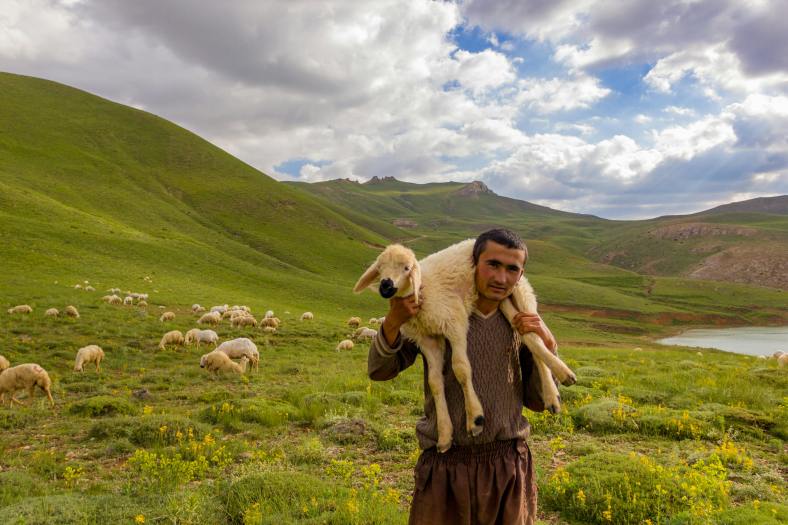
The kingdom that Jesus was describing is a world moving toward the vision of Isaiah when we will beat our swords into plowshares and our spears into pruning hooks, when nation shall not lift up sword against nation nor shall they study war anymore.[4]  The kingdom that Jesus proclaimed is the world where God walks with us as Ezekiel envisioned, a world where God shepherds us, where Christ seeks out the lost and brings back the strays, where through us, Jesus binds up the injured and strengthens the weak and feeds us all with justice.[5]

The reign of God is a realm in which the poor are blessed and the hungry are filled and those who mourn are comforted.  It is the world Mary envisioned in the Magnificat when she sang, “He has shown strength with his arm; he has scattered the proud in the thoughts of their hearts. He has brought down the powerful from their thrones, and lifted up the lowly; he has filled the hungry with good things, and sent the rich away empty.”[6]

Yes, God exercises power.  But not the way we usually think of power. God’s power is all about empowering you.  God is about giving power rather than holding onto it.  God gives power to us so that we can love and care for the world more fully and effectively. Together.  “The greatest manifestation of the power of God,” said Bishop Yvette Flunder, “comes when we work together to find ways to be together and do justice together and love together and stand together.”  

The kingdom of God is all of us together.

 “Jesus did not establish an institution,” wrote Bishop Michael Curry, “though institutions can serve his cause. He did not organize a political party, though his teachings have a profound impact on politics. Jesus did not even found a religion. No, Jesus began a movement, fueled by his Spirit, a movement whose purpose was and is to change the face of the earth from the nightmare it often is into the dream that God intends.”

Today is Christ the King Sunday.  It is a day when we use the “worn out metaphor” of kingly power to try to open the doors and windows of our hearts, minds and souls to the empowering love of God through Jesus Christ.  It is a day when we acknowledge both that God in Christ is the ultimate power and that we need to redefine how we understand and use power.  It is a day when we are asked to declare that our deepest and most profound allegiance is to Jesus Christ above and beyond every other allegiance.  It is a day that challenges us to walk in the Way of Jesus so that we can help to bring God’s vision of a whole, healthy, loving and cooperative world into reality on earth as it is in heaven.

Today is the day we volunteer to change the face of the earth from the nightmare it so often is into the dream that God intends.  In the name of Christ the King.


[1] Diana Butler Bass; “Christ the King”; A Beautiful Year: 52 Meditations on Faith, Wisdom, and Perseverance

[2] Politics and the English Language, 1946. 

[3] Luke 23:3

[4] Isaiah 2:4; Micah 4:3

[5] Ezekiel 34:15-16

[6] Luke 1:46-55

Focus

Luke 21:5-19; Malachi 4:1-2a; 2 Thessalonians 3:6-13

The temple in Jerusalem—Herod’s temple—had been under construction for almost 50 years when Jesus sat down in its outer courtyard to speak with his disciples.  Herod had begun reconstructing the temple in 20 BCE, and even though it was still a work in progress, it was already regarded as one of the wonders of the world.  The work would be completed in 63 CE, some thirty years after this teaching moment Jesus has with his disciples, only to be destroyed by the Romans seven years later—but that’s getting ahead of our story.

In order to be able to build the massive temple he envisioned, Herod first had to rebuild Mount Moriah, the low mountain on which the temple stood.  To do this, he encased the mountain with walls more than 33 meters (108 feet) high, then filled in the space with earth until it encompassed an area of more than 144,000 square meters.    

The temple in Jerusalem was a visual wonder.  A description in the Talmud says that  the interior walls of the temple were faced with blue, yellow, and white marble.   Gold spikes lined the parapet wall on the roof.  Josephus wrote that the entire eastern fascia was covered with gold.  “The rays of the early morning sun, striking the Temple façade created a blinding reflection,” he wrote.  “The rest was white, so that this towering edifice looked like a snow-clad mountain from afar.” 

It must have sounded like madness for Jesus to say that it was all coming down—that not one stone would be left upon another.  But by the time Luke wrote his gospel, sometime around the year 85, everything Jesus predicted in today’s gospel reading had already happened.  

Destruction of the temple.  Wars and insurrections.  Earthquakes. Famines and plagues.  Betrayals and persecutions.

In 64 CE, the emperor Nero carried out the first official persecution against Christians, using them as a scapegoat for the catastrophic fire that had destroyed much of Rome.

In July of 66 CE, the Jews rose up in revolt against the Romans and slaughtered a Roman garrison in Jerusalem, igniting a full-out war with Rome.  In 70 CE, after four years of fighting, the Roman general Titus destroyed the temple and much of the rest of Jerusalem along with it.  

As for wars and rumors of wars, just between the time when Jesus spoke those words and the time Luke wrote them down, Rome fought the Roman-Parthian War, the Boudica Uprising in Britain, the first Jewish-Roman War, the Spartacus war, the Lepidus versus Sulla Roman Civil War, the Sertorian War and the first of three wars with the Kingdom of Dacia.  

Wars and insurrections.  Earthquakes.  The eruption of Vesuvius which destroyed Pompeii and Herculaneum.  Portentous signs in the heavens.  Famines.  Plagues. Persecutions.  All these things happened between the time Jesus spoke those prophetic words and the time Luke wrote them down in his account of the life and teaching of Jesus.

But the world did not end.

Dositheos the Samaritan, Theudas the Rebel, Simon bar Kokhba and other would-be liberators of Israel gathered followers, led rebellions and claimed to be the Messiah.  They were not.  And now history barely remembers them.

It’s easy to get distracted by apocalyptic thinking and doomsday scenarios.  That’s why books like The Late, Great Planet Earth and the Left Behind series have always sold so well.  But Jesus made it pretty clear that we’re not supposed to spend a lot of time thinking about that.  “About that day and hour no one knows,” he said, “—not the angels in heaven nor even the Son, but only the Father.”  (Matthew 24:36)

These lectionary texts that we have for today from Malachi, Second Thessalonians and Luke invite us to focus.  You could say they invite us to focus on what we’re focusing on—on what’s getting our attention.

The gospel lesson for today comes right after the passage where Jesus comments on the poor widow who put her two pennies—all she had–into the temple treasury.  The disciples were busy gazing at the grandeur of the temple and didn’t even see her until Jesus pointed her out to them.  They were focused on the impressive architecture.  Jesus, on the other hand, was focused on the people.  

Are we seeing what Jesus sees…or are we distracted?

It’s understandable that the disciples were captivated by the splendor and beauty of the temple as they sat there with Jesus, but they lost focus on why they had come to Jerusalem in the first place.  Reading the gospel accounts, you have to wonder if they ever really understood why they were there to begin with, although Jesus certainly tried to tell them often enough.  And now, there they were, a day or two away from his crucifixion and they kept getting distracted—first by the beauty of the temple then by speculations about apocalypse.  “When will this be?  Teacher, what will be the secret signs that all this is about to happen?”

To be fair, I know I would have had the same questions.  I suspect you might, too.  Wouldn’t you want to be ready for it?  Even with our long historical perspective that tells us that wars and plagues and famines and earthquakes and false messiahs have been pretty much stock set pieces in the long drama of life on earth—even though all these things have  always been happening—and are happening right now—we would want to know when the grand finale is coming to our neighborhood.   We would want to know when the final curtain for everyone everywhere is coming down.

Because the lectionary cycle repeats, we get this same group of texts every three years.  But even with that repeating cycle, I believe that these texts continue to speak to us in a unique way every time they come up.  They always seem timely—sometimes so much so that it’s uncanny. 

Nine years ago we were reading these texts on the first Sunday after the presidential election when Hillary Clinton had won the popular vote but Donald Trump carried the Electoral College.  That was a pretty tense time.  A lot of people were wondering what would happen next.  I thought it was noteworthy that Hillary Clinton even quoted a line from our 2nd Thessalonians text in her concession speech: “Brothers and sisters, do not be weary in doing what is right.”  

Six years ago these texts came up while we were wading through the first impeachment hearings.  Again, it was a tense time and people wondered if the country’s anxiety might explode into something more than oppositional rhetoric. 

Today we hear these texts as we are coming off of the longest government shutdown in our nation’s history, a standoff that, according to the Congressional Budget Office, caused somewhere between 7 and 14 billion dollars in losses to the economy that will not be recovered, a funding freeze that left millions of SNAP recipients going hungry, a stalemate that, in the end, did nothing to address the pending crisis in health care coverage for millions of Americans—which was what the whole thing was about to begin with.  It’s hard not to focus on that.

We are living through an ongoing constitutional crisis with an Administration that is bent on authoritarian overreach, a Congress that seems incapable of responding with any kind of backbone, and a Supreme Court that can’t seem to find its moral compass.  It’s hard not to focus on that.

It’s hard sometimes not to let our focus, our vision, be hijacked by the currents of anger and isolation that have been flooding our lives with such violence and loss. 

We are still recovering from a pandemic that physically isolated us from each other.  We are still dealing with fallout from the January 6 assault on the Capitol four years ago.

Homelessness.  The high cost of housing.  The cost of education.  Racism.  Inflation.  The endlessly rising cost of medical care.  A hunger crisis exacerbated by the government shutdown and cancelling of SNAP benefits.  Climate change that threatens our very existence… These things all need our attention.

Spouse. Family.  Work.  Church.  School.  Neighbors.  Community Groups.  Meetings. These things are all worthy of our attention.

Netflix.  Apple +.  Disney +.  Prime Video.  HBO.  Showtime.  Cable News.  Sports.  Facebook. Instagram. X. Reddit.  Bluesky. These things are all very good at distracting us when the world just seems to be too much.

So where do you focus?

It’s tempting, very tempting, to just shrug it all off, to give up and wait for Jesus to come back and fix everything.  Some Christians have built whole theologies around that.  The writer of 2nd Thessalonians was dealing with that very problem when he said to keep away from “those living in idleness.”  Apparently some people were so convinced that Jesus was coming back at any moment that they just stopped working and were mooching off the rest of the community.  They had lost focus on what Christ had called them to be and to do.

Focus.

Focus on what is helping.  Focus on what is good.  Focus on what is improving.  Focus on what you can be thankful for.  Focus on what is changing.  Focus on what needs to be changed.  But don’t be anxious.  Don’t let it all overwhelm you.  Do what you can where you can when you can.  

Then take a breath.

Take a breath.  And take a long look back.  

Everything changes.  There are only three things that are eternal:  God, Life, and Love—and life and love are eternal because they come from God. 

The crazy politics, the anger and fear and hate, the anxiety and tension, the stupidity and racism, all the antagonism, all the misunderstandings, even the violence… will someday all fade into history.

The beautiful temples, the faces that we cherish and hands we hold, our favorite music and art will someday all be lost to the world’s memory.

But God, Life and Love will live on.  And because we are made in God’s image and because we are loved by God and filled with God’s spirit and life, so will we.

So let’s stay focused.  Let’s keep moving forward.  Let’s focus on the vision, as Jesus did, that the reign of God, the kin-dom of God, the commonwealth of God’s justice and mercy is in reach.  Let’s keep working to make that a reality on earth as it is in heaven.  Let us not grow weary in doing what is right.

Yes, a dystopian, destructive, apocalyptic unraveling of our world is always a possibility.  Maybe it’s even inevitable.   But there’s no point worrying about it.  Instead, let’s keep working to build the alternative.  

Martin Luther once said, “Even if I knew that tomorrow the world would go to pieces I would still plant my apple tree.”

So let’s do that.  Let’s keep planting our apple trees.  Let’s live in hope.

“The very least you can do in your life,” wrote Barbara Kingsolver, “is to figure out what you hope for. And the most you can do is live inside that hope. Not admire it from a distance but live right in it, under its roof. What I want is so simple I almost can’t say it: elementary kindness. Enough to eat, enough to go around. The possibility that kids might one day grow up to be neither the destroyers nor the destroyed. That’s about it. Right now I’m living in that hope, running down its hallway and touching the walls on both sides.”[1]

Let’s live inside our hope.  Let’s focus on making the world a kinder, healthier, safer, more loving place for those who come after us.  Let’s seek first God’s kin-dom and God’s righteousness.  In a world of bad news, let’s not just proclaim the Good News, let’s be good news.

And even if it looks like the walls of the temple are coming down, it doesn’t have to bring us down with it.  “Do not be weary in doing what is right.  By your endurance you will gain your souls.”  

May we continue to live inside our hope.  And may God embrace us with mercy so that we may live through what is temporary without losing what is eternal.

In Jesus’ name.


[1] Animal Dreams, Barbara Kingsolver

Of Sadducees and Tricky Questions

Luke 20:27-38

Jesus had finally arrived in Jerusalem.  Luke tells us in chapter 20 that Jesus was teaching in the temple every day.  A sizeable crowd gathered around him to listen as he taught about the kingdom of God,  but the scribes and temple authorities were continually trying to trip him up.  “So they watched him,” writes Luke, “and sent spies who pretended to be honest, in order to trap him by what he said and then to hand him over to the jurisdiction and authority of the governor.” (Luke 20:20)  

With that kind of framing from Luke, it’s natural to assume that the Sadducees in today’s gospel text have come to Jesus with a “gotcha” question.  “Teacher,” they ask, “Moses wrote for us that if a man’s brother dies leaving a wife but no children, the man shall marry the widow and raise up children for his brother.  Now there were seven brothers; the first married a woman and died childless; then the second and the third married her, and so in the same way all seven died childless.  Finally the woman also died.  In the resurrection, therefore, whose wife will the woman be? For the seven had married her.”

In order to really understand what’s going on in this little dialogue between Jesus and the Sadducees, it’s probably helpful for us to understand more about who the Sadducees were and what levirate marriage is.

The Sadducees were a conservative Jewish sect whom the Romans had placed in charge of operating the Temple.  They were well educated, well connected, often wealthy and they focused on maintaining the well-organized and efficient operation of the Temple as a way to safeguard their elite status and positions of power.  They believed in free will, that each individual has complete control over their own destiny and choices, and they rejected any notion that fate or divine intervention played any kind of role in our lives.

In religious matters the Sadducees accepted only the written Torah as authoritative and rejected the oral traditions and rabbinic interpretations that the Pharisees considered authoritative.  They also entirely rejected the supernatural.  They did not believe in angels, demons, resurrection or any kind of afterlife with rewards and punishments because none of those things were mentioned in Torah.  They believed that when the body died the soul died with it.

Levirate marriage—the Hebrew word for it is Yibbum—is pretty much exactly what the Sadducees describe in their question to Jesus.  Deuteronomy 25 spells it out this way: “When brothers reside together and one of them dies and has no son, the wife of the deceased shall not be married outside the family to a stranger. Her husband’s brother shall go in to her, taking her in marriage and performing the duty of a husband’s brother to her,and the firstborn whom she bears shall succeed to the name of the deceased brother, so that his name may not be blotted out of Israel.”

While the whole thing sounds pretty misogynistic to our ears—the woman is still treated more or less as property after all—this practice actually had some very real benefits for the widow in their frankly patriarchal culture.  Levirate marriage ensured that the widow remained financially supported and that she remained connected to her husband’s family.  It protected children and safeguarded their family identity and inheritance rights.   It provided an heir for the deceased man which allowed his name and legacy to be carried on, and it promoted cohesion and continuity within the clan by keeping wealth and property in the family.  And to be fair, either the widow or the brother-in-law could opt out of the arrangement with a ritual called Chalitzah which is also described in Deuteronomy 25, although there was a certain amount of shame attached to doing that.

As I said earlier, the question that the Sadducees ask Jesus sounds like a “gotcha” question, especially since Luke has flat-out stated that the Temple authorities “were trying to trap him.”  But Diana Butler Bass has suggested that there might be another way to hear their question.

What if these Sadducees are being sincere in their question?  What if these men who did not believe in life after death were asking Jesus about the resurrection because they were afraid that maybe, just maybe, there really is more to come after we die?  What if they’re afraid because their whole tradition has taught them not to believe that, but now they have questions and their tradition has no answers?  

That’s a precarious place to be when you’re living through a time of turmoil and uncertainty, when the Empire might suddenly decide there has been one too many subversive acts and it’s time to break out the swords and spears.  Theirs was a precarious and disquieting belief, a belief without hope or comfort, in a world or culture where at any given moment and for the flimsiest of reasons, death could be waiting just the other side of the door.

The way you hear the Sadducees’ question can affect the way you hear Jesus’ answer.  If you hear him responding to just another “gotcha” question, he might actually sound a bit snarky in his response.  But if he is responding to a sincere question that rises out of their fear of death, then he sounds like a good pastor addressing their fears with comfort and understanding as he explains a theological mystery. “Those who belong to this age marry and are given in marriage, but those who are considered worthy of a place in that age and in the resurrection from the dead neither marry nor are given in marriage.  They can’t die anymore. They are like the angels.  They are children of God!”  

And then, to bring it home, he gives them an argument from the Torah, the one part of the scriptures they trust.  He gives them an example from Exodus: “The fact that the dead are raised Moses himself showed in the story about the bush.  He speaks of the Lord as the God of Abraham, the God of Isaac, and the God of Jacob.  He speaks of God not as God of the dead but of the living.  For to God all of them are alive.”

The big problem for the Sadducees is that they had decided in advance what they would and would not hear, what they would and would not read.  They had eternal questions but their tunnel vision would not even let them read their own favorite sources in a more expansive and comforting way.

Because they would only read Torah, the Pentateuch—Genesis, Exodus, Leviticus, Numbers, Deuteronomy—they couldn’t hear the jubilant voice of Isaiah saying, “Your dead shall live; their corpses shall rise.  Those who dwell in the dust will awake and shout for joy!  For your dew is a radiant dew, and the earth will give birth to those long dead.”[1]  They were deaf to the voice of Ezekiel saying, “Thus says the Lord God: I am going to open your graves and bring you up from your graves, O my people!”[2]  They never heard Daniel saying “Many of those who sleep in the dust of the earth shall awake, some to everlasting life and some to shame and everlasting contempt.”[3]

The Sadducees didn’t have a problem with their Bible.  They had a problem with the way they were reading their Bible.  They were missing the best parts!  They were missing the promises and the good news!  And they were missing those things because they thought they already knew what it said.  They thought they already knew which parts were most important.

That can happen to any of us.  Our assumptions can cause us to miss things that are life-changing.

I get Richard Rohr’s Daily Meditations from the Center for Action and Contemplation in my email every morning.   I usually read it, but sometimes, if it looks like something I’ve seen before, I just discard it.  When I opened Friday’s meditation, I noticed right away that it was about the beatitudes.  Well, I’ve read the Beatitudes in English and Greek and preached on them for 30 years.  I’m pretty familiar with the Beatitudes.  I was about to drag the meditation to the electronic bin when my eye caught the word Aramaic.  

This post, this particular meditation, was written by Elias Chacour, a Palestinian Arab-Israeli who is the former archbishop of the Melkite Greek Catholic church in Palestine.  Bishop Chacour had things to say about the Beatitudes that I had never read or heard before, and taking time to read what he said has given me a whole new way to understand them.

“Knowing Aramaic, the language of Jesus,” he wrote, “has greatly enriched my understanding of Jesus’ teaching. Because the Bible as we know it is a translation of a translation, we sometimes get a wrong impression. For example, we are accustomed to hearing the Beatitudes expressed passively: 

“Blessed are those who hunger and thirst for justice, for they shall be satisfied. 

“Blessed are the merciful, for they shall obtain mercy. 

“Blessed are the pure in heart, for they shall see God. 

“Blessed are the peacemakers, for they shall be called children of God. 

 “’Blessed’ is the translation of the word makarioi, used in the Greek New Testament. However, when I look further back to Jesus’ Aramaic, I find that the original word was ashray, from the verb yashar. Ashray does not have this passive quality to it at all. Instead, it means “to set yourself on the right way for the right goal; to turn around, repent; to become straight or righteous.”  

“When I understand Jesus’ words in Aramaic, I translate like this: 

Get up, go ahead, do something, move, you who are hungry and thirsty for justice, for you shall be satisfied. 

Get up, go ahead, do something, move, you peacemakers, for you shall be called children of God. 

“To me this reflects Jesus’ words and teachings much more accurately. I can hear him saying, “Get your hands dirty to build a human society for human beings; otherwise, others will torture and murder the poor, the voiceless, and the powerless.” “Christianity is not passive but active, energetic, alive, going beyond despair…. 

“Get up, go ahead, do something, move,” Jesus said to his disciples.”[4]  

When we take away our preconceived notions of what we think the scriptures are supposed to say, when we let new voices inform our reading, it can be life changing.

Life is eternal.  Love is immortal.  So ashray!  Get up, go ahead, do something, move!  In Jesus’ name.


[1] Isaiah 26:19

[2] Ezekiel 37:12-14

[3] Daniel 12:2

[4] Daily Meditations, Center for Action and Contemplation; Friday, November 7, 2025

Someone The Light Shines Through

Back in the bad old days, there was a dismal little mill town where just about everything was owned by two miserly old brothers who were not interested in much of anything except making money.  They owned the mill where the people worked, they owned the houses the workers lived in, they owned the only store in town, in fact the only thing that the brothers did not own in that town was the church.  

The pastor of the church was a good-hearted man, and it troubled him deeply to see the people of his parish struggling to survive on their meager wages, so he frequently sent letters to the two miserly old brothers asking them to use their wealth to improve the life of their workers, the people of the town.

Now it happened that one of the brothers died and the pastor was summoned to the brothers’ mansion to plan for the funeral.  As he sat down across from the surviving brother, he noticed that the old penny-pincher had a pile of letters neatly stacked in front of him.  The old man laid his hand on the stack of letters, looked the pastor in the eye and said, “Pastor, I’ll give the town everything you ever asked for in these letters if you’ll say in my brother’s eulogy that he was a saint.”  

Now the pastor was a very truthful man, and he wasn’t sure how he would be able to do this, but the needs of the town were great and the old miser had offered him a way to meet those needs.  So on the day of the funeral, the pastor stood up in the pulpit, prayed silently for a moment, then said, “The man in this casket was a miserly skinflint, a greedy, mean-spirited thief who cheated his workers out of what they were owed so he could line his own pockets.  He was, all-in-all, a miserable excuse for a human being…  But compared to his brother, he was a saint.”

On this All Saints Sunday, it seems appropriate to take a moment not just to remember the saints who have gone before us, but to think about what it is to be a saint.

A little girl went to church with her grandparents one Sunday in a huge, old, stone church with lots of beautiful stained glass windows.  The little girl asked her grandmother, “Who are all those people in the windows?  “Oh, those are saints,” said her grandmother.  “There’s Saint Teresa, and Saint Mary, Saint Peter, Saint Paul, Saint John…”  When she got home she told her mom and dad all about grandma and grandpa’s magnificent old church with the beautiful windows depicting all the saints.  Her dad, curious about how much she understood, asked her, “What is a saint?”  She thought for a minute then replied, “A saint is somebody the light shines through.”

I think that’s the best definition of a saint that I’ve ever heard:  A saint is someone the light shines through.

Someone delving through the archives of the town of Milford, Connecticut discovered the minutes from a town meeting in 1640.  Among the other items of town business, this was recorded for posterity: “Voted that the earth is the Lord’s and the fullness thereof; Voted that the earth is given to the Saints; Voted that we are the Saints.”

I’m not sure how the people of Milford understood it in 1640, but there is a lot of truth in what they were saying.  We are the saints.  Or at least we’re supposed to be.  We are called to be the people the light shines through.  That, at least, is how St. Paul used the term. 

When he addressed his letter to the followers of Jesus in Rome he wrote, “To all who are in Rome, loved by God and called to be saints…”  His letter to the Jesus followers in Corinth begins in a similar way: “To the church of God that is in Corinth, to those who are sanctified in Christ Jesus, called to be saints…”  His greeting to the Philippians is only slightly different: “To all the saints in Christ Jesus who are in Philippi, with the bishops and deacons: Grace to you and peace from God our Father and the Lord Jesus Christ.”

I really love the way Eugene Peterson translated the opening of 1 Corinthians in The Message Bible: “I send this letter to you in God’s church at Corinth, Christians cleaned up by Jesus and set apart for a God-filled life.”

It makes a lot of sense to me to think of saints as people who are being “cleaned up by Jesus and set apart for a God-filled life.”  

The Greek word for “saints” is hagiois.  It literally means “the holy ones” or “sacred ones,” persons who are consecrated and dedicated to serving God.   In the early church, saints weren’t just people who were particularly pious or “saintly” or canonized by the church.  The saints included all the followers of Jesus, everyone who was dedicated to living in the Way of Jesus in the beloved community.  You don’t have to read very far in Paul’s letters to the Corinthians to realize that those “saints” were still very much in the process of being “cleaned up by Jesus. ” But Paul still regarded them as saints—a people set apart to show the world what the kin-dom of God, the commonwealth of God’s justice and kindness, could look like.

Saints are people who are awake to, or at least awakening to the love of God, so they try to live a “Christian” life—a life characterized by its integrity with the teaching of Jesus, a life glowing with the love that flows from Christ, a life of compassion consistent with the compassion of Jesus—in short, saints are people who are trying to live a life of deep relationship with Jesus.  And with each other.

“The Christian life,” wrote Marcus Borg, “is about a relationship with God that transforms us into more compassionate beings. The God of love and justice is the God of relationship and transformation. . . . The Christian life is not about believing or doing what we need to believe or do so that we can be saved. Rather, it’s about seeing what is already true — that God loves us already — and then beginning to live in this relationship.  It is about becoming conscious of and intentional about a deepening relationship with God. 

“The Christian life is not about pleasing God the finger-shaker and judge,” he continued. “It is not about believing now or being good now for the sake of heaven later.  It is about entering a relationship in the present that begins to change everything now.  Spirituality is about this process: the opening of the heart to the God who is already here.”[1]  

Saints are people who are learning to open their hearts.  

Saints are people who understand that life and love are bigger than what we see.   It’s tempting to think of the company of saints, the communion of saints as our own little church, especially if we spend a lot of our time and energy focused on the life of our congregation with all its joys and challenges.  But it’s also important to remember that the Church of Jesus Christ, the Community of Faith, the Company of Saints is bigger than we can see.  It’s important to remember that it has outposts in surprising places and manifests itself in surprising ways, that it stretches across time and space in ways that go far beyond our doors, beyond our local streets, beyond our county, state and nation.  It goes beyond our time and connects us to all the saints who have gone before us and all who will come after.

The Letter to the Hebrews reminds us that we are surrounded by a great Cloud of Witnesses.  We profess in the creed that we believe in the Communion of Saints.  In a way that transcends both our vision and our understanding, those who have gone before us gather with us around the bread and the cup.

Stop and think for a moment of those who surround you this morning… the people who are present with you today in your heart and mind, who are present in faith…

In The Sacred Journey, Frederick Buechner wrote:

“How they do live on… and how well they manage to take even death in their stride because although death can put an end to them right enough, it can never put an end to our relationship with them. Wherever or however else they may have come to life since, it is beyond a doubt that they live still in us. 

“ Who knows what ‘the communion of saints’ means, but surely it means more than just that we are all of us haunted by ghosts because they are not ghosts, these people we once knew, not just echoes of voices that have years since ceased to speak, but saints in the sense that through them something of the power and richness of life itself not only touched us once long ago, but continues to touch us. 

In my last year of seminary, I had a profound mystical experience of the Communion of Saints.  I was attending Easter morning worship at a little Lutheran Church in Oakland that had been rebuilt in 1907 after the great San Francisco earthquake of 1906.  As I sat waiting for the service to begin, I found myself thinking of all the generations of people who had been part of that community of faith over the years.  I imagined them singing old, familiar hymns, clothed in their austere Sunday Best during the years of the Great Depression.  I imagined soldiers and sailors in uniform during World War II.  I imagined kids in bell-bottoms and beads during the ‘60s.  In my imagination I could see them all, clothed in the style of their times, singing the Easter hymns decade after decade.  As I looked around, I couldn’t help but notice all the older people who sat alone, and I was suddenly struck that each of them had someone beside them—someone invisible to the sight of the eyes, but not to the sight of their hearts.  I had a powerful sense that the saints from all those eras were gathered around the altar and in the sparsely filled pews.  When I got back to my seminary apartment, I wrote a poem while the experience was still fresh in my mind.

Easter in a Dying Church (1996)

They come because they have always come…

and on this day of days, 

not to pass through the beckoning door,

not to let their careful footsteps drum

old echoes from the wooden floor

would deny the pattern of their ways

and all the times that they have come before.

They sit where they have always sat…

each in the customary pew, 

with room enough for all, 

even for the visiting few  

who do not hear the sweet, unearthly voices

singing Alleluia in memories so loud;

room enough for those who do not recall 

the passings, the accidents, the choices 

which have thickened the witnessing cloud

and left this sparse, embodied remnant of the hosts

surrounded by their holy ghosts.

They come to meet where they have always met…

to taste the wine with a beloved friend

who has faded from sight 

but still shares the cup in the world without end,

to break bread with the cherished spouse

who, though swallowed by the light,

still prays beside each member of this house,

to meet children, uncles, sisters, mothers, 

cousins, aunts, fathers, brothers,

in soul or body distanced from their common place—

yet present in this sacred space.

They come to be seen with the unseen…

to testify to the most revered of their presumptions:

that before and beyond here and now

the empty tomb 

leaves a hole in all assumptions.

May we all continue to be cleaned up by Jesus.  May we all become people the light shines through until that day comes when we become completely transparent in the great cloud of witnesses.

May we be saints…for the sake of the kin-dom of God.


[1] The Heart of Christianity, Marcus Borg

Limping Toward Understanding

Genesis 32:22-31; 2 Timothy 3:14-4:5; Luke 18:1-8

Sooner or later you have to face the music.  If you don’t, it just gets louder.  

After stealing his brother Esau’s birthright, Jacob ran away to Paddam-Aram in Mesopotamia because Esau had threatened to kill him.  In Paddam-Aram, Jacob went to work for his Uncle Laban, his mother’s brother, and married Laban’s two daughters, Rachel and Leah, his cousins—which was a thing people did in those daya.  And still do in some places.  I was surprised to learn that first cousin marriage is legal in 18 states, including California!

Jacob ended up staying with Laban for twenty years, but after twenty years they had had enough of each other.  Whatever trust Jacob and Laban had had for each other had eroded, and Laban’s sons felt like Jacob was somehow cheating them out of their inheritance because he had developed a tricky little breeding program that resulted in him owning more livestock than their father.  

So Jacob packed up his wives, his children and his livestock and headed for home in Canaan, hoping that his brother, Esau, might have forgotten about the stolen birthright, or at least maybe cooled off a bit in the twenty years he had been gone.

As Jacob, with all his family and servants and flocks and baggage drew closer to Edom where Esau was living, he sent messengers ahead to tell Esau that he was coming.  The message he sent was kind of humble brag with an implication that he could make it worth Esau’s while if Esau could bring himself to forgive and forget the whole birthright business.  

Esau sent the messengers back with a simple message of his own:  I’m coming to meet you.  Actually, what the messengers said to Jacob was, “Esau is coming to meet you… and he has four hundred men with him.”  

By now Jacob and his retinue had come to the ford of the Jabbok river, a kind of point of no return.  He knew that he either had to face his brother now or turn around and keep running forever.  He sent his wives and children across the river, then stayed on the other side to pray.  And this is where Jacob’s story gets abruptly strange.

The text simply says, “Jacob was left alone; and a man wrestled with him until daybreak.”  Who was this man?  Where did he come from?  Who started the fight?  Genesis doesn’t tell us, but Jacob figured it out.  When the night of wrestling was over, when the stranger had let him go and blessed him, as Jacob was limping away he named the place Peniel, saying, “I have seen God face to face, and yet my life is preserved.”

Jacob wrestled with his conscience.  Jacob wrestled with his history.  Jacob wrestled with his guilt and shame.  Jacob wrestled with his fear.  

And Jacob wrestled with God.  Jacob wrestled with God, then limped away with a new name:  Israel.  Which means wrestles with God.  Jacob limped away with a new identity and a new understanding of himself…and a new understanding of God.

Have you ever wrestled with God?  Have you ever sat up late into the night trying to come to terms with your own life?  Have you ever lost sleep because your mind won’t let go of questions about evil and injustice?  Have you ever lain awake with your own grief wondering where God is or how God could have allowed such pain?  Have you ever tried to distance yourself from the consequences of your own actions but God keeps putting them in front of you?  Have you ever felt like God has just been giving you a smackdown that’s making you limp through life?

I’ve wrestled with God in all these ways at one time or another.  I think most of us wrestle with God or at one time or another… one way or another.   I think that’s part of being human.  And I think it’s how God helps us get rid of the false gods we carry in our heads—the Santa Clause god, the Zeus god, the Old-Man-in-the-Sky god, the Rambo god, the God-is-All-About-Me god.  

These days I tend to wrestle with God through the scriptures in a way that has both deepened my faith and challenged it.  I’ll give you an example, but you may not like it.  You may even think I’m a bit of a heretic.

Our second reading for this 19th Sunday after Pentecost in Cycle C of the Revised Common Lectionary comes from 2nd Timothy.  I will confess to you right here and now that I don’t particularly like the Pastoral Epistles.  I don’t like it that they are pseudepigrapha—works written under the signature of the Apostle Paul but really authored by someone else.  It doesn’t help that they were written well after the apostolic era, very late in the first century or early in the second, but if that objection was going to cause me to completely ignore them then I would also have to ignore the Gospel of John for the same reasons, and I’m not going to do that because I love the Gospel of John.  

The thing that I dislike the most is that the letters to Timothy reassert Patriarchy with a capital P and relegate women to silence.  This is completely contrary to St. Paul who lifted up the ministries of women like Junia, Priscilla, Lydia, Chloe, Euodia, and Syntychae. Paul considered them his partners in the Gospel.  He even called Junia an apostle.  

I dislike the tone of these epistles.  I dislike it that they spill all kinds of words about behavior and rules and say precious little about faith.  I don’t care for the subtext of us versus them, which hints at a binary, rigid, closed, and legalistic community which stands in stark contrast to the open arms and heart of Jesus and the grace that Paul preached so consistently.  

We wrestle with God when we wrestle with the scriptures.  And just as with Jacob at the Jabbok, it is always God who starts the wrestling match.  I told you some of the reasons I don’t much care for the Pastoral Epistles.  But I keep wrestling with them.  I keep wrestling with them because I trust that in some way they convey the word of God—there is something in there that God wants me to learn or come to terms with.  These books of the Bible present an obstacle for me, but faith, as Richard Rohr says, is not for overcoming obstacles, it’s for experiencing them… all the way through.

The parable of the widow and the judge in today’s Gospel reading, Luke 18:1-8, is another piece of scripture I wrestle with.  

Scholars think that when the author of Luke sat down to write he had a copy of Mark’s gospel, and a document with assorted sayings of Jesus, and also a collection of Jesus stories and parables that none of the other gospel writers had.  This story of the widow and the judge most likely comes from that unique material since it doesn’t appear in any of the other gospels.  

There are hints here that Luke, himself, didn’t quite know what to do with this parable, but he felt it should be included, so he sandwiched it in between Jesus talking about the Parousia—the End Times and Second Coming—and the parable of the Pharisee and the Tax Collector.  

The parable of the widow and the judge sounds authentic.  As Amy-Jill Levine says, it sounds like a Jesus story, but as she also notes, there is something about Luke’s introduction that doesn’t quite fit.  He seems to be domesticating a story that’s more than a little disturbing, especially if you take away Luke’s framing of the parable.  In other words, Luke’s introduction—”Jesus told them a parable about their need to pray always and not to lose heart”—doesn’t really capture the punch of this story.  And once again, it doesn’t help that many of our translations soften the hard edge of the original language.

How does it sound to you when you hear it this way?  “In a certain city there was a judge who did not fear God and had no regard for other people.  There was a widow in that city and she kept coming to him and saying, ‘Avenge me against my adversary.’  He didn’t want to at the time, but later he said to himself, ‘Even though I do not fear God or respect other people, on account of the trouble this widow causes, I will avenge her so that in the end she won’t beat me up.”

“Avenge me against my adversary.”  That’s what the widow actually says in the Greek text and that has a lot more edge to it than, “Grant me justice against my opponent.”   “I will avenge her so that she doesn’t beat me up.”  That’s what the judge says in the Greek text.  He uses a phrase borrowed from boxing which has a lot more punch to it than “I will grant her justice, so that she may not wear me out by continually coming.”

If we listen to the force of the original language, the widow is not seeking justice, she is seeking revenge.  The judge is not making an unbiased ruling in her favor in order to see justice done; he is being coerced with a threat of violence.  So… is this really a parable about our need to pray always and not lose heart?  Or is something else going on here?

In Luke 12:57-59, Jesus advised that one should try to settle things before going to court because the judge might rule against you and you could end up in prison.  The people who first heard Jesus tell this story knew that judges were not always fair, that courts could not always be relied on for justice.  

“The parable proper,” writes Amy-Jill Levine, “ends with the judge’s decision and so it ends as a story about corruption, violence, and vengefulness… Has the widow made the judge ‘just’ by convincing him to rule in her favor, or has she corrupted him?  What would the widow’s opponent think?   What do we think?”[1]

If we take out Luke’s framing of this parable we hear a very different story—a story with an unsettling ending.  Is it possible that this is really a cautionary tale about unvarnished human nature and unmitigated self-interest?  What feeling do we carry away if the last words that Jesus says to close the story of the vengeful widow and the unjust judge are, “Listen to what the unjust judge says. When the Son of Man comes, will he find faith on earth?” Period.  The end.  

The Greek word that is translated as “faith” can also be translated as trust.  So how does it sound, this parable about vengeance, coercion and corruption, if we hear Jesus saying, “When the Son of Man comes, will he find trust on earth?”  

In a time like ours when trust is thin on the ground, when the institutions we have always trusted to maintain order and fairness are often coerced and corrupted to suit the interests of a few powerful people, when forces and systems we trusted to protect us are turned against us, that question rings with a new urgency.  

When the Son of Man comes, will he find trust on earth?

When we wrestle with God through the scriptures, we may not always end up in a comfortable place.  We may end up limping away, pursued by a difficult question or a reflection of ourselves that we don’t much care for.  But with a little faith, or trust, we might find ourselves limping toward a new understanding of the scriptures, of God, of ourselves—and maybe even a better understanding of what it really means to do justice, to love kindness, and to walk humbly with God.  


[1] Short Stories by Jesus, Amy-Jill Levine, p.235

The Space Between

Luke 17:11-19

You know how you can read something a hundred times and on the one hundred and first time something will pop out at you that you never really saw before?  I don’t know how many times I’ve read this passage from Luke over the years.  It’s pretty familiar, but this week, something in the opening line really jumped out at me:

On his way to Jerusalem, Jesus passed through between Samaria and Galilee. 

That is such a curious way for this story to begin.  Where, exactly, is this space between Samaria and Galilee?   On the map Samaria and Galilee butt right up against each other.  There is and was a border that separated the two territories.  There was also a very pronounced social, cultural and religious line in the sand separating the Jews of Galilee from the Samaritans of Samaria, a line of intense historical animosity.  So what is the writer of Luke trying to tell us when he says that Jesus was passing between Samaria and Galilee?

As he entered a certain village, ten men with leprosy approached him but kept their distance and shouted, “Jesus, Master, have mercy on us!”  Jesus looked at them and said, “Go show yourselves to the priests.” And as they went, they were cleansed of their skin disease.

In Biblical times, leprosy was a catch-all term for a variety of skin conditions, especially those that created whitish patches of scaly skin such as atopic dermatitis or plaque psoriasis.  White, scaly skin can also, however, be one of the first symptoms of true leprosy, what we now call Hansen’s disease, so in an age before microscopes,  diagnostic tests and bloodwork, it made some sense to assume the worst when those scaly patches appeared.  

The book of Leviticus dictated that persons with such as skin disease had to live outside the town.  The leper laws in Leviticus required them to tear their clothes and mess up their hair to make themselves more easily identifiable, and they were required to wear a cloth mask or veil that covered from the upper lip to the chin.  They were also required to carry a bell or wooden clapper and to cry out “unclean, unclean” to warn people not to get too close, because the law required them to keep a safe distance from everyone else.  The Talmud said that the minimum safe distance on a normal day was two cubits, about six feet, but if it was windy 150 feet was the recommended safe distance.

These men with a skin disease stood at a distance and begged Jesus for mercy .  Their plea had to be loud enough to travel across the space between them and Jesus.

Jesus healed them, but he didn’t lay hands on them.  He didn’t put them in the awkward position of violating both religious and civil laws that required them to keep their distance, which meant that in this particular instance, Jesus observed those laws, too.   So he didn’t lay hands on them, and the text doesn’t say anything about him praying for them, either.  He simply said, “Go show yourselves to the priests,”  which is what Torah required if they were healed.  Their healing happened in the space between them and Jesus.

On the face of it, this looks like a simple, if somewhat unusual, story about healing.  There is also the noteworthy gratitude of the one man who returns to thank Jesus and prostrates himself before him in an act of worship, so it can also a story about gratitude.  But when we look closer, I think there is more to it than that.  

Clearly this is a story that reminds us of God’s power to heal.  It also shows us yet another example of Jesus’ compassion.  And yes, it even makes a point about taking a moment to be grateful when God has done something extraordinary for you.  But I think maybe Luke is also trying to tell us something about the power and importance of between places, those places and times when we are in neither one place or the other but on the edge or verge of both.

Luke tells us that Jesus was passing through between Samaria and Galilee.  Jesus is in a borderland, an in-between space that is both Galilee and Samaria, and at the same time really neither one.

The ten men with the skin disease were also in a between space.  They were husbands, fathers, brothers living at a distance from those they loved most in order to keep their loved ones safe.  They were living on the outskirts of the village, living on the margins of the community in that space where the village ended and the wilderness began.  More poignantly, they were also living in that thin space between life and death.  

Because their disease had excluded them from all other society, they formed their own small community, Jews and Samaritans bound together by their common affliction in a space where the cultural animosity and antagonism of Jew versus Samaritan was not only irrelevant but could threaten their survival. 

Every border, every territorial boundary, no matter where it is, is a testament to conflict.  It is a reminder that at some point in history one group of people behaved aggressively against another group of people.  Every border is a monument to our human failure to make peace with our differences, a testimony that the space between us is often filled with anger and fear.

Anxiety, said Saint Augustine, is the garden in which sin grows.

When borders are rigidly drawn and vigorously enforced, they sharpen the divide and highlight the differences between the people on one side or the other.  They intensify the “otherness” of those who are not from our side of the line, and that, in turn, can stimulate anxiety, suspicion and fear, which all too often leads to scapegoating and violence. 

On the other hand, when borders are porous and less strictly enforced, they become zones of cross-pollination and fusion between cultures, places where ideas and feelings are shared,  places where transformation is possible.

The borderlands, the between spaces, are places where meaningful change is not only more possible but more apt to happen.  

Twenty years ago, Stuart Kauffman, a researcher in theoretical biology and complex systems, proposed a new theory to explain how organisms and systems adapt and become more complex.  He called his theory Adjacent Possible Theory or “APT-ness,” and he has suggested that the “adjacent possible” is such a powerful dynamic that it could be considered the fourth general law of physics.  

Adjacent Possible Theory suggests that at any given moment there is a space of untapped potential around every complex system—around every organism, around every person, around every institution.  That field of untapped potential in the adjacent possible is actually a new field of energy that powers change and transformation. 

In other words, you are surrounded by an energizing halo of possibility.

Think about your living room. Most of us have the same furniture, sitting in the same spots for years at a time. When the house gets crowded on game days or holidays, you know where people are going to end up, what the traffic flow is going to be like, where there are going to be “traffic jams,” where the favorite spot to hang out always is.

Kauffmann’s law of the “adjacent possible” says real change takes place when you re-arrange the current configuration of things, opening up a new possibility for movement and matter.  Rearrange your living room furniture, and see what happens.  Without adding even one new chair or table, the whole feeling of the room is changed. People move about the room differently. They interact with others in new groups. The energy in the room flows in a new configuration. All that just by moving the furniture.

The Adjacent Possible, that halo of possibility is particularly potent in between spaces because the between space is adjacent to two or more differing realities or paradigms and draws energy from both.  The “furniture” tends to be in flux.

In many ways the Church is in an in between space.  We are in a time, a space, where we are no longer what we were but what we will be has not yet been revealed.  The culture has been moving us to the margins.  We are in a space of transformation, the realm of the Adjacent Possible.  The good news is that there is energy in that space, the energy to be made new.

In the original Greek text of Luke’s story of the healing of the ten men with the skin condition, there are three different words for the healing that takes place.  The first word is katharizo.  It means “to be cleansed.”  Catharsis.  This is what the 10 men experience as they leave Jesus to go to the priests.

The second word is iathei.  It means “to be changed to an earlier, correct, or appropriate state.”  To be restored.  This is what the one grateful Samaritan experienced.  He saw that he was restored.

The third word is sesoken, the active indicative form of sozo.  It is often translated as saved, but it also means to be made well or whole.  This is the word Jesus speaks to the Samaritan who bows before him in praise and gratitude when he says, “Your faith has made you whole.”  

As a church and as a nation, we are standing in an in-between place.  We are in the borderland of the Adjacent Possible, surrounded by a halo of possibility for transformation.  The shape of that transformation depends on the choices we make. 

If we open our eyes, our minds, our hearts to encounter Jesus in this in-between space, if we ask Christ for his healing mercy and guidance, then we, too, can experience cleansing, restoration, and positive transformation.   We, too, can be made whole.

Our task, our calling, is to step past the hard lines of the borders we’ve drawn, the lines that divide into us versus them.  If we want to be made whole again, we need to step into the in-between places.  That’s where we can encounter each other.  That’s where we can form a new sense of community.  That’s where we can stand in a halo of possibility. That’s where we can encounter Jesus.  That’s where God is doing a new thing… in Jesus’ name.

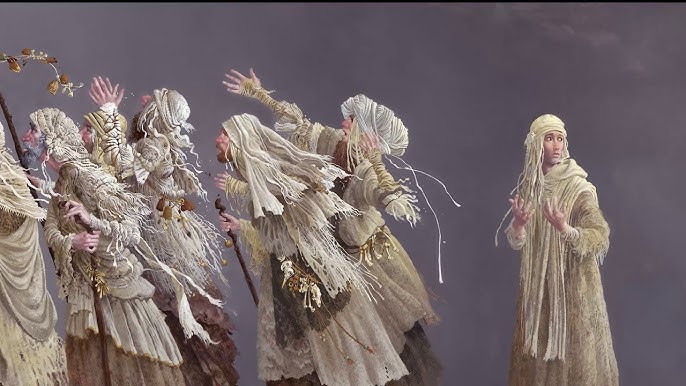
Image: Ten Lepers by James Christensen

Song of Anger, Song of Faith

Habakkuk 1:1-4; 2:1-4;  Psalm 37:1-9; Luke 17:5-10

In January of 1949, Pete Seeger sat down at the piano with his friend, Lee Hays, and plunked out a song he was working on.  Hays liked it and they massaged the lyrics together.  A year later, they recorded the song on Charter Records with their group, The Weavers.  They only sold maybe a thousand copies and never got any airplay, but that didn’t surprise them because Seeger and Hays were both blacklisted by the McCarthyism craziness that was making life impossible for so many artists and others.   People suspected that the song had some kind of communist message because, as Seeger said, “In 1949 only ‘Commies’ used words like ‘peace’ and ‘freedom.’  

Somehow the song made its way down to South America where it became fairly popular and local groups created different versions of it. Twelve years later, Peter, Paul and Mary recorded it and it became a top-ten hit.  The next year, 1963, Trini Lopez recorded a version with a Latin vibe that landed at number 3 on the charts.[1]   

Suddenly the song was everywhere.  People were singing it in coffee houses and cocktail lounges.  Folk groups were singing it at Hootenannies.  Teenagers who only knew four guitar chords were singing it in church.  I know, because I was one of them.  

The song was originally titled, “The Hammer Song,” but is more commonly known by its first line: “If I Had a Hammer.”  

I thought of that song this week when I was reading our first reading from Habakkuk because the first line of the chorus is  “I’d sing out danger, I’d sing out a warning…”  That’s exactly what poor Habakkuk had been trying to do as the mighty Chaldean army drew ever closer to Jerusalem.  He saw his beloved nation beset from without by forces bent on conquest and colonization, and beset from within by denial and corruption.

I think we’ve all felt like Habakkuk at one time or another.  His words are so honest, his feelings so raw, his anger so palpable, and he doesn’t buffer any of it with any false piety.

O LORD, how long shall I cry for help,

                  and you will not listen?

         Or cry to you “Violence!”

                  and you will not save?

         Why do you make me see wrong-doing

                  and look at trouble?

         Destruction and violence are before me;

                  strife and contention arise.

         So the law becomes slack

                  and justice never prevails.

         The wicked surround the righteous—

                  therefore judgment comes forth perverted.[2]

Some scholars think that Habakkuk was a temple prophet, a Levite who also served as one of the temple musicians.  If so, he spent his days singing and composing psalms of praise for worship.  But now songs of praise and worship aren’t speaking to him anymore…or speaking for him.  He’s angry with God.  He sees the world falling apart.  He sees that his society is corrupted.  He sees that the enemy is coming and his country won’t be able to withstand them.  He feels like God isn’t paying attention.  So instead of a psalm of praise, he composes a song of rage and lament.  He sings out danger.  He sings out a warning.

In his frustration with God, Habakkuk finally says, “You know what?  I’ve said all I can say. I’m just going to go up in the tower and wait and watch.  You’ve heard my complaint, God, so what do you have to say about all this?”

Habakkuk stood in the tower and waited for God to respond.  I can’t help but wonder if another song came into Habakkuk’s mind while he was up there waiting and watching on the rampart.  He surely would have been familiar with Psalm 37, a psalm which tradition says was written by King David when he was an old man.  The answer God finally gives Habakkuk seems to resonate with that Psalm 37’s advice: 

Do not fret because of the wicked;

                  do not be envious of wrongdoers,

         for they will soon fade like the grass,

                  and wither like the green herb.[3]

When God finally spoke to Habakkuk, God gave him neither advice nor a pep talk.  Instead, God gave Habakkuk a task list. Habakkuk recorded God’s instructions by adding another verse to his song:

Then the LORD answered me and said:

         Write the vision;

                  make it plain on tablets,

                  so that a runner may read it.

         For there is still a vision for the appointed time;

                  it speaks of the end, and does not lie.

         If it seems to tarry, wait for it;

                  it will surely come, it will not delay.

         Look at the proud!

                  Their spirit is not right in them,

                  but the righteous live by their faith.[4]

Remember the vision.  Write it down.  Make it visible.  Make it plain and simple so that even someone running by can grasp it.  The righteous will live by faith.

When life seems precarious and frustrating, it’s tempting to worry if our faith is going to do us any good.  When the world seems to be trying to tear itself apart, it’s tempting to wonder if I have enough faith to fix even one small piece of it.  But God tells us to keep moving toward the vision, the new reality, the kin-dom that God is working to create.  God reminds us that even when it looks like God is absent, God is not only present but is deeply engaged in the process of making things new.  God tells us, “Don’t worry about having enough faith.  It’s your faith that’s telling you there is a problem.  Start with that.”

Joy J. Moore of Luther seminary said, “Habakkuk speaks to me.  I hear him saying, ‘I have enough faith to believe that things aren’t right, things are not the way they’re supposed to be—and enough faith to watch and see what you’re going to do, God.’  In days like these, I need those words.”

In days like these we all need those words.  Write down the vision.  Keep it in front of you.  Make it simple so even someone in a hurry can read it and carry it with them.    

While they were on their way to Jerusalem, Jesus had reminded his disciples that there were consequences for wounding or misleading others.  In the next breath, though, he told them that they needed to be generous with forgiveness.  “If someone sins against you seven times in one day but repents seven times then you must forgive them seven times.” Forgiving so freely must have sounded like an insurmountable challenge to the disciples because they responded by saying, “Increase our faith!”[5]

I think we’ve all had that moment too.  We’ve all had our Habakkuk moment where we wonder if God is seeing the wrongs that we’re seeing and we’ve had our disciple moment when we have felt that if we just had more faith we could maybe live in the healing and mending way that Jesus is asking of us.

But what is faith?  Is it belief?  Is it power?  Is it obedience?  Is it humility?  Is it quantifiable?

“If you had faith the size of a mustard seed,” said Jesus, “you could say to this mulberry tree, ‘Be uprooted and planted in the sea,’ and it would obey you.”  What is he saying behind the hyperbole?

Faith equals trust said Martin Luther.  “Faith is a living, bold trust in God’s grace, so certain of God’s favor that you would stake your life on it a thousand times.”  

Faith is confidence.  Faith is acting on your trust with confidence that God is faithful and trustworthy.  Paul Tillich said that faith, when you see it, will look a lot like courage.

Faith isn’t just a feeling.  Faith isn’t even just believing.  Faith is doing what God has asked us to do, being bold enough and courageous enough to participate in what God is creating.  Faith isn’t quantifiable.  It’s not a noun.  It’s a verb.

Faith isn’t interested in accolades and trophies, because faith is motivated by love and captivated by hope.

“Who among you,” said Jesus, “would say to your slave who has just come in from plowing or tending sheep in the field, ‘Come here at once and take your place at the table’?  Would you not rather say to him, ‘Prepare supper for me, put on your apron and serve me while I eat and drink; later you may eat and drink’?  Do you thank the slave for doing what was commanded?  So you also, when you have done all that you were ordered to do, say, ‘We are worthless slaves; we have done only what we ought to have done!’”

I think Jesus may have said this tongue-in-cheek—it’s unlikely that any of his disciples had any slaves—but his point was clear.  “When you’ve done all that you’ve been told to do” then you’ve done what you were supposed to do.  

We try to keep people from stumbling and pick them up when they do because that’s our job—as  followers of Jesus and as a decent human beings.  We forgive and keep on forgiving because Jesus told us to, and because we know that forgiveness is the starting point for healing and restoration of relationships.  Faith isn’t interested in accolades and trophies, because faith is captivated by the vision of the kin-dom of God, the commonwealth of God’s justice and kindness.

Sometimes we sing the song of Habakkuk because the brokenness of the world just seems so overwhelming.  Sometimes we are reluctant to take on the work of embracing God’s vision, of building the commonwealth of justice and kindness, because we feel ill-equipped, like we just don’t have the tools.   

In his autobiography, How Can I Keep From Singing, Pete Seeger talked about the message of The Hammer Song.  “The message,” he said, “was that we have got tools and we are going to succeed. This is what a lot of spirituals say: we will overcome. I have a hammer. The last verse didn’t say ‘But there ain’t no hammer, there ain’t no bell, there ain’t no song, but honey, I got you.’ We could have said that! The last verse says ‘I have a hammer, and I have a bell, I have a song.’ Here it is. ‘It’s the hammer of justice, it’s the bell of freedom, the song of love.’ No one could take these away.”

We have the tools we need to fix the world.  We have the vision of God’s kin-dom.  We have the hammer of justice and the bell of freedom.  We have the song of love between our brothers and our sisters and our non-binary siblings all over this land.

We just need to have faith…and even the littlest bit of faith is enough to change the world.


[1] Hammer Recalled;  Richard Harrington, The Washington Post, Feb. 1, 1983

[2] Habakkuk 1:1-4 (NRSV)

[3] Psalm 37:1-2

[4] Habakkuk 2:1-4

[5] Luke 17:1-10

The Works of Grace

Luke 16:19-31

One bright afternoon in heaven, three people showed up at the Pearly Gates at the same time. St. Peter called the first person over and said, “What did you do on earth?” “I was a doctor,” she said.  “I treated people when they were sick and if they could not pay I would treat them for free.”  “That’s wonderful, Doctor,” said St. Peter. “Welcome to heaven, and be sure to visit the science museum!”  Then he called the second person over.  “What did you do on earth?” he asked.  “I was a school teacher,” the man replied.  “I taught educationally challenged children.”  “Oh, well done!” said St. Peter.  “Go right in!  And be sure to check out the buffet!”  Then St. Peter called over the third person.  “And what did you do on earth?” he asked.  “I ran a large health insurance company,” said the man.  “Hmmm,“ said St. Peter. “Well, you may go in but you can only stay for three days.”

Some people think that the parable of the rich man and Lazarus is about heaven and hell. And in a way, maybe it is, but not in the obvious way.  Like all good parables, this story where the poor man is comforted after death and the rich man is left languishing alone in Hades is another one of those Jesus stories that should make us stop and rethink what we believe and what role that belief plays in our lives.

We Lutherans and many other Protestants are big on Grace.  This was Martin Luther’s big breakthrough after all—the understanding that we don’t earn our salvation, but that God’s love and God’s grace is what saves us.  

When I was in confirmation class many, many years ago, our whole class was required to memorize Ephesians 2:8-9: “For by grace you have been saved through faith, and this is not your own doing; it is the gift of God—  not the result of works, so that no one may boast.”  The Lutheran curriculum we were following wanted to make it crystal clear that being saved was entirely dependent on God’s grace.  For most of us at that age, being saved simply meant that you get to go to heaven when you die, and no one suggested that there might be other richer or more nuanced ways to understand it.

So Grace, we were taught, is your ticket to heaven and the only way in.  The formula was pretty simple.  You might do all the nice and good things it’s possible to do in the world, but that won’t get you into heaven because no matter how good and nice and helpful you are, you’re still going to sin.  You can’t help it.  It’s part of human nature.  And sinful people can’t go to heaven, because no sin is allowed there.  But, if you believe in Jesus, then God will forgive all your sins!  You get a free pass.  You get Grace with a capital G.

The problem with our Protestant theology of Grace is that too many people stopped with that overly simple middle-school understanding.  Too many people came to believe that all they have to do is accept Jesus into their hearts as their personal Lord and Savior, and that’s it.  Done.  

This truncated understanding can lead to what Dietrich Bonhoeffer called “cheap grace,” a belief that what you do or don’t do doesn’t matter because God will forgive you for Christ’s sake simply because you say you believe.  This is like setting off on a thousand mile hike and stopping after the first 20 yards.  At best, “cheap grace” leads to a very shallow personal theology and a me-centered spirituality.  At worst it lays a foundation for an “anything goes” way of life with no sense of accountability. People who believe in this kind of “cheap grace” can sometimes do atrocious things, or leave very necessary things undone, and still think of themselves as “saved.”  

Many of us cling to the gift of grace promised in Ephesians 2:8-9, and rightfully so, but too many of us stopped reading too soon;  we failed to read on through verse 10 where it says,  “For we are what he has made us, created in Christ Jesus for good works, which God prepared beforehand to be our way of life.” (NRSV) 

I particularly like the way the New Living Translation renders verse 10:  “For we are God’s masterpiece. He has created us anew in Christ Jesus, so we can do the good things he planned for us long ago.”

We are saved—rescued, healed, made whole, restored—by grace through faith.  But “through faith” doesn’t just mean that we intellectually accept the idea of grace.  Real faith opens our eyes to God’s grace at work in our lives and the world around us.  Real faith moves us to embody and to enact God’s grace.  Real faith moves us to do the good things God planned for us long ago.  If we don’t do those good things, then faith becomes nothing more than a security blanket of wishful thinking to wrap around ourselves on dark nights of doubt and fear.  As the Book of James says, “we are shown to be right with God by what we do, not by faith alone… For just as the body without the spirit is dead, so faith without works is also dead.” (James 2:24-26)

One of the themes in Luke and Acts is the presence and work of the Holy Spirit, and yet Luke doesn’t let us “spiritualize” things that put us on the spot.  The examples of the “work of the Spirit” in Luke and Acts, especially as that work plays out in the ministry of Jesus, are practical, concrete, and challenging.  As much as we might want to spiritualize the story of the Rich Man and Lazarus, it’s tough to explain away its central message, especially in light of what Jesus has to say about wealth and poverty throughout the entire Gospel. 

The Gospel of Luke emphasizes that the status of the rich and poor is reversed in the kingdom of God.  In the opening chapter of Luke, Mary sings, “He has brought down the powerful from their thrones, and lifted up the lowly;  he has filled the hungry with good things, and sent the rich away empty.” (1:46-55)

 In the Sermon on the Plain, Jesus says, “Blessed are you who are poor, for yours is the kingdom of God. Blessed are you who are hungry now, for you will be filled,” and then “woe to you who are rich, for you have received your consolation. Woe to you who are full now, for you will be hungry.” (6:20-25)

Luke makes it clear that “the poor” receive special attention in the ministry of Jesus and in the kingdom he is announcing. When he stands up to preach in the synagogue in Nazareth, he reads from the scroll of Isaiah,  “The Spirit of the Lord is upon me, because he has anointed me to bring good news to the poor.” (4:18)

When John the Baptist is in prison and sends one of his disciples to ask Jesus if he really is the one they’ve been waiting for, Jesus says, “Go and tell John what you have seen and heard: the blind receive their sight, the lame walk, the lepers are cleansed, the deaf hear, the dead are raised, the poor have good news brought to them.” (7:22)

When he is a dinner guest at the home of a Pharisee, Jesus tells his host and others, “Don’t invite all your friends to your banquets, invite the poor, the crippled, the lame and the blind.” (14:12) – because that’s who is invited to God’s banquet (14:21).

When the rich young ruler asks Jesus how he can inherit eternal life he is told to go sell all he has and give it to the poor. (18:18-30)

In Luke’s gospel Jesus makes it clear that having “treasures in heaven” is not just about piety; it is also about selling possessions and distributing wealth to the poor. (12:33; 18:22)  

In Luke’s gospel, conversion doesn’t just mean accepting Jesus as your Lord and Savior or asking Jesus into your heart, whatever that means. When Zacchaeus the tax collector is befriended by Jesus, he gives half of his possessions to the poor and repays anyone he has defrauded four times over.  

Concern for the poor is a central part of the ministry of Jesus, but it wasn’t invented by Jesus.  Jesus himself stresses that it is the commandment of Torah.  In Deuteronomy, Moses states: “If there is among you anyone in need, a member of your community in any of your towns within the land that the LORD your God is giving you, do not be hard-hearted or tight-fisted toward your needy neighbor.  You should rather open your hand, willingly lending enough to meet the need, whatever it may be.  Be careful that you do not entertain a mean thought, thinking, “The seventh year, the year of remission, is near,” and therefore view your needy neighbor with hostility and give nothing; your neighbor might cry to the LORD against you, and you would incur guilt.  Give liberally and be ungrudging when you do so, for on this account the LORD your God will bless you in all your work and in all that you undertake.  Since there will never cease to be some in need on the earth, I therefore command you, ‘Open your hand to the poor and needy neighbor in your land.’” (Deut. 15:7-11)

This parable of the rich man and Lazarus raises important questions.  We’re not told that Lazarus did anything particularly noble or good.  He was just poor.  So why is he carried away by angels to be nestled and comforted in the bosom of Abraham after he dies?   We’re not told that the rich man did anything particularly horrible, he’s just self-centered.  So why is he in anguish in the flames of Hades after he dies?

Lazarus benefits from the default of grace.  He is a descendent of Abraham, so he is included in God’s covenant with Abraham.  He hasn’t done anything to remove himself from the covenant so he will spend eternity “in the bosom of Abraham,” enjoying companionship with others who have kept the covenant.

The rich man, on the other hand, removed himself from the covenant when he failed to “open his hand” to the poor and needy neighbor on his doorstep.  He failed to even see Lazarus, much less see their kinship in the covenant of Abraham and the covenant of humanity.  Instead of using his resources to help Lazarus, he used them exclusively to feed his own appetites. He is condemned to live forever in the burning loneliness that he, himself, created.  By focusing only on himself during his life, he created a great uncrossable chasm which now separates him forever from the companionship of eternity. 

“Some people, we learn, will never change,” says Amy-Jill Levine.  “They condemn themselves to damnation even as their actions condemn others to poverty.  If they think that they can survive on family connections—to Abraham, to their brothers—they are wrong.  If they think their power will last past their death, they are wrong again.”[1]

There is a sad “too-little-too-late” moment at the end of this short story by Jesus.  The rich man, realizing that there is no reprieve for him, asks Abraham to send Lazarus to warn his five brothers so they don’t end up “in this place of torment.”  Abraham reminds him that Moses and the prophets have already warned them, and the rich man replies, “No, Father Abraham!  But if someone is sent to them from the dead, then they will repent!”  Abraham says simply, “If they won’t listen to Moses and the prophets, they won’t be persuaded even if someone rises from the dead.”

“We are those five siblings of the rich man,” wrote Barbara Rossing.  “We who are still alive have been warned about our urgent situation… We have Moses and the prophets; we have the scriptures; we have the manna lessons of God’s economy, about God’s care for the poor and hungry.  We even have someone who has risen from the dead.  The question is: Will we—the five sisters and brothers—see?  Will we heed the warning before it’s too late?”[2]


[1] Short Stories by Jesus, p. 271, Amy-Jill Levine

[2] Working Preacher.org; Barbara Rossing, Commentary on Luke 16:19-31, September 25, 2016

The Joy of Reconnecting

Luke 15:1-10

We have seen an alarming increase in violence in our country this year, especially in the last few months.  As of this week there have been 47 school shootings in the U. S.[1]  On top of that the strained remainder of our national equilibrium has been rocked by two political assassinations. 

I really don’t want to dwell on this situation.  I doubt if I could tell you anything you don’t already know.  I don’t have any words that could shed new light on our violence problem and I am all too aware that even when our words are written or spoken with the best intentions they can generate a lot of heat that enflames without bringing any light of healing.  I will say this, though.  I think part of the problem is that we, as a people, have been losing our joy.  And we’ve been losing our joy because we’ve been losing our overall sense of connection with each other.  

We sequester ourselves into like-minded cloisters, sifting ourselves into righteous versus unrighteous, clean versus unclean, and then we snipe at each other from our guarded hilltops, each group using its own specialized vocabulary to describe the wrongness of the others who are not us.  There’s nothing new about this.  It’s a dynamic as old as humanity itself.  

So how do we recapture our joy?  How do we reconnect when the connection has been broken?

Well, if we’re following the example of Jesus, we tell a story.

So this one time, some Pharisees and religion teachers were getting all cranky because Jesus was having way too much fun with the wrong crowd.  Tax collectors and known sinners—you know, those people who color outside the lines where the religious boundaries are concerned—these kinds of people kept coming to listen to him and he didn’t shoo them away or disrespect them or anything.  On the contrary, he would welcome them and invite them to join the discussion!  Sometimes he would even break bread with them.  Basically, he treated them like they were all old friends at a reunion.

This didn’t sit well with the holier-than-thou guardians of propriety.  They didn’t think associating with “those people” was appropriate for a well-known rabbi, especially one with such a growing following.  They thought he should be setting an example for the rabble.  Well, he actually was setting an example, it just wasn’t the one they wanted him to set.   So they were grumbling about him.

Jesus overheard all their crabby comments, of course.  He thought about calling them out on their snooty attitude, but what good would that do?  It would just make them defensive and even more stand-offish when what he really wanted was for them to loosen up and join the party.  So he tried to reframe their thinking with a couple of hypothetical scenarios.  Parables.  He told them some parables.

“Suppose a guy has a hundred sheep,” he said, “and one of them wanders off and gets lost.  “Won’t he leave the other ninety-nine in the wilderness to go search for the one that is lost until he finds it?  And when he finds it, he will joyfully carry it home on his shoulders.  And when he gets home, he will call all his friends and neighbors and say, ‘Rejoice with me because I have found my lost sheep!’  It’s like that.  There is more joy in heaven over one lost soul’s rescued life than over ninety-nine righteous people who don’t need rescuing.

“Or how about this—suppose a woman has ten silver coins on her necklace and she loses one.  Won’t she light a lamp and sweep the entire house and get down on her hands and knees to sweep under furniture and look in every nook and cranny until she finds it?  And when she does find it, she’ll call all her neighbors and friends and say, ‘Rejoice with me!  I’ve found my lost drachma!  It’s just like that!” said Jesus.  “There is joy and celebration among God’s angels when even one lost soul returns to God!”     

Now I am absolutely sure that some of the people listening to Jesus spin these hypotheticals were chuckling, and I am just as sure that some of them were scratching their heads because there is some obvious craziness in these little stories.  Leave ninety-nine sheep in the wilderness while you go off searching for one?  Who would do that?  And sheep don’t repent.  Coins don’t repent.  And is it really repentance?  The sheep didn’t do anything to help himself be found—he didn’t wander home all sheepish about being lost.  The silver coin didn’t roll itself across the floor to rejoin the other nine coins on the necklace. 

Or are these stories allegories maybe?  Is the shepherd God?  But does God leave ninety-nine obedient sheep at risk in the wilderness to go find the one that wandered off?  Maybe. But that does raise questions, especially if you’re one of the ninety-nine.  

So maybe God is like the reckless shepherd who puts everything at risk to find the one lost sheep.  Maybe God is like the woman who drops everything and lights a lamp and cleans house until she finds that one lost silver drachma.  Maybe.

Or maybe something else is going on here.  Sheep and coins don’t repent—at least not the way we usually understand repentance.  They don’t apologize.  They don’t have a change of mind or a change of heart.   

But what if Jesus is giving us a new definition of repentance?  What if repentance is not about clearing some kind of moral bar?  What if it’s not about moral rectitude or moral correction?  What if repentance is about being brought back to where you fit in God’s grand design, being brought back into the community and communion?  What if repentance is about crossing all those artificial barriers we put up between each other, those barriers that divide us into opposing camps?

Maybe repentance is about being brought back together.  Maybe it’s about reconnecting.[2]

That would explain this other thing.  Did you notice how many times Jesus mentions joy in these two little stories?  Five times!  The shepherd carries the sheep joyfully!  He calls out to his neighbors to rejoice with me!  Jesus says there is joy in heaven when a lost soul is reconnected with the community.  The woman who finds her lost coin calls out to her neighbors rejoice with me!  And once again, Jesus says there is joy in the presence of God’s angels when even one lost soul is reunited with companions.  It’s all about the joy!

Jesus wanted the Pharisees to understand that they were missing out on the joy!  He wanted them to understand that there is joy in making connections with people you might ordinarily be reluctant to associate with.  There is joy when we step out of our clique or private club of like-minded associates to go out and meet the wider world.  

Matt Harding is a guys who knows all about that joy.  

Matt was living the dream.  He was working as a Video Game Developer, creating new games for Activision, one of the biggest companies in the business.  He was kicking around ideas for a new game with his team one day, when somebody suggested, “Let’s do a ‘shoot-em-up’ game.  Those are very popular.”  Matt said sarcastically, “Sure.  How about Destroy all Humans?[3]  Matt was being facetious, but the boss liked the idea and gave the game a green light. And that’s when Matt quit.  “I didn’t want to spend two years of my life writing a game about killing everyone,” he said.  

Now Matt had time on his hands, and a fair bit of savings, so he decided to see the world. One day in Saigon, Matt was in kind of a goofy mood so he did this funny little dance in front of a restaurant, which his travel buddy caught on video.  It gave them a good laugh, so they decided that they would do this everywhere they were going on their trip around the world. 

When they got home, they cut together all these fun little clips to create a three minute video of Matt dancing in all kinds of interesting places all over the world.  And that would have been the end of it, except that Matt’s sister uploaded the video to this new thing on the internet called YouTube™.     

Dancing Matt became an internet phenomenon almost overnight.  So Matt decided to go out into the world and do it again, only this time he would invite people to dance with him.  And dance they did.  Over a period of about 15 years he recorded and posted six Dancing Matt videos which have brought joy to people all over the world.  You can find all of them at www.wheretheheckismatt.com

When NPR asked Matt what he had learned as he danced through the world, he said, “Here’s what I can report back: People want to feel connected to each other. They want to be heard and seen, and they’re curious to hear and see others from places far away.  

I share that impulse. It’s part of what drives me to travel.”

In her TED talk about Vulnerability, Brené Brown said, “A deep sense of love and belonging is an irreducible need of all people.  We are biologically, cognitively, physically, and spiritually wired to love, to be loved, and to belong.  When those needs are not met, we don’t function as we were meant to.  We break.  We fall apart.  We numb.  We ache.  We hurt others.  We get sick.”

Right now our country is in a grumbling mood…and so is much of the rest of the world. We are not functioning as we were meant to.  We have found too many ways to separate ourselves from each other.  We have turned too many people into “those people,” the ones we don’t want to be seen with.  As a result, we’re missing the joy.  We’re missing the celebration.

We need to repent, not with apologies or penance, but by reconnecting.  We need to find our way back into where we fit with each other in God’s grand design.  We need to find our way back into community and communion.  We need to bring ourselves back together.  And maybe even dance with strangers.  Because that’s where the joy is.


[1] CNN

[2] Special Thanks to Prof. Matt Skinner and Sermon Brainwave for this perspective.

[3] Destroy All Humans is in its 7th version and is available on multiple platforms.  Clearly there’s money in nihilism.

How Far Will You Go?

Luke 14:26-33

In the summer of 1972, when I was 19, my best friend, Mackay, and I decided that it would be all kinds of fun to ride our bicycles from Long Beach, California to Ensenada, Mexico.  And so one sunny morning in June, we set off pedaling down the Pacific Coast Highway with sleeping bags and a few other necessities strapped to our bikes. 

The miles flew by through Seal Beach, Huntington Beach and Newport Beach.  The hills of Laguna slowed us down a bit more than we had anticipated, but it was still too early for lunch when we reached San Clemente, so we decided to push on and have lunch in Oceanside.  But at the south end of San Clemente, we ran into a very big obstacle that we had not planned on.  Camp Pendleton Marine Base.  

We knew we wouldn’t be able to ride through Pendleton on the freeway, but we thought we could ride through the base on the old highway, which, according to our maps, still ran alongside the freeway.  The very nice Marine guard at the entrance to the base told us that that was not going to happen–  because the old highway was long gone.  

After some begging and pleading and a few choruses of “Gosh, We’ve Ridden All This Way,” he got on the phone and managed to get permission for us to ride through the base.   He sketched out a map for us and gave us very strict instructions to stay on the route he had outlined for us,  making it clear that straying off that route could have grave consequences, including but not limited to death, dismemberment or being imprisoned.  

An hour and a half later, we were utterly lost on a winding dirt road when a very perturbed Marine officer in a jeep came roaring up to us and asked us what the H-E-DOUBLE-Q we thought we were doing.  He also told us that we were perilously close to a live-fire range, then threatened to throw us in the stockade or make us enlist or both before finally deciding to guide us down to the southern end of the base.  He sent us off with a warning that if we ever set foot or bicycle tire on the base again there would be dire consequences unless, of course, we were in a Marine uniform.  

We had lost a lot of time on the confusing roads of Pendleton, so we powered through Oceanside and into San Diego without stopping for lunch.  Then came the ordeal of getting through San Diego on surface streets which proved to be far more complicated and took much longer than we had planned.  And just so you know, not even the military had GPS yet in those days, so we were at the mercy of outdated gas station roadmaps.  

The sun was getting ready to call it a day by the time we crossed the border into Tijuana.  We grabbed a couple of tacos from a taco cart then raced the sun for the last 14 miles to Rosarito Beach where we camped for the night.

The rest of the trip was pretty uneventful.  The ride from Rosarito to Ensenada on the old road up across the mountain—the only way bicycles were allowed to go—was a challenging but beautiful ride.  After a night in Ensenada, we turned around and headed for home.  

We spent the night at Rosarito Beach again, had a good breakfast at the cantina, then set out for the border.  We made good speed and got to Tijuana at about three in the afternoon which gave us plenty of time to make it to Silver Strand State Beach in San Diego where we were planning to pitch our tent for the night.

And that’s when we ran into another obstacle we hadn’t planned on.  There were three long lines of cars waiting to cross the border into California.  We rode our bikes up between the lines of cars to the state line expecting that the border guard would just wave us through—after all, where would a couple of guys on bicycles hide anything?   But the guard at the border wasn’t having it.  He gave us a lecture about trying to cut the line then told us to go all the way back to the end of the line.  Two hours later after standing in the heat astride our bicycles and breathing exhaust fumes from all the cars, we finally got back to the border where the same guard just waved us across without even asking for our I.D.   

At that point, we pulled over to the side of the road and took stock of where we were and what lay ahead of us.  We were exhausted, hot and sweaty.  Our legs were trembling and aching.  We didn’t even want to think about trying to get through Pendleton again.  What we wanted most was a good shower, a long, cold drink and a good meal. What we wanted was to be home.  

The bicycle ride that we had thought would be all kinds of fun had turned out to be all kinds of challenging.  Our stamina had evaporated in the exhaust fumes and unrelenting sunshine while we waited at the border.  We were fresh out of  possibility.  Our ride was over.  We made our way to the airport and, grateful for small miracles, managed to snag seats on a flight back to Long Beach.  

“Who would build a tower without first figuring out how much it’s going to cost?” asked Jesus.  “What king would go to war without first figuring out if he has a chance of winning?”  Who would ride a bicycle to Ensenada without making sure that they could actually get there and back?

Luke tells us that large crowds were traveling with Jesus as he made his way toward Jerusalem.  They had been watching him heal people.  They had been listening to him as he taught them about the kingdom of God and how radically different it is from the empire of Caesar.   The crowd was drawn to him.  They liked him.  They liked the different world he described, the better world that he told them is possible.  A lot of them were probably wondering what it might be like to be part of his inner circle—to be his disciple.

But there’s a big difference between being a fan and being a disciple.  

Jesus wanted to make it clear to the crowd that becoming a disciple means putting him and the kingdom of God first.  Jesus wanted them to understand that  becoming a disciple means you join him in making the kingdom of God, the commonwealth of God’s justice and kindness, a reality on earth as it is in heaven.  And Jesus wants us to understand that the other kingdoms of this world are going to resist you when you do that.  

The kingdom of family may be perfectly happy for you to be a fan of Jesus, even for you to embrace some of the things he teaches.  But they may not be so happy when you start giving away time and resources that they feel they have a claim to.  “Whoever comes to me and does not hate father and mother, wife and children, brothers and sisters, yes, and even life itself, cannot be my disciple,” said Jesus.  And no, he did not mean a disciple has to have some kind of intense animosity toward family, but he did mean that you, as a disciple, have to be willing to turn away from them, to let them go, when what they want is trying to pull you away from where Jesus is leading you.

The kingdoms, the empires of this world will resist you when you become a disciple of Jesus and set to work in earnest to make God’s reign a reality in your life and in the world.  

The kingdom of consumerism will sneer at you for not having the newest, shiniest, most fashionable, most advanced everything—clothes, gadgets, house, car or whatever when you, as a disciple of Jesus, learn to be satisfied with what you have and to give away what you don’t really need. 

The kingdom of capitalism will call you a socialist or maybe even a communist when you, as a disciple of Jesus, insist that those who have more should contribute to the well-being of those who have less.  When you remind them, as Jesus did, that God did not intend for the bountiful resources of the earth to enrich only a few, they will call you a radical and try to silence you.

The empire of power will oppose you when, as a disciple of Jesus, you stand up for the powerless, take the side of the marginalized and speak for the voiceless.  They will combat you when you  work to liberate the oppressed, fight for the dispossessed and lobby to set the captives free.  When you, as a disciple of Jesus, insist that all people are equal and beloved in God’s sight so the opportunities and benefits of life together in a civil society should be equal, too, regardless of race or gender or color or sexuality or country of origin.  They will call you a trouble-maker and try to put a stop to you…one way or another.

“Whoever does not carry the cross and follow me cannot be my disciple,” said Jesus, and those people in the crowd, especially the wannabe disciples, knew he wasn’t just using hyperbole.  They knew that the cross he was talking about wasn’t a metaphor.  He was telling them there would be a real cross with real nails and real pain…because when you try to establish the reign of God in the midst of the empire of coercive power, coercive power will try to stop you.  Brutally.  

If you want to be my disciple, says Jesus, then stop and think about what that might cost you.  There’s no shame if you can’t go that far.  There’s no shame if you just want to follow in the crowd and listen from a safer distance.  But you should know, eventually that won’t be enough.  

Eventually the Word of God will bring you to a place where either you will summon up the stamina and will to finish the ride… or call it quits.  Eventually either the vision of the kingdom of God will become all-consuming for you, or you will dismiss it as a nice but unobtainable ideal—or maybe some kind of prize in the afterlife if you are nice enough to qualify.

Traveling with Jesus sounds like all kinds of fun.  And it does have its rewards.  There are healings along the way.  He’s a marvelous teacher and the Way of life he envisions is beautiful.  He loves you and isn’t shy about making that known.   Jesus loves the crowd… but not everyone in the crowd is ready to go all the way to discipleship.  

Lots of people can ride a bicycle.  Comparatively few can ride it all the way to Ensenada and back.

How far will you go?