Who Sinned?

John 9:1-41

The gospel text for this Sunday is the entire ninth chapter of the Gospel of John. That’s a very long reading and there is a lot to think about in those 41 verses, so this week I’m going to combine the reading of the text with my observations instead of our usual practice of standing for the reading of the text followed by the preaching a more conventional sermon.

Before I begin, though, there is a difficulty in the text that we need to clarify.  In the Gospel of John, Jesus is often confronted or antagonized by a group identified as “the Jews.”  The Greek word here is Ioudaioi, and it refers to a particular group of self-appointed conservative Judeans who saw themselves as the guardians of the temple, the Torah, and Jewish traditions.  It’s important to remember that almost every character in the Gospel of John, including and especially Jesus, is Jewish. When the writer of John uses “the Jews” to describe those who are challenging Jesus, we are not supposed to think this means the Jewish people as a whole; it is only this one pious and prickly group that is being referred to.   I hate it that this even needs to be said, but, unfortunately, we live in a time when anti-Semitism is once again on the rise and historically these references to “the Jews” in the Gospel of John have been used to feed inexcusable bigotry and animosity.  The writer of John was a Jew.  The disciples were Jews.  Jesus was a Jew, and Jesus loved his people, the Jews—even those particular Ioudaioi who were a thorn in his side.

Chapter nine of John tells us the story of Jesus healing the man born blind.  In the Gospel of John, unlike the synoptic gospels, Jesus makes four or maybe five separate trips to Jerusalem.  This story is takes place during his third trip which starts in chapter seven when Jesus travels to Jerusalem in secret to celebrate Succoth, the Feast of the Tabernacles.  His presence doesn’t remain a secret for very long.  Throughout chapters seven and eight, while he teaches in the courtyards of the temple he has several heated disputes with his antagonists and it is clear that they are looking for an excuse to kill him.  And that’s where things stand when we come to the beginning of chapter nine.

John 9:1   As he walked along, he saw a man blind from birth. 2 His disciples asked him, “Rabbi, who sinned, this man or his parents, that he was born blind?”

When something tragic happens or when we see or experience misfortune, there is something in us that wants to know why.  We want to know who or what is responsible.  Random unfortunate things happened in life in ancient times just as they happen today and when there was no immediately discernable cause or observable reason to pin the blame on someone or some circumstance, people figured that God must be responsible.  Some people still think that way today.  And since God is good and wouldn’t do anything hurtful without a very good reason, then those who think God has created the unfortunate state of affairs as a punishment circle back around to blaming the victim or victims.  

In the minds of the disciples, in their frame of reference from their culture, if a person was born blind or with some other disability, it had to be because God wanted them to be disabled or, if their thinking is a little more nuanced, it happened because someone’s sin interfered with God’s good design and intentions.  That’s why the disciples asked Jesus, “Whose sin caused this man to be born blind?  His sin or his parents?”

This was the common understanding in their world, but it was a pretty unhealthy and unhelpful way to think about God and, frankly, about life.  Understandable, but not helpful.  Jesus wants to change their perspective.  He wants them to understand that God is not in the business of inflicting suffering and that disabilities are not the result of someone’s moral failure. 

In his book When Bad Things Happen to Good People, Rabbi Harold Kushner said, “God does not cause our misfortunes. Some are caused by bad luck, some are caused by bad people, and some are simply an inevitable consequence of our being human and being mortal, living in a world of inflexible natural laws. The painful things that happen to us are not punishments for our misbehavior, nor are they in any way part of some grand design on God’s part. Because the tragedy is not God’s will, we need not feel hurt or betrayed by God when tragedy strikes. We can turn to Him for help in overcoming it, precisely because we can tell ourselves that God is as outraged by it as we are.”

So, back to the Gospel text:

2 His disciples asked him, “Rabbi, who sinned, this man or his parents, that he was born blind?” 3 Jesus answered, “Neither this man nor his parents sinned.”

And this is where we come to a translation problem.  In verse 3, the NRSV has Jesus saying, “He was born blind so that God’s works might be revealed in him.  We must work the works of him who sent me while it is day; night is coming, when no one can work.”  Some translations read, “This happened so that God’s works might be revealed…” But here’s the problem: the words “he was born blind” or “this happened” are not in the Greek text.  They are an insertion that makes it sound like the man’s blindness was predestined by God just so Jesus could come along and demonstrate God’s power.  It reads like God set up this poor blind man as a stage prop.

But that is not what the original text says.   So what does it say?  What does it sound like if we follow the actual Greek text and re-work the punctuation, which, by the way, was also added by translators and was not part of the original text?  

It reads like this: “Neither this man nor his parents sinned.  So that the works God might be revealed in him, we must work the works of the One who sent me while it is day.  Night is coming when no one can work.”  That’s what the original text actually says.  The Contemporary English Version paraphrases it pretty nicely this way:  “Because of his blindness, you will see God work a miracle for him.”  There is no implication in the text that God made this poor man blind as some kind of punishment or for any other reason.  On the contrary, through Jesus, God is going to give him his sight.  God’s works will be revealed in him.

Back to the text:  4 Jesus said, “We must work the works of him who sent me while it is day; night is coming, when no one can work. 5 As long as I am in the world, I am the light of the world.”

The theological theme of light and darkness is a thread that runs through the Gospel of John from the very beginning.  John 1:4 tells us, “In him was life and the life was the light of all people.  The light shines in the darkness, and the darkness did not overcome it.”  In John 3:19 we read, “And this is the judgment, that the light has come into the world, and people loved darkness rather than light because their deeds were evil.”  In John 8:12, just one chapter before Jesus encounters the man born blind, Jesus says, “I am the light of the world.  Whoever follows me will never walk in darkness but will have the light of life.”

This theme of light and darkness is personified in the man born blind, a person who has literally lived his life in the dark.  In this gospel, light and darkness symbolize belief and unbelief and when Jesus gives sight to the blind man as the story unfolds we see him move from the darkness of unbelief to the light and life of belief.

We continue with the text:

5 As long as I am in the world,” said Jesus, “I am the light of the world.  6 When he had said this, he spat on the ground and made mud with the saliva and spread the mud on the man’s eyes,  7 saying to him, “Go, wash in the pool of Siloam” (which means Sent). Then he went and washed and came back able to see.

The Gospel of John echoes the book of Genesis in several ways, and a number of early Church Fathers saw Jesus’ act of mixing the mud as a repetition of God creating humans from the dust of the ground in Genesis.  Irenaeus, Basil the Great and John Chrysostom went so far as to say that the man Jesus healed had been born without eyes and that when Jesus spread the mud on his eyes he was actually creating new eyes for him.  That detail is not in the Gospel text of course, but it is a tradition that is almost as old as the Gospel of John, itself. 

So how did people respond when they saw that their neighbor had been miraculously given his sight?

8 The neighbors and those who had seen him before as a beggar began to ask, “Is this not the man who used to sit and beg?” 9 Some were saying, “It is he.” Others were saying, “No, but it is someone like him.” He kept saying, “I am he.” 10 But they kept asking him, “Then how were your eyes opened?” 11 He answered, “The man called Jesus made mud, spread it on my eyes, and said to me, ‘Go to Siloam and wash.’ Then I went and washed and received my sight.” 12 They said to him, “Where is he?” He said, “I do not know.”

The neighbors, the people who passed by this man every day had a hard time believing that he had been given his sight.  It was the kind of thing that just didn’t happen in the world as they understood it. Their response reminds me of an old Calvin and Hobbs cartoon from years ago where Calvin says, “It’s not denial.  I’m just selective about the reality I accept.”

13   They brought to the Pharisees the man who had formerly been blind. 14 Now it was a Sabbath day when Jesus made the mud and opened his eyes. 15 Then the Pharisees also began to ask him how he had received his sight. He said to them, “He put mud on my eyes. Then I washed, and now I see.” 16 Some of the Pharisees said, “This man is not from God, for he does not observe the Sabbath.” Others said, “How can a man who is a sinner perform such signs?” And they were divided. 17 So they said again to the blind man, “What do you say about him? It was your eyes he opened.” He said, “He is a prophet.”*

What, exactly, was the problem the Pharisees had with Jesus healing the blind man on the Sabbath?  In this particular instance it wasn’t the healing so much as how Jesus did it.  In Exodus 35:2 the Torah says that the people are to refrain from creative work on the Sabbath.  But because the Torah does not spell out exactly what qualifies as creative work, the Sages had developed a list of 39 creative acts that were forbidden on the Sabbath.  Number 10 on that list was kneading dough, which had been expanded to include working with clay.  So when Jesus made mud to heal the blind man’s eyes, they saw it as a violation of Sabbath law.  But they also were not ready to believe that the blind man had been given his sight, or even that he had really been blind in the first place.

Back to the text:

18   The Jews did not believe that he had been blind and had received his sight until they called the parents of the man who had received his sight 19 and asked them, “Is this your son, who you say was born blind? How then does he now see?” 20 His parents answered, “We know that this is our son and that he was born blind, 21 but we do not know how it is that now he sees, nor do we know who opened his eyes. Ask him; he is of age. He will speak for himself.” 22 His parents said this because they were afraid of the Jews, for the Jews had already agreed that anyone who confessed Jesus to be the Messiah would be put out of the synagogue. 23 Therefore his parents said, “He is of age; ask him.”

Fear has been an undercurrent of this story since the blind man received his sight but this is the first time it is named.  The man’s neighbors are anxious because to acknowledge the miracle would mean that they would have to reevaluate who they think Jesus is and also, no small thing, how the universe works and how God works.  The Pharisees are anxious for the same reason, so they not only try to deny the miracle but to disqualify the miracle worker, Jesus.  The man’s parents are nervous for all the same reasons, but also because the Pharisees could bar them from the synagogue.  And that is no small thing.  

According to the Jewish Encyclopedia, there were 394 synagogues in Jerusalem in the early first century.  These synagogues were places for religious study and debate but they also functioned as community centers and economic centers.  Business deals were hammered out in the synagogue.  Workers were hired in the synagogue.  Marriages were contracted.  The synagogue was the center of community life and being thrown out or banned could be both economically and socially disastrous. 

So fear, anxiety, makes everyone except Jesus and the formerly blind man reluctant to acknowledge the extraordinary thing that God has done in their midst.  Before we get judgmental, though, it’s important to remember that everything that happens in the gospels happens with the oppressive might of Rome in the background.  Everything Jesus does has to break through the atmosphere of fear that the Romans relied on to enforce the peace.

24   So for the second time they called the man who had been blind, and they said to him, “Give glory to God! We know that this man is a sinner.” 25 He answered, “I do not know whether he is a sinner. One thing I do know, that though I was blind, now I see.” 26 They said to him, “What did he do to you? How did he open your eyes?” 27He answered them, “I have told you already, and you would not listen. Why do you want to hear it again? Do you also want to become his disciples?” 28 Then they reviled him, saying, “You are his disciple, but we are disciples of Moses. 29 We know that God has spoken to Moses, but as for this man, we do not know where he comes from.” 30 The man answered, “Here is an astonishing thing! You do not know where he comes from, yet he opened my eyes. 31 We know that God does not listen to sinners, but he does listen to one who worships him and obeys his will. 32 Never since the world began has it been heard that anyone opened the eyes of a person born blind. 33 If this man were not from God, he could do nothing.” 34 They answered him, “You were born entirely in sins, and are you trying to teach us?” And they drove him out.

In their anger, frustration and fear, the Pharisees resort to demonizing the formerly blind man.  Without facts or justification they move him to the category of “sinner,” even insisting that he was born “entirely in sins.”  If he’s a sinner, they don’t need to deal with him except to exclude him.  They excommunicate him from the community.  

35   Jesus heard that they had driven him out, and when he found him he said, “Do you believe in the Son of Man?” 36 He answered, “And who is he, sir? Tell me, so that I may believe in him.” 37 Jesus said to him, “You have seen him, and the one speaking with you is he.” 38 He said, “Lord, I believe.” And he worshiped him.

The Gospel has taken us from blindness to sight, from darkness to light, from unbelief to belief.  Throughout this story the Gospel has shown us that the ones who are really blind are those who choose not to see the goodness of God at work.  And now the story of the man who received his sight concludes with one last word of judgment.  “And this is the judgment, that the light has come into the world, and people loved darkness rather than light because their deeds were evil.”

39 Jesus said, “I came into this world for judgment, so that those who do not see may see and those who do see may become blind.” 40 Some of the Pharisees who were with him heard this and said to him, “Surely we are not blind, are we?”  41 Jesus said to them, “If you were blind, you would not have sin. But now that you say, ‘We see,’ your sin remains.

That is how this chapter ends, but there is one more thing for us to see here. Throughout this story, John never tells us the name of this man that Jesus healed.  He is called a sinner.  He is referred to as a beggar.  But most often he is referred to as the man born blind or the blind man or he who had been blind.  He is identified by his disability.  

That’s a thing we still do far too often to those among us who live with disabilities. We see them, we identify them in terms of the disability instead of as whole persons in their own right.  We see the challenge they live with instead of all the other traits that make them who they are.

The man Jesus healed was more than just a man born blind.  He had a name. And the church, thank God, has remembered his name even though it wasn’t recorded in the Gospel of John where his story is told.  His name was Celidonius which means “little swallow.”  According to the tradition of the Eastern Church, Celidonius stayed with Jesus and became a disciple after he was given his sight.  Years later he is said to have established the first Christian church at Nimes in Gaul and he is remembered in both the Roman and Eastern Churches as Saint Celidonius.    
Lent. Again.

Lent. Again.

Still humming a clinging scrap of Christmas,

still squinting through the bright winter light 

bouncing off the shining gifts of Epiphany,

suddenly the wind shifts and you get a face full of

Ashes. Deep sighs and ashes and those somber words

no one likes to say or hear, those words that make you 

think of all those friends and relatives who

were swallowed by history far, far too suddenly 

and too soon,

those words that taunt you, making you wonder 

if the 25-year warranty on your new gizmo or thingamabob

is just so much paper irony 

or a chuckle from heaven.

Remember that you are dust. 

Ashes and dust. And let me just mark it here

on your forehead so you don’t forget, right here

where all the world will see it and

the well-meaning busybodies in the grocery store

will awkwardly try to do you the favor 

of letting you know that there is 

a crossing smudge of mortality on your face.

Lent. Again.

Forty days, not counting Sundays, 

of wondering about wandering 

in deserts of every kind,

of negotiating multi-level interchanges from one 

high road to another,

inching along on thoroughfares

that never allow their advertised speed,

forty days to be mindful of inattentiveness,

forty days to ponder why a fast goes so slowly.

Forty days to unpack and weigh the stuff you carry,

to gingerly avoid jagged edges

as you sort through, evaluate and discard because

you have begun to learn the wisdom

of traveling light or simply

because your legs and your soul

are not as strong as they once were

and why take a risk of 

tripping before your time and 

falling face first into the dust and ashes?

Lent. Again.

Forty days of all things tempting and tempting all things,

forty days of analyzed appetites, considered cravings,

delusions diluted and dispensed,

forty days to wonder if you have spent your life 

constructing a coffin or creating a chrysalis,

forty days bedeviled by the seductive suggestion

to do and be merely good

when the broken heart of heaven is

spending its last erg of strength

and last drop of blood

to trudge uphill

and endure the messy, 

agonizing business

of making you new.

Lent. Again. 

Playing the Same Tune

Sometimes even saints need a come to Jesus meeting.

Mark 9:2-9; Matthew 17:1-9; Luke 9:28-36

Have you ever sung in a choir or played in an orchestra?  If you have, you’ve probably had a moment when you realized that you were, for all intents and purposes, part of one large instrument.  Your voice in the choir was like one pipe in an organ.  You were part of a single, large organic instrument comprised of many voices, all being played by the director or conductor.  It’s a wonderful experience to be part of something like that, to know that you’re part of something large and beautiful and organic which, if it’s done right, can, in its magical way, completely transport people.  It’s a humbling feeling to know that you are helping to bring this powerful yet transitory thing into the world, a thing composed only of sound, a thing that was not in the world before the conductor raised their baton and will vanish when they cut off the last note and its echoes die in the hall.  

It’s an amazing experience.  And it all works beautifully as long as everyone learns their part.  And they all follow the conductor.  And they all play or sing the same piece.  All it takes for things to start to unravel, though, is for someone to decide they’re not happy with the conductor.  Or the piece.  Or their part.  Little rebellions lead to great ones.  It can start with something as minor as the woodwinds rushing the conductor’s beat.  It could end with the disgruntled first trumpet player playing Trumpet Voluntary in the middle of Mozart’s Requiem. 

That seems to be Peter’s problem when Jesus tells him what lies ahead for them in Jerusalem.  He’s not happy with the conductor.  He had been traveling with Jesus for a while now.  He had watched him feed multitudes of people.  He had seen him walk on the sea.  He had watched Jesus cast out demons and heal people.  So when Jesus asked, “Who do you say that I am?” Peter naturally replied, “You are the Messiah!”  It seemed like the obvious answer.  After all, who else could do all those things?  But Jesus was cautious with Peter’s answer.  In all three synoptic gospels he sternly ordered his disciples not to tell people that he is the Messiah.  “No Messiah talk.  Are we clear?”

That didn’t sit well with Peter.  And then Jesus started to tell his disciples and everybody else that he was going to go to Jerusalem to speak truth to power at the corner of Religion and Politics.  He told them that the Powers That Be were going to reject him and abuse him.  He told them that he would be crucified.  And that on the third day he would rise again.  

No one wanted to hear that.  That’s crazy talk. Peter could not bring himself to sing along with that chorus.  He would not.  He took Jesus aside and rebuked him.  

Think about that a minute.  Peter rebuked Jesus.  And apparently the other disciples were kind of half-way behind Peter on this one.  Both Mark and Matthew write that Jesus turned and rebuked Peter saying, “Get behind me, Satan! You’re not setting your mind on divine things but on human things.”

Jesus had a few more things to say to his disciples and the crowd about what it takes to be a disciple—namely, a willingness to put your life on the line and take up the cross.  But Peter and the disciples were silent.

Peter rebuked Jesus.  Jesus rebuked Peter.

And then silence.  Six days of silence.

It’s easy to miss that.  Things move fast in the gospels.  Jesus moves quickly from one thing to the next.  The phrase “and immediately” occurs frequently in both Mark’s and Matthew’s gospels.  But not here. 

Six days later.  So what was that like?  Six days of tension between Jesus and Peter?  Six days of anxiety for the disciples?  The gospels don’t say.  The gospels are silent.  And maybe Jesus and the disciples were, too.

Finally, Jesus decided that Peter needed a “come to Jesus” meeting.  Or a come withJesus moment.  So he asked Peter, James and John to come with him up the mountain.

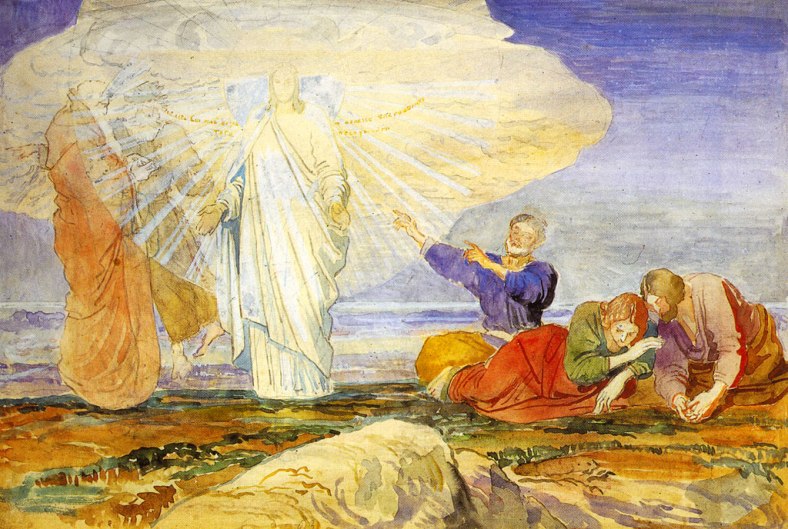
And there on the mountain they saw him transfigured—shining bright and radiant, light within and light without.   They saw who their teacher really is inside his humanity.  They saw Moses and Elijah, the law-bringer and the great prophet, the two most important figures in the history of their people, appear with Jesus and converse with him.  

Peter, whose default mode seems to be talk-first-think-later, babbled out, “Lord, it’s a good thing that we’re here!  Let’s make three shrines, one for you, one for Moses, one for Elijah…”  The gospels tell us he didn’t know what he was saying because he was terrified.  Well you would be, wouldn’t you?  

And then all of a sudden there was a cloud throwing a shadow over them, wrapping them in a fog.  All the brightness was dimmed.  And a voice came out of the cloud and said, “This is my Son, the Beloved.  Listen to him.”

And as suddenly as it all started, it was over.  There was no one there but Jesus.  And as they headed back down the mountain he told them not to tell anyone about what they had seen until “after the Son of Man has risen from the dead.” 

It took a lot to get through to Peter.  It took six days of silence and a hike up the mountain.  It took seeing Jesus talking with Moses and Elijah as he was shining like the sun.  It took hearing the voice of God speaking to him from a cloud saying, “This is my Son.  The Beloved.  Listen to him!” 

That’s what it took to get Peter to play the same tune and follow the conductor.

What does it take for us?

There have always been people who try to bend Jesus to their agenda instead of bending themselves to the Way of Jesus.  There have always been people who call themselves Christian who don’t seem to actually listen much to Jesus.

For a long time now we have seen a strain of pseudo-Christianity in this country and around the world that has little to do with the teaching of Jesus as we encounter him in the gospels.  It is based on triumphalism, issue-based moralism, and a theology of glory.  It worships and celebrates power and ignores the call to enter the into world’s trials and suffering as Christ entered into our trials and suffering.  It walks hand-in-hand with extreme nationalism and, often, racism.  It sees baptism as a get-out-o-hell-free card and not as a way of life in the beloved community.  It has co-opted the name Christian and Christian language and symbols, but it has not learned to do justice, to love kindness or to walk humbly with God.  It has not learned to love the neighbor as oneself. 

So many, like Peter, wanted a militant messiah.  But that’s not the way God does things.  That’s not the Way of Jesus.

Six days before their trip up the mountain, after Peter rebuked Jesus and Jesus rebuked him back, Jesus had this to say to the crowd that had been gathered around them:  “If any want to become my followers, let them deny themselves and take up their cross and follow me.  For those who want to save their life will lose it, and those who lose their life for my sake, and for the sake of the gospel, will save it.  For what will it profit you to gain the whole world but forfeit your life?  Indeed, what can they give in return for your life?”

Jesus was not giving a recruitment speech designed to conjure the rewards and glories of conquest and victory.  He was issuing a realist’s invitation to a subversive movement where participation could have deadly consequences.  He was calling them, and is calling us still, to confront the powers and systems that diminish and oppress and marginalize and antagonize and lie to people wherever we find those powers and systems.  

Following Jesus can be dangerous.  Listening to him can put you at odds with family and friends.  It can complicate your life.  But it will also give your life meaning and purpose. 

Jesus wanted to make it clear that he was not a white-horse-sword-in-hand messiah. He wanted his disciples and everyone else to understand that his way of confronting injustice and oppression was to free people from its weight, heal their wounds, and then simply between them and the things that assailed them and speak the truth.  That was the music he was bringing.  That was the song he wanted the world to sing with him.  Peter didn’t like that song at all.  He wanted the Concerto for White Horse and Sword.  

So six days later, Jesus took Peter up the mountain to show him who he was really arguing with. So Peter could see him shine like the sun.  And so Peter could hear the voice of heaven telling him to shut up and listen.

Sometimes we all need to be reminded that Jesus leads and we follow, that he’s the conductor and we’re the players in the orchestra and singers in the choir.  Sometimes we all need to go up the mountain to be reminded of who Jesus is inside his humanity.  Sometimes we all need to be reminded of those words from the cloud: “This is my Son.  The Beloved.  Listen to him.”  

Especially those last words…  

Listen to him.

Salt and Light for the Healing of the World

Stay Salty and Be Lit, all y’all

Matthew 5:13-20

“You”—and that’s you plural, all y’all—”You are salt of the earth,” said Jesus.  He was giving his followers, and that includes us, a new identity.  He was calling his disciples to live their lives as a visible counter-narrative to the status quo of the culture surrounding them, calling them to live by an ethic that was in stark contrast to the dynamics of empire which pitted neighbor against neighbor in an endless competition for the basic necessities of life.

You all are the salt of the earth.  Salt, sometimes referred to as “white gold” was and is one of the most useful and valuable things in the world.  “By Hercules, then, life cannot be lived humanely without salt,” said Pliny the Elder. “It is such an essential substance that its name is transferred to powerful mental pleasures too. All the charm and the greatest humor of life along with rest from work are called salts (sales)—it rests on this more than any other.”

Because salt was so valuable, the empire exercised significant direct control over salt production and distribution.  The Roman state operated or regulated many saltworks and heavily taxed the production of mines and saltworks that it did not directly control or operate. 

Salt has always been used to bring out the flavors in food.  You all enhance the flavor of the world around you.  You all bring out the distinctive nuances of uniqueness in every group you are a part of so that the savory essence of our individuality doesn’t melt away in a puddle of insipid sameness.

People have known since prehistoric times that salt is a biological necessity.  Our bodies and the bodies of almost all animals use salt, the electrolytes of sodium and chloride, to absorb and transport nutrients, to maintain blood pressure, to maintain proper fluid balances, to transmit nerve signals and to contract and relax muscles.  So you all maintain the flow and balance of life’s necessities for the health of the world.  The world cannot survive without you all.

Salt has been used since ancient times to cleanse and disinfect wounds.  So you all are the disinfectant of the earth.  You cleanse the wounds of abuse and oppression. You sanitize hearts and minds infected with lies and old hatreds.  You neutralize unhealthy appetites and desires that could lead to serious disease. 

Salt has been used since ancient times to preserve meat and fish and other perishables.  You all are the preservative of the earth.  You preserve the things that feed, nourish, sustain and energize the world.

Salt, for the ancient Jews, was a symbol of the permanence of God’s covenant. Grains of salt were placed on the lips of 8-day old babies during the rites of purification.  So you all are the living reminder of God’s permanent promise to and presence with the earth.  

Salt was believed to offer protection against evil spirits.  So you all are the guardians of the goodness of the earth who stand against evil.

Salt was sometimes as valuable ounce for ounce as gold so it was frequently used as money.  Roman soldiers received part of their wages in salt.  That part of their compensation was called salarium argentum or “salt silver,” and it’s where we get our word salary.  So you all are money, baby.  You all are the currency of the earth.

You all are the salt of the earth, but salt that simply stays in the shaker doesn’t season anything, so sprinkle yourselves out there to bring out all the good flavors of the world.

You are the salt of the earth, but salt that never leaves the box doesn’t heal any wounds or preserve anything.

You are the salt of the earth, but salt that simply sits in the sack won’t clear ice off of the roads and sidewalks to make the way safer for everyone, so shovel yourselves out there.

You all are the salt of the earth.  That’s how essential and valuable Jesus wants us to be in the world.  And just to make sure we get the point, he shifts metaphors.

“You”—and again, you is plural, all y’all—“You are the light of the world.”   

Cicero, the great Roman statesman who tried to preserve the Roman Republic during the rise of Julius Caesar described Rome as “a light to the world.”  At the time the Gospel of Matthew was being written, the Roman poet, Statius, described the emperor Domitian as “the light of the sun in the palace, a divine shining radiance that casts abundant light everywhere.”  

“Not so fast,” said Jesus in the Gospel of Matthew, “Rome is not the light of the world and neither is the tyrannical, violent emperor.  Au contraire.  You all are the light of the world.”

You all bring the light of truth to a world that all too often likes to obscure its real motives in the shadows of untruth, half-truth, treachery and duplicity.

You all are the light of goodness and generosity that can keep the world from stumbling off a cliff in the moonless night of narcissism, greed, selfishness, self-indulgence and self-absorption.

You all are the light of faith and hope that keeps the world from crashing onto the rocks of despair. You all are the light of love that guides the world toward a brighter day.

Let your light shine, said Jesus—not with spiritual arrogance or ostentatious piety, but with the simple brightness of caring for each other.  Let your light shine by speaking up for each other, especially for those who have no voice.  Let your light shine by standing up for each other, especially when you are standing up for what’s right  and fair and decent.  You, together, are the light of the world.

“Do not think that I have come to abolish the law or the prophets; I have come not to abolish,” said Jesus, “but to fulfill.” Jesus was mobilizing us to live a visible life of righteousness in this world—to be a visible sign of God’s righteousness alive and at work in this world.  

Righteousness is a central theme in the Gospel of Matthew, but righteousness is also understood in a particular way in this gospel.  

“I tell you,” said Jesus, “unless your righteousness exceeds that of the scribes and Pharisees, you will never enter the kingdom of heaven.”  That sounds pretty daunting.  After all, the scribes and the Pharisees were famous for being fastidious in keeping the law;  they were the public face of legalistic righteousness.  But Jesus, in Matthew’s gospel, had a different definition of righteousness.

The Greek word for “righteousness” is dikaiosyne.  It’s a compound word formed from dike which means “just” or “fair,” and syne which means together.  In Matthew’s gospel, righteousness doesn’t describe intransigent moralizing, it describes instead a sense of justice and fairness rooted in compassion.  The word has a communal character—it describes an ethic rooted in community.  

In the first chapter of Matthew , Joseph is called righteous because in his compassion for Mary he did not want to expose her to public disgrace.  In chapter 3, when John the Baptist tries to prevent Jesus from being baptized, Jesus replies, “Let it be so now; for it is proper for us in this way to fulfill all righteousness.”  Jesus immersed himself in the waters of John’s baptism of repentance not because he needed to repent, but in order to show that he was united with and in solidarity with all those who do repent. It was a righteous act.  

In chapter 25, in Matthew’s description of the final judgment, the righteous are the ones who feed the hungry, give water to the thirsty, clothe the naked, house the homeless stranger, and care for the sick and visit those in prison.  These are the people who hear Jesus say, “‘Come, you that are blessed by my Father, inherit the kingdom prepared for you from the foundation of the world.” (25:34)  

When Jesus tells us we are the salt of the earth and the light of the world, he is calling us to be living examples of God’s kind-hearted, compassionate, and frankly practical righteousness.  He is, in short, telling us to take care of each other.  He is telling us to treat each other like friends.  And he is telling us to do it in a way that is visible to the world around us.

Being salt and light is what helped Christianity grow from a small and often despised fringe movement into a major force of transformation for the empire and, eventually, for the world.

In The Rise of Christianity, sociologist Rodney Stark put it this way: “Christianity revitalized life in Greco-Roman cities by providing new norms and new kinds of social relationships able to cope with many urgent urban problems. To cities filled with the homeless and the impoverished, Christianity offered charity as well as hope. To cities filled with newcomers and strangers, Christianity offered an immediate basis for attachments. To cities filled with orphans and widows, Christianity provided a new and expanded sense of family. To cities torn by violent ethnic strife, Christianity offered a new basis for social solidarity. And to cities faced with epidemics, fires, and earthquakes, Christianity offered effective nursing services.”

A lot has changed in the world since the days when Domitian was the emperor and Matthew was writing his gospel, but in too many places the shadow side of human nature is still spilling pain and suffering and death on the vulnerable.  It seems sometimes that we will never see the end of the three great destroyers—greed, racism and misogyny.  

The world still needs salt to highlight its diversity, heal its wounds and preserve its life.  The world more than ever needs light to guide it in the way of truth and lead it out of the endless darkness of selfishness.

You are the salt of the earth.  You are the light of the world.

It’s our time to heal.  It’s our time to shine.  In the name of Jesus.

Withdrawing to Galilee

Matthew 4:12-23

“Now when Jesus heard that John had been arrested, he withdrew to Galilee.” 

In Matthew’s telling of the life and work of Jesus, the arrest of John is the trigger that launches Jesus into his ministry of proclamation, teaching, healing and non-violent resistance.   John’s arrest sets him on a path that will eventually lead him to his death in Jerusalem.

When Jesus launches his ministry, the timing is political.  The arrest of John the Baptist is the catalyst that sets him in motion.  Herod Antipas had John arrested because John had been speaking out forcefully against Herod’s abuses of power and other moral failings, including his adulterous marriage to his sister-in-law which was forbidden under Jewish law.  As he railed against Herod, John had been attracting hundreds of followers, which made him dangerous.  So Herod did what authoritarianism always does.  He silenced the inconvenient voice of truth and criticism.  He disappeared the leader of the potential resistance.

When Jesus heard that John had been arrested, he withdrew to Galilee.   “Withdrew” is an interesting word choice here.  It’s an accurate translation, but one that’s apt to give us the wrong idea.  Jesus isn’t retreating.  He’s pivoting.  He is intentionally relocating to a more strategic position.

Why Galilee?  Matthew saw Jesus fulfilling a prophecy from the 9th chapter of Isaiah, but there were other very good reasons for Jesus to begin his work in Galilee. 

Historically, Galilee had been a hotbed of anti-Roman and anti-Herodian sentiment.  Long before Jesus arrived, Galilee had given rise to episodes of armed resistance and tax revolts.  In 37 BCE Hasmonean insurgents from Galilee waged a 2-year guerilla war against Herod and his Roman  overlords, hiding out in caves in Galilean hills between engagements.  In 6 BCE, Judas of Galilee led a revolt against the Quirinius census.   The city of Gamla, near the Sea of Galilee, had become a stronghold for Zealot extremists who had no qualms about using violence in their ongoing fight against the empire.  Galileans even practiced economic resistance when, beginning around 4 BCE, they initiated a 70-year boycott against mass produced clay lamps and red-slip pottery tableware which was used everywhere in the empire and taxed to help support the Roman military machine.

“Galilee of the Gentiles” had an ethnically diverse population.  Jews were the dominant group, but in an attempt to subvert Jewish resistance, the Romans had offered economic incentives for people from other parts of the empire to settle there.  Matthew tells us that Jesus made his home in Capernaum, a bustling, multi-ethnic hub from which other Galilean towns and villages could easily be reached either by boat or by road.  Because it was a garrison town and customs station, Capernaum had a highly visible Roman presence which meant that it would also give Jesus more opportunities to encounter travelers and settlers from other parts of Palestine, Syria, Greece, Egypt, Gaul and elsewhere.

“From that time Jesus began to proclaim, ‘Repent, for the kingdom of heaven has come near.’” (4:17).   That’s the good news, the gospel, that Jesus proclaims from his strategic base in Capernaum. 

“Repent” really is not a good translation.  “Repent,” in English, has overtones of penance and sorrow and regret, but the Greek word Metanoia means a change of heart, a change of thinking, a change of direction, a change of behavior.  Metanoieteis the word Jesus speaks in the Greek text.  It’s a command.  An imperative.  From that time Jesus began to proclaim, “Time for a change.  The commonwealth of God’s justice and kindness has come near.  It’s in reach.  Change your heart.  Change your thinking.  Change the way you do things.”  

When Jesus proclaims that the kingdom of God is in reach, he is not speaking metaphorically.  He is calling for a spiritual transformation, yes, but that is just the beginning.  He’s also calling for social, political and economic transformation because the commonwealth of God’s justice and mercy does not operate by the same rules as the empire.

As he walks by the Sea of Galilee, Jesus sees Peter, Andrew, James and John casting their nets into the sea.  He calls out to these Galilean fishermen and says, “Follow me, and I will make you become (literally) fishers of people.”  The translation here is a little tricky because the preposition is implied.  It could be “I will make you become fishers of people,” or “fishers for people,” or even “fishers on behalf ofpeople.”  But any way you translate it, Jesus is issuing a not-so-subtle invitation to Peter and Andrew and James and John to throw off the yoke of Rome.

In The Galilean Fishing Economy and the Jesus Tradition, K.C. Hanson explained that Simon, Andrew, James and John were only semi-independent.  The Galilean fishing industry was very tightly controlled by the Roman Empire.  Caesar owned every body of water in the empire.  Fishing was state-regulated.  Fishermen had to pay a hefty fee to join a syndicate.  Most of what was caught in the Sea of Galilee was dried and exported at a regulated price and heavily taxed, and it was illegal to catch even one fish outside this system.

So how does it sound now… “Follow me and I will make you Fishers for people.”?  Especially when you remember that this is in the context of Jesus proclaiming that the Basilea, the commonwealth of God’s mercy and justice is happening now?  

“I will make you Fishers for People.  For your fellow human beings.  Not just for the empire.  Not just for the elite, the wealthy, the powerful, the 1%, the people who reap all the profits but do none of the work.”

And of course Jesus uses a fishing metaphor to issue this commanding invitation because he’s talking to fishermen.  

Follow me, said Jesus.

Follow me and I will make you the you that you were meant to be

for the good of all God’s people.

Barbara Brown Taylor reminds us that this is a miracle story.  These Galilean fishermen don’t drop everything and “immediately” follow Jesus because of their extraordinary courage.  They do it because of who it is that calls them.

Jesus makes it possible for them.  Jesus captivates them with his vision and his presence and his words…and the Holy Spirit.  In the same way Jesus can make it possible for us.

Last week we took time to remember Dr. Martin Luther King, Jr, a man who clearly followed Jesus as he led and inspired others to keep reaching for that better reality called the kingdom of God—the commonwealth of God’s kindness and justice.  In a speech at Riverside Church in New York City, exactly one year before he was assassinated, he said this:

“Our only hope today lies in our ability to recapture the revolutionary spirit and go out into a sometimes hostile world declaring eternal hostility to poverty, racism, and militarism. With this powerful commitment we shall boldly challenge the status quo and unjust mores and thereby speed the day when every valley shall be exalted, and every mountain and hill shall be made low, and the crooked shall be made straight and the rough places plain . . .Now let us begin. Now let us rededicate ourselves to the long and bitter — but beautiful — struggle for a new world.”

“When Jesus heard that John had been arrested, he withdrew to Galilee.”  That sentence at the beginning of today’s gospel reading sits heavy in my heart.  It would be easy to write off John’s arrest as just one more authoritarian act of oppression in a land where authoritarian oppression was the norm.  It would be easy to skim past it and go straight to the calling of the fishermen, a story we can easily spiritualize if we don’t think too much about what it is that they gave up to follow Jesus and what it cost them and their families.  It would be easy, even, to just not see it.  But it is the thing that sets the work of Christ in motion.  

It would be easy to think, well that was then and this is now—that’s just how things were.  But this week, this month, while the streets of our cities are filled with armed and masked federal agents who are kidnapping and killing our neighbors, while resistance to authoritarian thuggery in Minneapolis and elsewhere is met with violence it is simply not possible to ignore that sentence.  Where do we withdraw to?  Where is our Galilee, our place of resistance? Where do we go to stand up with Jesus and say, “Time for change.  The Commonwealth of God’s justice and mercy is at hand.”

When Jesus heard that Rene Nicole Good, a 37-year-old mother of three had been shot and killed, he withdrew to Galilee.  

When Jesus heard that Liam Conejo Ramos, a 5-year-old preschooler in a blue bunny hat had been abducted outside his home, he withdrew to Galilee.  

When Jesus heard that Alex Jeffrey Pretti, an ICU nurse was shot and killed by government agents who are long on hostility but short on training, he withdrew to Galilee.  

When Jesus heard that 100 clergy had been arrested at the Minneapolis airport while protesting the presence and tactics that government agents are using to oppress our neighbors, he withdrew to Galilee.  And stood with them.

Minneapolis is our Galilee.

Chicago is our Galilee.

Portland is our Galilee.

Wherever our neighbors are being assaulted and oppressed, that is our Galilee.  That is where we hear Jesus calling us to follow him, even if it means stepping away from life as we’ve always known it.  

Jesus is telling us it’s time for a change.  The kingdom of heaven, the commonwealth of God’s justice and mercy is in reach.  “Now let us begin. Now let us rededicate ourselves to the long and bitter — but beautiful — struggle for a new world.”  

Fleshing Out the Story

Could it be the most important idea in history?

John 1:1-18

I deeply and truly love Christmas, but the sheer enormity of it is almost overwhelming   I’m not talking about all the shopping or all the hustle and bustle and preparation at home and at church.  I’m not even grumbling about the over-the-top commercialism or all the different greeting card interpretations of the “true meaning of Christmas” which can put you in a psychological sugar coma if you try to swallow them all at once.   

The thing that is almost overwhelming for me is the daunting task of trying to convey the real true meaning of Christmas, the task of sharing a genuine and meaningful understanding of The Incarnation, the theological claim that Saint Francis thought was the most important doctrine of the church—the mind-stretching assertion that the mystery we call God, the Maker of Everything, came to us as one of us—the idea that God “became flesh and lived among us” from gestation to birth to death as a particular person in a particular place and in a particular time so that we could begin to more fully understand that God is with us in all persons, in all creatures, in all creation, and at all times.

That thought, that idea, that reality that we call The Incarnation is so enormous and mind-boggling that it’s really tempting to retreat into the less cosmic halo of ideas that hover around that manger in Bethlehem, ideas like innocence and love personified and new beginnings.  Those are all good, true and valuable things.  They are meaningful parts of the package.  But the goodness, truth, new beginnings and love we see in that holy child become even more potent when we begin to truly understand what God is doing in that manger in Bethlehem.

When the early followers of Jesus began to write down their understanding of who Jesus was and what he was about, when they began to explain what meant to them and what they meant when they called him Christ—Christos—the anointed one, it’s clear that they saw him as something more than just a great spiritual teacher or religious leader.   You don’t have to read very far in these early writings to discover that these followers of Jesus thought there was something of cosmic importance about him.  Early on they called him the Son of God but that description didn’t seem to be enough for many of them.  It didn’t seem to fully capture the all-encompassing  fullness of what they had experienced in Jesus the Christ.  

“He is the reflection of God’s glory and the exact imprint of God’s very being, and he sustains all things by his powerful word,” said the writer of Hebrews.[1]  “He is the image of the invisible God, the firstborn of creation,” said the author of Colossians, “for in him all things in heaven and on earth were created, things visible and invisible…all things have been created through him and for him…for in him all the fullness of God was pleased to dwell, and through him God was pleased to reconcile to himself all things, whether on earth or in heaven…”[2]

Late in the first century, a writer we’ve come to know as John sat down to write his account of Jesus.  He wasn’t interested in creating just another chronicle of the life of Jesus as others had done; he wanted to explore the meaning of Jesus.  He wanted to make it clear that Jesus the Christ was not someone who could be defined, contained or constrained by geography or time or even philosophy, because the God of all geography and time and philosophy was and is somehow present in him.  

John began his gospel like this:

In the beginning was the Word, and the Word was with God, and the Word was God.  He was in the beginning with God.  All things came into being through him, and without him not one thing came into being. What has come into being in him was life, and that life was the light of all humanity.  The light shines on in the darkness, and the darkness has not understood it…. And the Word became flesh and lived among us, and we gazed on his glory, glory as of the only Son from the Father, full of grace and truth.

The language of this prologue is pure poetry.  But it’s also philosophy.  And in a strange, farsighted way, John was brushing up against physics. 

The Greek word we translate as “Word” is logos.  Logos was a word that ancient philosophers loved to play with and because of that we have numerous ways to translate it.  One of the oldest meanings of logos was story or narrative.  Where does your mind go if you hear In the beginning was the story, and the story became flesh and lived among us?  

Logos could also mean content or reason or statement.  Other philosophical meanings included, orderideablueprintprimordial templateprimal thought, or intention.  

Logos became flesh and lived among us.  The metaphysical became physical.  If that sounds too esoteric, consider quantum physics. 

 Energy moves through quantum fields as abstract mathematical wave functions.  When wave functions are observed, they tend to collapse into particles.  Particles continually move through patterns in a kind of quantum dance, always moving toward closeness, joining, partnering, combining.  Fermions dance with bosons.  Neutrinos, muons, gluons, leptons and quarks assemble themselves into protons, neutrons and electrons which assemble themselves into atoms which assemble themselves into molecules we call elements.  Hydrogen and carbon molecules dance together to form the four essential organic compounds: nucleic acids, proteins, lipids and carbohydrates.  And out of all of this comes life.  The Word, the Story, the Pattern, the Intention, the Thought becomes flesh and dwells among us.  

The great British astrophysicist James Jeans wrote: “The universe begins to look more like a great thought than a great machine.  Mind no longer appears as an accidental intruder into the field of matter; we are beginning to suspect that we ought rather to hail it as a creator and governor of the realm of matter… We discover that the universe shows evidence of a designing or controlling power that has something in common with our own minds.”[3]

This is The Incarnation.  The great Thought of God expressed in the whole universe condensed itself into a singular human life and lived among us.  And why would God do that?  

Love.

Pierre Teilhard de Chardin saw love as the driving force of the universe. “For Teilhard, love is a passionate force at the heart of the Big Bang universe, the fire that breathes life into matter and unifies elements center to center; love is deeply embedded in the cosmos, a ‘cosmological force.’”[4]

God is Love, we read in 1 John.  “God is love, and those who abide in love abide in God, and God abides in them.”

Love became flesh and lived among us.  And still lives among us.  And within us.  And around us.  And beyond us.  

Love…God… was not content to be an abstract idea or a mere sentiment.  God, the Author of Life, the One in whom we live and move and have our being is Love with a capital L.  Love Personified…and Love is all about relationship.  Christmas is when God, the Love that founded the universe, showed up as one of us in order to show us in person just how much we are loved and in order to teach us to love each other more freely and completely. 

Love became flesh and lived among us so that we might learn to love God with all our heart, mind, soul and strength and love our neighbors as ourselves. 

Love didn’t come to us as a king or potentate to lord it over us.  Love came as a poor baby among a poor and oppressed people far from the centers of privilege and power in order to show us that “the fire that breathes life into matter and unifies elements center to center,” is alive in and breathing life into all of us and wants to unify us with each other center to center and heart to heart.  

It’s an enormous idea, this thing called Christmas, this Incarnation.  This idea that the Word became flesh encompasses everything we see and everything we don’t see.  It speaks in poetry then carries us into the depths of philosophy and physics and biology.  It warms the heart and boggles the mind.  It is, quite literally everything.  And the beating heart of it is love.

To even begin to understand the Incarnation, we have to open our minds and our hearts.  As another early follower of Jesus wrote: “I pray that you may have the power to comprehend, with all the saints, what is the breadth and length and height and depth, and to know the love of Christ that surpasses knowledge, so that you may be filled with all the fullness of God.”[5]

Merry Christmas


[1] Hebrews 1:3

[2] Colossians 1:15

[3] James Jeans, The Mysterious Universe, as quoted by Ilia Delio, The Unbearable Wholeness of Being, p. 40

[4] Ilia Delio, ibid., p.43

[5] Ephesians 3:18-19

Our Down To Earth God

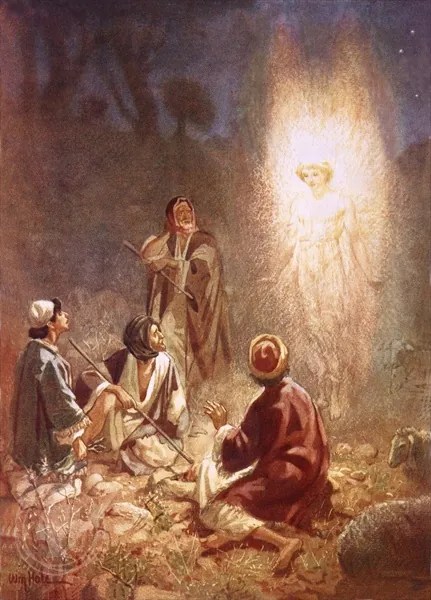
Then an angel of the Lord stood before them, and the glory of the Lord shone around them, and they were terrified. –Luke 2:9 (NRSV)

It’s funny how you can look at something a hundred times or more and then one day someone will point out something you hadn’t noticed and the whole thing looks different to you.  That happened to me a few years ago when a colleague pointed out one simple word in Luke’s Christmas story that had always just flown right by me.

Stood.  That was the word.  Stood.

The angel stood before them.  On the ground.

In all the years of reading or hearing this Christmas story I had always imagined this angel and the multitude of the heavenly host hovering in the air.  I think the Christmas carols taught us to picture it that way.  Angels we have heard on high.  It came upon a midnight clear, that glorious song of old, from angels bending near the earth.  

But that’s not what it says in the Gospel of Luke.  The angel stood before them.

If you were a shepherd in a field on a dark night, it would be pretty unsettling to have an angel appear in the air above you making announcements, but at least if the angel is in the air there’s some distance between you—a separation between your environment and the angel’s.  But if the angel suddenly appears standing in front of you, standing on the same ground you’re standing on, shining with the glory of the heavens… well I think my knees would turn to rubber.  And then imagine what it feels like when the whole multitude of the heavenly host is suddenly surrounding you and singing Glory to God.

Angels in the air feels slightly safer than angels on the ground.  Slightly.  If the angels are above, that means that they came from above.  It means that heaven is “up there” somewhere.  It doesn’t mess with the way we understand the spiritual cosmos.  But if the angels appear standing in front of us or behind us or around us, what does that say about heaven?  Could it be that heaven, the dwelling place of God and the angels, is not just “up there” but also here, with us?  Around us?  Could it mean that the angels of God are standing near us all the time and they simply choose not to show themselves?  Or that we’re just blind to their presence? Could it mean that this ground we walk on and build on and live on is also part of the dwelling place of God—so holy ground?

The angels didn’t bend near the earth.  They stood on it.  

We have this tendency, we humans, to want to separate the material from the spiritual, the divine from the physical.  We are such binary, black and white thinkers in a universe that’s full of colors and shades of gray.  We want here to be here and there to be there.  We want to put borders even on the oceans and talk about territorial waters!  We want to draw a clear and well defended line between our country and the country next door.  So it’s not surprising that we’ve assumed that there is a border between heaven and earth.

We seem to be most comfortable when there’s a little distance between us and angels, a little distance between us and God.  That seems to be the way most people talk about it, anyway.  “Put in a good word with the man upstairs,” they say.  And then there’s that song: “God is watching from a distance.” 

But that’s not what Christianity says.  That’s not what Christmas says.  The Word became flesh and lived among us, and we have seen his glory, the glory as of a father’s only son, full of grace and truth.  In him the fullness of God was pleased to dwell.  Not from a distance, but right in front of us.  With us.  As one of us.

We have trouble seeing the presence of God, seeing Christ in creation.  We have trouble seeing Christ in each other.  We even have trouble understanding Christ in Jesus.  How can Jesus be both divine and human?  We struggle to wrap our minds around that idea, so we have a tendency to make him either all human or all divine.  We picture that baby in the manger with a halo, and it doesn’t cross our minds that he might need to breastfeed and be burped and he might need his diapers changed.

Christmas, the mystery of the incarnation, tells us that God is not a bearded old man watching us from the clouds, a deity who is willing to give us what we ask if we are really good or strike us down with a thunderbolt if we’re bad.  That’s not God.  That’s Santa Claus.  Or Zeus.   

God, the Author of Life, the One in whom we live and move and have our being is Love with a capital L.  Love Personified.  And Love is all about relationship.  Christmas is when God, the Love that created the universe, showed up as one of us in order to show us in person just how much we are loved and in order to teach us to how to love each other more freely and completely. 

“We need to see the mystery of incarnation in one ordinary concrete moment,” wrote Richard Rohr, “and struggle with, fight, resist, and fall in love with it there. What is true in one particular place finally universalizes and ends up being true everywhere.”  In other words, God is present everywhere, in, with, and under everything.  Including you.  And me.  And all those people we’re inclined not to like. But to really grasp this idea, we need to first see God fully present in one particular person.  We need to see God in this particular baby.  This human baby

That, in the end, is what Christmas, the incarnation, is trying to tell us.  Christmas is God’s way of teaching us that there never really was any distance between heaven and earth, between the divine and the human, between the spiritual and the material.  Christmas is God proving once again that Christ is in, with, and under all the things—all things—including all the things we think we oversee and all the things we overlook.  Christmas is angels standing on the earth singing to shepherds and surrounding them with the glory of the Lord to remind them that they, too, are spiritual beings immersed in a human experience.  

Christmas is God’s love made visible.  Pope Francis said, “What is God’s love? It is not something vague, some generic feeling. God’s love has a name and a face: Jesus Christ, Jesus.”  I would add that, if you open your heart and your mind to it, God’s love can have your face, too.

Love is vulnerable—and what’s more vulnerable than a baby?  God comes to us as a baby because it’s easy to love a baby.  It’s easy to be vulnerable with a vulnerable infant.

Christmas is homey and concrete and vulnerable.  It enters the world surrounded by the earthy aromas of animals.  It needs to be fed at a mother’s breast.  It needs its diapers changed.  It cries when it’s hungry and shivers when it’s cold.  It spits up a little bit on your shoulder.  It looks out at the world with brand new eyes and tries to see and understand what it sees.  Most of all, it reaches out to be picked up and held close to your heart.  Christmas wants to be loved and to give love.  

Christmas is our down-to-earth God made manifest.  Yes, gloria in excelsis deo, glory to God in the highest, but glory, too, to God on earth where the angels stand to sing to shepherds, because the Spirit of God is in them, too, and God loves them like crazy.  Just like God loves you.

My prayer for you this Christmas is that you would enter deeply into the concrete, down-to-earth, human and divine mystery of incarnation.  May your eyes and ears be opened to the angels who stand upon the earth and minister to all God’s children.  May you come to see Christ incarnate, permeating all creation.  May you come to see that you are always and everywhere standing on holy ground.  May you dispense with artificial borders in your heart, in your mind, and in this lovely world.  And may you come to see yourself and all the others who share this world with you as spiritual beings immersed in a human experience.  Most of all, though, may you know that you are loved. 

May Christ be born anew in your heart this day and every day.  In Jesus’ name.

Tonight’s the Night the World Begins Again

Christmas Eve 

I’ve been thinking about some Christmas  gifts…and by that I mean some of the gifts that Christmas gives us.

It is the season of giving, after all – and yes, it’s over-commercialized—but in the right spirit even that can help us develop a habit and spirit of generosity.  And that is a gift.

The months leading up to Christmas are a good time to practice delayed gratification.  Don’t buy that now…Christmas is coming.   I know I need to practice that a lot more than I do.  So that’s a gift.

For some it’s a change of habit just to be thinking about what to get for other people, thinking more about others—who they are, what they need, what they would like.  It can feel like an obligation but again, with the right frame of mind it can become a healthy, joyful, even life-giving habit.  That’s a gift.

At Christmastime we are intentional about asking people what they want.  That’s an excellent exercise that can help us learn not to be “curved in upon the self.” So, that’s a gift, too.

Christmas, itself, is a gift.  It’s a change of focus.  It comes with some built-in themes that are important.  Giving.  Receiving.  Gathering.  Family.  Peace.  Hope.  Joy.  Love.  Remembering.  Birth.  The Presence of God.  Wonder.

I don’t know about you, but I  really need the gift of Christmas, itself, this year.  It’s been that kind of year.  

I need to be reminded to stop and breathe and think about giving and receiving and gathering and family.  I need time to stop and remember.

I need to let words like hope and peace and light fill up my soul for awhile.  

I need a time to stop and listen to songs about beauty and joy and angels and promises fulfilled…and God showing up in surprising ways and surprising places.

I need the wonder of it all.

I need the songs.  That might sound strange for me to say since I can’t really hear them anymore, but I remember them—every note every word and even the harmonies. I may not hear them with my ears anymore, but I hear them perfectly in my mind and in my heart.  And I need the songs and carols… because the music that still lives in my heart heals me.  It rekindles my hope and my joy and my faith  faster than words alone can ever do.  “Those who sing pray twice,” said Martin Luther.  

Do you have a favorite Christmas song or carol?  Is there one—or maybe there are several?—that touch you in some particularly powerful way?

There are a lot of Christmas songs and carols that I dearly love and I listen to them over and over and over again.  But there’s one Christmas song in particular I keep coming back to these past few Christmases. And this year, especially, I’ve been listening to it—thinking about it—a lot.  In fact I’ve been listening to it off and on all year long.

It’s twenty years old now—it came out in 2005, but by Christmas Song standards it’s almost brand new.  It’s called Better Days by the Goo Goo Dolls, written by John Rzeznik.  Yeah, I know.  Goo Goo Dolls.  Silly name, but a great band.  And a powerful song.  Listen to these words:

And you asked me what I want this year

And I try to make this kind and clear

Just a chance that maybe we’ll find better days

‘Cause I don’t need boxes wrapped in strings

And designer love and empty things

Just a chance that maybe we’ll find better days

Better days.  When all is said and done, isn’t that what we all want?  For ourselves, for our families and friends?  For….  Everyone?  Better days.   

I need some place simple where we could live

And something only you can give

And that’s faith and trust and peace while we’re alive

Those are some pretty good gifts we can give to each other.  For Christmas.  For every day.  And the song is right… we will only have faith and trust and peace while we’re alive if we give those things to each other.  Faith.  Trust.  Peace.  But the song knows we need something else if we’re going to be able to give each other faith and trust and peace…

And the one poor child who saved this world

And there’s ten million more who probably could

If we all just stopped and said a prayer for them

The one poor child who saved this world.  That’s why we’re here tonight.  That’s what we’re here to celebrate.  But we’re also here to be reminded that because of that child, Jesus, Emmanuel, God With Us, we have the example and the power to save the world together.  God came in person to give us what we need so we can give each other the gifts of faith and trust and peace.  

I wish everyone was loved tonight

And we could somehow stop this endless fight

Just a chance that maybe we’ll find better days

The thing is, everyone is loved tonight—loved by God, at least.  But they don’t all know it and they certainly don’t all feel it.  If they did, if they all felt loved, if we all felt loved, maybe it would stop the endless fight that seems to be the curse of the human race.  But the only way for that to happen is if we take the love that God gives us and let it be real and meaningful and visible in our lives.  And then give it to each other in real and meaningful and visible ways.  

Brené Brown said,  “Jesus comes to show us what love looks like.  God is love.  But God knows that if God just comes down and says I am love and I want you to love each other, we’re going to go straight to hearts and unicorns.  We know it’s difficult and we don’t like difficult, so we’re going to romanticize it.  Hearts and unicorns.  But love is difficult.  So Jesus comes to show us how to do it.  He comes to show us that love doesn’t tolerate shaming.  Love doesn’t exclude people because they’re different.  Love reaches out and touches and embraces all the people we don’t want to touch or embrace. Love does the hard work.  Love does the hard things.”

But there’s something else that God shows us about love by coming as a baby, by coming, especially, as a poor baby.  Right at the beginning—Jesus shows us, God shows us, that love is willing to be vulnerable.  Love is willing to let down all its defenses.  

When you think of all the ways that God could have come to us–all the ways we imagined throughout history that God would come to us—most of that imagery is all about power and royalty and thunder and smoke and lightning.  But then God shows up as a baby.  A poor baby.  In a poor country.  A homeless baby.  A migrant born on the road on a journey his parents were forced to take.  A refugee baby forced to flee for his life.

One poor child who saved the world.   

I haven’t told you the refrain that runs through the song yet.  It’s repeated twice between the verses, but the song ends with it, too.  It’s both a promise and a call to action:

So take these words and sing out loud

‘Cause everyone is forgiven now

‘Cause tonight’s the night the world begins again

Take these words and sing out loud.  That’s the call to action.  

‘Cause everyone is forgiven now.  That’s the promise. It’s also another great gift of Christmas.  In this baby, who is God With Us, we are given a chance to start over with a clean slate. 

In this baby, who is love itself coming to us in its most human and dependent and vulnerable form, we can find forgiveness and we can learn to give forgiveness— and if we can forgive and be forgiven, if we can let go of old hurts and forgive others, then we really can give each other the gifts of faith and trust and peace while we’re alive.  And then there really is a chance that maybe we’ll find better days.

So take these words and sing out loud, 

‘Cause everyone is forgiven now.

And tonight’s the night the world begins again.

Tonight’s the night the world begins again.

What’s In A Name?

Matthew 1:18-25

She will bear a son, and you are to name him Jesus, for he will save his people from their sins. – Matthew 1:21

In Act II, scene II of Romeo and Juliet, Juliet is on the balcony lamenting the long-running feud between her family, the Capulets, and Romeo’s family, the Montagues.  Some ancient grudge that no one remembers keeps the two families at each other’s throats.  If you are born a Montague, any Capulet is your enemy.  And vice versa.  Their names are at war.  So Juliet, mooning over Romeo, protests to the night air:

‘Tis but thy name that is my enemy;

Thou art thyself, though not a Montague.

What’s Montague?  it is nor hand, nor foot,

Nor arm, nor face, nor any other part

Belonging to a man.  O, be some other name!

What’s in a name? that which we call a rose

By any other name would smell as sweet;

In one sense, of course, Juliet is absolutely right.  If you took away their warring surnames they would still be basically the same people—a couple of infatuated adolescents making bad decisions.  

In another sense, though, she’s absolutely wrong.  A rose by any other name might smell as sweet, but its name has power.  If I ask you to imagine a flower, you might imagine a daisy or a carnation or any number of other flowers.  But if I ask you to imagine a rose, you will not only see a rose in your mind’s eye, you might even smell its fragrance.  Names have power.

Do you have a nickname?  Most of the time—certainly not always—but most of the time we’re kind of fond of our nicknames.  A good nickname is a kind of gift.  You can’t make up your own nickname.  You really can’t even ask for one.  Nicknames just sort of happen, organically, or spontaneously.  One day friends or family just start calling you Goober or Dobie or Winkie or Duke and it just sort of sticks.

Nicknames are often descriptive in some way or have a story behind them.  And very often the use of that nickname is reserved for a certain circle of people.

My sister has a nickname.  It’s the name we in the family have always called her, in fact I sometimes have to think twice to remember her actual name.  All her close friends from high school and college know her by that nickname, but everybody else just knows her given name.  Her business name.  Not too long ago she was Facetiming with her best friend from high school and one of her work colleagues overheard her friend call my sister by her nickname.  The colleague said, “Oh!  That’s a great nickname!  I’m going to call you that from now on.”   This left my sister in a quandary.  On the one hand, she likes this colleague well enough, but on the other hand, she’s not “that kind of friend.”  She’s not part of the circle that uses that name.  That nickname belongs to a particular group of people from a particular time in her life.  That nickname belongs to family and certain long-standing friendships that are basically extended family.

Names don’t just label us as individuals, they can also socially locate us.  They carry context.  My dad, for instance, was known to everyone in his work life and social life as John or J.B.  But his brothers and sisters and all his nieces and nephews called him Norman or Uncle Norman.  He was always known by his middle name among family and among all the people who lived in the rural area of the Ozarks where he grew up.  But the military and the government and the business world don’t make allowances for people who are known by their middle names.  All the standard forms that you have to fill out at one time or another ask for first name and middle initial.  Those forms essentially renamed my dad.  In doing so, they not only changed his official identity, they changed his self-understanding.

The names people use for us can shape us.  They say something about how we relate to each other, about who we are and what we do in the world.   My wife’s students call her Dr. B.  Her grandsons call her Nani.  Same person, different roles, different contexts.  

Titles are something like nicknames.  If I talk about Professor Studious or Doctor Pokenprobe or Senator Foghorn or Judge Fairheart,  for instance, their titles immediately tell you something about them.  If nothing else, you know something about their role and function in society.  It’s interesting that both officially and in common practice, the title becomes attached to the name and can even function as the name.   

Messiah is a title.  So is Christ—and let’s be clear, Christ is not Jesus’ last name.  Originally Messiah and Christ meant the same thing.  Anointed.  Messiah is Hebrew and Christ is Greek.  

Some of the oldest Greek manuscripts of Mathew 1:18 read, “This is how the birth of Messiah happened…”  These older manuscripts don’t include the name of Jesus at this point, but everyone understood that Jesus is who the writer was talking about.  Ever since Peter’s confession, those who followed Jesus knew him as Messiah or Christ.  The Messiah, the Christ, is Jesus.  When Matthew introduces this story with the title of Christ or Messiah he is not only telling us that this is a story about the birth of Jesus, but that it’s also a story about God’s mission in the world through the person of Jesus and those around him.  It’s a story of how God works through people like us—people with doubts, fears, misgivings, but also hope and grace and a willingness to trust, even if it means suspending disbelief to believe the unbelievable.  The name Messiah, Christ, carries all that weight.

This is how the birth of Messiah happened.  Mary was betrothed to Joseph.  It was named a betrothal, but it was in fact a marriage.  It just hadn’t been consummated yet.  “But before they came together,” Matthew tells us,  “she was found to have a child in her womb from the Holy Spirit.”  Mary is pregnant but she’s a virgin.  And that circumstance gave her a new name.  She will be known forever as Virgin Mary, and just saying her name brings the whole birth story of Jesus to mind.

Because the marriage isn’t consummated, Joseph plans to divorce her quietly and privately so as not to expose her to all the cruelty, ridicule and meanness that she might experience if he were to denounce her publicly.  Certainly it’s his right in these circumstance to shame her and her family along with her—that would be regarded as perfectly righteous and just according to their law, tradition, and culture.  According to the law, she could even be stoned to death—although that was almost never actually done.  But Matthew tells us that Joseph is a just man.  A righteous man.  And now Joseph has another name:  Joseph the Just.  Fortunately for both Mary and Jesus, Joseph understands that there is more to being just and righteous than simply adhering to the letter of the law or meticulously observing cultural traditions.  Joseph understands that real justice, real righteousness requires compassion, understanding and mercy. 

The fact that he is unwilling to expose Mary to public shame says something really touching about his affection for her.  What he decides to do is, in fact, an act of love in its own way.  He decides to divorce her—to release her—but quietly.  Privately.  He doesn’t want to see her punished. 

It’s a good plan.  A grace-filled plan, but before Joseph can act on it, an angel intervenes in a dream and tells him to go ahead with the marriage because the child Mary is carrying was conceived by the Holy Spirit.  So now the unborn child has an additional name, a title:  Holy.

Joseph agrees to proceed with the marriage as instructed.  But the angel wants more from Joseph than just his forbearance.  The angel tells Joseph to name the child.

Naming a child is an act of adoption.  Even before the baby is born, the instruction to name the child creates a new relationship between the boy and Joseph.  Joseph will be his adoptive father.  The baby will be Joseph’s adopted son.

Joseph is told to name the boy Jesus.  Yeshua.  Which means God Saves.  That name will guide his destiny.  That name will define his relationship to all who follow him throughout history.  God saves.  Jesus saves.

What’s in a name?  Identity.  Relationships. History.  Even destiny.  Messiah is the long-awaited liberator who fulfills the hopes of the Jewish nation.  Christ is the savior of all humanity but also the very presence of God in, with and under all things in creation.  Jesus bears in his very name the message that God saves.

But Mary’s child, Joseph’s adopted son, has yet another name, and that name may be the most important one for all of us who long for the presence of God.  Matthew tells us that he will be called Emmanuel, which means “God with us.”  

To my mind, there is no name more meaningful, no rose as sweet as that one.  Emmanuel.  God with us.

The Beginning of the Middle of the Story

Matthew 11:2-11; Isaiah 35:1-10; James 5:7-10

Imagine poor John, locked in the dungeon of Herod’s fortress, his fate hanging on the whims of people who are notoriously immoral and impulsive.  Imagine him staring at the stone walls of his cell with nothing but time on his hands.  Time to reflect.  Time to remember.  Time to second-guess both his mission and his memory.  Time to doubt.

Did he really see the Holy Spirit descend on Jesus or was it just a trick of the light dancing on the water?  Did he really hear the voice of God or was it, as some said, only thunder bouncing off the hills?  

He knows he is going to die soon.  He knows that Herodias will find some reason to have him executed.  If at all possible, he would like to put his doubts to rest before that happens. So he sends two of his disciples to find Jesus and ask him:  “Are you the one who is to come, or are we to wait for another?”  

 It’s easy to brush past John the Baptist even though he comes up in our lectionary texts every year at this time.  It’s easy to think of him as a footnote in history, a wild man in the wilderness whose primary purpose was to point to Jesus.  The gospel accounts do tend to skew his story that way, but then the gospels are primarily interested in the story of Jesus, and in that story John is not the central character.

We forget that John, the son of Elizabeth and Zechariah, had hundreds, maybe even thousands of followers, so many that Herod Antipas saw him as a potential political threat.  The Roman historian, Josephus described John as “this good man, who had commanded the Jews to exercise virtue, righteousness towards one another and piety towards God.”  Many of John’s followers remained loyal to him after his death and even today the Mandaeans, an ethnoreligious group with roots going back to ancient Palestine, regard themselves as followers of John the Baptist whom they see as the greatest of the prophets.  

Muslims know John as Yahya ibn Zakariya, and venerate him as one of the great prophets.  John is also revered by people of the Bahai faith and the Druze.  Clearly his call to live a life of virtue, to treat each other with righteousness and generosity and to revere God resonated beyond his role in the gospels.  In the fullness of history, John is much more than just a prelude to Jesus.

I think one reason we tend to diminish John in our Christian traditions is that we come to him very late in his story and very early in the story of Jesus.  We forget that both of them come in the middle of a much, much larger and longer story, a story that began with God making a covenant with Abraham, a story that is carried through times of slavery and exile in Egypt and Babylon.  It is a story of a people who cling to their covenant and identity during times of foreign oppression by Assyria, Babylon, Greece and Rome.  It is the story of hope kept alive by the leadership, visions and prophetic voices of Moses, Jeremiah, Isaiah, Micah, Amos and others, including John the Baptizer.

It is a story of seeds planted as dreams of a better world, a world where creation, itself, is restored and renewed, where “the wilderness and the dry land shall be glad, the desert shall rejoice and blossom abundantly and rejoice with joy and singing.”  This longer, larger story plants the seeds of a vision of healing where “weak hands are strengthened” and “feeble knees made firm,” where “the eyes of the blind shall be opened and the ears of the deaf unstopped” and where “the lame shall leap like a deer and the tongue of the speechless sing for joy.”  These are the seeds of God’s vision for a world where captives, exiles and refugees return home, where migrants find a place to put down roots, where all wanderers find a safe place to “obtain joy and gladness,” a place where “sorrow and sighing shall flee away.”[1]  

This longer, larger story is the guiding vision of faithful generations scattering seeds of peace throughout the world until that much anticipated day when the flower of peace will bloom, that day when “they shall beat their swords into plowshares and their spears into pruning hooks,” when “nation shall not lift up sword against nation, nor shall they study war anymore.”[2]

This longer, larger story is the story of hope always on the horizon.  It is the story of a people waiting for the Anointed One who will inaugurate the fulfillment of the vision.

This is the longer, larger story that John inherits.  John enters the story knowing there is so much that still needs to be repaired before the vision he has inherited can become a reality.  He knows that the thing most urgently in need of repair is the human heart, the human way of seeing, the human way of being, the human way of thinking.  He sees the brokenness of the world clearly.  He sees the ways that those who wield power and authority are complicit in that brokenness.  He feels the anxiety and dissatisfaction of the people who bear the scars of living in that predatory and oppressive brokenness.  He sees the dissonance between the world as it is and the world as it should be.

And then he sees Jesus.  And that hope that was always on the horizon seems closer and more possible than ever before.

John points to Jesus.  But John is not done.  John sees the world, and he tells the truth about what he sees.  He calls people to change, to turn around and go a new direction because a reckoning is coming and the new day is dawning.  He speaks truth to power.  And when he publicly condemns Herodias, the wife of Herod Antipas for divorcing Herod’s brother, when he publicly denounces Herod for marrying his brother’s wife, he is arrested.

Languishing in prison, bedeviled by doubt, John sends his question to Jesus:  Are you the one… or should we wait for another?

Jesus doesn’t answer John with bravado or any kind of self-proclamation.  He simply tells John’s disciples “Go and tell John what you hear and see:  the blind receive their sight, the lame walk, the lepers are cleansed, the deaf hear, the dead are raised, and the poor have good news brought to them.  And blessed is anyone who does not stumble because of me.”  

Jesus is telling John that the things Isaiah foresaw are happening, the signs generations had hoped for are being performed.  Jesus is telling John that in his work the seeds of God’s vision are sprouting and peeking above the soil.  In him the kingdom has begun to arrive.

If you have times of doubt, if you have times when the brokenness of the world seems overwhelming, if you find yourself being punished for speaking truth, remember John.  John had tremendous faith. Among those born of women, said Jesus, there has been no one greater than John.   But when the walls were closing in, even John had his doubts.

If you have times when you wonder if humanity is a lost cause, take a moment to remind yourself that the seeds of God’s vision are still growing and still being planted.  It’s up to us to keep sowing them.  “The farmer waits for the precious crop from the earth,” wrote James, “being patient with it until it receives the early and the late rains.  You also must be patient. Strengthen your hearts, for the coming of the Lord is near.”[3]  

And finally, it’s always good to remember that we don’t know where we are in God’s longer, larger story.  Yes, the world is still broken, but there are signs of repair work in progress if you know where to look, and one of those signs is you and me.  We are partners in God’s work of repairing the world.  And that, alone, is cause for rejoicing.  


[1] Isaiah 35:1-10

[2] Isaiah 2:4; Micah 4:3

[3] James 5:7-10