Does Your Eye See Evil Because I Am Good?

Matthew 20:1-16

In this week’s gospel lesson, Jesus says that the kingdom of heaven is like a landowner who hired workers at different times of the day to go work in his vineyard.  At the end of the day, he pays the workers who have labored all day in the hot sun the same wage as those who have only been working for an hour.  This is one of the more challenging parables of Jesus and, as is so often the case, we may miss the point entirely if we over spiritualize it or try to turn it into an oversimplified allegory.

There’s a line at the end of this parable that I keep coming back to over and over.  The landowner is speaking to a disgruntled all-day worker who doesn’t think it’s fair that he was paid the same as the workers who only worked one hour.  Most English translations have the landowner saying to the unhappy worker, “Are you envious because I am generous?”  What it actually says in the Greek, though, is “Is your eye evil because I am good?”

Is your eye evil because I am good?

That’s an amazing question, and I think it’s more to the point than “are you envious?”.  It can be taken two ways:  One is, “Are you looking for something bad here?  Are you looking for something to be upset about because I did a good thing?” The other, if you want to get really old school, is “Did someone put the evil eye on you?  Are you cursed so that you only see bad where there is good happening?” 

So how are you seeing this parable?  

Who do you identify with in this story?

The all-day laborer?

The mid-day laborer?

The end-of-day laborer?

The owner of the vineyard?

The way we see this story depends a lot on our point of view—on where we stand when we’re looking at it.  The way you interpret this story depends a lot on your own socio-economic position and life circumstances.

I think most of us tend to identify with the all-day laborers—those first guys hired early in the morning.  We resonate with them, don’t we, when they say, “What’s the deal here?  We were out there working our tails off all day in the hot sun and you’re paying these guys who showed up an hour ago the same as us?!?  That’s not fair!”

That’s a natural response.  Let me tell you just how natural.

In 2003, researchers at Emory University in Atlanta did an experiment with Capuchin monkeys.  The monkeys were taught to complete a simple task, and when they did the task successfully, they were given a slice of cucumber as a reward.  They liked cucumber, and they were all perfectly happy being rewarded with a piece of cucumber.  Until one of them was given a grape.  Then cucumber wasn’t good enough anymore.  They all wanted a grape for completing the task and if they didn’t get it, they rebelled in all the loud and messy ways that monkeys can rebel.

Even monkeys want to make sure they’re getting the same deal as the other monkeys.  Even monkeys seem to have a built-in idea of what’s “fair.” So it’s natural, I think, for us to identify with the workers who feel slighted after laboring all day in the vineyard.   

Because of that, this parable makes a lot of us uncomfortable.  The kingdom of God is like a landowner who paid his workers on a grossly uneven scale.  So what is Jesus saying here?  Is God…unfair?

The traditional way to get around all that discomfort has been to say, “Well this parable is all about Grace.  Jesus is talking about getting into heaven and the point is that the Johnny-come-latelies will get in just like those who have been working in the church their whole lives.” 

Maybe.  But what if he’s really talking about economics?  What if the point he’s making is about the practical duties and responsibilities that come with having assets at your disposal?  What if he’s talking about the duty that the rich have to the less well off?  What if he’s talking about the kind of economic dynamics that keep a whole community healthy—not so much trickle-down as flow-through?  

What if this really is about wealth, every day dollars and cents and community economics?  What if Jesus is giving us God’s model for the administration and stewardship of wealth?

And before you dismiss that idea, note where this parable comes in the book of Matthew.  Just before this parable, a rich young man has come up to Jesus and asked what he has to do to inherit eternal life.  In addition to keeping the commandments, Jesus tells him to sell everything he has, give the money to the poor and then to come and follow him.  The young man “went away grieving, for he had many possessions.”  When he saw the young man’s response Jesus said, “It’s easier for a camel to go through the eye of a needle than for someone who is rich to enter the kingdom of God.”  That’s what leads into this parable.

Remember too, that Jesus is talking to a Jewish audience and this gospel is written to a community of Jewish Christians.  They have laws and traditions and customs that are all about making sure that the less fortunate are provided for.  

Leviticus 23:22 tells us, “When you reap the harvest of your land, you shall not reap to the very edges of your field, or gather the gleanings of your harvest; you shall leave them for the poor and for the alien: I am the Lord your God.”

In Deuteronomy 15:11, we read ‘Since there will never cease to be some in need on the earth, I therefore command you, ‘Open your hand to the poor and needy neighbor in your land.’

The audience who first head this parable were even familiar with other stories that are quite similar to this.   Rabbi Shimon ben Eliezar told a story about a king who hired two workers.  The first worked all day and received one denarius.  The second worked one hour and received one denarius.  Which one, asked the rabbi, was the more beloved?  Not the one who worked only one hour, he explained.  The king loved them both equally! 

In her amazing book Short Stories by Jesus, Amy-Jill Levine wrote:

 “The parable does not promote egalitarianism; instead, it encourages householders everywhere to support laborers, all of them.  More than just aiding those at the doorstep, those who have should seek out those who need.  If the householder can afford it, he should continue to put others on the payroll, pay them a living wage (even if they cannot put in a full day’s work), and so allow them to feed their families while keeping their dignity intact.  The point is practical, it is edgy, and it is a greater challenge to the church then and today than the entirely unsurprising idea that God’s concern is that we enter, not when.

   “Jesus is neither a Marxist nor a capitalist.  Rather, he is both an idealist and a pragmatist.  His focus is often less directly on ‘good news to the poor’ than on ‘responsibility of the rich.’  Jesus follows Deuteronomy 15:11, ‘Since there will never cease to be some in need on the earth, I therefore command you, ‘Open your hand to the poor and needy neighbor in your land.’” —Short Stories by Jesus, p. 218

Because we are who we are in our culture, I think we tend to hear this story through the filter of our Lutheran theology of Grace and we read it through the lens of a Calvinist work ethic.  We want to make it about Grace and Heaven and the rewards of hard work, so we make some assumptions about the characters in the story that probably aren’t what Jesus had in mind at all.  

But maybe we can see it differently if we slow down and ask the text some questions.

Why are those other workers in the marketplace looking for work in the middle of the day?  

Verse 3 in the NRSV says that when the landowner went out about 9 o’clock “he saw others standing idle in the marketplace.”  ‘Standing idle’ is a legitimate translation, but it’s not the only translation.  I don’t know about you, but when I hear ‘standing idle’ it has a connotation of laziness.  But the Greek word, agrou, the word that gets translated as ‘standing idle’ can also mean simply ‘without work’ or ‘not working.’

There could be any number of reasons why they weren’t working.  There could be all kinds of reasons why they showed up late to the day labor pool.

They might be caring for an elderly relative in the morning, which would be fulfilling both a family duty and a scriptural obligation. They might be caring for a sick spouse.  And maybe they simply weren’t hired by other landowners.

Jesus’ story makes no judgment on them for being late to the marketplace or simply being there “without work.”  So why do we?

We tend to focus on the workers, but the landowner needs some scrutiny, too.  Is the landowner a bad manager?  Is he clueless about how many workers he needs for his harvest?  Is that why he keeps returning to the marketplace?  Or is there something else going on here?

Timothy Thompson wrote a play based on this parable in which he depicts two brothers waiting in the marketplace, hoping for work. John is strong and capable; Philip is just as strong and willing but has lost a hand in an accident. When the landowner comes, John is taken in the first wave of workers, but Philip is left behind.  Later, other workers are brought to the field, but Philip is not among them.  John is glad to have the work, but he’s worried about his brother.  He knows Philip needs the work just as much as he does. Finally, the last group of workers arrives, and John is relieved to see that Philip is with them.  He’s glad to know that Philip will get paid for at least one hour. So imagine John’s surprise when the owner of the vineyard pays Philip a full days’ wage!  John is overjoyed, knowing that Philip – his brother – will have the money necessary to feed his family.  And when it’s his turn to stand before the landowner and receive his pay, instead of complaining as the others have, John throws out his hand and says with tears in his eyes, “Thank you, my lord, for what you’ve done for us today!”

The kingdom of heaven is like that.

God’s justice arises out of a sense of community in which we see the “eleventh hour” workers as our brothers and sisters whose needs and dignity are every bit as important as our own. 

When the landowner hired the workers he said, “I will give you whatever is right.”  What is right.  It might not be what looks “fair” to everybody else, but it will be what is right and just.  It will be what is needed.

Maybe in this parable beyond giving us a story about grace or qualifying for eternity, Jesus is giving us a model to follow.  Maybe he’s telling us how to do what is right even if it doesn’t look particularly fair.

I suppose it depends on how you see it.  

The Keys of Heaven

The Keys of Heaven

The body of the old man lay stretched out upon the table, prepared according to custom and covered with a shroud.  The priest, who had been gazing out the window, or perhaps deep into his own thoughts, broke from his reverie, stood up, and removed a papyrus scroll from the folds of his robe then moved to the body lying on the table and gently, reverently, lifted the edge of the shroud and took something from the right hand of the old man lying beneath it, and lifted it high in the lamplight for all to see.  Everyone reacted to the familiar object dangled before them.  Some smiled wistfully, a few nodded in recognition, one woman buried her face in her scarf and wept.  It was a plain thing, a simple leather thong suspending ten stones, seven smaller, three larger, each separated from the others by a knot in the leather.  They did not catch the light in any particular way.  They did not glow or sparkle.  There was no mystic aura about them.  But the faithful people in that gathering would not have traded those stones for rubies or diamonds or sapphires or pearls. “The Keys to Heaven,” said the priest.  With care bordering on ceremony he handed the odd artifact to the Deaconess who stood at the feet of the old man’s corpse.  She continued to cradle the leather strip and its stones in her hands so all could see it in the soft glow of the oil lamps.   The priest unrolled the scroll and began to read.

By vocation the priest was the chief reader at a busy scriptorium.  Six days of the week he would read aloud to a phalanx of copyists—reading slowly, distinctly, and loudly enough to be heard at the back of the room yet fast enough to keep up with the demands of the business, to meet its deadlines and keep it profitable.  The qualities that made him so very good at his job also made him an excellent public lector, a role which added to his income.  This talent also served him well, of course, in his role as priest in this small community of the faithful.  But now, as he began to read his dear friend’s last will and testament, he put aside his professional voice and tried to find in himself the deep wells of strength and gentleness that characterized his departed friend; he did his best to summon his friend’s voice for his friend’s words.  This is what he read:

My dear friends, my brothers and sisters, grace to you and peace in the name of the One we follow, who was, who is and who is to come.  Amen.  I pray you know how much you are loved.   I have so very little to leave to you in the way of earthly things.  My little house and my poor purse I entrust to this community.  Perhaps they may be used to benefit a widow or two.  Let the Deaconess administer these things as she is most capable.  Let the tools of my trade go Nathaniel, my apprentice.  I have no other possessions except the Keys to Heaven.  These I bequeath to you all for your common use and good, but I must tell you how I came to have them.

I think that almost every one of you, most when you were children, but some when you were older, have asked me, “Andreas, what are those stones hanging from your belt?” and I would say, “They are the Keys to Heaven and I am giving them to you.”  Then you would say, “When can I have them?”  And I would say, “When you can tell me how they are made!”  So now, I will tell you their story.

For all the years I have lived among you, you have known me as Andreas the Leatherworker.  That was not always my name.  For that matter, working leather was not always my trade, but that is of no importance.  When I was much younger and full of anger at the world I did some dangerous and stupid things.  One thing in particular was even evil, though I did not think so at the time.  As a consequence, I found myself on the run, hiding from the patrols of soldiers that seemed to be everywhere on the road.  I cut my hair and shaved my beard.  I stole the tunic, mantle and belt of a tradesman while he was bathing in the river and left my very fine and costly clothes in their place.  Then I fastened a sword to my belt and kept on running.

Three nights later, just at nightfall, I saw a man sitting by a campfire just to the side of the road.  Half mad with hunger and exhaustion, I moved toward him, drew my sword and said, “Give me your food and your money.”  I meant to growl it out in a menacing way but my throat was so parched I must have croaked like a raven.  “We will gladly share our food with you,” said the man, “but what money we have with us is not ours to give.”  I started to move toward him with my sword when his words pierced the fog of my hunger.  We.  He had said “we.”  I blinked, looked again, and could not believe I had not seen them the first time—four other men. Two of them were some small distance behind the man by the fire but were now walking briskly toward us.  Another man was emerging from the brush carrying an armload of wood for the fire, and another with a water skin was just coming up from the stream.  Five men altogether.  Even if I were not nearly dead from hunger and thirst I could never take on five men.  My head began to swim, my knees gave out and I fell, unconscious.

I awakened to find one of the men bathing my forehead with a cool, wet cloth while another was bandaging my arm.  Apparently I had cut it with my own sword when I fell.  The man I had first seen, the one I had threatened and tried to rob, lifted a cup of cool water to my lips but urged me to drink it slowly.  As soon as I was able to sit up one of the men gave me a piece of bread and a piece of dried fish which I devoured immediately without a word. 

I didn’t know what to expect next and I was too weak to try to run.  When the big man, the first man I had seen by the fire, picked up my sword I half expected him to kill me with it. Instead he laid it in front of me in the dirt.  “This is yours,” he said, “though I think you might be better off not to keep it.  That’s a Roman Gladius.  A soldier’s sword.  And you don’t strike me as a soldier. I think maybe that sword has already brought you trouble and if I were you I would just bury it here at the side of the road.”  

I was dumbstruck.  That sword had been nothing but trouble.  That sword and my hot temper were the whole reason I had had to flee for my life.  

I looked at the big man.  He was smiling at me, and I realized, looking at him, that there was no fear in him.  No anger.  “You must still be hungry,” he said.  “I tried to rob you!” I said, incredulous.  “I threatened you!”  “Yes.  You did,” he said.  “I forgive you.”  “But I…”  I started.  “Let it go,” he said, quietly.  “I have.  What you bind on earth is bound in heaven.  What you release on earth is released in heaven.  I release it.  I release you.  Let it go.”

I sat staring at the ground for a long time, confused, not knowing what to think.  

I heard him chuckle, looked up and saw him smiling at me.  He leaned over and picked up a smooth agate pebble from the ground, walked over and placed it in my hand.  “Here,” he said. “Keep this.  This is the first Key to Heaven.  Forgiveness.”  “I don’t know if I can be forgiven.” I said.  His expression became reflective and he gazed into the fire for a long moment. “I felt that way once,” he said at last. “I betrayed my best friend…my teacher…my master.  I betrayed him three times in one night to save my own skin.”  “What happened?” I asked.  “They crucified him,” he said simply.  “But I got away because I pretended that I didn’t know him. Three times in one night someone accused me of being one of his companions and three times I denied it.  And I didn’t think I would ever be forgiven for that.  But he forgave me.  And he helped me forgive myself.  He released me from my sin and he helped me let go of my sin—helped me to stop clinging to it..”  “Wait a minute,” I said, “I though you said they crucified him.”  “They did,” he said.  “Well then how…when did he forgive you?”  The way he looked at me I could tell he was trying to decide something and it was another very long moment before he said, “That’s another story and if you would like to travel with us I will gladly tell it another day.  For now,” and here he smiled again, “hold on to that little piece of forgiveness and let that be enough for today.”

And that, my beloved brothers and sisters is how I came to have the first of the Keys of Heaven, the Key of Forgiveness.  Having nowhere else to go and nothing to lose, I became a travelling companion of Petrus, the Fisherman, who taught me the ways of his Master and baptized me into a new life with a new name.  And along the way he gave me the Keys of Heaven and taught me how they are made, or where they can be discovered, so that each of us can have them and carry them with us and unlock Heaven around us wherever we are.  

The first key is Forgiveness.  The Second is Gratitude.  The third is Generosity.  The fourth is Compassion. These four open your heart to the world God made, the world God loves.  The fifth key is Integrity.  The Sixth is Thoughtfulness.  These two open the soul and mind to look beyond yourself and deal fairly with all others.  The seventh is Be Not Afraid.  This key gives you the presence of mind to remember that you have all the others at your command and it helps you to use them wisely.

Then there are the three larger keys.  These give the first keys their power.  At the same time, the first keys can unlock the power of these three.  They are Faith, Hope and Love.

So, my beloved friends, these are the Keys to Heaven.  I hope you can see that I spoke the truth all these years when I said, “I am giving them to you.”  I hope and pray that in my life you saw forgiveness, gratitude, generosity, compassion, integrity and thoughtfulness.  I hope you saw me live without fear.  I pray that you are gathering these keys for yourself by the example of our Master.  May you all continue to grow in Faith, Hope and Love until we are reunited in the Life to Come.

Peace be with you.

I am always your brother,

Andreas

The small assembly sang a hymn.  The priest pronounced a benediction.  The Deaconess replaced the Keys of Heaven in the old man’s hand, and in the dim lamplight they reverently carried his body to its place of rest.  

Dandelions

Matthew 13:31-33, 44-52

When I was a teenager there was a lady at church who used to pay me to come dig dandelions out of her yard.  You can’t just pull  them or cut them; you have to dig them out because they’re perennials, and if the tap root is left intact they’ll simply grow back.  I don’t bother digging them out of our yard.  I know it’s a losing battle.  Besides, if you keep the yard mowed, the grass and the dandelions tend to strike a balance.

Did you know that dandelions are not native to the Americas?  They probably came here on the Mayflower.  European colonists brought them here.  On purpose.  They’re actually very useful plants.  Every part of the dandelion is edible.  The leaves can be used in salads or sautéed or boiled, like spinach.  The flower petals can be fermented along with other juices, usually citrus, to make dandelion wine.  The roots, when dried and ground into powder, can be used as a caffeine-free substitute for coffee and were an essential ingredient in the original recipe for root beer.  Raw dandelion greens are a moderate source of calcium, potassium, iron, and manganese and contain high amounts of vitamin A, vitamin C, vitamin K, beta carotene and other anti-oxidants. 

Dandelions have been used in natural medicine for thousands of years.  The root is a diuretic.  The leaves are good for treating constipation.  Dandelions have been used in natural medicine to treat liver and stomach problems, diabetes, cancer, and high blood pressure.  

And if all that isn’t enough to make you appreciate the lowly dandelion, when the pretty little yellow flower turns magically overnight to a silver puffball, you can pluck the stem and make a wish as you blow on it to scatter the seeds to the wind.

So what do you see when you see a dandelion?  A charming, tenacious, self-propagating, useful little plant that could actually be part of your dinner every night?  Or a weed?  

The kingdom of heaven is like a dandelion.

“The kingdom of heaven is like a mustard seed that someone took and sowed in his field,” said Jesus.  “It is the smallest of all the seeds, but when it has grown it is the greatest of shrubs and becomes a tree, so that the birds of the air come and make nests in its branches.” 

The people Jesus was talking to saw the mustard plant pretty much the way we see the dandelion.  Pliny the Elder wrote about its many medicinal and culinary uses, but he was quick to note, “Mustard grows entirely wild, though it is improved by being transplanted: but on the other hand when it has once been sown it is scarcely possible to get the place free of it, as the seed when it falls germinates at once.”  In other words, it has its uses, but it’s basically a weed.  And yet, in Jesus’ story, someone actually plants it in his field.  On purpose.  Someone sees its inherent value.  They know that mustard oil can help ease pain from stiff or bruised muscles.  They know a mustard poultice can help ease asthma or relieve coughing and stuffy sinuses.  They know mustard can function as a diuretic and help cleanse the liver.  They know it can be used as a spice to flavor food and help preserve it.  

As Jesus tells the story, the man plants one seed in his field.  And if we’re a listener in Jesus’ audience we assume that soon the whole field will be transformed.  It will be a mustard field.   Jesus makes a point of also noting that other creatures also benefit from that mustard plant.  The birds of the air have a place to land and build their nests.  

The kingdom of heaven is like that.

When Jesus talks about the kingdom of heaven, he’s not talking about the afterlife.  He’s talking about a life of mercy, grace and justice.  Now.  He’s talking about a life of generosity and abundance.  Now.  He’s talking about how that life of mercy, grace, justice, generosity and abundance reaches beyond us to benefit all of creation.  Now.  

When Jesus talks about the kingdom of heaven, he’s talking about the things we fail to notice, common everyday life things, little things that are right there in front of us if we will only take a moment to really look at them and appreciate them, if have enough sense to grasp their importance.

“The kingdom of heaven is like yeast that a woman took and mixed in with three measures of flour until all of it was leavened.”

Sounds simple enough, but there’s something we lose in the translation, so here are three things here to better understand this little parable.  

First, the yeast isn’t yeast.  It’s leaven.  They didn’t know about yeast, per se, in Jesus’ time. Think sourdough starter.  Making sourdough has been a fun trend during the pandemic.  One of my friends makes regular posts on Facebook about the state of her starter.  She even named it.  I remember years ago when a friend sent us some starter that she was particularly proud of so that we could make some sourdough bread of our own.  It was a thing to share it and pass it along.  The kingdom of heaven is like that.

Second, the woman in the parable doesn’t “mix” the leaven into the flour.  The Greek word there is enkrypto.  It says literally that she hides it in the flour.  The kingdom is something transformative that’s hidden in the midst of all the other ingredients—that little something that’s in, with, and under the other things that changes all of them.  The kingdom of heaven is like that.

Third, three measures of flour. We’re not talking about 3 cups here.  According to Amy-Jill Levine, in first century terms we’re looking at somewhere between 40 and 60 pounds of flour.[1]  This woman in Jesus’ parable is making enough bread to feed her whole village and she’s going to need all the women in the village to help her knead the dough.  The kingdom of heaven is like that.

Again, when Jesus talks about the reign of heaven, he is not talking about pearly gates and streets of gold in the life after life.  He is talking about living an alternative life with alternative values and higher allegiances here and now.  One of the times Jesus says this most plainly is in Luke 17:20-21.

Once Jesus was asked by the Pharisees when the kingdom of God was coming, and he answered, “The kingdom of God is not coming with things that can be observed;  nor will they say, ‘Look, here it is!’ or ‘There it is!’ For, in fact, the kingdom of God is among you.”

The kingdom, the reign of heaven, is among us.  It’s in the midst of us. Present tense.  Now. That’s why Jesus uses such everyday pictures to describe it.  It is a domain in which we live and move and have our being if we know how to see it.   

The reign of heaven is learning to see each other as undiscovered treasures that we stumble across in a field that doesn’t belong to us, learning to see Christ in, with, and under each person we encounter.  

The reign of heaven is discovering a pearl, a life, so valuable and beautiful that we’re willing to go all in to have it, to live it in a world that God so loves that God went all in to save it.

The reign of heaven is a splash of cold water on your face in the morning reminding you that in the clear waters of your baptism you were promised that nothing can separate you from the love of God in whom you live and move and have your being, reminding you that Christ is present in, with, and under the water, reminding you that life itself is always and everywhere being renewed and transformed by little things seen and unseen.

The kingdom of heaven is every act of justice, of kindness and mercy, of grace and generosity, floating into the world like a dandelion seed blown by a child’s wish.  It plants itself in a crack in the sidewalk and brings color and new life out of the brokenness.  

The kingdom of heaven is like that.

In Jesus’ name.


[1] Short Stories by Jesus: The Enigmatic Parables of a Controversial Rabbi,  Amy-Jill Levine, p.121; HarperCollins, 2014

Sowing Generosity

Matthew 13:1-9, 18-23

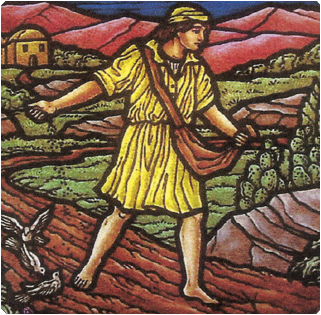
Listen!  A sower went out to sow.

Karsten Lundring is an alum of California Lutheran University who really loves his alma mater.  Karsten attends every CLU football game and when the Kingsmen score he throws out handfuls of Jolly Rancher candies to the crowd in the stands.  Some of those candies fall through the bleachers and land on the ground.  Some are caught by people who are dieting or diabetic so they get passed along to someone else.  Sometimes people catch the orange ones but they just don’t like the orange ones, only the red ones so they give them away.  Some are caught by fans of the opposing team.  But a lot of the candies are caught by hungry children and CLU fans who are enjoying excitement of the touchdown and are delighted to celebrate with a taste of something sweet.[1]

A sower went out to sow.  

Jesus doesn’t usually explain his parables, but because his disciples pestered him about it he explained this one.  Well, partly.  He explained about the ground where the seeds landed.  The different places where the seeds end up serve as analogies for the different people who will hear the message that Jesus and his disciples are proclaiming, the announcement that the reign of God is about to begin.  Some will get it, some won’t.  Pick your reason.  Some are too shallow or too self-involved.  Some are too busy.  Some are too worried.  Some are misguided by their own misconceptions—these are all things that can keep the domain of God from really taking root in your life or, to put it another way, that can keep you from taking root in the domain of God.  

We have an natural habit when we read the parables of asking “What does this mean?” Please explain this.  We want to read them all as allegories—sometimes they are, sometimes they’re not.  We want to translate the analogies, to solve the riddle and walk away from the parable knowing The Point.  But Jesus tells parables not so that we can ask questions of them and arrive at some moral maxim like an Aesop’s fable, but so that the parable can ask questions of us.  Jesus tells parables to help us see the world, ourselves and God differently.  

When I’ve preached or taught on this Parable of the Sower in the past, I’ve always focused on the soil since that’s the part that Jesus explains.  My sermons were usually some version of “What Kind of Soil Are You?” with sometimes a side order of “What Are You Going To Do To Become More Productive Soil?” 

If you ever heard me preach one of those sermons, I apologize.  I messed the point.  I also missed the point.  Don’t get me wrong.  It’s always a good thing to be looking at what we can do to let the love and life of God take deeper root in our lives.  It’s always good to pay attention to how our faith or lack of it is manifested in the lives we lead.  But that’s not the point of this parable.  There are other parables for that.  The fig tree in the vineyard comes to mind.

Parables ask us questions, and as I sat with this parable and listened to it again, the question it was asking me was “What do you see here that you haven’t seen before?”  Jesus is giving his disciples some answers, but not all the answers.  There’s more to see here.  And then I saw two things that made it a whole new story for me.

The first was this:  the soil can’t change itself.  It is what it is.  The pathway is going to be the pathway as long as people are walking on it.  The rocks are going to be the rocks.  Thorn bushes don’t uproot themselves.  

Jesus is telling his disciples and “anyone with ears” who will listen to not make themselves crazy trying to talk people into signing up for the reign of heaven if they’re just not ready to do that.  Just sow the seed.  Go out and announce it: the Domain of God is within reach.  Live it.  Be it.  Those who are ready will get it, and it will surprise you how many of them there are.  As for the rest, let the Holy Spirit work on them.  Rocks can be moved or worn down.  Pathways can be rerouted or tilled and fertilized.  Thorn bushes can be removed in any number of ways.  But right now that’s not your job.  Leave the Holy Spirit and the circumstances of life to soften them up.  You sow the seed.

The second thing I saw that absolutely turned this into a new story for me is this: this is a story of unbridled abundance and generosity.  There is no shortage of seed.  The sower throws it everywhere with no regard whatsoever about where it’s landing.  The word of the kingdom, as Jesus calls it in his explanation to the disciples, is an endless resource and when it lands with someone who hears and understands it, it reproduces itself even more abundantly. 

God has created this world to be a world of abundance and generosity.  As Gandhi said, this world has enough for everyone’s need, but not for everyone’s greed.  The earth itself participates in the generosity of God. The generosity of God was spoken in the word of creation.  The word of the kingdom is a word of perpetual regeneration.  Genesis.  Generation.  Regeneration.  The creative love of God is grounded in Generosity.  

“God writes the gospel not in the Bible alone, but on trees and flowers and clouds and stars,”  wrote Martin Luther, and surely God’s message of generosity and abundance is written in every harvest and planting.  

I remember being on our family wheat farm in Kansas once in the spring when the new wheat was standing bright green and knee-high in the fields.  I looked out and saw a family of deer grazing on the new shoots down by the creek.  I asked my mother’s cousin, Frank, if we shouldn’t maybe do something to shoo them away.  He just smiled and said, “Oh there’s plenty for them and us.  We’ll share it.”  

There was good soil there in Kansas where my family grew wheat.  The harvest was plentiful.  There’s good soil for the word of the kingdom, the domain of God, in many, many hearts out in the world.  Many people are already living in the heart of the kingdom whether they know it or not, living lives of generosity that produce more generosity in others.

When Michelle Brenner was furloughed from her job at a menswear store in Gig Harbor, Washington, because of the Corona virus, she was, naturally, upset, so she went home and made herself a big pan of lasagna using her grandmother’s recipe.  Nothing works like comfort food to soothe the soul.  Michelle realized that if her grandmother’s lasagna was making her feel better, it might lift other people’s spirits, too, so she posted on Facebook, “Hello favorite friends… if any of you want some fresh, homemade, no calorie-counting lasagna, let me know and I will gladly prepare it.”

A few requests trickled in—a retired neighbor, an out of work friend… Then Michelle took it on herself to deliver a few pans of lasagna to hospital workers and first responders, a few struggling single parents and others she knew of who were just scraping by. Word began to spread.  Soon she had so many requests that making homemade lasagna for others had become her full-time job.  When the president of the Gig Harbor Sportsman’s Club got wind of Michelle’s mission, he offered to let her use their commercial kitchen which had been closed because of Covid-19.  Three months later she’s still at it.  So far she has given away more than 1200 pans of homemade lasagna, although she’s lost track of the exact number.

Michelle initially used her $1200 stimulus check to pay for lasagna ingredients but that money was soon gone.  Fortunately, without being asked, people began to contribute what they could.  Some would give a dollar.  One person gave $100.  Somebody set up a Facebook fundraiser for her that raised $10,000.  All in all, people have given about $22,000 to the woman who is now known affectionately as The Lasagna Lady.  Every penny goes into lasagna while Michelle, herself, gets by on unemployment insurance. 

“It’s a pan of love,” says Michelle. “A lot of the people I make lasagna for have lost their jobs, and this is my way of saying, ‘I understand and I’m here for you.’ ”

When Jesus explained the Parable of the Sower to his disciples he said, “As for what was sown on good soil, this is the one who hears the word and understands it, who indeed bears fruit and yields, in one case a hundredfold, in another sixty, and in another thirty.”  Or 1200 pans of lasagna. 

I don’t know where Michelle Brenner heard the good news of the kingdom of heaven, the good news of God’s abundance and generosity.  I don’t know if she ever attended any church or is part of any faith.  Maybe she learned it from the earth itself.  Maybe it was layered between the noodles and the meat and the sauce and the cheese in her grandmother’s lasagna recipe.  I don’t know where or how she learned it, but she learned it.  And she’s passing along.

And a sower goes out to sow.

In Jesus’ name.  Amen.


[1] Thanks to Pastor Kirsten Moore, Calvaray Lutheran Church, Rio Linda, California for this story.