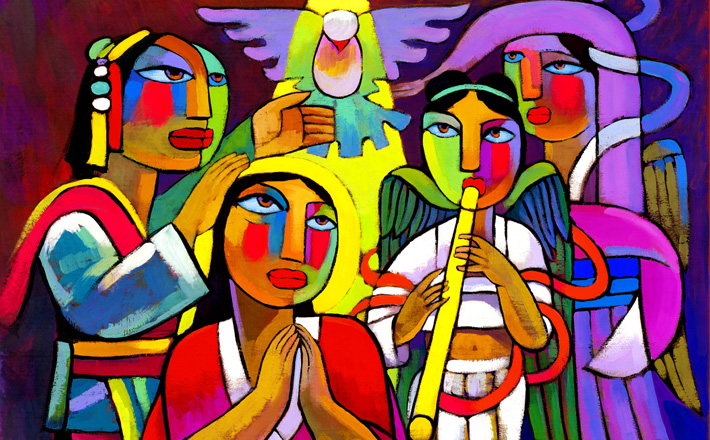
When Mom Doesn’t Like Your Job

Mark 3:20-35

Question:  What do Katy Perry, Kris Kristofferson, Florence Nightingale, Edouard Manet, Miles Davis, Alfred Nobel, Edgar Allen Poe and Robert Zemeckis have in common?   Answer: Their parents objected to the careers they chose.

Family can have a profound influence on the path we follow in life.  Alex Haley said that in every conceivable way, the family is a link to our past and a bridge to our future.  Your family can inspire, you, guide you, and cheer you on as you find and pursue your vocation, or they can misguide, misdirect, discourage and just plain thwart you.

I first felt called to become a pastor when I was fifteen years old.  My parents did not like the idea, and that is one of the main reasons I didn’t begin seminary until I was almost forty.  They loved me.  But they had a different future in mind for me than the future that chose me.

In today’s gospel reading from Mark we find two groups who would be happier if Jesus were to pursue a different career.  They would like nothing better than for him to stop the healings and exorcisms and the preaching and teaching and go do something more normal. Like be a carpenter, maybe.  On the face of it, these two groups wouldn’t seem to have much to do with each other, but the one big thing they have in common is that Jesus scares them.

Jesus had been busy traveling around the Galilee, announcing the arrival of the Reign of God, or, as Diana Butler Bass calls it, the Commonwealth of God’s Justice and Mercy.  In his preaching and teaching he had been describing a very different way of life that comes with God’s reign, and he had been demonstrating what this Commonwealth of Kindness looks like with healings and exorcisms and other acts that restore people to community.  In doing all this, he had also butted heads with the religious establishment because he was continuously reinterpreting Torah in ways that undermined the hierarchical authority of the scribes and the piety of the Pharisees.

Mark tells us that the crowd following him had become so large that it was almost unmanageable.  People were coming from as far away as Jerusalem, Idumea, Tyre and Sidon.  And then one day his family showed up, lingering somewhere at the edge of that great crowd that was following Jesus everywhere he went.

The NRSV translation says that his family had come to restrain him.  That’s a fair enough translation, but it doesn’t really capture the force of krateo, the Greek word that Mark uses, unless you imagine them using actual restraints.  To be clear, they had come to seize him and take him home by force if necessary because they thought he had lost his mind.

They were afraid for him.  They were afraid for him because they didn’t understand him.  They were afraid for him because it was hard for them to believe that this kid who grew up in their house had turned out to be so much more than the kid who grew up in their house.  They were probably a little bit afraid for themselves, too.  After all, having a crazy, radical preacher in the family can be hard on a family’s reputation.

But mostly they were afraid for him because they loved him.  He was family, after all.  So they worried about him, especially when they overheard this other group that wanted to rein him in.  Or worse.

Some scribes had come down from Jerusalem to see Jesus for themselves and to begin to form some kind of official opinion of him and his actions.  And their official opinion was that he made them nervous.  They wouldn’t have said it in so many words, but they were afraid him.  They were afraid because he called their privilege—their role and status and authority into question.  But mostly they were afraid of him because the crowd loved him.  And the crowd kept growing.  Big crowds would make their Roman overlords pay attention, and the things Jesus was saying, his language about “the Kingdom of God,” might sound like a call for revolution. . . which, to be fair, it was.  And is.  

“It is by Beelzebul, the ruler of the demons, that he casts out demons,” said the scribes.  “Well how does that make any sense?” asked Jesus.  “How can Satan cast out Satan?  If a kingdom is divided against itself, that kingdom cannot stand!” He may have had his family in mind when he added, “And if a house is divided against itself, that house will not be able to stand. And if Satan has risen up against himself and is divided, he cannot stand, but his end has come.”

Finally, to make it crystal clear just what his mission was all about he said, “No one can enter a strong man’s house and plunder his property without first tying up the strong man; then indeed the house may be plundered.”  

But Jesus wasn’t finished.  In one last note of caution for the scribes, Jesus said something that should give all of us pause, especially when we are about to speak judgmentally about people or things happening in our world that we don’t like or that make us uncomfortable.  “Truly I tell you,” he said, “people will be forgiven for their sins and whatever blasphemies they utter, but whoever blasphemes against the Holy Spirit can never have forgiveness but is guilty of an eternal sin.”

He said this because the scribes had accused him of being possessed by Beelzebul. But Jesus, of course, was actually intimately connected with the Holy Spirit.  

I have thought of this passage often over the years when I have heard others say that something they are opposed to is evil or demonic. During the years when our denomination was debating whether it was okay or not to ordain lesbian and gay and trans people, I more than a few times heard people describe our efforts at being more inclusive as being evil when it seemed clear to me and others that it was the work of the Spirit.

How many times in history have we been trying to hold a door shut that the Holy Spirit is trying to open?  How many times in history has the Church called something demonic only to realize in retrospect that it was the work of the Spirit trying to broaden our minds and horizons?  God’s embrace is always bigger than ours and God’s vision always sees farther than ours.

God’s perspective is broader than ours.  Jesus sees things differently than we do, and sometimes that can be unsettling.  I still find the last segment of this episode with the scribes and his family disconcerting.   

Jesus’ mother, Mary, stood outside the house with his brothers and sisters, calling out to him.  The crowd that surrounded him made sure he knew they were there.  Someone spoke up and said, “Your mother and your brothers and sisters are outside asking for you.” 

The way Jesus responded can sound cold and heartless, but it’s important to remember that everything Jesus said or did in this Gospel of Mark was calculated to reveal the values and vision of the Reign of God—the Commonwealth of God’s justice and mercy.  

Jesus posed a rhetorical question: “Who are my mother and my brothers?” he asked.  Then, looking at all those people who were crowded around him, he gave the Reign of God answer to that question.  “Here are my mother and my brothers! Whoever does the will of God is my brother and my sister and my mother.”

In one sentence, Jesus undermined the coercive and restrictive potential of the biological family and at the same time expanded the definition of family.  As cold as his answer might sound to us, Jesus did not actually disown or repudiate his biological family, but he wanted to make it clear that in God’s eyes family goes far beyond being biologically related.  In the Commonwealth of God’s justice and kindness, family is whoever does the will of God.

Sometimes the imagery in the gospels can be confusing or opaque.  More often, though, I suspect that the problem isn’t so much that the words of scripture are puzzling as that they make us uncomfortable, so we move past the troubling parts without taking time to really deal with them.  As Mark Twain once said, “It ain’t those parts of the Bible that I can’t understand that bother me, it is the parts that I do understand.”

According to Ched Myers, author of Binding the Strong Man, which has become pretty much the go-to commentary on the Gospel of Mark, this gospel was probably written somewhere in Palestine between 68 and 71 CE during the height of the Jewish revolt against the Roman occupation.  Myers tells us that this gospel, in which Jesus is gritty, uncompromising, down-to-earth, and scathingly direct—this Gospel of Mark is, in fact, a manifesto for nonviolent revolution, written to serve as an alternative path for the followers of Jesus who are being pulled into the violence of the uprising against Rome.  

In Mark, the followers of Jesus, then and now, are truly being called to subvert the dominant paradigm—to challenge and deconstruct and then reconstruct the systems by which our world operates until there truly is liberty and justice and peace and health and wholeness for all.  Anywhere there is coercion, the followers of Jesus are called to stand up to it with nonviolence.  

In other words, the gospel that Jesus proclaims, the living and uncompromising assertion of the Commonwealth of God’s justice and kindness, is nothing short of a nonviolent revolution.

Almost every pastor I know has stories about times we have been accused of being too political.  I have had people say to me that they come to church to hear about spirituality and not politics.  I get it. We humans have this very unfortunate tendency to compartmentalize our lives.  We organize our hearts and minds in little boxes: spirituality in this box, politics in this box, everyday life in this box over here.  The problem is that that these things really are not separate.  Our politics and economics are a barometer for our spirituality.  Our everyday life and the way we conduct our business puts our real beliefs on display.  

If we are sincere about following Jesus, then we can’t avoid politics because the gospel that Jesus proclaims is a kind of revolution and revolution is political.  Jesus wasn’t crucified for being a spiritual teacher.  He was crucified at the intersection of religion and politics because he was proclaiming a revolution that seeks to transform and restructure the entire world, to unite and unify all of life, and to redefine what it means to be human.  But before you can do that, you have to undo life as it is.  You have to take apart coercive systems and deconstruct business as usual.

Jürgen Moltmann, the great German Lutheran theologian who died this past week wrote, “Those who hope in Christ can no longer put up with reality as it is, but begin to suffer under it, to contradict it. Peace with God means conflict with the world, for the goad of the promised future stabs inexorably into the flesh of every unfulfilled present.”[1]  God calls us to take up the tools of Christ to bring that promised future into the unfulfilled present.  But our tools are nonviolent tools.  Following the model set by Jesus, we use logic and common sense instead of violence.  Our first tool for reshaping the world is a stubborn resistance rooted in love and compassion and kindness and truth and hope.  And our hope is rooted in a vision of a healthy world where we all live in peace and cooperation with each other and with our God-beloved, God-made planet in a harmonious and generous balance.

Jesus came to bind the strong man, to take down all the human, religious and demonic forces that bully and constrict God’s children and crush our souls. Empire.  Coercive religion. Even family when it becomes too rigid and authoritarian.  People who are deeply vested in unhealthy systems don’t like to read the gospel this way.  They prefer to keep things “spiritual” which, in the end, means that neither Jesus nor his words ever touch the ground.  Or the depths of the heart.  And they certainly don’t change the world.

Jesus came to plunder the house of the strong man, to liberate every person who will follow his Way so that together we can build the Commonwealth of God’s justice and kindness and make it as visible on earth as it is in heaven.  


[1] Jürgen Moltmann, Theology of Hope: On the Ground and the Implications of a Christian Eschatology

What the World Needs Now

John 15:9-17

“What the world needs now is love, sweet love.  It’s the only thing that there’s just too little of.”  Jackie DeShannon was absolutely right when that song reached the top of the charts back in 1965.  And the Beatles were right, too, when they had a megahit with All You Need Is Love in 1967.  But Jesus said it first.  A long time before John Lennon and Paul McCartney or Burt Bacharach and Hal David.

Love is a powerful force.  It creates relationships.  It can overcome fear and hate.  Love is what created the universe.  It can sometimes transform things instantaneously, but more often it builds and changes things slowly.  Over time. Because love is patient and kind.

Love can improve your health.  It can even make you more successful, although that is entirely a side-effect.

In 1938, during the Great Depression, a group of doctors at Harvard Medical School began a long-term study to determine what factors contributed most to long-term health and well-being in men.  The Study of Adult Development has been ongoing for more than 80 years now.  Once selected, participants are followed for the rest of their lives.  They fill out a questionnaire every other year covering their physical and mental health, financial status, relationship status, and general level of happiness.  Every five years some of the men are selected at random for more in-depth study.  

Some of the findings in the study haven’t been all that surprising.  For instance, they’ve verified that alcoholism is destructive.  It has been the primary cause of divorce among study participants and it strongly correlates with neurosis and depression.  So, no big surprise there.  But here’s one that is surprising:  financial success depends more on warm relationships than on intelligence. In fact “warm relationships” play a huge role in lifetime satisfaction, wealth, and well-being.

A warm childhood relationship with your mother makes a difference long into adulthood:

  • Men who had warm childhood relationships with their mothers earned considerably more per year than men whose mothers were uncaring.
  • Men who had poor childhood relationships with their mothers were much more likely to develop dementia in later life.
  • In professional life, a man’s boyhood relationship with his mother—but not with his father—was associated with greater effectiveness at work.

But a warm relationship with your father is important, too. Warm childhood relationships with fathers correlated with:

  • Lower rates of adult anxiety.
  • Greater enjoyment of vacations.
  • Increased life satisfaction at age 75.

When George Vaillant, the former director of the Study, was interviewed by The Atlantic, his main conclusion was that “warm relationships” throughout life had a greater positive influence on “life satisfaction” than anything else—greater than money, greater than achievement, greater than acquisition and accumulation of things.  Warm relationships, he said, were the greatest predictor of happiness.  By far.  “Put differently,” Vaillant says,  “The study shows happiness is love. Full stop.”[1]  When a Canadian broadcaster suggested that his statement was overly broad and sentimental, Vaillant looked down at his data then looked up and replied,  “The answer is L-O-V-E.”[2]

“As the Father has loved me, so I have loved you,” said Jesus.  “Abide in my love. If you keep my commandments, you will abide in my love, just as I have kept my Father’s commandments and abide in his love.”

The word “love” here is agape which is a particular kind of love.  This isn’t a sentimental or emotional love, although it can develop into warm feelings.  But agape doesn’t start that way.  Agape is a decision.  It starts in the head before it moves to the heart.  Madeleine L’Engle described it this way:  “Agape love is…profound concern for the well-being of another, without any desire to control that other, to be thanked by that other, or to enjoy the process.”   

Dr. Martin Luther King said, “Agape does not begin by discriminating between worthy and unworthy people, or any qualities people possess.  It begins by loving others for their own sakes… Therefore, agape makes no distinction between friend and enemy; it is directed toward both. It is redemptive goodwill for all people.  It is a love that asks nothing in return.  It is an overflowing love…And when you rise to love on this level, you begin to love people not because they are likeable, but because God loves them.”   

When Saint Paul writes that Love is patient and kind, that love is not envious or boastful or arrogant or rude, that it doesn’t insist on its own way, that love it is not irritable or resentful, that it does not rejoice in wrongdoing, but rejoices in the truth…when he writes that love bears all things, believes all things, hopes all things, endures all things, when he writes that love never quits, he is describing agape.  

When Jesus says, “As the Father has loved me, so I have loved you,” that’s the kind of love he is talking about, the decision to act for the well-being of others.  So what about those warm feelings that can have such a positive effect?  Well, agape love may start in your head as a decision, but it often moves to the heart because when you love with agape love, you make yourself vulnerable.  That’s part of the decision.  That’s why, right after Jesus reminds his disciples that he loves them, he goes on to call them his friends.

“Abide in my love,” says Jesus.  Most of us don’t use the word “Abide” too often.  The Greek word that’s at work here is meno, which means to stay, to remain, to continue, to continue to exist.  It’s in the imperative form here, so Jesus says it as a command.  Continue to exist in my love.  Stay in my love.

There are two ways to think about that.  One is that Jesus surrounds us with his love and commands us to stay inside the parameters of that love as we act and interact with each other and the world.  This might be what Saint Paul means when he talks about being “in Christ.”  

The other way to understand it is to see that our lives have been infused with the love of Jesus and we are now commanded to continue to regenerate that love for those around us, to keep spreading it out into the world.  Both understandings work.  Both keep the love of God flowing.  And Jesus assures us that if we keep the commandment to love, we will continue to abide, to exist, within the love of God.

“I have said these things to you,” said Jesus, “so that my joy may be in you, and that your joy may be complete.” This statement always catches me by surprise.  

I’ll be honest, I don’t usually think of Jesus as joyful.  You certainly don’t see him depicted that way very often in the gospels.  We see him arguing with scribes and Pharisees or impatient with his disciples when they’re being dense. We see his generosity, especially when he’s healing.  We see his power when he’s casting out demons, there’s certainly something energetic about that.  But joyful?  

When you think about it, the episodes of cranky or serious Jesus that we see depicted in the gospels are brief and they’re probably very much the exception rather than the rule.  We do see him dining with tax collectors and sinners.  Those were probably fun times.  He does tell the occasional joke—you know, a camel through the eye of a needle?  And joy would explain why huge crowds came to see him.  Joy is attractive!  Joy is charismatic!

So Jesus commands us to continue to exist in his agape love so that his joy may be in us and so that our joy may be complete.  And then to make it crystal clear that he’s serious about this—joyfully serious—he makes love a commandment.  “This is my commandment, that you love one another as I have loved you.”

As I have loved you.    

“No one has greater love than this,” continues Jesus, “to lay down one’s life for one’s friends.”  He’s referring to the cross here, of course, hinting at just how far he will go to demonstrate his agape love for all of us.  He will lay down his physical life.

But he might be referring to even more if we dive down below the surface.  The word that’s translated as “life” here is psyche.  It means living soul, inner self, mind.  It can also mean what we refer to as “ego.”  Richard Rohr has said that in order to learn how to fully and truly love we have to learn how to get our egos out of the way.  No one has greater love than this, to lay down one’s ego for one’s friends.

“Authentic Christianity,” says Rohr, “is not so much a belief system as a life-and-death system that shows you how to give away your life, how to give away your love, and eventually how to give away your death.  Basically, how to give away—and in doing so, to connect with the world, with all other creatures, and with God…Here the primary language is unlearning, letting go, surrendering, serving others, and not the language of self-development—which often lurks behind our popular notions of salvation.[4]

Paul Tillich once wrote about meeting a Swedish woman who had spent time in a prison camp for giving aid and comfort to prisoners and orphans during World War I.  He found in her a personification of that “greater love.”  “It is a rare gift to meet a human being in whom love – this means God – is so overwhelmingly manifest,” he wrote. “It undercuts theological arrogance as well as pious isolation. It is more than justice and greater than faith or hope. It is the very presence of God in the form of a human being. For God is love. In every moment of genuine love we are dwelling in God and God in us.”

When you let God’s love flow through you, you begin to love, as John Duns Scotus says, things in themselves and for themselves, and not for what they do for you.  That’s when you begin to love your spouse.  That’s when you begin to really love others—when you start seeing them detached from you or what they do for you or how they make you look or what they can get for you. 

When we love, we manifest God.  It’s as simple as that.  As it says in Ephesians, “I pray that you may be strengthened in your inner being with power through his Spirit and that Christ may dwell in your hearts through faith as you are being rooted and grounded in love.  I pray that you may have the power to comprehend, with all the saints, what is the breadth and length and height and depth and to know the love of Christ that surpasses knowledge, so that you may be filled with all the fullness of God.”[1]

When you love things and people in themselves, you are looking out at the world with the eyes of God.  When you look out from those eyes, you see that it’s not about you.  And you will see things that will give you joy.  Simple things will make you happy. Reality will start giving you joy, inherently.  And you will start overcoming the gap between you and everything else.

Abide in Christ’s love.  Be a friend of Jesus.  Build those warm relationships in the world.  So that Christ’s joy may be in you.  And your joy may be complete.


[1] Ephesians 3:16-19

To Know By Heart

John 10:11-18

You are one of a kind.  Even if you have an identical twin there is a lot about you that is unique.  Your fingerprints are unique, of course, but did you know that your toeprints are, too?  Your voiceprint is also unique and can be used to identify you.  The patterns in the irises of your eyes are yours and yours alone, and so are the patterns of the blood vessels in your retinas.  Your gait when you walk is uniquely yours and can be used to pick you out from a crowd.  You can be singled out from a multitude of other people online by patterns in the way you type on your keyboard or move your mouse, a little trick that’s been used, apparently, in espionage.  But here’s a new one—at least it was new to me.  Did you know you have a distinctive cardiac signature?   That’s right.  Your heart beats in a way that is unique to you and can’t be disguised.  The Pentagon has recently developed a laser-based tool called Jetson that can read your cardiac signature through your clothes from 200 meters away.  So now if somebody says they know your heart you might want to ask exactly what they mean by that.

“I know my own and my own know me,” said Jesus, “just as the Father knows me and I know the Father.”   Jesus knows your heart, although clearly not in the same way that the Pentagon’s invasive new toy does.  More importantly, though, we know the heart of Jesus.  We know he loves us and he cares for us enough to lay down his life for us.

Jesus calls himself the Good Shepherd.  I wonder how many of us really understand what he means by that.  I think what comes to mind for a lot of us when we hear “Good Shepherd” is a kind of greeting card image or something from a stained glass window.  We picture Jesus looking pristine in a white robe with a gentle, pure white lamb draped across his shoulders.  Gentle Jesus, meek and mild.  But that image is a far cry from what the people listening to Jesus on that long-ago day in Jerusalem would have been picturing when Jesus described himself as the Good Shepherd.

When Jesus was talking to people two thousand years ago in Galilee and Judea, he used metaphors that were part of their everyday lives.  Many of these metaphors also echoed their scriptures and history.  That’s one of the things that made him such an effective teacher, but it also made him controversial sometimes.  

Even people who had never been outside of Jerusalem’s walls knew about shepherds.  They were a common sight.  They had all seen shepherds bringing sheep into the city for the markets and for sacrifices in the temple.  

The Shepherd was also an image from their faith heritage.  Joseph, one of the 12 sons of Jacob, had been a shepherd.  Jacob worked as a shepherd for Laban so he could marry Rachel and Leah who had also tended sheep.  Zipporah, the wife of Moses, had tended flocks with her sisters.  Moses tended sheep before God called him to lead his people out of Egypt.  King David started out as a shepherd.  

The prophets spoke of the kings and religious leaders or Israel as shepherds—sometimes good, but sometimes not so much.  The prophet Jeremiah wasn’t pulling any punches when he wrote, “Woe to the shepherds who destroy and scatter the sheep of my pasture! says the Lord.  Therefore thus says the LORD, the God of Israel, concerning the shepherds who shepherd my people: It is you who have scattered my flock and have driven them away, and you have not attended to them. So I will attend to you for your evil doings, says the LORD.”

God was regarded as the ultimate shepherd and, through the prophets, often spoke of the people of Israel as “my flock.”   In Psalm 80, the Psalmist cries out, “Give ear, O Shepherd of Israel, you who lead Joseph like a flock! You who are enthroned upon the cherubim, shine forth!”  And, of course, there is Psalm 23 where David sings of his reliance on God with the words, “The Lord is my shepherd.”

When Jesus called himself the Good Shepherd, it brought a particular image to mind for those listening to him, but it wasn’t stained glass and greeting cards.  There was nothing particularly pristine in their picture of a shepherd.  They knew that shepherding was a very physical, dirty, and smelly job.  But they also knew that good shepherds were strong and  brave and tough when they had to be to protect the sheep.  When David was still young, he told  King Saul that he was tough enough to take on Goliath because, as a shepherd in the field, he had already killed a bear and a lion.  

At night, when a shepherd would bring the sheep in from the pasture into the safety of the fold, he would recline across the opening of the sheepfold, making his own body the gate of the sheep pen, a barrier between the sheep and any predators or thieves, so that anything or anyone that tried to get at the sheep would have to do it across his body.

Often several shepherds would bring multiple flocks into a large sheepfold for the night.  When it was time to lead them out again to pasture in the morning, each shepherd would simply start calling out to their sheep with a call that was familiar to their own flock.  Each flock knew their own shepherd’s distinct voice and would follow him and only him out to pasture.  So again, when Jesus says, “My sheep know my voice,” he is using a metaphor that’s familiar to all his listeners.  

So why is Jesus using this powerful image in that time and place?  He’s in the precincts of the temple.  He is already in hot water for healing on the sabbath, bringing sight to a man born blind.  This is all happening during the Feast of the Dedication, Hannukah, the feast that commemorates the rededication of the temple after the victory of the uprising led by Judas Maccabeus over Antiochus Epiphanes in 164 BCE.  Judas Maccabeus was a national hero, someone whom the Jews thought of, historically, as a good shepherd.  The temple was the place that more than any other symbolized the people’s covenant relationship with God.  So with all that as background, the Pharisees and temple authorities are listening to Jesus very carefully.  And what Jesus says is, to their ears, very provocative.

“I am the Good Shepherd,” says Jesus.  Just what is he saying?  Is he comparing himself to Moses?  To David? To Judas Maccabeus? Was he comparing himself to their great prophets and kings, the revered political and military leaders or the past, the heroes who had freed them from their oppressors and enemies? 

Was Jesus equating himself with God, the ultimate Good Shepherd?   Just what did he mean when he said, “I am the Good Shepherd.” They had to be wondering.  

And then he said this: “I have other sheep that do not belong to this fold. I must bring them also, and they will listen to my voice. So there will be one flock, one shepherd.”  Who was he talking about?  Could he be talking about gentiles?  Was he talking about bringing them into the covenant?  Into the temple?  This was both unsettling and provocative to the Pharisees and temple authorities.

Who would those other sheep be for us today?  Who are those who are “not of this sheepfold”—or not of this church, maybe?—who Jesus intends to bring into the flock?

“There will be one flock,” said Jesus.  One flock.  One shepherd.  None of the artificial distinctions we’re so fond of making.  No us.  No them.  The Good Shepherd has gone outside the sheepfold to call in all the sheep who know his voice.  All of them.  All of us.  Are we ready to be one big happy flock with sheep we don’t know? Even if some of them have different kinds of wool?  One flock.  One shepherd.

“I know my own and my own know me.”   I wonder about that statement.  Is it always that straightforward?  Especially the second part—“my own know me”?  The other day I saw a video on Facebook that made me really think about what happens when the sheep don’t really know the shepherd, when they’re not really attuned to the shepherd’s voice.  

The video was shot by a man who was taking a nice leisurely hike through a forest in France.  As he came around a bend in the trail he saw a woman in red shorts jogging toward him and behind her was a fairly sizable flock of sheep.  When she got up to the man, who captured all this on his phone, she stopped to talk to him and the sheep came to a full stop behind her.  He asked her if she always led her sheep through the forest and she told him that they were, in fact, not her sheep.  These sheep had all just been milling around near the beginning of the trail and when she jogged by them, they all just turned and began jogging along right behind her.  When she stopped, they stopped.  When she ran, they ran.  When she finished explaining this to the man, she started jogging back down the trail and the sheep swept past him, the whole flock, running along behind the woman they had mistaken for their shepherd. 

“I know my own and my own know me.”  We think we know our Shepherd, but sometimes we make mistakes.  Sometimes we go jogging off behind other shepherds.  

I know I’ve sometimes been misled into following other voices.  It’s easy to follow the voice of politics or partisanship or moralism or prestige or money.  It’s easy to get caught up by voices that try to flock us together around national or racial or cultural or generational or religious identity.  

It’s easy to follow someone who looks like they know where they’re going or sounds like they know what they’re doing.  It’s easy to be misled out into a forest  full of unseen dangers.  

It’s easy, sometimes, to think you’re following the Good Shepherd when it’s actually someone else mimicking his voice or borrowing his name for their own purposes.  We all saw those “Jesus” signs at the January 6th Capitol Insurrection.  I’m pretty sure that wasn’t really the Good Shepherd inspiring that activity.  We’ve all seen politicians standing in front of churches or holding up Bibles to buttress their authority or polish their image

“My own know me,” said Jesus.  Well, with practice, yes.  I think that’s our never-ending homework—to keep listening, to keep learning to hear the voice of the Good Shepherd in a world that so noisy with other voices, to discern the voice of Christ above all the pretenders and the racket and the misguided or misleading “shepherds” that try to distract us.  

“My own know me.”  Maybe Jesus states this so positively, so affirmatively, so that we have to take it as a goal and not make a liar out of him.  “My own know me.”  Okay, Jesus.  I will do everything I can to make that’s true, to make sure I know you.  

But that first part—that part where Jesus says “I know my own,” –-that’s where the good news is for us.  Even when we have wandered off through the forest following the wrong voice or our own stubborn inclinations, Jesus still knows us. Jesus still says to us, You belong to me.  You are mine.  I know you.  I know your going out and your coming in.  I know your fingerprints and your toeprints and the pattern of your irises.  I know your heart.  I have your cardiac signature.  You are mine.

There will be one flock.  One shepherd…who knows the heart of each and every one of us.  A Shepherd who has laid down his life for us.  That’s the Shepherd we can follow.  That’s the voice we can trust. 

The Final Truth

John 12:20-33

As some of you know, I used to be a musician.  But I don’t listen to music anymore.  I can’t, really, since I have lost so much of my hearing. Music just doesn’t sound the same to me, and it’s frustrating because I know what it’s supposed to sound like.  So I don’t listen to music anymore.  Except in my memory.  

I do have a very good memory for music, and I can still hear a lot of pieces quite well in my mind’s ear, so to speak.  And in my dreams.  I dream in music a lot.  Sometimes in my dreams I hear pieces I wrote.  Sometimes I compose new pieces.  And quite often in my dreams I hear favorite pieces that have been part of the soundtrack of my life.  When that happens, I usually figure that it’s a kind of message from me to me, something my subconscious wants to tell me or remind me of.  Or… it could be the Holy Spirit.  Just saying.

The other morning, as I was still in that lovely place between sleeping and waking—you know, that place where you’re no longer fully asleep but you’re not really awake yet either—while I was still in that dreamy place, my mental mixtape began to play the song Nightingale by Judy Collins, a song that has always had a special place in my heart.  Joshua Rifkin’s orchestration of that song and Judy Collins’ voice are simply exquisite.  But her lyrics—her lyrics in that song are nothing short of profound.

Jacob’s heart bent with fear,

Like a bow with death for its arrow;

In vain he searched for the final truth

To set his soul free of doubt.

Over the mountains he walked,

With his head bent searching for reasons;

Then he called out to God

For help and climbed to the top of a hill.

Wind swept the sunlight through the wheat fields,

In the orchard the nightingale sang,

While the plums that she broke with her brown beak

Tomorrow would turn into songs.

Then she flew up through the rain

With the sun silver bright on her feathers.

Jacob put back his frowns and sighed and walked

Back down the hill.

God doesn’t answer me and

He never will.

As I lay there in bed, slowly waking up while the words and music of Nightingale faded, I thought about how often we are like poor Jacob in that song, our hearts bent with fear, searching in vain for some final truth that will set our souls free of doubt. 

I thought of how often, like Jacob, we walk across the beauty of God’s creation with our heads bent down as we search for some kind of enlightenment in the dark recesses of our own reasoning. 

Or maybe on our phones.  

I imagined Jacob calling out to God for help as he climbed to the top of the hill.  I thought of him watching the wind sweep the sunlight through the wheat fields, how he heard the nightingale sing from the orchard then watched as she flew up through the rain with the sun silver bright on her feathers.  

Lying in my bed, half awake, I thought about how Jacob, in the song, saw and heard all that beauty… and utterly failed to see or hear God’s presence, the answer to his prayer, the final truth that could set his soul free of doubt.

And as I rested in the gentle beauty of that music and the powerful imagery of those lyrics, I suddenly found myself thinking about those Greeks in the Gospel of John who wanted to see Jesus.

Now among those who went up to worship at the festival were some Greeks. They came to Philip, who was from Bethsaida in Galilee, and said to him, “Sir, we wish to see Jesus.”  (John 12:20-21)

We don’t really know anything about the Greeks who made this request.  Were they Greek proselytes preparing to convert to Judaism?  Were they tourists who had come to see the temple?  After all, it was one of the wonders of the world at that time, and what better time to see it than during one of Israel’s most important festivals?  Had they heard that Jesus could work miracles and were maybe hoping to see one for themselves?  Were they interested in becoming disciples?  

Those are all possibilities, but I can’t help but think that maybe they wanted to have some kind of philosophical discussion with Jesus.  Greeks, after all, had a reputation of being philosophical by nature.  As St. Paul noted in 1 Corinthians, “Jews ask for signs and Greeks desire wisdom.”  So maybe that’s what they were looking for.  Maybe they wanted some time with Jesus the teacher of wisdom.  Maybe they were looking for the final truth to set their souls free of doubt.

We don’t really know anything about these Greeks or their motives.  But we surely can understand their request: We would like to see Jesus.  

I would like to see Jesus. Wouldn’t you?  Oh, I know I see him all the time in a Matthew 25 kind of way.  I see him in people in need.  I see him in people enduring injustice.  I see him in people pushed to the margins.  I see him in people whose lives are disrupted by religion or politics or violence or war or the economics of greed.  I see him.  

I do.  

And I see him in a 1 Corinthians 12, Body-of-Christ kind of  way, too.  I see him in the kindness of friends and strangers.  I see him in the ways we support each other and lift each other up and work together to dial up the love and grace and dial down the anger and fear and hate.  

I see Jesus in you.  

I see Jesus in you and that keeps me going.

But sometimes I would like to see Jesus the way Philip and Andrew saw him.  Face to face.  Wouldn’t you?

A few years ago, on the website Journey with Jesus, Debi Thomas wrote,  “I know what it’s like to want Jesus in earnest — to want his presence, his guidance, his example, and his companionship.  I know what it’s like to want — not him, but things from him: safety, health, immunity, ease.  I know what it’s like to want a confrontation — a no-holds-barred opportunity to express my disappointment, my sorrow, my anger, and my bewilderment at who Jesus is compared to who I want him to be.”[1]  

It stings to read that, but it’s so honest.  “I know what it’s like to want—not him, but things from him.”  It makes me think of that African American spiritual we sing sometimes, I Want Jesus to Walk With Me.  “I want Jesus to walk with me; all along my pilgrim journey, Lord, I want Jesus to walk with me;  In my trials, Lord, walk with me; when my heart is almost breaking, Lord, I want Jesus to walk with me;  When I’m in trouble, Lord, walk with me; when my head is bowed in sorrow, Lord, I want Jesus to walk with me.”

I want to see Jesus.  I want Jesus to walk with me.  But am I ready to walk with him? That, right there, is a pivot point of spiritual growth.  Why do I want to see Jesus?  How do I want to see Jesus?  Do I want to see Jesus because I want something from him?  Do I want to see Jesus because my faith is wavering?  Do I want Jesus to tell me some final truth to set my soul free from doubt?

Am I willing to let Jesus be the final truth that sets my soul free of doubt?

Do I want to see Jesus because I want to surrender to him?  Do I want to see Jesus so I can follow him and serve him?  

Those are the kinds of questions we need to ask ourselves when we feel that powerful yearning to see Jesus.  And let’s be clear.  There are no wrong answers here… except dishonest answers.  

We don’t know why those Greeks at the Festival wanted to see Jesus.  What we do know is that as soon as Philip and Andrew came to Jesus with their request, Jesus began to talk about the cost of discipleship and about his own coming death.  

We might be singing “I want Jesus to walk with me,” but Jesus responds with, “Fine.  Walk with me. But this is where I’m going. You might not like it.”

When Peter and Andrew told Jesus that the Greek visitors wanted to meet him, Jesus answered, “Time’s up. The time has come for the Son of Man to be glorified.’”[2]  That’s how Eugene Peterson paraphrased it in The Message Bible.  Time’s up. 

The time for sightseeing is over.  The time for spectator discipleship is over.  Now the Human One will be glorified.  Glorified.  As in martyred.  As in putting the cost of God’s love on full display.

“Listen carefully,” he says. “Unless a grain of wheat is buried in the ground, dead to the world, it is never any more than a grain of wheat. But if it is buried, it sprouts and reproduces itself many times over.  In the same way, anyone who holds on to life just as it is destroys that life. But if you let it go, reckless in your love, you’ll have it forever, real and eternal.”[3]  

Jesus is telling his disciples, then and now, a message that disciples are always reluctant to hear.  If you cling to your life just the way it is, you will destroy it.  If you loosen your grip on life as you know it, if you let go of it in reckless love, you’ll have it forever.  

Reckless love.  Reckless love of God.  Reckless love of yourself.  Reckless love of others.  Reckless love is eternal.  Reckless love is the final truth.  

“If any of you wants to serve me, then follow me,” said Jesus. 

We would like to see Jesus.  But do we want to see him so we can serve him?  Do we want to see him so we can learn to be better followers?  Are we willing to be buried…like seeds…so we can grow into something more amazing than we can even begin to imagine?  

The language that Jesus uses here as he talks to the Greek visitors and his disciples and the crowd and us is all imagery and metaphor. The time has come to be glorified. When a seed is planted.  When I am lifted up.  But all that poetic language is euphemism for the horrifying reality of the cross.  Are we willing to go there to see Jesus?

Beginning next Sunday we will observe again the events of Holy Week, a week that builds to the brutal torture and crucifixion of Jesus on Good Friday.  Attendance at worship on Good Friday is always low.  We want to see Jesus…but we don’t want to see Jesus on the cross.  We don’t want to see Jesus die, especially not in such an ugly, helpless, bloody and brutal way.

We don’t want to see Jesus willingly take on the hatred, the contempt, the violence, even the sheer indifference of this world—taking it all into his own body.  We want to see Jesus, but we don’t want to see Jesus there.  Like that.  

We want to see Jesus in a hundred other ways—muscular super-hero Jesus, miracle-worker Jesus, wisdom Jesus, justice radical Jesus (my personal favorite), social worker Jesus, American Jesus wrapped in a flag.  But Jesus on the cross?

That’s where reckless love takes Jesus.  That’s what he is saying in all that poetic language.  The seed will be buried and dead to the world.

If we want to see Jesus, really see Jesus, we need to look to the cross… because that’s where, in reckless love, he opens his heart and his arms to you.  

And me.  

And the whole world.  

And that’s the final truth.


[1] Debi Thomas, Journey With Jesus, 14 March 2021

[2] The Message, John 12:23

[3] The Message, John 12:24-25

[4] The Message, John 12:26

Pardon Our Disruption

Numbers 21:4-9; John 3:14-21

Such an intriguing story in the Book of Numbers.  The people of Israel are on the road between Mt. Hor and the Gulf of Aqaba.  They’re complaining.  Again.  This time they’re not happy with the food.  It’s always something.  Anyway, the people grumbled, so the Lord sent poisonous snakes among them, and many Israelites were bitten and died.  That’s how the Israelites tell the story.

Nobody ever tells the story from the snakes’ point of view.  I mean, look at it from their perspective. They were all just slithering around, minding their own snaky business in Snake Land when suddenly the whole nation of Israel showed up with all their arguments, grumbling and complaints and pitched camp right on top of them, driving tent pegs down into their dens, breaking their eggs, chasing them with sticks, throwing rocks at them, hacking at them with swords… So yeah, they bit a few of them.  They were just trying to defend themselves.  They weren’t trying to kill anybody.  Why would they?  The Israelites were too big to eat…at least for those kinds of snakes.  

The text tells us that Moses prayed to the Lord to make the snakes go away.  But maybe the leader of the snakes also prayed to the Lord to make the people go away.  Maybe the leader of the snakes suggested that the Lord could tell Moses to put a big bronze snake up on a pole to remind the people that they were in snake territory, and that the snakes were there first thank you very much, so they should be careful where they were poking around and pitching their tents.  

Well, that’s not the way we get the story in the Book of Numbers, but then snakes never were any good at public relations, and they don’t come off too well in the Bible as a rule.  Still, it’s interesting that in this particular instance, even in the Moses version of the story, God is using the snakes to accomplish God’s business and that includes healing cranky, ungrateful people from snakebite… which they wouldn’t have got bit in the first place if they hadn’t been cranky and ungrateful and gone poking about looking for something else to eat when there wasn’t anything kosher out there to begin with.

So, the moral of that story is be grateful for what you have, even if you’re a little tired of it.  And leave the snakes alone.  

Many, many, many, many, many years later, this story would come up again when Jesus sat down one night with a Pharisee named Nicodemus.  Jesus was trying to help Nicodemus understand some very basic things about living in the love of God.  This was difficult for Nicodemus because he was a very smart and knowledgeable person.  A teacher, in fact.  He knew the sacred writings of Israel backwards and forwards and upside down, but the things Jesus was saying mystified him.  He had a lot to unlearn.  The way he understood things got in the way of him comprehending things…if you know what I mean.  

Jesus was trying to help Nicodemus learn how to see and enter and experience the kingdom of God.  The Commonwealth of God’s justice and kindness.  Nicodemus was trying hard to get his head around it, but what he really needed to do was to put his whole heart into it.  

Nicodemus needed another pathway into the mystery.

“It’s like this,” said Jesus.  “Remember when Moses lifted up that bronze snake in the wilderness?  It’s like that, Nicodemus.  The Human One will also be lifted up.  And in the same way that people were healed when they looked to that bronze snake gleaming in the sun, they’ll be healed when they look to the Human One, only they’ll be healed of something much more deadly than snake venom.

“Have you ever wondered, Nicodemus, what kind of magic was at work in that bronze snake on that pole in the desert.  It was a powerful magic, stronger than any other kind of magic.  When people looked at that snake on the pole, the light flashing off of it pierced their hearts and reminded them that they had complained against Moses and against God.  They had been in a desert, in a land of no food and no water, and God had provided for them!  But they were ungrateful.  There was poison in their hearts and it came out in their words.  The snakes biting them was a kind of metaphor for the way they had been treating each other.  And Moses.  And God.

“When they looked at that bronze snake glinting in the desert sun, they could see a very unflattering image of themselves.  They could taste the bitterness of their ingratitude and the venom of their complaining.  It made them stop and think.  It made them remember all the ways that God had been taking care of them.  They repented.  And they were healed, because they also saw that God loved them enough to put up with them long enough to transform them.  They could stop being snakes, metaphorical or otherwise.  The magic, the power that flowed from that snake on the pole was God’s forgiveness and God’s love and God’s vision of a better way to be. 

“But people forget, Nicodemus.  The lessons they’ve learned don’t always carry over from one generation to the next even when they’re written down and kept in the book of memories. 

“And now the whole world is snakebit, Nicodemus.  People believe they are walking always and everywhere under the dark night of God’s judgment.  They don’t see that they have been always and everywhere in the bright light of God’s love.  They’re perishing.  Their souls are dying because they can’t let themselves believe they are loved.

“Listen, Nicodemus.  God loves the world so much that God has given God’s unique Son so that whoever trusts and follows him won’t perish, won’t fade into an everlasting death and nothingness, but will instead live forever in the light of God’s love.  

“You think God is about judgment, Nicodemus?   I’ll tell you about judgment.  God wants to bring everyone and everything, even the snakes, into the light of God’s love.  But some don’t want to come.  Some want to stay in the dark.  Some want to keep living in the deep shadows of hatred and fear, and us versus them.  Some have a greedy hunger in them that wouldn’t be satisfied if they swallowed the whole world.  Some think they are the whole world and don’t have room in their hearts for anyone or anything else.  They think they’re all that and a bag of chips.  Some, Nicodemus, many really, want to keep judging others, because it’s the only way they can make themselves feel like they have any value, so they just keep living in the shadow of judgment…and the shadow of their own fears.

“But the Son of God is not here to judge, Nicodemus.  The Son is here to make people whole.  To save them from self-destruction.  To lead people out of the shadows.

“The world has forgotten how lovely it is, Nicodemus.  The Son of God has come to help the world remember, to relearn its beauty and its kindness.  

“The world has forgotten that when God created everything God said it was good.  All of it.  Everyone.  Even the snakes.

“The Son of God has come to help people remember Original Goodness.[1]

“When they see the Human One lifted up, Nicodemus, they will be reminded of all the ugly things that happen in a snakebit world.  They will be reminded of how the venom in their own hearts and souls can wound and kill.  And then they will remember they weren’t made that way.  Then they will see the love of God.  They will see that the Son came out of love, not out of need.  And the love of God will transform them.  They will step back into the light of God’s love.”

All of that is what Jesus was trying to get Nicodemus to  understand.  And us.  It’s what he would like us to understand, too.

When you think about it, all of this is about disruption. 

The Israelites disrupted the generally sleepy life of the snakes when they pitched camp in their territory. The snakes disrupted the grumbly and quarrelsome life of the Israelites when they started biting them.  God and Moses disrupted the poisonous dynamics of fear and dissatisfaction when they set up the snake on a pole.  Nicodemus disrupted Jesus’ quiet evening when he dropped by at night for a private interview.  In his conversation with Nicodemus, Jesus disrupted our understanding of theology and the scriptures, especially our understanding of how judgment works.  Or doesn’t.

God works through disruptions to transform things and people. 

Sometimes life is disrupted by things that are completely beyond our control.

March 10, is the anniversary of the Long Beach earthquake of 1933, a disruption that killed 115 to 120 people and caused an estimated $40 million in damage.  That would be more than $800 million today.  Two hundred thirty school buildings were either destroyed or declared unsafe for use.  Out of that disruption, though, came new standards for building safety, including specific codes for school buildings.  New methods of government assistance for disaster response and reconstruction were instituted, too, as people realized that these kinds of resources were needed when damage was too widespread or extensive to expect a city to be able to recover and rebuild on its own.  Essentially, we found new ways to take care of each other.  To love each other.

That disruption has faded into the history books, but there is another disruption that we’re all too aware of, one that is still disrupting our lives in some ways.  

Four years ago this previous week was our last week of “normal” life as our lives were disrupted by the devastating pandemic of Covid 19.

For more than a year we lived in isolation, unable to worship in church together, unable to gather in our sanctuaries.  Our buildings.  But we never stopped being church.  The disruption of the pandemic made being church more difficult in some ways, but it also transformed us in some important ways, too.  Like all disruptions, it taught us more about who we are and invited us to think about who we want to be, who we are called to be, as we move forward.

The Israelites weren’t the same people when they left the land of the snakes.  They complained less and were more grateful.  Life-as-usual had been disrupted.

Nicodemus wasn’t the same person when the sun rose the next morning as he was when he had sat down with Jesus in the dark of night before.  He had begun to understand both God’s love and God’s judgment differently.  Everything he knew, everything he understood had been disrupted. You might say he was being reborn.

We aren’t the same people we were four years ago.  All the patterns of our lives have been disrupted.  In a time when need and circumstances required us to stay physically apart you would think we would have made every effort to find ways to pull together, but all too often, as a nation at least, we let the polarity of our dysfunctional politics pull us farther apart.  We have seen the damage caused by the venom of our fears and anger.  But we have also heard the voice of Christ calling us together and helping us relearn our loveliness,  reminding us of our Original Goodness. 

We have seen the serpent lifted up in the desert.  But also the cross lifted at calvary.  Through earthquake or pandemic, climate disruption or politics…even snakes…  God’s love still flows to carry us through it all.  Together.  The only question is this: will we let ourselves be healed and transformed so we can build something new, or will we just keep biting each other?

In Jesus’ name.


[1] Genesis 1:31

The Big If

One of my first courses in seminary was an overview of Martin Luther’s life and writings taught by the late, great Dr. Timothy Lull.  

Luther frequently wrote or spoke about his battles with the devil so it was natural that we ended up in a lively discussion in class one morning about Luther’s understanding of evil and Satan.  During that discussion, one of my classmates asked, “Dr. Lull, do you believe in Satan.”  The room was suddenly silent as Dr. Lull paused and looked out the window, deep in thought.  Finally, he turned back to us and said, “No.  I don’t believe in Satan.  But let me explain.  Luther tells us that to say ‘I believe’ is the same as saying ‘I trust.’  I save the words ‘I believe’ for God.  I believe in God.  I trust God.  I would never trust anything opposed to God.  Now, if you want to ask me if I think there is a personal force or entity at work in the world that is bent on evil, a force or entity who is opposed to God and all that God is doing, a force or entity who seeks to undermine and destroy us and the rest of creation, well, I think a good argument could be made that such a force or entity does exist.  But I would never trust it.  I would never believe in it.”

Every year on the first Sunday in Lent, the gospel text is always about, or at least contains, the story of Jesus being tested by Satan in the wilderness.  Mark’s version of the testing of Jesus reads almost like an afterthought, sandwiched between Jesus’ baptism and the beginning of his revolutionary proclamation of the kingdom of God in Galilee.  Matthew and Luke, on the other hand, flesh out the  temptation of Jesus in great detail which includes dialogue between Jesus and Satan and the specific temptations Jesus faced and how he responded.

I suppose the idea behind this focus on temptation is that when we look again at how Jesus responded to temptation we are better prepared to acknowledge and wrestle with our own demons and temptations during this long 40-day season of getting our spiritual houses in order.  It also confronts us with an opportunity to give some serious thought to what we think about evil—what we think it is and how we think it works.

Evil is opportunistic and insidious, but it’s not stupid.  It plays on desires we already have even if we’re not fully aware of them.   It lures us with things that we think will make us whole in some way.  And it finds its opportunities by either prodding us to question our sense of self-worth or by pumping up our egos to inflate our sense of self-worth.

Eric Berne, the Canadian psychologist who created Transactional Analysis, had a theory that by age 5 most of us have developed a “core story” about who we are and our inherent worth.  For far too many people, that story is kind of shaky and not all that positive.  One of the gifts of baptism is that in baptism we are given a new core story.  We are given an identity to live up to, an identity that grounds us and sustains us. As we are immersed into the life and love of the triune God, we hear the same words proclaimed over us that the voice of God proclaimed to Jesus at his baptism:  this is my beloved child.  You are God’s beloved child.

Evil wants us to doubt our identity as children of God…or at least to not remember it or think about it.  When we forget that identity, evil can get a foothold in our psyches by eroding our sense of self.  The very first words the tempter says to Jesus in the wilderness are, “If you are the Son of God…”  That’s a very big “if” and it’s loaded with insinuations.  The tempter is trying to get Jesus to doubt his identity or, failing that, to make too much of it.

Martin Luther once shared in a sermon how his sense of self-worth was assailed as he lay awake in the middle of the night: 

“When I awoke last night, the Devil came and wanted to debate with me; he rebuked and reproached me, arguing that I was a sinner. To this I replied: Tell me something new, Devil! I already knew that perfectly well; I have committed many a solid and real sin. Indeed there must be good honest sins–not fabricated and invented ones–for God to forgive for His beloved Son’s sake, who took all my sins upon Him so that now the sins I have committed are no longer mine but belong to Christ.”[1]

In  Life of the Beloved: Spiritual Living in a Secular World, Henri Nouwen wrote: 

“Over the years, I have come to realize that the greatest trap in our life is not success, popularity, or power, but self-rejection. Success, popularity, and power can indeed present a great temptation, but their seductive quality often comes from the way they are part of the much larger temptation to self-rejection. When we have come to believe in the voices that call us worthless and unlovable, then success, popularity, and power are easily perceived as attractive solutions. The real trap, however, is self-rejection. As soon as someone accuses me or criticizes me, as soon as I am rejected, left alone, or abandoned, I find myself thinking, ‘Well, that proves once again that I am a nobody.’ … [My dark side says,] I am no good… I deserve to be pushed aside, forgotten, rejected, and abandoned. 

Self-rejection is the greatest enemy of the spiritual life because it contradicts the sacred voice that calls us the “Beloved.” Being the Beloved constitutes the core truth of our existence.” 

You are God’s beloved child.  

Is that how you understand the core of your existence?  Or are there voices in your life, maybe even internal voices, that don’t want you to believe that you are seen and loved by God?

The word devil comes from the Greek word diabolos which means “the slanderer.”  When the tempter says to Jesus, “If you are the Son of God…” there is a kind of slander in that little word “if.”  It’s the same slander that comes to us in the voice of our self-doubt.  We hear it saying things like, “You’re not really a child of God.  You’re not really much of anything, are you?”  When that kind of voice gets in our heads we start wanting to prove ourselves, especially if we can do so without really doing anything “wrong.”

The thing that’s so insidious about the temptations the devil lays before Jesus, the thing that’s so insidious about most temptations and a good deal of outright evil, is that these things often look like good things on the face of it.  In fact, evil is often a good thing done in the wrong way or at the wrong time or for the wrong reasons.

What’s wrong with turning stones into bread?  Wouldn’t that be a great way to feed the hungry?  But to do that, you would have to do violence to creation.  You would have to coerce the stone into becoming something other than what God made it to be, something of an entirely different nature.  And to do that, you would have to separate yourself from creation.  You would have to stand apart from creation so you can impose your will upon it.  It’s true that later in Matthew’s gospel account Jesus will feed 5000 people with a few loaves and fish, but he doesn’t turn them into something other than loaves and fish to do it.

What’s wrong with trusting the scriptures so devoutly that you’re willing to believe that angels will catch you when you plunge off the temple parapet?  But where is the love in a shortcut like that?  How would that build relationships that become the foundation of God’s commonwealth of justice and mercy?  How would that be anything but another demonstration of power in a world that is already much too much infatuated with power?

What’s wrong with the King of kings and the Lord of lords assuming control over all the nations of the world?  Isn’t that exactly what the Book of Revelation says will happen at the Great Conclusion?  But how would that be done?  What would happen to free will in the process?  What kind of violence would resist that singular authority being imposed and how many would be lost before all the dust settled?  How would seizing and wielding imperious authority teach the world to deconstruct all the soul-crushing oppression of imperialism?

For Jesus to have done any of these things would have been a denial of his humanity.  Yes, he was and is the Son of God.  But he also was a son of humanity. His favorite title for himself was “the Son of Man” which can be better translated as “The Human One.”  If he had taken the slanderer’s bait to prove his divinity, he would have separated himself from his humanity.

Jesus was able to resist temptation because he had a firm understanding of who he was.  He believed the voice of God that proclaimed him to be God’s beloved son.  He also believed in the essential goodness of his humanity so he was unwilling to separate himself from humanity.  In the end, in the full confidence of both his divine authority and his essential human goodness, he simply ordered the tempter to go away. And the devil departed from him.  

Jesus trusted God.  Jesus believed in God.  Jesus met the devil face to face.  But he didn’t believe in him.  So when you are assailed by that insidious voice that wants you to forget your basic human goodness and God’s divine embrace of you as a beloved child,  be like Jesus.  Just tell that voice to go away.


[1] Heiko Oberman, Luther: Man between God and the Devil, p.105-6

I Believe

I believe in the Mystery beyond us,
the One Who Is,
the Maker who imagines all things into existence,
the Impulse of Intent who turns quantum possibility into tangible reality,
the Love in whom we live and move and have our being,
endlessly revealed in microcosm and macrocosm,
visible in all that is.

I believe in the Mystery among us,
The Christ,
The nexus and intersection of Spirit and matter,
alive and vibrant in, with and under all things seen and unseen,
the Word of Creation who came to us as one of us,
revealed most fully in Jesus of Nazareth
in whom the fullness of the divine was pleased to dwell,
who, at the cost of his own life,
confronted coercive power with nonviolence,
greed with generosity,
oppression with liberation,
pain with healing,
and death with resurrection and new life.

I believe in the Mystery within us,
the Spirit who guides us into all truth,
the breath of life in every breath,
the wind who lifts the wings of our creativity,
the warm scent of goodness who entices us deeper
into the divine vision of who and what we are meant to be,
the relentless wind of evolution who transforms us in body, mind and spirit,
the cleansing breath of wisdom who opens our eyes,
and renovates our understanding,
the yearning who draws us together in the beloved community,
the whispering ache who opens our hearts with compassion,
the deep breath of grace exhaled in forgiveness,
the sustaining breath who moves us to care for each other
and to live in harmony with all Creation,
the gasp of wonder who inspires us to live in gratitude.

Faith Along the Way

John 14:1-14

I’ll never forget the way I felt on that long-ago Sunday when Pastor George Johnson announced that he was leaving us.  He had been our pastor, my pastor, at Christ Lutheran Church here in Long Beach for twelve years.  He had confirmed me.  He had performed our wedding.  He baptized our daughter, Brooke.  I still had so much I wanted to learn from him about what it means to be a Christian—and how to be a Christian.  And now suddenly he was telling us that he was going away, that God was leading him somewhere else.

When George told us he was leaving, I felt disheartened and disoriented.  I felt dismayed.  I felt anxious about the future of our congregation and my own future as a person of faith.  My heart was troubled.

I felt sad and discouraged when I learned that Pastor George was leaving, but what I felt that day was nothing compared to what the disciples must have felt when they heard Jesus say, “I am only going to be with you a little while longer. . . Where I’m going you cannot come.”  

That evening as they sat down to dinner, he had washed their feet and told them they must learn how to serve one another.  Hard on the heels of that teaching, he had told them that he was about to be betrayed.  But before they could really take in that troubling news, he gave them a new commandment:  “I give you a new commandment, that you love one another. Just as I have loved you, you also should love one another.  By this everyone will know that you are my disciples, if you have love for one another.” 

And that’s when he told them he was leaving. “Where I am going, you cannot follow me now; but you will follow afterward.”

So they were upset.  They were confused.  They were anxious.  Their hearts were in turmoil.

 “Do not let your hearts be troubled,” said Jesus.  “Believe in God; believe also in me.” 

That’s how it reads in most of our translations.  What it actually says in the Greek, though, is slightly different: 

Do not let your (plural) heart (singular) be troubled.  

It’s possible that this is just a quirk of the language, but it’s more likely that Jesus is reminding them to be unified in their love for one another and for him, to be so united in love and purpose that it would be as if they had one heart.  And he wants that singular communal heart to be at peace.

You, plural, do not let your singular heart be troubled.

“Believe in God; believe also in me.”   Again, that’s how many of our translations render it, but it really would be better translated and more to the point to hear him say, “Trust God.  And also trust me.”  The Greek word at work here, pisteuete, can be translated either way—believe or trust.  

Believe or trust?  They have similar meanings but they’re not exactly synonyms.  Believe is a head word, an intellect word.  Trust is a word with guts.  A word with heart.  A word with legs.  Belief is isolated and cerebral.  Trust is a relationship.  I may believe you’re strong enough to hold the rope that keeps me from plunging into the abyss, but it takes trust for me to actually put that rope in your hands. 

Jesus is telling them that, come what may, they can trust him.  Trust God, he says, and trust me.  Trust me to the end.  Trust me to beyond what looks like the end.  Things are about to get more horrible than you can imagine.  There will be betrayal and painful, ugly, humiliating death.  There will be astonishing, joyful, unexpected resurrection.  There will be mysterious and baffling ascension.  Those are just stops along the Way.  Keep following me.  Keep going.  Trust God.  Trust me.

“In my Father’s house,” says Jesus, “there are many dwelling places.”  

I feel a lot of sympathy for the translators here because the “dwelling places” are not really places at all.  The Greek word translated as “dwelling places,” monai, comes from the same root as the word for “abide.”  Meno, to abide, is the Gospel of John’s favorite and most frequently used word to describe being in a relationship with Jesus.  It’s the word Jesus uses when he tells Philip, “The words that I say to you I do not speak on my own; but the Father who dwells in me—abides in me—is doing his works.”

When Jesus tells us that there are many dwelling places in God’s house, he is not giving us a tableau of heaven;  he’s not painting us a picture of the great reward at the finish line.  He’s giving us a travelogue.  Jesus is telling us that faith in him is, in fact, a journey with him.  He’s telling us that as we follow him through God’s house in this world and into what comes next, there is no end of places to stop and catch our holy breath.  He’s telling us that there are a lot of places to pitch our tent along the Way, a lot of places to enjoy our companionship, to tell stories and sing songs and make s’mores on the pleasant evenings or to huddle together for warmth and comfort when things are cold and dismal. 

All along the Way there are places to abide.

“If it were not so,” said Jesus, “would I have told you that I go to prepare a place for you?  And if I go and prepare a place for you, I will come again and will take you to myself, so that where I am, there you may be also.  And you know the way to where I am going.”

Thomas said to him, “Lord, we do not know where you are going. How can we know the way?”  Good old Thomas.  He speaks for us, doesn’t he?  Throughout the Gospel of John whenever Jesus sounds like an esoteric Zen Master, Thomas is the one who speaks up to say, “I don’t get it.  Explain it to me like I’m five.”  

“You know the way,” said Jesus.  “You know me.  I am the way. And the truth.  And the life.  No one comes to the Father except through me.”

Too many Christians have pulled this statement out of its context and turned it into a proof text to claim that believing in Jesus is the one and only way to get to heaven.  Not only does this reduce faith in Christ to nothing more than a ticket to paradise, it is completely contrary to the spirit and intention of the other “I AM” statements in John.  

In the seven “I AM” statements in John, Jesus is telling us that he is the ultimate source of abundant life and grace.  When Jesus says, “I am the bread of life” or “I am the light of the world ” or “I am the gate” or “I am the Good Shepherd” or “I am the true vine,” these statements signify the very presence of God.  Jesus, himself, makes that clear when he says, “If you know me, you will know my Father also.  In fact, you already know him and have seen him.”  

This is an echo of what he has already said to them at the end of chapter 12 when he said: 

“Whoever believes in me believes not in me but in him who sent me. And whoever sees me sees him who sent me. I have come as light into the world, so that everyone who believes in me should not remain in the darkness. I do not judge anyone who hears my words and does not keep them, for I came not to judge the world, but to save the world.”

“I am the Way the Truth and the Life,” says Jesus.  “No one comes to the Father except—through  me/because of me/with me—those are all legitimate ways to translate that versatile little Greek preposition dia that indicates Jesus is the conduit into God’s presence.  Jesus isn’t saying that you have to make some formal statement of spiritual allegiance to him or accept certain doctrinal principles about him.  Whether you do these things or not, he is the one who brings you into the presence of God because he is the presence of God.

Frederick Buechner put it this way:

Jesus said, “I am the way, and the truth, and the life; no one comes to the Father, but by me.” He didn’t say that any particular ethic, doctrine, or religion was the way, the truth, and the life. He said that he was. He didn’t say that it was by believing or doing anything in particular that you could “come to the Father.” He said that it was only by him—by living, participating in, being caught up by the way of life that he embodied, that was his way. 

“Thus it is possible to be on Christ’s way and with his mark upon you without ever having heard of Christ, and for that reason to be on your way to God though maybe you don’t even believe in God.”

It is possible to be on Christ’s way without ever having heard of Christ.  It’s possible to be on Christ’s way if you are a Muslim or a Jew or a Buddhist or a Hindu or a Taoist.  It’s possible to be living in the Way of Jesus even if you are agnostic or an atheist.  

If your life is centered in love for God’s people and for God’s creation, if Truth is your highest value and it pains you to see truth devalued, if you believe that Life is a gift to be entered into deeply, a gift to be treasured and enjoyed and shared, then whether you know it or not, you are walking in the Way of Jesus, a Way that leads directly to God’s presence…even if you don’t recognize it.

“I’m going on ahead of you,” said Jesus, “and I know that right now it feels just devastating.  But trust God.  Trust me.  Keep walking in my Way.  Keep speaking Truth.  Keep empowering and sustaining Life and immersing yourself in it.  Our pilgrimage into the heart of God is endless and there will be no end of places for us to meet up along the Way.” 

Image © AinVaresArt, http://www.ainvaresart.com

Taking the Plunge

One Sunday, a young family came to church and sat in the front row so the children could have a clear view of everything.  It happened that on that particular Sunday, the pastor was baptizing a brand new little baby.  The little five-year-old daughter, watching from the front pew, was utterly fascinated by the baptism ceremony, but didn’t really understand what it was all about.  As the pastor began to scoop water from the font and pour it onto the baby’s head, she turned to her father and in a very loud voice asked, “Daddy, why is he brainwashing the baby??”

Baptism isn’t brainwashing, of course, but over a lifetime it is supposed to change the way you think, the way you see the world, and the way you interact with the world.  We baptize people, including babies, as a sign that they are included in God’s grace and in God’s mission to transform the world.  We baptize because Jesus told us to baptize.[1]  And we baptize because Jesus, himself, was baptized.

The baptism of Jesus is covered in all four gospels.  Sort of.  John’s gospel has a scene where Jesus is at the river while John is baptizing, and  John says he saw the Spirit descend on Jesus like a dove, but the Gospel of John never actually describes Jesus being baptized.  

My favorite version of the Baptism of Jesus is in the Gospel of Matthew because it starts out with John and Jesus arguing.  Can you imagine it?  There they are, hip deep in the water, and Jesus says to John, “Do you have to dunk me all the way under?  Can’t you just scoop up a handful of water and pour it over my head?” And John says, “Dude!  No!  Are you crazy?  I’m John the Baptist, not John the Episcopalian!”

Actually, what they were arguing about was that John didn’t want to baptize Jesus—at least according to Matthew’s account.  Jesus came to John to be baptized, and Matthew tells us that John would have prevented him.  It didn’t feel right to John.  It didn’t feel appropriate to him because he knew that Jesus was more important than he was.  For him to baptize Jesus seemed upside down and backwards.  “I need to be baptized by you!” he tells Jesus.  

need to be baptized by you.  That’s an interesting choice of words.  The wording in Greek implies that John is lacking something that he thinks Jesus can give him.  What could that be?

Jesus finally persuades John to go ahead and baptize him when he says, “Let it be so now; for it is proper for us in this way to fulfill all righteousness.”  Today’s English Version translates that as “Let it be so for now. For in this way we shall do all that God requires.”  The Contemporary English Bible says, “For now this is how it should be, because we must do all God wants us to do.”

Basically, Jesus is telling John, “let’s go ahead with this because it’s the right thing to do.”

So there’s another reason we baptize:  it’s the right thing to do.  It’s what God wants us to do.

The word “baptism” comes from the Greek verb baptizein which means “to dip,” or “to dip frequently or intensively, to plunge or to immerse.”[2]  It’s also the verb that’s used to describe putting dressing on a salad, though, so you could say it also means “to sprinkle.”  

Because early Christian baptisms were usually by immersion, some have insisted that you have to be fully immersed or it’s not a real baptism.  But The Didache, a manual for good church practice written in the late 1st or very early 2nd century said, “If you have not living water (running water, such as a stream or river), baptize into other water; and if you cannot in cold, in warm. But if you have not either, pour out water three times upon the head into the name of Father and Son and Holy Spirit.”  

That practice of pouring out water on the head is called afflusion, by the way, and as The Didache attests, it has been one of the ways the church has baptized people since its earliest days.

Martin Luther described baptism as one of the means of grace through which God creates and strengthens “saving faith.”  He borrowed language from Titus 3:5 to depict baptism as a “washing of regeneration” in which infants and adults are reborn.  In that rebirth, said Luther, we are clothed with the righteousness of Christ. 

“Baptism, then,” he went on to say, “signifies two things—death and resurrection, that is, full and complete justification. When the minister immerses the child in the water it signifies death, and when he draws it forth again it signifies life. Thus Paul expounds it in Romans 6: ‘We were buried therefore with Christ by baptism into death, so that as Christ was raised from the dead by the glory of the Father, we too might walk in newness of life.’ This death and resurrection we call the new creation, regeneration, and spiritual birth. This should not be understood only allegorically as the death of sin and the life of grace, as many understand it, but as actual death and resurrection. For baptism is not a false sign.”

In other words, as Luther describes it, we actually die and are resurrected in our baptism.  Life—baptized life—is brand new.

Luther also said that the amount of water is never an issue.  Water is the physical sign of what God is doing in baptism; it is the Word of God that makes baptism effective.  One drop of water is enough because it’s the  Word of God that has all the power.  The water and the Word together become a sign of what Christ has done and is doing for us.  

Baptism is not a sign of my decision for Christ, it is a sign of Christ’s decision for me.  It is a sign of God’s grace—the grace that gives us life, the grace that sustains our life.  By the presence of the living Word, Jesus Christ, and by the power of the Holy Spirit who lives in us and works through us, that one drop of water can make all the difference in the world.

Baptism isn’t an event, it’s a way of life.  But if our baptism makes one drop of difference in our lives, then we nurture that new life so it can grow and mature. That’s what church is for. That’s what Bible study is for. That’s what prayer and contemplation are for.  But church, prayer, Bible study—these things are not our mission—they are things that prepare us for and empower us for our mission. 

The late Thomas Troeger who taught preaching at Yale Divinity School once said,  “When we follow Jesus into the waters of baptism, we are making a statement, a witness to our desire not only for a new life for our individual selves, but a new life for the whole world. We are renouncing Herod’s action of shutting up John, of shutting up hope, of shutting up the transformation of this world. We are affirming the opening of heaven, the opening of hope, the releasing of God’s renewing power into the world. 

“Every time we have a baptism in our churches, we are making a statement of the same good news that John preached. It is not good news to the Herods of the earth. It is not good news to those who want to shut up the transforming power of God, including those who do it in the name of narrowly doctrinaire religion. But it is good news for everyone who yearns and hungers for a new world, a new creation. When we follow Jesus into the baptismal waters or when we reaffirm our baptismal vows, we are giving testimony that the opening of heaven is greater than any human effort to shut up the power of God.”

What happened for Jesus in his baptism also happens for us in our baptism.  The heavens are opened to us so there is no barrier between us and the presence of God, no barrier between us and each other.  We are told that we are loved.  We are named as children of God in a world that wants to call us all kinds of other names, a world that encourages us to label ourselves in ways that separate us from each other and to name others in a way that separates them from us.  But baptism reminds us that we are all God’s children.  We are all in this together.

Yes, our word baptism does come from the Greek verb which means to immerse.  But what is it that we are immersed into?   The water is an important sign.  It speaks to us physically, spiritually and psychologically in a powerful way.  But what we are being plunged into is the life and love, the vision and mission of the Triune God.

In a world full of bad news, baptism makes us the Good News people.  Our baptism loves us and names us.  The Spirit of God descends on us and into us to empower us and to open our minds and hearts.  And our ears.  In baptism we are given a new identity; we hear God proclaim You are my child.  I am pleased with you.  I like you!  Now…let’s go out and change the world!


[1] Matthew 28:19

[2] Anchor Yale Bible Dictionary

Image by He Qi

Wrestling With God

Genesis 32:22-31; 2 Timothy 3:14-4:5; Luke 18:1-8

Sooner or later you have to face the music.  If you don’t, it just gets louder.  

After stealing his brother Esau’s birthright, Jacob ran away to Paddam-Aram in Mesopotamia because Esau had threatened to kill him.  In Paddam-Aram, Jacob went to work for his Uncle Laban, his mother’s brother, and married Laban’s two daughters, Rachel and Leah, his cousins.  Which was a thing people did in those days… and still do in some places.  I’m looking at you, Alabama.

Jacob worked for Laban for twenty years, but Laban had this nasty habit of cheating him.  For instance, Jacob wanted to marry Rachel, the cousin who, according to Genesis, was graceful and beautiful, the one he had fallen in love with.  Uncle Laban said, well, you can marry Rachel after you’ve worked for me for seven years.  So Jacob worked for Laban the required seven years and Laban gave him a big, traditional wedding.  But when he removed the veil from his blushing bride on his wedding night, Jacob discovered that Laban had tricked him.   Instead of being married to Rachel, he was now married to Leah, his other cousin, the one who, according to the text, had lovely eyes.  So there was that.

Jacob was not at all happy about the switch and let Laban know it.  “Not a problem,” said Laban.  Just work for me for another seven years and then you can marry Rachel, too.  So Jacob worked for Laban another seven years and this time really did get to marry Rachel.   

Jacob ended up staying with Laban for twenty years, but after twenty years they had had enough of each other.  Whatever trust Jacob and Laban had had for each other had eroded, and Laban’s sons felt like Jacob was somehow cheating them out of their inheritance because he had developed a tricky little breeding program that resulted in him owning more livestock than their father owned. 

So Jacob decided that it was time to go back home.  He packed up his wives, his children and his livestock and headed for Canaan, hoping that his brother, Esau, might have forgotten about the stolen birthright, or at least maybe cooled off a bit in the twenty years he had been gone.

As Jacob, with all his family and servants and flocks and baggage drew near to Edom where Esau was living, he sent messengers ahead to tell Esau that he was coming.  The message he sent was a kind of humble brag with an implication that he could make it worth Esau’s while if Esau could bring himself to forgive and forget the whole birthright business.  “Thus you shall say to my lord, Esau,” Jacob told the messengers.  “Thus says your servant Jacob, ‘I have lived with Laban as an alien, and stayed until now; and I have oxen, donkeys, flocks, male and female slaves; and have sent to tell my lord, in order that I may find favor in your sight.’”

Esau sent the messengers back with a simple message of his own:  I’m coming to meet you.  Actually, what the messengers said to Jacob was, “Esau is coming to meet you… and he has four hundred men with him.”  

By now Jacob and his retinue had come to the ford of the Jabbok river, a kind of point of no return. He knew that he either had to face his brother now or turn around and keep running forever.  He sent his wives and children across the river, then stayed on the other side to pray.  And this is where Jacob’s story gets abruptly strange.

The text simply says, “Jacob was left alone; and a man wrestled with him until daybreak.”  Who was this man?  Where did he come from?  Who started the fight?  Genesis doesn’t tell us, but Jacob figured it out.  When the night of wrestling was over, when the stranger had let him go and blessed him, as Jacob was limping away he named the place Peniel, saying, “I have seen God face to face, and yet my life is preserved.”

Jacob wrestled with his conscience.  Jacob wrestled with his history.  Jacob wrestled with his guilt and shame.  Jacob wrestled with his fear.  

And Jacob wrestled with God.  Jacob wrestled with God then limped away with a new name:  Israel. Wrestles with God.  Jacob limped away with a new identity, a new understanding of himself…and of God.

Have you ever wrestled with God?  Have you ever sat up late into the night trying to come to terms with your own life?  Have you ever lost sleep because your mind won’t let go of questions about evil and injustice?  Have you ever lain awake with your own grief wondering where God is or how God could have allowed such pain?  Have you ever tried to distance yourself from the consequences of your own actions but God keeps putting them in front of you?  Have you ever felt like God has just been giving you a smackdown that’s making you limp through life?

I’ve wrestled with God in all these ways at one time or another.  I think most of us wrestle with God or at one time or another… one way or another.   I think that’s part of being human.  And I think it’s how God helps us get rid of the false gods we carry in our heads—the Santa Clause god, the Zeus god, the Rambo god, the God-is-All-About-Me god.  

These days I tend to wrestle with God through the scriptures.  This wrestling has both deepened my faith and challenged it.  I’ll give you an example, but you may not like it.  You may even think I’m a heretic.

Our second reading for this 19th Sunday after Pentecost in Cycle C of the Revised Common Lectionary comes from 2nd Timothy.  I will confess to you right here and now that I don’t particularly like the Pastoral Epistles.  I don’t like it that they are pseudepigrapha—works written under the signature of the Apostle Paul but really authored by someone else.  It doesn’t help that they were written well after the apostolic era, very late in the first century or early in the second, but if that objection was going to cause me to completely ignore them then I would also have to ignore the Gospel of John for the same reason, and I’m not going to do that because I love the Gospel of John.  

The thing that I dislike the most is that the letters to Timothy reassert Patriarchy with a capital P and relegate women to silence.  This is completely contrary to St. Paul who lifted up the ministries of women like Junia, Priscilla, Lydia, Chloe, Euodia, and Syntychae and considered them his partners in the Gospel, even calling Junia an apostle.  

I dislike the tone of these epistles.  I dislike it that they spill all kinds of words about behavior and rules and say precious little about faith.  I don’t care for the subtext of us versus them, which hints at a binary, rigid, closed, and legalistic community rather than the grace of the open arms and heart of Jesus.  

And finally, I have a particular bone to pick with how 2 Timothy 3:16 gets mistranslated so often because that mistranslation reinforces the sin of bibliolatry—creating an idol of the Bible.  Here is what the Greek text of 2 Timothy 3:16 says in a simple word-for-word translation:  all writing God-breathed and beneficial for teaching, for correction, for discipline and with justice

Did you notice that the word “is” isn’t in there?  The New Revised Standard version says, “All scripture is inspired by God and is useful for teaching, for reproof… etc.”  The NIV says, “All Scripture is God-breathed and is useful for teaching, rebuking, correcting… etc.”   But Richmond Lattimore, the late, great Greek scholar translated it this way: “All God-breathed writings are useful for teaching, correction, reproof… etc.”  

Remember, every translation is an interpretation.  It makes more sense to me to read this the way Lattimore translated it because his translation means that we have to sit down together with the words of the Bible and think about which parts are God breathed—divinely inspired—and which parts are perhaps not, and what does that mean for us as people of faith.  It makes more sense to me because when those words were written nobody had yet decided which writings would be considered as holy scripture and which would not.  The formation of the canon was still a few centuries in the future.  And even if the writer was referring to the writings of the Hebrew scriptures, which seems most likely, we should remember that the rabbis were constantly engaged in discussing which parts of the Tanakh were “God-breathed” and which were simply beneficial, useful writings, or even writings to be preserved because of their cultural importance, like Esther or Song of Solomon, neither of which even mentions God.

We wrestle with God when we wrestle with the scriptures.  And just as with Jacob at the Jabbok, it is always God who starts the wrestling match.  I told you all the reasons I don’t much care for the Pastoral Epistles.  But I keep wrestling with them.  I keep wrestling with them because in some way they convey the word of God—there is something in there that God wants me to learn or come to terms with.  These books of the Bible present an obstacle for me, but faith, as Richard Rohr says, is not for overcoming obstacles, it’s for experiencing them… all the way through.

The parable of the widow and the judge in today’s Gospel reading, Luke 18:1-8, is another piece of scripture I wrestle with.  When the writer of Luke sat down to write, scholars think he had a copy of Mark’s gospel, a document with assorted sayings of Jesus, and a collection of Jesus stories and parables that none of the other gospel writers had.  This story of the widow and the judge most likely comes from that unique Lukan material since it doesn’t appear in any of the other gospels. 

There are hints that Luke, himself, didn’t quite know what to do with this parable, but he felt it should be included.  He sandwiches it in between Jesus talking about the Parousia—the End Times and Second Coming—and the parable of the Pharisee and the Tax Collector.  

The parable of the widow and the judge sounds authentic.  As Amy-Jill Levine says, it sounds like a Jesus story, but as she also notes, there is something about Luke’s introduction that doesn’t quite fit.  He seems to be domesticating a story that’s more than a little disturbing, especially if you take away Luke’s opening.  In other words, “Jesus told them a parable about their need to pray always and not to lose heart” doesn’t really capture the punch of this story.  And once again, it doesn’t help that many of our translations soften the hard edge of the original language.

How does it sound to you when you hear it this way?  “In a certain city there was a judge who did not fear God and had no regard for other people.  There was a widow in that city and she kept coming to him and saying, ‘Avenge me against my adversary.’  He didn’t want to at the time, but later he said to himself, ‘Even though I do not fear God or respect other people, on account of the trouble this widow causes, I will avenge her so that in the end she won’t beat me up.”

“Avenge me against my adversary.”  That’s what it says in the Greek, and that has a lot more edge to it than, “Grant me justice against my opponent.”   “I will avenge her so that she doesn’t beat me up.”  That’s what the Greek says.  It uses a phrase borrowed from boxing and it has a lot more punch to it than “I will grant her justice, so that she may not wear me out by continually coming.”

If we listen to the force of the original language, the widow is not seeking justice, she is seeking revenge.  The judge isn’t making an unbiased ruling in her favor in order to see justice done, he is being coerced with a threat of violence.  So… is this really a parable about our need to pray always and not lose heart?  Or is something else going on here?

In Luke 12:57-59, Jesus advised that one should try to settle things before going to court because the judge might rule against you and you could end up in prison.  The people who first heard Jesus tell this story knew that judges were not always fair, that courts could not always be relied on for justice.  In this parable, Jesus gives an example of what can happen if one fails to settle things out of court.

“The parable proper,” writes Amy-Jill Levine, “ends with the judge’s decision and so it ends as a story about corruption, violence, and vengefulness.  Stereotypes of judges and widows both fall.  Justice is not clearly rendered.  Has the widow made the judge ‘just’ by convincing him to rule in her favor, or has she corrupted him?  What would the widow’s opponent think?   What do we think?”[1]

Luke closes the frame around the parable in a way that reinforces his opening.  “And the Lord said, ‘Listen to what the unjust judge says.  And will not God grant justice to his chosen ones who cry to him day and night?  Will he delay long in helping them?  I tell you, he will quickly grant justice to them.  And yet, when the Son of Man comes, will he find faith on earth?” 

There was no punctuation in the original Greek texts, no quotation marks or commas or periods; those are all inserted by translators, so knowing where Jesus leaves off and Luke begins is a little ambiguous.  How do we hear the text if the last words that Jesus uses to close the story are, “Listen to what the unjust judge says.”  Period.  The end.  How do we hear it if we take out Luke’s framing altogether?  Is it possible that this is really a cautionary tale about unvarnished human nature and unmitigated self-interest?

What if Jesus ended the story of the vengeful widow and the corrupt judge with, “When the Son of Man comes, will he find faith on earth?”

When we wrestle with God through the scriptures, we may not always end up in a comfortable place.  We may end up limping away…but we will be limping toward a new understanding of ourselves and of God.  


[1] Short Stories by Jesus, Amy-Jill Levine, p.235

Image Credit: Jacob Wrestling With God, Jack Baumgartner, giclée prints available at http://www.baumwerkshop.com