Triangulating Jesus

Luke 10:38-42

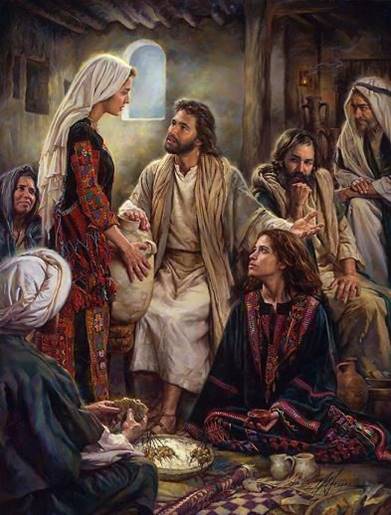
So. . . this one time Jesus was on the road and he stopped into a certain village and a woman named Martha welcomed him, which means she invited him into her home, which was a very nice and generous thing to do since Jesus probably had an entourage travelling with him and it would be rude not to include all of them.  

That village may have been Bethany if this is the same Martha that is mentioned in the Gospel of John as the sister of Mary and Lazarus.  Luke doesn’t tell us the name of the village and Luke doesn’t mention Lazarus, so it may have been some other village and a different Mary and Martha altogether. 

For ages it was assumed that the Mary and Martha of this brief episode in Luke are the same Mary and Martha from chapter 11 in the Gospel of John, the Mary and Martha who lived with their brother, Lazarus in Bethany, about three miles from Jerusalem.  And maybe it is the same Mary and Martha.  But maybe not.  Some scholars are convinced that these two sisters in Luke’s story are not those two sisters in John’s story and that this village is not Bethany.

A few years ago an astute Bible scholar named Elizabeth Schrader Polczer was taking a very close look at some very ancient manuscripts of the Gospel of John as part of her doctoral work and she noticed some odd little smudges and scrapes and overwriting in the text in the papyrus she was examining.  It looked like someone a long, long time ago—like maybe in the 2nd century—had inserted Martha into the Lazarus story.  

Whoever did this long-ago editing may have assumed that Martha had accidently been left out of John’s account.  That’s one theory.  On the other hand, maybe Martha was inserted to downplay the importance of Mary the Magdalene—Mary the Tower.  Mary Magdalene, who is almost certainly also Mary of Bethany, the sister of Lazarus, was a very popular and important apostolic figure in the early church before the patriarchy boys club tried to diminish her influence by tarnishing her reputation.  That whole business about her being a lady of easy virtue?  No basis in fact.  Just some bad patriarchic exegesis with malice aforethought.  I’m looking at you, Gregory the Not-So-Great.

Anyway, another reason why this Mary and Martha in Luke are probably not Mary and Martha of Bethany is that Bethany is very close to Jerusalem, and there is no indication in the 10th chapter of Luke that Jesus was anywhere near Jerusalem or even going in that direction.  At the beginning of the chapter he was denouncing towns in Galilee and in the chapter before that he was in Samaria.  

Another thing to consider is that Mary and Martha were two of the most common names for women in that part of the world at that time.  There are, for example, no less than six different women named Mary in the New Testament.  And while there aren’t so many Marthas mentioned, it’s not much of a stretch to think there could be at least two.

And none of this has anything to do with this particular story.  So let’s get back to the story.

So. . . Martha invites Jesus and probably his ride-along disciples into her home then gets busy providing hospitality.  This was important.  Hospitality was serious business in their culture.  It was a holy obligation backed up by scripture.  Sodom and Gomorrah were destroyed with fire from heaven for failing to provide hospitality.  Well, that and also for sexually assaulting the travelers who came through town.  But that counts as a failure of hospitality, right?

In a culture where so many people, even some wealthy and important people, were nomadic, hospitality was one of the most important cultural virtues.  When you invited someone into your home, the very least that was expected was that you would provide a good meal.  So suddenly Martha has a ton of work to do to cook some dinner for Jesus and his companions.  And maybe she needs to work out some sleeping arrangements.  And maybe she’s checking the pantry to make sure she has enough flour to make more bread and dried figs and parched grains to give them all a good breakfast.  The point is, Martha isn’t just busy for the sake of being busy.  She’s doing her best to be a good hostess and to fulfill an important social obligation.  Her busyness is honorable busyness.  Necessary busyness.  

Anyway, Martha’s got her hands full with all the hostess things and she looks across the room and sees her sister, Mary, just sitting there on the floor listening to Jesus.  

Just sitting.  

Listening to Jesus.

Martha tries to get Mary’s attention and gestures toward the food prep in progress on the table, but Mary doesn’t take the hint.  Martha picks up the water jug and tilts it toward the door, pantomiming that she would like Mary to make a quick trip to the well.  Mary doesn’t even see her because she is so caught up in what Jesus is saying.

Finally, Martha has had enough.  She storms across the room to Jesus (as politely as possible) and says, “Lord, don’t you care that my sister has left me to do all the work by myself?  Tell her to come and help me!”

I wonder how she felt when Jesus said, “Martha, Martha! You are anxious and bothered about so many things, but only one thing is necessary. Mary has chosen what is best, and it will not be taken away from her.”

Oof.

So. . . Are you a Mary or a Martha?   Wait, don’t answer that.  The fact is, one of the things I really don’t like about this text is that far too often it tempts us to ask questions like that.  We turn a story of two good people doing two good things into a kind of binary contest with a winner and a loser and we make Jesus sound all judgy in the process.  

Let’s look again at what’s actually happening in this little drama in five verses.  Jesus arrives.  Martha gets busy to provide good hospitality.  She is fulfilling her expected role, what she believes is required of her.  Mary, on the other hand, sits down with Jesus, and listens to him.  She is giving him her time and attention which is also an important social duty.  

Notice that Jesus doesn’t say anything about what either of the sisters is doing—he doesn’t say anything critical to Martha or anything affirming to Mary—until Martha drags him into the middle of the tension between the two sisters.  That’s called triangulating.  

Triangulation happens when a person complains about another person to a third person instead of addressing the issue directly. Triangulation is very common in families, especially among siblings.  In its worst forms it can be abusive.  In its most common forms its used in particular moments or situations to establish or maintain dominance, to confirm who is in charge at least for the moment.

How often do we try to triangulate with Jesus?  How often do we try to draw Jesus in on our side of a dispute?  How often do we assume that Jesus is on our side in a disagreement with our siblings in Christ?  That’s something worth thinking about, so maybe jot that down in your notebook of Spiritual Growth Questions.  It’s a good one for keeping us honest.

When Jesus says to Martha that she is anxious and bothered about many things he is very subtly stepping out of the triangle she tried to rope him into.  He isn’t criticizing her, he is merely describing her state of mind to her.  Unfortunately, that kind of  truth often sounds like criticism, especially if we’re feeling the least bit defensive.  

When Jesus tells Martha that Mary has chosen what is best, he is, again very subtly, telling Martha to stop trying to control her sister, and he is reminding her that giving a guest time and attention is at least as important as all the hospitality duties that Martha thinks are so culturally crucial.  To emphasize this, he makes it clear to Martha that he will not allow Mary’s moment of spiritual communion with him to be taken away for the sake of housework or social propriety.  

These things Jesus says to Martha can sound a bit harsh until we remember that Martha also was free to stop and sit at the feet of Jesus any time she wanted from the moment he entered her house.  The lesson for her and all Marthas might be “before you get busy with all the things, take a moment to be with all the people.”

There were very clear social conventions in their world about hospitality and meals, but Jesus was already famous for disregarding or even criticizing these kinds of conventions, so  Mary and Martha had options.  

I think this little story in Luke wants us to think about our options so we don’t accidentally create tension and anxiety and open the door to triangulation, especially at times when we want to be welcoming and hospitable.  For instance, Mary could have stepped up to help Martha right from the beginning so they could get things prepared faster and then both sat down to a conversation with Jesus.  They could have asked Jesus when he first arrived if he wanted to eat first or sit together and talk first.  Better than that, any and all of them could have stepped in and pitched in when they saw that Martha was determined to fulfill her traditional role as a hostess. And, of course, Martha could have sat with Mary and listened to Jesus and then asked Mary—and maybe also Jesus and his crew, why not?—to pitch in and help make supper.  

There is no really satisfying ending to this very brief story in Luke.  There is no easy moral to take home here.  You can’t just say “be a Mary and not a Martha.”  We need Marthas.  Marthas make things happen in the world, and especially in the church.  Every Sunday when you come in and sit down to worship a crew of volunteer Marthas has already been hard at work.  Marthas chose the hymns and practiced the music.  Marthas prepared and printed the bulletin.  Marthas checked the sound system and the cameras for online streaming.  Marthas made sure there would be bread and wine for communion.  Marthas prepared the altar and lit the candles.  And Marthas made the coffee and snacks for the fellowship time after worship.

We need Marthas.  And we need Marys.  We need the people who listen attentively and ponder what they’re hearing.  We need people who hear the words of Christ, internalize them, and pass them along to others.  We need the teachers and counselors and preachers and theologians who keep us faithful and in tune with the heart of Jesus. 

The fact is that almost every one of us has been a Martha at one time or another and almost every one of us has been a Mary at one time or another.  Both were doing good things.  Both were serving, just in different ways.  Still, when Martha tried to triangulate Jesus into the unspoken tension with her sister, Jesus does say that Mary made the better choice. 

So maybe the message is this: before you get all caught up in the necessary busyness of life, take time to sit at the feet of Jesus.  Listen to what he says.  Internalize his Word.  Breathe in his Spirit.  Then your necessary busyness, and especially the busyness of hospitality, will be motivated by the Spirit of serving and the love of Christ that crosses all boundaries and welcomes all guests.

Oh, and maybe don’t triangulate Jesus into criticizing your siblings.

The Breath, The Wind, The Spirit

John 14:8-17, 25-27; Acts 2

“When the day of Pentecost had come, they were all together in one place.  And suddenly from heaven there came a sound like the rush of a violent wind, and it filled the entire house where they were sitting.  Divided tongues, as of fire, appeared among them, and a tongue rested on each of them.  All of them were filled with the Holy Spirit and began to speak in other languages, as the Spirit gave them ability.”

It’s no surprise that this is the text that usually gets all our attention on Pentecost Sunday.  It’s a big, dramatic story.  The language is intense and the narrative is filled with almost cinematic details that light up our imaginations!  Violent wind!  Tongues of fire!  Everyone streaming out into the street speaking different languages!  This outpouring of the Holy Spirit in the second chapter of Acts is so vivid and powerful, so action-packed and full of good stuff for motivating the church that it’s no wonder we return to it every year to be inspired by it and to have our own personal zeal and dedication rekindled. 

This Pentecost story in the second chapter of Acts is an important part of our heritage; many call it the birthday of the church, but Diana Butler Bass reminds us that it’s really the birth of something much bigger.  “It’s the birth of a new humanity, a new creation!”  On the day of Pentecost, as the followers of Jesus proclaimed the Good News in the languages of everyone gathered there, Peter reminded the crowd of what the prophet Joel had said four or five hundred years earlier, “In the last days,” God declares, “I will pour out my Spirit upon all flesh.”

All flesh.  All people.  As St. Paul reminds us in Romans, “All who are led by the Spirit of God are children of God.”

The Pentecost story in Acts tells the story of that moment in history when the Spirit of God was poured out for all people, not just the insiders.  In fact, the insiders quite literally rushed outside to bring the fire of God’s presence and love and Good News to everyone who would listen.  

But there is another story in the New Testament about the outpouring of the Spirit, and over the past few years I have felt myself more and more drawn to that story from the end of the Gospel of John. 

In chapter 20 of John, the disciples were huddled together in hiding.  It was evening, three days after Jesus was crucified.  The day had been an emotional roller coaster.  Just before sunrise, Jesus’ tomb was found to be unsealed and empty.  Mary Magdalen claimed that she had seen Jesus and spoken with him, but no one else had.  And then suddenly, even though the doors were locked, there he was standing in the room with them!  “Peace be with you,” he said.  “As the Father has sent me, now I’m sending you.”  

And then he breathed on them and said, “Receive the Holy Spirit.”

This is a much gentler and more subdued giving of the Spirit.  It’s not as flashy as Luke’s Pentecost story, but it is very powerful in its own way.  It’s more personal. More intimate.  The Holy Spirit is given and received as the very breath of Jesus.  

This is the culmination of a wonderful play on words that has been going on throughout John’s gospel since chapter 3 when Jesus told Nicodemus that “The wind blows wherever it chooses, and you hear its sound, but do not know where it is coming from or where it is going.  So it is with everyone born of the Spirit.”  In Greek, the language in which the Gospel of John was written, the word for wind and breath and spirit are all the same word.  Pneuma.  So when Jesus breathes on them in chapter 20 and says, “Receive the Holy Spirit,” it could also be understood as “receive the Holy Breath” or “Receive the Holy Wind.” 

What does it do to our understanding of the Spirit if we can hear it all three ways: to hear it as the Spirit, the essence of God that resides with us and in us, guiding us and speaking to our spirits; but also to hear it as the very breath of Jesus filling our lungs, empowering our words when we speak; and then to also hear it as the wind of God that blows us where God wants or needs us to be?  Receive the Holy Breath.  Receive the Holy Wind.  Receive the Holy Spirit.

I like the rambunctious giving of the Spirit in Acts 2.  It’s a joyful and empowering picture of the Spirit at work.  And it’s for everyone!  All people!  But as I said, I have been more and more drawn to the way the Gospel of John describes the movement and work of the Spirit.  I find this quieter, gentler “Pentecost” more in keeping with my own experience and more consistent with the ways I have seen the Spirit move and work most often in others.  I find that very often the work of the Spirit is so subtle that it’s not until I look back on the moment that I even realize that the Spirit was at work.

Let me give you an example.  As I was preparing this sermon, I had done my research and gathered all the bits and pieces in my notes, and prayed, so that the only thing left to do was to start writing.  And that’s where I was stuck.  My brain needed more time to percolate all the things I had been reading and thinking.  I guess I was still in sermon-avoidance mode.  So I went online to Facebook just to get the synapses firing and blow out the cobwebs.  As I scrolled through different posts, I came upon a painting of Jesus by Maria Brock.  It is an arresting and well done painting, and there were two things I liked about it immediately.  First, in this painting Jesus looks like a Palestinian.  There’s an authenticity about it that makes it easy to say, “Yeah.  Jesus could very well have looked like that.”  But the thing that was really striking about this picture, at least for me, is that Jesus is smiling.  He looks warm and friendly and understanding.  And loving.  

Staring at this marvelous picture of Jesus, I found myself thinking about our gospel text for today from John 14.  This passage is part of the Last Supper Discourse, also called the Farewell Discourse.  John describes Jesus gathered with his disciples on the night of his betrayal, taking advantage of their short remaining time together to prepare them for what is to come.  

I have always imagined him being very somber throughout this whole discourse, after all, he’s sharing some very serious things with his disciples.  But then I remembered that this dinner took place during the week of Passover, a joyful and celebratory time for the Jews.  And looking at this picture where he’s smiling, where he looks so loving, I began to think, “What if this was his expression as he said all these difficult and necessary things?  What if he was looking at them with deep love and gentleness and patient understanding?”  

As I looked at that painting, I began to hear his words differently.  The tone of voice changed and the words of Jesus came alive for me in a new way.  I could hear Jesus saying with that gentle and loving smile, “Do not let your hearts be troubled and do not let them be afraid,” and those words went to my heart in a deeper way than ever before.

That, I believe, was a Holy Spirit moment.   Finding that picture.  Reimagining that scene of the text.  Opening to the words of Christ in a new way.  That’s the kind of thing the Holy Spirit does for us much more often, I think, than tongues of fire and speaking in unfamiliar languages.

It was a happy and festive season for their people, but it was probably not a happy and festive mood in the room where Jesus had gathered his disciples to give them the new commandment to love each other and to promise them the gift of the Spirit.  They were anxious and afraid.  They had so many unanswered questions.  Jesus had told them that he would be departing from them and it had begun to sink in that soon they would be on their own.  They needed some kind of reassurance.  

In her commentary on the Working Preacher website, Meda Stamper said, “The promise of the Spirit does not come to completely faithful, courageous people, already loving one another and the world boldly, already worshiping in spirit and truth.  It comes in the midst of confusion and fear, which has made them unable to grasp what he is saying, and it is the answer to that.  Jesus makes the promise of the Spirit, emerging from the mutual love of the Father and Son for one another and for us, into which they and we are invited, at the very moment when such grace seems most beyond their grasp and ours.”[1]  

Jesus tells them and us that simply in our love for one another we open our hearts to the Holy Spirit, the presence of God in us and with us, to guide us and make us bold enough love a world which, frankly, is not always loveable—a world that is sometimes threatening—but a world that is always and everywhere loved by God.

Jesus promises that when loving the world and each other feels like a trial, when it seems to be beyond our ability to find one more drop of grace and understanding in what Johannes Buetler called our “lawsuit with the world,”[2] when life, itself, feels like an ordeal, Jesus promises that we will have a Paraclete.  An Advocate.  The Spirit comes alongside us and abides in us in the same way that the Father abides in the Son and Jesus dwelled in the world.  “When the physical presence of Jesus is no longer available, still the way, the truth, and the life are in us.”[3]

This is what the Spirit does.  She comes into us like a breath and carries us forward like a powerful wind.  She reminds us of all the things that Jesus has taught us.  She gives us courage to witness, to convict or convince the world of the presence of Christ and the power of love.  She gives us the energy and the courage to do in our time what Jesus did in his own time—to love each other and the world into health and wholeness.  

“Jesus in John shows us what living love looks like in his own life of making God’s love for the world known,” said Meda Stamper. “He enacts love… in words and works: in dangerously truthful testimony to political and religious authorities; in a ministry of boundary-breaking healing and of feeding the physically and spiritually hungry; and in a life of humility,… friendship, and prayer.  He tells us that we are to follow his example…”

Jesus enacts love and tells us to do the same.  Jesus makes his own life an example of God’s love in the world and tells us to do the same.

This is the quieter Pentecost, the alternative Pentecost, a Pentecost centered in love. This is the Pentecost that empowers us to love God and to love our neighbors as ourselves. The Spirit is breathed into us, dwells in us, advocates for us, and flows through us as a witness to God’s love in a hurting world.  Jesus calls us to live into the fullness of life in this Holy Spirit to bring light and love and restoration to all of creation.

Jesus breathes the Spirit into us to give us comfort and courage and peace.  “Peace I leave with you,” he says. “My peace I give to you,” and the peace that Jesus gives us is the breath of the Spirit.  It is the very presence of God in us.   Do not let your hearts be troubled, and do not let them be afraid.  God is with you and in you.

Whether it’s with tongues of fire and a loud rush of wind, or with a whisper, a breath, or a breeze, may this Pentecost renew the power of the Spirit within you.

May the Spirit of God make you bold to love the world.  May this Holy Spirit, the breath of Christ within you, empower you to be kind, to speak truth, and to stand for justice and fairness.  May your life be centered in love.  And may the peace of Christ, which passes all understanding, keep your hearts and minds in Christ Jesus.


[1] Meda Stamper, Commentary on John 14:8-17, 25-27

[2] Johannes Buetler, Paraclete, The New Interpreters Dictionary of the Bible

[3] Meda Stamper, Commentary on John 14:8-17, 25-27

Rise Up

The Solemnity of the Ascension of Jesus Christ, also called Ascension Day, was on Thursday.  It’s always on a Thursday because it always comes 40 days after Easter. Since it’s always on a Thursday, it often gets overlooked, and because the Feast of the Ascension of Our Lord is always on Thursday, and since most of us aren’t in the habit of going to church on Thursday, and since Lutherans and other protestants don’t always pay attention to Feast days anyway, we have the option of observing it on Sunday.  So, it’s Ascension Sunday.  Except that it’s really still the 7th Sunday in Easter.  

The Feast of the Ascension.  It’s almost as if we really didn’t want anybody to notice it.  Ascension?  Uh… right.  Isn’t that mentioned in the Creed?  Ascended into heaven, seated at the right hand of the Father…  and… he will come again with special coupons for everything you need for your Summer barbeque.  No?

I have to confess that I’ve always had a little trouble taking the Feast of the Ascension seriously.  The way Luke and Acts describe Jesus ascending always felt a little cartoonish to me.  In my imagination I keep seeing it like a Terry Gilliam animation from Monty Python with Jesus suddenly rising up from the ground then catching a ride out of town on a nearby cloud.  

I realize that’s not the best way for a pastor to be thinking about a significant event in the life and ministry of Jesus, an event so significant that it is included in the Creeds, so I’ve made an effort to think about it more seriously.  After all, the Ascension of Jesus has real significance for those of us who are followers of Jesus.  It deserves some thoughtful attention. 

The Ascension marks a turning point in the way God engages with humanity—with us.  For a very long time, God engaged with us infrequently through prophets like Moses, Jeremiah, Isaiah and Micah.  Moses gave us Torah—the teachings—with some very good basic information we needed to build good relationships and a just society.  The prophets chimed in with occasional corrective advice and direction. And encouragement.  Or sometimes to scold us.  Worship in the temple and reading the scriptures in the synagogue were formative community experiences that reminded the people that they lived together in the covenant of God’s teachings, that God was with them, and that their relationships with each other and with God were important. 

But, good as the law and the prophets were, people kept finding loopholes or subverting their intent, so to get us back to “love your neighbor as yourself” (that’s from Leviticus, by the way), God entered human history as one of us in Jesus of Nazareth, the Christ.  

Jesus interpreted and expanded the teachings of the law and spoke in the tradition of the prophets to confront human systems based on greed and oppressive power dynamics, to renew our relationship with God, and to expand our understanding of God.  

And to teach us not to be afraid of God.  

Richard Rohr says, “Jesus didn’t come to change God’s mind about us, Jesus came to change our mind about God.”  Most importantly, Jesus came to proclaim that the reign of God had begun—that a human society structured on God’s values of love, kindness, diversity, inclusion, equity, justice and generosity was being inaugurated and was within reach.  That was the Good News that Jesus preached and taught everywhere he went: the commonwealth of God’s justice and kindness is within reach… and it’s doable.

So after going to all the trouble of incarnation and living a fully human life from start to finish, after challenging our religious and political and economic systems and suffering the most extreme consequences for doing that, after training disciples, after being crucified and then resurrected—after all that, why would Jesus just up and leave?  

I can think of two reasons, and they’re connected.  First, I think Jesus ascended, returned to his trans-dimensional life, because it was time for the kids to grow up and go out on their own.  The kids being us.  God decided it was time to engage with humanity in a new way.  Instead of working and speaking primarily through only a few select prophets, God was now going to engage the world through a multitude of persons by endowing every open and loving person with the Holy Spirit.  And for that to happen, Jesus had to step back so we could step forward.  His disciples and followers would never fully take the responsibility of renewing and transforming their world if Jesus was still handy in person to arbitrate disputes, point the way through dilemmas, and make all the tough decisions.  

Jesus had prepared them for this.  Luke says he opened their minds to understand the scriptures.  He reaffirmed the key points of what he had been teaching them, telling them that repentance, metanoia—a conversion of heart and mind that changes how you see and approach the world—metanoia and forgiveness of sins was to be proclaimed to all peoples.  Then he told them to go back to Jerusalem and wait for his signal.  “Stay in the city until you have been clothed with power from on high,” he says in Luke.  “You will receive power when the Holy Spirit has come upon you,” he says in Acts.

During that time of waiting in Jerusalem, the disciples prayed together, sang together, worshiped together, and ate together.  Acts says that they shared all things in common.  They created a model for the followers of Jesus that we still follow in some ways.  This life together was part of their preparation for the work that lay ahead.  Through all this they continued to remind each other of their discipleship experiences with Jesus, sharing what they had learned and imagining how they might apply that knowledge.  Though they probably didn’t realize it, they were building a foundation of community to fortify their relationships with each other and to build the mutual support that they would rely on to carry them through the challenging days ahead.

The long and the short of it is this: Jesus ascended so we could take up the baton of transforming the world.  We are empowered to do this work and guided by the Holy Spirit who enriches us through our life together.  

I think the second reason Jesus ascended is that he had taught us everything we need to know to live a whole, healthy and helpful life.  These were the same lessons that we are called to share with the rest of the world:  

  • If someone lashes out at you, let it go.  Turn the other cheek. 
  • Don’t curse your enemies, pray for them instead. In fact, don’t stop there—love your enemies. 
  • Forgive and you will be forgiven.  
  • Do not judge and you will not be judged.  
  • Treat others the way you would like to be treated.  
  • Share—if you have an extra coat, give it to someone who doesn’t have one.  If you have 5 loaves and two fish pass it around to the multitude in front of you.
  • Give something to everyone who asks.  Yes he really did say that.  (Luke 6:30)
  • Don’t make yourself crazy worrying about how you’re going to get by.  God knows what you need.  Trust that you and God together will find a way to muddle through.  
  • Don’t embrace violence or the tools of violence.  Those who live by the sword will die by the sword.
  • And most important of all, love God with all your heart, soul, mind and strength, and love your neighbor as yourself.  That’s what the law and the prophets were all about.  Love each other.

Much of what Jesus taught was a restatement of what God had been trying to teach us from the beginning.  Jesus, himself, said he had come to fulfill what the law and the prophets had been saying all along.  He embodied what the prophet Micah had said 700 years before him, “God has told you what is good, people.  And what does God require of you but to do justice and to love kindness and to walk humbly with your God.”  

What else was there to teach?  All the bases had been covered.  So it was time for Jesus to return to the place he called “My Father’s House.” As one of my friends said, “The Feast of the Ascension celebrates the day that Jesus started working from home.”  

Jesus started working from home.  But he promised that we wouldn’t be left like orphans.  Yes, the work of the kin-dom was now in our hands, but we wouldn’t have to do it alone.  He promised that the Holy Spirit would be with us and in us to guide us and prompt us and remind us of what Jesus had taught us.  “I have said these things to you while I am still with you,” he says in the Gospel of John.  “But the Advocate, the Holy Spirit, whom the Father will send in my name, will teach you everything, and remind you of all that I have said to you. Peace I leave with you; my peace I give to you. … Do not let your hearts be troubled, and do not let them be afraid.” 

The book of Acts tells us that while the disciples were gazing up toward heaven and watching Jesus ascend, two men in white robes suddenly stood by them and said, “Men of Galilee, why do you stand looking up toward heaven?  This Jesus, who has been taken up from you into heaven, will come in the same way as you saw him go into heaven.”  

Why do y’all keep looking up toward heaven?  Your work is down here.  Jesus will be back when the time is right.

Our work is down here.  And God knows we could be doing better.  War is still erupting all over the world because people are greedy or sometimes because people are so convinced that their way of seeing the world is the only way and that people who see it another way must be eliminated. Or conquered.  Or controlled. People are still turning to self-medication in huge numbers because life for many is meaningless and painful or frightening…or just plain boring.   Whole groups of people are oppressed by other whole groups of people because we have made gods of power and competition and money instead of following the God of love and cooperation.  The planet itself is crying out in pain and becoming less habitable because we have trashed it instead of loving it and taking care of it and learning our proper place in the interconnected, intricate, and beautiful web of creation. 

In a month like this past month—a month when we saw basic tenets of our constitution challenged or flagrantly ignored, when rights like habeas corpus and the right of due process were simply disregarded, a month when we saw life-sustaining food and health programs being torn away from the poorest among us so that the wealthiest could pay less in taxes while saddling the country with an additional $3.5 trillion in debt[1], when once again a political party that refuses to compromise managed to ignore the overwhelming voice of the people and impose legislation that will make life in this country more tenuous for all of us—in a month like this it’s really tempting to gaze up to the heavens and hope that the next cloud that floats overhead will be carrying Jesus back to us to fix everything once and for all.

But that doesn’t seem to be happening.  That is not, apparently, the plan.  At least not for now.  Jesus is still working from home, or walking among us in disguise like the Undercover Boss,  which means that the work of transforming the world through love and truth is still very much in our hands.  “A Christian,” said St. Augustine, “is a mind through which Christ thinks, a heart through which Christ loves, a voice through which Christ speaks, and a hand through which Christ helps.” 

It’s time for us to rise up.  It’s time for us to ascend, not to a cloud that will take us away from it all, but to our feet taking us into it all—into the world with the ministry of love, healing, and transformation that Jesus has left in our hands.  

God has told us how to live and what to do.  Do justice.  Love kindness.  Walk humbly with God and with each other.  Love God.  Love your neighbor.  Love yourself.  Love the world that God has given us.  Love it into peace and wholeness one person at a time.  And listen to the Holy Spirit reminding us of everything Jesus said.  Peace be with you.


[1] Congressional Budget Office, reported by Robert Reich.

Seeing Jesus: Bodies on the Line

“In a little while, the world will no longer see me,” said Jesus, “but you will see me.”[1]

When Pastor Dave Nagler was nominated to become Bishop Dave Nagler, he told the synod assembly a story about a time he saw Jesus while he was serving as the Director of the Central City Lutheran Mission (CCLM) in San Bernardino.  CCLM has been helping to provide a variety of services and assistance to the county’s most vulnerable people since 1994 and ten years ago, in 2015, they became part of Lutheran Social Services.  I don’t know if they still do this, but when Dave was the director they would have a morning worship service on Sunday, then after the service, people were invited into the fellowship hall for lunch.

There was a boy from the neighborhood named Rudy who had been born in a very small town in Mexico.  He was born with bowed legs and since his town was very poor, there wasn’t any medical help to provide braces or to surgically straighten them.  Rudy loved to hang out at the church, and he followed Pastor Dave around like an eager puppy, running everywhere on his little, bowed legs as he tried to keep up with Dave’s long stride.  Rudy was fascinated by the worship service and was always asking Dave if he could help out.  “Pastor Dave, can I collect the money?”  “Pastor Dave, can I hold the cup at communion?”  “Pastor Dave, can I wash the cup after communion?”    

One Sunday, right after worship when everyone else had filed into the fellowship hall for lunch, Dave was still up at the altar putting away the communion elements when an unhoused man wandered into the church through the side door.  The man was disheveled and obviously a little disoriented, and didn’t seem to be quite aware of where he was.  Dave didn’t think much about it because people like that drifted in all the time.  He figured he would go talk to the man when he finished what he was doing.  Rudy, however, hustled over to the man, took his arm, and led him over to the baptismal font and said,  “Bend over the water,” and without questioning, the man bent over the water.  Before anyone could say or do anything, Rudy poured a handful of water onto the man’s head.  Then Rudy led the man up to the altar and said, “Pastor Dave, can he have communion?”  It was one of those moments when time stands still and the angels hold their breath to see what you’re going to do.  Dave gave the man communion then walked with him over to the fellowship hall to make sure he got some lunch.

Most pastors will tell you that there are times in life, in ministry, when you will see Jesus.  If your mind and your heart are open, you will see Jesus so, so clearly.  There are times when you will undeniably feel the breath of the Spirit filling your words or guiding your steps.  “That day,” said Pastor Dave, “Rudy showed me Jesus.”  

“You will see me,” said Jesus, “because I am alive.  And because I am alive, you will be alive.  The day that you realize that my life is your life and your life is my life, that’s the day you will begin to see that I am in the Father, and you are in me and I am in you.  You who love me will be loved by my Father, and I will love you and make myself plain to you.”[2]  And here’s the thing we need to remember as we hear this:  every time Jesus says “you” here, it’s plural.  All y’all.  His life is our life.  He lives in us, collectively and connectedly.  We who love him are the ones who make him visible in the world.  We are the ones who show God’s love to the world.  Our arms are the arms Jesus uses to embrace the world.  And our eyes are the eyes that get to see his presence.

Former Bishop Andy Taylor said that the main thing is to keep the main thing the main thing, and the main thing is the Gospel—the announcement of God’s love and presence in the world through Jesus.  We are not called just to just preach about God’s love or teach about God’s love, we are called to live into it and let it be alive in us.  We are called to embody it.

Jesus said, “Those who love me will keep my word.”  Richard Rohr once said, “The only way I know how to love God is to love what God loves.”  Loving Jesus and keeping his word means that we get to show people in clear and tangible ways that they are loved.  That means that when someone is oppressed or threatened, we stand up for them, even when it’s scary.  When someone is excluded, we welcome them to the table.  When someone is wounded, we make a safe space for them to be healed.  When someone is beaten down, we lift them up.  That’s what it means to love one another as Jesus has loved us.  That’s what it means to follow Jesus.  And sometimes that means we have to put our bodies on the line.

It was five years ago today, May 25, 2020, that George Floyd was killed by police on the streets of Minneapolis.  In the wake of his death and the deaths of Breonna Taylor, Daunte Wright, Andre Hill, Manuel Ellis, Atatiana Jefferson and too many others, Black Lives Matter organized protests all across the country.  I was part of a group of clergy and other faith leaders who were asked to attend the Black Lives Matter Rally at the Civic Center in Los Angeles.  The organizers asked us to wear our clerical collars and our stoles—symbols of our office, clear and visible signs that we were there representing our various faith communities and traditions.  We were not there to speak.  We were there to witness.  We were asked to perform one simple task, to stand shoulder to shoulder with each other in a line, a kind of human boundary line between the law enforcement officers and the protesters.  We were there to help create a safe space where Black people and other Persons of Color gathered in community could speak their grievances and share their grief.  We were there to help assure both sides that things would remain peaceful.

It was scary to stand there in that line.  It was still early days in the Pandemic and even though we were all masked, we knew that Covid was in the air.  But the really scary part was to stand just a few yards away from a line of fully armed Sheriff’s deputies in riot gear, watching them watching us, and knowing that my stole and my pectoral cross and my clerical collar wouldn’t help one bit if they suddenly decided to move in on the demonstrators.  

As you might expect, my mind was racing.  But then I made a decision that brought me an unexpected feeling of peace.  I decided that I was going to love those deputies.  I was going to love them because God loves them.  Jesus loves them.  I realized that they were in a difficult position, too, and probably didn’t want to be there.  As I stood there across from those deputies with their hands resting on their batons or their holsters, I just kept repeating one thought in my mind over and over:  “God loves you.  God loves everyone here.  We are all children of God.”  And then these words of Jesus came to me: “Peace I leave with you.  My peace I give you.  Do not let your hearts be troubled and do not be afraid.”  

Those words of Jesus became my prayer that day—my prayer not just for me but for the deputies and the protestors and the faith leaders and the media and everyone else who was there.  Peace.  Do not let your hearts be troubled and do not let them be afraid.” 

Sometimes you have to put your body on the line for the sake of your faith, or just for the sake of what’s right.  This is Memorial Day weekend.  Tomorrow we will pause to remember and honor all those who put their bodies on the line and paid the ultimate price in service to our nation—a nation that has taken pride in its immigrant heritage and its diverse people, a nation that has called itself “the land of opportunity.”  Tomorrow we remember those who put their lives on the line for a nation that has, for most of its history, understood its government to be a government of, by and for the people, a nation that has stood for 250 years safeguarded by the rule of law spelled out in a constitution which declares who will live under its protection with the words “We the People,” a constitution that clarifies the purpose behind its creation: “in order to form a more perfect union, establish justice, ensure the domestic tranquility, provide for the common defense and secure the blessings of liberty for ourselves and our posterity.”     

There is so much in our country and in our world that has become oppositional.  There is a real struggle going on between those who believe that a more livable society can be built through empathy and education, through intentional inclusion of our diverse cultures, races and ethnicities, through a more equitable use of our common resources and a more equitable system of financial responsibility.  Others want to impose an unyielding system of authoritarianism and conformity with rigid systems of hierarchy and harshly enforced order. Those positions have boiled themselves down to hardened political polarities and ideologies.  People just aren’t listening to each other.  There is no real exchange of ideas, no conversation, just entrenched positions.  

Jesus is calling his followers, calling us, to step into the front lines of this tension.  We are being called to create a space of grace where people can be heard and their fears addressed, where conversation can begin and the seeds of God’s transformative love can be planted.  

We are called to build a Beloved community, a people who are living into the Gospel, a companionship enlivened by the vibrant love of God.  That’s what church is supposed to be about.  We are called to create a welcoming space where God can love us into something new.  We are called to create a community where people can see Jesus.

There is a beautiful vision at the end of the Book of Revelation, a vision of the New Jerusalem coming down out of the heavens from God.  Some people think this is a description of what heaven will be like.  Some think it is a literal description of what God is going to do at the end of time.  Personally, I think it’s a wonderful metaphor for what the church of Jesus Christ can be and should be right now when we’re at our best.  

The river of life flows in that city[3] and I believe that this river of life in all its fullness can flow in and through us when we immerse ourselves in God’s life and love and grace.  

The tree of life grows in that city with its leaves that are for the healing of the nations[4]—healing for all the different peoples of the world, healing for all the wounds we have inflicted on each other simply because we are different from each other.  I think we can be that tree when we are rooted in the love of Christ.  

Revelation tells us that the people will bring all the splendor and richness of their various cultures and ethnic traditions into that city.[5]  Imagine how vibrant and powerful our worship and ministries would be if we opened our doors and our hearts to all that splendor and richness here and now.

God has given us a vision, a revelation, of the Beloved Community as a loving and healing place where everyone is welcome at the table, a place where the splendor and richness of all peoples and every person is cherished and celebrated.  A place where people are transformed and renewed.  

May the Spirit empower us to make that vision a reality on earth as it is in heaven.  May this church and every church become a place where people can see Jesus.

Peace be with you.  Do not let your hearts be troubled.  Do not let them be afraid.


[1] John 14:19-20

[2] John 14:18-20

[3] Revelation 22:1

[4] Revelation 22:2

[5] Revelation 21:26

Love Story

I came across one of the best love stories of all time three years ago when Russia invaded Ukraine.  A man who had managed to get himself and his family out of Mariupol during the Russian bombing told a reporter that they owed their escape to a stranger.  Here’s what he told the reporter:

I left the bomb shelter and saw a car with keys in the ignition near the store.  I watched it for two hours, waited for the owner.  When the owner didn’t show up, I didn’t wait.  I took my family, got in the car and drove to Vinnitsa to stay with relatives.  I found a phone number in the glove compartment and called the owner:

“Sorry,” I said, “I stole your car.  Saved my family.”

“’Thank God!’” he said.  ‘Don’t worry, I have four cars.  I took my family out in my Jeep.  The rest of the cars I filled with fuel and left in different places with the keys in the ignition and the number in the glove compartment.  I received calls back now from all the cars.  There will be peace.  See you.  Take care of yourself.’”

As I said, it’s a love story.  Leaving those cars behind, gassed up and ready to go  with the keys in the ignition so that other people, strangers, could escape the hellish bombing of their city—that was an act of love.  That was God showing up in person.  

“I give you a new commandment,” said Jesus, “that you love one another.  Just as I have loved you, you also should love one another.  By this everyone will know that you are my disciples, if you have love for one another.”

It is not our adherence to doctrine that marks us as disciples of Jesus.  It is not our intellectual assent or understanding of the faith.  Embracing particular ideas about atonement or grace or the nature of Christ is not what identifies us as disciples of Jesus.  We are not known as his followers because of our righteousness or our moral stance on hot-button issues.  It isn’t even “accepting Jesus into our hearts,” whatever that might mean, that tells the world that we are devoted to him.  

“By this everyone will know you are my disciples,” said Jesus, “—if you have love for one another.” 

When Jesus was asked which of the commandments was the most important, he went straight to love.  “You shall love the Lord your God with all your heart, mind, soul and strength.  And love your neighbor as yourself.  There are no greater commandments.  On these two commandments hang all the law and the prophets. Do this and you will live.”[1]

When some of the people in Corinth got all wrapped up in their charismatic gifts and started to take a kind of conceited pride in their spirituality, St. Paul wrote to them with a word of caution:

“If I speak in the tongues of mortals and of angels, but do not have love, I am a noisy gong or a clanging cymbal.  And if I have prophetic powers, and understand all mysteries and all knowledge—if I have so much faith that I can move mountains, but do not have love, I am nothing.  If I give away all my possessions—even if I give up my body as a martyr—but do not have love, I gain nothing.”

A few years later, Paul had more to say about love in his letter to the Christians in Rome:

Owe no one anything, except to love one another; for the one who loves another has fulfilled the law.  The commandments, “You shall not commit adultery; You shall not murder; You shall not steal; You shall not covet”; and any other commandment, are summed up in this word.  “Love your neighbor as yourself.”  Love does no wrong to a neighbor; therefore, love is the fulfilling of the law.

Paul’s descriptions of love in 1 Corinthians and Romans are excellent and instructive.  But they’re also rather passive.  When Jesus talked about love, he seems to have had something more active in mind.  Often when he talked about love, he would combine it with action.  “I say to you, love your enemies and pray for those who persecute you.”[2]  “Love your enemies and do good to those who hate you.”[3] When a lawyer tried to find a loophole in the commandment to love your neighbor by asking, “Well, who is my neighbor?” Jesus responded with a story about a Samaritan who rescues a traveler who had been beaten up by bandits and left for dead.  Clearly, loving your neighbor involves action.  Love also involves generosity.  The Gospel of John tells us that God so loved the world that God gave God’s unique child to us.  Giving is an act of love.

All people are called to love, not just Christians, but followers of Jesus have been commanded to love so that we can be known as his disciples.   Love is supposed to be the thing that identifies us.  Love is what we’re supposed to be all about…but how do you that?  Especially, how do you do that part about loving your enemies—or even just people you don’t particularly like?

You may remember that the ancient Greek language in which the New Testament was written had four different words for love: agape, eros, philia, and storge.  Storge was a word used to describe duty to family and country—think of it as patriotism.   Philia is friendship.  It meant a lot to call someone your friend in the ancient world.  True friendship, then and now, is a kind of love.  Eros was the most commonly used word for love in the ancient world, at least by writers, poets and philosophers.  Our word eroticcomes from eros, but properly understood there’s a lot more to it than that.  

Agape is the word for love that’s used most often in the New Testament.  Agape is a love that is unconditional.  It has no motive other than to seek the well-being of the beloved.  It can be spontaneous, but usually it is decisional—you simply decide that you are going to love that other person or those other people.  Period.  Agape is indifferent to any kind of reward and it doesn’t seek reciprocity— agape doesn’t ask to be loved in return.  Agapeis the simple yet profound recognition that giving of yourself is a worthy and good thing to do.  It is an unconditional willing of good.  Agape loves the beloved for their own sake, whether they are worthy and deserving or not.

Eros, on the other hand, speaks of desire and longing.  Eros seeks to possess what we find valuable but not to covet or desire a person at the expense of overall well-being.  Edward Collins Vacek defined eros as “loving the beloved for our own sake.”[4]  

Plato thought that eros was a pathway to God.  His reasoning went like this:  I see a beautiful person or thing and I desire them or it, but if I look beyond the person or thing I find that what I am really desiring is beauty.  But what makes beauty beautiful is truth, so if I look beyond beauty, I find that what I really desire is truth.  But truth comes from God, so what I am really desiring is God.  

Ilia Delio reaffirms that the heart of eros is passion or desire.  “Eros,” she writes,  “is that ineffable longing that stretches beyond oneself for the sake of oneself.”  She goes on to suggest that eros and agape aren’t so much in contrast with each other as related to each other and that philia—friendship—is the thread between them.  In philia a person gives themselves over to the relationship.  Philia is expressed in camaraderie and companionship, in life together in community.  In his book Love, Human and Divine: The Heart of Christian Ethics, Edward Collins Vacek says that philia “may be the most cosmic form of love because it is based on mutuality, reciprocity, and cooperation—with the purpose of promoting overall well-being.”  That’s how the Quakers have always understood it, which is why they officially called themselves The Society of Friends.

Agape is the word for love that’s used most frequently in the New Testament, but there are moments when philia comes into the text to give love a meaning that is broader and deeper.  Jesus brings agape and philia together in John 15:13 when he says, “No one has greater love than this, to lay down one’s life for one’s friends.”  No one has greater agapethan to lay down one’s life for one’s philon—those friends who are loved with the deep bond of philia.  He goes on to say, “You are my friends (philia/philon) if you do what I command you.”  And what did Jesus command?—that we should love one another with agape love as he has loved us.  

So how do we love—how do we obey the command to love?  Well to start with, it helps to realize that the kind of love Jesus commands doesn’t have to involve any warm, fuzzy emotions.  You can decide that you will unconditionally envision and work for goodness for others without expecting anything to come back to you.  You can decide to love with agape.  That’s the starting point.

But agape can be a poor kind of love if it doesn’t bloom into something more than just a decision.  If it remains simply a decisional kind of love, it can become rote, individualistic, non-mutual, and even task-oriented.  Yes, agape is patient and kind, it is not envious or boastful or arrogant or rude, it does not insist on its own way, it rejoices in truth, it bears all things, believes all things, hopes all things, endures all things, and does not quit—agape has all those qualities that St. Paul pointed out to the Corinthians.  But agape can be all that and a bag of chips and still not be warm enough to bloom into a real relationship.  And God is always inviting and nudging us into relationships.  Love, complete and healthy love at work in a community of faith, starts with a good base of agape, but mixes in a good dose of philia, friendship, and even a dash of eros, to keep us longing for God, for each other, and for the beauty of our relationships.

From the beginning of creation, God has been pouring love into the universe and calling us into relationship.  Love is the force that brings quantum waves together to form hydrogen atoms and then brings hydrogen atoms together to form stars.  Love is the force that drives evolution, overcoming entropy to continually transform biological life into higher, more complex, more aware forms of life—forms capable of loving.  Pierre Teilhard de Chardin wrote, “If there were no internal propensity to unite, even at a prodigiously rudimentary level — indeed in the molecule itself — it would be physically impossible for love to appear higher up, with us, in hominized form. . . . Driven by the forces of love, the fragments of the world seek each other so that the world may come into being.”

Love is the motive of creation and the engine of evolution.

We are commanded to love because it is intentional love that identifies us as followers of Jesus, but even more importantly, because love is what God has been using throughout all time to shape and transform the whole of creation.  When we reflect love back to God and to each other in meaningful and tangible ways, we are participating in God’s formative and transformative work.  

Teilhard de Chardin also said, “The day will come when, after harnessing the ether, the winds, the tides, gravitation, we shall harness for God the energies of love.  And on that day, for the second time in the history of the world, humanity will have discovered fire.”

Love is patient and kind.  Love does bear all things and believe all things and hope all things, and endure all things.  But love goes beyond that.  Love, real love, becomes action.  

Love joins the picket lines and protests to stand against injustice and to protect the rights of those whose rights are being violated.  Love speaks for those who have been silenced.  Love writes letters to senators and representatives urging them to protect medical care and food programs for the people who rely on those services to survive.   Love rescues.  Love saves.  Love speaks truth to power.  

Love puts gas in the car and leaves the keys in the ignition so that beloved strangers can escape to a new life.  Love promises there will be peace.  

May the Spirit ignite in all of us the bright flame of God’s transforming and saving love in the name of Jesus.


[1] Mark 12:28-34; Matthew 22:36-40; Luke 10:25-28

[2] Matthew 5:43

[3] Luke 6:27

[4] Edward Collins Vacek, Love, Human and Divine: The Heat of Christian Ethics, 1994, pp. 157-158; as quoted by Ilia Delio, The Unbearable Wholeness of Being, Orbis Books, 2013, p.42

All Persons Being Equal

Clergy persons often refer to this Sunday as Shepherd Sunday or Good Shepherd Sunday because of the lectionary readings assigned for today, but I’m going to depart from the lectionary because it’s also Mother’s Day. 

I’ve been thinking a lot about my mom.  She was an amazing woman—a social worker and, until cancer cut her life short, a law student.  She was smart, generous and loving.  She had a great sense of humor and a deep and vibrant faith.  She’s probably the reason I became a pastor.  And I’ve missed her every day of the last 36 years

My mom told me once that I’d never amount to much because I procrastinate too much.  I said, “Oh yeah?  Well just you wait.”  

I’ll never forget one Mother’s Day—we had a big family meal at Mom and Dad’s house but right after dinner Mom kind of disappeared.  I found her in the kitchen getting ready to wash a sink full of dirty dishes.  I said, “Mom, it’s Mother’s Day!  Go sit down and relax.  You can do the dishes tomorrow.”

Mothers Day was first proposed by Julia Ward Howe and other feminist activists just after the Civil War.  Julia Ward Howe, by the way, wrote The Battle Hymn of the Republic.  These women originally envisioned Mothers Day as a day for mothers around the world to come together to promote international peace, and also to honor mothers who had lost sons and husbands to the carnage of the war.  Unfortunately, aside from a few stirring proclamations, their efforts didn’t produce much.

A few decades later, though, Anna Maria Jarvis almost single handedly managed to make Mothers Day a national holiday.  Inspired by her mother’s wish to see a national day honoring mothers, Anna Jarvis began promoting the idea throughout the country.  By 1911 Mothers Day was being observed in every state, and in 1914, President Woodrow Wilson signed a proclamation officially designating the second Sunday in May as Mother’s Day. 

And here’s an odd but important note:  originally there was no apostrophe in Mother’s Day.  Julia Howe and Anna Jarvis both envisioned it as a day to honor all mothers.  Plural.  But the greeting card industry, the florists, and the candy makers quickly idealized it and individualized it and began promoting it as a day for you to honor your mother.  In their advertising, Mothers Day (plural/all mothers) quickly became Mother’s Day with an apostrophe, as in your particular mother’s day (singular/possessive).  Needless to say, the idea of it being a day to promote international peace pretty much vanished with the arrival of that apostrophe.

Ann Jarvis, who had worked so hard to make Mother’s Day a national observance, ended up hating it. The holiday became so commercialized, that in 1943 she tried to organize a petition to rescind Mother’s Day, but her efforts went nowhere.  Frustrated, and literally at her wits’ end, Anna Jarvis died in 1948 in a sanitarium.  Ironically, her medical bills were paid by a consortium of people in the floral and greeting card industries.

As joyful and sentimental as Mother’s Day is for some, others find it almost unbearably painful.  Anne Lamott’s Mother’s Day column which she re-posts every year begins this way: “This is for those of you who may feel a kind of sheet metal loneliness on Sunday, who had an awful mother, or a mother who recently died, or wanted to be a mother but didn’t get to have kids, or had kids who ended up breaking your hearts…”  Lamott goes on to acknowledge many of the ways that this Greeting Card holiday can be painful for many women…and also for many children.

Most pastors I know are ambivalent at best when it comes to Mother’s Day.  It’s something of a minefield for us.  We don’t dare let it go unmentioned, but at the same time we are very aware of those women in our congregations who for one reason or another will be feeling that “sheet metal loneliness” that Anne Lamott talks about.

On the plus side, though, Mother’s Day does give us an opportunity to highlight issues that women face in a world and culture that still operates with far too much patriarchal dominance and oppression, often in ways that men don’t even see.

One of the most persistent and troubling issues that women face is the gender pay gap, the disparity in earnings between women and men that gets amplified when those women and men are mothers and fathers.  Often referred to as the “motherhood penalty,” this phenomenon sees mothers earning significantly less than fathers, even when they possess similar qualifications and experience.  Overall nationally, mothers were paid 61.8 cents for every dollar paid to fathers.  In 2023, mothers who worked full-time year-round were paid 74.3 cents per dollar paid to fathers.  That means that mothers earned $19,000 lessfor a year of full-time work, an amount that’s roughly equal to the cost of infant care.[1]

Mothers of color face an even larger earning gap when compared to White fathers.  Nationally, in 2023, Black mothers earned 48.8 cents per dollar paid to White fathers, Native American mothers earned 48.2 cents, and  Latina mothers earned 42.7 cents per dollar paid to White fathers.  

In contrast to the “motherhood penalty,” fathers often experience a “fatherhood bonus,” where their earnings may actually increase following the birth of a child. Employers tend to perceive fathers as more stable and committed to their jobs, leading to higher wages and better career prospects. This bias not only perpetuates economic inequality but also reinforces traditional gender roles within the family and the workplace.

This economic inequality is so very contrary to the values of the kingdom of God, or as Diana Butler Bass calls it, the Commonwealth of God’s justice and mercy.  In his letter to the Galatians, St. Paul wrote, “In Christ Jesus you are all children of God through faith. . .There is no longer Jew or Greek; there is no longer slave or free; there is no longer male and female, for all of you are one in Christ Jesus.”  In his book The Forgotten Creed: Christianity’s Original Struggle Against Bigotry, Slavery, and Sexism, Stephen J. Patterson points out that this egalitarian statement did not originate with Paul.  Rather, Paul is quoting a baptismal creed that was already in use by early Christian communities, a creed which Patterson describes as one of “the earliest attempts to capture in words the meaning of the Jesus movement.”

These early Christians understood that race, class and gender are typically used to divide the human race into us and them.  When these earliest Christians listened to the voice of their good shepherd,  they believed that Jesus was calling them to live in radical equality.  In their baptismal creed, these early followers of Jesus claimed that there is no us versus them.  We are all one.  We are all children of God.  We are all equal.  

Unfortunately, the radical egalitarianism of these earliest Jesus communities didn’t last long.   Their way of life made these communities stand out too sharply in contrast to the patriarchal and hierarchical norms of the Roman culture that surrounded them.  Living out this radical equality made the followers of Jesus more visible and vulnerable when Roman authorities began to persecute them. 

And now here we are, two thousand years later and, despite some progress, people are still, by and large, expected to fulfill traditional roles, and the culture punishes those who don’t or won’t.  One of the problems with Mother’s Day is that it reinforces a cultural expectation that puts the weight of parenting primarily on Mom. That’s unfair to Mom and limits a child’s experience because even Super Mom can’t really do it alone.  As the old African proverb reminds us, it takes a village to raise a child.  

“My main gripe with Mother’s Day,” said Anne Lamott, “is that it feels incomplete and imprecise.  The main thing that ever helped mothers was other people mothering [their children], including aunties and brothers; a chain of mothering that keeps the whole shebang afloat. I am the woman I grew to be partly in spite of my mother, who unconsciously raised me to self-destruct; and partly because of the extraordinary love of her best friends, my own best friends’ mothers, and from surrogates, many of whom were not women at all but gay men. I have loved them my entire life, including my mom, even after their passing.”

Raising children is a community affair.   It should be done with an eye on what’s best for the community.  We lose sight of that too often.  We think good parenting means raising kids who will share our cherished internal family values.  That’s only natural, but the child really needs to be prepared for the time when they will leave home to enter the world on their own.  They need to be prepared not just to make a valuable contribution to the community, but to be a positive contribution to the community.  

Parents need to remember that their children are not just a gift that God gives to them, but a gift that they, in turn, give to the world.  We need to send our children into the world equipped with empathy, wisdom, patience and understanding.  As Barbara Kingsolver said, “We want our children to grow up in a culture of kindness and generosity.” They need to have a clear understanding of and feeling for the intrinsic value of other people.  Developing those attributes requires more influence than any one parent can provide.  And I have to say, I think a lot of the problems we’re facing today as a nation are a direct result of too many people in positions of authority who were raised without that extended community and without those values—especially an understanding of the intrinsic value of other people.

Jesus told a story in chapter 20 of the Gospel of Matthew about a man who went to the marketplace one morning to hire some workers, and before sending them out to work in his vineyard, he made a verbal contract with them to pay them the basic daily wage of one denarius.  A few hours later, he went to the marketplace again and hired some more workers and said, “I will pay you whatever is right.”  He went to the marketplace three more times during the day to hire more workers, the last time just an hour before sunset, and each time he told those workers that he would pay them “whatever is right.”  At the end of the day when all the workers lined up to receive their pay, he paid the workers who had only been in the field for an hour one denarius, the whole day’s wage.  Naturally, the workers who had been working since sunrise figured they were in for one heck of a bonus, but when it was their turn to be paid, the man also paid them one denarius, the standard daily wage.  They were upset about this and groused about it. “These latecomers only worked an hour and you have made them equal to us even though we were out here in the heat all day!”  The landowner responded, “Friend, I am doing you no wrong;  didn’t you agree with me for the usual daily wage? I chose to give the latecomers the same as you.  Am I not allowed to do what I choose with what belongs to me?  Or are you envious because I am generous?”

This parable makes a lot of people squirm, mostly because we tend to feel slighted on behalf of those workers who were out in the hot sun all day.  On the flip side, we tend not to feel any joy on behalf of the one-hour workers who got what amounts to an astonishing bonus.  I think we feel all this because we lose sight of what this parable is all about and our focus is in the wrong place.  

This is not just a story about wages—how much should the fieldworker get paid per hour—or how much should a mother be paid—this is a story about what’s best for the community.  Jesus starts the story by saying “The kingdom of heaven is like…”  The context is bigger than the owner of the vineyard or the workers.  

The landowner understands that his wealth, his resources are not just for his own personal benefit or his family’s, but are meant to be used to make the whole community healthier and stronger.  I suppose you could say he’s “mothering” the community.  He understands that he is not just paying workers to harvest his grapes on his property, rather, he is providing a means of support for the whole community.  He understands that by paying the one-hour worker the full day’s wage, he is creating one less beggar in the marketplace while preserving that person’s dignity and helping to feed that worker’s family for days.  He understands that by paying all the workers the same wage he is sending the message that they are all equally vested in the good of the community.  

In this short story by Jesus, the workers who complained saw what the land owner was doing and they didn’t like it.  They said, “you have made them equal to us.”   In our country today there are still people who don’t like it when you propose making the richest people carry a larger share of the tax burden that supports our government and systems that benefit all of us, or if you propose something like single-payer universal healthcare, something they may not use because they can afford good private medical care but something that would, nonetheless, be beneficial for everyone else.   Something that would strengthen the community.

“You have made them equal to us.”   What is it in us that rebels at true equality?  Why do we have this desire, this expectation that some should be more equal than others?  Why do some people work so hard to limit or prevent diversity, equity and inclusion and to preserve stratification of society even when it results in less qualified people doing critical jobs?  Why is it so hard for some to understand that when we try to live by the ethics of equality and inclusion that Jesus modeled for us, we’re not trying to displace them, we’re just trying to build solidarity within diversity?  And why did the church lose sight of its beautiful and powerful first creed?

In Christ there is no longer Jew or Gentile, there is no longer slave or free, there is no longer male and female.  We are all God’s children.

And that brings us back around to the original intent for Mothers Day.  It was intended to be something to strengthen the community and bring peace to the world.   Just like our Christian faith.

In Jesus’ name.


[1] Institute for Women’s Policy Research, Fact Sheet, May 2025

The Big Fish of Civil Disobedience

John 21:1-19

The Gospel of John comes to a very satisfying conclusion at the end of Chapter 20.  In that chapter, the resurrected Jesus encounters Mary Magdalene by the empty tomb.   In the evening of that same day he appears to the disciples who were huddling in fear in the upper room.  Jesus greets them with a benediction of peace and breathes on them to bestow the Holy Spirit which will empower them for the work that lies ahead.  A week after that, he appears to Thomas to address his doubts.  The final words of chapter 20 feel like a conclusion:  “Now Jesus did many other signs in the presence of his disciples that are not written in this book.  But these are written so that you may continue to believe that Jesus is the Christ, the Son of God, and that through believing you may have life in his name.” 

The end. 

Except it’s not.

Just as you’re about to close the book, the narrator starts up again in chapter 21 saying,  “After these things Jesus showed himself again to the disciples by the Sea of Tiberias, and he showed himself in this way.”  And what comes next is a fishing story.  Which is a little strange since fishing is not mentioned even once anywhere else in the entire Gospel of John.  

The final chapter of John, chapter 21, is a bit odd in a number of ways.  There is a general consensus among scholars that this chapter was added to the gospel at a later date, some say as much as 20 years after the original ending.  Since John was the last of the gospels, most likely written sometime around 90 CE depending on who you ask, that would mean that this epilogue was written sometime around 110 CE or thereabout. 

This epilogue, this fishing story, is not a story meant to inspire evangelism, although it has often been preached that way.  It’s not a story meant to affirm and reinforce the bodily resurrection of Jesus, although it has often been preached that way, too.  This is a story about civil disobedience.

So what was going on in the world and in the communities of Jesus people around that time that made it feel necessary to add this chapter?   And why does this chapter take them so suddenly back to Galilee?  And why are they going fishing?

To answer these questions, we need to revisit a little bit of history.

Jesus began his ministry in Galilee and that’s where he called his first disciples.  The writer of John seems to assume that we already know that Peter and Andrew and James and John were fishermen who fished in the Sea of Galilee before meeting Jesus.  John assumes we already know the story of how they dropped their nets and left their boats when Jesus walked by and said, “Follow me and I will teach you to fish for people.”  But if we didn’t know those stories from Matthew, Mark and Luke, we would not learn them from John because John’s gospel hasn’t been at all interested in fishing.  Until now.  In the epilogue.

Fishing was an important industry in the empire and it was heavily controlled.[1]  By law, the emperor owned every body of water in the empire and all the fish in those waters. Every last one of them.  It was illegal to fish without a license and those licenses were expensive.  Most fishing was done by family cooperatives who pooled their money to buy the license and the boats and nets.  You could make a living but you wouldn’t get rich because about 40% of the catch went for taxes and fees.  And you were probably making payments on the boat, too.  After the fish were caught they would be carted or carried by boat to a processing center where the fish would be salted and dried or pickled, except for the large fish.  I’ll come back to the large fish in a moment. 

The most important processing center on the Sea of Galilee was just down the road from Capernaum in the town of Tarichaea.  The Hebrew name for that town was Magdala Nunayya, which means Tower of Fish.  Just a side note here: Magdalameans tower, so Mary Magdalene means Mary the Tower, which tells us something about her status among the apostles.  Herod Antipas wanted to curry favor with the emperor Tiberias, so in the year 18 CE he established a city three and a half miles away from Tarichaea which he named Tiberias in honor of the emperor.  

Herod built piers and fish processing facilities then invited people from all over the empire to come live in Tiberias and work in its fishing industry.  Gentile pagans flocked to the town looking for employment on the Sea of Galilee which these newcomers now called the Sea of Tiberias.  Almost overnight the Jewish family coop fishing businesses that had sustained people like Peter and Andrew and James and John found themselves in stiff competition with state-sponsored foreign fishermen from all over the empire, and the wealthy fish-processing town of Tarichaea/Magdala Nunayya began rapidly losing money to Herod’s processing plants in the city of Tiberias.  

One of the consequences of all this was that opposition to Roman occupation and Herod’s administrative oversight began to intensify in Galilee, and Tarichaea became a hotbed of resistance. Eventually, that resistance became a revolt and a full-blown war.

In the year 70, the Roman general Titus completely leveled Tarichaea.  The Galilean fishing industry would have been completely destroyed, but the people of the city of Tiberias took an oath of loyalty to the emperor, so they were allowed to continue catching and processing fish in the Sea of Tiberias.  That same year, Titus sacked Jerusalem and destroyed the temple but the resistance to Rome’s heavy-handed power never entirely melted away.  The fishing community of Galilee continued to harbor a core of that resistance that core of the resistance movement.

All of this is in the background of Chapter 21, this epilogue to the Gospel of John.  This chapter was written about 80 years after the crucifixion and resurrection of Jesus and for most of those 80 years Rome had been at war with the Jews which meant they were also at war with the Christians because as far as Rome was concerned, the Christians were just another Jewish sect, a sect which the Roman Senate had declared to be an “illegal superstition.”  That declaration opened the door for persecution of Christians under Nero and Domitian and later emperors.  

So back to the original question: what was going on in the world and in the communities of Jesus people around that time that made it feel necessary to add this chapter?   In the year 112, Pliny the Younger who was serving as governor of Bithynia and Pontus wrote to Trajan, the emperor, and asked, “I have some people who have been accused of being Christians.  What do you want me to do with them?”   Trajan wrote back and said, “Well, don’t go hunting for them, but if someone is accused of being a Christian, just ask them to renounce their faith, take an oath of loyalty to the Emperor, and offer sacrifices to the gods of Rome.  If they do that, let them go.  If not, execute them.”  

This was not an easy time to be devoted to Jesus—not that it had ever been easy.  But now, if a neighbor publicly accused you of being a Christian you had a very hard choice to make.  On top of that, the seemingly endless war that Rome was waging on Jews who showed the least bit of activism kept popping up in hot spots, and as far as Rome was concerned Christians were just another kind of Jews, which, to be fair, was often true since many Christians were Jews who followed Jesus.  On top of all that, these early Jesus people had expected Christ to return at any minute to overthrow the Empire of Rome and replace it with the kingdom of God, but that had not happened yet.  The original Apostles were all gone to their reward and the People of the Way were losing hope and direction.  What do we do?  How do we continue?  How do we live in the life-giving Way of Jesus in the face of an oppressive and dehumanizing Empire?

Chapter 21 acknowledges the presence of the empire right away.   After these things Jesus showed himself again to the disciples by the Sea of Tiberias.  Only the Gospel of John refers to the Sea of Galilee as the Sea of Tiberias.  That name is used nowhere else in the New Testament.  That’s the empire’s name for this body of water.  It’s a reminder that the Emperor claims ownership of this sea which plays such a large role in the story of our faith.  The emperor is in the story.  But the writer of this chapter is telling us right from the top that even where the empire claims sovereignty, Jesus shows up to challenge that claim with a quiet but firm counter claim.   

Gathered there together were Simon Peter, Thomas called the Twin, Nathanael of Cana in Galilee, the sons of Zebedee, and two others of his disciples. Simon Peter said to them, “I am going fishing.” They said to him, “We will go with you.”  This naming of the disciples is a roll call of the companions of Jesus who established Christ-following communities throughout the empire.  This is a reminder to all those followers of Jesus and his apostles that we are all in the same boat even if the empire claims to own the sea.  

So they go fishing all night.  But they don’t catch anything.  Frustrating. Disheartening.  And doesn’t life in the church feel just like that sometimes.  You do everything you know how to do and you get bupkis. 

And that’s when they spot Jesus standing on the beach, waiting for them.  They don’t recognize him right away.  People usually don’t recognize the risen Christ right away. The disciples don’t recognize him until they follow his instructions, drop their net on the right side of the boat and then haul in so many fish that they can’t even lift the net into the boat.  That’s when they recognize him.  

When they got to the beach they found Jesus cooking some fish and bread over a charcoal fire and he invited them to breakfast.  It’s easy to go right past that, but it’s important not to miss it.  Jesus is already cooking a fish.  Jesus already has one of the emperor’s fish.  Jesus is engaged in an act of civil disobedience.  And he’s about to make it an even bigger act of civil disobedience.  “Bring some of the fish that you have just caught,” he tells them.  So Simon Peter hauled the net ashore and found it was full of large fish.  A hundred fifty-three large fish.  

A hundred fifty-three fish is impressive.  But the thing that would have been really impressive to the first people who read or heard this story was that they were large fish.  Regular fish were sent to the processor to be processed.  Large fish, however, were wrapped and put on ice and shipped off for the tables of the wealthy and nobility and even for the emperor, himself.  Large fish, the emperor’s large fish, were not for consumption by common fishermen on the beach.  But Jesus has other ideas.  “Bring me some of the fish you have caught and come have breakfast.”

Jesus is making a statement.  The sea does not belong to the emperor.  The sea belongs to God.  The fish do not belong to the emperor.  The fish belong to all God’s people.  In God’s economy the first and biggest and best of the world’s abundance does not automatically go to the wealthy and powerful. In God’s economy the abundant provision of the earth is for everyone. Jesus appropriates the emperor’s fish, large fish fit for the emperor’s own table, and creates a feast for his disciples, for the people who did the hard work of fishing. 

After a nice reunion breakfast of roasted fish and bread, Jesus turned to Simon Peter and said, “Simon son of John, do you love me more than these?”  The word “these” makes Jesus’ question hauntingly ambiguous.  Does he mean more than these friends of ours, these other disciples?  Does he mean “these things?”—do you love me more than your boats and your nets and your life as a fisherman?  What are “these”?  Maybe it’s all of the above.

Jesus asks Peter this “do you love me” question three times, and in the Greek text there is an interesting play on words using two different words for love, agape and phileo.  Jesus asks Peter if he loves him with an agape love, the decisional, self-sacrificing love that puts the needs of the beloved first.  Peter responds with phileo,the deep bond of brotherly love and friendship.  Both words mean love and scholars note that they were often used interchangeably, but they’re not exactly synonyms and subtle nuances in meaning can flavor a conversation the way subtle differences in spices can change the flavor of a stew.  There is tension in this conversation between Peter and Jesus, and that tension is emphasized by the subtle differences in the words each one uses for love.

Jesus repeats the question a second time and Peter repeats his answer.  But the third time, Jesus asks the question differently, using the word for love that Peter has been using:  “Simon son of John, do you love me like a brother?”  That stings.  Peter feels hurt, and you can feel the heat when he says, “Lord, you know everything.  You know that I love you.”  

This tense dialogue with Peter, with its play between agape and phileo, echoes a moment from the final teaching Jesus shared with his disciples on the night he was betrayed.   As he sat at the table relaying his parting thoughts he said, “This is my commandment, that you love one another (agape) as I have loved you. No one has greater love than this, to lay down one’s life for one’s friends (philon).  You are my friends if you do what I command you.” (John 15:12-14)  

That was the same night when Peter denied Jesus three times.  Now, Jesus asks Peter three times to affirm his love and friendship, and three times he commands Peter to lead and care for those who will follow in the Way of Christ.  Feed my lambs.  Shepherd my sheep.  Feed my sheep.  With these words, Jesus reinstates Peter as a disciple.

Jesus wasn’t just speaking to Peter.  Jesus was speaking to all his followers in every age.

Do you love me?  Feed my lambs.  Shepherd my sheep.  Take care of people.  Do justice, love kindness and walk humbly with God.  Help the helpless and stand with the hopeless.  Protect the vulnerable.  Feed the hungry.  Protest injustice.  Embrace diversity, equity and inclusion, even if it breaks the rules of empire.  

Follow me.  You are my friends if you do what I command you.  The risen Jesus speaks these words to Peter as both a challenge and an invitation.   That challenge and invitation extends to anyone willing to follow Christ and be a disciple of the Way.  That challenge and invitation extends to you and to me.  And sometimes the abundant life in Christ and the feast of love and joy requires a little civil disobedience. 


[1] Hanson, K.C., The Galilean Fishing Economy and the Jesus Tradition; Biblical Theology Bulletin 27 (1997), 99-111.  

In, With, and Under

It’s a simple thing.  You take a bit of bread and a sip of wine.  But it’s not just bread and wine.  It is nutrition for the soul where spirit and matter intersect.  Christ is in the bread.  Christ is in the wine. You are taking Christ into yourself.  The body of Christ becomes your body and you become part of the body of Christ. The blood of Christ becomes your blood and your blood flows through the body of Christ. You are being empowered and equipped to be Christ’s hands and feet and eyes and ears, to speak Christ’s love and forgiveness and grace.  In that bit of bread and taste of wine you are united as one with all the others who have shared in this sacrament in every age. In that bit of bread and that taste of wine you are drawn back to that last supper that Jesus shared with his disciples.  In that bit of bread and taste of wine you are also being drawn into tomorrow.  

This is the eucharist, literally “the good gift,” the sacrament of communion.  This is the sacrament that signifies our unity as followers of Jesus.  And ironically, sadly, it has been the pivot point of many of Christianity’s most intense  disagreements. 

Over the centuries church leaders and theologians have excommunicated each other over their different understandings of just exactly how Jesus is present or if Jesus is present in that bit of bread and taste of wine.  Ulrich Zwingli, the Swiss reformer said that Christ isn’t really present.  The sacrament, he said, is only a “remembrance.”  Martin Luther insisted that Christ truly is present “in, with, and under” the bread and the wine.  Legend says he was so adamant about this that while arguing with Zwingli he carved it into a table top: “corpus meum est”—“this is my body.”   Luther and Zwingli excommunicated each other.  And the Pope excommunicated them both.  Calvin later said that Christ is present, but only spiritually.  No one was quite sure what to make of that.

And I think all of this makes Jesus weep.

One of the very first social boundaries that Jesus crossed was the boundary of table fellowship. The Pharisees criticized him roundly for it.  In their day, who you ate with was important. Table fellowship determined your social status.  It had implications beyond that.  In a culture where the ideas of “clean” and “unclean” or “acceptable” and “unacceptable” were important social constructs that could have serious implications for how your life was going to go,  who you shared a table with and who invited you to their table was a huge thing.  Dining with the right people could open doors and make your reputation.  Dining with the wrong people could close those doors and besmirch your name even if you had done nothing wrong.  So when the Pharisees talk about Jesus eating with tax collectors and sinners, it’s not a compliment; it’s an accusation.  But Jesus did it to make a point.  In the Commonwealth of God’s justice and kindness, everyone is welcome at the table.  In the kingdom of God everyone is “acceptable.”  Everyone.

On the night he was betrayed, even Judas was at the table.  Even his betrayer received the bread and wine.  Levi the tax collector sat beside Simon the Zealot.  Simon Peter the Galilean fisherman sat beside Thomas the builder.  They’re not mentioned by name, but it’s probably safe to assume that Mary Magdalene was there, and Joanna, and Mary, his mother.  The point is, there were people gathered around that table who might not have been acceptable in the “polite” company of the Pharisees, or maybe even in each other’s company if Jesus wasn’t there as their host.

When Jesus breaks the bread and begins to pass it around the table, I can’t help but wonder if he isn’t looking at the faces of all his friends as he says, “this is my body.”   Is he, maybe, thinking, “You—this eclectic group who would never in a million years have come together on your own, you all together, each of whom would be an outcast somewhere—you, this companionship—this is my body.  You people sharing this bread are the ones who will carry on my Christ-ness, my Christ presence in the world.  Take me into yourselves the way you take in the bread and the wine.  Take in my teaching, my way of being, my love, my spirit, my grace, my unity with God, my way of seeing—swallow me whole so you can be my hands and feet and voice, so I will still be present in the world.”

True faith is a continuing metanoia and metamorphosis, and God gives us examples in everyday life.  Seed is buried in the earth then sprouts up green to stand in the sun and ripen with heads of grain which are crushed and ground.  They change in form to become flour, which changes in form again when bound with water then changes in form yet again when baked to become bread.  

We come to the Way of Jesus as individuals.  As we take up the work of Christ we are changed in form.  Our habits, impulses and priorities change.  We are infused with the Holy Spirit. We are bound together in the water of baptism, then baked into a community through life and service together. 

This is my body.  For you.

That same night, we’re told in John’s gospel,  Jesus had washed their feet.  “You call me Teacher and Master,” he said.  “And you’re right, I am.  But if I, your Master and Teacher have washed your feet, you should wash one another’s feet.  And in case you’re a little slow on the uptake, what I’ve just done was to give you an example.  I want you to serve each other.  More than that, I want you to love each other.  I’m giving you a new commandment: you must love one another just as I have loved you.  That’s how people will know you’re my disciples—if you have love for one another.”

And these things, too, are in that bit of bread and that sip of wine.  

The call to serve is there—in, with and under the bread and the wine.   Love is there—in, with and under the bread and the wine.  Grace and forgiveness are there—in, with and under the bread and the wine. The Word of Creation is there—in, with and under the bread and the wine.  

Christ is there—in, with, and under the bread and wine—the way Christ is present in all of Creation.

Life in all its fullness is there in a bit of bread and a taste of wine if you open your heart and mind to take it in.

What Does Love Look Like?

John 12:1-8

Love does a lot of hard work.  What I mean is that our English word, love, carries a heavy load and covers a lot of territory that ranges from a fondness for things and persons to deep attachment to ideas and ideals.  We talk of love to describe emotions ranging from infatuation and romance to the bonds of commitment in marriage.  We use the word love to talk about our family relationships and our favorite sports teams.  We talk about books and movies and songs we love.  We say we love our country to declare our patriotism.  

We talk a lot about love in the church, which is appropriate since the word loveappears 185 times in the New Testament.  That’s just over a third of the 540 references to love in the entire Bible.  John 3:16 tells us that Jesus was given to the world as a gift of God’s love.  Jesus commanded us to love each other and also told us to love our enemies.  He affirmed that the greatest commandment is to love God with all our heart, soul, mind and strength and to love our neighbor as ourselves.  He told us that people would recognize us as his disciples by our love for one another.  And he said there was no greater love than to give up your life for your friends.

As I said, our English word love covers a lot of territory, which makes it vulnerable to misuse and misinterpretation.  The New Testament, however, was originally written in Greek, a language that has four different words for love, each one with its own sphere of meaning, but the New Testament only uses two of those words.  

Philos describes a friendship love, a deep bond of affection characterized by mutual respect, shared interests and companionship.  Philos (philei) is the word used in John 16:27 when Jesus says, “The Father himself loves you because you have loved me.”  God has befriended us because we befriended Jesus.  Philos is the love word Paul uses in Romans 12:10 when he writes, “Love one another with mutual affection.”

The New Testament use of Philos, or Phileo in its verb form, is a reminder that part of our call as followers of Christ is to befriend each other and live together in a deep bond of friendship.  Philos is an important kind of love. But the most commonly used Greek New Testament word for love is agape.  

Agape is the highest form of love.  It is a pure, selfless, unconditional love that desires the highest good for another. This is the love St. Paul is talking about in 1 Corinthians 13 when he writes, “Love is patient.  Love is kind. Love is not envious or boastful or arrogant.  It does not insist on its own way.”  And so on.  Agape is the love word Jesus uses when he gives us a new commandment to love one another, and it’s the word the writer of 1 John uses to tell us that God is love.

It’s interesting to think about these different words for love and it’s useful to note which word is being used when we try to more fully understand something we’re reading in the Bible.  But no matter which word you use, unless we embody it, love remains just an intellectual exercise or an immaterial emotion.  Love, to be real,  must be enacted.  

God is love—the most powerful and creative force in the universe.  Ilia Delio, a Franciscan theologian and evolutionary biologist wrote, “Divine love exists when God becomes God within us—it is a potential energy that must be activated to demonstrate its power.”  

God is love, a pure, selfless, unconditional love that desires the highest good for us and for all of creation, a potential energy that must be activated in us to demonstrate its power.  Love must be embodied to activate its power.  But what does that look like?

Six days before the Passover, Jesus and his disciples came to Bethany to dine at the home of Lazarus, Mary and Martha.  While they were dining, Mary began to anoint Jesus’s feet with a very expensive aromatic oil made from spikenard.  She not only massaged the ointment into his tired feet, she dried his feet with her hair.  

This is one of the most evocative and sensual moments in the whole Bible.  And it’s also a very clear depiction of what embodied love looks like.  

This scene in the Gospel of John engages all our senses.  The soothing balm of the ointment being lovingly and gently massaged into the skin of Jesus’s feet by tender and sensitive hands. The silken touch of Mary’s long, dark hair caressing his feet as she dries them.  And the aroma.  The fragrance, John tells us, filled the house—the fragrance of spikenard.  Earthy.  Spicy.  Musky.  Soothing. Hypnotic.  In ancient times, the scent of spikenard was used as aromatherapy to dispel anxiety and stress.  It was even used to treat melancholia—what we call depression.  The ancients believed that it’s scent could transport you out of your thoughts or worries or sadness into a state of tranquility, peace and well-being.

When Mary rubbed this exotic, expensive ointment onto Jesus’s feet, her lovely, extravagant act of devotion, kindness and love was probably exactly what Jesus needed at that moment.  The tender massaging of his feet after so many, many months of walking the stony and dusty roads of Galilee, the Decapolis, and Judah probably felt like a little bit of heaven.  After all the road-weary days and nights surrounded by sweaty disciples and jostling crowds the soothing fragrance that was filling every corner of the house was probably the nicest aroma he had smelled in a very long time.  That moment of just plain niceness as Mary focused all her attention on doing something pleasant for him, something that would speak her love for him better than any words—that moment would be the last time anyone showed him kindness and concern for his wellbeing.  It was his last moment of peace, intimacy and tenderness before his crucifixion.  

Sadly, that moment was interrupted.  

“Why wasn’t this ointment sold and the money given to the poor?” asked Judas. “This stuff is worth what…three hundred denarii?  That’s the better part of a year’s wages for a laborer.  There are better ways to use that much money than slathering it on his feet.”

Judas comes across as one of those people who know the price of everything and the value of nothing.  The Gospel of John tells us that he wasn’t really concerned about the poor at all but was angling for a way to get some of that cash into his own pockets.  And maybe that’s true.  But to be fair, spikenard ointment really was very, very expensive.  It’s made from a plant in the honeysuckle family that grows in the Himalayas of Nepal, India and China.  It was costly to make it and even more costly to transport it.

All four gospels tell the story of this deeply personal encounter, but they tell it in different ways and different settings.  One thing that all versions of this story have in common, though, is that someone is indignant about the attention and the expense being lavished on Jesus.  In Matthew and Mark, it’s all the disciples who complain about the expense of the ointment.  All of them chime in about how the money could have been given to the poor.  “Why was this ointment wasted in this way?” they say in Mark.  “Why this waste?” in Matthew.

Waste.  Her extravagant care for Jesus, her loving attention—they see it as a waste.    

Why is it that some of us are so uncomfortable with extravagant expressions of love and devotion?  What is it about moments of intimate caring that gets some of us up on our high horse and turns us into critics?  

I don’t usually quote Friedrich Nietzsche, but there is something he wrote that seems particularly appropriate here.  He said, “The certain prospect of death could sweeten every life with a precious and fragrant drop of levity.”

Mary had bought this expensive ointment to anoint Jesus’s body after his death.  But she loved him so much that she couldn’t bear the thought that he wouldn’t get to experience its healing and soothing properties while he was still alive. So she opened the alabaster jar and anointed him with it while he was still alive to sweeten his last hours and days “with a precious and fragrant drop of levity.”  She brought lightness to counter the heaviness of those final days.  And only a few days later, Jesus would follow her example as he washed his disciples’ feet at the last supper.

Life is both precious and precarious.  Death is a foregone conclusion; it’s only the timing that’s uncertain.  So why do we not live every moment of every day with “a precious and fragrant drop of levity?”  Why do we not find more ways to express our love for each other?

Why do we back away from extravagant gestures of love?  We should be accustomed to them if we’re paying any attention at all.  Annie Dillard said, “If the landscape reveals one certainty, it is that the extravagant gesture is the very stuff of creation.  After the one extravagant gesture of creation in the first place, the universe has continued to deal exclusively in extravagances, flinging intricacies and colossi down aeons of emptiness, heaping profusions on profligacies with ever-fresh vigor.  The whole show has been on fire from the word go.”

Mary was extravagant in her love for Jesus.  Jesus was extravagant in his love for the world.  God has been extravagant in love poured out into all of creation.  And God is calling us to embody and enact extravagant love for each other.

So what does that look like?  What does extravagant love look like in your life?  What does it look like in your work?  What does it look like in our community? What does it look like in our nation, especially in a time of political and economic turmoil and disruption?  How do we embody extravagant love?

Last Monday evening, Senator Cory Booker stood on the floor of the Senate and began to speak. Citing the example of the late Representative John Lewis, a man who, as Senator Booker said “loved his country even when his country didn’t love him back,” Senator Booker said, “Tonight, I rise with the intention of getting in some good trouble. I rise with the intention of disrupting the normal business of the United States Senate for as long as I am physically able.  I rise tonight because I believe, sincerely, that our country is in crisis.”

 I don’t know how Senator Booker’s 25 hour speech looked to you, but I saw it as a powerful act of love.  

Senator Booker set aside partisanship and conventional patriotic rhetoric to speak from his heart about how the recent disruptions and brokenness of our political and economic systems are affecting people’s individual lives.  He talked about real people.  He shared what people had been telling him in phone calls and meetings.  He shared their fear and pain from letters they had written to him.  He didn’t just speak of an ambiguous, amorphous love for the nation, he spoke out of his love for its people.

In that speech he said, “These are not normal times in America, and they should not be treated as such. This is our moral moment. This is when the most precious ideas of our country are being tested…. Where does the Constitution live, on paper or in our hearts? . . . In this democracy, the power of people is greater than the people in power.”

I don’t usually get this political in my sermons, but I have to say that Senator Booker is right.  These are not normal times in our country.  This is a moral moment for the nation which means it’s also a moral moment for the church.  If our faith means anything, it means that now is a time to stand up for those who are abused and oppressed, for those who are living in fear of losing their health care or their livelihood.  This is a moral moment for us. 

Where does the love of Christ live?  On the paper pages of scripture?  In our heads as an ideal?  Or in our hearts…and hands…and voices…and feet?

Yesterday, more than millions of people took to the streets to protest the policies and practices of the Trump administration.  They protested on behalf of immigrants who have been deported and imprisoned without due process.  They protested on behalf of the people who have been swept up off the street and disappeared.  They protested on behalf of all the people whose jobs were suddenly eliminated and all those whose healthcare is threatened.  They protested against a regime that prioritizes tax advantages for billionaires and oligarchs over the everyday needs of everyday people.  They protested out of love.

Dorothy Day said, “God is Love. Love casts out fear. Even the most ardent revolutionist, seeking to change the world, to overturn the tables of the money changers, is trying to make a world where it is easier for people to love, to stand in that relationship with each other of love. We want with all our hearts to love, to be loved.”

God is love, a pure, selfless, unconditional love that desires the highest good for us and for all of creation, a potential energy that must be activated in us to demonstrate its power.  But what does that look like in your life?   Pierre Teilhard de Chardin wrote, “Someday, after mastering the winds, the waves, the tides and gravity, we shall harness for God the energies of love, and then, for a second time in the history of the world, [we] will have discovered fire.”

Stuff Happens

Stuff Happens

Ten weeks ago 16,255 homes, businesses and other buildings were destroyed and 29 people died in the Palisades and Eaton fires here in Southern California. 

Last weekend, a deadly series of storms across the US South and Midwest leveled homes and businesses and killed 42 people.  Wildfires swept across Oklahoma and destroyed 400 homes.  In Kansas, a dust storm led to a highway pileup involving at least 50 vehicles in which 8 people were killed.

Four weeks ago, 68 people were killed when heavy rains in the Philippines caused a landslide that destroyed a gold-mining village.  Another 51 are still missing and presumed dead.

Twenty-six people were killed when a train was hijacked by a militant group in Pakistan, and a fire in a nightclub in North Macedonia left 59 people dead.

Last Saturday, under orders of the President, US Immigration & Customs deported hundreds of Venezuelans to a brutal prison in El Salvador in defiance of a court order instructing them to turn the planes around.  As a result, many legal experts are saying that our country is now in a full-blown constitutional crisis.

There is no shortage of tragedy in our world.  On any given day, in any given week, horrible things happen to people.  And when horrible things happen, one of our first instincts is to look for somewhere to lay the blame.

Sometimes it’s easy to pinpoint the source of the tragedy and fix the blame on the responsible party or parties.  I think we could all agree on who is primarily culpable for the slaughter and destruction in Ukraine.  But knowing who to blame and knowing the motives behind their aggression only makes the carnage more horrible.

It isn’t always easy to decide who or what has caused a tragedy.  Sometimes—far too often—we blame the victims.  What were those people in the Philippines thinking when they built their houses on an unstable hillside?  

Some people blame God when horrible things happen.  When a horrendous earthquake killed more than 100,000 people in Haiti in 2010, evangelist Pat Robertson said that God was punishing the people of Haiti because in 1804 they had made a deal with the devil to drive out their French colonial overlords.  He didn’t say why God waited 106 years to exact this punishment.  Robertson also claimed that Hurricane Katrina, which devastated New Orleans and killed more than 1800 people in 2005, was God’s punishment for allowing abortion, gay rights, and other liberal policies to continue in the U.S. 

We might think Robertson’s ideas are Loony Tunes, but a surprising number of people still see the world that way.  The idea that calamity is God’s punishment for sin is as old as humanity.  In the Book of Job, when Job is afflicted with one heartbreak after another, the three friends who come to offer him moral support yammer on for days insisting that Job must have offended God in some way.  When Job resolutely insists that he is innocent, their response is pretty much, “Well you must have done something!”  In the end, though, God puts an end to their speculation about what Job might or might not have done. “Who is this that darkens counsel by words without knowledge?” says God. “Where were you when I laid the foundations of the earth?  Go on, tell me if you’re so smart.”   The message in the end is that, while God may have allowed Job to suffer, God didn’t cause Job’s troubles.

While Jesus was on his way to Jerusalem, some people brought up the issue of some Galileans whom Pilate had killed mingling their blood with their sacrifices.  It’s important to note that this wasn’t just Pilate being randomly cruel and bloodthirsty, although he was certainly capable of that.  The Galileans in question were almost certainly executed for being resistance fighters in the endless underground campaign against Rome’s occupation.  

So why was the crowd asking Jesus about this?  Were they thinking he would be scandalized by it?  Did they think he would be shocked that Pilate would not only kill these Galileans but would also profane their sacrifice?  Did they think that maybe, since Jesus was also a Galilean, he might be angry enough to join the zealots who were fighting against Rome?  Or did they simply want him to share his thoughts on why God would do this or allow it to happen?  Was God punishing those Galileans for some reason?  Was their sin really so awful that they deserved to die that way?  

So Jesus asks them, “Do you think that because these Galileans suffered in this way they were worse sinners than all other Galileans?  No, I tell you; but unless you repent, you will all perish as they did.  Or those eighteen who were killed when the tower of Siloam fell on them—do you think that they were worse offenders than all the others living in Jerusalem?  No, I tell you; but unless you repent, you will all perish just as they did.”

Stuff happens.  Do you think God or Karma or the universe was punishing the people of Pacific Palisades and Altadena because they were worse sinners than everyone else in California?  No.  That’s not how it works.  And those forty-two who were killed by tornadoes—do you think they were snuffed out because they were the most awful people in that part of the country?  No.  God doesn’t work that way.  But… unless you repent, you will all perish just as they did.  

What did Jesus mean by that?  Repent is such a ponderous and dreary word. It’s all about regret and contrition. The Greek word, though—metanoia, the word that we translate as “repent”—that word is full of possibility.  Metanoia means a change of heart, a change of mind, a change of viewpoint, a change of direction.  Metanoia might start with contrition, but it doesn’t end there.  Metanoia is always a way forward.  

Jesus is telling them, “Unless you change the way you see and understand life, unless you change the way you see and understand God and how God works, you’re all going to be lost the same as they were.  You’ll die in your ignorance.  Death can sneak up on you or catch you by surprise, and when it does, you’ve lost your opportunity to embrace the life and love of God and for that matter, the life and love of humanity.  You’ve lost your opportunity to do justice and love kindness and walk humbly with God and humankind and the rest of creation.  You’ve lost your opportunity to make a positive difference in the world.

To bring home the point, he told them a parable.  A story.  “A man had a fig tree planted in his vineyard; and he came looking for fruit on it but he didn’t find any.  So he said to the gardener, ‘Look,  for three years now I have come looking for fruit on this fig tree, and still I find none.  Cut it down! Why should it be wasting the soil?’  The gardener replied, “Sir, leave it alone for another year.  I’ll dig around it and put manure on it.  Maybe it will bear fruit next year.  But if not, then you can cut it down.’”

A lot of us were taught in Sunday School to read parables as allegories.  So if we did that with this parable, the land owner would be God and the fig tree would be some unproductive person who is not doing anything to improve the world, and the gardener who wants to spare the tree and work with it would be Jesus.  That’s the Sunday School explanation.

Reading the parable that way has some merit, but it also has some problems.  “Allegorical readings,” said Amy-Jill Levine, “can speak to eternal truths and ultimate longings. Yet…such readings rarely produce a challenge and rarely offer a surprise; rather, they confirm standard Christian views.  A second problem with the traditional allegories…is that they cannot convey what a parable would have meant to its original audience.  Allegories require keys, so that readers know that the elements given in the tale correspond to very particular elements on the outside.  As these allegories were developed much later, that original audience would not have had the key.”[1]

How would you hear this parable if, instead of treating it as an allegory, you put yourself into the story?  What would you hear if you were to sit inside the parable, put on its characters for a moment and let them speak to you and through you?  What questions would this parable prompt you to ask yourself if you let it be more than a simple morality tale?  

For instance:  Am I like the absentee landowner?  Have I avoided getting my hands dirty by keeping my distance from those places and moments where life and death actually happen?  Have I been pronouncing judgment from the sidelines?  Have I been seeing the value of things only in terms of whether or not they are productive in some measurable, consumable, marketable way?  Have I been looking at life through the lens of cost/benefit analysis, weighing how people and other living things consume resources and take up time and space?  Do I need to be persuaded to see possibilities, to extend a little patience and grace?  Do I need to show some empathy?

Am I like the fig tree?  Am I failing in some way to nurture and nourish others?  Am I holding on to space and resources that could be used more productively to sustain others?  Am I throwing shade over someone else’s life and preventing them from growing or fulfilling their potential?  Am I willing to change or let myself be changed, to “repent,” to take the path of metanoia so I can learn to bring more love, joy, peace, patience, kindness, generosity, faithfulness, and gentleness into the world around me?  Am I taking life—being alive—for granted and neglecting the gift that God has given me to be present and aware and alive in this amazing God-filled world?

Am I like the gardener?  Am I willing to get my hands deep into the dirt and manure of life if it will bring someone else some grace, give someone else a chance to grow and bloom and become what they were made to be?   Am I willing to give time and energy and sweat and love and hope to help someone else thrive?

Why do horrible things happen?  Jesus is not going to answer that question…  because “Why?” is not a life-giving question.  Jesus is not going to play the blame game, because placing blame doesn’t heal anyone or help the survivors.  Instead, Jesus tells us a story to remind us that life is both precious and precarious, to remind us that we are interconnected and our choices affect each other, and to remind us that time is not on our side.  He reminds us that there are forces at work in the world which, like the land owner, would cut us down without hesitation or remorse.  But his story also reminds us that the force of love and life is also in the world, a force that is willing to go elbow deep in muck and manure to give us a chance to grow and thrive and bear good fruit.  

Fred Rogers once said to his television friends in Mr. Rogers’ Neighborhood, “When I was a boy and I would see scary things on the news, my mother would say to me, ‘Look for the helpers.  You will always find people who are helping.’”

I was reminded of Mr. Rogers’ good advice the other day when I read about the group of masons that has banded together to form Save the Tiles.  These volunteers are racing against the clock to rescue valuable Batchelder and other historic ceramic tiles from Altadena homes destroyed by the Eaton fire before the Army Corps of Engineers bulldozes the burned out houses to the ground.  The group is using their special skills to retrieve the tiles and return them to the owners of the burned homes so the owners can use them in the construction of their new homes.   

Look for the helpers.

When Russia invaded Ukraine three years ago we saw a steady stream of stories about violence, destruction and devastation.  But there were also stories about the extraordinary things people did to help the people of Ukraine survive their nightmare.  

Border guards, volunteers and ordinary people lined the sides of the wooden pedestrian bridge across the Tisza river with stuffed animals and toys so that refugee children crossing from Ukraine into Romania could, as one volunteer put it, “enter the country with a nice thought.” 

An organization called Deaf Bridge, which had been working in Ukraine to help establish church ministries for deaf and hearing impaired people, quickly shifted to helping deaf people in Ukraine find shelter and escape routes.  Also, since deaf people can’t hear air raid sirens, they taught them to look for visual cues and paired them with hearing persons so that they would know when danger was imminent.

Polish parents left baby strollers in Poland’s railway stations for refugee parents to use when they arrived with their babies in their arms and their childcare necessities in a backpack.

Volunteers arrived in Poland from all over the world to work with World Central Kitchen which is still providing food for refugees and also for Ukrainian cities where food is in short supply.  

Life is both precious and precarious.  Horrible things do happen on a daily basis.  We are living in a difficult time and it feels like the ground is shifting under our feet.  There is always someone who is all too ready to cut down the tree.  

But there is also always someone who is ready to try to save it, someone who is willing to stand up to those who wield the axe, someone who is willing to dig around the roots and even sink their hands into the muck to give it another chance at life.  

So who, in this story, are you?


[1] Short Stories by Jesus, Amy-Jill Levine, p.128