The Joy of Reconnecting

Luke 15:1-10

We have seen an alarming increase in violence in our country this year, especially in the last few months.  As of this week there have been 47 school shootings in the U. S.[1]  On top of that the strained remainder of our national equilibrium has been rocked by two political assassinations. 

I really don’t want to dwell on this situation.  I doubt if I could tell you anything you don’t already know.  I don’t have any words that could shed new light on our violence problem and I am all too aware that even when our words are written or spoken with the best intentions they can generate a lot of heat that enflames without bringing any light of healing.  I will say this, though.  I think part of the problem is that we, as a people, have been losing our joy.  And we’ve been losing our joy because we’ve been losing our overall sense of connection with each other.  

We sequester ourselves into like-minded cloisters, sifting ourselves into righteous versus unrighteous, clean versus unclean, and then we snipe at each other from our guarded hilltops, each group using its own specialized vocabulary to describe the wrongness of the others who are not us.  There’s nothing new about this.  It’s a dynamic as old as humanity itself.  

So how do we recapture our joy?  How do we reconnect when the connection has been broken?

Well, if we’re following the example of Jesus, we tell a story.

So this one time, some Pharisees and religion teachers were getting all cranky because Jesus was having way too much fun with the wrong crowd.  Tax collectors and known sinners—you know, those people who color outside the lines where the religious boundaries are concerned—these kinds of people kept coming to listen to him and he didn’t shoo them away or disrespect them or anything.  On the contrary, he would welcome them and invite them to join the discussion!  Sometimes he would even break bread with them.  Basically, he treated them like they were all old friends at a reunion.

This didn’t sit well with the holier-than-thou guardians of propriety.  They didn’t think associating with “those people” was appropriate for a well-known rabbi, especially one with such a growing following.  They thought he should be setting an example for the rabble.  Well, he actually was setting an example, it just wasn’t the one they wanted him to set.   So they were grumbling about him.

Jesus overheard all their crabby comments, of course.  He thought about calling them out on their snooty attitude, but what good would that do?  It would just make them defensive and even more stand-offish when what he really wanted was for them to loosen up and join the party.  So he tried to reframe their thinking with a couple of hypothetical scenarios.  Parables.  He told them some parables.

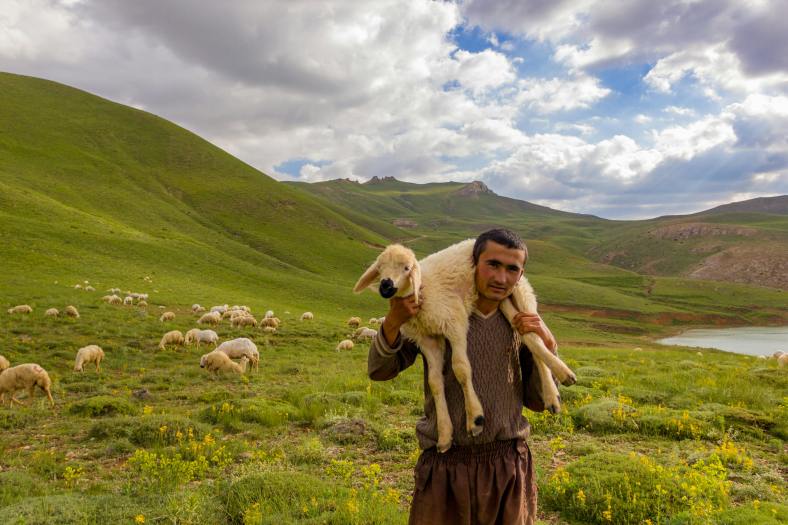
“Suppose a guy has a hundred sheep,” he said, “and one of them wanders off and gets lost.  “Won’t he leave the other ninety-nine in the wilderness to go search for the one that is lost until he finds it?  And when he finds it, he will joyfully carry it home on his shoulders.  And when he gets home, he will call all his friends and neighbors and say, ‘Rejoice with me because I have found my lost sheep!’  It’s like that.  There is more joy in heaven over one lost soul’s rescued life than over ninety-nine righteous people who don’t need rescuing.

“Or how about this—suppose a woman has ten silver coins on her necklace and she loses one.  Won’t she light a lamp and sweep the entire house and get down on her hands and knees to sweep under furniture and look in every nook and cranny until she finds it?  And when she does find it, she’ll call all her neighbors and friends and say, ‘Rejoice with me!  I’ve found my lost drachma!  It’s just like that!” said Jesus.  “There is joy and celebration among God’s angels when even one lost soul returns to God!”     

Now I am absolutely sure that some of the people listening to Jesus spin these hypotheticals were chuckling, and I am just as sure that some of them were scratching their heads because there is some obvious craziness in these little stories.  Leave ninety-nine sheep in the wilderness while you go off searching for one?  Who would do that?  And sheep don’t repent.  Coins don’t repent.  And is it really repentance?  The sheep didn’t do anything to help himself be found—he didn’t wander home all sheepish about being lost.  The silver coin didn’t roll itself across the floor to rejoin the other nine coins on the necklace. 

Or are these stories allegories maybe?  Is the shepherd God?  But does God leave ninety-nine obedient sheep at risk in the wilderness to go find the one that wandered off?  Maybe. But that does raise questions, especially if you’re one of the ninety-nine.  

So maybe God is like the reckless shepherd who puts everything at risk to find the one lost sheep.  Maybe God is like the woman who drops everything and lights a lamp and cleans house until she finds that one lost silver drachma.  Maybe.

Or maybe something else is going on here.  Sheep and coins don’t repent—at least not the way we usually understand repentance.  They don’t apologize.  They don’t have a change of mind or a change of heart.   

But what if Jesus is giving us a new definition of repentance?  What if repentance is not about clearing some kind of moral bar?  What if it’s not about moral rectitude or moral correction?  What if repentance is about being brought back to where you fit in God’s grand design, being brought back into the community and communion?  What if repentance is about crossing all those artificial barriers we put up between each other, those barriers that divide us into opposing camps?

Maybe repentance is about being brought back together.  Maybe it’s about reconnecting.[2]

That would explain this other thing.  Did you notice how many times Jesus mentions joy in these two little stories?  Five times!  The shepherd carries the sheep joyfully!  He calls out to his neighbors to rejoice with me!  Jesus says there is joy in heaven when a lost soul is reconnected with the community.  The woman who finds her lost coin calls out to her neighbors rejoice with me!  And once again, Jesus says there is joy in the presence of God’s angels when even one lost soul is reunited with companions.  It’s all about the joy!

Jesus wanted the Pharisees to understand that they were missing out on the joy!  He wanted them to understand that there is joy in making connections with people you might ordinarily be reluctant to associate with.  There is joy when we step out of our clique or private club of like-minded associates to go out and meet the wider world.  

Matt Harding is a guys who knows all about that joy.  

Matt was living the dream.  He was working as a Video Game Developer, creating new games for Activision, one of the biggest companies in the business.  He was kicking around ideas for a new game with his team one day, when somebody suggested, “Let’s do a ‘shoot-em-up’ game.  Those are very popular.”  Matt said sarcastically, “Sure.  How about Destroy all Humans?[3]  Matt was being facetious, but the boss liked the idea and gave the game a green light. And that’s when Matt quit.  “I didn’t want to spend two years of my life writing a game about killing everyone,” he said.  

Now Matt had time on his hands, and a fair bit of savings, so he decided to see the world. One day in Saigon, Matt was in kind of a goofy mood so he did this funny little dance in front of a restaurant, which his travel buddy caught on video.  It gave them a good laugh, so they decided that they would do this everywhere they were going on their trip around the world. 

When they got home, they cut together all these fun little clips to create a three minute video of Matt dancing in all kinds of interesting places all over the world.  And that would have been the end of it, except that Matt’s sister uploaded the video to this new thing on the internet called YouTube™.     

Dancing Matt became an internet phenomenon almost overnight.  So Matt decided to go out into the world and do it again, only this time he would invite people to dance with him.  And dance they did.  Over a period of about 15 years he recorded and posted six Dancing Matt videos which have brought joy to people all over the world.  You can find all of them at www.wheretheheckismatt.com

When NPR asked Matt what he had learned as he danced through the world, he said, “Here’s what I can report back: People want to feel connected to each other. They want to be heard and seen, and they’re curious to hear and see others from places far away.  

I share that impulse. It’s part of what drives me to travel.”

In her TED talk about Vulnerability, Brené Brown said, “A deep sense of love and belonging is an irreducible need of all people.  We are biologically, cognitively, physically, and spiritually wired to love, to be loved, and to belong.  When those needs are not met, we don’t function as we were meant to.  We break.  We fall apart.  We numb.  We ache.  We hurt others.  We get sick.”

Right now our country is in a grumbling mood…and so is much of the rest of the world. We are not functioning as we were meant to.  We have found too many ways to separate ourselves from each other.  We have turned too many people into “those people,” the ones we don’t want to be seen with.  As a result, we’re missing the joy.  We’re missing the celebration.

We need to repent, not with apologies or penance, but by reconnecting.  We need to find our way back into where we fit with each other in God’s grand design.  We need to find our way back into community and communion.  We need to bring ourselves back together.  And maybe even dance with strangers.  Because that’s where the joy is.


[1] CNN

[2] Special Thanks to Prof. Matt Skinner and Sermon Brainwave for this perspective.

[3] Destroy All Humans is in its 7th version and is available on multiple platforms.  Clearly there’s money in nihilism.
Entertaining Angels

Hebrews 13:1-2, 15-16; Luke 14:7-14

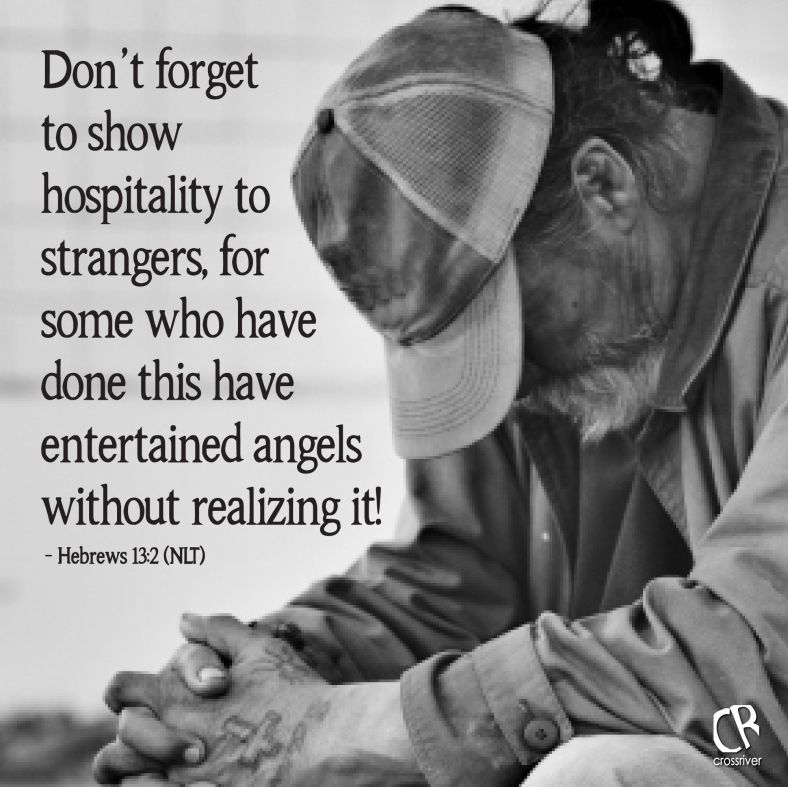
“Let mutual love continue.  Do not neglect to show hospitality to strangers, for by doing that some have entertained angels without knowing it.”  (Hebrews 13:1-2, NRSV)

“The next time you put on a dinner, don’t just invite your friends and family and rich neighbors, the kind of people who will return the favor.  Invite some people who never get invited out, the misfits from the wrong side of the tracks.”  (Luke 14:12, The Message)

Every time I read these texts I think of Eric.  Eric showed up one Sunday night when we were doing Stories, Songs and Supper at Gloria Dei Lutheran Church where I served as pastor for 12 years.  He stood at the church door and asked what was happening as he saw people gathering, greeting each other, laughing, and we told him, “It’s a thing we do called Stories, Songs, and Supper.  We share a meal then sing a bunch of old familiar songs, then someone tells a story, then we sing a little more.”  We invited him to come in and join us. So he did.

I was pretty sure he was unhoused, although to be fair, his clothes were neater and cleaner than most of the other unhoused people who came by the church.  Eric had a gift of gab and while we were eating he told us a bit about himself then told us that this dinner was special for him because it was his birthday.  So we all sang Happy Birthday to him.  After supper, he helped to clear the tables, then joined us in the sanctuary for the singing and storytelling.  

I was more than a little surprised when Eric showed up for our Adult Ed class the next Sunday morning and stayed for worship.  The following Saturday, he joined in with one of our small groups in the volunteer work we were doing with Lutheran Social Services.  

Eric kept showing up for just about everything we were doing at church and in almost no time he became an important part of our little family of faith at Gloria Dei.

 “Do not neglect to show hospitality to strangers,” Hebrews tells us, “for by doing that some have entertained angels without knowing it.”

Well,  Eric was no angel.  But then again, maybe he was.  In ancient times the word angelhad a double meaning.  It could refer to a supernatural being who served God, or it could simply mean a messenger.   Eric was, in and of himself, a message to us—a gift to us all at the little church with a big heart.

We learned a lot from Eric.  We learned a little about life on the streets.  We learned more than we wanted to know about our neighbors’ attitudes toward the unhoused.  We learned how the police and the justice system in our city respond to those who are experiencing homelessness.  We learned about our own attitudes toward those living rough.  Most of all, though, we experienced an energy and vitality that stayed with us for a long time after he left us.  All this because we welcomed one gregarious man into our party on his birthday.

“The next time you put on a dinner,” said Jesus,  “don’t just invite your friends and family and rich neighbors, the kind of people who will return the favor.  Invite some people who never get invited out, the misfits from the wrong side of the tracks.  You’ll be—and experience—a blessing. They won’t be able to return the favor, but the favor will be returned—oh, how it will be returned!—at the resurrection of God’s people.” (Luke 14:12-14, The Message

“You will be—and you will experience—a blessing.”  Eric taught us just how true that is.

Jesus loved sharing meals with people.  Think about all the stories in the gospels that involve eating!  Jesus distributed food to multitudes.  Jesus dined with Simon the Tanner and Zacchaeus.  And, of course, there was that last Passover meal with his disciples.  After the resurrection he broke bread with the Emmaus travelers and cooked fish on the beach for the disciples.  Jesus shared a table with Pharisees even though some Pharisees had criticized him for sharing a table with “the wrong kind of people.”  “This fellow eats with tax collectors and sinners!” they said. There are so many Jesus stories that revolve around eating that some have suggested that his primary work was organizing dinner parties.  

Sharing the table—issuing a wide and inclusive invitation—this was one of the ways Jesus embodied the commonwealth of God’s justice and kindness, the kin-dom of God. 

“The gospel,” said Rachel Held Evans, “doesn’t need a coalition devoted to keeping the wrong people out.  It needs a family of sinners, saved by grace, committed to tearing down the walls, throwing open the doors, and shouting, ‘Welcome!  There’s bread and wine.  Come eat with us and talk.’ This isn’t a kingdom for the worthy, it’s a kingdom for the hungry.”

In the earliest days of what we now think of as the Church, many—maybe most—groups of Jesus followers looked like and operated like dinner-party groups—they organized their fellowship and worship around sharing a table, and everyone brought what they could to the banquet.  We see hints of this in 1 Corinthians 11 when St. Paul chastises the Corinthians for bringing their divisions to the table, but even more sternly for failing to make sure that the have-nots were included in the celebration when the haves were feasting.

“When you meet together,” he wrote, “you are not really interested in the Lord’s Supper. For some of you hurry to eat your own meal without sharing with others. As a result, some go hungry while others get drunk.  What? Don’t you have your own homes for eating and drinking?  Or do you really want to disgrace God’s church and shame the poor? What am I supposed to say? Do you want me to praise you? Well, I certainly will not praise you for this!” (1 Cor 11:20-22, NLT)

The practice of early Christianity was centered around the table.  When it worked it was egalitarian, transformative, and beautiful.  When it didn’t, it descended into another bad example of classism.  But the evidence suggests that most of the time and in most places it worked.  

The table of Christ was the one place in their world where they were all equal.  It was the one place where it didn’t matter if you lived in a mansion or a shack or  sheltered under the eaves of the town hall.  It was the one place where it didn’t matter if you were a slave or a free person.  It was the one place where it didn’t matter if you were male or female—at least not in those earliest days of the Jesus communities.  

At the table of Christ, all were equal and all shared in what was brought to the supper—but most especially, all shared in the bread and the wine of Christ’s presence.

In his book The Forgotten Creed: Christianity’s Original Struggle against Bigotry, Slavery, and Sexism, Stephen J. Patterson has recovered what is believed to be the earliest baptismal creed of the Jesus movement:

“For you are all children of God in the Spirit.

There is no Jew or Greek,

there is no slave or free,

there is no male and female;

for you are all one in the Spirit.”

If that sounds familiar, it’s because St. Paul quotes this creed in his letter to the Galatians with a slight twist at the end.  Instead of saying “for you are all one in the Spirit,” Paul writes, “for you are all one in Christ Jesus.” (Galatians 3:28)

“The creed’s basic claim,” writes Patterson, “is that baptism exposes the follies by which most of us live, defined by the other, who we are not.  It declares the unreality of race, class, and gender: there is no Jew or Greek, no slave or free, no male and female.  We may not all be the same, but we are all one, each one a child of God.”  

In the weekly journal Journey With Jesus, Dan Clendenin described how his daughter’s friend wanted to invite everyone in her church to her wedding but the budget wouldn’t allow it.  So instead of having a fancy wedding meal for just a few family and close friends, they got the police to block off the main street in downtown Waco, Texas.  Guests danced in the streets and ate ice cream from a Baskin Robbins ice cream cart.  The wedding cake was under the gazebo in the park and they cut small pieces so everyone could get a taste.  The groom, a pastor, had worked a lot with unhoused people and many of them showed up for the wedding,  then helped to clean up the streets afterward.  The little African-American girl who lived next door to the bride brought her mother and her grandfather along to the wedding.  The grandfather quickly became the center of attention as he danced to the street music and soon the college girls were lining up to dance with him.  Passers-by strolling on the street were invited to join in the party.  And everyone was welcomed as an honored guest.

This is what the kingdom of God looks like.  A celebration that’s open to everyone.

It’s a family of sinners, saved by grace, tearing down the walls, throwing open the doors, and shouting, “Welcome!  There’s bread and wine.  Come eat with us and talk.

This is what the church of Jesus is supposed to be about:  radical hospitality.   

A kingdom for the hungry.

So let mutual love continue.  

And don’t forget to show hospitality to strangers.

Who knows… they just might be angels.

In, With, and Under

It’s a simple thing.  You take a bit of bread and a sip of wine.  But it’s not just bread and wine.  It is nutrition for the soul where spirit and matter intersect.  Christ is in the bread.  Christ is in the wine. You are taking Christ into yourself.  The body of Christ becomes your body and you become part of the body of Christ. The blood of Christ becomes your blood and your blood flows through the body of Christ. You are being empowered and equipped to be Christ’s hands and feet and eyes and ears, to speak Christ’s love and forgiveness and grace.  In that bit of bread and taste of wine you are united as one with all the others who have shared in this sacrament in every age. In that bit of bread and that taste of wine you are drawn back to that last supper that Jesus shared with his disciples.  In that bit of bread and taste of wine you are also being drawn into tomorrow.  

This is the eucharist, literally “the good gift,” the sacrament of communion.  This is the sacrament that signifies our unity as followers of Jesus.  And ironically, sadly, it has been the pivot point of many of Christianity’s most intense  disagreements. 

Over the centuries church leaders and theologians have excommunicated each other over their different understandings of just exactly how Jesus is present or if Jesus is present in that bit of bread and taste of wine.  Ulrich Zwingli, the Swiss reformer said that Christ isn’t really present.  The sacrament, he said, is only a “remembrance.”  Martin Luther insisted that Christ truly is present “in, with, and under” the bread and the wine.  Legend says he was so adamant about this that while arguing with Zwingli he carved it into a table top: “corpus meum est”—“this is my body.”   Luther and Zwingli excommunicated each other.  And the Pope excommunicated them both.  Calvin later said that Christ is present, but only spiritually.  No one was quite sure what to make of that.

And I think all of this makes Jesus weep.

One of the very first social boundaries that Jesus crossed was the boundary of table fellowship. The Pharisees criticized him roundly for it.  In their day, who you ate with was important. Table fellowship determined your social status.  It had implications beyond that.  In a culture where the ideas of “clean” and “unclean” or “acceptable” and “unacceptable” were important social constructs that could have serious implications for how your life was going to go,  who you shared a table with and who invited you to their table was a huge thing.  Dining with the right people could open doors and make your reputation.  Dining with the wrong people could close those doors and besmirch your name even if you had done nothing wrong.  So when the Pharisees talk about Jesus eating with tax collectors and sinners, it’s not a compliment; it’s an accusation.  But Jesus did it to make a point.  In the Commonwealth of God’s justice and kindness, everyone is welcome at the table.  In the kingdom of God everyone is “acceptable.”  Everyone.

On the night he was betrayed, even Judas was at the table.  Even his betrayer received the bread and wine.  Levi the tax collector sat beside Simon the Zealot.  Simon Peter the Galilean fisherman sat beside Thomas the builder.  They’re not mentioned by name, but it’s probably safe to assume that Mary Magdalene was there, and Joanna, and Mary, his mother.  The point is, there were people gathered around that table who might not have been acceptable in the “polite” company of the Pharisees, or maybe even in each other’s company if Jesus wasn’t there as their host.

When Jesus breaks the bread and begins to pass it around the table, I can’t help but wonder if he isn’t looking at the faces of all his friends as he says, “this is my body.”   Is he, maybe, thinking, “You—this eclectic group who would never in a million years have come together on your own, you all together, each of whom would be an outcast somewhere—you, this companionship—this is my body.  You people sharing this bread are the ones who will carry on my Christ-ness, my Christ presence in the world.  Take me into yourselves the way you take in the bread and the wine.  Take in my teaching, my way of being, my love, my spirit, my grace, my unity with God, my way of seeing—swallow me whole so you can be my hands and feet and voice, so I will still be present in the world.”

True faith is a continuing metanoia and metamorphosis, and God gives us examples in everyday life.  Seed is buried in the earth then sprouts up green to stand in the sun and ripen with heads of grain which are crushed and ground.  They change in form to become flour, which changes in form again when bound with water then changes in form yet again when baked to become bread.  

We come to the Way of Jesus as individuals.  As we take up the work of Christ we are changed in form.  Our habits, impulses and priorities change.  We are infused with the Holy Spirit. We are bound together in the water of baptism, then baked into a community through life and service together. 

This is my body.  For you.

That same night, we’re told in John’s gospel,  Jesus had washed their feet.  “You call me Teacher and Master,” he said.  “And you’re right, I am.  But if I, your Master and Teacher have washed your feet, you should wash one another’s feet.  And in case you’re a little slow on the uptake, what I’ve just done was to give you an example.  I want you to serve each other.  More than that, I want you to love each other.  I’m giving you a new commandment: you must love one another just as I have loved you.  That’s how people will know you’re my disciples—if you have love for one another.”

And these things, too, are in that bit of bread and that sip of wine.  

The call to serve is there—in, with and under the bread and the wine.   Love is there—in, with and under the bread and the wine.  Grace and forgiveness are there—in, with and under the bread and the wine. The Word of Creation is there—in, with and under the bread and the wine.  

Christ is there—in, with, and under the bread and wine—the way Christ is present in all of Creation.

Life in all its fullness is there in a bit of bread and a taste of wine if you open your heart and mind to take it in.

Body Language

John 6:51-58

“Very truly, I tell you,” said Jesus, “unless you eat the flesh of the Son of Man and drink his blood, you have no life in you.”  This is such graphic language.  Well, let’s be honest.  It’s more than graphic, it’s cannibalistic.  Eat my flesh?  Drink my blood?  It’s no wonder the Ioudaioi—those Jews who were challenging Jesus at every turn—it’s no wonder they found what he was saying confusing and even repulsive.  

Just to be clear, the word translated here as “flesh,” sarx in the Greek, essentially means meat.  And blood. . . well, blood is blood is blood and it is absolutely forbidden for an observant Jew to eat or drink it, or even to eat meat with the blood still in it.  “For the life of the flesh is in the blood,” says God in Leviticus, “and I have given it to you for making atonement for your lives on the altar, for, as life, it is the blood that makes atonement. Therefore I have said to the Israelites, ‘No person among you shall eat blood, nor shall any alien who resides among you eat blood.”[1]  That’s the rule for the blood of sheep and goats and cattle and every other animal, so for Jesus to tell people crowding around him that they need to eat his flesh and drink his blood would be beyond shocking.

So why does Jesus use such scandalous language here in the sixth chapter of John? 

The rhetoric of cannibalism had a long tradition in the ancient world because it was particularly effective for its shock value when someone really wanted to drive home a point. In the 26th chapter of Leviticus we find a series of blessings and curses that are a sort of codicil to the covenant between God and the people of Israel.  If the people remain faithful to the covenant,  God will make the land rich, the trees will yield plentiful fruit, enemies will be routed, the rains will fall in due season, and so on.  One of my favorite things God says here is “I will place my dwelling in your midst, and I shall not abhor you.”  Not exactly warm and fuzzy. 

On the flip side, the curses for breaking the covenant are pretty severe:  fields that don’t produce, famine, wild animals killing children and destroying the fields and vineyards, and finally the ultimate curse, being attacked by enemies and held under siege so that “you shall eat the flesh of your sons, and you shall eat the flesh of your daughters.”

Torah repeats the curse in Deuteronomy[2], and Jeremiah and Ezekiel both expand on the threat of cannibalism as a reminder to the people that being unfaithful to the covenant has penalties[3].  

The prophet Micah uses the rhetoric of cannibalism as a sharp polemic to chastise the unfaithful rulers of Judah and Israel:

Listen, you heads of Jacob

                  and rulers of the house of Israel!

         Should you not know justice?—

                  you who hate the good and love the evil,

         who tear the skin off my people

                  and the flesh off their bones,

         who eat the flesh of my people,

                  flay their skin off them,

         break their bones in pieces,

                  and chop them up like meat in a kettle,

                  like flesh in a caldron.[4]

Yikes.

The invective of cannibalism was common throughout the Greco-Roman world and was most commonly used to denounce treachery, betrayal, faithlessness, factionalism and threats to society.  Homer described the warriors arrayed against Troy as blood-thirsty predators.  Agamemnon’s vicious fighting style is compared to “wolves, who tear flesh raw” and  Achilles’ rage is so intense that he desires to cut up Hector’s flesh and eat it raw.  In a historically later example, Cicero vilified Mark Antony saying, “he gorged himself with the blood of citizens.”

The upshot of all this is that the people listening to Jesus have heard this kind of jargon before, but not the way Jesus is using it.  Jesus, here in chapter six of John, takes this all this unsavory language and subverts it—he reverses its direction.  Instead of a curse for breaking the covenant, eating his flesh and blood become the seal and sign of a new covenant with God through him.  Instead of being a threat of the worst kind of destruction, his flesh and blood bring the promise of eternal life. Instead of fearing the gruesome penalty for causing strife, divisions and factions in society, his followers will be bonded into a profound unity with him and with the Father, a unity so deep that “those who eat my flesh and drink my blood abide in me and I in them.”

When Jesus refers to himself as “the living bread that came down from heaven” then goes on to say “Whoever eats of this bread will live forever, and the bread that I will give is my flesh for the life of the world,” this is obviously sacramental language.   He is pointing to the cross, but also beyond the cross to the table of companionship and the eucharist that binds us to Christ and to each other.

When he describes himself as “the living bread come down from heaven” and asserts that he gives his flesh “for the life of the world,” he is claiming for himself the mystical descriptions of John’s prologue in the first chapter.  He is telling us that he is the Word who became flesh and lives among us.  He is telling us that he is the one in whom there is life, a life that is the light of all humanity.  He is, in short, telling us that he is the Cosmic Christ, the Word who was with God, the logos who brought all things into being.

Eli Lizorkin-Eyzenberg wrote, “[W]hen Jesus referred to his body and blood, he meant the bread and wine should become, in the minds and hearts of his followers, fully associated with him in the entire spectrum of his life – his person, his teachings and his works. In other words, Jesus expected to be fully understood and received through active participation by faith. By faith in Him, the believer would partake of salvation, which is found in Jesus alone and is offered freely to all. So let me summarize. Jesus’ statement about his body and blood is true and no other picture could have made it clearer. His flesh and his blood, meaning Jesus Himself – the whole Jesus – is the only thing that can sustain a human being to life everlasting.[5]

The central theme of the Gospel of John is incarnation, a word that literally means “in the flesh.”  Christ is the intersection, the nexus between the spiritual and invisible God and the visible material creation.  Jesus, as the Christ, is God’s declaration that God is present in, with, and under all of creation.  The bread and wine of communion is our reminder that Christ is present in, with, and under the everyday things of life that sustain us, that God in Christ is sustaining us and traveling through life with us.  “Those who eat my flesh and drink my blood abide in me and I in them,” said Jesus.

When we share the sacrament of the table, we are reminded that Jesus has bound us together to be the body of Christ, to carry the life that brings light to the world into the world for the life of the world.

 “Both Christ cosmically and Jesus personally make the unbelievable believable and the unthinkable desirable,” said Richard Rohr.  “Jesus Christ is a Sacrament of the Presence of God for the whole universe!”  Rohr went on to say, ““We must keep eating and drinking the Mystery, until one day it dawns on us, in an undefended moment, ‘My God, I really am what I eat! I also am the Body of Christ.’[6]


[1] Leviticus 17:11-12

[2] Deuteronomy 28:53ff

[3] Jeremiah 19:9; Ezekiel 5:10

[4] Micah 3:1-3

[5] Lizorkin-Eyzenberg, Eli. The Jewish Gospel of John: Discovering Jesus, King of All Israel, p. 97. Jewish Studies for Christians. Kindle Edition.

[6] Richard Rohr, The Universal Christ: How a Forgotten Reality Can Change Everything We See, Hope For and Believe

On the Feast of the Epiphany, 2017

On the Feast of the Epiphany, 2017

I sat down under the food court canopy

at the Big Box store

and paused before eating

the Big Box hotdog

which everyone agrees is the best of all hotdogs.

I paused to ask that it would be blessed to my body,

blessed and not cursed.

I paused to recall the Day of Diagnosis,

to think through once again the fat portfolio

of foods and ingredients I must no longer ingest,

to recite to myself the litany of

common, ordinary, everyday, ingredients

in all their varied and marvelous, delicious, featured or hidden forms

that my body now reacts to as if they are poison.

I paused to guesstimate how many

of my allergens, my demons,

might be in this Big Box hotdog.

I paused to calculate the risk.

I paused to think if there had been other recent

times when I had crossed the line

for I am allowed some small indulgences

once in awhile,

if I do not eat or drink too much,

if I first take the medicine that dulls the reaction,

if I use it sparingly,

only once in awhile

on a special occasion,

such as a Feast Day.

I was prepared.

I had not indulged in other forbidden fruit…

that I could recall, not to my awareness.

I had taken the medicine.

I was prepared.

And so was the hotdog:

one stripe of deli mustard, one stripe of ketchup,

a generous spill of perfectly cubed sweet onion,

warm and waiting in my hands,

an elegantly beautiful and aromatic still life.

The sausage stretched

beyond the snug embrace of its bun

and as the skin snapped

in the pressure of that first small bite

and flavors washed across my tongue

my eyes were opened

and I could taste and see the goodness

and in the goodness was remembrance.

I remembered my grandfather’s wheat fields in Kansas.

I remembered driving all night through the desert,

to get there in time to help with harvest.

I remembered wondering if the bread

in the sandwiches my mom packed in my lunch for school

maybe, just maybe, had some small taste of wheat from our farm.

I remembered when the corral by the barn was turned into a turkey pen.

I remembered the multitude of those fearsome beasts

—have you seen them up close when you’re only 4?—

milling about in angry close quarters

and me being sternly but unnecessarily warned

not to get too close.

I remember thinking my grandfather,

who I knew as a quiet and gentle man,

must also have a fearsome side

because those turkeys would give him

a wide circle of respect when he waded into their midst.

And I remembered thinking at the next Thanksgiving

as Mom put our turkey in the oven,

“I hope this is that big nasty gray one that followed me along the fence.”

And I remembered all the early morning milking

on my other grandfather’s dairy farm in Arkansas,

in the years before he and my uncle switched to beef cattle.

I remembered them hooking up the machines in the pre-dawn cold

to the cows that would take them

and milking the others by hand.

I remembered churning butter on the porch

from the cream we had skimmed that morning,

then later picking fresh sweet corn, tomatoes, okra and string beans.

I remembered feeling rooted to the land because everything on the table

came from the fields and garden around us.

And mindful of the flavors in my mouth I remembered other sacred meals.

I remembered eating an almost inedible chicken in the jungle in Colombia,

barely sheltered from the rain in a poor couple’s lean-to.

I remembered finding the will to be honestly grateful

for this god-awful chicken because to them it was the richest

gift of gratitude they could bestow. And I remembered

feeling so unworthy of that gratitude

because we had given them so little.

Some vitamins. Some antibiotics. A few sutures. Some sulfa powder.

A prayer. A little hope.

But the wound in the man’s leg had healed and he could work again.

So we were invited to share in a meal of their one and only chicken.

I remembered eating delicious, mysterious, robust greens in Tanzania,

greens cooked in oil, with a side of ubiquitous peanut butter and some bits of meat.

I remembered how the women of the clinic and the village

had worked for hours to prepare the meal,

how it was delicious and filling,

how a little went a long way.

I remembered how it seemed

both mysteriously wonderful and not mysterious in the least

that the boisterous crowd of us all fit around one small picnic table

and the whole night was lit by lanterns, starlight and laughter.

And I remembered sharing tortillas and rice and beans

with migrants in Tijuana

as they told me about the hazards of a life lived on two sides of the border,

of how hard it is to hold family together when your lives

are laid across borders, of how hard it is

to work and pay the bills when the work is on one side

and the family is on the other,

of how easy it is to end up on the wrong side because of a lapse in paperwork.

I remembered my soul being fed by their sadness and their tenacity

as we shared tortillas and beans and rice.

And I remembered, also in Tijuana,

my friend the surfer-priest pushing a bowl of mariscos soup away from him

because he saw a baby shark’s fin in it, saying “I made a deal with sharks.

I don’t eat them and they don’t eat me.”

And I remembered barbecued ribs shared with a brother

as our motorcycles cooled in the shade of giant redwoods.

I remembered the brewpub owner/entrepreneur

who gave us those ribs the night before and told us

to save themfor the redwoods, the same generous man

who took us into his home for the night

and treated us at his brewpub to the best jambalaya we had ever had,

who, next morning, set us on the road

with a breakfast of smoked salmon and kale smoothies,

who did all this so easily and casually

even though he didn’t know a thing about us

except that we were friends of his friend.

And I remembered

the overpriced New York airport hamburger split three ways in 1974,

and Cervelle au Beurre Noir in Paris,

and a hundred nights of gourmet meals in Boston,

and freeze-dried meals beside high Sierra lakes,

and Mexican food on the way to Death Valley,

and my Aunt Roberta’s fried chicken and fried okra,

and my Mom’s lutefisk and potatis korv at Christmas,

and my Dad’s prime rib and steak and lobster.

On the Feast of the Epiphany

Under the food court canopy of the Big Box store

I tasted and I saw

and there was remembrance

of flavors, and places, and persons.

I tasted and I saw the goodness.

I saw that the plastic table under the food court canopy

where I was mindful of each slow bite of my Big Box Hotdog,

this table anchored to its polished concrete floor

was sitting on the same earth as every table

or carpet or blanket or tent floor or towel or spot of ground,

where I have ever been fed.

I saw that my life has been

one continuous communion

at one great and continuous table

where the foods have been a memorable delight

whose flavors are still fresh on my tongue,

but the true sustenance was in the companions.

O taste and see. And remember.

In, With, and Under

It’s a simple thing.  You take a bit of bread and a taste of wine.  But it’s not just bread and wine.  You are told that Christ is in these things.  You are taking Christ into yourself.  In that bit of bread and that taste of wine you are drawn back to that original supper that Jesus shared with his disciples on the night he was betrayed.  In that bit of bread and taste of wine you are also being drawn into tomorrow.  You are being equipped to be Christ’s hands and feet and eyes and ears, to speak Christ’s love and forgiveness and grace.  In that bit of bread and taste of wine you are united as one with all the others who have shared in this sacrament in every age.

This is the eucharist, literally “the good gift,” the sacrament of communion.  This is the sacrament that signifies our unity as followers of Jesus.  And ironically, sadly, it has been the pivot point of many of Christianity’s most intense  disagreements. 

Over the centuries church leaders and theologians have excommunicated each other over their different understandings of just exactly how Jesus is present or if Jesus is present in that bit of bread and taste of wine.  Ulrich Zwingli, the Swiss reformer said that Christ isn’t really present.  The sacrament, he said, is only a “remembrance.”  Martin Luther insisted that Christ truly is present “in, with, and under” the bread and the wine.  Legend says he was so adamant about this that while arguing with Zwingli he carved it into a table top: “corpus meum est”—“this is my body.”   Luther and Zwingli excommunicated each other.  And the Pope excommunicated them both.  Calvin later said that Christ is present, but only spiritually.  No one was quite sure what to do with that.

And I think all of this makes Jesus weep.

One of the very first social boundaries that Jesus crossed was the boundary of table fellowship.  The Pharisees criticized him roundly for it.  In their day, who you ate with was important.  Table fellowship determined your social status.  It had implications beyond that.  In a culture where the ideas of “clean” and “unclean” or “acceptable” and “unacceptable” were important social constructs that could have serious implications for how your life was going to go,  who you shared a table with and who invited you to their table was a huge thing.  Dining with the right people could open doors and make your reputation.  Dining with the wrong people could close those doors and besmirch your name even if you had done nothing wrong.  So when the Pharisees talk about Jesus eating with tax collectors and sinners, it’s not a compliment.  But Jesus did it to make a point.  In the kingdom of God everyone is welcome at the table.  In the kingdom of God everyone is “acceptable.”  Everyone.

On the night he was betrayed, even Judas was at the table.  Even his betrayer received the bread and wine.  Levi the tax collector was there.  So was Simon Peter the Galilean fisherman and Simon the Zealot.  They’re not mentioned by name, but it’s probably safe to assume that Mary Magdalene was there, and Joanna, and Mary, his mother.  The point is, there were people gathered around that table who we know would not have been acceptable in the “polite” company of the Pharisees.

When Jesus breaks the bread and begins to pass it around the table, I can’t help but wonder if he is looking at the faces of his friends as he says, “this is my body.”   Is he, maybe, thinking, “You—this eclectic group who would never in a million years have come together on your own, you all together, each of whom would be an outcast somewhere—you, this companionship, is my body.  You people sharing this bread are the ones who will carry on my Christ-ness, my Christ presence in the world.  Take me into yourselves the way you take in the bread and the wine.  My teaching, my way of being, my love, my grace, my way of seeing—swallow me whole so you can be my hands and feet and voice, so I will still be present in the world.”

Grains of wheat or barley are crushed and ground.  They change in form to become flour, which changes in form again when bound with water then baked to become bread.  

Individuals who learn the Way of Jesus together and work together in the work of Christ are changed in form.  Their habits, impulses and priorities change.  They are infused with the Holy Spirit. They’re bound together in the water of baptism, then baked into a community through life and service together. 

This is my body.  For you.

That same night, we’re told in John’s gospel,  Jesus had washed their feet.  “You call me Teacher and Master,” he said.  “And you’re right, I am.  But if I, your Master and Teacher have washed your feet, you should wash one another’s feet.  And in case you’re a little slow on the uptake, what I’ve just done was to give you an example.  I want you to serve each other.  More than that, I want you to love each other.  I’m giving you a new commandment: you must love one another just as I have loved you.  That’s how people will know you’re my disciples—if you have love for one another.”

And these things, too, are in that bit of bread and that taste of wine.  

The call to serve is there, in, with and under the bread and the wine.   

Love is there, in, with and under the bread and the wine.  

Grace and forgiveness are there, in, with and under the bread and the wine.  

The Word of Creation is there, in, with and under the bread and the wine.  

Christ is there, in, with, and under the bread and wine—the way Christ is present in all of Creation.

All of that in a bit of bread and a taste of wine if you open your heart to take it in.

Betrayed- A Maundy Thursday Meditation

“It is easier to forgive an enemy than to forgive a friend.” ― William Blake

Betrayed. It’s such a gut-wrenching word, isn’t it? Betrayed. Just to say it, just to read it can open up that aching hollow in the pit of your stomach, can make the room tilt, can dim the light and warmth of the brightest day. I don’t know anyone who hasn’t felt it at one time or another.

Betrayed. The word can conjure up faces you haven’t thought of in years, or bring to mind places and events you thought were long ago laid to rest. It can test your claims of forgiveness. Betrayal cannot happen unless first there is trust. It is, by definition, a breach of trust.

For I received from the Lord what I also handed on to you, that the Lord Jesus on the night when he was betrayed took a loaf of bread, and when he had given thanks, he broke it and said, “This is my body that is for you. Do this in remembrance of me.” –1 Corinthians 11:23-24

We hear these words every week in the Words of Institution. I was taught in Confirmation, and the lesson was repeated in seminary, that the most important words here are the words for you. That’s what Martin Luther said: the most important words we hear as we receive the sacrament are the words for you. I’m certainly not going to argue with that. I believe that every time we receive the sacrament we are having a powerful encounter with Christ. I think that’s happening on both a personal level and on a community level. The you is both singular and plural, although in the Greek text it is decidedly plural, all y’all.

Lately, however, the word in the Words that gives me pause is the word betrayed. On the night he was betrayed. I find it remarkable that, knowing everything that was about to happen, knowing that a friend who had followed him, listened to his teaching, watched him perform miracles, a friend who had travelled with him, camped with him and broken bread with him was leaving the room to betray him, to arrange for his death—knowing all this, Jesus still took the time and energy to give his followers, to give us, a gift.

I can’t help but think that this betrayal was very much on his mind when he picked up that piece of Passover bread and transformed its meaning with the words, “This is my body.” This is my body that is even now being betrayed. This is my body that will suffer in ways you won’t want to remember. So when you see that suffering and your mind reels, bring your staggering thoughts back to this bread. Think of how it takes life to sustain life. Think of how the wheat gives its all, its stalk cut off at the ground, its long stem, once supple and green, desiccated into sun-bleached straw, its nutritious seeds ground to powder, all to sustain your life. Think of how it is transformed into a loaf, a thing that bears no resemblance to what it was except by its flavor. Think of how in that new form it can serve many whereas when it was a single seed it was not even enough to meet the needs of one. Think of how in passing through the oven its ordeal of baking fills the room with one of the most restful, restorative fragrances known to humankind. Think of how there is redemption and new life in its pain.

Pain is the French word for bread. It is a strange quirk of our languages and there is no clear etymological connection, but I think of it almost every time I serve communion. Pain is bread. Bread is pain. It’s pronounced differently than our English word pain—more like pan—but even knowing that there is no clear linguistic relationship between French pain and English pain, my mind and heart refuse to accept that it is mere coincidence or accident that pain means bread.

The bread that heals us is pain. It is the pain of betrayal. It is the pain of humiliation. It is the pain of physical ordeal. For you. For me. For us. It is a pain to end all pain, eventually. A pain to make us cling to each other and make us vow that we will do whatever we can to save anyone, everyone, else from ever having to endure such pain again.