Fleshing Out the Story

Could it be the most important idea in history?

John 1:1-18

I deeply and truly love Christmas, but the sheer enormity of it is almost overwhelming   I’m not talking about all the shopping or all the hustle and bustle and preparation at home and at church.  I’m not even grumbling about the over-the-top commercialism or all the different greeting card interpretations of the “true meaning of Christmas” which can put you in a psychological sugar coma if you try to swallow them all at once.   

The thing that is almost overwhelming for me is the daunting task of trying to convey the real true meaning of Christmas, the task of sharing a genuine and meaningful understanding of The Incarnation, the theological claim that Saint Francis thought was the most important doctrine of the church—the mind-stretching assertion that the mystery we call God, the Maker of Everything, came to us as one of us—the idea that God “became flesh and lived among us” from gestation to birth to death as a particular person in a particular place and in a particular time so that we could begin to more fully understand that God is with us in all persons, in all creatures, in all creation, and at all times.

That thought, that idea, that reality that we call The Incarnation is so enormous and mind-boggling that it’s really tempting to retreat into the less cosmic halo of ideas that hover around that manger in Bethlehem, ideas like innocence and love personified and new beginnings.  Those are all good, true and valuable things.  They are meaningful parts of the package.  But the goodness, truth, new beginnings and love we see in that holy child become even more potent when we begin to truly understand what God is doing in that manger in Bethlehem.

When the early followers of Jesus began to write down their understanding of who Jesus was and what he was about, when they began to explain what meant to them and what they meant when they called him Christ—Christos—the anointed one, it’s clear that they saw him as something more than just a great spiritual teacher or religious leader.   You don’t have to read very far in these early writings to discover that these followers of Jesus thought there was something of cosmic importance about him.  Early on they called him the Son of God but that description didn’t seem to be enough for many of them.  It didn’t seem to fully capture the all-encompassing  fullness of what they had experienced in Jesus the Christ.  

“He is the reflection of God’s glory and the exact imprint of God’s very being, and he sustains all things by his powerful word,” said the writer of Hebrews.[1]  “He is the image of the invisible God, the firstborn of creation,” said the author of Colossians, “for in him all things in heaven and on earth were created, things visible and invisible…all things have been created through him and for him…for in him all the fullness of God was pleased to dwell, and through him God was pleased to reconcile to himself all things, whether on earth or in heaven…”[2]

Late in the first century, a writer we’ve come to know as John sat down to write his account of Jesus.  He wasn’t interested in creating just another chronicle of the life of Jesus as others had done; he wanted to explore the meaning of Jesus.  He wanted to make it clear that Jesus the Christ was not someone who could be defined, contained or constrained by geography or time or even philosophy, because the God of all geography and time and philosophy was and is somehow present in him.  

John began his gospel like this:

In the beginning was the Word, and the Word was with God, and the Word was God.  He was in the beginning with God.  All things came into being through him, and without him not one thing came into being. What has come into being in him was life, and that life was the light of all humanity.  The light shines on in the darkness, and the darkness has not understood it…. And the Word became flesh and lived among us, and we gazed on his glory, glory as of the only Son from the Father, full of grace and truth.

The language of this prologue is pure poetry.  But it’s also philosophy.  And in a strange, farsighted way, John was brushing up against physics. 

The Greek word we translate as “Word” is logos.  Logos was a word that ancient philosophers loved to play with and because of that we have numerous ways to translate it.  One of the oldest meanings of logos was story or narrative.  Where does your mind go if you hear In the beginning was the story, and the story became flesh and lived among us?  

Logos could also mean content or reason or statement.  Other philosophical meanings included, orderideablueprintprimordial templateprimal thought, or intention.  

Logos became flesh and lived among us.  The metaphysical became physical.  If that sounds too esoteric, consider quantum physics. 

 Energy moves through quantum fields as abstract mathematical wave functions.  When wave functions are observed, they tend to collapse into particles.  Particles continually move through patterns in a kind of quantum dance, always moving toward closeness, joining, partnering, combining.  Fermions dance with bosons.  Neutrinos, muons, gluons, leptons and quarks assemble themselves into protons, neutrons and electrons which assemble themselves into atoms which assemble themselves into molecules we call elements.  Hydrogen and carbon molecules dance together to form the four essential organic compounds: nucleic acids, proteins, lipids and carbohydrates.  And out of all of this comes life.  The Word, the Story, the Pattern, the Intention, the Thought becomes flesh and dwells among us.  

The great British astrophysicist James Jeans wrote: “The universe begins to look more like a great thought than a great machine.  Mind no longer appears as an accidental intruder into the field of matter; we are beginning to suspect that we ought rather to hail it as a creator and governor of the realm of matter… We discover that the universe shows evidence of a designing or controlling power that has something in common with our own minds.”[3]

This is The Incarnation.  The great Thought of God expressed in the whole universe condensed itself into a singular human life and lived among us.  And why would God do that?  

Love.

Pierre Teilhard de Chardin saw love as the driving force of the universe. “For Teilhard, love is a passionate force at the heart of the Big Bang universe, the fire that breathes life into matter and unifies elements center to center; love is deeply embedded in the cosmos, a ‘cosmological force.’”[4]

God is Love, we read in 1 John.  “God is love, and those who abide in love abide in God, and God abides in them.”

Love became flesh and lived among us.  And still lives among us.  And within us.  And around us.  And beyond us.  

Love…God… was not content to be an abstract idea or a mere sentiment.  God, the Author of Life, the One in whom we live and move and have our being is Love with a capital L.  Love Personified…and Love is all about relationship.  Christmas is when God, the Love that founded the universe, showed up as one of us in order to show us in person just how much we are loved and in order to teach us to love each other more freely and completely. 

Love became flesh and lived among us so that we might learn to love God with all our heart, mind, soul and strength and love our neighbors as ourselves. 

Love didn’t come to us as a king or potentate to lord it over us.  Love came as a poor baby among a poor and oppressed people far from the centers of privilege and power in order to show us that “the fire that breathes life into matter and unifies elements center to center,” is alive in and breathing life into all of us and wants to unify us with each other center to center and heart to heart.  

It’s an enormous idea, this thing called Christmas, this Incarnation.  This idea that the Word became flesh encompasses everything we see and everything we don’t see.  It speaks in poetry then carries us into the depths of philosophy and physics and biology.  It warms the heart and boggles the mind.  It is, quite literally everything.  And the beating heart of it is love.

To even begin to understand the Incarnation, we have to open our minds and our hearts.  As another early follower of Jesus wrote: “I pray that you may have the power to comprehend, with all the saints, what is the breadth and length and height and depth, and to know the love of Christ that surpasses knowledge, so that you may be filled with all the fullness of God.”[5]

Merry Christmas


[1] Hebrews 1:3

[2] Colossians 1:15

[3] James Jeans, The Mysterious Universe, as quoted by Ilia Delio, The Unbearable Wholeness of Being, p. 40

[4] Ilia Delio, ibid., p.43

[5] Ephesians 3:18-19
Our Down To Earth God

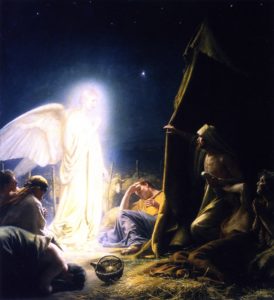
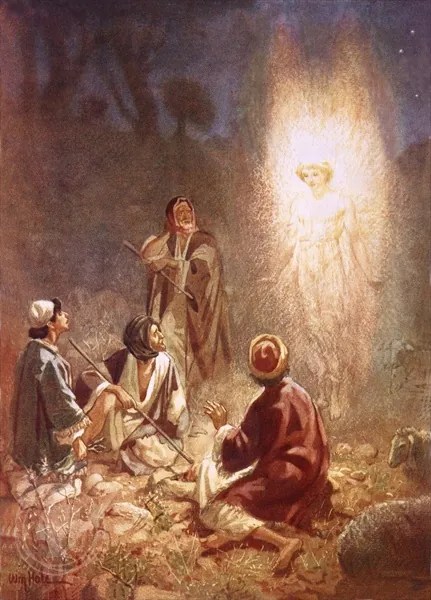
Then an angel of the Lord stood before them, and the glory of the Lord shone around them, and they were terrified. –Luke 2:9 (NRSV)

It’s funny how you can look at something a hundred times or more and then one day someone will point out something you hadn’t noticed and the whole thing looks different to you.  That happened to me a few years ago when a colleague pointed out one simple word in Luke’s Christmas story that had always just flown right by me.

Stood.  That was the word.  Stood.

The angel stood before them.  On the ground.

In all the years of reading or hearing this Christmas story I had always imagined this angel and the multitude of the heavenly host hovering in the air.  I think the Christmas carols taught us to picture it that way.  Angels we have heard on high.  It came upon a midnight clear, that glorious song of old, from angels bending near the earth.  

But that’s not what it says in the Gospel of Luke.  The angel stood before them.

If you were a shepherd in a field on a dark night, it would be pretty unsettling to have an angel appear in the air above you making announcements, but at least if the angel is in the air there’s some distance between you—a separation between your environment and the angel’s.  But if the angel suddenly appears standing in front of you, standing on the same ground you’re standing on, shining with the glory of the heavens… well I think my knees would turn to rubber.  And then imagine what it feels like when the whole multitude of the heavenly host is suddenly surrounding you and singing Glory to God.

Angels in the air feels slightly safer than angels on the ground.  Slightly.  If the angels are above, that means that they came from above.  It means that heaven is “up there” somewhere.  It doesn’t mess with the way we understand the spiritual cosmos.  But if the angels appear standing in front of us or behind us or around us, what does that say about heaven?  Could it be that heaven, the dwelling place of God and the angels, is not just “up there” but also here, with us?  Around us?  Could it mean that the angels of God are standing near us all the time and they simply choose not to show themselves?  Or that we’re just blind to their presence? Could it mean that this ground we walk on and build on and live on is also part of the dwelling place of God—so holy ground?

The angels didn’t bend near the earth.  They stood on it.  

We have this tendency, we humans, to want to separate the material from the spiritual, the divine from the physical.  We are such binary, black and white thinkers in a universe that’s full of colors and shades of gray.  We want here to be here and there to be there.  We want to put borders even on the oceans and talk about territorial waters!  We want to draw a clear and well defended line between our country and the country next door.  So it’s not surprising that we’ve assumed that there is a border between heaven and earth.

We seem to be most comfortable when there’s a little distance between us and angels, a little distance between us and God.  That seems to be the way most people talk about it, anyway.  “Put in a good word with the man upstairs,” they say.  And then there’s that song: “God is watching from a distance.” 

But that’s not what Christianity says.  That’s not what Christmas says.  The Word became flesh and lived among us, and we have seen his glory, the glory as of a father’s only son, full of grace and truth.  In him the fullness of God was pleased to dwell.  Not from a distance, but right in front of us.  With us.  As one of us.

We have trouble seeing the presence of God, seeing Christ in creation.  We have trouble seeing Christ in each other.  We even have trouble understanding Christ in Jesus.  How can Jesus be both divine and human?  We struggle to wrap our minds around that idea, so we have a tendency to make him either all human or all divine.  We picture that baby in the manger with a halo, and it doesn’t cross our minds that he might need to breastfeed and be burped and he might need his diapers changed.

Christmas, the mystery of the incarnation, tells us that God is not a bearded old man watching us from the clouds, a deity who is willing to give us what we ask if we are really good or strike us down with a thunderbolt if we’re bad.  That’s not God.  That’s Santa Claus.  Or Zeus.   

God, the Author of Life, the One in whom we live and move and have our being is Love with a capital L.  Love Personified.  And Love is all about relationship.  Christmas is when God, the Love that created the universe, showed up as one of us in order to show us in person just how much we are loved and in order to teach us to how to love each other more freely and completely. 

“We need to see the mystery of incarnation in one ordinary concrete moment,” wrote Richard Rohr, “and struggle with, fight, resist, and fall in love with it there. What is true in one particular place finally universalizes and ends up being true everywhere.”  In other words, God is present everywhere, in, with, and under everything.  Including you.  And me.  And all those people we’re inclined not to like. But to really grasp this idea, we need to first see God fully present in one particular person.  We need to see God in this particular baby.  This human baby

That, in the end, is what Christmas, the incarnation, is trying to tell us.  Christmas is God’s way of teaching us that there never really was any distance between heaven and earth, between the divine and the human, between the spiritual and the material.  Christmas is God proving once again that Christ is in, with, and under all the things—all things—including all the things we think we oversee and all the things we overlook.  Christmas is angels standing on the earth singing to shepherds and surrounding them with the glory of the Lord to remind them that they, too, are spiritual beings immersed in a human experience.  

Christmas is God’s love made visible.  Pope Francis said, “What is God’s love? It is not something vague, some generic feeling. God’s love has a name and a face: Jesus Christ, Jesus.”  I would add that, if you open your heart and your mind to it, God’s love can have your face, too.

Love is vulnerable—and what’s more vulnerable than a baby?  God comes to us as a baby because it’s easy to love a baby.  It’s easy to be vulnerable with a vulnerable infant.

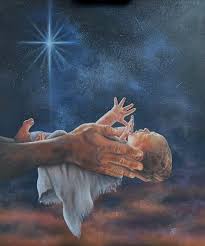
Christmas is homey and concrete and vulnerable.  It enters the world surrounded by the earthy aromas of animals.  It needs to be fed at a mother’s breast.  It needs its diapers changed.  It cries when it’s hungry and shivers when it’s cold.  It spits up a little bit on your shoulder.  It looks out at the world with brand new eyes and tries to see and understand what it sees.  Most of all, it reaches out to be picked up and held close to your heart.  Christmas wants to be loved and to give love.  

Christmas is our down-to-earth God made manifest.  Yes, gloria in excelsis deo, glory to God in the highest, but glory, too, to God on earth where the angels stand to sing to shepherds, because the Spirit of God is in them, too, and God loves them like crazy.  Just like God loves you.

My prayer for you this Christmas is that you would enter deeply into the concrete, down-to-earth, human and divine mystery of incarnation.  May your eyes and ears be opened to the angels who stand upon the earth and minister to all God’s children.  May you come to see Christ incarnate, permeating all creation.  May you come to see that you are always and everywhere standing on holy ground.  May you dispense with artificial borders in your heart, in your mind, and in this lovely world.  And may you come to see yourself and all the others who share this world with you as spiritual beings immersed in a human experience.  Most of all, though, may you know that you are loved. 

May Christ be born anew in your heart this day and every day.  In Jesus’ name.

Tonight’s the Night the World Begins Again

Christmas Eve 

I’ve been thinking about some Christmas  gifts…and by that I mean some of the gifts that Christmas gives us.

It is the season of giving, after all – and yes, it’s over-commercialized—but in the right spirit even that can help us develop a habit and spirit of generosity.  And that is a gift.

The months leading up to Christmas are a good time to practice delayed gratification.  Don’t buy that now…Christmas is coming.   I know I need to practice that a lot more than I do.  So that’s a gift.

For some it’s a change of habit just to be thinking about what to get for other people, thinking more about others—who they are, what they need, what they would like.  It can feel like an obligation but again, with the right frame of mind it can become a healthy, joyful, even life-giving habit.  That’s a gift.

At Christmastime we are intentional about asking people what they want.  That’s an excellent exercise that can help us learn not to be “curved in upon the self.” So, that’s a gift, too.

Christmas, itself, is a gift.  It’s a change of focus.  It comes with some built-in themes that are important.  Giving.  Receiving.  Gathering.  Family.  Peace.  Hope.  Joy.  Love.  Remembering.  Birth.  The Presence of God.  Wonder.

I don’t know about you, but I  really need the gift of Christmas, itself, this year.  It’s been that kind of year.  

I need to be reminded to stop and breathe and think about giving and receiving and gathering and family.  I need time to stop and remember.

I need to let words like hope and peace and light fill up my soul for awhile.  

I need a time to stop and listen to songs about beauty and joy and angels and promises fulfilled…and God showing up in surprising ways and surprising places.

I need the wonder of it all.

I need the songs.  That might sound strange for me to say since I can’t really hear them anymore, but I remember them—every note every word and even the harmonies. I may not hear them with my ears anymore, but I hear them perfectly in my mind and in my heart.  And I need the songs and carols… because the music that still lives in my heart heals me.  It rekindles my hope and my joy and my faith  faster than words alone can ever do.  “Those who sing pray twice,” said Martin Luther.  

Do you have a favorite Christmas song or carol?  Is there one—or maybe there are several?—that touch you in some particularly powerful way?

There are a lot of Christmas songs and carols that I dearly love and I listen to them over and over and over again.  But there’s one Christmas song in particular I keep coming back to these past few Christmases. And this year, especially, I’ve been listening to it—thinking about it—a lot.  In fact I’ve been listening to it off and on all year long.

It’s twenty years old now—it came out in 2005, but by Christmas Song standards it’s almost brand new.  It’s called Better Days by the Goo Goo Dolls, written by John Rzeznik.  Yeah, I know.  Goo Goo Dolls.  Silly name, but a great band.  And a powerful song.  Listen to these words:

And you asked me what I want this year

And I try to make this kind and clear

Just a chance that maybe we’ll find better days

‘Cause I don’t need boxes wrapped in strings

And designer love and empty things

Just a chance that maybe we’ll find better days

Better days.  When all is said and done, isn’t that what we all want?  For ourselves, for our families and friends?  For….  Everyone?  Better days.   

I need some place simple where we could live

And something only you can give

And that’s faith and trust and peace while we’re alive

Those are some pretty good gifts we can give to each other.  For Christmas.  For every day.  And the song is right… we will only have faith and trust and peace while we’re alive if we give those things to each other.  Faith.  Trust.  Peace.  But the song knows we need something else if we’re going to be able to give each other faith and trust and peace…

And the one poor child who saved this world

And there’s ten million more who probably could

If we all just stopped and said a prayer for them

The one poor child who saved this world.  That’s why we’re here tonight.  That’s what we’re here to celebrate.  But we’re also here to be reminded that because of that child, Jesus, Emmanuel, God With Us, we have the example and the power to save the world together.  God came in person to give us what we need so we can give each other the gifts of faith and trust and peace.  

I wish everyone was loved tonight

And we could somehow stop this endless fight

Just a chance that maybe we’ll find better days

The thing is, everyone is loved tonight—loved by God, at least.  But they don’t all know it and they certainly don’t all feel it.  If they did, if they all felt loved, if we all felt loved, maybe it would stop the endless fight that seems to be the curse of the human race.  But the only way for that to happen is if we take the love that God gives us and let it be real and meaningful and visible in our lives.  And then give it to each other in real and meaningful and visible ways.  

Brené Brown said,  “Jesus comes to show us what love looks like.  God is love.  But God knows that if God just comes down and says I am love and I want you to love each other, we’re going to go straight to hearts and unicorns.  We know it’s difficult and we don’t like difficult, so we’re going to romanticize it.  Hearts and unicorns.  But love is difficult.  So Jesus comes to show us how to do it.  He comes to show us that love doesn’t tolerate shaming.  Love doesn’t exclude people because they’re different.  Love reaches out and touches and embraces all the people we don’t want to touch or embrace. Love does the hard work.  Love does the hard things.”

But there’s something else that God shows us about love by coming as a baby, by coming, especially, as a poor baby.  Right at the beginning—Jesus shows us, God shows us, that love is willing to be vulnerable.  Love is willing to let down all its defenses.  

When you think of all the ways that God could have come to us–all the ways we imagined throughout history that God would come to us—most of that imagery is all about power and royalty and thunder and smoke and lightning.  But then God shows up as a baby.  A poor baby.  In a poor country.  A homeless baby.  A migrant born on the road on a journey his parents were forced to take.  A refugee baby forced to flee for his life.

One poor child who saved the world.   

I haven’t told you the refrain that runs through the song yet.  It’s repeated twice between the verses, but the song ends with it, too.  It’s both a promise and a call to action:

So take these words and sing out loud

‘Cause everyone is forgiven now

‘Cause tonight’s the night the world begins again

Take these words and sing out loud.  That’s the call to action.  

‘Cause everyone is forgiven now.  That’s the promise. It’s also another great gift of Christmas.  In this baby, who is God With Us, we are given a chance to start over with a clean slate. 

In this baby, who is love itself coming to us in its most human and dependent and vulnerable form, we can find forgiveness and we can learn to give forgiveness— and if we can forgive and be forgiven, if we can let go of old hurts and forgive others, then we really can give each other the gifts of faith and trust and peace while we’re alive.  And then there really is a chance that maybe we’ll find better days.

So take these words and sing out loud, 

‘Cause everyone is forgiven now.

And tonight’s the night the world begins again.

Tonight’s the night the world begins again.

What’s In A Name?

Matthew 1:18-25

She will bear a son, and you are to name him Jesus, for he will save his people from their sins. – Matthew 1:21

In Act II, scene II of Romeo and Juliet, Juliet is on the balcony lamenting the long-running feud between her family, the Capulets, and Romeo’s family, the Montagues.  Some ancient grudge that no one remembers keeps the two families at each other’s throats.  If you are born a Montague, any Capulet is your enemy.  And vice versa.  Their names are at war.  So Juliet, mooning over Romeo, protests to the night air:

‘Tis but thy name that is my enemy;

Thou art thyself, though not a Montague.

What’s Montague?  it is nor hand, nor foot,

Nor arm, nor face, nor any other part

Belonging to a man.  O, be some other name!

What’s in a name? that which we call a rose

By any other name would smell as sweet;

In one sense, of course, Juliet is absolutely right.  If you took away their warring surnames they would still be basically the same people—a couple of infatuated adolescents making bad decisions.  

In another sense, though, she’s absolutely wrong.  A rose by any other name might smell as sweet, but its name has power.  If I ask you to imagine a flower, you might imagine a daisy or a carnation or any number of other flowers.  But if I ask you to imagine a rose, you will not only see a rose in your mind’s eye, you might even smell its fragrance.  Names have power.

Do you have a nickname?  Most of the time—certainly not always—but most of the time we’re kind of fond of our nicknames.  A good nickname is a kind of gift.  You can’t make up your own nickname.  You really can’t even ask for one.  Nicknames just sort of happen, organically, or spontaneously.  One day friends or family just start calling you Goober or Dobie or Winkie or Duke and it just sort of sticks.

Nicknames are often descriptive in some way or have a story behind them.  And very often the use of that nickname is reserved for a certain circle of people.

My sister has a nickname.  It’s the name we in the family have always called her, in fact I sometimes have to think twice to remember her actual name.  All her close friends from high school and college know her by that nickname, but everybody else just knows her given name.  Her business name.  Not too long ago she was Facetiming with her best friend from high school and one of her work colleagues overheard her friend call my sister by her nickname.  The colleague said, “Oh!  That’s a great nickname!  I’m going to call you that from now on.”   This left my sister in a quandary.  On the one hand, she likes this colleague well enough, but on the other hand, she’s not “that kind of friend.”  She’s not part of the circle that uses that name.  That nickname belongs to a particular group of people from a particular time in her life.  That nickname belongs to family and certain long-standing friendships that are basically extended family.

Names don’t just label us as individuals, they can also socially locate us.  They carry context.  My dad, for instance, was known to everyone in his work life and social life as John or J.B.  But his brothers and sisters and all his nieces and nephews called him Norman or Uncle Norman.  He was always known by his middle name among family and among all the people who lived in the rural area of the Ozarks where he grew up.  But the military and the government and the business world don’t make allowances for people who are known by their middle names.  All the standard forms that you have to fill out at one time or another ask for first name and middle initial.  Those forms essentially renamed my dad.  In doing so, they not only changed his official identity, they changed his self-understanding.

The names people use for us can shape us.  They say something about how we relate to each other, about who we are and what we do in the world.   My wife’s students call her Dr. B.  Her grandsons call her Nani.  Same person, different roles, different contexts.  

Titles are something like nicknames.  If I talk about Professor Studious or Doctor Pokenprobe or Senator Foghorn or Judge Fairheart,  for instance, their titles immediately tell you something about them.  If nothing else, you know something about their role and function in society.  It’s interesting that both officially and in common practice, the title becomes attached to the name and can even function as the name.   

Messiah is a title.  So is Christ—and let’s be clear, Christ is not Jesus’ last name.  Originally Messiah and Christ meant the same thing.  Anointed.  Messiah is Hebrew and Christ is Greek.  

Some of the oldest Greek manuscripts of Mathew 1:18 read, “This is how the birth of Messiah happened…”  These older manuscripts don’t include the name of Jesus at this point, but everyone understood that Jesus is who the writer was talking about.  Ever since Peter’s confession, those who followed Jesus knew him as Messiah or Christ.  The Messiah, the Christ, is Jesus.  When Matthew introduces this story with the title of Christ or Messiah he is not only telling us that this is a story about the birth of Jesus, but that it’s also a story about God’s mission in the world through the person of Jesus and those around him.  It’s a story of how God works through people like us—people with doubts, fears, misgivings, but also hope and grace and a willingness to trust, even if it means suspending disbelief to believe the unbelievable.  The name Messiah, Christ, carries all that weight.

This is how the birth of Messiah happened.  Mary was betrothed to Joseph.  It was named a betrothal, but it was in fact a marriage.  It just hadn’t been consummated yet.  “But before they came together,” Matthew tells us,  “she was found to have a child in her womb from the Holy Spirit.”  Mary is pregnant but she’s a virgin.  And that circumstance gave her a new name.  She will be known forever as Virgin Mary, and just saying her name brings the whole birth story of Jesus to mind.

Because the marriage isn’t consummated, Joseph plans to divorce her quietly and privately so as not to expose her to all the cruelty, ridicule and meanness that she might experience if he were to denounce her publicly.  Certainly it’s his right in these circumstance to shame her and her family along with her—that would be regarded as perfectly righteous and just according to their law, tradition, and culture.  According to the law, she could even be stoned to death—although that was almost never actually done.  But Matthew tells us that Joseph is a just man.  A righteous man.  And now Joseph has another name:  Joseph the Just.  Fortunately for both Mary and Jesus, Joseph understands that there is more to being just and righteous than simply adhering to the letter of the law or meticulously observing cultural traditions.  Joseph understands that real justice, real righteousness requires compassion, understanding and mercy. 

The fact that he is unwilling to expose Mary to public shame says something really touching about his affection for her.  What he decides to do is, in fact, an act of love in its own way.  He decides to divorce her—to release her—but quietly.  Privately.  He doesn’t want to see her punished. 

It’s a good plan.  A grace-filled plan, but before Joseph can act on it, an angel intervenes in a dream and tells him to go ahead with the marriage because the child Mary is carrying was conceived by the Holy Spirit.  So now the unborn child has an additional name, a title:  Holy.

Joseph agrees to proceed with the marriage as instructed.  But the angel wants more from Joseph than just his forbearance.  The angel tells Joseph to name the child.

Naming a child is an act of adoption.  Even before the baby is born, the instruction to name the child creates a new relationship between the boy and Joseph.  Joseph will be his adoptive father.  The baby will be Joseph’s adopted son.

Joseph is told to name the boy Jesus.  Yeshua.  Which means God Saves.  That name will guide his destiny.  That name will define his relationship to all who follow him throughout history.  God saves.  Jesus saves.

What’s in a name?  Identity.  Relationships. History.  Even destiny.  Messiah is the long-awaited liberator who fulfills the hopes of the Jewish nation.  Christ is the savior of all humanity but also the very presence of God in, with and under all things in creation.  Jesus bears in his very name the message that God saves.

But Mary’s child, Joseph’s adopted son, has yet another name, and that name may be the most important one for all of us who long for the presence of God.  Matthew tells us that he will be called Emmanuel, which means “God with us.”  

To my mind, there is no name more meaningful, no rose as sweet as that one.  Emmanuel.  God with us.

Advent. The Brokenhearted Season.

“The extraordinary thing that is about to happen is matched only by the extraordinary moment just before it happens. Advent is the name of that moment.” – Frederick Buechner, Advent

Waiting.  It’s about waiting.  It’s about holding your breath as you pause for what’s coming.  It’s about remembering to breathe so you’re awake to see it arrive.  It’s about closing your eyes so you can hold on to the dream of what is possible, what might be.  It’s about opening your eyes to the beauty and pain and joy and sorrow and harshness and gentleness and passion and peace of everything that already is and everything that is about to unfold.  It is the excited pins and needles of anticipation.  It is the queasy uneasiness of suspense. Waiting.  We live in a season of waiting.

“The thing I love most about Advent is the heartbreak. The utter and complete heartbreak.” –Jerusalem Jackson Greer; A Homemade Year: The Blessings of Cooking, Crafting, and Coming Together

Yearning.  Feel the yearning.  Let yourself fall into it for a moment.  Wallow in it for a moment.  Let it break your heart that the world is not yet made whole.  Let it break your heart that the promise is not fulfilled.  Let your eyes well with unshed tears for all the tears shed in this world. Stare hard at the reality that our species seems to forever be a painful work in progress.  Feel the weighty disappointment of our failure to be what God made us to be and balance it on the sharp pinpoint of the promise that we, all of us, feel—the promise of what we could be, the promise of what we’re supposed to be.  Let yourself feel that deep knowing that things are not now as they are intended to be.  

Let it break your heart.  Then understand that it is through the broken heart that God enters the world.  It is through the broken heart that the promise is revived.  It is through the broken heart that the vision of what should be moves forward toward what will be.  It is through today’s broken heart that we see tomorrow’s vision of the world that God is calling us to build together.  It is the light aglow in the broken heart that illuminates the faces of those around us whose hearts are also breaking.  It is in the yearning of the broken heart that we find the Advent of Emmanuel, God With Us.   

 “Advent is the time of promise; it is not yet the time of fulfillment. We are still in the midst of everything and in the logical inexorability and relentlessness of destiny.…Space is still filled with the noise of destruction and annihilation, the shouts of self-assurance and arrogance, the weeping of despair and helplessness. But round about the horizon the eternal realities stand silent in their age-old longing. There shines on them already the first mild light of the radiant fulfillment to come. From afar sound the first notes as of pipes and voices, not yet discernable as a song or melody. It is all far off still, and only just announced and foretold. But it is happening, today.” –Alfred Delp; Advent of the Heart: Seasonal Sermons and Prison Writings, 1941-1944 

Advent. Arriving, but not yet.  Almost.  Get ready.  It’s coming.  It’s on the way.  But we are still in the midst of everything and in the logical inexorability and relentlessness of destiny.  Keep moving toward the moment.  Keep moving toward the encounter.  Keep still in the not-yetness of it all.  

Decorate.  From decoratus in the old poetic Latin that still connects our thoughts and words with those who decorated long before us, who handed down their most important and enduring ornaments.  Decorare – the verb that tells us to adorn, to beautify, to embellish.  From decus—to make fit, to make proper so that we might be ready with decorum.  Decorate your house.  Decorate your heart.  Decorate your language.  Decorate your greetings, your symbols, your understanding.  Decorate your soul. 

And yes, we need to decorate.  Yes, we need to fill the space around us, to fill our homes, our souls, our hearts with brighter things, to see more solid and enduring visions than the everyday shadow parade of destruction and annihilation.  We need to fill our ears with more stirring and touching melodies than shouts of self-assurance and arrogance, we need songs that lift the heart above the drone of lamentation, the weeping of despair and helplessness.  We need to keep moving toward the music and the light.  We need to lift our eyes to that first mild light of radiant fulfillment to come.  We need to fill our ears with the first notes of pipes and voices no matter how faint and far they may seem.  

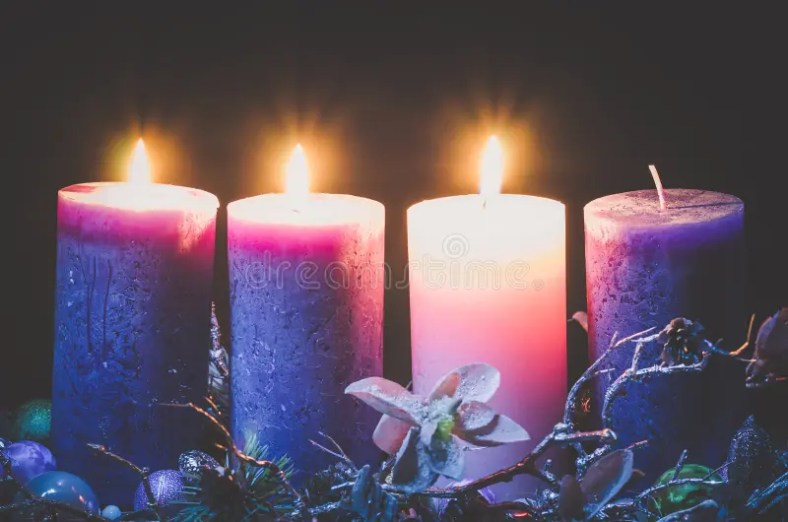
We need to hum and sing and play the old familiar songs that move our hearts to that softer, readier place where the True Song will be born.  We need to light the ancient candles one at a time to guide our steps down the long corridor of waiting, the pathway of arrival.  We need to bring each flame to the heart until the soul is aglow with the depth of its meaning and power.  

We need to reignite the flame of Hope to show us our way through the numbing fog of sameness.  We need to internalize the flame of Peace to quiet our anxieties and give us patience.  We need to swallow whole the flame of Joy to whet our appetite for the feast to come.  We need to embody the flame of Love to warm us as we journey together, to show us again that we are walking arm in arm, to remind us that our fates are intertwined, to illuminate the purpose of life, to lead us to the Light of the World.

“For outlandish creatures like us, on our way to a heart, a brain, and courage, Bethlehem is not the end of our journey but only the beginning – not home but the place through which we must pass if ever we are to reach home at last.” –Frederick Buechner, The Magnificent Defeat

Arrive.  But understand in your arriving that even after the meaningful journey of Advent we don’t arrive at Christmas.  Christmas arrives to us.  

The Gift comes to meet us on the road to take us to a place we could never attain on our own. We celebrate.  We ponder.  We dance and revel in the laughing lights of Hope and Peace and Joy and Love that carried us and that we carried with us, the lights that guided us to this place.  

We gaze amazed at the Gift before us, almost comically humble and plain, artlessly displayed and wiggling inside its wrappings, laid out on a bed of straw in a manger, and yet more artistically subtle, more beautiful and precious than the Magi gifts of gold, frankincense and myrrh.  And if you take a moment to think about what this Gift really is, what this baby really means to the world and what this baby means to you, in particular,  you may just hear the voice of Emmanuel saying, “Now the journey begins in earnest.  Be not afraid.  I’m coming with you.”

And the Logos Became Flesh

John 1:1-18

I have a confession.  I deeply and truly love Christmas, but the sheer enormity of it leaves me flummoxed.   I’m not talking about all the shopping or all the bustle and preparation at home and at church.  I’m not even grumping about the over-the-top commercialism or all the different greeting card interpretations of the “true meaning” which can put you in a psychological sugar coma if you try to swallow them all at once.   

I’m talking about the daunting task of trying to convey a genuine and meaningful understanding of The Incarnation, the idea that the mystery we call God, the Maker of All Things Seen and Unseen, came to us as one of us—the idea that God “became flesh and lived among us” from gestation to birth to death as a particular person in a particular place and in a particular time so that we could begin to more fully understand that God is with us in all persons, in all creatures, in all creation, and at all times.

That thought, that idea, that reality that we call The Incarnation is so enormous and mind-boggling that it’s really tempting to retreat into the less cosmic halo of ideas that hover around that manger in Bethlehem, ideas like innocence and love personified and new beginnings.  Those are all good, true and valuable things.  They are meaningful parts of the package.  But the goodness, truth, new beginnings and love we see in that holy child become even more potent when we begin to truly understand what God is doing in that manger in Bethlehem.

When the early followers of Jesus began to write down their understanding of who Jesus was and what he was about, when they began to explain what they meant when they called him Christ—Christos—the anointed one, it’s clear that they saw him as something more than just a great spiritual teacher or religious leader.   You don’t have to read very far in these early writings to discover that these followers of Jesus thought there was something of cosmic importance about him.  Early on they called him the Son of God but that description didn’t seem to be enough for some of them.  It didn’t seem to fully capture the cosmic fullness of what they had experienced in Jesus the Christ.  

“He is the reflection of God’s glory and the exact imprint of God’s very being, and he sustains all things by his powerful word,” said the writer of Hebrews.[1]  “He is the image of the invisible God, the firstborn of creation,” we read in Colossians, “for in him all things in heaven and on earth were created, things visible and invisible…all things have been created through him and for him…for in him all the fullness of God was pleased to dwell, and through him God was pleased to reconcile to himself all things, whether on earth or in heaven…”[2]

Late in the first century, a writer we’ve come to know as John sat down to write his account of Jesus.  He wasn’t interested in creating just another chronicle of the life of Jesus as others had done; he wanted to explore the meaning of Jesus.  He wanted to make it clear that Jesus the Christ was not someone who could be defined, contained or constrained by geography or time or even philosophy, because the God of all geography and time and philosophy was and is somehow present in him.  

John began his gospel like this:

In the beginning was the Word, and the Word was with God, and the Word was God.  He was in the beginning with God.  All things came into being through him, and without him not one thing came into being.  What has come into being in him was life, and that life was the light of all humanity.  The light shines on in the darkness, and the darkness has not understood it…. And the Word became flesh and lived among us, and we gazed on his glory, glory as of the only Son from the Father, full of grace and truth.

The language of this prologue is pure poetry.  But it’s also philosophy.  And in a strange, farsighted way, John was brushing up against physics.  

The Greek word we translate as “Word” is logos.  Logos was a word that ancient philosophers loved to play with and because of that we have numerous ways to translate it.  One of the oldest meanings of logos was story or narrative.  Where does your mind go if you hear In the beginning was the story, and the story became flesh and lived among us?  

Logos could also mean content or reason or statement.  Other philosophical meaningsincluded, orderideablueprintprimordial templateprimal thought, or intention.  

Logos became flesh and lived among us.  The metaphysical became physical.  If that sounds too esoteric, consider quantum physics.  

 Energy moves through quantum fields as abstract mathematical wave functions.  When wave functions are observed, they tend to collapse into particles.  Particles continually move through patterns in a kind of quantum dance, always moving toward closeness, joining, partnering, combining.  Fermions dance with bosons.  Neutrinos, muons, gluons, leptons and quarks assemble themselves into protons, neutrons and electrons which assemble themselves into atoms which assemble themselves into molecules we call elements.  Hydrogen and carbon molecules dance together to form the four essential organic compounds: nucleic acids, proteins, lipids and carbohydrates.  And out of all of this comes life.  The Word, the Story, the Pattern, the Intention, the Thought becomes flesh and dwells among us.  

The great British astrophysicist James Jeans wrote: “The universe begins to look more like a great thought than a great machine.  Mind no longer appears as an accidental intruder into the field of matter; we are beginning to suspect that we ought rather to hail it as a creator and governor of the realm of matter… We discover that the universe shows evidence of a designing or controlling power that has something in common with our own minds.”[3]

This is The Incarnation.  The great Thought of God expressed in the whole universe condensed itself into a singular human life and lived among us.  And why would God do that?  

Love.

Teilhard de Chardin saw love as the driving force of the universe.  “For Teilhard, love is a passionate force at the heart of the Big Bang universe, the fire that breathes life into matter and unifies elements center to center; love is deeply embedded in the cosmos, a ‘cosmological force.’”[4]

God is Love, we read in 1 John.  “God is love, and those who abide in love abide in God, and God abides in them.”

Love became flesh and lived among us.  And still lives among us.  And within us.  And around us.  And beyond us.  

Love…God… was not content to be an abstract idea or a mere sentiment.  God, the Author of Life, the One in whom we live and move and have our being is Love with a capital L.  Love Personified.  And Love is all about relationship.  Christmas is when God, the Love that founded the universe, showed up as one of us in order to show us in person just how much we are loved and in order to teach us to love each other more freely and completely. 

Love became flesh and lived among us so that we might learn to love God with all our heart, mind, soul and strength and love our neighbors as ourselves.  

Love didn’t come to us as a king or potentate to lord it over us.  Love came as a poor baby among a poor and oppressed people far from the centers of privilege and power in order to show us that “the fire that breathes life into matter and unifies elements center to center,” is alive in and breathing life into all of us and wants to unify us with each other center to center and heart to heart.  And to all who receive him, who believe in his name, he gives power to become children of God.[5]

It’s an enormous idea, this thing called Christmas, this Incarnation.  This idea that the Word became flesh encompasses everything we see and everything we don’t see.  It speaks in poetry then carries us into the depths of philosophy and physics.  It warms the heart and boggles the mind.  It is, quite literally everything.  And the beating heart of it is love.

To even begin to understand the Incarnation, we have to open our minds and our hearts.  As another early follower of Jesus wrote: “I pray that you may have the power to comprehend, with all the saints, what is the breadth and length and height and depth, and to know the love of Christ that surpasses knowledge, so that you may be filled with all the fullness of God.”[6]

Merry Christmas


[1] Hebrews 1:3

[2] Colossians 1:15

[3] James Jeans, The Mysterious Universe, as quoted by Ilia Delio, The Unbearable Wholeness of Being, p. 40

[4] Ilia Delio, ibid., p.43

[5] John 1:12

[6] Ephesians 3:18-19

The Blessing of Ritual and the Ritual of Blessing

Luke 2:22-49

Welcome to the Sunday of Colliding Traditions!  Today, December 31, is the seventh day of Christmas—seven swans a-swimming—and also the first Sunday of Christmas.  And in the secular calendar it’s New Year’s Eve.

People throughout the world have all kinds of interesting rituals and traditions for welcoming in the new year.  Meri and I have a tradition of eating shrimp on New Year’s Eve.  It seems to work for us, so I was glad to learn that a number of Asian cultures think eating shrimp on New Year’s Eve or New Year’s Day brings good luck.  Other cultures, however, think eating shrimp brings bad luck because shrimp swim backward—away from the good fortune that’s heading your way.  The same goes for lobster.  

In Ecuador people set fire to effigies at midnight on New Year’s Eve.  These effigies  are stuffed with paper containing brief descriptions of bad situations people want to escape or undesirable things or even photographs of things they would like to be rid of.  And it’s important that the effigy be burned completely or the bad situations will return.  

In the Philippines people try to use as many round things as possible as they celebrate the new year—round food, round clothing, round candies.  The round things represent coins so this ritual is a way to encourage the New Year to bring them greater wealth.

In Denmark people save up old plates all year then hurl them against the front doors of their friends’ houses on New Year’s Eve in a ritual that is supposed to bring good fortune. I have no idea how or why that’s supposed to work.

In Spain people begin to pop grapes into their mouths as the clock begins to strike 12.  The goal is to get 12 grapes into your mouth—one with each chime of the clock—to ensure good luck for every month of the new year.

Buddhists in Japan literally ring in the new year, not with 12 chimes of the clock, but by ringing a bell 108 times.  They believe this ritual banishes all human sin.  In Japan it is also considered good luck to be smiling or laughing as you enter the new year.

In Germany many people enjoy a traditional meal of Silvesterkarpfen (New Year’s Carp) on New Year’s Eve.  It is considered good luck to keep a scale from the carp in your wallet throughout the year to bring wealth and good fortune.  But be careful that the scale doesn’t slip out when you reach for your cash because removing the scale removes the good luck.

In Mexico, Bolivia, Brazil and other parts of Central and South America, the color of your underwear is very important on New Year’s Eve.  Red or pink is for those who hope to find love in the new year.  Yellow or gold ensures prosperity.  Green is for hope and white is for peace.  If you want to really ensure that this charm works, make sure your New Year’s skivvies are brand new.

Rituals and traditions shape us.  Even the odd ones.  Especially the odd ones. They tell us who we are and where we fit in the world.  Joseph Campbell said that in our rituals we enact and participate in our myths, the central and formative stories that shape us as a people. When you participate in a ritual, he said, “your consciousness is being re-minded of the wisdom of your own life.” 

“When the time came for their purification according to the law of Moses, they brought him up to Jerusalem to present him to the Lord.”  Forty days after his birth, Mary and Joseph brought Jesus to the temple in accordance with the rituals and tradition of their people.  Mary came for the rite of purification which required the sacrifice of a lamb or, if the family could not afford a lamb, two turtledoves or young pigeons were offered.  Jesus, as a first-born child, was being presented to be consecrated to God.  Both these rituals were in keeping with Torah, the holy teachings that define what is required of the people of the covenant.  These rituals help define what it means to be Jewish. 

Luke is reminding us here that Jesus was Jewish.  Luke reminds us that the life of Jesus was shaped and enriched from the very beginning by rituals and traditions that were part of the covenant of his people.  He reminds us that Jesus grew up in a house where it was understood that they lived in a special relationship with God and with the people of God, a relationship that came with both blessings and obligations.

In addition to the rite of purification and the rite of dedication which Luke refers to here in passing, Luke also gives us a more specific example of another Jewish tradition, the tradition of blessing.

Luke tells us that about an old man named Simeon who was righteous and devout, and that the Holy Spirit had revealed to Simeon that he would not die until he had seen the Lord’s Messiah.  When Simeon saw Jesus in the temple, he understood that God’s promise to him had been fulfilled.  “Guided by the Spirit,” Simeon took the baby Jesus in his arms and praised God for keeping the promise.

The words Simeon spoke here have been part of my own formative tradition.  We used to say them or sing them in the old King James language at the close of almost every worship service when I was growing up:  “Lord, now lettest thou thy servant depart in peace, according to thy word: for mine eyes have seen thy salvation, which thou hast prepared before the face of all people; a light to lighten the Gentiles, and the glory of thy people Israel.”

When I was a boy those words sounded like magic.  Listening to them, repeating them, I began to fall in love with the music and richness and power of language.

Simeon gave thanks to God that he had lived to see God’s salvation with his own eyes.  And as he spoke his thanks, he also spoke words of blessing over the child.  

As he gazed at the baby in his arms he had a vision of the child’s future.  He said that the baby would become a light for revelation to the gentiles, that he would become the glory of Israel.  He told Mary that her son was destined for the falling and the rising of many in Israel and that he would be a sign that would be opposed so that the inner thoughts of many would be revealed.  Then, as he lifted his eyes from the face of the baby to the face of his mother, he saw something of her future, too.

Frederick Buechner captured this moment in all its tenderness and heartbreak: “What he saw in her face was a long way off, but it was there so plainly he couldn’t pretend. ‘A sword will pierce through your soul, he said.

“He would rather have bitten off his tongue than said it, but in that holy place he felt he had no choice. Then he handed her back the baby and departed in something less than the perfect peace he’d dreamed of all the long years of his waiting.”

Simeon wasn’t the only person to speak a blessing over Jesus that day.  Anna, an aged widow who was also a prophet was also in the temple and when she saw the baby Jesus, “she began to praise God and to speak about the child to all who were looking for the redemption of Jerusalem.”

Anna and Simeon spoke words of blessing over the baby Jesus.  They looked into the future on his behalf and spoke what they saw for him.  With their words they set a course for him, or at the very least described their hopes for him.

We seem to have lost the tradition of blessing.  We still have the word, but we seldom have the words.  We say “God bless you” or even just “bless you” as if that was the whole thing when it is barely the beginning of a real blessing.  We have lost the art of speaking goodness to and for each other, of using our words to call up goodness and identity and destiny into the present moment and project them into future.   

I wonder what might happen if we began this new year with a blessing.  What kind of healing and wholeness might we bring to the world if we learned to speak our hopes for each other and acknowledge the gifts we see in each other?  

I invite you to try an experiment this New Year.  I invite you to learn how to bless.  I invite you to bless your children, your home, your loved ones and your friends.  I invite you to speak goodness into the world.

So… I’ll go first.  Receive a blessing, a benediction:

As this old year ends, your pains and frustrations will be transformed into wisdom. You will see a way forward with unfinished business. Fear and anxiety will have no hold on you.  Throughout this new year, you will walk in the path of peace and joy.  By your calm presence, you will be a blessing to all around you, and especially to those who are troubled in mind, heart or spirit.  You will shine with the love of Christ and carry with you the peace of God which passes all understanding.  You will walk in the Way of Jesus and speak goodness into the world in his name.

Amen.

The Gift

A Moment in the Lights of Christmas

The little boy stopped in his tracks and pulled his mother’s hand tight to his chest.  His father, catching up to them, stopped and rested a hand on the boy’s shoulder.  The fog of their breath, illuminated for a moment by the streetlamp, sparkled briefly like a halo before vanishing into the crisp night air, and the boy’s wide and glistening eyes reflected a kaleidoscope of colors from countless lights on the ostentatiously decorated houses.  A passable version of Jingle Bells wafted down the street from a group of not-too-bad carolers but was soon overwhelmed by an odd assortment of recorded music pouring out of various holiday displays, some sacred, some not so much.

The thing that had stopped the boy as he skipped down the street was not the seemingly endless cascade of colored light nor one of the comical inflated cartoon characters in Santa hats, nor even the impressive electric train set and miniature Alpine village filling an entire front yard.  The thing that stopped him stone still there on the cold December sidewalk was an old-fashioned crèche, a simple manger scene.

Compared to all the other neighborhood displays the crèche was almost embarrassingly understated.  There were no shepherds or angels or magi in this tableau, just Mary, Joseph and the baby Jesus.  Their figures, though, were particularly well crafted and cunningly lit.  They looked so real that one had to do a double-take to make sure that they were, in fact, sculptures and not human actors holding a pose.  The figures looked decidedly Middle-Eastern and even, if such a thing is possible, a bit dislocated in time, as if they had been transported to this sanitary American cul de sac from a dusty, distant, Palestinian past. But perhaps the thing that was most arresting was the way they looked at you if you stood just where the boy and his parents were standing.

Mary is usually depicted with her hands on her heart as she ponders her child in the manger.  Joseph is most often shown gazing at the baby.  But this scene was different.  As they stared at the tableau of the holy family, the boy, the mother, the father almost felt as if they had intruded, as if they had inadvertently stumbled into something serious and secret and would now have to be initiated into its mysteries.  Joseph seemed to be giving them a stare of careful appraisal and assessment as he looked directly into their eyes. “Are you a friend or a foe? Can you handle this?  Can you treasure this precious thing you did not ask for, this responsibility, this honor, this gift that will give you everything and also demand everything? Can you stay with him when it would be easier to walk away?” he seemed to be asking.  Mary, too, gazed intently, unblinking, into their eyes and seemed to be asking, “Do you understand the weight of this gift?  Do you even begin to understand what you have here? Do you know what is happening here? Do you know who he is?  Will you let him show you who you are?”

And then there was the baby.  How to describe this baby?  He, too, seemed to be looking straight into their souls, but in his face there were no questions.  There was instead an indescribable mix of innocence and wisdom.  There was promise and foreshadowing.  There was the shining hint of divinity and the burbling drool of humanity.  There was life, organic and messy, full of merriment and ecstasy and pain and tears and plain everydayness.  There was light, revealing, illuminating, probing, warming, piercing and soothing, burning and healing.  There was love, gentle and compassionate, fierce and yearning, ruthless and gracious. Love in all its purest shades.  Love in all its joy.  Love in all its anguish.  There was all that in that baby face and something else.  Deep in those eyes was God’s own Yes.

They stood transfixed at the crèche for what seemed like a long time—a moment out of time—one small family regarding another across and through time, still-life speaking to life in a held breath of stillness, until the not-too-bad carolers drew near and broke through the little family’s reverie with  tidings of comfort and joy that were a just a bit rushed and ever so slightly off key.

A few minutes later, without much thinking about it, the boy, the mother and the father found themselves in their car making their way home.   The father drove a little more slowly than usual as they rolled across the familiar bumps and dips of familiar streets.  The boy watched the reflections of Christmas lights dance and swirl across the windows of passing cars.  And the mother’s eyes were focused on something only she could see as she softly hummed Silent Night.

Our Down to Earth God

Then an angel of the Lord stood before them, and the glory of the Lord shone around them, and they were terrified. –Luke 2:9 (NRSV)

It’s funny how you can look at something a hundred times or more and then one day someone will point out something you hadn’t noticed and the whole thing looks different to you.  That happened to me a couple of years ago when a colleague pointed out one simple word in Luke’s Christmas story that had always just flown right by me.

Stood.

The angel stood before them.  On the ground.

In all the years of reading or hearing this Christmas story I had always imagined this angel and the multitude of the heavenly host hovering in the air.  I think the Christmas carols taught us to picture it that way.  Angels we have heard on high.  It came upon a midnight clear, that glorious song of old, from angels bending near the earth.  

But that’s not what it says in the Gospel of Luke.  The angel stood before them.

If you were a shepherd in a field on a dark night, it would be pretty unsettling to have an angel appear in the air above you making announcements, but at least if the angel is in the air there’s some distance between you—a separation between your environment and the angel’s.  But if the angel suddenly appears in front of you standing on the same ground you’re standing on, shining with the glory of the heavens… well I think my knees would turn to rubber.  And then imagine what it feels like when the whole multitude of the heavenly host is suddenly surrounding you and singing Glory to God.

Angels in the air feels slightly safer than angels on the ground.  Slightly.  If the angels are above, that means that they came from above.  It means that heaven is “up there” somewhere.  It doesn’t mess with the way we understand the spiritual cosmos.  But if the angels appear standing in front of us or behind us or around us, what does that say about heaven?  Could it be that heaven, the dwelling place of the angels, is not just “up there” but also here, with us?  Around us?  Could it mean that the angels of God are standing near us all the time and they simply choose not to show themselves?  Or that we’re just blind to their presence? Could it mean that this ground we walk on and build on and live on is also part of the dwelling place of God—so holy ground?

The angels didn’t bend near the earth.  They stood on it.  

We have this tendency, we humans, to want to separate the material from the spiritual, the divine from the physical.  We are such binary, black and white thinkers in a universe that’s full of colors and shades of gray.  We want here to be here and there to be there.  We want to put borders on oceans and talk about territorial waters!  We want to draw a clear and well defended line between our country and the country next door.  So it’s not surprising that we’ve assumed that there is a border between heaven and earth.

We seem to be most comfortable when there’s a little distance between us and angels, a little distance between us and God.  That seems to be the way most people talk about it, anyway.  “Put in a good word with the man upstairs,” they say.  And then there’s that song: “God is watching from a distance.”

But that’s not what Christianity says.  That’s not what Christmas says.  The Word became flesh and lived among us, and we have seen his glory, the glory as of a father’s only son, full of grace and truth.  In him the fullness of God was pleased to dwell.  Not from a distance, but right in front of us.  With us.  As one of us.

We have trouble seeing the presence of God, seeing Christ in creation.  We have trouble seeing Christ in each other.  We even have trouble understanding Christ in Jesus.  How can Jesus be both divine and human?  We struggle to wrap our minds around that idea, so we have a tendency to make him either all human or all divine.  We picture that baby in the manger with a halo, and it doesn’t cross our minds that he might need to breastfeed and burp and need his diapers changed.

Christmas, the mystery of the incarnation, tells us that God is not a bearded old man watching us from the clouds, a deity who is willing to give us what we ask if we are really good or strike us down with a thunderbolt if we’re bad.  That’s not God.  That’s Santa Claus.  Or Zeus.   

God, the Author of Life, the One in whom we live and move and have our being is Love with a capital L.  Love Personified…and Love is all about relationship.  Christmas is when God, the Love that founded the universe, showed up as one of us in order to show us in person just how much we are loved and in order to teach us to love each other more freely and completely. 

“We need to see the mystery of incarnation in one ordinary concrete moment,” wrote Richard Rohr, “and struggle with, fight, resist, and fall in love with it there. What is true in one particular place finally universalizes and ends up being true everywhere.”  In other words, God is present everywhere, in, with, and under everything.  Including you.  And me.  And all those people we’re inclined not to like.  But to really grasp this idea, we need to first see God fully present in one particular person.  We need to see God in this particular baby.  This human baby

That, in the end, is what Christmas, the incarnation, is trying to tell us.  Christmas is God’s way of teaching us that there never really was any distance between heaven and earth, between the divine and the human, between the spiritual and the material.  Christmas is God proving once again that Christ is in, with, and under all the things—all things—including all the things we think we oversee and all the things we overlook.  Christmas is angels standing on the earth singing to shepherds and surrounding them with the glory of the Lord to remind them that they, too, are spiritual beings immersed in a human experience.  

Christmas is God’s love made visible.  Pope Francis said, “What is God’s love? It is not something vague, some generic feeling. God’s love has a name and a face: Jesus Christ, Jesus.”  I would add that, if you open your heart and your mind to it, God’s love can have your face, too.

Love is vulnerable—and what’s more vulnerable than a baby?  God comes to us as a baby because it’s easy to love a baby.  It’s easy to be vulnerable with a vulnerable infant.

Christmas is earthy and concrete and vulnerable.  It enters the world surrounded by the homey smell of a stable.  It needs to be fed at a mother’s breast.  It needs its diapers changed.  It cries when it’s hungry and shivers when it’s cold.  It spits up a little bit on your shoulder.  It looks out at the world with brand new eyes and tries to see and understand.  Most of all, it reaches out to be picked up and held close to your heart.  Christmas wants to be loved and to give love.  

Christmas is our down-to-earth God made manifest.  Yes, gloria in excelsis deo, glory to God in the highest, but glory, too, to God on earth where the angels stand to sing to shepherds, because the Spirit of God is in them, too, and God loves them like crazy.  Just like God loves you.

My prayer for you this night is that you would enter deeply into the concrete, down-to-earth, human and divine mystery of incarnation.  May your eyes and ears be opened to the angels who stand upon the earth and minister to all God’s children.  May you come to see Christ incarnate, permeating all creation.  May you come to see that you are always and everywhere standing on holy ground.  May you dispense with artificial borders in your heart, in your mind, and in this lovely world.  And may you come to see yourself and all the others who share this world with you as spiritual beings immersed in a human experience.  Most of all, though, may you know that you are loved. 

May Christ be born anew in your heart this night and every night.  In Jesus’ name.

Our Down-to-Earth God

Then an angel of the Lord stood before them, and the glory of the Lord shone around them, and they were terrified. –Luke 2:9 (NRSV)

It’s funny how you can look at something a hundred times or more and then one day someone will point out something you hadn’t noticed and the whole thing looks different to you.  That happened to me last week when a colleague pointed out one simple word in Luke’s Christmas story that had always just flown right by me.

Stood.

The angel stood before them.  On the ground.

In all the years of reading or hearing this Christmas story I had always imagined this angel and the subsequent multitude of the heavenly host hovering in the air.  I think the Christmas Carols taught us to picture it that way.  Angels we have heard on high.  It came upon a midnight clear, that glorious song of old, from angels bending near the earth.  

But that’s not what it says in the Gospel of Luke.  The angel stood before them.

If you were a shepherd in a field on a dark night, it would be pretty unsettling to have an angel appear in the air above you making announcements, but at least if the angel is in the air there’s some distance between you—a separation between your environment and the angel’s.  But if the angel suddenly appears in front of you standing on the same ground you’re standing on, shining with the glory of the Lord… well I think my knees would turn to rubber.  And then imagine what it feels like when the whole multitude of the heavenly host is suddenly surrounding you and singing Glory to God.

Angels in the air feel slightly safer than angels on the ground.  If the angels are above, that means that they came from above.  It means that heaven is “up there” somewhere.  But if the angels appear standing in front of us or behind us or around us, what does that say about heaven?  Could it be that heaven, the dwelling place of the angels, is not just “up there” but also here, with us?  Around us?  Could it mean that the angels of God are standing near us all the time and they simply choose not to show themselves?  Or that we’re just blind to their presence? Could it mean that this ground we walk on and build on and live on is also part of the dwelling place of God—so holy ground?

The angels didn’t bend near the earth.  They stood on it.  

We have this tendency, we humans, to want to separate the material from the spiritual, the divine from the physical.  We are such binary, black and white thinkers in a universe that’s full of colors.  We want to put borders on oceans.  And we certainly seem to want a border between heaven and earth.

We seem to be most comfortable when there’s a little distance between us and angels, a little distance between us and God.  That seems to be the way most people talk about it, anyway.  “Put in a good word with the man upstairs,” they say.  And then there’s that song: “God is watching from a distance.”

But that’s not what Christianity says.  That’s not what Christmas says.  The Word became flesh and lived among us, and we have seen his glory, the glory as of a father’s only son, full of grace and truth.  In him the fullness of God was pleased to dwell.  Not from a distance, but right in front of us.  As one of us.

We have trouble seeing the presence of God, seeing Christ in creation.  We have trouble seeing Christ in each other.  We even have trouble understanding Christ in Jesus.  How can Jesus be both divine and human?  We struggle to wrap our minds around that idea, so we have a tendency to make him either all human or all divine.  We picture that baby in the manger with a halo, and it doesn’t cross our minds that he might need to breastfeed and need his diapers changed.

“We need to see the mystery of incarnation in one ordinary concrete moment,” wrote Richard Rohr, “and struggle with, fight, resist, and fall in love with it there. What is true in one particular place finally universalizes and ends up being true everywhere.”  In other words, Christ is present everywhere, in, with, and under everything.  Including you.  And me.  And all those people we’re inclined not to like.

That, in the end, is what Christmas, the incarnation, is all about.  Christmas is God’s way of teaching us that there never really was any distance between heaven and earth, between the divine and the human, between the spiritual and the material.  Christmas is God proving once again that Christ is in, with, and under all the things we think we oversee and all the things we overlook.  Christmas is angels standing on the earth to sing to shepherds and surrounding them with the glory of the Lord to remind them that they, too, are spiritual beings immersed in a human experience, as Pierre Teilhard de Chardin said.  

Christmas is God’s love made visible.  Pope Francis said, “What is God’s love? It is not something vague, some generic feeling. God’s love has a name and a face: Jesus Christ, Jesus.”  I would add that, if you open your heart and your mind to it, God’s love can have your face, too.

Christmas is earthy and concrete.  It needs to be fed at a mother’s breast.  It needs its diapers changed.  It cries when it’s hungry and shivers when it’s cold.  It looks out at the world with new eyes and tries to see and understand.  Christmas wants to be loved and to give love.  

Christmas is our down-to-earth God made manifest.  Yes, gloria in excelsis deo, glory to God in the highest, but glory, too, to God on earth where the angels stand to sing to shepherds, because the Spirit of God is in them, too, and God loves them like crazy.  Just like God loves you.

My prayer for you this night is that you would enter deeply into the concrete, down-to-earth, human and divine mystery of incarnation.  May your eyes and ears be opened to the angels who stand upon the earth and minister to all God’s children.  May you come to see Christ incarnate in all creation so that you are always standing on holy ground.  May you dispense with artificial borders in your heart, in your mind, and in this lovely world.  And may you come to see yourself and all the others who share this world with you as spiritual beings immersed in a human experience.  May Christ be born anew in your heart.  In Jesus’ name.