If Not Now, When?

Luke 13:10-17

Here’s a quick recap of today’s Gospel lesson.  One Sabbath day Jesus is teaching in the synagogue when he sees a woman who has been bent over double for 18 years.  Jesus calls her over to him and says, “Woman, you are released from your weakness.  He lays his hands on her, and instantly she stands up straight, and starts praising God.  But not everybody is happy about this. Now the leader of the synagogue is the one who is getting all bent out of shape.  He thinks healing and/or being healed on the Sabbath is a violation of the law.  “Now is not the time,” he says.  “Come back some other day.”

Why is it that no matter what good thing you’re doing or trying to do, somebody is going to get bent out of shape about it?

When the whole country was bent out of shape with the Great Depression of the 1930s, President Franklin D. Roosevelt tried to straighten things out with a whole package of programs called The New Deal.  This package included the Works Progress Administration to provide jobs in a country where 24.9% of the workforce was unemployed and those lucky enough to have kept their jobs had seen their income cut by 42.5%.  The New Deal package also included Social Security to provide a guaranteed minimum income for retired workers or those too disabled to work.  

The well-off people of Roosevelt’s own social class opposed the New Deal.  They said that it was Socialism and un-American.  They said that putting people to work with the WPA would put the government in competition with private industry.  Other critics, like Huey Long, said the New Deal  didn’t go far enough or do enough.  Voices from a number of quarters said it was too expensive for a country suffering through a depression.  “Now is not the time,” they said.

When President Dwight D. Eisenhower decided to champion the interstate highway system, his critics called it “another ascent into the stratosphere of New Deal jitterbug economics.”  People who were concerned about the stability of the post-war economy said that the country simply could not afford it.  “Now is not the time,” they said.

When President John F. Kennedy declared in his State of the Union address in 1962 that we were going to go to the moon and take on other ambitious goals “not because they are easy but because they are hard” and because they would “organize and measure the best of America’s energies and skills,” he summed up his challenge by asking, “If not now, then when?  If not us, then by whom?”

“If not now, when?  If not us, then who?”  

I can imagine Jesus saying that to the synagogue leader who is upset with him for healing the woman who had been bent over for 18 years by “a spirit of weakness.” 

“You hypocrites!” he says. “You’ll untie your donkey on the Sabbath, you’ll let your ox out of its stall on the Sabbath and lead it out for water, but you don’t think this daughter of Abraham,  your sister, should be released from her bondage on the Sabbath?  What, 18 years bent over in pain isn’t long enough for you?  Now is not the time?  Well, if not now, when?”

“This woman, a daughter of Abraham,” he said “has been held in bondage by Satan for eighteen years.  Isn’t it right that she be released, even on the Sabbath?”  

Held in bondage by Satan.  The implication of what Jesus was saying was that anyone who would oppose her being freed from the “spirit of weakness” that had been keeping her bent over would be collaborating with Satan.  

There’s something evil about prolonging someone’s pain when you have the means and opportunity to provide relief.  

There’s something evil about prolonging someone’s bondage when you have the means and opportunity to set them free.  

More than 100 million people in this country are now dealing with some degree of medical debt.[1]  Eighty percent[2] of those with medical debt had medical insurance when the debt was incurred but found that their insurance did not cover the expensive treatment, meds or procedures they needed.  An estimated 550,000 people will file for bankruptcy this year because of medical debt.[3]  And it’s about to get worse, far worse, because the Great Big Beautiful Bill that congress just passed guts Medicaid which was the medical insurance 72 million people in this country have relied on.  The Congressional Budget Office estimates that somewhere between 8 million and 24 million will lose their coverage either partially or entirely.  All of them will lose some financial security.  Some will lose their homes.  

This is what happens when we are all in bondage to a for-profit medical system.  But when we talk about Medicare for all or some other form of universal health care like the kind every other industrialized country in the world provides for their citizens, the insurance companies all say in unison, “We can’t afford it.  The economy won’t sustain it.  Now is not the time.”  

There’s something evil about prolonging someone’s pain when you have the means and opportunity to provide relief.  

There’s something evil about prolonging someone’s bondage when you have the means and opportunity to set them free.  

We seem to be perpetually caught between factions that want to bring healing to our over-heating planet and forces who are worried about the costs and the changes that would come with fixing the problems we have caused.   As we talk about funding new infrastructure for producing renewable energy, as we talk about ways to make more electric vehicles and make them more affordable so we can reduce the pollution that produces global warming and climate change, as we talk about creating more and better mass transit, there is a chorus of voices saying, “It’s too expensive.  The economy won’t support it.  The technology is not all there yet.  Now is not the time.”

When we talk about how we can address the lingering and malignant nastiness of racism, and antisemitism, we run headlong into people who want to remove the books and curricula that teach about these things from our libraries and schools.  They don’t want their children to feel bad about the way their forbears treated people who were different from themselves.  They don’t want their children to know about our legacy of slavery, and they really don’t want them to know how de-humanizing and violent slavery really was.  They don’t want them to know about Jim Crow laws and segregation.  They don’t want them to know about all the ways that racism is still making life difficult to impossible for people of color.  “They’re just children,” they say.  They’re too young to be exposed to those things.  Now is not the time.”  

Well if not now, when?  If they don’t learn about the ugly hate and violence of our shared past, how will our children know not to make the same horrible mistakes in the future?  How will they understand the hate and violence they still see today?  

And what about the Black children and Brown children and Jewish children and Muslim children who are still living with the challenge of all that racism.  The redlining may be gone on the map but the neighborhoods it created linger on along with their diminished opportunities and services and quality of life.  These children of God have been held in bondage for centuries.  Isn’t it right that they be released?  Isn’t it right that they be freed from the things that have bent their lives out of shape?  Isn’t it right that in the name of Jesus and in the name of our common humanity we should stretch out our hands and help them stand up straight…even on the Sabbath?  If not now, when?  If not us, then who?

How will our children understand how destructive and wrong it is to treat others as something less than human, something less than children of God, something less than their siblings in Christ if they don’t learn about it when they’re still young enough to have some empathy?  How will they understand the brokenness of the world they are inheriting from us if we don’t teach them about the mistakes we’ve made?

Yes, they will feel bad about it.  Yes, it will make them sad.  That’s the point.  That’s how they will be moved to do better.  

Those who don’t want to see us address racism and antisemitism and all the other destructive and violent isms that are tearing our country and our world apart try to disparage and belittle those of us who are trying to create awareness and change things for the better.  They try to dismiss us by saying we’re “woke.”  They say it like it’s a bad thing.  

Do you know what woke means?  It’s a term that originated in the Black community.  Woke means you are awakened to the needs of others.  Woke means you are well-informed, thoughtful, compassionate, humble and kind.  Woke means you are eager to make the world a better place for all people.  Woke means you are aware of the systems we live in and how they can produce unequal opportunities and outcomes.

Jesus told us to be woke.  He told us repeatedly to stay awake.  Jesus told us to read the signs of the times.  Jesus told us to pray for God’s reign of love and respect to become a reality on earth as it is in heaven.  

Jesus himself ran headlong into that all-too-human propensity to defend the status quo.  He was continually challenged by people who were upset because he didn’t play by the rules. “There are six days of the week for working.  Come on those days to be healed, not on the Sabbath.”  But Jesus didn’t think anyone should have to wait for healing or to be set free from bondage.  Not even on the Sabbath.

Today’s Gospel tells us that the things Jesus said to the synagogue leader shamed his enemies.  Nobody likes to be shamed.  But sometimes that’s what it takes to humble us.  Sometimes that’s what it takes for us to learn.  Sometimes that’s what it takes to wake us up.

There is so much that needs the healing, freeing and restoring touch of Christ in our world.  There are so many who need to be freed by the love of God.  When we follow Jesus, we are choosing to do these things “not because they are easy, but because they are hard.”  When we follow Jesus, we are choosing “to organize and measure the best of our energies and skills” for the healing of our relationships, our communities and our world.  When we follow Jesus we are choosing to let the shame of our history move us in a better direction, to follow a more generous and loving Way through our present time and into the future.  When we follow Jesus we are choosing to help a society that is bent out of shape to stand up straight.  

If not now, then when?  If not us, then who?


[1] Consumer Financial Protection Bureau, 2024

[2] Cornell ILR, Scheinman Institute

[3] Ibid

Burning Down The World

Luke 12:49-56

“I have come to throw fire upon the earth, and how I wish it were already ablaze!”  Wow!  This is not “Jesus meek and mild” talking.  This is Jesus under stress.  This is Jesus who sees the cross bearing down on him.  This is Jesus impatient with everyone misinterpreting and misunderstanding him or just plain being dense.  This is Jesus on fire!    

Where did that idea—Jesus meek and mild—where did that idea even come from anyway? Is Jesus gentle?  Often.  Is Jesus compassionate?  Absolutely.  Always.  But meek and mild?  Not in my Bible. 

“I came to set the world on fire and how I wish it was already blazing!”  From the very beginning of his ministry Jesus has been announcing that the kingdom of God, the Commonwealth of God’s justice and mercy, is arriving.  A new reality is breaking into the old world order.  

Jesus did not come to maintain or reinforce the status quo.  He came to show us the heart of God and to share God’s vision of the world as God intended it to be.  He came to transform the world by transforming us. 

Jesus knew that life would be difficult for those who choose to follow him.  He knew that living in the stream of God’s love, proclaiming the radical equality and openness of God’s kindness, freely offering mercy and forgiveness, standing up for the oppressed, speaking for the voiceless, standing in solidarity with the poor and marginalized—he knew that this would create friction in a world that operated by other standards.  He knew that sometimes that friction would begin at home.

Jesus was a realist— he knew that the alternate and better reality he was proclaiming, his Good News initiating the reign of God, was going to cause division— not because he was unclear about it, but because this fire of transformation was going to bring a never-ending cycle of change.  And most people don’t like change.  He knew that conflict would be inevitable because God was entrusting this world-transforming, never-ending mission to everyday human beings— to us— and even on our best days, even when we’re filled with and empowered by the Holy Spirit, even when we think we’re seeing and hearing Jesus as clearly as possible, we can and will find things argue about.  

The church started arguing when it was still basking in the warm afterglow of the flames of Pentecost. Peter argued with James about including Gentiles in the family of faith.  Paul and Peter butted heads over authority and practice.  Paul and Barnabas argued over whether or not John Mark could travel with them and ended up going their separate ways.  In Phillipi, an argument between two important women pastors, Euodia and Syntyche, threatened to sink the congregation so Paul had to plead with them in his letter to the Phillipians, “Please, because you belong to the Lord, settle your disagreement.”  

“Do you think that I have come to bring peace to the earth?” said Jesus. “No, I tell you, but rather division!”

Jesus was so prophetic when he talked about the ways we separate ourselves from each other but I wonder if he ever imagined just how divided we would become.  There are 40 different church bodies in North America, in the US and Canada, that call themselves Lutheran.  There are 45,000 church bodies in the world that call themselves Christian.  And all of them have separated themselves from some other church body at some point in history.  Honestly, I think this makes Jesus weep.

The vision of the kingdom is that we are supposed to build bigger tables, not higher walls.  We’re supposed to open our doors wider, not close them against people who disagree with us.  The message of Jesus is that we’re supposed to embrace each other with love, not take intransigent stands in opposition to each other because of the way we interpret the Eucharist or the way we baptize or how we translate a few things here and there.

Whenever we take our eyes off of Christ and start focusing on other, lesser things— whenever we let those other, lesser things become more important than living in the way of Jesus, we end up fighting and going our separate ways.  When we get heated up about doing the right rite rightly or deciding who is and who is not acceptable in the body of Christ, whenever we start to think that we know who God does and does not like, whenever we start to think that our way is the only right way to read the Bible— whenever we start to think that following Jesus is about preserving the good old days and the good old ways instead of opening the door to the new thing that the Holy Spirit is doing,  the fire between us can flare out of control and become divisive and destructive.  

“I have come to throw fire upon the earth, and how I wish it were already ablaze!” said Jesus.  Here in Southern California we are all too familiar with the destruction and devastation caused by fire.  We know all too well that fire can kill and destroy.  It can turn everything to ashes, soot, and pain. 

But fire can also bring us light and warmth.  Fire can clear the ground and enrich the soil to make way for new life.  There are trees who need fire for their seeds to germinate.  Fire can cleanse and refine and temper things.  

Martin Luther reminded us that “The Word of God comes, whenever it comes, to change and renew the world.” Jesus, the living Word of God, has thrown fire upon the earth, a fire of transformation that brings a never-ending cycle of change. Change can create tension if we’re not all changing in the same way or in the same direction, and tension can generate a lot of heat— but not always a lot of light.  

Change is going to continue because Christ has brought a transforming fire to the earth, a fire that has been burning for more than 2000 years.  For two millennia Jesus has been changing us and changing the world but we haven’t always handled it well.  When we align the story of our life together and the stories of our individual lives with the story of Christ, things move forward with light and warmth and energy.  When our stories diverge, the fire between us can burn us.

“Yet they meet as well as diverge, our stories and Christ’s,” said Frederick Buechner, “and even when they diverge, it is his they diverge from, so that by his absence as well as by his presence in our lives we know who he is and who we are and who we are not.

“We have it in us to be Christs to each other and maybe in some unimaginable way to God too — that’s what we have to tell finally. We have it in us to work miracles of love and healing as well as to have them worked upon us. We have it in us to bless with him and forgive with him and heal with him and once in a while maybe even to grieve with some measure of his grief at another’s pain and to rejoice with some measure of his rejoicing at another’s joy almost as if it were our own. And who knows but that in the end, by God’s mercy, the two stories will converge for good and all, and though we would never have had the courage or the faith or the wit to die for him any more than we have ever managed to live for him very well either, his story will come true in us at last. And in the meantime, this side of Paradise, it is our business (not like so many peddlers of God’s word but as men and women of sincerity) to speak with our hearts (which is what sincerity means) and to bear witness to, and live out of, and live toward, and live by, the true word of his holy story as it seeks to stammer itself forth through the holy stories of us all.”[1]

We align the story of our life together and the stories of our individual lives with the story of Jesus.  When all is said and done it’s important to remember that the story of Jesus is a love story.  He throws fire upon the earth to burn away everything that is not love, to clear the ground and enrich the soil so the seeds of love can germinate and we can grow into “little Christs” for each other.

If there must be fire between us, let it be the fire of love.

In the name of Jesus.


[1] A Room Called Remember; Frederick Buechner

Triangulating Jesus

Luke 10:38-42

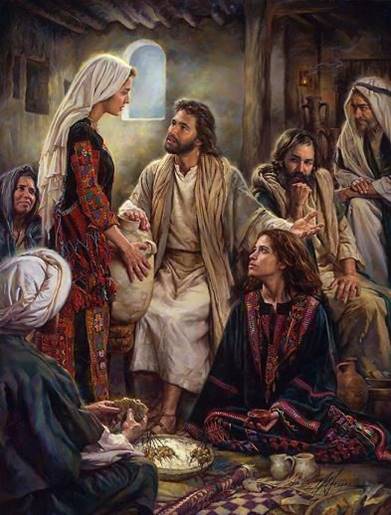
So. . . this one time Jesus was on the road and he stopped into a certain village and a woman named Martha welcomed him, which means she invited him into her home, which was a very nice and generous thing to do since Jesus probably had an entourage travelling with him and it would be rude not to include all of them.  

That village may have been Bethany if this is the same Martha that is mentioned in the Gospel of John as the sister of Mary and Lazarus.  Luke doesn’t tell us the name of the village and Luke doesn’t mention Lazarus, so it may have been some other village and a different Mary and Martha altogether. 

For ages it was assumed that the Mary and Martha of this brief episode in Luke are the same Mary and Martha from chapter 11 in the Gospel of John, the Mary and Martha who lived with their brother, Lazarus in Bethany, about three miles from Jerusalem.  And maybe it is the same Mary and Martha.  But maybe not.  Some scholars are convinced that these two sisters in Luke’s story are not those two sisters in John’s story and that this village is not Bethany.

A few years ago an astute Bible scholar named Elizabeth Schrader Polczer was taking a very close look at some very ancient manuscripts of the Gospel of John as part of her doctoral work and she noticed some odd little smudges and scrapes and overwriting in the text in the papyrus she was examining.  It looked like someone a long, long time ago—like maybe in the 2nd century—had inserted Martha into the Lazarus story.  

Whoever did this long-ago editing may have assumed that Martha had accidently been left out of John’s account.  That’s one theory.  On the other hand, maybe Martha was inserted to downplay the importance of Mary the Magdalene—Mary the Tower.  Mary Magdalene, who is almost certainly also Mary of Bethany, the sister of Lazarus, was a very popular and important apostolic figure in the early church before the patriarchy boys club tried to diminish her influence by tarnishing her reputation.  That whole business about her being a lady of easy virtue?  No basis in fact.  Just some bad patriarchic exegesis with malice aforethought.  I’m looking at you, Gregory the Not-So-Great.

Anyway, another reason why this Mary and Martha in Luke are probably not Mary and Martha of Bethany is that Bethany is very close to Jerusalem, and there is no indication in the 10th chapter of Luke that Jesus was anywhere near Jerusalem or even going in that direction.  At the beginning of the chapter he was denouncing towns in Galilee and in the chapter before that he was in Samaria.  

Another thing to consider is that Mary and Martha were two of the most common names for women in that part of the world at that time.  There are, for example, no less than six different women named Mary in the New Testament.  And while there aren’t so many Marthas mentioned, it’s not much of a stretch to think there could be at least two.

And none of this has anything to do with this particular story.  So let’s get back to the story.

So. . . Martha invites Jesus and probably his ride-along disciples into her home then gets busy providing hospitality.  This was important.  Hospitality was serious business in their culture.  It was a holy obligation backed up by scripture.  Sodom and Gomorrah were destroyed with fire from heaven for failing to provide hospitality.  Well, that and also for sexually assaulting the travelers who came through town.  But that counts as a failure of hospitality, right?

In a culture where so many people, even some wealthy and important people, were nomadic, hospitality was one of the most important cultural virtues.  When you invited someone into your home, the very least that was expected was that you would provide a good meal.  So suddenly Martha has a ton of work to do to cook some dinner for Jesus and his companions.  And maybe she needs to work out some sleeping arrangements.  And maybe she’s checking the pantry to make sure she has enough flour to make more bread and dried figs and parched grains to give them all a good breakfast.  The point is, Martha isn’t just busy for the sake of being busy.  She’s doing her best to be a good hostess and to fulfill an important social obligation.  Her busyness is honorable busyness.  Necessary busyness.  

Anyway, Martha’s got her hands full with all the hostess things and she looks across the room and sees her sister, Mary, just sitting there on the floor listening to Jesus.  

Just sitting.  

Listening to Jesus.

Martha tries to get Mary’s attention and gestures toward the food prep in progress on the table, but Mary doesn’t take the hint.  Martha picks up the water jug and tilts it toward the door, pantomiming that she would like Mary to make a quick trip to the well.  Mary doesn’t even see her because she is so caught up in what Jesus is saying.

Finally, Martha has had enough.  She storms across the room to Jesus (as politely as possible) and says, “Lord, don’t you care that my sister has left me to do all the work by myself?  Tell her to come and help me!”

I wonder how she felt when Jesus said, “Martha, Martha! You are anxious and bothered about so many things, but only one thing is necessary. Mary has chosen what is best, and it will not be taken away from her.”

Oof.

So. . . Are you a Mary or a Martha?   Wait, don’t answer that.  The fact is, one of the things I really don’t like about this text is that far too often it tempts us to ask questions like that.  We turn a story of two good people doing two good things into a kind of binary contest with a winner and a loser and we make Jesus sound all judgy in the process.  

Let’s look again at what’s actually happening in this little drama in five verses.  Jesus arrives.  Martha gets busy to provide good hospitality.  She is fulfilling her expected role, what she believes is required of her.  Mary, on the other hand, sits down with Jesus, and listens to him.  She is giving him her time and attention which is also an important social duty.  

Notice that Jesus doesn’t say anything about what either of the sisters is doing—he doesn’t say anything critical to Martha or anything affirming to Mary—until Martha drags him into the middle of the tension between the two sisters.  That’s called triangulating.  

Triangulation happens when a person complains about another person to a third person instead of addressing the issue directly. Triangulation is very common in families, especially among siblings.  In its worst forms it can be abusive.  In its most common forms its used in particular moments or situations to establish or maintain dominance, to confirm who is in charge at least for the moment.

How often do we try to triangulate with Jesus?  How often do we try to draw Jesus in on our side of a dispute?  How often do we assume that Jesus is on our side in a disagreement with our siblings in Christ?  That’s something worth thinking about, so maybe jot that down in your notebook of Spiritual Growth Questions.  It’s a good one for keeping us honest.

When Jesus says to Martha that she is anxious and bothered about many things he is very subtly stepping out of the triangle she tried to rope him into.  He isn’t criticizing her, he is merely describing her state of mind to her.  Unfortunately, that kind of  truth often sounds like criticism, especially if we’re feeling the least bit defensive.  

When Jesus tells Martha that Mary has chosen what is best, he is, again very subtly, telling Martha to stop trying to control her sister, and he is reminding her that giving a guest time and attention is at least as important as all the hospitality duties that Martha thinks are so culturally crucial.  To emphasize this, he makes it clear to Martha that he will not allow Mary’s moment of spiritual communion with him to be taken away for the sake of housework or social propriety.  

These things Jesus says to Martha can sound a bit harsh until we remember that Martha also was free to stop and sit at the feet of Jesus any time she wanted from the moment he entered her house.  The lesson for her and all Marthas might be “before you get busy with all the things, take a moment to be with all the people.”

There were very clear social conventions in their world about hospitality and meals, but Jesus was already famous for disregarding or even criticizing these kinds of conventions, so  Mary and Martha had options.  

I think this little story in Luke wants us to think about our options so we don’t accidentally create tension and anxiety and open the door to triangulation, especially at times when we want to be welcoming and hospitable.  For instance, Mary could have stepped up to help Martha right from the beginning so they could get things prepared faster and then both sat down to a conversation with Jesus.  They could have asked Jesus when he first arrived if he wanted to eat first or sit together and talk first.  Better than that, any and all of them could have stepped in and pitched in when they saw that Martha was determined to fulfill her traditional role as a hostess. And, of course, Martha could have sat with Mary and listened to Jesus and then asked Mary—and maybe also Jesus and his crew, why not?—to pitch in and help make supper.  

There is no really satisfying ending to this very brief story in Luke.  There is no easy moral to take home here.  You can’t just say “be a Mary and not a Martha.”  We need Marthas.  Marthas make things happen in the world, and especially in the church.  Every Sunday when you come in and sit down to worship a crew of volunteer Marthas has already been hard at work.  Marthas chose the hymns and practiced the music.  Marthas prepared and printed the bulletin.  Marthas checked the sound system and the cameras for online streaming.  Marthas made sure there would be bread and wine for communion.  Marthas prepared the altar and lit the candles.  And Marthas made the coffee and snacks for the fellowship time after worship.

We need Marthas.  And we need Marys.  We need the people who listen attentively and ponder what they’re hearing.  We need people who hear the words of Christ, internalize them, and pass them along to others.  We need the teachers and counselors and preachers and theologians who keep us faithful and in tune with the heart of Jesus. 

The fact is that almost every one of us has been a Martha at one time or another and almost every one of us has been a Mary at one time or another.  Both were doing good things.  Both were serving, just in different ways.  Still, when Martha tried to triangulate Jesus into the unspoken tension with her sister, Jesus does say that Mary made the better choice. 

So maybe the message is this: before you get all caught up in the necessary busyness of life, take time to sit at the feet of Jesus.  Listen to what he says.  Internalize his Word.  Breathe in his Spirit.  Then your necessary busyness, and especially the busyness of hospitality, will be motivated by the Spirit of serving and the love of Christ that crosses all boundaries and welcomes all guests.

Oh, and maybe don’t triangulate Jesus into criticizing your siblings.

The Breath, The Wind, The Spirit

John 14:8-17, 25-27; Acts 2

“When the day of Pentecost had come, they were all together in one place.  And suddenly from heaven there came a sound like the rush of a violent wind, and it filled the entire house where they were sitting.  Divided tongues, as of fire, appeared among them, and a tongue rested on each of them.  All of them were filled with the Holy Spirit and began to speak in other languages, as the Spirit gave them ability.”

It’s no surprise that this is the text that usually gets all our attention on Pentecost Sunday.  It’s a big, dramatic story.  The language is intense and the narrative is filled with almost cinematic details that light up our imaginations!  Violent wind!  Tongues of fire!  Everyone streaming out into the street speaking different languages!  This outpouring of the Holy Spirit in the second chapter of Acts is so vivid and powerful, so action-packed and full of good stuff for motivating the church that it’s no wonder we return to it every year to be inspired by it and to have our own personal zeal and dedication rekindled. 

This Pentecost story in the second chapter of Acts is an important part of our heritage; many call it the birthday of the church, but Diana Butler Bass reminds us that it’s really the birth of something much bigger.  “It’s the birth of a new humanity, a new creation!”  On the day of Pentecost, as the followers of Jesus proclaimed the Good News in the languages of everyone gathered there, Peter reminded the crowd of what the prophet Joel had said four or five hundred years earlier, “In the last days,” God declares, “I will pour out my Spirit upon all flesh.”

All flesh.  All people.  As St. Paul reminds us in Romans, “All who are led by the Spirit of God are children of God.”

The Pentecost story in Acts tells the story of that moment in history when the Spirit of God was poured out for all people, not just the insiders.  In fact, the insiders quite literally rushed outside to bring the fire of God’s presence and love and Good News to everyone who would listen.  

But there is another story in the New Testament about the outpouring of the Spirit, and over the past few years I have felt myself more and more drawn to that story from the end of the Gospel of John. 

In chapter 20 of John, the disciples were huddled together in hiding.  It was evening, three days after Jesus was crucified.  The day had been an emotional roller coaster.  Just before sunrise, Jesus’ tomb was found to be unsealed and empty.  Mary Magdalen claimed that she had seen Jesus and spoken with him, but no one else had.  And then suddenly, even though the doors were locked, there he was standing in the room with them!  “Peace be with you,” he said.  “As the Father has sent me, now I’m sending you.”  

And then he breathed on them and said, “Receive the Holy Spirit.”

This is a much gentler and more subdued giving of the Spirit.  It’s not as flashy as Luke’s Pentecost story, but it is very powerful in its own way.  It’s more personal. More intimate.  The Holy Spirit is given and received as the very breath of Jesus.  

This is the culmination of a wonderful play on words that has been going on throughout John’s gospel since chapter 3 when Jesus told Nicodemus that “The wind blows wherever it chooses, and you hear its sound, but do not know where it is coming from or where it is going.  So it is with everyone born of the Spirit.”  In Greek, the language in which the Gospel of John was written, the word for wind and breath and spirit are all the same word.  Pneuma.  So when Jesus breathes on them in chapter 20 and says, “Receive the Holy Spirit,” it could also be understood as “receive the Holy Breath” or “Receive the Holy Wind.” 

What does it do to our understanding of the Spirit if we can hear it all three ways: to hear it as the Spirit, the essence of God that resides with us and in us, guiding us and speaking to our spirits; but also to hear it as the very breath of Jesus filling our lungs, empowering our words when we speak; and then to also hear it as the wind of God that blows us where God wants or needs us to be?  Receive the Holy Breath.  Receive the Holy Wind.  Receive the Holy Spirit.

I like the rambunctious giving of the Spirit in Acts 2.  It’s a joyful and empowering picture of the Spirit at work.  And it’s for everyone!  All people!  But as I said, I have been more and more drawn to the way the Gospel of John describes the movement and work of the Spirit.  I find this quieter, gentler “Pentecost” more in keeping with my own experience and more consistent with the ways I have seen the Spirit move and work most often in others.  I find that very often the work of the Spirit is so subtle that it’s not until I look back on the moment that I even realize that the Spirit was at work.

Let me give you an example.  As I was preparing this sermon, I had done my research and gathered all the bits and pieces in my notes, and prayed, so that the only thing left to do was to start writing.  And that’s where I was stuck.  My brain needed more time to percolate all the things I had been reading and thinking.  I guess I was still in sermon-avoidance mode.  So I went online to Facebook just to get the synapses firing and blow out the cobwebs.  As I scrolled through different posts, I came upon a painting of Jesus by Maria Brock.  It is an arresting and well done painting, and there were two things I liked about it immediately.  First, in this painting Jesus looks like a Palestinian.  There’s an authenticity about it that makes it easy to say, “Yeah.  Jesus could very well have looked like that.”  But the thing that was really striking about this picture, at least for me, is that Jesus is smiling.  He looks warm and friendly and understanding.  And loving.  

Staring at this marvelous picture of Jesus, I found myself thinking about our gospel text for today from John 14.  This passage is part of the Last Supper Discourse, also called the Farewell Discourse.  John describes Jesus gathered with his disciples on the night of his betrayal, taking advantage of their short remaining time together to prepare them for what is to come.  

I have always imagined him being very somber throughout this whole discourse, after all, he’s sharing some very serious things with his disciples.  But then I remembered that this dinner took place during the week of Passover, a joyful and celebratory time for the Jews.  And looking at this picture where he’s smiling, where he looks so loving, I began to think, “What if this was his expression as he said all these difficult and necessary things?  What if he was looking at them with deep love and gentleness and patient understanding?”  

As I looked at that painting, I began to hear his words differently.  The tone of voice changed and the words of Jesus came alive for me in a new way.  I could hear Jesus saying with that gentle and loving smile, “Do not let your hearts be troubled and do not let them be afraid,” and those words went to my heart in a deeper way than ever before.

That, I believe, was a Holy Spirit moment.   Finding that picture.  Reimagining that scene of the text.  Opening to the words of Christ in a new way.  That’s the kind of thing the Holy Spirit does for us much more often, I think, than tongues of fire and speaking in unfamiliar languages.

It was a happy and festive season for their people, but it was probably not a happy and festive mood in the room where Jesus had gathered his disciples to give them the new commandment to love each other and to promise them the gift of the Spirit.  They were anxious and afraid.  They had so many unanswered questions.  Jesus had told them that he would be departing from them and it had begun to sink in that soon they would be on their own.  They needed some kind of reassurance.  

In her commentary on the Working Preacher website, Meda Stamper said, “The promise of the Spirit does not come to completely faithful, courageous people, already loving one another and the world boldly, already worshiping in spirit and truth.  It comes in the midst of confusion and fear, which has made them unable to grasp what he is saying, and it is the answer to that.  Jesus makes the promise of the Spirit, emerging from the mutual love of the Father and Son for one another and for us, into which they and we are invited, at the very moment when such grace seems most beyond their grasp and ours.”[1]  

Jesus tells them and us that simply in our love for one another we open our hearts to the Holy Spirit, the presence of God in us and with us, to guide us and make us bold enough love a world which, frankly, is not always loveable—a world that is sometimes threatening—but a world that is always and everywhere loved by God.

Jesus promises that when loving the world and each other feels like a trial, when it seems to be beyond our ability to find one more drop of grace and understanding in what Johannes Buetler called our “lawsuit with the world,”[2] when life, itself, feels like an ordeal, Jesus promises that we will have a Paraclete.  An Advocate.  The Spirit comes alongside us and abides in us in the same way that the Father abides in the Son and Jesus dwelled in the world.  “When the physical presence of Jesus is no longer available, still the way, the truth, and the life are in us.”[3]

This is what the Spirit does.  She comes into us like a breath and carries us forward like a powerful wind.  She reminds us of all the things that Jesus has taught us.  She gives us courage to witness, to convict or convince the world of the presence of Christ and the power of love.  She gives us the energy and the courage to do in our time what Jesus did in his own time—to love each other and the world into health and wholeness.  

“Jesus in John shows us what living love looks like in his own life of making God’s love for the world known,” said Meda Stamper. “He enacts love… in words and works: in dangerously truthful testimony to political and religious authorities; in a ministry of boundary-breaking healing and of feeding the physically and spiritually hungry; and in a life of humility,… friendship, and prayer.  He tells us that we are to follow his example…”

Jesus enacts love and tells us to do the same.  Jesus makes his own life an example of God’s love in the world and tells us to do the same.

This is the quieter Pentecost, the alternative Pentecost, a Pentecost centered in love. This is the Pentecost that empowers us to love God and to love our neighbors as ourselves. The Spirit is breathed into us, dwells in us, advocates for us, and flows through us as a witness to God’s love in a hurting world.  Jesus calls us to live into the fullness of life in this Holy Spirit to bring light and love and restoration to all of creation.

Jesus breathes the Spirit into us to give us comfort and courage and peace.  “Peace I leave with you,” he says. “My peace I give to you,” and the peace that Jesus gives us is the breath of the Spirit.  It is the very presence of God in us.   Do not let your hearts be troubled, and do not let them be afraid.  God is with you and in you.

Whether it’s with tongues of fire and a loud rush of wind, or with a whisper, a breath, or a breeze, may this Pentecost renew the power of the Spirit within you.

May the Spirit of God make you bold to love the world.  May this Holy Spirit, the breath of Christ within you, empower you to be kind, to speak truth, and to stand for justice and fairness.  May your life be centered in love.  And may the peace of Christ, which passes all understanding, keep your hearts and minds in Christ Jesus.


[1] Meda Stamper, Commentary on John 14:8-17, 25-27

[2] Johannes Buetler, Paraclete, The New Interpreters Dictionary of the Bible

[3] Meda Stamper, Commentary on John 14:8-17, 25-27

Seeing Jesus: Bodies on the Line

“In a little while, the world will no longer see me,” said Jesus, “but you will see me.”[1]

When Pastor Dave Nagler was nominated to become Bishop Dave Nagler, he told the synod assembly a story about a time he saw Jesus while he was serving as the Director of the Central City Lutheran Mission (CCLM) in San Bernardino.  CCLM has been helping to provide a variety of services and assistance to the county’s most vulnerable people since 1994 and ten years ago, in 2015, they became part of Lutheran Social Services.  I don’t know if they still do this, but when Dave was the director they would have a morning worship service on Sunday, then after the service, people were invited into the fellowship hall for lunch.

There was a boy from the neighborhood named Rudy who had been born in a very small town in Mexico.  He was born with bowed legs and since his town was very poor, there wasn’t any medical help to provide braces or to surgically straighten them.  Rudy loved to hang out at the church, and he followed Pastor Dave around like an eager puppy, running everywhere on his little, bowed legs as he tried to keep up with Dave’s long stride.  Rudy was fascinated by the worship service and was always asking Dave if he could help out.  “Pastor Dave, can I collect the money?”  “Pastor Dave, can I hold the cup at communion?”  “Pastor Dave, can I wash the cup after communion?”    

One Sunday, right after worship when everyone else had filed into the fellowship hall for lunch, Dave was still up at the altar putting away the communion elements when an unhoused man wandered into the church through the side door.  The man was disheveled and obviously a little disoriented, and didn’t seem to be quite aware of where he was.  Dave didn’t think much about it because people like that drifted in all the time.  He figured he would go talk to the man when he finished what he was doing.  Rudy, however, hustled over to the man, took his arm, and led him over to the baptismal font and said,  “Bend over the water,” and without questioning, the man bent over the water.  Before anyone could say or do anything, Rudy poured a handful of water onto the man’s head.  Then Rudy led the man up to the altar and said, “Pastor Dave, can he have communion?”  It was one of those moments when time stands still and the angels hold their breath to see what you’re going to do.  Dave gave the man communion then walked with him over to the fellowship hall to make sure he got some lunch.

Most pastors will tell you that there are times in life, in ministry, when you will see Jesus.  If your mind and your heart are open, you will see Jesus so, so clearly.  There are times when you will undeniably feel the breath of the Spirit filling your words or guiding your steps.  “That day,” said Pastor Dave, “Rudy showed me Jesus.”  

“You will see me,” said Jesus, “because I am alive.  And because I am alive, you will be alive.  The day that you realize that my life is your life and your life is my life, that’s the day you will begin to see that I am in the Father, and you are in me and I am in you.  You who love me will be loved by my Father, and I will love you and make myself plain to you.”[2]  And here’s the thing we need to remember as we hear this:  every time Jesus says “you” here, it’s plural.  All y’all.  His life is our life.  He lives in us, collectively and connectedly.  We who love him are the ones who make him visible in the world.  We are the ones who show God’s love to the world.  Our arms are the arms Jesus uses to embrace the world.  And our eyes are the eyes that get to see his presence.

Former Bishop Andy Taylor said that the main thing is to keep the main thing the main thing, and the main thing is the Gospel—the announcement of God’s love and presence in the world through Jesus.  We are not called just to just preach about God’s love or teach about God’s love, we are called to live into it and let it be alive in us.  We are called to embody it.

Jesus said, “Those who love me will keep my word.”  Richard Rohr once said, “The only way I know how to love God is to love what God loves.”  Loving Jesus and keeping his word means that we get to show people in clear and tangible ways that they are loved.  That means that when someone is oppressed or threatened, we stand up for them, even when it’s scary.  When someone is excluded, we welcome them to the table.  When someone is wounded, we make a safe space for them to be healed.  When someone is beaten down, we lift them up.  That’s what it means to love one another as Jesus has loved us.  That’s what it means to follow Jesus.  And sometimes that means we have to put our bodies on the line.

It was five years ago today, May 25, 2020, that George Floyd was killed by police on the streets of Minneapolis.  In the wake of his death and the deaths of Breonna Taylor, Daunte Wright, Andre Hill, Manuel Ellis, Atatiana Jefferson and too many others, Black Lives Matter organized protests all across the country.  I was part of a group of clergy and other faith leaders who were asked to attend the Black Lives Matter Rally at the Civic Center in Los Angeles.  The organizers asked us to wear our clerical collars and our stoles—symbols of our office, clear and visible signs that we were there representing our various faith communities and traditions.  We were not there to speak.  We were there to witness.  We were asked to perform one simple task, to stand shoulder to shoulder with each other in a line, a kind of human boundary line between the law enforcement officers and the protesters.  We were there to help create a safe space where Black people and other Persons of Color gathered in community could speak their grievances and share their grief.  We were there to help assure both sides that things would remain peaceful.

It was scary to stand there in that line.  It was still early days in the Pandemic and even though we were all masked, we knew that Covid was in the air.  But the really scary part was to stand just a few yards away from a line of fully armed Sheriff’s deputies in riot gear, watching them watching us, and knowing that my stole and my pectoral cross and my clerical collar wouldn’t help one bit if they suddenly decided to move in on the demonstrators.  

As you might expect, my mind was racing.  But then I made a decision that brought me an unexpected feeling of peace.  I decided that I was going to love those deputies.  I was going to love them because God loves them.  Jesus loves them.  I realized that they were in a difficult position, too, and probably didn’t want to be there.  As I stood there across from those deputies with their hands resting on their batons or their holsters, I just kept repeating one thought in my mind over and over:  “God loves you.  God loves everyone here.  We are all children of God.”  And then these words of Jesus came to me: “Peace I leave with you.  My peace I give you.  Do not let your hearts be troubled and do not be afraid.”  

Those words of Jesus became my prayer that day—my prayer not just for me but for the deputies and the protestors and the faith leaders and the media and everyone else who was there.  Peace.  Do not let your hearts be troubled and do not let them be afraid.” 

Sometimes you have to put your body on the line for the sake of your faith, or just for the sake of what’s right.  This is Memorial Day weekend.  Tomorrow we will pause to remember and honor all those who put their bodies on the line and paid the ultimate price in service to our nation—a nation that has taken pride in its immigrant heritage and its diverse people, a nation that has called itself “the land of opportunity.”  Tomorrow we remember those who put their lives on the line for a nation that has, for most of its history, understood its government to be a government of, by and for the people, a nation that has stood for 250 years safeguarded by the rule of law spelled out in a constitution which declares who will live under its protection with the words “We the People,” a constitution that clarifies the purpose behind its creation: “in order to form a more perfect union, establish justice, ensure the domestic tranquility, provide for the common defense and secure the blessings of liberty for ourselves and our posterity.”     

There is so much in our country and in our world that has become oppositional.  There is a real struggle going on between those who believe that a more livable society can be built through empathy and education, through intentional inclusion of our diverse cultures, races and ethnicities, through a more equitable use of our common resources and a more equitable system of financial responsibility.  Others want to impose an unyielding system of authoritarianism and conformity with rigid systems of hierarchy and harshly enforced order. Those positions have boiled themselves down to hardened political polarities and ideologies.  People just aren’t listening to each other.  There is no real exchange of ideas, no conversation, just entrenched positions.  

Jesus is calling his followers, calling us, to step into the front lines of this tension.  We are being called to create a space of grace where people can be heard and their fears addressed, where conversation can begin and the seeds of God’s transformative love can be planted.  

We are called to build a Beloved community, a people who are living into the Gospel, a companionship enlivened by the vibrant love of God.  That’s what church is supposed to be about.  We are called to create a welcoming space where God can love us into something new.  We are called to create a community where people can see Jesus.

There is a beautiful vision at the end of the Book of Revelation, a vision of the New Jerusalem coming down out of the heavens from God.  Some people think this is a description of what heaven will be like.  Some think it is a literal description of what God is going to do at the end of time.  Personally, I think it’s a wonderful metaphor for what the church of Jesus Christ can be and should be right now when we’re at our best.  

The river of life flows in that city[3] and I believe that this river of life in all its fullness can flow in and through us when we immerse ourselves in God’s life and love and grace.  

The tree of life grows in that city with its leaves that are for the healing of the nations[4]—healing for all the different peoples of the world, healing for all the wounds we have inflicted on each other simply because we are different from each other.  I think we can be that tree when we are rooted in the love of Christ.  

Revelation tells us that the people will bring all the splendor and richness of their various cultures and ethnic traditions into that city.[5]  Imagine how vibrant and powerful our worship and ministries would be if we opened our doors and our hearts to all that splendor and richness here and now.

God has given us a vision, a revelation, of the Beloved Community as a loving and healing place where everyone is welcome at the table, a place where the splendor and richness of all peoples and every person is cherished and celebrated.  A place where people are transformed and renewed.  

May the Spirit empower us to make that vision a reality on earth as it is in heaven.  May this church and every church become a place where people can see Jesus.

Peace be with you.  Do not let your hearts be troubled.  Do not let them be afraid.


[1] John 14:19-20

[2] John 14:18-20

[3] Revelation 22:1

[4] Revelation 22:2

[5] Revelation 21:26

Love Story

I came across one of the best love stories of all time three years ago when Russia invaded Ukraine.  A man who had managed to get himself and his family out of Mariupol during the Russian bombing told a reporter that they owed their escape to a stranger.  Here’s what he told the reporter:

I left the bomb shelter and saw a car with keys in the ignition near the store.  I watched it for two hours, waited for the owner.  When the owner didn’t show up, I didn’t wait.  I took my family, got in the car and drove to Vinnitsa to stay with relatives.  I found a phone number in the glove compartment and called the owner:

“Sorry,” I said, “I stole your car.  Saved my family.”

“’Thank God!’” he said.  ‘Don’t worry, I have four cars.  I took my family out in my Jeep.  The rest of the cars I filled with fuel and left in different places with the keys in the ignition and the number in the glove compartment.  I received calls back now from all the cars.  There will be peace.  See you.  Take care of yourself.’”

As I said, it’s a love story.  Leaving those cars behind, gassed up and ready to go  with the keys in the ignition so that other people, strangers, could escape the hellish bombing of their city—that was an act of love.  That was God showing up in person.  

“I give you a new commandment,” said Jesus, “that you love one another.  Just as I have loved you, you also should love one another.  By this everyone will know that you are my disciples, if you have love for one another.”

It is not our adherence to doctrine that marks us as disciples of Jesus.  It is not our intellectual assent or understanding of the faith.  Embracing particular ideas about atonement or grace or the nature of Christ is not what identifies us as disciples of Jesus.  We are not known as his followers because of our righteousness or our moral stance on hot-button issues.  It isn’t even “accepting Jesus into our hearts,” whatever that might mean, that tells the world that we are devoted to him.  

“By this everyone will know you are my disciples,” said Jesus, “—if you have love for one another.” 

When Jesus was asked which of the commandments was the most important, he went straight to love.  “You shall love the Lord your God with all your heart, mind, soul and strength.  And love your neighbor as yourself.  There are no greater commandments.  On these two commandments hang all the law and the prophets. Do this and you will live.”[1]

When some of the people in Corinth got all wrapped up in their charismatic gifts and started to take a kind of conceited pride in their spirituality, St. Paul wrote to them with a word of caution:

“If I speak in the tongues of mortals and of angels, but do not have love, I am a noisy gong or a clanging cymbal.  And if I have prophetic powers, and understand all mysteries and all knowledge—if I have so much faith that I can move mountains, but do not have love, I am nothing.  If I give away all my possessions—even if I give up my body as a martyr—but do not have love, I gain nothing.”

A few years later, Paul had more to say about love in his letter to the Christians in Rome:

Owe no one anything, except to love one another; for the one who loves another has fulfilled the law.  The commandments, “You shall not commit adultery; You shall not murder; You shall not steal; You shall not covet”; and any other commandment, are summed up in this word.  “Love your neighbor as yourself.”  Love does no wrong to a neighbor; therefore, love is the fulfilling of the law.

Paul’s descriptions of love in 1 Corinthians and Romans are excellent and instructive.  But they’re also rather passive.  When Jesus talked about love, he seems to have had something more active in mind.  Often when he talked about love, he would combine it with action.  “I say to you, love your enemies and pray for those who persecute you.”[2]  “Love your enemies and do good to those who hate you.”[3] When a lawyer tried to find a loophole in the commandment to love your neighbor by asking, “Well, who is my neighbor?” Jesus responded with a story about a Samaritan who rescues a traveler who had been beaten up by bandits and left for dead.  Clearly, loving your neighbor involves action.  Love also involves generosity.  The Gospel of John tells us that God so loved the world that God gave God’s unique child to us.  Giving is an act of love.

All people are called to love, not just Christians, but followers of Jesus have been commanded to love so that we can be known as his disciples.   Love is supposed to be the thing that identifies us.  Love is what we’re supposed to be all about…but how do you that?  Especially, how do you do that part about loving your enemies—or even just people you don’t particularly like?

You may remember that the ancient Greek language in which the New Testament was written had four different words for love: agape, eros, philia, and storge.  Storge was a word used to describe duty to family and country—think of it as patriotism.   Philia is friendship.  It meant a lot to call someone your friend in the ancient world.  True friendship, then and now, is a kind of love.  Eros was the most commonly used word for love in the ancient world, at least by writers, poets and philosophers.  Our word eroticcomes from eros, but properly understood there’s a lot more to it than that.  

Agape is the word for love that’s used most often in the New Testament.  Agape is a love that is unconditional.  It has no motive other than to seek the well-being of the beloved.  It can be spontaneous, but usually it is decisional—you simply decide that you are going to love that other person or those other people.  Period.  Agape is indifferent to any kind of reward and it doesn’t seek reciprocity— agape doesn’t ask to be loved in return.  Agapeis the simple yet profound recognition that giving of yourself is a worthy and good thing to do.  It is an unconditional willing of good.  Agape loves the beloved for their own sake, whether they are worthy and deserving or not.

Eros, on the other hand, speaks of desire and longing.  Eros seeks to possess what we find valuable but not to covet or desire a person at the expense of overall well-being.  Edward Collins Vacek defined eros as “loving the beloved for our own sake.”[4]  

Plato thought that eros was a pathway to God.  His reasoning went like this:  I see a beautiful person or thing and I desire them or it, but if I look beyond the person or thing I find that what I am really desiring is beauty.  But what makes beauty beautiful is truth, so if I look beyond beauty, I find that what I really desire is truth.  But truth comes from God, so what I am really desiring is God.  

Ilia Delio reaffirms that the heart of eros is passion or desire.  “Eros,” she writes,  “is that ineffable longing that stretches beyond oneself for the sake of oneself.”  She goes on to suggest that eros and agape aren’t so much in contrast with each other as related to each other and that philia—friendship—is the thread between them.  In philia a person gives themselves over to the relationship.  Philia is expressed in camaraderie and companionship, in life together in community.  In his book Love, Human and Divine: The Heart of Christian Ethics, Edward Collins Vacek says that philia “may be the most cosmic form of love because it is based on mutuality, reciprocity, and cooperation—with the purpose of promoting overall well-being.”  That’s how the Quakers have always understood it, which is why they officially called themselves The Society of Friends.

Agape is the word for love that’s used most frequently in the New Testament, but there are moments when philia comes into the text to give love a meaning that is broader and deeper.  Jesus brings agape and philia together in John 15:13 when he says, “No one has greater love than this, to lay down one’s life for one’s friends.”  No one has greater agapethan to lay down one’s life for one’s philon—those friends who are loved with the deep bond of philia.  He goes on to say, “You are my friends (philia/philon) if you do what I command you.”  And what did Jesus command?—that we should love one another with agape love as he has loved us.  

So how do we love—how do we obey the command to love?  Well to start with, it helps to realize that the kind of love Jesus commands doesn’t have to involve any warm, fuzzy emotions.  You can decide that you will unconditionally envision and work for goodness for others without expecting anything to come back to you.  You can decide to love with agape.  That’s the starting point.

But agape can be a poor kind of love if it doesn’t bloom into something more than just a decision.  If it remains simply a decisional kind of love, it can become rote, individualistic, non-mutual, and even task-oriented.  Yes, agape is patient and kind, it is not envious or boastful or arrogant or rude, it does not insist on its own way, it rejoices in truth, it bears all things, believes all things, hopes all things, endures all things, and does not quit—agape has all those qualities that St. Paul pointed out to the Corinthians.  But agape can be all that and a bag of chips and still not be warm enough to bloom into a real relationship.  And God is always inviting and nudging us into relationships.  Love, complete and healthy love at work in a community of faith, starts with a good base of agape, but mixes in a good dose of philia, friendship, and even a dash of eros, to keep us longing for God, for each other, and for the beauty of our relationships.

From the beginning of creation, God has been pouring love into the universe and calling us into relationship.  Love is the force that brings quantum waves together to form hydrogen atoms and then brings hydrogen atoms together to form stars.  Love is the force that drives evolution, overcoming entropy to continually transform biological life into higher, more complex, more aware forms of life—forms capable of loving.  Pierre Teilhard de Chardin wrote, “If there were no internal propensity to unite, even at a prodigiously rudimentary level — indeed in the molecule itself — it would be physically impossible for love to appear higher up, with us, in hominized form. . . . Driven by the forces of love, the fragments of the world seek each other so that the world may come into being.”

Love is the motive of creation and the engine of evolution.

We are commanded to love because it is intentional love that identifies us as followers of Jesus, but even more importantly, because love is what God has been using throughout all time to shape and transform the whole of creation.  When we reflect love back to God and to each other in meaningful and tangible ways, we are participating in God’s formative and transformative work.  

Teilhard de Chardin also said, “The day will come when, after harnessing the ether, the winds, the tides, gravitation, we shall harness for God the energies of love.  And on that day, for the second time in the history of the world, humanity will have discovered fire.”

Love is patient and kind.  Love does bear all things and believe all things and hope all things, and endure all things.  But love goes beyond that.  Love, real love, becomes action.  

Love joins the picket lines and protests to stand against injustice and to protect the rights of those whose rights are being violated.  Love speaks for those who have been silenced.  Love writes letters to senators and representatives urging them to protect medical care and food programs for the people who rely on those services to survive.   Love rescues.  Love saves.  Love speaks truth to power.  

Love puts gas in the car and leaves the keys in the ignition so that beloved strangers can escape to a new life.  Love promises there will be peace.  

May the Spirit ignite in all of us the bright flame of God’s transforming and saving love in the name of Jesus.


[1] Mark 12:28-34; Matthew 22:36-40; Luke 10:25-28

[2] Matthew 5:43

[3] Luke 6:27

[4] Edward Collins Vacek, Love, Human and Divine: The Heat of Christian Ethics, 1994, pp. 157-158; as quoted by Ilia Delio, The Unbearable Wholeness of Being, Orbis Books, 2013, p.42

Signs of Spring

Every year there are certain things we look for in the early Spring, certain signs that tell us we are approaching the season of Easter.  There may or may not be one last big snowfall in the mountains.  We may or may not get soaked by El Niño rains.  The dandelions may or may not suddenly show up in our front lawns and the lilies may or may not bloom in time for our Easter morning services.  But one thing you can absolutely count on as Easter approaches is that there will be a rash of articles showing up in our newspapers, focus pieces in our magazines, pundits on podcasts and blogs on social media debating whether or not Jesus actually rose from the dead.

To be fair, there has been less of that this year, and I can’t help but wonder if that maybe has something to do with our current political climate. Maybe folks are feeling less safe about saying something that might be perceived as anti-Christian. That would be unfortunate. Christianity does not need to be defended by the state, and the separation of church and state has always been a healthier state of affairs for both.

In 1999, Marcus Borg and N.T. Wright collaborated on a book called The Meaning of Jesus: Two Visions.  In an Easter season interview that same year with National Public Radio’s Chris Roberts, the two well-respected scholars summarized their very different understandings of the Resurrection.  

Marcus Borg said, “I do believe in the Resurrection of Jesus. I’m just skeptical that it involved anything happening to his corpse… The truth of Easter really has nothing to do with whether the tomb was empty on a particular morning 2,000 years ago or whether anything happened to the corpse of Jesus. I see the truth of Easter as grounded in the Christian experience of Jesus as a living spiritual reality of the present.”

N.T. Wright responded by saying, “When [the early followers of Jesus] believed in Resurrection, they were talking about what we would call some kind of embodiment. A disembodied Resurrection is a contradiction in terms…We can be completely confident on Easter day that the things we’re saying in church are true. For the very good reason that, historically speaking, it’s actually impossible to explain the rise of early Christianity without it.” [1]

I have to tell you that I really resonate with what Marcus Borg says about the truth of Easter being grounded in the Christian experience of Jesus as a living spiritual reality of the present.  Yes.  That should be the Easter experience we carry with us every single day—Jesus as a living spiritual reality alive in our own physical bodies and in our corporate body as the church.  

But when all is said and done, I think that Wright is right.  We must explain why the earliest Christians believed in Jesus Christ’s bodily Resurrection and risked hostility and danger to rapidly spread the message that he had been raised from the dead and appeared to them in person.  

People have had doubts about the Resurrection of Jesus from the very beginning, and one of the things I really appreciate about the New Testament is that these early witnesses to the Resurrection take those doubts seriously and meet them head on.  

The original ending of the Gospel of Mark, the earliest of the gospels written sometime around 69 or 70 C.E. during the height of the Jewish rebellion against Rome, plays on that doubt.  Mark’s gospel ends with the women finding the tomb empty except for a young stranger clothed in white who tells them that Jesus is risen and that they are to meet him in Galilee.  They run away terrified, which leaves the reader hanging, but also leaves us with the implied message that the risen Christ is out there in the world and we need to go find him. (16:8)

The Gospel of Matthew ends with the disciples doubting even as Jesus gives them the Great Commission.  In Matthew 28:16-17 we read, “Now the eleven disciples went to Galilee, to the mountain to which Jesus had directed them.  When they saw him, they worshiped him, but they doubted.” 

In the Gospel of Luke when the risen Jesus appears suddenly in the midst of the disciples in the upper room, they believe they are seeing a ghost, so Jesus says to them, “’Why are you frightened, and why do doubts arise in your hearts?  Look at my hands and my feet; see that it is I myself. Touch me and see, for a ghost does not have flesh and bones as you see that I have.’  And when he had said this, he showed them his hands and his feet.  Yet for all their joy they were still disbelieving and wondering.”  To prove he is really physically, bodily there, he asks for something to eat.  Because ghosts don’t eat.

The Gospel of John, of course, gives us the story of Thomas who refuses to believe that Jesus is risen until he sees him with his own eyes and touches him with his own hands.  Thomas has become a paradigm for reasonable doubt but also for our confession of the faith.  Thomas is the one who first bows down before the risen Jesus and says, “My Lord and my God.”

But the very earliest testimony to the Resurrection comes from the Apostle Paul, and he, too, directly addresses those who doubt.  In 1 Corinthians 15, written at least 15 years before the Gospel of Mark, Paul wrote: “I handed on to you as of first importance what I in turn had received: that Christ died because of our sins . . . and that he was buried and that he was raised on the third day . . .  and that he appeared to Cephas, then to the twelve.  Then he appeared to more than five hundred brothers and sisters at one time, most of whom are still alive, though some have fallen asleep.  Then he appeared to James, then to all the apostles. Last of all, as to one untimely born, he appeared also to me. For I am the least of the apostles, unfit to be called an apostle, because I persecuted the church of God.” 

Paul testified to his own encounter with the risen Jesus, and to the experience of a surprising number of others.  It’s almost as if he is saying, “If you don’t believe me, fine.  There are lots of others who have seen him, too.  Go ask one of them.”  

Paul goes on to speak to the doubt that some in Corinth are experiencing when he writes, “Now if Christ is proclaimed as raised from the dead, how can some of you say there is no resurrection of the dead?  If there is no resurrection of the dead, then Christ has not been raised,  and if Christ has not been raised, then our proclamation is in vain and your faith is in vain.  We are even found to be misrepresenting God, because we testified of God that he raised Christ . . . If for this life only we have hoped in Christ, we are of all people most to be pitied.  But in fact Christ has been raised from the dead, the first fruits of those who have fallen asleep.”

N.T. Wright wrote, “In the New Testament Gospels’ depiction, the risen Jesus was no ghost, disembodied spirit or vision. Jesus did not have a merely resuscitated corpse but a body with uncanny new properties, yet a physical body nonetheless.”

In that resurrected body, which was the same but not quite the same as the body he died in, Jesus cooked fish on the beach for his friends.  He left footprints on the dusty road to Emmaus as he walked, unrecognized, beside his friends and opened their minds to understand the scriptures so that they could see that everything that had happened to him was in perfect continuity with what God had been doing all along.  They recognized him when he broke bread with his wounded hands.

In his resurrected body with uncanny new properties, he appeared behind locked doors and offered his wounds for inspection.  He ate a piece of broiled fish to prove he wasn’t a ghost, and in so doing, as Debi Thomas wrote, he turned their trauma into communion.

We need the Resurrection.  We need an embodied Jesus because we are embodied.  Tielhard de Chardin said, “We are not human beings having a spiritual experience, we are spiritual beings having a human experience.”  I love how Debi Thomas expressed this:  

“I know that it might be unfashionable to ‘need’ the resurrection.  Isn’t this the criticism so often leveled at Christians?  That our faith is a crutch, an opiate, a refusal to face the harsher aspects of reality?  But here, too, I will bear witness and insist that I need Jesus’s bodily resurrection precisely because I, too, am embodied.  As the ancient Psalmists and prophets so beautifully describe it, my spiritual life is inseparable from my physical one: my heart melts like wax, my throat grows parched, my bones go out of joint, my tears cover my pillow, and my groans, sighs, and moans reach wordlessly for God.  Every experience I have of the holy is grounded in my body.

“And so I need a Savior with a body like mine — a body that adores, worships, and celebrates, but also a body that fails, ages, aches, breaks, and dies.  A body that carries wounds and scars, visible and invisible, fresh and faded.  A body that is profoundly and often terrifyingly vulnerable to forces beyond my ability to mitigate or control.  A body that is, for the most part, defenseless against injury, violence, illness, injustice, and cruelty.  A body that might die — as Jesus himself died — too soon, out of season, away from loved ones, in random, inexplicable, cruelly traumatic circumstances too frightening to contemplate.  I need a God who resurrects bodies.”[2] 

I know I need Resurrection.  Eleven years ago when I was diagnosed with prostate cancer I found myself confronting my mortality, especially since both my mom and my dad died of cancer.  My surgeon assured me that my chances of coming through the surgery and radiation were probably good.  Don’t you love the language doctors use once the “C” word has been spoken?  You hear the word “probably” a lot.  The point is, once the word “cancer” has been spoken, it sharpens your focus.  Things that had been theoretical either become the life raft you cling to or they get discarded.  I realized during that time that, while I’m willing to entertain and discuss all kinds of ideas and theories about Resurrection, for me personally a psychological or philosophical or solely spiritual understanding isn’t enough to carry the weight of my hopes and fears.  I need something with some bones in it, some skin on it.  And I’m not alone in that.

I have seen a lot of death in my decades as a pastor.  I have accompanied people up to death’s door and held their hands as they crossed the threshold.  Resurrection is what has given many of them the courage to walk peacefully and fearlessly through that door.  And Resurrection is what has given me the courage and confidence to walk through the valley of the shadow with them.

And that’s the point.  Resurrection gave the earliest followers of Jesus the courage to risk hostility and danger so they could carry on his work of proclaiming that there was a better way to live, a better way to be community, a way to oppose all the dehumanizing, competitive pettiness of empire, a way to live in mutual support of each other in the commonwealth of God’s justice and kindness.

Jesus was a real physical person who was tortured to death in a first-century lynching.  The state and the religious authorities colluded to crucify him, to physically destroy him and in so doing to destroy his opposition to their power.  His crucifixion was a political statement.  What they failed to see and understand, though, was that in Jesus there was a power and authority that dwarfed any power or authority they imagined they had over him.

For that reason,  nothing less than a bodily resurrection would do to nullify their violence and call their power into question.  It was his physical body they killed.  It would have to be his physical body that would proclaim their work undone.  

The resurrection of Jesus was also a political statement.  It was God’s way of saying that violence will not have the last word.  Oppression will not have the last word.  Pain will not have the last word.  Fear will not have the last word.  Anger will not have the last word. Disease will not have the last word.  Suffering will not have the last word.  Death will not have the last word.

The Resurrection of Jesus was God’s way of saying that love, grace, forgiveness, kindness, generosity, hope and faith—these things will have the last word. 

The resurrection was God affirming that Life and Love will have the last word.  

And will be the last word. 

Through Jesus Christ, our risen Lord.


[1] The Resurrection of Jesus; Religion and Ethics Newsweekly; NPR/PBS, March 26, 1999

[2] Embodied; Debi Thomas, http://www.journeywithjesus.net; April 11, 2021

The Hard Stuff

Luke 6:27-38

Have you ever been reading along in your Bible and you come across something you wish Jesus had just not said?

Love your enemies.

Do good to those who hate you.  

Bless those who curse you.

Pray for those who abuse you.

Turn the other cheek.

If someone takes your coat, give them your shirt, too.

Give something to everyone who asks.

This is the hard stuff.  This is the part that’s difficult.  It’s all so counter-intuitive.  Jesus is asking us to behave in a way that is diametrically opposed to our instincts.

It would be very easy to ignore this teaching of Jesus, to just forget he ever said it, or find ways to explain it away.  In fact we do that a lot.  Ignore the parts we don’t like.

We might say that Jesus is setting up an impossible ideal here that forces us to admit our sin and brokenness so that we admit our need for God’s forgiveness and grace. David Lose calls that the “Lutheran option.”  It’s good, sound theology as far as it goes, but it lets us off the hook.  It keeps us from taking these new rules of engagement that Jesus gives us seriously or thinking that they could actually be applied.

Another way to dismiss these difficult expectations is that we could just say that Jesus is being idealistic and naïve.  

Actually, that’s one thing we absolutely can NOT say.  Jesus, and the people listening to him were far from naïve.  They were well-acquainted with the frustration of not responding to undeserved violence, aggression and oppression,  but they were also were painfully aware of the cost of revenge and retaliation.  

In the year 6 CE, when Jesus was about 10 years old,[1] Roman authorities installed a new governor over the province of Judea.  When this new governor, Coponius, tried to impose new taxes on the region, including the new Census tax which everyone in the empire was required to pay, a large rebellion broke out led by Judas the Galilean.  The rebellion spread until Quirinius, the governor of Syria stepped in to impose order.  You may remember Quirinius from Luke’s Christmas story in chapter 2.  Under Quirinius’ orders, Roman soldiers razed the city of Sepphoris, a rebel stronghold just a three miles from Nazareth where Jesus grew up.  After Sepphoris was burned to the ground, the Romans rounded up Judas and two thousand Galileans and crucified them.  

This example of Roman authority and order maintained by violence was still fresh in the memories of the people gathered with Jesus on that hillside by the sea.  I think it’s safe to say that the Galileans listening to Jesus, those people living under the watchful eyes of their Roman overlords and their wealthy collaborators, heard his words a little differently than we hear them twenty centuries later.

It’s important for us to understand that Jesus was not calling oppressed and abused people to be doormats, to simply roll over passively and take whatever abuse was being dished out.  When Jesus said, “If anyone strikes you on the cheek, offer the other also;  and if anyone takes away your coat, give them your shirt, too,” he was teaching his followers a way to do radical non-violent resistance.  

In his book Violence and Nonviolence in South Africa, Jesus’ Third Way, Walter Wink pointed out that when Jesus said to turn the other cheek he wasn’t talking about a fistfight, he was talking about a backhand slap that was the normal way of admonishing inferiors.  As Wink explained, “Masters backhanded slaves; husbands, wives; parents, children; men, women; Romans, Jews. We have here a set of unequal relations, in each of which retaliation would be suicidal. The only normal response would be cowering submission.

It is important to ask who Jesus’ audience is. In every case, Jesus’ listeners are not those who strike, initiate lawsuits or impose forced labor, but their victims (“If anyone strikes you…would sue you…forces you to go one mile…”). There were among his hearers people who were subjected to these very indignities, forced to stifle their inner outrage at the dehumanizing treatment meted out to them by the hierarchical system of caste and class, race and gender, age and status, and as a result of imperial occupation.”

Wink goes on to explain that, odd as it may sound, in the body language and social ritual of the first century, turning the other cheek would be a way of asserting equality in the relationship and maintaining one’s dignity.  A backhanded slap was a gesture of rebuke or punishment directed at someone of lower status.  Striking the other cheek would require the use of an open hand which would be seen in their society as acknowledging equality.  The open-handed slap was the way one Roman or patrician challenged someone of equal status.

When Jesus tells his followers to give their shirt if someone takes their coat, that, too, is a kind of nonviolent resistance based on public shaming.  If you owed a rich person money and were unable to pay, the law would allow him to take your coat as collateral against the loan.  Giving your shirt, too, would dramatize how unfair the law is and how heartless your creditor is for taking advantage of such a law.  Most men wore nothing more than a simple shirt or tunic belted at the waist under a coat or robe. Making a creditor take his shirt in addition to his coat would leave a man standing in the street in his loincloth but it would shame the creditor whose impatience and greed would leave someone so exposed.

Luke doesn’t include this, but in Matthew’s rendition of nonviolent resistance Jesus says, “If anyone forces you to go one mile, go also the second mile.”  The Roman law of impressment said that a Roman soldier could order a Jew to carry his heavy pack, but only for one mile.  At the end of the mile, Jesus says to go another mile  if you are the Jew impressed into this service, because by going the extra mile you assume control of the situation.  You assert a measure of equality and preserve your dignity, and you just might get the soldier in trouble with his superiors if they’re paying attention.

When Jesus tells us to confront violence with nonviolence, he invites us to be creative.  In 2020, the racist right-wing group The Proud Boys tore down the Black Lives Matter Banner at Metropolitan African Methodist Episcopal Church in Washington D.C. and spray painted racist and violent graffiti on the church.  The church sued the Proud Boys, a group that Wikipedia describes as “an American far-right, neofascist militant organization” and won a judgment of $2.8 million in damages.  When the Proud Boys refused to pay, the court awarded control of the Proud Boys’ trademark to the church which effectively stripped them of their name.  The Proud Boys can no longer use their name or trademarked logo without permission of the church.  The church “turned the other cheek” and won an important symbolic victory in the process.

With his guidance on how we should treat each other, Jesus is inviting us into a new world, a world that has very different values and operates on laws that are contrary to what we’re used to.  The world Jesus invites us to inhabit is grounded in shalom, a peace based on respect and on recognition of our mutual humanity.   In this world we realize that striking back when we’re struck merely perpetuates or accelerates the cycle of violence.

This doesn’t mean that we give evil and aggression a free pass.  WE are still called to confront evil when we see it and speak out against injustice.  But we do not fight violence with violence. Instead, we meet evil and aggression with creativity and love, a creativity that either defuses the evil or shows the world what it really is, and a love that remembers that the aggressor or perpetrator is also someone who God loves.

The people who live in this world of shalom know that forgiveness breaks all the patterns of cause and effect that prolong and propagate disharmony between persons and peoples.   

The people who live in this world – this world that Jesus calls The Kingdom of God, the Commonwealth of God’s justice and kindness—the people who live in this world know that love is not just a means to an end or a nicety of life, but love is the source and goal of life itself.  It is the fountain from which morality and justice flow naturally like waters from a spring.  The people who live in this Realm of God know that the reason we fail so often to establish a healthy morality without moralizing, the reason we fail so often to establish restorative justice without the soul-damaging poison of retribution, is that we have failed first to love.

So is this a new set of commandments Jesus is giving us?  Or is it a promise?  Are these laws?  Or is this an invitation?

These instructions from Jesus sound almost impossible when we hear them from the standpoint of everyday life and our culture’s instinctive response.  But they sound very different when you hear them as a promise of how life can be.  They sound very different when you hear them as an invitation to develop new instincts and live a different kind of life.

You are invited to live in the Realm of God’s love, the Commonwealth of God’s justice and kindness, where people love their enemies and do good even to those who hate them.  Where they respond to curses with blessings.  

If we can live as a citizens of this different world, our reward will be great and we will be children of the Most High, for God is just as kind to the ungrateful and the wicked as to those who are trying to not be ungrateful and wicked.  

That’s the world we are invited into.  That’s the way we are asked to live.  It isn’t easy.  We fail often.  But, forgive and you will be forgiven. 

“Do not judge, and you will not be judged; do not condemn, and you will not be condemned. Forgive, and you will be forgiven;  give, and it will be given to you. A good measure, pressed down, shaken together, running over, will be put into your lap; for the measure you give will be the measure you get back.”

That’s the promise.  And you are invited.  Starting now.

In Jesus’ name.


[1] Scholars are uncertain about the year of Jesus’ birth, but both Matthew and Luke note that Herod the Great was still alive when Jesus was born.  Herod died in 4 BCE.

Do Not Be Afraid

Luke 5:1-11

What would it take for you to walk away from everything?  What would move you to walk out of your life and into a whole new existence with no guarantees and no clear idea of what kind of life you were about to begin?

The story of Jesus calling the fishermen, Peter, Andrew, James and John, is in all three synoptic gospels, but Luke’s telling of the story is significantly different from Matthew and Mark’s version.  In Mark and Matthew the story we get is pretty bare bones:  Jesus is walking along the shore of the Sea of Galilee when he sees Peter and Andrew and James and John fishing.  Jesus says, “Follow me,” and they do.  They drop their nets and follow.  Just like that. And all the blank spaces and unanswered questions are left to our imagination.  

The gospel writers each have their own reasons for telling the story the way they do.  Mark moves quickly past the fishermen because in Mark, Jesus is always on the move—”on the way” is the expression Mark uses.  There are demons that need casting out and people to be healed and all of it happens on the road.  Also, the writer of Mark gives the impression that he’s not all that fond of Peter and the others, so he moves past them pretty quickly.  

Matthew doesn’t spend any more time than necessary on Jesus recruiting the fishermen because there is Torah waiting to be reinterpreted by Jesus and five sermons to be preached and besides, everybody already knows that story.  

Luke, though, Luke is a storyteller.  Luke thinks the details are important.  Luke likes the narrative to flow smoothly.  

Matthew and Mark give the impression that Jesus was more or less a stranger to Peter and the others when he called them to follow, a dynamic that makes their following him look all the more miraculous.  In Luke, though, we see that Jesus and Peter had crossed paths before.  Jesus had already been teaching in the synagogue at Capernaum, so Peter had heard him there.  And Jesus had been to Peter’s house where he healed Peter’s mother-in-law of a fever.  This makes it easier to understand why Peter doesn’t object when Jesus helps himself to Peter’s boat and tells him to push off a little bit from the shore to create a little space between them and the crowd.  

In Luke’s telling of the story, Peter had already seen Jesus cast out demons and heal people, both at the synagogue and at his own house.  And he had also been listening to Jesus teaching the crowd while he cleaned his nets.  So now, there they were, just the two of them, Peter and Jesus in Peter’s boat while Jesus finished speaking to the crowd.  

Can you imagine what Peter was feeling?  Sit still with it a moment and imagine yourself sitting next to this teacher who speaks with authority in the synagogue, who makes Torah and the Prophets come alive, this exorcist who speaks to demons and casts them out, this man who can heal with a touch of his hand, this man, Jesus, sitting next to you in your boat while the water gently laps against the sides.  

And now he tells you to head out into deep water and let down your nets.   And you hesitate.   You’re tired.  You tell him you worked all night and didn’t catch so much as a sardine.  But it’s Jesus telling you to do this, so you drag on the oars and row out to deeper water.  You figure you’ll humor him.  You’ll drop your nets in the water and after they’ve sat there a few minutes you’ll pull them back up and row home for some overdue sleep.  

But when you start to pull up your nets, they’re heavy.  So heavy you’re afraid you’ll lose your grip.  And as you pull the net closer to the surface you see the water boiling with fish, so many fish that you know you won’t be able to lift them into the boat by yourself.  You yell out for your partners to come help you, and the four of you work hard, feverishly, until your muscles ache and you’re covered in sweat.  And when it’s all over you’ve filled two boats with so many fish that they’re close to being swamped.  

And that’s when you stop.  And you look at Jesus…who is holding you in his steady gaze.  And you suddenly realize that you are in the presence of holiness, that something…someone transcendent is there in your boat with you and all those fish.  And all you can think of is how unworthy you are, how unclean and imperfect you feel in the presence of this man, Jesus, who radiates wholeness and goodness.  You realize that he sees you, he really sees who and what you are in a way that makes you see yourself through his eyes, and it brings you to your knees.

And then he says the only thing that could put you on your feet again.  Do not be afraid, he says, in a voice that dissipates all anxiety.  Do not be afraid.  From now on you will be catching people.

“When they had brought their boats to shore,” Luke tells us, “they left everything and followed him.

They left everything.  Have you ever thought about what that entailed, what all that ‘everything’ included?  Fishing in first century Galilee was a cash-intensive business and usually involved whole families.  In the Roman world, Caesar owned every body of water, so Caesar owned the lake they fished in and all the fish in the lake.  That meant that you had to pay Caesar for a license to catch his fish in his lake.  It was illegal to catch even one fish without that license.  Since the lake was in the territory controlled by Herod Antipas, Antipas administered the collection of fees, which included a tax to pay for his management services.  The actual management was done by a broker/tax collector who would grant your license, collect your license fees and also collect the tax on your catch.  Your catch would be processed—salt dried or pickled—by a separate business, a fish processor who charged a percentage of the catch.  And there was another tax on the processed fish as it was sent to market through the broker.  Boats were expensive and were often leased with monthly payment plans.  Nets were in constant need of repair.  In good seasons you might hire extra help.  To cover all these expenses it was common for two or more families to join together in a syndicate.  That seems to be the case that we see with the Yonah family and the Zebedee family in the gospels.  All of that financial obligation and responsibility and all the people whose lives were supported by the business, all of that was part of the ‘everything’ that the fishermen left behind to follow Jesus.

Do not be afraid.  

In Learning to Walk in the Dark, Barbara Brown Taylor wrote, “The only real difference between Anxiety and Excitement was my willingness to let go of Fear.”  When you hear Jesus say, “Do not be afraid,” it’s like an exorcism.  Something lets go of you… and you let go of it.  And that’s when all bets are off and the future is wide open.  

Do not be afraid.

The story of the miraculous catch of fish is only in Luke.  There is a similar story in the epilogue of the Gospel of John, but it appears at the end, not at the beginning.  In both instances, though, the astonishing bounty of fish helps to motivate Peter to follow Jesus or, in the case of John’s gospel, to get back to work of showing people the kingdom of God.

Luther Seminary Professor Rolf Jacobson said that the miraculous catch of fish is an example of the holy breaking into our mundane everyday world.  It is that, but it seems to me that it might be more accurate to see this as an example of Jesus helping people to look up from the mundane everydayness of the world to see that it is already holy, to see that they have been surrounded by holiness their entire lives, to see that they live and move and have their being in a world that is infused with God’s presence, God’s provision, God’s love in every small detail.

As I read the gospels, sometimes it seems like Jesus was walking through a different world than the rest of us.  What he was teaching all those people on the shore while Peter mended his nets was how to see and how to live in that different, healthier, more whole world, the world as he saw it, a world of goodness and kindness and loving connection, a world he called the kingdom of God, the Commonwealth of God’s justice and mercy.  He was living all day every day in that holiness, that all-pervasive Presence of the Holy One.  He embodied it.  With this astonishing catch of fish, he helped Peter and the others understand that God would take care of them, he helped them see that there was a possibility for another way of life, a different kind of life altogether, and he was opening the door for them to step into it.

So they left everything.  And followed him.  To begin the work of making the kingdom of God an everyday reality on earth as it is in heaven.  To catch people—to capture their imaginations and teach them to see the world Jesus sees.

That’s the work the followers of Jesus have been doing for more than two millennia now, and there’s a long list of people from Augustine and Ambrose to Albert Schweitzer and Martin Luther King and millions whose names are unknown who have left everything and faced every danger to proclaim Christ’s vision of the kingdom and to show us what it looks like in action.  

It’s work that never ends because there will always be Caesars who want to own everything and make the rest of us pay just to be alive.  There are always those who want to erase the good work we’ve done and the good work we’re planning because they think that it weakens the iron grip of their control… or even simply because it undermines their Social-Darwinist understanding of how the world works.  There are always those who don’t like mercy and kindness because they see life as a competition and not as a cooperative venture.  There are always those who think that some lives are more worthy than others, that some people are intrinsically more valuable and some are intrinsically worthless, so there will always be a need for us to remind them that, as Jesus sees us, every last one of us is a beloved child of God.

When Caesar tries to eliminate diversity, equity and inclusion, the followers of Jesus remind the world that God’s loving embrace includes everyone and rejoices in their differences and talents.  When wealthy, ambitious, Caesar wannabes try to tarnish the reputation of helpful people and organizations like Lutheran Social Services, the followers of Jesus remind them that we encounter Jesus, himself, in serving the hungry, the unhoused, the differently abled, the dependent and the immigrant.

“In Judaism,” said Rabbi Lord Jonathan Sacks, “faith is not acceptance but protest against the world that is in the name of the world that is not yet but ought to be.”  It’s the same for the followers of Jesus.  Christ is calling us to leave the boat of mundane habit and self-protection to step onto the path of active, activist faith, to be the light that shines faithfully as we push back the gathering darkness of the world that is and show the way to the world that is not yet but ought to be. 

Do not be afraid.  

In Your Hearing

Luke 4:14-21

I was fortunate to have Dr. Timothy Lull as one of my advisors in seminary.  Tim drilled it into us that, because the things Martin Luther did and said in his ministry were always in response to real world situations—a  habit Luther learned from Jesus who was also always addressing real world situations—our ministry, and especially our preaching, should always speak to what is really happening in the world and in the Church.  Tim had a saying to help us remember this:  The world sets the agenda.

The world sets the agenda.

Well this week the world gave us a very full agenda.  So much agenda that it borders on chaos.  At a time like this, it’s tempting to preach something benign about how much God loves us, then step to the side and wait for this time of transition to pass.  It’s tempting.  But that is not our calling as followers of Jesus.  The world sets the agenda, yes.  But Christ speaks to that agenda.

So here is a not brief enough glance at the agenda the world gave us this week.

Monday was Martin Luther King Day.  It’s always inspiring to take time to remember Dr. King’s work for civil rights and to hear again his prophetic words of vision, hope, liberation and aspiration.  It’s a day to embrace our diversity and see how our differences are gifts that make us stronger as a people and as a nation. It’s a day dedicated to helping us remember our better angels, a day to recommit ourselves to the principle that all persons are created equal and to reaffirm our goal of establishing greater equality and equity in our nation because, as Dr. King said, “Injustice anywhere is a threat to justice everywhere.”  

Monday was also Inauguration Day and President Trump began his new term in office with a flurry of Executive Orders.  The Washington Post said he “flooded the zone.”  With one order, he declared a state of emergency at our southern border and authorized federal troops to patrol the border.  He initiated new immigration raids and authorized Immigration and Customs Enforcement officers to invade churches, schools and other places of sanctuary while searching for undocumented immigrants.  He also shut down the Biden Administration’s asylum program, dashing the hopes of immigrants waiting in line in Mexico for their applications to be legally processed.  

But the President was just getting started, and before the day was out he would have issued a variety of other executive orders to set Project 2025 in motion.  One order ended Diversity, Equity and Inclusion programs in all federal institutions.  In another order with the cumbersome title of Defending Women from Gender Ideology Extremism and Restoring Biological Truth in the Federal Government he said this: “It is the policy of the United States to recognize two sexes, male and female.  These sexes are not changeable and are grounded in fundamental and incontrovertible reality.” 

On Tuesday, the President attended the National Prayer Service at Washington National Cathedral.  It was a beautiful interfaith worship service with speakers from several different faith traditions culminating in a thoughtful and grace-filled sermon by Episcopal Bishop Mariann Edgar Budde.  In that sermon, she talked about our need for true unity.  “Unity,” she said, “is a way of being with one another that encompasses and respects our differences, that teaches us to hold multiple perspectives and life experiences as valid and worthy of respect.  That enables us in our communities and in the halls of power to genuinely care for one another.  Even when we disagree.”  

It was a carefully crafted sermon, respectful, powerful, and deeply rooted in the teaching and ministry of Jesus.  This was especially true at the end of the sermon when she addressed the President directly saying, “Let me make one final plea. Mr. President.

“Millions have put their trust in you. And as you told the nation yesterday you have felt the providential hand of a loving God. In the name of our God, I ask you to have mercy upon the people in our country. And we’re scared now. There are gay, lesbian and transgender children in Democratic, Republican and independent families – some who fear for their lives. And the people who pick our crops and clean our office buildings, who labor in poultry farms and meatpacking plants, who wash the dishes after we eat in restaurants, and work the night shifts in hospitals, they may not be citizens or have the proper documentation, but the vast majority of immigrants are not criminals. They pay taxes and are good neighbors. They are faithful members of our churches and mosques, synagogues … and temples.

“I ask you to have mercy, Mr. President, on those in our communities whose children fear that their parents will be taken away. And that you help those who are fleeing war zones and persecution in their own lands to find compassion and welcome here.

“Our God teaches us that we are to be merciful to the stranger for we were all once strangers in this land. May God grant us the strength and courage to honor the dignity of every human being; to speak the truth to one another in love. and walk humbly with each other and our God. For the good of all people in this nation and the world.”

Mr. Trump and Vice President Vance were clearly not pleased with Bishop Budde’s sermon, and . . .  

On Wednesday, Mr. Trump demanded an apology from Bishop Budde.  When Time Magazine asked her about the president’s demand for an apology, she said bluntly, “I’m not going to apologize for asking for mercy for others.”

Also on Wednesday, our Evangelical Lutheran Church in America Bishops of Region 1 issued a joint statement in response to the President’s executive orders on immigration.  In that statement they said, “We believe that every human being, regardless of their country of origin or legal status, is created in the image of God and has inherent dignity and worth. This foundational truth compels us to approach the issue of immigration with compassion and a commitment to the common good.  Scripture repeatedly instructs us to love our neighbor and show the stranger hospitality. God commands the people of Israel, “The foreigner residing among you must be treated as your native-born. Love them as yourself” (Leviticus 19:34). . .The Lutheran tradition emphasizes both mercy and justice. Justice requires everyone, including immigrants, to be treated fairly and equitably. While upholding the rule of law is important, it must not be done in ways that dehumanize or exploit vulnerable people.”  They had a great deal more to say and I invite you to look online for their full statement.

On Thursday, while unhappy MAGA extremists continued to demonize and even threaten Bishop Budde, another Episcopal priest, closer to home, brought a measure of grace and healing to those who have lost so much in our recent wildfires.  Father Mel Soriano performed a Blessing of the Ashes in Altadena at the site of the home he and his husband, Stephen had lost to the Eaton fire.  Raising his hands over the ruins of his neighborhood he said, “Let love rise once again from these ashes. Make the bonds of family and community stronger than ever. Though the fire has consumed 

businesses, worship spaces, parks, and homes, the fire has not taken away hope. The fire has not taken away kindness. The fire has not taken away your presence among us. For we know you are here beside us on this Camino. We entrust our future into your hands, knowing that you make all things new. In Christ’s name, we pray. Amen.”  

On Friday, the Church responded to the world’s agenda once again as the ELCA bishops of Region 2 issued a joint statement addressing Mr. Trump’s Executive Order on sexuality.  Their statement was prefaced by Galatians 3:28: In Christ there is no longer Jew or Greek, no slave or free, no male or female, for in Christ you are all one.  “Dear friends in Christ,” they wrote, “This week the President of the United States declared there are only two genders: male and female. We write today to say something which we would not think needed to be said: The president does not get to dictate human gender classification. The law does not get to dictate gender classification. Even the apostle Paul, almost two thousand years ago, knew that human-imposed definitions, such as ethnicity, social class, oppressor’s titles or gender were not valid. Because of the unifying work of Jesus Christ, all human labels no longer apply.”  The Bishops’ statement had much more to say including selected quotes from the ELCA social statement on human sexuality.  Again, I encourage you to find their statement online and read it for yourself.

And now, here we are on Sunday, and I think it’s God’s own sense of serendipity, or maybe God’s own sense of humor, that the week that began with edicts restricting the language of sex and gender should end, and a new week begin, on Reconciling in Christ Sunday, the Sunday when we celebrate Christ’s wide, inclusive love of Lesbian, Gay, Bi, Trans and Queer persons and the wonderful ways they enrich the Church.  I think it’s also the work of the Holy Spirit that while last week began with an unrestrained rollout of the President’s Project 2025 agenda, this week begins with Jesus announcing his agenda as recorded in our gospel text in Luke.

When he came to Nazareth, where he had been brought up, he went to the synagogue on the Sabbath day, as was his custom. He stood up to read, and the scroll of the prophet Isaiah was given to him. He unrolled the scroll and found the place where it was written:

         “The Spirit of the Lord is upon me,

                  because he has anointed me

                           to bring good news to the poor.

         He has sent me to proclaim release to the captives[1]

                  and recovery of sight to the blind,

                           to set free those who are oppressed[2],

         to proclaim the year of the Lord’s favor.”

The poor receive good news.  Prisoners of war and prisoners of circumstances are released.  People’s blinders are removed to open up their vision and understanding.  People in dire circumstances are set free.  Now is the time.

After he read this passage from Isaiah, Jesus rolled up the scroll.  Luke tells us that “the eyes of all in the synagogue were fixed on him” when he said, “Today this scripture has been fulfilled in your hearing.”  

Fulfilled in your hearing.  What an interesting phrase.  The Greek actually says in your ears.  Is Jesus telling them that he is the fulfillment of Isaiah’s messianic prophesy?  It’s usually understood that way.  But could he also be telling them—telling us—that this is our mission, our agenda, too?   

Christ’s agenda is our agenda.  His mission has come to us as the body of Christ. The Spirit of the Lord is upon us, given to us in our baptism.  The Lord has anointed us to create a world, a culture that is good news for the poor.  The Lord has anointed us to liberate those who are held captive by all kinds of circumstances in all kinds of bondage.  The Lord has anointed us to open the eyes of those who can’t see the truth or those who have lost their vision of a better, more hopeful world and more joyful life, those whose vision is distorted by others who filter what they see through biased lenses.  The Lord has anointed us to set people free from dire circumstances and oppressive language and systems that don’t want to allow them to be their true selves.  Today.  Now is the acceptable time.  The right time.

The world is setting the agenda.  It’s trying to steamroll people into rigid conformity.  Personally, I don’t find that very compatible with the agenda of Jesus. 

So, which agenda will you choose?  Which agenda will be fulfilled in our hearing  . . . in Jesus’ name?


[1] αἰχμαλώτοις – the word specifically refers to prisoners of war or political prisoners

[2] τεθραυσμένους– literally ‘those who are choked,’ persons in dire circumstances or living under oppressive foreign rule