What Kind of Kingdom?

Luke 23:33-43

Today is the last Sunday of the church year, Christ the King Sunday or Reign of Christ Sunday.  This is a fairly new addition to the church calendar—it was added only 100 years ago—and frankly, not everyone is happy about it.  

In 1925, the world was trying desperately to put itself back together in the aftermath of World War I and it wasn’t going well.  Pope Pius XI was gravely concerned by the growing tide of secularism and ultra-nationalism in Germany, Italy and elsewhere, and, of course, the rise of Communism in Russia.  In response he issued an encyclical called Quas Primas—“That Which is First.” Interestingly, it can also be read as a question, “What is First?”.  In this encyclical, he established The Solemnity of Our Lord Jesus Christ, King of the Universe or, as it came to be commonly known, the Feast of Christ the King.  

Pope Pius was trying to restate and reinforce the idea of the sovereignty of Christ over, well, everything.  He wanted to make it clear that our deepest and most profound allegiance should be to Jesus Christ above and beyond every other allegiance.  But in doing it in this way, was he, maybe, missing the point of what Jesus was actually saying when he talked about the kingdom of God?

The image of Christ as King is problematic for us in a number of ways.  First of all, it’s hard for us to relate to even the idea of a king.  There aren’t very many real monarchs left in the world, and most of the ones who are still here wield a power that is primarily symbolic or ceremonial.  As a case in point, King Charles III ascended to the throne of Great Britain three years ago after the long reign of his mother, Queen Elizabeth, but neither the world nor Great Britain have seen any significant changes in the governance of the United Kingdom as a result.  That’s because whatever power the throne still has is very strictly circumscribed by a democratic parliament. 

Another problem with the imagery of Christ the King is that, unfortunately, Christianity doesn’t have a very good track record with kings.  Too often in history Christianity has found itself either colluding with or coopted by the oppressive forces of empire instead of the liberating and restorative teaching of Jesus and the movement of the Holy Spirit.

In her book A Beautiful Year: 52 Meditations on Faith, Wisdom and Perseverance,  Diana Butler Bass said, “The word king is so problematic.  It is wedded to social privilege and pyramids of wealth and power and invested with centuries of inequities and fairy-tale fantasies.”[1]  Our experience of kings stands in stark contrast to the egalitarian vision Jesus was describing when he announced that the basilea of God was within reach.

Basilea.  That’s the Greek word in the gospels that we translate as kingdom.  It’s a word that the empire used to describe the domain of Caesar and also the territory governed by Herod and other client kings.  And even as Jesus was proclaiming the arrival of the basileaof God, it was a word that was both too small and too loaded to really capture the new reality that Jesus was describing.

The word Kingdom implies boundaries. Boundaries imply limitations and location.  You are either inside or outside.  Even the synonyms for kingdom make it sound territorial. 

The word Kingdom also implies power, usually and especially coercive power. Constantine and later Christian emperors and kings readily embraced the concept of the Kingdom of Christ because it was an image they could use in exercising their own power.  They could claim that they were appointed by Christ and were ruling under his authority, which meant that they could spin just about anything they did as justifiable because they were acting on Christ’s behalf.  Convert people at the point of the sword or by torture?  No problem.  We’re doing it for Jesus.  

Today, Christian Nationalism and other authoritarian movements appropriate the language of Christ the King to imagine Jesus as a muscular monarch, kicking tail and taking names.  Under the auspices of Christ the King, they want to establish a restrictive theocracy, but in embracing that idea they completely miss the new reality that Jesus was calling us to embrace.

Kingdom, realm, reign, sovereignty—none of these terms are really a good fit for what Jesus was describing when he announced that the basilea tou theou –which we translate as The Kingdom of God—is arriving, is at hand, is within reach. 

George Orwell was a guy who knew a thing or two about language and how we use, abuse, twist and misuse it.  Orwell said, “There is a huge dump of worn-out metaphors which have lost all evocative power and are merely used because they save people the trouble of inventing phrases for themselves.”[2]

Christ the King is one of those worn-out metaphors.  We keep using it because we haven’t come up with a better phrase to describe the vision of God’s all-pervading influence that Jesus was proclaiming or a way to describe our belief that God in Christ is the ultimate power that moves the universe through love, compassion, creativity, grace and cooperation.  

On the plus side, Christ the King does make us ask ourselves some important questions. What do we mean when we say that Christ is sovereign?  How do we understand the kingdom of God, the reign of God?  How do we understand the power of God?  How do we understand power in general?  How do we use power?  Do our values reflect the values of empire or the values of Jesus?  What kind of kingdom do we belong to?  And what do we do when our allegiance to Christ and the values of Jesus are in conflict with the values and practices of the other powers that hold sway in our lives?

The kingdom of God, as Jesus described it, was and is a resistance movement.  To say that Christ is king is a resistance claim.  It is a challenge to the way power is coercively used most of the time in our world.  Jesus is a different kind of king.  The crucifixion is his coronation.  He surrenders to the coercive power of empire to show us its naked violence, but also to show us the greater power of love and nonviolence.

Pontius Pilate understood that Jesus was all about resisting the empire’s coercive power but also the empire’s imagery.  When Pilate asked Jesus straight out, “Are you the king of the Jews?” Jesus simply replied, “You say so.  Those are your words.”[3]  The soldiers crucifying Jesus mocked him saying, “If you are the king of the Jews, save yourself!” Pilate mocked both Jesus and the Jewish people by having a board nailed above his head with the inscription, “This is the King of the Jews.”  These were people who understood power in only one way.  Control.  Coercion.  Power over.

But the reign of God that Jesus was describing is a cooperative world.  The reign of God doesn’t force itself on anyone or try to control anyone.  Christ, as king, pervades, persuades, encourages, nudges and asks us to live up to a vision of our better selves. 

 The commonwealth of God’s justice and kindness is a world where generosity, grace, compassion and mercy prevail.  It is a world driven by and governed by love.  It is a world where everyone’s needs are met and no one goes hungry.  It is a kingdom that opens pathways through every kind of border, boundary and barrier.  It is a world where the only control is self-control.  Its central values are to do justice, to love kindness, and to walk humbly with God. Its only law is love: love God, and love your neighbor as yourself.  

The kingdom that Jesus was describing is a world moving toward the vision of Isaiah when we will beat our swords into plowshares and our spears into pruning hooks, when nation shall not lift up sword against nation nor shall they study war anymore.[4]  The kingdom that Jesus proclaimed is the world where God walks with us as Ezekiel envisioned, a world where God shepherds us, where Christ seeks out the lost and brings back the strays, where through us, Jesus binds up the injured and strengthens the weak and feeds us all with justice.[5]

The reign of God is a realm in which the poor are blessed and the hungry are filled and those who mourn are comforted.  It is the world Mary envisioned in the Magnificat when she sang, “He has shown strength with his arm; he has scattered the proud in the thoughts of their hearts. He has brought down the powerful from their thrones, and lifted up the lowly; he has filled the hungry with good things, and sent the rich away empty.”[6]

Yes, God exercises power.  But not the way we usually think of power. God’s power is all about empowering you.  God is about giving power rather than holding onto it.  God gives power to us so that we can love and care for the world more fully and effectively. Together.  “The greatest manifestation of the power of God,” said Bishop Yvette Flunder, “comes when we work together to find ways to be together and do justice together and love together and stand together.”  

The kingdom of God is all of us together.

 “Jesus did not establish an institution,” wrote Bishop Michael Curry, “though institutions can serve his cause. He did not organize a political party, though his teachings have a profound impact on politics. Jesus did not even found a religion. No, Jesus began a movement, fueled by his Spirit, a movement whose purpose was and is to change the face of the earth from the nightmare it often is into the dream that God intends.”

Today is Christ the King Sunday.  It is a day when we use the “worn out metaphor” of kingly power to try to open the doors and windows of our hearts, minds and souls to the empowering love of God through Jesus Christ.  It is a day when we acknowledge both that God in Christ is the ultimate power and that we need to redefine how we understand and use power.  It is a day when we are asked to declare that our deepest and most profound allegiance is to Jesus Christ above and beyond every other allegiance.  It is a day that challenges us to walk in the Way of Jesus so that we can help to bring God’s vision of a whole, healthy, loving and cooperative world into reality on earth as it is in heaven.

Today is the day we volunteer to change the face of the earth from the nightmare it so often is into the dream that God intends.  In the name of Christ the King.


[1] Diana Butler Bass; “Christ the King”; A Beautiful Year: 52 Meditations on Faith, Wisdom, and Perseverance

[2] Politics and the English Language, 1946. 

[3] Luke 23:3

[4] Isaiah 2:4; Micah 4:3

[5] Ezekiel 34:15-16

[6] Luke 1:46-55

In Your Hearing

Luke 4:14-21

I was fortunate to have Dr. Timothy Lull as one of my advisors in seminary.  Tim drilled it into us that, because the things Martin Luther did and said in his ministry were always in response to real world situations—a  habit Luther learned from Jesus who was also always addressing real world situations—our ministry, and especially our preaching, should always speak to what is really happening in the world and in the Church.  Tim had a saying to help us remember this:  The world sets the agenda.

The world sets the agenda.

Well this week the world gave us a very full agenda.  So much agenda that it borders on chaos.  At a time like this, it’s tempting to preach something benign about how much God loves us, then step to the side and wait for this time of transition to pass.  It’s tempting.  But that is not our calling as followers of Jesus.  The world sets the agenda, yes.  But Christ speaks to that agenda.

So here is a not brief enough glance at the agenda the world gave us this week.

Monday was Martin Luther King Day.  It’s always inspiring to take time to remember Dr. King’s work for civil rights and to hear again his prophetic words of vision, hope, liberation and aspiration.  It’s a day to embrace our diversity and see how our differences are gifts that make us stronger as a people and as a nation. It’s a day dedicated to helping us remember our better angels, a day to recommit ourselves to the principle that all persons are created equal and to reaffirm our goal of establishing greater equality and equity in our nation because, as Dr. King said, “Injustice anywhere is a threat to justice everywhere.”  

Monday was also Inauguration Day and President Trump began his new term in office with a flurry of Executive Orders.  The Washington Post said he “flooded the zone.”  With one order, he declared a state of emergency at our southern border and authorized federal troops to patrol the border.  He initiated new immigration raids and authorized Immigration and Customs Enforcement officers to invade churches, schools and other places of sanctuary while searching for undocumented immigrants.  He also shut down the Biden Administration’s asylum program, dashing the hopes of immigrants waiting in line in Mexico for their applications to be legally processed.  

But the President was just getting started, and before the day was out he would have issued a variety of other executive orders to set Project 2025 in motion.  One order ended Diversity, Equity and Inclusion programs in all federal institutions.  In another order with the cumbersome title of Defending Women from Gender Ideology Extremism and Restoring Biological Truth in the Federal Government he said this: “It is the policy of the United States to recognize two sexes, male and female.  These sexes are not changeable and are grounded in fundamental and incontrovertible reality.” 

On Tuesday, the President attended the National Prayer Service at Washington National Cathedral.  It was a beautiful interfaith worship service with speakers from several different faith traditions culminating in a thoughtful and grace-filled sermon by Episcopal Bishop Mariann Edgar Budde.  In that sermon, she talked about our need for true unity.  “Unity,” she said, “is a way of being with one another that encompasses and respects our differences, that teaches us to hold multiple perspectives and life experiences as valid and worthy of respect.  That enables us in our communities and in the halls of power to genuinely care for one another.  Even when we disagree.”  

It was a carefully crafted sermon, respectful, powerful, and deeply rooted in the teaching and ministry of Jesus.  This was especially true at the end of the sermon when she addressed the President directly saying, “Let me make one final plea. Mr. President.

“Millions have put their trust in you. And as you told the nation yesterday you have felt the providential hand of a loving God. In the name of our God, I ask you to have mercy upon the people in our country. And we’re scared now. There are gay, lesbian and transgender children in Democratic, Republican and independent families – some who fear for their lives. And the people who pick our crops and clean our office buildings, who labor in poultry farms and meatpacking plants, who wash the dishes after we eat in restaurants, and work the night shifts in hospitals, they may not be citizens or have the proper documentation, but the vast majority of immigrants are not criminals. They pay taxes and are good neighbors. They are faithful members of our churches and mosques, synagogues … and temples.

“I ask you to have mercy, Mr. President, on those in our communities whose children fear that their parents will be taken away. And that you help those who are fleeing war zones and persecution in their own lands to find compassion and welcome here.

“Our God teaches us that we are to be merciful to the stranger for we were all once strangers in this land. May God grant us the strength and courage to honor the dignity of every human being; to speak the truth to one another in love. and walk humbly with each other and our God. For the good of all people in this nation and the world.”

Mr. Trump and Vice President Vance were clearly not pleased with Bishop Budde’s sermon, and . . .  

On Wednesday, Mr. Trump demanded an apology from Bishop Budde.  When Time Magazine asked her about the president’s demand for an apology, she said bluntly, “I’m not going to apologize for asking for mercy for others.”

Also on Wednesday, our Evangelical Lutheran Church in America Bishops of Region 1 issued a joint statement in response to the President’s executive orders on immigration.  In that statement they said, “We believe that every human being, regardless of their country of origin or legal status, is created in the image of God and has inherent dignity and worth. This foundational truth compels us to approach the issue of immigration with compassion and a commitment to the common good.  Scripture repeatedly instructs us to love our neighbor and show the stranger hospitality. God commands the people of Israel, “The foreigner residing among you must be treated as your native-born. Love them as yourself” (Leviticus 19:34). . .The Lutheran tradition emphasizes both mercy and justice. Justice requires everyone, including immigrants, to be treated fairly and equitably. While upholding the rule of law is important, it must not be done in ways that dehumanize or exploit vulnerable people.”  They had a great deal more to say and I invite you to look online for their full statement.

On Thursday, while unhappy MAGA extremists continued to demonize and even threaten Bishop Budde, another Episcopal priest, closer to home, brought a measure of grace and healing to those who have lost so much in our recent wildfires.  Father Mel Soriano performed a Blessing of the Ashes in Altadena at the site of the home he and his husband, Stephen had lost to the Eaton fire.  Raising his hands over the ruins of his neighborhood he said, “Let love rise once again from these ashes. Make the bonds of family and community stronger than ever. Though the fire has consumed 

businesses, worship spaces, parks, and homes, the fire has not taken away hope. The fire has not taken away kindness. The fire has not taken away your presence among us. For we know you are here beside us on this Camino. We entrust our future into your hands, knowing that you make all things new. In Christ’s name, we pray. Amen.”  

On Friday, the Church responded to the world’s agenda once again as the ELCA bishops of Region 2 issued a joint statement addressing Mr. Trump’s Executive Order on sexuality.  Their statement was prefaced by Galatians 3:28: In Christ there is no longer Jew or Greek, no slave or free, no male or female, for in Christ you are all one.  “Dear friends in Christ,” they wrote, “This week the President of the United States declared there are only two genders: male and female. We write today to say something which we would not think needed to be said: The president does not get to dictate human gender classification. The law does not get to dictate gender classification. Even the apostle Paul, almost two thousand years ago, knew that human-imposed definitions, such as ethnicity, social class, oppressor’s titles or gender were not valid. Because of the unifying work of Jesus Christ, all human labels no longer apply.”  The Bishops’ statement had much more to say including selected quotes from the ELCA social statement on human sexuality.  Again, I encourage you to find their statement online and read it for yourself.

And now, here we are on Sunday, and I think it’s God’s own sense of serendipity, or maybe God’s own sense of humor, that the week that began with edicts restricting the language of sex and gender should end, and a new week begin, on Reconciling in Christ Sunday, the Sunday when we celebrate Christ’s wide, inclusive love of Lesbian, Gay, Bi, Trans and Queer persons and the wonderful ways they enrich the Church.  I think it’s also the work of the Holy Spirit that while last week began with an unrestrained rollout of the President’s Project 2025 agenda, this week begins with Jesus announcing his agenda as recorded in our gospel text in Luke.

When he came to Nazareth, where he had been brought up, he went to the synagogue on the Sabbath day, as was his custom. He stood up to read, and the scroll of the prophet Isaiah was given to him. He unrolled the scroll and found the place where it was written:

         “The Spirit of the Lord is upon me,

                  because he has anointed me

                           to bring good news to the poor.

         He has sent me to proclaim release to the captives[1]

                  and recovery of sight to the blind,

                           to set free those who are oppressed[2],

         to proclaim the year of the Lord’s favor.”

The poor receive good news.  Prisoners of war and prisoners of circumstances are released.  People’s blinders are removed to open up their vision and understanding.  People in dire circumstances are set free.  Now is the time.

After he read this passage from Isaiah, Jesus rolled up the scroll.  Luke tells us that “the eyes of all in the synagogue were fixed on him” when he said, “Today this scripture has been fulfilled in your hearing.”  

Fulfilled in your hearing.  What an interesting phrase.  The Greek actually says in your ears.  Is Jesus telling them that he is the fulfillment of Isaiah’s messianic prophesy?  It’s usually understood that way.  But could he also be telling them—telling us—that this is our mission, our agenda, too?   

Christ’s agenda is our agenda.  His mission has come to us as the body of Christ. The Spirit of the Lord is upon us, given to us in our baptism.  The Lord has anointed us to create a world, a culture that is good news for the poor.  The Lord has anointed us to liberate those who are held captive by all kinds of circumstances in all kinds of bondage.  The Lord has anointed us to open the eyes of those who can’t see the truth or those who have lost their vision of a better, more hopeful world and more joyful life, those whose vision is distorted by others who filter what they see through biased lenses.  The Lord has anointed us to set people free from dire circumstances and oppressive language and systems that don’t want to allow them to be their true selves.  Today.  Now is the acceptable time.  The right time.

The world is setting the agenda.  It’s trying to steamroll people into rigid conformity.  Personally, I don’t find that very compatible with the agenda of Jesus. 

So, which agenda will you choose?  Which agenda will be fulfilled in our hearing  . . . in Jesus’ name?


[1] αἰχμαλώτοις – the word specifically refers to prisoners of war or political prisoners

[2] τεθραυσμένους– literally ‘those who are choked,’ persons in dire circumstances or living under oppressive foreign rule

Out of Love for the Truth

John 8:31-36

“Out of love for the truth and from a desire to elucidate it, the Reverend Father Martin Luther, Master of Arts and Sacred Theology, and ordinary lecturer therein at Wittenberg, intends to defend the following statements and to dispute on them in that place.  Therefore he asks that those who cannot be present and dispute with him orally shall do so in their absence by letter.  In the name of our Lord Jesus Christ, Amen.”

This was the introduction to the 95 Theses which Martin Luther nailed to the door of the Wittenberg University Chapel on Wednesday, October 31, 1517.   We sometimes think that nailing the 95 Theses to the door of the church was an act of rebellion, and in retrospect it was powerfully symbolic.  But it was actually a normal practice.  The church door served as a kind of bulletin board for the academic community.  If you wanted to propose a debate, that’s where you posted the notice with the propositions to be discussed.

Luther did not intend for the 95 Theses to be a manifesto for rebellion.  He had no idea that his challenge to the practice of selling indulgences would spark a revolutionary movement that would sweep across Europe bringing enormous changes in religion, politics, education, and everyday life, but once that movement started, he gave himself to it body and soul because he was committed to the truth of the Gospel and the love of Christ. 

The truth quite literally set him free from the heavy-handed authority of Rome—the Pope excommunicated him.  But the truth also bound him to the proclamation of salvation by God’s grace through faith and to the authority of God’s word in the scriptures.

Out of love for the truth and from a desire to elucidate it…  

According to the Gospel of John, when Jesus was on trial before Pontius Pilate he stated, “For this I came into the world, to testify to the truth. Everyone who belongs to the truth listens to my voice.”  In response, Pilate asked him, “What is truth?”  

In some respects that seems like an almost ridiculous question.  We know what truth is.  We learn about truth almost as soon as we learn to talk.  Sadly, that’s also when we learn to lie, because we learn pretty quickly that the truth may reveal things we would like to keep hidden.  We learn very early on that sometimes truth has consequences that we would like to avoid, and that those consequences might be unpleasant or even painful.  

Truth, the dictionary tells us, is the true or actual state of a matter.  Something is true when it is in conformity with reality.  We say a thing is true when it is a verified or indisputable fact.  The truth reflects actuality or actual existence.  When we say a thing is a basic truth, we mean that it is an obvious or accepted or provable fact.  

Truth means that my desires or imagination do not have the final word in determining what is reality and what is not.

There are twenty-seven verses in the gospels that contain the word truth.  Twenty-one of those verses are in the Gospel of John where truth is not only a central theme, it is anchored in and identified with the person of Jesus.  In John 1:14 we read, “the Word became flesh and lived among us, and we have seen his glory, the glory as of a father’s only son, full of grace and truth.”  Three verses later, John puts aside the figurative language of the Word to make it clear who he is talking about: “The law indeed was given through Moses; grace and truth came through Jesus Christ.”

When Jesus sat discussing theology with a Samaritan Woman at Jacob’s Well, he told her that “true worshipers will worship the Father in spirit and truth.”  This suggests that truth is a vital element in our connection to God.

In chapter 14, not long after Jesus has told Thomas that he, himself, is “the way, the truth, and the life,” Jesus refers to the Holy Spirit as “the Spirit of truth” and in chapter 16 he tells his disciples that “when the Spirit of truth comes, he will guide you into all the truth.”  In chapter 17, as he prays for the disciples, Jesus asks that they would be sanctified or consecrated in truth.

“For this I was born,” Jesus told Pilate, “and for this I came into the world, to testify to the truth.  Everyone who belongs to the truth listens to my voice.” (John 18:37)

In today’s Gospel reading from chapter 8 of John’s gospel, we see a hint that some of those who were listening to Jesus were unsure about continuing to follow him.  Some scholars think that this passage is indicative of tension between Jewish followers of Jesus and Gentile believers in the community where this gospel was written, and that John, the writer, is calling both sides back to the middle ground of the truth found in the person and teaching of Jesus.  

“Jesus said to the Jews who had believed in him, ‘If you continue in my word—if you remain faithful to my teachings, then you are truly my disciples.  And you will come to know the truth.  And the truth will set you free.”  When they protested that they were descendants of Abraham and had never been enslaved by anyone—apparently they forgot about their own history with Babylon and Egypt—Jesus went on to make it clear that he was talking about the truth setting them—and us—free from our slavery to sin.  

But how does the truth set us free from sin?  

René Girard would suggest that truth sets us free from endless mimetic rivalries which are always based in falsehood, fantasy or desire.  Sin is the endless stream of little contests and competitions that we create against each other which escalate, eventually, into big and violent contests.  Truth can free us from this because truth has no bias.  Just as God is the ground of all being, truth is the ground of reality, the neutral acknowledgment of the way things are.  Sin wants to create a different reality or to act as if life is happening in a different reality with different rules.

Martin Luther defined sin as being curved in on the self.  Sin is when I put my preferences, my desires, my ideas, my plans, my goals above and before everyone and everything else.  Sin is me, me, me, me, me taken to the extent that it harms or disenfranchises or marginalizes or disempowers or diminishes or neglects you, you, you, you, you or them, them, them, them, them.  Sin creates a false reality, an illusion centered on my desires, my fears, my imagination.  And that illusion is seductive and captivating.  It ensnares.  It enslaves.  It makes me believe that I am the center of the universe, that what I think or believe or even just what I want very, very badly to be true is what is real.

Truth disabuses me of that illusion.

Once again: Truth means that my desires or imagination do not have the final word in determining what is real and what is not.

We are currently struggling through a time when truth is endangered in our culture.  There’s nothing new about that.  People have always preferred to put their own spin on facts that confront their biases or preconceived ideas or desires.  People throughout history have taken refuge in denial when events or outcomes don’t fit the way they wanted things to happen or the results they wanted.  What’s new is how widespread and militant this devaluation of the truth has become.  

When lies and spin become so prevalent that they begin to undermine any common understanding of basic facts, the world becomes a more dangerous place.  When people refuse to accept observable facts, when there is no longer the common cultural ground of truth based on fact, then there is no longer a starting point for discussion or compromise.  There is no way to move past confrontation and opposed binary positions that divide us.  When people lift up conspiracy theories and “alternative facts” as justification for their actions or opinions then we stand on the precipice of political violence.  

Sadly, we have seen clear examples of that lately.  It has become the sin of our society fed by the polarity of our politics.

The proliferation of misinformation and outright lies in our political and social conversation has become so common and problematic that our ELCA Conference of Bishops recently issued a joint statement to address the problem. These are the opening lines of their statement:

We know that the power of truth is greater than the power of deceit.

We, the members of the Conference of Bishops of the Evangelical Lutheran Church in America, speak with one voice to condemn the hateful, deceptive, violent speech that has too readily found a place in our national discourse. We lament the ways this language has led to hate-fueled action. We refuse to accept the ongoing normalization of lies and deceit. We recommit ourselves to speaking the truth and pointing to the one who is truth. 

We refuse to accept the ongoing normalization of lies and deceit.  We recommit ourselves to speaking the truth.   To do otherwise is sin.

Sin convinces me that I stand apart from the rest of humanity.  But the truth, the fact, is that I am deeply and intimately connected to the rest of humanity and, in fact, to all of creation.  Standing apart is an illusion.  Rugged individualism is a destructive myth—destructive because it undermines and negates the relationships that keep us alive in every sense of the word.

“We must all overcome the illusion of separateness,” said Richard Rohr.  “It is the primary task of religion to communicate not worthiness but union, to reconnect people to their original identity “hidden with Christ in God” (Colossians 3:3). The Bible calls the state of separateness ‘sin.’ God’s job description is to draw us back into primal and intimate relationship.”

As followers of Jesus, we are called to live in the imitation of God.  We are called to observe what God is doing all the time and everywhere and then do the same.  We are called to be generous because God is generous.  We are called to be creative because God is creative.  We are called to embrace diversity because God revels in diversity so much that no two things are exactly alike in the entire universe.  But above and beyond everything else, we are called to love.  “Love,” said St. Paul, “does not rejoice in unrighteousness, it rejoices in the truth.” (1 Cor 13:6)  Untruth is corrosive to love.  Lies and deception undermine and chip away at love until it disappears.  But truth reinforces love and makes it stronger.  There’s a reason we talk about “true” love.

We are called to love because God loves.  God is love.  Richard Rohr has said, God does not love us if and when we change.  God loves us so that we can change. That is the essence of grace—the grace that makes us whole, the grace that heals us, the grace that reunites us, the grace that saves us and leads us into the truth.  Truth is where all grace begins.

At the conclusion of their statement, the ELCA Bishops gave us some good practical advice to help us ensure that our lives, thoughts, speech and actions are anchored in grace and truth:

We find courage in our collegiality and implore the members of the Evangelical Lutheran Church in America, as well as our partners and friends, to join us as we:

  • Pledge to be vigilant guardians of truth, refusing to perpetuate lies or half-truths that further corrode the fabric of our society.
  • Commit to rigorous fact-checking, honoring God’s command to “test everything; hold fast to what is good” (1 Thessalonians 5:21).
  • Reject the use of humor that normalizes falsehood, remembering that our speech should “always be gracious” (Colossians 4:6).
  • Boldly advocate for the marginalized and oppressed, emulating Christ’s love for the least among us.
  • Courageously interrupt hate speech, standing firm in the knowledge that all are created in God’s image.
  • Lean in with curiosity, engage with those who think differently and “put the best construction on our neighbor’s action” (Luther’s explanation of the Eighth Commandment).
  • Amplify voices of truth.

Emboldened by the Holy Spirit, may we resist deception and lift up the truth that all members of humanity are created in the image of God.

On this Sunday, we celebrate a Reformation began with the words, “Out of love for the truth…”.  May we resist the sin of deception and live with a commitment to truth that continues to reform and refresh our faith, our lives and our world.  In the name of the Way and the Truth and the Life.

Crazy Bread

John 6:56-69

When you think about it objectively, religion is kind of strange.  The whole idea of it, if you step back and look at it from a certain perspective, is just kind of odd.  The idea that if we meet regularly and perform certain rituals and pray a certain way and sing certain songs in a certain way, somehow God, the almighty, all powerful, omniscient Maker of the Universe, will like us better or come closer to us or overlook our bad behavior or give us things.  That whole idea is, on the face of it, kind of bizarre, and yet, that seems to be the way a great number of people understand God and church and faith and religion in general.  

Years ago, the late George Carlin had a very funny routine about all this.  I’m going to change one or two of his words because I don’t want to say them in church, but here’s what he said:

“When it comes to balderdash*, big-time, major league balderdash, you have to stand in awe of the all-time champion of false promises and exaggerated claims: religion. No contest. No contest. Religion. Religion easily has the greatest balderdash story ever told. 

“Think about it. Religion has actually convinced people that there’s an invisible man living in the sky who watches everything you do, every minute of every day. And the invisible man has a special list of ten things he does not want you to do. And if you do any of these ten things, he has a special place, full of fire and smoke and burning and torture and anguish, where he will send you to live and suffer and burn and choke and scream and cry forever and ever ’til the end of time!

“But he loves you. He loves you, and he needs money! He always needs money! He’s all-powerful, all-perfect, all-knowing, and all-wise, but somehow he just can’t handle money! Religion takes in billions of dollars, they pay no taxes, and they always need a little more. Now, you talk about a good balderdash story.” 

I have to tell you, if I thought for half a minute that God was anything like that, I’d be an atheist, too.  And the sad fact is, that this is exactly how a lot of religion and the Christian faith in particular is presented and represented.  You think I’m exaggerating?  Go watch religious TV for a day and get back to me.  The picture you get is that God is distant, generally ticked off and inclined to be cranky, and it’s a good thing Jesus is there as our go-between because he keeps talking the Father down when he’s just itching to wipe us out altogether.  Except that in a lot of these “Christian” broadcasts, they think Jesus, himself, is going to come back any minute now  to settle our hash.  Yikes!  He’s making a list, checking it twice, and you better believe he knows who’s naughty and who’s nice.  

That’s not God!  That’s Santa Claus—and not in a fun way.  That’s Zeus throwing thunderbolts from Olympus!    

Richard Rohr said, “Jesus did not come to change God’s mind about us.  Jesus came to change our minds about God.  God did not need Jesus to die on the cross to decide to love humanity. God’s love was infinite from the first moment of creation; the cross was just Love’s dramatic portrayal in space and time.”[1]  

Instead of responding to our violence with more violence, God, in Jesus, endured our violence and responded with grace, love, forgiveness and resurrection.  Jesus came to give us a new understanding of who God is and how God is at work in the world so we could have a fresh start in our relationship with God and with each other.

If God and Jesus are not punishing, vindictive, or violent, then we have no excuse for being that way.  Ever.  

Jesus is the human face of the Cosmic Christ—the nexus where spirit and matter intersect.  The Gospel of John[2] tells us that “all things came into being through him.”  In Colossians we see it spelled out a different way.  “He is the image of the invisible God, the firstborn of all creation; for in him all things in heaven and on earth were created, things visible and invisible…—all things have been created through him and for him. He himself is before all things, and in him all things hold together.[3]

This is not an invisible, cranky old Sky Man watching from a distance.  This is not Zeus or Santa Claus keeping score to determine rewards and punishments.  This is God who has poured God’s  divine self into all of creation to infuse everything with love and goodness.  This is Christ in, with, and under not only the bread and wine of the table, but all things.  In him all things hold together.

All things.

In other words, there’s more than meets the eye in everything you see or touch.  There’s more than meets the eye in everything.  Period.  As it says in Ephesians, Christ is in all and through all.[4]

It’s like Crazy Bread at little Caesar’s.  If you just glance at it, you’ll just see breadsticks.  If you pick one up, though, you’ll find it kind of slippery because it’s slathered in butter and dusted with granules of Parmesan.  And if it happens to be a piece of stuffed Crazy Bread, the minute you bite into it you’ll discover a surprise because it’s filled with melted mozzarella.  There’s more to it than meets the eye.  If you pass it up because you think it’s just a breadstick, you’ll miss the surprise. You’ll miss the experience.

When Jesus was teaching in the synagogue at Capernaum, he said, “Those who eat my flesh and drink my blood abide in me, and I in them. Just as the living Father sent me, and I live because of the Father, so whoever eats me will live because of me. This is the bread that came down from heaven, not like that which your ancestors ate, and they died. But the one who eats this bread will live forever.”[5]  

He wanted us to understand that he is incarnate, God is incarnate, in all things. The world is full of the life and light of Christ.  Yes, Christ is absolutely present in the bread and wine of communion.  But also in the soil where the wheat grew, and in the stalk of the plant and in the grains that were ground into flour.  He wants us to understand that he was incarnate in the vine and the grape and the yeast that ferments it into wine.  He wants us to understand that he is present in our coming together at the table in the same way he is present when water bonds with flour to make dough, creating a new thing altogether—a thing that is still water and flour but also something different, something greater, something more.  He wants us to understand that he is present in the trials and troubles we share the same way he is present in the fire and heat that bakes the bread.  He wants us to understand that “taste and see the goodness of the Lord”[6] is more than a poetic metaphor—it’s an invitation to open our eyes and broaden our understanding so we can see Christ, so we can begin to see that in him all things hold together.  It’s an invitation to hold all life more dearly—not just our lives, all life—because in him was life, and life is the light of humanity[7]

 By that light we understand that the life of Christ is infused into all living things and the planet itself.  By that life we participate in the eternal cycle of life, death, and resurrection—like the grains of wheat that fall to the earth and die but rises again in the fullness of a new existence.

“The words I have spoken,” said Jesus, “are spirit and life.”[8]  He went on to acknowledge that some people had difficulty with what he was saying.  Some took him far too literally when he talked about eating his flesh and blood.  They were offended.  They didn’t understand that it was his words that carried spirit and life.  They didn’t understand that he was the Word—the Word that became incarnate, embodied, living among us full of grace and truth.  The things he said didn’t fit the context of their religion—or at least not as they understood their religion.  So they turned away.

As I said at the beginning, religion is an odd thing.  It can help us understand or it can get in the way of our understanding.  It can open our hearts and minds, or it can close them.  It’s important to remember that Jesus didn’t come to give us a religion.  He came to show us the love of God in person.  He came so that we may have life in all its abundance.[9]


[1] A Nonviolent Atonement (At-One-Ment); Fr. Richard Rohr, Center for Action and Contemplation; 10/12/16

[2] John 1:3 ff

[3] Colossians 1:15 ff

[4] Ephesians 1:23; 4:6

[5] John 6:56 ff

[6] Psalm 34:8

[7] John 1:3

[8] John 6:63

[9] John 10:10


* Carlin used a scatological word particular to a bovine male, a bull. 

Body Language

John 6:51-58

“Very truly, I tell you,” said Jesus, “unless you eat the flesh of the Son of Man and drink his blood, you have no life in you.”  This is such graphic language.  Well, let’s be honest.  It’s more than graphic, it’s cannibalistic.  Eat my flesh?  Drink my blood?  It’s no wonder the Ioudaioi—those Jews who were challenging Jesus at every turn—it’s no wonder they found what he was saying confusing and even repulsive.  

Just to be clear, the word translated here as “flesh,” sarx in the Greek, essentially means meat.  And blood. . . well, blood is blood is blood and it is absolutely forbidden for an observant Jew to eat or drink it, or even to eat meat with the blood still in it.  “For the life of the flesh is in the blood,” says God in Leviticus, “and I have given it to you for making atonement for your lives on the altar, for, as life, it is the blood that makes atonement. Therefore I have said to the Israelites, ‘No person among you shall eat blood, nor shall any alien who resides among you eat blood.”[1]  That’s the rule for the blood of sheep and goats and cattle and every other animal, so for Jesus to tell people crowding around him that they need to eat his flesh and drink his blood would be beyond shocking.

So why does Jesus use such scandalous language here in the sixth chapter of John? 

The rhetoric of cannibalism had a long tradition in the ancient world because it was particularly effective for its shock value when someone really wanted to drive home a point. In the 26th chapter of Leviticus we find a series of blessings and curses that are a sort of codicil to the covenant between God and the people of Israel.  If the people remain faithful to the covenant,  God will make the land rich, the trees will yield plentiful fruit, enemies will be routed, the rains will fall in due season, and so on.  One of my favorite things God says here is “I will place my dwelling in your midst, and I shall not abhor you.”  Not exactly warm and fuzzy. 

On the flip side, the curses for breaking the covenant are pretty severe:  fields that don’t produce, famine, wild animals killing children and destroying the fields and vineyards, and finally the ultimate curse, being attacked by enemies and held under siege so that “you shall eat the flesh of your sons, and you shall eat the flesh of your daughters.”

Torah repeats the curse in Deuteronomy[2], and Jeremiah and Ezekiel both expand on the threat of cannibalism as a reminder to the people that being unfaithful to the covenant has penalties[3].  

The prophet Micah uses the rhetoric of cannibalism as a sharp polemic to chastise the unfaithful rulers of Judah and Israel:

Listen, you heads of Jacob

                  and rulers of the house of Israel!

         Should you not know justice?—

                  you who hate the good and love the evil,

         who tear the skin off my people

                  and the flesh off their bones,

         who eat the flesh of my people,

                  flay their skin off them,

         break their bones in pieces,

                  and chop them up like meat in a kettle,

                  like flesh in a caldron.[4]

Yikes.

The invective of cannibalism was common throughout the Greco-Roman world and was most commonly used to denounce treachery, betrayal, faithlessness, factionalism and threats to society.  Homer described the warriors arrayed against Troy as blood-thirsty predators.  Agamemnon’s vicious fighting style is compared to “wolves, who tear flesh raw” and  Achilles’ rage is so intense that he desires to cut up Hector’s flesh and eat it raw.  In a historically later example, Cicero vilified Mark Antony saying, “he gorged himself with the blood of citizens.”

The upshot of all this is that the people listening to Jesus have heard this kind of jargon before, but not the way Jesus is using it.  Jesus, here in chapter six of John, takes this all this unsavory language and subverts it—he reverses its direction.  Instead of a curse for breaking the covenant, eating his flesh and blood become the seal and sign of a new covenant with God through him.  Instead of being a threat of the worst kind of destruction, his flesh and blood bring the promise of eternal life. Instead of fearing the gruesome penalty for causing strife, divisions and factions in society, his followers will be bonded into a profound unity with him and with the Father, a unity so deep that “those who eat my flesh and drink my blood abide in me and I in them.”

When Jesus refers to himself as “the living bread that came down from heaven” then goes on to say “Whoever eats of this bread will live forever, and the bread that I will give is my flesh for the life of the world,” this is obviously sacramental language.   He is pointing to the cross, but also beyond the cross to the table of companionship and the eucharist that binds us to Christ and to each other.

When he describes himself as “the living bread come down from heaven” and asserts that he gives his flesh “for the life of the world,” he is claiming for himself the mystical descriptions of John’s prologue in the first chapter.  He is telling us that he is the Word who became flesh and lives among us.  He is telling us that he is the one in whom there is life, a life that is the light of all humanity.  He is, in short, telling us that he is the Cosmic Christ, the Word who was with God, the logos who brought all things into being.

Eli Lizorkin-Eyzenberg wrote, “[W]hen Jesus referred to his body and blood, he meant the bread and wine should become, in the minds and hearts of his followers, fully associated with him in the entire spectrum of his life – his person, his teachings and his works. In other words, Jesus expected to be fully understood and received through active participation by faith. By faith in Him, the believer would partake of salvation, which is found in Jesus alone and is offered freely to all. So let me summarize. Jesus’ statement about his body and blood is true and no other picture could have made it clearer. His flesh and his blood, meaning Jesus Himself – the whole Jesus – is the only thing that can sustain a human being to life everlasting.[5]

The central theme of the Gospel of John is incarnation, a word that literally means “in the flesh.”  Christ is the intersection, the nexus between the spiritual and invisible God and the visible material creation.  Jesus, as the Christ, is God’s declaration that God is present in, with, and under all of creation.  The bread and wine of communion is our reminder that Christ is present in, with, and under the everyday things of life that sustain us, that God in Christ is sustaining us and traveling through life with us.  “Those who eat my flesh and drink my blood abide in me and I in them,” said Jesus.

When we share the sacrament of the table, we are reminded that Jesus has bound us together to be the body of Christ, to carry the life that brings light to the world into the world for the life of the world.

 “Both Christ cosmically and Jesus personally make the unbelievable believable and the unthinkable desirable,” said Richard Rohr.  “Jesus Christ is a Sacrament of the Presence of God for the whole universe!”  Rohr went on to say, ““We must keep eating and drinking the Mystery, until one day it dawns on us, in an undefended moment, ‘My God, I really am what I eat! I also am the Body of Christ.’[6]


[1] Leviticus 17:11-12

[2] Deuteronomy 28:53ff

[3] Jeremiah 19:9; Ezekiel 5:10

[4] Micah 3:1-3

[5] Lizorkin-Eyzenberg, Eli. The Jewish Gospel of John: Discovering Jesus, King of All Israel, p. 97. Jewish Studies for Christians. Kindle Edition.

[6] Richard Rohr, The Universal Christ: How a Forgotten Reality Can Change Everything We See, Hope For and Believe

Our Down to Earth God

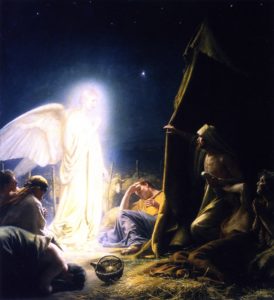
Then an angel of the Lord stood before them, and the glory of the Lord shone around them, and they were terrified. –Luke 2:9 (NRSV)

It’s funny how you can look at something a hundred times or more and then one day someone will point out something you hadn’t noticed and the whole thing looks different to you.  That happened to me a couple of years ago when a colleague pointed out one simple word in Luke’s Christmas story that had always just flown right by me.

Stood.

The angel stood before them.  On the ground.

In all the years of reading or hearing this Christmas story I had always imagined this angel and the multitude of the heavenly host hovering in the air.  I think the Christmas carols taught us to picture it that way.  Angels we have heard on high.  It came upon a midnight clear, that glorious song of old, from angels bending near the earth.  

But that’s not what it says in the Gospel of Luke.  The angel stood before them.

If you were a shepherd in a field on a dark night, it would be pretty unsettling to have an angel appear in the air above you making announcements, but at least if the angel is in the air there’s some distance between you—a separation between your environment and the angel’s.  But if the angel suddenly appears in front of you standing on the same ground you’re standing on, shining with the glory of the heavens… well I think my knees would turn to rubber.  And then imagine what it feels like when the whole multitude of the heavenly host is suddenly surrounding you and singing Glory to God.

Angels in the air feels slightly safer than angels on the ground.  Slightly.  If the angels are above, that means that they came from above.  It means that heaven is “up there” somewhere.  It doesn’t mess with the way we understand the spiritual cosmos.  But if the angels appear standing in front of us or behind us or around us, what does that say about heaven?  Could it be that heaven, the dwelling place of the angels, is not just “up there” but also here, with us?  Around us?  Could it mean that the angels of God are standing near us all the time and they simply choose not to show themselves?  Or that we’re just blind to their presence? Could it mean that this ground we walk on and build on and live on is also part of the dwelling place of God—so holy ground?

The angels didn’t bend near the earth.  They stood on it.  

We have this tendency, we humans, to want to separate the material from the spiritual, the divine from the physical.  We are such binary, black and white thinkers in a universe that’s full of colors and shades of gray.  We want here to be here and there to be there.  We want to put borders on oceans and talk about territorial waters!  We want to draw a clear and well defended line between our country and the country next door.  So it’s not surprising that we’ve assumed that there is a border between heaven and earth.

We seem to be most comfortable when there’s a little distance between us and angels, a little distance between us and God.  That seems to be the way most people talk about it, anyway.  “Put in a good word with the man upstairs,” they say.  And then there’s that song: “God is watching from a distance.”

But that’s not what Christianity says.  That’s not what Christmas says.  The Word became flesh and lived among us, and we have seen his glory, the glory as of a father’s only son, full of grace and truth.  In him the fullness of God was pleased to dwell.  Not from a distance, but right in front of us.  With us.  As one of us.

We have trouble seeing the presence of God, seeing Christ in creation.  We have trouble seeing Christ in each other.  We even have trouble understanding Christ in Jesus.  How can Jesus be both divine and human?  We struggle to wrap our minds around that idea, so we have a tendency to make him either all human or all divine.  We picture that baby in the manger with a halo, and it doesn’t cross our minds that he might need to breastfeed and burp and need his diapers changed.

Christmas, the mystery of the incarnation, tells us that God is not a bearded old man watching us from the clouds, a deity who is willing to give us what we ask if we are really good or strike us down with a thunderbolt if we’re bad.  That’s not God.  That’s Santa Claus.  Or Zeus.   

God, the Author of Life, the One in whom we live and move and have our being is Love with a capital L.  Love Personified…and Love is all about relationship.  Christmas is when God, the Love that founded the universe, showed up as one of us in order to show us in person just how much we are loved and in order to teach us to love each other more freely and completely. 

“We need to see the mystery of incarnation in one ordinary concrete moment,” wrote Richard Rohr, “and struggle with, fight, resist, and fall in love with it there. What is true in one particular place finally universalizes and ends up being true everywhere.”  In other words, God is present everywhere, in, with, and under everything.  Including you.  And me.  And all those people we’re inclined not to like.  But to really grasp this idea, we need to first see God fully present in one particular person.  We need to see God in this particular baby.  This human baby

That, in the end, is what Christmas, the incarnation, is trying to tell us.  Christmas is God’s way of teaching us that there never really was any distance between heaven and earth, between the divine and the human, between the spiritual and the material.  Christmas is God proving once again that Christ is in, with, and under all the things—all things—including all the things we think we oversee and all the things we overlook.  Christmas is angels standing on the earth singing to shepherds and surrounding them with the glory of the Lord to remind them that they, too, are spiritual beings immersed in a human experience.  

Christmas is God’s love made visible.  Pope Francis said, “What is God’s love? It is not something vague, some generic feeling. God’s love has a name and a face: Jesus Christ, Jesus.”  I would add that, if you open your heart and your mind to it, God’s love can have your face, too.

Love is vulnerable—and what’s more vulnerable than a baby?  God comes to us as a baby because it’s easy to love a baby.  It’s easy to be vulnerable with a vulnerable infant.

Christmas is earthy and concrete and vulnerable.  It enters the world surrounded by the homey smell of a stable.  It needs to be fed at a mother’s breast.  It needs its diapers changed.  It cries when it’s hungry and shivers when it’s cold.  It spits up a little bit on your shoulder.  It looks out at the world with brand new eyes and tries to see and understand.  Most of all, it reaches out to be picked up and held close to your heart.  Christmas wants to be loved and to give love.  

Christmas is our down-to-earth God made manifest.  Yes, gloria in excelsis deo, glory to God in the highest, but glory, too, to God on earth where the angels stand to sing to shepherds, because the Spirit of God is in them, too, and God loves them like crazy.  Just like God loves you.

My prayer for you this night is that you would enter deeply into the concrete, down-to-earth, human and divine mystery of incarnation.  May your eyes and ears be opened to the angels who stand upon the earth and minister to all God’s children.  May you come to see Christ incarnate, permeating all creation.  May you come to see that you are always and everywhere standing on holy ground.  May you dispense with artificial borders in your heart, in your mind, and in this lovely world.  And may you come to see yourself and all the others who share this world with you as spiritual beings immersed in a human experience.  Most of all, though, may you know that you are loved. 

May Christ be born anew in your heart this night and every night.  In Jesus’ name.

God Gets Physical

John 1:1-14

This past week, NASA launched the James Webb Space Telescope, a remarkable remote observatory that will travel 1.5 million kilometers, about 3.9 times the distance to the moon, before it parks itself in a Lagrange point—a kind of neutral zone in the tug-of-war between the sun’s gravitational pull and Earth’s gravitational pull.  There it will unfurl its highly polished mirrors made of gold-plated beryllium, and begin to stare deep into space—deeper than we have ever seen before with any other instrument.  As it peers into the depths of space it will also be looking back in time because the light it sees was generated billions of years ago.  It will be able to see celestial events that happened before the earth was formed.

The astrophysicists, astronomers, and engineers who designed and programmed the Webb Space Telescope have given it four primary missions:

  • to search for light from the first stars and galaxies that were formed in the universe after the Big Bang;
  • to study the formation and evolution of galaxies;
  • to study the formation of stars and planetary systems;
  • to study other planetary systems to see if they can tell us anything about the origins of life.

The writer of the Gospel of John didn’t have a telescope, but in a poetic way John did have a clear view of the beginning of all things.  In the beginning was the logos he said.  The Word.  The Blueprint.  The Narrative.  The Story.  The Content.  The logos was with God.  The logos was God.  All things came into being through the logos, and not one thing that came into existence came into existence except through the logos.  

Here in the prologue of John’s gospel, the logos is another term for Christ.  John is telling us about the Cosmic Christ who existed before all things, who is present in, with and under all things because all things came into being through the Christ.  Christ, the logos, is that aspect of the Divine Presence where Spirit intersects with matter.  Christ is in those distant stars and galaxies that the Webb telescope will show us.  Christ is in the giant nebulae and dust pillars that Hubble has shown us, those columns of interstellar dust and gas where stars are born.  Christ is in the quasars and pulsars, the black holes and gravitational waves and dark matter.

But Christ, the logos, is not just in the macrocosm. Christ is also in the microcosm.  Christ is in the strings of string theory.  Christ is in the strange interactions of quantum mechanics where quite literally anything and everything is a possibility.  Christ is in the anomalies of quantum flux. 

The writer of John goes on to tell us that Christ was not only in the inorganic dance of chemistry and physics, but that through the logos, through Christ, life came into being. Through Christ nitrogen and hydrogen and carbon and oxygen came together to form amino acids.  Through Christ amino acids formed long chain proteins which then formed protein blocks which then evolved into single-celled organisms.  Through Christ single-celled organisms bonded to form symbiotic colonies which then evolved to become multi-celled organisms.  Through Christ life began to take on more and more diverse forms.  Plants, ants, beetles, fish, mice, dinosaurs, cats and dogs, monkeys, apes, humans.  

John tells us that Christ was the origin of life.  In the logos was life, and that life is the light of all humanity.  I suspect that’s because humanity not only lives life, but we also seek to understand it.  

In an age when we have figured out so much about the essential structure of things in physics and the intricate functions of things in biology, an age when we have delved deep into the geology of our own world and have begun to poke into crust of other planets, it’s tempting to think we can explain esoteric things like existence without God in the equation.  But one of the beauties of real science is that the more we learn, the more we realize there is so much more that we don’t know.  Those who dive deepest soon realize there is no bottom, no stopping point, because they have thrown themselves into the mystery of existence.  As Werner Heisenberg said, “The first gulp from the glass of natural sciences will turn you into an atheist, but at the bottom of the glass God is waiting for you.” 

The word Christ, Christos, means anointed.  John is telling us that through the logos,through Christ, all of creation is anointed with, infused with the presence of God.  As Saint Paul said, God is never far from us because “in him we live and move and have our being.”[1]  Saint Patrick understood this intimate and inescapable presence of Christ when he prayed: 

“Christ with me, Christ before me, 

Christ behind me, Christ in me, 

Christ beneath me, Christ above me, 
Christ on my right, Christ on my left, 
Christ when I lie down, Christ when I sit down, 
Christ in the heart of everyone who thinks of me, 
Christ in the mouth of everyone who speaks of me, 
Christ in the eye that sees me, 
Christ in the ear that hears me.”[2] 

Then entire physical universe is where God hides…but it’s also where God is revealed.  God is not “up there” somewhere—well, not only “up there”—God is right here.  Christ is in you.  Christ is in me.  That is what Jesus, the Christ is all about.  Jesus came to show us that God is with us.  In us. Working through us.  “We spend so much time trying to get “up there,” says Richard Rohr, “we miss that God’s big leap in Jesus was to come “down here.” So much of our worship and religious effort is the spiritual equivalent of trying to go up what has become the down escalator.”[3]

Once we really accept the idea that through Christ God is present in all of creation, the world becomes “home, safe, enchanted, offering grace to any who look deeply.”[4]  The Webb Space Telescope will be looking deeply. It may even be able to see as far as the dawn of creation. There’s no telling what we will learn.  But whatever it shows us, it will simply be telling us more about Christ, in whom we live and move and have our being.


[1] Acts 17:28

[2] Prayer of St. Patrick, 5th century

[3] Richard Rohr, The Universal Christ: How a Forgotten Reality Can Change Everything We See, Hope For and Believe

[4] Ibid. 

Dear Pontius Pilate

Dear Pontius Pilate

John 18:33-38a

Dear Pontius Pilate,

I have spent much of this week reviewing a single moment from your life, to be specific, your brief interrogation of Jesus of Nazareth.  Surely you remember it.

One of the advantages I have, looking at this moment twenty one centuries after the fact, is that I know things you could not possibly have known. You could not have known, for instance, that this moment when Jesus stood before you was, in fact, a pivotal moment in the history of all humanity.  I’m sure that to you he just looked like another troublemaker and the whole business seemed needlessly tiresome.  As he stood in front of you awaiting judgment, with his overeager accusers prodding you from the wings and insisting on his execution, how could you possibly have known that your decision either way would have repercussions that would change the course of history?  I wonder…if you had known how monstrously important your moment with Jesus really was, would it have changed your decision? Would you have taken more time to think about it?  To make your choice?

After your exchange with him about whether or not he was a king or had made any claim to be a king—an issue which, it seems, was left somewhat unresolved—Jesus said something that was both intriguing and a bit enigmatic.  He said, “For this I was born, and for this I came into the world, to bear witness to the truth. Everyone who belongs to the truth listens to my voice.” 

That last part is a little tricky in translation—that’s one of the problems with reviewing things centuries after they happened.  Details can become blurred.  Languages don’t always translate precisely.  Words and phrases seldom bring their cultural context with them when they plunge into a new language.  Did Jesus say “everyone who belongs to the truth” or “everyone who is of the truth” or “out of the truth” or “from the truth”?  All these are reasonable and acceptable translations of that potent little Greek word ek.  The differences in meaning are subtle, but not unimportant.  The choices we make in how we choose to hear it carry weight.  Personally, I like belongs.  It reminds me that truth, even as a philosophical concept, is bigger than I am.  Truth is my master, I am truth’s servant.  This means, of course, that I must be very careful that it’s not my own subjective version of truth or my wishful thinking version of truth that I am serving.  I have to be careful that I haven’t bound myself in service to a propaganda version of truth.  I belong to truth.  It owns me.  So I listen to the voice of Jesus.

You asked a simple question in response to Jesus.  Well that’s not quite true.  It’s not a simple question at all.  It is, in point of fact, a question that has kept various philosophers, theologians, and even scientists awake at night for two millennia.   Three small words in our language, also in your language, and also the ancient Greek that handed the question down to us:

Quid est veritas?  What is truth?

Were you being cynical when you asked that, my dear Prefect?  Or did you ask it, as Frederick Buechner suggests, with a lump in your throat?  Is this a question that had kept you awake at night, also?  Or had you dismissed the whole idea of objective truth after so many years on the judgment seat hearing people give competing versions of “the truth”?  

Did it occur to you for even an instant, my dear Pontius Pilate, that the truth was standing right in front of you as you asked the question?  Did it occur to you that the truth was not an idea or philosophical concept, but rather a person?

The truth was standing right in front of you, Prefect.  I don’t say that out of piety.  I don’t say it to be in conformity with the holy writings that arose from his followers in the years after your time with him.  I don’t say it merely to resonate with his own words when he said, “I am the way, the truth, and the life.”  I say it, dear Pontius Pilate, because it is true. Objectively true. The answer to your question, the truth, was standing right in front of you.

Here is the truth that you were not seeing, my dear Pontius, as Jesus stood before you in silence with his hands tied and his fate all but sealed:

Heaven was confronting empire.  

As you faced each other, it was more than Jesus of Nazareth fronting Pontius Pilate of Rome.  In you, Prefect, was all the relentless and violent might of the empire spilled down through its systems of hierarchy and bureaucracy.   In you was oppression and military organization used ruthlessly to maintain efficiency, protect investment, and continue the empire’s  domination.  All that might and power and agenda was condensed into your title, Prefect.  And in that moment with Jesus, all the authority of that title was condensed into your word, your yes or your no.  

Across from you was Jesus, unadorned humanity in the image and likeness of God.  Challenging your word of imperial authority, your yes or no, was the yes of life,  the yes of creation, the yes of generosity, the yes who spoke light into the shadowy hearts of all humanity.  Creation, life, the light of understanding, love, which is the presence of the divine, grace and her twin sister mercy, equity and her twin sister justice—these things have always been opposed to empire, and Jesus of Nazareth embodied all this as he stood facing you in silence.  Standing before you was one in whom the fullness of God was pleased to dwell.  

All the natural flow and goodness of earth and heaven was standing before the empire’s paranoid, overzealous, and slightly incompetent middle management, waiting for a decision.  

But so was everyday life.

The truth came before you, Pontius, in plain clothes.  Truth came to you as one of the invisible people you passed without seeing as you rode your chariot through the city.  Truth came before you already roughed up and mistreated by those with less authority but more fear, anger, and frustration.  Truth stood before you as one of the little people.

Truth came as a workman turned rabbi, a teacher who was trying to open the eyes and widen the embrace of his people—of all people—a teacher who was trying to give us a larger vision of how life could be with real justice and real fairness and real concern for persons.  He was trying to show us how life could be in a kin-dom of God where we love our neighbors as ourselves.  

The truth stood before you armed only with words and a vision, the most powerful tools humanity has ever known.  But words and vision have always found themselves contesting swords and spears because empire knows that words and vision are inevitably its undoing. 

Heaven confronted empire, Prefect, and heaven came armed with nothing but truth, words, and vision. 

“What is truth?” you asked.  Can you see now, my dear Marcus Pontius Pilatus, that truth is not an idea, nor merely empirically proven facts?  Can you see yet that truth is a person?  All of us stand in that truth one way or another.  And empire will always have trouble seeing that.  The light shines in the darkness, but the darkness has never understood it.  

Truth was staring you in the face, Prefect.  

Know that truth, Pontius, and the truth will make you free.  

The Cloud of Witnesses

My very earliest memory is full of lightning, thunder, and freezing rain.  And my mother crying.  

I was not quite 4 years old.  It was nap time at the preschool, and we were all supposed to be stretched out on our rugs relaxing and thinking sleepy thoughts, but most of us were curled up in a fetal position because the lightning kept flashing and the thunder kept thundering and the little beads of freezing rain pelting the windows sounded like something skittering and malicious trying to break in.  And suddenly, there was my mom, appearing out of nowhere, bending over the teacher’s desk and whispering something to her while my teacher made an “Oh no!” face.  The next thing I knew, I was in the back seat of the car.  Mom sat in the driver’s seat.  But she didn’t start the car.  We just sat there.  Then my mom put her face in her hands and wept.  

Clearly something was very wrong.  Something awful had happened.  And since I was not quite four years old, I assumed that whatever it was, it was my fault.  So I started apologizing, just saying “I’m sorry, I’m sorry, I’m sorry” over and over again.  And, of course, I started crying, too, because I was confused and scared and not quite four years old, and my mother was crying, and the thunder kept thundering and the lightning kept flashing, and the wind was howling as it threw freezing rain against the windshield.  But mostly I cried because I was absolutely positive that I had done something very, very bad that made my mother cry, though I couldn’t have told you for the life of me what that might be.

Finally, Mom composed herself and reassured me that I had not done anything wrong.  She told me that my grandpa had died.  Her father, the person who, at that point in my life, I loved more than anyone else in the world, except maybe her,  had died.  I had sat in his lap in the farmhouse kitchen just one week before, sneaking sips of cream and sugar coffee from his saucer.  And now he was dead.  

Everything about the following days after that moment is blur in my memory.  Except for this: I have a very clear memory of looking at my grandpa laid out in his casket at his funeral.  I must have looked at him for some time, because when I close my eyes, I can still see him.  As I looked at him, I realized that he was both there and not there—that the body lying in the casket was my beloved grandfather, but that the something that made him the person I knew and loved was not in that casket.  And yet, I felt him so close to me.  As a matter of fact, I have felt him close to me many, many times since then.  

I learned some very important things about death at the tender age of not quite four.  

The first thing I learned is that death hurts.  It may or may not hurt the person who dies.  That depends a lot on how they die.  In fact, if pain is involved, death is a blessed release from that pain.  Still, death hurts.  It hurts those who are left behind, those of us who love the one who has died.  Death rips a piece out of the fabric of our lives, and there’s no patching it.  It hurts to know that the loved one who has died won’t be here with us any more—at least not in the tangible, put-your-arms-around-them-and-hug-them way they were here before.  It hurts to know you won’t be able to sing with them or cook with them or walk with them or joke with them or have lunch with them or any of the million little things we do with each other.  At least not in the way you did those things before.

Death hurts.  So we weep.  My mother wept.  Jesus wept when his friend Lazarus died.  He felt the pain survivors feel in the face of death.  In fact, the original language of the story hints there was anger in his weeping—anger at the pain and bewilderment that death always brings with it.  Death hurts.

I also learned when I was not quite four that death comes to everyone.  No exception.  As my mom talked to me about my grandfather’s death, she made that pretty clear.  She grew up on a farm, so she didn’t pull any punches.  I am going to die, she said.  Someday.  Your dad is going to die.  Someday.  You are going to die.  Someday.  It happens to everyone.  It’s nothing to be afraid of.  It’s a part of life.

Death is a part of life.  Life and death are part of the same continuum.  And if you don’t find a way to make peace with that idea—make peace with the idea of your own death—you will find all kinds of ways to make yourself crazy trying to deny death.  Our whole Western culture is built around exactly that kind of craziness.  Ernest Becker described our collective insanity from denying death and its destructive consequences so well that he won a Pulitzer Prize for his book, The Denial of Death.   Money, seeking fame, gluttony, narcissism, surrounding ourselves with stuff, addiction—all these things and more can be ways to hide from the deep truth of our mortality.  

We just don’t want to think about it.  We use euphemisms so we don’t have to say the words.  He passed. Passed away.  Passed on.  She’s gone ahead.  He kicked the bucket.  Bought the farm.  Gave up the ghost.   Went to be with the Lord.  Went to heaven.  Met his maker.  Was called home.  Has gone on to a better place.  Even the military will say that there were X number of casualties instead of saying that X number of people died or were killed.  They died.  They are dead.

Death.  It’s a spooky word.  There is a finality about it.  I think sometimes we’re afraid to say it because we think might summon it.  But guess what?  We’re not that powerful.  We might have mojo, but we don’t have that kind of mojo.  And besides, death coming eventually anyway.  For each and every one of us.

I’ve thought a lot about death since I was not quite four years old, especially during the last twenty-five years.  As a pastor, I’ve been in the room with Death a lot more often than the average person.  But that’s not why I’ve spent so much time thinking about it.  I’ve thought a lot about death because I’m in the Life business, specifically the Life in Christ business.  And one of the things that’s essential for Christians to remember is that we were baptized into death.  Saint Paul said so in Romans:  “Do you not know that all of us who have been baptized into Christ Jesus were baptized into his death? Therefore we have been buried with him by baptism into death, so that, just as Christ was raised from the dead by the glory of the Father, so we too might walk in newness of life.”

Newness of life.  That’s the thing you get if you make peace with death.  You don’t need to be afraid of death anymore.  You understand that life and death are part of the same thing, the same continuum.  So you can be free from all the crazy-making things that shackle you if you’re trying to deny your mortality.  You can be free to live life in all its fullness. 

There are some fairy-folk in some of Terry Pratchett’s Discworld novels called the Nac Mac Feegle.  They’re six inches tall, blue, mischievous, wear kilts, and speak with a Scottish accent.  They are absolutely fearless and embrace life with joyful ferocity.  The thing that makes them fearless and so fiercely, joyfully alive is their one central belief:  they believe they have already died and that the world they now live in is heaven.  There’s no need to be afraid of death.  It’s already happened.  And if they do happen to die, they believe that they are just going to another part of heaven they haven’t been to yet.  I can’t help but think that as Christians, we’re supposed to believe something like that.  We’ve already died.  In baptism we have died with Christ so we can walk fearlessly, freely, and even with a fierce joy into newness of life.

Life and death are part of the same continuum.  And it is a continuum that continues.  Life. Death. Resurrection.  As Saint Paul said, “For if we have been united with him in a death like his, we will certainly be united with him in a resurrection like his.”  It is Christ’s life in us that carries us through death.  It is Christ’s life in us and our life in Christ that guarantees our resurrection. Someday.  In God’s own good time.  

In the meantime, the Letter to the Hebrews reminds us that we are surrounded by a great cloud of witnesses.    In so many, many ways our loved ones who have died still walk with us and stand beside us.  Their lives have shaped our lives.  We feel their presence.  They gather with us at the table in the Communion of Saints and share the sacrament that connects us through all the generations in an unbroken line all the way to the apostles and to Jesus himself.  

At his last supper, Jesus told us to remember him.  He didn’t mean that we should simply think about him with fondness and nostalgia.  He meant it in the Jewish way of remembering.  He meant for us to bring him forward out of the past and into the present to be fully with us so we can be fully with him.

This is a day when we remember the saints—those people of faith who have died in Christ and will rise again in God’s own good time.  But they arise with us now in a different way when we remember them.  

We remember them.  Re-member.  To receive again as a member.  To reassemble the whole from parts that were separated.  We speak their names. We remember them.  We call them out of our memories and acknowledge their place in the assembled body of Christ.  We remind ourselves that they have died, but they still stand with us in the body of Christ.

We believe that on this day and every day the saints live on in the love of God and life of Christ.  This is not a denial of death.  We do not deny death.  We defy it.  We defy it as we fiercely and joyfully embrace life eternal.

Crazy Bread

John 6:56-69

When you think about it objectively, religion is kind of strange.  The whole idea of it, if you step back and look at it from a certain perspective, is just king of odd.  The idea that if we meet regularly and perform certain rituals and pray a certain way and sing certain songs in a certain way, somehow God, the almighty, all powerful, omniscient Maker of the Universe, will like us better or come closer to us or overlook our bad behavior or give us things—that whole idea is, on the face of it, kind of bizarre.  And yet, that seems to be the way a great number of people understand God and church and faith and religion in general.  

Years ago, the late George Carlin had a very funny routine about all this.  I’m going to change one or two of his words because I don’t want to say them in church, but here’s what he said:

“When it comes to [bull puckey], big-time, major league [bull puckey], you have to stand in awe of the all-time champion of false promises and exaggerated claims, religion. No contest. No contest. Religion. Religion easily has the greatest [bull puckey] story ever told. Think about it. Religion has actually convinced people that there’s an invisible man living in the sky who watches everything you do, every minute of every day. And the invisible man has a special list of ten things he does not want you to do. And if you do any of these ten things, he has a special place, full of fire and smoke and burning and torture and anguish, where he will send you to live and suffer and burn and choke and scream and cry forever and ever ’til the end of time!

“But He loves you. He loves you, and He needs money! He always needs money! He’s all-powerful, all-perfect, all-knowing, and all-wise, somehow just can’t handle money! Religion takes in billions of dollars, they pay no taxes, and they always need a little more. Now, you talk about a good [bull puckey] story.” 

I have to tell you, if I thought for half a minute that God was anything like that, I’d be an atheist, too.  And the sad fact is, that this is exactly how a lot of religion and the Christian faith is presented and represented.  You think I’m exaggerating?  Go watch religious TV for a day and get back to me.  The picture you get is that God is distant, generally ticked off and inclined to be cranky, and it’s a good thing Jesus is there as our go-between because he keeps talking the Father down when he’s just itching to wipe us out altogether.  Except that in a lot of these “Christian” broadcasts, they think Jesus, himself, is going to come back any minute now  to settle our hash.  

Yikes!  He’s making a list, checking it twice, and you better believe he knows who’s naughty and who’s nice.  That’s not God!  That’s Santa Claus—and not in a fun way.  That’s Zeus throwing thunderbolts from Olympus!    

Richard Rohr said, “Jesus did not come to change God’s mind about us.  Jesus came to change our minds about God.  God did not need Jesus to die on the cross to decide to love humanity. God’s love was infinite from the first moment of creation; the cross was just Love’s dramatic portrayal in space and time.”[1]  

Instead of responding to our violence with more violence, God, in Jesus, endured our violence and responded with grace, love, forgiveness and resurrection.  Jesus came to give us a new understanding of who God is and how God is at work in the world so we could have a fresh start in our relationship with God and with each other.

If God and Jesus are not punishing, vindictive, or violent, then we have no excuse for being that way.  Ever.  

Jesus is the human face of the Cosmic Christ—the nexus where spirit and matter intersect.  The Gospel of John[2] tells us that “all things came into being through him.”  In Colossians we see it spelled out a different way.  “He is the image of the invisible God, the firstborn of all creation; for in him all things in heaven and on earth were created, things visible and invisible…—all things have been created through him and for him. He himself is before all things, and in him all things hold together.[3]

This is not an invisible, cranky old Sky Man watching from a distance.  This is not Zeus or Santa Claus keeping score to determine rewards and punishments.  This is God who has poured the divine self into all of creation to infuse everything with love and goodness.  This is Christ in, with, and under not only the bread and wine of the table, but all things.  In him all things hold together.

In other words, there’s more than meets the eye in everything you see or touch.  There’s more than meets the eye in everything.  Period.  As it says in Ephesians, Christ is in all and through all.[4]

It’s like Crazy Bread at little Caesar’s.  If you just glance at it, you’ll just see breadsticks.  If you pick one up, though, you’ll find it kind of slippery because it’s slathered in butter and dusted with granules of Parmesan.  And if it happens to be a piece of stuffed Crazy Bread, the minute you bite into it you’ll discover a surprise because it’s filled with melted mozzarella.  There’s more to it than meets the eye.  If you pass it up because you think it’s just a breadstick, you’ll miss the surprise. You’ll miss the experience.

When Jesus was teaching in the synagogue at Capernaum, he said, “Those who eat my flesh and drink my blood abide in me, and I in them. Just as the living Father sent me, and I live because of the Father, so whoever eats me will live because of me. This is the bread that came down from heaven, not like that which your ancestors ate, and they died. But the one who eats this bread will live forever.”[5]  

He wanted us to understand that he is incarnate, God is incarnate, in all things. The world is full of the life and light of Christ.  Yes, Christ is absolutely present in the bread and wine of communion.  But also in the soil where the wheat grew, and in the stalk of the plant and in the grains that were ground into flour.  He wants us to understand that he was incarnate in the vine and the grape and the yeast that ferments it into wine.  He wants us to understand that he is present in our coming together at the table in the same way he is present when water that bonds with flour to make dough, creating a new thing altogether—a thing that is still water and flour but also something different, something greater, something more.  He wants us to understand that he is present in the trials and troubles we share the same way he is present in the fire and heat that bakes the bread.  He wants us to understand that “taste and see the goodness of the Lord”[6] is more than a poetic metaphor—it’s an invitation to open our eyes and broaden our understanding so we can see Christ, so we can begin to see that in him all things hold together.  It’s an invitation to hold all life more dearly—not just ours, all life—because in him was life, and life is the light of humanity[7].  And by that light we understand that the life of Christ is infused into all living things and the planet itself.  By that life we participate in the eternal cycle of life, death, and resurrection—like the grains of wheat that fall to the earth and die but rises again in the fullness of a new existence.

“The words I have spoken,” said Jesus, “are spirit and life.”[8]  He went on to acknowledge that some people had difficulty with what he was saying.  Some took him far too literally when he talked about eating his flesh and blood.  They were offended.  They didn’t understand that it was his words that carried spirit and life.  They didn’t understand that he was the Word—the Word that became incarnate, embodied, living among us full of grace and truth.  The things he said didn’t fit the context of their religion—or at least not as they understood their religion.  So they turned away.

As I said at the beginning, religion is an odd thing.  It can help us understand or it can get in the way of our understanding.  It can open our hearts and minds, or it can close them.  It’s important to remember that Jesus didn’t come to give us a religion.  He came to show us the love of God in person.  He came so that we may have life in all its abundance.[9]


[1] A Nonviolent Atonement (At-One-Ment); Fr. Richard Rohr, Center for Action and Contemplation; 10/12/16

[2] John 1:3 ff

[3] Colossians 1:15 ff

[4] Ephesians 1:23; 4:6

[5] John 6:56 ff

[6] Psalm 34:8

[7] John 1:3

[8] John 6:63

[9] John 10:10