The Space Between

Luke 17:11-19

You know how you can read something a hundred times and on the one hundred and first time something will pop out at you that you never really saw before?  I don’t know how many times I’ve read this passage from Luke over the years.  It’s pretty familiar, but this week, something in the opening line really jumped out at me:

On his way to Jerusalem, Jesus passed through between Samaria and Galilee. 

That is such a curious way for this story to begin.  Where, exactly, is this space between Samaria and Galilee?   On the map Samaria and Galilee butt right up against each other.  There is and was a border that separated the two territories.  There was also a very pronounced social, cultural and religious line in the sand separating the Jews of Galilee from the Samaritans of Samaria, a line of intense historical animosity.  So what is the writer of Luke trying to tell us when he says that Jesus was passing between Samaria and Galilee?

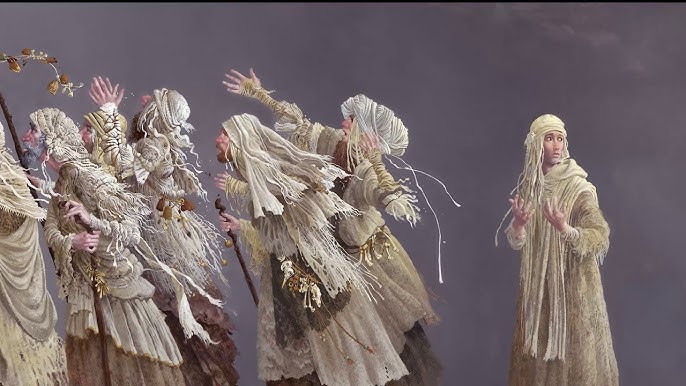
As he entered a certain village, ten men with leprosy approached him but kept their distance and shouted, “Jesus, Master, have mercy on us!”  Jesus looked at them and said, “Go show yourselves to the priests.” And as they went, they were cleansed of their skin disease.

In Biblical times, leprosy was a catch-all term for a variety of skin conditions, especially those that created whitish patches of scaly skin such as atopic dermatitis or plaque psoriasis.  White, scaly skin can also, however, be one of the first symptoms of true leprosy, what we now call Hansen’s disease, so in an age before microscopes,  diagnostic tests and bloodwork, it made some sense to assume the worst when those scaly patches appeared.  

The book of Leviticus dictated that persons with such as skin disease had to live outside the town.  The leper laws in Leviticus required them to tear their clothes and mess up their hair to make themselves more easily identifiable, and they were required to wear a cloth mask or veil that covered from the upper lip to the chin.  They were also required to carry a bell or wooden clapper and to cry out “unclean, unclean” to warn people not to get too close, because the law required them to keep a safe distance from everyone else.  The Talmud said that the minimum safe distance on a normal day was two cubits, about six feet, but if it was windy 150 feet was the recommended safe distance.

These men with a skin disease stood at a distance and begged Jesus for mercy .  Their plea had to be loud enough to travel across the space between them and Jesus.

Jesus healed them, but he didn’t lay hands on them.  He didn’t put them in the awkward position of violating both religious and civil laws that required them to keep their distance, which meant that in this particular instance, Jesus observed those laws, too.   So he didn’t lay hands on them, and the text doesn’t say anything about him praying for them, either.  He simply said, “Go show yourselves to the priests,”  which is what Torah required if they were healed.  Their healing happened in the space between them and Jesus.

On the face of it, this looks like a simple, if somewhat unusual, story about healing.  There is also the noteworthy gratitude of the one man who returns to thank Jesus and prostrates himself before him in an act of worship, so it can also a story about gratitude.  But when we look closer, I think there is more to it than that.  

Clearly this is a story that reminds us of God’s power to heal.  It also shows us yet another example of Jesus’ compassion.  And yes, it even makes a point about taking a moment to be grateful when God has done something extraordinary for you.  But I think maybe Luke is also trying to tell us something about the power and importance of between places, those places and times when we are in neither one place or the other but on the edge or verge of both.

Luke tells us that Jesus was passing through between Samaria and Galilee.  Jesus is in a borderland, an in-between space that is both Galilee and Samaria, and at the same time really neither one.

The ten men with the skin disease were also in a between space.  They were husbands, fathers, brothers living at a distance from those they loved most in order to keep their loved ones safe.  They were living on the outskirts of the village, living on the margins of the community in that space where the village ended and the wilderness began.  More poignantly, they were also living in that thin space between life and death.  

Because their disease had excluded them from all other society, they formed their own small community, Jews and Samaritans bound together by their common affliction in a space where the cultural animosity and antagonism of Jew versus Samaritan was not only irrelevant but could threaten their survival. 

Every border, every territorial boundary, no matter where it is, is a testament to conflict.  It is a reminder that at some point in history one group of people behaved aggressively against another group of people.  Every border is a monument to our human failure to make peace with our differences, a testimony that the space between us is often filled with anger and fear.

Anxiety, said Saint Augustine, is the garden in which sin grows.

When borders are rigidly drawn and vigorously enforced, they sharpen the divide and highlight the differences between the people on one side or the other.  They intensify the “otherness” of those who are not from our side of the line, and that, in turn, can stimulate anxiety, suspicion and fear, which all too often leads to scapegoating and violence. 

On the other hand, when borders are porous and less strictly enforced, they become zones of cross-pollination and fusion between cultures, places where ideas and feelings are shared,  places where transformation is possible.

The borderlands, the between spaces, are places where meaningful change is not only more possible but more apt to happen.  

Twenty years ago, Stuart Kauffman, a researcher in theoretical biology and complex systems, proposed a new theory to explain how organisms and systems adapt and become more complex.  He called his theory Adjacent Possible Theory or “APT-ness,” and he has suggested that the “adjacent possible” is such a powerful dynamic that it could be considered the fourth general law of physics.  

Adjacent Possible Theory suggests that at any given moment there is a space of untapped potential around every complex system—around every organism, around every person, around every institution.  That field of untapped potential in the adjacent possible is actually a new field of energy that powers change and transformation. 

In other words, you are surrounded by an energizing halo of possibility.

Think about your living room. Most of us have the same furniture, sitting in the same spots for years at a time. When the house gets crowded on game days or holidays, you know where people are going to end up, what the traffic flow is going to be like, where there are going to be “traffic jams,” where the favorite spot to hang out always is.

Kauffmann’s law of the “adjacent possible” says real change takes place when you re-arrange the current configuration of things, opening up a new possibility for movement and matter.  Rearrange your living room furniture, and see what happens.  Without adding even one new chair or table, the whole feeling of the room is changed. People move about the room differently. They interact with others in new groups. The energy in the room flows in a new configuration. All that just by moving the furniture.

The Adjacent Possible, that halo of possibility is particularly potent in between spaces because the between space is adjacent to two or more differing realities or paradigms and draws energy from both.  The “furniture” tends to be in flux.

In many ways the Church is in an in between space.  We are in a time, a space, where we are no longer what we were but what we will be has not yet been revealed.  The culture has been moving us to the margins.  We are in a space of transformation, the realm of the Adjacent Possible.  The good news is that there is energy in that space, the energy to be made new.

In the original Greek text of Luke’s story of the healing of the ten men with the skin condition, there are three different words for the healing that takes place.  The first word is katharizo.  It means “to be cleansed.”  Catharsis.  This is what the 10 men experience as they leave Jesus to go to the priests.

The second word is iathei.  It means “to be changed to an earlier, correct, or appropriate state.”  To be restored.  This is what the one grateful Samaritan experienced.  He saw that he was restored.

The third word is sesoken, the active indicative form of sozo.  It is often translated as saved, but it also means to be made well or whole.  This is the word Jesus speaks to the Samaritan who bows before him in praise and gratitude when he says, “Your faith has made you whole.”  

As a church and as a nation, we are standing in an in-between place.  We are in the borderland of the Adjacent Possible, surrounded by a halo of possibility for transformation.  The shape of that transformation depends on the choices we make. 

If we open our eyes, our minds, our hearts to encounter Jesus in this in-between space, if we ask Christ for his healing mercy and guidance, then we, too, can experience cleansing, restoration, and positive transformation.   We, too, can be made whole.

Our task, our calling, is to step past the hard lines of the borders we’ve drawn, the lines that divide into us versus them.  If we want to be made whole again, we need to step into the in-between places.  That’s where we can encounter each other.  That’s where we can form a new sense of community.  That’s where we can stand in a halo of possibility. That’s where we can encounter Jesus.  That’s where God is doing a new thing… in Jesus’ name.

Image: Ten Lepers by James Christensen

In, With, and Under

It’s a simple thing.  You take a bit of bread and a sip of wine.  But it’s not just bread and wine.  It is nutrition for the soul where spirit and matter intersect.  Christ is in the bread.  Christ is in the wine. You are taking Christ into yourself.  The body of Christ becomes your body and you become part of the body of Christ. The blood of Christ becomes your blood and your blood flows through the body of Christ. You are being empowered and equipped to be Christ’s hands and feet and eyes and ears, to speak Christ’s love and forgiveness and grace.  In that bit of bread and taste of wine you are united as one with all the others who have shared in this sacrament in every age. In that bit of bread and that taste of wine you are drawn back to that last supper that Jesus shared with his disciples.  In that bit of bread and taste of wine you are also being drawn into tomorrow.  

This is the eucharist, literally “the good gift,” the sacrament of communion.  This is the sacrament that signifies our unity as followers of Jesus.  And ironically, sadly, it has been the pivot point of many of Christianity’s most intense  disagreements. 

Over the centuries church leaders and theologians have excommunicated each other over their different understandings of just exactly how Jesus is present or if Jesus is present in that bit of bread and taste of wine.  Ulrich Zwingli, the Swiss reformer said that Christ isn’t really present.  The sacrament, he said, is only a “remembrance.”  Martin Luther insisted that Christ truly is present “in, with, and under” the bread and the wine.  Legend says he was so adamant about this that while arguing with Zwingli he carved it into a table top: “corpus meum est”—“this is my body.”   Luther and Zwingli excommunicated each other.  And the Pope excommunicated them both.  Calvin later said that Christ is present, but only spiritually.  No one was quite sure what to make of that.

And I think all of this makes Jesus weep.

One of the very first social boundaries that Jesus crossed was the boundary of table fellowship. The Pharisees criticized him roundly for it.  In their day, who you ate with was important. Table fellowship determined your social status.  It had implications beyond that.  In a culture where the ideas of “clean” and “unclean” or “acceptable” and “unacceptable” were important social constructs that could have serious implications for how your life was going to go,  who you shared a table with and who invited you to their table was a huge thing.  Dining with the right people could open doors and make your reputation.  Dining with the wrong people could close those doors and besmirch your name even if you had done nothing wrong.  So when the Pharisees talk about Jesus eating with tax collectors and sinners, it’s not a compliment; it’s an accusation.  But Jesus did it to make a point.  In the Commonwealth of God’s justice and kindness, everyone is welcome at the table.  In the kingdom of God everyone is “acceptable.”  Everyone.

On the night he was betrayed, even Judas was at the table.  Even his betrayer received the bread and wine.  Levi the tax collector sat beside Simon the Zealot.  Simon Peter the Galilean fisherman sat beside Thomas the builder.  They’re not mentioned by name, but it’s probably safe to assume that Mary Magdalene was there, and Joanna, and Mary, his mother.  The point is, there were people gathered around that table who might not have been acceptable in the “polite” company of the Pharisees, or maybe even in each other’s company if Jesus wasn’t there as their host.

When Jesus breaks the bread and begins to pass it around the table, I can’t help but wonder if he isn’t looking at the faces of all his friends as he says, “this is my body.”   Is he, maybe, thinking, “You—this eclectic group who would never in a million years have come together on your own, you all together, each of whom would be an outcast somewhere—you, this companionship—this is my body.  You people sharing this bread are the ones who will carry on my Christ-ness, my Christ presence in the world.  Take me into yourselves the way you take in the bread and the wine.  Take in my teaching, my way of being, my love, my spirit, my grace, my unity with God, my way of seeing—swallow me whole so you can be my hands and feet and voice, so I will still be present in the world.”

True faith is a continuing metanoia and metamorphosis, and God gives us examples in everyday life.  Seed is buried in the earth then sprouts up green to stand in the sun and ripen with heads of grain which are crushed and ground.  They change in form to become flour, which changes in form again when bound with water then changes in form yet again when baked to become bread.  

We come to the Way of Jesus as individuals.  As we take up the work of Christ we are changed in form.  Our habits, impulses and priorities change.  We are infused with the Holy Spirit. We are bound together in the water of baptism, then baked into a community through life and service together. 

This is my body.  For you.

That same night, we’re told in John’s gospel,  Jesus had washed their feet.  “You call me Teacher and Master,” he said.  “And you’re right, I am.  But if I, your Master and Teacher have washed your feet, you should wash one another’s feet.  And in case you’re a little slow on the uptake, what I’ve just done was to give you an example.  I want you to serve each other.  More than that, I want you to love each other.  I’m giving you a new commandment: you must love one another just as I have loved you.  That’s how people will know you’re my disciples—if you have love for one another.”

And these things, too, are in that bit of bread and that sip of wine.  

The call to serve is there—in, with and under the bread and the wine.   Love is there—in, with and under the bread and the wine.  Grace and forgiveness are there—in, with and under the bread and the wine. The Word of Creation is there—in, with and under the bread and the wine.  

Christ is there—in, with, and under the bread and wine—the way Christ is present in all of Creation.

Life in all its fullness is there in a bit of bread and a taste of wine if you open your heart and mind to take it in.

The Scandal of False Opposition

Mark 9:38-50

In George Eliot’s wonderful book, Middlemarch, Dorothea Brooke asks a question that I keep coming back to over and over again.  “What do we live for,” she asks, “if it’s not to make life less difficult for each other?”  

That’s a powerful question, and if you take nothing else home with you today, I hope you take that.  I hope you let that question live with you.  What do we live for, if it’s not to make life less difficult for each other?

It seems like so often in life too many of us go out of our way to do just the opposite.  We make life more difficult, more challenging, more contentious, often without even intending to.  

In the ninth chapter of Mark, there’s a moment when the disciples made life more difficult for someone and they wanted Jesus to approve what they had done.  John, the disciple, came to Jesus and said, “Teacher, we saw someone casting out demons in your name, and we tried to stop him because he was not following us.”   

Think about that for a minute.  Someone was freeing people from spiritual oppression or possession—in the name of Jesus, no less—and they tried to stop him.  Because…?  Because he was not part of their group.  In the eyes of the disciples he wasn’t properly authorized to use the name of Jesus, I guess.

The way Jesus responded to this probably surprised his disciples, and  I can’t help but think he was maybe just a little bit exasperated when he told them, “Don’t stop him!  No one who does a deed of power in my name will be able soon afterward to speak evil of me.  Whoever is not against us is for us!  If someone does something as simple as giving you a cup of water in the name of Christ which you bear, they’re helping, not hurting.  Nobody loses God’s favor for helping others.”

That seems pretty clear, but Jesus has more to say.  He really wants them—and us—to be more aware of this human habit we have of creating opposition where there isn’t any, just like the disciples did when they told the non-disciple to stop casting out demons in Jesus’ name because he wasn’t a member of the Disciple Club.  

“If any of you cause one of these little ones who believe in me to sin,” said Jesus, “it would be better for you if a great millstone were hung around your neck and you were thrown into the sea.”  That’s how his words are translated in the Updated Edition of the NRSV and in a number of other English translations.  In some translations, he says, “If you cause one of these little ones to stumble…” which is a more accurate translation but still doesn’t really give us the whole sense of what Jesus is talking about.

The Greek word in question here is skandalise.  In its most common sense, it means to cause someone to stumble or to trip someone.  It comes from the word skandalon which gives us our English word scandal, but it’s not an exact equivalent.  A skandalon is a stumbling block or a trip wire.  It’s something that trips you up, slows you down, stops you, or springs a trap.   

The late René Girard said that in Mark’s Gospel this term is being used by Jesus in a very particular way to describe a very common dynamic in our relationships with each other.  He said that we “scandalize” each other in any number of ways by creating almost endless small rivalries which lead to blaming and scapegoating.  

I saw an short stick-figure animation the other day that was a perfect example of this.  The first character said, “Dang.  I spilled orange juice all over myself.  You never tighten the lid properly.” “Never?” said the other character.  “You’re saying I always, in every instance in my entire life, fail to screw the lid all the way down?”  “Yes.  The orange juice, the milk, the aspirin bottle… you never put the cap on right.”  “Well maybe the real problem is that you insist on shaking things without checking to make sure the cap is secure.”

Sound familiar?  They are “scandalizing” each other.

René Girard said that all these little contests of will are the “scandals” that Jesus is referring to and that we “scandalize” each other all the time in any number of ways, often without even noticing it.  These “scandals” create tension and anxiety in our relationships and they can escalate if they’re not addressed right away.  We carry that anxiety and tension out into the world with us where it joins in the great cloud of everyone else’s anxiety and tension.  

Think of road rage.  It may start with something small, one car not letting another merge into a lane, or one car cutting in front of another, but as we’ve seen far too often, with the wrong people in the wrong mood on the wrong day it can quickly escalate into something violent that puts everyone on the road at risk.

We scandalize others and are scandalized by others, colliding with each other in what Girard calls a cycle of mimetic rivalry which we keep reflecting back and forth at each other. Eventually, says Girard, our mimetic rivalry becomes contagious and our anxiety can all too easily become a kind of violent potential energy looking for a place to land, or, more specifically, a designated victim who will be the scapegoat that releases the tension.

We fall into this mimetic rivalry naturally enough, but there are forces in our world that encourage it for their own profit.  Politicians and certain news organizations, for instance, often manufacture or exaggerate a problem to serve as the target of our anxieties so they can then portray themselves as the ones who have the solutions—solutions which almost always involve scapegoating someone else.

This was the dynamic Hitler was using when he convinced the German people that the Jews were the source of their problems.  This is the dynamic some of our own politicians are using when they stir up antagonism toward immigrants, or even the other party.   

“If one of you scandalizes one of these little ones who believe in me, the ones with less power or resources or stature, it would be better for you if a great millstone—the Greek actually says the millstone of a donkey, a millstone so large you need a donkey to turn it—it would be better for you if a great millstone were hung around your neck and you were thrown into the sea,” said Jesus.  In other words, if you do something inadvertently or intentionally that traps someone else into a cycle of mimetic rivalry, especially if it’s someone with less social currency than you have, you’re sinking yourself and that other person into a very deep sea of trouble.

Jesus wants us to know that it starts in our bodies.  He wants us to understand that this mimetic rivalry is a very physical thing.  

“If your hand scandalizes you, cut it off.  It’s better for you to enter life maimed than to have two hands and go to Gehenna.  If your foot trips you up, cut it off; it is better for you to enter life lame than to have two feet and to be thrown into Gehenna.  And if your eye scandalizes you, pluck it out.  It is better for you to enter the kingdom of God with one eye than to have two eyes and be thrown into Gehenna where the worm never dies and the fire is never quenched.  I’ll say more about Gehenna in a moment.

Now let’s be clear.  Jesus is not advocating that we maim ourselves in any way.  A lot of people are really troubled by this passage, and a lot of pastors hate to preach on it.  One pastor asked his adult Sunday School class to think about which Sunday would be good for inviting their friends to church and one woman said, “Any Sunday except pluck-your-eye-out Sunday.”

She has a point.  It’s a scary text and it could put people off.  But it’s important to remember that Jesus is using hyperbole here.  He uses these very graphic images to hammer home the point.  The cycle of mimetic conflict begins in your body.  If your hand reaches for things that don’t belong to you, teach it to open up in gratitude for the things you do have.  If your hand all-too-easily balls itself into a fist, teach it to relax and reach out to others with understanding and compassion.  Metaphorically cut off that angry hand and give yourself one that’s peaceful.  If your foot keeps stepping into trouble, give yourself a foot that knows a better path.  If it keeps ending up in your mouth, well that’s a different problem, but maybe give yourself a more patient tongue.  If your eye keeps looking at others with inappropriate desire, retrain it to look on the world with genuine love and appreciation.

Mimetic rivalry and mimetic desire begin in your body.  And your body can be trained.  And healed.

Thich Nat Hanh, the great spiritual teacher once said, “My anger lives in my body but it will do no harm if I do not direct it at anyone.  When you say something really unkind, when you do something in retaliation, your anger increases.  You make the other person suffer, and he will try hard to say or to do something back to get relief from his suffering.  That is how conflict escalates.  I would not look upon anger as something foreign to me that I have to fight…I have to deal with my anger with care, with love, with tenderness, with nonviolence.”

 If we don’t learn to stop this scandalizing that we fall into all too easily, the penalty is pretty severe.  And it’s self-inflicted.  “Better for you to enter the kingdom of God with one eye than to have two eyes and be thrown into Gehenna, where the worm never dies and the fire is never quenched.”

Many of our translations say “thrown into hell,” but the Greek word here is Gehenna, not Hades or Sheol, and it is a very specific place.  Gehenna was the nickname of the Valley of Hinnom, a ravine running along the south side of Jerusalem.  It was believed to be cursed because, allegedly, children had been sacrificed to the Canaanite god Moloch there in one of the darker chapters of Israel’s history.  In the time of Jesus, this ravine, Gehenna, had become the city dump.  In addition to all kinds of refuse, corpses of animals were dumped there as were the bodies of criminals and nameless beggars. 

Jesus is telling us that if we keep scandalizing each other, if we don’t teach ourselves to escape these mimetic cycles of antagonism and anxiety, we will be sending ourselves to the trash heap, and I suppose that is a kind of hell.  The mimetic repetitive cycle where we keep mirroring our anxieties off each other, this scandalizing is the worm that never dies and the fire that is never quenched.  

But there is a way out.  “Everyone will be salted with fire,” said Jesus.  “Have salt in yourselves, and be at peace with one another.”  Salt, in his time, was medicine.  It was the number one antibiotic.  Salt was used to treat infection.  And it burned like fire, but it worked.  Salt also transforms things.  If you put salt in your food as you’re cooking, it doesn’t just season it, it changes the chemical composition of it because salt is a mineral, not a seasoning.  It transforms the food and makes it something different.  “Have salt in yourselves,” said Jesus.  “Burn out this contagious infection of antagonism so you can be at peace with one another.  Be transformed.”

Be at peace.  Be at peace with each other and with yourself.  Do your best to lower the temperature and reduce the anxiety around you.  And the anxiety within you.  “Be kind,” said author Wendy Mass.  “Everyone you meet is fighting a battle you know nothing about.”  

Be kind.  Greet the world with an expansive and welcoming attitude—not one of exclusion or antagonism or defensiveness.  Help people whenever and however you can.  Or at the very least, don’t be a stumbling block when you see someone else helping people. 

After all, what do we live for, if it’s not to make life less difficult for each other?  Especially if we can do it in the name of Jesus.

Scattering Seeds

Mark 4:26-34

With what can we compare the kingdom of God…  

What do you think of when you hear or read that phrase: the kingdom of God?  I think it’s hard for us to really grasp what Jesus was talking about when he talked about the kingdom of God not only because he described it in metaphors and parables, but because a kingdom, itself, is a thing entirely outside of our experience for almost all of us.

Most of us think of kingdoms in terms of either physical territory or fairy tales, but clearly Jesus is talking about something that transcends mere physical boundaries and is a lot more real than fairy tales.  A kingdom can simply be a territory ruled over by a king or queen, but it can also mean a sphere of authority or rule, and that might be closer to what Jesus is getting at:  the rule of God.  The authority of God.  But even that is something most of us can’t relate to too well because we have never lived under the authority of a monarch or a lord or a master, and those monarchies that are still active in our world are either almost entirely symbolic or wildly dysfunctional or utterly dictatorial.  And I don’t think we want to attribute any of those qualities to God.

Also, words like authority and rule can have a coercive edge to them, and the kingdom, as Jesus describes it, seems to be much more about influence, persuasion and cooperation.  It’s more organic.  It’s something that grows in us and around us and among us.  

I have often used the phrase “kin-dom of God” for that reason—to try to capture some of the cooperative, love-based nature of God’s sovereign rule as Jesus describes it in the beatitudes and parables.  Diana Butler Bass has called it the Commonwealth of God’s justice and mercy, and I think that might be even more in the right direction.  Maybe.  But it’s also important to remember that the kingdom of God is not a democracy.  God is sovereign.  God’s rule is absolute.  Fortunately for us, so is God’s love, and that love is the very fabric of this thing Jesus is trying to describe as “the kingdom of God.”  The kin-dom of God.  The Commonwealth of God’s kindness.

When Jesus told these parables, and thirty-some years later when Mark wrote them down, trouble was brewing in Galilee and Judah and pretty much throughout all of Palestine.  Landowners were putting pressure on tenant farmers for rents they could barely pay.  Scribes from the temple in Jerusalem were demanding a crushing and complex levy of tithes from those same farmers.  Herod Antipas was demanding taxes from the landowners because Rome was demanding taxes from him.  Unemployment was high.  Bandits roamed the highways.  Soldiers patrolled everywhere.  Rome’s colonial government was heavy-handed and oppressive to the point of brutality.  People wanted a heavenly anointed messiah to step in and fix things before they exploded—or maybe to light the fuse and set off the explosion that everyone felt was coming. It’s no wonder that the disciples kept asking Jesus, “Is this the time when you will bring in the kingdom?”

Jesus kept trying to tell them and all the crowds following him, “No, the kingdom of God is not like that.  It’s not what you’re thinking.  It won’t do any good to simply replace one coercive external system with another one even if the ruler is God!”  

The change has to be internal.  It has to be organic.  Seeds have to be planted.  Human hearts and minds have to be changed. It’s not about imposing a new kind of law and order.  It’s about implanting a new kind of love and respect.  That’s what will fix the world.

“The kingdom of God is as if someone would scatter seed on the ground, and would sleep and rise night and day, and the seed would sprout and grow, he does not know how.”

For generations we had a family farm in Kansas—my  mother’s family farm—where we grew winter wheat.  Winter wheat is planted in late September or early October, depending on the weather.  Not long after it’s planted, it starts to sprout.    Beautiful little shoots that look like blades of grass start to poke their heads up out of the soil.  And then just as they’re getting started, the cold hits them.  And it looks like it’s killed them.  They slump back down to the dirt and go dormant, and they’ll just lie there all through the winter.  The ground will freeze.  Snow will drift and blanket over them.  And there’s nothing you can do.  

All winter long you go about your business.  You sleep and rise night and day.  And then you get up one spring morning and notice that the weather is a bit warmer, and the snow is patchy or mostly gone, and you look out the window to see that you suddenly have a field full of beautiful green wheat starting to rise up out of the ground.  It’s an amazing thing to see, and if you have half a sense of wonder, you thank God for the natural everyday miracle of it and marvel at it for at least a moment before you get on with your chores.  

The kingdom of God is like that, says Jesus.  It is seeds scattered on the earth.  Seeds of ideas and vison. And sometimes it looks like they’ve died.  Or been crushed.  Or been frozen out or buried.  Or simply forgotten.  But they are still there, just waiting for their moment.  

The kingdom of God is seeds of ideas and vision and understanding.  They are ideas about fairness and justice and cooperation.  They are an understanding about fuller and more generous ways to love each other and take care of each other.  The kingdom is a resolve to make a world that is healthier for everyone.  It’s a resolution to embrace God’s vision for how the world is supposed to work—a world where everyone is housed and everyone is fed and everyone can learn and everyone is safe and everyone is free to be their true self.  The kingdom is a determination to repair the damage we’ve done and restore creation so that we and all the creatures who share this world with us can breathe clean air and have clean water.

The kingdom of God, the rule of God, the reign of God, the kin-dom of God, the Commonwealth of God’s justice and mercy is a commitment to let justice roll down like water and to show each other kindness and to walk humbly with God and with each other.  It is a continual correction of our vision so we keep learning how to see the image and likeness of God in each other—in each and every face we face so that racism and classism and every other kind of ism evaporate from the earth.  It is the seed of courage taking root in our hearts and minds so that we learn not to be afraid of something or someone simply because it or they are different from us or from what we know or what we expect or what we are used to.

“With what can we compare the kingdom of God, or what parable will we use for it?,” said Jesus.  “It is like a mustard seed, which, when sown upon the ground, is the smallest of all the seeds on earth; yet when it is sown it grows up and becomes the greatest of all shrubs, and puts forth large branches, so that the birds of the air can make nests in its shade.”

The mustard seed!  That tiny seed that produces the most egalitarian, most democratic of plants!  That’s what God’s kingdom is like.  It freely and bounteously shares itself and all that it has.  Given half a chance it spreads itself everywhere.  The mustard plant doesn’t care if you are rich or poor.  You don’t have to buy one.  It will come to you and give you and your family food and medicine and spices for your cuisine and healing oils for what ails you.  A most amazing, versatile and humble plant.  And it starts as just a little tiny seed.

The kingdom of God is the planting of seeds. The seeds don’t have to be eloquent preaching or brilliant explanations of theology—probably better most of the time if they’re not.  “Preach the gospel at all times,” said St. Francis. “When necessary, use words.”  At a time when the city of Assisi was a rough and dangerous place, Francis would walk through the town from the top of the hill to the bottom and say as he went, “Good morning, good people!”  When he got to the bottom of the hill he would turn to the brother who accompanied him and say, “There.  I have preached my sermon.”  What he meant was he planted a seed—he had reminded the people that the day was good and that they had it in themselves to be good people.

The seeds of the kingdom may be little acts of habit, like bowing your head for a moment to say grace before a meal in a restaurant, even if you don’t say it out loud.  That simple thing might remind those around you to pause, to be thankful, to remember all the connections that bring food to our tables, to remember the goodness of the earth and the sweat of the farmers, to remember the presence of God.

The seeds of the kingdom might be small acts of kindness.  When Oscar Wilde was being brought down to court for his trial, feeling more alone and abandoned than he had ever felt in his life, he looked up and saw an old acquaintance in the crowd.  Wilde later wrote, “He performed an action so sweet and simple that it has remained with me ever since.  He simply raised his hat to me and gave me the kindest smile that I have ever received as I passed by, handcuffed and with bowed head. Men have gone to heaven for smaller things than that. It was in this spirit, and with this mode of love, that the saints knelt down to wash the feet of the poor, or stooped to kiss the leper on the cheek. I have never said one single word to him about what he did … I store it in the treasure-house of my heart … That small bit of kindness brought me out of the bitterness of lonely exile into harmony with the wounded, broken, and great heart of the world.”

The seeds of the kingdom might be a word of affirmation and encouragement when it’s needed most.  Helen Mrsola was teaching ninth graders new math years ago.  They were struggling with it.  The atmosphere in the classroom was becoming more tense and irritable every day.  So one Friday afternoon Helen decided to take a break from the lesson plan.  She told her students to write down the name of each of their classmates on a piece of paper, then to also write down something nice about that student.  She collected the papers, and over the weekend Helen compiled a list for each student of what the other students had written. On Monday, she gave each student a paper with list of what the other students liked about them.  The atmosphere in the class changed instantly; her students were smiling again. Helen overheard one student whisper, “I never knew that I meant anything to anyone!” 

Years later, a number of the students, all young adults now, found themselves together again at a school function.  One of them came up to Helen and said, “I have something to show you.”  He opened his wallet and carefully pulled out two worn pieces of notebook paper that had obviously been opened and folded and taped many times.  It was the list of things his classmates liked about him.  “I keep mine in my desk at work,” said another classmate.  Another classmate pulled hers out of her purse, saying she carried it with her everywhere she went.  Still another had placed his in his wedding album.

The kingdom of God.  The rule of God.  The reign of God.  The kin-dom of God.  The Commonwealth of God’s kindness. . . 

To what shall we compare it?

It’s like seeds scattered on the earth, says Jesus.  It’s like mustard seeds.  Seeds of righteousness.  Seeds of justice. Seeds of vision.   Seeds of help.  Seeds of hope.  Seeds of mercy.  Seeds of peace.  Seeds of affirmation.  Seeds of goodness.  Seeds of kindness.   Seeds of love.  

You don’t know how they grow.  But oh, they do grow.

On earth as in heaven.

The Dawn of a New Day in the Middle of the Night

John 3:1-17

Nicodemus came to Jesus by night.  Some have suggested that Nicodemus came to see Jesus at night because he didn’t want to be seen talking to Jesus.  The Gospel of John tells us that Nicodemus was a Pharisee and an archon, a leader or ruler of the people and a highly respected teacher.  He was also fairly wealthy.  He had standing in the community as a righteous man, blessed by God, so he had a reputation to protect, and he was putting all that at risk by meeting with a man who many of his fellow Pharisees regarded as a troublemaker.  

Nicodemus came to see Jesus at night because it was less risky.  Nicodemus came at night so he could avoid the crowds.   Nicodemus came at night because it would be easier to have an open and honest conversation away from the judging eyes and oppositional expectations of his fellow Pharisees.  That’s how this meeting of the minds is often framed, and, in fact, that might all be true.  But there is more going on here that we might miss if we simply accept this very practical and prosaic explanation then go charging ahead to our favorite verses later in this passage.  I’m looking at you, John 3:16.

Nicodemus came to Jesus by night.  Night, nyx in the Greekmeans darkness.  Nicodemus came in darkness.  Figuratively, night can be symbolic of blindness, especially spiritual blindness. Metaphorically, night can also mean a state of incomplete or defective spiritual understanding.  But night is also a time for revelations, especially in dreams.  

The dynamic tension between light and darkness is an important recurring theme in the Gospel of John.  One of the first things this gospel says about Jesus, the Logos, is, “In him was life, and the life was the light of all people.  The light shines in the darkness, and the darkness has not understood it.” (John 1:3-4)  Later, in chapter 3, we will read that light has come into the world but people loved darkness. . . “For all who do evil hate the light and do not come to the light so that their deeds may not be exposed.  But those who do what is true come to the light, so that it may be clearly seen that their deeds have been done in God.” (John 3:19-21)

Nicodemus came to Jesus by night.  He came in the darkness of an incomplete or faulty understanding of God and how God works and what God was doing in the world.  No judgment there.  If we’re honest, we’re all in the dark to one degree or another.  But he came into the light of Jesus, who could illuminate and broaden his understanding.

Nicodemus came to Jesus by night… and night has yet one more meaning that might surprise us.  For the Jews, the new day begins at sunset.  That means that night is the beginning of a new day.

When Nicodemus sat down with Jesus, it was, for him, the beginning of a new day.  He was moving out of darkness and into the light.  Nicodemus reminds us that faith is a process.  He reminds us that understanding unfolds by degrees.

The first thing Nicodemus said to Jesus when they sat down to talk was, “Rabbi, we know that you are a teacher who has come from God; for no one can do these signs that you do apart from God.” It’s kind of sad, really, but in our time and our culture, when we see a greeting like that we think it’s just flattery, and our first impulse is to hold onto our wallets.  But Nicodemus wasn’t trying to schmooze Jesus.  He was simply stating his confusion.  It’s as if he was saying, “Look, I can see that you have a direct connection to God, but you are just so different from what we’re used to, from what we expect.”

His confusion and doubt notwithstanding, Nicodemus showed Jesus great respect. He called him rabbi and acknowledged not just the powerful things Jesus had done, but the source of his power.  Nicodemus acknowledged the relationship Jesus shared with the one he called Father, though he couldn’t possibly have understood the true nature of that relationship.

But then, who does?  Oh, we have no shortage of doctrinal formulas and illustrations now to describe that relationship—relationships, really, because the Holy Spirit is part of that eternal dance of love we call the Trinity.  But when you get right down to it, who can really understand the relationship between the Maker, the Christ and the Spirit?  Saint Augustine said that trying to understand the Trinity is like trying to pour the ocean into a seashell.  

We recite the illustrations and restate the formulas and then think that because we found some language to corral it, we understand the mystic communion of love that is God.  But our language, itself, betrays our lack of real understanding.  In naming them Father, Son, and Spirit, or Creator, Redeemer and Sustainer we insert a separateness between them and ascribe roles for each person which is the antithesis of their relationship, their existence, their being, their unity, where they cannot and will not be separate.    

Frederick Buechner described the Trinity as the Mystery Beyond us, the Mystery Among us, and the Mystery Within us—and it’s all one deep and eternal Mystery that gives us life, the Mystery in which we live and move and have our being.  The best we can do is enter into the Mystery and experience it—and understand that we will never completely understand.  

Right now we stand at a perilous moment in our history.  Our planet, our only home, is sick from pollution that we released into the air we breathe and the waters that sustain us.  Our economies are dominated by greed.  There are political forces at work in our country and our world that are bent on authoritarianism and oligarchy.  At the same time there are those who want to flex their moralizing muscles to invade everyone’s privacy and codify what you may or may not do with your own body, or tell you who you may or may not love, or even deciding what you may or may not be allowed to read.  Ironically, some of these power-hungry people call themselves Christian.  And let’s not forget our seemingly relentless fear of anyone who is different, a fear that endlessly reasserts itself in unreasoned hatred and violence.  And on that note, I would be remiss if I didn’t note that yesterday marked the 4th anniversary of the death of George Floyd. 

The world is a mess, and it seems sometimes that all of creation is crying out to the heavens saying, “I can’t breathe!”

Fortunately for us, God’s love and grace is patient and kind and the Holy Spirit, the Breath of Life, continues to draw us into the dance of Trinity.  The Mystery Within us leads us to the Mystery Among us who forever points us to the Mystery Beyond us.  In the light of Christ our eyes are opened to see the promise of the new day, the possibility and promise of the Reign of God—the Commonwealth of God’s justice and kindness—becoming a reality on earth as it is in heaven.  

When the Spirit draws us into the perichoresis, the circle dance of love that is God, it’s like being born anew, being born from above, and it can happen to us at any age.  

Love can change us.  Love can change us as individuals, it can change us as a people, it can change us as a nation, and it can change the world.

When we are captivated by God’s love for the world, for all of creation.  We see each other and the world with new eyes, we hope with a hope that is greater and deeper than our practical assessments allow, and we love with a love that’s beyond our capacity.  

This is how God has loved the cosmos—the world—all of it, everything: God gave God’s unique son so that everyone who lovingly trusts him need not be destroyed or lost in the endless waves of chaos but may instead have eternal life.  God did not send Christ into the world to judge the world, but so that the world might be healed and made whole through him.  

That’s what love does.  Love heals.  Love unites.  Love makes things whole.  That’s the point.  God loves.  God loves everything God has made.  The dance of Trinity embraces all of creation and says that it is good.  

Jesus reminds us repeatedly that the Reign of God—the Commonwealth of God’s justice and kindness—is in reach.  It’s doable.  The Spirit, in love, is calling us to embrace God’s vision of a whole and healthy world and to join the work of making it our reality.

As the Spirit draws us to the light and love of Christ, in the middle of the night may we find the dawn of a new day.  

Metanoia: The Revolution of Change

Mark 1:1-8

The beginning of the good news of Jesus Christ, the Son of God.

That sounds so simple, straightforward and clear, doesn’t it?  If you just pick up your Bible and read it, there’s nothing shocking here.  Nothing surprising.  It even sounds kind of innocent.

But how would you hear it if I were to tell you that this simple opening sentence is, in fact, one of the most subversive and seditious sentences ever written?  What does it sound like when you learn that this simple opening sentence, “The beginning of the good news of Jesus Christ, the Son of God,” is a shot across the bow of the Roman Empire, that it subversively twists the empire’s own language of dominance to launch an ongoing insurgence against both Rome and the temple establishment?  How innocent does it sound when you learn that, in fact, the entire Gospel of Mark, which was written during the dangerous and dark days of the Jewish uprising against Rome, that it was written to be a manifesto to guide the followers of Jesus in nonviolent revolution.

The emperor Augustus was fond of calling himself, Divi filius, son of a God, and subsequent emperors held onto the title.  It was stamped on Rome’s coins so no one would forget.  So to call Jesus the Son of God was to usurp the emperor’s title.

Christos, Christ, literally means ‘the anointed one.’  It was the Greek version of messiah.  Rome’s emperors were anointed when they were raised to the rank of princeps, so the emperor was sometimes referred to as “the anointed one.”  In Jewish lore it was believed that Messiah, the Anointed One, would throw off Rome’s oppressive rule and lead Israel to a new era of independence.  So to call Jesus Christos was yet another treasonous claim in this subversive opening statement.

Even the term “good news” was appropriated from the empire.  The Greek word, euangelion, which we sometimes translate as gospel, was a word that was particularly important  to the cult of the divine emperor.  When an heir to the throne was born it was announced as “good news,” euangelion.  When he came of age another euangelion proclaimed the “good news” throughout the empire, and his eventual accession to the throne would be declared as “good news” in every corner of the empire.  But the euangelion, the “good news” which people heard most often was the “good news” announcement of military victory.  In the first century Roman world, euangelion, “good news,” had become a synonym for victory.

The beginning of the good news of Jesus Christ the Son of God.  The beginning of the victory of Jesus, the Anointed One, the Son of God.  When you begin to understand the social and political implications these words had as Mark was writing them, probably somewhere in Galilee while the Jewish uprising against Rome was nearing its disastrous climax, they lose their “once-upon-a-time” innocence and begin to sound more like a defiant declaration of resistance.  Which is exactly what they are.

So, the good news of Jesus Christ, the Son of God, is a declaration that the revolution is under way.  It is an announcement that, in Jesus, God is challenging all the coercive forces that oppress and distort our God-beloved lives in this God-beloved world. 

This is the good news of Jesus.  

But Mark, the writer telling us this story, doesn’t start with Jesus.  He reminds us that the story started before Jesus.  Long before Jesus.  He reminds us that Advent, before it was a season in the Church calendar, was a long season of history, centuries of waiting for Emmanuel to come.  He reminds us that during that long Advent of history God would speak through the prophets from time to time to remind the people that the covenant and promises that God had made with Abraham and Sarah and with Moses and with David had not been forgotten.  The prophets would remind them that God was with them in their times of trouble, and the day was coming when God would be with them more powerfully and personally and concretely than they dared to imagine.  

Mark reminds us that “the beginning of the good news of Jesus, the Christ, the Messiah, the Son of God”—that this story had its real beginning long before Jesus arrived.  “As it is written in the prophet Isaiah,” he writes, to remind us that even though Jesus is the title character of his story, he’s really not entering the stage until the second act.  The stage has to be set.  The way has to be prepared.

Even the announcement has to be announced. To give the prophetic voice extra weight, Mark gives Isaiah a preamble from Malachi and simply refers to them both as Isaiah because who said it is not as important as what is being said:

“See, I am sending my messenger ahead of you,

                  who will prepare your way;” – that’s Malachi–

         “the voice of one crying out in the wilderness:

                  ‘Prepare the way of the Lord,

                  make his paths straight” –that’s Isaiah.

But it isn’t Jesus whom the prophets are announcing.  Not yet anyway.  Not here.

First, there is one last prophet we need to hear from: John, the Baptizer, dressed like Elijah and living off the land out in the wilderness where he can listen to God without distractions.  John the Baptizer who wants to be sure we’re ready, really ready for Jesus, the Christ, the Son of God.  So he prepares the way by “proclaiming a baptism of repentance for the forgiveness of sins” and announcing—wait for it—that someone even more powerful is coming. 

Repentance.  It’s not something you would think would draw a big crowd.  But Mark tells us that “people from the whole Judean countryside and all the people of Jerusalem were going out to him, and were baptized by him in the river Jordan, confessing their sins.”  He must have been some kind of preacher, that John.

Repentance.  In English it’s a plodding and ponderous word filled with regret and contrition.  Repentance is a stinging backside, bruised knees and hunched shoulders.  Personally, I would like to ban the word and replace it with the Greek word: Metanoia.  

Metanoia is climbing out of a dank hole into the sunlight.  Metanoia is being freed from the nasty habits that ruin your health and suck the life out of your wallet.  Metanoia is putting on new glasses with the right prescription and realizing that you had only been seeing a third of the details and half the colors in the world.  Metanoia  is shoes that fit right, have cushy insoles, perfect arch support, and take the cramp out of your lower back.  Metanoia is thinking new thoughts and behaving in new ways.  Metanoia is a change of mind, a change of heart, a change of life, a new direction.  

John came proclaiming a baptism of metanoia.  And to make sure the idea really stuck with people, he gave them an experience to go with it.  He dunked them in the river.  “There.  You were dry, now you’re wet.  You were going down the wrong road, now you’re on the right one.  You were dusty and crusty, now you’re clean.  You’re changed.  You’re new.  And just in time, too.  Because the One we’ve been waiting for is coming.  I’m just the warm-up band.  I dunked you in water.  He’s going to marinate you in the Holy Spirit.”

A voice cried out in the wilderness, “Prepare the way of the Lord!”

Or…

A voice cried out! “In the wilderness prepare the way of the Lord!”

There is no punctuation in the ancient languages.  So the translators try to make sense of it for us.  Is it a voice in the wilderness calling us to prepare?  Or is it a voice calling us to prepare a way in the wilderness?  Isaiah has it one way, Mark has it the other way.

Either way the message is clear: this is a time to prepare.

Sue Monk Kidd wrote about how one year during Advent she decided to visit a monastery for a day to help put herself in the right frame of mind for a meaningful Christmas.  As she passed one of the monks she greeted him with, “Merry Christmas.”  He replied, “May Christ be born in you.”  His words caught her off guard and she found that she had to sit with them for a long time.  As she pondered what the monk had said, she realized that Advent is a time of preparation and transformation.  A time of metanoia.  It is a time, she wrote, “of discovering our soul and letting Christ be born from the waiting heart.”

What kind of metanoia do you need to open the path for Christmas, to make way for Christ to be born anew in your waiting heart?   

Sometimes it feels like we are still wandering in the wilderness.  Which star do we follow to find our path through a wilderness of political and social friction?   What signs will guide us through a wilderness of violent rhetoric and violent acts?  How do we prepare the way forward when the world keeps erupting into war and no side is entirely innocent?  What language will reach the hearts and minds of those who find progress threatening so they choose to be obstructive or destructive? 

Sometimes it has seemed that the way of Christ, the way ahead is not clear.  Except for this: the way of Christ is the way of love.  Love God. And love our neighbors as ourselves. 

It’s hard to love our neighbors when political tensions and social issues divide us. It’s hard to stand together when so many things try to pull us apart.  

But this, too, is part of our Advent.  This is part of our wilderness where we hear the voice cry out, calling us to prepare the way of the Lord.  This wilderness of dysfunction is where we are called to prepare the way for Christ be born in the waiting heart.  This is where we are transformed.  This is our metanoia.

When we were all isolated during the pandemic, people often talked about what they would do “when things get back to normal.”  Maybe this Advent, this Prepare the Way of the Lord time, this metanoia time is a good time to ask ourselves what our new normal should look like. 

Maybe this would be a good time to sit down together and talk about what being apart taught us about being together.  Maybe this would be a good time to share our hopes and dreams and visions of what Christ is calling us to do to make life richer and fuller and more manageable for everybody.  Maybe this is a good time to make a new path through the wilderness, a time for collective metanoia, a time to discover all the little ways we can work together to make the kin-dom of God a reality on earth as it is in heaven.

Hidden Talent

Matthew 25:14-30

“For it is as if a man, going on a journey, summoned his slaves and entrusted his property to them;  15 to one he gave five talents, to another two, to another one, to each according to his ability. Then he went away. At once 16 the one who had received the five talents went off and traded with them and made five more talents.  17 In the same way, the one who had the two talents made two more talents.  18 But the one who had received the one talent went off and dug a hole in the ground and hid his master’s money.  19 After a long time the master of those slaves came and settled accounts with them.  20 Then the one who had received the five talents came forward, bringing five more talents, saying, ‘Master, you handed over to me five talents; see, I have made five more talents.’  21 His master said to him, ‘Well done, good and trustworthy slave; you have been trustworthy in a few things; I will put you in charge of many things; enter into the joy of your master.’  22 And the one with the two talents also came forward, saying, ‘Master, you handed over to me two talents; see, I have made two more talents.’  23 His master said to him, ‘Well done, good and trustworthy slave; you have been trustworthy in a few things; I will put you in charge of many things; enter into the joy of your master.’  24 Then the one who had received the one talent also came forward, saying, ‘Master, I knew that you were a harsh man, reaping where you did not sow and gathering where you did not scatter, 25 so I was afraid, and I went and hid your talent in the ground. Here you have what is yours.’  26But his master replied, ‘You wicked and lazy slave! You knew, did you, that I reap where I did not sow and gather where I did not scatter?  27 Then you ought to have invested my money with the bankers, and on my return I would have received what was my own with interest.  28 So take the talent from him, and give it to the one with the ten talents. 29 For to all those who have, more will be given, and they will have an abundance, but from those who have nothing, even what they have will be taken away.  30 As for this worthless slave, throw him into the outer darkness, where there will be weeping and gnashing of teeth.’

I saw a video of a painting not long ago that was simply mind-boggling.  The painting, called Getting Old, is by the Spanish artist Sergi Cadenas who has developed a technique that allows him to paint multiple images on the same canvas so that if you view the painting from one angle you see one thing but if you see it from a different angle, you see something completely different.  For instance, in Getting Old, when you view the left side of the painting you see a portrait of a young woman, but as you move to the right you see her age.  And when you come all the way to the right side of the painting, you see her as an old woman.  In another one of his paintings, you see Marilyn Monroe morph into Albert Einstein as you move from left to right.  What you see in his paintings depends entirely on where you are standing. 

Sometimes the parables of Jesus are like that.  Mark Allen Powell once talked about how his students in different countries interpreted the Parable of the Prodigal Son very differently.  When he asked his students, “Why did the prodigal have nothing to eat?”  His students in Tanzania replied, “Because no one gave him anything.” To them the idea that no one would give a hungry person something to eat was a shocking moment in the story.   His students in St. Petersburg in Russia replied, “Because there was a famine in the land.”  They still had a cultural memory of the famine of World War II, so that was the element of the story that stood out to them.  His American students said he had nothing to eat Because he wasted his father’s money.  That’s the thing that stood out most to them.  All those things are in the text of the story, but people heard the same story very differently because of their history, their culture, and their location.

“How you hear a parable,” said Barbara Brown Taylor, “has a lot to do with where you are hearing it from.”  It’s like a Sergi Cadenas painting: what you see depends on where you’re standing.

I think when it comes to this parable, which we usually call the Parable of the Talents, most of us have been standing in the same spot and hearing it or seeing it pretty much the same way all our lives.  We hear it primarily as a stewardship parable and an allegory.  The Master, who represents God, gives each of us certain gifts and resources and capabilities—talents—each according to our abilities.  We’re supposed to use our talents—our resources, gifts and abilities—to build up the church and further the kingdom of God.  Someday, either when Jesus returns or when we meet our Maker, there will be an accounting, and you surely do not want to be the “wicked and lazy slave” who just buried your talent in the ground.

There are some real strengths in hearing the parable this way.  We can focus on those first two slaves who apparently have a high opinion of their master and want to follow his example.  We can put our talents to good use.  We can put our abilities to good use.  We can multiply and enlarge them.  We can follow the master’s example, and in the end, we can be praised and rewarded for doing so. 

That raises the issue of how we see and understand God and God’s generosity, and that is always a good thing for each of us to spend some time thinking about.  

You’ll notice that at the beginning of the parable the Master doesn’t give the slaves any instructions as he doles out the money, nor does he give any warnings about consequences.  The actions the slaves take depend entirely on how well they know the master and what they think about him.  And what they think is expected of them.

It’s the same for us.  The action we take or fail to take with the gifts and resources God has placed in our hands depends entirely on how well we know God, how much we trust God, how we see God, how we understand God, how much we love God.  

The first two slaves seem to have a positive opinion of their master and act accordingly.  They follow his example. The third slave regards his master as “a harsh man” and something of a thief, and so acts accordingly.  

So how do you picture God?  What kind of God are you responding to as you use the talents that are at your disposal?  Are you responding in trust to a benevolent God of grace and generosity or are you responding in timid fear to a God of harsh judgment?  Or are you just obliviously toodling along in life and not giving much thought to either God or your gifts?

God gives us talents and resources to help make God’s kin-dom a reality on earth as it is in heaven and to build up the church as the nucleus and example of that new reality.  You’ve been blessed so you can be a blessing.  

And I suppose I should stop right there and ask you to get out your checkbooks and pass around sign-up sheets so you can volunteer for various ministries, because what I’ve said so far is pretty much the bottom line of good stewardship, and it’s always good to be reminded about good stewardship.  

As I implied earlier, however, there is another way to hear this parable.  There is another place to stand so that we see the story differently, but to get there we need to move our ears and minds into a very different time and place. 

If we’re going to try to hear this parable the same way the original listeners heard it as they sat at Jesus’ feet 2000 years ago, one of the first things we need to know is that a talent was an enormous amount of money.  One talent was equivalent to twenty years’ wages.  So, there’s a bit of shock value right at the beginning of the story.  

A man going on a journey summons three slaves.  He gives the first one of the equivalent of 100 years’ wages.  He gives the next one 40 years’ wages.  The third one gets 20 years’ wages.  It’s tempting to try to calculate what that would be in our money in our time, but it’s really kind of pointless because the other differences between their culture and ours and their economy and ours are just too vast for the numbers to really have any meaning.  Just know that we’re talking about a lot of money.

The next thing we need to know if we’re going to try to hear this story the way Jesus’ audience was hearing it is that most people in the first century Mediterranean world had a “limited good” understanding of everyday economics.  

Recent research by Bruce Malina, Richard Rohrbaugh, Will Herzog, Amy-Jill Levine and others has shown that Palestinian Jews in the first century believed that there was only so much of the pie to go around.  So, if someone had a great deal of the worlds goods it meant that someone else had been deprived.  Or ripped off.  Honorable people did not try to get more and those who did were regarded as thieves, even if their means were technically legal.  According to Malina and Rohrbaugh, “Noblemen avoided such accusations of getting rich at the expense of others by having their slaves handle their financial affairs. Such behavior could be condoned in slaves, since slaves were without honor anyway.” [1]

In Torah, Jews are expressly forbidden to charge interest to other Jews[2] although Deuteronomy says that interest may be charged to a foreigner.  Here again the wealthy used their slaves to bypass the law, making loans to the poor, even fellow Jews, at interest rates anywhere from 60% to as high as 200%.  According to Will Herzog,[3] the poor would put their fields up as security and when they couldn’t pay the exorbitant interest, the wealthy would take their land.  So those first century people gathered around Jesus listening to this parable would probably assume that this is the way the wealthy master and his two slaves doubled their money.

The slave who buried his Master’s talent in the ground, on the other hand, was actually acting in accordance with Jewish law and custom.  The Talmud states that this is the safest way to safeguard someone else’s money.  As for the suggestion the master makes that he should have left the talent with the bankers so it could have at least made some interest, that idea would be regarded with suspicion because it might violate Torah if the bankers were generating interest from fellow Jews.

So, for those listening to Jesus on that long-ago day, the master who is wealthy enough to hand his slaves such staggering amounts of money must be a crook, because how else would he ever come by so much wealth?  He gives his money to his slaves to invest because that’s what rich people do to sidestep Torah and avoid getting their own hands dirty.  

Two of the slaves embrace this economic scheme wholeheartedly and manage to double their master’s money.  If you’re in the crowd listening to Jesus, you’re going to assume that they did this on the backs of the poor.  

So how do we hear this parable now?  And what do we do with it?  What does it mean for us if the third slave—the one the master calls wicked and lazy, the one who hid the talent in the ground—what does it mean if the third slave is really the hero of the story? 

What if, when he says, “Master, I knew you were a harsh man, reaping where you did not sow, and gathering where you did not scatter seed,” –what if he’s simply calling his master out and telling the truth?  What if Jesus is simply saying, then and now, this is how the system works, folks; this is what the money people do?  This is why the CEO makes 300 times what the assembly line worker makes.

Will Herzog, Amy-Jill Levine, Malina & Rohrbaugh and others have pointed out that, especially in the Gospel of Matthew, Jesus was often using parables to highlight the disparities, inequities and injustices of the political and economic systems of his time…and ours.  

And yes, the third slave is punished.  His talent is taken away and given to the one who has ten.  Even though he does the right thing, according to the Talmud, he’s thrown out “into the outer darkness, where there will be weeping and gnashing of teeth.”  

How do we understand that? What does it mean that the good guy gets punished? Does it help to remember that a few days after telling this story, at least in Matthew’s chronology, after turning over the tables of the money changers, and after standing up to both political and religious authorities, Jesus, himself, is thrown to the “outer darkness” of crucifixion and death and then buried like the third slave’s talent.  

So how do you hear this parable now?

Do you hear it as a call to stewardship?  Do you hear it as a call to take stock of the gifts God has entrusted to you, a call to evaluate how you have been using those gifts?  That’s still a perfectly good way to hear it.

Do you hear it as an invitation to consider how you have been thinking about and seeing God and how you respond to your picture of God?  

Do you hear this parable as an invitation to take another look at how our economic systems work—to look at who benefits and who gets the shaft, and what role you play in all that?

Is it possible that Jesus is giving us a snapshot of the abusive way business-as-usual works in this world so that we can see how vital it is to be part of the better way, the Way that Jesus called the kingdom of heaven or kingdom of God? 

Could this parable be an invitation from Jesus to embrace a life, an ethic, a way of being that is based on cooperation and not merely on competition, a life that mirrors God’s generosity instead of the world’s incessant drive to grab onto more and more of everything?

Could it be that Jesus is telling us a cautionary tale to show us how desperately we need to immerse ourselves in the beloved community, the congregation dedicated to grace and generosity, because the world of business-as-usual won’t think twice about eating us alive?

So maybe this is a stewardship story after all—just not the one we expected.

There is more than one way to hear it.  There is more than one face to see in this painting.

And that is just so Jesus.

Regardless of how you hear it, how are you going to respond to it?

If you’re wondering about what you should do with your talents, the wonderful gifts that God has placed in your hands, I suggest that it’s much safer to “bury” them in the beloved community, the family of faith, the congregation that is trying to live in the Way of Jesus, than to risk them with business as usual.  Ironically, if you bury your gifts in the Beloved Community, that will actually put them to work, because in this fertile ground they will grow and produce much fruit.

In Jesus’ name.  


[1] Bruce Malina and Richard Rohrbaugh, Social-Science Commentary on the Synoptic Gospels, p. 149

[2] Exodus 22:25 and Deuteronomy 23:19; 23:20

[3] William Herzog, Parables as Subversive Speech: Jesus as Pedagogue of the Oppressed.

There Are None So Blind

John 9:1-41

Not too long ago I got lost while trying to find a mortuary.  I was on my way to attend a memorial service—thankfully, I wasn’t supposed to officiate at this one—and I just couldn’t find the place.  I entered the address into the GPS system in my car and followed the directions explicitly until the bossy GPS lady who lives in my dashboard said rather brusquely, “You have arrived at your destination.”  Honestly, I don’t think she likes me.  It’s her tone of voice, you know what I mean?  She’s always so abrupt. “Turn left NOW.”  “Turn right NOW.”   

Anyway, when she told me I had arrived at my destination, I looked over to my right, where my directions indicated the mortuary was supposed to be, and I didn’t see anything that looked at all like a mortuary.  I also didn’t see any kind of address numbers on the building that was there, so despite the confident insistence of the GPS lady, I was pretty sure I was in the wrong place.

Across the street, though, was a very large church and a very large graveyard that took up that whole block.  Aha, I thought, I’ll bet the mortuary is somewhere over there.  So I drove around the church and graveyard.  Three times.  But I never found any way to get in.  All the gates in the tall iron fence that surrounded the place were chained and locked.  So even though there was a graveyard, there was no mortuary.  At least not one that I could see.  

I pulled over and reset the address I had been given into my car’s GPS, then followed the bossy lady’s terse directions again—honestly, she really does sound like she’s annoyed about something—and once again I arrived at the same place where she had originally told me to go.  And once again, I didn’t see any mortuary.  So I drove home.

When I got home, after sending a text to my friend to apologize for my absence at her loved-one’s memorial service, I looked up the address I had been given in Google maps then clicked Street View.  And there it was, right where my GPS lady said it was.  Google even labeled the building as “Such And Such Mortuary.”  I realized that I had been right in front of it all along.  But I hadn’t seen it because it didn’t look like I expected a mortuary to look and it wasn’t in a spot where I expected a mortuary should be.  

It was there, but I couldn’t see it.  Sometimes we miss what’s right in front of us because we can’t see past our assumptions.

One day, as Jesus was walking through Jerusalem, he saw a man who had been blind from birth.  The text doesn’t tell us, by the way, how they knew he was born blind and didn’t become blind later.  Maybe he had a sign that said “Please help, born blind.”  

Anyway, while passing by, Jesus saw a man who was blind.  His disciples, on the other hand, saw a karmic punishment for sin.  That’s the first blinding assumption we encounter in this story.  This man is blind?  Somebody must have sinned.  That’s how the disciples understood the universe.  If you see an affliction, it must be that God is punishing someone.  Things like being born blind don’t just randomly happen…someone is to blame for this, right?  So they ask Jesus, “Rabbi, who sinned, this man or his parents, so that he was born blind?”  

“What’s wrong with you guys?” said Jesus.  “Nobody sinned!  What’s with all the blaming and shaming?”  Well, that’s not what he actually said, but that’s what it sounds like to me.  “Neither this man nor his parents sinned,” is what he actually said.

And then we come to a translation problem.  In verse 3, the NRSV has Jesus saying, “He was born blind so that God’s works might be revealed in him.  We must work the works of him who sent me while it is day; night is coming, when no one can work.”  Some translations read, “This happened so that God’s works might be revealed…” But here’s the problem: the words “he was born blind” or “this happened” are not in the Greek text.  They are a translation insertion that makes it sound like the man’s blindness was predestined just so Jesus could come along and demonstrate God’s power.  It reads like God set him up to be a stage prop.

But that is not what the original text says.   So what does it sound like if we follow the actual Greek words and re-work the punctuation, which was also added by translators and not part of the original text?  It reads like this: “Neither this man nor his parents sinned.  So that the works God might be revealed in him, we must work the works of the One who sent me while it is day.  Night is coming when no one can work.  As long as I am in the world, I am the light of the world.”

In other words, “Nobody sinned.  This isn’t about sin.  But since I’m here and he’s here, let’s use this opportunity to bring some light into this man’s life and reveal the power and presence of God while we’re at it.”

The traditional translation sounds like this poor blind man was being manipulated by God.  But the original text sounds like he experienced the grace of God when Jesus gave him the gift of sight.  That is so much more in keeping with what we read in John’s prologue: “From his fullness we have received grace upon grace” or “one gift after another.” (John 1:16)

Jesus made a paste of mud and spit and smeared it on the man’s eyes then told him to go wash his eyes in the pool of Siloam.  He went and washed and came back able to see.  And ran smack-dab into more assumptions.

“The neighbors and those who had seen him before as a beggar began to ask, ‘Is this not the man who used to sit and beg?’   Some were saying, ‘It is he.” Others were saying, ‘No, but it is someone like him.’” He kept saying, “Hello?? It’s really me!”  

The verbs in this section are all imperfect active indicative which suggests a continuing argument or impasse.  They kept saying it wasn’t the same man.  He kept insisting “It really is me, your formerly blind neighbor.”

Isn’t it just so human that some of them assumed that he couldn’t possibly be the blind beggar they had been seeing every day because this guy, obviously, can see! Their assumptions blinded them to the miracle right in front of them.  How could it be the same guy?  People born blind don’t just suddenly see.  The world doesn’t work that way.  God doesn’t work that way. If they accepted that it really was the same person, they would have to change the way they understood God, history, the world, the universe and everything.  So these doubting neighbors deny the evidence of their eyes and assume that it must be someone who looks like him.  

It’s easier for some people to ignore the facts than to accept new facts that require them to change the way they see and understand the world.

The doubting neighbors brought the man who had been blind to the Pharisees to see what light they might shed on the situation, but as it turned out, they had their own version of assumption blindness.  When the formerly blind man told the Pharisees how Jesus made a paste of mud then smeared it on his eyes and that when he washed it off he could see, they did not ignore the facts in front of them, but some of them did twist the facts to their own benighted purposes.  

Some of the Pharisees said, “This man is not from God, for he does not observe the Sabbath.” Others said, “How can a man who is a sinner perform such signs?”  So, to summarize, Jesus gave the blind man his sight on the Sabbath.  And that’s not kosher.  You’re not supposed to do any kind of work on the Sabbath.  And if you wanted to be a real stickler, Jesus was specifically violating the restriction against kneading dough on the Sabbath when he made the mud paste.  True, mud and bread dough aren’t quite the same thing, but kneading is kneading, and they were needing an excuse to discredit Jesus in some way.

Once again, it’s easier for some people to ignore the facts, or twist the facts, or invent their own facts than to accept new facts that require them to change the way they see and understand the world.  “The light shines in the darkness, but the darkness cannot comprehend it.” (John 1:5)

Like detectives interrogating a criminal, the Pharisees made the formerly blind man tell his story repeatedly.  When some of them asserted that he had never really been blind, his parents were brought in to affirm that yes, he was born blind, and no, they didn’t know who gave him his sight, and by the way he’s an adult and this has nothing to do with us.  When they asked him one last time to go through the facts again, the formerly blind man was just plain exasperated. “I have told you already,” he said, “and you would not listen. Why do you want to hear it again? Do you also want to become his disciples?”   

That question really pushed their buttons.  They were supposed to be the authorities on all things sacred, and the suggestion, even if it was a bit facetious, that they might become disciples, students, of this Jesus who dared to do questionable things like healing on the Sabbath?  That really set them off.  They doubled-down on their commitment to Moses and Mosaic law, then circled back to their cultural assumption that the man was born blind because of sin.  “You were born entirely in sins,” they said.   And then they threw him out.  

And that’s when Jesus came looking for him.  

“Do you believe in the Son of Man?” asked Jesus.  “Who is he, sir,” the man replied.  “Tell me so that I may believe in him.”  “You have seen him,” said Jesus, “in fact, he is the one speaking to you.”  “Lord, I believe,” said the man and then bowed down to Jesus in reverence.  

In John’s gospel, to believe is to trust.  Belief is relationship.  
“To those who receive him, who believe in his name, he gives power to become children of God.”   

The man who had been born blind was now the one who could truly see Jesus as the Christ.  As Jesus predicted, the work of God had been done through him not only by Jesus giving him sight, but also by his testimony that challenged the assumption blindness of his neighbors and the Pharisees.  

“I came into this world for judgement,” said Jesus to the man, “so that those who cannot see may receive their sight, and that those who think they see may become blind.”  “And this is the judgment,” we read in chapter 3, “that the light has come into the world, and people loved darkness rather than light because their deeds were harmful.”*  

In a world where we can pick or choose our sources of information to suit our biases and our agendas, we need to remember that facts are facts even when we don’t particularly like them or if they challenge our assumptions.  People following “alternative facts” or simply inventing harmful narratives erodes our common understanding of reality and truth, and that can be extremely destructive, sometimes on a massive scale.

As followers of Jesus we should have a particularly strong devotion to truth.  In his prayer for us before he was arrested, Jesus prayed, “Sanctify them in your truth.  Your word is truth.” In John’s gospel, the last thing Jesus said to Pilate before he was handed over to be crucified was, “For this I was born, and for this I came into the world, to testify to the truth. Everyone who belongs to the truth listens to my voice.” (John 18:37)

The blind man’s doubtful neighbors and the Pharisees missed the truth that was right in front of them.  They couldn’t see past their assumptions to see the One they had been looking for their entire lives.  May God help us all to put aside the assumptions that blind us so that we don’t drive right past the thing we’re looking for.


* ponera is the Greek word.  It is usually translated as “evil” but can also mean “worthless” or “harmful” or “weak.”

Hope

Isaiah 2:1-5; Romans 13:8-14; Matthew 24:36-44

There’s something going on at the house next door to us.  We haven’t seen any sign of the people who live there for almost a month.  No coming and going, no sounds of doors or windows opening or closing.  No voices floating over the backyard wall.  No barking from the dog.  A few weeks ago, the faded old blue minivan that was always—and I mean always—parked at the curb in front of their house…that old van just disappeared and so far it hasn’t been back.  

We didn’t see them move out.  There was never a For Sale sign in their yard.  We haven’t seen the house on any real estate listings.  We just noticed one day that it was empty. 

Then last week a team of painters showed up and began painting the house inside and out. Sometime during the week a bunch of new furniture was moved in.  It all looks new and modern and kind of Scandinavian.  We can see it through the front window because there are no drapes.  But that’s another odd thing…at night, there are no lights on in the house.  Not one.  Last Monday, landscapers showed up and they worked steadily for several days.  They even worked on Thanksgiving day.  They’ve pulled out all the shrubs and plants that had become kind of overgrown, tilled the planter beds, and now they’ve planted a number of rose bushes.  Rose bushes that are blooming.  In November.

So, all in all, it looks like maybe we’re going to have new neighbors.  With all this preparation, it’s obvious that someone is coming.  Probably soon.  To tell you the truth, we’re kind of on pins and needles waiting to see.  

Somebody’s coming.  We just don’t know when.  

We also don’t know who our new neighbors will be.  We don’t know what they’ll be like.  What we do know is that newness is coming.  In some ways it has already begun with the preparation of the house and yards.  So we’re watching to see what happens next with the house next door.

Advent is something like that.  Except the house next door is our house.  Our world.  And we do know who’s coming because he’s been here before.  

This is the season when we get our house in order.  It’s the season when we prepare for the coming of Christ while at the same time we prepare to celebrate the first time Christ came to us as Jesus of Nazareth.  

Advent is the season when we remind ourselves of the great dream of the prophets during that long wait for the first coming of Christ, the dream of the one who would bring in God’s reign of peace and justice as Isaiah described it:

Out of Zion shall go forth instruction,

                  and the word of the LORD from Jerusalem.

He shall judge between the nations,

                  and shall arbitrate for many peoples;

         they shall beat their swords into plowshares,

                  and their spears into pruning hooks;

         nation shall not lift up sword against nation,

                  neither shall they learn war any more.

            O house of Jacob,

                  come, let us walk

                  in the light of the LORD!

Advent is the time when we remember that their hope, that ancient hope, is our hope.  It is a time when we remember that just as Jesus came to teach us the Way of love and truth, the Way of cooperation and companionship, the Way of kindness and justice, he will come again when the time is right to remake and renew the world.  So let us walk in the light of the Lord.  

We don’t know when that will be– the Second Coming of Christ.  The only thing we can know for certain is that each day brings us one day closer.  As St. Paul says, “You know what time it is.  Now is the moment for you to wake up.  For salvation is nearer to us now than when we became believers;  the night is far gone, the day is near.”  I don’t think Paul is telling us to make sure our bags are packed so much as he is saying make sure you don’t miss Jesus when he shows up.

It’s easy for us to get preoccupied with life-as-it-is.  I know it’s easy for me to sometimes be so focused on my own train of thought that I become oblivious to everything going on around me.  I think we can all be that way sometimes.

We’re like the absent-minded professor who became so absorbed in his work that he forgot the simplest details. One morning his wife said, “Now Henry, remember, we are moving today. Here, I’m putting this note in your pocket to remind you. Now don’t forget.”  When the professor came home that evening, he walked in the front door and found the house completely empty. Distraught and disoriented, he walked out to the curb and sat down.  A young boy walked up to him, and he asked him, “Little boy, do you know the people who used to live here?”  The boy replied, “Yes, Dad, Mom told me you’d forget.” 

Advent is a time when we remind each other of the important hope we so easily forget.  I sometimes forget that Jesus has promised to return.  I can go days, weeks, months without ever stopping to remember, “Hey, this might be the day that Jesus comes back!” 

Advent reminds us that Jesus told us to be ready, “for the Son of Man is coming at an unexpected hour.”  It’s not when you think it will be.  It’s not when you suppose it will be. It’s not when you choose.  So be ready.

It will be a surprise.  “Two will be in the field; one will be taken and one will be left.  Two women will be grinding meal together; one will be taken and one will be left.  Keep awake therefore, for you do not know on what day your Lord is coming.”

This is not the so-called rapture, by the way.  Jesus is not describing people being caught up in the air or even disappearing.  He says that one will be left and one will be taken.  He doesn’t say where one will be taken.  That Greek word for “taken” is paralambanomai.  It doesn’t mean to be lifted up or to meet.  It means “to go along with.”  It’s used in the Transfiguration story when it says that “Jesus took with him Peter and James and his brother John.”

Two will be working in the field; one will go along with Jesus and the other will just keep working.  Two women will be grinding meal together; one will keep working and one will go along with Jesus.  It will be like the time Jesus was walking along the seashore and called out to Peter and James and John, “Follow me.”  

Brian Stoffregen wrote, “It isn’t a special word or a magical word about floating up in the air. It is much more like the fishermen or tax collector answering Jesus’ call to follow me – come along with me – let’s walk down the road together.
 
“What are the people doing when this “taking” or “leaving” occurs? They are at their place of employment. They are busy at work. My guess is that the man working in the field is “left”, because he couldn’t leave his important work. My guess is that the woman working in the mill is “left”, because she couldn’t leave her important work.”

Some will go with him because they’re ready.  They been watching.  They’ve been waiting.  They’ve been hoping for his return.  And they’ve been learning to discern all the undercover ways that Christ has been with us all along.  You can look at Matthew 25 for more about that.

Advent is the season of waiting and watching.  And hoping.  We live in the meantime.  We live somewhere between our deep dissatisfaction with the way things are and our hopes for the way things ought to be.  We live in hope that the time is coming when things will be made right.

Advent tells us that that time is coming.  It doesn’t tell us when, it just tells us to keep our eyes open, to watch.  And to hope.  

Newness is coming to the house next door.  Newness is coming to our house.  Newness is coming to the world.  Salvation is nearer to us now that it was when we got up this morning.  So watch.  And hope.  And be ready.  In the meantime, let’s keep walking in the light of the Lord.

Teach Us to Pray – Part 1

Luke 11:1-13

A little boy was saying his bedtime prayers and finished by saying very loudly, “AND GOD, PLEASE GIVE ME A NEW BICYCLE!”  “Why did you say that so loudly?” his mother asked. “God’s not hard of hearing.”  “I know,” he said.  “But Grandma is.”

Whether he knew it or not, this little guy was onto something.  God often uses other people to answer our prayers, in fact, I would say that that’s how it works most of the time.  I’ll say more about that next week.

The Gospel text for this week contains Luke’s version of the prayer we know as The Lord’s Prayer.  This prayer that Jesus gave his disciples is not only one of the great treasures of our faith, it’s also, in its way, a radical call to a discipleship.  In this prayer we are asking God to empower us, guide us, and walk with us as we embrace a new way of life with new values and a new vision of what the world can be.  It really is, in six simple lines, a kind of manifesto for life as a follower of Jesus.

Because this prayer is so important, not just historically, but also for the life and future of the church, I’m going to take us through it in two parts.  This week we’ll go up through “Your kingdom come.”  Next week we’ll start with “our daily bread.”

Jesus was praying in a certain place, and after he had finished, one of his disciples said, “Lord, teach us to pray as John taught his disciples.”  Now why would the disciple be asking this?  The disciples almost surely already knew how to pray in general.  They had probably all learned the various traditional Jewish prayers, and they had watched Jesus pray many times.  So what, exactly is the disciple asking for?   Well, there’s a clue in the phrase “as John taught his disciples.”

John the Baptizer had apparently taught his disciples a special prayer for their community.  This prayer would have identified them as followers of John, and it would have contained key words or phrases that would have reminded them of John’s teachings.   Now this disciple of Jesus is asking for a similar prayer to be used by the community of his followers, and Jesus responds by giving them what we’ve come to know as The Lord’s Prayer.  

Because Jesus gives this prayer to his disciples as a kind of gift to the community of his followers, I’ve often thought that calling it The Disciples’ Prayer would make more sense, but we’ve known it as The Lord’s Prayer for so long that trying to rename it is probably a lost cause.  Still, it’s worth remembering that this is a prayer that Jesus gave to his followers to be used as something that would identify and unite them, and at the same time remind them of what he had taught them. 

There are a few different versions of the Lord’s prayer.  That’s partly because it was originally transmitted and taught orally.  As such, it would naturally be remembered slightly differently from community to community.  This is probably why the version in the Gospel of Luke differs slightly from the version in the Gospel of Matthew, and both of them differ from the version in the Didache, the late first-century manual on how to do church.  The most common version used today is based on the wording that first appeared in The Book of Common Prayer in 1549.  That version, in turn, was based on William Tyndale’s translation of the Gospel of Matthew from 1526.  That’s the only translation, by the way, where you’ll find “forgive us our trespasses” in Matthew 6:12 instead of “forgive us our debts.”[1]

I could talk all day about difficulties and variations in translation and transmission of the prayer.  It has even been a centerpiece of controversy a time or two in church history, but for now let’s use Luke’s version to take a deeper look at the meaning of this amazing prayer that Jesus has given to us.

“When you pray,” said Jesus—and the “you” is plural here—“when all y’all pray, say: Father, hallowed be your name.  Your kingdom come.  Give us each day our daily bread.  And forgive us our sins, for we ourselves forgive everyone indebted to us.  And do not bring us to the time of trial.”

Prayer is simply a conversation with God.  You start a conversation by getting the other person’s attention and you usually do that by saying their name or title.  For example, my grandsons call me Pono.  When I hear one of the say, “Pono,” I know they want to talk to me about something or ask me something or sometimes just come sit with me.  It’s the same when we begin the Lord’s Prayer saying, “Father…”  We’re letting God know we want to communicate something.  

The word Father also conveys a relationship.  “Father” acknowledges that we have a personal relationship with God.  It’s supposed to help us feel like we’re sharing our hearts with a warm, nurturing, loving parent.  

That’s the kind of relationship Jesus is encouraging us to have with God.  But the Father image, or for that matter the Mother image doesn’t work for everybody.  Some people have experienced abuse or conflict with their father or mother or both so parent imagery isn’t inviting for them.  When that’s the case, it’s perfectly okay to address God in some other way.

Devout Jews will often address God as Hashem in their prayers.  Hashem means “the name,” and addressing God as Hashem gives them a way to address God by name, sort of, without actually saying God’s name, which they believe is too holy to be spoken.  In effect, Hashem becomes a name they call God in much the same way that Pono is the name my grandsons call me.   

In her book Help. Thanks. Wow., Anne Lamott wrote, “Nothing could matter less than what we call [God].  I know some ironic believers who call God Howard, as in ‘Our Father, who art in Heaven, Howard by thy name.’  I called God Phil for a long time, after a Mexican bracelet maker promised to write ‘Phil 4:4-7’ on my bracelet, Philippians 4:4-7 being my favorite passage of Scripture, but got only as far as ‘Phil’ before having to dismantle his booth.  Phil is a great name for God.

“Let’s not get bogged down on whom or what we pray to.  Let’s just say prayer is communication from our hearts to the great mystery, or Goodness, or Howard;  to the animating energy of love we are sometimes bold enough to believe in; to something unimaginably big, and not us.  We could call this force Not Me, and Not Preachers Onstage with a Choir of 800.  Or for convenience we could just say ‘God.’”

Anne Lamott’s advice to call on God with whatever name opens your heart and draws you closer to God might seem contradictory to what comes next in the Lord’s Prayer: “Hallowed be your name,” or to translate it directly from the Greek, “Let it be sacred, the name of you.”  So are we treating God’s name as sacred if we call on God as Howard or Phil or Hashem?  Well that depends entirely on your attitude when you use that name. 

The Jewish people have always avoided saying the actual name of God, the name God spoke to Moses from the burning bush.  One reason they avoid speaking God’s name is that it’s one way to ensure that they don’t break the commandment against taking the Lord’s name in vain.  Taking God’s name in vain means a lot more than just saying God’s name at the wrong time or in the wrong way or saying “Oh my God” as an expletive.  Taking God’s name in vain means using the name or authority of God in a way that draws ridicule.  It can mean taking the authority of God upon yourself for purposes that have nothing to do with God’s reign or God’s desires.  It can mean using God’s name or authority to further your own ideas or agenda, to buttress your own authority, orr simply using God’s name or authority for show.

Let it be sacred, Hashem.  Let it be sacred, the name of you.

When we pray this, we are asking God to help and guide us and everyone else who “calls upon the name of the Lord.”  It’s a way of saying, “Keep us honest, Hashem.”

The next petition in the prayer is maybe the most challenging if we really think about what we’re saying.

“Your kingdom come.”  Or again, translating directly from Luke’s Greek text, “Let it come, the reign of you.”   

I think sometimes that if we took this petition seriously our knees would buckle.  When we pray this, we are volunteering to do whatever we can to make God’s reign a reality here and now.  We are saying that we are not just in favor of radical changes in the way we do things—radical economic, political, religious and societal changes—we are saying that we will volunteer to make those changes as God guides us.  

This is where the Lord’s Prayer is no longer merely a nice religious artifact or litany of devotion. This petition is where the Lord’s Prayer becomes subversive in the best possible way.  And if anyone wants to suggest that Jesus is really praying about the establishment of God’s heavenly kingdom at the end of time, then I would suggest that they haven’t really read the gospels or understood the teaching of Jesus.  Jesus wasn’t crucified because he talked about heaven; he was executed for proclaiming that the kin-dom of God was within reach.  

“Your kingdom come” or “let your reign begin” also has to go hand-in-hand with “let your name be sacred.”  We are praying for God’s vision to become a reality, not our own vision.  

So… I’m leaving you with a lot to think about this week.  How do you speak to God?  How do you call upon God?  What name or practice opens your heart to deep communication with the heart of Life and Love?  How do you safeguard and respect the authority of God?  How do you avoid abusing that authority and power?  And most importantly, are you really ready and willing for God’s reign to begin here and now?  


[1] I’m very grateful to Brian Stoffregen for this bit of history and other insights in his weekly Exegetical Notes.