I Will Make You Fishers (of/for/on behalf of) People

Mark 1:14-20

Note: Yesterday I read a terrific reflection by Diana Butler Bass based on this same text. In that reflection she took the phrase that has typically been translated as “the kingdom of God” and retranslated it as “the commonwealth of God’s mercy and justice.”  This is, I think, by far the best shorthand understanding of what Jesus was describing and what the original Greek text was trying to convey with the phrase basilea tou theou.  So I appropriated it. After reading DBB’s reflection I went back into my own manuscript to change the kingdom of God to the commonwealth of God’s mercy and justice.  

(singing) “I will make you fishers of men, fishers of men, fishers of men.  I will make you fishers of men if you fol-low me.” 

How many of you learned that song in Sunday School oh so many years ago?  It was a good way to remember the story of Jesus calling Peter and Andrew and James and John who just dropped everything and went with Jesus when he invited them to follow him.  Our Sunday School teacher or pastor always made of point of reminding us that we are invited to follow Jesus, too.  

That song and the gospel text come with a promise—the promise that Jesus will make us “fishers of men” if we follow him.  Well, it used to say “men.”  Which was never really accurate since the Greek word in the Mark is anthropon, which really means humans.  Or humanity.  Basically all people in general.  But singing “I will make you fishers of all people in general” takes some of the bounce out of the music.

This happy little song reminded us in a very simple way that Jesus wants us to be “fishing” for people which we usually understood as a kind of recruitment evangelism.  The unstated understanding is that there is supposed to be something really magnetic—one might even say charismatic— about us as persons filled with the Spirit, as people who love Jesus, as people who find joy and comfort and strength and wholeness in our communities of faith— that we are imbued with a grace so graceful that it makes others want to jump into our boat and join the party.  In other words, Jesus was calling us to be the bait that would bring others into the nets of the church, or get them to jump into the boat with us, where they, too, might come to believe in Jesus and be saved.  

But what if we got it wrong?   Or maybe we didn’t get it wrong so much as we misplaced the emphasis.  Or maybe we just failed to fully understand what Jesus was asking of us.

Historically we—and by “we” I mean the Church—we have focused on believing in Jesus and on trying to convince others to believe in Jesus.  And that’s not a bad thing.  Far from it.  But “believe” is a tricky word for us in our time and in our culture.  For us, “believe” is often a head word.  We use it to describe what we think or, sometimes, what we feel.  On Sunday mornings we recite a Creed that restates the important things we believe about God.  But I think that for too much of our history our belief has stayed mostly in our heads.  And in our churches.  We crafted a whole religion around what we believe when what Jesus has been inviting us into is a whole new way of living—a whole new kind of life, a whole new way of being in the world, a whole new way of being human.  And being whole.

Did you notice in the beginning of today’s gospel what Jesus asks people to believe in, what he asks them and us to trust?

“Jesus came to Galilee proclaiming the good news of God and saying, ‘The time is fulfilled, and the kingdom of God has come near; repent, and believe in the good news.’”  (Mark 1:14-15, NRSV)

That’s how the New Revised Standard Version translates it.  But I think Eugene Peterson’s translation in The Message better captures the power and urgency of what Jesus is saying:

Jesus went to Galilee preaching the Message of God: ‘Time’s up! God’s kingdom is here. Change your life and believe the Message.’”

Change your life and believe the message.  

Jesus calls us to believe that God’s realm, God’s commonwealth of justice and mercy, God’s ethics, God’s way of life… is here.  It’s do-able.  It is in reach.  And how do we get there?  We follow him.  Jesus will lead us into that way of living and being.  Our eyes and hearts and minds are opened to the kingdom of God not by believing certain things about Jesus,  but by following him.

There is only one time in all the Gospels where Jesus asks anyone to believe in him—and even that is open to interpretation and translation.

In John 14:1 after Jesus has told his disciples at the last supper “where I’m going you cannot follow” and Peter objects that he will follow him anywhere, Jesus says, “Do not let your hearts be troubled.  Believe in God.  Believe also in me.”  But that could also be translated as “Trust God and trust me.”  In fact, Eugene Peterson in The Message Bible translates that passage as “Don’t let this throw you.  You trust God, don’t you?  Trust me.”

Now it’s true that Jesus does say a number of positive things in the gospels, particularly in John, about people who believe in him—or trust him—and the narrative of the Gospel of John talks a lot about believing in Jesus.  But when Jesus, himself, is proclaiming the good news, he is not out there announcing that people should believe in him.

One time in all the gospels he says, “Believe in me.”  Twenty-two times he says, “Follow me.”  Twenty-two times.  The fact is, it’s not until his disciples have been following him for quite a while that they begin to really believe in him as the Son of God, as the Messiah.  

We in the church have tried for so long to persuade people to believe in Jesus. Maybe we should focus more on inviting them to follow Jesus—with us, of course—and trust that belief will come in due time.

Follow me.  Live the way I live.  Learn to see the way I see and think the way I think. And love the way I love.

And as we think about what Jesus is saying here about believing and following, it is important to remember that all this comes at the beginning of the Gospel of Mark. This is the gospel written with the Jewish uprising against the Roman Empire clearly in the background.  This is the gospel where Jesus is a nonviolent revolutionary who appropriates the empire’s language to announce his own Good News, his own declaration of victory.  This is where Jesus issues the invitation to enter into a new kind of kingdom. 

When Jesus proclaims that the kingdom of God is in reach, he is not speaking metaphorically.  He is calling for a spiritual transformation, but that is just the beginning because Jesus is also calling for social, political and economic transformation.  The commonwealth of God’s justice and mercy does not operate by the same rules as the empire.

Jesus calls out to these Galilean fishermen and says, “Follow me, and I will make you become (literally) fishers of people.”  The translation here is a little tricky because the preposition is implied.  It could be “I will make you become fishers ofpeople,” or “fishers for people,” or even “fishers on behalf of people.”  But any way you translate it, Jesus is issuing a not-so-subtle invitation to Peter and Andrew and James and John to throw off the yoke of Rome.

In The Galilean Fishing Economy and the Jesus Tradition, K.C. Hanson explained that Simon, Andrew, James and John were only semi-independent.  The Galilean fishing industry was very tightly controlled by the Roman Empire.  Caesar owned every body of water in the empire.  Fishing was state-regulated.  Fishermen had to pay a hefty fee to join a syndicate.  Most of what was caught in the Sea of Galilee was dried and exported at a regulated price and heavily taxed, and it was illegal to catch even one fish outside this system.

So how does it sound now… “Follow me and I will make you Fishers for people.”? Especially when you remember that this is in the context of Jesus proclaiming that the Basilea, the commonwealth of God’s mercy and justice is happening now? 

“I will make you Fishers for People.  For your fellow human beings.  Not just for the empire.  Not just for the elite, the wealthy, the powerful, the 1%. 

And of course Jesus uses a fishing metaphor to issue this commanding invitation because he’s talking to fishermen.  

If he was talking to the builders at Sephora what would he have said?  “Follow me and I will teach you to build for the people.”  What would he say to you?  To the artist, “Follow me and paint the vision of God’s realm.”  To the doctor and the nurse and the therapist, “Follow me and heal broken bodies and souls.”  To the educator, “Follow me and help awaken minds and hearts to the wonders of God’s creation and the beauty of what God is doing in the world.”  

Debie Thomas wrote, “To all of us: ‘Follow me and I will make you…” This is a promise to cultivate us, not to sever us from what we love.  It’s a promise rooted in gentleness and respect—not violence and coercion.  It’s a promise that when we dare to let go, the things we relinquish might be returned to us anew, enlivened in ways we couldn’t have imagined on our own.”

Follow me, said Jesus.

Follow me and I will make you the you that you were meant to be

for the good of all God’s people.

Barbara Brown Taylor reminds us that this is a miracle story.  These Galilean fishermen don’t drop everything and “immediately” follow Jesus because of their extraordinary courage.  They do it because of who it is that calls them.

Jesus makes it possible for them.  Jesus captivates them with his vision and his presence and his words…and the Holy Spirit.  In the same way Jesus can make it possible for us.

Last week we took time to remember Dr. Martin Luther King, Jr, a man who clearly followed Jesus as he led and inspired others to keep reaching for that better reality called the kingdom of God—the commonwealth of God’s mercy and justice.  In a speech at Riverside Church in New York City, exactly one year before he was assassinated, he said this:

Our only hope today lies in our ability to recapture the revolutionary spirit and go out into a sometimes hostile world declaring eternal hostility to poverty, racism, and militarism. With this powerful commitment we shall boldly challenge the status quo and unjust mores and thereby speed the day when every valley shall be exalted, and every mountain and hill shall be made low, and the crooked shall be made straight and the rough places plain . . .Now let us begin. Now let us rededicate ourselves to the long and bitter — but beautiful — struggle for a new world.

Maybe it’s time to take it again from the top…

The Good News, the Triumphant Announcement of God:

The wait is over.  The moment is ripe… Time’s up!  The Reign, the Realm, the Kingdom of God, the Dominion of God—the commonwealth of God’s justice and mercy—is within reach.

So change your direction, change your mind, change your life…

And trust that good news.

Believe it.

A Breath of Fresh Air

John 20:19-31

Have you ever found yourself in a group of people who are going on and on about a particularly beautiful and inspiring place they’ve all been to but you haven’t been there?  Or maybe they’re talking about a show or a movie you haven’t seen, and they keep talking about how moving it is or how a particular scene brought tears to their eyes, or how it made them think about things in a whole new way?  And maybe they even turn to you and say, “Oh you’ve got to go see it!”  But you haven’t been to that place or seen that show, and you really can’t imagine that it’s everything they say it is, so you wander over to another group who are having a good-natured debate about whether or not garlic belongs in guacamole. 

It’s hard to be fully involved in the conversation about an experience you haven’t had.  It’s hard to believe that the thing everybody’s talking about is really as terrific as they say when you haven’t seen it yourself.

In today’s Gospel reading we have a story about a guy who had not yet had the experience that all his friends were talking about, a guy who simply couldn’t imagine the life-changing event his friends were describing because it just seemed too far-fetched, too contrary to the way the universe and life are known to work.  It was easier to believe that his friends were pulling some kind of elaborate prank in very poor taste than to believe that their beloved teacher who had been tortured to death had suddenly shown up in the room with them very much alive.

The story of Thomas is a story for us.  And a story about us.  When Jesus asks Thomas, “Have you believed because you have seen?” then adds, “Blessed are those who have not seen and yet have come to believe,” he is talking to us.  And about us.

This is a story for us, to us and about us even before Thomas is ever mentioned.  The story begins with the disciples huddled together behind locked doors.  They are afraid.  The world beyond those locked doors has become a dangerous place for them, and it’s easy for them to imagine that all that danger might burst through those locked doors any second now.  

They are grieving.  They are afraid.  And they are in turmoil.  In the midst of all that, Peter and the other disciple had erupted into the room all in a lather to say that the tomb was empty and the grave clothes were all neatly folded.  Okay.  Weird, but maybe explainable.  But then Mary Magdalene swept in and told them that she has seen Jesus and spoken to him!  But so far, she’s the only one who claimed to have actually seen the Jesus, resurrected and alive.  She’s the only one so far who had claimed to have spoken with him.  And for the rest of them… well that was just…unbelievable… so they passed it off as a delusion caused by her grief.  Or maybe some kind of female thing.  Because, you know, that’s how the boys’ club usually dealt with the perplexing things women sometimes said.

So there they were, locked in grief and fear and unbelief every bit as much as they were locked behind those doors.

But then Jesus showed up behind their locked door, stepping into their emotional prison to free them from the fear and grief that were paralyzing them, and at the same time unlocking and opening for them a whole new understanding of life and death and God.  

Jesus does the same thing for us.  Jesus steps inside our locked up spaces.  Jesus steps through our fear and unbelief to come and stand beside us and among us, to show us that he is alive—and to teach us how to live in a new reality.  If we will believe.  If we will trust.

In his book Living Jesus, Luke Timothy Johnson wrote, “The most important question concerning Jesus, then, is simply this: Do we think he is dead or alive?

“If Jesus is simply dead, there are any number of ways we can relate ourselves to his life and his accomplishments. And we might even, if some obscure bit of data should turn up, hope to learn more about him. But we cannot reasonably expect to learn more from him.

“If he is alive, however, everything changes. It is no longer a matter of our questioning an historical record, but a matter of our being put in question by one who has broken every rule of ordinary human existence. If Jesus lives, then it must be as life-giver. Jesus is not simply a figure of the past in that case, but a person in the present; not merely a memory we can analyze and manipulate, but an agent who can confront and instruct us. What we can learn about him must therefore include what we continue to learn from him.”

When Jesus steps into the locked up places in our hearts and minds, when Jesus steps through our fears and unbelief to stand before us, to stand in the midst of us, he does it for a reason.  The living Jesus stands in our midst not just so that we can resume the same old relationships with God and with each other that we had before, but so that we can begin an entirely new relationship with God and with each other.  

Jesus does not just want us to learn about him.  Jesus wants us to learn from him so we can live in unity with him.  We are not united to a dead, historical Christ who lives only in the pages of the Gospels.  We are united to a living Jesus who stands here among us, who meets us at the table of companionship, sharing with us and serving us all at the same time. We are united with a living Jesus who meets us in disguise on the streets just as in Matthew 25.  He awakens us to his presence and opens our eyes to look for him.  He urges us to be listening for him.  He opens our minds so we can learn from him.  He embraces us to be one with him as he is one with the Father.  

But Jesus doesn’t just show up.  Jesus knows that there’s something more that we need so we can rise out of our pain and fears and unbelief.  Jesus knows we need a spirit of courage that will make us brave enough and bold enough to love each other and love the world, a spirit of joy and wonder that will keep us from slipping into cynicism or despair in a world that is all too often indifferent when it isn’t being downright nasty.  Jesus knows that if we’re going to help heal the world’s angst, we need to be free of it ourselves.  So he gives us the antidote.

“Peace be with you,” he says.  Shalom aleichem.  Put away your anxiety.  Let go of your fear.  Put away your disagreement.  Stop trying so hard to be right.  Try, instead to be loving.  Stop the finger-pointing.  Stop investing so much energy and emotion in nonsense and things that don’t really matter.  “Peace.  There is so much you may never agree on, but you can agree on me.  Peace.  I will be your peace.”  

“After he said this, he showed them his hands and his side. Then the disciples rejoiced when they saw the Lord.” 

He showed them his hands and his side.  He shows us his wounds.  

In Wounded Lord, Robert Smith’s commentary on the Gospel of John, which he completed shortly before he died, he wrote: “Those wounds will never go away.  The exalted Christ has not passed to a sublime existence immune to suffering.  Even after Good Friday and Easter, God continues to turn to the world through the wounded Christ.

 “To believe in this Jesus means to take him, wounds and all, into our own lives.  To believe means to participate in Christ’s own suffering on behalf of the true life of the world.”

Our Christ, our God, is not some transcendent deity who sits in heaven far removed from the pain of our existence.  Our Christ, our God is wounded from embracing the world, wounded from loving the world.  We can sing about victory all we want, but the reality is that we’re still in the struggle, and the Good News, the really Good News is not that our Messiah, our Commander is immortal and impervious, but that he has a Purple Heart.  The Good News is that his wounds were fatal, but his fatality was not.  His wounds mean that our wounds may kill us, but that won’t stop us.  “If we share in a death like his,” says St. Paul, “then surely we will share in a resurrection like his.”

But first, we need peace.  And before we can spread peace “out there” we need to spread it “in here.”  

         We each need to receive that peace.

         We need to share that peace with each other.

This is so important that Jesus said it three times.  Peace be with you.

“Jesus said to them again, “Peace be with you. As the Father has sent me, so I send you.” 

This is where we go from being disciples to being apostles.  Now we have the same mission Jesus had.  We are not supposed to just sit still and happy in our own little pool of peace.  We are sent.  We have to go out in peace.  And with peace.  We have to be grounded in Shalom—the blessing of well-being—but on the move, carrying the shalom of God with us, sharing it and spreading it.

“When he had said this, he breathed on them and said to them, ‘Receive the Holy Spirit.  If you forgive the sins of any, they are forgiven them; if you retain the sins of any, they are retained.”

It says in most English translations that Jesus breathed on them.  Karoline Lewis of Luther Seminary says that the better translation would be that he breathed into them, and she reminds us that the word that’s used in the Greek, emphisao, is the same word that’s used in the Septuagint Greek version of Genesis 2 when God breathes life into the human that God has made out of earth.  This is the breath that gives life.  Jesus breathes the Spirit of life into us to give us a whole new life.

Breathe.  Take a moment right now and breathe.  Inhale the Spirit of God that is being breathed into you right now, right where you are.  Breathe.  

Now breathe out.  Let the holiness in you, the Christ in you, the love and goodness in you fill the room.  And now breathe in again.  Breathe in the Holy Spirit, the breath of Christ. 

And now, think about this.  This new life that you are breathing in—it has a purpose.  You are being sent.  “As the Father sent me, so I am sending you,” said Jesus.  You are being sent to bring God’s shalom to the world.  You are being sent to bring shalom into your home, to breathe out the love of Christ and breathe in the presence of Christ from those around you.  You are being sent into the world to breathe the Spirit of God and divine shalom into every place you go and everyone you meet.

Hand in hand with the breath of the Spirit comes the duty of 

forgiveness.  As Jesus breathes into his disciples he says, “If you forgive the sins of any, they are forgiven them; if you retain the sins of any, they are retained.”  Jesus gives us this very serious but also joyous job of discernment.  If you forgive, it’s forgiven.  Forever. Period. If you do not forgive, someone will carry the burden unforgiveness…and it might be you.  Refusing to forgive can forge a very heavy chain that binds you to the unforgiven person in ways that are painful and destructive. 

The Greek word for forgiveness means “to set loose, to set free.”  Just as there is bondage in not forgiving, there is transformative liberation in forgiveness.  As followers of Jesus, we are in the forgiveness business.

Robert Capon in Hunting the Divine Fox wrote:  “The church is not in the morals business. The world is in the morals business. . .

“What the world cannot get right, however, is the forgiveness business – and that, of course, is the church’s real job. She is in the world to deal with the Sin which the world can’t turn off or escape from. She is not in the business of telling the world what’s right and wrong so that it can do good and avoid evil. She is in the business of offering, to a world which knows all about that tiresome subject, forgiveness for its chronic unwillingness to take its own advice. But the minute she even hints that morals, and not forgiveness, is the name of her game, she instantly corrupts the Gospel and runs headlong into blatant nonsense. . . We Easter People have been sent to forgive sins.”

Receive the Holy Spirit.  Breathe in the shalom of God then breathe it out again into a world that is gasping for the breath of peace.  If you forgive anybody anything, in God’s eyes it is forgiven.  When you do not forgive, someone will carry the burden and the body of Christ will continue to be wounded.  

And don’t worry about the Thomases of this world.  Don’t worry about those who don’t believe.  Just love them patiently and surround them with your peace.  When they see what you’ve seen and hear what you’ve heard, perhaps they will come to believe what you believe.  Until then, forgive their unbelief.  

The Problem With Creeds

Here we are almost at the end of the season of Epiphany and I can’t help but think of the epiphanies I’ve experienced.  I’ve had my share of “aha!” moments, but most of my epiphanies roll out slowly with the cover peeled back a bit at a time until I realize that I’m seeing or understanding things differently than before. What are your epiphanies like? How do they happen?  What new light of understanding illuminates your world so that you see something differently than you did a month ago, a year ago, a decade ago, a generation ago?  

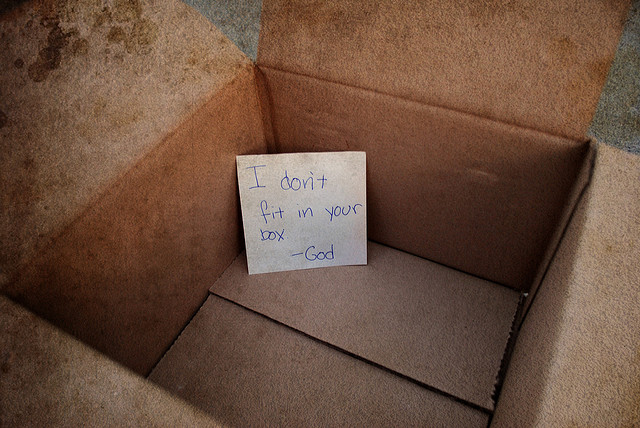
God won’t be boxed in.

God is almost entirely unpredictable.  I say almost entirely because the one thing we can predict is that regardless of circumstances, God loves us.  God will love us in, with, under and through all things, but trying to predict what that love will look like, what shape it will take, how it will work?  That’s crazy-making.  God won’t be boxed in.  

I’ve been reading a fascinating book called When Jesus Became God by Richard Rubenstein, which is about the fascinating theological and political battle surrounding the Council of Nicaea in 325 CE in which the first prototype of the Nicene Creed was formulated.  The Emperor Constantine called the Council to settle a raging theological dispute that pivoted around several theological questions:  Was Jesus divine?  What did that mean, exactly?  What was Jesus’ relationship to the Father?  And the Spirit?  Was Jesus subordinate to the Father?  Was Jesus co-eternal with the Father or was he created? 

These questions had simmered in the background since the very beginning of Christianity but most Christians were more or less content to live with differing opinions on these matters.  But when Emperor Constantine became a Christian, stopped the persecutions, and made the religion legal, suddenly it seemed important to find official answers and establish doctrine.   

The Council of Nicaea was supposed to settle these matters once and for all, but, even though the Trinitarians “won” the debate and formulated most of the language of the Creed, the Arians continued to push for their interpretation of the faith for more than a century and often were in the majority.  They believed that Jesus was created by the Father and was not co-eternal, that he had a kindof divinity as the son of God, but was not equal to the Father, was instead subordinate to the Father. And so on.  So while the Creed gave language to the first official doctrine of the Church, in practice it really failed to unify the Church in any meaningful way.

Creeds can be useful.  Up to a point.  They are useful to help clarify what we think.  They draw lines that determine the boundaries of what we understand about God and our relationship with God, and help us identify ideas that don’t seem consistent with what we’ve known and experienced of God.  They tell us who’s in and who’s out—who agrees with the official line and who does not. But that’s also part of their limitation.  God is bigger, deeper, wider and more innovative than any boundaries we draw.  God is not a cat.  God does not want to curl up inside our box.  

Another problem with creeds is that they emphasize some aspects of our faith over others, sometimes even ignoring things that are vitally important.  In both the Apostles’ and Nicene Creed, for instance, more and more Christian thinkers are calling attention to what’s being called The Great Comma.

“But have you ever noticed the huge leap the creed makes between “born of the Virgin Mary” and “suffered under Pontius Pilate”? A single comma connects the two statements, and falling into that yawning gap, as if it were a mere detail, is everything Jesus said and did between his birth and his death! Called the “Great Comma,” the gap certainly invites some serious questions. Did all the things Jesus said and did in those years not count for much? Were they nothing to “believe” in? Was it only his birth and death that mattered? Does the gap in some way explain Christianity’s often dismal record of imitating Jesus’ life and teaching?” –Diana Butler Bass, A People’s History of Christianity: The Other Side of the Story

Perhaps the greatest problem with our creeds, though, is that they focus on what we think about God and not what we’re doing to live out our relationship with God.  There is nothing in their language about service. There’s nothing about love. There is nothing about hope.  There is nothing in them about helping “the least of these brothers and sisters”, or life together in a family of faith.  Forgiveness of sins is mentioned but there is no actual call to forgive each other as we have been forgiven.  In fact, there is no call to action at all. The creeds are, instead, a historical snapshot of what the men who formulated them (and they were all men) understood to be the most important philosophical premises of their faith. And to be clear, these were the statements formulated by those who won the battles—battles that were sometimes physical and not just philosophical.  One can’t help but wonder how Jesus felt about that…or feels now, for that matter.

Yes, we do believe.  But more importantly, we are called to follow Christ and to live as the Body of Christ.  I wonder… what would a creed look like that focused on that?  What language would move our statement of faith out of our heads and into our hearts and hands and feet?