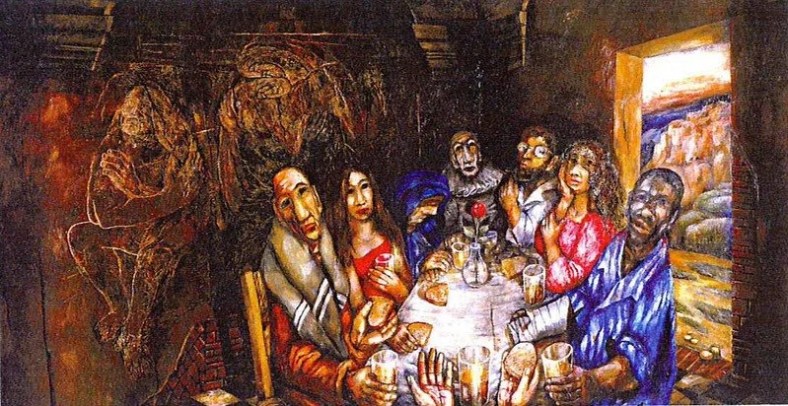
While Jesus was having dinner at Matthew’s house, many tax collectors and sinners came and ate with him and his disciples. When the Pharisees saw this, they asked his disciples, “Why does your teacher eat with tax collectors and sinners?” When Jesus heard this, he said, “It is not the healthy who need a doctor, but the sick. Go and learn what this means: ‘I desire mercy, not sacrifice.’ I have not come to call the righteous, but sinners.”[1]
For a long time now we have seen a strain of pseudo-Christianity in this country and around the world that has little to do with the teaching of Jesus as we encounter him in the gospels. It is based on triumphalism, issue-based moralism, and a theology of glory. It worships and celebrates power and ignores the call to enter into the world’s trials and suffering the way Jesus did. It walks hand-in-hand with extreme nationalism and, often, racism. It sees baptism as a get-out-o-hell-free card and not as a way of life in the beloved community. It has co-opted the name Christian and Christian language and symbols, but it has not learned to do justice, to love kindness or to walk humbly with God. It has not learned to love the neighbor as oneself.
In Matthew 25, Jesus tells us up front the criteria by which we as a people are being judged. The final test, it turns out, is a practicum. “I was hungry and you gave me food. I was thirsty and you gave me something to drink. I was a stranger and you welcomed me. I was naked and you gave me clothing. I was sick and you took care of me. I was in prison and you visited me…Truly I tell you, just as you did it (or did not do it) to the least of these who are members of my family, you did it to me.” The nations that have fed the hungry and brought water to the thirsty, clothing to the naked, health care to the sick, the nations that have welcomed the stranger—these nations inherit the kingdom. The nations that did not practice these basic caregiving duties of our common humanity are accursed and relegated to the eternal fire prepared for the devil and all his angels. [2]
So, what will be the judgment for a nation that cuts off medical aid to people around the world and makes medical care unaffordable for its own citizens? What will be the judgment for a nation that stops food aid to dependent people in other lands and even curtails food assistance for its own citizens? What will be the judgment for a nation that fills its streets with masked and armed agents who kidnap immigrants and deport them without a hearing or a trial or locks them up in overcrowded detention centers? What will be the judgment for a nation that closes its doors to refugees who are fleeing from violence and oppression?
On Thursday the United States House of Representatives voted to cut $141 million in funding from the Special Supplemental Nutrition Program for Women, Infants and Children, a program that provides fruit and vegetables to poor pregnant and postpartum women and nearly 5.4 million children here in the United States. The shutdown and dismantling of USAID last year has already led to more than 750,000 preventable deaths worldwide[3] and researchers warn that if the funding cuts are not reversed, the reduction in access to healthcare, nutrition, and sanitation could lead to more than 14 million preventable deaths by 2030.[4]
Last year, Elon Musk posted a meme on X that referred to the poor as “a parasite class.” Musk’s philosophical guru, Curtis Yarvin, has “joked” that the poor should be melted down into biodiesel.[5] Jesus, on the other hand, says that the poor are blessed and the kingdom of God is theirs.
The late Tony Campolo said, “If we were to set out to establish a religion in polar opposition to the Beatitudes Jesus taught, it would look strikingly similar to the pop Christianity that has taken over North America today.” So how do we stay faithful to the teaching, love and ethics of Jesus while living under the shadow of a political culture that seems intent on dismantling and destroying so much that is good and helpful and life-sustaining in our country and in the world?
The Beatitudes of Jesus are a good diagnostic tool for measuring our spiritual health, both collectively and individually. Looking at how we understand these core teachings of Jesus and how we apply them—or how much we ignore them—can tell us a lot about what kind of Christians we really are.
In his book, A Man Without a Country, Kurt Vonnegut said, “For some reason, the most vocal Christians among us never mention the Beatitudes. But, often with tears in their eyes, they demand that the Ten Commandments be posted in public buildings. And of course, that’s Moses, not Jesus. I haven’t heard one of them demand that the Sermon on the Mount, the Beatitudes, be posted anywhere. ‘Blessed are the merciful’ in a courtroom? ‘Blessed are the peacemakers’ in the Pentagon? Give me a break!”
As Vonnegut pointed out, the Beatitudes of Jesus are mostly conspicuous by their absence. Now more than ever. And that tells us something important about what we as a people really think about living in the Way of Jesus.
In both Matthew’s and Luke’s versions of the beatitudes, Jesus was proclaiming a vision of the commonwealth of God’s justice and mercy that completely subverts the common understanding of who God favors and how the world works.
Heather Cox Richardson has said that the stories we tell about our world shape our culture. When he preaches about the kingdom of God, he is telling a story about a more whole and healthy culture. He is helping us imagine a new world of compassion, justice, integrity and peace, and he wants us to understand that in this new world God prioritizes those whose need is greatest and not those who are already doing just fine thank you. He starts by helping us to reimagine ourselves, to see ourselves as blessed.
I wonder sometimes how much of the divisiveness, anger, greed and general dysfunction we experience today arises from the stories we tell ourselves about our world, a world we often picture as an arena of scarcity where we compete for survival. We have forgotten how to bless each other—how to imagine and pronounce a positive vision and future for each other. For all of us. What might happen if we learned to give that gift to each other and the world? That would be gospel. That would be Good News.
When is the last time someone blessed you? I don’t mean the hasty “bless you” that we say when someone sneezes or the “well bless your heart” people sometimes say in a way that sounds like what they’re really saying is “well aren’t you a curious little specimen.”
When is the last time that anyone spoke a real blessing to you?
When is the last time you felt like someone had spoken a powerful and prophetic word to tell you that you matter and that you live in the heart of goodness…
When is the last time that someone told you
that you are consecrated…
that your life is sacred…
that you are holy?
When is the last time someone told you that God sees you and loves you even when you’re not feeling it? Especially when you’re not feeling it?
When is the last time you spoke that kind of blessing for someone else?
When Jesus looked at his rag-tag disciples, when he looked out over the crowd, he could see them in the deepest and most meaningful way. He knew them. He knew who they were and what they were.
He saw how life had broken them. He saw their longing to be made whole again. He saw their yearning to be told that their lives mattered, that their struggles mattered, that their pain mattered. He wasn’t recruiting followers, he was just meeting people in the everyday reality of their lives and telling them the truth about themselves. Just like he does for us.
He told them who they were. But he also told them who they could be. His words were not just descriptive, they were prophetic. Just like they are for us.
He looked out at them and told them they were blessed. Just like he tells us. Just like we should tell each other.
Blessed are the poor and the poor in spirit. Blessed are those who doubt. Blessed are those who struggle with believing. Blessed are those who wonder if they have enough faith. Blessed are those who feel spiritually malnourished and spiritually drained. Blessed are those who are far from certain about who God is and what God does and how it all works. Blessed are those who find all the old answers unsatisfactory or troubling. Blessed are those whose minds and hearts are open to new information, new ways of seeing and new ways of thinking. Blessed are those who sometimes feel lost in the mystery of it all. Blessed are the poor in spirit. They shall see things others do not see. They will ask questions others do not dare to ask. They will use their imaginations in ways that others find daunting.
Blessed are the poor. Blessed are those who are running on empty. Blessed are those who are down to their last nickel. Blessed are those who can’t make the rent or buy the medicine. Blessed are the unhoused. Blessed are the poor. God sees them. God walks with them. Even when they can’t see it or feel it, heaven is all around them and within them. And they are blessed.
Blessed are those who mourn. Blessed are those for whom grief is an inescapable prison. Blessed are those whose lives have been hollowed out by loss. Blessed are those who live in the shadow of death. Blessed are those who weep. Blessed are those whose tears have dried up but whose pain has not. Blessed are those who have learned the hard way that grief is love persevering. Blessed are the brokenhearted. Blessed are those who are crumbling inside but hold themselves together to keep everyone around them from falling apart. Blessed are those who mourn. Their tears are sacred. God carries their pain and walks beside them. Blessed are those who weep. Someday they will laugh.
Blessed are the gentle, the meek, the nonviolent. Blessed are those who look for ways to compromise and cooperate instead of making life a contest or a competition. Blessed are the strong who restrain themselves. Blessed are those who do not fight back, those who would rather take it than dish it out. Blessed are those who go unnoticed, the ones who sit alone at lunch, the unimpressive, the unemployed. Blessed are the janitors and sanitation workers and fast food workers. Blessed are the people on the street whom we fail to see because we pretend they are invisible. Blessed are the meek. God sees them. God loves them. They will inherit the earth.
Blessed are those who hunger and thirst for righteousness. Blessed are those who were born with an acute sense of what is fair and what is not, what is right and what is not. Blessed are those who have a passion for justice. Blessed are those who work to overcome injustice even when the injustice has nothing to do with them or their lives. Blessed are those who are wrongly accused. Blessed are the undocumented. Blessed are those who stand against the bullies. Blessed are those who confront racism and work to dismantle it. Blessed are those who march in the streets and speak truth to power. Blessed are those who hunger and thirst for righteousness. God sees them. God loves them. God will nourish them with justice and their cup will be filled.
Blessed are the merciful. Blessed are those who fill the world around them with kindness. Blessed are those who are generous with forgiveness. Blessed are those who are just plain generous. Blessed are those who are slow to judge and condemn because they understand how much grace they have been given. Blessed are the merciful. God sees them. God loves them. They will receive mercy.
Blessed are the pure in heart. Blessed are those who have retained their innocence and are just plain good. Blessed are those who have recovered their innocence and cling to it. Blessed are the honest. Blessed are the truthful. Blessed are those who love with no agenda. Blessed are those who are in recovery, who are living out the twelve steps, who are cleansing their bodies and their souls and making amends. Blessed are those who refuse to be cynical. Blessed are the pure in heart. God loves them. God sees them. And they shall see God.
Blessed are the peacemakers. Blessed are those who bring food to those who are starving. Blessed are those who bring medical attention to those who are in peril. Blessed are those who work to disarm a weaponized world. Blessed are those who encourage us to seek common ground. Blessed are those who care for the planet and work to heal the earth. Blessed are the peacemakers. God embraces them as God’s own children.
Blessed are those who are persecuted for doing the right thing. Blessed are those who are disrespected and taunted for being compassionate. Blessed are the woke. Blessed are those who are scorned because they speak out for a better world and work for the shalom of God. Blessed are those who are battered or imprisoned because they protest against all the things that dehumanize and oppress people. Blessed are those who are persecuted for doing the right thing. The commonwealth of God’s justice and kindness belongs to them.
Blessed are you when people revile you and persecute you and say all kinds of untrue and evil things against you because you have embraced the Way, the Truth and the Life. Blessed are you when people spread lies about you because your integrity exposes their duplicity. Blessed are you when people criticize you for being awake to the pain and injustice around you. If you only knew how great your reward is in heaven, you would be dancing with joy. God sees you. God loves you. And remember, they persecuted the prophets in the same way, so you are in good company.
You are blessed.
You are consecrated.
You are holy.
You are set apart to bring a blessing and to be a blessing in a world that thinks it is cursed.
You are consecrated to help others see the beauty and sacredness of our life together in this amazing God-made world.
With all your faults—and God knows them better than you know them yourself—you are loved by God more than you can begin to imagine so that you can spread the love of God to others.
God is blessing you. God is loving you. God is transforming you.
You live in the heart of goodness.
Blessed are you.
Now…go bless the world… in Jesus’ name.
[1] Matthew 9:9-13
[2] Matthew 25:31-45
[3] ImpactCounter https://healthpolicy-watch.news/the-human-cost-one-year-after-the-us-took-a-chainsaw-to-global-health/
[4] UCLA Fielding School of Public Health
[5] Reported in The Cottage by Diana Butler Bass, 02/15/2025
Painting: Das Mahl mit den Sündern (The Meal with the Sinners) by the German priest-artist Sieger Köder

