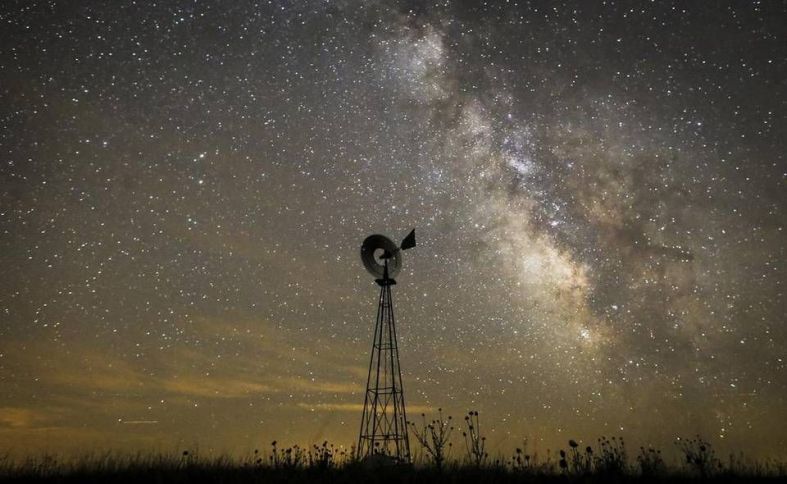
The Light Over the Barnyard

John 1:6-9; 19-28; 1Thessalonians 5:16-24

If we’re lucky and there is no cloud cover, on December 21, the night of the Winter Solstice, the longest night of the year, we will get to see something like the Star of Bethlehem.  Jupiter and Saturn will appear in a great conjunction, within 0.1 degrees of each other as viewed from earth, so that they will appear to be not two bright planets, but one very bright star.  Close conjunctions of Jupiter and Saturn happen every 20 years, but the last time they were this close was more than 800 years ago, in 1226.

So in these closing days of 2020, a strange year of plague and politics, protests and polemics, could it be that we are being given a sign in the heavens as two great planets combine their radiance into one great light?    

One of the things I loved to do when I was a kid, during the times when we would visit the family farm in Kansas, was to go out at night and stand in the middle of the field and just stare at the brilliance of the night sky.  I loved to see the lights of heaven spread out above me in the Milky Way.  We would get far enough away from the house so that the house lights didn’t interfere with our stargazing, then just let ourselves get lost in those deep fields of space and all those millions of stars.  

On a night with a full moon the stars were fainter, but we could see well enough to nose around a bit in the pasture and to make our way back to the house without our flashlights if we were careful.  But on a night with no moon it was another story altogether.  On a night with no moon it was easy to lose yourself in the sky and get turned around, and if the lights at the house went out, as they did one time, you could lose your bearings in the dark.

On those nights, standing in the dark, marveling at the stars, I would feel such a strange mixture of awe and vulnerability.  I learned fairly early about the distance and strangeness of the stars and planets and it was always a source of wonder to me to think about the great journey through time and space those lights had taken to reach me standing in a field in Kansas.  It made me feel both important and insignificant at the same time—important because God had given me the eyes to see and a mind to comprehend the vastness of creation—insignificant because I realized that I was one kid standing on a small planet orbiting a minor star on an outer spiral arm of one galaxy among billions.

And in the middle of these kinds of thoughts, always, every single time, something would happen to remind us that the night was not our natural habitat.  Some noise or movement would remind us as we stood out there in the field that the night was full of other creatures and that some of them were not our friends.  Fortunately, that also always seemed to be about the time when Mom or Aunt Betty would decide we had been out in the dark long enough and they would turn on the big mercury vapor light that glared over the barnyard.  The message was clear.  Time to come home.  And there was no mistaking which way to go once that light was turned on…provided you were turned in the right direction so you could see it.

Sometimes, if you get turned around in the moonless night and you are facing the wrong direction, you need a nudge from someone to turn you toward the light so you can find your way home.

There was a man sent from God, whose name was John.  He came as a witness to testify to the light, so that all might believe through him.  He himself was not the light, but he came to testify to the light.  To give people a nudge in the right direction.

This happened during a time of tension and anxiety, but for many it was also a time of anticipation and expectation, so when John began baptizing and preaching it was understandable that the priests and Levites would want to know who he was and what he had to say for himself.  What was surprising was that John started by telling them who he was not.

“I’m not the Messiah.”  He said that pretty plainly, right off the top.

So they asked him, “Well… what then.  Are you Elijah?”

“Nope.”

“The prophet?”

“No. Not the prophet.”

“Well then who are you?”

“I am the voice of one crying out in the wilderness, ‘Make straight the way of the Lord.’  Just like the prophet Isaiah said.

“Well if you’re not the Messiah and you’re not Elijah and you’re not the prophet, why are you baptizing?”

“I’m baptizing with water.  But if you knew who was already standing here among you… the one who comes after me… I’m not worthy to even untie his sandals.”

For what it’s worth, a little thing should be noted here.  It says in the text at the beginning of this passage that John was sent by God.  But it says that the people giving John the third degree here, the priests and Levites, were sent by the Pharisees.  It’s an interesting contrast.  The one who is sent by God wants to focus the attention, to shine the light if you will, on someone else.  But the interrogation team sent by the Pharisees are laser-focused on John.  John keeps trying to redirect their attention to the one they’ve really been expecting for eons.  He tells them,   “Guys, at best I’m the moon.  You should be looking for the sun.  And if you had eyes to see it, you would realize he’s already here among you.”

John comes to a people who, as Isaiah said, are walking in darkness and points to the light that is dawning among us.  He comes to a people who are disoriented in the night and turns us to face the beacon that can bring us home.  

And here we are in the closing days of the year of Covid and Chaos, craving Christmas, singing Christ be our Light.  And God hears our prayers.  God sends us John the Baptist to turn us in the right direction, to face us toward the light of Christ. 

God sends us a sign in the heavens.  In a year when politics has pulled us ever further apart, two gas giants (make of that what you will) have drawn close to each other, Jupiter and Saturn in a rare conjunction, shining with a single bright light to remind us that we are brighter when we shine together.

In a year when we have not been able to come together as the body of Christ in the familiar surroundings of our sanctuaries, God reminds us that Christ is, as Luther said, in, with, and under the common things of life like bread and wine and water so that life, itself is sacred.  God reminds us that Christ is in all of creation.  God reminds us that Christ is in you and in me.  And, more importantly, that we are in Christ, so that even in our individual homes, gathered together by way of our computers and phones we are still the body of Christ.

At the end of a year when we have had so many reasons to weep, God sends us the words of Saint Paul writing in his first letter to Thessaloniki, the oldest of his letters:  “Rejoice always.  Pray without ceasing.  Give thanks in all circumstances.  Do not quench the Spirit.”  

So if you feel like you’ve been walking through a moonless night and you’re all turned around, stop.  Take a minute.  Take a breath.  Look up.

There is a sign in the heavens to remind you that you are not alone.  Christ is in, with and under all of creation and that includes your own sacred life.  

Rejoice.  Pray.  Give thanks.  Do not quench the Spirit.  Any minute now the light’s going to come on over the barnyard.  And if necessary, someone will nudge you in the right direction so you can see it.

Until then, may the God of peace himself sanctify you entirely; and may your spirit and soul and body be kept sound and blameless at the coming of our Lord Jesus Christ.  

The one who calls you is faithful, and he will do this.

A Way in the Wilderness

Mark 1:1-8

The beginning of the good news of Jesus Christ, the Son of God. 

2        As it is written in the prophet Isaiah,

         “See, I am sending my messenger ahead of you,

                  who will prepare your way; 

3        the voice of one crying out in the wilderness:

                  ‘Prepare the way of the Lord,

                  make his paths straight,’” 

4 John the baptizer appeared in the wilderness, proclaiming a baptism of repentance for the forgiveness of sins.  5 And people from the whole Judean countryside and all the people of Jerusalem were going out to him, and were baptized by him in the river Jordan, confessing their sins.  6 Now John was clothed with camel’s hair, with a leather belt around his waist, and he ate locusts and wild honey.  7 He proclaimed, “The one who is more powerful than I is coming after me; I am not worthy to stoop down and untie the thong of his sandals.  8 I have baptized you with water; but he will baptize you with the Holy Spirit.”

“The beginning of the good news…”

Those words take us somewhere, don’t they?  Right away they tell us we’re going to hear a story.  You might as well say Once Upon a Time. 

The beginning of the good news of Jesus, the Christ, the Son of God.  But Mark, the writer telling us this story, doesn’t start with Jesus.  He reminds us that the story started before Jesus.  Long before Jesus.  He reminds us that Advent, before it was a season in the Church calendar, was a long season of history, centuries of waiting for Emmanuel to come.  He reminds us that during that long Advent of history God would speak through the prophets from time to time to remind the people that the covenant and promises that God had made to Abraham and Sarah and to Moses and to David had not been forgotten.  The prophets would remind them that God was with them in their times of trouble, and the day was coming when God would be with them more powerfully and concretely than they dared to imagine.  

Mark reminds us that “the beginning of the good news of Jesus, the Christ, the Messiah, the Son of God”—that this story had its real beginning long before Jesus arrived.  “As it is written in the prophet Isaiah,” he writes, to remind us that even though Jesus is the title character of his story, he’s really not entering the stage until the second act.  The stage has to be set.  The way has to be prepared.

Even the announcement has to be announced. To give the prophetic voice extra weight, Mark gives Isaiah a preamble from Malachi and simply refers to them both as Isaiah because who said it is not as important as what is being said:

“See, I am sending my messenger ahead of you,

                  who will prepare your way;” – that’s Malachi–

         “the voice of one crying out in the wilderness:

                  ‘Prepare the way of the Lord,

                  make his paths straight” –that’s Isaiah.

But it isn’t Jesus the prophets are announcing.  Not here anyway.

First, there is another character we need to hear from.  Another prophet, some would say.  John, the Baptizer, dressed like Elijah and living off the land out in the wilderness where he can listen to God without distractions.  John the Baptizer who wants to be sure we’re ready, really ready for Jesus, the Christ, the Son of God.  So he prepares the way by “proclaiming a baptism of repentance for the forgiveness of sins” and announcing—wait for it—that someone even more powerful is coming. 

Repentance.  It’s not something you would think would draw a crowd.  But Mark tells us that “people from the whole Judean countryside and all the people of Jerusalem were going out to him, and were baptized by him in the river Jordan, confessing their sins.”  He must have been some preacher, that John.

Repentance.  In English it’s a smudged and leaden word filled with regret and contrition.  Repentance is a stinging backside, bruised knees and hunched shoulders.  I suggest we ban it and replace it with the Greek word: Metanoia.  Metanoia is climbing out of a dank hole into the sunlight.  Metanoia is being freed from the nasty habits that ruin your health and suck the life out of your wallet.  Metanoia is putting on new glasses with the right prescription and realizing that you had only been seeing a third of the details and half the colors in the world.  Metanoia  is shoes that fit right, have cushy insoles, perfect arch support, and take the cramp out of your lower back.  Metanoia is thinking new thoughts and behaving in new ways.  Metanoia is a change of mind, a change of heart, a change of life, a new direction.  

John came proclaiming a baptism of metanoia.  And to make sure the idea really stuck with people, he gave them an experience to go with it.  He dunked them in the river.  “There.  You were dry, now you’re wet.  You were going down the wrong road, now you’re on the right one.  You were dusty and crusty, now you’re clean.  You’re changed.  You’re new.  And just in time, too.  Because the One we’ve been waiting for is coming.  I’m just the warm-up band.  I dunked you in water.  He’s going to marinate you in the Holy Spirit.”

A voice cried out in the wilderness, “Prepare the way of the Lord!”

A voice cried out! “In the wilderness prepare the way of the Lord!”

There is no punctuation in the ancient languages.  So the translators try to make sense of it for us.

Is it a voice in the wilderness calling us to prepare?  Or is it a voice calling us to prepare a way in the wilderness?  Isaiah has it one way, Mark has it the other way.

Either way the message is clear: this is a time to prepare.

Sue Monk Kidd wrote about how when she was younger she would take time during Advent to sit next to the nativity set under her Christmas tree and think about the past year and then think about the coming of Jesus and what she might do to prepare herself for a meaningful Christmas.  One year she decided to visit a monastery for a day.  As she passed one of the monks she greeted him with, “Merry Christmas.”  He replied, “May Christ be born in you.”  His words caught her off guard and she found that she had to sit with them for a long time. It was in those words from that monk that she realized that Advent is a time of preparation and transformation.  A time of metanoia.  It is a time, she wrote, “of discovering our soul and letting Christ be born from the waiting heart.”

What kind of metanoia do you need to open the path for Christmas, to make way for Christ to be born anew in your waiting heart?   

This has in many ways been a wilderness year for all of us.  Sometimes it has seemed that the way of Christ, the way ahead is not clear.  Except for this: the way of Christ is the way of love.  Love God. And love our neighbors as ourselves. 

It’s been hard to love our neighbors when we can’t be with them in person, when we have to wear masks, when we can’t hug, when we have to maintain physical distance.  It’s been hard to understand that those things are, in fact, acts of love.  

It’s been hard to stand together when we have to stay so far apart.

But this, too, is part of our Advent.  This has been part of our wilderness where we have heard the voice cry out, calling us to prepare the way of the Lord.  This is where we are preparing the way for Christ be born in the waiting heart.  This is where we are transformed.  This is our metanoia.

We’ve all had conversations about “when things get back to normal.”  But maybe this Advent, this Prepare the Way of the Lord time, this metanoia time is a good time to ask if we really want things to get back to normal.

Sure, we want to be done with the pandemic and the restrictions and protocols.  But do we really want to go back to the kind of hectic lives we were living before?  What have we been learning during this time?  We have a chance to make things new, different, better.  So what is Christ calling us to make of this life?  As we make a new path through the wilderness, what is our collective metanoia?  What is our new way, our better way?

There’s an old John Denver song, Rhymes and Reasons, that I’ve had stuck in my head for weeks now.  Sometimes I think, “Oh there’s that dumb song again.”  But other times I just let myself fall into it.  And you know, it really has brought me more than a little hope and comfort.  For weeks now.  Especially at times when I’ve felt really sad.  Or really angry.  Or both.

So you speak to me of sadness and the coming of the winter

Fear that is within you now and it seems will never end

And the dreams that have escaped you and the hopes that you’ve forgotten

And you tell me that you need me now and you want to be my friend

And you wonder where we’re going, where’s the rhyme and the reason

And it’s you cannot accept it is here we must begin

To seek the wisdom of the children and the graceful way of flowers in the wind.

For the children and the flowers are my sisters and my brothers

Their laughter and their loveliness can clear a cloudy day

Like the music of the mountains and the colors of the rainbow

They’re a promise of the future and a blessing for today.

Though the cities start to crumble and the towers fall around us

The sun is slowly fading and it’s colder than the sea

It is written from the desert to the mountains they shall lead us

By the hand and by the heart and they will comfort you and me.

In their innocence and trusting they will teach us to be free.

For the children and the flowers are my sisters and my brothers

Their laughter and their loveliness can clear a cloudy day

And the song that I am singing is a prayer to nonbelievers

If you come and stand beside us, we can find a better way.

As I said, that song has been running through my head for weeks now.  In my more cynical moments I think it’s kind of insipid and puerile.  I mean really, “the children and the flowers are my sisters and my brothers.”  But then I stop and listen again.  And I realize that that cynical critic in me, that inner voice that wants to disparage the simple honesty of these lyrics and even the healing joy of my own experience of the song is one of the places where I need metanoia.  This is where I need to clear a path in the wilderness.  My own internal wilderness.

So.  This is the beginning of the good news of Jesus, the Christ, the Son of God.  This is the beginning of the story.  Get ready.  Jesus is coming.  Christmas is coming.  Prepare the way.

This Is The Time

It’s time.  

Time to get out the boxes with the special decorations, each one with its own story and all of them together part of the bigger story.  It’s time to deck the halls, to fill the home with light and music.  It’s time to dig out recipes and to bake.  It’s time to prepare.

I loved Christmas as a kid.  I still do.  What I didn’t realize for years, though, was how much I loved Advent.  I loved all the preparation. I loved the anticipation.  I loved the way the house looked when it was all decorated.  I loved the way the kitchen smelled when it was full of baking and roasting.  I loved how everyone, even though they were a bit frazzled, still managed to be in a pretty cheery mood.  

I love the honesty of Advent.  I love the sense of longing in the texts and prayers.  “Stir up your power, Lord Christ, and come.”  And yes, Christ has already come to us, but no, Christ has not yet returned, and we surely do feel sometimes like he’s overdue.  There is an honest yearning for things to be better, especially in this year when everything has been scrambled and turned sideways by the pandemic.  “Oh that you would tear open the heavens and come down!”  Isaiah shouts for us.  We’re in over our heads.  “Restore us, O God of hosts; let your face shine, that we might be saved!” the Psalmist cries out for us.  But we also hear, “Comfort, O comfort my people, says your God… Every valley will be lifted up.  Every mountain and hill made low.  The uneven ground shall be made level and the rough places a plain.”  Things will be smoother.  Something better, something brighter is coming.  Help is on the way.  A new day will dawn.  

I love the way Advent, if we pay attention to it, sets the scene for Christmas by reminding us that we are not the first ones to live in a time of shadows hoping for light.  “During the rule of King Herod of Judea…” we read in the first chapter of Luke.  This is the same King Herod who, in Matthew’s gospel, murdered all the male babies in Bethlehem under age two.  This is the Herod who killed two of his own sons because he suspected them of plotting against him, the Herod who killed his wife Mariamne, the Hasmonean princess, along with her brother and her mother.  This is the Herod who replaced the High Priest in the temple with a Sadducee who would be more inclined to do things the way he wanted them done.  This is the same Herod who, according to Josephus, as he lay dying, ordered that one member of every family in Judea should be slain so that the whole country would be in mourning when he died. Fortunately the order was never carried out, but the people never forgot that it had been issued.  

This is the time, Luke reminds us, when Quirinius is appointed legate of the expanded Roman province of Syria with the specific mandate to carry out a census, something forbidden by Jewish law, so that Tiberius can impose a new tax.  This is a time when Rome’s domination of Judea is iron-clad and iron-fisted with no velvet glove to make it less harsh.  This is a time when work is hard, taxes are heavy, and freedom is limited.

But this is also the time when an angel appears to an aged childless couple, Elizabeth, whose name means “God keeps promises” and to Zechariah, whose name means “God remembers.”  The angel promises them that they will have a child and that they are to name him Yochanan, John, which means “God is gracious,” and that many will rejoice because of him and he will be filled with the Holy Spirit.

This is the time when a kinswoman comes to visit Elizabeth, a young, unmarried kinswoman named Mary, who is also pregnant with a miraculous child.  And when Elizabeth sees her, her unborn child leaps in her womb.  This is the time when Mary sings a prophetic song of joy and rebellion that has been bringing hope to people on the margins for two thousand years.  My soul magnifies the Lord and my spirit rejoices in God my Savior, for he has looked with favor on the lowliness of his servant… He has scattered the proud in the thoughts of their hearts.  He has brought down the powerful from their thrones, and lifted up the lowly; he has filled the hungry with good things, and sent the rich away empty…”

This is the time to sit with the candles of hope, peace, joy, and love.  This is the time to remember.  And to look forward.  This is Advent.  And soon, Christmas.

The King shall come when morning dawns and light triumphant breaks, when beauty gilds the eastern hills and life to joy awakes.

Waiting for the Light

Waiting for the Light

Mark 13:24-37

“But in those days, after that suffering,

         the sun will be darkened,

                  and the moon will not give its light, 

25       and the stars will be falling from heaven,

                  and the powers in the heavens will be shaken. 

26 Then they will see ‘the Son of Man coming in clouds’ with great power and glory.  27 Then he will send out the angels, and gather his elect from the four winds, from the ends of the earth to the ends of heaven. 

28  “From the fig tree learn its lesson: as soon as its branch becomes tender and puts forth its leaves, you know that summer is near.  29 So also, when you see these things taking place, you know that he is near, at the very gates.  30 Truly I tell you, this generation will not pass away until all these things have taken place.  31 Heaven and earth will pass away, but my words will not pass away. 

32 “But about that day or hour no one knows, neither the angels in heaven, nor the Son, but only the Father.  33 Beware, keep alert; for you do not know when the time will come.  34 It is like a man going on a journey, when he leaves home and puts his slaves in charge, each with his work, and commands the doorkeeper to be on the watch.  35 Therefore, keep awake—for you do not know when the master of the house will come, in the evening, or at midnight, or at cockcrow, or at dawn,  36 or else he may find you asleep when he comes suddenly.  37 And what I say to you I say to all: Keep awake.”

As of this weekend, 270,000 people in the United States have died of the Corona virus.  That’s two hundred seventy thousand empty seats at the Thanksgiving table this year, enough people to fill every seat in Angels’ Stadium in Anaheim six times.  

Because of the Corona virus, job losses and general economic disparity, only 44% of American households with children feel confident that they will be able to afford the food they need for the coming week.[1]  Put another way, 56% of American households with children are food insecure.  Twelve percent of those households reported that they sometimes or often do not have enough to eat.  

One in 5 renters in America are behind on rent and worried about eviction.  Persons of color were likelier to report difficulty affording rent because they have been harder hit by pandemic job losses.

In so many ways and for so many of us, this is a grim and precarious time.  The words of Isaiah ring in us like a bell:

O that you would tear open the heavens and come down,

                  so that the mountains would quake at your presence—  

          When you did awesome deeds that we did not expect,

                           you came down, the mountains quaked at your presence.[2]

O God, why won’t you do for us the kinds of things you did in the past?  Where’s our parting of the sea?  Where is our manna falling from the sky?  

It was a grim and precarious time for the people of Judah when Isaiah wrote those words.  They were suffering under the harsh oppression of Babylon.  They wanted divine intervention.  And isn’t that what we want now?

It was a grim and precarious time when Jesus sat on the Mount of Olives and shared his apocalyptic vision with his disciples.  As we read the story in chapter 13 of Mark, Jesus is telling his disciples about the end of the world not long before Judas betrays him, not long before he is crucified.  And it’s a very perilous time when the writer of the gospel records all this.  If biblical scholar Ched Myers is correct, Mark is writing this gospel some time during the Jewish revolt against Rome, the rebellion that will end with the destruction of Jerusalem and the temple.

“But in those days, after that suffering,

         the sun will be darkened,

                  and the moon will not give its light, 

         and the stars will be falling from heaven,

                  and the powers in the heavens will be shaken. 

Those words take on new weight on the first Sunday of Advent when you think of them being spoken during a time of violent political oppression, a time when any hint of opposition is quickly and decisively squashed.  These words have a sharper edge when you think of them being written down and preserved while the streets of the city are filled with the noise and bloodshed of battle between Roman soldiers and Jewish partisans.  

Beware.  Stay alert.  Stay awake.  The advice Jesus gives is practical.  Keep your eyes open.  Don’t fall for false messiahs and conmen. Don’t make yourself crazy trying to figure out God’s timetable because only God knows.  It’s going to be a bumpy ride.  There will be trying times.  Stay awake.

Advent is a time for pragmatism and preparation.  

Advent is a time to walk into the turmoil and the pain of life with your eyes wide open.  In an age and a season when it is all too easy to live in denial, when we would love to jump straight to Christmas, Advent calls us to take a hard look at the world around us.  Advent calls us to see the world as it really is, to see ourselves as we really are, to open our eyes to things that we maybe don’t want to see, to listen to things we might prefer not to hear.  Advent calls us to be realistic…about the world and about ourselves. 

In 1952, as the Korean War was dragging on and the Cold War between the United States and the Soviet Union was becoming more intense, William and Annabeth Gay wrote a haunting and profound hymn that, to my mind, perfectly captures the spirit of Advent for our age.  The title that Annabeth gave it is Carol of Hope, but you might know it by its first line which is how it’s titled in most hymnals, a line that sounds anything but hopeful:  Each Winter As the Year Grows Older.

Each winter as the year grows older, we each grow older, too.  

The chill sets in a little colder; the verities we knew

seem shaken and untrue.[3]

When race and class cry out for treason, when sirens call for war, 

they overshout the voice of reason and scream till we ignore

 all we held dear before.

Yet I believe beyond believing that life can spring from death,

that growth can flower from our grieving, that we can catch our breath

and turn transfixed by faith.

So even as the sun is turning to journey to the north,

the living flame, in secret burning, can kindle on the earth

and bring God’s love to birth.

O Child of ecstasy and sorrows, O Prince of peace and pain,

brighten today’s world by tomorrow’s, renew our lives again;

Lord Jesus, come and reign!

Advent calls us to be realistic about the shadow side of life, to mark where we’ve not only grown older but colder, where the verities we knew seem shaken and untrue.  Advent calls us to identify those voices that overshout the voice of reason so we can be more attentive to reason and to the Prince of Peace and pain.  

But Advent doesn’t simply ask us to dwell in gloom and shadows.  Advent also calls us to bring light—four lights to restore brightness and health to a self, a nation, a world stumbling in murky obscurity—four lights to prepare the way for the true light of Christ. 

And the first light is Hope.

“Genuine hope is not blind optimism,” said Jürgen Moltmann.  “It is hope with open eyes, which sees the suffering and yet believes in the future.”

And perhaps Barack Obama was thinking of Moltmann when he said, ““Hope is not blind optimism. It’s not ignoring the enormity of the task ahead or the roadblocks that stand in our path. It’s not sitting on the sidelines or shirking from a fight. Hope is that thing inside us that insists, despite all evidence to the contrary, that something better awaits us if we have the courage to reach for it, and to work for it, and to fight for it. Hope is the belief that destiny will not be written for us, but by us, by the men and women who are not content to settle for the world as it is, who have the courage to remake the world as it should be.”

Hope is that thing inside us that insists, despite all evidence to the contrary, that something better awaits us.

“The very least you can do in your life is figure out what you hope for,” wrote Barbara Kingsolver. “And the most you can do  is live inside that hope.  Not admire it from a distance but live right in it, under its roof.”[4]

So on this first Sunday of Advent we light the candle of Hope.  

On this first Sunday of Advent as we begin a new year in the calendar of the Church, we light the candle of Hope.  If the sun is darkened and the moon will not give its light and the stars seem to be falling, light the candle of hope.

If we are suffering now because of the pandemic, Saint Paul reminds us that, “suffering produces endurance,  and endurance produces character, and character produces hope,  and hope does not disappoint us, because God’s love has been poured into our hearts through the Holy Spirit that has been given to us.”[5]

“If we hope for what we do not see,” he said, “we wait for it with patience.”[6]  

So if it looks like the sun has been darkened and the moon won’t shine and the stars are falling and the world is more or less metaphorically ending, in the spirit of Advent, let’s be realistic and honest about it.  Let’s stay awake and aware.  And then let’s light a candle of Hope.  Because Hope is that thing inside us that insists, despite all evidence to the contrary, that something better awaits us.

May the God of hope fill you with all joy and peace in believing, so that you may abound in hope by the power of the Holy Spirit.[7]


[1] https://www.cbpp.org/blog/as-thanksgiving-approaches-fewer-than-half-of-households-with-kids-very-confident-about;  also https://www.marketplace.org/2020/05/07/44-of-americans-fear-they-wont-be-able-to-afford-food-poll-finds/ (Marketplace/Edison Research)

[2] Isaiah 64:1-2

[3] Each Winter As the Year Grows Older, William Gay, 1920-2008;

  Tune: Carol of Hope, Annabeth Gay, 1925-2020;  Evangelical Lutheran Worship, #252

[4] Barbara Kingsolver, Animal Dreams

[5] Romans 5:4-5

[6] Romans 8:25

[7] Romans 15.13

The Royal Law

Matthew 25:41-46

“When the Son of Man comes in his glory, and all the angels with him, then he will sit on the throne of his glory.  32 All the nations will be gathered before him, and he will separate people one from another as a shepherd separates the sheep from the goats,  33 and he will put the sheep at his right hand and the goats at the left.  34 Then the king will say to those at his right hand, ‘Come, you that are blessed by my Father, inherit the kingdom prepared for you from the foundation of the world;  35for I was hungry and you gave me food, I was thirsty and you gave me something to drink, I was a stranger and you welcomed me,  36 I was naked and you gave me clothing, I was sick and you took care of me, I was in prison and you visited me.’  37 Then the righteous will answer him, ‘Lord, when was it that we saw you hungry and gave you food, or thirsty and gave you something to drink?  38And when was it that we saw you a stranger and welcomed you, or naked and gave you clothing?  39And when was it that we saw you sick or in prison and visited you?’  40 And the king will answer them, ‘Truly I tell you, just as you did it to one of the least of these who are members of my family, you did it to me.’  41 Then he will say to those at his left hand, ‘You that are accursed, depart from me into the eternal fire prepared for the devil and his angels;  42 for I was hungry and you gave me no food, I was thirsty and you gave me nothing to drink,  43 I was a stranger and you did not welcome me, naked and you did not give me clothing, sick and in prison and you did not visit me.’  44 Then they also will answer, ‘Lord, when was it that we saw you hungry or thirsty or a stranger or naked or sick or in prison, and did not take care of you?’  45 Then he will answer them, ‘Truly I tell you, just as you did not do it to one of the least of these, you did not do it to me.’  46 And these will go away into eternal punishment, but the righteous into eternal life.”

When the Son of Man comes in his glory, and all the angels with him, then he will sit on the throne of his glory.  All the nations will be gathered before him, and he will separate people one from another as a shepherd separates the sheep from the goats.

I think it’s interesting to see how people react to this picture of Jesus as the king and judge of humanity.  Some people are all too ready for Jesus to return and get the judging underway.  Others—and I’m one of those—are content for him to take his own sweet time.  Yeah, there are a lot of things I would like to see repaired in this world, a lot of things where I would like to see the divine hand taking direct action, but then I remind myself that Christ is taking direct action through you and me and that, in fact, that is what this particular picture that Jesus is painting is really all about.

In one of our ELCA clergy Facebook groups this week, one pastor asked the question, “Where is the grace in this passage?”  That’s a really Lutheran question, and to their credit, a lot of our pastors did a pretty fair job of making a case for grace in this passage even though it is so clearly about judgment.  I was feeling a little bit contrarian, so I noted that the writer of Matthew was not a Lutheran and didn’t seem to be all that concerned about grace.  Righteousness, yes. Grace, not so much.  In fact, the word grace doesn’t appear even once in the entire Gospel of Matthew.

But that doesn’t mean grace isn’t in there.  Mercy is a kind of grace, and twice Jesus quotes Hosea and tells the Pharisees, “Go and learn what this means, ‘I desire mercy, not sacrifice.’”[1]  In Matthew 18 he tells the parable of a slave who is forgiven a great debt, a story about mercy, grace and forgiveness and how we sometimes fail to pass that same grace along to others.  In chapter 23, Jesus again scolds the Pharisees for their lack of grace when he says, “Woe to you, scribes and Pharisees, hypocrites! For you tithe mint, dill, and cumin, and have neglected the weightier matters of the law: justice and mercy and faith. It is these you ought to have practiced without neglecting the others.”

In an odd way, there is even grace in this picture of the final judgment where the sheep are separated from the goats, even though the goats are sent away to eternal punishment.  To see that grace clearly, though, may take a bit of translating.

In Hebrew there are two words for “people.”  The word ‘am is used to designate people who are Jewish, the people of the covenant, our people.  Goy or goyim are people who are pagans or gentiles.  Those other people.  The same idea appears in the Greek of the New Testament.  Laoí is used for people inside the faith community or the church and éthne is used for people or peoples outside the faith community or church.  When this passage says “All the nations will be gathered before him,” the word that is translated as nations is éthne.  So this is a description of all those people who are outside the community of faith.  Those other people.  They’re the ones being judged.  At least that’s what’s implied in the language.

The implication of the language and the lesson for those within the community of believers, is that there are people who are righteous even among those who live by other beliefs and those who have never heard of Christ.  They are instinctively taking care of the persons in their communities who are in need, and in doing so, they are caring for Christ.  It’s specifically because they are not believers, not members of the community of faith, that they ask Jesus “When did we see you in these circumstances?”

So one way you might see grace in this passage about judgment, then, is that even though these “sheep” on the right hand were not people of the covenant or followers of Jesus, they inherit the kingdom because they lived lives of righteousness and compassion.  Christ, the king, surrounded by his angels, seated on the throne of his glory, brings in all these people who never knew him or knew about him because they simply acted out of compassion.

Having said that, it’s also a given that if you are part of the community of faith, a follower of Jesus, it is expected that you will also be feeding the hungry, giving drink to the thirsty, caring for the sick, visiting the imprisoned, clothing the naked, welcoming the stranger.  Those things are part of the way of life in the kingdom of heaven.  This kind of righteousness rooted in compassion—it’s who we are.  It’s what we do.  It’s how we, too, encounter Jesus.

Whether you read it as applying to insiders or outsiders or both, it’s tempting sometimes to read this passage as our Ticket to Heaven Punch Card.  Feed the hungry?  Check.  Clothing for the poor? Check.  Welcome a stranger?  Check.  Visit someone in prison?  Check.  If we do that, though, we’ll miss the point of everything Jesus had to say in Matthew’s gospel about the kingdom of heaven and about what constitutes real righteousness.  We would be like those scribes and Pharisees he rebuked in chapter 23, paying attention to the details but neglecting the justice, mercy, and faith at the heart of it all.  

Oh, and love. We would be missing the love.

In chapter 19 someone asks Jesus, “What good deed must I do to inherit eternal life?”  Jesus replies, “If you wish to enter eternal life, keep the commandments.”  “But which ones?” he is asked.  Jesus replies, “You shall not murder; You shall not commit adultery; You shall not steal; You shall not bear false witness;  Honor your father and mother; also, You shall love your neighbor as yourself.”  

Jesus repeats the commandment to love later in chapter 22 when he is asked what is the greatest commandment.  He replies, ‘You shall love the Lord your God with all your heart, and with all your soul, and with all your mind.’  This is the greatest and first commandment.  And a second is like it: ‘You shall love your neighbor as yourself.’  On these two commandments hang all the law and the prophets.”

When Jesus said, “love your neighbor as yourself” he wasn’t inventing a new rule, he was quoting Leviticus.  Love your neighbor as yourself was an important ethic of the Jewish people.  Jesus broadened that ethic and applied it more widely by expanding the definition of neighbor.  Because “love your neighbor” was so central to the teaching of Jesus, it became the central ethic of his followers.

Saint Paul wrote in Galatians, “For the whole law is summed up in a single commandment, “You shall love your neighbor as yourself.”[2]  Again, writing in Romans, he said, “The commandments, ‘You shall not commit adultery; You shall not murder; You shall not steal; You shall not covet’; and any other commandment, are summed up in this word, ‘Love your neighbor as yourself.’”[3]  James called it the royal law: “You do well if you really fulfill the royal law according to the scripture, ‘You shall love your neighbor as yourself.’”[4]

What the “sheep,” the righteous who are rewarded in Matthew 25 are doing when they feed the hungry and clothe the naked and welcome the stranger is simply this: they are loving their neighbor.

In this picture of judgment in Matthew 25 we also see another portrait of love.  We see a king sitting on his throne of glory.  But this is a king who cares deeply for “the least of these” in the human family, a king who has compassion for those who struggle.  He cares so much about the struggling and suffering that how they are treated becomes the yardstick by which the others around them are judged.  We see a king who walks with them in their struggles and identifies with them.  With us.  We see a king who rewards those who show love and compassion through acts of mercy and assistance and kindness.  We see a king who defines “love your neighbor as yourself” as the heart and soul, the absolute bottom line of righteousness.

Love, real love, the kind that Jesus is talking about, the kind that comes from a decision and sticks around for the long haul, the kind that gives of itself… love is transformative.  It transforms the hungry into the well-fed.  It transforms the naked into the clothed.  It transforms the unemployed into workers.  It transforms the homeless into the housed.  It transforms the stranger into a friend. 

The other day I was listening to a TED talk by Andrew Solomon called Love, No Matter What.  His TED talk is about what life is like for families where one of the kids is different in some way, and in that talk he told about Clinton Brown.  

When Clinton was born he was diagnosed with diastrophic dwarfism, a very disabling condition.  The doctors at the hospital told his parents that Clinton would never walk or talk, that he wouldn’t have any intellectual capacity, that he probably wouldn’t even recognize them.  The doctors suggested that they should just leave Clinton at the hospital so he could die there quietly and not be a burden to them.

But his mother wasn’t having it.   She took him home.  And even though she didn’t have a lot in the way of education or financial assets, she managed to find the best doctor in the country for treating diastrophic dwarfism and convinced him to take Clinton as a patient.  

Over the course of his childhood, Clinton had 30 major surgical procedures.  Since he was stuck in the hospital during all that time, he had tutors.  It turns out he was not intellectually challenged at all.  He studied hard and became the first member of his family to go to college.  And because he could walk now, he even lived on campus and managed to customize a car so it would accommodate his unusual body.

One day his mother was driving home and she saw his car parked in the parking lot of a bar near the college that was popular with the students.  “I saw that car, which you can always recognize, in the parking lot of a bar,” she said.  “And I thought to myself, ‘They’re six feet tall, he’s three feet tall. Two beers for them is four beers for him.'” She said, “I knew I couldn’t go in there and interrupt him, but I went home, and I left him eight messages on his cell phone.  And then I thought, if someone had said to me, when he was born, that my future worry would be that he’d go drinking and driving with his college buddies …” 

Solomon asked her, “What do you think you did that helped him to emerge as this charming, accomplished, wonderful person?” And she said, “What did I do? I loved him, that’s all. Clinton just always had that light in him. And his father and I were lucky enough to be the first to see it there.”

She loved him.  She loved him enough to not leave him at the hospital to die quietly.  She loved him enough to find the best doctor.  She loved him enough to make sure he was educated.  She loved him enough to see him as a person and not as a condition or an anomaly.  Love transformed him.

“Truly I tell you, just as you did it to one of the least of these who are members of my family, you did it to me.”  

Christ is with us and among us, always, waiting to see how we love each other and love the world…how we love him.

In Jesus’ name.


[1] Matthew 9:13, 12:7

[2] Galatians 5:14

[3] Romans 13.9

[4] James 2:8

Hidden Talent

Matthew 25:14-30

“For it is as if a man, going on a journey, summoned his slaves and entrusted his property to them; 15 to one he gave five talents, to another two, to another one, to each according to his ability. Then he went away.  16 The one who had received the five talents went off at once and traded with them, and made five more talents.  17 In the same way, the one who had the two talents made two more talents.  18 But the one who had received the one talent went off and dug a hole in the ground and hid his master’s money.  19 After a long time the master of those slaves came and settled accounts with them.  20 Then the one who had received the five talents came forward, bringing five more talents, saying, ‘Master, you handed over to me five talents; see, I have made five more talents.’  21His master said to him, ‘Well done, good and trustworthy slave; you have been trustworthy in a few things, I will put you in charge of many things; enter into the joy of your master.’  22 And the one with the two talents also came forward, saying, ‘Master, you handed over to me two talents; see, I have made two more talents.’  23 His master said to him, ‘Well done, good and trustworthy slave; you have been trustworthy in a few things, I will put you in charge of many things; enter into the joy of your master.’  24 Then the one who had received the one talent also came forward, saying, ‘Master, I knew that you were a harsh man, reaping where you did not sow, and gathering where you did not scatter seed;  25 so I was afraid, and I went and hid your talent in the ground. Here you have what is yours.’  26 But his master replied, ‘You wicked and lazy slave! You knew, did you, that I reap where I did not sow, and gather where I did not scatter?  27 Then you ought to have invested my money with the bankers, and on my return I would have received what was my own with interest.  28So take the talent from him, and give it to the one with the ten talents.  29 For to all those who have, more will be given, and they will have an abundance; but from those who have nothing, even what they have will be taken away.  30 As for this worthless slave, throw him into the outer darkness, where there will be weeping and gnashing of teeth.’

I saw a video of a painting not long ago that was nothing short of mind-boggling.  It was a painting by Spanish artist Sergi Cadenas who has developed a technique that allows him to paint multiple images on the same canvas so that if you view the painting from one angle you see one thing but if you see it from a different angle you see something completely different.  For instance, in the first painting of his that I saw when you view the left side you see a portrait of a young woman but as you move to the right you see her age and when you come all the way to the right side of the painting, you see her as an old woman.  In another one of his paintings you see Marilyn Monroe transition into Albert Einstein as you move from left to right.  What you see depends entirely on where you stand.

Sometimes the parables of Jesus are like that.  Mark Allen Powell once talked about how his students in different countries interpreted the Parable of the Prodigal Son very differently.  When he asked his students, “Why did the prodigal have nothing to eat?”  His students in Tanzania replied, “Because no one gave him anything.” To them the idea that no one would give a hungry person something to eat was a shocking element in the story.   His students in St. Petersburg in Russia replied, “Because there was a famine in the land.”  They still had a cultural memory of the famine of World War II and that element of the story stood out to them.  His American students answered, “Because he wasted his father’s money.”  That’s the thing that stood out to them.  All of those things are in the text of the story, but people heard the same story very differently because of their history, culture and location.

“How you hear a parable has a lot to do with where you are hearing it from,” said Barbara Brown Taylor.  The same parable can look different or sound different to different people depending on where they’re hearing it from.  It’s like a Sergi Cadenas painting: what you see depends on where you’re standing.

I think when it comes to this parable, the Parable of the Talents, most of us have been standing in the same spot and hearing it or seeing it pretty much the same way all of our lives.  We hear it primarily as a stewardship parable.  God, the Master, gives each of us certain gifts and resources and abilities, talents, each according to our abilities.  We’re supposed to use our talents—our resources, gifts and abilities—to build up the church and further the kingdom of God.  Someday, either when Jesus returns or when we meet our Maker, there will be an accounting, and you surely do not want to be the “wicked and lazy slave” who just buried your talent in the ground.

There are some real strengths in hearing the parable this way.  We can focus on those first two slaves who apparently have a high opinion of their master and want to follow his example.  We can put our talents to good use.  We can put our abilities to good use.  We can enlarge them.  And in the end we can be praised and rewarded for doing so.

That raises the issue of how we see and understand God and God’s generosity, and that is always a good thing for each of us to spend some time thinking about.  You’ll notice that at the beginning of the parable the Master doesn’t actually give any instructions as he doles out the money, nor does he give any warnings about consequences.  The actions the slaves take depend entirely on how well they know the master and what they think about him.  

It’s the same for us.  The actions we take or fail to take with the gifts and resources God has placed in our hands depends entirely on how well we know God, how much we trust God, how we see God, how we understand God, how much we love God.  The first two slaves have a positive opinion of their Master and act accordingly.  The third slave regards him as “a harsh man” and something of a thief and acts accordingly.  So how do you picture God?  What kind of God are you responding to as you use the talents that are at your disposal?  Are you responding in trust to a benevolent God of grace and generosity or are you responding in timid fear to a God of harsh judgment?  Or are you just obliviously toodling along in life and not giving much thought to either God or your gifts?

God gives us talents and resources to help make God’s kin-dom a reality on earth as it is in heaven and to build up the church as the nucleus of that reality.  You’ve been blessed so you can be a blessing.  And I suppose I should stop right there and ask you to get out your checkbooks and sign up to volunteer for various ministries because what I’ve said so far is pretty much the bottom line of good stewardship and we’re long overdue for a word about stewardship.  

As I implied earlier, however, there is another way to hear this parable.  There is another place to stand so that we see the story differently, but to get there we need to be reminded of a few facts.

If we’re going to try to hear this parable the way those listening to Jesus heard it, one of the first things we need to know is that a talent was a huge amount of money.  One talent was equivalent to twenty years’ wages.  So there’s a bit of shock value right at the beginning of the story.  A man going on a journey summons three slaves.  He gives the first one of the equivalent of 100 years’ wages.  He gives the next one 40 years’ wages.  The third one gets 20 years’ wages.  It’s tempting to try to calculate what that would be in our money in our time, but it’s really kind of pointless because the other differences between their culture and ours and their economy and ours are too vast for the numbers to really have any meaning.  

The next thing to know if we’re going to try to hear this the way Jesus’ audience was hearing it is that, according to Bruce Malina and Richard Rohrbaugh, most people in the first century Mediterranean world had a “limited good” understanding of the world.  They believed that there was only so much of the pie to go around, so if someone had a great deal of the worlds goods it meant that someone else had been deprived.  Honorable people did not try to get more and those who did were regarded as thieves, even if their means were technically legal.  “Noblemen avoided such accusations of getting rich at the expense of others by having their affairs handled by slaves. Such behavior could be condoned in slaves, since slaves were without honor anyway.”[1]

Exodus 22:25 and Deuteronomy 23:19 expressly forbid Jews to charge interest to other Jews, although Deuteronomy 23:20 says that interest may be charged to a foreigner.  Here again the wealthy used their slaves as a bypass of the law, making loans to the poor at interest rates anywhere from 60% to as high as 200%. According to Will Herzog,[2]  the poor would put their fields up as security and when they couldn’t pay the exorbitant interest, the wealthy would take their land.  So those first century people gathered around Jesus listening to this parable would probably assume that the wealthy master and his two slaves who doubled their money had “traded” in this way.

The slave who buried his Master’s talent in the ground was actually acting in accordance with Jewish law and custom.  The Talmud states that this is the safest way to safeguard someone else’s money.  As for the suggestion the Master makes that he should have left the talent with the banker so it could have at least made some interest, a case could be made that to do so would violate Torah.

So for those listening to Jesus, the Master who is wealthy enough to hand his slaves such staggering amounts of money must be a crook because how else would he ever come by such wealth?  He gives his money to his slaves to invest because that’s what rich people do to sidestep Torah and avoid tainting their reputations any further.  Two of the slaves enter wholeheartedly into this economic scheme and manage to double their master’s money.  One can only assume, if you’re in the crowd listening to Jesus, that they did it on the backs of the poor.  

And now comes the big question.  What if the third slave—the one the master calls wicked and lazy, the one who hid the talent in the ground—what if the third slave is really the hero of the story? What if when he says, “Master, I knew you were a harsh man, reaping where you did not sow, and gathering where you did not scatter seed,” –what if he’s simply calling him out and telling the truth.  What if Jesus is simply saying, then and now, this is how the system works, folks.  This is what the money people do.  This is why the CEO makes 300 times what the clerk makes.

Will Herzog, Amy-Jill Levine, Malina & Rohrbaugh and others have pointed out that, especially in the Gospel of Matthew, Jesus was often using parables to highlight the disparities, inequities and injustices of the political and economic systems of his time…and ours.  

And yes, the third slave is punished.  His talent is taken away and given to the one who has ten.  Even though he does the right thing, according to the Talmud, he’s thrown out “into the outer darkness, where there will be weeping and gnashing of teeth.”  But then a few days after telling this story, at least in Matthew’s chronology, after turning over the tables of the money changers and standing up to both political and religious authorities, Jesus, himself, is thrown to the darkness of crucifixion and death.  He will be buried like the third slave’s talent.  But he will rise again.

So how do you hear this parable now?

Do you hear it as a call to stewardship?  Do you hear it as a call to take stock of the gifts God has entrusted to you, a call to evaluate how you have been using those gifts?  That’s still a perfectly good way to hear it.

Do you hear it as an invitation to consider how you have been thinking about and seeing God and how you respond to your picture of God?

Do you hear this parable as an invitation to take another look at how our economic systems work—to look at who benefits and who gets the shaft?

There is more than one way to hear it.  There is more than one face in  this painting.

And that is so Jesus.

Regardless of how you hear it, how are you going to respond to it?


[1] Bruce Malina and Richard Rohrbaugh, Social-Science Commentary on the Synoptic Gospels, p. 149

[2] William Herzog, Parables as Subversive Speech: Jesus as Pedagogue of the Oppressed.

Try Wait

Matthew25:1-13

“Then the kingdom of heaven will be like this. Ten bridesmaids took their lamps and went to meet the bridegroom.  2 Five of them were foolish, and five were wise.  3 When the foolish took their lamps, they took no oil with them;  4 but the wise took flasks of oil with their lamps.  5 As the bridegroom was delayed, all of them became drowsy and slept.  6 But at midnight there was a shout, ‘Look! Here is the bridegroom! Come out to meet him.’  7 Then all those bridesmaids got up and trimmed their lamps.  8 The foolish said to the wise, ‘Give us some of your oil, for our lamps are going out.’  9 But the wise replied, ‘No! there will not be enough for you and for us; you had better go to the dealers and buy some for yourselves.’  10 And while they went to buy it, the bridegroom came, and those who were ready went with him into the wedding banquet; and the door was shut.  11Later the other bridesmaids came also, saying, ‘Lord, lord, open to us.’  12 But he replied, ‘Truly I tell you, I do not know you.’  13 Keep awake therefore, for you know neither the day nor the hour.

In the middle of Hanalei town on the island of Kauai is a long grassy common area where people can sit and eat or just chill.  Along its southeast edge is a line of shops and a cafe in what used to be the old school building.  There’s also another little food place that sits apart from the old school building and intrudes into the middle of the common.  It’s Federico’s Fresh Mex Cuisine now, and the food’s pretty good.  But that little place used to be Bubba’s Burgers.  And Bubba’s in Hanalei was legendary.

There was always a line of people out the door waiting to get burgers and fries, Bubba’s t-shirts or hats.  And the people working in that place—well you never saw a crew work so hard and so fast to keep a line moving.  And all without air conditioning.  And even though anybody with eyes could see that these amazing people were working as hard and as fast as humanly possible, there was always some Haole bugging the staff to ask when their order would be ready.  When that happened, the person handling orders at the counter would just point to a sign that was 100% pure Hawaiian philosophy: 

TRY WAIT.

Try wait.  

Don’t you love it?  Try wait.

We’ve had a lot of practice this week with “try wait” as we waited for ballots to be counted and results to be reported so we could find out who is going to be president.   It’s been interesting to see how people handled the suspense as we watched states move from one color to another.  I think we could all sympathize with the little three-year old girl who asked, “Mommy, how much longer are you gonna watch the map show?”

In today’s gospel lesson, Jesus tells a story about waiting.  Ten bridesmaids take their lamps and go to meet the bridegroom.  In a traditional wedding the bridegroom would come with his companions to meet the bride at her parents’ house.  Her bridesmaids would then escort her along with the groom and his companions to the groom’s house for the wedding and celebration.  If the wedding was to take place after sunset, the bridesmaids’ lamps would be essential to help keep people from stumbling in the dark.  

When Jesus tells this story it all sounds perfectly normal to his audience.  The bride is assumed to be in her parents’ house waiting with family.  The bridesmaids are waiting in the courtyard.  Five of them were smart enough to bring extra oil for their lamps.  Well of course they did.  Who would be foolish enough not to bring extra oil?  Everyone knows how these things can go.  What if the groom and his friends have a little pre-party party and lose track of time?  What if the groom’s uncle Mordecai is late in arriving from his village?  These things happen.  Of course they brought extra oil.

Ah, says Jesus, but five were not so smart.  They didn’t bring any extra oil.  And the bridegroom was delayed.  Uncle Mordecai was very late.  And it took a while for the best man to sober up.  And all that time the bridesmaids were sitting in the courtyard of the bride’s parents’ house with their lamps burning because any minute now the bridegroom might come. 

But he didn’t.  And they fell asleep.  All ten of them.

Finally, at midnight—Midnight!—somebody shouts that the bridegroom is coming.  The bridesmaids scramble to trim their wicks and refill and relight their lamps.  The foolish five who didn’t bring any extra oil see their lamps sputtering out and ask their sisters to share some of their extra oil.  “No!” they reply.  “There won’t be enough for you and for us.”  

It sounds harsh and stingy, but they’re right to say that.  It’s going to be bad enough that the whole wedding party has to go in procession to the groom’s house with only the dim light of five lamps instead of ten.  How awful would it be if they had ten lamps but they all burned out half way there and everyone was left to stumble blindly in the dark?  What if the bride stepped in donkey dumplings?  Or broke her ankle in a pothole?

And this, if you’re listening to Jesus tell this story in Jerusalem 2,000 years ago, this next line is where you would chuckle or maybe even laugh out loud.  “You better go to the dealers and buy some more oil for yourselves,” say the wise bridesmaids to the foolish bridesmaids.  Find a dealer and buy some oil at midnight?  That’s funny, that is.  That’s nonsense! And what’s even more ridiculous?  They try to do it!  These five silly women run off into the night to try to find more oil.  Which, of course, they can’t.

While they were gone, the bridegroom came and the whole wedding party, minus the foolish bridesmaids, made their way to the wedding feast and went inside and shut the gates.  Later the other bridesmaids managed to find their way to the wedding but the gate was already shut.  They banged on the gate and cried out “Lord, lord, open up!  It’s us!”  But he replied, “Truly I tell you, I don’t know you.”

And how could he know them?  He couldn’t see their faces standing out there on the other side of the gate in the dark with no lamp to light them.

Hmm.  So aside from a few chuckles at the expense of the foolish bridesmaids, where is the grace in this story?  Where is the good news?

Well let’s try this.  Let’s say that we’re the bridesmaids.

If we’re the bridesmaids, then it’s both grace and good news that we’re invited to the wedding.  We are invited to the eternal celebration of God’s love.

That invitation is a gift of grace.  But that grace, like freedom, brings with it responsibilities.  That’s the oil in the lamp. A bridesmaid gets to go to the celebration.  But a bridesmaid also has responsibilities as part of the wedding party.

When the foolish bridesmaids are standing in the dark asking to be admitted to the wedding and the gatekeeper says, “Truly, I don’t know you,” it’s an echo of Matthew 7:22-23 where Jesus says,  “On that day many will say to me, ‘Lord, Lord, did we not prophesy in your name, and cast out demons in your name, and do many deeds of power in your name?’  Then I will declare to them, ‘I never knew you; go away from me, you evildoers.’”

Clearly it’s not enough just to talk the talk.  It’s not enough even to “do many deeds of power” in Jesus’ name.  God isn’t interested in our showmanship or our piety or our religiosity.  You need to be recognized.  

So what does Jesus want?

In Matthew 5:16 in the Sermon on the Mount, Jesus says, “Let your light shine before others so that they may see your good works and give glory to your Father in heaven.”  Light does not illuminate itself.  It illuminates everything it shines on.  Our job is to bring light and to be light, to shine the light on others, to help others see.  Our job is also to be the heat, the energy that gets the work done in a world that needs work so that God’s reign may come on earth as it is in heaven.   

When we bear the light of Christ, when it shines through us like living lamps of God’s love, it makes us recognizable as companions of Christ.  When we bear the light of God’s love we are known by Christ.

Another bit of grace I see in this story, and I admit it doesn’t look like grace or good news at first glance, is in the very last line at the close of the parable where Jesus says,  “Keep awake therefore, for you know neither the day nor the hour.”

The grace here is in the warning.  Jesus tells us flat out that the day will come when the door will close.  It is an article of our faith, our creed, that Christ will return.  We don’t talk about it much.  It’s not the centerpiece of our tradition as it is with some.  But it’s there.  

Jesus gives us a warning.  Someday, in your personal life or in the life of the world, the end will come.  It may catch you by surprise.  Keep awake.  Or it may seem like you’ve been waiting forever.  Try wait some more.  Either way, keep awake.  Stay ready.

The big mistake the foolish bridesmaids make in this parable is not that they didn’t bring extra oil. That’s certainly a mistake, but it’s not the mistake that leaves them standing in the dark.  The really huge mistake they make that ends up excluding them from the party is that they go running off into the night to try to find more oil instead of staying with the wedding party to do their main job which was to escort the bride.

On May 18, 1790 the sky was thick and heavy over New England.  The sun was pale and red in the early morning and at dusk, and when the moon rose it was pink.  The next day, May 19th, starting at about  9 or 10 in the morning, the sky began to darken.  By noon the sun was completely obscured, leaving almost all of New England in darkness.  Roosters began crowing.  Hens returned to roost.  Crickets began chirping.  Cows returned to their barns.   Many people, thinking it was the Day of Judgment, hurried to their churches to make confession and pray.  

The Connecticut Governor’s Council happened to be meeting and it was suggested that they adjourn so that they might prepare to meet their Maker.  Councilman Abraham Davenport, a Connecticut militia colonel, wouldn’t hear of it. “I am against adjournment,” he said. “The day of judgment is either approaching, or it is not. If it is not, there is no cause of an adjournment; if it is, I choose to be found doing my duty. I wish therefore that candles may be brought.”

Some things take a long time coming.  Our election this week has taught us that.  All votes will be counted and challenges met.  Eventually.  The pandemic will end.  Eventually.  In the meantime, let your light shine.  And when the election and the pandemic are behind us and we start to move forward again, let your light shine some more.  That’s how Jesus will recognize you when he returns.

Keep awake, let your light shine, do your duty… and when necessary, try wait.

(Note:  There is still a Bubba’s Burgers in Kapa’a.  Worth the wait.)

Saint Don of Long Beach

Matthew 5:1-12

My sense of time is out of sync.  With Covid messing up all our internal clocks and scrambling our routines, Summer didn’t so much fade into Fall as crash land into it.  Halloween just didn’t feel like the big seasonal transition point that it has been in past years, and after seeing everyone in masks for nine months it lost a bit of its punch.  Still, this is where we are in the calendar, so it’s probably best for all our psyches if we acknowledge the season and move forward.

Since Halloween and Reformation Day happen at the same time—you do remember that Martin Luther nailed the 95 theses to the door of the Wittenberg University Chapel on All Hallows Eve in 1517, right?—I always used to suggest to my confirmation students that they should dress for Halloween as great characters from the Reformation.  You know, Martin or Katie Luther, Phillip Melancthon, Duke Frederick the Wise, Father Staupitz, Cardinal Cajetan, Pope Leo X….  For some reason none of the kids ever did it.  

Did you dress up for Halloween?  Did you put on a costume or a disguise?  I think we should stretch the All Hallows fun for a while.  I was thinking a kind of masquerade might be fun.  It might even help to take some of the anxiety out of election day.  

I think we should all pretend to be Saints.  Wouldn’t that be a great way to celebrate All Saints Day?   And the best part is, you don’t have to wear a costume or make yourself look different in any way.  You would need to wear a mask if you go out in public.  Because that’s what a saint would do. To protect others.  But other than that, you could just look like you.  Because if you’re a disciple of Jesus—if you’re someone who is really trying hard to listen closely to Jesus and live the way he calls us to live—you are a saint.

Somewhere along the way in the last two thousand years we got the idea that saints have to be dead—that saints are particularly holy persons who have performed miracles both before and after death.  Somewhere we got the idea that to be a saint you have to be people put through a rigorous certification process by the Roman church. 

Well, those people definitely are saints.  They deserve our respect, and any number of them can serve as good examples of how to live a saintly life.  But when St. Paul addressed his letters to “all the saints” in Phillipi or Corinth or Rome he wasn’t talking about people who had been canonized by an official process that didn’t yet exist.  And he certainly wasn’t talking to people who were dead.  The word he used, the word we translate as “saints” was hagiois.  It means those who are consecrated or dedicated to following Jesus and serving the community of the faithful.  It was Paul’s way of referring to all those who had been baptized.

So, if you’ve been baptized—consecrated to Christ—you are a saint.

So see!  No costume! 

Except there kind of is.  A costume.  Of sorts.

It’s a very subtle disguise we wear, we saints.  So subtle that most never see it.

Our costume, our masquerade, is that we actually live in a different world, a different reality, than everyone else, a world that is in, with, and under, and around, and through, and over the world everyone else is living in.  We who are saints are called to live in the kingdom of heaven.

The kingdom of heaven is not some future reality that we may accomplish someday.  Well, it is that, but it’s also a present reality that we can be living into right now. 

The kingdom of heaven is not some abstract life after life.  It is not some mythical place with pearly gates and golden slippers and halos and harps.  It’s not fluffy clouds and angels.

The kingdom of heaven occurs when people take the words of Jesus to heart and live into them.  Here.  Now.  Always.

In the gospel of Matthew, Jesus describes the contrast between heaven and earth as something that isn’t as binary as spiritual versus physical or now versus later.   Heaven is, quite simply, where God’s will is done.  Heaven is where God rules rather than where “the kings of the earth” hold sway. Heaven is the place God is constructing and inviting us to enter. Now.  Not in some indefinite future.  Not after death.  Now.

Heaven is both present and future, since God is both present and future.  God’s kingdom is not yet fully established “on earth as it is in heaven,” but we are invited to live into it now and to help make it more fully a reality.  The thing is, though, even though we are saints we need instructions on how to do that.  Fortunately, Jesus gives us those instructions.  

The Sermon on the Mount is, as Amy-Jill Levine describes it, “the beginner’s guide to the kingdom of heaven,”[1] and the Beatitudes which we see in today’s gospel lesson (Matthew 5:1-12) are the first lesson in that guide.  This is the lesson where the saints learn how to see, because living in this other reality, the kingdom of heaven that’s layered over the world of everybody else, requires a special kind of vision.  

The first thing we need to learn to see is who are the blessed ones.  We need to learn to see this because common wisdom tells us that the blessed ones in this world are the rich, the powerful, the well-connected—the people who know where are all the strings are and how to pull them.  The blessed ones, according to common wisdom, are the healthy, the well-fed, the well-housed, the well thought-of, and the well-off –those for whom everything is going pretty darn well.  

Jesus would quibble.  Those folk may or may not be blessed.  Certainly they are fortunate.  But blessed, as Jesus is using it here, is different.  Blessed means God sees them.  Blessed means God takes note of them.  Blessed means God is on their side and in their corner.  

So who are the blessed?  

“Blessed are the poor in spirit,” says Jesus, “for theirs is the kingdom of heaven.”  I’ve always struggled with understanding exactly who “the poor in spirit” are, with what exactly that phrase really means.  One understanding has said that the poor in spirit are those who struggle with or are weak in their faith.  Maybe, but that has never felt quite right to me.  Another definition says the poor in spirit are simply those who are not being conceited or prideful.  That might be closer, but it’s not quite there.

Amy-Jill Levine defines the poor in spirit as “those who recognize that they are both the beneficiaries of the help of others and part of a system in which they are to pay it forward and help those whom they can.  Poor in spirit are those who do not sit around saying ‘Look at what I’ve accomplished,’ or worse, feel resentful because they have not received what they consider sufficient honor.  They know they did the right thing; they know God knows, and that’s sufficient recognition indeed.”[2]

The poor in spirit see their privilege.  They are aware of their interdependence.  They see the gap between what they have and what others do not have and they have a vision of leveling the field.  The poor in spirit feel empathy for those who do not have what they have and that spurs them to generosity. They are blessed because they have that insight, that vision of the kin-dom, an understanding of their common humanity with others. Theirs is the kingdom of heaven.

“Blessed are those who mourn, for they will be comforted.” 

Let’s back up for a moment to our definition of blessed.  The Greek word here is makarioi. It literally means the blessed ones but in most of our translations it becomes blessed are.  But it’s still a tricky word.  Makarios, the root word, can mean happy, fortunate, free from care, favored.  It can also mean a gift bestowed.   None of those definitions seem to go with “those who mourn.”

As I noted a moment ago, Jesus is using the term blessed a little differently.  Remember, this is lesson one in entering into the kingdom of heaven.  This is learning to see how God is present and at work in our lives, even in the excruciatingly painful moments.  Even when we mourn. 

Death is painful.  Death is real.  And the Bible takes death seriously.  The scriptures do not diminish mourning with platitudes.  Jesus weeps for Lazarus.  The disciples mourn for Jesus.

So where is the blessing for those who mourn?

“In part those who mourn are blessed because not everyone can mourn.  To mourn is to say, ‘I loved this person, and I desperately miss this person’—a heart that knows how to grieve is a heart that know how to love,” writes Amy-Jill Levine.[3]

Being able to mourn also means taking time to mourn.  Our culture is so uncomfortable with loss and grief that we tend to want to rush through it and diminish it.  We say the most inane things to each other instead of acknowledging the loss and listening with open hearts and open arms or simply sitting in silence.

Blessed are those who mourn because they take time to mourn.  Blessed are those who mourn because God stands with the brokenhearted. 

“Blessed are the meek, for they will inherit the earth.”  Meek does not mean insignificant.  It does not mean being a doormat.  The Greek word that’s used here is praus. It’s the same word that’s used to describe a wild animal that’s been tamed.  A tame lion is still a lion.  It might be more helpful to think in terms of gentle.  Blessed are the gentle.  Blessed are the nonviolent.  Blessed are those with great authority who do not lord it over others.  Blessed are those who model servant leadership rather than despotism.  Blessed are those who do not use their power for exploitation.  They shall inherit the earth.

To inherit the earth is not a windfall.  It is a responsibility.  Creation is handed into your care and stewardship.  It is something to be treasured and tended and cared for.  It is an inheritance to be passed along to bless future generations.

“Blessed are those who hunger and thirst for righteousness, for they will be filled.”  In the Gospel of Matthew, righteousness is one of the central themes of Jesus’ ministry.  Righteousness is also one of the hallmarks of the kingdom of heaven.  In Greek, the word is dikaiosyne. It’s a compound word combining dike, justice, and syne, together.  It means to be just together or to create justice together.   Righteousness affects the whole community.

Blessed are those who hunger and thirst for righteousness.  Blessed are those who want to live in a just and fair world where laws and economics and opportunities are applied evenly and fairly to everyone regardless of their station or standing in life.  

Blessed are those who hunger and thirst for righteousness.  They will be filled because their hunger and thirst will move them to address the inequities and inequalities of the world one by one as they encounter them.  Their lives will always have purpose and they will know that they are doing good as the prophet Micah described it: to do justice, to love kindness, and to walk humbly with God.

And so the list goes on—the beginner’s guide for entering the kingdom of heaven.  We keep learning– learning to see life through the blessed eyes of the merciful and the pure of heart, learning to be peacemakers.  Learning to endure persecution if we must.  Learning to live in this other reality that is in, with, and under the day-to-day world.  Learning to live into the kingdom of heaven.  Learning to be saints.

And yes, this is All Saints Day, the day we pause to remember the saints who have gone before us.  Saints like St. Teresa of Avila and St. Francis of Assisi.  But also we remember our local, everyday saints.  Saints like St. Mike and St. Marion and St. Don of Long Beach.  This is the day we stop to remember how they were blessed, and how they blessed us.

This is a day to remember that, now and always, we are blessed.


[1] Amy-Jill Levine, The Sermon on the Mount: A Beginner’s Guide to the Kingdom of Heaven; Abingdon, 2020; xiii

[2] Ibid, 8

[3] Ibid;12

Knowing Things Changes You. You Can’t Help It.

John 8:31-36; Matthew 22:34-46

“Knowing things changes you.  You can’t help it.”

Maybe some of you recognize that line.  I use it as a signature line on my emails.  It comes from one of my favorite novels, The Bromeliad Trilogy, from my very favorite author, the late Sir Terry Pratchett.  The novel is about of a civilization of Nomes who have lived for generations in an old-style department store, something like a Harrods or Selfridges.  These Nomes believe that their “world” of the department store was created for them, and that, in fact, Nomes simply cannot possibly exist anywhere else.  One day, though, a young Nome named Masklin learns that the store is soon to be demolished.  In a very short time he must convince the other Nomes that their world is ending, that they aren’t as important as they think they are, and that they can all survive if they’re willing to make some sacrifices and hard choices.

After significant struggle, Masklin manages to lead the Nomes to a new home just in the nick of time.  In his struggle to gain their confidence and find them a new home, he has to learn many new skills and absorb a great deal of new information.  Often the things he’s learned and seen put him at odds with the other Nomes.  At one point toward the end of the story, his girlfriend, Grimma, says to him, “Masklin, you’ve changed.”

Masklin pauses for a long, thoughtful moment before he replies, “Knowing things changes you.  You can’t help it.”

The human mind is a remarkable thing.  We can choose not to see things that are right in front of us. We can choose not to learn things that are clearly beneficial.  We can go through our days with our eyes and ears closed to anything that veers from what we already know—or think we know.  Or we can choose to stay curious, interested  and open to discovery, new information, and change.

In 1945, Percy Spencer, an engineer at Raytheon was standing in front of a magnetron, a vacuum tube used to create high frequency radar waves, when he noticed that the candy bar in his pocket had started to melt.  He was intrigued, so he scattered a few popcorn kernels in front of the tube.  The kernels exploded all over the lab.  Spencer started tinkering and experimenting and ten years later he patented a “radar range” that cooked with high frequency microwaves.  Today you have one in your kitchen.   

Microwave ovens became part of the restructuring and reordering of life after the disorder of World War II.  Kitchens are designed to accommodate them.  A whole industry of microwave foods and microwave cuisine was developed.  Schedules became more flexible because food preparation became less time consuming.  

Life has changed for all of us because Percy Spencer learned something.  He learned that the high frequency radio waves that could spot aircraft miles away could also melt a candy bar and pop popcorn and cook things.  It changed him.  It changed life for all of us.

Knowing things changes you.  You can’t help it.

All life moves in cycles of Order, Disorder, and Reorder.  Your life.  My life.  Our relationships.  Cultures.  Nations.  The world.  Order.  Disorder.  Reorder.  This is simply part of being alive.  This is the pattern of transformation and growth.  

As Richard Rohr has pointed out, “To grow toward love, union, salvation, or enlightenment, we must be moved from Order to Disorder and then ultimately to Reorder.

We can see this pattern clearly and repeatedly in the life of Martin Luther.  He was about to graduate with a degree in law and enter a life of order when a sudden lightning storm threw his life into disorder and drove him to the monastery.  Life in the monastery was one of imposed order, but his doubts and his anger at God kept his heart, mind, and soul in a turmoil of disorder.  He was sent to teach at Wittenberg, and it was there, as he prepared for a lecture, that the words of Romans 3:23-24 leapt off the page to bring peace to his disordered spirit:  “since all have sinned and fall short of the glory of God, they are now justified by his grace as a gift, through the redemption that is in Christ Jesus.”  These words reordered his spirit and his intellect.

Knowing this changed him.  He couldn’t help it.

A changed Martin Luther began to ask questions.  Good questions.  Hard questions.  His questions began to shake the Church.  Order was threatened.  The Reformation began—a long time of great disorder, marked often by great violence.  But it was disorder with a purpose, and in the end, the world found its way to a kind of order once again.  A new order.  A different order.

“Know the truth, and the truth will make you free,” said Jesus.  He said this to Judeans who had believed in him but who didn’t quite understand what he was talking about.  He was trying to tell them that what they were hearing from him was nothing less than God’s own word and promise.  They couldn’t quite grasp it.  He was trying to tell them that they were so committed to their understanding of things, to the order that they knew, that it was making them blind and deaf to the truth of who he was and what he was trying to show them and tell them, making them blind and deaf to the new order of the beloved community that God was calling them to be part of.  

“I tell you,” said Jesus, “everyone who commits sin is a slave to sin.  The slave does not have a permanent place in the household; the son has a place there forever.  So if the Son makes you free, you will be free, indeed.”   Remember, he says all this to Judeans who had believed in him.  So what sin could he be referring to in this context other than their refusal to see and understand?  What could their sin be other than that they were choosing not to hear what they did not want to hear, choosing not to see what they did not want to see.  Jesus was offering to free them so they could live in the freedom of the beloved community under the ethic of love instead of the yoke of the law, but they were choosing to live instead in the illusion of “all systems normal.” 

In today’s other gospel reading, Matthew 22:34-46, a lawyer who wants to test Jesus asks him what is the greatest commandment in the law.  In response, Jesus quotes back to him the Shema from Deuteronomy 6:  “You shall love the Lord your God with all your heart, and with all your soul, and with all your mind.”  But then he adds to it from Leviticus 19, “And the second is like it: ‘You shall love your neighbor as yourself.’ On these two commandments hang all the law and the prophets.” 

Saul the Pharisee certainly knew these commandments in the days when he was persecuting the early Christians.  The Shema, after all, was part of every devout Jew’s life.  But on the road to Damascus a vision of Christ threw Saul’s orderly life into disorder and he heard these words in a radically new way.  His life was reordered to such a degree that Saul the Persecutor, the legalist Pharisee, became Paul the Apostle of grace. He wrote in Romans: “Owe no one anything, except to love one another; for the one who loves another has fulfilled the law.  The commandments, “You shall not commit adultery; You shall not murder; You shall not steal; You shall not covet”; and any other commandment, are summed up in this word, “Love your neighbor as yourself.”  Love does no wrong to a neighbor; therefore, love is the fulfilling of the law.”

He had come to know the truth, and the truth set him free.  He knew something old in a new way and it changed him.  

Knowing things changes you.  You can’t help it. 

For 8 months now we have been all been living a very different life than any of us envisioned a year ago.  This time last year none of us imagined Pandemic life.  None of us imagined that we would have to think twice about gatherings with even a few friends and family.  None of us imagined wearing masks whenever we left our homes for even a simple trip to the store.  No one imagined that we would be meeting and worshipping and learning electronically.  No one imagined how much time we would have alone with our own thoughts or how much time we would have to look at and think about what is happening with the rest of the world.

After 8 months, one can’t help but wonder, what have we learned?  What do we know now that we didn’t know before?  What do you know now that you didn’t know then?  About yourself?  About your relationships?  About the church? About the country?  About the world?  How has it changed you?

We have had 8 months of disorder imposed on us by a virus.   What will reorder look like?  Are we content to simply try to rebuild what was or are we wiser?  Have we learned things that will change the way we reorder our lives?  Do we have a larger vision?  Is God guiding us to something that looks more like the kin-dom? 

“If you continue in my word, you are truly my disciples,” said Jesus.  Have we learned a better way to do that in this time of introspection?  Are we being prepared for a new Reformation?  Have we learned a truth that will set us free as we move through disorder to reorder in our lives, in our nation, in the church, in the world?  Do we really need to know anything more than to love God and love our neighbors as ourselves? 

I think you know the answer to that.

And knowing things changes you.  You can’t help it.

Faith and Politics

Matthew 22:15-22

The Pharisees went out and plotted how they could trap Jesus in what he said. 16 And they sent their disciples to him along with the Herodians, saying, “Teacher, we know that you are true and teach the way of God in truth, and show deference to no one, for you are not swayed by appearances. 17 So tell us, what do you think? Is it proper to pay a tax to Caesar or not?” 18 But Jesus, perceiving their evil intent, said, “Why are you testing me, you hypocrites? 19 Show me the coin used for the tax.” So they brought him a denarius. 20 And Jesus said to them, “Whose image is this, and whose inscription?” 21 They answered him, “Caesar’s.” Then he said to them, “Then give back to Caesar the things that are Caesar’s, and to God the things that are God’s.” 22 When they heard this they were astonished, so they left him and went away.

Loaded questions.  Gotcha questions.  They’ve been a part of politics forever.  Remember when, as a candidate, Barack Obama was asked why he wasn’t wearing an American Flag pin in his lapel?  His response was that his patriotism ran deeper than a lapel pin.  That should have been the end of it, but, of course it wasn’t.   

Loaded questions are designed for entrapment and today’s gospel gives us one of the all-time great examples.  It’s a political question, designed to put Jesus on the spot.  The really fascinating thing about it is that two political factions that usually wanted nothing to do with each other came together to ask this question.  That’s how much they wanted Jesus out of the way.  That’s how much they wanted to discredit him.

“Is it proper to pay a tax to Caesar or not?” they ask.  The particular tax they’re asking about is the poll tax, a tax of one denarius per year levied on every adult man and woman in the empire.  This tax was relatively new when they asked Jesus this question.  It had been instituted by Tiberius not long before Jesus was born as part of his overall reform of Rome’s taxation system.  

The Herodians, who were big supporters of Rome and all it stood for, were all in favor of the tax as a way to help pay for what they saw as the many benefits of being part of the empire—decent roads, improved trade, aqueducts, general law and order, and so on.  The Pharisees, on the other hand, were not supporters of their Roman overlords and not at all happy about the tax that paid for these conquerors to dominate them and every aspect of their lives in their own homeland.  One of the things that they found particularly objectionable, though, was Roman money.  

Roman currency was not just a reminder that Rome had complete control of the economy, it was also propaganda.  The Roman denarius had on the obverse, the “heads” side, a portrait of the emperor, Tiberius, so every coin was a reminder of who was in charge.  On the reverse, the “tails” side, was a seated woman in the role of Pax, the goddess of peace, a reminder that Rome kept the peace.  

To devout Jews like the Pharisees, the portrait stamped on these coins was a kind of idolatry.  But worse than the portrait was the inscription on the coins: Tiberius Caesar, Son of the Divine Augustus, Pontifex Maximus.  The coin proclaimed not only that the emperor was the son of a god, but also the high priest of the empire’s religions.  All of the empire’s religions.  Including theirs.

When the Pharisees and the Herodians team up to ask Jesus their loaded question, they think they have him trapped.  If he says, “No, it’s not right to pay this tax,” he’ll make the Pharisees and a lot of others in the crowd happy, but he’ll be guilty of sedition in Rome’s eyes and the Herodians won’t waste a minute bringing it to Pilate’s attention.  If he says, “Yes, it’s perfectly proper,” then he’ll give the Pharisees ammunition and disappoint the crowd; they’ll no longer regard him as a prophet and he’ll lose these last precious opportunities to teach them about the kin-dom of God.

What he does instead of falling into their binary yes or no trap is brilliant.  He asks to see the coin that’s used to pay the tax, and when they produce one for him he asks, “Whose image is this and whose inscription?”  “Caesar’s,” they reply.  I imagine this was a tense moment.  I can imagine him holding that coin in his hand, evaluating the metal portrait in his palm for a long moment before he hands it back to them and says, “Then give back to Caesar the things that are Caesar’s, and to God the things that are God’s.”

When they heard this, the text says, they were astonished, so  they left him and went away.

On the face of it, it sounds simple.  On the face of it, it sounds like we can divide life into two compartments: on one side of the line are the things that belong to God, spiritual things, and on the other side of the line are secular things.

But wait a minute.  What really belongs to Caesar?  Does his own likeness?   Don’t we read in Genesis that we were created in the likeness of God?  So in that sense, isn’t Caesar’s own likeness something that, in the end, belongs to God?  Does the silver the coin that bears his picture belong to Caesar?  He may be in possession of it or exercise some control over its distribution, but isn’t God the one who brought both the silver and the man depicted into being?  Long after Caesar has been gathered to his ancestors, the silver will pass to other hands and only God will know where it is.  When all is said and done, doesn’t everything belong to God?

When I was a kid, we always sang a brief refrain as the offering was brought forward: “We give thee but thine own, whate’er the gift may be; all that we have is thine alone, a trust, O Lord, from thee.”  It was a reminder that we don’t really own anything, that everything we have in our hands belongs to God and we are entrusted with it for a time.  

Give back to Caesar the things that are Caesars.  What is that, exactly?  What are those things, if everything really belongs to God?

Well, there are some things we owe to Caesar.   One thing we owe to Caesar is taxes, not just because it’s the civil law, but because as people of faith and followers of Christ it’s ethical to pay our fair share to support the civil contract we live under and from which we benefit.  We’re bound by an agreement to form a more perfect union, establish justice, ensure domestic tranquility, provide for the common defense, and promote the general welfare.  That’s our civil contract with each other and God calls us to keep it in good faith.

Voting is another thing we owe Caesar.  It is one of our most important obligations in our  government of, by, and for the people.  Voting is supposed to be how we select those who will be stewards of our collective resources on our behalf.  It’s how we select people to make decisions on our behalf.  Our vote is the tool we wield to ensure that the burden of taxes is distributed more fairly.  Our vote is our shield to ensure that justice is maintained, that our laws are applied evenly and fairly, that no group is unfairly targeted by them or excluded from their protection. 

As people of faith and followers of Jesus, though, voting is also something we owe to God.  

As a follower of Jesus, when I prepare to cast my ballot, I have to ask myself bigger questions, deeper questions, than mere partisan questions.  I have to think beyond expediency.  I have to remind myself that political issues and economic issues are also theological issues.  My responses to political and economic issues reflect what I truly believe and impact the world more than my words.  

As a follower of Jesus I am beholden to a deeper loyalty than partisan loyalty.  As a follower of Jesus I am beholden to a deeper loyalty than patriotism.

So as a follower of Jesus, how do I render my vote unto Caesar without compromising what I owe to God?

In 2 Corinthians 5:20, St. Paul calls us Ambassadors for Christ’s reconciliation.  Doesn’t that include reconciliation of our racial divisions?  Doesn’t that mean we should be agents of establishing equity and bringing healing?  Is there a way for me to vote for that?  I there a candidate who is working for reconciliation?

In Genesis we read that we were created male and female in God’s image, equal before God in our creation.  Throughout the Bible we see repeated instances of women in leadership, but in our society we still see women denigrated all too often.  In Galatians St. Paul said There is no longer Jew or Greek, there is no longer slave or free, there is no longer male and female; for all of you are one in Christ Jesus.  Isn’t misogyny a gospel issue for followers of Jesus?  Is there a way to vote that improves the status and protection of women?  Is there a candidate who has a better record in that area?

In both testaments of our scriptures we read that we are supposed to welcome strangers (Matt. 25) and that aliens in our land are supposed to be treated as citizens (Lev.19:33).  Is there a way to vote that moves more us in that direction?

The Pharisees and Herodians asked Jesus a politically loaded question.  Instead of giving an answer that would satisfy either party, he gave them an answer that required them to go back and think not only about his response, but also about what had motivated them to ask their question in the first place.  Their question was political and so was his answer, but not in a way they were expecting.  He made them take responsibility for their own stance and their own answers to their own question.

That’s what Jesus asks from us as his followers: to think about what our stance means, to think about what our faith means, to think about how it affects our vote, and to think about how our vote affects the rest of the world.  Jesus asks us to take responsibility.

Dr. Barbara Williams-Skinner asked an interesting question in Sojourners magazine: How Would Jesus Vote?  In answer to her question she came up with

“Four Guidelines for Voting While Christian.

  1. PURPOSE: Jesus would begin by understanding his purpose.  Jesus began his ministry announcing his purpose saying, “He has sent me to change your life, God’s kingdom is here.”  Being God’s agent means placing priority on God’s higher spiritual kingdom or commandments than on natural earthly laws or human desires.
  2. POWER: Jesus would use his power to act on behalf of the vulnerable.
  3. PEACEMAKER: Jesus would be a bridge-builder and peacemaker between opposing sides on issues.  Jesus blessed peacemakers, and called his followers to be salt in a decaying earth, and light in a dark and divided world. He defined disciples and followers, saying, “Your love for one another will prove to the world that you are my disciples.” He taught that the greatest commandment is to love God and others as oneself.
  4. PRAYER: Jesus would pray before he voted.

Jesus prayed about everything. Before every challenge, like feeding the five thousand (Matthew 14:13); bringing the dead back to life (John 11:41, 42); before crucifixion (Matthew 26:42); and even on the cross experiencing a brutal execution, (Luke 23:34), Jesus prayed. The moral and spiritual transformation of America and the election of high-character leaders in every sphere of influence will be produced by prayer. Christ-followers should pray for the wisdom of God in choosing leaders and policies that reflect God’s values. Most of all they should pray for leaders on opposing sides, that they will follow God’s word in all decisions.”

This is a time for all of us to be in deep thought and deep prayer about what comes next.  With God’s help and with people following sensible guidelines, this pandemic will end, and then it will be time to rebuild.  We’ll need to rebuild our economy.  We’ll need to rebuild a good deal of infrastructure.  We’ll need to rebuild social structures and connections.  We’ll need to rebuild much of Christ’s church.  And all these things may emerge in a shape don’t yet know or understand.  We’ll need wise, thoughtful, and responsible people in positions of leadership.  We’ll need wise, thoughtful, and responsible laws and policies.  We’ll need the leading of the Spirit and the Grace of Christ.

Now is the time for us to trust that God has a vision for that rebuilding.  Now is the time to ask God to guide us in the first step of that rebuilding.  Now is the time to pray.  Now is the time to vote.

In Jesus’ name.