Apocalypse

Mark 13:1-8

“When the end of the world comes,” said Mark Twain, “I want to be in Kentucky.  They’re twenty years behind everything.”

The word apocalypse comes directly from Greek and only drops one small syllable on its way into English.  Apokalypsis to Apocalypse.  The literal meaning is “to uncover” or “to unveil.”  It originally meant a disclosure, a revelation.  

The word can also describe a particular kind of literature.  That’s the first meaning in Merriam Webster’s dictionary:

one of the Jewish and Christian writings of 200 b.c. to a.d. 150 marked by pseudonymity, symbolic imagery, and the expectation of an imminent cosmic cataclysm in which God destroys the ruling powers of evil and raises the righteous to life in a messianic kingdom.

Webster also gives what it calls the “Essential Meaning”:

a great disaster a sudden and very bad event that causes much fear, loss, or destruction.

In more common usage, apocalypse is often used as shorthand for “the end of the world.”

From disclosure to disaster.  That’s quite a shift in meaning.  

Why are people so fascinated with the idea of The Apocalypse, the End of the World?  What is it about the human psyche that wants to immerse itself in “end of the world” thinking?  And why has our interest in this topic been growing? 

I took a look at Wikipedia’s list of Apocalyptic films.  It paints an interesting picture.  Before 1950, there were only 4 apocalypse movies.  The first one was a Danish film made in 1916 called, prosaically enough, The End of the World.  And then we went fifteen years before anyone made another apocalyptic movie.  That one was a French film made in 1931, also titled The End of the World.  American filmmakers got into the Apocalypse business in 1933 with Deluge from RKO Pictures, and then the Brits took a turn in 1936 with a United Artists picture called Things to Come, written by H.G. Wells.  So in the whole first half of the 20th century, only 4 apocalyptic movies are listed.  Four.  

And then they stopped.  That’s probably because the world was at war in the 1940s.  People were living through an apocalypse, and they wanted their movies to tell them there was a brighter day coming, a time of rebuilding.  

Apocalyptic films reappeared in the 1950s, but they were still sporadic enough that it would be stretching things at that point to call them a genre.  From 1950 to 1959 there are eleven apocalypse movies on Wikipedia’s list, but things would pick up significantly in the 1960s.  

From 1960 to 1969, twenty-six apocalypse movies are listed, including the classics Dr. Strangelove and Planet of the Apes. The 1970s gave us 39 apocalypse or post-apocalypse movies.  From 1980-1989, producers cranked out 47 apocalypse movies.  In the 1990s the stream of apocalyptic films slowed but not by much.  That decade gave us 41 apocalypse movies, but the Left Behind series of books hit the market in 1995, smack in the middle of that decade, so maybe people were reading about apocalypse instead of going to see it on the screen.  

After slowing just a bit in the ‘90s, the genre exploded in the 2000s.  From 2000 through 2009, Wikipedia lists 69 movies with apocalyptic themes showing up on our screens and probably in our collective psyche, because from 2010 through 2019, that number blew up again.  In that decade Wikipedia lists 109 movies with apocalyptic themes.  It’s too early to tell how “apocalyptic” this decade will be.  The pandemic put a serious crimp in film production of all genres, but even with a Covid-imposed lockdown, the first two years of this decade have put 15 apocalypse movies on our screens.

So back to the original question: why are people so fascinated by apocalypse?  Why is there such a big market for dystopia and humanity’s grand finale? 

I don’t know what the social psychologists would say about that, but I do know what Biblical scholars and theologians say.  They tell us that apocalyptic literature appears—and movies are a form of that—when a people is oppressed, or under great stress, or experiencing persecution.  The Book of Ezekiel, with its strange visions and imagery, appears during the time of the Babylonian conquest of Judah to give hope and courage to captive and enslaved people who had seen their nation not just defeated but destroyed.  The Book of Daniel was written to give hope and courage to the Jewish rebels fighting against Antiochus IV Epiphanes, the cruel Greek Seleucid ruler who desecrated Yahweh’s temple by setting up an altar to Zeus and sacrificing a pig on it.  John’s Apocalypse, which we call the Book of Revelation, was written to give hope and courage to followers of Jesus in Asia Minor who were being oppressed and persecuted by Rome. 

Hope and courage for people in dire straits.  That’s what all the ancient apocalypses are really all about when you wade through all the fascinating imagery.  They use imagery as a kind of code because the people writing them and reading them are living in dangerous circumstances.  If the empire is breathing down your neck, it’s not safe to say “Rome is a gluttonous, greedy, selfish pig of a nation that bullies other nations into handing over the best of everything while the rest of us are sucked dry.”  So instead you write about a harlot who sits on seven hills.  You can’t say that the emperor is a monster, so you write about a monster, a dragon with seven heads.

The writers of the apocalyptic works in the Bible, and the Holy Spirit who guided them, never intended to be giving a coded timeline of the end of all things.  That’s not why they were written.  They were written to give a simple clear message:  “Hang in there.  Yes, these are scary times.  But God is on your side. Nasty empires and oppressive regimes don’t last forever.  They either exhaust themselves, or somebody conquers them (see Darius the Mede bringing new management to Babylon), or enough people finally get tired of their rubbish and rise up to throw them out on their ear (see Antiochus Epiphanes versus the Maccabees), or they overindulge themselves to death and collapse from internal squabbling and rot (see Rome).  Once more for emphasis: Hold on to hope.  Have courage. God is on your side.  And God wins in the end.”

That is the uniform, universal message of pretty much all apocalyptic literature.

With one apocalyptic exception:  the “little apocalypse” in chapter 13 of the Gospel of Mark. 

Mark was written during the Jewish uprising against Rome from 66-70 CE.  There was tremendous pressure on the followers of Jesus in Palestine to join with the Jewish forces in the fight against Rome.  They were told it was their patriotic duty to save Israel.  Special emphasis was put on protecting the temple in this appeal to patriotism.

The temple was in particular danger for several reasons.  It was the natural rallying point in the heart of Jerusalem, their ancient capitol.  That would make it a target for the Romans.  It was also the largest temple to any god in the Roman world, something of a point of pride for the Jewish people.  It was an important tourist attraction, drawing both pilgrims and tourists.  It was the heartbeat of Jerusalem’s economy.  It was also one of the most beautiful, if not the most beautiful building complex in the ancient world.  Most importantly, though, it was central to every Jew’s sense of identity.  The temple was Israel.  Israel was the temple.  To destroy the temple would be to destroy the nation.  That, in turn, would put every Jewish person’s sense of identity adrift.  Their spirit and resistance would be broken.  For all these reasons, protecting the temple was the rebellion’s top priority.

In Mark 13, when the disciples are gobsmacked by the beauty and grandeur of the temple, Jesus just flatly tells them, “It’s all coming down.  Not one stone will be left on another.”  A bit later as they gather on the Mount of Olives, Jesus sits down to teach.  The disciples, having just heard a tantalizing tidbit of apocalypse want details.  “When is it going to happen?  What will the signs be that it’s about to happen?”  

Remember, this gospel, unlike Matthew, Luke, and John is being written while the temple is still standing, but in great jeopardy.  The questions the disciples are asking in the text are the questions that Mark’s faith community, his companion followers of Jesus, are asking.   They are desperate for a timetable.  As Mark writes his account, the Roman legions have vacated Palestine temporarily to go fight one of their frequent civil wars, but everyone knows they’ll be back. And with a vengeance. But when?

They want a timetable.  They want signs to look for.  But Jesus isn’t going to give them one.  “Stay on the path,” he says.  “Don’t let anyone lead you astray.  Others are going to come claiming they’re the Messiah.  Don’t fall for it.  If people try to tell you that various wars or natural disasters or famines are signs of the end and it’s time to get in the fight, don’t fall for it.  All these things are going on always and everywhere.  They are not signs of the end.  They are birth pangs.  Something new is being born.”

When they continue to pester him to be specific about the time of the temple’s destruction, Jesus finally says, “No one knows.  Even I don’t know. Only the Father knows.”  

This “little apocalypse” from Jesus in Mark is radically different from other apocalyptic writings in one major point.  Other apocalyptic writings—those included in the Bible like Daniel and Revelation, extra-biblical books like 1 Enoch and 4 Ezra, and the apocalyptic pamphlets that circulated throughout Palestine during the rebellion—all focused on the basic universal apocalyptic message: hang tough, fight the good fight, God is with you, hope and courage.  But this homily from Jesus is almost the opposite.  Ched Myers and other scholars suggest that he is telling his followers to abandon the temple.  He is telling his followers not to join in the resistance.  He urges them not to be led astray from their path of nonviolent resistance by charismatic leaders with messianic claims, swords and spears.

Jesus calls us to a different pathway of apocalypse.  This is not the pathway of Judas Maccabeus picking up his sword to fight the Greeks.  This is not the pathway of Simon bar Giora, claiming to be the new King David as he leads guerilla bands in surprise attacks.  This is not Mad Max with a sawed-off shotgun.  

Jesus is telling them that the rebellion is not the kingdom of God.

This is the pathway of Jesus, the Way of nonviolence.  The way of critiquing the bad by doing the better.  The rebellion is not the kingdom. But the kingdom is a rebellion…done a different Way.

In the Gospel of Mark, the kingdom of God, as it is embodied by Jesus, is revealed to us as a nonviolent rebellion against business as usual, economics as usual, politics as usual, government as usual, and religion as usual.  It is also very much a rebellion against rebellion as usual.  The entire mission of Jesus in the gospels is, in its way, an apocalypse.  A revealing.  It pulls back the veil to show us the serious flaws in our ways of doing things.  It critiques the bad by giving us a vision of the better.  Yes, the Way of Jesus does describe the end of the world.  It ends when it is gradually, nonviolently reimagined heart by heart, mind by mind, one person at a time until the reign of God has come on earth as it is in heaven.  

How’s that for an apocalypse?

The Cloud of Witnesses

My very earliest memory is full of lightning, thunder, and freezing rain.  And my mother crying.  

I was not quite 4 years old.  It was nap time at the preschool, and we were all supposed to be stretched out on our rugs relaxing and thinking sleepy thoughts, but most of us were curled up in a fetal position because the lightning kept flashing and the thunder kept thundering and the little beads of freezing rain pelting the windows sounded like something skittering and malicious trying to break in.  And suddenly, there was my mom, appearing out of nowhere, bending over the teacher’s desk and whispering something to her while my teacher made an “Oh no!” face.  The next thing I knew, I was in the back seat of the car.  Mom sat in the driver’s seat.  But she didn’t start the car.  We just sat there.  Then my mom put her face in her hands and wept.  

Clearly something was very wrong.  Something awful had happened.  And since I was not quite four years old, I assumed that whatever it was, it was my fault.  So I started apologizing, just saying “I’m sorry, I’m sorry, I’m sorry” over and over again.  And, of course, I started crying, too, because I was confused and scared and not quite four years old, and my mother was crying, and the thunder kept thundering and the lightning kept flashing, and the wind was howling as it threw freezing rain against the windshield.  But mostly I cried because I was absolutely positive that I had done something very, very bad that made my mother cry, though I couldn’t have told you for the life of me what that might be.

Finally, Mom composed herself and reassured me that I had not done anything wrong.  She told me that my grandpa had died.  Her father, the person who, at that point in my life, I loved more than anyone else in the world, except maybe her,  had died.  I had sat in his lap in the farmhouse kitchen just one week before, sneaking sips of cream and sugar coffee from his saucer.  And now he was dead.  

Everything about the following days after that moment is blur in my memory.  Except for this: I have a very clear memory of looking at my grandpa laid out in his casket at his funeral.  I must have looked at him for some time, because when I close my eyes, I can still see him.  As I looked at him, I realized that he was both there and not there—that the body lying in the casket was my beloved grandfather, but that the something that made him the person I knew and loved was not in that casket.  And yet, I felt him so close to me.  As a matter of fact, I have felt him close to me many, many times since then.  

I learned some very important things about death at the tender age of not quite four.  

The first thing I learned is that death hurts.  It may or may not hurt the person who dies.  That depends a lot on how they die.  In fact, if pain is involved, death is a blessed release from that pain.  Still, death hurts.  It hurts those who are left behind, those of us who love the one who has died.  Death rips a piece out of the fabric of our lives, and there’s no patching it.  It hurts to know that the loved one who has died won’t be here with us any more—at least not in the tangible, put-your-arms-around-them-and-hug-them way they were here before.  It hurts to know you won’t be able to sing with them or cook with them or walk with them or joke with them or have lunch with them or any of the million little things we do with each other.  At least not in the way you did those things before.

Death hurts.  So we weep.  My mother wept.  Jesus wept when his friend Lazarus died.  He felt the pain survivors feel in the face of death.  In fact, the original language of the story hints there was anger in his weeping—anger at the pain and bewilderment that death always brings with it.  Death hurts.

I also learned when I was not quite four that death comes to everyone.  No exception.  As my mom talked to me about my grandfather’s death, she made that pretty clear.  She grew up on a farm, so she didn’t pull any punches.  I am going to die, she said.  Someday.  Your dad is going to die.  Someday.  You are going to die.  Someday.  It happens to everyone.  It’s nothing to be afraid of.  It’s a part of life.

Death is a part of life.  Life and death are part of the same continuum.  And if you don’t find a way to make peace with that idea—make peace with the idea of your own death—you will find all kinds of ways to make yourself crazy trying to deny death.  Our whole Western culture is built around exactly that kind of craziness.  Ernest Becker described our collective insanity from denying death and its destructive consequences so well that he won a Pulitzer Prize for his book, The Denial of Death.   Money, seeking fame, gluttony, narcissism, surrounding ourselves with stuff, addiction—all these things and more can be ways to hide from the deep truth of our mortality.  

We just don’t want to think about it.  We use euphemisms so we don’t have to say the words.  He passed. Passed away.  Passed on.  She’s gone ahead.  He kicked the bucket.  Bought the farm.  Gave up the ghost.   Went to be with the Lord.  Went to heaven.  Met his maker.  Was called home.  Has gone on to a better place.  Even the military will say that there were X number of casualties instead of saying that X number of people died or were killed.  They died.  They are dead.

Death.  It’s a spooky word.  There is a finality about it.  I think sometimes we’re afraid to say it because we think might summon it.  But guess what?  We’re not that powerful.  We might have mojo, but we don’t have that kind of mojo.  And besides, death coming eventually anyway.  For each and every one of us.

I’ve thought a lot about death since I was not quite four years old, especially during the last twenty-five years.  As a pastor, I’ve been in the room with Death a lot more often than the average person.  But that’s not why I’ve spent so much time thinking about it.  I’ve thought a lot about death because I’m in the Life business, specifically the Life in Christ business.  And one of the things that’s essential for Christians to remember is that we were baptized into death.  Saint Paul said so in Romans:  “Do you not know that all of us who have been baptized into Christ Jesus were baptized into his death? Therefore we have been buried with him by baptism into death, so that, just as Christ was raised from the dead by the glory of the Father, so we too might walk in newness of life.”

Newness of life.  That’s the thing you get if you make peace with death.  You don’t need to be afraid of death anymore.  You understand that life and death are part of the same thing, the same continuum.  So you can be free from all the crazy-making things that shackle you if you’re trying to deny your mortality.  You can be free to live life in all its fullness. 

There are some fairy-folk in some of Terry Pratchett’s Discworld novels called the Nac Mac Feegle.  They’re six inches tall, blue, mischievous, wear kilts, and speak with a Scottish accent.  They are absolutely fearless and embrace life with joyful ferocity.  The thing that makes them fearless and so fiercely, joyfully alive is their one central belief:  they believe they have already died and that the world they now live in is heaven.  There’s no need to be afraid of death.  It’s already happened.  And if they do happen to die, they believe that they are just going to another part of heaven they haven’t been to yet.  I can’t help but think that as Christians, we’re supposed to believe something like that.  We’ve already died.  In baptism we have died with Christ so we can walk fearlessly, freely, and even with a fierce joy into newness of life.

Life and death are part of the same continuum.  And it is a continuum that continues.  Life. Death. Resurrection.  As Saint Paul said, “For if we have been united with him in a death like his, we will certainly be united with him in a resurrection like his.”  It is Christ’s life in us that carries us through death.  It is Christ’s life in us and our life in Christ that guarantees our resurrection. Someday.  In God’s own good time.  

In the meantime, the Letter to the Hebrews reminds us that we are surrounded by a great cloud of witnesses.    In so many, many ways our loved ones who have died still walk with us and stand beside us.  Their lives have shaped our lives.  We feel their presence.  They gather with us at the table in the Communion of Saints and share the sacrament that connects us through all the generations in an unbroken line all the way to the apostles and to Jesus himself.  

At his last supper, Jesus told us to remember him.  He didn’t mean that we should simply think about him with fondness and nostalgia.  He meant it in the Jewish way of remembering.  He meant for us to bring him forward out of the past and into the present to be fully with us so we can be fully with him.

This is a day when we remember the saints—those people of faith who have died in Christ and will rise again in God’s own good time.  But they arise with us now in a different way when we remember them.  

We remember them.  Re-member.  To receive again as a member.  To reassemble the whole from parts that were separated.  We speak their names. We remember them.  We call them out of our memories and acknowledge their place in the assembled body of Christ.  We remind ourselves that they have died, but they still stand with us in the body of Christ.

We believe that on this day and every day the saints live on in the love of God and life of Christ.  This is not a denial of death.  We do not deny death.  We defy it.  We defy it as we fiercely and joyfully embrace life eternal.

Leaving Home/Going Home

            How lovely is your dwelling place,

                        O LORD of hosts!

            My soul longs, indeed it faints

                        for the courts of the LORD;

            my heart and my flesh sing for joy

                        to the living God. 

               Even the sparrow finds a home,

                        and the swallow a nest for herself,

                        where she may lay her young. —Psalm 84:1-3

I started to drive away but something moved me to pull over to the curb and stop.   I sat there in my car looking across the street at the house we had called home for the last seven years.  It didn’t feel right to just drive away.  After all, we had a relationship with this place, and you don’t just drive away from a relationship without a good goodbye. After a long look at the house, the words finally came.  “Thank you, house,” I said. “You kept us warm and dry in the winter and cool in the summer.  We had a few trials but much more joy within your walls and you held us together through all of it. You gave us a place to be family.  You gave us a place to be home.  I know you will do the same for your new owners.  Hold them and protect them.  I hope your walls will remember our love and laughter.  We will remember you with much fondness.”  I took a long last look at the pale yellow house on the corner lot then drove away for the last time. 

We are moving to live closer to our daughter and son-in-law and grandsons.  The new house has a pool which is a huge attraction for our water-loving grandsons.  We haven’t even moved our furniture in yet and they’ve already taken a swim there.  

It’s exciting to move into a different house.  It’s fun to do all the things that make it ours—choosing paint colors, taking out old carpet and putting in new flooring, planning where the furniture will go.  But there is also a kind of wistful sadness in leaving the old house behind.  It was more than just a house.  It was our home.

As I write this on All Saints Day, I am mindful of all the saints I’ve been at home with and all the places I’ve called home over the years.  All Saints Day is for me a kind of marker in the calendar, signaling a time of introspection, ingathering and family.  Thanksgiving lies just ahead.  Then Christmas.  These are times to be shared with family, whether the accidental family of your gene pool or your church family or the intentional family of like-minded friends that you’ve gathered around yourself.  These are times to remember and to make new memories.

This is also a time—and this day in particular—to be mindful of the “great cloud of witnesses,” those beloved people who have gone before us and whose presence we still carry in our hearts.  This is a day and a season to remember the faces that always warmed our hearts and reminded us that we are not alone in this world or the next.  This is a day, even, to remember the houses that held us, the places where we were at home.  This is also a day and a season to remember that someday we will move on.

Life is movement.   Some of us move many times.  Some put down roots in a place and stay there most of their lives.  But eventually everyone moves on to the great mystery, the great What Comes Next.  Eventually every one of us will move to the House with many dwelling places where a place for us has been prepared. 

In my work I have been privileged and blessed to be with many as they made that final move.  Some were mightily reluctant to go and approached it with anger or fear.  Most though, had made peace with the idea and were ready for the move.  Some even welcomed it joyfully.  When you know you’re going to move, it’s always best to make peace with the idea.  It’s even better when you can anticipate your new residence with joy.

I’m just a poor wayfaring stranger
Traveling through this world below
There’s no sickness, no toil or danger
In that bright land to which I go

I’m going there to see my father
And all my loved ones, who’ve gone on
I’m just going over Jordan
I’m just going over home

Narrativium

Thoughts Along the Way…

On the second shelf from the top in the bookcase across from my desk The Active Life by Parker Palmer is lying atop Return to Stillness by Trevor Carolan.  Return to Stillness, in turn, rests atop Wishful Thinking by Frederick Buechner.  At least once a day the odd and accidental stacking of these three titles makes me smile.  In some oblique way I’m pretty sure that this is a map of my psyche.  Narrativium stacked those books that way, I’m sure of it. 

I’ve been thinking a lot about narrativium.  I discovered narrativium while reading The Science of Discworld by Ian Stewart, Jack Cohen and the late and much-lamented Terry Pratchett, creator of the Discworld series of books.  I started reading it on vacation and I’ve been taking the book in small bites because it contains a lot of good, real-world science, well explained—everything from quantum theory to biology to climatology to geology and plate tectonics.  Between the chapters of real-world science is a pretty funny story about Discworld magic and the bumbling wizards of Unseen University.  In their universe, narrativium is an essential element.  Copper, iron, hydrogen, oxygen, carbon, narrativium.  Narrativium is the element that drives everything else.  It makes oxygen and hydrogen combine to form water because that’s their narrative, their story.  It drives living things to evolve because that’s how you eventually get orangutans and bananas and keep the story of everything else moving along.  Narrativium is what makes all things, animate or inanimate, live out their destinies.  

Narrativium is, I think, a handy, or at least a playful way to think about an important theological concept.  “In the beginning was the Word,” we read in the powerfully poetic creation narrative at the opening of  the Gospel of John.  The Greek word that we translate as “Word” is logos, and one of the oldest meanings of logos is “story” or “narrative.”  In the beginning was narrativium.  The story.  The Narrative.  And the Narrative created context.  And the Narrative stepped into the context and dwelt among us.  And that’s when the story really got rolling.  God is not only the One Who Is (which is one way to translate the divine name God reveals to Moses in Exodus), God is the Narrative in whom we live and move and have our being!  God is the story.

There’s a terrific little book by Prof. Amy-Jill Levine called Short Stories by Jesus.  Jesus knew that we understand life by the stories we hear, the stories we tell and the stories we live, so when he wanted to get a point across, he told stories. Parables. Narrativium.  We explain our most complex ideas with stories.  Sometimes the story is told with music, sometimes in poetry, sometimes in prose, sometimes in calculus, but it’s always a story.  Once upon a time two hydrogen atoms bumped into an oxygen atom and made water. E=mc2. Once before time God said, “Let there be light.”  

So what’s your story?  What stack of titles maps your psyche?  How does your story fit into the Great Story who became flesh and dwelt among us, the Narrative in whom we live and move and have our being?  Is it being told with calculus or simple arithmetic?  Is it a saga set to music?  Is there a chapter where you dance?  Are you working on a good ending?  Oh… and are you getting enough narrativium in your diet?

Stand Still

Mark 10:46-52

One of the things you can do to really bring stories from the Bible to life and get more meaning from them is to picture yourself in the story.  Read through it slowly and think about each of the characters, then ask yourself, “Who am I in this story?”  

So let’s go through this episode again, and as we do, think about who you might be if you were one of the characters in this narrative.  

Jesus and his disciples are on the way up to Jerusalem.   As they pass through Jericho, there’s a large crowd with them because by this time Jesus has become pretty well known, but also a lot of people are travelling to Jerusalem for the coming Passover.  As they’re leaving town—Jesus, the disciples, the crowd—they encounter Bartimaeus, a blind beggar sitting at the side of the road.  Very few of the minor characters in Mark’s gospel are named, so we have a clue that maybe we should pay a little more attention to Bartimaeus.  

Bartimaeus hears the crowd shuffling by and when he hears someone mention Jesus, he shouts out, “Jesus, son of David, have mercy on me!”  The crowd tries to silence him, but he persists and shouts out all the more loudly, “Jesus, son of David, have mercy on me!”  

And this is when a fascinating little thing happens in the story.  It’s fascinating, but it’s small, so it’s easy to slide right past it.  It says in the text, “Jesus stood still.”  Jesus hears Bartimaeus over the hubbub of the crowd and he stops.  And stands still.  

Can you picture it?  Jesus is standing perfectly still, so the crowd stops.  They stand still, too.  Everybody stops to see why Jesus has stopped and is just standing there, right there in the middle of the road.  That—that moment when everything has come to a standstill—that is when Jesus says, “Call him over.”  So someone in the crowd calls out to Bartimaeus, “Cheer up! On your feet!  He’s calling you!”  

Bartimaeus throws off his cloak, leaps to his feet and sprints over to Jesus.  So now they’re face to face, and Jesus says to Bartimaeus, “What do you want me to do for you?”  “My teacher,” says Bartimaeus, “let me see again.”  The Jesus says to him, “Go.  Your faith has healed you.”  And just like that, Bartimaeus can see again.

But he doesn’t go.  At least he doesn’t go back to what he was doing before.  Instead, he follows Jesus on the way.

So if you put yourself in this story, who are you?

Maybe you’re a bystander.   You live in Jericho in a nice little house right there on the main road.  It’s a great place for people-watching.  Everyone who’s on the way to Jerusalem goes right by your door.  You see Jesus passing through, and you’re interested.  You’ve heard a lot about him.  You would certainly be willing to engage in a polite conversation with him if he suddenly wandered over to your porch and asked for a drink of water.  But he seems determined to keep moving, so that’s not going to happen.  Plus there are all those other people with him, so even if you felt moved to go over to him, how close could you get?  And what would you talk about anyway?  No, all things considered, it’s easier to just watch the Jesus parade from the safe distance of your front porch.  You don’t need to get in the middle of it.  Better not to get involved.  But wait a minute… he’s stopping.  He’s just standing there.  What’s he doing?  O look!  He’s going to do something about that annoying beggar who’s always just sitting there across the road from your house, bothering people for spare change.  About time somebody did something about him.  You know, there ought to be a law to keep people like that from cluttering up nice neighborhoods like this.  

So is that who you are in this story?

If you’re not a bystander, maybe you’re one of the disciples.  You’ve been following Jesus for quite a while now, so long that sometimes you forget why you’re still with him, especially with some of the things he’s been saying lately—telling you he’s going to be rejected by the priests and authorities and then crucified… What the heck does all that mean, anyway?  He’s got to be talking figuratively, right?  You’d ask him to explain it again, but it’s so hard to get any time alone with him lately.  This crowd is around all the time and it just seems to keep growing.  He talks about getting to Jerusalem like it’s so urgent, but then he’ll stop to heal someone or share an observation about something or debate someone, and the next thing you know you’ve lost half an hour—or half a day.  Maybe after Jerusalem, after the Passover, things will get back to normal…not that your time with him has ever been anything like normal.  You can’t remember the last time you just had a day off to sit in the shade and think.  Every time you try to get away the crowd seems to find you and they bring along everyone who so has so much the sniffles to see if he can heal them.  It seems like you’re spending all your time and energy lately on crowd control.  And even when you’re on the move there are people on the road who want his attention—like that noisy blind beggar over there.   Aaaand, there it is.  He’s stopping.  Huh… he’s just standing there.  Okay, here we go, he’s calling the beggar over to him.  The way things have been going, that guy’s going to want to join the group and follow you.  Just what you need.  Another hanger-on.  Another mouth to feed.  Maybe after Jerusalem you can just chuck it all and head back to Galilee.  

So is that who you are in this story?  One of the disciples?

Maybe you’re part of the large crowd.  You’ve been trying to get closer to Jesus so you can hear what he’s saying, and there’s so much you want to ask him, but every time you think you see a way to squeeze in closer, someone jostles you aside and you’re back where you started.  It’s no fun just being part of the crowd, surrounded by all this noise.  Every time Jesus starts to say something the people right behind you start talking about some mundane thing or another and you can’t hear Jesus over their loud voices.  It seems like everybody just shouts, and the bigger the crowd gets, the louder they get.  Haven’t they ever heard of nice, quiet conversational voices?  Oh great.  Who’s shouting now?  Someone tell that beggar to shut up.  It’s hard enough already to hear what Jesus is saying.  Wait… what’s Jesus doing?  He’s stopping.  He’s just standing there.  Everybody’s stopped.  Hey, this is your chance to get closer to him while everyone’s just standing there.  Oh no.  He’s calling the beggar over to him.  And isn’t that just your luck.  Well, it’s still a good hike to Jerusalem.  Maybe you’ll find a way to get close to him while you’re on the way.

So is that who you are in this story?  Someone who is travelling the same road in the same direction but not really getting close enough to Jesus to get the full picture of who he is and what he’s about and what he means for you?

Are you, maybe, Bartimaeus?  You sit passively by the side of the road as the rest of the world rolls along in front of you, waiting for any little bit of grace or kindness that someone might toss your way.  You would be proactive, making your own way forward, but there’s that one great affliction that stops you, that limits your opportunities and abilities.  And you’ve become so dependent.  If only you could see again.  Or hear again.  Or walk again.  Or think again.  Or laugh again.  Or feel again.  If only there was some light in your darkness, or music in your silence, or strength in your limbs, or clarity in your heart and mind.  You are so tired of being invisible on the sidelines, so tired of the miasma that your life has become.  You hear the crowd ambling by and out of your darkness you ask over and over again, “Anything for me?  Can you spare anything for me?”  And then someone mentions Jesus.  Jesus of Nazareth.  The teacher.  The healer.  The life changer.  You grasp at the straw.  You’re surprised at the force of your own voice as you cry out, “Jesus, Son of David!  Have mercy on me!”  Somebody tries to silence you.  They’re annoyed with you.  They tell you not to bother them—and not to bother the teacher with your need.  With your existence.  But suddenly all the noise stops.  There’s an unnerving silence.  The shuffling crowd is standing still, holding their breath.  Then someone says, “He’s calling you.”  You throw aside everything as you leap to your feet.  Finally, there’s hope for you.  Unseen hands guide you to him until you feel his presence right in front of you.  With you.  And then he asks you the oddest question:  “What do you want me to do for you?”  And part of you just wants to scream.  Can’t he see your affliction?  Can’t he see the great obstacle that’s keeping you from really entering into the fullness of life?  But then it dawns on you…Jesus is not presuming that dealing with your obvious affliction is the thing you most want most from him.  He is treating you like a whole person.  He is waiting for you to tell him what you want most.  And you realize that what you want most, what you need most, is to follow him, but you could do that so much more easily if first he heals you.  So you say let me see again.  Let me hear music again.  Let there be a spring in my step again.  Let my mind and heart be clear again.  Let me laugh again.  Let me feel again.  

So is this who you are in the story?  Are you the person in need at the side of the road?  There’s no shame in that.  Most of us have been that person at one time or another, waiting for our moment of healing.  Is that you?

Or are, perhaps, you’re Jesus?  Don’t dismiss that idea with false humility.  Don’t inflate it with ego, either.  Martin Luther said we are called to be “little Christs” to each other.  Saint Paul tells us that as followers of Jesus on the Way, Christ is in us and we are in Christ.  Jesus, himself, said that just as he was immersed in the life and love of the Father, so we are immersed in his life and love.  “As you, Father, are in me and I am in you, may they also be in us… The glory that you have given me I have given them, so that they may be one, as we are one,  I in them and you in me, that they may become completely one.” (John 17:20-23)

So you could be Jesus in the story.  You could be the one who brings compassion and healing and sight to someone crying out from the side of the road.

Is that who you are?

I think we have all been all of these—the bystander, the distracted disciple, the person going along with the crowd, the person in need.  But for a moment, let’s just stand still.  Let’s stand still so we can hear the voice calling out for mercy.  Let’s stand still so we can see the need that’s begging at the side of the road.   Then from this turning point on the Way, may God empower us to be “little Christs,” bringing attention, compassion, and healing to those who cry out from the side of the road.

In Jesus’ name.

Image © Julia Stakova, Bulgarian artist

Whatever We Ask

Mark 10:35-45

“Whoever wishes to become great among you must be your servant, and whoever wishes to be first among you must be slave of all. For the Son of Man came not to be served but to serve, and to give his life a ransom for many.”

There’s an interesting picture that’s been popping up here and there in social media.  It’s a picture of a middle-aged man washing dishes in a restaurant kitchen.  Now you might think, “What’s so interesting about that?”  Well the thing that makes this picture interesting is that the man washing dishes in the restaurant kitchen is Rock and Roll Hall of Famer Jon Bon Jovi, the front man for the very successful rock band, Bon Jovi. 

Back in 2011 Jon and his wife Dorothea wanted to do something to help hungry people, but they didn’t want it to be just another food pantry or soup kitchen.  Food banks and soup kitchens do good work, but they also tend to isolate hungry people from everyone else or spotlight them—and not in a good way.   

Jon and Dorothea decided to open a restaurant where payment is optional so that folks who cannot afford a restaurant meal can dine right alongside those who can.  That’s how JBJ Soul Kitchen came to be.  The menu has no prices.  You select what you like and are encouraged to make a suggested donation. If you are unable to donate, you are invited to participate in what they call “volunteer opportunities,” which usually entails working in the kitchen in one way or another.  When he’s not on tour, Jon Bon Jovi himself often stops in to volunteer as a waiter, cook or dishwasher.  

When the pandemic hit, though, JBJ Soul Kitchen had to change its model.  “Due to the pandemic,” said Jon in a recent interview, “we couldn’t have any volunteers work. But we still had mouths to feed. So Dorothea and I worked five days a week for two months before we went to Long Island and opened a food bank that fed 6,000 people a month there.”

Whoever wishes to become great among you must be your servant, and whoever wishes to be first among you must be slave of all.

If you log in to a particular YouTube channel on any given evening, you’ll find one of the richest, most successful women in the world sitting on her bed in her pajamas reading a children’s book.  The lady in her PJs is none other than Dolly Parton, and her YouTube program, Goodnight with Dolly, is targeted toward preschoolers, because children who have someone read to them on a regular basis develop their own reading skills earlier and more easily.  Dolly understood that not every parent has free time to sit and read with their kids, especially single parents.  And not all parents read well enough, themselves, to provide their kids with that important head start.  That was the case with Dolly’s own father who started working while still very young and as a result never learned to read or write.  So Dolly Parton decided that, in honor of her father, she would help as many kids as possible develop those very necessary pre-reading and early reading abilities.

Goodnight with Dolly is the newest venture in Dolly Parton’s long-time campaign for literacy.  In 1995, Dolly launched the Imagination Library in Sevier County, her home county in East Tennessee, to inspire a love of reading by giving one free children’s book a month to every child in the county from age two until they start school.  With the help of local community partners, the Imagination Library has now spread throughout the United States, United Kingdom, Canada, Australia, and Ireland.  Nearly two million kids are now registered in the Imagination Library, and the organization has given away more than 165 million books.  But there are still others who haven’t been reached.  So Dolly Parton sits on her bed in her pajamas and reads to the kids whose parents aren’t available or able to read to them.

Whoever wishes to become great among you must be your servant, and whoever wishes to be first among you must be slave of all.

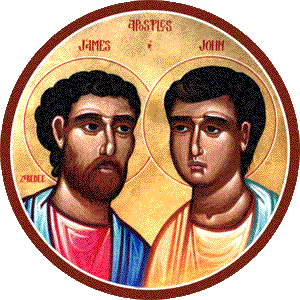
The Disciples James and John came to Jesus and said, “Teacher, we want you to do for us whatever we ask of you.”  When he asked them what they wanted, they said, “Let one of us sit at your right hand and one at your left when you come into your glory.”  

It’s interesting that Jesus doesn’t chastise them even a little for asking something so audacious.  He simply tells them that they don’t know what they’re asking.  He hints at the ordeal he will soon endure when he asks them,  “Are you able to drink the cup that I drink, or be baptized with the baptism that I am baptized with?”  They answer just a little too quickly:  “We are able,”  and it seems pretty clear that they don’t know what they’re in for.

We shouldn’t be too hard on James and John.  To their credit, they really do have faith.  They believe that Jesus can give them what they want.  They believe that he will soon “come into his glory.”  They just don’t understand what that means.  

A lot of us have come to Jesus at one time or another saying, “I want you to give me whatever I ask of you.”  A lot of people have thought that this is really the essence of praying.  Give me what I ask for.  And a lot of us have asked at one time or another to be put in positions of authority and prestige—right seat or left seat, either one is okay as long as we have a seat at the table.  We want that position that gives us the authority to fix all those things that other people are messing up.  We have ambition.

Jesus doesn’t chastise them for their ambition.  But the other disciples do.  So Jesus has to remind them all of what he has been saying all along.  You want to be a leader?  Fine!  Good!  Now, can you be a servant?

Whoever wishes to become great among you must be your servant, and whoever wishes to be first among you must be slave of all.

When Boris Baranov was appointed to the position of Shift Supervisor at the powerplant where he worked, he was given significant authority over some of the plant’s operations.  Along with that authority, of course, came some extra responsibilities.  Boris never dreamed, though, that saving most of Europe from becoming a nuclear wasteland would be one of those responsibilities.  But then, the powerplant where Boris worked was the Chernobyl Nuclear Power Station. 

On April 26, 1986 one of the four reactors at Chernobyl exploded releasing 400 times more radioactive fallout than the bomb dropped on Hiroshima in 1945.  The toll of that explosion was significant.  Two workers were killed instantly.  Another 29 would die from radiation burns or poisoning over the next few months.  

All the fires were extinguished within six hours, but now there was a risk of an even larger explosion—an explosion that would be many times more devastating.  

Several days after they thought that everything was under control, they discovered that the reactor in unit 4 had continued to melt down. Below the reactor was a thick concrete slab and below the slab was a large pool of water which was normally used to cool the reactor.  The core of the badly damaged reactor was now melting its way through the concrete slab.  If it were to reach the water, it would create an gargantuan steam explosion with a force of 3 to 5 megatons.  The enormous cloud of radioactive steam and ash that would have risen into the wind from that explosion would have made much of Europe uninhabitable for 500,000 years. 

To prevent the explosion, the water under the reactor had to be drained, but the only way to do that was by manually turning the right valves which were in the basement, and the basement was already flooded with radioactive water from putting out the fires.  Boris Baranov, the shift supervisor, Valeri Bespalov, the senior engineer, and mechanical engineer Alexei Ananenko volunteered to wade into the flooded basement and turn the valves.  Their brave and selfless act of service saved millions of lives.

Whoever wishes to become great among you must be your servant, and whoever wishes to be first among you must be slave of all.

There’s nothing wrong with ambition.  Jesus doesn’t rebuke James and John for their ambition.  He even affirms that they will in the end drink from his “cup” and be immersed in his “baptism.”  But he wants them to understand that ambition for ambition’s sake can lead to responsibilities you’re not prepared for, challenges you haven’t even begun to imagine.  

James and John wanted to be great, to sit in positions of prestige and authority.  And in the end, in a way, they got what they asked for.  According to tradition, after ten or twelve years proclaiming the gospel in Palestine alongside his brother John and the rest of the disciples,  James took the gospel to Spain.  In the end he returned to Jerusalem where he was killed by Herod Agrippa.  Again according to tradition, John took the gospel to Ephesus.  James and John found direction for their ambition.  But along the Way they had to learn a very hard lesson. 

Whoever wishes to become great among you must be your servant, and whoever wishes to be first among you must be slave of all.

Tough Love

Mark 10:17-31

In 1962 while on a visit to America, Karl Barth, the famous Swiss theologian, was asked by a student if he could summarize his whole life’s work in theology in a single sentence.  Barth replied, “Why yes, I can. In the words of a song I learned at my mother’s knee: Jesus loves me, this I know, for the Bible tells me so.”

I realized the other day that I haven’t reminded people of this simple truth nearly enough in my years as a pastor.  Jesus loves you.  I hope you can hear it again—maybe hear it fresh as if for the first time:  Jesus loves you.  The Holy Spirit loves you.  God loves you.  Let that sit with you for a minute.  

The simple truth is that God’s love for you is the starting point for…everything.  Why are you here on earth having a life?  Because God loves you.  God worked through all of the history of the universe to make sure you would be here to be loved.  

That is such an extraordinary thing to think about.  Jesus loves me.  This I know. When you hold that thought in your mind and heart for even a five uninterrupted minutes of contemplation, it’s mind boggling.  

I think that a lot of us who have lived any time at all in the embrace of the Christian faith, and especially if we have lived in the bosom of the church—I think we’ve forgotten this.  Or maybe just taken it for granted.   But the plain truth is that being loved by God is a thing that should astonish us at least once a day.  Preferably when we first get up in the morning.

The thing that got me thinking about all this is that there is a moment in verse 21 of our gospel text for this week that catches me off guard every time I read it.  It’s only in Mark’s account of Jesus’ encounter with the man “who had many possessions.”  For some reason Matthew and Luke don’t record this detail.  Here it is:

Jesus, looking at him, loved him.  

I don’t know which is more odd: that Mark bothers to make note of this or that Matthew and Luke don’t.  

I’ll circle back to this in a minute.

This passage, Mark 10:17-31, is so rich with things that deserve our attention that we could look at this  together for weeks and still just be scratching the surface.  For instance, there’s the question Jesus asks the rich man right at the beginning of their conversation: “Why do you call me good?  No one is good but God alone.”  Why does he say that?  What are we supposed to make of that?

There’s the matter of eternal life…which is not the same thing as endless life.  Do you know the difference?  There’s a distinction there that is definitely worthy of more attention.

The rich man has asked Jesus, “What must I do to inherit eternal life?”  That’s a strange question.  An inheritance is something that’s left to you.  Given to you.  Passed down to you.  You don’t “do” anything to inherit things except maybe try not to get disinherited.  Even if you work very hard to be in the good graces of your benefactor, though, in the end it’s their decision that determines if you will or won’t inherit anything.

Jesus tells the man, “You know the commandments: ‘You shall not murder; You shall not commit adultery; You shall not steal; You shall not bear false witness; You shall not defraud; Honor your father and mother.’”  Why does he add “you shall not defraud” to the list?  That’s not one of the Ten Commandments.  Matthew and Luke don’t include this, either.  So why does Jesus include this in his list of commandments here in Mark?   The word in Greek for defraud is apostereō.  It means “to cause someone to suffer loss through illicit means, to illegally deprive someone.”  In Deuteronomy 24 in the Greek version of the Old Testament, a form of  that word is used in the statute that prohibits withholding wages from the poor, the needy, and immigrants.  Is that why Jesus, in Mark, thinks that the rich man needs to be reminded of this statute?  Is there something we’re missing here? That would be worth some study. 

Finally, of course, there’s the issue that appears to be the whole point of this encounter.  “You lack one thing,” said Jesus. “Go, sell what you own, and give the money to the poor, and you will have treasure in heaven; then come, follow me.” 

When the  rich man heard this, he was shocked.  And went away grieving.  For he had many possessions.

The rich man had asked Jesus what he had to do to inherit eternal life.  And Jesus, forthright as always, told him. Go sell your stuff.  Give the money away.  Then come and follow me on the Way to eternal life.

Eternal life flows from God as a gift of grace…but you can’t fully receive that gift if something is getting in the way between you and God.  The rich man didn’t realize it, but he had another god standing in his way—standing between him and the one true God—between him and life eternal.  

If Jesus had just told him that he was dangerously close to committing idolatry, he probably would have denied it.  He probably would have quite truthfully responded that he had never bowed down to an idol or visited the temple of another god.  But idolatry is rarely as simple as just worshipping graven images. 

If Jesus had just told him that there was another god standing between him and God, an idol who was strangling the flow of life from God so that the river of life had been reduced to a trickle, he probably wouldn’t have understood.  He probably would have pointed to his wealth and said, “But clearly God has been blessing me.”

“Show me what you trust, what your heart clings to, and I will show you your god,” said Martin Luther.  The rich man’s heart was clinging to his many possessions.  They were dragging him away from the thing he wanted and needed most.  They were throttling his spiritual growth.  So Jesus told him to just get rid of it all.  

But he couldn’t.  He just couldn’t imagine himself doing what Jesus prescribed for him.  Jesus might as well have asked him to jump over the moon.  Or try to squeeze a camel through the eye of a needle.

So why did Jesus ask him to do the impossible—or at least something impossible for him?  I think the answer is in that odd line that only appears here in Mark:  

Jesus, looking at him, loved him.  

Jesus looked at him…and really saw him.  He saw what he wanted.  He saw what he needed.  He saw what was in the way.  Jesus saw him.  Everything about him.  

And he loved him. 

When you love someone, you’ll do anything you can to help them be healthy and whole.  Sometimes the things love demands of us are really difficult—like letting your kids make their own mistakes, for instance, because you know that’s how they’ll really learn.  Sometimes love makes you say hard things for the good of the beloved. Like telling an alcoholic that they flat out have to stop drinking before it kills them and your relationship, too. 

Jesus loved the rich man.  So he told him that if he really wanted eternal life—not just endless life, but eternal life, that bountiful, all-encompassing, loving life in the constant companionship of God—then he had to quit his addiction.  Cold turkey.  He had to get rid of his stuff.

And that brings us back around to where we started.  Jesus loves me. This I know.  Jesus love you.  This I know, too.  And that means that Jesus will do whatever it takes to help us be healthy and whole—which, by the way, is the original meaning of salvation—to be made healthy and whole and swimming in the eternal stream of God’s love.

So work out your salvation with fear and trembling.  And remember, if you feel Jesus is asking you to do the impossible for your own good, it’s because he loves you.  And with God, all things are possible.

Surprise!

“We need transformed people today, and not just people with answers.” -Richard Rohr

When is the last time you were surprised by something you read in the Bible?  When is the last time you read something in the scriptures that astonished you and made you re-think your ideas about God or life or humanity?

Most of us fall into certain assumptions about the Bible somewhere along the way.  We think of it as a collection of rules or behavior modification or just advice on how to be good.  Or we think of it as an anachronistic collection of stories that may occasionally have some relevance but that doesn’t really have that much to do with our daily lives beyond being saved.  Most of us accept that it is somehow a tool for our spiritual growth and development, but we often don’t have a clear idea of how to use it that way.  

I remember attending a graduation dinner at a certain faith-based university years ago.  Meri and I were seated next to a bright-eyed young woman, one of the graduating students, who was accompanied by her parents.  She was graduating with a high GPA in her major, Christian Education, and she had earned a certificate that authorized her to teach Bible and faith classes in her  denomination.  Her parents were justifiably proud of her accomplishments and her dad said, “Tell the pastor what you told me earlier—about what Bible means, what it stands for.”  “Oh,” she said with a big smile, “it’s an acronym:  Basic Instructions Before Leaving Earth, B-I-B-L-E!”  “Isn’t that great!?” enthused her dad.  I smiled and said something politely encouraging, but inwardly I was dismayed.

I’ve heard that acronym numerous times since that evening, and I’ve felt the same sense of dismay every time I’ve heard it.   Invariably it has come up in circumstances where I didn’t feel free to say, “No, that’s a horrible acronym!  That’s a worse-than-useless way to describe the Bible!”  

Let me explain.  First and foremost, the focus of the Bible is not about Leaving Earth—unless you want to say Leaving It Better Than When We Arrived.  It’s true that there is a fair amount of material that concerns our salvation.  But salvation, at least as the scriptures understand it, is about being made well, whole, complete.  And yes, rescued, but that’s the most limited understanding of the word.  Plus, it’s clear in the Bible that God intends salvation for all of creation, not just you and me.  And yes, there are some instructions to encourage and help us as we “work out our salvation with fear and trembling,” but those instructions are given so that we can all live more peaceful and healthy lives here on this earth, in the community of humanity, now.  The Bible is not about going to heaven.  It’s about how God has been working to bring heaven to earth.  

But there’s another big error in that acronym and it’s right there in the first word.  Basic.  We tend to hear “basic” as “simple.”  Some of the “instructions” seem simple at first glance, but that’s the problem.  When God does give an instruction, you’re supposed to do more than glance at it.  You’re supposed to figure out how you’re going to live it.  And living even the “simple” instructions can be more complicated than we tend to think…because we don’t think.

Take the Ten Commandments, the most “basic” instructions we’re given in the Bible.   “You shall have no other gods,” says God.  And that sounds simple enough until we start to really analyze our relationship with money or other things that are important to us. “Show me what you trust, what your heart clings to, and I will show you your god,” said Luther.  “You shall not commit adultery,” said God.  “If you look at someone with lust, you’re violating that one,” said Jesus.  “You shall not murder,” said God.  “If you’re carrying a grudge or hating someone, you’ve violating that one,” said Jesus.  And on it goes.  The “instructions” we are given may be basic in the sense that they set a baseline for us, but they’re anything but basic in terms of trying to live them. 

And that’s another problem with the acronym.  It reduces this amazing library of books and letters to a pocket guide—and one that’s pretty useless, at that.  There are whole sections of the Bible that are about how people have struggled to understand and live by the “basic” instructions God gave them.  There are sections full of songs and poems of praise or lament.  There are parables, short stories and fables.  There are histories.  There is theology—writers sharing what they had learned or come to understand about God.  There are hopes and prayers and visions.  There are heroes.  There are villains.

“This marvelous anthology of books and letters called the Bible is all for the sake of astonishment!” writes Richard Rohr in his book Things Hidden: Scripture as Spirituality.  “It’s for divine transformation (theosis), not intellectual or ‘small-self’ coziness,” 

I invite you to start reading the Bible in a new way.  I invite you to forget what you think it says and let it speak to you as if you’re hearing or reading it for the first time.  I invite you to open yourself to the possibility of being astonished as you allow yourself to be led by the Spirit on a journey of discovery.  The Bible…whatever you think it is, it’s not that.  It’s more.  Much, much more.

People As Things

Mark 10:2-16 

Martin Luther defined sin as being “curved in upon the self.”  That’s a really good and useful definition.  It covers just about all the bases.  But a few years ago I read another terrific definition of sin, this one from my favorite author of fiction, the late Sir Terry Pratchett.  In his book Carpe Jugulum, Granny Weatherwax, the wise witch of the hill country, defines sin in her own acerbic way while talking to a young theology student named Mightily Oats:  

“…And that’s what your holy men discuss, is it?” asked Granny Weatherwax.

“Not usually. There is a very interesting debate raging at the moment on the nature of sin, for example,” answered Mightily Oats.

“And what do they think? Against it, are they?”

“It’s not as simple as that. It’s not a black and white issue. There are so many shades of gray.”

“Nope.”

“Pardon?”

“There’s no grays, only white that’s got grubby. I’m surprised you don’t know that. And sin, young man, is when you treat people like things. Including yourself. That’s what sin is.”

“It’s a lot more complicated than that–“

“No. It ain’t. When people say things are a lot more complicated than that, they means they’re getting worried that they won’t like the truth. People as things, that’s where it starts.”

“Oh, I’m sure there are worse crimes–“

“But they starts with thinking about people as things…”

Sin is when you treat people like things.

Some Pharisees came to Jesus, and to test him—treating him a bit like a thing—they asked, “Is it lawful for a man to divorce his wife?”  It’s interesting that this the question they use to test him.  The easy answer, and one that probably wasn’t open to debate in their minds, is yes.  It is lawful.  It says so pretty clearly in Deuteronomy.  Chapter 24 verse 1.  

Jesus understands that they’re really asking something else, though.  What they really want is his opinion on when it is permissible for a man to divorce his wife.  What are the acceptable grounds for divorce?  

Oh, and pay attention to that language.  It’s all about a man divorcing his wife.  Not the other way around.

Deuteronomy does not specify that a man needs any particular reason to divorce his wife.  It simply says, “Suppose a man enters into marriage with a woman, but she does not please him because he finds something objectionable about her, and so he writes her a certificate of divorce, puts it in her hand, and sends her out of his house.”

Deuteronomy seems to simply assume that divorce is going to happen and doesn’t offer any real commentary on it.  In Jesus’ time, though, there was a big debate going on between the followers of two very influential rabbis, the school of Hillel and the school of Shammai, about what constituted just cause for divorce.  What kinds of things made it okay.  Hillel argued that, since Deuteronomy didn’t specify that a reason was needed except that she doesn’t please him, then anything she does that he finds objectionable—that’s the language in the statute—is acceptable grounds for the divorce.  It could be as simple as “she burned the bread” he argues.  Shammai and his followers, on the other hand, argued that divorce is only acceptable in the case of adultery.  

Jesus ties adultery to his answer, too, and at first glance, it looks like he’s siding with Shammai, but his response is more nuanced than that.  He’s actually refusing to get involved in their debate over the law itself.  Instead, he wants the Pharisees to see that just by arguing about this statute from Deuteronomy they are lending legitimacy to the already established practice of divorce instead of seeing it as a sad example of human brokenness in general, an example of men in particular being curved in upon themselves and treating women as things that they can take up or discard at will.  Jesus wants them to see that there is a huge problem built into the statute itself and that this law rests on assumptions that are hugely problematic.

“Moses gave you this law because you’re so hard-hearted,” said Jesus.  So right there at the beginning he is challenging them to look at why this law is even on their books.  It’s because the men are so hard-hearted.  They act as if it is their natural right to have control over the woman’s fate.  The very language of the statute seems to assume that.  It’s all about a man divorcing his wife.  

But Jesus reminds them that before there was this questionable law, there was the world as God had made it.  Both male and female were created in the image and likeness of the divine.  Male and female were equal.  That was God’s original vision and intent.  Jesus yanks them out of their debate over when and how it’s okay to destroy a relationship, and reminds them of the original intention of the relationship as it is defined in Genesis: “For this reason ‘a man shall leave his father and mother and be joined to his wife,  and the two shall become one flesh.’ So they are no longer two, but one flesh. Therefore what God has joined together, let no one separate.”

You may not catch it right away, but Jesus is actually taking on patriarchy here.  In her ground-breaking book In Memory of Her, Elizabeth Schüssler Fiorenza describes it this way:

Divorce is necessary because of the male’s hardness of heart, that is, because of men’s patriarchal mind-set and reality…However, Jesus insists, God did not intend patriarchy but created persons as male and female human beings.  It is not woman who is given into the power of man in order to continue “his” house and family line, but it is man who shall sever connections with his own patriarchal family and “the two persons shall become one sarx (body/flesh)”… The [Genesis] passage is best translated as “the two persons—man and woman—enter into a common human life and social relationship because they are created as equals.”[1]

Jesus is protesting the way that patriarchal privilege has so casually and easily driven a wedge into the unity and equality originally intended for men and women and for marriage. 

He is not intending to create an absolute prohibition of divorce.  He acknowledges that it is an unfortunate fact of life.  But he wants to level the playing field.  And he also wants to make sure that no one enters into divorce lightly or with unrealistic expectations.  

He makes it clear that those who remarry after divorcing will bring a certain amount of spiritual and emotional baggage to their new relationship whether they realize it or not. They will be “committing adultery” in the sense that they are no longer remaining faithful to the original relationship, and some part of their mind and heart will always know that.  

I don’t think Jesus is so much describing a continuous state of sin here as he is acknowledging the reality of the pain of broken relationships.  He applies this understanding to both men and women.  And it’s important to note that he doesn’t tell people to stay in relationships where they are being abused or broken or even simply neglected.  It’s important to remember, too, that Jesus is the one who can heal the brokenness, ease the pain and forgive the sin that every divorce brings with it.

Jesus is trying to make it clear to both the Pharisees and his disciples that, in God’s eyes, the central problem with their understanding of the divorce law in Deuteronomy is that the whole thing is based on men treating women as objects, and that even if you restore equality to the relationship and level the power dynamics, treating people as things will always drive a wedge into the relationship.

Having said what needed to be said about treating people as if they were disposable, Mark’s gospel now turns Jesus’ focus to another group of persons whom their culture tended to treat as objects.  Children.  Only this time it’s the disciples who are failing to see the basic humanity of these smaller persons.

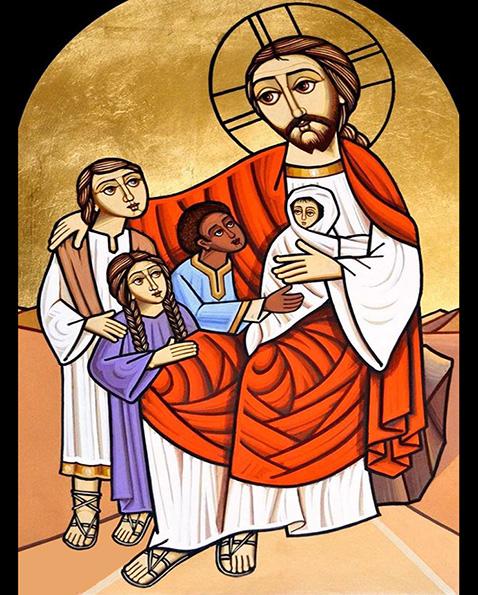
Mark tells us, “People were bringing little children to him in order that he might touch them; and the disciples spoke sternly to them.”  Jesus was indignant. “Let the little children come to me,” he said, “It’s people like these who make up the Kingdom of God!”  That was a huge thing to say in a world where children had no stature whatsoever.  But Jesus wasn’t finished.  “Listen.  Whoever does not receive the Kingdom of God as a little child will never enter it.”

This is where a lot of commentators rhapsodize about the innocence of children.  I always wonder when I read those commentaries if the writer has any actual experience with real children.  So if Jesus isn’t referring to “the innocence of children” here, what does he mean when he says we need to receive the kingdom as a little child? 

One thing almost all children have is curiosity.  Richard Rohr calls it “a beginner’s mind of a curious child…what some would call ‘constantly renewed immediacy.”[2]  This is the state of mind which Rohr says makes it easier for us to enter into real spiritual growth.  This is the state of mind we need in order to not make assumptions that we know everything.  This is the state of mind that enables us to see everyone else and ourselves as children of God, and not as objects.  Things. 

When we are able to see each other as children of God, when we are able to receive the Kingdom of God as a present reality and immerse ourselves in it with a beginner’s mind, a constantly renewed sense of immediacy, when we stop treating people as things, then we will be able to begin healing ourselves and the world.  Then we will be taken up in the arms of Christ and blessed.  And by the power and presence of Christ within us, we will embrace and bless the world around us.

In Jesus’ name.


[1] In Memory of Her: A Feminist Theological Reconstruction of Christian Origins; Elizabeth Schüssler-Fiorenza, p.143

[2] Things Hidden: Scripture as Spirituality; Richard Rohr, p. 8

To Make Life Less Difficult

Mark 9:38-50

On September 11, 2001, Emilio Martinez was anxious to get home from a business trip.  He boarded an early flight in Ohio, but the plane had barely got off the ground when the pilot came on the intercom to tell the passengers that there was a “security breach” and that their plane was being diverted immediately to Omaha.  

Emilio had an intuition that something very serious was happening—something that might make it very difficult for him and others to get home—so as soon as he got a cell signal, he called a car rental company and arranged to rent the biggest van they had.

When he deplaned, he heard the news about what was happening with the hijacked planes and the World Trade Center towers as he made his way quickly to pick up the van he had rented while still in the air.  He did the rental paperwork quickly, then parked the van close to the terminal and went back inside.  He tore a big piece of cardboard off of a discarded cardboard box then borrowed a Sharpie from a gate agent and made a sign that said “GOING TO DENVER.”  Even though everyone was nervous and scared at that point, people started approaching him to ask if he was really going to Denver.  “Yes,” he said.  “And I can take seven people with me.”

In no time, Emilio’s rented van was filled with seven strangers.  All of them nervous.  All of them scared.  But all of them wanting desperately to get home.  All eight of them jumped into the van and Emilio drove them home from Omaha to Denver.  Denver is a huge metropolitan area with lots of suburbs, but Emilio drove each and every one of his seven new friends to their front door.  When they tried to offer him money to help cover the rental of the van or pay for the gas, he refused.  With his simple act of generosity, Emilio Martinez became one of the unsung heroes of 9/11.

In George Eliot’s wonderful book Middlemarch, the heroine, Dorothea Brooke, asks the question, “What do we live for, if it’s not to make life less difficult for each other?”  If you take nothing else home with you today, I hope you take that.  I hope you let that question live with you.  What do we live for, if it’s not to make life less difficult for each other?

In the ninth chapter of Mark, there’s a moment when the disciples want Jesus to make life more difficult for someone.  The disciple John came to Jesus and said, “Teacher, we saw a man using your name to expel demons and we stopped him because he wasn’t in our group.”

Think about that for a minute.  Someone was freeing people from spiritual oppression or possession—in the name of Jesus, no less—and they tried to stop him.  Because…?  Because he was not part of their group.  In the eyes of the disciples he wasn’t properly authorized to use the name of Jesus, I guess.

Here’s how Jesus responded, as Eugene Peterson describes it in The Message: “Jesus wasn’t pleased. ‘Don’t stop him. No one can use my name to do something good and powerful, and in the next breath cut me down.  If he’s not an enemy, he’s an ally.  Why, anyone by just giving you a cup of water in my name is on our side. Count on it that God will notice.”[1]

That seems pretty clear, but Jesus has more to say.  He really wants them—and us—to get the point.  When it comes to helping people, as far as Jesus sees it, we’re all on the same side.  

But Jesus has another concern.  He’s worried that by butting in on the good work that the non-disciple was doing, his disciples might have done something to alienate him and all those people watching him from faith in Christ.  He’s worried that their bad example and cliquish attitude might turn people away.

“On the other hand,” he says—this is The Message again—“if you give one of these simple, childlike believers a hard time, bullying or taking advantage of their simple trust, you’ll soon wish you hadn’t. You’d be better off dropped in the middle of the lake with a millstone around your neck.” 

Jesus is using hyperbole to make a point here…and he’s just getting warmed up.  “If your hand or your foot gets in God’s way, chop it off and throw it away. You’re better off maimed or lame and alive than the proud owner of two hands and two feet, godless in a furnace of eternal fire. — And if your eye distracts you from God, pull it out and throw it away.  You’re better off one-eyed and alive than exercising your twenty-twenty vision from inside the fire of hell.”  

Now let’s be clear.  Jesus is not advocating that we maim ourselves in any way.  A lot of people are really troubled by this passage, and a lot of pastors hate to preach on it.  One pastor asked his adult Sunday School class to think about which Sunday would be good for inviting their friends to church and one woman said, “Any Sunday except pluck-your-eye-out Sunday.”

She has a point.  It’s a scary text and it could put people off.  But it’s important to remember that Jesus is using hyperbole here.  He uses these very graphic images to hammer home the point.  He knows his followers will remember what he’s telling them precisely because what he says is so shocking and the images are so graphic.  

But when you read past the hyperbole, you realize that he’s basically telling us, “Use some self-control, people!  Think before you act!  Think before you speak!  Especially if you identify as one of my followers!  If you bear the name of Christ, if you call yourself a Christian, think about how you represent Jesus.  Your words and actions can come back to haunt not just you, but all of us who bear the name of Christ.

How many times have you seen a news story about how some “Christians” have made life difficult for other people?  About a Christian-owned bake shop, say, that won’t make a wedding cake for a gay couple or about a prominent “Christian” making some kind of statement of hate or exclusion.  My heart just sinks every time I see a story like that.  I know that there will be people out there who will see that and it will turn them away from faith in Christ. 

Jesus wants us to know that we will answer for those kinds of things. 

Author Wendy Mass said, “Be kind.  Everyone you meet is fighting a battle you know nothing about.”  In The Message, Jesus says the same thing another way:  “Everyone’s going through a refining fire sooner or later  but you’ll be well-preserved, protected from the eternal flames. Be preservatives yourselves. Preserve the peace.”

Preserve the peace.  Greet the world with an expansive and welcoming attitude—not one of exclusion.  Help people whenever and however you can.  Or at the very least, don’t be an obstruction when you see someone else helping people. 

After all, what do we live for, if it’s not to make life less difficult for each other?  Especially if we can do it in the name of Jesus.


[1] Mark 9:38-50 in The Message, a paraphrase translation of the Bible by Eugene Peterson