A Song of Defiance

Luke 1:46-56

Fortunate Son by Credence Clearwater Revival.  Blowin’ in the Wind by Bob Dylan.  The Times They Are a Changin’ also by Bob Dylan.  For What It’s Worth by Buffalo Springfield.  Ohio by Crosby, Stills, Nash and Young.  Get Up, Stand Up by Bob Marley and the Wailers.  Redemption Song, also by Bob Marley.  What’s Goin’ On by Marvin Gaye.  This Land is Your Land by Woody Guthrie.  Strange Fruit by Billie Holliday.  Brother Can You Spare a Dime? by Yip Harburg and Jay Gorney.   Imagine by John Lennon.  Born In The USA by Bruce Springsteen.  Talkin’ Bout a Revolution by Tracy Chapman.  A Change is Gonna Come by Sam Cooke.  Big Yellow Taxi by Joni Mitchell.  9 to 5 by Dolly Parton.  

What do these songs all have in common?  They’re all protest songs.  If you type “Protest Songs” into your search engine, you’ll find every one of these songs on at least one of the many lists that will pop up.  

You might be surprised that some of these are regarded as protest songs.  9 to 5, for instance, has such an energetic, positive-sounding melody that it’s easy to just bop along to the music.  Yet because of the way its lyrics addresses the inequities of the workplace, it has become a kind of worker’s anthem, especially for women.  

If you don’t know the context, Blowin’ in the Wind sounds like just an innocuous 1960s folk song.  “How many roads must a man walk down before you call him a man?” sounds like a universal philosophical question until you remember that when Dylan wrote this song, African-American men were marching in the streets carrying signs that said “I Am A Man” to assert their identity and humanity in a segregated and racist culture that discounted and diminished  them by calling them “boy.”  Suddenly that philosophical question has sharp edges.

Many people have a fondness for This Land is Your Land as an almost patriotic song, a piece of classic Americana.  They forget that Woody Guthrie, who wrote that song, was regarded as a radical leftist and blacklisted by the infamous House Committee on Un-American Activities.  One of the verses of that beloved song that gets overlooked and is almost never actually sung is about poverty and hunger:  In the shadow of the steeple I saw my people/ By the relief office I seen my people/ As they stood there hungry, I stood there asking/ Is this land made for you and me?

Some protest songs try to awaken awareness.  Some name and describe social situations and injustices.  Some are simply songs of lament for the way things are.  Some remind us of the ways we are failing to live up to our ideals.  And some invite us to imagine how things could be better. 

All of these protest songs moved people to one degree or another and made them think.  But none of them hold a candle to the Magnificat by Mary, Mother of Jesus in the Gospel of Luke.

This song that Mary sings in chapter one of Luke is a radical protest song.  In an Advent sermon in 1933, Dietrich Bonhoeffer said, “The song of Mary is the oldest Advent hymn. It is at once the most passionate, the wildest, one might even say the most revolutionary Advent hymn ever sung. This is not the gentle, tender, dreamy Mary whom we sometimes see in paintings.…This song has none of the sweet, nostalgic, or even playful tones of some of our Christmas carols. It is instead a hard, strong, inexorable song about the power of God and the powerlessness of humankind.”

Archbishop Oscar Romero prayed the words of Mary’s song every day.  He drew inspiration from her song to continue preaching for justice and economic opportunity for the poor of El Salvador.  He heard Mary singing as one of the poor and, in a country where only 14 families controlled all the wealth, he proclaimed, “You have to be poor to really know the power of the good news.”

Poor and oppressed people throughout the world have been uplifted and empowered by Mary’s song, so much so that oppressive governments have banned it at various times.  In India, during the time of British rule, singing of the Magnificat in church was prohibited for fear it would encourage rebellion.  In Guatemala in the 1980s, the Magnificat became a favorite song among the impoverished masses, inspiring them to believe that God was on their side and change was possible, so the Guatemalan government banned any public singing or recitation of Mary’s song.  In Argentina, the Mothers of the Plaza de Mayo whose children had been disappeared during the Dirty War, placed the words of the Magnificat on posters throughout the capital.  In response, the military junta banned any public display, recitation, or performance of the Magnificat.  They saw how it gave the people courage and reminded them that God was on their side.

The poor and oppressed identify with Mary.  They don’t just see her as “holy Mary, Mother of God,” they see her as one of their own, a peasant girl, in difficult circumstances, but defiant and empowered.   Carolyn Sharp of Yale Divinity put it this way: “Don’t envision Mary as a radiant woman peacefully composing the Magnificat.  Instead, see her as a girl who sings defiantly to her God through her tears, fists clenched against an unknown future.”  Dr. Sharp goes on to say that if we can see her this way, “Mary’s courageous song of praise [becomes] a radical resource for those seeking to honor the holy amid the suffering and conflicts of life.”

God has shown the strength of God’s own arm;

and has scattered the arrogant in the intent of their hearts.

God has brought down the powerful from their thrones,

and lifted up the lowly;

God has filled the hungry with good things,

and sent the rich away empty.

Mary’s song makes it clear that God is initiating a new social order, that the world is about to turn.  Her song announces that Christ’s coming is a world-transforming event.  Her song proclaims that Christ is coming to challenge the structures of sin and death, evil and oppression.  

Her song echoes the song of Isaiah 61 which her son, Jesus, will someday read in the synagogue to initiate his ministry:

The spirit of the Lord GOD is upon me,

                  because the Holy One has anointed me;

         God has sent me to bring good news to the oppressed,

                  to bind up the brokenhearted,

         to proclaim liberty to the captives,

                  and release to the prisoners;

         to proclaim the year of the God’s favor,

                  and the day of vengeance of our God;

                  to comfort all who mourn;

         to provide for those who mourn in Zion—

                  to give them a garland instead of ashes,

         the oil of gladness instead of mourning,

                  the mantle of praise instead of a faint spirit.

Mary’s song resonates with the songs of God’s liberation throughout the ages.  In Exodus 15, Miriam sings of God’s mighty acts in saving the people from Pharoah’s pursuing army.  In 1 Samuel 2, Hannah prophesies about God turning the tables on behalf of the poor when she sings, “Those who were full have hired themselves out for bread, but those who were hungry are fat with spoil.”  

Mary’s song rings with the prophetic reminder that God is at work in every age to rebalance the scales.  She reminds us that God will not allow oppression, injustice, negligence and inequity to go on forever.  The reign of God has been announced.  The vision proclaimed and described.  In a world where things have not been operating according to God’s plan, Mary has told us that change is underway and invited us to be on the right side of it.  And just so we know which side that is, she has given us a song.

*Image by Linda Donlin

The Keys of Heaven

The Keys of Heaven

The body of the old man lay stretched out upon the table, prepared according to custom and covered with a shroud.  The priest, who had been gazing out the window, or perhaps deep into his own thoughts, broke from his reverie, stood up, and removed a papyrus scroll from the folds of his robe then moved to the body lying on the table and gently, reverently, lifted the edge of the shroud and took something from the right hand of the old man lying beneath it, and lifted it high in the lamplight for all to see.  Everyone reacted to the familiar object dangled before them.  Some smiled wistfully, a few nodded in recognition, one woman buried her face in her scarf and wept.  It was a plain thing, a simple leather thong suspending ten stones, seven smaller, three larger, each separated from the others by a knot in the leather.  They did not catch the light in any particular way.  They did not glow or sparkle.  There was no mystic aura about them.  But the faithful people in that gathering would not have traded those stones for rubies or diamonds or sapphires or pearls. “The Keys to Heaven,” said the priest.  With care bordering on ceremony he handed the odd artifact to the Deaconess who stood at the feet of the old man’s corpse.  She continued to cradle the leather strip and its stones in her hands so all could see it in the soft glow of the oil lamps.   The priest unrolled the scroll and began to read.

By vocation the priest was the chief reader at a busy scriptorium.  Six days of the week he would read aloud to a phalanx of copyists—reading slowly, distinctly, and loudly enough to be heard at the back of the room yet fast enough to keep up with the demands of the business, to meet its deadlines and keep it profitable.  The qualities that made him so very good at his job also made him an excellent public lector, a role which added to his income.  This talent also served him well, of course, in his role as priest in this small community of the faithful.  But now, as he began to read his dear friend’s last will and testament, he put aside his professional voice and tried to find in himself the deep wells of strength and gentleness that characterized his departed friend; he did his best to summon his friend’s voice for his friend’s words.  This is what he read:

My dear friends, my brothers and sisters, grace to you and peace in the name of the One we follow, who was, who is and who is to come.  Amen.  I pray you know how much you are loved.   I have so very little to leave to you in the way of earthly things.  My little house and my poor purse I entrust to this community.  Perhaps they may be used to benefit a widow or two.  Let the Deaconess administer these things as she is most capable.  Let the tools of my trade go Nathaniel, my apprentice.  I have no other possessions except the Keys to Heaven.  These I bequeath to you all for your common use and good, but I must tell you how I came to have them.

I think that almost every one of you, most when you were children, but some when you were older, have asked me, “Andreas, what are those stones hanging from your belt?” and I would say, “They are the Keys to Heaven and I am giving them to you.”  Then you would say, “When can I have them?”  And I would say, “When you can tell me how they are made!”  So now, I will tell you their story.

For all the years I have lived among you, you have known me as Andreas the Leatherworker.  That was not always my name.  For that matter, working leather was not always my trade, but that is of no importance.  When I was much younger and full of anger at the world I did some dangerous and stupid things.  One thing in particular was even evil, though I did not think so at the time.  As a consequence, I found myself on the run, hiding from the patrols of soldiers that seemed to be everywhere on the road.  I cut my hair and shaved my beard.  I stole the tunic, mantle and belt of a tradesman while he was bathing in the river and left my very fine and costly clothes in their place.  Then I fastened a sword to my belt and kept on running.

Three nights later, just at nightfall, I saw a man sitting by a campfire just to the side of the road.  Half mad with hunger and exhaustion, I moved toward him, drew my sword and said, “Give me your food and your money.”  I meant to growl it out in a menacing way but my throat was so parched I must have croaked like a raven.  “We will gladly share our food with you,” said the man, “but what money we have with us is not ours to give.”  I started to move toward him with my sword when his words pierced the fog of my hunger.  We.  He had said “we.”  I blinked, looked again, and could not believe I had not seen them the first time—four other men. Two of them were some small distance behind the man by the fire but were now walking briskly toward us.  Another man was emerging from the brush carrying an armload of wood for the fire, and another with a water skin was just coming up from the stream.  Five men altogether.  Even if I were not nearly dead from hunger and thirst I could never take on five men.  My head began to swim, my knees gave out and I fell, unconscious.

I awakened to find one of the men bathing my forehead with a cool, wet cloth while another was bandaging my arm.  Apparently I had cut it with my own sword when I fell.  The man I had first seen, the one I had threatened and tried to rob, lifted a cup of cool water to my lips but urged me to drink it slowly.  As soon as I was able to sit up one of the men gave me a piece of bread and a piece of dried fish which I devoured immediately without a word. 

I didn’t know what to expect next and I was too weak to try to run.  When the big man, the first man I had seen by the fire, picked up my sword I half expected him to kill me with it. Instead he laid it in front of me in the dirt.  “This is yours,” he said, “though I think you might be better off not to keep it.  That’s a Roman Gladius.  A soldier’s sword.  And you don’t strike me as a soldier. I think maybe that sword has already brought you trouble and if I were you I would just bury it here at the side of the road.”  

I was dumbstruck.  That sword had been nothing but trouble.  That sword and my hot temper were the whole reason I had had to flee for my life.  

I looked at the big man.  He was smiling at me, and I realized, looking at him, that there was no fear in him.  No anger.  “You must still be hungry,” he said.  “I tried to rob you!” I said, incredulous.  “I threatened you!”  “Yes.  You did,” he said.  “I forgive you.”  “But I…”  I started.  “Let it go,” he said, quietly.  “I have.  What you bind on earth is bound in heaven.  What you release on earth is released in heaven.  I release it.  I release you.  Let it go.”

I sat staring at the ground for a long time, confused, not knowing what to think.  

I heard him chuckle, looked up and saw him smiling at me.  He leaned over and picked up a smooth agate pebble from the ground, walked over and placed it in my hand.  “Here,” he said. “Keep this.  This is the first Key to Heaven.  Forgiveness.”  “I don’t know if I can be forgiven.” I said.  His expression became reflective and he gazed into the fire for a long moment. “I felt that way once,” he said at last. “I betrayed my best friend…my teacher…my master.  I betrayed him three times in one night to save my own skin.”  “What happened?” I asked.  “They crucified him,” he said simply.  “But I got away because I pretended that I didn’t know him. Three times in one night someone accused me of being one of his companions and three times I denied it.  And I didn’t think I would ever be forgiven for that.  But he forgave me.  And he helped me forgive myself.  He released me from my sin and he helped me let go of my sin—helped me to stop clinging to it..”  “Wait a minute,” I said, “I though you said they crucified him.”  “They did,” he said.  “Well then how…when did he forgive you?”  The way he looked at me I could tell he was trying to decide something and it was another very long moment before he said, “That’s another story and if you would like to travel with us I will gladly tell it another day.  For now,” and here he smiled again, “hold on to that little piece of forgiveness and let that be enough for today.”

And that, my beloved brothers and sisters is how I came to have the first of the Keys of Heaven, the Key of Forgiveness.  Having nowhere else to go and nothing to lose, I became a travelling companion of Petrus, the Fisherman, who taught me the ways of his Master and baptized me into a new life with a new name.  And along the way he gave me the Keys of Heaven and taught me how they are made, or where they can be discovered, so that each of us can have them and carry them with us and unlock Heaven around us wherever we are.  

The first key is Forgiveness.  The Second is Gratitude.  The third is Generosity.  The fourth is Compassion. These four open your heart to the world God made, the world God loves.  The fifth key is Integrity.  The Sixth is Thoughtfulness.  These two open the soul and mind to look beyond yourself and deal fairly with all others.  The seventh is Be Not Afraid.  This key gives you the presence of mind to remember that you have all the others at your command and it helps you to use them wisely.

Then there are the three larger keys.  These give the first keys their power.  At the same time, the first keys can unlock the power of these three.  They are Faith, Hope and Love.

So, my beloved friends, these are the Keys to Heaven.  I hope you can see that I spoke the truth all these years when I said, “I am giving them to you.”  I hope and pray that in my life you saw forgiveness, gratitude, generosity, compassion, integrity and thoughtfulness.  I hope you saw me live without fear.  I pray that you are gathering these keys for yourself by the example of our Master.  May you all continue to grow in Faith, Hope and Love until we are reunited in the Life to Come.

Peace be with you.

I am always your brother,

Andreas

The small assembly sang a hymn.  The priest pronounced a benediction.  The Deaconess replaced the Keys of Heaven in the old man’s hand, and in the dim lamplight they reverently carried his body to its place of rest.  

Wait

Thoughts Along the Way…

“The extraordinary thing that is about to happen is matched only by the extraordinary moment just before it happens. Advent is the name of that moment.” – Frederick Buechner, Advent

Waiting.  It’s about waiting.  It’s about holding your breath as you pause for what’s coming.  It’s about remembering to breathe so you’re awake to see it arrive.  It’s about closing your eyes so you can hold on to the dream of what is possible, what might be.  It’s about opening your eyes to the beauty and pain and joy and sorrow and harshness and gentleness and passion and peace of everything that already is and everything about to unfold.  It is the excited pins and needles of anticipation.  It is the queasy uneasiness of suspense. Waiting.  We live in a season of waiting.

“The thing I love most about Advent is the heartbreak. The utter and complete heartbreak.” –Jerusalem Jackson Greer; A Homemade Year: The Blessings of Cooking, Crafting, and Coming Together

Yearning.  Feel the yearning.  Let yourself fall into it for a moment.  Wallow in it for a moment.  Let it break your heart that the world is not yet made whole.  Let it break your heart that the promise is not fulfilled.  Let your eyes well with unshed tears for all the tears shed in this world. Stare hard at the reality that our species seems to be forever a painful work in progress.  Feel the weighty disappointment of our failure to be what God made us to be and balance it on the sharp pinpoint of the promise we, all of us, feel—the promise of what we could be, the promise of what we’re supposed to be.  Let yourself feel that deep knowing that things are not now as they are intended to be.  Let it break your heart.  Then understand that it is through the broken heart that God enters the world.  It is through the broken heart that the promise is revived.  It is through the broken heart that the vision of what should be moves forward toward what will be.  It is through today’s broken heart that we see tomorrow’s vision of the world God is calling us to build together.  It is the light aglow in the broken heart that illuminates the faces of those around us whose hearts are also breaking.  It is in the yearning of the broken heart that we find the Advent of Emmanuel, God With Us.   

 “Advent is the time of promise; it is not yet the time of fulfillment. We are still in the midst of everything and in the logical inexorability and relentlessness of destiny.…Space is still filled with the noise of destruction and annihilation, the shouts of self-assurance and arrogance, the weeping of despair and helplessness. But round about the horizon the eternal realities stand silent in their age-old longing. There shines on them already the first mild light of the radiant fulfillment to come. From afar sound the first notes as of pipes and voices, not yet discernable as a song or melody. It is all far off still, and only just announced and foretold. But it is happening, today.” –Alfred Delp; Advent of the Heart: Seasonal Sermons and Prison Writings, 1941-1944 

Arriving.  But not yet.  Almost.  Get ready.  It’s coming.  It’s arriving.  But we are still in the midst of everything and in the logical inexorability and relentlessness of destiny.  Keep moving toward the moment.  Keep moving toward the encounter.  Keep still in the not-yetness of it all.  Decorate.  Decorate your house.  Decorate your heart.  Decorate your language.  Decorate your greetings, your symbols, your understanding.  Decorate your soul—from decoratus in the old poetic Latin that still connects our thoughts and words with those who decorated before us, who handed down their most important and enduring ornaments.  Decorare – the verb that tells us to adorn, to beautify, to embellish.  From decus—to make fit, to make proper so that we might be ready with decorum.  And yes, we need to decorate.  Yes, we need to fill the space around us, to fill our homes, our souls, our hearts with brighter things to see, more solid and enduring visions than the shadow parade of destruction and annihilation.  We need to fill our ears with more stirring melodies than shouts of self-assurance and arrogance, songs that lift the heart above the drone of lamentation, the weeping of despair and helplessness.  We need to keep moving toward the music and the light.  We need to lift our eyes to that first mild light of radiant fulfillment to come.  We need to fill our ears with the first notes of pipes and voices no matter how faint and far they may seem.  We need to hum and sing and play the old familiar songs that move our hearts to that softer, readier place where the True Song will be born.  We need to light the ancient candles one at a time to guide our steps down the corridor of waiting, the pathway of arrival.  We need to bring each flame to the heart until the soul is aglow with the depth of its meaning and power.  We need to reignite the flame of Hope to show us our way through the numbing fog of sameness.  We need to internalize the flame of Peace to quiet our anxieties and give us patience.  We need to swallow whole the flame of Joy to whet our appetite for the feast to come.  We need to embody the flame of Love to warm us as we journey together, to show us again that we are walking arm in arm and our fates are intertwined, to illuminate the purpose of life, to lead us to the Light of the World.

“For outlandish creatures like us, on our way to a heart, a brain, and courage, Bethlehem is not the end of our journey but only the beginning – not home but the place through which we must pass if ever we are to reach home at last.” –Frederick Buechner, The Magnificent Defeat

Arrive.  But understand in your arriving that even after the meaningful journey of Advent we don’t arrive at Christmas.  Christmas arrives to us.  The Gift comes to meet us on the road to take us to a place we could never attain on our own. We celebrate.  We ponder.  We dance and revel in the laughing lights of Hope and Peace and Joy and Love that we carried with us, that brought us to this place.  We gaze amazed at the Gift before us, almost comically humble and plain, artlessly displayed and wiggling inside its wrappings, laid out on a bed of straw in a manger, and yet more artistically subtle, more beautiful and precious than the Magi gifts of gold, frankincense and myrrh.  And if you take a moment to think about what this Gift really is, what this baby really means to the world and what this baby means to you, in particular,  you may just hear the voice of Emmanuel saying, “Now the journey begins in earnest.  Be not afraid.  I am with you.”

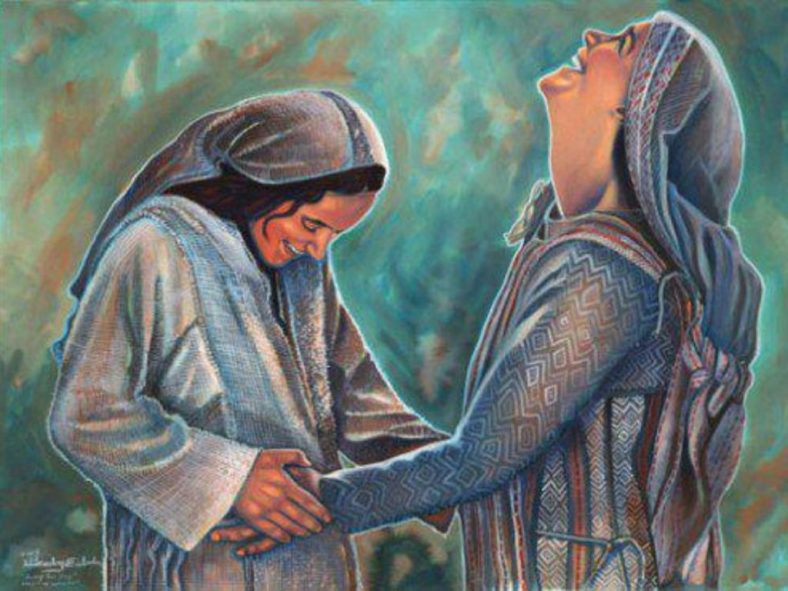
Mothers of Reconciliation

Luke 1:39-45

Do you have any favorite relatives, favorite cousins, aunts, uncles?  If you found it necessary to make yourself scarce for a while, do you have a relative you know you could go stay with who wouldn’t judge you and would maybe even be glad to see you?  

Immediately after Gabriel told Mary that she was to be the mother of Jesus, Mary decided to get out of town.  Nazareth was a small town, and a small town is not always the friendliest place for a not-yet-married mother-to-be.  People talk.  And when they don’t have all the facts, they tend to invent them, often with an unkind or salacious spin.  So, the Gospel of Luke tells us, “Mary set out in those days and went in a hurry to a town in the hill country of Judah.”  In a hurry, with haste, Mary went to stay with her older, loving, wise, nonjudgmental relative, Elizabeth, who also happened to be miraculously pregnant.

If someone told you that you that you could only have one of the four gospels to read and study for the rest of your life, the Gospel of Luke would not be a bad choice.  Luke has a good sense for drama and he tells the story of Jesus in very human terms.  

Luke anchors his version of the Good News in history.  After a brief introduction, his narrative begins with the words, “In the days of Herod, king of Judea…”  He tells us that Jesus is born during the reign of Augustus Caesar, when Quirinius is governor of Syria overseeing the collection of the first census and poll tax.  He wants us to have historical context, not so much so we can pin events down to exact dates, but rather to give us a political, social, and cultural backdrop as he stages the story of Jesus.

Another reason to consider Luke if you could have only one gospel is that political and economic justice are important themes in Luke.  Jesus inaugurates his ministry in Luke’s gospel by reading in the synagogue from Isaiah 61, using Isaiah’s poetry to make it clear that his proclamation of God’s reign is all about good news for the poor, healing, justice and liberation (Luke 4).  Subversion of the dominant paradigm is insinuated between the lines.

In Luke’s gospel, the Holy Spirit is named more often and more directly and plays a more visible role than in Matthew and Mark and John.  Jesus tells more stories in Luke.  Some of our favorite and best-known parables are found only in Luke.  And Luke uses scripture from the Tanakh, the Old Testament, in subtle ways to link the story of Jesus to his ancestors, because when all is said and done, Luke understands that Jesus is the crowning glory of generations of his people and his family; his story is the ultimate chapter of a long continuous narrative about the trials, triumphs, and brokenness of God’s people.    

But if you only get to have one gospel, maybe the best reason to choose Luke is the women.  Women play a larger role in Luke and speak more in Luke than in any of the other three gospels.  And the things they say are prophetic. 

When Mary meets with Elizabeth, even their names are telling part of the story and linking them to the heritage of their people and a family tradition of liberation and new order.  The name Mary is a diminutive form of Miriam.  The name comes from the same root as myrrh and has multiple meanings:  bitter, beloved, rebellious.  Miriam in Exodus was a prophet, sister of Moses.  According to a tradition[1], when Pharaoh’s army was about to overtake the Israelites, Moses held out his staff and his hand to part the Red Sea, but Miriam is the one who led the people through the parted waves, calling the women to follow her, the women in turn then calling their men to follow them as they raised their tambourines and sang and danced her way across the dry path between the walls of water.   The name Elizabeth is a form of Elisheba from El shava, meaning “God is my oath.”  Elisheba was also part of the Exodus story.  As the wife of Aaron she became the mother of all the priestly line of Israel.  When Mary and Elizabeth meet, it is a meeting of generations of priesthood and prophecy, but in a marvelous twist the mother with the priestly name will bear a child who will become a prophet, and the mother with the name of a prophet will bear a child who will be later be called, “a high priest in the order of Melchizedek.”[2]

And where are the men in all this?  Absent or silent.  Elizabeth’s husband, Zechariah the priest, has been silenced because he did not believe the angel Gabriel when Gabriel told him that Elizabeth would bear a child.  He will not speak again until his son John is circumcised.  And Joseph, Mary’s betrothed?  The surrogate father of Jesus barely appears at all in Luke’s gospel. He is named only four times and never speaks.  And Luke gives the distinct impression, reading between the lines, that Joseph stayed behind in Nazareth while Mary went to see Elizabeth.  Luke tells us that when the order for the census came, “Joseph also went from the town of Nazareth in Galilee to Judea, to the city of David called Bethlehem…”[3]  The implication is that he stopped by the house of Elizabeth and Zechariah “in a town in the hill country of Judah” to pick up Mary on his way to Bethlehem.

The men are silent, but the women speak.  Oh do they speak.  When Elizabeth heard Mary’s greeting, the baby leaped in her womb and Elizabeth was filled with the Holy Spirit.  Elizabeth exclaimed with a loud cry, “Blessed are you among women, and blessed is the fruit of your womb.”  A loud cry.  Krauge megale it says in the Greek.  A very loud shout.  Elizabeth’s words are included in the prayer of the rosary, but I’ve never heard them shouted.  Hail Mary, full of grace, the Lord is with you.  BLESSED ART THOU AMONG WOMEN AND BLESSED IS THE FRUIT OF YOUR WOMB…

No, it’s not usually said that way. But wouldn’t it be wonderful if it was—to remind us of the great joy Elizabeth feels when she is filled with the Holy Spirit and recognizes the child that her young relative is carrying in her womb.  She speaks prophecy.  She speaks profound blessing.  Why should that be merely whispered or mumbled?  These are words of joy for the whole community of humanity!

This is a story of women proclaiming the Word of God.  This is a story of a family living out God’s power and presence.  God builds community, peoples, nations from proclamation and from families.  

Sadly, far too often proclamation is misguided and families are dysfunctional.  Too much of our story as a human family is a story of anger, disruption, fracture, and violence.  Maybe because the men have been doing most of the talking.  Too much history and not enough herstory. The descendants of Abraham fighting the descendants of Abraham—the children of Sarah and the children of Hagar locked in hostility for generations.  The descendants of one race locked in a vicious spiral of fear of and hatred for other races when we are all related in the human race, when we are all family.

These two women who meet in this unnamed town in the hills of Judah, these two women who rejoice loudly and prophesy in each other’s presence, these two women are the mothers of reconciliation and renewal.  Their sons will enter a fractured world of unreconciled peoples to bring a call for change and a vision for peace and understanding . God will use this family to bring healing and renewal to all families—to the whole human family—if we can learn how to listen. 

The son of Elizabeth will preach repentance, metanoia, a summons to change course.  The child of Mary will proclaim a direction for that change of course, a vision of the reign of God, a new way of being, a way of embracing our heritage and responsibility as children of God and siblings in humanity.  One will embody God’s call to be transformed.   One will embody God’s power of recreation and renewal.

These two women are family.  Their sons, these cousins, enter the world to remind us that we are all family, all related, all our stories intertwined.  Mary and Elizabeth remind us that God speaks and works through families even if it’s the slow work of generations.  Mary and Elizabeth remind us that God speaks and works through women to heal the world.  They are the mothers of John and Jesus.  They are chosen by God to be the mothers of renewal and reconciliation.


[1] Exodus 14-15

[2] Hebrews 5:10

[3] Luke 2:4

Painting by Corby Eisbacher @ArtByCorby

Light a Candle

You find yourself glancing at the calendar and the clock with a slight sense of panic. So much to do and the days are rushing by. Busyness blinds you to the presence and the present of the Present. Decorating. Shopping. Wrapping. Mailing. Visiting. Hosting.

Stop. Light a candle.

You find yourself constantly wondering just how much Christmas you can afford. You feel as if you dare not shut off your mental calculator and the joys of the season are clouded by the Ghost of Bills yet to come. Every gift becomes a bit of addition which, in turn, becomes an anxious subtraction.

Stop. Light a candle.

You find yourself lost in a lonely daydream as the Ghost of Christmas Past fills your thoughts with scenes of happier holidays from days gone by. An old familiar song reminds you of friends and family no longer near at hand and your heart aches more than just a little.

Stop. Light a candle.

You find yourself dizzy from trying to steer your way through the year-end collision of events. Reformation. Halloween. Election. Veterans Day. Christ the King. Advent. Christmas. New Year. Taxes. Fiscal Planning.

Stop. Light a candle.

You find yourself simply feeling as if something is missing, as if you’re forgetting something, as if there must be something more.

Stop. Light a candle.

Five candles. Three blue and one pink for Advent. One white for Christmas.

First, ignite the flame of Hope, the Prophecy Candle. Let this flame remind you that God’s promises not only echo through the past but draw us toward the future. Let the light remind you that just as a feather will rise naturally above the heat of a single flame, so you, too, can be lifted without effort by the Spirit that warms and enlightens us all.

Next, light the flame of Peace, the Bethlehem Candle. Let this flame remind you that the peace of God is found in humble moments and humbler places. Let this light remind you that the real gift we all seek is something no amount of money can buy. Peace.

Then light the flame of Joy, the candle of a different color, the Shepherd’s Candle. Sing the old familiar songs of Joy and surround yourself with light and music. Dance with the Ghosts of your past and know that they are very much alive in your memories and in the presence of God. Watch the old movies, taste the old, familiar flavors. Let this light rekindle your senses and remind you that this song of Joy is eternal.

Now light the flame of Love, the Angels Candle. Let this light bring equilibrium to these days of celebration. Let it guide you through the maze of these impacted days. Let the flame of Love burn a pathway through the adiaphorous clutter. Let its warmth empower you to embrace the days. Swallow its light whole so that it shines through you.

Finally, sit in the presence of the light of Christ. Let the Candle of Christmas remind you that the most humble child born in the most unlikely circumstances bears the image and likeness of the Maker of Us All. Let it remind you that the thing that has been missing in our lives, the object of our unsettled yearning, is not a thing or an object at all, but the very Source of our Hope, Peace, Joy and Love.

O come, O come, Emmanuel.

Look Again

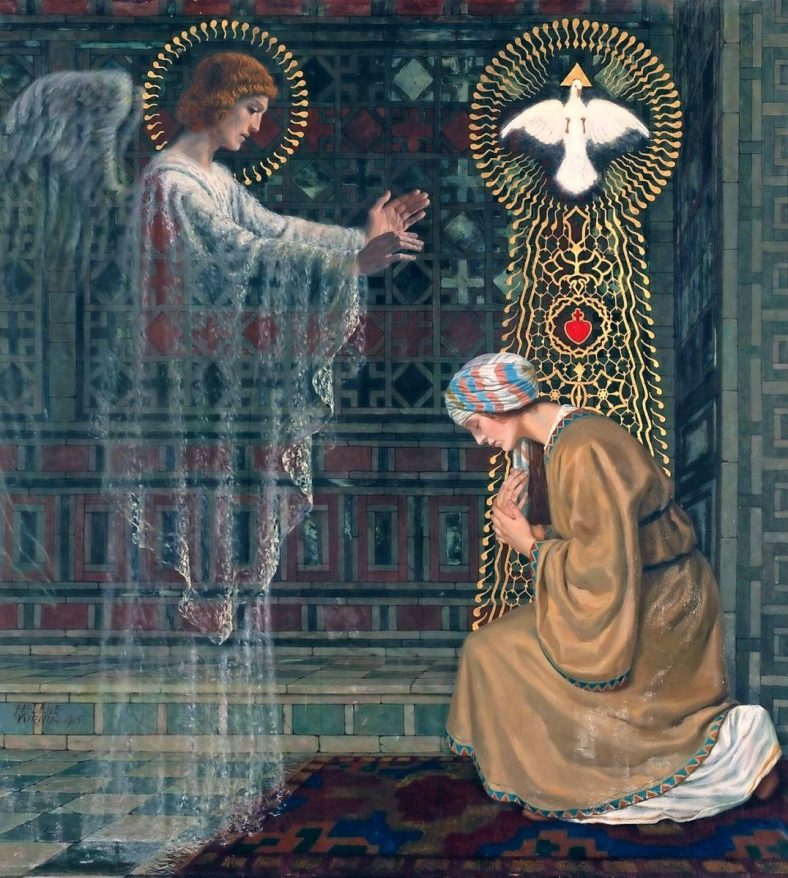
Luke 1:26-38

“In the sixth month the angel Gabriel was sent from God into a town in the Galilee called Nazareth, to a virgin betrothed to a man whose name was Joseph, of the house of David. And the name of the virgin was Mary.”  If you’ve been a Christian for more than five minutes, you’ve heard these words before.  These are the opening words of The Annunciation, that part or the Christmas story we all know and love so well when Gabriel tells Mary she will become the mother of Jesus.  We know this story.  We know this episode of the story by heart.  But I wonder… When is the last time we really listened to it or read it carefully?

Look again at the opening line: “In the sixth month the angel Gabriel was sent from God into a town in the Galilee called Nazareth…”  I have always pictured Gabriel just suddenly appearing before Mary and probably startling her.  Certainly it’s depicted that way in any number of paintings.  But look at what Luke has actually written here—he is bringing the focus of the story from heaven to earth, to a specific territory, then a town, then to a person.  Gabriel comes from God to Galilee to Nazareth to Mary.  As I re-read this, I suddenly had a picture of Gabriel arriving unseen on a hilltop in Galilee then making his way down the hill past grazing goats and sheep to the road, cloaking himself to look like a traveler as he made his way into town and found his way through Nazareth’s dusty streets until he came to Mary.  Maybe she saw him coming and was watching him as he walked toward her house.  Maybe she wondered who this mysterious stranger might be as he approached and then became a bit wary as she realized he was coming directly toward her. Maybe she thought he had some business with her father. 

When you picture it this way, it opens you up to the idea that maybe angels walk among us all the time.  Maybe they emerge from heaven make their way into town then find their way through the streets until they get to where they were sent.  It makes you wonder how many times you might have walked right by an angel or sat a few seats away from one at McDonalds.  

So maybe she saw him coming, but even if Mary had seen Gabriel approaching, it really would have been a surprise when he spoke to her.  And what he said was so unusual: “Rejoice, favored one!  The Most High God is with you!”

Between timidly formal translations, millions of persons repeating the rosary millions of times,  and Franz Shubert’s lovely but overly romantic musical setting of Ave Maria, the shock value of Gabriel’s greeting was bled off a long time ago.  And that’s unfortunate, because what he said rocked Mary’s world and, if we’re paying attention, should rock ours, too.  

Hail Mary, full of grace?  Not exactly.  First of all, “Hail” or “Greetings” are subdued translations of the angel’s first word to Mary.  “Chaire!” is what he says.  It can mean “greetings” or “hail” but those are timid choices.  Chaire!, which is what Gabriel says in the original Greek text, is the imperative form of Chairo – to rejoice!  Rejoice, favored one!  The Most High God is with you!  Rejoice!

No wonder Mary was “thoroughly troubled by what he said and tried to discern what sort of greeting this was.”  Some translations say she “pondered” what sort of greeting it was, but the sense of the Greek word, dialogizemai, is that she had a pretty serious inner conversation with herself as she tried to sort it out.  The word dialog is in the word and the word means inner dialog, to think or thoroughly reason through something.  It’s easy to read right past all that, or listen right past it, but this is one of the places where we really are supposed to slow down or even stop for a moment and stand a moment in Mary’s bare feet.  

Imagine what she was thinking.  Who is this mysterious stranger?  Why is he telling me to rejoice? Why is he even talking to me, which is not exactly smiled upon in our society, and why did he call me “favored one?”  Favored by whom?  What does that mean?  He said the Most High God is with me.  Why me?  What makes me so special?

Now imagine Gabriel watching her as she puzzles through his words and wonders about his intentions.  Imagine him seeing that she is thoroughly troubled by his presence and what he’s said.  Imagine him letting her take a good long moment to think before he speaks again.

“Fear not, Mary, for you have found favor with God.”  That’s the second time he has told her that she is favored.  Favored by God.  

And now he will tell her what that favor brings with it.

“You will conceive in your womb and give birth to a son, and you will name him Jesus.  He will be great and will be called the Son of the Most High, and the Sovereign God will give him the throne of his ancestor David. He will reign over the house of Jacob forever, and of his sovereignty there will be no end.”[1]

“Hang on a minute,” said Mary.  “Let’s back up to the ‘conceive in your womb’ part.”  Actually, what Mary said is better than that.  “Mary said to the angel, ‘How can this be since I have not known a man intimately?”  In one question she does three things: she lets the angel know that she knows how babies are made, she makes it clear that she has no personal experience of that kind of relationship, and she challenges the divine messenger to explain how this impossible thing will be accomplished.  

The name Israel means “wrestles with God” or “contends with God.”  It is an important part of the tradition of Israel to question God, to ask for explanations, to challenge God or bargain with God.  Jacob physically wrestled with God.  Abraham bargained with God.  Moses tried to talk God out of using him to lead the people because he wasn’t good at public speaking.  Elijah on the mountain top begged God to just go away and let him die.  And now Mary, good daughter of Israel, says to God’s messenger, “Hang on a minute…I know how this works and what you’re describing is simply not possible under the current circumstances.”

It’s okay to argue with God.  There is a lot of precedence.  If you find yourself arguing with God, contending with God, questioning God, you’re in good company.  

“How can this be?” asks Mary.  So Gabriel explains how it can be.

And here is a place where we have missed something important in just about every English translation ever.  In Greek, the word spirit, pneuma, is gender neutral.  All our translations simply say, “The Holy Spirit will overshadow you.”  What we miss is this:  Mary, in Nazareth in Galilee, would have been speaking either Aramaic or Hebrew, most probably Aramaic.  In both Aramaic and Hebrew, the word for spirit is feminine.  Ruach in Hebrew.  Rukah in Aramaic.  

So what Mary heard Gabriel say would have been something like this: “The Holy Spirit, She will come upon you and the power of the Most High will overshadow you; therefore the one born will be holy.  He will be called Son of God.”[2]

The feminine aspect of God would envelop her and bring the power of God to do the impossible.  

What does that do to your understanding of this story?  What does that do to your understanding of who God is and how God works? 

Gabriel then tells her that her pregnancy is not the only “impossible” conception.  Her kinswoman, Elizabeth, well past child-bearing years has also become pregnant.  “For nothing will be impossible with God.”

Mary surrenders to God’s plan.  Mary surrenders to God.  And once again, most of our translations have drained most of the power out of Mary’s words by being too genteel.  Most of our translations say something like, “Here am I, the servant of the Lord.”  Some use a more gender-specific term; she calls herself a handmaiden or maidservant.  But what she actually says is, “Look!  The woman-slave of the Lord.  Let it happen to me according to your word.”

“Look, Angel.  See me.  See what saying yes to God, yes to this plan will make me.  You make it sound so glorious.  You tell me I’m ‘favored.’  But I know that saying yes to all this makes me a slave.  So look.  See the slave woman of the Lord.” 

Have you heard a different story now?  Have you heard this familiar story in a different way?

What is the takeaway?  For me there are four.

  • If you take time to look again at things you think you already know, you can learn a lot.  You can hear old stories in new ways.  And maybe they can speak to you in a new way to draw you deeper into the mystery of the presence of God.
  • It’s okay to wrestle with God, to debate and discuss and challenge God when God is calling or challenging you to embark on something impossible.
  • When you do say yes to the thing God is asking, God will take you at your word, so it’s best to surrender completely.  Mary understood that.
  • When God asks you to do the impossible, it helps to remember that “nothing will be impossible with God.”  And you have an angel’s word on that.

[1] Translation by Dr. Wilda Gafney, A Woman’s Lectionary for the Whole Church, Year W

[2] Ibid.

Advent

(1994)

Listen.

The thunder is approaching.

The noise of distant battle,

the clashing of Powers and Principalities rages in the 

air.

The bleating of goats sings counterpoint to the fright of sheep

as six trumpets play their fearsome harmonies,

six seals are broken, six bowls poured out,

and the distance which holds back the seventh note

is only a pause

for breath.  For thought.  For thunder.

Not so far away.

Not so far away.  The heavens are shaken.

            O Come, O Come Emmanuel.

Look.

Lightening and artillery flash

across the gloaming sky.

One horseman rides a hog, one swoops in stealth,

one tops his tank with the juice of 

corn that would have fed millions,

one walks door to door, shaking hands, smiling,

spreading death.

The lamps of the foolish are burning low.

They have spent their oil in shopping,

moving from stall to stall in markets filled with dazzling

darkness,

seeking The Thing to fill their gnawing emptiness,

never seeing in their dimming sight 

The Whom it may concern.

The oil is nearly gone and the wise have not 

enough to share.

Six billion souls behold the descent 

of shadow.  Of dusk.  Of night.

Just at the horizon.

Just at the horizon.  The flames of faith are flickering.

          O Come, O Come Emmanuel.

Smell.

An acrid hint of fear

insinuated in the stiffening breeze:

a distant conflagration sweeping closer.

Fires, not of judgment but of consequence,

burn away both chaff and grain,

roaring across plains, up mountains, through forests

sucking away the breath of humankind before it is ever

breathed.

A stench of mistrust mingles with the uncollected 

garbage

strewn along city streets,

stashed in dark corners, dark alleys, dark lives

sodden with acid rains.

The smoke which rises before the Altar

spews from the barrel

of a cigarette.  Of a crack pipe.  Of a gun.

Just around the corner.

Just around the corner.  Our incense makes heaven weep.

          O Come, O Come Emmanuel.

But listen.

A shout rends the veil of darkness

hiding the wholly holy.

Keening contractions of anguish, fear,

anticipated joy, pierce the thunder.

The Announcement, wrenched 

from the throat of an unwed teenage girl, her belly full of

wonder,

is panted in cleansing breaths

across the crowning:

“He comes

for Judgment.  For Hope.  For Help!”

Nearly here.

Nearly here.  Creation writhes in labor.

          O Come, O Come, Emmanuel.

But look.

Angels gather at the borders

to sunder with a song

the Kingdom of Consuming.

“Gloria in Excelsis Deo and Enough.

Enough for all who live.  Enough pain.  Enough greed.

Enough darkness and damnable domination.

Enough of nations, noble causes and nonsense.

Enough manipulation and murder.  Enough.

For unto you is being born the illegitimate savior

who brings your only hope for 

legitimacy,

your only hope of hope, your only plausible future,

your only real choice, 

your only second chance.

Unto you is being born 

the One who brings 

enough

to eat.  To share.  To begin anew.”

Any moment now.

Any moment now.  The world is trembling.

           O Come, O Come, Emmanuel.

Now taste.

Crush the tart grape,

ripe for pressing 

into the cup of pain and cleansing

which always overflows.

Chew the plain grain,

ripe for milling into the bread of journeying—

the flat bread by which we flee the Pharaohs,

escaping between their monuments into the desert.

Taste 

and see the goodness and the realness of all 

that is not yet here.

All is not ready.  All is not ready.

Come to the table which is not yet set

for the feast not yet laid.

We are anxiously awaiting You

for a supper.  For a blessing.  For a signal.

We are almost ready.

We are almost ready.  We are unmade.

          O Come, O Come, Emmanuel.

Dear Pontius Pilate

Dear Pontius Pilate

John 18:33-38a

Dear Pontius Pilate,

I have spent much of this week reviewing a single moment from your life, to be specific, your brief interrogation of Jesus of Nazareth.  Surely you remember it.

One of the advantages I have, looking at this moment twenty one centuries after the fact, is that I know things you could not possibly have known. You could not have known, for instance, that this moment when Jesus stood before you was, in fact, a pivotal moment in the history of all humanity.  I’m sure that to you he just looked like another troublemaker and the whole business seemed needlessly tiresome.  As he stood in front of you awaiting judgment, with his overeager accusers prodding you from the wings and insisting on his execution, how could you possibly have known that your decision either way would have repercussions that would change the course of history?  I wonder…if you had known how monstrously important your moment with Jesus really was, would it have changed your decision? Would you have taken more time to think about it?  To make your choice?

After your exchange with him about whether or not he was a king or had made any claim to be a king—an issue which, it seems, was left somewhat unresolved—Jesus said something that was both intriguing and a bit enigmatic.  He said, “For this I was born, and for this I came into the world, to bear witness to the truth. Everyone who belongs to the truth listens to my voice.” 

That last part is a little tricky in translation—that’s one of the problems with reviewing things centuries after they happened.  Details can become blurred.  Languages don’t always translate precisely.  Words and phrases seldom bring their cultural context with them when they plunge into a new language.  Did Jesus say “everyone who belongs to the truth” or “everyone who is of the truth” or “out of the truth” or “from the truth”?  All these are reasonable and acceptable translations of that potent little Greek word ek.  The differences in meaning are subtle, but not unimportant.  The choices we make in how we choose to hear it carry weight.  Personally, I like belongs.  It reminds me that truth, even as a philosophical concept, is bigger than I am.  Truth is my master, I am truth’s servant.  This means, of course, that I must be very careful that it’s not my own subjective version of truth or my wishful thinking version of truth that I am serving.  I have to be careful that I haven’t bound myself in service to a propaganda version of truth.  I belong to truth.  It owns me.  So I listen to the voice of Jesus.

You asked a simple question in response to Jesus.  Well that’s not quite true.  It’s not a simple question at all.  It is, in point of fact, a question that has kept various philosophers, theologians, and even scientists awake at night for two millennia.   Three small words in our language, also in your language, and also the ancient Greek that handed the question down to us:

Quid est veritas?  What is truth?

Were you being cynical when you asked that, my dear Prefect?  Or did you ask it, as Frederick Buechner suggests, with a lump in your throat?  Is this a question that had kept you awake at night, also?  Or had you dismissed the whole idea of objective truth after so many years on the judgment seat hearing people give competing versions of “the truth”?  

Did it occur to you for even an instant, my dear Pontius Pilate, that the truth was standing right in front of you as you asked the question?  Did it occur to you that the truth was not an idea or philosophical concept, but rather a person?

The truth was standing right in front of you, Prefect.  I don’t say that out of piety.  I don’t say it to be in conformity with the holy writings that arose from his followers in the years after your time with him.  I don’t say it merely to resonate with his own words when he said, “I am the way, the truth, and the life.”  I say it, dear Pontius Pilate, because it is true. Objectively true. The answer to your question, the truth, was standing right in front of you.

Here is the truth that you were not seeing, my dear Pontius, as Jesus stood before you in silence with his hands tied and his fate all but sealed:

Heaven was confronting empire.  

As you faced each other, it was more than Jesus of Nazareth fronting Pontius Pilate of Rome.  In you, Prefect, was all the relentless and violent might of the empire spilled down through its systems of hierarchy and bureaucracy.   In you was oppression and military organization used ruthlessly to maintain efficiency, protect investment, and continue the empire’s  domination.  All that might and power and agenda was condensed into your title, Prefect.  And in that moment with Jesus, all the authority of that title was condensed into your word, your yes or your no.  

Across from you was Jesus, unadorned humanity in the image and likeness of God.  Challenging your word of imperial authority, your yes or no, was the yes of life,  the yes of creation, the yes of generosity, the yes who spoke light into the shadowy hearts of all humanity.  Creation, life, the light of understanding, love, which is the presence of the divine, grace and her twin sister mercy, equity and her twin sister justice—these things have always been opposed to empire, and Jesus of Nazareth embodied all this as he stood facing you in silence.  Standing before you was one in whom the fullness of God was pleased to dwell.  

All the natural flow and goodness of earth and heaven was standing before the empire’s paranoid, overzealous, and slightly incompetent middle management, waiting for a decision.  

But so was everyday life.

The truth came before you, Pontius, in plain clothes.  Truth came to you as one of the invisible people you passed without seeing as you rode your chariot through the city.  Truth came before you already roughed up and mistreated by those with less authority but more fear, anger, and frustration.  Truth stood before you as one of the little people.

Truth came as a workman turned rabbi, a teacher who was trying to open the eyes and widen the embrace of his people—of all people—a teacher who was trying to give us a larger vision of how life could be with real justice and real fairness and real concern for persons.  He was trying to show us how life could be in a kin-dom of God where we love our neighbors as ourselves.  

The truth stood before you armed only with words and a vision, the most powerful tools humanity has ever known.  But words and vision have always found themselves contesting swords and spears because empire knows that words and vision are inevitably its undoing. 

Heaven confronted empire, Prefect, and heaven came armed with nothing but truth, words, and vision. 

“What is truth?” you asked.  Can you see now, my dear Marcus Pontius Pilatus, that truth is not an idea, nor merely empirically proven facts?  Can you see yet that truth is a person?  All of us stand in that truth one way or another.  And empire will always have trouble seeing that.  The light shines in the darkness, but the darkness has never understood it.  

Truth was staring you in the face, Prefect.  

Know that truth, Pontius, and the truth will make you free.  

The Least of These

From Matthew 25:31-49: “Truly I tell you, just as you did it to one of the least of these who are members of my family, you did it to me.”(NRSV) Note that Jesus does not say, “As you did to the deserving but unlucky.” Nor does he say “As you did it to the industrious,” or “to the independent” or “to the self-sufficient” or “to the frugal” or “to the responsible.” He says, “to the least.” The Greek word there is “elachiston.” It means smaller than small. Less than less. “Micro” is small. This is smaller.
Since this is the only place in the gospels where we get a preview of what’s on humanity’s final exam, I think we should take Jesus at his word, and this Word should frame not only our ministries, but also our lifestyles and our politics.

I Can Read it Myself. Sort of.

Steve Beckham's avatarThoughts Along the Way

Every God-breathed writing is also useful for teaching, for reproach, for correction and restoration, and for instruction in righteousness and justice so that the person of God may be completely equipped for every good work. – 2 Timothy 3:16, (my translation)

“I have my own Bible and I can read it myself,” said the man, a little heatedly. “I don’t need anybody to tell me what it says.” Much as I wanted to respond, I knew it wasn’t the right moment. That discussion would have to wait for a calmer time. Besides, I knew exactly how he felt. I remember feeling that way, too.

When I first went to seminary I thought I was pretty darn well prepared, at least in the important qualification of Knowing My Bible. In 1980 I had worked as a line producer on the team that recorded and produced Zondervan’s NIV translation of The Bible…

View original post 1,011 more words