The Greatest Miracle

Matthew 14:13-21

There are six accounts in the gospels of Jesus feeding thousands of people from almost nothing: two in Matthew, two in Mark, one in Luke and one in John.  The accounts are similar in most details.  In each one Jesus is moved by compassion for the crowd and uses the very meager resources at hand, five loaves and two fish in some accounts or seven loaves and a few fish in others, to provide so much food that baskets of leftovers are collected afterward.  In John’s version, the loaves and fish are provided by a young boy who has been watching Jesus from the edge of the crowd.  

In a world where 783 million people will go hungry today—34 million of them in our own country—in a world where 45% of all child deaths are caused by hunger or hunger-related illness, these stories of Jesus feeding multitudes serve to remind us that we have a responsibility to feed a hungry world and we’re not doing a very good job of following his example.  

Hunger in our world and in our country is a solvable problem.  The US Department of Agriculture estimates that 130 billion pounds of food is wasted every year in this country alone—that’s more than 200 pounds per person being dumped into landfills while 34 million people go hungry. 

Each of the gospel accounts of Jesus miraculously feeding thousands begins by telling us that he was moved by compassion for the hungry crowd, and I can’t help but think that maybe that’s the thing we’re missing when it comes to feeding our hungry world.  When grain shipments bound for food-insecure nations are blown up at the dock by the misguided missiles of a needless war, it’s hard to believe that food production is the problem.  When voices in Congress are trying to reduce or eliminate the Supplemental Nutrition Assistance Program, also known as food stamps, it’s hard to believe that inflation of food prices is the main reason people are going hungry.  When 67 counties in our country are food deserts that don’t have a single grocery store because the big grocery corporations decided that a supermarket in those counties would not be profitable, it’s hard to believe that the high rate of food insufficiency in those same 67 counties is because people are uninformed about the importance of healthy nutrition. 

The six gospel accounts of Jesus feeding thousands of hungry people are a clear invitation for us to consider how we are or are not following his example in feeding hungry people today, but there are other dynamics in these miracle stories, and if we only focus on the food we may miss something else that’s equally important.  

It’s also easy to miss something important by wandering down the rabbit hole of trying to rationally explain the miracle.  Some think that the people in the crowd were so inspired by seeing Jesus and the disciples passing out their measly 5 loaves and two fish that they all decided to share the snacks they had stowed away in the sleeves of their robes.  Sure.  That works.  Maybe.  I suppose it would be a small miracle in its own way and certainly a good example of sharing what we have to make sure everyone has something.  But the Gospel writers don’t even hint that that’s what’s happening in these accounts.  They seem to think that something much more impressive happened. 

I, for one, have no problem believing that Jesus made food appear where none had been before.  After all, God has been creating something out of nothing since the beginning of . . . everything.  

Nothing seems to be God’s favorite material to work with.  Nature abhors a vacuum.  Emptiness is meant to be filled.  There are more things in heaven and earth than are dreamt of in our philosophy, Horatio.  And just for fun, do a Google search on Miracles and Quantum Physics sometime.  That’ll glaze your donut.

There are a lot of similarities in the 6 miracle feeding stories, but the context for each one is different, and the context is particularly important in Matthew 14.

When the disciples of John the Baptist came to tell Jesus that John had been murdered by Herod Antipas, Jesus “withdrew from there in a boat to a deserted place by himself.”  It’s easy to imagine that Jesus wanted some privacy for his grief, some time to pray, some time to think about what this meant for the message of the kingdom of heaven that both he and John had been proclaiming.  But when he got to that lonely spot at the end of the lake, instead of a private retreat there was a multitude waiting for him.

When the crowds heard that John had been killed, they went looking for Jesus.  John had been important to them, and if anyone could speak to their fear, their loss, their broken hearts and their shattered hopes, it would be Jesus. 

“They followed him on foot from the towns.  When he went ashore, he saw a great crowd; and he had compassion for them and cured their sick.”

When Jesus saw the crowd he went to work.  He prayed.  He laid hands on the sick.  He hollowed himself out so all the power of the Holy Spirit could flow through him.  

And he let himself feel their hunger.  Spiritual hunger.  Intellectual hunger.  Hunger for a better life.  Hunger for justice.  Hunger for independence. Hunger for healing.  And just plain, old physical hunger.  He felt all of it.  From all of them.  A great chasm of hunger from the thousands on the hillside in front of him.

He loved them in all their hunger and his compassion moved him to do the impossible.  He took what he had, five loaves and two fish, which by every worldly measure was obviously insufficient, then he looked up to heaven, and he blessed it.  Eulogesen is the Greek word in Matthew’s text.  It quite literally means that he said good things about it.  “Thank you.  This is good.”  Then he broke the bread and told his disciples, his students, to hand it out to the crowd, trusting that in this God-made, God-blessed world, on that God-blessed hillside with all its God-blessed hunger what they had to share was good, and that by God’s power and presence and grace there would be enough.  More than enough.

“And all ate and were filled,” Matthew tells us, “and they took up what was left over of the broken pieces, twelve baskets full. And those who ate were about five thousand men, besides women and children.”

Jesus fed five thousand men, besides women and children—such a weird way for Matthew to say that women and children were also there but not included in the count.  Jesus fed all those people from five loaves and two fish, but the food that fed them wasn’t the only thing that Jesus created out of almost nothing that day.  He also created a community.  A community of companionship.

Meals were not merely utilitarian in first century Palestine.  Sharing a meal was a way to affirm kinship, friendship and good will. Sharing a meal was also a way to affirm or elevate one’s status in a world where status was important.  To put it plainly, it was a way to show that those gathered together for the meal recognized each other as “acceptable” in a world where some were regarded as clearly “unacceptable” or “unclean.” 

Jesus, had been criticized by some Pharisees for eating with “sinners” and tax collectors, people considered unacceptable in good company.  But in this feast on the hillside at the end of the lake, he included everyone, regardless of their social standing or ritual acceptability.  In that great crowd of all kinds of people, no one was turned away.  No one was excluded.  Everyone was equal in their hunger.  Everyone was equal in being fed.

In the book After Jesus Before Christianity, the authors tell us that meals were the primary social engagement for the early followers of Jesus.  During the first two centuries, the people who were loyal to Jesus commonly organized themselves into something that, to us, would look like supper clubs.  They would gather once, twice or even several times a week in someone’s home to share a meal, to sing, to pray together and to remember the stories of Jesus. 

In an era when the Church is in rapid decline, I can’t help but wonder what might happen if we followed the example of those early Jesus people today.  What would happen if we transformed our pews into long tables and benches and converted our sanctuaries into dining halls then gathered each week to throw open our doors and invite our neighbors in for a hearty meal, some prayer and some singing?   Who knows what kinds of hunger we might feed?  Who knows what kind of emptiness Christ might fill?

Those of us who come to church come with hungers of our own.  We also come to share a meal— a meal that reminds us that we are in Christ and Christ is in us—a meal that fills us with Christ’s compassion as we taste and see the goodness of the Lord.  We come to share a meal that calls us to trust that in this God-made, God-blessed world, that in this God-blessed place with all its God-blessed hungers what we have is good.  We come to learn again that we can share what we have even if when it doesn’t seem to be enough, and that by God’s power and presence there will always be enough.  More than enough.  

About Those Weeds…

Matthew 13:24-30, 36-43

[Jesus] put before [the crowd] another parable: “The kingdom of heaven may be compared to someone who sowed good seed in his field;  25 but while everybody was asleep, an enemy came and sowed weeds among the wheat, and then went away.  26 So when the plants came up and bore grain, then the weeds appeared as well.  27 And the slaves of the householder came and said to him, ‘Master, did you not sow good seed in your field? Where, then, did these weeds come from?’  28 He answered, ‘An enemy has done this.’ The slaves said to him, ‘Then do you want us to go and gather them?’  29 But he replied, ‘No; for in gathering the weeds you would uproot the wheat along with them.  30 Let both of them grow together until the harvest; and at harvest time I will tell the reapers, Collect the weeds first and bind them in bundles to be burned, but gather the wheat into my barn.’” 

36  Then he left the crowds and went into the house. And his disciples approached him, saying, “Explain to us the parable of the weeds of the field.”  37 He answered, “The one who sows the good seed is the Son of Man;  38 the field is the world, and the good seed are the children of the kingdom; the weeds are the children of the evil one,  39 and the enemy who sowed them is the devil; the harvest is the end of the age, and the reapers are angels.  40 Just as the weeds are collected and burned up with fire, so will it be at the end of the age.  41 The Son of Man will send his angels, and they will collect out of his kingdom all causes of sin and all evildoers,  42 and they will throw them into the furnace of fire, where there will be weeping and gnashing of teeth.  43 Then the righteous will shine like the sun in the kingdom of their Father. Let anyone with ears listen!

In 1965, William Youngdahl, the pastor of Augustana Lutheran Church in Omaha, Nebraska became convinced that racism was a pernicious evil, a spiritual cancer destroying the soul of America.  As he thought about how he might address this in his parish, it dawned on him that most of the people in his all-White congregation simply didn’t know any Black people—that many had never had an actual conversation with a Black person.  Youngdahl thought that a logical first step in confronting racism and White Supremacy would be for White people and Black people to simply meet and talk to each other.  To introduce the idea to his community, he invited youth from nearby Calvin Memorial Presbyterian Church, a nearly all Black congregation, to join in worship with his congregation.  That went reasonably well so he prepared to move to the next step in his plan which was to ask couples from his congregation to have dinner at the homes of couples from the Presbyterian congregation.  That’s when polite smiles faded and attitudes surfaced.  He quickly discovered that while the Presbyterians were willing, the members of his own congregation were resistant—passively at first, but then more actively.  At first they simply said they didn’t think people would be comfortable dining at the homes of their Black hosts.  Then they said they didn’t think “our people” were quite ready for such a big step.  The more Youngdahl encouraged them to try the idea, the more his Council and other members of the congregation found reasons to object.  They began to accuse him of being divisive and revolutionary.  In the end, they forced him out of his position as pastor.  They saw him as a weed in their field.[1]

If you spend much time discussing religion, you’re almost certain to find someone who thinks you are a weed.  And, of course, you will also find people whom you think are weeds. It seems that there are always people ready and eager to pull the weeds… or at least what they think are the weeds.  

“In Matthew’s day and in every generation,” wrote Robert Smith, “it takes little talent to finger members of the community who look like bad seed.  Where do they come from?  It is easy to lose confidence in the way God runs the universe.”[2]  

The weed that Jesus refers to in this parable is almost certainly darnel, Lolium temulentum, a poisonous grain that looks so much like wheat that it’s also called “false wheat.”  It’s easy to mistake it for wheat and vice versa if you’re not trained to spot the differences, especially when the plants are just beginning to grow.

Jesus says to let the weeds grow.  The reapers will take care of them when the time comes.  But almost from the beginning, the church seems to have not been listening to that particular instruction.

The word “heresy” has cropped up pretty frequently in the history of the church.  It comes from the Latin haresis which means “a school of thought or philosophical sect.”  The Latin comes from the Greek heiresis which means “to take or choose for oneself.” In Greek debate it was used to describe “a differing opinion.”  In church use, the conventional meaning of heresy is “a belief or opinion that is contrary to orthodox doctrine.”  Historically in the church, however, heresy” seems to have meant, “Look!  Here’s a weed!  Quick, let’s pull it!”

In 431, at the Council of Ephesus, the teachings of the British Monk and theologian, Pelagius, were condemned as heresy.  Fortunately for Pelagius, he had died in 418 or he might have been in for a rough time, not that he hadn’t been roughed up a bit while he was still alive.  After all, you don’t go toe-to-toe with powerful bishops like Augustine and Jerome without getting a few bruises to your reputation.  Or your body.  Theologians played rough in those days.

And what was the great sin of Pelagianism?  Pelagius had dared to question St. Augustine’s idea of Original Sin, the idea that all of humanity was perpetually polluted by Adam’s sin.  

Augustine said that from birth we are in bondage to sin and cannot free ourselves. No, said Pelagius, we are born innocent.  True, we are born into a world where sin is nearly inescapable, but we have the gift of free will which is one of the gifts of grace!  We can choose to move toward the love of Christ and Christ’s grace brings us the rest of the way in.  No, said Augustine, our human will is entirely corrupted.  The human will is not free.  If Christ had not freely given us God’s grace, no effort of ours would make us even want it.  Pelagius is a heretic, a weed that must be uprooted.

On the 6th of July in 1415, Jan Hus, a Czech academic theologian,  philosopher and priest was burned at the stake as a heretic for condemning indulgences and crusades.  He had also advocated, like Wycliffe before him, that the scriptures should be translated into the languages of the common people so that everyone could read them for themselves.  The Church said that was heresy.

On May 30, 1431, Joan of Arc was burned at the stake for heresy and cross dressing. The case against her for heresy was weak, and Joan answered the inquisition’s questions with such pious intelligence that the English bishops hearing her case were ready to dismiss the theological heresy charges. But they had her dead to rights on the charge of dressing like a man.  Plus, they felt she needed to be punished for being such an inspiring military leader and a brilliant military strategist, talents that were not appreciated in a woman.

In 1521, Martin Luther was condemned as a heretic and sentenced to death for his widely circulated writings insisting on church reform.  Some of the reforms he advocated had been proposed by Jan Hus a hundred years earlier.  Luther had developed a large popular following and his denunciation of indulgences hit the church right in the wallet.  Fortunately, because he was under the protection of Frederick the Wise, the powerful duke of Saxony, Luther’s opponents were never able to capture him and execute him.

In 1633, Galileo Galilei was declared a heretic and forced to recant his assertion that the earth moves around the sun and not the other way around.  He died under house arrest 9 years later, but 359 years later in 1992 he was vindicated when Pope John Paul II admitted that Galileo was right, the earth does move around the sun.  And in the year 2000, a mere 8 years after admitting that Galileo was right, the Church held a ceremony in which they issued him a formal apology.  Galileo, who had been dead for 358 years at that point, was unable to attend.

In his book Parables of the Kingdom, Robert Farrrar Capon reminds us that the enemy who sows the weeds doesn’t have any real power over goodness. The wheat in the parable is already sown.  The reign of God is already in the world and there’s nothing the enemy can do about it.  But, “he can sucker the forces of goodness into taking up arms against the confusion he has introduced, to do his work for him. That is why he goes away after sowing the weeds. He has no need to hang around. Unable to take positive action anyway—having no real power to muck up the operation—he simply sprinkles around a generous helping of darkness and waits for the children of light to get flustered enough to do the job for him.”

All these heretics, all these persons with differing views, were seen in their time as weeds in the field.  Some were pulled and burned, ignoring the advice of Jesus: Let both of them grow together until the harvest.  He tells those who are eager to yank up the weeds that they’re likely to pull up the wheat, too.  Jesus also leaves a cautionary question hanging in the air, a question that echoes through this parable and our history: What makes you so sure you know the difference between darnel and wheat? 

Today, Pelagius is being reevaluated. A fair number of theologians are thinking that maybe he wasn’t entirely wrong and maybe Augustine wasn’t entirely right.  Jan Hus is commemorated as a martyr whose ideas planted seeds that flourished in the Reformation.  Joan of Arc has been canonized as a saint and nobody much cares that she wore pants.  Martin Luther is acknowledge as a titanic figure who not only ignited the Reformation but set the stage for the Enlightenment.  And Galileo opened our minds to the notion that religious dogma should not stand in opposition to the empirical observations of science.  

Time and time again throughout our history, persons and ideas that were thought to be weeds in the field turned out to be wheat.

So if you think that some person or some group are weeds in the field and need to be uprooted because their theological ideas or practice or opinions differ from yours, maybe it would be best to leave them alone, to live and let live, and leave the judgment to the more far-sighted understanding of God.

Let both of them grow together until the harvest; and at harvest time I will tell the reapers, Collect the weeds first and bind them in bundles to be burned, but gather the wheat into my barn.

Do not judge and you will not be judged.  Don’t be in such a hurry to yank those ideas or persons you think are weeds out of God’s field.  Grow and let grow.  Because that’s what Jesus said to do.


[1] For a thought-provoking look at this story see the documentary A Time For Burning by William Jersey.  Available on YouTube

[2] Augsburg Commentary on the New Testament: Matthew; Robert H. Smith, 1998, p.178

This Seed That Was Scattered

Matthew 13:1-9, 18-23;  Isaiah 55:10-11

A sower went out to sow…  I wonder how many times you’ve heard this parable.

It’s in all three of the synoptic gospels, Matthew, Mark and Luke, so it seems clear that the early followers of Jesus thought it was important.

The parable is an allegory, and when his disciples ask him to explain it to them Jesus tells them what the different elements represent.

  • The seed, says Jesus, is the “word of the kingdom.”   In Luke he says it’s “the word of God,” and in Mark simply “the word”  But Matthew is more specific: the seed is “the word of the kingdom.”
  • The seed that falls on the path and is eaten by birds represents those who hear the word of the kingdom but don’t understand or take time to consider it “so the evil one comes and snatches away what is sown in the heart.”
  • The seed that falls on rocky ground represents those who are initially enthusiastic but there is no depth in their response.  The word of the kingdom can’t take root in their lives.
  • Some of the seed is choked by thorns.  Jesus tells his disciples that thorns and weeds represent the cares of the world, the lure of wealth, the busyness of maintaining a certain standard of living.  These things suck away all the energy that would sustain the word of the kingdom.
  • And then there’s the good soil which generates a bountiful yield.  But what is that exactly?  A rich spiritual life?  A pious life? A life devoted to religion and evangelism?  

It’s often suggested that it helps to understand a parable more fully if you try to place yourself in the story.  How would you see yourself in this parable?  Would you be the sower?  The seed? 

In all the years I’ve preached this parable, I’ve usually focused on asking us to reflect on what kind of soil we are.  Judging by commentaries and other sermons I’ve seen or heard, that’s a very common approach to this parable:  What kind of soil are you?

But that’s not the only possibility here.  We can place ourselves in the parable in other ways.  In fact, when I think about it, I know I have played other roles in this parable.

I think there have probably been times when I might have been a big, flat, underground rock in somebody else’s field.  I think of all the years I worked with young people and led youth events.  I remember the energy and enthusiasm of all those kids, and then I think about how few of them are still part of the church now, and I wonder—did we introduce them to a faith that was too shallow?  Did we give them too much flash and not enough substance?  Did we—did I— do something that somehow blocked their roots?

I know there were times when I was a weed.  I know there were times when my mere existence probably restricted someone else’s spiritual growth—if for no one else then at least for my parents.  I know that sometimes I was the “cares of this world” for them.   But maybe I imposed some care or busy-ness that stymied the growth of others, too.  It’s hard to live in any kind of interdependent relationship without bringing some of the cares of this world with you.  Relationships, especially family relationships almost always include pressures about time and money and other resources.  If you have kids or a spouse or a partner, then “the cares of this world” are just part of the package.  And once you get used to a certain standard of living and to making sure your loved ones enjoy certain advantages and opportunities, those things just become kind of automatically incorporated into your way of life and you don’t think too much about how all that might be affecting your relationship with the rest of the world or your relationship with God.  So maybe being the weeds or thorns in somebody’s field is just unavoidable if you have any kind of life at all with other people.

Then there’s the Sower.  We usually think of the Sower as God or Jesus.  That’s out of humility, perhaps, but it’s also a pretty effective way to make sure that our own role in this parable remains passive.  And I don’t think Jesus is calling us ever to be passive where the kingdom of God is concerned.

As I reread and rethink this parable, it occurs to me that Jesus could very well be inviting us to think of ourselves as the sower.  In fact, it really is our job as followers of Jesus to be spreading the word of the kingdom out there in the everyday world.  We’re supposed to be out there in the world scattering the seed everywhere we go.  It’s part of our discipleship.  In fact, you’ve probably already been the sower more times than you know.

Which brings us to the seed.  Just what is this seed that we’ve been sowing?

Assuming that in some way, shape or form you are indeed living out the gospel in your everyday life, just what Good News are you proclaiming?  What is the seed that you are sowing?

For the past 20+ years, religion in general but Christianity in particular has been in decline.  There has been a lot of analysis of why that’s happening, but one thing seems clear:  it’s not for a lack of Sowers sowing the seed.  There are still a lot of evangelists out there in the world using some of the most sophisticated tools in history.  There is no shortage of church outreach and church growth and church invitation programs.  So why aren’t we getting results?  Has the whole world turned into rocky or thorny soil?  Is it all one hard-packed foot-path of cares and worries and pursuit of wealth where the Good News simply can’t take root?

Maybe.  Certainly there seems to be a lot more of all that.  But maybe we have a different problem altogether. 

Maybe there’s a problem with the seed we’ve been sowing.

Let’s go back for a minute to all that seed that falls along the path.  People hear the word of the kingdom and they don’t understand it.  It doesn’t connect with them.  It doesn’t get their attention.  So it doesn’t take root.

Now let’s stretch the metaphor.  What if it’s the seed that’s the problem?  What if somewhere along the way we substituted a sack of hybrid seed for the original seed that Jesus was sowing.  

And let’s say, for the sake of argument, that that hybrid seed worked pretty well for a very long time but now it doesn’t.  What if, even when that seed is falling on fertile ground, people understand the message but it just doesn’t make sense to them anymore so they reject it.

For a long time, we’ve been sowing a seed of what Brian McLaren calls “carrot on a stick” theology—talking about our faith in Christ as if it’s primarily about going to heaven when we die.  Sometimes it’s called fire insurance theology.

Here’s Fire Insurance theology in a nutshell:  

  • We’re all doomed to Hell.   Hell is the default afterlife because “all have sinned and fall short of the glory of God.”  God is deeply offended by sin.  But sin is inescapable.  It’s part of the human condition.  So we’re all doomed.
  • God demands compensation for the offense of our sin and the way we have become a blight on the perfection of God’s original creation.  “The wages of sin is death.”  Jesus is sacrificed to appease God and save us.  He takes the punishment we deserve and pays the debt we owe for our sin.
  • If we accept what Jesus has done and invite Jesus into our hearts, then God forgives our sin and we get to go to heaven

You’ve all heard this theological story, right?

Fire insurance theology doesn’t work anymore.   It’s not that people don’t understand it, it’s that they do understand it and it doesn’t make sense to them anymore.   And truthfully, it never really did, even in a world where every culture and every religion practiced sacrifice in some way, shape or form because the gods needed to be appeased. 

Carrot-on-a-stick theology, fire insurance theology doesn’t work anymore because the flaws in its internal logic have been laid bare:  

  • It’s a theology that talks about a God of infinite love one moment but then sanctifies bloodshed and violence the next. 
  • It describes a God who is satisfied if we agree to an intellectual transaction rather than a God who is passionately interested in living with us, working through us, and loving us as we endure the troubles of life. 
  • It describes Jesus primarily as a cosmic dealmaker who goes through hell to buy our way out of eternal misery rather than as the very presence of Emmanuel, God with us, who teaches, inspires and leads us as we undergo a complete transformation of the heart, soul, and mind so that God’s vision of shalom for the world can become a reality “on earth as it is in heaven.” 
  • Carrot-on-a-stick/Fire Insurance Theology leads to what Dietrich Bonhoeffer called “cheap grace”—a way of thinking that says “since I’ve accepted Jesus as my personal savior and he’s forgiven my sins, then not only is nothing more expected of me, but anything I do from here on out is okay.  It’s all forgiven in advance.”  

Carrot-on-a-stick/fire insurance theology has been the church’s primary theological story for a long time now.  But that’s not the Good News that Jesus preached.  That’s not the seed he was sowing.

In v. 19, Jesus calls the seed “the word of the kingdom.”  That’s what the sower is sowing. In The Divine Conspiriacy, Dallas Willard wrote, “The Gospel is less about how to get into heaven after you die and more about how to live in the kingdom of heaven before you die.”

Have you noticed that in the gospels Jesus does four basic things:  

  • He announces that the kingdom of heaven is arriving.  It is within reach;
  • He teaches what that reign of God looks like and how it operates.  That’s what the beatitudes and all the parables are all about.  When Jesus preaches and teaches, he is casting a vision of a new reality, a reality that is achievable if we will live as he lives;
  • He liberates the spiritually oppressed so they are free to participate fully in this new reality; 
  • And he heals people.  He makes them whole.

When Jesus sends his disciples out on their mission he tells them to do those same things—announce the kingdom, cast out demons, heal the sick.

THAT’s the seed the Sower went out to sow.

That’s the seed we should still be sowing.

The gospel is not just about your personal salvation—or anyone’s personal salvation—but it does include our personal salvation if we really understand what salvation means.  

For too long we’ve understood “being saved” simply to mean “being rescued” –-having our fat pulled out of the fire.  But that’s only one of its meanings.  Its older, deeper meaning is “to be healed, to be made whole.”  So when St. Paul says, “Work out your salvation with fear and trembling,” another way to hear that is “work out your healing” or “work out your wholeness” with fear and trembling. (Phil. 2:12)  Oh, and by the way, “you” is plural here.  Work it out for all of you, all y’all.

Richard Rohr said, “When religion is not about healing, it really does not have much to offer people in this life.” 

Rohr goes on to say, “If there isn’t much of a relationship between our religion and our politics, I think it’s because we are not involved in healing ourselves. How can we understand the healing of the world?  Only whole people can call forth a more whole world.  Healing depends on relating with love and compassion.”

So here’s the Good News.  Here’s the seed we can sow, the seed Jesus was sowing:  

God loves you and wants to heal you.  You collectively and you individually.

God wants to heal your body.  I confess I don’t have much experience with that and don’t know much about how that works.  I do believe, however, that God is still in the physical healing business through medicine and the healing arts and prayer and every once in a while, through a miracle or two.

God wants to heal your soul.  God wants to heal your anger and your fear and your doubt and your brokenness.   God wants to find that place in you that’s turned hard and stony and soften it with love.  God wants to touch that place in your heart that feels like it will always be wounded and bathe it with compassion and joy.  God wants to heal your relationships.  And that includes your relationship with yourself.

God wants to heal you, body, mind and spirit.

But it’s even better than that. God doesn’t want to heal just you.  God wants to heal everything.  You.  Your family.  The community.  The culture.  The environment.  Our politics.  The nation.  The world.  

When John 3:16 tells us that God so loved the world, the Greek word that gets translated as world is Cosmos.  God so loved everything.

Here’s my own translation of John 3.16-17 – 

This is how much God loved the world and everything: God gave his unique Son so that no one need be destroyed or lost; by trusting in him, anyone can have a whole and lasting life.  God didn’t send this Son condemn us, but so that through him the world could be healed and made whole.

The good news of the kingdom—the seed that the Sower has been sowing—is that God is at work to heal the world.  To heal all of creation.  To heal us.  To heal our relationships.  To make us whole.  That’s really been the Good News all along.  That’s been the real seed we’re supposed to be sowing—a healthier, more peaceful and more loving vision for the life of all humanity. 

It’s true, the soil has changed.  Fields we thought were fertile might not be and the good soil might not be where we expect it—but then the Sower in the parable doesn’t go looking for fertile soil.  He just casts the good seed all around and trusts that some of it will land in fertile ground and grow.  

I believe that if we get back to sowing that original seed—announcing that God’s vision of a whole and healthy and fair world is within reach, if we get back to living in a way that shows the world around us that God is working with us and in us and through us to make God’s vision of justice and equity and God’s ethic of shalom a reality on earth as it is in heaven—I believe if we proclaim that the reign of God is within reach and live as if it is already our reality, then we will see it take root and grow in ways we can’t even begin to imagine.   We will see what Isaiah promised so long ago: 

As the rain and the snow come down from heaven

                  and do not return there until they have watered the earth,

         making it bring forth and sprout,

                  giving seed to the sower and bread to the eater,

         so shall my word be that goes out from my mouth;

                  it shall not return to me empty,

         but it shall accomplish that which I purpose

                  and succeed in the thing for which I sent it.

Sent Out

Note: Today, Pentecost Sunday, was my last Sunday as pastor of Gloria Dei Lutheran Church in Long Beach. I am retiring. What follows is both my Pentecost and my farewell sermon.

Acts 2:1-21; John 20:19-23

“When the day of Pentecost had come, they were all together in one place.”  Kind of like us.  Here.  Now.  Today.  They were all in one place and then all of a sudden a sound like a mighty blast of wind filled the place and tongues of fire appeared and came to rest on each of them.  And all of them were filled with the Holy Spirit.

That’s how the book of Acts describes the Holy Spirit coming upon the followers of Jesus.  The writer of Luke, who was also the writer of Acts, really likes special effects, especially the ones that seem to pierce the boundary between heaven and earth.  Just look at his Christmas story.  

The description of Pentecost in Acts is dynamic and inspiring, and I know that the Spirit still does show up in some pretty remarkable and breathtaking ways sometimes.  I think we should always be open to that kind of energizing experience of the Spirit, always praying for the Spirit to fire us up with a passion to speak about what God has done and what God is doing among us and in the world.

The story of Pentecost in Acts is knock-your-socks-off inspiring and it can speak to us very powerfully of hope and empowerment and mission.  But there’s another story about the giving of the Holy Spirit that can speak to us just as powerfully even though it is a much quieter story.

The Gospel of John tells us that it was evening on the first day of the week when the disciples received the Spirit, evening on the day of the resurrection.  The Jews have always understood evening to be a transition time, a time when one day is ending and a new day is beginning.  For them the new day begins at sunset.  John tells us that it was evening.  An in-between time.  And the disciples were all together, except for Thomas.  

They were all together behind locked doors.  They were tense.  They were confused.  They were apprehensive.  Their future was uncertain.  Kind of like us.  Here.  Now.  Today.  They were all in one place, smothered under the weight of their anxiety, when suddenly Jesus came and stood among them and said, “Peace be with you.”

He showed them his wounds.  He spoke peace to them again.  And then he told them they were going to be sent out.  And then he breathed on them and said, “Receive the Holy Spirit.  If you forgive the sins of any, they are forgiven; if you withhold forgiveness, it remains withheld.”

That’s how the disciples received the Holy Spirit in the Gospel of John.  It may not seem as theatrical as the fire and wind of Pentecost in the book of Acts, but it is no less dramatic.  It’s just a different kind of drama—a quieter and more personal drama, but no less life-changing.

As much as we might long for a blast of wind and tongues of fire, it has been my experience that most of us have received the Holy Spirit more in a Gospel of John way than in a Book of Acts way.  Most of us, I think, have experienced the Spirit as the quiet but revitalizing breath of Christ shared among friends in the beloved community.  The Spirit has come to us in hearing, studying and sharing the Word of God, in sharing the bread and wine of the table and in a splash of water at the font.  The Spirit has come to us in conversation and companionship, in words of comfort and whispers of prayer.  The Spirit has come to us in laughter and in singing.  And sometimes in tears.  

As long as we have gathered together in the name and presence and love of Jesus, the Holy Spirit has never stopped filling us and renewing us in our life of ministry, worship and faith.  Together.

When Jesus breathes on his friends he reaffirms the promise of peace.  Shalom.  “Peace I leave with you,” he had told them earlier. “My peace I give to you. I do not give to you as the world gives. Do not let your hearts be troubled, and do not let them be afraid.”(John 14:27) And now as he fills the room with his breath, the breath of the Holy Spirit, he says to them once again, “Peace be with you.”

They needed that peace.  We need that peace, because to receive  the Holy Spirit also means receiving a mandate to pass it along.  It means being sent out to carry the love, grace and joy of Christ into the world to transform the world.  

Jesus sends us into the world, empowered by the Spirit, to forgive sins.  Immediately after saying “receive the Holy Spirit,” Jesus says, “If you forgive the sins of any, they are forgiven them; if you withhold forgiveness of any, it remains withheld.”   Eugene Peterson in The Message said it this way, “If you forgive someone’s sins, they’re gone for good. If you don’t forgive sins, what are you going to do with them?”

We have been given the power and authority and responsibility to free people from the burden of sin.  Or to bury them under that burden if we neglect or fail to free them.  We’ve been given the Spirit to make the love of God tangible, to make God’s grace visible in the world.

This is the news of Pentecost:  God has a whole new way of being in the world.  God has chosen to work in the world in us, with us, and through us.   We cannot be afraid of change—because God has called us and empowered us to be the change that all of creation has been longing for.  (Romans 8) 

God, through us, is transforming the world, and that can be daunting.  But God has shown us the Way, the Truth and the Life in Jesus and empowered us with the Holy Spirit so we can walk that Way, speak that truth and live that Life.

“Peace I leave you,” said Jesus.  “My peace I give you. Do not let your hearts be troubled, and do not let them be afraid.” 

In his book, God’s Politics, Jim Wallis tells about the time he was attending worship in St. George’s cathedral in South Africa during the days of apartheid.  Bishop Desmond Tutu was preaching when suddenly the service was interrupted by South African security police who marched into the cathedral to intimidate Bishop Tutu so he would not speak out yet again against the apartheid government.  

When the Security Police filed into the building with weapons, tape recorders and cameras, Bishop Tutu stared them down then said to them, “You are powerful. Very powerful. But I serve a God who will not be mocked.” Then with a dazzling, warm smile he said to them, “Since you have already lost, I invite you today to join the winning side.” 

Immediately the congregation was transformed.  The spell of fear that had gripped them was broken and the people began to dance.  They danced out into the streets where even more security forces were waiting to intimidate them, but the police ended up standing aside and letting the people dance in the joy of the Spirit.

When the forces of intimidation showed up at church, Bishop Tutu stared them down with a dazzling smile and the Fruit of the Spirit.  That’s our weapon.  That’s our most powerful tool in the God Family Business—the business of transforming the world:  a dazzling smile fully loaded with all the fruit of the Spirit—love, joy, peace, patience, kindness, generosity, faithfulness,  gentleness, and self-control.  And also grace, which is often the same thing as forgiveness.  

And I would add one more characteristic of the Spirit: gratitude.

As I stand here this morning preaching my final sermon as pastor of the Little Church with a Big Heart, my heart is overflowing.  I am so grateful to God and to each and every one of you for the almost 12 years we’ve had together, for the love we’ve shared, for the joy we’ve shared, and even for the sorrows we’ve shared.  I am grateful for the way you have all been the Church.  I am grateful for your sense of mission that reaches far beyond this building.  I am grateful for your consistent stewardship of your time, treasures and talents.   I am grateful for the ways you have adapted to change. Most of all, though, I am grateful for the love you have given so freely to Meri and me as we have shared this life of faith together.

Thank you for calling me to be your pastor all those years ago.  

And now God is sending us out, me to retirement and you to continue being the Little Church with a Big Heart in new and different ways.  Be not afraid.  You have all the gifts you need.  You are the Body of Christ.  You are filled with the Holy Spirit.

God be with you.  As St. Paul said in Colossians: “Though I am absent in body, yet I am with you in spirit, and I rejoice to see your morale and the firmness of your faith in Christ.”  Peace be with you.  In the name of the Father, the Son and the Holy Spirit. 

Graduation

Acts 1:6-14; John 17:1-11

There is so much going on at this time of year.  The weather is warmer so it’s nice to get outside.  It’s a good time for gardening or deferred maintenance around the house—don’t forget to clean out your dryer vent, by the way.  Baseball, soccer and other sports are kicking into high gear.  Schools are having finals and graduations.  People are taking vacation or planning vacation.  Last week was Mother’s Day.  Next weekend is Memorial Day weekend—we’re already seeing ads for the sales.  When you add in Congregational Meetings, birthday celebrations and a retirement party it’s easy for something important to be overlooked.  Something like, say, the Ascension of Jesus.

The Solemnity of the Ascension of Jesus Christ, also called Ascension Day, was on Thursday.  It’s always on a Thursday because it always comes 40 days after Easter.  Because it’s always on a Thursday, it often gets overlooked.  Fortunately, we have the option of commemoration the Ascension on the 7th Sunday of Easter.

The Gospel of Luke and the Book of Acts are written by the same author—let’s just go ahead and call him Luke—and Luke thought that the Ascension was so important that he wrote about it twice.  The Gospel of Luke ends with the Ascension as a kind of preview of coming attractions, and the Acts of the Apostles begins with the Ascension.  By ending his gospel with the Ascension, Luke was telling us that this event marked the end of the earthly ministry of Jesus.  By beginning the book of Acts with the Ascension, Luke is telling us that the Ascension marks the beginning of the mission of the followers of Jesus.

The 7th Sunday of Easter/Ascension Sunday is a transition point between the energizing excitement of the resurrection and the energizing empowerment of the Holy Spirit at Pentecost.  It’s a time to stand for a moment with the disciples as they stood at a transition point between their work of learning from Jesus to their work of teaching the Way of Jesus.  

It’s a good time to remember the power and importance of transitions.

In today’s gospel lesson from John 17, Jesus prays for his disciples, and by extension for us.  He says that we belong to him, that we are a gift the Father has given him.  We belong to him and we also belong to the Father, which Jesus would have us understand is one and the same thing.  

Jesus says that he is glorified in his followers.  The Message translates it as “my life is on display in them,” and I think that’s a useful way for us to think about what it means for Jesus to be glorified in us.  His life is on display in us.  He asks the Father to protect us.  And then he ends this part of his prayer by asking that we may be one as he and the Father are one.

“Holy Father, protect them in your name that you have given me, so that they may be one, as we are one.”

In today’s reading from the first chapter of Acts, we get Luke’s fuller account of the Ascension.  The Message nicely captures the clueless confusion of the disciples as they stand at a transition point that will radically change their lives:  “When they were together for the last time they asked, ‘Master, are you going to restore the kingdom to Israel now? Is this the time?’” 

Isn’t that just so like us.  You would think that after all they’ve seen, all they’ve been through, they might have learned to sit tight and see what comes next, but they can’t let go of their pet vision, their favorite idea, their fondest hope.  We have that same problem sometimes, don’t we?  We bring up our agenda before Jesus has a chance to show us what comes next.

Jesus is surprisingly blunt in his response to them.  He wants them to know that God’s agenda is broader than restoring Israel as an independent earthly kingdom.  He wants them to be ready to move out into the whole world.  He wants them to get the whole idea of the “Kingdom of Israel” –Israel as another political and military world power—out of their heads to make room for the world-wide Kin-dom of God.  He wants their minds and hearts free for what comes next, for the work he’s calling them to do.  

Once again, Eugene Peterson captures not just the words but the mood of Jesus’ response in The Message:  “He told them, ‘You don’t get to know the time. Timing is the Father’s business.  What you’ll get is the Holy Spirit. And when the Holy Spirit comes on you, you will be able to be my witnesses in Jerusalem, all over Judea and Samaria, even to the ends of the world.’”

“These were his last words. As they watched, he was taken up and disappeared in a cloud. They stood there, staring into the empty sky. Suddenly two men appeared—in white robes! They said, ‘You Galileans!—why do you just stand here looking up at an empty sky? This very Jesus who was taken up from among you to heaven will come as certainly—and mysteriously—as he left.’”

You Galileans!  Why do you just stand there looking up at an empty sky?  You Galileans.  You People from anywhere and everywhere… why do you just stand there looking up at an empty sky?  Jesus will be back.  In God’s own good time.  In the meantime, there’s work to do…and it’s not up there in the sky.

So why did the resurrected Christ ascend to heaven and leave us here to slog on without him, especially knowing that sometimes it was going to be so difficult and so painful?

Maybe we can think of Ascension Day as Graduation Day.  If he had simply stayed with us here forever, maybe it would have stunted our growth.  We would always be waiting for him to identify every problem and propose every solution.  We would always be asking him what we should think.  We would be like the spoiled kids who never develop any life skills who end up living the rest of their in their parents’ spare room or basement.  

The Ascension is Graduation Day.  It’s the day Jesus hands us the keys.  It’s the day we become adults in the faith and responsible partners in the mission and ministry of healing the world.

Jesus taught us everything we need to know.  He gave us the Holy Spirit—so we’re not really ever without him at all.  And now, with the knowledge Christ gives us, with the love he instills in us, and with the guidance of the Spirit, he wants us to master our own lives and take on God’s work.  

We are now God’s tools for transforming the world so that God’s reign may come on earth as it is in heaven.  Christ’s work has become our work.  Rebuilding the world on Christ’s ethic of love, grace and forgiveness is our priority.  

That means that we have to be clear about what Christ’s ethic of love looks like in practical terms in this world.  How do we live out the beatitudes of Matthew 5?   How do we learn to see Christ in the needs of our neighbor as in Matthew 25?   How do we embrace the mission of Luke 4 and Isaiah 61: “the Spirit of the Lord is upon me, the Lord has anointed me to bring good news to the poor”?  How do we live out the values Luke 6, “blessed are the poor, but woe to those who are rich” in our personal lives, and in our life together as the church, and in our life as a society, a culture and a nation?  How do we witness to our Ethic of Love, compassion and caring for the neighbor and even instill these values into our systems without imposing our religion on others, but at the same time being clear that our faith is, for us, the source of these values?   

Figuring this out, answering these questions, takes prayer and discernment.  It takes time and discussion.  It takes time together beyond Sunday worship and coffee.  If we’re really going to live as witnesses to the love, the power, and the Way of Christ it means we take time together to examine our church, our community, our world and our nation through the lens of Christ’s commandment to love one another.

I mentioned earlier that Memorial Day is coming up.

I remember Memorial Day picnics at Salemsborg Cemetery in Kansas when I was a kid.  There would be a prayer and a brief speech by the pastor and a hymn or two.  People would visit the graves of their loved ones and plant flags on the graves of veterans.  Special attention was given to those who had died while serving.   I remember how my dad, who was usually pretty talkative in large gatherings, was quiet and introspective at these Memorial Day picnics, and I imagine he was thinking of all his friends in his B-24 Bomber group, especially the ones who never came home from the war.  

“Greater love has no one than this,” said Jesus. “To give up your life for your friends.” 

That truth was old even when Jesus said it.  He was applying it, of course, to his own sacrifice for all of us and the sacrifice we should all be willing to make for each other.  But it was something every soldier already knew and took to heart because soldiers have been giving up their lives for their friends for millennia—for crown, country and cause, of course, too, but deep at the root of it, mostly because they have believed that it’s what is necessary to protect family and friends.

That is the root that Jesus taps into with his Ethic of Love—that God-instilled instinct within us to give ourselves to each other and for each other in a cause that’s greater and more noble than our own selfish interests.  When Jesus calls us to “love one another even as I have loved you,” he’s asking us to find that God-given well of instinctive altruism inside ourselves and to drink deeply from it.

Every gravestone of a soldier or sailor or flyer killed in service is a marker both of the triumph and the failure of this Ethic of Love.  It is a triumph because it stands as a witness to ultimate self-sacrifice.  And as Jesus said, there is no greater love.  It is a failure because we have not yet succeeded in creating a world where we care about each other enough to free each other from the devastation of armed conflict and violence.  

“You will be my witnesses,” said Jesus.  You will be my witnesses that there is a better way.  You will bring love and grace and forgiveness to a world filled with violence, greed and fear.  You will meet the world’s anger and hate with forgiveness, peace and love.  You will meet the world’s fear and greed with grace, hope and generosity.

You Galileans… you people… you followers of Christ, why are you staring up at the empty sky?  There’s work to do.  In Jesus’ name.

Loving Jesus

John 14:15-21

A new student asked her yoga instructor, “Can you teach me to do the splits?” “Hmmm,” said her instructor.  “How flexible are you?”  “Well,” said the student, “I can’t come on Tuesdays.”

A man called the obstetrician in a panic and yelled into the phone, “My wife is pregnant, and her contractions are only two minutes apart!”  “Is this her first child,” asked the doctor.  “No, you idiot!” yelled the man.  “This is her husband!”

The way we hear things is important.  The way we hear things can make a huge difference in how we understand and how we respond. 

In his wonderful book The Magnificent Defeat, Frederick Buechner wrote:

“WHEN A MINISTER reads out of the Bible, I am sure that at least nine times out of ten the people who happen to be listening at all hear not what is really being read but only what they expect to hear read. And I think that what most people expect to hear read from the Bible is an edifying story, an uplifting thought, a moral lesson—something elevating, obvious, and boring. So that is exactly what very often they do hear. Only that is too bad because if you really listen—and maybe you have to forget that it is the Bible being read and a minister who is reading it—there is no telling what you might hear.”

“We don’t see things as they are,” said Anais Nin, “we see things as we are.”  

The same goes for hearing.  We don’t always hear what someone is actually saying.  Sometimes that’s because we don’t really want to hear it.  Sometimes it’s because we think we’ve heard it before.  And sometimes it’s because we’re already thinking about our own reinterpreted version of what we think they’re saying.

“If you love me,” said Jesus, “you will keep my commandments.

How do you hear that?  What does it mean to love Jesus?  What does it look like for you—to love Jesus?  

Mark Allen Powell wrote a profound little book called Loving Jesus which takes seriously the idea of what it means to love Jesus.  The title is kind of a giveaway.  In the forward to Loving Jesus, he wrote this:  

“Becoming people who love God is the only reliable path to being more spiritual.  Loving God transforms people from within and connects them to something eternal and ultimate.

“The Christian faith is not just a religion (a system of rituals and beliefs), but a relationship—a relationship of love with Jesus Christ who is risen from the dead.  When this basic point is missed, the Christian religion becomes hollow and staid.

“When Christianity is not, first and foremost, a relationship of love, it becomes a matter of works and toil and patient endurance—all worthwhile, perhaps, but a far cry from the spiritual experience of joy and peace that it is supposed to be.”

What does it mean to love Jesus?  What does that look like?

How much is your love for Jesus affected by the picture of Jesus you carry in your head and in your heart?  And how does that picture affect the way you hear Jesus?

In May of 2017, the cover of Living Lutheran magazine featured 16 different pictures of Jesus, sixteen depictions of how people from different eras, cultures and ethnic groups imagine or imagined Jesus.  https://www.qgdigitalpublishing.com/publication/?i=617964

Do any of these look like the Jesus you’re talking to when you pray?

Can you hear the words “I am in my Father, and you in me, and I in you” from any of these faces?  Is it easier to hear it from some than from others?

Here’s what Jesus looked like to me as a kid—the classic Warner Sallman painting of Jesus standing at the door and knocking. https://www.warnersallman.com/collection/images/christ-at-hearts-door/

That’s what Jesus looked like in my childhood mind.  That’s who I talked to when I prayed.  And in my mind he sounded like Victor Mature.  A serious baritone voice with ponderous music in the background.  And, of course, he spoke in King James Bible English because that’s what we heard in Sunday School, even though we didn’t understand half of it…  “Philip saith unto him, Lord, shew us the Father, and it sufficeth us.”  How’s that again?

Later we switched to the RSV in Sunday School and I saw other pictures of Jesus, so I began to hear him differently, too.

As time went on, more new translations were published—The New English Bible, The Good News Bible, The NIV, the NLT, the NRSV, The Message—and with each translation the words changed, usually just a little, but sometimes a little change in wording meant more than a little difference in meaning and understanding.

When I was a teenager, other pictures of Jesus began to emerge.  Sometimes we saw him depicted as younger and hipper looking.  Sometimes he looked a little more rugged, like someone who really might be walking everywhere he went and living out in the elements.  

Sometimes he was even laughing.

It didn’t occur to me until years later, though, that in all of these pictures he was pretty much Anglo.  White.  Like me.  And my dad and my mom and almost everybody I knew and went to church with.  He might have a good tan from being outdoors so much. 

But give him a haircut and dress him for church and he’d fit in just about any pew in any predominantly white church in America.  In fact, starting in the late ‘70s you wouldn’t even have to give him a haircut.

How does “Blessed are the poor” sound coming from Jesus in a suit?  

There’s been an increasing trend over the past few decades for different cultures and groups to portray Jesus as one of their own.  Black Jesus, Asian Jesus, Latino Jesus… 

On the one hand, this can be a useful way for people to hear Jesus speaking to them more clearly and directly within the context of their own life and culture, especially since so many of the images of Jesus have, for so long been kind of white, Northern European looking.  It’s easier for people to relate to and embrace a Jesus who looks like them.  That’s why a northern European church made so many images of a northern European-looking Jesus to begin with, and the wide dispersion and normalization of those images had everything to do with colonialism and nothing at all to do with how Jesus actually looked.

So yes, culturally diverse images are a good and necessary thing.

On the other hand, it’s easy for any culture to commit the same kind of small idolatry that white America has committed and white Europe before us.  It’s easy to fashion Jesus in our own image.  When we do that, when we appropriate him to our race and our culture, some of the things he says, especially the things that critique us most directly, may lose some of their power.  Many of the things he said resonate all the more powerfully because he spoke as a member of a marginalized class in a nation of oppressed people.

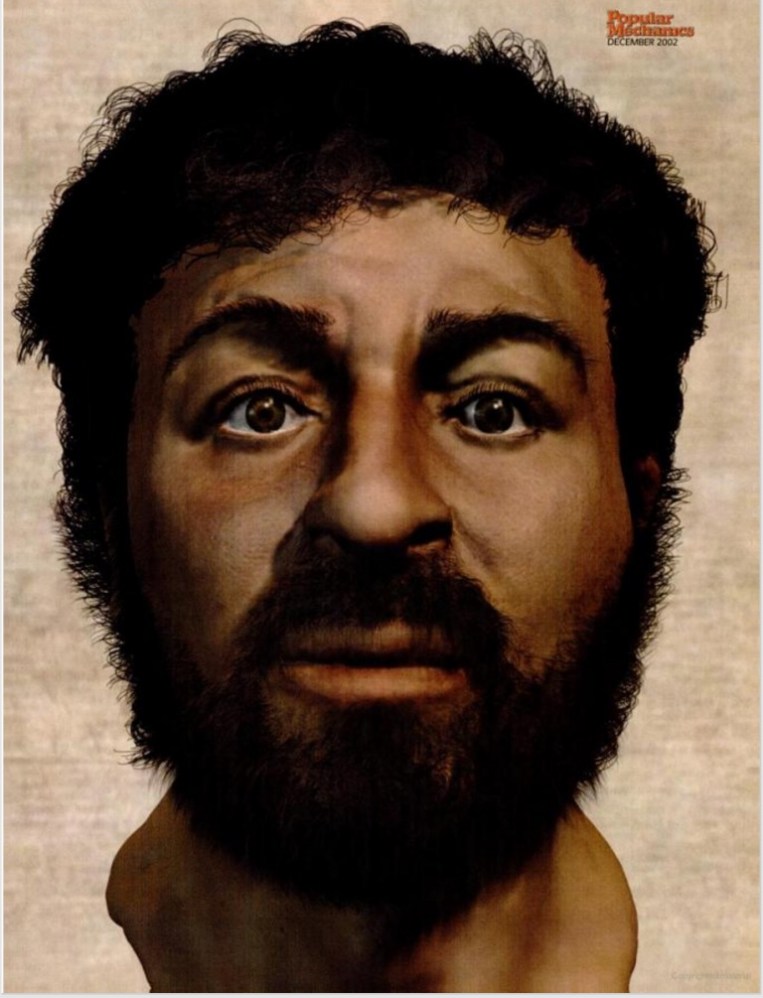
And that brings me to this image.  https://www.christianpost.com/news/forensic-science-reveals-most-real-face-of-jesus-ever.html

In 2001 a team of Israeli and British forensic anthropologists and computer programmers used skeletal remains from first century Galilean peasant men to construct a composite portrait of Jesus. Let’s be clear NOBODY is saying that this iswhat Jesus looked like.  What they are saying, though, is that he probably looked a lot more like this than like any of the other painting or depiction we’ve ever seen.

Look at that face.  Dark olive skin.  Curly, somewhat kinky hair.  Dark brown eyes.  If he was typical for the region, he probably stood somewhere between 5’1” tall to maybe as tall as 5”7”, and weighed about 110 pounds.  He would have been short, wiry, spare and strong—and most likely nothing special to look at.  

Now… can you hear him saying, “If you love me, you will keep my commandments?”

Are you willing to let him give you a commandment—even a gentle, grace-filled commandment?  

Can you love him?  

Can you see him as Emmanuel—God with us?

I ask you this because this portrait has been haunting me since the first time I saw it. When I first saw it, I confess that I recoiled from it a little bit.  More than a little bit.  This face is so different from the Jesus I had always imagined.

But then I remembered Isaiah 53:2-3 —“He had no form or majesty that we should look at him, nothing in his appearance that we should desire him.  He was despised and rejected by others…and we held him of no account.”

This face haunts me.  This is the face that I see more and more in my mind’s eye when I read the words of Jesus in the gospels.  This face challenges me.

Can I love him?  Can I see him as Emmanuel? 

When I see this face speaking the familiar words of the gospel, the words themselves are no longer familiar.  They are new.  They have sharp edges.  They penetrate my expectations in extraordinary ways and surprising places.  This Jesus also comforts me more than any of the Jesus pictures I knew as a child.  There’s an earnest sincerity in that face, the kind of sincerity that we tend to experience a little more readily from those who have “nothing in their appearance” to otherwise distract us.  His words feel more personal.

If you love me you will keep my commandments.

And what are those commandments?

Well there’s just one, really, but he repeats it twice:

John 13.34 – I give you a new commandment, that you love one another. Just as I have loved you, you also should love one another. 

John 15.12 – “This is my commandment, that you love one another as I have loved you. 

The way we show that we love Jesus is to love one another.  He gives us the Holy Spirit, the Spirit of truth, to give us the courage and will to love each other.  He gives us the Holy Spirit to help us get over ourselves so we can see Christ in each other.

It’s a true thing in life that some faces are harder to love than others.  

Some of the faces we face stir up unpleasant memories for us.  Some of them express unpleasant attitudes.  Some just seem unapproachable.

But in every face we face, Jesus wants us to find their true face, the face he knows and loves—and beneath that, even in some way, to see in them the image of God. Which is why Jesus gives us the Spirit of truth to help us love him and find the face we love in each other.

Sometimes you have to look hard and deep into a face to find the face you can love, the face that remembers it was created in the image and likeness of God.  And sometimes you have to adjust the way you’re seeing.

There’s a wonderful scene in the movie Hook (1991) where Peter Pan, played by Robin Williams, returns to Neverland after having lived for years as a grownup in the grownup world.  At first the Lost Boys don’t recognize him and are downright suspicious of him.  But then Pockets, one of the smallest boys, gets up close to him, looks at him through Peter’s own upside down glasses, squinches up Peter’s face and suddenly recognizes the face of his old friend.  He sees the face of the boy who left Neverland hidden in the grownup face of the man who has returned.  And in that moment all the love comes flooding back.  https://www.youtube.com/watch?v=wt-O1ReOPOQ

Within every face we face, Jesus wants us to find that person’s true face, the face he knows and loves—and beneath that, even in some way, to see in them the image of God.  In every face we face, Jesus wants us to search for his face.

“Those who love me show it by loving others,” says Jesus. “And God loves those who love me. And I love them.  And I will reveal myself to them.”

Who could ask for more than that?

Faith Along the Way

John 14:1-14

I’ll never forget the way I felt on that long-ago Sunday when Pastor George Johnson announced that he was leaving us.  He had been our pastor, my pastor, at Christ Lutheran Church here in Long Beach for twelve years.  He had confirmed me.  He had performed our wedding.  He baptized our daughter, Brooke.  I still had so much I wanted to learn from him about what it means to be a Christian—and how to be a Christian.  And now suddenly he was telling us that he was going away, that God was leading him somewhere else.

When George told us he was leaving, I felt disheartened and disoriented.  I felt dismayed.  I felt anxious about the future of our congregation and my own future as a person of faith.  My heart was troubled.

I felt sad and discouraged when I learned that Pastor George was leaving, but what I felt that day was nothing compared to what the disciples must have felt when they heard Jesus say, “I am only going to be with you a little while longer. . . Where I’m going you cannot come.”  

That evening as they sat down to dinner, he had washed their feet and told them they must learn how to serve one another.  Hard on the heels of that teaching, he had told them that he was about to be betrayed.  But before they could really take in that troubling news, he gave them a new commandment:  “I give you a new commandment, that you love one another. Just as I have loved you, you also should love one another.  By this everyone will know that you are my disciples, if you have love for one another.” 

And that’s when he told them he was leaving. “Where I am going, you cannot follow me now; but you will follow afterward.”

So they were upset.  They were confused.  They were anxious.  Their hearts were in turmoil.

 “Do not let your hearts be troubled,” said Jesus.  “Believe in God; believe also in me.” 

That’s how it reads in most of our translations.  What it actually says in the Greek, though, is slightly different: 

Do not let your (plural) heart (singular) be troubled.  

It’s possible that this is just a quirk of the language, but it’s more likely that Jesus is reminding them to be unified in their love for one another and for him, to be so united in love and purpose that it would be as if they had one heart.  And he wants that singular communal heart to be at peace.

You, plural, do not let your singular heart be troubled.

“Believe in God; believe also in me.”   Again, that’s how many of our translations render it, but it really would be better translated and more to the point to hear him say, “Trust God.  And also trust me.”  The Greek word at work here, pisteuete, can be translated either way—believe or trust.  

Believe or trust?  They have similar meanings but they’re not exactly synonyms.  Believe is a head word, an intellect word.  Trust is a word with guts.  A word with heart.  A word with legs.  Belief is isolated and cerebral.  Trust is a relationship.  I may believe you’re strong enough to hold the rope that keeps me from plunging into the abyss, but it takes trust for me to actually put that rope in your hands. 

Jesus is telling them that, come what may, they can trust him.  Trust God, he says, and trust me.  Trust me to the end.  Trust me to beyond what looks like the end.  Things are about to get more horrible than you can imagine.  There will be betrayal and painful, ugly, humiliating death.  There will be astonishing, joyful, unexpected resurrection.  There will be mysterious and baffling ascension.  Those are just stops along the Way.  Keep following me.  Keep going.  Trust God.  Trust me.

“In my Father’s house,” says Jesus, “there are many dwelling places.”  

I feel a lot of sympathy for the translators here because the “dwelling places” are not really places at all.  The Greek word translated as “dwelling places,” monai, comes from the same root as the word for “abide.”  Meno, to abide, is the Gospel of John’s favorite and most frequently used word to describe being in a relationship with Jesus.  It’s the word Jesus uses when he tells Philip, “The words that I say to you I do not speak on my own; but the Father who dwells in me—abides in me—is doing his works.”

When Jesus tells us that there are many dwelling places in God’s house, he is not giving us a tableau of heaven;  he’s not painting us a picture of the great reward at the finish line.  He’s giving us a travelogue.  Jesus is telling us that faith in him is, in fact, a journey with him.  He’s telling us that as we follow him through God’s house in this world and into what comes next, there is no end of places to stop and catch our holy breath.  He’s telling us that there are a lot of places to pitch our tent along the Way, a lot of places to enjoy our companionship, to tell stories and sing songs and make s’mores on the pleasant evenings or to huddle together for warmth and comfort when things are cold and dismal. 

All along the Way there are places to abide.

“If it were not so,” said Jesus, “would I have told you that I go to prepare a place for you?  And if I go and prepare a place for you, I will come again and will take you to myself, so that where I am, there you may be also.  And you know the way to where I am going.”

Thomas said to him, “Lord, we do not know where you are going. How can we know the way?”  Good old Thomas.  He speaks for us, doesn’t he?  Throughout the Gospel of John whenever Jesus sounds like an esoteric Zen Master, Thomas is the one who speaks up to say, “I don’t get it.  Explain it to me like I’m five.”  

“You know the way,” said Jesus.  “You know me.  I am the way. And the truth.  And the life.  No one comes to the Father except through me.”

Too many Christians have pulled this statement out of its context and turned it into a proof text to claim that believing in Jesus is the one and only way to get to heaven.  Not only does this reduce faith in Christ to nothing more than a ticket to paradise, it is completely contrary to the spirit and intention of the other “I AM” statements in John.  

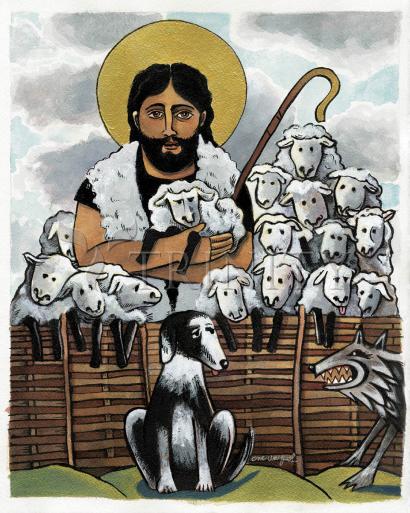
In the seven “I AM” statements in John, Jesus is telling us that he is the ultimate source of abundant life and grace.  When Jesus says, “I am the bread of life” or “I am the light of the world ” or “I am the gate” or “I am the Good Shepherd” or “I am the true vine,” these statements signify the very presence of God.  Jesus, himself, makes that clear when he says, “If you know me, you will know my Father also.  In fact, you already know him and have seen him.”  

This is an echo of what he has already said to them at the end of chapter 12 when he said: 

“Whoever believes in me believes not in me but in him who sent me. And whoever sees me sees him who sent me. I have come as light into the world, so that everyone who believes in me should not remain in the darkness. I do not judge anyone who hears my words and does not keep them, for I came not to judge the world, but to save the world.”

“I am the Way the Truth and the Life,” says Jesus.  “No one comes to the Father except—through  me/because of me/with me—those are all legitimate ways to translate that versatile little Greek preposition dia that indicates Jesus is the conduit into God’s presence.  Jesus isn’t saying that you have to make some formal statement of spiritual allegiance to him or accept certain doctrinal principles about him.  Whether you do these things or not, he is the one who brings you into the presence of God because he is the presence of God.

Frederick Buechner put it this way:

Jesus said, “I am the way, and the truth, and the life; no one comes to the Father, but by me.” He didn’t say that any particular ethic, doctrine, or religion was the way, the truth, and the life. He said that he was. He didn’t say that it was by believing or doing anything in particular that you could “come to the Father.” He said that it was only by him—by living, participating in, being caught up by the way of life that he embodied, that was his way. 

“Thus it is possible to be on Christ’s way and with his mark upon you without ever having heard of Christ, and for that reason to be on your way to God though maybe you don’t even believe in God.”

It is possible to be on Christ’s way without ever having heard of Christ.  It’s possible to be on Christ’s way if you are a Muslim or a Jew or a Buddhist or a Hindu or a Taoist.  It’s possible to be living in the Way of Jesus even if you are agnostic or an atheist.  

If your life is centered in love for God’s people and for God’s creation, if Truth is your highest value and it pains you to see truth devalued, if you believe that Life is a gift to be entered into deeply, a gift to be treasured and enjoyed and shared, then whether you know it or not, you are walking in the Way of Jesus, a Way that leads directly to God’s presence…even if you don’t recognize it.

“I’m going on ahead of you,” said Jesus, “and I know that right now it feels just devastating.  But trust God.  Trust me.  Keep walking in my Way.  Keep speaking Truth.  Keep empowering and sustaining Life and immersing yourself in it.  Our pilgrimage into the heart of God is endless and there will be no end of places for us to meet up along the Way.” 

Image © AinVaresArt, http://www.ainvaresart.com

Who Wants You to Believe What? And Why?

John 10:1-10

The Revised Common Lectionary, which most pastors and preachers follow in our tradition, repeats every three years.  The texts don’t change, but the way we hear them is different every time.  God continues to speak through these texts to this people in this place at this time and in these current circumstances.  The text doesn’t change, but the circumstances do.

Six years ago, for instance, today’s gospel text spoke to me powerfully and deeply in ways I could never have foreseen.  

Only two days before preaching this text, I had presided over a memorial service for Meghan Brown, the daughter of some our closest friends, a young woman who had grown up with our kids.  

I had performed her wedding two years earlier, which gave her death an extra layer of pain for me and a feeling of something like guilt, because she was murdered by her husband, the man I had united her to in marriage.  

When I came to the part of today’s gospel where Jesus says, “The thief comes only to steal and kill and destroy; I came that they may have life and have it abundantly,” it just wrecked me.  

But then I thought about her memorial service.  I thought about the church filled to capacity with people who had been touched by her, whose lives had interconnected with hers and with ours.  I thought about how they had all come “back to church” for her, back to the Christ-centered starting point where all our relationships had begun.  

I thought about how in that service, despite the pain and anger and sadness that had brought us there, we experienced the joy and comfort of the abundant life we had all shared over the years.  And I realized that our abundant life continues.  I realized that Meghan’s abundant life continues, that she lives on in the hearts and memories of her friends and family and in the loving presence and heart of Christ.

Three years ago, when this gospel text came up for the 4th Sunday of Easter, we were still in the very early days of the Covid 19 pandemic lockdown.  Talking about the abundant life seemed like the apex of irony when we were sequestered in our homes and hearing about thousands of deaths every day.  But our abundant life together continued in spite of our enforced isolation.  We found ways to continue our worship and education online and even discovered that our after-worship fellowship time had a unique advantage because everyone was able see everyone all at once and speak to everyone all at once, taking turns in the conversation. 

The text is the same but we hear it differently because of what is going on in our lives and in our world.  

What’s influencing the way you hear the text this year?

One of the downsides of preaching the lectionary is that the lectionary sometimes isolates sections of a text from its fuller context.  The fourth Sunday of Easter, for example, is traditionally known as Good Shepherd Sunday, so the lectionary each year takes a different section of chapter ten from John’s gospel where Jesus uses shepherd and sheep imagery.  We get a different part of chapter 10 each year, but all these fragments are part of a larger unit, a larger story being told in John, that starts at the beginning of chapter nine and doesn’t end until verse 21 of chapter 10.  

This is the story of Jesus healing the man born blind, and the events of the story that’s told in chapter nine play out in and give meaning to the cryptic shepherd imagery Jesus uses in chapter 10.  

After Jesus gives the blind man his sight, some Pharisees are upset because Jesus healed on the Sabbath.  By the time we get to the end of this story in verse 21 of chapter 10, some of them are accusing Jesus of having a demon and being out of his mind.  Others, however, noted that a demon wouldn’t say the things Jesus has been saying and that a demon certainly wouldn’t open the eyes of the blind. 

They heard the same words but they heard them differently.

When the formerly blind man tells his interrogators that Jesus is a prophet, they drive him out of the temple.  He’s gets booted out of his lifelong flock but in that same moment he is received into another flock. 

He has been kicked out of the religious community that he had been part of his entire life, but he has also been immediately accepted into the faith community surrounding Jesus, the “sheep who hear his voice.”  He hears Jesus not only as the prophet who gave him his sight, but now as the Son of Man (9:35-38) who came into this world “for judgment, so that those who do not see may see and those who do see may become blind.” (9:39)

The Pharisees and religious authorities who kicked the blind man out of their “flock” are also listening to Jesus but they’re not quite sure what to make of him.  In his Shepherd language, they hear Jesus referencing Isaiah and Ezekiel and Zechariah, but in alluding to those prophets, they also hear something that might be criticism leveled directly at them.

The formerly blind man hears Jesus describe himself as the gate that opens to welcome him into the safety, camaraderie and protection of the flock led by the Good Shepherd.  The Pharisees hear Jesus describe himself as the gate that separates the flock away from their influence and the rigid observance of religious traditions that they see as the only path of righteousness.

They hear the same words but they hear very different meanings.

When I taught Confirmation, I always began our section on the Apostles’ Creed by asking the students, “Who wants you to believe what, and why?”  We kept that question in front of us the whole time we talked about the Creed.  We kept that question in front of us as we talked about our society and all the forces and influences in our culture that want us to think and act a certain way.  We kept that question in front of us as we talked about all the voices that call out to us in life, that call us to follow them, voices that are not the voice of the Good Shepherd.

Who wants you to believe what?  And why? 

When we were ordered to stay at home three years ago to help prevent the spread of a disease that was killing people by the thousands every day, when we were ordered to wear masks in public, when we were asked to practice social distancing and stay at least six feet apart from each other when we took the risk of venturing out for groceries, most people heard these orders as the voice of medical authority urging reasonable precautions in order to keep us all safe.  But some protested and refused to abide by these precautions because they heard these orders as the voice of malicious authoritarianism with some kind of nefarious secret agenda.

We all heard the same words.  We didn’t all hear them the same way.  We didn’t hear the same voice.

What voices are you listening to?  What news sources do you read or watch or listen to?  What kind of message are they giving you about the world?  Are they messages rooted in faith, hope and love?  Or are they messages rooted in fear?  Do they seek to enlarge your freedom and the freedom of others or do they want control?

We’ve just entered another Presidential campaign season, and this week one of our political parties released a campaign commercial  depicting a bleak and almost apocalyptic future that will supposedly be the inevitable result of electing their opponent.  All of the images in the commercial were  generated by Artificial Intelligence.  Nothing in it is real.  Nothing at all.  Even the images of real people are faked, intentionally faked in a way that makes them look creepy.  At the end of all that computer generated dystopian imagery a voice asks, “Who’s in charge here?”  

Wow.  Talk about gob-smacking irony.  That’s quite a question, coming from a machine.

But I have another question:  Who wants you to believe what?  

And why?

What voices are you listening to?  What news sources do you read or watch or listen to?  What kind of message are they giving you about the world?  About yourself?  What kind of messages are you letting into your heart and mind and soul? 

Are they messages rooted in faith, hope and love?  Or are they messages rooted in fear?  

Do they seek to enlarge your heart or shrink it?  

Do they seek to open your embrace of others or close it?

Who is the gatekeeper for your heart and mind and soul?

“Very truly, I tell you,” said Jesus, “I am the gate for the sheep.  All who came before me are thieves and bandits, but the sheep did not listen to them.  I am the gate. Whoever enters by me will be saved and will come in and go out and find pasture.  The thief comes only to steal and kill and destroy. I came that they may have life and have it abundantly.”

The Shepherd leads the sheep and they follow him because they know his voice. But there are so many other voices that want to distract us.  So many other things calling our names and asking for or even demanding our time. So many things drawing us away from the sheepfold, from the companionship of faith.  So many voices competing with the voice of Jesus, the Shepherd.  

We know what they take from us, these voices that call us away.  But what do they give us when all is said and done?

“The thief comes only to steal and kill and destroy,” said Jesus.  “I came that they may have life, and have it abundantly.”

Abundant life.  That’s what Jesus wants to give us

Abundant life.  That’s what the community of faith is supposed to be about—what it is about at its best.  Abundant life is the gift Christ gives us in our life together.

As I conducted Meghan’s memorial service six years ago, I realized that, while it was Meghan’s tragic and untimely death that had brought us together that day, it was Jesus, the Good Shepherd, who had originally brought us all together in the first place.  We had all met each other in the very beginning because we had come to church.  We had met in the company of Christ.  We had heard the voice of the Shepherd who called us all together into one great big flocking family.

That’s how it has been for us here, too, at the Little Church with a Big Heart.  Jesus has been our gateway into this remarkable community, this flock that is so full of love, a love that has been palpable and undiminished by the years.  

“The gatekeeper opens the gate for the Shepherd, and the sheep hear his voice. He calls his own sheep by name and leads them out.”

The Shepherd calls us by name and we follow his voice.  Sometimes he calls us to flock together and sometimes he puts us out to pasture.  When I retire in a few weeks, I’ll just be following the Shepherd out to pasture.  But I will still be listening to the Shepherd.  And I will always be grateful for the time I spent in this flock.

And as I follow the Shepherd out to pasture, I will still be listening to the world around me and asking who wants me to believe what?  And why?

A Breath of Fresh Air

John 20:19-31

Have you ever found yourself in a group of people who are going on and on about a particularly beautiful and inspiring place they’ve all been to but you haven’t been there?  Or maybe they’re talking about a show or a movie you haven’t seen, and they keep talking about how moving it is or how a particular scene brought tears to their eyes, or how it made them think about things in a whole new way?  And maybe they even turn to you and say, “Oh you’ve got to go see it!”  But you haven’t been to that place or seen that show, and you really can’t imagine that it’s everything they say it is, so you wander over to another group who are having a good-natured debate about whether or not garlic belongs in guacamole. 

It’s hard to be fully involved in the conversation about an experience you haven’t had.  It’s hard to believe that the thing everybody’s talking about is really as terrific as they say when you haven’t seen it yourself.

In today’s Gospel reading we have a story about a guy who had not yet had the experience that all his friends were talking about, a guy who simply couldn’t imagine the life-changing event his friends were describing because it just seemed too far-fetched, too contrary to the way the universe and life are known to work.  It was easier to believe that his friends were pulling some kind of elaborate prank in very poor taste than to believe that their beloved teacher who had been tortured to death had suddenly shown up in the room with them very much alive.

The story of Thomas is a story for us.  And a story about us.  When Jesus asks Thomas, “Have you believed because you have seen?” then adds, “Blessed are those who have not seen and yet have come to believe,” he is talking to us.  And about us.

This is a story for us, to us and about us even before Thomas is ever mentioned.  The story begins with the disciples huddled together behind locked doors.  They are afraid.  The world beyond those locked doors has become a dangerous place for them, and it’s easy for them to imagine that all that danger might burst through those locked doors any second now.  

They are grieving.  They are afraid.  And they are in turmoil.  In the midst of all that, Peter and the other disciple had erupted into the room all in a lather to say that the tomb was empty and the grave clothes were all neatly folded.  Okay.  Weird, but maybe explainable.  But then Mary Magdalene swept in and told them that she has seen Jesus and spoken to him!  But so far, she’s the only one who claimed to have actually seen the Jesus, resurrected and alive.  She’s the only one so far who had claimed to have spoken with him.  And for the rest of them… well that was just…unbelievable… so they passed it off as a delusion caused by her grief.  Or maybe some kind of female thing.  Because, you know, that’s how the boys’ club usually dealt with the perplexing things women sometimes said.

So there they were, locked in grief and fear and unbelief every bit as much as they were locked behind those doors.

But then Jesus showed up behind their locked door, stepping into their emotional prison to free them from the fear and grief that were paralyzing them, and at the same time unlocking and opening for them a whole new understanding of life and death and God.  

Jesus does the same thing for us.  Jesus steps inside our locked up spaces.  Jesus steps through our fear and unbelief to come and stand beside us and among us, to show us that he is alive—and to teach us how to live in a new reality.  If we will believe.  If we will trust.

In his book Living Jesus, Luke Timothy Johnson wrote, “The most important question concerning Jesus, then, is simply this: Do we think he is dead or alive?

“If Jesus is simply dead, there are any number of ways we can relate ourselves to his life and his accomplishments. And we might even, if some obscure bit of data should turn up, hope to learn more about him. But we cannot reasonably expect to learn more from him.

“If he is alive, however, everything changes. It is no longer a matter of our questioning an historical record, but a matter of our being put in question by one who has broken every rule of ordinary human existence. If Jesus lives, then it must be as life-giver. Jesus is not simply a figure of the past in that case, but a person in the present; not merely a memory we can analyze and manipulate, but an agent who can confront and instruct us. What we can learn about him must therefore include what we continue to learn from him.”

When Jesus steps into the locked up places in our hearts and minds, when Jesus steps through our fears and unbelief to stand before us, to stand in the midst of us, he does it for a reason.  The living Jesus stands in our midst not just so that we can resume the same old relationships with God and with each other that we had before, but so that we can begin an entirely new relationship with God and with each other.  

Jesus does not just want us to learn about him.  Jesus wants us to learn from him so we can live in unity with him.  We are not united to a dead, historical Christ who lives only in the pages of the Gospels.  We are united to a living Jesus who stands here among us, who meets us at the table of companionship, sharing with us and serving us all at the same time. We are united with a living Jesus who meets us in disguise on the streets just as in Matthew 25.  He awakens us to his presence and opens our eyes to look for him.  He urges us to be listening for him.  He opens our minds so we can learn from him.  He embraces us to be one with him as he is one with the Father.  

But Jesus doesn’t just show up.  Jesus knows that there’s something more that we need so we can rise out of our pain and fears and unbelief.  Jesus knows we need a spirit of courage that will make us brave enough and bold enough to love each other and love the world, a spirit of joy and wonder that will keep us from slipping into cynicism or despair in a world that is all too often indifferent when it isn’t being downright nasty.  Jesus knows that if we’re going to help heal the world’s angst, we need to be free of it ourselves.  So he gives us the antidote.

“Peace be with you,” he says.  Shalom aleichem.  Put away your anxiety.  Let go of your fear.  Put away your disagreement.  Stop trying so hard to be right.  Try, instead to be loving.  Stop the finger-pointing.  Stop investing so much energy and emotion in nonsense and things that don’t really matter.  “Peace.  There is so much you may never agree on, but you can agree on me.  Peace.  I will be your peace.”  

“After he said this, he showed them his hands and his side. Then the disciples rejoiced when they saw the Lord.” 

He showed them his hands and his side.  He shows us his wounds.  

In Wounded Lord, Robert Smith’s commentary on the Gospel of John, which he completed shortly before he died, he wrote: “Those wounds will never go away.  The exalted Christ has not passed to a sublime existence immune to suffering.  Even after Good Friday and Easter, God continues to turn to the world through the wounded Christ.

 “To believe in this Jesus means to take him, wounds and all, into our own lives.  To believe means to participate in Christ’s own suffering on behalf of the true life of the world.”

Our Christ, our God, is not some transcendent deity who sits in heaven far removed from the pain of our existence.  Our Christ, our God is wounded from embracing the world, wounded from loving the world.  We can sing about victory all we want, but the reality is that we’re still in the struggle, and the Good News, the really Good News is not that our Messiah, our Commander is immortal and impervious, but that he has a Purple Heart.  The Good News is that his wounds were fatal, but his fatality was not.  His wounds mean that our wounds may kill us, but that won’t stop us.  “If we share in a death like his,” says St. Paul, “then surely we will share in a resurrection like his.”

But first, we need peace.  And before we can spread peace “out there” we need to spread it “in here.”  

         We each need to receive that peace.

         We need to share that peace with each other.

This is so important that Jesus said it three times.  Peace be with you.

“Jesus said to them again, “Peace be with you. As the Father has sent me, so I send you.” 

This is where we go from being disciples to being apostles.  Now we have the same mission Jesus had.  We are not supposed to just sit still and happy in our own little pool of peace.  We are sent.  We have to go out in peace.  And with peace.  We have to be grounded in Shalom—the blessing of well-being—but on the move, carrying the shalom of God with us, sharing it and spreading it.

“When he had said this, he breathed on them and said to them, ‘Receive the Holy Spirit.  If you forgive the sins of any, they are forgiven them; if you retain the sins of any, they are retained.”

It says in most English translations that Jesus breathed on them.  Karoline Lewis of Luther Seminary says that the better translation would be that he breathed into them, and she reminds us that the word that’s used in the Greek, emphisao, is the same word that’s used in the Septuagint Greek version of Genesis 2 when God breathes life into the human that God has made out of earth.  This is the breath that gives life.  Jesus breathes the Spirit of life into us to give us a whole new life.

Breathe.  Take a moment right now and breathe.  Inhale the Spirit of God that is being breathed into you right now, right where you are.  Breathe.  

Now breathe out.  Let the holiness in you, the Christ in you, the love and goodness in you fill the room.  And now breathe in again.  Breathe in the Holy Spirit, the breath of Christ. 

And now, think about this.  This new life that you are breathing in—it has a purpose.  You are being sent.  “As the Father sent me, so I am sending you,” said Jesus.  You are being sent to bring God’s shalom to the world.  You are being sent to bring shalom into your home, to breathe out the love of Christ and breathe in the presence of Christ from those around you.  You are being sent into the world to breathe the Spirit of God and divine shalom into every place you go and everyone you meet.

Hand in hand with the breath of the Spirit comes the duty of 

forgiveness.  As Jesus breathes into his disciples he says, “If you forgive the sins of any, they are forgiven them; if you retain the sins of any, they are retained.”  Jesus gives us this very serious but also joyous job of discernment.  If you forgive, it’s forgiven.  Forever. Period. If you do not forgive, someone will carry the burden unforgiveness…and it might be you.  Refusing to forgive can forge a very heavy chain that binds you to the unforgiven person in ways that are painful and destructive. 

The Greek word for forgiveness means “to set loose, to set free.”  Just as there is bondage in not forgiving, there is transformative liberation in forgiveness.  As followers of Jesus, we are in the forgiveness business.

Robert Capon in Hunting the Divine Fox wrote:  “The church is not in the morals business. The world is in the morals business. . .

“What the world cannot get right, however, is the forgiveness business – and that, of course, is the church’s real job. She is in the world to deal with the Sin which the world can’t turn off or escape from. She is not in the business of telling the world what’s right and wrong so that it can do good and avoid evil. She is in the business of offering, to a world which knows all about that tiresome subject, forgiveness for its chronic unwillingness to take its own advice. But the minute she even hints that morals, and not forgiveness, is the name of her game, she instantly corrupts the Gospel and runs headlong into blatant nonsense. . . We Easter People have been sent to forgive sins.”

Receive the Holy Spirit.  Breathe in the shalom of God then breathe it out again into a world that is gasping for the breath of peace.  If you forgive anybody anything, in God’s eyes it is forgiven.  When you do not forgive, someone will carry the burden and the body of Christ will continue to be wounded.  

And don’t worry about the Thomases of this world.  Don’t worry about those who don’t believe.  Just love them patiently and surround them with your peace.  When they see what you’ve seen and hear what you’ve heard, perhaps they will come to believe what you believe.  Until then, forgive their unbelief.