And the Logos Became Flesh

Christmas Day

John 1:1-18

I have a confession.  I deeply and truly love Christmas, but the sheer enormity of it leaves me flummoxed.   I’m not talking about all the shopping or all the bustle and preparation at home and at church.  I’m not even grumping about the over-the-top commercialism or all the different greeting card interpretations of the “true meaning” which can put you in a psychological sugar coma if you try to swallow them all at once.   

I’m talking about the daunting task of trying to convey a genuine and meaningful understanding of The Incarnation, the idea that the mystery we call God, the Maker of Everything, came to us as one of us—the idea that God “became flesh and lived among us” from gestation to birth to death as a particular person in a particular place and in a particular time so that we could begin to more fully understand that God is with us in all persons, in all creatures, in all creation, and at all times.

That thought, that idea, that reality that we call The Incarnation is so enormous and mind-boggling that it’s really tempting to retreat into the less cosmic halo of ideas that hover around that manger in Bethlehem, ideas like innocence and love personified and new beginnings.  Those are all good, true and valuable things.  They are meaningful parts of the package.  But the goodness, truth, new beginnings and love we see in that holy child become even more potent when we begin to truly understand what God is doing in that manger in Bethlehem.

When the early followers of Jesus began to write down their understanding of who Jesus was and what he was about, when they began to explain what they meant when they called him Christ—Christos—the anointed one, it’s clear that they saw him as something more than just a great spiritual teacher or religious leader.   You don’t have to read very far in these early writings to discover that these followers of Jesus thought there was something of cosmic importance about him.  Early on they called him the Son of God but that description didn’t seem to be enough for some of them.  It didn’t seem to fully capture the cosmic fullness of what they had experienced in Jesus the Christ.  

“He is the reflection of God’s glory and the exact imprint of God’s very being, and he sustains all things by his powerful word,” said the writer of Hebrews.[1]  “He is the image of the invisible God, the firstborn of creation,” wrote St. Paul, “for in him all things in heaven and on earth were created, things visible and invisible…all things have been created through him and for him…for in him all the fullness of God was pleased to dwell, and through him God was pleased to reconcile to himself all things, whether on earth or in heaven…”[2]

Late in the first century, a writer we’ve come to know as John sat down to write his account of Jesus.  He wasn’t interested in creating just another chronicle of the life of Jesus as others had done; he wanted to explore the meaning of Jesus.  He wanted to make it clear that Jesus the Christ was not someone who could be defined, contained or constrained by geography or time or even philosophy, because the God of all geography and time and philosophy was and is somehow present in him.  

John began his gospel like this:

In the beginning was the Word, and the Word was with God, and the Word was God.  He was in the beginning with God.  All things came into being through him, and without him not one thing came into being.  What has come into being in him was life, and that life was the light of all humanity.  The light shines on in the darkness, and the darkness has not understood it…. And the Word became flesh and lived among us, and we gazed on his glory, glory as of the only Son from the Father, full of grace and truth.

The language of this prologue is pure poetry.  But it’s also philosophy.  And in a strange, farsighted way, John was brushing up against physics.  

The Greek word we translate as “Word” is logos.  Logos was a word that ancient philosophers loved to play with and because of that we have numerous ways to translate it.  One of the oldest meanings of logos was story or narrative.  Where does your mind go if you hear In the beginning was the story, and the story became flesh and lived among us?  

Logos could also mean content or reason or statement.  Other philosophical meaningsincluded, orderideablueprintprimordial templateprimal thought, or intention.  

Logos became flesh and lived among us.  The metaphysical became physical.  If that sounds too esoteric, consider quantum physics.  

 Energy moves through quantum fields as abstract mathematical wave functions.  When wave functions are observed, they tend to collapse into particles.  Particles continually move through patterns in a kind of quantum dance, always moving toward closeness, joining, partnering, combining.  Fermions dance with bosons.  Neutrinos, muons, gluons, leptons and quarks assemble themselves into protons, neutrons and electrons which assemble themselves into atoms which assemble themselves into molecules we call elements.  Hydrogen and carbon molecules dance together to form the four essential organic compounds: nucleic acids, proteins, lipids and carbohydrates.  And out of all of this comes life.  The Word, the Story, the Pattern, the Intention, the Thought becomes flesh and dwells among us.  

The great British astrophysicist James Jeans wrote: “The universe begins to look more like a great thought than a great machine.  Mind no longer appears as an accidental intruder into the field of matter; we are beginning to suspect that we ought rather to hail it as a creator and governor of the realm of matter… We discover that the universe shows evidence of a designing or controlling power that has something in common with our own minds.”[3]

This is The Incarnation.  The great Thought of God expressed in the whole universe condensed itself into a singular human life and lived among us.  And why would God do that?  

Love.

Teilhard de Chardin saw love as the driving force of the universe.  “For Teilhard, love is a passionate force at the heart of the Big Bang universe, the fire that breathes life into matter and unifies elements center to center; love is deeply embedded in the cosmos, a ‘cosmological force.’”[4]

God is Love, we read in 1 John.  “God is love, and those who abide in love abide in God, and God abides in them.”

Love became flesh and lived among us.  And still lives among us.  And within us.  And around us.  And beyond us.  

Love…God… was not content to be an abstract idea or a mere sentiment.  God, the Author of Life, the One in whom we live and move and have our being is Love with a capital L.  Love Personified…and Love is all about relationship.  Christmas is when God, the Love that founded the universe, showed up as one of us in order to show us in person just how much we are loved and in order to teach us to love each other more freely and completely. 

Love became flesh and lived among us so that we might learn to love God with all our heart, mind, soul and strength and love our neighbors as ourselves.  

Love didn’t come to us as a king or potentate to lord it over us.  Love came as a poor baby among a poor and oppressed people far from the centers of privilege and power in order to show us that “the fire that breathes life into matter and unifies elements center to center,” is alive in and breathing life into all of us and wants to unify us with each other center to center and heart to heart.  

It’s an enormous idea, this thing called Christmas, this Incarnation.  This idea that the Word became flesh encompasses everything we see and everything we don’t see.  It speaks in poetry then carries us into the depths of philosophy and physics.  It warms the heart and boggles the mind.  It is, quite literally everything.  And the beating heart of it is love.

To even begin to understand the Incarnation, we have to open our minds and our hearts.  As another early follower of Jesus wrote: “I pray that you may have the power to comprehend, with all the saints, what is the breadth and length and height and depth, and to know the love of Christ that surpasses knowledge, so that you may be filled with all the fullness of God.”[5]

Merry Christmas


[1] Hebrews 1:3

[2] Colossians 1:15

[3] James Jeans, The Mysterious Universe, as quoted by Ilia Delio, The Unbearable Wholeness of Being, p. 40

[4] Ilia Delio, ibid., p.43

[5] Ephesians 3:18-19
Our Down to Earth God

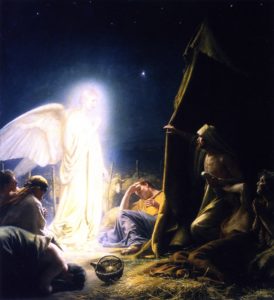
Then an angel of the Lord stood before them, and the glory of the Lord shone around them, and they were terrified. –Luke 2:9 (NRSV)

It’s funny how you can look at something a hundred times or more and then one day someone will point out something you hadn’t noticed and the whole thing looks different to you.  That happened to me a couple of years ago when a colleague pointed out one simple word in Luke’s Christmas story that had always just flown right by me.

Stood.

The angel stood before them.  On the ground.

In all the years of reading or hearing this Christmas story I had always imagined this angel and the multitude of the heavenly host hovering in the air.  I think the Christmas carols taught us to picture it that way.  Angels we have heard on high.  It came upon a midnight clear, that glorious song of old, from angels bending near the earth.  

But that’s not what it says in the Gospel of Luke.  The angel stood before them.

If you were a shepherd in a field on a dark night, it would be pretty unsettling to have an angel appear in the air above you making announcements, but at least if the angel is in the air there’s some distance between you—a separation between your environment and the angel’s.  But if the angel suddenly appears in front of you standing on the same ground you’re standing on, shining with the glory of the heavens… well I think my knees would turn to rubber.  And then imagine what it feels like when the whole multitude of the heavenly host is suddenly surrounding you and singing Glory to God.

Angels in the air feels slightly safer than angels on the ground.  Slightly.  If the angels are above, that means that they came from above.  It means that heaven is “up there” somewhere.  It doesn’t mess with the way we understand the spiritual cosmos.  But if the angels appear standing in front of us or behind us or around us, what does that say about heaven?  Could it be that heaven, the dwelling place of the angels, is not just “up there” but also here, with us?  Around us?  Could it mean that the angels of God are standing near us all the time and they simply choose not to show themselves?  Or that we’re just blind to their presence? Could it mean that this ground we walk on and build on and live on is also part of the dwelling place of God—so holy ground?

The angels didn’t bend near the earth.  They stood on it.  

We have this tendency, we humans, to want to separate the material from the spiritual, the divine from the physical.  We are such binary, black and white thinkers in a universe that’s full of colors and shades of gray.  We want here to be here and there to be there.  We want to put borders on oceans and talk about territorial waters!  We want to draw a clear and well defended line between our country and the country next door.  So it’s not surprising that we’ve assumed that there is a border between heaven and earth.

We seem to be most comfortable when there’s a little distance between us and angels, a little distance between us and God.  That seems to be the way most people talk about it, anyway.  “Put in a good word with the man upstairs,” they say.  And then there’s that song: “God is watching from a distance.”

But that’s not what Christianity says.  That’s not what Christmas says.  The Word became flesh and lived among us, and we have seen his glory, the glory as of a father’s only son, full of grace and truth.  In him the fullness of God was pleased to dwell.  Not from a distance, but right in front of us.  With us.  As one of us.

We have trouble seeing the presence of God, seeing Christ in creation.  We have trouble seeing Christ in each other.  We even have trouble understanding Christ in Jesus.  How can Jesus be both divine and human?  We struggle to wrap our minds around that idea, so we have a tendency to make him either all human or all divine.  We picture that baby in the manger with a halo, and it doesn’t cross our minds that he might need to breastfeed and burp and need his diapers changed.

Christmas, the mystery of the incarnation, tells us that God is not a bearded old man watching us from the clouds, a deity who is willing to give us what we ask if we are really good or strike us down with a thunderbolt if we’re bad.  That’s not God.  That’s Santa Claus.  Or Zeus.   

God, the Author of Life, the One in whom we live and move and have our being is Love with a capital L.  Love Personified…and Love is all about relationship.  Christmas is when God, the Love that founded the universe, showed up as one of us in order to show us in person just how much we are loved and in order to teach us to love each other more freely and completely. 

“We need to see the mystery of incarnation in one ordinary concrete moment,” wrote Richard Rohr, “and struggle with, fight, resist, and fall in love with it there. What is true in one particular place finally universalizes and ends up being true everywhere.”  In other words, God is present everywhere, in, with, and under everything.  Including you.  And me.  And all those people we’re inclined not to like.  But to really grasp this idea, we need to first see God fully present in one particular person.  We need to see God in this particular baby.  This human baby

That, in the end, is what Christmas, the incarnation, is trying to tell us.  Christmas is God’s way of teaching us that there never really was any distance between heaven and earth, between the divine and the human, between the spiritual and the material.  Christmas is God proving once again that Christ is in, with, and under all the things—all things—including all the things we think we oversee and all the things we overlook.  Christmas is angels standing on the earth singing to shepherds and surrounding them with the glory of the Lord to remind them that they, too, are spiritual beings immersed in a human experience.  

Christmas is God’s love made visible.  Pope Francis said, “What is God’s love? It is not something vague, some generic feeling. God’s love has a name and a face: Jesus Christ, Jesus.”  I would add that, if you open your heart and your mind to it, God’s love can have your face, too.

Love is vulnerable—and what’s more vulnerable than a baby?  God comes to us as a baby because it’s easy to love a baby.  It’s easy to be vulnerable with a vulnerable infant.

Christmas is earthy and concrete and vulnerable.  It enters the world surrounded by the homey smell of a stable.  It needs to be fed at a mother’s breast.  It needs its diapers changed.  It cries when it’s hungry and shivers when it’s cold.  It spits up a little bit on your shoulder.  It looks out at the world with brand new eyes and tries to see and understand.  Most of all, it reaches out to be picked up and held close to your heart.  Christmas wants to be loved and to give love.  

Christmas is our down-to-earth God made manifest.  Yes, gloria in excelsis deo, glory to God in the highest, but glory, too, to God on earth where the angels stand to sing to shepherds, because the Spirit of God is in them, too, and God loves them like crazy.  Just like God loves you.

My prayer for you this night is that you would enter deeply into the concrete, down-to-earth, human and divine mystery of incarnation.  May your eyes and ears be opened to the angels who stand upon the earth and minister to all God’s children.  May you come to see Christ incarnate, permeating all creation.  May you come to see that you are always and everywhere standing on holy ground.  May you dispense with artificial borders in your heart, in your mind, and in this lovely world.  And may you come to see yourself and all the others who share this world with you as spiritual beings immersed in a human experience.  Most of all, though, may you know that you are loved. 

May Christ be born anew in your heart this night and every night.  In Jesus’ name.

The Beginning of the Middle of the Story

Matthew 11:2-11; Isaiah 35:1-10; James 5:7-10

Imagine poor John, locked in the dungeon of Herod’s fortress, his fate hanging by the whims of people who are notoriously immoral and impulsive.  As he stares at the stone walls of his cell he has nothing but time on his hands.  Time to reflect.  Time to remember.  Time to second-guess both his mission and his memory.  Time to doubt.

Did he really see the Spirit descend on Jesus or was it just a trick of the light dancing on the water?  Did he really hear the voice of God or was it, as some said, only thunder bouncing off the hills?  He knows he is going to die soon.  He knows that Herodias will find some reason to have him executed.  If at all possible, he would like to put his doubts to rest before that happens.

So he sends two of his disciples to find Jesus and ask him:  “Are you the one who is to come, or are we to wait for another?”  

 It’s easy to brush past John the Baptist even though he comes up in our texts every year at this time.  It’s easy to think of him as a footnote in history, a wild man in the wilderness whose primary purpose was to point to Jesus.  The gospel accounts do tend to skew his story that way, but then the gospels are primarily interested in the story of Jesus, and in that story John is not the central character.

We forget that John, the son of Elizabeth and Zechariah, had hundreds, perhaps even thousands of followers, so many that Herod Antipas saw him as a potential political threat.  The Roman historian, Josephus described John as “this good man, who had commanded the Jews to exercise virtue, righteousness towards one another and piety towards God.”  Many of John’s followers remained loyal to him after his death and even today the Mandaeans, an ethnoreligious group with roots going back to ancient Palestine, regard themselves as followers of John the Baptist whom they see as the greatest of the prophets.  

Muslims know John as Yahya ibn Zakariya, and venerate him as one of the greatest of God’s prophets.  John is also revered by people of the Bahai faith and the Druze.  Clearly his call to live a life of virtue, to treat each other with righteousness, and to revere God resonated beyond his role in the gospels.  In the fullness of history, John was much more than just a prelude to Jesus.

I think one reason we tend to diminish John in our Christian traditions is that we come to him very late in his story and very early in the story of Jesus.  We forget that both of them come in the middle of a much, much larger and longer story, a story that began with God making a covenant with Abraham, a story that is carried through times of slavery and exile in Egypt and Babylon.  It is a story of a people who cling to their covenant and identity during times of foreign oppression by Assyria, Babylon, Greece and Rome.  It is the story of hope kept alive by the leadership, visions and prophetic voices of Moses, Jeremiah, Isaiah, Micah, Amos and others, including John the Baptizer.

It is a story of seeds planted as dreams of a better world, a world where creation, itself, is restored and renewed, where “the wilderness and the dry land shall be glad, the desert shall rejoice and blossom abundantly and rejoice with joy and singing.”  This longer, larger story plants the seeds of a vision of healing where “weak hands are strengthened” and “feeble knees made firm,” where “the eyes of the blind shall be opened and the ears of the deaf unstopped” and where “the lame shall leap like a deer and the tongue of the speechless sing for joy.”  These are the seeds of God’s vision for a world where captives, exiles and refugees return home, where migrants find a place to put down roots, where all wanderers find a safe place to “obtain joy and gladness, and sorrow and sighing shall flee away.”[1]  

This longer, larger story is scattered as seeds of peace being sown throughout the world until that much anticipated day when the flower of peace will bloom, that day when “they shall beat their swords into plowshares and their spears into pruning hooks,” when “nation shall not lift up sword against nation, nor shall they study war anymore.”[2]

This longer, larger story is the story of hope always on the horizon.  It is the story of a people waiting for the Anointed One who will inaugurate the fulfillment of the vision.

This is the longer, larger story that John inherits.  John enters the story knowing there is so much that still needs to be repaired before the vision he has inherited can become a reality, and that the things most urgently in need or repairing are the human heart, the human way of seeing, the human way of being, the human way of thinking.  He sees the brokenness of the world clearly.  He sees the ways that those who wield power and authority are complicit in that brokenness.  He feels the anxiety and dissatisfaction of the people who bear the scars of living in that predatory and oppressive brokenness.  He sees the dissonance between the world as it is and the world as it should be.

And then he sees Jesus.  And that hope that was always on the horizon seems closer and more possible than ever before.

John points to Jesus.  But John is not done.  John sees the world, and he tells the truth about what he sees.  He calls people to change, to turn around and go a new direction because a reckoning is coming and the new day is dawning.  He speaks truth to power.  And when he publicly condemns Herodias, the wife of Herod Antipas for divorcing Herod’s brother, when he publicly denounces Herod for marrying his brother’s wife, he is arrested.

Languishing in prison, bedeviled by doubt, John sends his question to Jesus:  Are you the one… or should we wait for another?

Jesus doesn’t answer John with bravado or any kind of self-proclamation.  He simply tells John’s disciples to “Go and tell John what you hear and see:  the blind receive their sight, the lame walk, the lepers are cleansed, the deaf hear, the dead are raised, and the poor have good news brought to them.  And blessed is anyone who does not stumble because of me.” 

Jesus is telling John that the things Isaiah foresaw are happening, the signs generations had hoped for are being performed.  Jesus is telling John that in his work the seeds of God’s vision are sprouting and peeking above the soil.  In him the kingdom has begun to arrive.

If you have times of doubt, if you have times when the brokenness of the world seems overwhelming, if you find yourself being punished for speaking truth, remember John.  John had tremendous faith. Among those born of women, said Jesus, there has been no one greater than John.   But when the walls were closing in, even John had his doubts.

If you have times when you wonder if humanity is a lost cause, take a moment to remind yourself that the seeds of God’s vision are still growing and still being planted.  It’s up to us to keep sowing them.  “The farmer waits for the precious crop from the earth,” wrote James, “being patient with it until it receives the early and the late rains.  You also must be patient. Strengthen your hearts, for the coming of the Lord is near.”[3]  

And finally, it’s always good to remember that we don’t know where we are in God’s longer, larger story.  Yes, the world is still broken, but there are signs of repair work in progress if you know where to look, and one of those signs is you and me.  We are partners in the repair work God is doing in the world.  And that, alone, is cause for rejoicing.  


[1] Isaiah 35:1-10

[2] Isaiah 2:4; Micah 4:3

[3] James 5:7-10

When John Came a-Wassailing*

In the fifteenth year of the sovereign rule of Emperor Tiberius,

a time of great oppression, ruthless and imperious,

the Song of God fell into John, the son of Zechariah,

and he sang it out so strongly they thought he might be Messiah.

But he said, “No, I am not the one you all have been expecting.

I’m just the voice that sings out where our paths are intersecting.

I’m not worthy to receive him or to tie his sandal thong!

He’s the Maker of all Music, I sing just one simple song.”

Like a-wassailing in the orchard to wake the cider trees,

the song of John cut through their pride and brought them to their knees.

As he showed them stark reality they began to realize

that the dream of God might now unfold before their very eyes.

So he sang them to the river, saying time was of the essence,

and immersed them in the cleansing flow of mercy and repentance.

His song filled up the wilderness with a tune to cleanse the heart

and wash away pretenses, and make hubris fall apart.

He sang, “Children of the covenant, you children of the promise,

you children of the circumstance and times that are upon us, 

all you questing, anxious seekers, all you folk both awed and flawed,

are you ready to stand naked in the searching gaze of God?

“All you tax-collecting schemers, all you servants of the sword,

all you noble trees and saplings in the orchard of the Lord,

yes, your roots go deep as Abraham and you’re clothed in your tradition,

but that’s not enough to save you on your pathway to perdition.

“O you brood of sneaky vipers, O you children of the snake,

Who warned you of the wrath to come? Who told you what’s at stake?

Did you think that life was something you could skate through or could fake?

Well, my sleeping trees of Zion, it’s time for you to wake.”

Then in dismay the people cried, “John, tell us what to do!

If our heritage means nothing is our fate left up to you?”

He said, “No that’s not in my hands, but it is somewhat in yours,

for the Winnower we’ve waited for is at the threshing floor.

“So now’s the time to change your ways, to make a course correction.

Now’s the time to turn around and go a new direction.

It’s time to change your heart and mind, not out of paranoia,

but because you’ve been immersed in the streams of metanoia.

“So give away your extra coat to the person who is shivering,

and give up half your sandwich to that hungry kid who’s quivering,

Don’t take more than what is rightful, do not lie, extort or cheat,

for the Winnower is coming and he’ll sift your soul like wheat.

“Look, the time has come to bear the fruit of new life and repentance

or you’ll reap the judgment that you’ve sown, you’ve been shaping your own sentence.

Even now the axe is at the root, even now your options dwindling,

so will you produce good cider?  Or will you be so much kindling?

“For the One who fashioned every soul finds a use for each and all.

Will you be the cider in the cup or the fire that warms the hall?

Will you be the sweet aroma drawing others to the table

or dissipate as so much smoke in a cautionary fable?

“And I know this all sounds frightening– to be assessed, appraised and weighed–

Every one of us has cause to fear, but I sing, ‘Be not afraid!’

For the one who does the winnowing, the one who does the sifting,

Is the Soul of grace and love and life, the Giver of all gifting.

“And I’m simply here to tell you in this wild and holy place

you have a chance to be made new, a chance to live in grace,

for the one who does the sifting does not come here to condemn

but to glean the seeds of love and good and make them grow again.

“So this song that sounds so ominous, it really is Good News!

for the God of second chances hopes that you will not refuse

to change your heart and mind and ways and show it by your fruits

with more loving and more honest and more generous pursuits.

The Word who will evaluate has not come to condemn

but to find the goodness in your soul and make it shine again,

for the one who does the winnowing, the one who does the sifting,

Is the Soul of grace and love and life, the Giver of all gifting.

*A note about the title:  The word Wassail comes from ves heill, Old Norse for “Be healthy!”  The Saxon version in Old England was Vas Hael, with the same meaning.  Most people today associate Wassailing with Christmas Caroling, and indeed there is a very old tradition called House Wassailing that is very much like Caroling, but that tradition evolved from the ancient tradition of Orchard Wassailing.  In the parts of ancient Britain where fruit trees were grown for producing cider, the Saxons would go out into their orchards during the deep days of winter and sing to the sleeping trees to wake them up and encourage them to produce good and bountiful fruit in the coming year.  It occurred to me that what John the Baptizer was doing in the wilderness by the Jordan was something like that—singing the people awake so they could produce good fruit.

Hope

Isaiah 2:1-5; Romans 13:8-14; Matthew 24:36-44

There’s something going on at the house next door to us.  We haven’t seen any sign of the people who live there for almost a month.  No coming and going, no sounds of doors or windows opening or closing.  No voices floating over the backyard wall.  No barking from the dog.  A few weeks ago, the faded old blue minivan that was always—and I mean always—parked at the curb in front of their house…that old van just disappeared and so far it hasn’t been back.  

We didn’t see them move out.  There was never a For Sale sign in their yard.  We haven’t seen the house on any real estate listings.  We just noticed one day that it was empty. 

Then last week a team of painters showed up and began painting the house inside and out. Sometime during the week a bunch of new furniture was moved in.  It all looks new and modern and kind of Scandinavian.  We can see it through the front window because there are no drapes.  But that’s another odd thing…at night, there are no lights on in the house.  Not one.  Last Monday, landscapers showed up and they worked steadily for several days.  They even worked on Thanksgiving day.  They’ve pulled out all the shrubs and plants that had become kind of overgrown, tilled the planter beds, and now they’ve planted a number of rose bushes.  Rose bushes that are blooming.  In November.

So, all in all, it looks like maybe we’re going to have new neighbors.  With all this preparation, it’s obvious that someone is coming.  Probably soon.  To tell you the truth, we’re kind of on pins and needles waiting to see.  

Somebody’s coming.  We just don’t know when.  

We also don’t know who our new neighbors will be.  We don’t know what they’ll be like.  What we do know is that newness is coming.  In some ways it has already begun with the preparation of the house and yards.  So we’re watching to see what happens next with the house next door.

Advent is something like that.  Except the house next door is our house.  Our world.  And we do know who’s coming because he’s been here before.  

This is the season when we get our house in order.  It’s the season when we prepare for the coming of Christ while at the same time we prepare to celebrate the first time Christ came to us as Jesus of Nazareth.  

Advent is the season when we remind ourselves of the great dream of the prophets during that long wait for the first coming of Christ, the dream of the one who would bring in God’s reign of peace and justice as Isaiah described it:

Out of Zion shall go forth instruction,

                  and the word of the LORD from Jerusalem.

He shall judge between the nations,

                  and shall arbitrate for many peoples;

         they shall beat their swords into plowshares,

                  and their spears into pruning hooks;

         nation shall not lift up sword against nation,

                  neither shall they learn war any more.

            O house of Jacob,

                  come, let us walk

                  in the light of the LORD!

Advent is the time when we remember that their hope, that ancient hope, is our hope.  It is a time when we remember that just as Jesus came to teach us the Way of love and truth, the Way of cooperation and companionship, the Way of kindness and justice, he will come again when the time is right to remake and renew the world.  So let us walk in the light of the Lord.  

We don’t know when that will be– the Second Coming of Christ.  The only thing we can know for certain is that each day brings us one day closer.  As St. Paul says, “You know what time it is.  Now is the moment for you to wake up.  For salvation is nearer to us now than when we became believers;  the night is far gone, the day is near.”  I don’t think Paul is telling us to make sure our bags are packed so much as he is saying make sure you don’t miss Jesus when he shows up.

It’s easy for us to get preoccupied with life-as-it-is.  I know it’s easy for me to sometimes be so focused on my own train of thought that I become oblivious to everything going on around me.  I think we can all be that way sometimes.

We’re like the absent-minded professor who became so absorbed in his work that he forgot the simplest details. One morning his wife said, “Now Henry, remember, we are moving today. Here, I’m putting this note in your pocket to remind you. Now don’t forget.”  When the professor came home that evening, he walked in the front door and found the house completely empty. Distraught and disoriented, he walked out to the curb and sat down.  A young boy walked up to him, and he asked him, “Little boy, do you know the people who used to live here?”  The boy replied, “Yes, Dad, Mom told me you’d forget.” 

Advent is a time when we remind each other of the important hope we so easily forget.  I sometimes forget that Jesus has promised to return.  I can go days, weeks, months without ever stopping to remember, “Hey, this might be the day that Jesus comes back!” 

Advent reminds us that Jesus told us to be ready, “for the Son of Man is coming at an unexpected hour.”  It’s not when you think it will be.  It’s not when you suppose it will be. It’s not when you choose.  So be ready.

It will be a surprise.  “Two will be in the field; one will be taken and one will be left.  Two women will be grinding meal together; one will be taken and one will be left.  Keep awake therefore, for you do not know on what day your Lord is coming.”

This is not the so-called rapture, by the way.  Jesus is not describing people being caught up in the air or even disappearing.  He says that one will be left and one will be taken.  He doesn’t say where one will be taken.  That Greek word for “taken” is paralambanomai.  It doesn’t mean to be lifted up or to meet.  It means “to go along with.”  It’s used in the Transfiguration story when it says that “Jesus took with him Peter and James and his brother John.”

Two will be working in the field; one will go along with Jesus and the other will just keep working.  Two women will be grinding meal together; one will keep working and one will go along with Jesus.  It will be like the time Jesus was walking along the seashore and called out to Peter and James and John, “Follow me.”  

Brian Stoffregen wrote, “It isn’t a special word or a magical word about floating up in the air. It is much more like the fishermen or tax collector answering Jesus’ call to follow me – come along with me – let’s walk down the road together.
 
“What are the people doing when this “taking” or “leaving” occurs? They are at their place of employment. They are busy at work. My guess is that the man working in the field is “left”, because he couldn’t leave his important work. My guess is that the woman working in the mill is “left”, because she couldn’t leave her important work.”

Some will go with him because they’re ready.  They been watching.  They’ve been waiting.  They’ve been hoping for his return.  And they’ve been learning to discern all the undercover ways that Christ has been with us all along.  You can look at Matthew 25 for more about that.

Advent is the season of waiting and watching.  And hoping.  We live in the meantime.  We live somewhere between our deep dissatisfaction with the way things are and our hopes for the way things ought to be.  We live in hope that the time is coming when things will be made right.

Advent tells us that that time is coming.  It doesn’t tell us when, it just tells us to keep our eyes open, to watch.  And to hope.  

Newness is coming to the house next door.  Newness is coming to our house.  Newness is coming to the world.  Salvation is nearer to us now that it was when we got up this morning.  So watch.  And hope.  And be ready.  In the meantime, let’s keep walking in the light of the Lord.

Pius, We Have a Problem

Luke 23:33-43

Today is the last Sunday of the church year, Christ the King Sunday or Reign of Christ Sunday.  This is a relatively new addition to the church calendar and, frankly, not everyone is happy about it.  

In 1925, the world was trying desperately to put itself back together in the aftermath of World War I and it wasn’t going well.  Pope Pius XI was gravely concerned by the growing tide of secularism and ultra-nationalism in Germany, Italy and elsewhere, and the imposition of Communism in Russia.  In response he issued an encyclical called Quas Primas—That Which is First (interestingly, it can also be read as a question, What is First?)—in which he established The Solemnity of Our Lord Jesus Christ, King of the Universe or, as it came to be commonly known, the Feast of Christ the King.  

Pope Pius was trying to restate and reinforce the idea of the sovereignty of Christ over, well, everything.  He wanted to make it clear that our deepest and most profound allegiance should be to Jesus Christ above and beyond every other allegiance.  But in doing it in this way, was he, maybe, missing the point of what Jesus was actually saying when he talked about the kingdom of God?

The image of Christ as King is problematic for us in a number of ways.  It’s hard for us to relate to even the idea of a king.  There aren’t very many real monarchs left in the world, and most of the ones who are still here wield a power that is primarily symbolic or ceremonial.  As a case in point, after the long reign of Queen Elizabeth, King Charles has now ascended to the throne of Great Britain, but nobody is expecting any significant change in the governance of the United Kingdom as a result because whatever power the throne still has is very strictly circumscribed by a democratic parliament. 

Another problem with the imagery of Christ the King is that the image itself is hopelessly patriarchal and patristic which puts it in stark contrast to the egalitarian vision Jesus was describing when he announced that the basilea of God was within reach.

Basilea.  That’s the Greek word in the gospels that we translate as kingdom.  It’s a word that the empire used to describe the domain of Caesar and also the territory governed by Herod and other client kings.  And even as Jesus was proclaiming the arrival of the basileaof God, it was a word that was both too small and too loaded to really capture the new reality that Jesus was describing.

The word Kingdom implies boundaries. Boundaries imply limitations and location.  You are either inside or outside.  Even the synonyms for kingdom make it sound territorial.  Realm—a royal domain or kingdom; a region, sphere, or domain within which something or someone prevails, or dominates.  Reign—the period during which a sovereign occupies the throne, the territory of royal rule or sovereignty; a dominating power or influence; to have control, rule, or influence.  

The word Kingdom also implies power, usually and especially coercive power.  Constantine and later Christian emperors and kings readily embraced the concept of the Kingdom of Christ because it was an image they could use in exercising their own power.  They could claim that they were appointed by Christ and were ruling under his authority, which meant that they could spin just about anything they did as justifiable because they were acting on Christ’s behalf.  Convert people at the point of the sword or by torture?  No problem.  We’re doing it for Jesus.  

Today, Christian Nationalism and other authoritarian movements appropriate the language of Christ the King to imagine Jesus as a muscular Rambo, kicking tail and taking names. Under the auspices of Christ the King, they want to establish a restrictive theocracy, but in embracing that idea they completely miss the new reality that Jesus was calling us to embrace.

Kingdom, realm, reign, sovereignty—none of these terms are really a good fit for what Jesus was describing when he announced that the basilea tou theou –what we translate as The Kingdom of God—is arriving, is at hand, is within reach. 

George Orwell was a guy who knew a thing or two about language and how we use, abuse, twist and misuse it.  Orwell said, “There is a huge dump of worn-out metaphors which have lost all evocative power and are merely used because they save people the trouble of inventing phrases for themselves.”[1]

Christ the King is one of those worn-out metaphors.  We keep using it because we haven’t come up with a better phrase to describe the vision of God that Jesus was proclaiming or a way to describe our belief that God is the ultimate power that moves the universe through love, compassion, creativity, grace and cooperation.  

On the plus side, Christ the King does make us ask ourselves some important questions.  What do we mean when we say that Christ is sovereign?  How do we understand the kingdom of God, the reign of God?  How do we understand the power of God?  How do we understand power in general?  How do we use power?  Do our values reflect the values of empire or the values of Jesus?  What kind of kingdom do we belong to?

The kingdom of God, as Jesus described it, was and is a resistance movement.  To say that Christ is king is a resistance claim.  It is a challenge to the way power is coercively used most of the time in our world.  Jesus is a different kind of king.  The cross is the coronation of Jesus.  He surrenders to the coercive power of empire to show us the greater power of love and nonviolence.

Pontius Pilate understood that Jesus was all about resisting the empire’s coercive power but also the empire’s imagery.  When Pilate asked Jesus straight out, “Are you the king of the Jews?” Jesus simply replied, “You say so.  Those are your words.”[2]  The soldiers crucifying Jesus mocked him saying, “If you are the king of the Jews, save yourself!” Pilate mocked both Jesus and the Jewish people by having a board nailed above his head with the inscription, “This is the King of the Jews.”  These were people who understood power in only one way.  Control.  Coercion.  Power over.

But the reign of God that Jesus was describing is a cooperative world.  The reign of God doesn’t force itself on anyone or try to control anyone.  Christ, as king, persuades, encourages, nudges and asks us to live up to a vision of our better selves.

 The reign of God is a world where generosity, grace, compassion and mercy prevail.  It is a world driven by and governed by love.  It is a world where everyone’s needs are met and no one goes hungry.  It is a kingdom that transcends every kind of border, boundary and barrier.  It is a world where the only control is self-control.  Its central values are to do justice, love kindness, and walk humbly with God. Its only law is love: love God, and love your neighbor as yourself. 

The kingdom that Jesus was describing is a world moving toward the vision of Isaiah when we will beat our swords into plowshares and our spears into pruning hooks, when nation shall not lift up sword against nation nor shall they study war anymore.[3]  The kingdom that Jesus proclaimed is the world where God walks with us as Ezekiel envisioned, a world where God shepherds us, where Christ seeks out the lost and brings back the strays, where through us, Jesus binds up the injured and strengthens the week and feeds us all with justice.[4]

The reign of God is a realm in which the poor are blessed and the hungry are filled and those who mourn are comforted.  It is the world Mary envisioned in the Magnificat when she sang, “He has shown strength with his arm; he has scattered the proud in the thoughts of their hearts. He has brought down the powerful from their thrones, and lifted up the lowly; he has filled the hungry with good things, and sent the rich away empty.”[5]

Yes, God exercises power.  But not the way we usually think of power. God’s power is all about empowering you.  God is about giving power rather than holding onto it.  God gives power to us so that we can love and care for the world more fully and effectively.  Together.  “The greatest manifestation of the power of God,” said Bishop Yvette Flunder, “comes when we work together to find ways to be together and do justice together and love together and stand together.”  

The kingdom of God is all of us together.

 “Jesus did not establish an institution,” wrote Bishop Michael Curry, “though institutions can serve his cause. He did not organize a political party, though his teachings have a profound impact on politics. Jesus did not even found a religion. No, Jesus began a movement, fueled by his Spirit, a movement whose purpose was and is to change the face of the earth from the nightmare it often is into the dream that God intends.”

Today is Christ the King Sunday.  It is a day when we use the “worn out metaphor” of kingly power to try to open the doors and windows of our hearts, minds and souls to the empowering love of God through Jesus Christ.  It is a day when we acknowledge both that God in Christ is the ultimate power and that we need to redefine how we understand and use power.  It is a day when we are asked to declare that our deepest and most profound allegiance is to Jesus Christ above and beyond every other allegiance.  It is a day that challenges us to walk in the Way of Jesus so that we can help to bring God’s vision of a whole, healthy, loving and cooperative world into reality on earth as it is in heaven.

Today is the day we volunteer to change the face of the earth from the nightmare it often is into the dream that God intends.


[1] Politics and the English Language, 1946. 

[2] Luke 23:3

[3] Isaiah 2:4; Micah 4:3

[4] Ezekiel 34:15-16

[5] Luke 1:46-55

Focus

Luke 21:5-19; Malachi 4:1-2a; 2 Thessalonians 3:6-13

The temple in Jerusalem—Herod’s temple—had been under construction for more than 40 years when Jesus sat down in its outer courtyard to speak with his disciples.  Herod had begun constructing the temple in 20 BCE, and it was already regarded as one of the wonders of the world even though it wouldn’t be completed until 63 CE, some thirty years after this teaching moment Jesus has with his disciples.

In order to be able to build the massive temple he envisioned, Herod first had to rebuild Mount Moriah, the low mountain on which the temple stood.  To do this, he encased the mountain with walls more than 33 meters (108 feet) high, then filled in the space with earth until it encompassed an area of more than 144,000 square meters.    

The temple in Jerusalem was a visual wonder.  A description in the Talmud says that  the interior walls of the temple were faced with blue, yellow, and white marble.   Gold spikes lined the parapet wall on the roof.  Josephus wrote that the entire eastern fascia was covered with gold.  “The rays of the early morning sun, striking the Temple façade created a blinding reflection,” he wrote.  “The rest was white, so that this towering edifice looked like a snow-clad mountain from afar.” 

It must have sounded like madness for Jesus to say that it was all coming down—that not one stone would be left upon another.  But by the time Luke wrote his gospel, sometime around the year 85, everything Jesus predicted in today’s gospel reading had already happened.  

In 70 CE, during the first Jewish-Roman war, the Roman general Titus destroyed the temple and much of the rest of Jerusalem along with it.  

Six years before that, the emperor Nero had carried out the first official persecutions against Christians, using them as a scapegoat for the burning of Rome in 64 CE.

As for wars and rumors of wars, just between the time when Jesus spoke these words and the time Luke wrote them down, Rome fought the Roman-Parthian War, the Boudica Uprising in Britain, the first Jewish-Roman War, the Spartacus war, the Lepidus versus Sulla Roman Civil War, the Sertorian War and the first of three wars with the Kingdom of Dacia.  

Wars and rumors of wars.  Earthquakes.  The eruption of Vesuvius which destroyed Pompeii and Herculaneum.  Portentous signs in the heavens.  Famines.  Plagues. Persecutions.  All these things happened between the time Jesus spoke those prophetic words and the time Luke wrote them down in his account of the life and teaching of Jesus.   

But the world did not end.

Dositheos the Samaritan, Theudas the Rebel, Simon bar Kokhba and other would-be liberators of Israel gathered followers, led rebellions and claimed to be the Messiah.  They were not.  And now history barely remembers them.

It’s easy to get distracted by apocalyptic thinking and doomsday scenarios.  That’s why books like The Late, Great Planet Earth and the Left Behind series have always sold so well.  But Jesus made it pretty clear that we’re not supposed to spend a lot of time thinking about that.  “About that day and hour no one knows,” he said, “—not the angels in heaven nor even the Son, but only the Father.”  (Matthew 24:36)

These lectionary texts that we have for today from Malachi, Second Thessalonians and Luke invite us to focus.  You could say they invite us to focus on what we’re focusing on—on what’s getting our attention.

The gospel lesson for today comes right after the passage where Jesus comments on the poor widow who put her two pennies—all she had–into the temple treasury.  The disciples were busy gazing at the grandeur of the temple and didn’t even see her until Jesus pointed her out to them.  They were focused on the impressive architecture.  Jesus, on the other hand, was focused on the people.  

Are we seeing what Jesus sees…or are we distracted?

It’s understandable that the disciples were captivated by the splendor and beauty of the temple as they sat there with Jesus, but they lost focus on why they had come to Jerusalem in the first place.  Reading the gospel accounts, you have to wonder if they ever really understood why they were there to begin with, although Jesus certainly tried to tell them often enough.  And now, there they were, a day or two away from his crucifixion and they kept getting distracted—first by the beauty of the temple then by speculations about apocalypse.  “When will this be?  Teacher, what will be the secret signs that all this is about to happen?”

To be fair, I know I would have had the same questions.  I suspect you might, too.  Wouldn’t you want to be ready for it?  Even with our long historical perspective that tells us that wars and plagues and famines and earthquakes and false messiahs have been pretty much stock set pieces in the long drama of life on earth—even though all these things have  always been happening—and are happening right now—we would want to know when the grand finale is coming to our neighborhood.   We would want to know when the final curtain for everyone everywhere is coming down.

Because the lectionary cycle repeats, we get this same group of texts every three years.  But even with that repeating cycle, I believe that these texts continue to speak to us in a unique way every time they come up.  They always seem timely—sometimes so much so that it’s uncanny. 

Six years ago we were reading these texts on the first Sunday after the presidential election when Hillary Clinton had won the popular vote but Donald Trump carried the Electoral College.  That was a pretty tense time.  A lot of people were wondering what would happen next.  I thought it was noteworthy that Hillary Clinton even quoted a line from our 2nd Thessalonians in her concession speech: “Brothers and sisters, do not be weary in doing what is right.”  

Three years ago these texts came up while we were wading through the first impeachment hearings.  Again, it was a tense time and people wondered if the country’s anxiety might explode into something more than oppositional rhetoric. 

Today we hear these texts right after the most anxious and divisive midterm elections in a long, long time—an election fraught with partisan vitriol and acts of violence.  While the votes are still being counted, many are wondering if our polarized political division in this country can ever be healed.  A lot of people are focused on that.

It’s hard sometimes not to let our focus, our vision, be hijacked by the currents of anger and isolation that have been flooding our lives with such violence. There was another school shooting this week, this time in Seattle.  As of November 11, Veterans Day, there had been 589 mass shootings in the US since the beginning of the year.  A total of 38,431 people have been killed by gun violence so far this year.  That certainly deserves our attention.   

We are still dealing with a pandemic that physically isolated us from each other.  We are still dealing with the fallout from the January 6 assault on the Capitol.

On this Veterans Day weekend it would be irresponsible not to mention the epidemic of veterans committing suicide.  

We have an ongoing addiction crisis.  Drug overdose deaths in the U.S. remain at record levels. According to provisional data by the Centers for Disease Control and Prevention, more than 109,000 people died from drug overdose in the 12-month period ending last March.

Homelessness.  The high cost of housing.  The cost of education.  Racism.  Inflation. Climate change that threatens our very existence… These things all need our attention.

Spouse. Family.  Work.  Church.  School.  Neighbors.  Community Groups.  Meetings. These things are all worthy of our attention.

Netflix.  Apple +.  Disney +.  Prime Video.  HBO.  Showtime.  Cable News.  Sports.  Facebook. Instagram. Twitter. These things are all very good at distracting us when the world just seems to be too much.

So where do you focus?

It’s tempting, very tempting, to just shrug it all off, give up and wait for Jesus to come back and fix everything.  Some Christians have built whole theologies around that.  The writer of 2nd Thessalonians was dealing with that very problem when he said to keep away from “those living in idleness.”  Apparently some people were so convinced that Jesus was coming back at any moment that they just stopped working and were mooching off the rest of the community.  They had lost focus on what Christ had called them to be and to do.

Focus.

Focus on what is helping.  Focus on what is good.  Focus on what is improving.  Focus on what you can be thankful for.  Focus on what is changing.  Focus on what needs to be changed.  But don’t be anxious.  Don’t let it all overwhelm you.  Do what you can where you can when you can.  

Then take a breath.

Take a breath.  And take a long look back.  

Everything changes.  There are only three things that are eternal:  God, Life, and Love.  And life and love are eternal because they come from God. 

The crazy politics, the anger and fear and hate, the anxiety and tension, the stupidity and racism, all the antagonism, all the misunderstandings… will someday all fade into history.

The beautiful temples, the faces that we cherish and hands we hold, our favorite music and art will someday all be lost to the world’s memory.

But God, Life and Love will live on.  And because we are made in God’s image and filled with God’s spirit and life and loved by God, so will we.

So let’s stay focused.  Let’s keep moving forward.  Let’s focus on the vision, as Jesus did, that the reign of God, the kin-dom of God is in reach.  Let’s keep working to make that a reality on earth as it is in heaven.  Let us not grow weary in doing what is right.

Yes, a dystopian, destructive, apocalyptic unraveling of our world is always a possibility, but there’s no point worrying about it.  Instead, let’s keep working to build the alternative.  

Martin Luther was once said, “Even if I knew that tomorrow the world would go to pieces I would still plant my apple tree.”

So let’s do that.  Let’s keep planting our apple trees.  Let’s live in hope.

“The very least you can do in your life,” wrote Barbara Kingsolver, “is to figure out what you hope for. And the most you can do is live inside that hope. Not admire it from a distance but live right in it, under its roof. What I want is so simple I almost can’t say it: elementary kindness. Enough to eat, enough to go around. The possibility that kids might one day grow up to be neither the destroyers nor the destroyed. That’s about it. Right now I’m living in that hope, running down its hallway and touching the walls on both sides.”[1]

Let’s live inside our hope.  Let’s focus on making the world a healthier, safer, more loving place for those who come after us.  Let’s seek first God’s kin-dom and God’s righteousness.  In a world of bad news, let’s not just proclaim the Good News, let’s begood news.

And even if it looks like the walls of the temple are coming down, it doesn’t have to bring us down with it.  “Do not be weary in doing what is right.  By your endurance you will gain your souls.”  

May we continue to live inside our hope.  And may God embrace us with mercy so that we may live through what is temporary without losing what is eternal.

In Jesus’ name.


[1] Animal Dreams, Barbara Kingsolver

Someone the Light Shines Through

Back in the bad old days, there was a dismal little mill town where just about everything was owned by two miserly old brothers who were not interested in much of anything except making money.  They owned the mill where the people worked, they owned the houses the workers lived in, they owned the only store in town, in fact the only thing that the brothers did not own in that town was the church.  

The pastor of the church was a good-hearted man, and it troubled him deeply to see the people of his parish struggling to survive on their meager wages, so he frequently sent letters to the two miserly old brothers asking them to use their wealth to improve the life of their workers, the people of the town.

Now it happened that one of the brothers died and the pastor was summoned to the brothers’ mansion to plan for the funeral.  As he sat down across from the surviving brother, he noticed that the old penny-pincher had a pile of letters neatly stacked in front of him.  The old man laid his hand on the stack of letters, looked the pastor in the eye and said, “Pastor, I’ll give the town everything you ever asked for in these letters if you’ll say in my brother’s eulogy that he was a saint.”  

Now the pastor was a very truthful man, and he wasn’t sure how he would be able to do this, but the needs of the town were great and the old miser had offered him a way to meet those needs.  So on the day of the funeral, the pastor stood up in the pulpit, prayed silently for a moment, then said, “The man in this casket was a miserly skinflint, a greedy, mean-spirited thief who cheated his workers out of what they were owed so he could line his own pockets.  He was, all-in-all, a miserable excuse for a human being…  But compared to his brother, he was a saint.”

On this All Saints Sunday, it seems appropriate to take a moment not just to remember the saints who have gone before us, but to think about what it is to be a saint.

A little girl went to church with her grandparents one Sunday in a big, old, stone church with lots of beautiful stained glass windows.  The little girl asked her grandmother, “Who are all those people in the windows?  “Oh, those are saints,” said her grandmother.  “There’s Saint Teresa, and Saint Mary, Saint Peter, Saint Paul, Saint John…”  When she got home she told her mom and dad all about the beautiful windows with all the saints in grandma and grandpa’s church.  Her dad, curious about how much she understood, asked her, “What is a saint?”  She thought for a minute then replied, “A saint is somebody the light shines through.”

I think that’s the best definition of a saint that I’ve ever heard:  A saint is someone the light shines through.

Someone delving through the archives of the town of Milford, Connecticut discovered the minutes from a town meeting in 1640.  Among the other items of town business, this was recorded for posterity: “Voted that the earth is the Lord’s and the fullness thereof; Voted that the earth is given to the Saints; Voted that we are the Saints.”

I’m not sure how the people of Milford understood it in 1640, but there is a lot of truth in what they were saying.  We are the saints.  Or at least we’re supposed to be.  We are called to be the people the light shines through.  That, at least, is how St. Paul used the term. 

When he addressed his letter to the followers of Jesus in Rome he wrote, “To all who are in Rome, loved by God and called to be saints…”  His letter to the Jesus followers in Corinth begins in a similar way: “To the church of God that is in Corinth, to those who are sanctified in Christ Jesus, called to be saints…”  His greeting to the Philippians is only slightly different: “To all the saints in Christ Jesus who are in Philippi, with the bishops and deacons: Grace to you and peace from God our Father and the Lord Jesus Christ.”

I really love the way Eugene Peterson translated the opening of 1 Corinthians in The Message Bible: “I send this letter to you in God’s church at Corinth, Christians cleaned up by Jesus and set apart for a God-filled life.”

It makes a lot of sense to me to think of saints as people who are being “cleaned up by Jesus and set apart for a God-filled life.”  

The Greek word for “saints” is hagiois.  It literally means “the holy ones” or “sacred ones,” persons who are consecrated and dedicated to serving God.   In the early church, saints weren’t just people who were particularly pious or “saintly” or canonized by the church.  The saints included all the followers of Jesus, everyone who was dedicated to living in the Way of Jesus and in the beloved community.  You don’t have to read very far in Paul’s letters to the Corinthians to realize that those “saints” were still very much in the process of being “cleaned up by Jesus. ” But Paul still regarded them as saints—a people set apart to show the world what the kin-dom of God could look like.

Saints are people who are awake to, or at least awakening to the love of God, so they try to live a “Christian” life—a life of integrity with the teaching of Jesus, a life glowing with the love that flows from Christ, a life of compassion consistent with the compassion of Jesus—in short, saints are people who are trying to live a life of deep relationship with Jesus.  And with each other.

“The Christian life,” wrote Marcus Borg, “is about a relationship with God that transforms us into more compassionate beings. The God of love and justice is the God of relationship and transformation. . . . The Christian life is not about believing or doing what we need to believe or do so that we can be saved. Rather, it’s about seeing what is already true — that God loves us already — and then beginning to live in this relationship.  It is about becoming conscious of and intentional about a deepening relationship with God. 

“The Christian life is not about pleasing God the finger-shaker and judge.  It is not about believing now or being good now for the sake of heaven later.  It is about entering a relationship in the present that begins to change everything now.  Spirituality is about this process: the opening of the heart to the God who is already here.”[1]  

Saints are people who are learning to open their hearts.  

Saints are people who understand that life and love are bigger than what we see.   It’s tempting to think of the company of saints, the communion of saints as our own little church, especially if we spend a lot of our time and energy focused on the life of our congregation with all its joys and challenges.  But it’s also important to remember that the Church of Jesus Christ, the Community of Faith, the Company of Saints is bigger than we can see.  It’s important to remember that it has outposts in surprising places and manifests itself in surprising ways, that it stretches across time and space in ways that go far beyond our doors, beyond our local streets, beyond our county, state and nation.  It goes beyond our time and connects us to all the saints who have gone before us and all who will come after.

The Letter to the Hebrews reminds us that we are surrounded by a great Cloud of Witnesses.  We profess in the creed that we believe in the Communion of Saints.  In a way that transcends both our vision and our understanding, those who have gone before us gather with us around the bread and the cup.

Stop and think for a moment of those who surround you this morning… the people who are present with you today in your heart and mind, who are present in faith…

In The Sacred Journey, Frederick Buechner wrote:

“How they do live on… and how well they manage to take even death in their stride because although death can put an end to them right enough, it can never put an end to our relationship with them. Wherever or however else they may have come to life since, it is beyond a doubt that they live still in us. 

“ Who knows what ‘the communion of saints’ means, but surely it means more than just that we are all of us haunted by ghosts because they are not ghosts, these people we once knew, not just echoes of voices that have years since ceased to speak, but saints in the sense that through them something of the power and richness of life itself not only touched us once long ago, but continues to touch us. 

In my last year of seminary, I had a profound mystical experience of the Communion of Saints.  I was attending Easter morning worship at a little Lutheran Church in Oakland that had been rebuilt in 1907 after the great San Francisco earthquake of 1906.  As I sat waiting for the service to begin, I found myself thinking of all the generations of people who had been part of that community of faith over the years.  I imagined them singing old, familiar hymns, clothed in their austere Sunday Best during the years of the Great Depression.  I imagined soldiers and sailors in uniform during World War II.  I imagined kids in bell-bottoms and beads during the ‘60s.  In my imagination I could see them all, clothed in the style of their times, singing the Easter hymns decade after decade.  As I looked around, I couldn’t help but notice all the older people who sat alone, and I was suddenly struck that each of them had someone beside them—someone invisible to the sight of the eyes, but not to the sight of their hearts.  I had a powerful sense that the saints from all those eras were gathered around the altar and in the sparsely filled pews.  When I got back to my seminary apartment, I wrote a poem while the experience was still fresh in my mind.

Easter in a Dying Church (1996)

They come because they have always come…

and on this day of days, 

not to pass through the beckoning door,

not to let their careful footsteps drum

old echoes from the wooden floor

would deny the pattern of their ways

and all the times that they have come before.

They sit where they have always sat…

each in the customary pew, 

with room enough for all, 

even for the visiting few  

who do not hear the sweet, unearthly voices

singing Alleluia in memories so loud;

room enough for those who do not recall 

the passings, the accidents, the choices 

which have thickened the witnessing cloud

and left this sparse, embodied remnant of the hosts

surrounded by their holy ghosts.

They come to meet where they have always met…

to taste the wine with a beloved friend

who has faded from sight 

but still shares the cup in the world without end,

to break bread with the cherished spouse

who, though swallowed by the light,

still prays beside each member of this house,

to meet children, uncles, sisters, mothers, 

cousins, aunts, fathers, brothers,

in soul or body distanced from their common place—

yet present in this sacred space.

They come to be seen with the unseen…

to testify to the most revered of their presumptions:

that before and beyond here and now

the empty tomb 

leaves a hole in all assumptions.

May we all continue to be cleaned up by Jesus.  May we all become people the light shines through until that day comes when we become completely transparent in the great cloud of witnesses.

May we be saints…for the sake of the kin-dom of God.


[1] The Heart of Christianity, Marcus Borg

Out of Love for the Truth

John 8:31-36

“Out of love for the truth and from a desire to elucidate it, the Reverend Father Martin Luther, Master of Arts and Sacred Theology, and ordinary lecturer therein at Wittenberg, intends to defend the following statements and to dispute on them in that place.  Therefore he asks that those who cannot be present and dispute with him orally shall do so in their absence by letter.  In the name of our Lord Jesus Christ, Amen.”

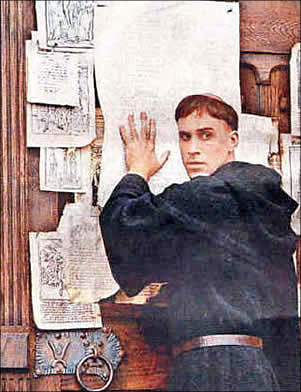
This was the introduction to the 95 Theses which Martin Luther nailed to the door of the Wittenberg University Chapel on Wednesday, October 31, 1517.   We sometimes think that nailing the 95 Theses to the door of the church was an act of rebellion, and in retrospect it was powerfully symbolic, but it was actually a normal practice.  The church door served as a kind of bulletin board for the academic community.  If you wanted to propose a debate, that’s where you posted the notice with the propositions to be discussed.

Luther didn’t intend for the 95 Theses to be a manifesto for rebellion.  He had no idea that his challenge to the practice of selling indulgences would spark a revolutionary movement that would sweep across Europe bringing enormous changes in religion, politics, education, and everyday life, but once that movement started, he gave himself to it body and soul because he was committed to the truth of the Gospel and the love of Christ.  The truth quite literally set him free from the heavy-handed authority of Rome—the Pope excommunicated him—but the truth also bound him to the proclamation of salvation by God’s grace through faith and to the authority of God’s word in the scriptures.

Out of love for the truth and from a desire to elucidate it…  

According to the Gospel of John, when Jesus was on trial before Pontius Pilate, Pilate asked him, “What is truth?”  In some respects that seems like an almost ridiculous question.  We know what truth is.  We learn about truth almost as soon as we learn to talk.  Sadly, that’s also when we learn to lie, because we learn pretty quickly that the truth may reveal things we would like to keep hidden.  We learn very early on that sometimes truth has consequences that we would like to avoid, and that those consequences might be unpleasant or even painful.  

Truth, the dictionary tells us, is the true or actual state of a matter.  Something is true when it is in conformity with reality.  We say a thing is true when it is a verified or indisputable fact.  The truth reflects actuality or actual existence.  When we say a thing is a basic truth, we mean that it is an obvious or accepted fact.  

Truth means that my desires or imagination do not have the final word in determining what is reality and what is not.

There are twenty-seven verses in the gospels that contain the word truth.  Twenty-one of those verses are in the Gospel of John where truth is not only a central theme, it is anchored in and identified with the person of Jesus.  In John 1:14 we read, “the Word became flesh and lived among us, and we have seen his glory, the glory as of a father’s only son, full of grace and truth.”  Three verses later, John puts aside the figurative language of the Word to make it clear who he is talking about: “The law indeed was given through Moses; grace and truth came through Jesus Christ.”

When Jesus sat discussing theology with the Samaritan Woman at Jacob’s Well, he told her that “true worshipers will worship the Father in spirit and truth.”  In chapter 14, not long after he has told Thomas that he, himself, is “the way, the truth, and the life,” Jesus refers to the Holy Spirit as “the Spirit of truth” and in chapter 16 he tells his disciples that “when the Spirit of truth comes, he will guide you into all the truth.”  In chapter 17, as he prays for the disciples, Jesus asks that they would be sanctified or consecrated in truth.

“For this I was born,” Jesus told Pilate, and for this I came into the world, to testify to the truth. Everyone who belongs to the truth listens to my voice.”

In today’s Gospel reading from chapter 8 of John’s gospel, we see a hint that some of those who were listening to Jesus were unsure about continuing to follow him.  Some scholars think that this passage is indicative of tension between Jewish believers and Gentile believers in the community where this gospel was written, and John, the writer, is calling both sides back to the middle ground of the truth found in the person and teaching of Jesus.  

“Jesus said to the Jews who had believed in him, ‘If you continue in my word—if you remain faithful to my teachings, then you are truly my disciples.  And you will come to know the truth.  And the truth will set you free.”  When they protested that they were descendants of Abraham and had never been enslaved by anyone—apparently they forgot about their own history with Babylon and Egypt—Jesus went on to make it clear that he was talking about the truth setting them—and us—free from our slavery to sin.

But how does the truth set us free from sin?  

Martin Luther defined sin as being curved in on the self.  Sin is when I put my preferences, my desires, my ideas, my plans, my goals above and before everyone and everything else.  Sin is me, me, me, me, me taken to the extent that it harms or disenfranchises or marginalizes or disempowers or diminishes or neglects you, you, you, you, you.  Sin creates a false reality, an illusion centered on my desires, my fears, my imagination.  And that illusion is seductive and captivating.  It ensnares.  It enslaves.  It makes me believe that I am the center of the universe, that what I think or believe or even just want very, very badly to be true is what is real.

Truth disabuses me of that illusion.

Once again: Truth means that my desires or imagination do not have the final word in determining what is reality and what is not.

We are currently struggling through a time when truth is endangered in our culture.  There’s nothing new about that.  People have always preferred to put their own spin on facts that confront their biases or preconceived ideas.  People throughout history have taken refuge in denial when events or outcomes don’t fit the way they wanted things to happen or the results they wanted.  What’s new is how widespread this devaluation of the truth has become.  

When lies and spin become so prevalent that they begin to undermine any common understanding of basic facts, the world becomes a more dangerous place.  When people refuse to accept observable facts, when there is no longer the common cultural ground of truth based on fact, then there is no longer a starting point for discussion or compromise.  There is no way to move past confrontation and opposed binary positions that divide us.  When people lift up conspiracy theories and “alternative facts” as justification for their actions or opinions then we stand on the precipice of political violence. 

Sadly, we have seen clear examples of that lately.  It has become the sin of our society.

Sin convinces me that I stand apart from the rest of humanity.  But the truth, the fact, is that I am deeply and intimately connected to the rest of humanity and, in fact, to all of creation.  Standing apart is an illusion.  Rugged individualism is a destructive myth—destructive because it undermines and negates the relationships that keep us alive in every sense of the word.

“We must all overcome the illusion of separateness,” said Richard Rohr.  “It is the primary task of religion to communicate not worthiness but union, to reconnect people to their original identity “hidden with Christ in God” (Colossians 3:3). The Bible calls the state of separateness ‘sin.’ God’s job description is to draw us back into primal and intimate relationship. As 1 John 3:2 reminds us, ‘My dear people, we are already children of God; what we will be in the future has not yet been fully revealed, and all I do know is that we shall be like God.’”

As followers of Jesus, we are called to live in the imitation of God.  We are called to observe what God is doing all the time and everywhere and then do the same.  We are called to be generous because God is generous.  We are called to be creative because God is creative.  We are called to embrace diversity because God revels in diversity so much that no two things are exactly alike in the entire universe.  But above and beyond everything else, we are called to love.  Because God loves.  God is love.  And, as Richard Rohr has said, God does not love us if and when we change.  God loves us so that we can change.

That is grace—the grace that makes us whole, the grace that heals us, the grace that reunites us, the grace that saves us.  

Believe it.  

It’s the truth…and it’s the only thing that can set us free.

All That and a Bag of Chips

Luke 18:9-14

One time I was at a planning meeting for a popular annual youth event, and we were discussing adding some people to the planning team who we thought might bring some new energy and ideas.  One very talented and popular youth director had let us know that he would like to be part of the team and that he had, in his words, “some great ideas to transform the event.”  We all liked this guy, but at the same time, his over-the-top self-confidence was a little off-putting.  “Well, he’s very talented and capable,” said one of the women on the team, “but his ego walks into the room before he does.”  “Yeah,” said another, “he thinks he’s all that and a bag of chips.”  

In Luke 18, Jesus tells a parable about a man who seems to think he’s “all that and a bag of chips.”  In contrast, there is also a man in the story who is so ashamed of himself that he can’t lift his eyes from the floor.  

Jesus also told this parable to some who trusted in themselves that they were righteous and regarded others with contempt:  “Two men went up to the temple to pray, one a Pharisee and the other a tax collector.  The Pharisee, standing by himself, was praying thus, ‘God, I thank you that I am not like other people: thieves, rogues, adulterers, or even like this tax collector.  I fast twice a week; I give a tenth of all my income.’  But the tax collector, standing far off, would not even look up to heaven, but was beating his breast and saying, ‘God, be merciful to me, a sinner!’ I tell you, this man went down to his home justified rather than the other; for all who exalt themselves will be humbled, but all who humble themselves will be exalted.” (Luke 18:9-14, NRSV)

On the face of it, this looks like the easiest of all the Jesus stories to interpret.  The point seems pretty clear:  Ego and bragging are bad.  Humility is good.  There.  Riddle solved.  Let’s go home.

But wait a minute.  I want to tell you this story again, but this time I want to take away Luke’s introduction and give you another translation of the ending.  

Remember, when Luke sat down to write his gospel he was drawing from a number of sources.  One of those sources was a unique collection of Jesus stories that Matthew, Mark and John apparently didn’t have, because those stories don’t appear in their gospels.  

If you read carefully, you may notice that when Luke inserts these stories into his telling of the life of Jesus, he often frames them with his opinion of what the story is about.  We saw this last week with Luke’s telling of the parable of the Widow and the Judge.  You may also notice that in Luke’s gospel, Pharisees almost always appear in a negative light and tax collectors are always portrayed as repenting and being transformed.  

These biases in Luke are so apparent that they almost amount to a binary formula in his writing: Pharisees bad, tax collectors good.  It’s important to remember, though, that the people who originally heard Jesus tell these stories fifty or more years before Luke wrote them down would have had exactly the opposite view:  Pharisees good, tax collectors bad.  In fact, tax collectors would have been seen as frankly despicable.  

Tax collectors were despised and regarded as traitors because they were considered  to be collaborators with the Roman oppressors.  In fact, tax collectors were so hated that they were frequently assassinated by a group of anti-Rome Jewish zealots called the Sicarii.  Some of the shock value of this story is that the tax collector even dares to come into the temple to pray.  

Pharisees, on the other hand, were generally admired.  People looked up to them as examples of how to live a righteous life.  They went above and beyond the requirements of Torah in order to increase the righteousness of all Israel.  They saw their fastidious keeping of the law as a kind of patriotic duty.  They believed that Messiah would not come until the nation was righteous enough to receive him, so they were extra conscientious about keeping the law to make up for those who were not.  The Pharisee in this parable would have believed that his extra righteousness could even compensate, at least a bit, for the tax collector’s treasonous collaboration with Rome, because they were both children of the covenant.

In our culture, in our day and age, we find the Pharisee’s prayer in this parable braggadocios and obnoxious.  ‘God, I thank you that I am not like other people: thieves, rogues, adulterers, or even like this tax collector.  I fast twice a week; I give a tenth of all my income.’  We tend to prefer our heroes a little humbler.

Gregory Peck and a friend were waiting for a table one night at a crowded restaurant and the wait seemed to be dragging on forever.  His friend became impatient and said to Gregory Peck, “Why don’t you tell the maître d’ who you are?”  Peck replied, “No, if you have to tell them who you are, then you aren’t.”

We like that kind of self-effacing humility.

The Pharisee’s prayer sounds like the opposite of that.  It sounds like he’s trying to remind God that he is one of the good guys, one of the important people, and he’s grateful that God made him a VIP.  It also sounds, at least to most of us, like he thinks he has earned whatever favor he has from God.

From that perspective, the Pharisee’s prayer reminds me a little of the table grace prayed by Jimmy Stewart as Charlie Anderson in the movie Shenandoah:  “Lord, we cleared this land.  We plowed it, sowed it, and harvest it.  We cook the harvest.  It wouldn’t be here and we wouldn’t be eating it if we hadn’t done it all ourselves.  We worked dog-bone hard for every crumb and morsel, but we thank you Lord just the same for the food we’re about to eat.  Amen.”

As I said earlier, it’s easy to read this parable as a story of self-righteous arrogance versus self-deprecating humility with Jesus declaring the contrite tax collector as the one who is justified.  But let me tell you the same story in a different way and see what you think.

Two broken men went into the temple to pray.  One of them knew he was broken and one did not like to think of himself that way but there was an uneasiness in his soul, a feeling of unworthiness that he just couldn’t escape.  

The one who knew he was broken was a tax collector.  His job made him a pariah.  Everyone hated him and saw him as a traitor because he worked for the Romans.  He hated himself for doing it.  But times were hard and there was a family to feed and clothe and a job was a job.  So he was living a life he hated and had become a person he hated.

The other man, a Pharisee, wanted more than anything else in the world to be righteous, to know that God approved of him.  He worked hard at being righteous.  He went above and beyond what the Torah required.  He was as good as it was possible to be according to the law.  And yet sometimes he felt like an imposter.  Sometimes he felt like none of it was good enough to make God love him.  So he stood off by himself in the temple and quietly prayed a prayer that was half to God and half to himself.  “Lord, I thank you that I’m not like other people…(I’m not a bad guy)…like thieves, rogues, adulterers… (I’m not a bad guy) or like this tax collector… I live by Torah… I fast twice a week… I give a tenth of everything… (Lord, tell me I’m a good guy.)”  He finished his prayer—half self-talk, half talking to God, and sighed.  Everything he said about himself, to himself, was true. And yet he still felt somehow incomplete.  Like he was missing something.  Something important.

As the Pharisee was leaving the temple, he glanced over at the other broken man, the tax collector. He was standing off in a corner, away from everyone else, but the Pharisee could see that the man was beating his breast and his face was damp with tears as he prayed, “God, be merciful to me, a sinner.”

And here is where we need to retranslate the end of the story.  There is a little word in the Greek text, para, that has multiple meanings.  It’s a preposition.  Most of our English translations translate it as “instead of” or “rather than.”  So our Bibles end the story with Jesus saying, “I tell you, this man (the tax collector) went down to his home justified rather than the other.” They’re telling us that the tax collector is justified and the Pharisee is not.  But that little word para can also mean “along with” or “beside.”  

How do we hear it if the story ends with Jesus saying, “I tell you this man went home justified alongside the other.”  Alongside the other.

Maybe this is a story about both of them receiving grace.  Maybe this is a story about both of them finding some healing as they stand before God in the temple praying their broken prayers from the depth of their broken hearts, each in the only way he knows how to pray.  Maybe this is a story about what our way of praying says about how we understand God.

And yes, “Those who exalt themselves will be humbled and those who humble themselves will be exalted.”  But maybe that means we will all meet somewhere in the middle under the umbrella of God’s love and grace.   In Jesus’ name.