About Those Weeds…

Matthew 13:24-30, 36-43

He put before them another parable: “The kingdom of heaven may be compared to someone who sowed good seed in his field;  25 but while everybody was asleep, an enemy came and sowed weeds among the wheat, and then went away.  26 So when the plants came up and bore grain, then the weeds appeared as well.  27 And the slaves of the householder came and said to him, ‘Master, did you not sow good seed in your field? Where, then, did these weeds come from?’  28 He answered, ‘An enemy has done this.’ The slaves said to him, ‘Then do you want us to go and gather them?’  29 But he replied, ‘No; for in gathering the weeds you would uproot the wheat along with them.  30 Let both of them grow together until the harvest; and at harvest time I will tell the reapers, Collect the weeds first and bind them in bundles to be burned, but gather the wheat into my barn.’” 

36  Then he left the crowds and went into the house. And his disciples approached him, saying, “Explain to us the parable of the weeds of the field.”  37 He answered, “The one who sows the good seed is the Son of Man;  38 the field is the world, and the good seed are the children of the kingdom; the weeds are the children of the evil one,  39 and the enemy who sowed them is the devil; the harvest is the end of the age, and the reapers are angels.  40 Just as the weeds are collected and burned up with fire, so will it be at the end of the age.  41 The Son of Man will send his angels, and they will collect out of his kingdom all causes of sin and all evildoers,  42 and they will throw them into the furnace of fire, where there will be weeping and gnashing of teeth.  43 Then the righteous will shine like the sun in the kingdom of their Father. Let anyone with ears listen!

In 1965, William Youngdahl, the pastor of Augustana Lutheran Church in Omaha, Nebraska became convinced that racism was a pernicious evil, a spiritual cancer destroying the soul of America.  As he thought about how he might address this in his parish, it dawned on him that most of the people in his all-white congregation simply didn’t know any black people—that many had never had an actual conversation with a black person.  Youngdahl thought that a logical first step in confronting racism and white supremacy would be for white people and black people to simply meet and talk to each other.  To introduce the idea to his community, he invited youth from the nearly all-black Calvin Memorial Presbyterian Church to join in worship with his all-white congregation.  That went reasonably well so he prepared to move to the next step in his plan which was to ask couples from his congregation to have dinner at the homes of couples from the Presbyterian congregation.  That’s when polite smiles faded and attitudes surfaced.  He quickly discovered that while the Presbyterians were willing, the members of his own congregation were resistant, passively at first, then more actively so.  At first they simply said they didn’t think people would be comfortable dining at the homes of their black hosts.  Then they said they didn’t think “our people” were quite ready for such a big step.  The more Youngdahl encouraged them to try the idea, the more his Council and other members of the congregation found reasons to object.  They began to accuse him of being divisive and revolutionary.  In the end, they forced him out of his position as pastor.  They saw him as a weed in their field.[1]

It seems that there always people eager to pull the weeds… or at least what they think are the weeds.  

“In Matthew’s day and in every generation,” wrote Robert Smith, “it takes little talent to finger members of the community who look like bad seed.  Where do they come from?  It is easy to lose confidence in the way God runs the universe.”[2]  

The weed Jesus refers to in this parable is almost certainly darnel, lolium temulentum, a poisonous grain that looks so much like wheat that it’s also called “false wheat.”  It’s easy to mistake it for wheat and vice versa if you’re not trained to spot the differences, especially when the plants are just beginning to grow.

Jesus says to let the weeds grow.  The reapers will take care of them when the time comes.  But almost from the beginning the church seems to have not been listening to that particular instruction.

The word “heresy” has cropped up rather frequently in the history of the church.  It comes from the Latin haresis which means “a school of thought or philosophical sect.”  The Latin comes from the Greek heiresis which means “to take or choose for oneself.” In Greek debate it was used to describe “a differing opinion.”  In church use, the conventional meaning of heresy is “a belief or opinion that is contrary to orthodox doctrine.”  Historically in the church, however, heresy”seems to have meant, “Look!  Here’s a weed!  Quick, let’s pull it!”

In 431, at the Council of Ephesus, the teachings of the British Monk and theologian, Pelagius, were condemned as heresy.  Fortunately for Pelagius, he had died in 418 or he might have been in for a rough time, not that he hadn’t been roughed up a bit while alive.  After all, you don’t go toe-to-toe with powerful bishops like Augustine and Jerome without getting a few bruises to your reputation…or your body.  Theologians fought dirty in those days.  And what was the great sin of Pelagianism?  Pelagius had dared to question St. Augustine’s idea of Original Sin, the idea that all of humanity was perpetually wounded by Adam’s sin.  Augustine said that from birth we are in bondage to sin and cannot free ourselves. No, said Pelagius, we are born innocent.  True, we are born into a world where sin is nearly inescapable, but we have the gift of free will which is one of the gifts of grace!  We can choose to move toward the love of Christ and Christ’s grace brings us the rest of the way in.  No, said Augustine, our human will is entirely degraded.  The human will is not free.  Pelagius is a heretic.

On the 6th of July in 1415, Jan Hus, a Czech academic theologian,  philosopher and priest was burned at the stake as a heretic for condemning indulgences and crusades.  He had also advocated, like Wycliffe before him, that the scriptures should be translated into the languages of the common people so that everyone could read them for themselves. 

On May 30, 1431, Joan of Arc was burned at the stake for heresy and cross dressing.  The church’s case for heresy was weak and Joan answered the inquisition’s questions with pious intelligence. But they had her dead to rights on the charge of dressing like a man.  It didn’t help her cause that she was an inspiring military leader and no slouch as a military strategist.

In 1521, Martin Luther was condemned as a heretic and sentenced to death for his widely circulated writings suggesting church reform.  Some of the reforms he advocated had been proposed by Jan Hus a hundred years earlier.  Luther had developed a large popular following and his denunciation of indulgences hit the church right in the wallet.  Fortunately, because he was under the protection of the powerful Duke Frederick the Wise, the death sentence was never implemented.

In 1633, Galileo Galilei was declared a heretic and forced to recant his assertion that the earth moves around the sun and not the other way around.  He died under house arrest 9 years later.  He was vindicated 359 years later in 1992 when Pope John Paul II admitted that Galileo was right, the earth does move around the sun.  A mere 8 years after that the Church issued a formal apology.  Galileo was unable to attend.

In his book Parables of the Kingdom, Robert Farrrar Capon reminds us that the enemy doesn’t have any real power over goodness. The wheat is already sown.  The reign of God is already in the world and there’s nothing the enemy can do about it.  But, “he can sucker the forces of goodness into taking up arms against the confusion he has introduced, to do his work for him. That is why he goes away after sowing the weeds. He has no need to hang around. Unable to take positive action anyway–having no real power to muck up the operation–he simply sprinkles around a generous helping of darkness and waits for the children of light to get flustered enough to do the job for him.”

All these heretics, all these persons with differing views, were seen in their time as weeds in the field.  Some were pulled and burned, ignoring the advice of Jesus: Let both of them grow together until the harvest.  He tells those who are eager to yank up the weeds that they’re likely to pull up the wheat, too.  Jesus also leaves a cautionary question hanging in the air, a question that echoes through this parable and our history: What makes you so sure you know the difference between darnel and wheat? 

Today, Pelagius is being reevaluated. A fair number of theologians are thinking that maybe he wasn’t entirely wrong and maybe Augustine wasn’t entirely right.  Jan Hus is regarded as a martyr whose ideas planted seeds that flourished in the Reformation.  Joan of Arc has been canonized as a saint and nobody much cares that she wore pants.  Martin Luther is acknowledge as a titanic figure who not only ignited the Reformation but set the stage for the Enlightenment.  Galileo opened our minds to the notion that religious dogma should not stand in opposition to empirical observations.  

Persons and ideas that were thought to be weeds in the field turned out to be wheat.

Let both of them grow together until the harvest; and at harvest time I will tell the reapers, Collect the weeds first and bind them in bundles to be burned, but gather the wheat into my barn.

Do not judge and you will not be judged.  Don’t be in such a hurry to yank those ideas or persons you think are weeds out of God’s field.  Grow and let grow.  In Jesus’ name.


[1] For a thought-provoking look at this story see the documentary A Time For Burning by William Jersey.  Available on YouTube

[2] Augsburg Commentary on the New Testament: Matthew; Robert H. Smith, 1998, p.178
Sowing Generosity

Matthew 13:1-9, 18-23

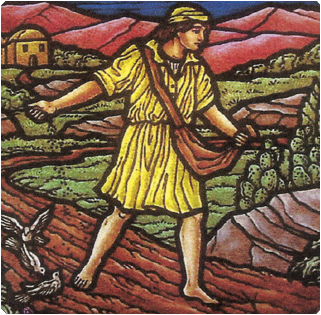
Listen!  A sower went out to sow.

Karsten Lundring is an alum of California Lutheran University who really loves his alma mater.  Karsten attends every CLU football game and when the Kingsmen score he throws out handfuls of Jolly Rancher candies to the crowd in the stands.  Some of those candies fall through the bleachers and land on the ground.  Some are caught by people who are dieting or diabetic so they get passed along to someone else.  Sometimes people catch the orange ones but they just don’t like the orange ones, only the red ones so they give them away.  Some are caught by fans of the opposing team.  But a lot of the candies are caught by hungry children and CLU fans who are enjoying excitement of the touchdown and are delighted to celebrate with a taste of something sweet.[1]

A sower went out to sow.  

Jesus doesn’t usually explain his parables, but because his disciples pestered him about it he explained this one.  Well, partly.  He explained about the ground where the seeds landed.  The different places where the seeds end up serve as analogies for the different people who will hear the message that Jesus and his disciples are proclaiming, the announcement that the reign of God is about to begin.  Some will get it, some won’t.  Pick your reason.  Some are too shallow or too self-involved.  Some are too busy.  Some are too worried.  Some are misguided by their own misconceptions—these are all things that can keep the domain of God from really taking root in your life or, to put it another way, that can keep you from taking root in the domain of God.  

We have an natural habit when we read the parables of asking “What does this mean?” Please explain this.  We want to read them all as allegories—sometimes they are, sometimes they’re not.  We want to translate the analogies, to solve the riddle and walk away from the parable knowing The Point.  But Jesus tells parables not so that we can ask questions of them and arrive at some moral maxim like an Aesop’s fable, but so that the parable can ask questions of us.  Jesus tells parables to help us see the world, ourselves and God differently.  

When I’ve preached or taught on this Parable of the Sower in the past, I’ve always focused on the soil since that’s the part that Jesus explains.  My sermons were usually some version of “What Kind of Soil Are You?” with sometimes a side order of “What Are You Going To Do To Become More Productive Soil?” 

If you ever heard me preach one of those sermons, I apologize.  I messed the point.  I also missed the point.  Don’t get me wrong.  It’s always a good thing to be looking at what we can do to let the love and life of God take deeper root in our lives.  It’s always good to pay attention to how our faith or lack of it is manifested in the lives we lead.  But that’s not the point of this parable.  There are other parables for that.  The fig tree in the vineyard comes to mind.

Parables ask us questions, and as I sat with this parable and listened to it again, the question it was asking me was “What do you see here that you haven’t seen before?”  Jesus is giving his disciples some answers, but not all the answers.  There’s more to see here.  And then I saw two things that made it a whole new story for me.

The first was this:  the soil can’t change itself.  It is what it is.  The pathway is going to be the pathway as long as people are walking on it.  The rocks are going to be the rocks.  Thorn bushes don’t uproot themselves.  

Jesus is telling his disciples and “anyone with ears” who will listen to not make themselves crazy trying to talk people into signing up for the reign of heaven if they’re just not ready to do that.  Just sow the seed.  Go out and announce it: the Domain of God is within reach.  Live it.  Be it.  Those who are ready will get it, and it will surprise you how many of them there are.  As for the rest, let the Holy Spirit work on them.  Rocks can be moved or worn down.  Pathways can be rerouted or tilled and fertilized.  Thorn bushes can be removed in any number of ways.  But right now that’s not your job.  Leave the Holy Spirit and the circumstances of life to soften them up.  You sow the seed.

The second thing I saw that absolutely turned this into a new story for me is this: this is a story of unbridled abundance and generosity.  There is no shortage of seed.  The sower throws it everywhere with no regard whatsoever about where it’s landing.  The word of the kingdom, as Jesus calls it in his explanation to the disciples, is an endless resource and when it lands with someone who hears and understands it, it reproduces itself even more abundantly. 

God has created this world to be a world of abundance and generosity.  As Gandhi said, this world has enough for everyone’s need, but not for everyone’s greed.  The earth itself participates in the generosity of God. The generosity of God was spoken in the word of creation.  The word of the kingdom is a word of perpetual regeneration.  Genesis.  Generation.  Regeneration.  The creative love of God is grounded in Generosity.  

“God writes the gospel not in the Bible alone, but on trees and flowers and clouds and stars,”  wrote Martin Luther, and surely God’s message of generosity and abundance is written in every harvest and planting.  

I remember being on our family wheat farm in Kansas once in the spring when the new wheat was standing bright green and knee-high in the fields.  I looked out and saw a family of deer grazing on the new shoots down by the creek.  I asked my mother’s cousin, Frank, if we shouldn’t maybe do something to shoo them away.  He just smiled and said, “Oh there’s plenty for them and us.  We’ll share it.”  

There was good soil there in Kansas where my family grew wheat.  The harvest was plentiful.  There’s good soil for the word of the kingdom, the domain of God, in many, many hearts out in the world.  Many people are already living in the heart of the kingdom whether they know it or not, living lives of generosity that produce more generosity in others.

When Michelle Brenner was furloughed from her job at a menswear store in Gig Harbor, Washington, because of the Corona virus, she was, naturally, upset, so she went home and made herself a big pan of lasagna using her grandmother’s recipe.  Nothing works like comfort food to soothe the soul.  Michelle realized that if her grandmother’s lasagna was making her feel better, it might lift other people’s spirits, too, so she posted on Facebook, “Hello favorite friends… if any of you want some fresh, homemade, no calorie-counting lasagna, let me know and I will gladly prepare it.”

A few requests trickled in—a retired neighbor, an out of work friend… Then Michelle took it on herself to deliver a few pans of lasagna to hospital workers and first responders, a few struggling single parents and others she knew of who were just scraping by. Word began to spread.  Soon she had so many requests that making homemade lasagna for others had become her full-time job.  When the president of the Gig Harbor Sportsman’s Club got wind of Michelle’s mission, he offered to let her use their commercial kitchen which had been closed because of Covid-19.  Three months later she’s still at it.  So far she has given away more than 1200 pans of homemade lasagna, although she’s lost track of the exact number.

Michelle initially used her $1200 stimulus check to pay for lasagna ingredients but that money was soon gone.  Fortunately, without being asked, people began to contribute what they could.  Some would give a dollar.  One person gave $100.  Somebody set up a Facebook fundraiser for her that raised $10,000.  All in all, people have given about $22,000 to the woman who is now known affectionately as The Lasagna Lady.  Every penny goes into lasagna while Michelle, herself, gets by on unemployment insurance. 

“It’s a pan of love,” says Michelle. “A lot of the people I make lasagna for have lost their jobs, and this is my way of saying, ‘I understand and I’m here for you.’ ”

When Jesus explained the Parable of the Sower to his disciples he said, “As for what was sown on good soil, this is the one who hears the word and understands it, who indeed bears fruit and yields, in one case a hundredfold, in another sixty, and in another thirty.”  Or 1200 pans of lasagna. 

I don’t know where Michelle Brenner heard the good news of the kingdom of heaven, the good news of God’s abundance and generosity.  I don’t know if she ever attended any church or is part of any faith.  Maybe she learned it from the earth itself.  Maybe it was layered between the noodles and the meat and the sauce and the cheese in her grandmother’s lasagna recipe.  I don’t know where or how she learned it, but she learned it.  And she’s passing along.

And a sower goes out to sow.

In Jesus’ name.  Amen.


[1] Thanks to Pastor Kirsten Moore, Calvaray Lutheran Church, Rio Linda, California for this story.

The Yoke’s On You

Matthew 11:16-19, 25-30

So how’s it going for you?  Are you getting a good handle on life in 2020?  How are your stress levels?  I mean, I know Jesus told us not to worry (Matthew 6, Luke 12), but sweet Lord, have you looked at 2020?  So far we have had a pandemic that looks like it’s going to be around for quite a while, we’ve had an economic collapse, and recovery doesn’t seem to be looking all that imminent, the stock market is bouncing up and down like a yo-yo,  ongoing civil unrest and demonstrations for racial justice have rocked our cities and spread across the globe, we’ve seen increasing political polarization as the election draws closer, we’ve stumbled through botched primary elections— All things considered, there’s more than a little to be stressed about.  Even nature seems to be in on the conspiracy of turmoil.  We’ve had record high temperatures in Siberia, Sahara dust storms landing on the American South, we’ve got Murder Hornets showing up in the Pacific Northwest, and now they’re warning that alligators in Florida may be more aggressive because of crystal meth that’s been flushed down the toilets.  Oh, also there’s a newly discovered species of shark in the Australian archipelago that can walk on its fins and briefly leave the water.  Fun times. 

So, in light of all that, how’s it going for you?  

You know, most people I talk to simply say they’re doing fine.  Just fine.

Do you know what fine stands for?  F.I.N.E.  Frazzled, Insecure, Neurotic and Emotional.  FINE.  Thank you to Pastor Kevin Mohr for that useful definition.  

Frazzled, Insecure, Neurotic and Emotional.  Yep.  I think we’re all just FINE.  And we’ve been FINE since even before the pandemic.  It’s no wonder that the world has developed so many coping mechanisms for reducing stress.  

Aside from guided meditation and mindful breathing and prayer (remember prayer?), here are a few of my favorites.

  • According to The Atlantic magazine, cleanfluencers have become very popular for helping people destress.  You say you don’t know what a cleanfluencer is?  That’s a person, usually a woman, who cleans her house or apartment on social media.  Apparently, thousands of people find it a great stress reliever to watch this.  Many swear that watching one of these 10 to 25-minute videos is just the ticket to help them fall asleep when nothing else will.
  • This next one is a little gross, but I swear it’s true.  Some people, especially younger ones in their teens and twenties, find pimple popping videos relaxing.  Yes, you heard that correctly.  These are videos of dermatologists such as Dr. Sandra Lee, known to her millions of viewers on YouTube as Dr. Pimple-Popper, using the proper tools to correctly extract the goo from blackheads and whiteheads.  According to Time.com there are several theories about why people find watching this so satisfying and relaxing.  Personally, I think it’s the catharsis of seeing something unhealthy and unsightly so quickly opened, and the bad stuff removed.  Problem solved. There’s a theological metaphor there just begging to be exploited but I’ll save it for another day.
  • I think my favorite recent example, though, of people being inventive in dealing with stress comes from Japan.  When Itaru Sasaki’s cousin died he was overcome with grief.  Itaru and his cousin had grown up in the same town and been best friends all their lives.  But with his cousin gone, he missed the times when they would hike to the top of the hill that overlooked the town of Otsuchi and just sit together and talk about anything and everything.  

   Then Itaru had an idea.  At the top of that hill where they had had so many long conversations, he built a white phone booth out of wood and glass.  Inside the booth he installed a chair and an old rotary-dial phone that wasn’t connected to anything.  Whenever he felt the need, he would hike up to the phone booth and dial his cousin’s number on what he called kaze no denwa, the Wind Phone, because his words to his cousin would be carried on the wind.  

   About a year after he had built the Wind Phone, the town of Otsuchi and that whole region were hit by a triple calamity, an earthquake, followed by a tsunami, followed by a nuclear meltdown.  More than 10% of the population of Otsuchi was lost.  A few of Itaru’s friends who knew about the Wind Phone began to ask if they could use it, too, and it wasn’t long until a steady stream of visitors began to make their way up the hill to dial the numbers of their lost loved ones so they could speak to them on the wind, to say the things left unsaid, to make confessions, to just chat about things, or to simply say one more time, ‘I love you.’  Before long, people were not only coming from all over Japan, but from distant parts of the world to deal with the stress of their grief by speaking to the departed on the Wind Phone.

Stress isn’t new.  It was just as common in ancient Judea as it is in our modern world.  Everyone was carrying some kind of burden.  Everyone was under some kind of yoke.

According to Rob Bell, when a rabbi in ancient Judea recruited a bright young student to be his disciple, he would drape his stole over the student’ shoulders and say, “Take my yoke upon you and follow me.” If the student was willing to be that rabbi’s disciple and learn his way of interpreting scripture, he would reply, “I take your yoke upon me.”  From that moment he would be a disciple and, for all intents and purposes, a slave to the rabbi in hopes that he, too, might someday become a rabbi.  The disciple would prepare the rabbi’s meals, run his errands, prepare his writing materials, serve as his bodyguard, and carry his belongings when he traveled.  It was no easy thing.  It was a kind of voluntary slavery.

“Come to me, all you that are weary and are carrying heavy burdens, and I will give you rest,” says Jesus.  “Take my yoke upon you, and learn from me; for I am gentle and humble in heart, and you will find rest for your souls.  For my yoke is easy, and my burden is light.” 

Honestly, I think sometimes we misunderstand what Jesus is telling us here.  I have frequently heard people refer to this saying of Jesus as if he is offering to solve all their problems.  But I just don’t see Jesus volunteering to be our panacea or our get out of jail free card.  I do believe, however, that we can take him at his word.

He is making the invitation to discipleship.  But he is not making us his slaves. He is offering us an alternative way of life, a more peaceful way.  He is offering to teach us his understanding not only of scripture but of God and he has only one interpretive principle: Love.  Love God, love your neighbor, love yourself.

We can lay our burdens down at the feet of Jesus and rest.  We can shake off whatever yokes we’ve been laboring under and take up his gentler, easier, lighter yoke as an act of love.

We can lay aside the soul-killing burden of always trying to be worthy of love, of always trying to be good enough, because Jesus reminds us that we are loved and invites to live in the community of the beloved.  

We can put down the burden of striving for status because Jesus has told us that we are children of God, and there is no status in heaven or earth higher than that.  

We can stop striving to be visible, to be admired, because Jesus has told us that God sees us and knows us and has given us the kingdom.  

We can shake off the yoke of perpetual penance because in Christ we have endless grace so that we can go about the business of restoring relationships and building new ones.  

We can lay down our addiction to stress.  We can rest in Christ. We can take the yoke of Christ upon us and find rest for our souls.

In Jesus’ name.

Message Received

Matthew 10:40-42

I’ve been thinking a lot about Eric.  I remember how Eric was attracted by the crowd one Sunday evening when we were doing Stories, Songs, and Supper.  I was pretty sure when I first saw him that he was homeless although to be fair, his clothes were cleaner and neater than most in that condition.  

He stood at the church door and asked what was happening as he saw people gathering, greeting each other, laughing, and we told him, “It’s a thing we do called Stories, Songs, and Supper.  We share a meal then sing a bunch of old familiar songs, then someone tells a story, then we sing a little more.”  We invited him to come in and join us.  So he did.

While he was eating he told us a bit about himself—he had a gift of gab—then after supper he helped clear the tables.  He joined right in with the singing and he had a pretty decent voice.  Somewhere in the midst of all that let it be known in his own gregarious way that joining with us that evening was a particular treat for him because it happened to be his birthday.  So we all sang Happy Birthday to him.  At the end of the evening, as he was leaving, he asked if he could borrow a book from the book table in the fellowship hall.  He took a novel and promised to return it.

The next Sunday, Eric was there for Sunday morning worship.  Soon he was participating in Adult Education classes and Bible study.  He joined in with one of our small groups in the work they were doing with Lutheran Social Services.  In almost no time Eric had become an important member of our little family of faith. 

We welcomed Eric into our lives and Eric welcomed us into his.  And we were all richer for it.

“Whoever welcomes you welcomes me, and whoever welcomes me welcomes the one who sent me,” said Jesus in the tenth chapter of Matthew.  This is the same gospel in which Jesus later says, “I was hungry and you fed me, I was thirsty and you gave me something to drink, I was a stranger and you welcomed me… Truly I tell you, just as you did it to one of the least of these who are members of my family, you did it to me.”

Christ often comes to us in ways we’re not expecting.  When we welcome the unexpected stranger, or graciously accept a welcome when we are the unexpected stranger, we experience the presence and grace of God in new and enriching ways.

I remember one dreary afternoon when the sky was the color of lead and the rain was relentless.  The light coming in my office window had unconditionally surrendered to winter and my mood matched the weather.  Suddenly I heard this bright, jazzy music coming from downstairs.  I ran down the stairs and there in the Fellowship Hall was Eric, pounding out boogie-woogie on the old out-of-tune piano.  Who knew?  He had come in to the hall to get out of the rain and the mood had come on him to just sit down and play.  He apologized for disturbing me and I told him, “No apologies necessary!  You brought light into a gloomy day! Keep playing.”

“Whoever welcomes a prophet in the name of a prophet will receive a prophet’s reward; and whoever welcomes a righteous person in the name of a righteous person will receive the reward of the righteous.”

We learned a lot from Eric.  We learned a little about life on the streets.  We learned more than we wanted to know about our neighbors’ attitudes toward the homeless.  We learned how the police and the justice system in our city respond to those who are experiencing homelessness.  We learned about our own attitudes toward those living rough.  Most of all, though, we experienced an energy and vitality that’s been missing since he left us.  All this because we welcomed one gregarious man into our party on his birthday.

As I read the scriptures and the history of the Church, I see a story where the Holy Spirit is always trying to open the door of welcome wider.  Sadly, though, every time the Spirit pushes the door open wider, there are more than a few trying to close it.  

God made a covenant with Abraham and told him that his descendants would be a blessing to all nations, but then his descendants tried to make it a “descendants only” club. 

Jesus welcomed “tax collectors and sinners” to his fellowship table but the Pharisees were scandalized and critical.  How could he be from God if he associated with such people?  Then down through the years, even the followers of Christ, people calling themselves by his name, would make all kinds of gateway tests of belief and morality to decide who was worthy of coming to Christ’s table.

When the Church was barely up and running Peter, under the direction of the Holy Spirit, baptized Cornelius and his household, Roman gentiles.  In response, James and the other Apostles back at headquarters in Jerusalem had a tizzy fit and raised all kinds “who gave you permission” questions.  

St. Paul placed women in the pastorate and leadership ranks of the congregations he established (Junia, Julia, Prisca, Lydia, Euodia, Scyntyche), but before he was cold in his grave other patriarchal hands were editing his writing (1 Cor. 14:34-36) while still others borrowed his name to write  the women out of their jobs (1 Timothy 2).  

Not exactly welcoming.

This month in the ELCA we celebrate the 50th anniversary of a change in wording in the bylaws of the Lutheran Church in America and the American Lutheran Church, two of the predecessor bodies of the ELCA.  Fifty years ago they voted to change the word “man” to the word “person” in their bylaws, thereby opening the door for the ordination of women. 

Fifty years later, women clergy often struggle with challenges that male clergy do not.  They deal with sexual harassment, disrespect, and often lower pay due to gender-based discrimination.  Some congregations still refuse to call a woman as pastor even when there are no other candidates.  The saddest part of that is that in doing so these congregations are depriving themselves of the gifts these talented women bring with them, gifts that could revitalize and renew them.  

When I think of the women pastors I know, I feel a tremendous hope and confidence for the future of the church.  If anyone can lead us to a brighter day, they can.

“Whoever welcomes a prophet in the name of a prophet will receive a prophet’s reward; and whoever welcomes a righteous person in the name of a righteous person will receive the reward of the righteous; and whoever gives even a cup of cold water to one of these little ones in the name of a disciple—truly I tell you, none of these will lose their reward.”

Eric taught us this lesson well: When we welcome the unexpected guest, we receive unexpected gifts. 

Fifty years ago the Spirit moved to open the door wider so that the church could receive the bountiful gifts that women bring through ordained service.  Eleven years ago the Spirit opened the door wider again when the ELCA voted to allow the ordination of LGTBQ persons.  And the church is richer for their ministry.

Today we stand at the edge of a tidal shift in our culture in regard to race, economic structures, and societal systems.  The Holy Spirit is pushing the door open yet again and maybe, maybe even pushing down the walls.  Church will be different.  There are new prophetic voices to hear.  New righteous persons to receive.  New gifts being given.  The only question is, will we welcome them?

In Jesus’ name.


Don’t Be Afraid

Matthew 10:24-39

[Jesus said,]   “A disciple is not above the teacher, nor a slave above the master;  25 it is enough for the disciple to be like the teacher, and the slave like the master. If they have called the master of the house Beelzebul, how much more will they malign those of his household! 

26  “So have no fear of them; for nothing is covered up that will not be uncovered, and nothing secret that will not become known.  27 What I say to you in the dark, tell in the light; and what you hear whispered, proclaim from the housetops.  28 Do not fear those who kill the body but cannot kill the soul; rather fear him who can destroy both soul and body in hell. (Gehenna) 29 Are not two sparrows sold for a penny? Yet not one of them will fall to the ground apart from your Father.  30 And even the hairs of your head are all counted.  31 So do not be afraid; you are of more value than many sparrows. 

32  “Everyone therefore who acknowledges me before others, I also will acknowledge before my Father in heaven;  33 but whoever denies me before others, I also will deny before my Father in heaven. 

34   “Do not think that I have come to bring peace to the earth; I have not come to bring peace, but a sword. 

35       For I have come to set a man against his father,

         and a daughter against her mother

         and a daughter-in-law against her mother-in-law; 

36       and one’s foes will be members of one’s own household.  37 Whoever loves father or mother more than me is not worthy of me; and whoever loves son or daughter more than me is not worthy of me;  38 and whoever does not take up the cross and follow me is not worthy of me.  39 Those who find their life will lose it, and those who lose their life for my sake will find it.

Standing up for what you believe in, standing up for the right thing, can cost you. 

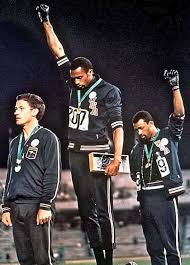
When Tommie Smith and John Carlos won the gold and bronze medals in the 200 meter dash in the 1968 Olympics in Mexico City, they stood on the awards podium with their black-gloved fists raised in what the press called a Black Power salute to call attention to  the ongoing fight for civil rights in the United States.  Tommie Smith and John Carlos called it a Human Rights Salute.  Standing with them on the podium was the silver medalist, a white man, an Australian named Peter Norman.  Norman didn’t raise his fist but he did something else that brought down the whirlwind.   In solidarity with Smith and Carlos, he wore the Olympic Project for Human Rights badge on his uniform.  

After the race, Carlos and Smith had told Norman what they planned to do during the ceremony and Norman encouraged them.  They asked Norman if he believed in human rights.  He said he did.  Then Smith and Carlos asked Norman if he believed in God.  He said he believed strongly in God and that what they were about to do was more important than any athletic accomplishment.  And then he said, “I’ll stand with you.” On their way to the medals ceremony Norman saw the Human Rights badge being worn by Paul Hoffman, a white member of the US rowing team and asked if he could borrow it for the ceremony.  He didn’t feel it was appropriate to raise his fist because that particular symbol belonged to the people whose civil rights were being denied.  But he could wear the patch.

That moment of solidarity was costly for Peter Norman.  He never returned to the Olympics.  Back in Australia he became a figure of controversy and got somewhat lost in his own life.  “If we were getting beat up,” said John Carlos years later, “Peter was facing an entire country and suffering alone.”

A disciple is not above the teacher, nor a slave above the master;  it is enough for the disciple to be like the teacher, and the slave like the master. If they have called the master of the house Beelzebul, how much more will they malign those of his household!” says Jesus in today’s gospel reading.  In other words, if they’re going to call Jesus himself the devil, don’t be surprised if they call you worse.  

This comes near the end of a long  section where Jesus is sending his disciples out on their first mission to proclaim the Good News—remember the good news?  the Reign of God is arriving?—but  now he’s telling them that this Good News, this news that people have waited for for eons is going to be disruptive, and some people aren’t going to like that.  

People are funny.  We can pray week after week, day after day, year after year “your kingdom come, your will be done on earth as it is in heaven.”  But when it gets down to actually working to make that happen, people get cranky because then we actually have to change things—our politics, our religious practices, our structures and systems…even ourselves.  “Do justice, love kindness, and walk humbly with your God” makes a lovely needlepoint but it can turn everything upside down when you actually put it in practice, especially the do  justice part.

Don’t be afraid, says Jesus. Do not be afraid of opposition.  You know it’s coming so just face it.  If you trust me, if you believe in what I’ve been teaching, then live by it.  Proclaim it.  Act on it.  Shout it from the rooftops. What’s the worst they can do to you?  Kill you?

Do not fear those who kill the body but cannot kill the soul; rather fear him who can destroy both soul and body in hell. (Gehenna)

Okay, two things here, and I’ll take the last one first.  Hell.  Hell isn’t hell. The actual word here is Gehenna which was a valley just outside Jerusalem where all the city trash was dumped and burned, including the carcasses of dead animals. It’s not the Hell of popular imagination.  Think city dump.  So, fear the One who can toss your whole self into the trash heap.

The second thing:  Soul.  The Greek word here is psyche.  Soul is one translation.  It can also mean life.  In this context, though, maybe think of it as your true self.  Jesus is saying don’t be afraid of those who can only kill your body.  Save your fear for God who can completely undo you.  Remember in Isaiah chapter 6 where Isaiah stands before the throne of God and says, “Woe is me for I am lost.”?  The Hebrew word there which we translate as lost is nidmeti.  It can mean lost or silenced.  It can also mean unmade. It’s the same idea here. 

Fear the One who can destroy both body and soul.  Fear the One who can destroy your true self.  God is one of only two entities in the universe who can unravel your true self.  And, spoiler, God won’t.  God will not.  God loves you with a passion.  God may work furiously to reshape you, to rid you of poisonous thoughts, ideas and attitudes, to smooth certain rough edges, but God will not destroy you.  

God may, however, let you destroy yourself.  God loves you enough to give you free will.  And you are the only other entity in the universe who can destroy your soul, you should be careful and thoughtful with that gift.  

One of the reasons, I think, that Christ gives us the high honor and calling of announcing and building the beloved community is to help steer us away from the numerous rabbit holes of self-destruction we could dive into, and also to give us trustworthy companions for the journey of life.  But, to take us back to where we started, Jesus knew that doing this, announcing that it’s time for a systemic do-over, would bring opposition and confrontation.

“Do not think that I have come to bring peace to the earth; I have not come to bring peace, but a sword.” 

There’s a similar passage in Luke 12 where Jesus says, “I came to bring fire to the earth, and how I wish it was already kindled.”  I don’t think that Jesus is saying in these passages that he is intent on creating conflict.  I think he is simply acknowledging that conflict is inevitable when we proclaim the kingdom and work for it because the whole and healthy society that God envisions, the kingdom of heaven, the reign of God is very much at odds with business as usual in the earth of empires and economies.

There will be opposition.  There is opposition. And some of it is brutal.  That’s why Jesus said, “Whoever does not take up the cross and follow me is not worthy of me.”

Scholar and theologian John Howard Yoder points out that the cross was “the standard punishment for insurrection for the refusal to confess Caesar’s lordship.”  The phrase ‘take up your cross’ was commonly used by Zealots when they were recruiting.  It was a call to stand in defiance and opposition to Rome and the systems of empire that perpetuated oppression.  

But there was another dimension to it.  Roman citizens could not be crucified.  If a citizen was guilty of a capital offence, even insurrection, they would be beheaded.  Crucifixion was reserved for those of lesser stature, the invisible non-persons of the empire who opposed it.  “Take up your cross” was not just a call to stand in defiance of Rome, it was also a call to identify with the people on the margins.  It was a way of saying “Stand with the poor, the downtrodden, the nobodies.” 

“Those who find their life will lose it, and those who lose their life for my sake will find it.”  And here we find the word psyche again in the Greek text, this time translated as life.  Life. Soul.  Self.  This is such a cryptic saying from Jesus.  Here’s how I understand it:  If you go looking for yourself, you’ll lose yourself, but if you lose yourself in the life of Christ, you’ll find yourself.  

I think maybe Jesus is saying stop worrying about the meaning of your life or what, exactly your soul is, or even who you are deep down in your soul.  Let go of all those esoteric questions and lose yourself in the business of the reign of God.  Work for equality and equity.  Feed the hungry.  House the homeless. Take care of the sick.  Bring hope to the hopeless.  Stand with those who need you to stand with them.  Act on your faith.  It may cost you.  There will be opposition.  Don’t be afraid.  The reign of God, the kingdom of heaven is in reach.  In Jesus’ name.

When the Spirit Speaks

On the sixth day of Sivan, seven weeks and one day after the Feast of Unleavened Bread, on the day of Shavuot which the Hellenized Jews call Pentekosta, the streets of Jerusalem were filled with people from every tribe and nation, from the far reaches of the empire and beyond, some even from Cush, Iberia and Ethiopia, from Scythia and the Parthian empire.  Jews and proselytes, curious gentiles and ambitious traders had come from everywhere to be in the Holy City for the festival of the first fruits of spring and to remember the giving of Torah to Moses.  

The followers of Jesus were in the city, too, gathered all together in one place, in one room, waiting as Jesus had instructed, waiting for a signal, waiting for what was to come next.  Then suddenly the house where they were sitting was filled with a sound from heaven, a sound like a hurricane.  It filled the house and drove them to their feet while something that looked like tongues of fire danced between them until a flame seemed to alight on the head of each one of them.  They felt a presence swell up inside them and knew it was the Holy Spirit.  

The Spirit drove them out of the house and into the street where they began to speak to the crowd in languages they had never known as the Spirit spoke through them proclaiming the love and grace of God as it had been made known to them in Jesus the Christ.  They spoke of God’s works of power through Jesus, his feeding of multitudes, his healings, his teaching.  They spoke of how he welcomed strangers and touched lepers.  They spoke of how he challenged the self-righteous and embraced the neglected.

On the day of Shavuot, the Festival of Harvest which was also called Pentekosta, the day on which Moses had been give the Law, the Holy Spirit began to spread the good news of the Reign of God through Jesus, the Christ, across the empire of Caesar and beyond.

Now two millennia later, on the 31st day of May, on the day that Christians call Pentecost which is also called Whitsunday or Whitsun, we are not all together in one place.  We are not all together in one room, though we may be gathered in one ZOOM.  

This is a strange birthday for the Church as we begin to contemplate moving back into our facilities, our sanctuary, after months apart in our homes.  There are so many practical questions to consider.  Is it really safe yet?  Will our people be able to adapt to the new practices required for safe worship in this time of pandemic or will they revert to old, ways of doing things simply out of habit—ways which are now unsafe?  With all the restrictions and safeguards, is it even worth doing now?  Should we wait until there is a vaccine?   Those are all good questions.  Necessary questions.

But I have other questions.

What have we learned from this time of isolation?  How has the Holy Spirt spoken to us?  Was this, somehow, the work of the Holy Spirit—not the virus, to be clear—but the separation?  Was it the work of the Spirit to send us out of our sanctuary and into our homes for a time—a time of contemplation and reflection?  Have we used this time to reflect on what it means to be the Church of Jesus Christ?  Have we used this time to listen to the Spirit, to discern what Christ is calling us to do and to become?  Are we listening now?

The Spirit has been speaking as always.  I’ve been hearing the Holy Spirt, not in the tongues of xenolalia or glossolalia, but in the everyday voices and silences of the congregation.  I’ve been hearing the Spirit and seeing the Spirit in phone calls, in prayer requests, in ZOOM meetings, in emails, in cards, letters and postcards, and on social media.  The Church is alive even if we are not all together in one place.  The church is open even if the building is closed.  The Spirit is still speaking.

On that first Pentecost the Spirit came upon them with the sound of a hurricane.  What kind of sound is the Spirit making now?

Sometimes, certainly, the Spirit speaks in silence.  The silence of our isolation.  The silence of our thoughts.  Sometimes in that silence the Spirit speaks to us with sighs too deep for words about our own lives and hearts and hopes and dreams.  As I listen to the Spirit in silence, I have been hearing the silence of a nation that has not yet grieved for 100,000 dead.

I believe, though, that there is also a sound that is carrying the presence of the Holy Spirit, a sound louder and deeper and broader than a hurricane and more turbulent than an earthquake, and yet often we seem deaf to it.  I wonder if we haven’t been sent out of our places of worship and into our homes so we could hear it better and learn to see the hand of God at work.  I wonder if our ears and minds and even our souls haven’t been so preoccupied with our hymns and liturgies and the pageantry of worship that we’ve been deaf and blind to the things the Spirit of God is engaged in, the things God is call us engage with.

At the beginning of creation the Spirit moved over the turbulent welter and waste of the waters to bring order out of chaos.  On this day of Pentecost is the sound of melting glaciers and rising seas the sound of the Spirit calling us to begin an era of re-creation, to take meaningful action in the battle against climate change?  Are we being called anew to fight pollution, to restore the earth, to cherish God’s creation?

In his day, the prophet Amos was filled with the Holy Spirit and empowered to challenge the economic disparities of Israel and to predict catastrophe for the wealthy.  In a country where 10% of the households have 70% of the wealth, in a country where 40 million have filed for unemployment as businesses have closed due to the pandemic, where Wall Street seems disconnected from Main Street, is the Spirit calling us to reexamine our priorities and restructure our economic systems?

In an era when the people of Israel thought that all God cared about was religion done rightly and in the right place, the Holy Spirit spoke through Isaiah and later through Micah and said quite literally, “I do not want your bull.  Not while the poor are languishing.  Not while there is rampant injustice.  Take care of those in need.  Give justice where it has been subverted. Bring me a contrite spirit and a broken heart and then we’ll talk about worship.”  In a day when we get caught up in discussions about the propriety or impropriety of on-line communion, when we’re deep in discussions about when and how to open our sanctuaries, when the very issue of reopening our churches has become a political flash point and fodder for the political divide, is the Holy Spirit, maybe telling us to cool our jets, to make sure first that our ministries and priorities are in order, that our hearts are in the right place, and then we can talk about worship in our buildings?

On that first Pentecost the Holy Spirit used a sound like a hurricane and tongues of flame to move the followers of Jesus into the streets.  On this day of Pentecost there is another sound and another fire as the Spirit of God moves through our streets.  It is the sound of the grief, the anger, and frustration of those who have been unheard, a grief and anger long suppressed and now unleashed.  The flames are flames of rage that have long been suppressed in the hearts of our sisters and brothers of African descent.  It is the wail of mourning for George Floyd, for Ahmaud Aubrey, for Breonna Taylor, for Eric Garner, for Trevon Martin, for the 9 killed at Bible Study at Mother Emmanuel AME Church, for Emmett Till, and for countless others.  The raging wind we hear is the sound of millions of voices sighing together the words of Fannie Lou Hamer, that they as a people and as individuals, are “sick and tired of being sick and tired.”  It is the Spirit, the Breath of God, squeezed from a people who are crying out “I can’t breathe.”

When I listen to the Spirit at this time of Pentecost I hear all of this.  A voice says, “Cry out!” and I say “What shall I cry out?”  And I hear the Spirit say, “Fix This!”  

When I listen to the Spirit I hear the words of Jesus reading from the scroll in the synagogue, words we drank in with our baptism when his mission became ours: “The Spirit of the Lord is upon me.  The Lord has anointed me to bring good news to the poor, to open the eyes of those who have been blinded by ugly ways of thinking, to liberate those who have been oppressed by hideous words and evil ideas, and to set the captives free.  Fix This.”

When I listen to the Spirit at this time of Pentecost I hear the narrative voice of the Gospel of John, words about Jesus that also became words about us in our communion: “Indeed, God did not send the Son into the world to judge or condemn the world, but so that the world might be saved, healed, made whole through him.  Fix This.”

When I listen to the Spirit at this time of Pentecost that’s what I hear.  I hear the brokenness.  I hear the lament and anger.  

But I also hear the promise and the call of God.  I hear the reminder that we have been anointed, empowered and called by the Spirit to be God’s tools of healing and restoration.  I hear the Spirit calling us to fulfill the promise.  

I hear the Spirit saying Fix This.  Fix it in your heart and in your mind.  Then help others fix it in theirs.  The Spirit of the Lord is upon us, calling us to transform the flames of anger and fear into flames of love.  May the winds of lament become the breath of grace and kindness and healing.  And with the power of the Spirit, immersed in the love of Christ, we will fix this.

That’s what I hear.  

What do you hear?

Doubt and Wounds and Overlooked Things

John 20:19-31

When it was evening on that day, the first day of the week, and the doors of the house where the disciples had met were locked for fear of the Jews, Jesus came and stood among them and said, “Peace be with you.”  20 After he said this, he showed them his hands and his side. Then the disciples rejoiced when they saw the Lord.  21 Jesus said to them again, “Peace be with you. As the Father has sent me, so I send you.”  22 When he had said this, he breathed on them and said to them, “Receive the Holy Spirit.  23 If you forgive the sins of any, they are forgiven them; if you retain the sins of any, they are retained.”

24  But Thomas (who was called the Twin), one of the twelve, was not with them when Jesus came.  25 So the other disciples told him, “We have seen the Lord.” But he said to them, “Unless I see the mark of the nails in his hands, and put my finger in the mark of the nails and my hand in his side, I will not believe.”

26  A week later his disciples were again in the house, and Thomas was with them. Although the doors were shut, Jesus came and stood among them and said, “Peace be with you.”  27Then he said to Thomas, “Put your finger here and see my hands. Reach out your hand and put it in my side. Do not doubt but believe.”  28 Thomas answered him, “My Lord and my God!”  29 Jesus said to him, “Have you believed because you have seen me? Blessed are those who have not seen and yet have come to believe.”

30  Now Jesus did many other signs in the presence of his disciples, which are not written in this book.  31 But these are written so that you may come to believe that Jesus is the Messiah, the Son of God, and that through believing you may have life in his name.


I have a tendency sometimes to overlook very important things because I’m focused on other important things…or even, sometimes, not so important things.  I think we all do that to one degree or another.

Last year, for example, there were a lot of important events:  the US/China trade war, Brexit, tensions with North Korea, tensions with Iran, the migrant exodus from Central America, the burning of Notre Dame, fires in the Amazon, wildfires in Australia, and, of course, the impeachment of President Trump.

But here are some important things that also happened last year that seem to have got lost in the shuffle.  Humpback whales in the South Atlantic came back from the brink of extinction and now number almost 25,000.  Dolphins are breeding in the Potomac for the first time since the 1880s.  100 seal pups were born on the shores of the Thames 60 years after the river was declared “biologically dead.”  Millions of Ethiopians working together planted 353 million trees in 12 hours.  The Netherlands became the first country in the world to eliminate all stray dogs—not by euthanasia, but through education, free veterinary care and pet adoption.  In Kenya, poaching rates dropped by 85%.  In Mozambique, one of Africa’s largest wildlife reserves went an entire year without losing a single elephant.  Malaria infections dropped by 76% in Cambodia, China, Laos, Myanmar, Thailand, and Vietnam and deaths fell by 95%.  Algeria and Argentina officially eliminated Malaria altogether.   The WHO announced that not one single case of H1N1 Bird Flu had been reported worldwide since 2017.  The CDC announced that cigarette smoking among US adults was at an all-time low of 13.7%.  Type 3 polio was declared officially eliminated—now only type 1 remains and it can only be found in Pakistan and Afghanistan. [1]

So why am I telling you all this?  Well, in this familiar story about Thomas being absent when the risen Jesus appears to the other disciples, I think there are some important things that we tend to overlook.  So let’s adjust our focus for a minute.

First of all, let’s not call it the story of Doubting Thomas.  For one thing, it’s not at all fair to Thomas.  Remember in chapter 11 of this same gospel, when the other disciples tried to tell Jesus not to go back toward Jerusalem because certain people were trying to kill him, Thomas is the one who said, “Well we might as well go with him so we can die with him, too.”  So maybe we could call him Brave Thomas.  Or Stalwart Thomas.  Or even Fatalist Thomas if you’re feeling cynical. But Doubting Thomas?  Let’s put that name aside because it slants how we read or hear the story.  But maybe we should take our eyes of Thomas altogether for a moment.

This chapter, chapter 20, was where the Gospel of John originally ended.  Someone other than the original author later added chapter 21 as an epilogue, but John’s gospel originally ended at the end of chapter 20.  That being the case, I would think that the things Jesus says and does in this concluding chapter are particularly important.  I have to wonder if focusing on Thomas hasn’t distracted us from what Jesus is saying and doing here.  Make no mistake, Thomas is important here, but is he really supposed to be the central character?

I think maybe we’ve made him the focal point of the story because his “doubt,” his original disbelief of the news that Jesus has appeared to the others, resonates with the doubts and disbelief we all feel sometimes if we’re honest with ourselves.  That’s normal.  That’s human. As Frederick Buechner said, “If you don’t have any doubts you are either kidding yourself or asleep. Doubts are the ants in the pants of faith. They keep it awake and moving.”

Doubt is an important thing for us to think about and to come to terms with, and it seems pretty clear that belief and disbelief are among the themes in this story.  But again, are we missing something else that’s at least as important because we’ve focused so much on Thomas and his skepticism?

Let’s go back to the beginning of the story.  It’s the first day of the week.  The doors of the house are locked because the disciples are afraid.  So right off the bat we see something important.  Fear locks doors.  Fear locks us into small places in our hearts, in our minds, in our thinking, in our lives.  Even physically.  As we are all sheltering in place with stay at home orders right now during the pandemic, I think we can sympathize.  Fear locks us down.  It might be a very sensible, reasonable fear—theirs was.  Ours certainly is during this pandemic.  Staying behind closed or even locked doors might be the safest, most right thing to do.  But the fact remains that behind all that sensibility is fear.  In our case with the Covid pandemic I’d like to think the fear is tempered by love—we stay home not just because we’re afraid of catching the disease but to avoid spreading it to others.  But the lesson here is that fear locks doors.

But look what happens next.

Jesus came and stood among them and said, “Peace be with you.”  Jesus comes into the locked down places in our lives and speaks peace.  Jesus speaks peace to our hearts, to our minds, to our anxieties, to our fears.  Jesus speaks Shalom, that word of wholeness and well-being and blessing that bleeds all the strength and energy out of our fears.  Peace.

Our dog, Tramp, is a brave little guy, but for some reason our smoke alarms scare the feisty right out of him.  If one so much as chirps from a low battery he panics.  He tries to be brave and stay close to us but I think that’s mostly because he can’t find a place to get away from the sound.  He tucks his tail between his legs trembles and quivers until Meri wraps him in a blanket and speaks gently to him to tell him everything’s okay while I change the battery on the alarm.  She speaks peace to him until he calms down.  She goes into the locked down place in his little canine psyche and speaks peace until he can stop trembling and come back to normal.  That’s what Jesus did for his disciples in that locked house.  That’s what he does for us when we’re locked in our anxieties.  Shalom.

After he said this, he showed them his hands and his side. Then the disciples rejoiced when they saw the Lord.

 Jesus, risen and eternal, still has his wounds.  That alone is worth thinking about.  What does it mean that, resurrected from death, Jesus still has the wounds from the cross?  Don’t rush to an answer.  That’s one of those questions that’s better to sit with than to answer.  And there’s also this to wonder about: the disciples don’t seem to fully recognize him until they see his wounds.  His wounds authenticate him.

They see his wounds, they recognize him and, the Greek text says, they are filled with joy.

I wonder.  I think I would feel a lot of things.  Joy would certainly be in the mix, but looking at those wounds on the body of someone whom I knew had been dead, even if he had predicted his resurrection… hearing that voice… Yes, there would be joy, but also fear and wonder and hesitation and a whole confusing cocktail of wrestling emotions.  Which is probably why Jesus had to say a second time, “Peace be with you,”  just to get their attention, because the next three things he said were really important.

As the Father sent me, so I send you.  In saying this they went from being disciples to being apostles.  Messengers.  Evangelists.  Ambassadors for the Resurrection and the Love of Christ.  They now had a mission: they were being sent into the world to proclaim Jesus as the Christ and announce that the Reign of God had begun.

When he had said this he breathed on them and said to them, “Receive the Holy Spirit.”  He empowered them for the mission he had given them.  With his own breath he breathed the breath of life into their ministries.  This is not the rambunctious, noisy and fiery Day of Pentecost described in Acts.  This is the personal and intimate trinitarian empowerment for a life of service.  This is the Word who became flesh breathing into them and us the Breath of the Creator who hovered over the waters of creation, breathing into them and into us the Spirit of creation for the work of re-creation.  And then…

If you forgive the sins of any, they are forgiven them; if you retain the sins of any, they are retained.  Jesus authorizes them and us to unlock the closed doors in the human heart and soul.  If a person is to become a new creation, as St. Paul so beautifully described it, there has to be an end to the old business that keeps people locked in destructive patterns and thinking.  There has to be a way to let in the light and fresh air.  Forgiveness unlocks transformation and Jesus empowered them and us to pronounce forgiveness.  Or not.  It’s a tremendous responsibility.

And now back to Thomas.  When Thomas finally does get to see the risen Jesus, note that he doesn’t berate Thomas.  Again, the first thing Jesus says is “Peace be with you.”  Shalom.  And then he invites Thomas to touch his wounds, a deeper more intimate encounter than merely just showing his wounds.  Then Jesus says to him, I like to think gently, “Do not doubt, but believe.”

 Thomas replies, “My Lord and my God.”

Dorothy Sayers, writing about this moment, said, “It is unexpected, but extraordinarily convincing, that the one absolutely unequivocal statement in the whole gospel of the Divinity of Jesus should come from Doubting Thomas. It is the only place where the word God is used without qualification of any kind, and in the most unambiguous form of words. And he does not say it ecstatically, or with a cry of astonishment but with flat conviction, as of one acknowledging irrefutable evidence that 2 + 2 = 4, that the sun is in the sky. Thomas says, you are my Lord and my God!”[2]

Jesus’ response to Thomas’ spontaneous confession of faith is meant, I think, more for us as it was meant for him: “Have you believed because you have seen me?  Blessed are those who have not seen and yet have come to believe.”

We may not have seen the risen Jesus with our own eyes, but we have experienced the living Christ.  It’s the living Christ who moves our eyes past what we expect to see so that we notice the other important things we might otherwise have overlooked.  It’s the living Christ who moves past our locked doors to breathe the fresh air of the Spirit into our lives so that we can be transformed and empowered.  It’s the living Christ who sends us out as apostles, ambassadors of God’s love, with a message of forgiveness.  It’s the living Christ who eternally shows us his wounds to show us the authenticity and depth of God’s love and forbearance.

We may not have seen the risen Jesus with our own eyes, but we have been shown the living Christ, and by the breath and Spirit, we show the living Christ to the world and carry the renewing breath of the Spirit out to restore the world.

[1] FutureCrunch, Angus Hervey

[2] Dorothy Leigh Sayers, Dramatic Readings on the Life of Christ, BBC, 1943

Tonight’s the Night the World Begins Again

I’ve been thinking about some Christmas gifts…and by that I mean some of the gifts that Christmas gives us.

It’s a season of giving – yes, it’s over-commercialized –but in the right spirit that can help us develop a habit and spirit of generosity.  And that’s a gift.

The months leading up to Christmas are a good time to practice delayed gratification.  Don’t buy that now…Christmas is coming.   I know I need to practice that sometimes.  So that’s a gift.

For some it’s a change of habit just to be thinking about what to get for other people, thinking more about others—who they are, what they need.  It can feel like an obligation but it can become a healthy, joyful, even life-giving habit.  That’s a gift.

At Christmastime we are intentional about asking people what they want.  That’s a good exercise for keeping us from being “curved in upon the self.”

Christmas, itself, is a gift.  It’s a change of focus.  It comes with some built-in themes that are important.  Giving.  Receiving. Gathering.  Family.  Peace. Hope.  Joy.  Love. Remembering.  Birth.  The Presence of God.  Wonder.

I don’t know about you, but I  really need the gift of Christmas, itself, this year. It’s been that kind of year.

I need to be reminded to stop and breathe and think about giving and receiving and gathering and family.  I need time to stop and remember.

I need to let words like hope and peace and light fill up my soul for awhile.

I need a time to stop and listen to songs about beauty and joy and angels and promises fulfilled…and God showing up in surprising ways and surprising places.

I need the wonder of it all.

I need the songs.  I especially need the songs and carols… because the music goes straight to my heart and heals me and rekindles my hope and my joy and my faith faster than words alone can ever do. “Those who sing pray twice,” said Martin Luther.

Do you have a favorite Christmas song or carol? Is there one—or maybe there are several?—that touch you in some particularly powerful way?

There are a lot of Christmas songs and carols that I dearly love and I listen to them over and over and over again.  But there’s one Christmas song in particular I keep coming back to these past few Christmases.  And this year, especially, I’ve been listening to it a lot.  In fact I’ve been listening to it off and on all year long.

It’s fairly recent—it came out in 2005, so by Christmas Song standards it’s almost brand new.  It’s called Better Days by the Goo Goo Dolls, written by John Rzeznik.  Yeah, I know.  Goo Goo Dolls.  Silly name, but a great band.  And a powerful song.  Listen to these words:

And you asked me what I want this year

And I try to make this kind and clear

Just a chance that maybe we’ll find better days


‘Cause I don’t need boxes wrapped in strings

And designer love and empty things

Just a chance that maybe we’ll find better days

Better days.  When all is said and done, isn’t that what we all want?  For ourselves, for our families and friends?  For….  Everyone? Better days.

I need some place simple where we could live

And something only you can give

And that’s faith and trust and peace while we’re alive

Those are some pretty good gifts we can give to each other.  For Christmas.  For every day.  And the song is right… we’ll only have faith and trust and peace while we’re alive if we give those things to each other.  Faith.  Trust.  Peace.  But the song knows we need something else if we’re going to be able to give each other faith and trust and peace…

And the one poor child who saved this world

And there’s ten million more who probably could

If we all just stopped and said a prayer for them

The one poor child who saved this world. That’s why we’re here tonight. That’s what we’re here to celebrate. But we’re also here to be reminded that because of that child, Jesus, Emmanuel, God With Us, we have the example and the power to save the world together.  God came in person to give us what we need so we can give each other the gifts of faith and trust and peace.

 I wish everyone was loved tonight

And we could somehow stop this endless fight

Just a chance that maybe we’ll find better days

The thing is, everyone is loved tonight—loved by God, at least.  But they don’t all know it and they certainly don’t all feel it.  If they did, if they all felt loved, if we all felt loved, maybe it would stop the endless fight that seems to be the curse of the human race.  But the only way for that to happen is if we take the love God gives us and let it be real and meaningful in our lives.  And then give it to each other in real and meaningful ways.

Brené Brown said,  “Jesus comes to show us what love looks like.  God is love.  But God knows that if God just comes down and says I am love and I want you to love each other, we’re going to go straight to hearts and unicorns.  We know it’s difficult and we don’t like difficult, so we’re going to romanticize it.  Hearts and unicorns.  But love is difficult.  So Jesus comes to show us how to do it.  He comes to show us that love doesn’t tolerate shaming.  Love doesn’t exclude people because they’re different.  Love reaches out and touches and embraces all the people we don’t want to touch or embrace. Love does the hard work.  Love does the hard things.”

But there’s something else that God shows us about love by coming as a baby, by coming, especially, as a poor baby.  Right at the beginning—Jesus shows us, God shows us, that love is willing to be vulnerable.  Love is willing to let down all its defenses.

When you think of all the ways that God could have come to us–all the ways we imagined throughout history that God would come to us—most of that imagery is all about power and royalty and thunder and smoke and lightning.  And then God shows up as a baby.  A poor baby. In a poor country.  A homeless baby.  A migrant born on the road on a journey his parents were forced to take.  A refugee baby forced to flee for his life.

One poor child who saved the world.

I haven’t quoted the refrain that runs through the song.  It’s repeated twice between the verses, but the song ends with it, too.  It’s both a promise and a call to action:

So take these words and sing out loud

‘Cause everyone is forgiven now

‘Cause tonight’s the night the world begins again

Take these words and sing out loud.  That’s the call to action.

‘Cause everyone is forgiven now.  That’s the promise. It’s also another great gift of Christmas.  In this baby, who is God With Us, we have a chance to start over with a clean slate.

In this baby, who is love itself coming to us in its most human and dependent and vulnerable form, we can find forgiveness and we can learn to give forgiveness— and if we can forgive and be forgiven, if we can let go of old hurts and forgive others, then we really can give each other the gifts of faith and trust and peace while we’re alive.  And then there really is a chance that maybe we’ll find better days.

So take these words and sing out loud,

‘Cause everyone is forgiven now.

And tonight’s the night the world begins again.


Tonight’s the night the world begins again.

A Nation Possessed

Last week was very difficult for me, as it was for a great many of us. I get up early on Sunday mornings, so the very first thing I saw when I turned on my computer at 4 a.m. was the news of the massacre in Orlando. It was still an unfolding story when I saw it; the body count was still being estimated. I confess that I was at a loss as to what to do with that horrible news at that early hour.

For a number of reasons I didn’t mention Orlando in worship that morning. The biggest reason was that I was pretty sure that few, if any, of the people attending would have heard the news yet and I didn’t want such horribly shocking news to cast a pall over worship and especially not over our farewell to two much-loved members who were moving across the country. Also, I needed time to process it before trying to deal with it pastorally and theologically.

By Monday morning Orlando was the stark lens through which I was seeing the whole world. I was filled with a deep sadness tinged by more than a little anger. In an effort to shift gears I clicked over to read a sermon written by my friend and colleague, Pastor Jennie Chrien who serves in Oxnard.   Her sermon was on the same lectionary text I had preached on the day before but she had taken a very different approach from mine. In addressing the Gospel of Luke’s account of the woman who washes and anoints Jesus’ feet (Luke 7:36-8:3), she had focused on the moment when Jesus turns to Simon the Pharisee and says, “Do you see this woman?” From that simple question Jennie had built an eloquent, powerful and moving sermon.

That important question, “Do you see?” wouldn’t leave me alone, jangling up against the ragged wound of Orlando as I turned my attention to the Gospel text for the coming week, the story of Jesus’ encounter with the wild, demon-possessed Gerasene man running naked among the tombs (Luke 8:26-39). I was also remembering anew the horror from almost exactly a year before when a crazy young white supremacist murdered 9 African Americans after sitting through Bible study with them.

Do you see? The question still hangs in the air.

As I read the Gospel for the week with all these things echoing in my heart, I realized that we, the good old US of A, we are the demon-possessed man. We are the man made crazy by fears and anxieties and bigotry and scapegoating. We are the man made crazy by blind rage and unreasoned hatreds.

We are the man with a hopelessly divided mind, made bipolar and schizophrenic by a cacophony of opposing inner voices—entrenched political parties with no common ground—conservatives vs. liberals and ne’er the twain shall meet on any common ground of common sense, putting our party identity or our ideology ahead of everything else that’s supposed to define us, making even our faith subservient to our chosen place on the ideological spectrum. We are so blinded by the ideological lenses we wear that we see only what we’ve decided in advance that we want to see. And since our biases rarely completely align with or truly resonate with the Gospel we hear and profess, our cognitive dissonance creates the first degree of our madness.

Do you see? Do you really see?

Oh, we have our moments of clarity but then the rage wells up in us and we explode in violence.

For most of us it’s just a violence of rhetoric and attitude, but it opens the door and for those who would turn it into a horribly tangible violence of death and destruction. Even among the most enlightened among us, our racism or our discomfort with sexualities that are different from our own our anxieties about those other religions—all these things creep out in unguarded words and give permission to the violence that is always waiting to happen. We breed the craziness.

Do you see?

We cloak our prejudices in our religions. We project our own craziness, our own fears and anxieties and hatred onto the most vulnerable and marginalized then drum up a sacred text or two to support our bigotry and give us permission to treat them horribly.We are so blinded by our own interpretation of our religions that we can’t see children of God standing right in front of us.

Do you see? Do you see that more than a little of our craziness comes from being caught in the middle of an epic struggle between love and hate?

Do you see that if you’re not actively and passionately on the side of love then you are at least passively on the side of hate? Do you see that if you are not generating light then you are opening the door to darkness?

Do you see that we are not just the crazy man among the tombs? Do you see that we are also the craven townspeople afraid of our own shadows. We recognize our own craziness and try to lock it up, to bind it with chains but we know, deep down that that’s not going to work.

Do you see that even when God works a miracle and restores one of us to our senses we respond with more anxiety because that is just so different from our usual experience?

Do you see a way out of all this?

Do you see how Jesus sees? Can you see the way Jesus sees? Can you put aside your politics, your ideology, your biases and prejudices, the less savory voices of your childhood, your inclination for self-protection, your fear of the “other,” your anxiety about a constantly changing world—can you put aside your own demons long enough to see the person in front of you?

Do you see how Jesus sees? Do you see that Jesus doesn’t see a prostitute washing his feet but a woman beaten down by the world who has had to make horrible choices in order to survive? Do you see that Jesus doesn’t see a crazy man running amok among the tombs but a human being bedeviled and enslaved by the legion craziness of the world?

Do you see that in Christ we are all children of God through faith, that in Christ there is no longer Jew or Greek, slave nor free, male or female, gay or straight or trans or bi, us or them?

Do you see that Jesus is our common ground even with our Muslim brothers and sisters? Yes, we understand Jesus very differently, but he is a central voice in both or our traditions and if we’re ever going to find peace with each other, Jesus, not Abraham, is our most likely common ground.

Do you see? Do you see that we are all going to have to learn to see differently?

No, we can’t afford to be stupid. No we can’t afford to be blind to real threats. But do you see that we are going to have to first recognize and deal with the real threats that arise from our own hearts and minds and souls?

Do you see that we’re going to have to stop listening to all the voices that divide us and pit us against each other? Do you see that we’re going to have to switch off the news channels and radio voices and web feeds and political voices that want to tell us how awful those “others” are, who want to tell us that “they” are not the real “us”?

Do you see that we’re going to have to really listen to Jesus—not the Old Testament—not even Paul, but Jesus—if we’re ever going to be freed from our own demons, our own contagious craziness?

Do you see that we are all of us, each of us, going to have to have at least one “come to Jesus” moment if we’re ever going to be freed from our demons?  Or to put it a more scriptural and Lutheran way, do you see that we are all, each of us, going to have to take off the lenses of our preconceptions and put down our guard long enough so that Jesus can come to us and cast our demons into the sea of God’s love?

Do you see? Can you see? Do you see that love—the love of Christ, the love exemplified and perpetually renewed by Jesus whether you know that’s where it comes from or not, is our only hope of ever being able to sit with each other calmly and in our right minds?

Do you see?

When John Came A-Wassailing

So here it came a singing toward us, the third Sunday in Advent. Gaudete Sunday. Rejoice Sunday. The Sunday we light the pink candle in the Advent wreath, the candle of Joy. As I looked at the lectionary texts for the week, it was easy to pick up the theme of joy. Well, it was easy to find joy in the first two readings anyway.

The first reading was from chapter three of Zephaniah. I think we only hear from Zephaniah maybe once every three years in the lectionary, but it’s worth waiting for. Did you hear that marvelous line in verse 17? “He will rejoice over you with gladness, he will renew you in his love; he will exult over you with loud singing!” What a picture!  Have you ever imagined God singing about you? To you? I sing to my dog sometimes just because he makes me happy. He seems to like it.  It’s kind of fun to think of God singing about us, to us, like that. So there’s some joy. That one was easy.

And then came the second reading from Philippians, that wonderful passage from St. Paul’s love letter to the church at Philippi: “Rejoice in the Lord always; again, I say Rejoice!” Well that’s pretty clear, too. So okay! Right there in those first two texts I’ve got plenty to work with to lay the groundwork for Gaudete –Rejoice- Sunday.

But then comes the Gospel reading from Luke 3, and, frankly, John the Baptist kind of sucks the wind right out of rejoicing. “You brood of vipers.” “Bear fruits worthy of repentance.” “The axe is at the root.” “The chaff will be burned with unquenchable fire.” Yeah. That’ll take you right to your happy place.

So I’m thinking about these texts and about Rejoice Sunday and about trying to tease some joy out of grumpy old John the Baptist, and in the middle of all that I found myself thinking about… wassailing.  What can I say?  It’s that time of year.

When the pagan Anglo-Saxons migrated to Britain in the middle of the 5th century, they brought with them the tradition of wassailing. Wassailing, of course, eventually became Christmas caroling, but it started out as something very different.

The word wassail comes from the Saxon phrase Wæs þu hæl which means, “be thou hale” or “be thou healthy” or “be thou well.” At their celebration of the Winter Solstice, the Anglo-Saxons would go out into their orchards and sing to their cider trees, their apple and pear and cherry trees, to wake them up from their winter sleep and to encourage them to be healthy, to produce good fruit so that they could have a plentiful harvest of good cider. “Wæs þu hæl!” they would sing. “Be thou healthy.” And it occurred to me as I thought of all this, that this is kind of what John the Baptist was doing as he was preaching at the Jordan. He was wassailing. He was singing out that it was time to wake up and be healthy. So maybe there is some joy there somewhere between “You brood of vipers” and “the chaff will be thrown into the fire.” Or at least a calling to joy.

With all that in mind, I began to re-imagine my picture of John preaching by the Jordan. Instead of seeing him as a voice of foreboding, instead of hearing him cranky and impatient, I imagined him singing. I imagined him wassailing to wake the people. So I decided that this was what I would do in my own orchard, my own parish, on this third Sunday of Advent. I wassailed to them.  I sang to them.  And it went like this…

When John Came A-Wassailing

In the fifteenth year of sovereign rule of the Emperor Tiberius,
In a time of ruthless potentates and wrongs both small and serious,
The Song of God fell into John, the son of Zechariah,
And he sang it out so strongly they thought he might be Messiah.

But he said, “No, I am not the one you all have been expecting.
I am just the song that sings out where our paths are intersecting.
I’m not worthy to receive him or to tie his sandal thong!
He is the Maker of all Music and I am just one simple song.”

Like a wassailing in the orchard to wake the cider trees,
The song of John cut through their crust and brought them to their knees
As they heard a new reality and began to realize
That the reign of God might now unfold before their very eyes.

So he sang them to the river, saying time was of the essence,
And immersed them in the cleansing flow of forgiveness and repentance,
And his song filled up the wilderness with a Word to spear the heart
Until the crowd was all convicted as their masks were torn apart.

He sang, “You children of the covenant, you children of the promise,
You children of the circumstance and times that are upon us,
All you questing, anxious seekers, all you folk both awed and flawed,
Are you ready to stand naked in the searching gaze of God?

“All you tax-collecting schemers, all you servants of the sword,
All you noble trees and saplings in the orchard of the Lord,
Yes, your roots go deep as Abraham and you’re clothed in your tradition
But that’s not enough to save you from your pathway to perdition.

“O you brood of sneaky vipers, O you children of the snake,
Who warned you of the wrath to come? Who told you what’s at stake?
Did you think that life was something you could skate through or could fake?
Well, my sleeping trees of Zion, it’s time for you to wake.”

Then in dismay the people cried, “John, tell us what to do!
If our heritage means nothing is our fate left up to you?”
And he said, “No that’s not in my hands, but it is somewhat in yours,
For the Winnower we’ve waited for is at the threshing floor.

“So now’s the time to change the way you think and see each other,
Now’s the time to change the way you treat your sister and your brother,
Now’s the time to change your heart and mind and show it by your fruits
With more honest and more decent and more generous pursuits.

“So give away your extra coat to the person who is shivering,
And give up half your sandwich to that hungry kid who’s quivering,
Don’t take more than what you’re meant to take, don’t lie, extort or cheat,
For the Winnower is coming and he’ll sift us all like wheat.

“Yes, the time has come to bear the fruit of new life and repentance
For you’ll reap the harvest that you’ve sown, you’re writing your own sentence.
Even now the axe is at the root, even now your options dwindling,
So will you produce good cider? Or will you be so much kindling?

“For the One who fashioned every soul finds a use for each and all.
Will you be the cider in the cup or the fire that warms the hall?
Will you be the sweet aroma drawing others to the table
Or dissipate as so much smoke in a cautionary fable?

“And I know this all sounds frightening– to be assessed, appraised and weighed–
Every one of us has cause to fear, but I sing, ‘Be not afraid!’
For the one who does the winnowing, the one who does the sifting,
Is the Soul of grace and love and life, the Giver of all gifting.

“And I’m simply here to tell you in this wild and holy place
You have another chance to be made new, a chance to live in grace,
For one who does the sifting does not come here to condemn
But to find every seed of love and good and make it grow again.

“So this song that sounds so ominous, it really is Good News!
For the God of second chances hopes that you will not refuse
To change your heart and mind and ways and show it by your fruits
With more loving and more honest and more generous pursuits.

“For the one who does the winnowing, the one who does the sifting,
Is the Soul of grace and love and life, the Giver of all gifting.
Yes, the one who does the sifting does not come here to condemn
But to find every seed of love and good and make it grow again.”

—–

So now as the lights of Advent, hope, peace, joy and love light your way to Christmas, Wæs þu hæl!  Be thou hale.