God’s Agenda

God’s Priority List

Luke 4:16-27

At one time or another, I think we’ve all wanted something from God.  I think we’ve all had that one thing we wish God would do for us.  Or maybe even a list of things.  Or maybe in a moment of doubt we’ve just wanted God to show us some small sign to reassure us that God really is with us and on our side.  A lot of these wishes, especially the smaller ones, go unspoken.  But when we’re honest with ourselves—and with God—I think almost all of us have that something we’d like to see God do for us.

I suspect that there was something like that at work in the hearts of the people who came to hear Jesus in the synagogue at Nazareth.  They had heard great stories about their hometown boy made good—stories about healings and exorcisms.  They had heard that he spoke with authority, eloquence and wisdom.  Some people were already calling him a prophet.  So when his hometown people came to hear him speak in his hometown synagogue, it was only natural that they brought their hopes and expectations—their unspoken wish lists—with them.  And when Jesus read the passage from Isaiah that starts with The Spirit of the Most High is upon me, it must have just heighted their expectations.

They knew that passage from Isaiah.  I’m sure many of them were silently saying the words with him as Jesus read them.  God has anointed me to proclaim good news to those who are poor.  God sent me to preach liberation to those who are captives and recovery of sight to those who are blind, to liberate those who are oppressed.  To proclaim the year of the Most High’s favor.  They knew those words.  And the way Jesus was speaking them, it sounded like a proclamation he was making about himself.  And then, as if to remove any doubt, the moment he sat down to teach he said Today this scripture has been fulfilled in your hearing.

He owned the prophecy.  He claimed it.  

I can imagine a buzz of excited conversation in the synagogue.  People’s hopes were high.  Hard to believe this is Joseph’s son.  Remember that time he got separated from the caravan coming back from Jerusalem and his parents couldn’t find him for three days?  But look at him now!

Luke doesn’t tell us everything Jesus said as he was teaching.  But at some point he must have said something that they heard as a criticism.  Maybe he said something about their failure to fully embrace the kin-dom of God and help bring it about on earth as it is in heaven.  Maybe he criticized their lack of imagination or their unwillingness to take any risks on behalf of what God was trying to accomplish.  Maybe he criticized their hopes that God was going to fulfill their wish list, when Isaiah wanted them to understand that they were being invited to fulfill God’s wish list and that the Spirit could empower them to do it.

Somewhere in there, also, Jesus made it clear that the miracle shop was closed for the day.  He wasn’t going to do any exorcisms or healings.  It was the Sabbath, after all, and doing works of power—healing, exorcisms, that kind of thing, was better left to another day if wasn’t urgent.  It’s a bit ironic, really, because at other times in other places people got upset with him for healing and casting out demons on the Sabbath.  And isn’t that just human nature in a nutshell.  There’s always someone who’s looking for a reason to be upset.  

Jesus watched their expressions change as the shadow of disappointment and irritation fell across their faces.  He could see that his criticisms didn’t sit well with them.  He could see that they were starting to formulate their own criticism of him in response.  So he beat them to it. Of course you’ll all quote me this proverb, “Doctor, cure yourself!” and you’ll all say, do the things here in your hometown that we heard you did in Capernaum!  

We shouldn’t be too hard on the people of Nazareth.  I think we might have felt the same way.  Don’t we deserve a few miracles, too?  Come on, Jesus, this is your hometown!  We knew you when!  You’re one of us!

Jesus was a master at reading the human heart.  He could hear all the words that weren’t being said.  He could feel their sense of entitlement.  So he reminded them that neither he nor God were bound by their expectations.  He reminded them that there were times and stories in their own tradition when their prophets brought the power of God to others, to “outsiders,” even though there were needs and wish lists right here at home.  Truly I tell you, no prophet is accepted in their hometown.  But I speak truth to you all, there were many widows in Israel in the days of Elijah, when the heavens were closed three years and six months, and there was a sever famine over all the land.  Yet, Elijah was sent to none of them, rather to Zarephath in Sidon, to a widow woman.  And there were also many lepers in Israel in the time of the prophet Elisha, and none of them was cleansed except Naaman the Syrian.

That was the spark that set them off.  They felt they were being disrespected.  It was a slap in the face!  It offended their sense of privilege.  Jesus was one of them, after all.  If anyone had a right to experience his amazing works of power, they did.  They should come first.

And here’s the thing.  Jesus was not telling them that he didn’t love them or that God didn’t love them.  Jesus was not telling them that God wasn’t going to meet their needs.  He was just reminding them that God had already set an agenda, and that God’s agenda was his agenda, too.  He was reminding them that long ago God had spoken through Isaiah to tell them that those who were hurting the most would be attended to first.  He was reminding them that his mission was to proclaim good news to the poor, liberation for captives, recovery of sight for the blind, and liberation for the oppressed.   That was his first order of business.  

They didn’t like to hear Jesus so bluntly telling them that their wishes were not God’s top priority.  It confronted their sense of privilege, and they exploded in rage.  They shoved him out to the edge of town and were going to throw him off the cliff.  And that’s when he finally did a small miracle for them, though I doubt if they saw it that way.  He stopped them from doing something that would have scarred their consciences and damaged their souls for the rest of their lives.  He passed through the midst of them and went on his way, leaving them standing there as the anger and adrenaline seeped out of them.

We love to be told how much God loves us.  We love to be reminded of all the ways that God has provided for us and is looking out for us.  And we usually don’t mind being told that God loves others, too, although we sometimes bristle when we’re told that God loves and cares for people we don’t much like.  Anne Lamott said, “You can safely assume that you’ve created God in your own image when it turns out that God hates all the same people you do.”

And that was part of the problem in Nazareth.  The god in their heads, the god in their hearts ran headlong into the God of their scriptures when Jesus began teaching them what that beloved passage from Isaiah really meant.  God’s favor does not privilege home or nation, but it does prioritize those who are hurting most.

There’s an old story about a little girl who was outside playing with her two brothers when she fell and scraped her knee.  Her mom heard her crying and ran outside, scooped her up and brought her in to the bathroom to clean and dress her wounds, and while her mom was sticking a big Band-Aid on her knee, the little girl asked, “Mom, which one of the three of us do you love the most?”  Her mom looked at her for a moment, then kissed her forehead and said, “Whichever one needs me the most.”

We all want to hear good news.  But the ones who need it most are the poor.  We would all like to be liberated from one thing or another, but the ones who need it most are those who are really held captive.  We all would like to see the world more clearly.  But the ones who need it most are blind in one way or another.  We all would like more autonomy, more real freedom and justice in one way or another.  But the ones who need it most are people who are actually oppressed. 

Over the past few years as protestors responded to the alarming number of incidents of black people being killed in circumstances that highlight the racism inherent in much of American life, the slogan Black Lives Matter began appearing at protests and on social media.  When that slogan, Black Lives Matter, first appeared, a lot of white people responded with All Lives Matter.  

All Lives Matter.  Well, yes, that’s true, of course.  But it’s beside the point.  All Lives do Matter, but it isn’t All Lives who are dealing with profiling and bigotry and discrimination.  It isn’t All Lives dealing with the heritage of neighborhood redlining that creates ghettos and a kind of economic bondage that perpetuates poverty.  It isn’t All Lives who need to have The Talk with their children about how to stay safe and come home alive if you get pulled over by the police because your tail light is out.  Saying Black Lives Matter is necessary because Black Lives have too often and for too long been treated as if they don’t matter.  We can’t say All Lives matter until we’ve made it clear that Black Lives are included in the All.

Many white people have reacted negatively to Black Lives Matter.  They have responded from the blindness of White Privilege, and it upsets them to have someone suggest that such a thing as White Privilege even exists.  They may be quick to point out that their lives don’t feel privileged, that they have had their struggles, too.  What they say is true, but it’s beside the point.  White privilege doesn’t mean your life hasn’t been hard.  It just means that the color of your skin isn’t one of the things that makes it harder.

When Jesus had finished reading that powerful passage from Isaiah, The Spirit of the Most High is upon me.  God has anointed me… he followed the reading by saying Today this scripture has been fulfilled in your hearing.  Those last three words are important.  

In your hearing.  Are we still hearing him?  He was announcing that he had come to restore vibrance and equity to our world.  He was announcing that he was going to start where his attention and love and transformative power were needed most.  If we are his followers, then we have the same mission.  In our baptism we have received the Holy Spirit, too.  If we stand with Jesus then we, too, should say, the Spirit of the Most High is upon us. God has anointed us to proclaim good news to those who are poor.  God is sending us to preach liberation to those who are captives and recovery of sight to those who are blind. God is calling us to liberate those who are oppressed.  God is calling us to announce that now is the time of God’s favor.  The kin-dom of God is within reach.

Now is the time of God’s favor.  Now is the time to change the world.  Now is the time for liberty and justice and fairness for all… starting with those who need it most.   
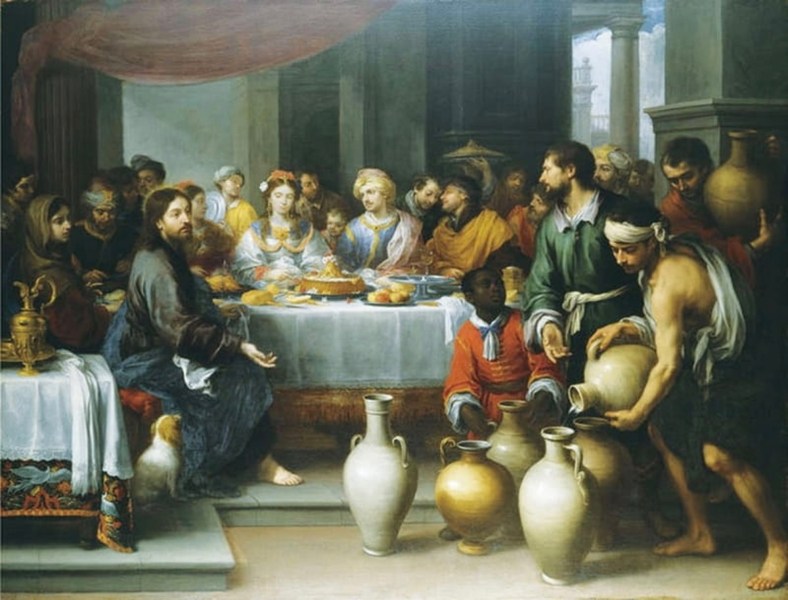
The Wine of Celebration

John 2:1-12

When Jesus’ mother comes to him during the wedding at Cana and tells him that the hosts have run out of wine,  Jesus says, “What concern is that to you and me?”  It’s really kind of funny to think of Jesus saying this to his mother.  “What does that have to do with us, Mom?”   I don’t know about you, but sometimes that’s how I feel when I read certain stories in the gospels, especially miracle stories.  My first thought at first glance is often, “Okay…but what does that have to do with you and me?”

Jesus turning water into wine at the wedding at Cana is often described as his first miracle.  But that’s not the word that the Gospel of John uses.  John’s gospel says it was the first of his signs.  Signs point to something.  Signs tell you that some kind of action is required or they alert you to something up ahead.  If you see a red octagonal sign, you put on the brakes.  If you see a sign that looks like a pointy-headed snake, a fat line that curves back and forth leading to a triangular arrowhead, you slow your roll because the sign has told you that you’re entering a stretch of road with tight curves. 

We refer to the sacraments as signs.  They are not symbols.  They don’t represent something else or invite us to think of something else.  The sacraments are signs of God’s presence and grace here and now.  They require action.  They require us to experience something.  Take and eat.  Drink this, all of you.  Put your head over the font or under the water and receive the Holy Spirit, then begin a whole new life in Christ and in the community of faith.  Right here.  Right now.   

When Jesus turned water into wine at the wedding at Cana, John’s gospel says it was the first of his signs.  The miracle itself, miraculous as it is, is not really what we’re supposed to looking at.  It’s pointing to something else.  So what are we supposed to see? What action is required in response?   What is being revealed about Jesus, and what deeper reality is Jesus revealing?  And is there maybe  something about us being revealed, too, in this miracle, this sign?

The word grace appears only four times in the gospels, all four times in the prologue to the gospel of John.  “And the Word became flesh and lived among us, and we have seen his glory, the glory as of a father’s only son, full of grace and truth.”  (John 1.14)  “From his fullness we have all received, grace upon grace. The law indeed was given through Moses; grace and truth came through Jesus Christ. (1:16-17).  Why does the word grace appear only in the prologue and not anywhere else in John’s gospel?  Professor Karoline Lewis suggests that if we take the Incarnation seriously, then once the Word becomes flesh, “the rest of John’s gospel shows you what grace tastes like, looks like, smells like, sounds like, feels like.”  

Jesus’ signs don’t just tell us what abundant grace is.  They show us.  Turning water into wine is a revelation, a revealing, of grace.  

In Jesus’ time wedding celebrations usually lasted a week and were essentially drinking parties.  There would be lots of food and lots of wine.  Friends and family might contribute food, but the wine was provided by the families of the bride and groom.  Running out of wine would be a huge embarrassment. It would indicate poor planning or poor finances or both.  

We can guess from little details that Jesus probably had some kind of family connection with the couple being married.  Jesus’ mother and brothers were there (2:12) and Mary seems to be comfortable giving orders to the servants, so maybe she was acting in some kind of semi-official capacity.  Maybe she was the wedding coordinator.  Whatever her relationship may have been, she was concerned for the reputation of the couple and the family.  For the couple, running out of wine would mean that their married life was off to a bad start.  The family would become the talk of the town, and not in a good way.  Jesus literally saved them all.  From embarrassment.

The guests were almost certainly poor people.  At least the majority would have been.  Most of the people Jesus knew were poor people, especially at this stage of his ministry.  These were people who worked in fields and vineyards, or fished, or tended livestock, or cut and hauled stones for Roman buildings.  These are folks whose lands have been plundered by ancient Palestine’s version of Big Agriculture—absentee landowners who did none of the work and kept most of the money.  Weddings were one of the few times these people could put all their troubles behind them and celebrate life.  A wedding was a time to drink, and sing and tell stories and dance.  But it would all be cut short if the wine ran out.  

The celebration was in full swing but it was all about to crash like a balloon being popped.  And then Jesus stepped in.  Grace stepped in.  Six stone jars full of water suddenly became wine.  One hundred twenty gallons of wine.  The best wine.  Exquisite wine.  Wine that would have cost them years of their wages.  Jesus turned water into wine so the celebration could continue.  

There was enough wine for everyone and then some.  There was abundance.  And everyone shared in it.  It wasn’t Pinot Noir for the better dressed and Rosé in a box for the rest.  Everyone, from the most prominent guest to the most humble  was served the best wine.  

This sign from Jesus doesn’t just tell us what abundant grace is, it shows us.  “From his fullness we have all received grace upon grace.”  Abundant grace—it tastes like the best wine when you’re expecting the cheap stuff…or even just water.  Abundant grace feels like being suddenly rescued from the worst kind of embarrassment.  Abundant grace looks like all your favorite foods spread out at a banquet.  Abundant grace sounds like music that gets in your bones and moves you with its happy rhythm and makes you dance before you even realize your body is swaying and your feet are tapping.  Abundant grace smells like baking bread and cake and wonderful sauces and fresh strawberries spread out at the buffet.  

Abundant grace fills you so full of life and joy and relief that you want everyone to have it.  You just have to share it.  Taste and see the goodness!

“Grace,” said Robert Capon, “is the celebration of life, relentlessly hounding all the non-celebrants in the world. It is a floating, cosmic bash shouting its way through the streets of the universe, flinging the sweetness of its cassations to every window, pounding at every door in a hilarity beyond all liking and happening, until the prodigals come out at last and dance, and the elder brothers finally take their fingers out of their ears.” 

In the eleventh chapter of 1 Corinthians, St. Paul scolds the Corinthians because when they gather together for their Agape feast, some of the more well-off persons are treating it as if it’s their own private picnic.  They have plenty of food and drink for themselves but they’re not sharing it.  Paul tells them that if they think their gathering is just about eating and drinking, then they should eat and drink at home because they’ve missed the point.  Then Paul reminds them that Jesus, on the night he was betrayed, broke bread and passed it out to everyone, then did the same with the wine.  When he said, “This is my body,” he was indicating that everyone who was sharing that bread with him was united to him, that they now would be the Body of Christ.  It’s not just the eating and drinking.  It’s also the sharing.  It’s the connecting of your life to mine and our lives to his.  It’s the unity.  So chew on that for a bit.  

Jesus turned water into a copious abundance of wine.  Embarrassment was averted. Joy was refueled.  That is what grace looks like.

What do the signs of Jesus point to?  Resurrection.  Life in all its fullness.  Joy—Christ’s joy in us so that our joy may be complete.  Light.  And Love. Grace upon grace.

And what does that have to do with you and me?  Well… we are the ones who get to drink this all in.  We are the ones who are still at the wedding, drinking the wine of celebration.  The best wine.  From his fullness we have all received—and are still receiving—grace  upon grace… so much grace that it has to spill out of us and overflow to others.  We are the ones who get to invite others to the abundant feast where the table is always full and the wine never ends.  That’s what all the signs of Jesus point to.  

Filling the Brackets

Luke 3:21-23, 31-38

Every week I send out the texts for the coming Sunday to our online worship production team.   A few days ago, Bob Siemer sent me an email saying he wanted to confirm a couple of things.  One of the things he wanted to confirm, in his words was, “You really are going to read the genealogy as part of the Gospel text (yawn).”

Well, I have to confess that when I first glanced at the gospel text that Wilda Gafney has given us for this week in the Women’s Lectionary, I felt pretty much the same as Bob.  Yawn.  But then I took a closer look at what Professor Gafney had done in translating this text from Luke.  When I looked more closely, I noticed the brackets.  

Luke and Matthew each give us a genealogy of Jesus.  For what it’s worth their genealogies don’t entirely agree, but each of them felt it was important to give us a picture of Jesus’s family tree.  Matthew starts with Abraham then takes the lineage forward in time until he gets to Jesus.  Luke starts with Jesus then takes the lineage backwards until he gets to Adam. And Eve.  Except that Luke didn’t mention Eve.  Or Ruth.  Or Rahab.  Or Tamar. Or Leah. Or Rebekah.  Or Sarah.  And that’s where Professor Gafney’s brackets come in.  In every instance in Luke’s genealogy where the women ancestors are known from the Old Testament stories that feature them, Wilda Gafney has inserted their names in brackets.  

Even though Luke doesn’t mention their names, these women whose names are in the brackets are also part of the human heritage of Jesus.  Their stories are part of his life just as much as the men who are named.  In some instances, their stories are more interesting than the men who are noted as their husbands, and yet they just got written out of the story when Luke was naming the ancestors of Jesus.

All this got me thinking…  How well do I know my own ancestors?  I have spent a bit of time on the website familysearch.org and have followed the my patrilineal line back to Sir Roger John Beckham, an English nobleman who lived from 1350 to 1386.  But I realized when I thought about Wilda Gafney’s brackets in Luke’s genealogy of Jesus that there is an enormous part of my own gene pool that I have entirely overlooked.  I haven’t filled in the empty brackets in my own heritage.

Nancy Ida Curtis.  Susan Elizabeth Casey.  Priscilla Phoebe Whiteley.  Rachel Ellen Daniels.  Harriet Owen.  Nancy Jane Moody.  Edith Elizabeth Davidson.  Emma Malmgren.  Hanna Maria Carlson.  Karolina Aurora Andersdotter.

I am directly descended from these women, yet most of their names were new to me.  I didn’t know about them until I traced things back through my grandmothers instead of my grandfathers.  My surname may have traveled down the line through my forefathers, but every bit of my mitochondrial DNA came from my foremothers.  If I don’t know about them, I know less than half of my own story.

It isn’t news that our culture and our church have been dominated by a male perspective since…well, forever.  History in general and church history in particular has been told primarily as a story of men.  Faithful, devout, and sometimes heroic men.  But from the very beginning there were also faithful, devout and sometimes heroic women, too.  It’s just that their presence and their roles have often been overlooked, which is really odd when you consider the fact that it was women who stuck by Jesus at the crucifixion.  It was women who first experienced the empty tomb.  It was women who first encountered the risen Jesus and it was women who first announced the resurrection to the men.  Who were in hiding.

In Sunday School and Bible studies we learn about King David.  And if we’re willing to read a little more deeply, we’ll learn about David’s great grandmother, Ruth.  Ruth was not even Jewish.  She was a Moabite.  But she loved her mother-in-law and stuck with her even after her husband died. She traveled back to Israel with her mother-in-law and became loyal to Israel’s God and three generations later her great-grandson became the king of Israel.  Luke tells us that Jesus was of the house and lineage of David.  This is his Jewish bona fides.  But if Jesus was of the house and lineage of David, King of Israel, then he was also of the house and lineage of Ruth, a woman of Moab.

The story becomes richer and more interesting when you follow the women.  Ruth married Boaz.  His mother was Rahab, a Canaanite woman.  She was the prostitute who hid the Israelite spies in her house in Jericho when Joshua was first preparing to attack the city.  She helped the spies escape by lowering them over the city wall in a basket.   The Jewish Women’s Archive (www.jwa.org) describes Rahab as “a woman triply marginalized—a Canaanite, woman, and prostitute [who]  moves to the center as bearer of a divine message and herald of Israel in its new land… She is remembered in Jewish tradition as the great proselyte, as ancestress of kings and prophets, and, in the New Testament, as ancestress of Jesus.” 

Why don’t we learn more about these fascinating women of the Old Testament?  Why don’t we know more about Deborah and Huldah and Hannah and Abigail, just four of the seven women prophets?   Did you know there were seven women prophets?

Why don’t we pay more attention to the astonishing women in the New Testament? How did we lose the story of Joanna, also known as Junia?  St. Paul refers to her as an apostle,[1]after all!  She travelled with Jesus and helped support his ministry.  She was a witness to both the crucifixion and the resurrection.  She crossed paths with and corresponded with Paul. Some scholars think she may even be the author of the Letter to the Hebrews.

Lydia of Phillipi, Phoebe of Cenchrae, Chloe of Corinth, Priscilla of Pontus, Thecla of Iconium.  All these women were partners in ministry with the Apostle Paul but we know so very little about them. 

We read and learn about St. Augustine, a great theologian and Doctor of the Church, but it was his mother, St. Monica, who steered him toward the church when he wanted nothing to do with it, then kept him in constant prayer, and finally  introduced him to St. Ambrose who could answer all his questions.

We celebrate Saint Patrick’s day every year, but why don’t we have parades for St. Brigid of Kildare, the mother saint of Ireland?  She founded several convents and monasteries, including Kildare which was a community where men and women could live together with equal status and equal responsibilities.  She had a tremendous influence on Celtic theology and Celtic liturgy. Because she oversaw several monasteries, she was regarded as a bishop.  Believing that the arts were an important expression of faith and devotion, she established a school of the arts at Kildare.  Much of what we know as classic Celtic art and illumination was either preserved or created by her artisans.

Why don’t we know more about Kassia of Constantinople?  She was a Byzantine-Greek composer, hymn writer and poet.  She is the only woman whose music is included in the Byzantine liturgy.

Why don’t we see more about St. Scholastica of Nursia in the church history books?  Her brother, St. Benedict, gets a lot of ink for establishing the Benedictine order and writing the Rule of Benedict, but she did the same thing at the same time establishing the Benedictine order of nuns.

Katharina von Bora, the wife of Martin Luther is fairly well known, as she should be.  But why don’t we hear more about Argula von Grumbach, the Bavarian noblewoman and writer who promoted and defended Luther and Melancthon with her essays, letters and poems?  Why do we not know more about how she challenged the University of Ingolstatdt’s faculty when they arrested a student on the charge of being “Lutheran?”

With all the Norwegian Lutherans, why don’t we hear more about Lady Inger Ottesdotter Romer, the powerful Norwegian noblewoman who promoted and financed the Lutheran Reformation in Norway and helped usher the Reformation into all of Scandinavia?

I could do this all day—naming women who have had a tremendous role in the scriptures and in the history of the church of Jesus Christ.  I could spend the rest of my life inserting brackets into the story of the Church.

I don’t know if we will ever be able to undo all the damage of patriarchy.  I doubt that we’ll ever be able to insert all the brackets that are needed to truly balance the history and understanding of our faith.  But I know we should try.

We say that Jesus is both fully human and fully divine.  One of the great things about that is that when we look at his human lineage we see a few people who were devout and heroic, but we also see a good number who were flawed and feckless.  In other words, human.   In the list of Jesus’s forebears, it was often the women, the people in the brackets who were the strongest, smartest, and most heroic.  Their strength and wit was part of the human heritage of Jesus.  They were part of who he would become and who he is.

Luke takes his genealogy of Jesus all the way back to Adam and notes that Adam was the child of God.  But so was Eve.  If we’re not listening to and learning the stories of all our grandmothers and mothers and sisters in our long lineage of faith, then we are learning less than half of the story.  

The 27th of January, just a few days ago, was the day the Church commemorates Lydia, Dorcas, and Phoebe.  In observing that commemoration, Guy Erwin wrote this:

It’s fitting, after a day in which we commemorated three male leaders of the early church, that today we think about three extraordinary women mentioned in scripture as important in their Christian communities. Within the social conventions of the ancient Mediterranean world, the public role of women was more circumscribed than that of men, but that didn’t prevent them wielding considerable influence, and even exercising some power within communities. Of course class and economic status intersect; wealth made women both freer and more restricted, as social convention often mattered most to the elite.

Lydia and Dorcas are both mentioned in the Acts of the Apostles: Lydia as a wealthy matron, active in her community in Macedonia; Dorcas as a helper of the poor in Joppa. Phoebe, who was part of a congregation near Corinth, is referred to by Paul with great respect. Historians know that what we know about the past is strongly shaped by who recorded the events and people, and that it’s important to look beyond that for other signs of those who are missing from or less regarded in the narrative. That’s often the case with the women in these stories. But we also don’t know much about many of the people on the sidelines, even the three male saints from yesterday.

The point for me is that it isn’t just the principals in the story, but the whole community that is part of the Christian story—not just those with names, but all the saints both named and unnamed. The story belongs to all of us, believers of every kind. We’re still making church history every day, and we stand in line with Lydia, Dorcas, and Phoebe. 

We stand in line with Lydia, Dorcas and Phoebe.  We are joined in communion with Kassia and Scholastica and Argula and Inger…and all the saints, named and unnamed.  The story belongs to us now.  Let’s try to live it and tell it in such a way that no one in the future will need to insert any brackets.


[1] Romans 16.7

When God Sings

There’s a song I used to sing to our kids when they were younger.  Sometimes I would sing it to them simply because I would have one of those moments when I would look at them and just be filled with joy from the simple fact that they exist.  It just made me happy that they were there. So I would sing this silly song to them.  But sometimes, more often, really, I would sing the song because they were in a snit about something and being pouty and cranky and not their real, better selves.  So I would sing.

Look at that face, just look at it, look at that fabulous face of yours!

I knew first look I took at it this was a face that the world adores.

Look at those eyes as wise and as deep as the sea!

Look at that nose!  It shows what a nose should be.

As for your smile, it’s lyrical, friendly and warm as a summer’s day.

That smile is just a miracle, where would I ever find words to say

The way that it makes me happy, whatever the time or place.

I’ll find in no book what I find when I look at that face.[1]

Did anyone ever sing over you?  To you?  About you?  It’s hard to remain gloomy if someone is singing to you.  

Most of the Book of Zephaniah is full of doom and gloom.  For two long chapters, the prophet makes it abundantly clear that God is mightily upset with idolatry, the ways the rich are taking advantage of the poor, and the way justice is being perverted.  But then suddenly at the end of his long, angry poem, the prophet changes his tune.  Suddenly his song about the end of the world becomes a song of grace and forgiveness. 

Sing aloud, daughter of Zion; shout, all Israel!

Rejoice, daughter, and exult with all your heart, daughter of Jerusalem!

The Judge of All Flesh has taken away the judgments against you…

The sovereign of Israel, Creator of the Heavens and Earth, 

is in your midst, daughter; no longer shall you fear evil.

The Ageless One, your God, is in your midst, daughter,

a warrior who will deliver salvation;

who will rejoice over you with gladness, daughter,

God will renew you in love, daughter,

God will exult over you, daughter, with loud singing.

Zephaniah had been telling the people that God was about to erase them from the face of the earth, but then he stops and says, “No, that’s not what God’s going to do at all.”  God forgives you.  God loves you.  God is with you, next to you.  God claims you as a daughter.  So let’s sing!”

It’s a kind of resurrection.  Zephaniah had declared them as good as dead.  But then… grace! Forgiveness!  Joy!

God will renew you with love. 

God will exult over you with singing. 

Loud singing.

Can you imagine God exulting over you?  

Can you imagine God singing about you?  

The Gospel of John tells us that Jesus is the Word who became flesh and lived among us, full of grace and truth, but maybe we could also see Jesus as the Song that God sings to us, the embodiment of the music of all creation who was and is in our midst bringing grace, restoration, and resurrection.  

That’s what the gospels are about, you know.  They are songs of restoration and resurrection.  

At the beginning of the Gospel of Mark, right after Jesus has cast out an unclean spirit in the synagogue, he goes to the home of Peter and Andrew, accompanied by James and John.  There he discovers that Peter’s mother-in-law is ill with a fever.  Jesus takes her by the hand and lifts her up and the fever leaves her.

When Jesus has restored Peter’s mother-in-law, Mark tells us that she served them.  We tend to bristle at that.  Personally, I like Wilda Gafney’s translation here.  She says that Peter’s mother-in-law “ministered to them.”  The verb in question is diakoneo and it can mean both to serve and to minister to.  That’s the verb that’s used in Mark 10:45 when Jesus describes himself as one who came not to be served, but to serve.  He tells the twelve that “whoever wishes to be first must be last and servant of all”  and “whoever wishes to become great among you must be your servant.”  

Serving is the mark of faithful discipleship.  It’s what followers of Jesus are supposed to do, and at the end of Mark’s gospel, we see that it is the women who followed Jesus who really understood about serving.  They were the ones who remained faithful to the end.  It’s entirely possible that Peter’s mother-in-law was among those women.  She rose to serve.  And maybe she just kept on serving Jesus all the way to Jerusalem.

Jesus took her hand and lifted her up.  What it actually says in the Greek is that he raised her up.  It’s the same language that is used in Mark 16 when the startled women at the empty tomb are told that Jesus has been raised up. Mark wants to understand that resurrection wasn’t just the end of the story, it was part of the daily ongoing story of Jesus.  The verb egeiro, to raise up, is used repeatedly in Mark’s healing stories.  In Mark 2:9, it’s the verb Jesus uses when he tells the paralytic to rise up.  In Mark 3:3 he tells the man with a withered hand to rise up and come forward.  In Mark 5:41 it’s the word he uses when he takes Jairus’s daughter by the hand and tells her to rise up.  In Mark 9:27, when a boy who has had a seizure is lying on the ground “as if dead,” Jesus takes him by the hand and tells him to rise up.

So often we yearn for Jesus to take us by the hand and give us the strength to rise up.  When it feels like life has just knocked us flat—when we get some bad news, when our most important relationships seems to be high on tension and low on love, when we feel alone and beset by one dang thing after another, when life feels like a small death and a series of tragedies, we yearn for Jesus to take us by the hand and raise us back to life.  We yearn for a small, everyday resurrection.

We all know that need.  We all know that feeling, that yearning for the hand of Jesus.

Thomas A. Dorsey wrote a powerful song about it.  It was Martin Luther King’s favorite song and he asked Mahalia Jackson to sing it at civil rights rallies.  Leontyne Price sang it at the state funeral of President Lyndon Johnson.  Aretha Franklin sang it at Mahalia Jackson’s funeral.  It’s a song about our yearning for everyday resurrections.

Precious Lord, take my hand,
Lead me on, let me stand,
I am tired, I am weak, I am worn;
Through the storm, through the night,
Lead me on to the light:

Take my hand, precious Lord,
Lead me home.

When my way grows drear,
Precious Lord, linger near,
When my life is almost gone,
Hear my cry, hear my call,
Hold my hand lest I fall:

Take my hand, precious Lord,
Lead me home.

This is Jesus’s ministry of resurrection.  Everyday resurrections.  Time after time in the gospels, time after time in our own lives, he takes our hand, lifts us up and sings us back to life.

Christ sings us back to life so we can rise up and serve each other and carry the song of resurrection, the song of new life, the song of God’s great love to the rest of the world.  Jesus takes us by the hand and raises us up out of our feverish troubles and pain so we can raise up others out of their feverish troubles with the outstretched hand of Christ and the promise of Zephaniah.  God is in your midst.  Christ is with you.  

Rise up.  God will renew you with love.  And God will exult over you with singing.  Loud singing.


[1] From The Roar of the Greasepaint, the Smell of the Crowd, Leslie Bricusse and Anthony Newly

The Right Thing To Do

Matthew 3:1-6, 11-17

Large crowds were coming out to hear John preach and to be baptized by him.  His preaching was pretty pointed.  He called the Pharisees and Sadducees a “brood of vipers” and he publicly rebuked Herod Antipas for stealing his brother’s wife.  His fiery preaching was probably one of the things that drew the crowds—that and the fact that he dressed and lived like a wild man of the desert, but the main attraction was clearly the baptisms.  Matthew says “the women and men of Jerusalem and all Judea were going out to him, and the whole region of the Jordan, and they were baptized in the river Jordan by him, confessing their sins.”

It never really struck me before, but all these people going down to the river?  It’s  kind of remarkable.  What was it that made them feel a need to go out to the wild man at the river to confess their sins and be baptized?  Something made them all feel that they needed to clean house and have a fresh start.  I think we’ve all known that feeling at one time or another.

Their religious institutions with sin offerings and a Day of Atonement apparently didn’t seem to offer enough relief for the sense of not-rightness were feeling.  Watching a priest slaughter a poor animal on their behalf or send one wandering out into the wilderness didn’t give them the catharsis they were craving.  They wanted an experience that told them body and soul that they were washed clean inside and out—that their sins were forgiven and it was a new day. So they came to the wild man at the river.  It seemed like the right thing to do.

There is something deeply, powerful and symbolic about going into the water, whether it’s a baptistry, a swimming pool, the ocean, a lake, a river or stream—or even just the shower or bathtub.  It speaks to the body, mind, and soul all at once.  That’s what all those people coming to John at the Jordan were looking for—something that spoke to them body and soul.  They wanted that deeply personal, powerful feeling of being washed clean and made new, and at the same time a feeling of being part of a community of others who had the same experience.  

John made it clear that his was a baptism of repentance for the forgiveness of sins.  And that raises a question: why did Jesus come to John to be baptized?  He didn’t need to repent of anything.  In Matthew’s telling of the story, John, himself recognized this and said to Jesus, “I can’t baptize you!  You should be baptizing me!”  

Jesus tells John, “Let it go now; for this way is proper for us to fulfill all righteousness.”  Basically, he tells John it’s the right thing to do.  But what does he mean by that?  Why is it the right thing to do?

Could it be that Jesus came to be baptized not because he needed something from the baptism, but because he wanted to give something?  

In his baptism, Jesus gives a gift of affirmation.  When he enters the water of the Jordan, he affirms the ministry of John.  He affirms the power and importance of confession.  He affirms the power of forgiveness, redemption and renewal.

When Jesus goes into the water, he affirms all those others who have come to John for a new start.  He acknowledges that he is one of them—one of us—and that he will do whatever is right and necessary so that they—and we—have no doubts about him being one of us.  He declares his solidarity with them, with us, with all humanity.  He inaugurates a fresh start for all of us.

When Jesus goes into the water, he affirms the goodness of water—the waters of the Jordan and all the waters of the earth.  He affirms creation, itself.  When he immerses himself in the water he is acknowledging the God-made goodness of the created, material world and showing us, if we have eyes to see it, that God is deeply present, immersed in this creation.

When Jesus was baptized by John at the Jordan, he was immersing himself into all the beauty and intricate complexity of the earth and at the same time into both the astonishing meanness and surprising generosity of humanity.  He immersed himself into all the joys and sorrows of daily life with all its battles and triumphs and defeats. He immersed himself in life as we experience it.  And so doing, he blessed it and affirmed it.

At the Jordan, Jesus affirmed the goodness and sacredness of all that God has made.  And that includes you…and me.  When he immersed himself in our world, our lives, Jesus affirmed that those words, “This is my child, my beloved with whom I am well pleased” were spoken for us, too.

When Jesus immersed himself in the Jordan, he affirmed the power of grace and the bravery of new beginnings.  He affirmed our desire to turn things around and make things new when it’s the right thing to do.

We forget sometimes that this is exactly what Jesus has called us to do.  We forget that in our baptism the Holy Spirit has given us the power to  turn things around and make things new.  We forget sometimes that with a word we can bring the light of Christ to the bleakest places and situations.  

Elizabeth Gilbert, the author of Eat, Pray, Love tells a story about someone who did exactly that on a cross-town bus during rush hour.  

“Some years ago,” she writes, “I was stuck on a crosstown bus in New York City during rush hour. Traffic was barely moving. The bus was filled with cold, tired people who were deeply irritated with one another, with the world itself. Two men barked at each other about a shove that might or might not have been intentional. A pregnant woman got on, and nobody offered her a seat. Rage was in the air; no mercy would be found here.

“But as the bus approached Seventh Avenue, the driver got on the intercom. ‘Folks,’ he said, ‘I know you have had a rough day and you are frustrated. I can’t do anything about the weather or traffic, but here is what I can do. As each one of you gets off the bus, I will reach out my hand to you. As you walk by, drop your troubles into the palm of my hand, okay? Don’t take your problems home to your families tonight, just leave them with me. My route goes right by the Hudson River, and when I drive by there later, I will open the window and throw your troubles in the water.’

“It was as if a spell had lifted,” wrote Gilbert. “Everyone burst out laughing. Faces gleamed with surprised delight. People who had been pretending for the past hour not to notice each other’s existence were suddenly grinning at each other like, is this guy serious?

“Oh, he was serious.

“At the next stop, just as promised, the driver reached out his hand, palm up, and waited. One by one, all the exiting commuters placed their hand just above his and mimed the gesture of dropping something into his palm. Some people laughed as they did this, some teared up but everyone did it. The driver repeated the same lovely ritual at the next stop, too. And the next. All the way to the river.”

Gilbert goes on to say this: “We live in a hard world, my friends. Sometimes it is extra difficult to be a human being. Sometimes you have a bad day. Sometimes you have a bad day that lasts for several years. You struggle and fail. You lose jobs, money, friends, faith, and love. You witness horrible events unfolding in the news, and you become fearful and withdrawn. There are times when everything seems cloaked in darkness. You long for the light but don’t know where to find it.

“But what if you are the light? What if you are the very agent of illumination that a dark situation begs for?  That’s what this bus driver taught me, that anyone can be the light, at any moment. This guy wasn’t some big power player. He wasn’t a spiritual leader. He wasn’t some media-savvy influencer. He was a bus driver, one of society’s most invisible workers. But he possessed real power, and he used it beautifully for our benefit.

“When life feels especially grim, or when I feel particularly powerless in the face of the world’s troubles, I think of this man and ask myself, ‘What can I do, right now, to be the light?’ Of course, I can’t personally end all wars, or solve global warming, or transform vexing people into entirely different creatures. I definitely can’t control traffic. But I do have some influence on everyone I brush up against, even if we never speak or learn each other’s name. 

“No matter who you are, or where you are, or how mundane or tough your situation may seem, I believe you can illuminate your world. In fact, I believe this is the only way the world will ever be illuminated, one bright act of grace at a time, all the way to the river.”[1]

When John asked Jesus why he wanted to be baptized, Jesus replied, “Because it’s the right thing to do.”  It was the right thing to do to remind us that by our actions we do have influence on each other. It was the right thing to do to show us that he was calling us to immerse ourselves in each other’s lives and in the life of the world.  It was the right thing to do to show his compassion for us, to show that he understands that sometimes we all need to take our troubles down into the water and let them be swept away.  It was the right thing to do to show us how we are constantly refreshed and renewed so that we can shine as children of the light, created in the image and likeness of God.  It was the right thing to do to show us how we can illuminate the world “one bright act of grace at a time, all the way to the river.”


[1] Elizabet Gilbert, posted by St. Alban’s Episcopal Church

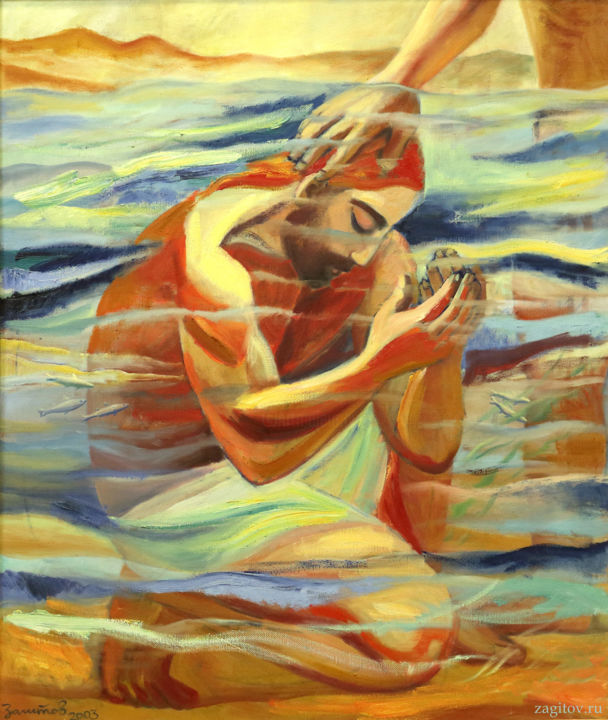
Painting: Baptism of Christ by Vladimir Zagitov

God Gets Physical

John 1:1-14

This past week, NASA launched the James Webb Space Telescope, a remarkable remote observatory that will travel 1.5 million kilometers, about 3.9 times the distance to the moon, before it parks itself in a Lagrange point—a kind of neutral zone in the tug-of-war between the sun’s gravitational pull and Earth’s gravitational pull.  There it will unfurl its highly polished mirrors made of gold-plated beryllium, and begin to stare deep into space—deeper than we have ever seen before with any other instrument.  As it peers into the depths of space it will also be looking back in time because the light it sees was generated billions of years ago.  It will be able to see celestial events that happened before the earth was formed.

The astrophysicists, astronomers, and engineers who designed and programmed the Webb Space Telescope have given it four primary missions:

  • to search for light from the first stars and galaxies that were formed in the universe after the Big Bang;
  • to study the formation and evolution of galaxies;
  • to study the formation of stars and planetary systems;
  • to study other planetary systems to see if they can tell us anything about the origins of life.

The writer of the Gospel of John didn’t have a telescope, but in a poetic way John did have a clear view of the beginning of all things.  In the beginning was the logos he said.  The Word.  The Blueprint.  The Narrative.  The Story.  The Content.  The logos was with God.  The logos was God.  All things came into being through the logos, and not one thing that came into existence came into existence except through the logos.  

Here in the prologue of John’s gospel, the logos is another term for Christ.  John is telling us about the Cosmic Christ who existed before all things, who is present in, with and under all things because all things came into being through the Christ.  Christ, the logos, is that aspect of the Divine Presence where Spirit intersects with matter.  Christ is in those distant stars and galaxies that the Webb telescope will show us.  Christ is in the giant nebulae and dust pillars that Hubble has shown us, those columns of interstellar dust and gas where stars are born.  Christ is in the quasars and pulsars, the black holes and gravitational waves and dark matter.

But Christ, the logos, is not just in the macrocosm. Christ is also in the microcosm.  Christ is in the strings of string theory.  Christ is in the strange interactions of quantum mechanics where quite literally anything and everything is a possibility.  Christ is in the anomalies of quantum flux. 

The writer of John goes on to tell us that Christ was not only in the inorganic dance of chemistry and physics, but that through the logos, through Christ, life came into being. Through Christ nitrogen and hydrogen and carbon and oxygen came together to form amino acids.  Through Christ amino acids formed long chain proteins which then formed protein blocks which then evolved into single-celled organisms.  Through Christ single-celled organisms bonded to form symbiotic colonies which then evolved to become multi-celled organisms.  Through Christ life began to take on more and more diverse forms.  Plants, ants, beetles, fish, mice, dinosaurs, cats and dogs, monkeys, apes, humans.  

John tells us that Christ was the origin of life.  In the logos was life, and that life is the light of all humanity.  I suspect that’s because humanity not only lives life, but we also seek to understand it.  

In an age when we have figured out so much about the essential structure of things in physics and the intricate functions of things in biology, an age when we have delved deep into the geology of our own world and have begun to poke into crust of other planets, it’s tempting to think we can explain esoteric things like existence without God in the equation.  But one of the beauties of real science is that the more we learn, the more we realize there is so much more that we don’t know.  Those who dive deepest soon realize there is no bottom, no stopping point, because they have thrown themselves into the mystery of existence.  As Werner Heisenberg said, “The first gulp from the glass of natural sciences will turn you into an atheist, but at the bottom of the glass God is waiting for you.” 

The word Christ, Christos, means anointed.  John is telling us that through the logos,through Christ, all of creation is anointed with, infused with the presence of God.  As Saint Paul said, God is never far from us because “in him we live and move and have our being.”[1]  Saint Patrick understood this intimate and inescapable presence of Christ when he prayed: 

“Christ with me, Christ before me, 

Christ behind me, Christ in me, 

Christ beneath me, Christ above me, 
Christ on my right, Christ on my left, 
Christ when I lie down, Christ when I sit down, 
Christ in the heart of everyone who thinks of me, 
Christ in the mouth of everyone who speaks of me, 
Christ in the eye that sees me, 
Christ in the ear that hears me.”[2] 

Then entire physical universe is where God hides…but it’s also where God is revealed.  God is not “up there” somewhere—well, not only “up there”—God is right here.  Christ is in you.  Christ is in me.  That is what Jesus, the Christ is all about.  Jesus came to show us that God is with us.  In us. Working through us.  “We spend so much time trying to get “up there,” says Richard Rohr, “we miss that God’s big leap in Jesus was to come “down here.” So much of our worship and religious effort is the spiritual equivalent of trying to go up what has become the down escalator.”[3]

Once we really accept the idea that through Christ God is present in all of creation, the world becomes “home, safe, enchanted, offering grace to any who look deeply.”[4]  The Webb Space Telescope will be looking deeply. It may even be able to see as far as the dawn of creation. There’s no telling what we will learn.  But whatever it shows us, it will simply be telling us more about Christ, in whom we live and move and have our being.


[1] Acts 17:28

[2] Prayer of St. Patrick, 5th century

[3] Richard Rohr, The Universal Christ: How a Forgotten Reality Can Change Everything We See, Hope For and Believe

[4] Ibid. 

What’s in a Name?

What’s In A Name?

Matthew 1:18-25

In Act II, scene II of Romeo and Juliet, Juliet is on the balcony lamenting the long-running feud between her family, the Capulets, and Romeo’s family, the Montagues.  Some ancient grudge that no one remembers keeps the two families at each other’s throats.  If you are born a Montague, any Capulet is your enemy.  And vice versa.  Their names are at war.  So Juliet, mooning over Romeo, protests to the night air:

‘Tis but thy name that is my enemy;

Thou art thyself, though not a Montague.

What’s Montague?  it is nor hand, nor foot,

Nor arm, nor face, nor any other part

Belonging to a man.  O, be some other name!

What’s in a name? that which we call a rose

By any other name would smell as sweet;

In one sense, of course, Juliet is absolutely right.  If you took away their warring surnames they would still be basically the same people—a couple of infatuated adolescents making bad decisions.  

In another sense, though, she’s absolutely wrong.  A rose by any other name might smell as sweet, but its name has power.  If I ask you to imagine a flower, you might imagine a daisy or a carnation or any number of other flowers.  But if I ask you to imagine a rose, you will not only see a rose in your mind’s eye, you might even smell its fragrance.  Names have power.

Do you have a nickname?  Most of the time—certainly not always—but most of the time we’re kind of fond of our nicknames.  A good nickname is a kind of gift.  You can’t make up your own nickname.  You really can’t even ask for one.  Nicknames just sort of happen, organically, or spontaneously.  One day friends or family just start calling you Goober or Dobie or Winkie or Duke and it just sort of sticks.

Nicknames are often descriptive in some way or have a story behind them.  And very often the use of that nickname is reserved for a certain circle of people.

My sister has a nickname.  It’s the name we in the family have always called her, in fact I sometimes have to think twice to remember her actual name.  All her close friends from high school and college know her by that nickname, but everybody else just knows her given name.  Her business name.  A couple of weeks ago she was Facetiming with her best friend from high school and one of her work colleagues overheard her friend call my sister by her nickname.  The colleague said, “Oh!  That’s a great nickname!  I’m going to call you that from now on.”   This left my sister in a quandary.  On the one hand, she likes this colleague well enough, but on the other hand, she’s not “that kind of friend.”  She’s not part of the circle that uses that name.  That nickname belongs to a particular group of people from a particular time in her life.  That nickname belongs to family and certain long-standing friendships that are almost family.

Names don’t just label us as individuals, they can also socially locate us.  They carry context.  My dad, for instance, was known to everyone in his work life and social life as John or J.B.  But his brothers and sisters and all his nieces and nephews called him Norman or Uncle Norman.  He was always known by his middle among family and among all the people who lived in rural area of the Ozarks where he grew up.  But the military and the government and the business world don’t make allowances for people who are known by their middle names.  All the standard forms that you have to fill out at one time or another ask for first name and middle initial.  Those forms essentially renamed my dad.  In doing so, they not only changed his official identity, they changed his self-understanding.

The names people use for us can shape us.  They say something about how we relate to each other, about who we are and what we do in the world.   My wife’s students call her Dr. B.  Her grandsons call her Nani.  Same person, different roles, different contexts.  

Titles are something like nicknames.  If I talk about Professor Studious or Doctor Pokenprobe or Senator Foghorn or Judge Fairheart,  for instance, their titles immediately tell you something about them.  If nothing else, you know something about their role and function in society.  It’s interesting that both officially and in common practice, the title becomes attached to the name and can even function as the name.   

Messiah is a title.  So is Christ—and let’s be clear, Christ is not Jesus’ last name.  Originally Messiah and Christ meant the same thing.  Anointed.  Messiah is Hebrew and Christ is Greek.  

Some of the oldest Greek manuscripts of Mathew 1:18 read, “This is how the birth of Messiah happened…”  These older manuscripts don’t include the name of Jesus at this point, but everyone understood that Jesus is who the writer was talking about.  Ever since Peter’s confession, those who followed Jesus knew him as Messiah or Christ.  The Messiah, the Christ, is Jesus.  When Matthew introduces this story with the title of Christ or Messiah he is not only telling us that this is a story about the birth of Jesus, but that it’s also a story about God’s mission in the world through the person of Jesus and those around him.  It’s a story of how God works through people like us—people with doubts, fears, misgivings, but also hope and grace and a willingness to trust, even if it means suspending disbelief to believe the unbelievable.  The name Messiah, Christ, carries all that weight.

This is how the birth of Messiah happened.  Mary was betrothed to Joseph.  It was named a betrothal, but it was in fact a marriage.  It just hadn’t been consummated yet.  “But before they came together,” Matthew tells us,  “she was found to have a child in her womb from the Holy Spirit.”  Mary is pregnant but she’s a virgin.  And that circumstance gave her a new name.  She will be known forever as Virgin Mary, and just saying her name brings the whole birth story of Jesus to mind.

Because the marriage isn’t consummated, Joseph plans to divorce her quietly and privately so as not to expose her to all the cruelty, ridicule and meanness that she might experience if he were to denounce her publicly.  Certainly it’s his right in these circumstance to shame her and her family along with her.  That would be regarded as perfectly righteous and just according to their law, tradition, and culture.  According to the law, she could even be stoned to death—although that was almost never actually done.  But Matthew tells us that Joseph is a just man.  A righteous man.  And now Joseph has another name:  Joseph the Just.  Fortunately for both Mary and Jesus, Joseph understands that there is more to being just and righteous than simply adhering to the letter of the law or meticulously observing cultural traditions.  Joseph understands that real justice, real righteousness requires compassion and mercy. 

The fact that he is unwilling to expose Mary to public shame says something really touching about his affection for her.  What he decides to do is, in fact, an act of love in its own way.  He decides to divorce her—to release her—but quietly.  Privately.  He doesn’t want to see her punished. 

It’s a good plan.  A grace-filled plan, but before Joseph can act on it, an angel intervenes in a dream and tells him to go ahead with the marriage because the child Mary is carrying was conceived by the Holy Spirit.  So now the unborn child has an additional name, a title:  Holy.

Joseph agrees to proceed with the marriage as instructed.  But the angel wants more from Joseph than just his forbearance.  The angel tells Joseph to name the child.

Naming a child is an act of adoption.  Even before the baby is born, the instruction to name the child creates a new relationship between the boy and Joseph.  Joseph will be his adoptive father.  The baby will be Joseph’s adopted son.

Joseph is told to name the boy Jesus.  Yeshua.  Which means God Saves.  That name will guide his destiny.  That name will define his relationship to all who follow him throughout history.  God saves.  Jesus saves.

What’s in a name?  Identity.  Relationships. History.  Even destiny.  Messiah is the long-awaited liberator who fulfills the hopes of the Jewish nation.  Christ is the savior of all humanity but also the very presence of God in, with and under all things in creation.  Jesus bears in his very name the message that God saves.

But Mary’s child, Joseph’s adopted son, has yet another name, and that name may be the most important one for all of us who long for the presence of God.  Matthew tells us that he will be called Emmanuel, which means “God with us.”  

To my mind, there is no name more meaningful, no rose as sweet as that one.  Emmanuel.  God with us.

Mothers of Reconciliation

Luke 1:39-45

Do you have any favorite relatives, favorite cousins, aunts, uncles?  If you found it necessary to make yourself scarce for a while, do you have a relative you know you could go stay with who wouldn’t judge you and would maybe even be glad to see you?  

Immediately after Gabriel told Mary that she was to be the mother of Jesus, Mary decided to get out of town.  Nazareth was a small town, and a small town is not always the friendliest place for a not-yet-married mother-to-be.  People talk.  And when they don’t have all the facts, they tend to invent them, often with an unkind or salacious spin.  So, the Gospel of Luke tells us, “Mary set out in those days and went in a hurry to a town in the hill country of Judah.”  In a hurry, with haste, Mary went to stay with her older, loving, wise, nonjudgmental relative, Elizabeth, who also happened to be miraculously pregnant.

If someone told you that you that you could only have one of the four gospels to read and study for the rest of your life, the Gospel of Luke would not be a bad choice.  Luke has a good sense for drama and he tells the story of Jesus in very human terms.  

Luke anchors his version of the Good News in history.  After a brief introduction, his narrative begins with the words, “In the days of Herod, king of Judea…”  He tells us that Jesus is born during the reign of Augustus Caesar, when Quirinius is governor of Syria overseeing the collection of the first census and poll tax.  He wants us to have historical context, not so much so we can pin events down to exact dates, but rather to give us a political, social, and cultural backdrop as he stages the story of Jesus.

Another reason to consider Luke if you could have only one gospel is that political and economic justice are important themes in Luke.  Jesus inaugurates his ministry in Luke’s gospel by reading in the synagogue from Isaiah 61, using Isaiah’s poetry to make it clear that his proclamation of God’s reign is all about good news for the poor, healing, justice and liberation (Luke 4).  Subversion of the dominant paradigm is insinuated between the lines.

In Luke’s gospel, the Holy Spirit is named more often and more directly and plays a more visible role than in Matthew and Mark and John.  Jesus tells more stories in Luke.  Some of our favorite and best-known parables are found only in Luke.  And Luke uses scripture from the Tanakh, the Old Testament, in subtle ways to link the story of Jesus to his ancestors, because when all is said and done, Luke understands that Jesus is the crowning glory of generations of his people and his family; his story is the ultimate chapter of a long continuous narrative about the trials, triumphs, and brokenness of God’s people.    

But if you only get to have one gospel, maybe the best reason to choose Luke is the women.  Women play a larger role in Luke and speak more in Luke than in any of the other three gospels.  And the things they say are prophetic. 

When Mary meets with Elizabeth, even their names are telling part of the story and linking them to the heritage of their people and a family tradition of liberation and new order.  The name Mary is a diminutive form of Miriam.  The name comes from the same root as myrrh and has multiple meanings:  bitter, beloved, rebellious.  Miriam in Exodus was a prophet, sister of Moses.  According to a tradition[1], when Pharaoh’s army was about to overtake the Israelites, Moses held out his staff and his hand to part the Red Sea, but Miriam is the one who led the people through the parted waves, calling the women to follow her, the women in turn then calling their men to follow them as they raised their tambourines and sang and danced her way across the dry path between the walls of water.   The name Elizabeth is a form of Elisheba from El shava, meaning “God is my oath.”  Elisheba was also part of the Exodus story.  As the wife of Aaron she became the mother of all the priestly line of Israel.  When Mary and Elizabeth meet, it is a meeting of generations of priesthood and prophecy, but in a marvelous twist the mother with the priestly name will bear a child who will become a prophet, and the mother with the name of a prophet will bear a child who will be later be called, “a high priest in the order of Melchizedek.”[2]

And where are the men in all this?  Absent or silent.  Elizabeth’s husband, Zechariah the priest, has been silenced because he did not believe the angel Gabriel when Gabriel told him that Elizabeth would bear a child.  He will not speak again until his son John is circumcised.  And Joseph, Mary’s betrothed?  The surrogate father of Jesus barely appears at all in Luke’s gospel. He is named only four times and never speaks.  And Luke gives the distinct impression, reading between the lines, that Joseph stayed behind in Nazareth while Mary went to see Elizabeth.  Luke tells us that when the order for the census came, “Joseph also went from the town of Nazareth in Galilee to Judea, to the city of David called Bethlehem…”[3]  The implication is that he stopped by the house of Elizabeth and Zechariah “in a town in the hill country of Judah” to pick up Mary on his way to Bethlehem.

The men are silent, but the women speak.  Oh do they speak.  When Elizabeth heard Mary’s greeting, the baby leaped in her womb and Elizabeth was filled with the Holy Spirit.  Elizabeth exclaimed with a loud cry, “Blessed are you among women, and blessed is the fruit of your womb.”  A loud cry.  Krauge megale it says in the Greek.  A very loud shout.  Elizabeth’s words are included in the prayer of the rosary, but I’ve never heard them shouted.  Hail Mary, full of grace, the Lord is with you.  BLESSED ART THOU AMONG WOMEN AND BLESSED IS THE FRUIT OF YOUR WOMB…

No, it’s not usually said that way. But wouldn’t it be wonderful if it was—to remind us of the great joy Elizabeth feels when she is filled with the Holy Spirit and recognizes the child that her young relative is carrying in her womb.  She speaks prophecy.  She speaks profound blessing.  Why should that be merely whispered or mumbled?  These are words of joy for the whole community of humanity!

This is a story of women proclaiming the Word of God.  This is a story of a family living out God’s power and presence.  God builds community, peoples, nations from proclamation and from families.  

Sadly, far too often proclamation is misguided and families are dysfunctional.  Too much of our story as a human family is a story of anger, disruption, fracture, and violence.  Maybe because the men have been doing most of the talking.  Too much history and not enough herstory. The descendants of Abraham fighting the descendants of Abraham—the children of Sarah and the children of Hagar locked in hostility for generations.  The descendants of one race locked in a vicious spiral of fear of and hatred for other races when we are all related in the human race, when we are all family.

These two women who meet in this unnamed town in the hills of Judah, these two women who rejoice loudly and prophesy in each other’s presence, these two women are the mothers of reconciliation and renewal.  Their sons will enter a fractured world of unreconciled peoples to bring a call for change and a vision for peace and understanding . God will use this family to bring healing and renewal to all families—to the whole human family—if we can learn how to listen. 

The son of Elizabeth will preach repentance, metanoia, a summons to change course.  The child of Mary will proclaim a direction for that change of course, a vision of the reign of God, a new way of being, a way of embracing our heritage and responsibility as children of God and siblings in humanity.  One will embody God’s call to be transformed.   One will embody God’s power of recreation and renewal.

These two women are family.  Their sons, these cousins, enter the world to remind us that we are all family, all related, all our stories intertwined.  Mary and Elizabeth remind us that God speaks and works through families even if it’s the slow work of generations.  Mary and Elizabeth remind us that God speaks and works through women to heal the world.  They are the mothers of John and Jesus.  They are chosen by God to be the mothers of renewal and reconciliation.


[1] Exodus 14-15

[2] Hebrews 5:10

[3] Luke 2:4

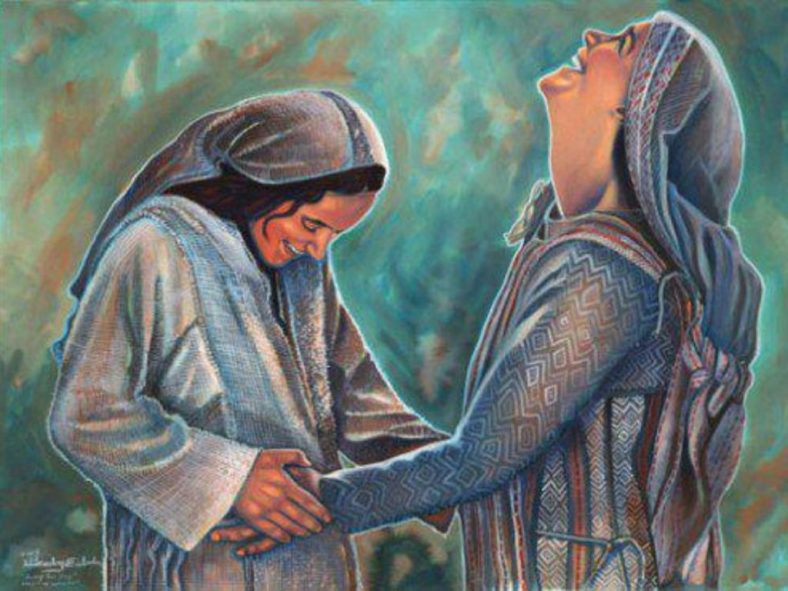
Painting by Corby Eisbacher @ArtByCorby

Look Again

Luke 1:26-38

“In the sixth month the angel Gabriel was sent from God into a town in the Galilee called Nazareth, to a virgin betrothed to a man whose name was Joseph, of the house of David. And the name of the virgin was Mary.”  If you’ve been a Christian for more than five minutes, you’ve heard these words before.  These are the opening words of The Annunciation, that part or the Christmas story we all know and love so well when Gabriel tells Mary she will become the mother of Jesus.  We know this story.  We know this episode of the story by heart.  But I wonder… When is the last time we really listened to it or read it carefully?

Look again at the opening line: “In the sixth month the angel Gabriel was sent from God into a town in the Galilee called Nazareth…”  I have always pictured Gabriel just suddenly appearing before Mary and probably startling her.  Certainly it’s depicted that way in any number of paintings.  But look at what Luke has actually written here—he is bringing the focus of the story from heaven to earth, to a specific territory, then a town, then to a person.  Gabriel comes from God to Galilee to Nazareth to Mary.  As I re-read this, I suddenly had a picture of Gabriel arriving unseen on a hilltop in Galilee then making his way down the hill past grazing goats and sheep to the road, cloaking himself to look like a traveler as he made his way into town and found his way through Nazareth’s dusty streets until he came to Mary.  Maybe she saw him coming and was watching him as he walked toward her house.  Maybe she wondered who this mysterious stranger might be as he approached and then became a bit wary as she realized he was coming directly toward her. Maybe she thought he had some business with her father. 

When you picture it this way, it opens you up to the idea that maybe angels walk among us all the time.  Maybe they emerge from heaven make their way into town then find their way through the streets until they get to where they were sent.  It makes you wonder how many times you might have walked right by an angel or sat a few seats away from one at McDonalds.  

So maybe she saw him coming, but even if Mary had seen Gabriel approaching, it really would have been a surprise when he spoke to her.  And what he said was so unusual: “Rejoice, favored one!  The Most High God is with you!”

Between timidly formal translations, millions of persons repeating the rosary millions of times,  and Franz Shubert’s lovely but overly romantic musical setting of Ave Maria, the shock value of Gabriel’s greeting was bled off a long time ago.  And that’s unfortunate, because what he said rocked Mary’s world and, if we’re paying attention, should rock ours, too.  

Hail Mary, full of grace?  Not exactly.  First of all, “Hail” or “Greetings” are subdued translations of the angel’s first word to Mary.  “Chaire!” is what he says.  It can mean “greetings” or “hail” but those are timid choices.  Chaire!, which is what Gabriel says in the original Greek text, is the imperative form of Chairo – to rejoice!  Rejoice, favored one!  The Most High God is with you!  Rejoice!

No wonder Mary was “thoroughly troubled by what he said and tried to discern what sort of greeting this was.”  Some translations say she “pondered” what sort of greeting it was, but the sense of the Greek word, dialogizemai, is that she had a pretty serious inner conversation with herself as she tried to sort it out.  The word dialog is in the word and the word means inner dialog, to think or thoroughly reason through something.  It’s easy to read right past all that, or listen right past it, but this is one of the places where we really are supposed to slow down or even stop for a moment and stand a moment in Mary’s bare feet.  

Imagine what she was thinking.  Who is this mysterious stranger?  Why is he telling me to rejoice? Why is he even talking to me, which is not exactly smiled upon in our society, and why did he call me “favored one?”  Favored by whom?  What does that mean?  He said the Most High God is with me.  Why me?  What makes me so special?

Now imagine Gabriel watching her as she puzzles through his words and wonders about his intentions.  Imagine him seeing that she is thoroughly troubled by his presence and what he’s said.  Imagine him letting her take a good long moment to think before he speaks again.

“Fear not, Mary, for you have found favor with God.”  That’s the second time he has told her that she is favored.  Favored by God.  

And now he will tell her what that favor brings with it.

“You will conceive in your womb and give birth to a son, and you will name him Jesus.  He will be great and will be called the Son of the Most High, and the Sovereign God will give him the throne of his ancestor David. He will reign over the house of Jacob forever, and of his sovereignty there will be no end.”[1]

“Hang on a minute,” said Mary.  “Let’s back up to the ‘conceive in your womb’ part.”  Actually, what Mary said is better than that.  “Mary said to the angel, ‘How can this be since I have not known a man intimately?”  In one question she does three things: she lets the angel know that she knows how babies are made, she makes it clear that she has no personal experience of that kind of relationship, and she challenges the divine messenger to explain how this impossible thing will be accomplished.  

The name Israel means “wrestles with God” or “contends with God.”  It is an important part of the tradition of Israel to question God, to ask for explanations, to challenge God or bargain with God.  Jacob physically wrestled with God.  Abraham bargained with God.  Moses tried to talk God out of using him to lead the people because he wasn’t good at public speaking.  Elijah on the mountain top begged God to just go away and let him die.  And now Mary, good daughter of Israel, says to God’s messenger, “Hang on a minute…I know how this works and what you’re describing is simply not possible under the current circumstances.”

It’s okay to argue with God.  There is a lot of precedence.  If you find yourself arguing with God, contending with God, questioning God, you’re in good company.  

“How can this be?” asks Mary.  So Gabriel explains how it can be.

And here is a place where we have missed something important in just about every English translation ever.  In Greek, the word spirit, pneuma, is gender neutral.  All our translations simply say, “The Holy Spirit will overshadow you.”  What we miss is this:  Mary, in Nazareth in Galilee, would have been speaking either Aramaic or Hebrew, most probably Aramaic.  In both Aramaic and Hebrew, the word for spirit is feminine.  Ruach in Hebrew.  Rukah in Aramaic.  

So what Mary heard Gabriel say would have been something like this: “The Holy Spirit, She will come upon you and the power of the Most High will overshadow you; therefore the one born will be holy.  He will be called Son of God.”[2]

The feminine aspect of God would envelop her and bring the power of God to do the impossible.  

What does that do to your understanding of this story?  What does that do to your understanding of who God is and how God works? 

Gabriel then tells her that her pregnancy is not the only “impossible” conception.  Her kinswoman, Elizabeth, well past child-bearing years has also become pregnant.  “For nothing will be impossible with God.”

Mary surrenders to God’s plan.  Mary surrenders to God.  And once again, most of our translations have drained most of the power out of Mary’s words by being too genteel.  Most of our translations say something like, “Here am I, the servant of the Lord.”  Some use a more gender-specific term; she calls herself a handmaiden or maidservant.  But what she actually says is, “Look!  The woman-slave of the Lord.  Let it happen to me according to your word.”

“Look, Angel.  See me.  See what saying yes to God, yes to this plan will make me.  You make it sound so glorious.  You tell me I’m ‘favored.’  But I know that saying yes to all this makes me a slave.  So look.  See the slave woman of the Lord.” 

Have you heard a different story now?  Have you heard this familiar story in a different way?

What is the takeaway?  For me there are four.

  • If you take time to look again at things you think you already know, you can learn a lot.  You can hear old stories in new ways.  And maybe they can speak to you in a new way to draw you deeper into the mystery of the presence of God.
  • It’s okay to wrestle with God, to debate and discuss and challenge God when God is calling or challenging you to embark on something impossible.
  • When you do say yes to the thing God is asking, God will take you at your word, so it’s best to surrender completely.  Mary understood that.
  • When God asks you to do the impossible, it helps to remember that “nothing will be impossible with God.”  And you have an angel’s word on that.

[1] Translation by Dr. Wilda Gafney, A Woman’s Lectionary for the Whole Church, Year W

[2] Ibid.

Dear Pontius Pilate

Dear Pontius Pilate

John 18:33-38a

Dear Pontius Pilate,

I have spent much of this week reviewing a single moment from your life, to be specific, your brief interrogation of Jesus of Nazareth.  Surely you remember it.

One of the advantages I have, looking at this moment twenty one centuries after the fact, is that I know things you could not possibly have known. You could not have known, for instance, that this moment when Jesus stood before you was, in fact, a pivotal moment in the history of all humanity.  I’m sure that to you he just looked like another troublemaker and the whole business seemed needlessly tiresome.  As he stood in front of you awaiting judgment, with his overeager accusers prodding you from the wings and insisting on his execution, how could you possibly have known that your decision either way would have repercussions that would change the course of history?  I wonder…if you had known how monstrously important your moment with Jesus really was, would it have changed your decision? Would you have taken more time to think about it?  To make your choice?

After your exchange with him about whether or not he was a king or had made any claim to be a king—an issue which, it seems, was left somewhat unresolved—Jesus said something that was both intriguing and a bit enigmatic.  He said, “For this I was born, and for this I came into the world, to bear witness to the truth. Everyone who belongs to the truth listens to my voice.” 

That last part is a little tricky in translation—that’s one of the problems with reviewing things centuries after they happened.  Details can become blurred.  Languages don’t always translate precisely.  Words and phrases seldom bring their cultural context with them when they plunge into a new language.  Did Jesus say “everyone who belongs to the truth” or “everyone who is of the truth” or “out of the truth” or “from the truth”?  All these are reasonable and acceptable translations of that potent little Greek word ek.  The differences in meaning are subtle, but not unimportant.  The choices we make in how we choose to hear it carry weight.  Personally, I like belongs.  It reminds me that truth, even as a philosophical concept, is bigger than I am.  Truth is my master, I am truth’s servant.  This means, of course, that I must be very careful that it’s not my own subjective version of truth or my wishful thinking version of truth that I am serving.  I have to be careful that I haven’t bound myself in service to a propaganda version of truth.  I belong to truth.  It owns me.  So I listen to the voice of Jesus.

You asked a simple question in response to Jesus.  Well that’s not quite true.  It’s not a simple question at all.  It is, in point of fact, a question that has kept various philosophers, theologians, and even scientists awake at night for two millennia.   Three small words in our language, also in your language, and also the ancient Greek that handed the question down to us:

Quid est veritas?  What is truth?

Were you being cynical when you asked that, my dear Prefect?  Or did you ask it, as Frederick Buechner suggests, with a lump in your throat?  Is this a question that had kept you awake at night, also?  Or had you dismissed the whole idea of objective truth after so many years on the judgment seat hearing people give competing versions of “the truth”?  

Did it occur to you for even an instant, my dear Pontius Pilate, that the truth was standing right in front of you as you asked the question?  Did it occur to you that the truth was not an idea or philosophical concept, but rather a person?

The truth was standing right in front of you, Prefect.  I don’t say that out of piety.  I don’t say it to be in conformity with the holy writings that arose from his followers in the years after your time with him.  I don’t say it merely to resonate with his own words when he said, “I am the way, the truth, and the life.”  I say it, dear Pontius Pilate, because it is true. Objectively true. The answer to your question, the truth, was standing right in front of you.

Here is the truth that you were not seeing, my dear Pontius, as Jesus stood before you in silence with his hands tied and his fate all but sealed:

Heaven was confronting empire.  

As you faced each other, it was more than Jesus of Nazareth fronting Pontius Pilate of Rome.  In you, Prefect, was all the relentless and violent might of the empire spilled down through its systems of hierarchy and bureaucracy.   In you was oppression and military organization used ruthlessly to maintain efficiency, protect investment, and continue the empire’s  domination.  All that might and power and agenda was condensed into your title, Prefect.  And in that moment with Jesus, all the authority of that title was condensed into your word, your yes or your no.  

Across from you was Jesus, unadorned humanity in the image and likeness of God.  Challenging your word of imperial authority, your yes or no, was the yes of life,  the yes of creation, the yes of generosity, the yes who spoke light into the shadowy hearts of all humanity.  Creation, life, the light of understanding, love, which is the presence of the divine, grace and her twin sister mercy, equity and her twin sister justice—these things have always been opposed to empire, and Jesus of Nazareth embodied all this as he stood facing you in silence.  Standing before you was one in whom the fullness of God was pleased to dwell.  

All the natural flow and goodness of earth and heaven was standing before the empire’s paranoid, overzealous, and slightly incompetent middle management, waiting for a decision.  

But so was everyday life.

The truth came before you, Pontius, in plain clothes.  Truth came to you as one of the invisible people you passed without seeing as you rode your chariot through the city.  Truth came before you already roughed up and mistreated by those with less authority but more fear, anger, and frustration.  Truth stood before you as one of the little people.

Truth came as a workman turned rabbi, a teacher who was trying to open the eyes and widen the embrace of his people—of all people—a teacher who was trying to give us a larger vision of how life could be with real justice and real fairness and real concern for persons.  He was trying to show us how life could be in a kin-dom of God where we love our neighbors as ourselves.  

The truth stood before you armed only with words and a vision, the most powerful tools humanity has ever known.  But words and vision have always found themselves contesting swords and spears because empire knows that words and vision are inevitably its undoing. 

Heaven confronted empire, Prefect, and heaven came armed with nothing but truth, words, and vision. 

“What is truth?” you asked.  Can you see now, my dear Marcus Pontius Pilatus, that truth is not an idea, nor merely empirically proven facts?  Can you see yet that truth is a person?  All of us stand in that truth one way or another.  And empire will always have trouble seeing that.  The light shines in the darkness, but the darkness has never understood it.  

Truth was staring you in the face, Prefect.  

Know that truth, Pontius, and the truth will make you free.