Body Language

John 6:51-58

“Very truly, I tell you,” said Jesus, “unless you eat the flesh of the Son of Man and drink his blood, you have no life in you.”  This is such graphic language.  Well, let’s be honest.  It’s more than graphic, it’s cannibalistic.  Eat my flesh?  Drink my blood?  It’s no wonder the Ioudaioi—those Jews who were challenging Jesus at every turn—it’s no wonder they found what he was saying confusing and even repulsive.  

Just to be clear, the word translated here as “flesh,” sarx in the Greek, essentially means meat.  And blood. . . well, blood is blood is blood and it is absolutely forbidden for an observant Jew to eat or drink it, or even to eat meat with the blood still in it.  “For the life of the flesh is in the blood,” says God in Leviticus, “and I have given it to you for making atonement for your lives on the altar, for, as life, it is the blood that makes atonement. Therefore I have said to the Israelites, ‘No person among you shall eat blood, nor shall any alien who resides among you eat blood.”[1]  That’s the rule for the blood of sheep and goats and cattle and every other animal, so for Jesus to tell people crowding around him that they need to eat his flesh and drink his blood would be beyond shocking.

So why does Jesus use such scandalous language here in the sixth chapter of John? 

The rhetoric of cannibalism had a long tradition in the ancient world because it was particularly effective for its shock value when someone really wanted to drive home a point. In the 26th chapter of Leviticus we find a series of blessings and curses that are a sort of codicil to the covenant between God and the people of Israel.  If the people remain faithful to the covenant,  God will make the land rich, the trees will yield plentiful fruit, enemies will be routed, the rains will fall in due season, and so on.  One of my favorite things God says here is “I will place my dwelling in your midst, and I shall not abhor you.”  Not exactly warm and fuzzy. 

On the flip side, the curses for breaking the covenant are pretty severe:  fields that don’t produce, famine, wild animals killing children and destroying the fields and vineyards, and finally the ultimate curse, being attacked by enemies and held under siege so that “you shall eat the flesh of your sons, and you shall eat the flesh of your daughters.”

Torah repeats the curse in Deuteronomy[2], and Jeremiah and Ezekiel both expand on the threat of cannibalism as a reminder to the people that being unfaithful to the covenant has penalties[3].  

The prophet Micah uses the rhetoric of cannibalism as a sharp polemic to chastise the unfaithful rulers of Judah and Israel:

Listen, you heads of Jacob

                  and rulers of the house of Israel!

         Should you not know justice?—

                  you who hate the good and love the evil,

         who tear the skin off my people

                  and the flesh off their bones,

         who eat the flesh of my people,

                  flay their skin off them,

         break their bones in pieces,

                  and chop them up like meat in a kettle,

                  like flesh in a caldron.[4]

Yikes.

The invective of cannibalism was common throughout the Greco-Roman world and was most commonly used to denounce treachery, betrayal, faithlessness, factionalism and threats to society.  Homer described the warriors arrayed against Troy as blood-thirsty predators.  Agamemnon’s vicious fighting style is compared to “wolves, who tear flesh raw” and  Achilles’ rage is so intense that he desires to cut up Hector’s flesh and eat it raw.  In a historically later example, Cicero vilified Mark Antony saying, “he gorged himself with the blood of citizens.”

The upshot of all this is that the people listening to Jesus have heard this kind of jargon before, but not the way Jesus is using it.  Jesus, here in chapter six of John, takes this all this unsavory language and subverts it—he reverses its direction.  Instead of a curse for breaking the covenant, eating his flesh and blood become the seal and sign of a new covenant with God through him.  Instead of being a threat of the worst kind of destruction, his flesh and blood bring the promise of eternal life. Instead of fearing the gruesome penalty for causing strife, divisions and factions in society, his followers will be bonded into a profound unity with him and with the Father, a unity so deep that “those who eat my flesh and drink my blood abide in me and I in them.”

When Jesus refers to himself as “the living bread that came down from heaven” then goes on to say “Whoever eats of this bread will live forever, and the bread that I will give is my flesh for the life of the world,” this is obviously sacramental language.   He is pointing to the cross, but also beyond the cross to the table of companionship and the eucharist that binds us to Christ and to each other.

When he describes himself as “the living bread come down from heaven” and asserts that he gives his flesh “for the life of the world,” he is claiming for himself the mystical descriptions of John’s prologue in the first chapter.  He is telling us that he is the Word who became flesh and lives among us.  He is telling us that he is the one in whom there is life, a life that is the light of all humanity.  He is, in short, telling us that he is the Cosmic Christ, the Word who was with God, the logos who brought all things into being.

Eli Lizorkin-Eyzenberg wrote, “[W]hen Jesus referred to his body and blood, he meant the bread and wine should become, in the minds and hearts of his followers, fully associated with him in the entire spectrum of his life – his person, his teachings and his works. In other words, Jesus expected to be fully understood and received through active participation by faith. By faith in Him, the believer would partake of salvation, which is found in Jesus alone and is offered freely to all. So let me summarize. Jesus’ statement about his body and blood is true and no other picture could have made it clearer. His flesh and his blood, meaning Jesus Himself – the whole Jesus – is the only thing that can sustain a human being to life everlasting.[5]

The central theme of the Gospel of John is incarnation, a word that literally means “in the flesh.”  Christ is the intersection, the nexus between the spiritual and invisible God and the visible material creation.  Jesus, as the Christ, is God’s declaration that God is present in, with, and under all of creation.  The bread and wine of communion is our reminder that Christ is present in, with, and under the everyday things of life that sustain us, that God in Christ is sustaining us and traveling through life with us.  “Those who eat my flesh and drink my blood abide in me and I in them,” said Jesus.

When we share the sacrament of the table, we are reminded that Jesus has bound us together to be the body of Christ, to carry the life that brings light to the world into the world for the life of the world.

 “Both Christ cosmically and Jesus personally make the unbelievable believable and the unthinkable desirable,” said Richard Rohr.  “Jesus Christ is a Sacrament of the Presence of God for the whole universe!”  Rohr went on to say, ““We must keep eating and drinking the Mystery, until one day it dawns on us, in an undefended moment, ‘My God, I really am what I eat! I also am the Body of Christ.’[6]


[1] Leviticus 17:11-12

[2] Deuteronomy 28:53ff

[3] Jeremiah 19:9; Ezekiel 5:10

[4] Micah 3:1-3

[5] Lizorkin-Eyzenberg, Eli. The Jewish Gospel of John: Discovering Jesus, King of All Israel, p. 97. Jewish Studies for Christians. Kindle Edition.

[6] Richard Rohr, The Universal Christ: How a Forgotten Reality Can Change Everything We See, Hope For and Believe

Asking the Wrong Questions

John 6:24-35

When I read this morning’s gospel lesson, I was reminded of something Annie Dillard wrote in A Pilgrim at Tinker Creek.  Pilgrim at Tinker Creek is a wonderful and thought-provoking little book, by the way, full of wisdom and pithy observations that get right to the heart of things as she thinks about life, and nature.  And God.  Anyway, here’s the part that came to mind as I read this morning’s gospel.  Annie had been listening to a mockingbird singing from her chimney, and she found herself wondering, “What is she saying in her song?”  But then she paused and thought,  “No; we have been as usual asking the wrong question. It does not matter a hoot what the mockingbird on the chimney is singing. If the mockingbird were chirping to give us the long-sought formula for a unified field theory, the point would be only slightly less irrelevant. The real and proper question is: Why is it beautiful?”  

Why is it beautiful?  That’s a transcendent question.  That’s a question that leads us more directly into an encounter with Christ’s presence in the song the mockingbird sings.  Why is there something in me that finds that lilting melody beautiful?  Why is there something built into me that thrills to life when I encounter beauty?  Why does anything that’s truly beautiful—the song of the mockingbird, the colors of sunrise or sunset—why is it that something that’s truly beautiful creates in us a sense of longing?  

If you start to ask those kinds of questions, you are on your way to encountering the sublime presence of Christ that surrounds us all the time and everywhere.  You’re on your way to what Richard Rohr calls “falling upward” into the Ground of All Being in whom we live, and move and have our being.

You can’t find the right answers in life if you’re asking the wrong questions.  

That’s one of the things that’s happening in today’s gospel; the crowd is asking Jesus the wrong questions.  They had followed him across the lake to the outskirts of Tiberius, and when they got hungry, Jesus fed them—the whole multitude—by sharing out 5 loaves and two fish that a young boy had brought with him.  At nightfall, Jesus slipped off into the hills to be alone for a while and the disciples quietly sailed back home toward Capernaum.  

The next morning, when the crowd saw that Jesus and the disciples were gone, they headed back across the lake to Capernaum to look for Jesus.  And when they found him, the first thing they asked him was, “Rabbi, when did you come here?”

It’s the wrong question.  It doesn’t lead to anything—at least not to anything useful and not to anything Jesus is interested in discussing.  So he cuts to the chase. “I tell you the solemn truth,” he says.  “You are looking for me not because you saw miraculous signs, but because you ate the loaves and had all you wanted.”  

He sees right to the heart of their motives.  Our motives.  How often do we seek out God, how often do we come to Christ saying, “Take care of my needs.  Satisfy my hunger.  Fulfill my desire.”?  We may not be saying it out loud, or we may be saying it in very prayerful language, but how often when we come to Jesus are we basically saying, “Jesus do the magic again.  Solve my problem.  Fix my situation.  Fill my hunger.”

“Do not work for the food that perishes,” says Jesus, “but for the food that endures for eternal life, which the Human One will give you. For it is on him that God the Father has set his seal.”  Change your focus, says Jesus.  You’re overlooking what matters.

But do they say, “Tell us more about that food that endures for eternal life.  What is that?  Who is the Human One—is that you?  What are you talking about exactly?”  No, they don’t say any of those things.  Instead, when they realize he’s not going to do the bread trick again and give them a late breakfast, they ask him, “What do we have to do to perform the works of God?” 

This is actually a good question, but they’re thinking about it the wrong way.  They seem to be looking for some secret incantation or special prayer that will enable them to do miracles.  The way they’re thinking about it, it’s a controlling question.  They want to know how they can get God to do what they want.  They want Jesus to teach them the magic trick.  It’s clear that they don’t really understand what they’re asking.  They ask how they can do the works of God, but they don’t even know what the work of God is.

So Jesus once again redirects.  “This is the work of God,” he says.  “Believe in him whom God has sent.” 

And now they’re finally starting to catch on that he’s talking about himself.  So they say to him, “What sign are you going to give us then, so that we may see it and believe you? What work are you performing?”  And then they go on about Moses giving their ancestors manna in the wilderness.  “Bread from heaven” they call it.   It’s more than a little ironic, really.  You want a sign?  Did you not eat your fill at yesterday’s picnic—that little miracle that started with 5 loves and 2 fish?  Have you not seen all the healings?  Once again Jesus has to redirect.

“I tell you the solemn truth,” says Jesus, “it was not Moses who gave you the bread from heaven, but it is my Father who gives you the true bread from heaven.  For the bread of God is that which comes down from heaven and gives life to the world.”  

“Well then give us this bread all the time!” That’s their response.  And it sure sounds like they’re still thinking about, well, bread.  Magic bread from heaven, maybe.  But bread.  They asked for the right thing this time, but they’re still thinking of it in the wrong way.  They’re missing the point.  So Jesus spells it out for them.

Jesus said to them, “I am the bread of life; the one who comes to me will never go hungry, and the one who believes in me will never be thirsty again.”

Blaise Pascal once said, “There is a God-shaped vacuum in the heart of every person, and it can never be filled by any created thing. It can only be filled by God, made known through Jesus Christ.”  Jesus is the bread of life who fills that hunger.  Jesus is the living water who quenches that thirst.  But we won’t come to a useful understanding of what that means if we’re asking the wrong questions or getting distracted with trains of thought that don’t go anywhere.  If we’re just thinking about physical food, we’re going to completely miss the spiritual nutrition that Jesus is providing.  And the irony here is that the spiritual nutrition Jesus brings us can help to feed the physical hunger of the world if we let that spiritual nutrition teach us to imitate his actions in our everyday world.

We tend to think that to believe in Jesus means that we intellectually or emotionally accept certain things about Jesus: that he is the Son of God or God incarnate, or that his death and resurrection somehow erases all our sin.  But to believe in Jesus also means to trust him, to follow his example.

After he fed the 5000 people on the hillside near Tiberias, the crowd that followed him back to Capernaum wanted to know what they had to do to “do the works of God.”  “Well to start with,” he told them, “trust the teacher God has sent you!”  He wanted them to realize that he wasn’t hiding anything or withholding any secrets. That day on the hillside he had shown them exactly how to “do the works of God.”   He took what was available even though it looked like it couldn’t possibly be enough—five loaves and two fish contributed by a boy in the crowd—he took what was available, he gave thanks for it, and he started handing it out.  

I want to share some statistics with you from ELCA World Hunger.  Today, right this very minute, in a world that by God’s grace provides more than enough food for everyone, more than 2 billion people aren’t sure where their next meal will come from.  For as many as 838 million of them, that next meal won’t come at all.  Not today, anyway.  And maybe not tomorrow.  Or the next day.  Two million children die every year from malnutrition.  There is a huge gender imbalance among the hungry:  84.2 million more women and girls face food insecurity than men and boys.  And food insecurity is not just a third world problem.  Seventeen million households in the United States face food insecurity.  Every day.  And yet supplemental food programs are often the first thing on the chopping block when budgets get tight.  

Just this week, the City of Los Angeles decided to discontinue the Rapid Response Senior Meals Program, a program that has been a lifeline for 5800 homebound low-income seniors.  Sixty-year-old Leo Del Rosario is one of the people who counts on that daily meal.  He has not been able to work regularly since he had heart-valve surgery last year.  To cut costs, he moved out of his apartment and has been renting a bedroom in a house.  When asked what he’s going to do without the city-provided meal he said, “Not to be dramatic, but you do what you have to do, right?  There’s always peanut butter.”  He went on to say that he would call on family and friends but try not to be a burden, then he added, “I will pray God’s grace, work hard, and implore City Hall to reconsider.  How we take care of our elderly is a reflection of ourselves and our society.”

How we take care of each other is a reflection of ourselves and our society.  It is also a barometer of our faith.  “The bread of God,” said Jesus, “is that which comes down from heaven and gives life to the world.”  Sometimes God uses our hands to hands to carry that life to the world. 

When Jesus says that he is the bread of life, he is telling us to swallow him whole, to take him completely into ourselves so that we can be completely complete in him and so that he can be at work in us.  That’s what the sacrament is all about.  It’s a sign—not merely a symbol, but a sign.  It points to Christ.  It tells us what to do.  Take and eat.  Taste and see the goodness of the Lord.  Share.  He wants the deepest level of intimacy possible with us.  He wants us to be completely infused with who he is and what he is about and how he lives in and loves us, and how he lives in and loves the world through us.  He wants to be part of our very cells so that wherever we go, he goes, too.

But we won’t get to that level of intimacy and understanding if we’re always asking Jesus the wrong questions or focusing on the wrong things.  Learning to ask the right questions is vitally important in your own relationship with Jesus, and it’s also hugely important in our life together as followers of Jesus.

What are some of the wrong questions we’ve been asking as a church?   I know I’ve been asking, “Lord, how can we get more people into the church?”  Maybe what I really should be asking is, “Lord, how can we bring the church to more people?” or simply “Lord, who are we missing and why?  What do they need that we can give them?”  

Or maybe we should be asking for something even more basic and broader than that.  Maybe we should be asking, “Jesus, help us to see you more clearly in, with, and under all things.  Help us to see the image and likeness of God in every face we face.  Help us to love them as deeply and completely as you love them.  Help us to fall upward into the fullness of you.  Make us carriers of your compassion.  Help us to see the beauty of your generosity in the world.

And when we hear the mockingbird sing, help us to understand why we find it so beautiful, why it touches our hearts, and what it is we’re longing for.

Sheep Without a Shepherd

The following was written on 7/20/24 and preached on the morning of 7/21/24 at Christ Lutheran Church in Orange, California mere hours before President Joe Biden announced that he was withdrawing from his campaign for a second term an endorsing Vice President Kamala Harris to be the Democratic Party’s candidate. I have profound respect for President Biden and I deeply appreciate his leadership over the past four years.

Mark 6:30-34, 53-56; Psalm 23; Jer. 23:1-6; Eph. 2:11-22

When the disciples regrouped with Jesus after their first solo mission, they were excited to tell Jesus, “all they had done and taught.”  Jesus, for his part, wanted time to debrief them and give them some more personal attention, plus, he realized that they were all due for a break, so he said, “Let’s get away by ourselves for a while. Take some time to rest, and you can tell me all about it.”  

So, they set off in a boat, heading for a deserted place up at the end of the lake, but the crowds spotted them, and by the time they beached the boat at the deserted spot it wasn’t deserted anymore;  a large crowd was waiting for them.  

When Jesus saw all those the people, he wasn’t angry or disappointed or frustrated, even though it was pretty clear that their private retreat wasn’t going to happen now.  Mark tells us, “As he went ashore, he saw the crowd, and he had compassion for them, because they were like sheep without a shepherd.  And he began to teach them many things.”

They were like sheep without a shepherd.  

The people were starving for guidance.  

Oh, there was no shortage of authority figures.  On the political level there was Herod Antipas functioning as their local “king,” and if that still left them with idle time on their hands, there were plenty  of Roman soldiers and functionaries ready to lord it over them.

On the religious side of things there were Pharisees admonishing them to rigorously keep Torah, scribes collecting their tithes and telling them how Torah was to be officially interpreted, and priests conducting sacrifices on their behalf.  

They had all kinds of authority figures.  But they had no guidance.  They didn’t need another overseer.  They needed a shepherd.  

Mark is specific in calling out the people’s need for a shepherd because shepherd was a term that had a deep resonance and rich history with his audience.  It was a term often associated with the patriarchs, monarchs and heroes of the nation. Abraham, Isaac and Jacob were shepherds.  Moses was working as a shepherd when he encountered the God in the burning bush.

David was the biblical paradigm of a shepherd and David, himself, wanted to make it clear that Israel’s first king, Saul, was not a good shepherd.  In the opening of his most famous psalm, Psalm 23, which was probably written while he was fighting to overthrow King Saul, David throws a clear jab at Saul with the opening line. “The Lord is my shepherd,” he writes.  Not Saul.  The Lord.  He goes on to describe all the comfort, nurture and protection that the Lord provides, all things which stand in sharp contrast to the abuse he suffered under Saul.  Later in the psalm David asserts his claim that he has been anointed by God to replace Saul, his enemy: “In the presence of my enemies,” he says, “you anoint my head with oil.”

If that reading of Psalm 23 sounds odd to you, I invite you to remember that there was no punctuation in the original Hebrew.  The line breaks and couplings we are familiar with come from the King James translation team who had an agenda quite different from King David’s.

The prophets often denounced bad or corrupt national leaders as unfaithful shepherds who had abused their flocks or even scattered them.  Jeremiah, writing as the Babylonians were bearing down on the Kingdom of Judah said, “Woe to the shepherds who destroy and scatter the sheep of my pasture! says the Lord!”  He clearly blamed the kings before and after Josiah for the fact that Israel was already lost and Judah was  about to be crushed by the might of Babylon.  He knew all was lost but he could also foresee a day when hope would be restored: “I will raise up shepherds over them who will shepherd them, and they shall no longer fear or be dismayed, nor shall any be missing, says the Lord.”  

In contrast to the failed or corrupt shepherds denounced by the prophets, the Good Shepherd becomes a figure repeated by the prophets as a symbol of messianic promise to carry the people through dark times.  “The days are surely coming, says the LORD, when I will raise up for David a righteous Branch,” wrote Jeremiah,  “and he shall reign as king and deal wisely and shall execute justice and righteousness in the land.  In his days Judah will be saved, and Israel will live in safety. And this is the name by which he will be called: “The Lord is our righteousness.”  

Isaiah continued the theme of the Good Shepherd.  “He will feed his flock like a shepherd; he will gather the lambs in his arms, and carry them in his bosom.”  The Good shepherd is sometimes envisioned as the new David. “I will set over them on shepherd, my servant David,” wrote Ezekiel. “He shall feed them and be their shepherd.  And I the Lord will be their God, and my servant David shall be prince among them.”

Jesus had compassion on the crowds who followed him so relentlessly.  He knew they were following him for the same reasons they had followed John.  They were looking for a shepherd.  

It would be easy to say they needed leadership, but they needed a special kind of leadership.  They didn’t want or need another leader making pronouncements from a throne or pontificating in the synagogue.  They needed a leader who walked among them, who shared their bread, who touched them with healing hands.  They needed a leader who could inspire them with a vision to make life meaningful and not just another plan to control them.  

They needed a shepherd.

I have to tell you, I feel such a connection to those people who ran ahead, that crowd that was waiting on the shore and hillside when Jesus stepped off the boat.  Those sheep without a shepherd.  They are us.  

We are in a strange and precarious state in our country right now.  We are barely keeping the lid on chaos and turmoil as we try to make our way through the riptides of this pre-election season.  For a host of reasons, many of them having to do with media, we find ourselves in a crisis of leadership at a moment when we need real leadership to guide us as we think through the process of selecting our future leaders.  We need candidates who will honor and guard the integrity of that process.  We need to feel confident that whomever we select will be a person of integrity because, as Dwight Eisenhower said, “The supreme quality of leadership is integrity.”

We need integrity and we need a vision.  We need a collective vision to bring us together in a healing peace with each other and the world, a vision of shalom to help us build a nation where there truly is “liberty and justice for all.”  We need a vision that promises the unalienable rights of “life, liberty and the pursuit of happiness” for all of us, not just some of us. 

Reverend Theodore Hesburgh, the former president of Notre Dame University said, “The very essence of leadership is that you have to have a vision.  It’s got to be a vision you articulate clearly and forcefully on every occasion.  You can’t blow an uncertain trumpet.”

We need a vision to guide us toward unity, not a false unity of coerced conformity, but a unity that honors our diversity and understands it as a strength.  

What we don’t need is a coercive plan that enriches some and deprives others.  We don’t need an “agenda” or “project” that increases rights and freedoms for some while taking rights and freedoms away from others. We don’t need a bullying scheme that marches us lock-step into enforced uniformity.  As Dwight Eisenhower also said, “You don’t lead by hitting people over the head—that’s assault, not leadership.”

The late, great Rosalynn Carter once said, “A leader takes people where they want to go.  A great leader takes people where they don’t necessarily want to go, but ought to be.”  We need a great leader.  We need a shepherd who can walk with us to where we ought to be.

When Jesus stepped off the boat into that great flock of sheep without a shepherd, Mark tells us that “he began to teach them many things.”  He began to tell them about the kingdom of God, the Commonwealth of God’s justice and kindness.

He shared with them his vision of the way things ought to be, the way they ought to be. 

Between 1933 and 1944, as the nation slowly climbed out of the Great Depression then found itself thrown into the chaos of World War II, President Franklin D. Roosevelt gave a series of 31 informal evening radio talks to the people of the nation.  In these Fireside Chats, Roosevelt kept people informed about what was happening in their nation.  He taught them more about how government and the economy works.  He kept them informed about what he and the rest of the government were doing to deal with the challenges people were facing.  He let them know that he knew what those challenges were and he understood how events that were far beyond their control were affecting their lives.  He let them know that they were not alone, that he was on their side.  Most importantly, he consistently inspired a hopeful vision of life beyond the crisis.  And in doing all of that he changed the relationship between the people and the president.  He became their companion, not just their leader.

John Quincy Adams said, “If your actions inspire others to dream more, learn more, do more and become more, you are a leader.” 

Jesus, our Good Shepherd, inspires us to dream more, learn more and do more, and teaches us to bring that kind of inspiration to others.  He leads us out of all the us vs. them dichotomies and binaries that lead to so much dissension and violence.  He brings us together in all our wonderful diversity so that, as St. Paul says, “he might create in himself one new humanity in place of two.”  

In the remaining days of this election year, I pray that our Good Shepherd will look on us with compassion and raise up for us a shepherd with integrity who inspires us to dream more, learn more and do more as we work to make the Commonwealth of God’s justice and kindness a reality on earth as it is in heaven.

Silencing the Critic

Mark 6:14-29

“Power does not corrupt,” said John Steinbeck. “Fear corrupts… perhaps the fear of a loss of power.”  That seems to be the story of Herod Antipas, at least as he is portrayed in the Gospel of Mark.  Because of his fear of losing face, Herod Antipas has gone down in history not as the king who built the beautiful city of Tiberias or who rebuilt the important trade city of Sepphoris, but as the villain who executed John the Baptist and had his head served up on a platter.  

Mark implies that it was really Herodias, Antipas’ wife, who was responsible for John’s death.  As Mark tells the story, she is the one who pressured Antipas into arresting John the Baptist in the first place, and she is clearly the one who tells her daughter, Salome, to ask for John’s head on a platter as a reward for her enticing dancing.  

John had been preaching and baptizing, calling people to a change of life, but he had also been talking about God’s judgment on the sins of the nation.  In that vein, John had been especially vocal in publicly condemning Herodias and Herod for divorcing their spouses in order to marry each other, a sin that John found particularly egregious because Herodias’s first husband was Antipas’ half-brother, Philip, the tetrarch of the large territory to the north and west of Galilee.   And because the wife Antipas was divorcing was a princess of an important kingdom to the south, this whole situation created more than a little political instability in the region.   

That political instability erupted into a nasty little border war.  In order to marry Herodias, Antipas divorced his first wife, Phasa-el, the daughter of Aretas, the king of Nabatea, which led to a bloody territorial war which proved disastrous for Antipas and his sovereignty in Galilee.  As the war began to get out of hand, the Roman Emperor Tiberius sent Roman troops marching in to reestablish the peace.

Blood had been spilled.  People had died.  Regional political balances had been upset.  

The ancient Jewish historian Josephus also records the beheading of John in his Antiquities of the Jews.  He reports the beheading in a straightforward recital of historic events.  There is no cunning wife or beguiling daughter.  In his account, the unjust arrest and beheading of John is described as a purely political expedient to silence a persistent critic.   

Some tend to read the execution of John the Baptist in Mark as a kind of morality tale, an abbreviated historical novella about a morally compromised aristocracy, one that won’t hesitate to imprison or even murder its critics.  But Mark is also telling us a cautionary political story.  We just don’t hear all the political nuances because we don’t know the history of all the people in the story, a history that would have been very familiar to Mark’s original readers.

The Jews of Palestine had no fondness or real loyalty to the Herodian dynasty. Herod the Great called himself a Jewish king, but he was not really Jewish.  He was an Edomite who had begun his career as a brutal enforcer in the Hasmonean dynasty.  The Hasmoneans had defeated the Greek Seleucid colonizers in the Maccabean revolt and, as a result, were much loved.  For a while.  But they became Hellenized, adopting the ways of their former Greek overlords and more or less abandoning their Jewish ways, laws and customs.  

Herod the Great, who was pretty much the equivalent of a mafia boss, rose to power through a combination of brutal force and astute politics.  His father, Antipater the Idumean, was on good terms with Julius Caesar, and Herod, himself, cultivated a friendship with Mark Antony who convinced the Roman Senate that he would be a good choice as a client king to keep the unruly region of Judea under control.  

Herod had nine wives and at least 10 children.  In his will, he divided his kingdom into four parts and arranged for three of his sons to govern in a tetrarchy with one of the sons, Archelaus, being given a double portion.  Antipas was given control of Galilee and Perea.  

One of the ways that the Herodian dynasty preserved its power and perpetuated its authority was through intermarriage that bordered on incest, and Herodias was a perfect example of this.  

Herodias was the granddaughter of Herod the Great.  Her father was Aristobulus, Herod’s son by Mariamne I, who was the last descendant of the Hasmonean dynasty.  After executing her father, Aristobulus, Herod the Great arranged for Herodias to marry Herod II, sometimes known as Herod Philip or Philip the Tetrarch. Herodias and Philip had one child, a daughter named Salome.  The Hasmonean bloodline of Mariamne, Herodias and Salome gave a slight patina of Jewish legitimacy to the Edomite Herodians, but it really wasn’t enough to make serious Jews regard them as genuinely Jewish rulers.

Neither the Hasmonians nor the Herodians paid much attention to the Law or the established rituals of Judaism, and the marriage of Herodias and Antipas was seen by many as an affront to Jewish culture, standards and customs.

It would be easy to write off John the Baptist as a religious zealot who was opposed to divorce and remarriage, but John was more deeply concerned with the political fallout from the marriage of Antipas and Herodias.  John was also attacking the dynastic agenda that the marriage represented, and he was particularly upset with their collaboration with Rome.

John was speaking truth to power, the truth of his people and the truth of the God they served.  He was, as always, inviting even Herodias and Antipas to a change of life.  Mark tells us that Antipas, at least, was beginning to listen: “for Herod feared John, knowing that he was a righteous and holy man, and he protected him.  When he heard him, he was greatly perplexed, and yet he liked to listen to him.”  

But Herodias flexed her power.  She wanted her annoying critic silenced once and for all.  And when, in an unguarded public moment Herod told Salome to ask for anything, Herodias saw her chance.  She told her daughter to ask for the head of John the Baptist.

Mark tells us that “the king was deeply grieved.”  But he was backed into a corner of his own making.

The king was deeply grieved.  John’s execution haunted him. Later, when Antipas began to hear reports about Jesus, he couldn’t help but wonder if it was John, raised from the dead.

Nobody likes to hear criticism.  Nobody likes to be told where they are failing or falling short.  Nobody likes to be told that they are on the wrong side in the everlasting struggle between right and wrong, good and evil.

But if we don’t speak up, nothing gets changed.  If we don’t speak up, bad can quickly go to worse.  

Those of us who are called to live in the Way of Jesus, who are called to invite the world to change, are also called to speak truth.  Even truth to power. Even when we know that power will try to silence us.

1 Peter 3:15 tells us, “Always be ready to make your defense to anyone who demands from you an accounting for the hope that is in you,  yet do it with gentleness and respect.”  Good words to remember when we stand up and invite the world to change when we tell the world what we see that needs to be changed. Good words to remember when we challenge the world to abandon self-serving lies and rationalizations so the truth can transform them.  Gentleness and respect.

“For this I was born,” said Jesus when he stood before Pilate, “and for this I came into the world, to testify to the truth.  Everyone who belongs to the truth listens to my voice.”

Crossing to the Other Side

Mark 4:35-41

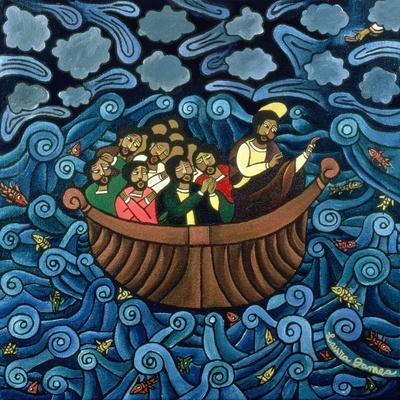
  On that day, when evening had come, he said to them, “Let us go across to the other side.” And leaving the crowd behind, they took him with them in the boat, just as he was. Other boats were with him. A great windstorm arose, and the waves beat into the boat, so that the boat was already being swamped. But he was in the stern, asleep on the cushion; and they woke him up and said to him, “Teacher, do you not care that we are perishing?” He woke up and rebuked the wind, and said to the sea, “Peace! Be still!” Then the wind ceased, and there was a dead calm. He said to them, “Why are you afraid? Have you still no faith?” And they were filled with great awe and said to one another, “Who then is this, that even the wind and the sea obey him?”

It’s been about three years now since the Covid 19 pandemic retreated enough so that we could begin to gather again in church and other public places.  We spent fifteen months secluded in our homes because a kind of life-storm rose up unexpectedly and caught us off guard and unprepared, a storm created by a virus that flew in from the other side of the world.  That storm has mostly receded now, although we are still dealing with occasional waves,  and maybe it’s just me, but even though it has been three years, it still feels like we haven’t really returned to normal, or at least what normal used to be.

In some ways that’s good.  There was a lot about our old “normal” that needed to be improved.  But in other ways, it’s not at all good.  It feels as if we are still locked into a heightened state of anxiety, and since anxiety always wants a target, we seem sometimes to be taking it out on each other, especially in our politics.

We lost a lot during the pandemic.  Social connections were lost or  strained. Some of our common understanding of how society is supposed to work was lost.  The Church, unable to gather in person in our usual places of worship, lost members in a decline that had already been underway but was exacerbated by the enforced restrictions and now shows no signs of slowing or reversing.  And, of course, millions of lives were lost throughout the world.  

Ever since Covid, we have been sailing through choppy waters toward the shore of a new and unknown reality.  It feels to me that we are somewhat like the disciples in the boat after Jesus calmed the storm.  The storm has stopped, but we are still sitting in the middle of the lake in the dark, bailing out our boat.

Today’s Gospel lesson from Mark lifts up some important things for us to think about as we sail toward a future we can’t really see.  And let’s face it, we’re not going to simply sail back into the way things used to be.  Too much was changed in those 15 months of isolation and these three years of recovery.  

In Mark’s telling of this story of the storm on the sea,  Jesus and his disciples set out in the evening, of all things, to sail across the Sea of Galilee.  A great windstorm blew up and the boat was being swamped.  We know it was a serious storm because even the fishermen who were out on this water all the time were frightened. Through all of this, Jesus was soundly asleep on a cushion in the stern of the boat.  Finally, the disciples cried out, “Teacher, do you not care that we are perishing?!?” That’s when Jesus woke up, then got up and rebuked the storm.  The sea became dead calm, and the disciples, dumbfounded by this new dimension of his power and abilities, were left wondering just who Jesus really is.

When we read or hear these stories, these episodes from the life and ministry of Jesus, it’s natural for us to ask ourselves, “Okay, what does that mean for me or for us?”  It’s always good to try to  imagine how the original listeners heard these gospel stories if we’re able, but we also hope there’s something in the story that we can take home with us, some lesson that fits our lives right here and right now.  That’s why we do this little exercise of preaching and teaching with the gospel every week.

With this particular story, it has been far too tempting for far too long to personalize it a little too much.  And I confess I’ve been as guilty as any preacher out there in doing this.  That sermon goes something like this:  “When storms arise in your life, just remember that Jesus is in the boat with you…even if he’s taking a nap at the moment.  He has the power to quiet the storm.  Maybe he’s asking you, ‘Why are you afraid?  Where’s your faith, pal?’  Muster up some courage.  Maybe it’s your turn to stand up and tell whatever  storm is swamping your boat, ‘Peace!  Be still.’”  

I have preached that sermon.

Listen, there are probably worse ways to go with this story.  We’ve all had moments in our lives when we’ve wanted to join the disciples in yelling, “Teacher, don’t you care that we’re perishing?!?”  I know I’ve been there a few times.  But the fact is, there is something greater at stake in this story than a bromide to help us face our fears.  There is something greater at stake here not just for them in their time, but for us in our time.  But to know what that is, we have to range beyond the boundaries of these six verses.

From the very beginning of the Gospel of Mark, Jesus has been announcing that the kingdom of God is imminent.  Actually, imminent is not quite the right word.  The Greek word is engikken.  It’s often translated as “has come near,” but there is an even greater sense of immediacy in the word than that.  Think of it as a train coming into the station.  It’s not all the way into the station yet but the engine has already reached the edge of the platform.  That’s the sense of it.  The kingdom of God’s engine has already reached the platform of our lives.  The train is engikken.  Get ready to board.

Everything Jesus says and does in the Gospel of Mark is said and done to demonstrate the power and presence of this new reality he calls the kingdom of God or, as Diana Butler Bass calls it, the Commonwealth of God’s justice and mercy.  He is not just telling people about this kingdom, he is showing them what it looks like and how it acts.  When Jesus calls the disciples, he is recruiting them to build a new community, a Beloved Community, based on the ideals and principles of “The Way,” which is another name Mark uses for the kingdom of God.  

Another thing to understand about the Gospel of Mark is that everything that happens in this Gospel is heavily weighted with myth and symbolism.  That’s not to say that the events the gospel depicts didn’t happen, but that it is important to pay attention to how Mark is describing and using these events and what kind of language he is using as he tells the story of Jesus.  

We need to ask questions.  What other scriptural connections does Mark make—or expect us to be making?  What apocalyptic expectations and understandings are at  work in the culture of Mark’s time?  What mythic stories are at work in the background as Mark tells the story of Jesus?  What cultural boundaries and expectations are being crossed?  If we don’t catch all these clues, then we might not get the point Mark is trying to make. We’ll get some other point instead.

When we see the disciples and Jesus set off from the shore in a boat in the evening, Mark wants us to be nervous.  We’re supposed to remember that in their mythic understanding the sea is the home of Chaos and Destruction.  Dread, unpredictable, cosmic forces hide in its depths and the only thing that could tame it at creation was the Spirit of God hovering over it.  That they are setting out as night falls with the intention of crossing all the way to the other side—well, if we were Mark’s first readers or listeners we would know they’re heading for trouble.

As the story unfolds, Mark assumes that somewhere in the back of our minds we are maybe remembering Psalm 107: “Some went down into the sea in boats…then they cried to the Lord in their trouble, and he delivered them from their distress; he made the storm be still, and the waves were hushed.” (107:23,39)  When we read that Jesus was asleep on a cushion in the stern of the boat, Mark wants us to remember how Jonah slept as his boat was about to break up in a mighty tempest. (Jonah 1:4, 10).  Mark puts all these things together so that we will understand that this storm that the disciples face out there on the sea of Chaos is not just a metaphor for the troubles of life.  This is a Cosmic storm.  Their boat is being assailed by cosmic forces.  Something wants to stop them.  Some great elemental power wants very much to keep them from getting to the other side of the lake.  But what?  And why?

To understand that, it’s important to understand why Jesus wanted to cross the lake in the first place.  

The Sea of Galilee was also called Lake Gennesaret or Lake Tiberias depending on who was talking about it.  It served as a clear geographic boundary between the territories of Philip and Agrippa in the tetrarchy of Palestine when the Emperor Augustus divided up the region between the sons of Herod the Great, and it continued to serve as a clear social boundary between the Jews of Galilee on the south side and the Hellenized Jews and Gentiles of various nationalities throughout the Decapolis on the north side. 

Why did Jesus want to go to the other side of the lake?  Quite simply because that’s where the gentiles were.  

Jesus was fighting other-ism.  Racism.  He wanted his new beloved community to embrace everyone—Jew, Gentile, people of all nationalities and types, people who had differences in how they worshipped. So he took his mission of proclamation, healing, exorcism and teaching across the sea to invite those “other” people to be part of “the Way.” He also wanted to teach his disciples that in the kingdom of God there simply is no room for such nonsense as racial exclusion or historical segregation or anything like that.  In the kingdom of God no one can call anyone else unclean.  Or unwelcome.  

That storm that rose up against them is symbolic of all the storms that rise up to resist our attempts at opening our hearts and minds to reconciliation and renewal.  It was the elemental malicious something in our world and in the human heart that wants to keep us forever sorted in our caste systems and historic animosities, that force that resists healing and unifying humanity.  And I want you to notice something here:  The words that Jesus spoke to stifle that storm are the words of exorcism.  Most of our translations make those words prettier than they actually are, but they are the same words that Jesus spoke when he cast out the demon in Mark 1:25.  “Peace.  Be still.”  Okay, sure.  But that’s a very mild translation.  The full force of the words in the Greek text is more like “Silence!  Shut up!  I muzzle you!”  

Maybe  this is how we need to speak to racism.  Maybe this is how we need to speak to Jim Crow laws and race-baiting and race-driven gerrymandering.  Maybe this is how we need to speak to racial slurs and jokes and microaggressions and all the derogatory language of bigotry.

Maybe we need to speak this clearly and bluntly to the forces that try to dissuade and discourage us from reaching out to make new bonds of friendship.  Maybe this is how we need to speak to those voices who keep dragging up tradition and history as reasons to preserve symbols of hatred and monuments to violence in public displays.  Maybe this is the plain kind of speech we need to use with those who continue to pursue paths of prejudice that have done nothing but separate us and poison us against each other.  Maybe instead of trying to be reasonable and persuasive against such divisive winds it’s time to simply say, “Stop right there!  I will not listen to hate.  I will not let you keep us from getting to the other shore.  I will not let you stop us from including everyone in the Beloved Community.”

During the pandemic, we had fifteen months of enforced separation, an imposed time to sit apart and consider all the things that are dividing us.  We had fifteen months to witness as more than a million people died from a disease that could have been curtailed much more easily and much more quickly if we had been more unified.  

We had 15 months to watch as unreasonable political forces and conspiracy theory voices assaulted the foundations of our democracy and truth, itself.  We had 15 months to see racial tensions repeatedly exacerbated by hate and violence and lamentable systemic conditioning.  

We had fifteen months to sit apart in our homes and miss each other and think about what it means to be friends, to be church, to be disciples of Jesus, to be people of The Way.  

And now the doors have been open for three years.  The storm has subsided.  We’ve been back together for some time now.  We get to be “us” again.  But there are people “not like us” across the road, across town, across the lake, on the other side of the sea of chaos. And Jesus is still saying, “Let’s go across to the other side.”  

Yes, storms will almost certainly rise up.  The elemental malicious  something will try to stop us.  But Christ is in the boat with us, and Christ has given us the words to silence bigotry.

“Christ sleeps in the deepest selves of all of us,” said Frederick Buechner, “and whatever we do in whatever time we have left, wherever we go, may we in whatever way we can call on him as the fishermen did in their boat to come awake within us and to give us courage, to give us hope, to show us, each one, our way. May he be with us especially when the winds go mad and the waves run wild, as they will for all of us before we’re done, so that even in their midst we may find peace…we may find Christ.”

image © Laura James

Scattering Seeds

Mark 4:26-34

With what can we compare the kingdom of God…  

What do you think of when you hear or read that phrase: the kingdom of God?  I think it’s hard for us to really grasp what Jesus was talking about when he talked about the kingdom of God not only because he described it in metaphors and parables, but because a kingdom, itself, is a thing entirely outside of our experience for almost all of us.

Most of us think of kingdoms in terms of either physical territory or fairy tales, but clearly Jesus is talking about something that transcends mere physical boundaries and is a lot more real than fairy tales.  A kingdom can simply be a territory ruled over by a king or queen, but it can also mean a sphere of authority or rule, and that might be closer to what Jesus is getting at:  the rule of God.  The authority of God.  But even that is something most of us can’t relate to too well because we have never lived under the authority of a monarch or a lord or a master, and those monarchies that are still active in our world are either almost entirely symbolic or wildly dysfunctional or utterly dictatorial.  And I don’t think we want to attribute any of those qualities to God.

Also, words like authority and rule can have a coercive edge to them, and the kingdom, as Jesus describes it, seems to be much more about influence, persuasion and cooperation.  It’s more organic.  It’s something that grows in us and around us and among us.  

I have often used the phrase “kin-dom of God” for that reason—to try to capture some of the cooperative, love-based nature of God’s sovereign rule as Jesus describes it in the beatitudes and parables.  Diana Butler Bass has called it the Commonwealth of God’s justice and mercy, and I think that might be even more in the right direction.  Maybe.  But it’s also important to remember that the kingdom of God is not a democracy.  God is sovereign.  God’s rule is absolute.  Fortunately for us, so is God’s love, and that love is the very fabric of this thing Jesus is trying to describe as “the kingdom of God.”  The kin-dom of God.  The Commonwealth of God’s kindness.

When Jesus told these parables, and thirty-some years later when Mark wrote them down, trouble was brewing in Galilee and Judah and pretty much throughout all of Palestine.  Landowners were putting pressure on tenant farmers for rents they could barely pay.  Scribes from the temple in Jerusalem were demanding a crushing and complex levy of tithes from those same farmers.  Herod Antipas was demanding taxes from the landowners because Rome was demanding taxes from him.  Unemployment was high.  Bandits roamed the highways.  Soldiers patrolled everywhere.  Rome’s colonial government was heavy-handed and oppressive to the point of brutality.  People wanted a heavenly anointed messiah to step in and fix things before they exploded—or maybe to light the fuse and set off the explosion that everyone felt was coming. It’s no wonder that the disciples kept asking Jesus, “Is this the time when you will bring in the kingdom?”

Jesus kept trying to tell them and all the crowds following him, “No, the kingdom of God is not like that.  It’s not what you’re thinking.  It won’t do any good to simply replace one coercive external system with another one even if the ruler is God!”  

The change has to be internal.  It has to be organic.  Seeds have to be planted.  Human hearts and minds have to be changed. It’s not about imposing a new kind of law and order.  It’s about implanting a new kind of love and respect.  That’s what will fix the world.

“The kingdom of God is as if someone would scatter seed on the ground, and would sleep and rise night and day, and the seed would sprout and grow, he does not know how.”

For generations we had a family farm in Kansas—my  mother’s family farm—where we grew winter wheat.  Winter wheat is planted in late September or early October, depending on the weather.  Not long after it’s planted, it starts to sprout.    Beautiful little shoots that look like blades of grass start to poke their heads up out of the soil.  And then just as they’re getting started, the cold hits them.  And it looks like it’s killed them.  They slump back down to the dirt and go dormant, and they’ll just lie there all through the winter.  The ground will freeze.  Snow will drift and blanket over them.  And there’s nothing you can do.  

All winter long you go about your business.  You sleep and rise night and day.  And then you get up one spring morning and notice that the weather is a bit warmer, and the snow is patchy or mostly gone, and you look out the window to see that you suddenly have a field full of beautiful green wheat starting to rise up out of the ground.  It’s an amazing thing to see, and if you have half a sense of wonder, you thank God for the natural everyday miracle of it and marvel at it for at least a moment before you get on with your chores.  

The kingdom of God is like that, says Jesus.  It is seeds scattered on the earth.  Seeds of ideas and vison. And sometimes it looks like they’ve died.  Or been crushed.  Or been frozen out or buried.  Or simply forgotten.  But they are still there, just waiting for their moment.  

The kingdom of God is seeds of ideas and vision and understanding.  They are ideas about fairness and justice and cooperation.  They are an understanding about fuller and more generous ways to love each other and take care of each other.  The kingdom is a resolve to make a world that is healthier for everyone.  It’s a resolution to embrace God’s vision for how the world is supposed to work—a world where everyone is housed and everyone is fed and everyone can learn and everyone is safe and everyone is free to be their true self.  The kingdom is a determination to repair the damage we’ve done and restore creation so that we and all the creatures who share this world with us can breathe clean air and have clean water.

The kingdom of God, the rule of God, the reign of God, the kin-dom of God, the Commonwealth of God’s justice and mercy is a commitment to let justice roll down like water and to show each other kindness and to walk humbly with God and with each other.  It is a continual correction of our vision so we keep learning how to see the image and likeness of God in each other—in each and every face we face so that racism and classism and every other kind of ism evaporate from the earth.  It is the seed of courage taking root in our hearts and minds so that we learn not to be afraid of something or someone simply because it or they are different from us or from what we know or what we expect or what we are used to.

“With what can we compare the kingdom of God, or what parable will we use for it?,” said Jesus.  “It is like a mustard seed, which, when sown upon the ground, is the smallest of all the seeds on earth; yet when it is sown it grows up and becomes the greatest of all shrubs, and puts forth large branches, so that the birds of the air can make nests in its shade.”

The mustard seed!  That tiny seed that produces the most egalitarian, most democratic of plants!  That’s what God’s kingdom is like.  It freely and bounteously shares itself and all that it has.  Given half a chance it spreads itself everywhere.  The mustard plant doesn’t care if you are rich or poor.  You don’t have to buy one.  It will come to you and give you and your family food and medicine and spices for your cuisine and healing oils for what ails you.  A most amazing, versatile and humble plant.  And it starts as just a little tiny seed.

The kingdom of God is the planting of seeds. The seeds don’t have to be eloquent preaching or brilliant explanations of theology—probably better most of the time if they’re not.  “Preach the gospel at all times,” said St. Francis. “When necessary, use words.”  At a time when the city of Assisi was a rough and dangerous place, Francis would walk through the town from the top of the hill to the bottom and say as he went, “Good morning, good people!”  When he got to the bottom of the hill he would turn to the brother who accompanied him and say, “There.  I have preached my sermon.”  What he meant was he planted a seed—he had reminded the people that the day was good and that they had it in themselves to be good people.

The seeds of the kingdom may be little acts of habit, like bowing your head for a moment to say grace before a meal in a restaurant, even if you don’t say it out loud.  That simple thing might remind those around you to pause, to be thankful, to remember all the connections that bring food to our tables, to remember the goodness of the earth and the sweat of the farmers, to remember the presence of God.

The seeds of the kingdom might be small acts of kindness.  When Oscar Wilde was being brought down to court for his trial, feeling more alone and abandoned than he had ever felt in his life, he looked up and saw an old acquaintance in the crowd.  Wilde later wrote, “He performed an action so sweet and simple that it has remained with me ever since.  He simply raised his hat to me and gave me the kindest smile that I have ever received as I passed by, handcuffed and with bowed head. Men have gone to heaven for smaller things than that. It was in this spirit, and with this mode of love, that the saints knelt down to wash the feet of the poor, or stooped to kiss the leper on the cheek. I have never said one single word to him about what he did … I store it in the treasure-house of my heart … That small bit of kindness brought me out of the bitterness of lonely exile into harmony with the wounded, broken, and great heart of the world.”

The seeds of the kingdom might be a word of affirmation and encouragement when it’s needed most.  Helen Mrsola was teaching ninth graders new math years ago.  They were struggling with it.  The atmosphere in the classroom was becoming more tense and irritable every day.  So one Friday afternoon Helen decided to take a break from the lesson plan.  She told her students to write down the name of each of their classmates on a piece of paper, then to also write down something nice about that student.  She collected the papers, and over the weekend Helen compiled a list for each student of what the other students had written. On Monday, she gave each student a paper with list of what the other students liked about them.  The atmosphere in the class changed instantly; her students were smiling again. Helen overheard one student whisper, “I never knew that I meant anything to anyone!” 

Years later, a number of the students, all young adults now, found themselves together again at a school function.  One of them came up to Helen and said, “I have something to show you.”  He opened his wallet and carefully pulled out two worn pieces of notebook paper that had obviously been opened and folded and taped many times.  It was the list of things his classmates liked about him.  “I keep mine in my desk at work,” said another classmate.  Another classmate pulled hers out of her purse, saying she carried it with her everywhere she went.  Still another had placed his in his wedding album.

The kingdom of God.  The rule of God.  The reign of God.  The kin-dom of God.  The Commonwealth of God’s kindness. . . 

To what shall we compare it?

It’s like seeds scattered on the earth, says Jesus.  It’s like mustard seeds.  Seeds of righteousness.  Seeds of justice. Seeds of vision.   Seeds of help.  Seeds of hope.  Seeds of mercy.  Seeds of peace.  Seeds of affirmation.  Seeds of goodness.  Seeds of kindness.   Seeds of love.  

You don’t know how they grow.  But oh, they do grow.

On earth as in heaven.

When Mom Doesn’t Like Your Job

Mark 3:20-35

Question:  What do Katy Perry, Kris Kristofferson, Florence Nightingale, Edouard Manet, Miles Davis, Alfred Nobel, Edgar Allen Poe and Robert Zemeckis have in common?   Answer: Their parents objected to the careers they chose.

Family can have a profound influence on the path we follow in life.  Alex Haley said that in every conceivable way, the family is a link to our past and a bridge to our future.  Your family can inspire, you, guide you, and cheer you on as you find and pursue your vocation, or they can misguide, misdirect, discourage and just plain thwart you.

I first felt called to become a pastor when I was fifteen years old.  My parents did not like the idea, and that is one of the main reasons I didn’t begin seminary until I was almost forty.  They loved me.  But they had a different future in mind for me than the future that chose me.

In today’s gospel reading from Mark we find two groups who would be happier if Jesus were to pursue a different career.  They would like nothing better than for him to stop the healings and exorcisms and the preaching and teaching and go do something more normal. Like be a carpenter, maybe.  On the face of it, these two groups wouldn’t seem to have much to do with each other, but the one big thing they have in common is that Jesus scares them.

Jesus had been busy traveling around the Galilee, announcing the arrival of the Reign of God, or, as Diana Butler Bass calls it, the Commonwealth of God’s Justice and Mercy.  In his preaching and teaching he had been describing a very different way of life that comes with God’s reign, and he had been demonstrating what this Commonwealth of Kindness looks like with healings and exorcisms and other acts that restore people to community.  In doing all this, he had also butted heads with the religious establishment because he was continuously reinterpreting Torah in ways that undermined the hierarchical authority of the scribes and the piety of the Pharisees.

Mark tells us that the crowd following him had become so large that it was almost unmanageable.  People were coming from as far away as Jerusalem, Idumea, Tyre and Sidon.  And then one day his family showed up, lingering somewhere at the edge of that great crowd that was following Jesus everywhere he went.

The NRSV translation says that his family had come to restrain him.  That’s a fair enough translation, but it doesn’t really capture the force of krateo, the Greek word that Mark uses, unless you imagine them using actual restraints.  To be clear, they had come to seize him and take him home by force if necessary because they thought he had lost his mind.

They were afraid for him.  They were afraid for him because they didn’t understand him.  They were afraid for him because it was hard for them to believe that this kid who grew up in their house had turned out to be so much more than the kid who grew up in their house.  They were probably a little bit afraid for themselves, too.  After all, having a crazy, radical preacher in the family can be hard on a family’s reputation.

But mostly they were afraid for him because they loved him.  He was family, after all.  So they worried about him, especially when they overheard this other group that wanted to rein him in.  Or worse.

Some scribes had come down from Jerusalem to see Jesus for themselves and to begin to form some kind of official opinion of him and his actions.  And their official opinion was that he made them nervous.  They wouldn’t have said it in so many words, but they were afraid him.  They were afraid because he called their privilege—their role and status and authority into question.  But mostly they were afraid of him because the crowd loved him.  And the crowd kept growing.  Big crowds would make their Roman overlords pay attention, and the things Jesus was saying, his language about “the Kingdom of God,” might sound like a call for revolution. . . which, to be fair, it was.  And is.  

“It is by Beelzebul, the ruler of the demons, that he casts out demons,” said the scribes.  “Well how does that make any sense?” asked Jesus.  “How can Satan cast out Satan?  If a kingdom is divided against itself, that kingdom cannot stand!” He may have had his family in mind when he added, “And if a house is divided against itself, that house will not be able to stand. And if Satan has risen up against himself and is divided, he cannot stand, but his end has come.”

Finally, to make it crystal clear just what his mission was all about he said, “No one can enter a strong man’s house and plunder his property without first tying up the strong man; then indeed the house may be plundered.”  

But Jesus wasn’t finished.  In one last note of caution for the scribes, Jesus said something that should give all of us pause, especially when we are about to speak judgmentally about people or things happening in our world that we don’t like or that make us uncomfortable.  “Truly I tell you,” he said, “people will be forgiven for their sins and whatever blasphemies they utter, but whoever blasphemes against the Holy Spirit can never have forgiveness but is guilty of an eternal sin.”

He said this because the scribes had accused him of being possessed by Beelzebul. But Jesus, of course, was actually intimately connected with the Holy Spirit.  

I have thought of this passage often over the years when I have heard others say that something they are opposed to is evil or demonic. During the years when our denomination was debating whether it was okay or not to ordain lesbian and gay and trans people, I more than a few times heard people describe our efforts at being more inclusive as being evil when it seemed clear to me and others that it was the work of the Spirit.

How many times in history have we been trying to hold a door shut that the Holy Spirit is trying to open?  How many times in history has the Church called something demonic only to realize in retrospect that it was the work of the Spirit trying to broaden our minds and horizons?  God’s embrace is always bigger than ours and God’s vision always sees farther than ours.

God’s perspective is broader than ours.  Jesus sees things differently than we do, and sometimes that can be unsettling.  I still find the last segment of this episode with the scribes and his family disconcerting.   

Jesus’ mother, Mary, stood outside the house with his brothers and sisters, calling out to him.  The crowd that surrounded him made sure he knew they were there.  Someone spoke up and said, “Your mother and your brothers and sisters are outside asking for you.” 

The way Jesus responded can sound cold and heartless, but it’s important to remember that everything Jesus said or did in this Gospel of Mark was calculated to reveal the values and vision of the Reign of God—the Commonwealth of God’s justice and mercy.  

Jesus posed a rhetorical question: “Who are my mother and my brothers?” he asked.  Then, looking at all those people who were crowded around him, he gave the Reign of God answer to that question.  “Here are my mother and my brothers! Whoever does the will of God is my brother and my sister and my mother.”

In one sentence, Jesus undermined the coercive and restrictive potential of the biological family and at the same time expanded the definition of family.  As cold as his answer might sound to us, Jesus did not actually disown or repudiate his biological family, but he wanted to make it clear that in God’s eyes family goes far beyond being biologically related.  In the Commonwealth of God’s justice and kindness, family is whoever does the will of God.

Sometimes the imagery in the gospels can be confusing or opaque.  More often, though, I suspect that the problem isn’t so much that the words of scripture are puzzling as that they make us uncomfortable, so we move past the troubling parts without taking time to really deal with them.  As Mark Twain once said, “It ain’t those parts of the Bible that I can’t understand that bother me, it is the parts that I do understand.”

According to Ched Myers, author of Binding the Strong Man, which has become pretty much the go-to commentary on the Gospel of Mark, this gospel was probably written somewhere in Palestine between 68 and 71 CE during the height of the Jewish revolt against the Roman occupation.  Myers tells us that this gospel, in which Jesus is gritty, uncompromising, down-to-earth, and scathingly direct—this Gospel of Mark is, in fact, a manifesto for nonviolent revolution, written to serve as an alternative path for the followers of Jesus who are being pulled into the violence of the uprising against Rome.  

In Mark, the followers of Jesus, then and now, are truly being called to subvert the dominant paradigm—to challenge and deconstruct and then reconstruct the systems by which our world operates until there truly is liberty and justice and peace and health and wholeness for all.  Anywhere there is coercion, the followers of Jesus are called to stand up to it with nonviolence.  

In other words, the gospel that Jesus proclaims, the living and uncompromising assertion of the Commonwealth of God’s justice and kindness, is nothing short of a nonviolent revolution.

Almost every pastor I know has stories about times we have been accused of being too political.  I have had people say to me that they come to church to hear about spirituality and not politics.  I get it. We humans have this very unfortunate tendency to compartmentalize our lives.  We organize our hearts and minds in little boxes: spirituality in this box, politics in this box, everyday life in this box over here.  The problem is that that these things really are not separate.  Our politics and economics are a barometer for our spirituality.  Our everyday life and the way we conduct our business puts our real beliefs on display.  

If we are sincere about following Jesus, then we can’t avoid politics because the gospel that Jesus proclaims is a kind of revolution and revolution is political.  Jesus wasn’t crucified for being a spiritual teacher.  He was crucified at the intersection of religion and politics because he was proclaiming a revolution that seeks to transform and restructure the entire world, to unite and unify all of life, and to redefine what it means to be human.  But before you can do that, you have to undo life as it is.  You have to take apart coercive systems and deconstruct business as usual.

Jürgen Moltmann, the great German Lutheran theologian who died this past week wrote, “Those who hope in Christ can no longer put up with reality as it is, but begin to suffer under it, to contradict it. Peace with God means conflict with the world, for the goad of the promised future stabs inexorably into the flesh of every unfulfilled present.”[1]  God calls us to take up the tools of Christ to bring that promised future into the unfulfilled present.  But our tools are nonviolent tools.  Following the model set by Jesus, we use logic and common sense instead of violence.  Our first tool for reshaping the world is a stubborn resistance rooted in love and compassion and kindness and truth and hope.  And our hope is rooted in a vision of a healthy world where we all live in peace and cooperation with each other and with our God-beloved, God-made planet in a harmonious and generous balance.

Jesus came to bind the strong man, to take down all the human, religious and demonic forces that bully and constrict God’s children and crush our souls. Empire.  Coercive religion. Even family when it becomes too rigid and authoritarian.  People who are deeply vested in unhealthy systems don’t like to read the gospel this way.  They prefer to keep things “spiritual” which, in the end, means that neither Jesus nor his words ever touch the ground.  Or the depths of the heart.  And they certainly don’t change the world.

Jesus came to plunder the house of the strong man, to liberate every person who will follow his Way so that together we can build the Commonwealth of God’s justice and kindness and make it as visible on earth as it is in heaven.  


[1] Jürgen Moltmann, Theology of Hope: On the Ground and the Implications of a Christian Eschatology

Human Values vs. Legal Values

Mark 2:23-3:6

How do you deal with people when their obsessive focus on something good leads them to use that good thing in a way that is manipulative or domineering?  How do you get through to people whose attention to the details of something good and beautiful leads them to treat people in a way that is harsh or even cruel?

There was a letter that appeared in Amy Dickinson’s advice column the other day that really brought that question home to me.  The letter writer was concerned because one particular house in their neighborhood had become an eyesore because of deferred maintenance.  

“Dear Amy,” they wrote. “I live in an affluent neighborhood of expensive although older homes. The vast majority of homes are well maintained and manicured. Many have had major remodels. 

However, there are a couple of homes that are in serious need of a facelift! One home in particular is a complete eyesore. 

Although it is worth more than a couple million dollars, the lawn is dead, paint doesn’t match and/or is faded in places, wood facia is rotting, along with other significant cosmetic problems.  There do not seem to be any code violations. I am not aware of the owners’ financial situation, but they’ve been there long enough that there should be significant equity to refinance and get money for repairs — or sell and move to a less expensive home.  Other neighbors have left notes, to no avail.  Any suggestions on how to get this family to fix up their house, or even move?”

The letter was signed, “Frustrated Neighbor,” and Amy’s response to this Frustrated Neighbor was pure gold:

“Dear Frustrated,” she wrote.  “It is so generous of you to provide such a detailed list of repairs to be made to this property! You’ve obviously inspected the house quite closely. 

“What a neighborhood! People leaving notes and developing repair punch lists and investment advice — and not one finding out who these neighbors are and asking if they need a hand. 

“I suggest you approach this by putting human values ahead of property values. Changing your orientation and approach should improve the neighborhood.”

Putting human values ahead of property values.  Or legal values.   Or economic values.  That’s exactly what Jesus was doing when he began his nonviolent campaign to confront the traditions and  institutions and the political and religious authorities and laws that were squeezing the life out of the people of Galilee.

In today’s Gospel reading from Mark, we see two episodes where Jesus is confronted by self-appointed guardians of Sabbath piety, men—and they were all men—whose  strict interpretation of Sabbath codes was impairing the quality of life for the very people whose quality of life they were supposed to be safeguarding.  Their pious concern for every jot and tittle of the very good gift of God’s law in Torah had led them to treat God’s people with harsh inflexibility.

The first confrontation comes when Jesus and his disciples “made their way” through the grain fields on the Sabbath.  As they forged a pathway through the field, the disciples were plucking and eating heads of grain.  This didn’t sit well with the Pharisees who were observing them.  “Look,” they said, “why are your disciples doing what is not lawful on the Sabbath.”  

The Law of Moses permitted poor people in Israel, or travelers, or aliens to glean enough grain for a meal from the crops in a landowner’s fields. Deuteronomy and Leviticus both make it clear that you were allowed to pluck grain by hand in a neighbor’s field or pick some grapes from your neighbor’s vines as long as you didn’t use a tool to cut the stalks or collect your gleanings in a basket.  The open question, though, was can you do this on the Sabbath?  

The Torah did not specifically say one way or the other, so the Pharisees, who were always inclined to err on the side of strictness, had concluded that, while it might be okay to do a little personal harvesting on the other six days of the week, it was definitely not okay on the Sabbath.  This, of course, could leave poor people in a real bind.  If you can’t use a basket to collect enough for tomorrow and you can’t come back to the field on the Sabbath, you’re pretty much stuck with going hungry on the day of rest.

Jesus, of course, took the opposite view.  Hunger doesn’t know or care what day it is.  Hunger doesn’t know or care about Sabbath laws.  Human values override religious legal values.

Jesus tried to get the Pharisees to discuss this issue by referring to an incident from the life of King David.[1]  “Have you never read what David did when he and his companions were hungry and in need of food,” he asked them,  how he entered the house of God when Abiathar was high priest and ate the bread of the Presence, which it is not lawful for any but the priests to eat, and he gave some to his companions?”  When the Pharisees responded with stony silence he added, “The Sabbath was made for humankind and not humankind for the Sabbath.”  The point Jesus was trying to make is that some human needs take precedence over other human needs.  The need for food takes priority over the need for rest or Sabbath observance.  

Since Mark’s account immediately moves to the next confrontation, we are left to assume that the Pharisees simply were not open to debating this issue with Jesus.

“Again he entered the synagogue, and a man was there who had a withered hand.  They were watching him to see whether he would cure him on the Sabbath, so that they might accuse him.”    

The way Mark’s gospel describes it, this looks like a setup for entrapment, but Jesus sees right through the Pharisees’ scheme and decides to put them on the spot. “Is it lawful to do good or to do harm on the Sabbath?” he asks them.  “To save a life or to kill?”  Jesus turns the issue into a clear binary decision.  The implication in his question is that there really is no moral middle ground between compassion and legalism.  If you fail to do good when you have the chance then you are doing harm.  If you do not act to save a life in peril when you have the chance, then you are complicit in the killing.  

The Pharisees responded to Jesus once again with silence.  Jesus, we are told, “looked around at them with anger.  He was grieved at their hardness of heart.” 

With all that tension simmering in the air, Jesus healed the man’s withered hand. And the Pharisees?  “The Pharisees went out and immediately conspired with the Herodians against him, how to destroy him.”

The Pharisees in these incidents are like a homeowners association who are so concerned about maintaining the curb appeal of the houses in their neighborhood that they completely ignore the lives of the people who live in those houses.  When they see a house that is not in compliance with their standards, rather than seeking to understand the situation or even provide assistance, they add to the burdens and difficulties of their neighbors with their notices of noncompliance and their threats of fees and legal action.

Standards are good.  Laws are necessary.  But people are more important.

In chapter 12 of Mark’s gospel a scribe asks Jesus, “Which is the first of all the commandments?” Jesus replied by combining a quote from Deuteronomy with a quote from Leviticus. “The first is,” he said, “is ‘Hear, O Israel: the Lord our God, the Lord is one; you shall love the Lord your God with all your heart and with all your soul and with all your mind and with all your strength.’ The second is this, ‘You shall love your neighbor as yourself.’ There is no other commandment greater than these.”

In reflecting on this Greatest Commandment, Father Richard Rohr said, “Imagine how different the world would be if we just obeyed that one commandment—to love our neighbor as we love ourselves. It would be the most mighty political, social upheaval imaginable. The world would be radically different if human beings really treated other people as they would like to be treated. We can take this as a simple rule of thumb: What would I want from that person right nowWhat would be helpful for me to receive? Well, there’s our commandment. There’s our obligation to do to others!  

“It’s so simple that we can see why we put all our attention on the Ten Commandments, or the hundreds of other regulations culture and religion place on us. It’s much easier to worry about things that keep us ‘pure,’ so to speak, but are of little consequence.  

“After all is said and done, it comes down to loving God and loving our neighbor—and that implies loving ourselves. If I said this without quoting Jesus, I could be accused of oversimplifying or ignoring some of the important commandments, but thank God Jesus said it first. He taught that it’s all about love, and in the end, that’s all we’re all going to be judged for. Did we love? Did we love life? Did we love ourselves? Did we love God and did we love our neighbor? Concentrating on that takes just about our whole lifetime and we won’t have much time left over to worry about what other people are doing or not doing. Our job is to love God, love ourselves, and love our neighbor.”[2]

The Pharisees love God and they love Torah, God’s law—that’s a good thing—and in their own way they love their neighbor because they believe that their neighbor will benefit if everybody rigorously obeys Torah.

Jesus loves God and also loves Torah, but Jesus interprets the law differently because he understands that, to paraphrase what he said about the Sabbath, the law was intended to serve people; people don’t exist to serve the law.

The way Jesus interprets Torah is consistent with the way the prophets understood the law.  The prophet Micah summed it up very succinctly when he wrote, “God has told you, O Mortal, what is good.  And what does the Lord require of you but to do justice, to love kindness, and to walk humbly with your God?”

To love kindness.  The Hebrew word that Micah uses here is chesed.  It means kindness.  Or steadfast lovingkindness. Or, sometimes, mercy.

In rabbinic tradition, the world is said to stand on three things:  Torah, divine service, and chesed—acts of kindness.  Chesed, kindness, is considered “boundless” because a person can never do too much of it.  It is behavior that goes above and beyond the letter of the law, a one-sided giving that brings goodness to the neighbor.

Chesed, kindness, strengthens mutual relationships.  It reinforces the bonds of our implied covenant with each other, our social contract.  Chesed, kindness, is one of the attributes of God.  At the end of Psalm 23 the psalmist is speaking of God’s steadfast lovingkindness when he says “Surely goodness and chesed, kindness, will pursue me all the days of my life and I will dwell in the house of the Lord forever.”

Kindness acknowledges that we are of the same kind.  We have the same needs.  We have the same fears.  We face the same pitfalls.  We have the same hopes.  We are of a kind.  Kindness acknowledges that what is good for you is good for me, or to put it another way, I will be kind to you and trust that you will be kind to me because we are all in this together.

What kind of world might we see if we made chesed, kindness, the central pillar our politics our economics and our laws?  That’s the question Jesus wants us to consider as he moves through our world announcing that the Kingdom of God, the Commonwealth of God’s justice and kindness, is within reach.  It can be our reality on earth as it is in heaven.

Standards are good.  Laws are necessary.  But people are more important.  


[1] 1 Samuel 21

[2] Adapted from Richard Rohr,“613 Commandments Reduced to Two,” homily, November 3, 2012. 

The Dawn of a New Day in the Middle of the Night

John 3:1-17

Nicodemus came to Jesus by night.  Some have suggested that Nicodemus came to see Jesus at night because he didn’t want to be seen talking to Jesus.  The Gospel of John tells us that Nicodemus was a Pharisee and an archon, a leader or ruler of the people and a highly respected teacher.  He was also fairly wealthy.  He had standing in the community as a righteous man, blessed by God, so he had a reputation to protect, and he was putting all that at risk by meeting with a man who many of his fellow Pharisees regarded as a troublemaker.  

Nicodemus came to see Jesus at night because it was less risky.  Nicodemus came at night so he could avoid the crowds.   Nicodemus came at night because it would be easier to have an open and honest conversation away from the judging eyes and oppositional expectations of his fellow Pharisees.  That’s how this meeting of the minds is often framed, and, in fact, that might all be true.  But there is more going on here that we might miss if we simply accept this very practical and prosaic explanation then go charging ahead to our favorite verses later in this passage.  I’m looking at you, John 3:16.

Nicodemus came to Jesus by night.  Night, nyx in the Greekmeans darkness.  Nicodemus came in darkness.  Figuratively, night can be symbolic of blindness, especially spiritual blindness. Metaphorically, night can also mean a state of incomplete or defective spiritual understanding.  But night is also a time for revelations, especially in dreams.  

The dynamic tension between light and darkness is an important recurring theme in the Gospel of John.  One of the first things this gospel says about Jesus, the Logos, is, “In him was life, and the life was the light of all people.  The light shines in the darkness, and the darkness has not understood it.” (John 1:3-4)  Later, in chapter 3, we will read that light has come into the world but people loved darkness. . . “For all who do evil hate the light and do not come to the light so that their deeds may not be exposed.  But those who do what is true come to the light, so that it may be clearly seen that their deeds have been done in God.” (John 3:19-21)

Nicodemus came to Jesus by night.  He came in the darkness of an incomplete or faulty understanding of God and how God works and what God was doing in the world.  No judgment there.  If we’re honest, we’re all in the dark to one degree or another.  But he came into the light of Jesus, who could illuminate and broaden his understanding.

Nicodemus came to Jesus by night… and night has yet one more meaning that might surprise us.  For the Jews, the new day begins at sunset.  That means that night is the beginning of a new day.

When Nicodemus sat down with Jesus, it was, for him, the beginning of a new day.  He was moving out of darkness and into the light.  Nicodemus reminds us that faith is a process.  He reminds us that understanding unfolds by degrees.

The first thing Nicodemus said to Jesus when they sat down to talk was, “Rabbi, we know that you are a teacher who has come from God; for no one can do these signs that you do apart from God.” It’s kind of sad, really, but in our time and our culture, when we see a greeting like that we think it’s just flattery, and our first impulse is to hold onto our wallets.  But Nicodemus wasn’t trying to schmooze Jesus.  He was simply stating his confusion.  It’s as if he was saying, “Look, I can see that you have a direct connection to God, but you are just so different from what we’re used to, from what we expect.”

His confusion and doubt notwithstanding, Nicodemus showed Jesus great respect. He called him rabbi and acknowledged not just the powerful things Jesus had done, but the source of his power.  Nicodemus acknowledged the relationship Jesus shared with the one he called Father, though he couldn’t possibly have understood the true nature of that relationship.

But then, who does?  Oh, we have no shortage of doctrinal formulas and illustrations now to describe that relationship—relationships, really, because the Holy Spirit is part of that eternal dance of love we call the Trinity.  But when you get right down to it, who can really understand the relationship between the Maker, the Christ and the Spirit?  Saint Augustine said that trying to understand the Trinity is like trying to pour the ocean into a seashell.  

We recite the illustrations and restate the formulas and then think that because we found some language to corral it, we understand the mystic communion of love that is God.  But our language, itself, betrays our lack of real understanding.  In naming them Father, Son, and Spirit, or Creator, Redeemer and Sustainer we insert a separateness between them and ascribe roles for each person which is the antithesis of their relationship, their existence, their being, their unity, where they cannot and will not be separate.    

Frederick Buechner described the Trinity as the Mystery Beyond us, the Mystery Among us, and the Mystery Within us—and it’s all one deep and eternal Mystery that gives us life, the Mystery in which we live and move and have our being.  The best we can do is enter into the Mystery and experience it—and understand that we will never completely understand.  

Right now we stand at a perilous moment in our history.  Our planet, our only home, is sick from pollution that we released into the air we breathe and the waters that sustain us.  Our economies are dominated by greed.  There are political forces at work in our country and our world that are bent on authoritarianism and oligarchy.  At the same time there are those who want to flex their moralizing muscles to invade everyone’s privacy and codify what you may or may not do with your own body, or tell you who you may or may not love, or even deciding what you may or may not be allowed to read.  Ironically, some of these power-hungry people call themselves Christian.  And let’s not forget our seemingly relentless fear of anyone who is different, a fear that endlessly reasserts itself in unreasoned hatred and violence.  And on that note, I would be remiss if I didn’t note that yesterday marked the 4th anniversary of the death of George Floyd. 

The world is a mess, and it seems sometimes that all of creation is crying out to the heavens saying, “I can’t breathe!”

Fortunately for us, God’s love and grace is patient and kind and the Holy Spirit, the Breath of Life, continues to draw us into the dance of Trinity.  The Mystery Within us leads us to the Mystery Among us who forever points us to the Mystery Beyond us.  In the light of Christ our eyes are opened to see the promise of the new day, the possibility and promise of the Reign of God—the Commonwealth of God’s justice and kindness—becoming a reality on earth as it is in heaven.  

When the Spirit draws us into the perichoresis, the circle dance of love that is God, it’s like being born anew, being born from above, and it can happen to us at any age.  

Love can change us.  Love can change us as individuals, it can change us as a people, it can change us as a nation, and it can change the world.

When we are captivated by God’s love for the world, for all of creation.  We see each other and the world with new eyes, we hope with a hope that is greater and deeper than our practical assessments allow, and we love with a love that’s beyond our capacity.  

This is how God has loved the cosmos—the world—all of it, everything: God gave God’s unique son so that everyone who lovingly trusts him need not be destroyed or lost in the endless waves of chaos but may instead have eternal life.  God did not send Christ into the world to judge the world, but so that the world might be healed and made whole through him.  

That’s what love does.  Love heals.  Love unites.  Love makes things whole.  That’s the point.  God loves.  God loves everything God has made.  The dance of Trinity embraces all of creation and says that it is good.  

Jesus reminds us repeatedly that the Reign of God—the Commonwealth of God’s justice and kindness—is in reach.  It’s doable.  The Spirit, in love, is calling us to embrace God’s vision of a whole and healthy world and to join the work of making it our reality.

As the Spirit draws us to the light and love of Christ, in the middle of the night may we find the dawn of a new day.  

(S)mothered in Prayer

John 17:6-19

It’s Mother’s Day today, so naturally, I’ve been thinking about my mom.  I bought my mom a mug that said, “Happy Mother’s Day from the World’s Worst Son.”  I forgot to give it to her.

I’ll never forget one Mother’s Day—we had a big family meal at Mom and Dad’s house but right after dinner Mom kind of disappeared.  I found her in the kitchen getting ready to wash a sink full of dirty dishes.  I said, “Mom, it’s Mother’s Day!  Go sit down and relax.  You can do the dishes tomorrow.”

My mom told me once that I’d never amount to much because I procrastinate too much.  I said, “Oh yeah?  Well just you wait.”  

Mother’s Day was first proposed by feminist activists after the Civil War.  They originally envisioned it as a day of peace to honor and support mothers who had lost sons and husbands to the carnage of the war.  

  In 1914, President Woodrow Wilson signed a proclamation officially designating the second Sunday in May as Mothers Day.

And here’s an odd but important note:  originally there was no apostrophe in Mother’s Day.  Julia Howe and Anna Jarvis envisioned it as a day to honor allmothers.  Plural.  But the greeting card industry, the florists, and the candy makers quickly figured out a way to monetize the holiday.  They individualized it and idealized it, and began promoting it as a day for you to honor your mother.  In their advertising, Mothers Day (plural/all mothers) quickly became Mother’s Day with an apostrophe, as in your mother’s day (singular/possessive).  Needless to say, the idea of it being a day to promote international peace pretty much vanished with the arrival of that apostrophe.

Mother’s Day became so commercialized that in 1943, Ann Jarvis, one of the women who had lobbied long and hard to make it a national holiday, tried to organize a petition to rescind Mother’s Day, but her efforts went nowhere.  Frustrated, and literally at her wits’ end, Anna Jarvis died in 1948 in a sanitarium.  Her medical bills, ironically, were paid by a consortium of people in the floral and greeting card industries.

Mother’s Day is one of those holidays that can be a great joy for some and a cringe-worthy day for others.  In her annual Mother’s Day column Anne Lamott wrote: “This is for those of you who may feel a kind of sheet metal loneliness on Sunday, who had an awful mother, or a mother who recently died, or wanted to be a mother but didn’t get to have kids, or had kids who ended up breaking your hearts…”  Lamott went on to acknowledge many of the ways that this Greeting Card holiday can be painful for many women…and also for many children.

Most pastors I know are ambivalent at best when it comes to Mother’s Day.  It’s something of a minefield for us.  We don’t dare let it go unmentioned, but at the same time we are very aware of those in our congregations who for one reason or another will be feeling that “sheet metal loneliness” that Anne Lamott described.

I said at the beginning of all this that I have been thinking about my mom.  One of the great gifts she gave me was that she taught me to pray.  She insisted that we give thanks before our meals and she sat next to me and listened as I prayed at bedtime.  Sometimes she would pray with me.  She also taught me that I could pray anytime and anywhere because God is always with me and always listening.

I was thinking of her as I read through the so-called High Priestly Prayer that Jesus prayed for his disciples in John 17, and it occurred to me that Jesus is “mothering” his disciples in this prayer as he prays for their safety and protection.

I’ve been blessed to know many people who are disciplined, devoted and powerful in their prayer life.  I’ve also known quite a few who find prayer daunting and mystifying. 

Robert McAfee Brown said that prayer, for many, is like a foreign land.  “When we go there, we go as tourists.  Like most tourists, we feel uncomfortable and out of place.  Like most tourists, we therefore move on before too long and go somewhere else.”

If you’ve ever felt even a little bit uncomfortable or awkward about praying, if you’ve ever felt like a “tourist in a foreign land” when you pray, you might be able to find some comfort in the prayer Jesus prays here in the 17th chapter of John.  

Jesus is clearly praying from the heart here.  He knows the end is near.  There is a lot to say and not much time left to say it.  He prays for protection for these friends who have been his travel companions and students for three years and are heading into more difficulty than they can begin to imagine.  He prays for their unity.  That has to be comforting for them, and there is comfort here for us, too, because his request for protection and unity for his followers travels down through the ages to include us here and now.  But there is something else in this prayer that might make us more at ease in our own prayers.

Jesus rambles.  I mean no disrespect or sacrilege when I say that.  In this prayer, Jesus rambles.  We could, of course, ascribe that rambling to the writer of the Gospel.  But we can’t deny it.  In this wonderful, passionate, heartfelt prayer for the unity and protection of his disciples, Jesus rambles.  A bit.

I, for one, find that very comforting.  Because I ramble in my prayers.  Often.   I talk to God a lot, and it’s a rare blue day when I come into the conversation with all my thoughts completely organized.  I suppose there are people who do, but that’s just not my personality type.  

Over the years of my ministry I’ve been asked a number of times to teach a class or workshop on prayer.  I confess it always catches me by surprise.  Part of me wants to say, “How do you not know how to pray?”  But I realized years ago that a lot of people think there is a proper method for praying and they suspect they’re not doing it right.  Or they think that if they learn some secret formula for prayer they have a better chance of their prayers being answered the way they want them answered.  

Here’s the thing.  Prayer is not that complicated.   There really aren’t any secrets.

Billy Graham said that prayer is simply a two-way conversation with God.  And since God doesn’t talk all that much, that means that you can simply share your thoughts and feelings with God.  That’s prayer.  You don’t have to kneel or fold your hands—although if doing that helps you pray, then by all means do so.  

If you’re the kind of person who likes more structure than that, you can try the ACTS model for prayer.  A-C-T-S.  A for Adoration, C for Confession, T for Thanksgiving, S-for Supplication.  

Start by telling God all the wonderful things you’re seeing and experiencing and how much you love God for filling the world with such goodness.  When’s the last time you said, “I love you” to God?  You might be surprised at how much that simple act can change you.  

So, Adoration.  Then Confession.  Take a moment for a little introspection and Confess your mistakes and shortcomings.  You don’t have to beat yourself up.  Don’t dwell on them, just acknowledge them.  And remember: God is in the forgiveness business.

Follow that by Thanking God for all that’s good in your life, all the ways you’ve been protected and cared for, for the food on your table, for, well, everything that makes your life livable.  Meister Eckhart said, “If the only prayer you ever say in your life is thank you, that will be enough.” 

After you’ve said “thank you,” then you can ask for things.  That’s the time for Supplication. Unless it’s an emergency, of course.  If someone or something is bleeding or broken—and that includes your heart—you can lead with Supplication.

Adoration, Confession, Thanksgiving, Supplication.  ACTS.  The nice thing about this model is that it keeps you from hitting up God with your requests before you’ve even said a proper hello.  It keeps us from treating God like Santa Claus or a celestial vending machine.

The point of prayer, after all, is not to get things from God or keep giving God your wish list. Remember, Jesus told us, “Your Father knows what you need before you ask.” (Matthew 6:8)  The real point of prayer is to develop and deepen your relationship with God.  “Prayer,” said Theresa of Avila, “is nothing else than being on terms of friendship with God.”  Henri Nouwen said, “Prayer is the most concrete way to make our home in God.”  Richard Rohr suggested, “What if instead of prayer, we used the word communing?  When you’re communing with someone, it isn’t long before you’re loving them.”

As for doing it right…there are as many ways to pray as there are people praying.  “Those who sing pray twice,” said Martin Luther.  So singing is an option.  So is dancing.  You can pray while walking.  You can pray while exercising.  Saint Ignatius said, “Bodily exercise, when it is well ordered, is also prayer and pleasing to our Lord.”  So there you go!  Pray while you’re at the gym!  

Back before I lost most of my hearing I used to lose myself in improvising on my guitar and I would offer that time to God as a kind of prayer.  Kelsey Grammer said, “Prayer is when you talk to God.  Meditation is when you’re listening.  Playing the piano allows you to do both at the same time.”  I think most musicians have had that kind of experience.  There are times in music when you experience a  holy presence that goes beyond words.  You can experience that even when you’re just listening if you really immerse yourself in the music.

“The Glory of God is the human being fully alive;” said Irenaeus, “the life of a human being is the vision of God.”  So if you’re singing or you’re dancing or riffing on your bagpipes, let that flow to the perichoresis of the ever-dancing Holy Trinity as a communion of Adoration, Confession, Thanksgiving and Supplication.  Let that activity speak for your heart and don’t worry about impressing God with churchy-sounding words and phrases.  “In prayer,” said Gandhi, “it is better to have a heart without words than words without heart.”  Or as Martin Luther put it, “The fewer the words, the better the prayer.” In fact, some of the best prayers you will ever pray will be when you sit in silence in the presence of God who speaks in silence.

And don’t worry about whether you should address God as Father, or Jesus, or Spirit, or Lord.  It’s all one to the Three-in-One.  When you speak to one of them you speak to all three.  In my own prayer life, I have begun using the Jewish tradition of addressing God as HaShem, which means “the Name.”  For me it’s a way to remain deeply personal with God and at the same time honor the holiness of God.

Prayer is a powerful way to center yourself in difficult times.  Adolfo Perez Esquivel, the artist and sculptor who won the Nobel Peace Prize in 1980 for organizing and leading the opposition to Argentina’s military dictatorship said, “For me it is essential to have the inner peace and serenity of prayer in order to listen to the silence of God, which speaks to us, in our personal life and the history of our times, of the power of love.”  Such an extraordinary thing—to find through prayer the strength and resolve to love in the face of brutal opposition.  

“Prayer,” said Myles Monroe, “is our invitation to God to intervene in the affairs of the world.”   “Prayer is not an old woman’s idle amusement,” said Gandhi.  “Properly understood and properly applied, it is the most potent instrument of action.”  “To clasp the hands in prayer,” said Karl Barth, “is the beginning of an uprising against the disorder of the world.”

Prayer is a powerful tool for difficult times.  We tend to turn to it automatically in times of crisis. But we shouldn’t wait for a crisis to turn to God.  As I said earlier, the main purpose of prayer is to deepen and strengthen our relationship with God.  “The moment you wake up each morning, all your wishes and hopes for the day rush at you like wild animals,” wrote C.S. Lewis.  “And the first job each morning consists in shoving it all back; in listening to that other voice, taking that other point of view, letting that other, larger, stronger, quieter life come flowing in.”  

That, in the end, is what prayer is all about:  letting that other, larger, stronger, quieter life come flowing in.  And letting our lives flow more deeply into the life of God in whom we live, and move, and have our being.

And that brings us back around to the original intent for Mothers Day.  It was intended to be something to strengthen the community and bring peace to the world.  This Mothers Day, I invite you, through your prayers, to do just that.

*Image © Alima Newton