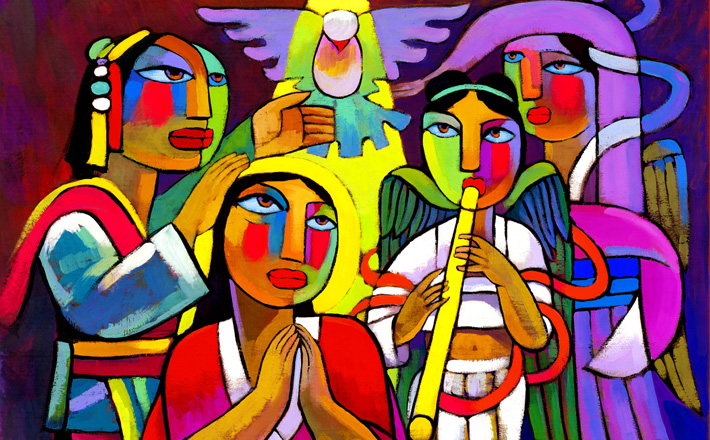
So What?

Luke 3:15-22

So.  This is the Sunday when we observe that one thousand nine hundred ninety-five years ago, give or take, Jesus was baptized by John in the Jordan River.  And I confess that on this Sunday when wildfires are still raging across Southern California, when our eyes are still watering from the smoke in the air, when our vision is still blurred with tears for all the homes and land destroyed and lives lost, when our hearts are still breaking for friends and family—for all the people who have had to evacuate, who have had to flee in terror as fire roared toward them—I confess that my first response to the baptism of Jesus in this week of catastrophe on a Sunday when the fires are still raging and homes and lives are still in peril–my first response to the baptism of Jesus is: so what?

So what if Jesus was baptized?  So what if a voice from heaven proclaimed him as the divine, beloved child of God with whom God was well pleased?  What does that have to do with me?  With us?  How does that help us at a time when our neighborhoods are on fire and our lives are filled with fear and anxiety and desperation?

One thousand nine hundred ninety-five years ago, more or less, Jesus was baptized.  What does this mean?  Where is the good news in that ancient fact in the face of the very real and present danger we are facing right now?

Where is the Good News?  

Well maybe—stay with me here– maybe it’s right where it has  always been.  Maybe it’s right in front of us, in the water and in the Word.  

The baptism of Jesus is depicted in all four gospels.  Sort of.  The Gospel of John alludes to baptism of Jesus but never actually describes him being baptized.  My favorite version of the Baptism of Jesus is in the Gospel of Matthew.  In Matthew, Jesus has no sooner waded into the water when John and Jesus start arguing.  That’s just so human.  In Matthew’s telling of the story, John didn’t want to baptize Jesus.  Matthew tells us that John “would have prevented him.”  It didn’t feel right to John.  It didn’t feel appropriate.  For him to baptize Jesus seemed upside down and backwards.  “I need to be baptized by you!” he tells Jesus.  

need to be baptized by you.  That’s an interesting choice of words.  It implies that John thought he was lacking something that Jesus could give him.  What could that be?

Jesus finally persuaded John to go ahead and baptize him when he said, “Let it be so now; for it is proper for us in this way to fulfill all righteousness.”  Basically, Jesus was telling John, “let’s go ahead with this because it’s the right thing to do.”

Why is it the right thing to do?  John’s baptism was a baptism of repentance for the forgiveness of sin[1].  But Jesus didn’t have any sin that he needed to repent of, did he?  So why was it the right thing for him to do?  How did his baptism “fulfill all righteousness”?

Preachers like to use the baptism of Jesus as a springboard to talk about the meaning of our baptism and the gifts that baptism bestows on us.  I’ll admit that that’s what I’ve preached about on this Sunday for many, many years.  But this year I think something else needs our attention.

Don’t get me wrong.  It’s always useful to take some time to remember our baptism and think about what it means and how we are living out our lives in the covenant of baptism.  But this year, as fires rage around us and life seems perilous and precarious, I have found myself thinking about the baptism of Jesus a little differently.  This year I find myself wondering what it meant for him.  What was he showing us?  What did he want us to see?  What did he want us to learn?

The word “baptism” comes from the Greek verb baptizein which means “to dip,” or “to plunge or to immerse.”[2] When we are baptized, the water that is poured over us is a sign that we are immersed into the life and love of the triune God, that we are plunged into the eternal perichoresis, the eternal circle dance of love that flows between the Father, the Son and the Holy Spirit.  But Jesus was already fully immersed in the life and love of the Trinity, so what did plunging into the water signify for him?  What was he immersing himself in?

I can’t help but think that what baptism signified for Jesus was not his immersion into the life of God, but his immersion into the life of humanity.  

With the Holy Spirit descending like a dove and the voice from heaven proclaiming that Jesus is heaven’s divine and pleasing child, it’s easy to get so caught up in the divinity of Jesus that we overlook how very human this moment is.  Jesus was already immersed in his divinity.  Here at the river, with water up to his chest, he was plunging into his humanity.

Jesus immersed himself into an existence where water is a necessity of life that can cleanse you and sustain you and quench your thirst, but it can also flood your home, sweep away your crops and livestock and drown you.

Jesus immersed himself into a life where fire can refine metals and give you light in the dark and warm your home and bake your bread and cook your meals, but it can also burn down your house and ravage your fields and orchards.  It can obliterate whole cities. It can burn you with the worst kind of pain.  And it can kill you. 

Jesus immersed himself into a human life in a body that was strong and beautiful, a body that could embrace the warm comfort of companions and smell the sweet and uplifting aromas and taste all the delicious flavors and see all the beautiful horizons and hear the music of the birds, a body that could feel joy and compassion and tenderness.  But it was also a vulnerable body, a body that could be wounded and injured,  a body that could smell the stink and feel the sharp edges and experience all the not-so-pleasant sensations of the world, a body that could feel anxiety and fear and pain.  A body that, in the end, could die.

Jesus immersed himself into all that it means to be human, the good and the bad. His baptism was more than an act of divine solidarity; it was a validation of deeply human unity.  He was showing us that he was one of us.  

But he wasn’t just immersing himself in us.

One thousand nine hundred ninety-five years ago, or thereabouts, Jesus was immersed in the waters of the Jordan, a river whose waters had been evaporated from the seas and transported in clouds before falling on the hills as snow and rain, a river that swept minerals and seeds and soil down from the mountains to enrich the land below, a river that carried away the effluent of people, cattle and animals as it flowed past villages and fields and farms and towns, a river filled with life and with a life of its own.  Jesus was immersed not only into the life of humanity, but into the life of the world itself, the life of the planet. 

And maybe that’s the Good News, on this Sunday when fires are still endangering our lives and so many things we hold dear are in jeopardy.  Maybe the Good News for us in the baptism of Jesus is that Christ is immersed in our lives and we are immersed in the life of Christ, but also that Christ is immersed in the life of the world.  Maybe, if we open our eyes and minds and hearts, we can trust that Jesus is with us, in, with and under all our heartbreaks and joys, our fears and our relief.  Maybe we can learn to trust him and hear his voice speaking a word of promise from Isaiah: 

“When you pass through the waters, I will be with you, and the rivers will not overwhelm you.  When you walk through fire you shall not be burned and the flame shall not consume you… for I am the Lord, your God…you are precious in my sight and honored and I love you.  Do not be afraid, for I am with you.”[2]


[1] Matthew 3:11

[2] Isaiah 43:2, 4, 5

When the Men Are Silent

And he came to her and said, “Greetings, favored one! The Lord is with you.”  But she was much perplexed by his words and pondered what sort of greeting this might be. ­–Luke 1:28-29

When I was seven years old my parents sat me down and said, “We are moving to California.”  I was much perplexed by their words.  I mean, I understood all their words… individually… as words.  I even understood their words as they had assembled them together in that sentence: we are moving to California.  It conveyed coherent meaning to me.  But that was the problem.  

There was too much meaning in those five words strung together like that. They were heavy with meaning.  They meant that I would be saying goodbye to life as I knew it in Kansas City, Missouri, saying goodbye to my best friend Dennis who lived right next door and all my other friends and cousins and Daniel Boone Elementary School and the woods where we played and fireflies in the backyard in the summer and sledding down the little hill in front of our house in the snow in the winter and a million other things that were crowding into my seven year old mind all at once.  

Mom and Dad tried to make it sound like it was good news.  Beaches!  Disneyland!  New Friends!  Are there any scarier words in the world for a kid than “New Friends?”  Worse, while I was still feeling the shock of their words, still being perplexed and wondering in my seven-year-old mind if maybe I had somehow caused this terrible thing to happen, I realized that things were already in motion and there wasn’t a thing I could do to stop it.

“Greetings, highly favored one, the Lord is with you.”  When I read that Mary was perplexed by the Angel Gabriel’s words I can’t help but wonder if she wasn’t feeling something like what I felt that day when my parents told me that my life was about to change completely and utterly.  Perplexed is a pretty tame translation for the word that’s in Luke’s Greek text.  Perplexed sounds like she was a bit puzzled, perhaps a little confused.  Diatarasso, the verb in the original text means she was distressed, disturbed, disoriented and deeply troubled by the angel’s words.  

Mary apparently knew that the ones who are highly favored by the Lord, those whom the Lord was with, were not folk who tended to have quiet, easy, uneventful lives.  The Lord tends to use the “favored ones” to get things done.  The Lord tends to move them around like chess pieces.  If an angel shows up to tell you that you are favored by God and that God is with you, hold on to your wallet and make sure your passport is up to date.  It means that God has plans for you.  Mary may have only been a teenager, but she was smart and she knew the stories about those whom the Lord favored.  So she pondered what sort of greeting this might be and waited for the angel to say more.  What was God up to?  What was God planning to do with her?

After a long moment of Mary saying nothing, Gabriel cleared his throat.  He had a message to deliver.  God had given him a script and told him not to deviate from it.  So he launched back into his speech.  It’s a nice speech, a very formal speech, the kind of speech you’d expect from an archangel on a mission from God. 

He told her she would conceive—in her womb, just in case she was uninformed about where conception happened.  He told her that the child would be a boy and that she was to name him Jesus.  He would be great.  He would be called the Son of the Most High.  The Lord would give him the throne of David.  His kingdom will have no end.

Up to this point Mary had been silent, but now she interrupts.  “How can this be,” she asks,  “since I am a virgin?”  She’s got some moxie, this young woman.  She’s not afraid to stop an archangel in the middle of his spiel and say, “Excuse me, but you’re forgetting one very important technicality.  I don’t know how it’s done with angels, but for humans there’s a part of the process missing in your plan here.”

“Ah, yes,” says the angel.  “I’m coming to that.”  And he resumes his recitation.  He told her that the Holy Spirit would initiate the pregnancy, that the power of the Most High would overshadow her, so the child would be holy.  He told her that her relative, Elizabeth, who was getting along in years and had never had children was now pregnant because nothing is impossible with God.  And with that Gabriel reached the end of his script and stood there waiting for a response.

Finally Mary has a chance to speak again.  Our translations soften the impact of her words, I think.  “Here am I, the servant of the Lord; let it be with me according to your word.” That’s how it reads in the NRSV and our other English versions are in the same dynamic range.  They sound so docile compared to the force of the words in the original language.  Even the Latin toned it down from Luke’s original Greek where there are hints of both fierceness and resignation in her words that don’t come through in the niceties of our translations.

The first thing she says is rather startling, especially if you remind yourself that she is saying it to one of the seven archangels who stand at the throne of God.  The first thing she says, literally translated, is, “Look.”  She invites the angel to really see her.  “Look,” she says, “the slave girl of the Lord.  It will happen to me according to your word.”

“Look at me, angel, before you vanish back to heaven.  Really pay attention for a moment to the one who is highly favored, the Lord’s slave girl. Yes.  It will happen just as you have said.  How could it not?  I am a slave in heaven’s hierarchical eyes. Who am I to argue with God?  But before you go, see me.  And think about how your visit will change my life.  See me, and think about what it will cost me because the Lord is with me. Think about what it means to be the slave girl of God, even if the slave agrees to play her part.”

Then the angel departed from her.  The language is abrupt, so the departure probably was, too.  I wonder if the angel left so quickly because he suddenly realized that his announcement had been more than a little coercive.  Nothing in his message even hinted that Mary had any choice in the matter.  Maybe he realized this and was a bit embarrassed by his own imperious manner. Or maybe not.  Maybe he was just done.  Who can tell with angels?  They’re not like us.

The angel departed, and not long after that, Mary departed to see her relative, Elizabeth and her miraculous pregnancy.

Now here’s an interesting thing.  Have you ever noticed that in the original Advent, that time building up to the birth of both John the Baptizer and Jesus, the men in the story are silent?  Well, Gabriel talks a lot, but he’s an angel and everything he says is a message from God. Otherwise the male voices are almost entirely silent. 

Zechariah, Elizabeth’s husband doubts Gabriel when Gabriel tells him he’s going to be a father so late in life, so Gabriel makes him mute for the entire time of Elizabeth’s pregnancy.  Joseph is visited by an angel a few times in Matthew’s gospel, but Joseph never speaks. The women, though,  the women speak powerfully and prophetically.  

Elizabeth silences the gossipy busybodies of her community saying, “This is what the Lord has done for me when he looked favorably on me and took away the disgrace I have endured among my people.”

When Mary comes to see her, Elizabeth is filled with the Holy Spirit and blesses Mary with words so powerful that they have become embedded in the beads of the rosary and engraved on the psyche of our faith for all generations. “Blessed are you among women, and blessed is the fruit of your womb.” And then she affirms Mary for agreeing to her role in God’s plan: “And blessed is she who believed that there would be a fulfillment of what was spoken to her by the Lord.”   

Elizabeth speaks in the tradition of the five women prophets of the Hebrew Bible, Miriam, Deborah, Huldah, Noadiah, and the unnamed prophetess mentioned in Isaiah 8.  She speaks in the strength of Judith, the conviction of Tamar, and joyful mirth of Sarah. 

Moved by her words and stirred by the Spirit, Mary begins to sing a prophetic song full of joy and power to proclaim the work of God. Young, poor, unmarried and pregnant, she becomes a prophet.

“My soul magnifies the Lord, and my spirit rejoices in God my Savior,  for he has looked with favor on the lowliness of his servant.”  She rejoices that God isn’t transforming the world through the rich and the powerful, but instead is working through the poor, the humble, the disenfranchised and marginalized—through her and people like her. 

She sings of things to come as if they are already accomplished, a proleptic vision of God remaking the world from the bottom up.  “Prophets,” writes Barbara Brown Taylor, “almost never get their verb tenses straight, because part of their gift is being able to see the world as God sees it — not divided into things that are already over and things that have not happened yet, but as an eternally unfolding mystery that surprises everyone, maybe even God.”

“The song of Mary is the oldest Advent hymn. It is at once the most passionate, the wildest, one might even say the most revolutionary Advent hymn ever sung,” said Dietrich Bonhoeffer.   She sings of a sweeping change in the social order, a change so radical that her Magnificat has been regarded as politically dangerous in places where despots and tyrants have tried to maintain control.  It was banned in India during British rule.  When Guatemala was ruled by a military junta in the 1980s they outlawed her Magnificat, and it was outlawed again during the “dirty war” in Argentina when the mothers of disappeared children began papering the streets with posters of her song.  When you’re trying to rule people with an iron fist you can’t have them singing about power being overturned.

“He has shown strength with his arm; he has scattered the proud in the thoughts of their hearts.  He has brought down the powerful from their thrones, and lifted up the lowly;  he has filled the hungry with good things, and sent the rich away empty.”

In a time when her own land and her own her own people are burdened by the yoke of Rome, she sings of God’s faithfulness:  He has helped his servant Israel, in remembrance of his mercy, according to the promise he made to our ancestors, to Abraham and to his descendants forever.”

Mary sings an overture for the work of her son, The Son of the Most High.  She sings to proclaim God’s vision of justice.  She sings to remind us that we are called to share the vision and to share the work of making God’s commonwealth of justice and kindness a reality on earth as it is in heaven.

Look.  See the slave girl of the Lord.  An angel speaks to her and she is much perplexed.  But she is not silenced.  She sings the song of Advent, the song of God’s revolution.

When the men are silent, the women sing.  And their songs change the world.

The Light of Hope

The Light of Hope

Luke 21:25   

There will be signs in the sun, the moon, and the stars and on the earth distress among nations confused by the roaring of the sea and the waves.  People will faint from fear and foreboding of what is coming upon the world, for the powers of the heavens will be shaken.  Then they will see ‘the Son of Man coming in a cloud’ with power and great glory.  Now when these things begin to take place, stand up and raise your heads, because your redemption is drawing near.”

  Then he told them a parable: “Look at the fig tree and all the trees;  as soon as they sprout leaves you can see for yourselves and know that summer is already near.  So also, when you see these things taking place, you know that the kingdom of God is near.  Truly I tell you, this generation will not pass away until all things have taken place.  Heaven and earth will pass away, but my words will not pass away.

 “Be on guard so that your hearts are not weighed down with dissipation and drunkenness and the worries of this life and that day does not catch you unexpectedly,  like a trap. For it will come upon all who live on the face of the whole earth.  36 Be alert at all times, praying that you may have the strength to escape all these things that will take place and to stand before the Son of Man.”

Four years ago on the first Sunday in Advent, the Centers for Disease Control reported that 270,000 Americans had died from Covid 19.  That was 270,000 empty seats at the Thanksgiving table, enough people to fill every seat in Dodger Stadium five times.  By the end of December, that number had climbed to 350,831[1].  All in all, in the first four years of the pandemic more than 1.2 million Americans died.  Thanks to vaccines, increased awareness and improved health practices, only 43,360 people have died from Covid in the US this year.  But that is 43,000 reminders that the virus can still be a deadly threat.

Because of general economic disparity in our country, 47.4 million people live in households experiencing food insecurity.  17.9% of households with children under 18 were food insecure in 2024.  That’s actually a huge improvement over four years ago when 56% of such households were food insecure, but it still represents 14 million children who are at risk of going to bed hungry every night in a country that has more than enough resources to ensure that everyone has enough to eat.[2]  And sadly, it almost goes without saying that rates of food insecurity are higher  among people of color and in single-parent households headed by women.

Because of the high cost and shortage of housing, more than 25% of renters in California spend more than 50% of their income on housing, and more than 160,000 experience homelessness on any given night.

On the other side of the world, Israel’s war against Hamas has degenerated from a justifiable defense into genocide in Gaza and the violence has expanded into Lebanon.  Russia’s aggressive war against Ukraine has become more dire as Russia has deployed a new nuclear capable hypersonic missle.  

Turning back to home, here in the US we are living in a time of political tension and uncertainty which our recent election has exacerbated as we brace ourselves for what comes next.

In so many ways and for so many of us, this is a grim and precarious time.  The words of Isaiah ring in us like a bell:

O that you would tear open the heavens and come down,

          so that the mountains would quake at your presence—  

          When you did awesome deeds that we did not expect,

          you came down, the mountains quaked at your presence.[3]

Like the people of Israel in Isaiah’s day, we find ourselves crying out in fear and frustration.  O God, why won’t you do for us the kinds of things you did in the past?  Where’s our parting of the sea?  Where is our manna falling from the sky?   Where is our just and prophetic leadership?  Where is the “righteous Branch for David” that Jeremiah promised, the one who will “execute justice and righteousness in the land?”[4]

This feels like a grim and precarious time.  But then, it was a grim and precarious time for the people of Judah when Jeremiah spoke that promise.  It was a grim and precarious time when Isaiah begged God to break open the heavens and come down.  The people of the covenant were suffering under the harsh oppression of Babylon.  They wanted the same kind of divine intervention that so many of us are longing for right now.

It was a grim and precarious time when Jesus sat on the Mount of Olives and shared his apocalyptic vision of the temple’s destruction with his disciples. The people were chafing under the harsh and authoritarian governance of Rome.  And it was a grim and precarious time for Jesus, himself,  and for his disciples, even though at that moment the disciples seemed obtusely unaware of just how much danger they were facing.

As we read the story in the synoptic gospels of Mark, Matthew and Luke, Jesus is telling his disciples about the coming time of turmoil just days before Judas betrays him and he is crucified.  And it’s also a very perilous time when the writer of Mark, the earliest Gospel, records all this.  Biblical scholar Ched Myers has suggested that Mark was writing his account during the Jewish revolt against Rome, the rebellion that ended with the destruction of Jerusalem and the temple.  There is a haunting and prophetic prescience when Jesus says,

“But in those days, after that suffering,

         the sun will be darkened,

                  and the moon will not give its light, 

         and the stars will be falling from heaven,

                  and the powers in the heavens will be shaken.”

Luke expands on Mark’s words and broadens the reach of the calamity when he writes:

“There will be signs in the sun, the moon, and the stars and on the earth distress among nations confused by the roaring of the sea and the waves.  People will faint from fear and foreboding of what is coming upon the world, for the powers of the heavens will be shaken.   

These words of Jesus take on new weight on the first Sunday of Advent when you think of them being spoken during a time of violent political oppression, a time when any hint of opposition to the empire’s political or social order is quickly and decisively squashed.  These words have a sharper edge when you think of them being written down and preserved while the streets of the city are filled with the noise and bloodshed of battle between Roman soldiers and Jewish partisans, or when you think of the followers of Jesus being tortured and persecuted by the agents of the empire.  

Beware.  Stay alert.  Stay awake.  The advice Jesus gives is practical.  Keep your eyes open.  Don’t fall for false messiahs and conmen.  Don’t make yourself crazy trying to figure out God’s timetable because only God knows.  It’s going to be a bumpy ride.  There will be trying times.  Stay awake.

Advent is a time for pragmatism and preparation. 

Advent is a time to walk into the turmoil and the pain of life with your eyes wide open.  In an age and a season when it is all too easy to live in denial, when we would love to jump straight to Christmas, Advent calls us to take a hard look at the world around us.  Advent calls us to see the world as it really is, to see ourselves as we really are, to open our eyes to things that we maybe don’t want to see, to listen to things we might prefer not to hear.  Advent calls us to be realistic…about the world and about ourselves. 

In 1952, as the Korean War was dragging on and the Cold War between the United States and the Soviet Union was becoming more intense, William and Annabeth Gay wrote a haunting and profound hymn that, to my mind, perfectly captures the spirit of Advent for our age.  The title that Annabeth gave it is Carol of Hope, but you might know it by its first line which is how it’s titled In most hymnals, a line that sounds anything but hopeful:  Each Winter As the Year Grows Older.[5]

Each winter as the year grows older, 

we each grow older, too.  

The chill sets in a little colder; the verities we knew

seem shaken and untrue.

When race and class cry out for treason, 

when sirens call for war, 

they overshout the voice of reason and scream till we ignore

 all we held dear before.

Yet I believe beyond believing that life can spring from death,

that growth can flower from our grieving, 

that we can catch our breath

and turn transfixed by faith.

So even as the sun is turning to journey to the north,

the living flame, in secret burning, 

can kindle on the earth

and bring God’s love to birth.

O Child of ecstasy and sorrows, O Prince of peace and pain,

brighten today’s world by tomorrow’s,

renew our lives again;

Lord Jesus, come and reign!

Advent calls us to be realistic about the shadow side of life, to mark where we’ve not only grown older but colder, to notice where the verities we knew seem shaken and untrue.  Advent calls us to identify those voices that overshout the voice of reason so we can be more attentive to reason and to the Prince of peace and pain.  

But Advent doesn’t simply ask us to dwell in gloom and shadows.  Advent also calls us to bring light—four lights to restore brightness and health to a self, a nation, a world stumbling in murky clouds of doubt and fear—four lights to prepare the way for the true light of Christ. 

And the first light is Hope.

“Genuine hope is not blind optimism,” said Jürgen Moltmann.  “It is hope with open eyes, which sees the suffering and yet believes in the future.” And perhaps Barack Obama was thinking of Moltmann when he said, ““Hope is not blind optimism. It’s not ignoring the enormity of the task ahead or the roadblocks that stand in our path. It’s not sitting on the sidelines or shirking from a fight. Hope is that thing inside us that insists, despite all evidence to the contrary, that something better awaits us if we have the courage to reach for it, and to work for it, and to fight for it. Hope is the belief that destiny will not be written for us, but by us, by the men and women who are not content to settle for the world as it is, who have the courage to remake the world as it should be.”

Hope is that thing inside us that insists, despite all evidence to the contrary, that something better awaits us.

“The very least you can do in your life is figure out what you hope for,” wrote Barbara Kingsolver. “And the most you can do  is live inside that hope.  Not admire it from a distance but live right in it, under its roof.”[6]

On this first Sunday of Advent, as we begin a new year in the calendar of the Church, we light the candle of Hope.  If the sun is darkened and the moon will not give its light and the stars seem to be falling, light the candle of hope.

If we are suffering now because of politics and war and the erosion of truth and trust, Saint Paul reminds us that, “suffering produces endurance,  and endurance produces character, and character produces hope,  and hope does not disappoint us, because God’s love has been poured into our hearts through the Holy Spirit that has been given to us.”[7]  “If we hope for what we do not see,” he said, “we wait for it with patience.”[8]

So if it looks like the sun has been darkened and the moon won’t shine and the stars are falling and the world is more or less metaphorically ending, in the spirit of Advent, let’s be realistic and honest about it.  Let’s stay awake and aware.  And then let’s light a candle of Hope.  Because Hope is that thing inside us that insists, despite all evidence to the contrary, that something better awaits us.

May the God of hopefill you with all joy and peace in believing, so that you may abound in hopeby the power of the Holy Spirit.[9]


[1] CDC National Center for Health Statistics;  2020 Final Death Statistics: Covid 19 as an Underlying Cause of Death vs. contributing Cause

[2] Food Research and Action Center https://frac.org/news/usdafoodsecurityreportsept2024

[3] Isaiah 64:1-2

[4] Jeremiah 33:14-16

[5] Each Winter As the Year Grows Older, William Gay, 1920-2008;

  Tune: Carol of Hope, Annabeth Gay, 1925-2020;  Evangelical Lutheran Worship, #252

[6] Barbara Kingsolver, Animal Dreams

[7] Romans 5:4-5

[8] Romans 8:25

[9] Romans 15:13

Out of Love for the Truth

John 8:31-36

“Out of love for the truth and from a desire to elucidate it, the Reverend Father Martin Luther, Master of Arts and Sacred Theology, and ordinary lecturer therein at Wittenberg, intends to defend the following statements and to dispute on them in that place.  Therefore he asks that those who cannot be present and dispute with him orally shall do so in their absence by letter.  In the name of our Lord Jesus Christ, Amen.”

This was the introduction to the 95 Theses which Martin Luther nailed to the door of the Wittenberg University Chapel on Wednesday, October 31, 1517.   We sometimes think that nailing the 95 Theses to the door of the church was an act of rebellion, and in retrospect it was powerfully symbolic.  But it was actually a normal practice.  The church door served as a kind of bulletin board for the academic community.  If you wanted to propose a debate, that’s where you posted the notice with the propositions to be discussed.

Luther did not intend for the 95 Theses to be a manifesto for rebellion.  He had no idea that his challenge to the practice of selling indulgences would spark a revolutionary movement that would sweep across Europe bringing enormous changes in religion, politics, education, and everyday life, but once that movement started, he gave himself to it body and soul because he was committed to the truth of the Gospel and the love of Christ. 

The truth quite literally set him free from the heavy-handed authority of Rome—the Pope excommunicated him.  But the truth also bound him to the proclamation of salvation by God’s grace through faith and to the authority of God’s word in the scriptures.

Out of love for the truth and from a desire to elucidate it…  

According to the Gospel of John, when Jesus was on trial before Pontius Pilate he stated, “For this I came into the world, to testify to the truth. Everyone who belongs to the truth listens to my voice.”  In response, Pilate asked him, “What is truth?”  

In some respects that seems like an almost ridiculous question.  We know what truth is.  We learn about truth almost as soon as we learn to talk.  Sadly, that’s also when we learn to lie, because we learn pretty quickly that the truth may reveal things we would like to keep hidden.  We learn very early on that sometimes truth has consequences that we would like to avoid, and that those consequences might be unpleasant or even painful.  

Truth, the dictionary tells us, is the true or actual state of a matter.  Something is true when it is in conformity with reality.  We say a thing is true when it is a verified or indisputable fact.  The truth reflects actuality or actual existence.  When we say a thing is a basic truth, we mean that it is an obvious or accepted or provable fact.  

Truth means that my desires or imagination do not have the final word in determining what is reality and what is not.

There are twenty-seven verses in the gospels that contain the word truth.  Twenty-one of those verses are in the Gospel of John where truth is not only a central theme, it is anchored in and identified with the person of Jesus.  In John 1:14 we read, “the Word became flesh and lived among us, and we have seen his glory, the glory as of a father’s only son, full of grace and truth.”  Three verses later, John puts aside the figurative language of the Word to make it clear who he is talking about: “The law indeed was given through Moses; grace and truth came through Jesus Christ.”

When Jesus sat discussing theology with a Samaritan Woman at Jacob’s Well, he told her that “true worshipers will worship the Father in spirit and truth.”  This suggests that truth is a vital element in our connection to God.

In chapter 14, not long after Jesus has told Thomas that he, himself, is “the way, the truth, and the life,” Jesus refers to the Holy Spirit as “the Spirit of truth” and in chapter 16 he tells his disciples that “when the Spirit of truth comes, he will guide you into all the truth.”  In chapter 17, as he prays for the disciples, Jesus asks that they would be sanctified or consecrated in truth.

“For this I was born,” Jesus told Pilate, “and for this I came into the world, to testify to the truth.  Everyone who belongs to the truth listens to my voice.” (John 18:37)

In today’s Gospel reading from chapter 8 of John’s gospel, we see a hint that some of those who were listening to Jesus were unsure about continuing to follow him.  Some scholars think that this passage is indicative of tension between Jewish followers of Jesus and Gentile believers in the community where this gospel was written, and that John, the writer, is calling both sides back to the middle ground of the truth found in the person and teaching of Jesus.  

“Jesus said to the Jews who had believed in him, ‘If you continue in my word—if you remain faithful to my teachings, then you are truly my disciples.  And you will come to know the truth.  And the truth will set you free.”  When they protested that they were descendants of Abraham and had never been enslaved by anyone—apparently they forgot about their own history with Babylon and Egypt—Jesus went on to make it clear that he was talking about the truth setting them—and us—free from our slavery to sin.  

But how does the truth set us free from sin?  

René Girard would suggest that truth sets us free from endless mimetic rivalries which are always based in falsehood, fantasy or desire.  Sin is the endless stream of little contests and competitions that we create against each other which escalate, eventually, into big and violent contests.  Truth can free us from this because truth has no bias.  Just as God is the ground of all being, truth is the ground of reality, the neutral acknowledgment of the way things are.  Sin wants to create a different reality or to act as if life is happening in a different reality with different rules.

Martin Luther defined sin as being curved in on the self.  Sin is when I put my preferences, my desires, my ideas, my plans, my goals above and before everyone and everything else.  Sin is me, me, me, me, me taken to the extent that it harms or disenfranchises or marginalizes or disempowers or diminishes or neglects you, you, you, you, you or them, them, them, them, them.  Sin creates a false reality, an illusion centered on my desires, my fears, my imagination.  And that illusion is seductive and captivating.  It ensnares.  It enslaves.  It makes me believe that I am the center of the universe, that what I think or believe or even just what I want very, very badly to be true is what is real.

Truth disabuses me of that illusion.

Once again: Truth means that my desires or imagination do not have the final word in determining what is real and what is not.

We are currently struggling through a time when truth is endangered in our culture.  There’s nothing new about that.  People have always preferred to put their own spin on facts that confront their biases or preconceived ideas or desires.  People throughout history have taken refuge in denial when events or outcomes don’t fit the way they wanted things to happen or the results they wanted.  What’s new is how widespread and militant this devaluation of the truth has become.  

When lies and spin become so prevalent that they begin to undermine any common understanding of basic facts, the world becomes a more dangerous place.  When people refuse to accept observable facts, when there is no longer the common cultural ground of truth based on fact, then there is no longer a starting point for discussion or compromise.  There is no way to move past confrontation and opposed binary positions that divide us.  When people lift up conspiracy theories and “alternative facts” as justification for their actions or opinions then we stand on the precipice of political violence.  

Sadly, we have seen clear examples of that lately.  It has become the sin of our society fed by the polarity of our politics.

The proliferation of misinformation and outright lies in our political and social conversation has become so common and problematic that our ELCA Conference of Bishops recently issued a joint statement to address the problem. These are the opening lines of their statement:

We know that the power of truth is greater than the power of deceit.

We, the members of the Conference of Bishops of the Evangelical Lutheran Church in America, speak with one voice to condemn the hateful, deceptive, violent speech that has too readily found a place in our national discourse. We lament the ways this language has led to hate-fueled action. We refuse to accept the ongoing normalization of lies and deceit. We recommit ourselves to speaking the truth and pointing to the one who is truth. 

We refuse to accept the ongoing normalization of lies and deceit.  We recommit ourselves to speaking the truth.   To do otherwise is sin.

Sin convinces me that I stand apart from the rest of humanity.  But the truth, the fact, is that I am deeply and intimately connected to the rest of humanity and, in fact, to all of creation.  Standing apart is an illusion.  Rugged individualism is a destructive myth—destructive because it undermines and negates the relationships that keep us alive in every sense of the word.

“We must all overcome the illusion of separateness,” said Richard Rohr.  “It is the primary task of religion to communicate not worthiness but union, to reconnect people to their original identity “hidden with Christ in God” (Colossians 3:3). The Bible calls the state of separateness ‘sin.’ God’s job description is to draw us back into primal and intimate relationship.”

As followers of Jesus, we are called to live in the imitation of God.  We are called to observe what God is doing all the time and everywhere and then do the same.  We are called to be generous because God is generous.  We are called to be creative because God is creative.  We are called to embrace diversity because God revels in diversity so much that no two things are exactly alike in the entire universe.  But above and beyond everything else, we are called to love.  “Love,” said St. Paul, “does not rejoice in unrighteousness, it rejoices in the truth.” (1 Cor 13:6)  Untruth is corrosive to love.  Lies and deception undermine and chip away at love until it disappears.  But truth reinforces love and makes it stronger.  There’s a reason we talk about “true” love.

We are called to love because God loves.  God is love.  Richard Rohr has said, God does not love us if and when we change.  God loves us so that we can change. That is the essence of grace—the grace that makes us whole, the grace that heals us, the grace that reunites us, the grace that saves us and leads us into the truth.  Truth is where all grace begins.

At the conclusion of their statement, the ELCA Bishops gave us some good practical advice to help us ensure that our lives, thoughts, speech and actions are anchored in grace and truth:

We find courage in our collegiality and implore the members of the Evangelical Lutheran Church in America, as well as our partners and friends, to join us as we:

  • Pledge to be vigilant guardians of truth, refusing to perpetuate lies or half-truths that further corrode the fabric of our society.
  • Commit to rigorous fact-checking, honoring God’s command to “test everything; hold fast to what is good” (1 Thessalonians 5:21).
  • Reject the use of humor that normalizes falsehood, remembering that our speech should “always be gracious” (Colossians 4:6).
  • Boldly advocate for the marginalized and oppressed, emulating Christ’s love for the least among us.
  • Courageously interrupt hate speech, standing firm in the knowledge that all are created in God’s image.
  • Lean in with curiosity, engage with those who think differently and “put the best construction on our neighbor’s action” (Luther’s explanation of the Eighth Commandment).
  • Amplify voices of truth.

Emboldened by the Holy Spirit, may we resist deception and lift up the truth that all members of humanity are created in the image of God.

On this Sunday, we celebrate a Reformation began with the words, “Out of love for the truth…”.  May we resist the sin of deception and live with a commitment to truth that continues to reform and refresh our faith, our lives and our world.  In the name of the Way and the Truth and the Life.

Whatever We Ask

Mark 10:35-45

“Whoever wishes to become great among you must be your servant, and whoever wishes to be first among you must be a slave of all. For the Son of Man came not to be served but to serve, and to give his life a ransom for many.”

There was an interesting picture that popped up here and there on social media a few years ago.  It was a picture of a middle-aged man washing dishes in a restaurant kitchen, which isn’t all that unusual, except in this particular picture, the man who was washing the dishes was Rock and Roll Hall of Famer Jon Bon Jovi, the front man for the very successful rock band, Bon Jovi. 

Back in 2011 Jon and his wife Dorothea wanted to do something to help hungry people, but they didn’t want it to be just another food pantry or soup kitchen.  Food banks and soup kitchens do good work, but they also tend to isolate poor people from everyone else or spotlight them—and not in a good way.   

Jon and Dorothea decided to open a restaurant where payment is optional so that folks who cannot afford a restaurant meal can dine right alongside those who can.  They called their restaurant JBJ Soul Kitchen and it has now expanded to three locations.  

The menu at JBJ has no prices.  You select what you like and are encouraged to make a suggested donation, but if you are unable to donate, you are invited to participate in what they call “volunteer opportunities,” which usually means working in the kitchen in one way or another.  When he’s not on tour, Jon Bon Jovi himself often stops in to volunteer as a waiter or cook or dishwasher.  

During the pandemic, as you might imagine, JBJ Soul Kitchen had to change its ways of operating.  In an interview in 2020, Jon said, “Due to the pandemic, we couldn’t have any volunteers work.  But we still had mouths to feed.  So Dorothea and I worked five days a week for two months before we went to Long Island and opened a food bank that fed 6,000 people a month there.”  

Whoever wishes to become great among you must be your servant, and whoever wishes to be first among you must be a slave of all.

There is a YouTube channel where, every night of the week, you’ll find one of the richest, most successful women in the world sitting on her bed in her pajamas reading a children’s book.  The very famous  lady in her PJs is none other than Dolly Parton, and her YouTube program, Goodnight with Dolly, is targeted toward preschoolers, because children who have someone read to them on a regular basis develop their own reading skills earlier and more easily.  

Dolly understood that not every parent has free time to sit and read with their kids, especially single parents.  And not all parents read well enough, themselves, to provide their kids with that important head start.  In fact, that was the case with Dolly’s own father who started working while still very young and as a result never learned to read or write.  So Dolly Parton decided that, in honor of her father, she would help as many kids as possible develop those very necessary pre-reading and early reading abilities.

Goodnight with Dolly is the newest venture in Dolly Parton’s long-time campaign for literacy.  In 1995, she launched the Imagination Library in Sevier County, her home county in East Tennessee, to inspire a love of reading by giving one free children’s book every month to every child in the county from age two until they start school.  With the help of local community partners, the Imagination Library has now spread throughout the United States, United Kingdom, Canada, Australia, and Ireland.  Nearly two million kids are now registered in the Imagination Library, and the organization has given away more than 254 million books.  Even so, there are still kids who haven’t been reached.  So Dolly Parton sits on her bed in her pajamas and reads to the kids whose parents aren’t available or aren’t able to read to them.

Whoever wishes to become great among you must be your servant, and whoever wishes to be first among you must be a slave of all.

The Disciples James and John came to Jesus and said, “Teacher, we want you to do for us whatever we ask of you.”  When he asked them what that might be, they said, “Let one of us sit at your right hand and one at your left when you come into your glory.”  

It’s interesting that Jesus didn’t chastise them even a little for asking something so audacious.  He simply told them that they didn’t really understand what they’re asking.  He hinted at the ordeal he would soon endure when he asked them,  “Are you able to drink the cup that I drink, or be baptized with the baptism that I am baptized with?”  They answered just a little too quickly:  “We are able,”  and it seems pretty clear that they didn’t really know what they were signing up for.

We shouldn’t be too hard on James and John.  To their credit, they really did have faith.  They truly believed that Jesus really could give them what they wanted.  They believed that he would soon “come into his glory.”  They just didn’t understand what that meant.  It didn’t occur to them that he was talking about the cross.

A lot of us have come to Jesus at one time or another saying, “I want you to give me whatever I ask of you.”  A lot of people have thought that this is really the essence of praying.  Jesus, please give me what I ask for.  And a lot of us have asked at one time or another to be put in positions of authority and prestige—right seat or left seat, either one is okay as long as we have a seat next to the throne. . .or at least at the table.  We want that position that gives us the authority to fix all those things that other people are messing up.  We have ambition.

Jesus didn’t rebuke James and John for their ambition.  But the other disciples did.  So Jesus had to remind all of them of what he had been saying all along.  You want to be a leader?  Fine!  Good!  Now, can you be a servant?

Whoever wishes to become great among you must be your servant, and whoever wishes to be first among you must be slave of all.

When Boris Baranov was appointed to the position of Shift Supervisor at the powerplant where he worked, he was given significant authority over some of the plant’s operations.  Along with that authority, of course, came some extra responsibilities.  Boris never dreamed, though, that saving most of Europe from becoming a nuclear wasteland would be one of those responsibilities.  But that’s exactly what happened one day when something seriously malfunctioned during his shift at the Chernobyl Nuclear Power Station, the powerplant where Boris worked. 

On April 26, 1986 one of the four reactors at Chernobyl exploded releasing 400 times more radioactive fallout than the bomb dropped on Hiroshima in 1945. Two workers were killed instantly.  Another 29 would die from radiation burns or poisoning over the next few months.  

All the fires were extinguished within six hours, but now there was a risk of an even larger explosion—an explosion that would be many times more devastating.  

Several days after they thought that everything was under control, they discovered that the reactor in unit 4 had continued to melt down. Below the reactor was a thick concrete slab and below the slab was a large pool of water which was normally used to cool the reactor.  

The core of the badly damaged reactor was now melting its way through the concrete slab.  If it were to reach the water, it would create an gargantuan steam explosion with a force of 3 to 5 megatons.  The enormous cloud of radioactive steam and ash that would have risen into the wind from that explosion would have made much of Europe uninhabitable for 500,000 years. 

To prevent the explosion, the water under the reactor had to be drained, which could only be accomplished by manually turning the right valves which were in the basement.  That would have been simple enough except that the basement was flooded with radioactive water from putting out the fires.  

Boris Baranov, the shift supervisor, Valeri Bespalov, the senior engineer, and mechanical engineer Alexei Ananenko volunteered to wade into the flooded basement and turn the valves.  Their brave and selfless act of service saved millions of lives.

Whoever wishes to become great among you must be your servant, and whoever wishes to be first among you must be a slave of all.

There’s nothing wrong with ambition.  Jesus didn’t rebuke James and John for their ambition.  He even affirmed that they would, in the end, drink from his “cup” and be immersed in his “baptism.”  But he wanted them to understand that ambition for ambition’s sake can lead to responsibilities you’re not prepared for, challenges you haven’t even begun to imagine.  

James and John wanted to be great, to sit in positions of prestige and authority.  And in the end, in a way, they got what they asked for.  According to tradition, after ten or twelve years proclaiming the gospel in Palestine alongside his brother John and the rest of the disciples,  James took the gospel to Spain.  In the end, when he returned to Jerusalem, he was killed by Herod Agrippa.  

John, according to tradition, took the gospel to Ephesus where he had a long life serving others and teaching them the way of Jesus.  James and John found direction for their ambition.  But along the Way they had to learn a very hard lesson. 

Whoever wishes to become great among you must be your servant, and whoever wishes to be first among you must be a slave of all.

In a matter of days now, we will have a very important national election.  The votes you cast in this election will be among the most important votes of your lifetime.  I cannot tell you whom you should vote for, but I will ask you to consider this:  who, among these candidates, has a history of seeking power out of sheer ambition, and who has a record of public service?  Who is seeking power for the sake of having power, and who is seeking a more powerful way to serve?  

Whoever wishes to become great among you must be your servant, and whoever wishes to be first among you must be a slave of all.  Please bear that in mind as you vote, then vote accordingly. . . and prayerfully. 

People as Things

Mark 10:2-16

Martin Luther defined sin as being “curved in upon the self.”  That’s a really good and useful definition.  It covers just about all the bases.  But a few years ago I read another terrific definition of sin in the book Carpe Jugulum by the late Sir Terry Pratchett, my favorite author of fiction.  In this book Granny Weatherwax, the wise woman of the hill country, defines sin in her own acerbic way while talking to a young theology student named Mightily Oats:  

“…And that’s what your holy men discuss, is it?” asked Granny Weatherwax.

“Not usually. There is a very interesting debate raging at the moment on the nature of sin, for example,” answered Mightily Oats.

“And what do they think? Against it, are they?”

“It’s not as simple as that. It’s not a black and white issue. There are so many shades of gray.”

“Nope.”

“Pardon?”

“There’s no grays, only white that’s got grubby. I’m surprised you don’t know that. And sin, young man, is when you treat people like things. Including yourself. That’s what sin is.”

“It’s a lot more complicated than that–“

“No. It ain’t. When people say things are a lot more complicated than that, they means they’re getting worried that they won’t like the truth. People as things, that’s where it starts.”

“Oh, I’m sure there are worse crimes–“

“But they starts with thinking about people as things…”

There you have it.  Sin is when you treat people as things.

Some Pharisees came to Jesus, and to test him—treating him a bit like a thing—they asked him, “Is it lawful for a man to divorce his wife?”  It’s interesting that they choose this question to test him.  The easy answer, and one that probably wasn’t open to debate in their minds, is yes.  It is lawful.  It says so quite clearly in Deuteronomy.  Chapter 24.  Verse 1.  

So there’s the answer.  It’s legal.  But Jesus understands that they’re really asking something else.  What they really want is his opinion on when it is permissible for a man to divorce his wife.  What are the acceptable grounds for divorce?  

Oh, and pay attention to that language.  It’s all about a man divorcing his wife.  Not the other way around.

Deuteronomy does not specify that a man needs any particular reason to divorce his wife.  It simply says, “Suppose a man enters into marriage with a woman, but she does not please him because he finds something objectionable about her, and so he writes her a certificate of divorce, puts it in her hand, and sends her out of his house.”

Deuteronomy seems to simply assume that divorce is going to happen and doesn’t offer any real commentary on it.  In Jesus’ time, though, there was a big debate going on between the school of Hillel and the school of Shammai, two very influential rabbis, about what constituted just cause for divorce.  What kinds of things made it okay.  

Hillel argued that, since Deuteronomy doesn’t specify that a reason is needed except that she doesn’t please him, anything she does that he finds objectionable—that’s the language in the statute—is acceptable grounds for the divorce.  It could be as simple as “she burned the bread” he argued.  Shammai and his followers, on the other hand, argued that divorce is only acceptable in the case of adultery.  

Jesus ties adultery to his answer, too, and at first glance, it looks like he’s siding with Shammai, but his response is more nuanced than that.  He’s actually refusing to get involved in their debate over the law itself.  Instead, he wants the Pharisees to see that just by arguing about this statute from Deuteronomy they are lending legitimacy to the already established practice of divorce instead of seeing it as a sad example of human brokenness in general, and an example of men in particular being curved in upon themselves and treating women as things that they can hold onto or discard at will.  Jesus wants them to see that that this law rests on assumptions that are highly objectionable, and because of that the statute, itself, is suspect.  

So Jesus takes the discussion out of Deuteronomy and anchors it, instead, in Genesis.  Out of the law and into the God-created nature of relationships.

“Moses gave you this law because you’re so hard-hearted,” said Jesus.  Right there at the beginning he is challenging them to look at why this law is even on their books.  It’s because the men are so hard-hearted.  They act as if it is their natural right to have control over the woman’s fate.  The very language of the statute seems to assume that.  It’s all about a man divorcing his wife.  

But Jesus reminds them that before there was this questionable law, there was the world as God had made it.  Both male and female were created in the divine image and likeness of God.  Male and female were equal.  That was God’s original vision and intent.  Jesus yanks them out of their debate over when and how it’s okay to destroy a relationship, and reminds them of the original intention of the relationship as it is defined in Genesis: “For this reason ‘a man shall leave his father and mother and be joined to his wife, and the two shall become one flesh.’ So they are no longer two, but one flesh. Therefore what God has joined together, let no one separate.”

You may not catch it right away, but Jesus is actually taking on patriarchy here.  In her ground-breaking book In Memory of Her, Elizabeth Schüssler Fiorenza describes it this way:

Divorce is necessary because of the male’s hardness of heart, that is, because of men’s patriarchal mind-set and reality…However, Jesus insists, God did not intend patriarchy but created persons as male and female human beings.  It is not woman who is given into the power of man in order to continue “his” house and family line, but it is man who shall sever connections with his own patriarchal family and “the two persons shall become one sarx (body/flesh)”… The [Genesis] passage is best translated as “the two persons—man and woman—enter into a common human life and social relationship because they are created as equals.”[1]

Jesus is protesting the way that patriarchal privilege has so casually and easily driven a wedge into the unity and equality originally intended for men and women.  And for marriage. 

He is not intending to create an absolute prohibition of divorce.  He acknowledges that it is an unfortunate fact of life.  But he wants to level the playing field.  And he also wants to make sure that no one enters into divorce lightly or with an unrealistic or incomplete understanding of the consequences.  

He makes it clear that those who remarry after divorcing will bring a certain amount of spiritual and emotional baggage to their new relationship whether they realize it or not. They will be “committing adultery” in the sense that they are no longer remaining faithful to the original relationship, and some part of their mind and heart will always know that.  

I don’t think Jesus is so much describing a continuous state of sin here as he is acknowledging the reality of the pain of broken relationships.  He applies this understanding to both men and women.  And it’s important to note that he doesn’t tell people to stay in relationships where they are being abused or broken or even simply neglected.  It’s important to remember, too, that Jesus is the one who can heal the brokenness, ease the pain and forgive the wounding that every divorce brings with it.

Jesus is trying to make it clear to both the Pharisees and to his own disciples that, in God’s eyes, the central problem with their understanding of the divorce law in Deuteronomy is that the whole thing is based on men treating women as objects, and that even if you restore equality to the relationship and level the power dynamics, treating people as things will always drive a wedge into your relationships.

Having said what needed to be said about treating people as if they were disposable, Mark’s gospel shifts focus so Jesus can address another group of persons whom their culture tended to treat as objects.  Children.  Only this time it’s the disciples who are failing to see the basic humanity of these smaller persons.

Mark tells us, “People were bringing little children to him in order that he might touch them; and the disciples spoke sternly to them.”  Jesus was indignant. “Let the little children come to me,” he said, “It’s people like these who make up the Kingdom of God!”  

That was a huge thing to say in a world where children had no stature whatsoever.  But Jesus wasn’t finished.  “Listen.  Whoever does not receive the Kingdom of God as a little child will never enter it.”

This is where a lot of commentators rhapsodize about the innocence of children.  I always wonder when I read those commentaries if the writer has any actual experience with real children.  I wonder if they’ve ever been on a long drive with two bored siblings in the back seat fighting because one kid’s arm or foot strayed into the territory claimed by the other kid.

So if Jesus isn’t referring to “the innocence of children” here, whatever that may be, what does he mean when he says we need to receive the kingdom as a little child? 

Well, one thing almost all children have is curiosity.  Richard Rohr calls it “a beginner’s mind of a curious child…what some would call ‘constantly renewed immediacy.”[2]  This is the state of mind which Rohr says makes it easier for us to enter into real spiritual growth.  This is the state of mind that can keep us from assuming that we already know everything.  This is the state of mind that enables us to see everyone else and ourselves as children of God, and not as objects.  Things. 

When we are able to see each other as children of God, when we are able to receive the Kingdom of God as a present reality and immerse ourselves in it with a beginner’s mind, a constantly renewed sense of immediacy, when we stop treating people as things, then we will be able to begin healing ourselves and the world.  Then we will be taken up in the arms of Christ and blessed.  And by the power and presence of Christ within us, we will embrace and bless the world around us.

In Jesus’ name.


[1] In Memory of Her: A Feminist Theological Reconstruction of Christian Origins; Elizabeth Schüssler-Fiorenza, p.143

[2] Things Hidden: Scripture as Spirituality; Richard Rohr, p. 8

The Scandal of False Opposition

Mark 9:38-50

In George Eliot’s wonderful book, Middlemarch, Dorothea Brooke asks a question that I keep coming back to over and over again.  “What do we live for,” she asks, “if it’s not to make life less difficult for each other?”  

That’s a powerful question, and if you take nothing else home with you today, I hope you take that.  I hope you let that question live with you.  What do we live for, if it’s not to make life less difficult for each other?

It seems like so often in life too many of us go out of our way to do just the opposite.  We make life more difficult, more challenging, more contentious, often without even intending to.  

In the ninth chapter of Mark, there’s a moment when the disciples made life more difficult for someone and they wanted Jesus to approve what they had done.  John, the disciple, came to Jesus and said, “Teacher, we saw someone casting out demons in your name, and we tried to stop him because he was not following us.”   

Think about that for a minute.  Someone was freeing people from spiritual oppression or possession—in the name of Jesus, no less—and they tried to stop him.  Because…?  Because he was not part of their group.  In the eyes of the disciples he wasn’t properly authorized to use the name of Jesus, I guess.

The way Jesus responded to this probably surprised his disciples, and  I can’t help but think he was maybe just a little bit exasperated when he told them, “Don’t stop him!  No one who does a deed of power in my name will be able soon afterward to speak evil of me.  Whoever is not against us is for us!  If someone does something as simple as giving you a cup of water in the name of Christ which you bear, they’re helping, not hurting.  Nobody loses God’s favor for helping others.”

That seems pretty clear, but Jesus has more to say.  He really wants them—and us—to be more aware of this human habit we have of creating opposition where there isn’t any, just like the disciples did when they told the non-disciple to stop casting out demons in Jesus’ name because he wasn’t a member of the Disciple Club.  

“If any of you cause one of these little ones who believe in me to sin,” said Jesus, “it would be better for you if a great millstone were hung around your neck and you were thrown into the sea.”  That’s how his words are translated in the Updated Edition of the NRSV and in a number of other English translations.  In some translations, he says, “If you cause one of these little ones to stumble…” which is a more accurate translation but still doesn’t really give us the whole sense of what Jesus is talking about.

The Greek word in question here is skandalise.  In its most common sense, it means to cause someone to stumble or to trip someone.  It comes from the word skandalon which gives us our English word scandal, but it’s not an exact equivalent.  A skandalon is a stumbling block or a trip wire.  It’s something that trips you up, slows you down, stops you, or springs a trap.   

The late René Girard said that in Mark’s Gospel this term is being used by Jesus in a very particular way to describe a very common dynamic in our relationships with each other.  He said that we “scandalize” each other in any number of ways by creating almost endless small rivalries which lead to blaming and scapegoating.  

I saw an short stick-figure animation the other day that was a perfect example of this.  The first character said, “Dang.  I spilled orange juice all over myself.  You never tighten the lid properly.” “Never?” said the other character.  “You’re saying I always, in every instance in my entire life, fail to screw the lid all the way down?”  “Yes.  The orange juice, the milk, the aspirin bottle… you never put the cap on right.”  “Well maybe the real problem is that you insist on shaking things without checking to make sure the cap is secure.”

Sound familiar?  They are “scandalizing” each other.

René Girard said that all these little contests of will are the “scandals” that Jesus is referring to and that we “scandalize” each other all the time in any number of ways, often without even noticing it.  These “scandals” create tension and anxiety in our relationships and they can escalate if they’re not addressed right away.  We carry that anxiety and tension out into the world with us where it joins in the great cloud of everyone else’s anxiety and tension.  

Think of road rage.  It may start with something small, one car not letting another merge into a lane, or one car cutting in front of another, but as we’ve seen far too often, with the wrong people in the wrong mood on the wrong day it can quickly escalate into something violent that puts everyone on the road at risk.

We scandalize others and are scandalized by others, colliding with each other in what Girard calls a cycle of mimetic rivalry which we keep reflecting back and forth at each other. Eventually, says Girard, our mimetic rivalry becomes contagious and our anxiety can all too easily become a kind of violent potential energy looking for a place to land, or, more specifically, a designated victim who will be the scapegoat that releases the tension.

We fall into this mimetic rivalry naturally enough, but there are forces in our world that encourage it for their own profit.  Politicians and certain news organizations, for instance, often manufacture or exaggerate a problem to serve as the target of our anxieties so they can then portray themselves as the ones who have the solutions—solutions which almost always involve scapegoating someone else.

This was the dynamic Hitler was using when he convinced the German people that the Jews were the source of their problems.  This is the dynamic some of our own politicians are using when they stir up antagonism toward immigrants, or even the other party.   

“If one of you scandalizes one of these little ones who believe in me, the ones with less power or resources or stature, it would be better for you if a great millstone—the Greek actually says the millstone of a donkey, a millstone so large you need a donkey to turn it—it would be better for you if a great millstone were hung around your neck and you were thrown into the sea,” said Jesus.  In other words, if you do something inadvertently or intentionally that traps someone else into a cycle of mimetic rivalry, especially if it’s someone with less social currency than you have, you’re sinking yourself and that other person into a very deep sea of trouble.

Jesus wants us to know that it starts in our bodies.  He wants us to understand that this mimetic rivalry is a very physical thing.  

“If your hand scandalizes you, cut it off.  It’s better for you to enter life maimed than to have two hands and go to Gehenna.  If your foot trips you up, cut it off; it is better for you to enter life lame than to have two feet and to be thrown into Gehenna.  And if your eye scandalizes you, pluck it out.  It is better for you to enter the kingdom of God with one eye than to have two eyes and be thrown into Gehenna where the worm never dies and the fire is never quenched.  I’ll say more about Gehenna in a moment.

Now let’s be clear.  Jesus is not advocating that we maim ourselves in any way.  A lot of people are really troubled by this passage, and a lot of pastors hate to preach on it.  One pastor asked his adult Sunday School class to think about which Sunday would be good for inviting their friends to church and one woman said, “Any Sunday except pluck-your-eye-out Sunday.”

She has a point.  It’s a scary text and it could put people off.  But it’s important to remember that Jesus is using hyperbole here.  He uses these very graphic images to hammer home the point.  The cycle of mimetic conflict begins in your body.  If your hand reaches for things that don’t belong to you, teach it to open up in gratitude for the things you do have.  If your hand all-too-easily balls itself into a fist, teach it to relax and reach out to others with understanding and compassion.  Metaphorically cut off that angry hand and give yourself one that’s peaceful.  If your foot keeps stepping into trouble, give yourself a foot that knows a better path.  If it keeps ending up in your mouth, well that’s a different problem, but maybe give yourself a more patient tongue.  If your eye keeps looking at others with inappropriate desire, retrain it to look on the world with genuine love and appreciation.

Mimetic rivalry and mimetic desire begin in your body.  And your body can be trained.  And healed.

Thich Nat Hanh, the great spiritual teacher once said, “My anger lives in my body but it will do no harm if I do not direct it at anyone.  When you say something really unkind, when you do something in retaliation, your anger increases.  You make the other person suffer, and he will try hard to say or to do something back to get relief from his suffering.  That is how conflict escalates.  I would not look upon anger as something foreign to me that I have to fight…I have to deal with my anger with care, with love, with tenderness, with nonviolence.”

 If we don’t learn to stop this scandalizing that we fall into all too easily, the penalty is pretty severe.  And it’s self-inflicted.  “Better for you to enter the kingdom of God with one eye than to have two eyes and be thrown into Gehenna, where the worm never dies and the fire is never quenched.”

Many of our translations say “thrown into hell,” but the Greek word here is Gehenna, not Hades or Sheol, and it is a very specific place.  Gehenna was the nickname of the Valley of Hinnom, a ravine running along the south side of Jerusalem.  It was believed to be cursed because, allegedly, children had been sacrificed to the Canaanite god Moloch there in one of the darker chapters of Israel’s history.  In the time of Jesus, this ravine, Gehenna, had become the city dump.  In addition to all kinds of refuse, corpses of animals were dumped there as were the bodies of criminals and nameless beggars. 

Jesus is telling us that if we keep scandalizing each other, if we don’t teach ourselves to escape these mimetic cycles of antagonism and anxiety, we will be sending ourselves to the trash heap, and I suppose that is a kind of hell.  The mimetic repetitive cycle where we keep mirroring our anxieties off each other, this scandalizing is the worm that never dies and the fire that is never quenched.  

But there is a way out.  “Everyone will be salted with fire,” said Jesus.  “Have salt in yourselves, and be at peace with one another.”  Salt, in his time, was medicine.  It was the number one antibiotic.  Salt was used to treat infection.  And it burned like fire, but it worked.  Salt also transforms things.  If you put salt in your food as you’re cooking, it doesn’t just season it, it changes the chemical composition of it because salt is a mineral, not a seasoning.  It transforms the food and makes it something different.  “Have salt in yourselves,” said Jesus.  “Burn out this contagious infection of antagonism so you can be at peace with one another.  Be transformed.”

Be at peace.  Be at peace with each other and with yourself.  Do your best to lower the temperature and reduce the anxiety around you.  And the anxiety within you.  “Be kind,” said author Wendy Mass.  “Everyone you meet is fighting a battle you know nothing about.”  

Be kind.  Greet the world with an expansive and welcoming attitude—not one of exclusion or antagonism or defensiveness.  Help people whenever and however you can.  Or at the very least, don’t be a stumbling block when you see someone else helping people. 

After all, what do we live for, if it’s not to make life less difficult for each other?  Especially if we can do it in the name of Jesus.

A Different Kind of Fire

James 3:1-12; Mark 8:27-38

It has been a stressful week in Springfield, Ohio.  A middle school was closed on Friday and two elementary schools were evacuated because of bomb threats.  Yesterday, three medical facilities in Springfield were targeted with more bomb threats.  The police have beefed up their staffing because racist threats of violence against Springfield’s Haitian immigrant community have been circulating and there is concern that these threats could escalate into actual violence.[1]  

Things were already a bit uneasy in Springfield, a mostly blue-collar city of about 60,000 residents.  The city’s manufacturing economy was hit hard by the Covid shutdown and economic renewal, while steady, has been moving more slowly than they had hoped.  Over the past few years about 15,000 Haitian immigrants have been drawn to the city by new factory jobs and relatively affordable housing, but some of the longtime residents, mostly white, have been antagonistic to the newcomers, accusing them of driving up housing costs and straining city services.

All of this came to a head last week when a neo-Nazi group fabricated a story about the Haitian immigrants kidnapping and eating their neighbors’ household pets.  This racially inflammatory story moved from the social media platform Telegram to X where it was picked up by Vice-Presidential candidate J.D. Vance who repeated it as part of a verbal jab Vice President Harris even though the story had already been debunked by the mayor of Springfield and police officials.  When former President Trump repeated the story during Tuesday night’s presidential debate, the lie about immigrants eating cats and dogs immediately became the source of countless jokes and memes, but the people of Springfield aren’t laughing, especially not the Haitian community.  Some of them are afraid to leave their homes.

“How great a forest is set ablaze by such a small fire!  And the tongue is a fire,” we read in the chapter three of James.  “The tongue is placed among our members as a world of iniquity; it stains the whole body, sets on fire the cycle of life, and is itself set on fire by hell —a restless evil, full of deadly poison.  With it we bless the Lord and Father, and with it we curse people, made in the likeness of God.”

Words have power.

This week we observed a horrible anniversary, the commemoration of an event that upended our world and set enormous changes in motion.  Coming, as it did, on the day after an important presidential election debate, this anniversary was overlooked by many, but in many ways the explosive shock of that day is still reverberating throughout our nation and the world.

It was twenty-three years ago, September 11, 2001, when terrorists violently assaulted our religious, social, economic, and political structures by crashing three planes into the World Trade Towers and the Pentagon.  Analysts think that the fourth plane, which was heroically brought down by its passengers, was intended to crash into the US Capitol building or the White House. 

The heinous action of the terrorists was born in words. It was a statement, a word of hatred, self-righteousness, religious piety and vitriol, but its inarticulate message was incinerated in the flames and destruction of its violence.  How great a forest is set ablaze by a small fire.

Words have power.

In the aftermath of that violent act, a lawyer sat down at his computer and wrote a sentence, a 60 word run-on sentence that blurred the line between war and peace, a sentence that led us into the longest war this country has ever known.  On September 18, 2001, that 60-word sentence was adopted by both houses of Congress and signed into law as the Authorization for Use of Military Force.

Words have power.

In the Gospel lesson from two weeks ago, some Pharisees and scribes gave Jesus a bad time because his disciples didn’t wash their hands before eating.  So Jesus said to the crowd, “Listen and understand:  it is not what goes into the mouth that defiles a person.  It’s what comes out of the mouth that defiles.  What comes out of the mouth gets its start in the heart. It’s from the heart that we vomit up evil arguments, murders, adulteries, fornications, thefts, lies, and racism.  That’s what pollutes.”

Words have power.

In last week’s Gospel lesson, Jesus traveled to the region of Tyre and Sidon.  The people of Israel had a low opinion of the people of Sidon and Tyre, an opinion rooted in a long history of animosity between the two regions.  When a woman from the area asked Jesus to free her daughter from a demon, Jesus insulted her.  “It’s not right to give the children’s food to the dogs,” he said.  He called her a dog.  You have to wonder why he would say such a thing.  

Did Jesus, the same Jesus who was criticized for hanging out with tax collectors and “sinners,” the same Jesus who crossed all kinds of boundaries to embrace all kinds of outcasts, the same Jesus who touched lepers! did this Jesus trek all the way to the heart of Sidon just to insult this poor woman with a racial slur?

Yes.  Yes he did. Jesus schlepped all the way to Sidon to create a teaching moment that his disciples and all his followers forever after would not forget.  Words have power.  Especially the ugly ones.

In that moment with that desperate woman, Jesus said aloud what his disciples were thinking.  He wanted them to hear the ugliness of their attitudes out loud.  He led them to the neighborhood of “those people,” the ones who they think are inferior, the ones who they think are cursed.  The ones who, in their understanding, God doesn’t much care for. 

I am not for one moment suggesting that the disciples in particular or Jews in general were xenophobic.  I’m suggesting that almost all of us are to one degree or another.   We humans have a bad tendency to “other” each other.  And we do it with our words.

Words have power.  Words have consequences.

It’s not what goes into the mouth that pollutes, it’s what comes out of the mouth.  It’s from the heart that we vomit up lies, blasphemies, bigotries, othering and racism.  That’s what pollutes us.  That’s what poisons us generation after generation.  

Our words have power.  

At the beginning of the Gospel of Mark, Jesus begins his campaign to change the world with an announcement.  He proclaims that the Reign of God is arriving.  Everything that happens in Mark’s gospel pivots around that opening announcement:  The reign of God, the dominion of God, the commonwealth of God’s justice and mercy, the kingdom of God—is arriving.  

The announcement, itself, the very language of it, has power.  Jesus doesn’t announce that the Kingdom of God has arrived, but that it is within reach.  The message is that even though Jesus, the Christ has arrived to inaugurate the reign of God, it’s not a done deal.  And maybe it never will be.  The language Jesus uses tells us that the kingdom may always be a work in progress.  

In chapter 8 of Mark, smack in the middle of the gospel, the disciples come to an inflection point, a crossroads.  Mark wants us to understand that if we follow Jesus and try to live his Way, at some point their inflection point will become our crossroads, too.  And it will all hang on a word.  Because words have power.

Jesus asks his disciples, “Who do people say that I am?”  It’s an easy question.  What’s the buzz?  What’s the word out there in the crowd?  What do the polls say?

They told him that some people thought of him as John the Baptist.  Others thought of him as Elijah.  They all pretty much agreed that at the very least he was a prophet.  

At this point, the question Jesus is asking is theoretical.  The words are speculative.  The question and the answers are all in the realm of rumor.  It’s about what people are thinking.  It’s a head question and the answers are all nothing more than opinion.

But words have power.  When Jesus redirects the question and asks his disciples point blank, “Who do you say that I am, he puts them on the spot.  Suddenly the question becomes visceral.  And so do all possible answers.  Words have power.  And that power becomes action.

The geographic location where Jesus asks this question is speaking its own words of power.  They are in Gentile territory just outside Caesarea Phillipi, a city famous as a center of pagan worship, most notably worship of the god Pan—a very sexy and earthy deity.  They are at the edge of a city that was reconstructed by and named for the Tetrarch Phillip, the sycophant son of the ruthless Herod the Great.  In an effort to curry favor with his Roman overlords, Phillip also dedicated the city to Caesar, the Roman Emperor, a dictator who claimed to be divine.  On top of all that, Caesarea Phillipi was the place where the Roman legions took their R&R.   And when those same Roman legions marched into Palestine to put down Jewish rebellion, they launched their campaigns from Caesarea Phillipi. 

Here, in a place that confronted the disciples with pagan gods and stared them down with the brute force of its political and military might, here is where Jesus asked them—and asks us—his pointed question:  “Who do you say that I am?”  In the face of the allure of mythical nature religion and all the idols that seduce us, in the face of intimidating political power, in the face of the addictive efficiency of brute force, in the face of a world noisy with rumor and gossip and inuendo, Jesus asks “Who do you say that I am?”

Peter said, “You are the messiah.  The Christ.”  Is that your answer, too?  What does that word mean to you?  Messiah.  Christ.  What consequences come with that word, that identity?

Jesus, apparently, did not like the way Peter and the others interpreted that word.  Messiah.  He told them not to say it.  He told them not to talk about him in those terms.  He didn’t deny that he was the Messiah, but he knew that they were thinking of Messiah in terms of political power.  Coercive clout.  Military might.  Maybe he was worried that they might be thinking of doing something rash and violent—the first century equivalent of  flying planes into Rome’s symbolic towers.  

So he told them to keep quiet.  

Then he told them about the cross.  He told them that if they really were his disciples there would be a cross for them, too. 

Peter didn’t like what Jesus was saying.  Peter was thinking of Messiah as a righteous general who would lead a holy army into a holy war, but Jesus was telling him he wasn’t willing to play that role, that pitting violence against violence was not the way to bring about a world of nonviolence.  So Peter argued with Jesus right there in front of everybody.  

How often do we argue with Jesus because he won’t play the role we want him to play?  How often are we looking for a Messiah who will kick tail and take names and step in and fix everything?  That seems to be what Christian Nationalism is all about, but if Jesus wasn’t willing to do it then, why does anyone think he would be willing to do it now?

In Mark’s gospel, acknowledging Jesus as Christ, living life as a follower of Jesus, means standing in opposition to both the religious and political systems that enrich and empower some while simultaneously creating a permanent underclass of the oppressed and disadvantaged.  The first readers of Mark understood that Jesus was asking for a total commitment to his nonviolent revolution, his transformation and restructuring of the world to bring it into conformity with God’s vision.  

Jesus is still asking that of us.  But he wants us to understand that there are consequences for standing against the powers.  He also, however, wants us to understand that there are consequences for not doing it, for continuing to play along with all the forces of business as usual. 

“What good will it be if you play the game and get everything you want, the whole world even, but lose your soul?  Your very self?  What are you going to get in exchange for selling off your soul in little pieces?  What’s the going rate for that internal eternal essence that makes you uniquely and creatively you?  What’s the market price for the image of God in you? What good will it be at the end of the day if you’re surrounded by every comfort but you’ve lost everything that makes you really you, everything in you that shines with the likeness of God? 

Be careful how you answer.  Words have power.  


[1] ABC News, September 14, 2024

When Tradition Becomes an Obstacle

Mark 7:1-8, 14-15, 21-23

During my first year in seminary, we took a trip to Naperville, Illinois during spring break so that we could attend the baptism of my nephew and serve as his godparents.  He was being baptized at a large Lutheran congregation that my sister and her husband had joined because it had some great programs for their kids and it was close to their new house, and they liked the pastor.  

The baptism was scheduled to happen during Sunday morning worship, but the pastor had asked that we meet on Saturday afternoon so we could rehearse how things would go during the service.  He had us walk through the baptismal service, talked very briefly about the meaning and importance of baptism, then turned to Meri and me and informed us that, unfortunately, we would not be allowed to receive communion.  See, this was a Lutheran Church Missouri Synod congregation—LCMS—and we are the other kind of Lutherans,  Evangelical Lutheran Church in America—ELCA.   

The LCMS has a rule that only LCMS members may receive communion in their churches.  That’s their tradition.  Some LCMS congregations or pastors are not rigorous about enforcing this rule, but some take it very seriously.  Some, in fact, will only allow members of their own congregation to receive communion, just to be sure they’re conforming to the rule.  

Their reasoning for this rule is based on chapter 11 of First Corinthians where St. Paul talks about eating the bread and taking the cup in an unworthy manner.  “For all who eat and drink without discerning the body,” he writes, “eat and drink judgment against themselves.”[1]  Based on their interpretation of this one scripture, the LCMS has decided that the only way to be certain that no one is receiving communion in “an unworthy manner” is to only commune people they have vetted by means of membership.  The end result of this is that they end up excluding a lot of people from the table of fellowship.  

The irony here is that these verses they reference come at the end of a section where Saint Paul has been chastising the Corinthians because not only have they neglected to make the sacrament of bread and wine the centerpiece of their agape feast, but some people are going hungry while others feast on what they’ve brought with them.  People who have plenty are not sharing with those who have nothing.  Some are being excluded at the feast of inclusion, and that is what Saint Paul is talking about when he says that some are failing to discern the body of Christ.  Yes, Christ is present in, with, and under the bread and wine, but in a more substantial way, the body of Christ is all those who gather to share at the table.  Saint Paul makes that crystal clear in the next chapter when he writes, “Now you are the body of Christ and individually members of it.”[2]  

My point in all this is not to pick on the LCMS.  They’re not the only church body with an exclusionary practice of communion, and critiquing denominations is a game where no one wins.  My point is that sometimes tradition gets in the way of inclusion and participation.  Sometimes traditions become an obstacles.

That’s the issue here in the 7th chapter of Mark when Jesus once again is confronted by the Pharisees and scribes.  They ask Jesus, “Why do your disciples not live according to the tradition of the elders, but eat with defiled hands?”  The tradition in question here is that the disciples did not practice ritual hand washing before eating.

Now in Exodus 30:18, there are Levitical instructions for the priests and Levites to wash their hands and feet before going into the tabernacle for worship.  Other than that there is no mention in all of the Tanakh about washing one’s hands or feet or pots and pans.  

Somewhere along the way, the Pharisees took this instruction that was intended only for the priests and Levites and only for going into the place of worship, and made a rule out of it for everybody every day before every meal.  It became their tradition.  Based on what we know now about germs, it’s actually a good rule.  A healthy rule.  Washing your hands is a good idea.  It’s a good way to reduce bacteria.  But the Pharisees and scribes didn’t know that.  They didn’t know anything about bacteria or good practices of asepsis.  They did all this washing of hands and vessels because it was their tradition.  Period.  And they wanted everyone else to keep their tradition because it was a way to maintain boundaries.  It was a way to easily see who had the right standards and who did not, a quick way to tell who was singing from the same song sheet, an easy indicator to tell who, in their opinion and practice, had the right point of view.

All of this handwashing business was part of the Pharisees’ elaborate social code of table fellowship.  Ched Myers describes it this way:

“In Mark the Pharisees represent the guardians of social  orthodoxy.  They believe the boundaries of the body politic can best be policed though control of political bodies.  Thus they seek to maintain gender, ethnic, and class divisions by stressing fidelity to their ‘traditions.’  At issue here were the rules of table fellowship that functioned socially (maintaining Jewish group identity), politically (who you ate with reflected your status in the hierarchy), and economically (control over production, distribution, and consumption of food.)”[3]

Jesus isn’t bothered by their rule or their tradition.  For all we know, Jesus may have washed his own hands before eating.  What Jesus is addressing here is the way they use their tradition.  The way they are applying their rule has an impact on the people around them.  They use it to decide who is in and who is out, who is worthy and who is unworthy, who is clean and who is defiled.  They use it to decide who they will buy from and who they will sell to.  They use it to create a caste system, to determine who can associate with whom.  They use it as a pretense for criticism of others.  They use it to exclude.  That’s what Jesus is objecting to.  It gives them a platform for declaring that some people are unacceptable—and that saddles people with a lot of social and economic consequences.  The Pharisees’ tradition had become a tool for sorting people into two categories:  one of us and not one of us.

Jesus wants to make it clear that “clean and unclean” are not determined by whether or not someone has washed their hands.  Washing your hands is a good idea, but touching your food with unwashed hands does not make the food ritually unclean, and eating food that has been touched by unwashed hands does not make the person unclean.  

According to Jesus, the Pharisees have been coming at this whole clean/unclean business from the wrong direction with their tradition.

“Jesus called the crowd again and said to them, ‘Listen to me, all of you, and understand:  there is nothing outside a person that by going in can defile, but the things that come out are what defile.’  For it is from within, from the human heart, that evil intentions come: fornication, theft, murder, adultery, avarice, wickedness, deceit, licentiousness, envy, slander, pride, folly.  All these evil things come from within, and they defile a person.”

For the ancients, the human heart represented the seat of rationality and will.  Jesus is saying if you want to talk about what defiles a person, what makes someone “unclean,” start there.  That’s where evil begins.  In the human heart.  

In the Anchor Bible Commentary, Joel Marcus wrote, “The basic problem Christians should be concerned about… is not how or what one should eat but the internal corruption of [the human person][4]. It is this malignancy that chokes the life out of tradition, turns it into an enemy of God, contorts it into a way of excusing injustice, and blinds those afflicted by it to their own culpability for the evils that trouble the world.”[5]

It makes me wonder…how much harm and even evil has been done in history in the name of “that’s the way we’ve always done it.”?

Evil starts in the human heart.  It’s there, in the heart, that the seeds of fear and greed and the impulse of othering take root and grow and blossom into evil intentions.  They don’t always look evil.  Often it just looks like we’re trying to protect our own interests.  But doing that—just that, protecting our own interests—sets a boundary between us and them, or you and me.  It draws a line in our thinking and tilts us toward looking out for Number One instead of looking out for the needs of the neighbor, the other.  That’s why we need to keep examining our hearts—our intentions, our thinking, our will—and especially our inclination to exclude.  It’s important to keep examining our traditions to make sure that we aren’t turning them into obstacles or even weapons.  

Evil starts in the human heart.  But evil is more complex than just my own negative thoughts and habits.  It goes beyond us individually to affect the world at large.  Matthew Skinner wrote, “We know enough about the human condition to say that evil is about more than an individual’s selfishness or bad decisions. It roams our collective existence, our social, economic, and familial systems. We are at once perpetrators and victims. And our victimization furthers our capacity to perpetrate. ‘The human heart,’ or the human will, remains a complex thing. Our kin and culture usually keep us ingrained in patterns of defiling self-destructiveness and idolatry.”

Ingrained patterns of defiling self-destructiveness and idolatry.  From a cynical point of view, that could be the history of the human race in a nutshell.  But it’s not the whole story.  

Evil comes from within… but so does goodness.  Love, generosity, mercy, forgiveness, grace…these things come from the heart, too.  The love and mercy of God is poured out for each and every one of us so that we can learn to nurture these life-giving qualities in our own human hearts.  Love, generosity, mercy forgiveness and grace can grow in our hearts until they displace the greed and fear that lead to evil.  We have the promise, the love, and the guidance of Christ to change our hearts, to heal them, and thereby to change and heal the world.  We have the grace of Christ to teach us new patterns and new ways of being.  We have the transformative power of Christ to remake our traditions so they can become doorways of invitation instead of obstacles of exclusion.  Most of all, we have the love of Christ and the power of the Holy Spirit to fill our hearts and give us a will to open our arms and embrace the world.  


[1] 1 Corinthians 11:29

[2] 1 Corinthians 12:27

[3] Ched Myers, Who Will Roll Away the Stone; p.310

[4] anthrōpos

[5] Joel Marcus, Mark 1-8 (Anchor Bible 27; New York: Doubleday, 2000), 460-61.

Crazy Bread

John 6:56-69

When you think about it objectively, religion is kind of strange.  The whole idea of it, if you step back and look at it from a certain perspective, is just kind of odd.  The idea that if we meet regularly and perform certain rituals and pray a certain way and sing certain songs in a certain way, somehow God, the almighty, all powerful, omniscient Maker of the Universe, will like us better or come closer to us or overlook our bad behavior or give us things.  That whole idea is, on the face of it, kind of bizarre, and yet, that seems to be the way a great number of people understand God and church and faith and religion in general.  

Years ago, the late George Carlin had a very funny routine about all this.  I’m going to change one or two of his words because I don’t want to say them in church, but here’s what he said:

“When it comes to balderdash*, big-time, major league balderdash, you have to stand in awe of the all-time champion of false promises and exaggerated claims: religion. No contest. No contest. Religion. Religion easily has the greatest balderdash story ever told. 

“Think about it. Religion has actually convinced people that there’s an invisible man living in the sky who watches everything you do, every minute of every day. And the invisible man has a special list of ten things he does not want you to do. And if you do any of these ten things, he has a special place, full of fire and smoke and burning and torture and anguish, where he will send you to live and suffer and burn and choke and scream and cry forever and ever ’til the end of time!

“But he loves you. He loves you, and he needs money! He always needs money! He’s all-powerful, all-perfect, all-knowing, and all-wise, but somehow he just can’t handle money! Religion takes in billions of dollars, they pay no taxes, and they always need a little more. Now, you talk about a good balderdash story.” 

I have to tell you, if I thought for half a minute that God was anything like that, I’d be an atheist, too.  And the sad fact is, that this is exactly how a lot of religion and the Christian faith in particular is presented and represented.  You think I’m exaggerating?  Go watch religious TV for a day and get back to me.  The picture you get is that God is distant, generally ticked off and inclined to be cranky, and it’s a good thing Jesus is there as our go-between because he keeps talking the Father down when he’s just itching to wipe us out altogether.  Except that in a lot of these “Christian” broadcasts, they think Jesus, himself, is going to come back any minute now  to settle our hash.  Yikes!  He’s making a list, checking it twice, and you better believe he knows who’s naughty and who’s nice.  

That’s not God!  That’s Santa Claus—and not in a fun way.  That’s Zeus throwing thunderbolts from Olympus!    

Richard Rohr said, “Jesus did not come to change God’s mind about us.  Jesus came to change our minds about God.  God did not need Jesus to die on the cross to decide to love humanity. God’s love was infinite from the first moment of creation; the cross was just Love’s dramatic portrayal in space and time.”[1]  

Instead of responding to our violence with more violence, God, in Jesus, endured our violence and responded with grace, love, forgiveness and resurrection.  Jesus came to give us a new understanding of who God is and how God is at work in the world so we could have a fresh start in our relationship with God and with each other.

If God and Jesus are not punishing, vindictive, or violent, then we have no excuse for being that way.  Ever.  

Jesus is the human face of the Cosmic Christ—the nexus where spirit and matter intersect.  The Gospel of John[2] tells us that “all things came into being through him.”  In Colossians we see it spelled out a different way.  “He is the image of the invisible God, the firstborn of all creation; for in him all things in heaven and on earth were created, things visible and invisible…—all things have been created through him and for him. He himself is before all things, and in him all things hold together.[3]

This is not an invisible, cranky old Sky Man watching from a distance.  This is not Zeus or Santa Claus keeping score to determine rewards and punishments.  This is God who has poured God’s  divine self into all of creation to infuse everything with love and goodness.  This is Christ in, with, and under not only the bread and wine of the table, but all things.  In him all things hold together.

All things.

In other words, there’s more than meets the eye in everything you see or touch.  There’s more than meets the eye in everything.  Period.  As it says in Ephesians, Christ is in all and through all.[4]

It’s like Crazy Bread at little Caesar’s.  If you just glance at it, you’ll just see breadsticks.  If you pick one up, though, you’ll find it kind of slippery because it’s slathered in butter and dusted with granules of Parmesan.  And if it happens to be a piece of stuffed Crazy Bread, the minute you bite into it you’ll discover a surprise because it’s filled with melted mozzarella.  There’s more to it than meets the eye.  If you pass it up because you think it’s just a breadstick, you’ll miss the surprise. You’ll miss the experience.

When Jesus was teaching in the synagogue at Capernaum, he said, “Those who eat my flesh and drink my blood abide in me, and I in them. Just as the living Father sent me, and I live because of the Father, so whoever eats me will live because of me. This is the bread that came down from heaven, not like that which your ancestors ate, and they died. But the one who eats this bread will live forever.”[5]  

He wanted us to understand that he is incarnate, God is incarnate, in all things. The world is full of the life and light of Christ.  Yes, Christ is absolutely present in the bread and wine of communion.  But also in the soil where the wheat grew, and in the stalk of the plant and in the grains that were ground into flour.  He wants us to understand that he was incarnate in the vine and the grape and the yeast that ferments it into wine.  He wants us to understand that he is present in our coming together at the table in the same way he is present when water bonds with flour to make dough, creating a new thing altogether—a thing that is still water and flour but also something different, something greater, something more.  He wants us to understand that he is present in the trials and troubles we share the same way he is present in the fire and heat that bakes the bread.  He wants us to understand that “taste and see the goodness of the Lord”[6] is more than a poetic metaphor—it’s an invitation to open our eyes and broaden our understanding so we can see Christ, so we can begin to see that in him all things hold together.  It’s an invitation to hold all life more dearly—not just our lives, all life—because in him was life, and life is the light of humanity[7]

 By that light we understand that the life of Christ is infused into all living things and the planet itself.  By that life we participate in the eternal cycle of life, death, and resurrection—like the grains of wheat that fall to the earth and die but rises again in the fullness of a new existence.

“The words I have spoken,” said Jesus, “are spirit and life.”[8]  He went on to acknowledge that some people had difficulty with what he was saying.  Some took him far too literally when he talked about eating his flesh and blood.  They were offended.  They didn’t understand that it was his words that carried spirit and life.  They didn’t understand that he was the Word—the Word that became incarnate, embodied, living among us full of grace and truth.  The things he said didn’t fit the context of their religion—or at least not as they understood their religion.  So they turned away.

As I said at the beginning, religion is an odd thing.  It can help us understand or it can get in the way of our understanding.  It can open our hearts and minds, or it can close them.  It’s important to remember that Jesus didn’t come to give us a religion.  He came to show us the love of God in person.  He came so that we may have life in all its abundance.[9]


[1] A Nonviolent Atonement (At-One-Ment); Fr. Richard Rohr, Center for Action and Contemplation; 10/12/16

[2] John 1:3 ff

[3] Colossians 1:15 ff

[4] Ephesians 1:23; 4:6

[5] John 6:56 ff

[6] Psalm 34:8

[7] John 1:3

[8] John 6:63

[9] John 10:10


* Carlin used a scatological word particular to a bovine male, a bull.