In, With, and Under

It’s a simple thing.  You take a bit of bread and a taste of wine.  But it’s not just bread and wine.  You are told that Christ is in these things.  You are taking Christ into yourself.  In that bit of bread and that taste of wine you are drawn back to that original supper that Jesus shared with his disciples on the night he was betrayed.  In that bit of bread and taste of wine you are also being drawn into tomorrow.  You are being equipped to be Christ’s hands and feet and eyes and ears, to speak Christ’s love and forgiveness and grace.  In that bit of bread and taste of wine you are united as one with all the others who have shared in this sacrament in every age.

This is the eucharist, literally “the good gift,” the sacrament of communion.  This is the sacrament that signifies our unity as followers of Jesus.  And ironically, sadly, it has been the pivot point of many of Christianity’s most intense  disagreements. 

Over the centuries church leaders and theologians have excommunicated each other over their different understandings of just exactly how Jesus is present or if Jesus is present in that bit of bread and taste of wine.  Ulrich Zwingli, the Swiss reformer said that Christ isn’t really present.  The sacrament, he said, is only a “remembrance.”  Martin Luther insisted that Christ truly is present “in, with, and under” the bread and the wine.  Legend says he was so adamant about this that while arguing with Zwingli he carved it into a table top: “corpus meum est”—“this is my body.”   Luther and Zwingli excommunicated each other.  And the Pope excommunicated them both.  Calvin later said that Christ is present, but only spiritually.  No one was quite sure what to do with that.

And I think all of this makes Jesus weep.

One of the very first social boundaries that Jesus crossed was the boundary of table fellowship.  The Pharisees criticized him roundly for it.  In their day, who you ate with was important.  Table fellowship determined your social status.  It had implications beyond that.  In a culture where the ideas of “clean” and “unclean” or “acceptable” and “unacceptable” were important social constructs that could have serious implications for how your life was going to go,  who you shared a table with and who invited you to their table was a huge thing.  Dining with the right people could open doors and make your reputation.  Dining with the wrong people could close those doors and besmirch your name even if you had done nothing wrong.  So when the Pharisees talk about Jesus eating with tax collectors and sinners, it’s not a compliment.  But Jesus did it to make a point.  In the kingdom of God everyone is welcome at the table.  In the kingdom of God everyone is “acceptable.”  Everyone.

On the night he was betrayed, even Judas was at the table.  Even his betrayer received the bread and wine.  Levi the tax collector was there.  So was Simon Peter the Galilean fisherman and Simon the Zealot.  They’re not mentioned by name, but it’s probably safe to assume that Mary Magdalene was there, and Joanna, and Mary, his mother.  The point is, there were people gathered around that table who we know would not have been acceptable in the “polite” company of the Pharisees.

When Jesus breaks the bread and begins to pass it around the table, I can’t help but wonder if he is looking at the faces of his friends as he says, “this is my body.”   Is he, maybe, thinking, “You—this eclectic group who would never in a million years have come together on your own, you all together, each of whom would be an outcast somewhere—you, this companionship, is my body.  You people sharing this bread are the ones who will carry on my Christ-ness, my Christ presence in the world.  Take me into yourselves the way you take in the bread and the wine.  My teaching, my way of being, my love, my grace, my way of seeing—swallow me whole so you can be my hands and feet and voice, so I will still be present in the world.”

Grains of wheat or barley are crushed and ground.  They change in form to become flour, which changes in form again when bound with water then baked to become bread.  

Individuals who learn the Way of Jesus together and work together in the work of Christ are changed in form.  Their habits, impulses and priorities change.  They are infused with the Holy Spirit. They’re bound together in the water of baptism, then baked into a community through life and service together. 

This is my body.  For you.

That same night, we’re told in John’s gospel,  Jesus had washed their feet.  “You call me Teacher and Master,” he said.  “And you’re right, I am.  But if I, your Master and Teacher have washed your feet, you should wash one another’s feet.  And in case you’re a little slow on the uptake, what I’ve just done was to give you an example.  I want you to serve each other.  More than that, I want you to love each other.  I’m giving you a new commandment: you must love one another just as I have loved you.  That’s how people will know you’re my disciples—if you have love for one another.”

And these things, too, are in that bit of bread and that taste of wine.  

The call to serve is there, in, with and under the bread and the wine.   

Love is there, in, with and under the bread and the wine.  

Grace and forgiveness are there, in, with and under the bread and the wine.  

The Word of Creation is there, in, with and under the bread and the wine.  

Christ is there, in, with, and under the bread and wine—the way Christ is present in all of Creation.

All of that in a bit of bread and a taste of wine if you open your heart to take it in.

We Would See Jesus

John 12:20-33

“Sir, we would like to see Jesus.”  Some Greeks had come to the week-long festival of the Passover in Jerusalem and were hovering at the back of the crowd thronging around Jesus. This was just days after Jesus had raised Lazarus from the dead and only one day after he had entered Jerusalem in the chaotic procession of Palm Sunday.  In John’s text, this was right after the Pharisees said to one another, “Look, the whole world has gone after him.”  That’s when, right on cue, these Greeks come to Philip and say, “Sir, we would like to see Jesus.”

It makes sense that they would come to Philip.  Philip is a Greek name.  They probably overheard him speaking to someone in Greek, which would come naturally to him since he was from Bethsaida, a Hellenized town on the northeastern side of the Sea of Galilee.  Philip consulted with Andrew, another Greek name, incidentally, also from Bethsaida, and the two of them went to tell Jesus.

Andrew and Philip are among the earliest disciples named in John’s gospel and they are the first two disciples who bring others to Jesus.  Andrew, having just met Jesus, himself, ran to find his brother, Simon Peter and blurted out, “We have found the Messiah!”  Jesus invited Philip to follow him, and Philip immediately went to find his friend Nathanael and bring him to meet Jesus, too.  And now, very nearly at the end of the gospel, Philip and Andrew are once again bringing people to see Jesus, but this time it’s because they have asked to meet him. 

So.  Philip and Andrew are good models for us.  They bring people to meet Jesus.  There’s a clue in there about effective evangelism, I think.  They didn’t invite people to join their discipleship group.  They brought them to meet Jesus.  

“Sir, we would like to see Jesus.” We don’t know anything about the Greeks who make this request. Are they Greek-speaking diaspora Jews who have come to Jerusalem on a pilgrimage to complete the obligations of Torah?  Are they Gentile proselytes preparing to convert to Judaism?  Are they Gentile tourists in town to see the temple, one of the wonders of the world during the time of one of its great festivals?  Have they heard about his miracles and are maybe hoping to see one for themselves?  Have they come to offer themselves as disciples?  We don’t really know anything about them or their motives.  But we surely can understand their request. 

We would like to see Jesus.  I would like to see Jesus. Wouldn’t you?  Oh, I know I see him all the time in a Matthew 25 way.  I see him in people in need.  I see him in people enduring injustice.  I see him in people pushed to the margins.  I see him.  I do.  And I see him in a 1 Corinthians 12, Body-of-Christ way.  I see him in the kindness of friends and strangers.  I see him in the ways we support each other and lift each other up and work together to dial up the love and grace and dial down the anger and fear and hate.  I see Jesus in you.  I see Jesus in you and that keeps me going.

But sometimes I would like to see Jesus the way Philip and Andrew got to see him, face to face. Debi Thomas put it this way:

 I know what it’s like to want Jesus in earnest — to want his presence, his guidance, his example, and his companionship.  I know what it’s like to want — not him, but things from him: safety, health, immunity, ease.  I know what it’s like to want a confrontation — a no-holds-barred opportunity to express my disappointment, my sorrow, my anger, and my bewilderment at who Jesus is compared to who I want him to be.[1]  

It stings to read that, but it’s so honest.  “I know what it’s like to want—not him, but things fromhim.”  It reminds me of that African American spiritual we sing sometimes, I Want Jesus to Walk With Me.  “I want Jesus to walk with me; all along my pilgrim journey, Lord, I want Jesus to walk with me.”  “In my trials, Lord, walk with me; when my heart is almost breaking, Lord, I want Jesus to walk with me.”  “When I’m in trouble, Lord, walk with me; when my head is bowed in sorrow, Lord, I want Jesus to walk with me.”

I want to see Jesus.  That, right there, is a pivot point of spiritual growth.  Why do I want to see Jesus?  How do I want to see Jesus?  Do I want to see Jesus because I want something from him?  Do I want to see Jesus because my faith is wavering?  Do I want to see Jesus because I want to surrender to him?  Do I want to see Jesus just to sit in his presence?

Those are the kinds of questions we need to ask ourselves when we feel that powerful yearning to see Jesus.  And let’s be clear.  There are no wrong answers here except dishonest answers.  

We don’t know why those Greeks at the Festival wanted to see Jesus.  What we do know is that as soon as Philip and Andrew came to Jesus with their request, Jesus began to talk about the cost of discipleship and about his own coming death.  We might be singing “I want Jesus to walk with me,” but Jesus responds with, “Fine.  This is where I’m going.  You might not like it.”

Peter and Andrew told Jesus that the Greek visitors wanted to meet him.  “Jesus answered, ‘Time’s up. The time has come for the Son of Man to be glorified.’”[2]  That’s how Eugene Peterson paraphrases it in The Message Bible.  Time’s up. 

The time for sightseeing is over.  The time for spectator discipleship is over.  Now the Human One will be glorified.  Glorified.  As in martyred.  

“Listen carefully,” he says. “Unless a grain of wheat is buried in the ground, dead to the world, it is never any more than a grain of wheat. But if it is buried, it sprouts and reproduces itself many times over.  In the same way, anyone who holds on to life just as it is destroys that life. But if you let it go, reckless in your love, you’ll have it forever, real and eternal.”[3]   

Jesus is once again telling his disciples, then and now, a message that disciples are always reluctant to hear.  If you hold on to life just as it is, you will destroy it.  If you let go of it in reckless love, you’ll have it forever.  Reckless love of God, yourself, and others is eternal. 

“If any of you wants to serve me, then follow me,” said Jesus. “Then you’ll be where I am, ready to serve at a moment’s notice. The Father will honor and reward anyone who serves me.”[4]

I want to see Jesus.  Yes.  But there’s that question again:  Do I want him—or do I want something  from him?  And have I given any thought to an even more important question: what does he want from me?

Do I want to see him so I can serve him?  Do I want to see him so I can learn to be a better follower?  Am I willing to be that seed that is buried?  

The language that Jesus uses here as he talks to the Greek visitors and his disciples and the crowd is all imagery and metaphor.  The time has come to be glorified. When a seed is planted.  When I am lifted up.  But all that poetic language is euphemism for a horrifying reality.

Beginning next Sunday we will observe again the events of Holy Week, a week that ends in the brutal torture and crucifixion of Jesus on Good Friday.  Attendance at worship on Good Friday is always low.  We want to see Jesus…but we don’t want to see Jesus on the cross.  We don’t want to see Jesus die, especially not in such an ugly, helpless, brutal way.

We don’t want to see Jesus willingly take the hatred, the contempt, the violence, even the sheer indifference of this world into his own body.  We want to see Jesus, but we don’t want to see Jesus there.  Like that.  We want to see Jesus in a hundred other ways—muscular super-hero Jesus, miracle-worker Jesus, wisdom Jesus, justice radical Jesus, social worker Jesus.  But Jesus on the cross?

That’s where reckless love takes Jesus.  That’s what he is saying in all the poetic language.  The seed will be buried and dead to the world.

If I want to see Jesus, really see Jesus, I need to look to the cross… where, in reckless love, he opens his heart and his arms to you.  And me.  And the whole world.


[1] Debi Thomas, Journey With Jesus, 14 March 2021

[2] The Message, John 12:23

[3] The Message, John 12:24-25

[4] The Message, John 12:26

Pardon Our Disruption

Numbers 21:4-9; John 3:14-21

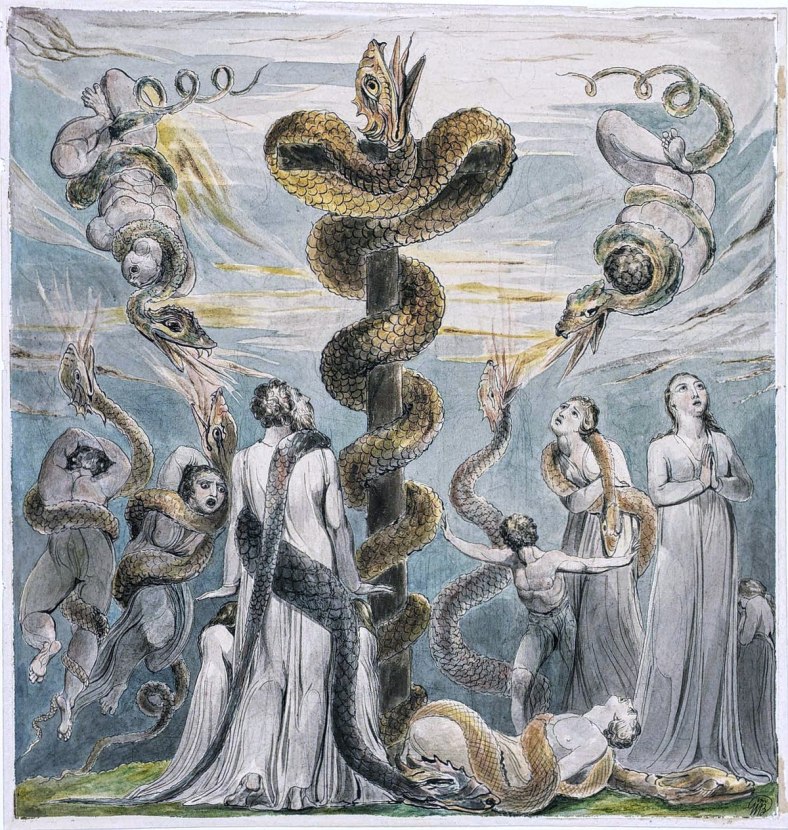
Such an interesting story in the Book of Numbers.  The people of Israel are on the road between Mt. Hor and the Gulf of Aqaba.  They’re complaining.  Again.  They’re not happy with the food.  It’s always something.  Anyway, the people grumbled, so the Lord sent poisonous snakes among them, and many Israelites were bitten and died.  That’s how the Israelites tell the story.

Nobody ever tells the story from the snakes’ point of view.  The way they see it, they were all just hanging about, minding their own snaky business in Snake Land when suddenly the whole nation of Israel showed up with all their noisy grumbling and complaints and pitched camp right on top of them, driving tent pegs down into their dens, breaking their eggs, chasing them with sticks, throwing rocks at them, hacking at them with swords… So yeah, they bit a few of them.  They were just trying to defend themselves.  They weren’t trying to kill anybody.  Why would they?  The Israelites were too big to eat…at least for those kinds of snakes.  

Moses prayed to the Lord to make the snakes go away.  Maybe the leader of the snakes asked the Lord to make the people go away.  Maybe the leader of the snakes suggested that the Lord could tell Moses to put a big bronze snake up on a pole to remind the people that they were in snake territory, and that the snakes were there first thank you very much, so they should be careful where they were poking around and pitching their tents.  

Well, that’s not the way we get the story in the Book of Numbers, but then snakes never were any good at public relations, and they don’t come off too well in the Bible as a rule.  Still, it’s interesting that in this particular instance, even in the Moses version of the story, God is using the snakes to accomplish God’s business and that includes healing cranky, ungrateful people from snakebite… which they wouldn’t have got bit in the first place if they hadn’t been cranky and ungrateful and gone poking about looking for something else to eat when there wasn’t anything kosher out there anyway.

So, the moral of that story is be grateful for what you have, even if you’re a little tired of it.  And leave the snakes alone.  

Many, many, many, many, many years later, this story would come up again when Jesus sat down one night with a Pharisee named Nicodemus.  Jesus was trying to help Nicodemus understand some very basic things about living in the love of God.  This was difficult for Nicodemus because he was a very smart and knowledgeable person, a teacher, in fact.  He knew the sacred writings of Israel backwards and forwards and upside down, but the things Jesus was saying mystified him.  He had a lot to unlearn.  The way he understood things got in the way of him comprehending things…if you grasp what I’m saying.  

Jesus was trying to help Nicodemus learn how to see and enter and experience the kingdom of God.  Nicodemus was trying to just get his head around it when he needed to put his whole heart into it.  

Nicodemus needed another pathway into the mystery.

It’s like this, said Jesus.  Remember when Moses lifted up that bronze snake in the wilderness?  It’s like that.  The Human One will also be lifted up.  And in the same way that people were healed when they looked to that bronze snake gleaming in the sun,  they’ll be healed when they look to the Human One, only they’ll be healed of something much more deadly than snake venom.

Have you ever wondered what kind of magic was at work in that bronze snake on that pole in the desert.  It was a powerful magic, stronger than any other.  When people looked at that snake on the pole, the light flashing off of it pierced their hearts and reminded them that they had complained against Moses and against God.  They had been in a desert, in a land of no food and no water, and God had provided for them.  But they were ungrateful.  There was poison in their hearts and it came out in their words.  The snakes biting them was a kind of metaphor for the way they had been treating each other.  And Moses.  And God.

When they looked at that bronze snake glinting in the desert sun, they could see a very unflattering image of themselves.  They could taste the bitterness of their ingratitude and the venom of their complaining.  So they repented.  And they were healed.  Because they also saw that God loved them enough to transform them.  They could stop being snakes, metaphorical or otherwise.  The magic, the power that emanated from that snake on the pole was God’s forgiveness and God’s love.  

And now the whole world is snakebit, Nicodemus.  People believe they are walking always and everywhere under the dark night of God’s judgment.  They don’t see that they have been always and everywhere in the bright light of God’s love.  They’re perishing.  Their souls are dying because they can’t let themselves believe they are loved.

Listen, Nicodemus.  God loves the world so much that God has given God’s only Son so that whoever believes him won’t perish, won’t fade into an everlasting death and nothingness, but will instead live forever in the light of God’s love.  

You think God is about judgment?   I’ll tell you about judgment.  God wants to bring everyone and everything, even the snakes, into the light of God’s love.  But some don’t want to come.  Some want to stay in the dark.  Some want to keep living in the deep shadows of hatred and fear, and us versus them.  Some have a greedy hunger in them that wouldn’t be satisfied if they swallowed the whole earth.  Some think they are the whole earth and don’t have room in their hearts for anyone or anything else.  They think they’re all that and a bag of chips.  Some, many really, want to keep judging others, because it’s the only way they can make themselves feel like they have any value, so they just keep living in the shadow of judgment…and the shadow of their own fears.

But the Son of God is not here to judge.  The Son came to heal.  To save.  To lead people out of the shadows.

The world has forgotten how lovely it is.  The Son of God has come to help the world remember, to relearn its beauty and its kindness.  

The world has forgotten that when God created everything God said it was good.  All of it.  Everyone.  Even the snakes.

The Son of God has come to help people remember Original Goodness.[1]

When they see the Human One lifted up, they will be reminded of all the ugly things that happen in a snakebit world, they will be reminded of how the venom in their own hearts and souls can wound and kill.  And then they will remember they weren’t made that way.  Then they will see the love of God.  They will see that the Son came out of love, not out of need.  And the love of God will transform them.  They will step back into the light of God’s love.

All of that is what Jesus was trying to get Nicodemus to  understand.  And us.  It’s what he would like us to understand, too.

When you think about it, all of this is about disruption. 

The Israelites disrupt the generally sleepy life of the snakes when they pitch camp in their territory. The snakes disrupt the grumbly and quarrelsome life of the Israelites when they start biting them.  God and Moses disrupt the poisonous dynamics of fear and dissatisfaction when they set up the snake on a pole.  Nicodemus disrupts Jesus’ quiet evening when he drops by at night for a private interview.  In his conversation with Nicodemus, Jesus disrupts our understanding of theology and the scriptures, especially our understanding of how judgment works.  

God works through disruptions to transform things and people.

This week we observed the anniversary of two significant disruptions.  

Wednesday, March 10, was the 88th anniversary of the Long Beach earthquake of 1933.  Between 115 to 120 people were killed.  Damage was estimated at $40 million.  That would be more than $800 million today.  Two hundred thirty school buildings were either destroyed or declared unsafe for use.  Out of that disruption, though, came new standards for building safety, including specific codes for school buildings.  New methods of government assistance for disaster response and reconstruction were instituted, too, as people realized that these kinds of resources were needed when damage was too widespread or extensive to expect a city to be able to recover and rebuild on its own.  Essentially, we found new ways to take care of each other.  To love each other.

The other anniversary is one we’re all too aware of.  It’s been one year since we were all in church together, worshipping in our sanctuary.  Our building.  But we’ve never stopped being church.  The disruption of this pandemic has made being church more difficult in some ways, but it has also transformed us in some important ways, too.  Like all disruptions, it has taught us more about who we are and invited us to think about who we want to be, who we are called to be, as we move forward.

The Israelites weren’t the same people when they left the land of the snakes.  They complained less and were more grateful.  Life-as-usual had been disrupted.

Nicodemus wasn’t the same person when the sun rose the next morning as he was when he had sat down with Jesus in the dark of night before.  He had begun to understand both God’s love and God’s judgment differently.  Everything he knew, everything he understood had been disrupted. You might say he was being reborn.

We aren’t the same people we were a year ago.  All the patterns of our lives have been disrupted.  In a time when need and circumstances required us to stay physically apart you would think we would have made every effort to find ways to pull together, but all too often, as a nation at least, we let the polarity of our dysfunctional politics pull us farther apart.  We have seen the damage caused by the venom of our fears and anger.  But we have also heard the voice of Christ calling us together and helping us relearn our loveliness,  reminding us of our Original Goodness. 

We have seen the serpent lifted up in the desert.  But also the cross lifted at calvary.  Through earthquake or pandemic, polar vortex or politics…even snakes…  God’s love still flows to carry us through it all.  Together.

In Jesus’ name.


[1] Genesis 1:31

When God Says Stop

John 2:13-22

I have a verse tattooed on the inside of my right forearm: James 1:19-20.  If you look it up, you’ll read this: “You must understand this, my beloved: let everyone be quick to listen, slow to speak, slow to anger;  for your human anger does not produce God’s righteousness.”  

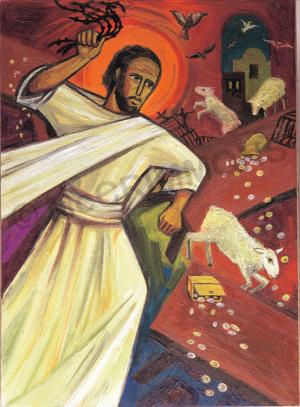
Human anger does not produce God’s righteousness.  But sometimes God’s righteousness produces anger.   “We boil at different degrees,” said Clint Eastwood, and apparently Jesus reached his boiling point in the temple’s outer courtyard, the Courtyard of the Gentiles, as he moved among the moneychangers and people selling livestock for sacrifices, and all kinds of other things.  He made a whip of cords and drove the cattle and sheep out of the temple courtyard.  He told those selling doves, the offering for poor people, to take them away.   He turned over the tables of the moneychangers.  And as he did all this he yelled, “Stop!  Stop making my Father’s house a marketplace!”

It can’t have been a surprise to Jesus that all this commercial enterprise was happening at the temple.  Animals were needed for the sacrifices and it was impractical to expect pilgrims traveling from far places to bring their own with them.  Salt, oil and wine were also needed.  Torah required these things.

A large open space like the Courtyard of the Gentiles would have seemed like a perfectly logical place to set up a marketplace to provide the things necessary for the rites of the temple, and as long as you’re selling those things, why not sell other things, too? 

In fact, it was well known throughout Palestine that the temple was in business for business.  There was nothing unusual about that.  It was the same at every temple in the ancient world.  Between supplying the needs of the sacrifice system and catering to the pilgrims who thronged there, the Jerusalem temple provided employment for a wide variety of people including curtain makers, barbers, incense manufacturers, goldsmiths, trench diggers, animal handlers, and dung removers.  And nobody seemed too bothered by it because the people in the ancient world didn’t make the same distinctions between secular and sacred that we make.  

So why is Jesus so upset?  Is it because all this commerce is somehow tarnishing the holiness of the temple?  Or was there something else going on?

Remember that for Jesus, the real concern in any situation is always first and foremost people.  It’s hard to imagine that he really cares all that much about the temple per se, but you can bet he cares a lot about the people who come to that building to worship and pray.

All this commotion happens in the Courtyard of the Gentiles, the one place in the temple grounds where Gentiles are allowed to be.  This is where they can catch a glimpse of some of the beauty that lies deeper inside.  This is where they can have instruction from rabbis and learn about Israel’s God and God’s Torah.  This is where they can become proselytes or converts.  This is where they can pray.  But it’s hard to do any of that in the noise and crowd of a marketplace with sheep and goats bleating and bulls bellowing and people dickering over prices or exchange rates.

So Jesus is probably concerned for the Gentiles who are being squeezed out of the one place designated for them.  But he’s also concerned about something else.  He’s concerned that the whole system is bleeding the life out of every day Judeans and Galileans and pilgrims from the diaspora who come to the temple out of obligation as the law commands.  He’s concerned because they’re the victims of racketeering and price-fixing.

Many of the commercial interests being conducted at the temple belonged to the family of Anas, the high priest.  Josephus, the first-century historian, called Anas “the great procurer.”  What Anas and his family don’t own directly, they license, driving up the prices of every item or animal sold.

And then there are the moneychangers, the ancient equivalent of bankers.  Not only did they exchange Greek or Roman money for Jewish or Tyrian coins, the only kind that were acceptable in the temple, they also dealt in general currency transactions and secured notes for properties.  These temple moneychangers were street level representatives of powerful banking institutions whose interests, in many cases, went far beyond Jerusalem.  You could think of these tables that Jesus overturns as little marketplace kiosks for Chase, or Wells Fargo or B of A.  

We like to think of this angry episode as Jesus displaying a surprising moment of religious zeal. Certainly there is an element of that and we’re steered in that direction in John’s gospel by the disciples remembering the words of Psalm 69:9, “Zeal for your house consumes me.”  However much we might want to think of this as a religious or spiritual act, however, the fact remains that Jesus is making a powerful political and economic statement with his actions.  He is hitting the power structure of the temple right in the pocketbook, a structure that is allied with the political structure of Jerusalem.  The temple is good business and Rome won’t like this disruption any more than Anas.  This action will have consequences.  As Eleanor Roosevelt said, anger is only one letter away from danger.

When Jesus said, “Stop!”  he was in perfect alignment with the prophets who had been saying the same thing for centuries.  Isaiah said it as he stood before the doors of the temple more than 700 years before: 

“What to me is the multitude of your sacrifices? says the LORD;

I have had enough of burnt offerings of rams and the fat of fed beasts

I do not delight in the blood of bulls, or of lambs, or of goats.

When you stretch out your hands, I will hide my eyes from you;

even though you make many prayers, I will not listen;

your hands are full of blood. 

Wash yourselves; make yourselves clean; remove the evil of your doings

from before my eyes; cease to do evil, learn to do good;

seek justice, rescue the oppressed, defend the orphan, plead for the widow.”[1]

Micah repeats the same message:

“With what shall I come before the LORD,

and bow myself before God on high?

Shall I come before him with burnt offerings,

with calves a year old?  Will the LORD be pleased with thousands of rams,

with ten thousands of rivers of oil? 

Shall I give my firstborn for my transgression,

the fruit of my body for the sin of my soul?” 

He has told you, O mortal, what is good;

and what does the LORD require of you

but to do justice, and to love kindness,

and to walk humbly with your God?[2]

The prophet Hosea was even more pointed in his condemnation of Israel’s failed stewards of authority:

Because of the wickedness of their deeds I will drive them out of my house.

I will love them no more; all their officials are rebels.[3]

All of these words of the prophets were surely in Jesus’ mind as he cleared the market out of the temple.  They were surely in the minds of the rabbis, priests and scribes, too, which might be one reason why they didn’t arrest  him on the spot.   Instead they asked for a sign.  He was speaking and acting like a prophet.  And prophets perform signs.  It didn’t occur to them that they  had just seen a sign that was perfectly in keeping with the prophetic tradition.  Still, Jesus gave them another sign. An enigmatic sign.  Tear down this temple, he said, and in three days I will raise it up again.

Bede Jarrett, the Dominican Friar and author once said, “The world needs anger.  The world often continues to allow evil because it isn’t angry enough.”  Sometimes I think that’s right, but as Aristotle said, “Anybody can become angry.  That is easy.  But to be angry with the right person and to the right degree and at the right time and for the right purpose and in the right way, that is not within everybody’s power and it is not easy.”

Jesus was angry.  But he was angry in the right way at the right time and for the right reasons.  And, well… he’s Jesus.  When he said “Stop!” it was the voice of God saying it.

Jesus was trying to stop a religious, political and economic triumvirate that was reinforcing ethnic, caste and class divisions and squeezing the poor into perpetual poverty.  God had been speaking to that system for centuries, telling them a day of reckoning was coming.  In the year 70 that reckoning finally arrived and the Romans destroyed the temple. 

From time to time, God says to those who know how to listen, “Stop.”  Stop.  Look at what you’re doing in my name and how you’re doing it.  Look at how you’re living.  Listen to what you’re saying.  Listen to how you’re saying it.  Listen to the words you’re putting in my mouth.  Stop.

Sometimes God says it through angry prophets.  Sometimes God says it through the sweeping movement of politics as the Babylons and Assyrias and Romes of history sweep across God’s people.  

Sometimes God says it with a whip made of cords while driving poor, dumb animals out of the temple courtyard and pouring out the money on the ground.    

And I can’t help but wonder if God hasn’t said it to us… with a pandemic.

Jesus, in the aftermath of his anger was still trying to teach.  

Tear down this building, he said.  The Holy One is not in the lovely building.  The Holy One is in the people who gather, in a body, a building that forever rebuilds itself.  The acceptable sacrifice is not the poor dumb animals or the bread and wine, it is justice and equity.  It is food for the hungry.  It is a people who care for each other.  It is kindness.  

Maybe this past year has been God’s way of telling us to Stop… to leave our house of worship where we hope and expect Christ will come to us, so we can more fully embody Christ and follow Jesus out into the world.


[1] Isaiah 1:11-15

[2] Micah 6:6-8

[3] Hosea 9:15

Faith=Trust

Genesis 17:1-7, 15-16;  Romans 4:13-25;  Mark 8:31-38

On May 20, 1927, when an unknown airmail pilot taxied his Ryan monoplane down the muddy runway at Roosevelt field on Long Island, some of those watching wondered if that fragile, fabric-covered aircraft,  heavy with fuel, would even clear the powerlines at the end of the field.  Just the year before, French flying ace René Fronk’s Sikorsky had crashed on takeoff on that same runway.  Noel Davis and Stanton Wooster had been killed while testing their plane at Langley Field in Virginia just a month before.  And only twelve days earlier, on May 8, the French aviators and war heroes Charles Nugesser and François Colis had disappeared somewhere over the Atlantic in their seaplane.

The odds were not in favor of Charles Lindbergh as he taxied down that muddy runway.  But despite the weight of 450 gallons of fuel, he coaxed The Spirit of St. Louis into the air and out over the ocean.  Thirty-three and a half hours and 3600 miles later, he landed at Le Bourget airfield outside of Paris, completing the first solo transatlantic flight in history.  And changing the world.

Lindbergh had faith that he would succeed.  He trusted his abilities as a pilot.  He had faith in his stamina.  He had faith in his team.  He trusted his plane.  This quiet and complex man from Minnesota also had a quiet and complex faith in God.  In later years when he flew combat missions in the Pacific theater during WWII, he would carry a New Testament with him.  Still later, after surveying the damage done to Hiroshima and Nagasaki by the atomic bomb, he wrote a book that warned against the advancement of technology when divorced from the ethical guidance of Jesus and other spiritual teachers.  His tombstone in the small graveyard beside Palapala Ho’omau Congregational Church on Maui contains these words from Psalm 139:  “If I take the wings of the morning, and dwell in the uttermost parts of the sea…” 

“Faith equals trust,” said Martin Luther.  Lindbergh trusted that even on the wings of the morning, over the uttermost parts of the sea he wasn’t alone.  God was with him.

In today’s first reading we are reminded of the covenant, the trust agreement, that God made with Abraham that he would become the ancestor of a multitude of nations.  Even though Abraham was 99 years old at the time, we’re told that he trusted that God could make it happen.  Sarah, you may recall, was a little more skeptical.  She laughed.  She knew that both she and her husband were well past child-bearing years.  But the Lord had the last laugh.  And when Sarah had a baby boy about nine months later, they named him Isaac, which means “laughter.”

St. Paul lifts up Abraham as a model of faith and tells us that his faith—his trust in God’s promise—was reckoned to him as righteousness.  He was regarded as righteous because he trusted God and believed God’s promise.  Frankly, I think Sarah deserves more than a few righteousness points here, too, even if she did laugh.  After all, she’s the one who had to get pregnant and give birth.  She did all the heavy lifting.  Abraham may have trusted God in his head and in his heart, but Sarah was invested in the deal with her whole self, body and soul.

Faith equals trust.  And trusting God is accounted as righteousness.  

That’s a nice, clear theological formula.  Unfortunately, clear and simple theological statements don’t always play out so cleanly and simply in real life.  Because we’re human.  And as with so many other things, what looks clear and simple can turn out to be less so when the rubber hits the road.  Sometimes we get it most wrong when we think we’re getting it most right.

That’s what’s happening with Peter as he rebukes Jesus on the outskirts of Caesarea Phillipi.  

Peter has great faith in Jesus.  Peter believes that Jesus is the Messiah and has said so.  But Peter’s faith is more in the Jesus of his hopes and dreams and aspirations than in the Jesus who is right in front of him.  Peter believes deeply in who he thinks Jesus could be and who he thinks Jesus should be.  He has profound faith in what he thinks Jesus can do and what he thinks Jesus should do. 

But now Jesus has told Peter what he is actually going to do.  What is actually  going to happen.  And the events that Jesus describes crash headlong into Peter’s imagined scenario of triumph and conquest.  All this time as they have travelled together, Jesus has talked about the basilea, the kingdom of God drawing near, being within reach.  But now Peter is realizing that his vision of what that means and how it is accomplished are apparently radically different from what Jesus has had in mind.  Being rejected by the elders, priests and scribes,  being killed—how could that accomplish anything?  And that part about rising again after 3 days—what does that even mean?   

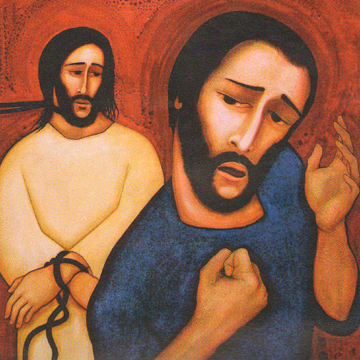
Peter doesn’t like what Jesus is saying.  So Peter takes Jesus aside and rebukes him.

A friend of mine, also a pastor, told us about a man in his parish who came to up to him after he had preached on Matthew 25:31-46, the passage where Jesus says, “I was naked and you clothed me, I was hungry and you fed me…as you did it to the least of these, you did it to me.”  The man was really upset.  He accused my colleague of being political and preaching socialism.  “The implication of what you were saying,” the man said, “is that it’s our job to feed everybody and make sure everybody has clothing and a roof over  their head and medical care.”  “I’m not the one saying it,” said my friend.  “Jesus is saying it.”  “Yeah,” said the man, “well I don’t like what Jesus is saying.”

From the very beginning of Christianity, followers of Jesus have sometimes not wanted to hear what Jesus is saying, not wanted to follow where Jesus is leading.  They have had deep and profound faith… in the Jesus in their heads, and maybe in the Jesus in their hearts, but not always in the Jesus who is right in front of them heading down the road they do not want to take and asking if they will follow.

Peter doesn’t like what Jesus is saying.  So Peter takes Jesus aside and rebukes him.

Mark writes that Jesus turns and looks at his disciples as he responds to Peter.  I think we’re supposed to have the sense that what Jesus says to Peter he is saying to all his disciples, and by extension that means he’s saying it to all of us.  “Get behind me, Satan!  For you are setting your mind not on divine things but on human things.”   

Ouch.  Even if you remind yourself that “Satan” can simply mean “opponent,” that stings.  “Get behind me.  Get behind where followers belong.  You’re setting your mind on your goals for me, not my goals for you.  You’re looking at your plans, not God’s plans.  That makes you the opposition.  That makes you one more obstacle to get past instead of part of the team that will make the kingdom take off and fly.”

Jesus spelled it out for the crowd and he spells it out for us.  “If any of you want to come with me,” he told them, “you must forget yourself.  Carry your cross, and follow me.  If you want to save your own life, you will lose it; but if you lose your life for me and for the gospel, you will save it.  Do you gain anything if you win the whole world but lose your soul? Of course not!  There is nothing you can give to regain your soul, your deepest self.  If you are ashamed of me and of my teaching in this godless and wicked day, then the Son of Man will be ashamed of you when he comes in the glory of his Father with the holy angels.”   

Jesus was telling them, and us, that he was looking for followers who were willing to give up everything, even life, even their souls, even their own fevered dreams of how Christ should do things, for the sake of making God’s reign a reality on earth as in heaven.  That talk about the cross was not hyperbole or metaphor. The people he was talking to had seen real crosses with real people hanging on them many times.  The Romans used crucifixion frequently and ruthlessly to put down political unrest and to discourage banditry.  It was their tool for keeping people in line.  Jesus was telling the crowd following him that if they were serious about being his disciples, they could end up being those poor, tortured, unfortunate wretches dying at the side of the road or the top of the hill, dying because they had stepped out of line.  He was telling them, and telling us, that there are consequences for doing things his way.  And some people don’t like to hear that.

In his book, What Is Wrong with the World, G. K. Chesterton wrote, “The Christian ideal has not been tried and found wanting.  It has been found difficult; and left untried.”  I think that’s why fairly early on the discipline of following Jesus in his Way of compassionate love and nonviolence somehow was transformed into a religion with rites and rituals and a hierarchy to perform them properly.  Baptism and the eucharist, the subversive sacramental actions for creating and sustaining community, became symbolic gateways for inclusion within or exclusion from the embrace of holiness in our togetherness.  It was easier for us to have faith in those things we could see and do than in the Christ who speaks to us through the gospels.  

Faith is a powerful force.  With faith we can move mountains or cross oceans.  With faith we can change the world.  But when our faith is misdirected or invested in the wrong things, it can lead us in the wrong direction.

“Get behind me, Satan,” said Jesus when Peter rebuked him for not sounding like the Jesus of his hopes, the messiah of his imagination.  Get behind me.

In the end, Peter did get behind Jesus.  He was behind him all the way.  And there, behind Jesus, Peter was finally able to trust—to have faith in– the Jesus who was right in front of him instead of the imaginary messiah in his head. 

Lent is a good time to ask yourself: Which Jesus do you have faith in?  The one in your head, or even the one in your heart?  Or the one who speaks to you  from the gospels—even if he says things you don’t particularly like?

With Beasts and Angels

Mark 1:9-15

The first time I ever slept out under the stars I was in Cub Scouts.  Scouts go camping.  It’s what they do.  So when our little Cub den was still brand new, it was decided that the dads and the boys should go on a campout.  I think the moms were the ones who decided that.  And so it came to pass that one Friday afternoon in mid May a gaggle of excited boys and their job-frazzled dads made their way to O’Neill Regional Park in the wild foothills of Orange County.  

The dads, in their wisdom, had decided that, since it was May and there was no rain in the forecast, tents were not necessary.  So when it was time for bed we simply rolled out our sleeping bags on top of tarps and climbed in.  The boys, of course, were sent to bed before the dads who stayed up for quite a while, talking and smoking around the campfire.  

I remember lying there in my bag looking up through twisted oak branches into the night sky.  It was a clear night, moonless, vast and deep, with no clouds between us and the stars, and as I lay there, bundled in my bag, I became uncomfortably aware that there was no roof above me and no walls around me.  What had seemed like a fun idea when we were just talking about it was turning out to be a little bit scary.  Not that I would ever admit that.

I could hear the dads talking quietly over by the campfire.  But I could hear other things, too.  Things rustling in the trees and the scrub.  I knew I was supposed to be sleeping, but I was wide awake with worries and questions too big and too frightening for my eight-year-old mind under that deep, moonless sky. 

Finally, I heard the conversation at the campfire breaking up and the dads saying goodnight.  And then my dad was climbing into his bag next to mine.  “Dad?”  I said.  

“Are you still awake?” he asked.  

“Yeah.  Dad, can I ask you something?” 

“What?”  

“Are there wild animals here?” 

There was a long pause and I was about to ask him again but he quietly said, “Um hm.  Yep.”

“Well like…what kind?”

“Oh… coyotes, bears, bobcats, mountain lions, racoons, possums, skunks.”

“Coyotes, bears and mountain lions?”

“Look, you don’t need to worry about bears or coyotes or mountain lions.  They don’t like to get too close to people in groups.  We’re okay.  They won’t bother us.  Okay?”

“Okay.”  

“Now make sure you tuck in that corner of your sleeping bag.  You don’t want a snake or a scorpion crawling in with you in the middle of the night.  Now goodnight.  Go to sleep.”

Jesus was in the wilderness 40 days, tested by Satan; and he was with the wild beasts; and angels waited on him.  I wonder what kind of noises he heard in the night.

When Jesus rises out of the waters of the Jordan at his baptism, he is a new person.  Not merely a new person, but a new kind of person.  The Spirit has descended into him—that’s what it says in Greek, into him—so he is possessed by the Spirit.  The voice of the Holy One has declared his identity: “You are my Son, the Beloved.  With you I am well pleased.”  From this moment on, Jesus is a new kind of human, a new creation.  From this moment on in Mark’s gospel, he will refer to himself as the Human One, or as we used to translate it, the Son of Man.  

St. Paul described Jesus as the first-born of a new humanity.  In 1 Corinthians 15, he refers to Jesus as the “last Adam.”  In 2 Corinthians 5:17, Paul made it clear that inclusion in this new humanity is extended to all of us who are baptized into Christ.  He writes, “If anyone is in Christ, there is a new creation: everything old has passed away; see, everything has become new!”

The identity declared to Jesus in his baptism is extended to you and to me in our baptism.  When we are baptized, the Spirit is imparted to us and we, too, hear the words, “You are God’s child.  You are beloved. God is pleased with you.”  And in that word and by that Spirit we are made a new creation.

So if I’m new, why is it that on so many days I feel so old?

Well, I think it’s because of what comes next.

“And the Spirit immediately drove him out into the wilderness.  He was in the wilderness forty days, tempted by Satan; and he was with the wild beasts.”  

The Spirit immediately threw him out into the wilderness where he was tested by the Adversary. The opposition.  

The word that’s translated as “tempted,” peirazō, can also be translated as “tested.”  Tested and tempted aren’t necessarily the same thing.  A temptation may be a test, but a test doesn’t have to be a temptation.  Testing may be done to try to learn the nature of someone or something.  To assess their character.  To take their measure. Temptation is an effort to lead someone into sin.  It’s true that in Matthew and Luke he is clearly being tempted.  But here in Mark I get the sense that something more subtle is going on, which is why I think Mark doesn’t go into details.

Mark says he was tested by Satan.  Satan as a Hebrew noun means “adversary.”  As a verb it means “to oppose” or “to be hostile.”  So Jesus, the New Human, fresh from his baptism, was thrown into the wilderness by the Spirit to be challenged by the opposition.  I don’t think we need to dwell too much on how that opposition appeared to him, because I think sometimes we face it, too.

Forty days is a long time to be in the wilderness.  Forty days is a long time to be alone with your thoughts.   I think we can imagine at least some of the voices Jesus may have heard because we hear them too.  You know the ones.  The ones that catch you off guard when you’re tired and vulnerable. The ones that sneak in between  your thoughts.  The ones that ask, “Are you really a child of God?  Are you really beloved?  If God is so well-pleased with you, why are you having such a rough time here?”

There’s nothing you can do with those voices except confront them.  Don’t try to debate them.  Whenever Martin Luther was challenged by these voices, which was apparently fairly often, he would just make the sign of the cross over himself and simply state, “I am a baptized child of God.”  Sometimes he would add, “Now go away and leave me alone.”  One time he did throw an ink pot at the shadow bedeviling him, but that makes a huge mess, so I don’t recommend it.

After you come to terms with those voices that challenge your identity as a child of God, after you’ve anchored that piece of your self-understanding in quiet confidence, the Adversary may come at you with the big, hanging question.  “Okay.  You really are a child of God.  You really are beloved.  So now what?  What are you going to do about it?”

I think that might have been the thing that tested Jesus most during those 40 days: the Now What question, thinking about how he was going to live out his identity as the Human One, thinking about how and when and where he was going to exercise his power so that his work opposing power didn’t become all about power. 

Sometimes, like Jesus, we find ourselves thrown into the wilderness.  Most often we don’t choose to be there.  Stuff happens.  Opposition happens.  Pain happens.  Illness happens.  Accidents happen.  Death happens.  Pandemics happen.  Suddenly, we’re in the wilderness and we hear wild beasts in the night.

But the wilderness can be where we learn what it really means to be God’s children.  Sometimes the hard, flinty places of life are where we realize that being loved by God doesn’t necessarily mean we’ll always be comfortable.  These are the places where we learn to trust.  But learning to trust takes time.  It takes practice, learning to sit through the night wrapped in love you can’t feel from a God you can’t see providing a kind of protection you don’t understand. 

You can only learn that when you feel vulnerable.  You can only learn that in the wilderness.  You can only learn that where the wild beasts are, real and metaphorical.

Mark is the only one of the gospel writers who notes that Jesus “was with the wild beasts.”  I’ve read interesting interpretations of that line.  Some think it’s a reference to the book of Daniel where the kings of the nations are represented as wild beasts.  So maybe this line suggests that Jesus was considering how to confront political authority. Could be.  Some have wondered if Mark is suggesting that Jesus was having an experience something like a Native American vision quest.  

These are interesting ideas and they have their merits.  But I wonder if it isn’t just that there really were wild beasts.

Even today there are still leopards and hyenas in the Judean wilderness.  In Jesus’ day there were also lions, bears and cheetahs.  So in addition to confronting The Adversary in whatever form The Adversary happened to take, maybe Jesus was also coming to terms with the predatory creatures of the wilderness.  Perhaps Jesus in the wilderness was finding some kind of relationship with those beasts, reminding them and himself that they shared a connection with God and that they had no reason to fear each other.

Howard Thurman said it this way in Disciplines of the Spirit: “To Jesus, God was Creator of life and the living substance, the Living Stream upon which all things moved, the Mind containing time, space, and all their multitudinous offspring. And beyond all these, He was Friend and Father.”  Perhaps, like Saint Francis, Jesus saw these wild beasts as brothers and sisters.

I remember one night lying in a tent in Ngorongoro Preserve in Tanzania.  I wasn’t afraid, exactly, but I was a little nervous, because I knew that outside the tent there were wild animals.  I knew they were there because I had seen them as we drove through the Preserve that day.  Elephants. Leopards.  Baboons.  Lions.  Wildebeest.  Hyenas.  It didn’t help my nervousness any that I could hear the gibbering of a pack of hyenas not too far from our camp.  And, of course, as I was lying there thinking of the thousand and one ways to die by animal, I realized that nature was calling in a more personal way and I really needed to go to the latrine. Which was at the other end of our camp.  Well, I put on my shoes, and left the tent and did what needed doing, praying all the way.

When I got back to my tent, I stopped and stood outside, looking out into the African night, and listening.  The hyenas were still gibbering, but it didn’t sound as menacing.  It really did sound kind of like laughter.  I could hear the soft rumbling and shuffling from a small family of elephants about a hundred yards away from us.  It was an almost friendly sound.  Somehow, as I had prayed my way to the latrine and back, my anxiety about the wild beasts in the dark had disappeared.

I saw something move out of the corner of my eye and turned to see one of our guides sitting on duffle bags in the back of the supply truck with a rifle resting across his lap.  He smiled and waved, then pointed at me and laid his face against the back of his folded hands in the universal gesture for sleep.  “Go back to bed,” he said without words. “I got this.”

“And the angels waited on him.”  There were angels with Jesus in the wilderness.  There always are.   Even in the valley of shadows, in the places with wild beasts, in the times and places of hunger and anxiety—even in the wilderness,  God’s messengers show up.  They come in all kinds of different ways and in unexpected forms.  And we don’t always recognize them.  But they come.

Do you recognize your angels?  Do you know them when they minister to you, when they show up bearing the love of God in some tangible form?  Do you recognize them when they remind you that you are God’s beloved child and that you are not alone in the time of testing, in the night full of wild beasts? 

Throughout our journey of Lent and beyond, may we walk with Christ.  May these 40 days remind us of what it means to be a new creation.  May we realize that God is also present in the wilderness of our challenges—when the Adversary in whatever form opposes us, may we remember that we, too, have been filled with the Spirit and heard the voice that proclaims us beloved.  When we hear the sounds of wild things all around us, may we remember that they, too, are created by God and loved by God.  And when we need it most, may we be waited on by angels.

In Jesus’ name.

A Season of Fasting

One year when I was serving in the Church Relations Office at California Lutheran University we decided to put together a Lenten devotional that could be emailed in daily installments to students, faculty, staff, and patrons.  Most of the feedback was positive.  One student, however, wrote us a rather heated letter.  He was not only opposed to our Lenten devotional, he was opposed to Lent.  “There is nothing in the Bible about Lent,” he wrote.  “It is a thing made up by the church.  If it is not in the Bible, we should not do it.” 

I wrote back what I hope was a gentle letter explaining that the practice of setting aside a time for fasting and preparation before the celebration of Easter was, in fact, one of the earliest practices of the church.  I also explained that it was the Church that gathered and assembled the books into the sacred library we call the Bible, but that there was nothing like an official agreement on which books were included and which were excluded until the Council of Rome in 382 CE.  So, even though the individual books of the Bible might be older, I explained, the followers of Jesus have been practicing Lent longer than they’ve had a Bible.  

Today, Ash Wednesday, is the beginning of Lent.  There are 46 days between Ash Wednesday and Maundy Thursday, but the season of Lent is only 40 days.  That’s because the six Sundays are not included in the fasting of Lent.  They are, though, included in the liturgical observation of the season.  We don’t sing the Gloria or the Alleluia during Lent.  In some traditions, the Alleluia is symbolically buried in a casket under the altar during this season and is “resurrected” for the celebration of Easter.

We begin our observance of Lent by marking ourselves with ashes.  Ashes have been a symbol since ancient times of grief and sorrow.  They also serve as a sign  of humility, or of repentance.  On Ash Wednesday we stand humbly before God and remember that we are both sinful and mortal.  

In Genesis, when God is escorting Adam and Eve out of the Garden of Eden and into a life of difficulty, God says to them, “By the sweat of your face you shall eat bread until you return to the ground, for out of it you were taken; you are dust, and to dust you shall return.” (3:19)

Later in Genesis when Abraham is bargaining with God and trying to keep God from destroying Sodom, Abraham says, “Let me take it upon myself to speak to the Lord, I who am but dust and ashes.” (18:27)  These are the words we quote as we mark ourselves with ashes.

Job, after his trials and tribulations, finally sees God’s majesty revealed and says, I had heard of you by the hearing of the ear, but now my eye sees you; therefore I despise myself, and repent in dust and ashes.”

Jeremiah, when he’s calling the people of Judah to repent and warning them of the destruction that is coming upon them, cries out, O my poor people, put on sackcloth, and roll in ashes; make mourning as for an only child, most bitter lamentation: for suddenly the destroyer will come upon us.”

In the book of Daniel, when Daniel is preparing to ask God to intervene and show mercy for his people, he writes: “Then I turned to the Lord God, to seek an answer by prayer and supplication with fasting and sackcloth and ashes.”

Ashes continued to be used as a sign of contrition in the early church.  Tertullian (c. 160-225) included sackcloth and ashes in the rite of repentance.  Around the year 800, those who had committed serious sins were covered in sackcloth and sprinkled with ashes before they were allowed to receive Holy Communion at Easter.  Sometime around the year 1000, as Lent came to be viewed as a season of penance, the practice of strewing ashes on the head was extended to the entire congregation.

Ashes remind us that because we are mortal, our life, our strength and our help come from God.  They open the doorway into Lent,  a time when we reflect on the way of Jesus and follow his path and listen to him more closely.

Lent is a time when we renew our practice of spiritual disciplines, especially prayer and fasting. 

There are a variety of ways to fast.  The traditional practice of many has been to give up meat during this time.  It has been the practice of some to have two small meals during the day then break the fast after sunset.  Some people simply give up something they’re attached to for the 40 days:  chocolate, television, podcasts, Facebook.  You can fast from anything that’s a daily part of your life.  The idea is to set that thing aside and give its space to Christ.  For instance, if you’re giving up lunch for the 40 days, then during that lunch hour you can spend time in prayer or meditation.  

On Sundays and Feast Days we get a break from fasting.  So if you’re giving up red meat for Lent, you can still have a bite of corned beef on the Feast of St. Patrick!

This time of fasting and preparation before Easter may have originated in the preparation for baptism.  The Didcache, a Syrian manual of church practice that dates to about the year 100, instructs that both those who are being baptized and those who are baptizing should fast for one or two days before the baptism.

At some point early on baptisms became tied to Easter.  Lent, then, became a time to prepare for baptism.  The practice of this, though, was far from uniform.  In Alexandria, Athanasius required his catechumens to prepare for 40 days, studying for 3 hours each day.  In other places, though, the preparation might be as little as a a week. 

At the Council of Nicaea in 325, in addition to establishing the doctrine of the Trinity, several important matters of church order and practice were standardized.  One of the things that was decided was how the date of Easter should be determined.  While they were at it, the bishops also agreed that Lent should be 40 days leading up to Easter.  

They didn’t call it Lent, by the way.  That’s our English word from the Old English word Lencten,  for Spring.  The Eastern bishops called it Tessarakosti and the Western bishops called it Quadragesima.  Both mean 40 days.

So why 40 days?

Though the Bible as such had not been assembled yet, the bishops at Nicaea were very familiar with the texts that would eventually be included in it.  They knew that the number 40 in these sacred texts represented a period of testing, trial, judgment, or probation.  In particular they were mindful of Jesus being tested in the wilderness for 40 days at the beginning of his ministry.

The number 40 occurs 146 times in the scriptures.  Moses lived 40 years in Egypt and 40 years in Midian before God called him to lead his people out of slavery.  He stayed on Mount Sinai with God and fasted for 40 days.  The Hebrew people wandered for 40 years in the wilderness before reaching the Promised Land.

Elijah spent 40 days and 40 nights walking to Mount Horeb.  Jonah’s prophecy to Nineveh gave them 40 days to repent or be destroyed.

Forty days may seem like a long time to fast, but there was also a practical reason for it.  In the days before refrigeration and food preservation, and in times when it wasn’t easy or inexpensive to ship food from other places, this would be the time of year when supplies of some foods, especially grains, vegetables and fruits would start to run low.  Fasting for an extended period could help to stretch these supplies until the new crops, especially the early grains, began to produce.

So are you planning to take up a spiritual discipline during Lent?  Are you thinking about praying more?  Meditating more?  Giving more?  Reading a devotional?   Here’s a suggestion:  Practice the discipline of kindness.  Be kind.  Practice having a generous spirit.  

Are you thinking of fasting?  It’s a worthwhile discipline and you can learn a lot about yourself by doing it.  But if giving up chocolate or television or meat or anything like that seems like it might be too much of a challenge, let me pass along this list of Suggestions for Fasting During Lent from Pope Francis:

Fast from hurting words and say kind words.

Fast from sadness and be filled with gratitude.

Fast from anger and be filled with patience.

Fast from pessimism and be filled with hope.

Fast from worries and have trust in God.

Fast from complaints and contemplate simplicity.

Fast from pressures and be prayerful.

Fast from bitterness and fill your heart with joy.

Fast from selfishness and be compassionate to others.

Fast from grudges and be reconciled.

Fast from words and be silent so you can listen.

This is a good time to listen.  

Listen to the message of the ashes.  The message of our mortality doesn’t have to be bad news.  God has breathed life into dust and ashes.  

Listen to our history.  We are part of a very long story that is still unfolding.  

Listen to Jesus.  He has called us to renew the world…and to be renewed ourselves.

Listen

Mark 9:2-9

Have you ever sung in a choir or played in an orchestra?  If you have, you’ve probably had a moment when you realized that you were, for all intents and purposes, part of one large instrument.  Your voice in the choir was like one pipe in an organ.  You were part of one large, organic instrument comprised of many voices, all being played by the director or conductor.  It’s a wonderful experience to be part of something like that, to know that you’re part of something large and beautiful and organic which, if it’s done right, can, in its magical way, completely transport people.  It’s a humbling feeling to know that you are helping to bring this powerful yet ephemeral thing into the world, a thing composed only of sound, a thing that was not in the world before the conductor raised his baton and will vanish when he cuts off the last note and its echoes die in the hall.  

It’s an amazing experience.  And it all works beautifully as long as everyone learns their part.  And they all follow the conductor.  And they all play or sing the same piece.  All it takes for things to start to unravel, though, is for someone to decide they’re not happy with the conductor.  Little rebellions lead to great ones.  It can start with something as minor as the woodwinds rushing the conductor’s beat.  It could end with the disgruntled first trumpet player playing Trumpet Voluntary in the middle of Mozart’s Requiem. 

That seems to be Peter’s problem here in the middle of Mark’s gospel.  He’s not happy with the conductor.  He has been traveling with Jesus for a while now.  He has watched him feed multitudes of people.  Twice.  He has seen him walk on the sea.  He has watched Jesus cast out demons and heal people.  So when Jesus asks, “Who do you say that I am?” Peter naturally replies, “You are the Messiah!”  It seems like the obvious answer.  After all, who else could do all those things?  But Jesus is less than enthusiastic with Peter’s answer, at least in Mark’s version of the story.  He sternly orders his disciples not to talk about it.  “No Messiah talk.  Are we clear?”

That didn’t sit well with Peter.  And then Jesus starts to tell his disciples and everybody else that he’s going to go to Jerusalem to confront the power structure of the temple, they’re going to reject him, and abuse him, and then he’s going to be crucified and on the third day rise again.  

No one wants to hear that.  That’s crazy talk. Peter cannot bring himself to sing along with that chorus.  He will not.  He takes Jesus aside and rebukes him.  

Think about that a minute.  Peter rebukes Jesus.  And apparently the other disciples are kind of half-way behind Peter on this one.  Mark writes, “But turning and looking at his disciples, he rebuked Peter and said, ‘Get behind me, Satan! For you are setting your mind not on divine things but on human things.’”

Jesus has a few more things to say to his disciples and the crowd about what it takes to be a disciple—namely, a willingness to take up the cross.  But Peter and the disciples are silent.

Peter rebukes Jesus.  Then Jesus rebukes Peter.

And then silence.  Six days of silence.

It’s easy to miss that.  Things move fast in Mark’s gospel.  Jesus moves quickly from one thing to the next.  The phrase “and immediately” occurs frequently.  But not here.  

Six days later.  Six days of tension between Jesus and Peter?  Six days of anxiety for the disciples? Mark doesn’t say.  Mark is silent.  And maybe they were, too.

Finally, Jesus decides that Peter needs a “come to Jesus” meeting.  Or a come with Jesus moment.  So he asks Peter, James and John to come with him up the mountain.

And there on the mountain they see him transfigured—shining white and radiant, light within and light without,  they see who their teacher really is inside his humanity.  They see Moses and Elijah, the law-bringer and the great prophet, the two most important figures in the history of their people, appear with him and converse with him.  

Peter, whose default mode seems to be talk-first-think-later, babbles out, “Lord, it’s a good thing that we’re here!  Let’s make three shelters, one for you, one for Moses, one for Elijah…”  Mark tells us he didn’t know what he was saying because he was terrified.  Well you would be, wouldn’t you.  

And then all of a sudden there is a cloud throwing a shadow over them.  All the brightness is dimmed.  And a voice comes out of the cloud and says, “This is my Son, the Beloved.  Listen to him.”

And as suddenly as it all started, it’s over.  There’s no one there but Jesus.  And as they head back down the mountain he tells them not to tell anyone about what they’ve seen until “after the Son of Man has risen from the dead.”

It took a lot to get through to Peter.  It took six days of silence and a hike up the mountain.  It took seeing Jesus talking with Moses and Elijah as he was shining like the sun.  It took hearing the voice of God speaking to him from a cloud saying, “This is my Son.  The Beloved.  Listen to him!” 

That’s what it took to get Peter to play the same tune and follow the conductor.

Is that what it takes for us?

There have always been people who try to bend Jesus to their agenda instead of bending themselves to the way of Jesus.  There have always been people who call themselves Christian who don’t seem to listen much to Jesus.

For a long time now we have seen a strain of pseudo-Christianity in this country and around the world that has little to do with the teaching of Jesus as we encounter him in the gospels.  It is based on triumphalism and a theology of glory.  It worships and celebrates power and ignores the call to enter the into world’s trials and suffering as Christ entered into our trials and suffering.  It walks hand-in-hand with nationalism and, often, racism.  It sees baptism as a get out of hell free card and not as a way of life in the beloved community.  It has co-opted the name Christian and Christian language but has not learned to do justice, to love kindness or to walk humbly with God—to love the neighbor as oneself. 

So many, like Peter, want a militant messiah.  But that’s not the way God does things.  That’s not the way of Jesus.

Six days before their trip up the mountain, after Peter rebuked Jesus and Jesus rebuked him back, Jesus had this to say to the crowd that had been gathered around them:  “If any want to become my followers, let them deny themselves and take up their cross and follow me.  For those who want to save their life will lose it, and those who lose their life for my sake, and for the sake of the gospel, will save it.  For what will it profit you to gain the whole world and forfeit your life?  Indeed, what can they give in return for your life?”

Jesus was not giving a recruitment speech designed to conjure the rewards and glories of conquest and victory.  He was issuing a realist’s invitation to a subversive movement where participation could have deadly consequences.  He was calling them, and is calling us still, to confront the powers and systems that oppress and marginalize and antagonize and lie to people wherever we find those powers and systems.  Following Jesus can be dangerous.  Listening to him can put you at odds with family and friends.  It can complicate your life.  But your life will be meaningful. 

Jesus wanted to make it clear that he was not a white-horse-sword-in-hand messiah.  He wanted his disciples and everyone else to understand that his way of confronting injustice and oppression was to free people from its weight, heal their wounds, and then simply stand in front of the powers and speak the truth.  That was the music he was bringing.  That was the song he wanted the world to sing with him.  Peter didn’t like that song at all.  He wanted the White Horse and Sword Cantata.  

So six days later, Jesus took him up the mountain to show him who he was really arguing with.  And so he could hear the voice.

Sometimes we all need to be reminded that Jesus leads and we follow, that he’s the conductor and we’re the players in the orchestra and singers in the choir.  Sometimes we all need to go up the mountain to be reminded of who Jesus is inside his humanity.  Sometimes we all need to be reminded of those words from the cloud: “This is my Son.  The Beloved.  Listen to him.”  

Especially those last words. 

“Listen to him.”

And She Began to Serve

Mark 1:29-39

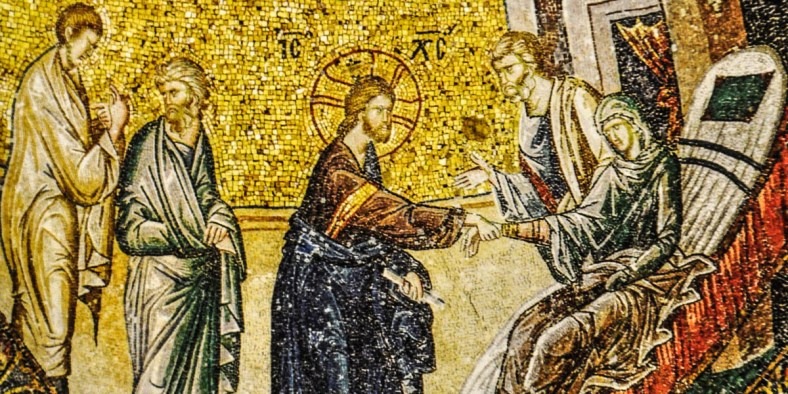
“He came and took her by the hand and lifted her up.  Then the fever left her, and she began to serve them.”  Two simple sentences.  And like so much of Mark’s gospel, a surprising amount of action in surprisingly few words. 

After preaching with authority in the synagogue at Capernaum, then casting out an unclean spirit from a man who interrupted him, Jesus is ready for a break.  So he goes to the house of his new disciples, Peter and Andrew.  It happens that Peter’s mother-in-law is sick.  She’s in bed with a fever.  They tell Jesus about her right away and Jesus goes to her.

And here is where the translation maybe is not our friend.  “He took her by the hand” sounds much gentler than what it says in the original language.  Kratésas it says in the Greek.  Kratéo is the verb.  It’s not a tender word.  It means to grasp firmly or strongly.  

And then it says he “lifted her up.”  Which is fine.  But again, something is lost in translation.  The verb Mark used is egeiro.  It’s the same word Jesus will use when he raises Jairus’ daughter from the dead and says, “Little girl, get up!”  It’s the same word the angel will use to tell the women that Jesus is not in the empty tomb because he is raised up—egeiro.  

So maybe this isn’t quite the gentle scene I had always imagined.  Maybe this is a scene full of strength and energy and power.  Jesus grasped her strongly, firmly by the hand and raised her.  

Then the fever left her.

And she began to serve them.

It’s tempting to get a little upset about that last part—she began to serve them.  After all, she’s just been sick with a fever.  And now here are all these guys who come traipsing into the house and because of the expectations of the society they live in, she jumps out of her sickbed to rustle up some dinner for them.  Oh, and by the way, does anybody care that it’s still the Sabbath?

Some commentators have pointed out that she would be happy to do this because in a culture where roles are clearly defined she could now resume her place as matriarch of the household along with all the social currency that comes with that.

But again, there’s something going on in the language that deserves a moment of attention.  It’s a little thing.  But, as I’ve been learning, Mark often uses these subtle little things to make big points.  In this case, it has to do with the word “serve.”  Here’s how Ched Myers explains it in his book, Say to This Mountain: Mark’s Story of Discipleship—

“Peter’s mother-in-law is the first woman to appear in Mark’s narrative.  We are told that upon being touched by Jesus, “she served him(1:31).  Most commentators, steeped in patriarchal theology, assume that this means she fixed Jesus dinner.  However the Greek verb “to serve” (from which we get our word “deacon”_ appears only two other times in Mark.  One is in 10:45—“The Human One came not to be served but to serve”—a context hardly suggesting meal preparation.

“Mark describes women ‘who, when Jesus was in Galilee, followed him, and served him, and…came up to Jerusalem with him’ (15:41).  This is a summary statement of discipleship:  from beginning (Galilee) to end (Jerusalem) these women were true followers who, unlike the men (see 10:32-45) practiced servanthood.”

So here is Peter’s mother-in-law—sadly we don’t have her name—but Mark identifies her service with a word that implies that there is a sacred aspect to her serving, a holiness that springs not from her sense of duty, but her faith.  She is a deacon.  

In Mark’s gospel, the men surrounding Jesus are often argumentative and a little dense.  But the women, though not mentioned often, are astute and faithful.  

I’ve been thinking about this a lot this week.  This week we had a graveside service for Barbara, one of those astute and faithful women who have kept the ministry of Jesus alive and well in this world for more than 20 centuries.  As I conducted her service I was wearing one of the stoles she wove for me on her loom, and it made me think of Tabitha who we read about in the book of Acts.  She was much loved by her community in Joppa, and when they summoned Peter to pray for her, they showed him all the tunics and other clothing she had made for people.

I thought of the women mentioned in the Gospel of Luke who travelled with Jesus and supported Jesus and the disciples financially.  Mary Magdalene, and Joanna, the wife of Herod’s steward Chuza, and Susanna, and many others, Luke says, who provided for them out of their resources.  

These women came to be called the Myrrh Bearers because they were the ones who went to the tomb to anoint Jesus’ body after the crucifixion, but found it empty.

Mary Magdalen was known to be particularly close to Jesus and was regarded as an Apostle by many in the early church until patriarchy asserted itself, suppressed her influence, and sullied her reputation by spreading the story that she had been a prostitute.  But it was Mary Magdalen, according to the Gospel of John, who first encountered the risen Jesus.  It was Mary Magdalen who first proclaimed his resurrection, making her the first evangelist.

Another Mary who was part of this group of women disciples, was Mary, the wife of  Cleopas.  If tradition is correct, her husband was the brother of Joseph, Jesus’ foster father, so she was the sister-in-law of Jesus’ mother, Mary.  She, too, was a Myrrh Bearer and is probably the unidentified person traveling with Cleopas on the road to Emmaus in chapter 24 of Luke’s gospel, making her one of the first witnesses to the resurrection.

Joanna, the wife of Herod’s steward, Chuza is someone we know a little more about.  We see her later identified in the letters of the Apostle Paul where he uses her Roman name, Junia.  Paul says she is prominent among the Apostles and that she knew Christ before he did (Romans 16:7).   In Junia we see someone remarkable, a woman disciple of Jesus who travelled with him in his ministry,  and continued in ministry as an Apostle, travelling as far as Rome for the cause of the gospel.

Priscilla and her husband Aquila are mentioned six times in the New Testament.  Priscilla is mentioned first four of those times, and it’s clear that she is a full partner in their work together for the sake of the gospel.  Tradition includes them among the 70 that Jesus sent out on a mission in the Gospel of Luke.  Priscilla, also called Prisca, her more formal name, has always been considered one of the first women preachers in the church.  We read in Acts 18:24-28 that she, along with Aquila, instructed Apollos in the faith.  There is even a theory that she is the author of the Epistle to the Hebrews.

Phoebe was an overseer and deacon in the Church at Cenchreae.   St. Paul referred to her in Romans 16 as a deacon and a patron of many.  This is the only place in the New Testament where a woman was referred to with both those titles. Diakonos kai prostateis.  A chief, a leader, a guardian, a protector.  St. Paul had such trust in her that he provided her with credentials so that she could serve as his emissary to Rome, and deliver his letter to them—that letter we know as the Epistle to the Romans.

Lydia of Thyatira, was a wealthy merchant of purple cloth, who welcomed St. Paul and his companions into her home at Phillipi and became a convert.  In doing so, she helped to establish the church at Phillipi, the first church in continental Europe.

In that church at Philippi were two women, Euodia and Syntyche who were serving in positions of pastoral leadership.  At some point they got into a disagreement. In his letter to the Philippians, Paul urges them to “be of the same mind in the Lord” so that their disagreement doesn’t split the church.  In calling them to unity, he notes that they have “struggled beside me in the work of the gospel.”

Jesus took Peter’s mother-in-law in his firm grip and raised her up.  And she began to serve.  She became a deacon.  She began making sure things got done.  Making sure ministry happened.  And it’s the women who have been making sure things get done and ministry happens ever since.

Fifty years ago, our denomination began to ordain women to the ministry of Word and Sacrament.  To be pastors.  On the one hand, it seemed then—and to some people it still seems—like a bold and progressive thing to do.  But when you look at the witness of the New Testament itself and what we have learned about the roles that women played in the earliest years of the church…well let’s just say that it was shamefully long overdue.

I think of the women I’m indebted to in my ministry.  I think of all the women teachers I’ve had, like Dr. Martha Ellen “Marty” Stortz, professor of Church history who opened my eyes to the rich goldmine of our heritage.  I think of the women scholars and writers I turn to for thought-provoking insights in theology and biblical studies.  Women like Debi Thomas, Barbara Brown Taylor, Rachel Held Evans, Roberta Bondi, Nadia Bolz-Weber, and Amy-Jill Levine.  I think of my women clergy colleagues who are so amazing and indispensable as we puzzle our way through the week’s texts and the week’s issues, and life in the church.

I think of the women in our congregation who make things happen.  Without whom things would not happen.  The Tabithas, the Junias, the Priscillas, the Marys, the Pheobes. The Myrrh Bearers.  The Apostles in our midst.

I think of them all.  And I am so grateful.

Jesus has grasped them by the hand and raised them up.  And they have served.  Showing the presence of Christ and proclaiming the kin-dom of God.  And we are all richer for it. 

How Do You Read It?

In the Gospel of Luke in chapter 10, a lawyer asks Jesus what he must do to inherit eternal life.   Jesus responds by asking the lawyer a question: “What is written in the law?  What do you read there?”  At least that’s how it’s translated in the NRSV.  A better translation, though, would be “What is written in the law? How do you read it?”

How do you read it?  How do you interpret it?  How do you understand it?  The lawyer replies to Jesus by quoting from Deuteronomy and Leviticus: “You shall love the Lord your God with all your heart, and with all your soul, and with all your strength, and with all your mind; and your neighbor as yourself.”  Then Jesus says him, “You have given the right answer; do this, and you will live.”

But this is when the lawyer really begins to answer the second part of the question “How do you read it?” because this is where he starts to look for wiggle room.  Wanting to justify himself, Luke tells us, he asks, “But who is my neighbor?”  And that’s what prompts Jesus to tell the parable of the Assaulted Traveler. You know it by another name.  But I’ll come back to that.

A man was travelling from Jerusalem down to Jericho, said Jesus, when he was set upon by bandits who stripped him and beat him and went away, leaving him half dead.  A little while later a priest comes along, sees the unfortunate man, but passes by and does nothing for him.  Not long after that a Levite comes by, a man dedicated to serving God.  He also sees the assaulted traveler bleeding, bruised and naked at the side of the road, but he, too, passes by and does nothing to help.  Fortunately,  right after that a Samaritan happens along.  He takes pity on the man.  Gives him first aid, takes him to a nearby inn, gives the innkeeper two days wages to care for the man, and promises to pay for any additional expenses on his way back.  

After telling this story, Jesus asks the lawyer, “Which of these three was a neighbor to the man who fell into the hands of the bandits?”  “The one who showed mercy,” said the lawyer.  “You go and do likewise,” said Jesus.  

You know this story well.  You have a familiar name for it.  But I gave you a different name for it.  I did that because the name we usually call it, “The Good Samaritan” carries a boatload of interpretive baggage.

Some context.  

When Jesus tells this story he is on his way to Jerusalem.  He is still in the countryside.  To the people in the countryside, bandits were not necessarily bad guys.  Because of economically oppressive systems inflicted by Rome and the heavy tithe system from the religious structure represented by priests and pharisees, and limited labor opportunities, many men turned to highway robbery.  Those listening to Jesus tell this story probably assumed that the man who was assaulted and left for dead was a rich merchant—bandits wouldn’t rob poor people, no money in it—and rich merchants were not trusted.  The common people in Jesus’ time had a world view of limited good; if someone was well off it was almost certainly at someone else’s expense.  Bandits tended to even the scales.

So bandits robbing a merchant—not shocking.  But a priest and Levite walking by and doing nothing?  That’s shocking.  These are men who have an obligation to help according to Torah.  Actually, according to Torah, anyone who can should help.  Most shocking of all, though, is that the person who does stop to help is a Samaritan.

I wonder if we can really understand how much Judeans hated Samaritans.  I suppose I could give some examples, but I would surely offend someone.  And that’s the point.  The people listening to Jesus, including the lawyer, would have been greatly offended that the Samaritan was the hero of the story.  The mutual hatred between Jews and Samaritans had deep historical roots.  When Jesus asks, “who was the neighbor?” the lawyer can’t bring himself to say the word Samaritan.  He simply says, “The one who showed mercy.”

This is an anit-racist story, pure and simple. When the lawyer asks Jesus, “But who is my neighbor?” he’s really asking “who is it okay for me to hate?”  So Jesus tells him a story where the hero is a person he is going to be automatically inclined to disregard and disrespect.  In the end, it turns out that the long answer to his original question of how can one inherit eternal life turns out to be, “Love God, love your neighbor as you love yourself, and that means you can’t be a racist.”

We call this episode “The Parable of the Good Samaritan.”  Earlier I called it “The Parable of the Assaulted Traveler.”  What if I called it “The Encounter With A Racist Lawyer”?  Changing the title can change the way you read it or hear it.  It can shift the focus.  In the same way, learning more of the background information can change the way you understand the story.  We’ve always heard it as a story about helping those in need—and it certainly contains that element—but it’s really a story about racism.

How do you read it?  This is such an important question for us to ask ourselves about the scriptures, about the news we’re reading and watching, and about life.