Teach Us to Pray – Part 2

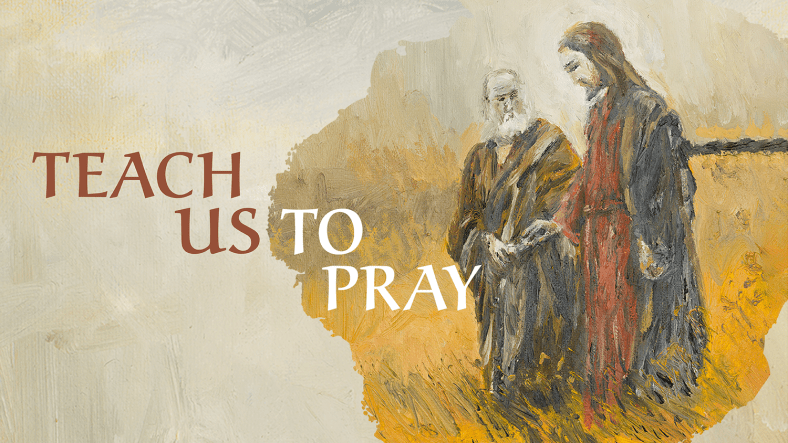
Teach Us to Pray – Part 2

Luke 11:1-13

Last week we finished Part 1 of our deep dive into Luke’s version of The Lord’s Prayer with the petition Your kindom come.  As I said last week, a literal translation would be “Let it come, the reign of you,” or “Let your reign begin.”  I also pointed out that this petition, “let your reign begin” is where this prayer stops being a nice religious sentiment or litany of devotion and becomes an endorsement of a better reality.  

Your kingdom come, or Let your reign begin is a declaration that we are in favor of radical changes in the way the world operates.  When we pray your kingdom come, we are asking God to work through us to make significant changes in economics, politics, religion and society in order to bring the justice and shalom of God to our everyday lives.  When we pray your kingdom come, let your reign begin, we are volunteering to live here and now God’s shalom and also to do whatever we can to bring God’s shalom to others and to all creation.

Shalom is what the Lord’s Prayer is all about.  Shalom is a Hebrew word that means peace.  But it’s not merely a peace based on the absence or suppression of hostility.  The word Shalom comes from the Hebrew root shalam which literally means “make it good.”  It is a word used to describe completeness and wholeness.  And, while it’s good for us to seek our own inner shalom, the real shalom of God’s reign happens in community.  The Shalom of the kin-dom is a peace that recognizes that we are all interconnected and interdependent.  Shalom desires the peace and well-being of others, which means that it requires justice and fairness.  

Cherokee theologian Randy S. Woodley describes it this way:  “Shalom is communal, holistic, and tangible. There is no private or partial shalom. The whole community must have shalom or no one has shalom. As long as there are hungry people in a community that is well fed, there can be no shalom. . . . Shalom is not for the many, while a few suffer; nor is it for the few while many suffer. It must be available for everyone.”[1] 

When we pray Your kingdom come, we are praying for shalom in our homes, in our towns, in our churches, in our nation and throughout the whole world.  We are praying for peace and justice and fairness for everyone.  And that brings us naturally to Give us each day our daily bread, because in God’s shalom everyone is fed and no one goes hungry. 

Give us each day our daily bread.  There is some ambiguity in the Greek wording here, and it can be translated in two ways.  The first way, of course, is the way we’re used to hearing it or saying it: give us today our daily bread.  Amy-Jill Levine points out, though, that this is not only redundant but rather odd.  She suggests that a better translation would be give us tomorrow’s bread today.  

Give us tomorrow’s bread today is a valid translation from a linguistic standpoint, but it may also give us both a more practical and a more wholistic way to think about what we’re asking.  In most households in Jesus’ day, the dough for the next day’s bread was prepared the evening before and allowed to rise during the night.  If you were going to have bread tomorrow, you needed to have the ingredients today.  Understood this way, this petition is a way of asking for something very practical.  We’re asking God to save us from at least a little anxiety by ensuring that we have today what we will need tomorrow.  

But this petition of the prayer reaches beyond our family table.  It is reminiscent of a traditional Jewish table prayer called the motzi: “Blessed are you, Lord our God, ruler of the universe, who brings forth bread from the earth.”  It reminds us that God doesn’t just magically put bread on the table, God uses the generosity of the earth and the labor of the whole community to put bread on the table. 

Last week I told the story of the little boy who was saying his bedtime prayers and prayed very loudly, “AND GOD, PLEASE GIVE ME A NEW BICYCLE!”  When his mother reminded him that he didn’t need to say it so loudly because God isn’t hard of hearing, he said  “I know, but Grandma is.”  As I said last week, this little guy was onto something—God often uses others to answer our prayers, in fact, that’s how it works most of the time.

When we pray give us tomorrow’s bread today, we are asking God to care for the land where the wheat grows.  We’re asking for clean and gentle rains so the crops can grow.  We are asking God to guard and protect the farmers who plant and care for and harvest the crops.  We are asking God to care for those who transport the wheat and mill it into flour.  We are asking God to care for the hands that make the dough and knead it and bake it.  We are asking for fuel for the fire in the ovens.  

Bread on the table depends entirely on the well-being of the community and on our relationships within the community.  God brings forth bread from the earth, but it is a team effort.  When we pray for both today’s bread and tomorrow’s we are once again praying for the shalom of God’s kin-dom.  The next time you hold a piece of bread in your hand, or any piece of food for that matter, think of all the hands that labored to bring it to your hand.

Shalom is what makes it possible for us to have our daily bread.  But sometimes things we do or say disrupt the cooperation and mutuality that make shalom possible.  Sometimes our sins or the sins of others rupture relationships, and forgiveness is needed to restore those relationships.  And that’s why Jesus taught us to pray And forgive us our sins, for we ourselves forgive everyone indebted to us.  

Luke says “forgive us our sins.”  Matthew says, “forgive us our debts.”  In both Aramaic and Hebrew, “debt” was another way to talk about sin.  In the version we pray in our congregation, we usually say “forgive us our sins as we forgive those who sin against us.”  That’s a perfectly fine way to pray this petition.  It reminds us that we do sin against God and against each other.  We do need forgiveness from God and from each other.  This petition reminds us that there is a reciprocity involved in forgiveness.  As Jesus said in Luke 6:37, “Do not judge, and you will not be judged; do not condemn, and you will not be condemned. Forgive, and you will be forgiven.”  Once again it’s about relationships all the way down, which means that this petition, too, is also about God’s shalom.

But let’s go back to the language about debts and forgiving debts.  Remember that Jesus was a Jew and he was teaching this prayer to his Jewish disciples.  This language about debts would have been a reminder to them of everything the Torah has to say about economic justice.  Jesus is telling them and us to live in an economically just way.

In Hebrew, the word for charitytzedakah, is from the same root as the word for righteousness, tzedek.  Torah says in Deuteronomy 15:11, “Since there will never cease to be some in need on the earth, I therefore command you, ‘Open your hand to the poor and needy neighbor in your land.’”  Deuteronomy 24:14 tells us, “You shall not withhold the wages of the poor and needy laborers, whether Israelites or aliens who reside in your land in one of your towns.” 

In this petition, Jesus reminds us to think of our spiritual indebtedness—we are all indebted to God’s grace—but we are reminded to consider the economic implications of the way we live.  Are the products and services we buy produced in a way that’s economically fair to the workers who produce them?   Does my lifestyle depend on or contribute to some economic injustice?  What can I do to change that?

Living a life of faith as a follower of Jesus means that sometimes we face difficult questions. Sometimes it feels almost as if we’re being tested.

And do not bring us to the time of trial.  When the Book of Common Prayer was revised in 1604, the phrase “and lead us not into temptation” in The Lord’s Prayer caused a huge controversy.  The Puritans were quick to point out that the Book of James says, “No one, when tempted, should say, ‘I am being tempted by God’; for God cannot be tempted by evil and he himself tempts no one.” (James 1:13)  This was only one of several complaints they had about the Book of Common Prayer, but it was one they were not willing to compromise.

They had a point.  What the Greek says in both Luke and Matthew is “do not bring us into a peirasmon.  Peirasmon is a time or place of testing, trial or examination.  Temptation may be a kind of test, but not every test is a temptation.  In this petition, you are asking to be spared from any kind of catastrophe or stress, any situation that would put your faith to the test. 

As I said in Part 1, The Lord’s Prayer, this prayer that Jesus gave his disciples is not only one of the great treasures of our faith, it’s also, in its way, a radical call to a discipleship.  In this prayer we are asking God to empower us, guide us, and walk with us as we embrace a new way of life with new values and a new vision of what the world can be.  It really is, in six simple lines, a kind of manifesto for life as a follower of Jesus.  In this prayer we are asking for peace, health, and  wholeness for ourselves and for our community.  We are asking God to help us live in the shalom of the kin-dom here and now.  We are asking God to help us live in the Way of Love.

“Shalom,” writes Jamie Arpin-Ricci, “is what love looks like in the flesh. The embodiment of love in the context of a broken creation, shalom is a hint at what was, what should be, and what will one day be again. Where sin disintegrates and isolates, shalom brings together and restores. Where fear and shame throw up walls and put on masks, shalom breaks down barriers and frees us from the pretense of our false selves.”[2] 

When we pray for God’s name not to be profaned, when we pray for God’s reign to begin in earnest, when we pray for a healthy community and world so that everyone may have tomorrow’s bread today, when we pray for forgiveness and the power to forgive, we are praying for God’s vision of a healthy world.  When we say “Amen,” we are not only saying “Make it so,” we are saying we will do what we can to live in that vision and make it a reality for others.  In Jesus’ name.


[1] Shalom and the Community of Creation; Randy S. Woodley

[2] Jamie Arpin-RicciVulnerable Faith: Missional Living in the Radical Way of St. Patrick

Teach Us to Pray – Part 1

Luke 11:1-13

A little boy was saying his bedtime prayers and finished by saying very loudly, “AND GOD, PLEASE GIVE ME A NEW BICYCLE!”  “Why did you say that so loudly?” his mother asked. “God’s not hard of hearing.”  “I know,” he said.  “But Grandma is.”

Whether he knew it or not, this little guy was onto something.  God often uses other people to answer our prayers, in fact, I would say that that’s how it works most of the time.  I’ll say more about that next week.

The Gospel text for this week contains Luke’s version of the prayer we know as The Lord’s Prayer.  This prayer that Jesus gave his disciples is not only one of the great treasures of our faith, it’s also, in its way, a radical call to a discipleship.  In this prayer we are asking God to empower us, guide us, and walk with us as we embrace a new way of life with new values and a new vision of what the world can be.  It really is, in six simple lines, a kind of manifesto for life as a follower of Jesus.

Because this prayer is so important, not just historically, but also for the life and future of the church, I’m going to take us through it in two parts.  This week we’ll go up through “Your kingdom come.”  Next week we’ll start with “our daily bread.”

Jesus was praying in a certain place, and after he had finished, one of his disciples said, “Lord, teach us to pray as John taught his disciples.”  Now why would the disciple be asking this?  The disciples almost surely already knew how to pray in general.  They had probably all learned the various traditional Jewish prayers, and they had watched Jesus pray many times.  So what, exactly is the disciple asking for?   Well, there’s a clue in the phrase “as John taught his disciples.”

John the Baptizer had apparently taught his disciples a special prayer for their community.  This prayer would have identified them as followers of John, and it would have contained key words or phrases that would have reminded them of John’s teachings.   Now this disciple of Jesus is asking for a similar prayer to be used by the community of his followers, and Jesus responds by giving them what we’ve come to know as The Lord’s Prayer.  

Because Jesus gives this prayer to his disciples as a kind of gift to the community of his followers, I’ve often thought that calling it The Disciples’ Prayer would make more sense, but we’ve known it as The Lord’s Prayer for so long that trying to rename it is probably a lost cause.  Still, it’s worth remembering that this is a prayer that Jesus gave to his followers to be used as something that would identify and unite them, and at the same time remind them of what he had taught them. 

There are a few different versions of the Lord’s prayer.  That’s partly because it was originally transmitted and taught orally.  As such, it would naturally be remembered slightly differently from community to community.  This is probably why the version in the Gospel of Luke differs slightly from the version in the Gospel of Matthew, and both of them differ from the version in the Didache, the late first-century manual on how to do church.  The most common version used today is based on the wording that first appeared in The Book of Common Prayer in 1549.  That version, in turn, was based on William Tyndale’s translation of the Gospel of Matthew from 1526.  That’s the only translation, by the way, where you’ll find “forgive us our trespasses” in Matthew 6:12 instead of “forgive us our debts.”[1]

I could talk all day about difficulties and variations in translation and transmission of the prayer.  It has even been a centerpiece of controversy a time or two in church history, but for now let’s use Luke’s version to take a deeper look at the meaning of this amazing prayer that Jesus has given to us.

“When you pray,” said Jesus—and the “you” is plural here—“when all y’all pray, say: Father, hallowed be your name.  Your kingdom come.  Give us each day our daily bread.  And forgive us our sins, for we ourselves forgive everyone indebted to us.  And do not bring us to the time of trial.”

Prayer is simply a conversation with God.  You start a conversation by getting the other person’s attention and you usually do that by saying their name or title.  For example, my grandsons call me Pono.  When I hear one of the say, “Pono,” I know they want to talk to me about something or ask me something or sometimes just come sit with me.  It’s the same when we begin the Lord’s Prayer saying, “Father…”  We’re letting God know we want to communicate something.  

The word Father also conveys a relationship.  “Father” acknowledges that we have a personal relationship with God.  It’s supposed to help us feel like we’re sharing our hearts with a warm, nurturing, loving parent.  

That’s the kind of relationship Jesus is encouraging us to have with God.  But the Father image, or for that matter the Mother image doesn’t work for everybody.  Some people have experienced abuse or conflict with their father or mother or both so parent imagery isn’t inviting for them.  When that’s the case, it’s perfectly okay to address God in some other way.

Devout Jews will often address God as Hashem in their prayers.  Hashem means “the name,” and addressing God as Hashem gives them a way to address God by name, sort of, without actually saying God’s name, which they believe is too holy to be spoken.  In effect, Hashem becomes a name they call God in much the same way that Pono is the name my grandsons call me.   

In her book Help. Thanks. Wow., Anne Lamott wrote, “Nothing could matter less than what we call [God].  I know some ironic believers who call God Howard, as in ‘Our Father, who art in Heaven, Howard by thy name.’  I called God Phil for a long time, after a Mexican bracelet maker promised to write ‘Phil 4:4-7’ on my bracelet, Philippians 4:4-7 being my favorite passage of Scripture, but got only as far as ‘Phil’ before having to dismantle his booth.  Phil is a great name for God.

“Let’s not get bogged down on whom or what we pray to.  Let’s just say prayer is communication from our hearts to the great mystery, or Goodness, or Howard;  to the animating energy of love we are sometimes bold enough to believe in; to something unimaginably big, and not us.  We could call this force Not Me, and Not Preachers Onstage with a Choir of 800.  Or for convenience we could just say ‘God.’”

Anne Lamott’s advice to call on God with whatever name opens your heart and draws you closer to God might seem contradictory to what comes next in the Lord’s Prayer: “Hallowed be your name,” or to translate it directly from the Greek, “Let it be sacred, the name of you.”  So are we treating God’s name as sacred if we call on God as Howard or Phil or Hashem?  Well that depends entirely on your attitude when you use that name. 

The Jewish people have always avoided saying the actual name of God, the name God spoke to Moses from the burning bush.  One reason they avoid speaking God’s name is that it’s one way to ensure that they don’t break the commandment against taking the Lord’s name in vain.  Taking God’s name in vain means a lot more than just saying God’s name at the wrong time or in the wrong way or saying “Oh my God” as an expletive.  Taking God’s name in vain means using the name or authority of God in a way that draws ridicule.  It can mean taking the authority of God upon yourself for purposes that have nothing to do with God’s reign or God’s desires.  It can mean using God’s name or authority to further your own ideas or agenda, to buttress your own authority, orr simply using God’s name or authority for show.

Let it be sacred, Hashem.  Let it be sacred, the name of you.

When we pray this, we are asking God to help and guide us and everyone else who “calls upon the name of the Lord.”  It’s a way of saying, “Keep us honest, Hashem.”

The next petition in the prayer is maybe the most challenging if we really think about what we’re saying.

“Your kingdom come.”  Or again, translating directly from Luke’s Greek text, “Let it come, the reign of you.”   

I think sometimes that if we took this petition seriously our knees would buckle.  When we pray this, we are volunteering to do whatever we can to make God’s reign a reality here and now.  We are saying that we are not just in favor of radical changes in the way we do things—radical economic, political, religious and societal changes—we are saying that we will volunteer to make those changes as God guides us.  

This is where the Lord’s Prayer is no longer merely a nice religious artifact or litany of devotion. This petition is where the Lord’s Prayer becomes subversive in the best possible way.  And if anyone wants to suggest that Jesus is really praying about the establishment of God’s heavenly kingdom at the end of time, then I would suggest that they haven’t really read the gospels or understood the teaching of Jesus.  Jesus wasn’t crucified because he talked about heaven; he was executed for proclaiming that the kin-dom of God was within reach.  

“Your kingdom come” or “let your reign begin” also has to go hand-in-hand with “let your name be sacred.”  We are praying for God’s vision to become a reality, not our own vision.  

So… I’m leaving you with a lot to think about this week.  How do you speak to God?  How do you call upon God?  What name or practice opens your heart to deep communication with the heart of Life and Love?  How do you safeguard and respect the authority of God?  How do you avoid abusing that authority and power?  And most importantly, are you really ready and willing for God’s reign to begin here and now?  


[1] I’m very grateful to Brian Stoffregen for this bit of history and other insights in his weekly Exegetical Notes.

Familiarity Blindness

Luke 10:25-37

Note: This sermon was preached in 2 parts which are combined here.

Have you ever experienced familiarity blindness?   A lot of us develop familiarity blindness with one thing or another—that condition where you know something so well that you actually stop seeing it.  The upshot of it is that the next time you do take a hard look at that familiar whatever it is, you see all kinds of things that you hadn’t noticed before.  

In my office at home I have a black and white photograph, a portrait of my grandparents—my mother’s mom and dad.  That picture was taken the year I was born, so I’ve been seeing it my entire life.  My grandmother, the woman in that picture, died nine days after my first birthday, so a lot of my impression of her came from that photograph.  As a kid, I always thought she must have been kind of stern and austere—that was how the picture struck me.  But the other day, I took a moment to look at it again from a slightly different angle, and I realized that she is  actually smiling ever so slightly, and her eyes look very loving, gentle and understanding.  Now that I was really looking at her picture, I also realized that there was something strikingly familiar about her eyes, and then it suddenly dawned on me that I was seeing my mother’s eyes in this picture of her mother.  That smile, those gentle eyes had always been there in the photograph, but I hadn’t seen them because of familiarity blindness.

I think it’s fair to say that many of us have a kind of familiarity blindness with the parables of Jesus in general and this one in particular, and I shared with you last week how Dr. Amy-Jill Levine’s amazing book, Short Stories by Jesus, helped me see this familiar story in a new way.

We talked last week about the lawyer who tries to trap Jesus into saying something that can be used against him.  We talked about his trick question about inheriting eternal life and how Jesus turned the tables with a trick question of his own but amplified it with an even more important question when he asked, “What is written in the Law?  How do you read it?” 

That first question, “what is written in the Law,” was a red herring.  Torah, the Law, doesn’t say anything at all about eternal life.  The Law of Moses isn’t interested in life after death but it is vitally concerned with how we live here and now.  The really important question is the second one Jesus asks the lawyer: How do you read it?   That question is just as important for us today as it was then.  Maybe even more so.

The lawyer responded to Jesus by quoting a mashup of the Shema from Deuteronomy and the Golden Commandment from Leviticus: “You shall love the Lord your God with all your heart, and with all your soul, and with all your strength, and with all your mind; and your neighbor as yourself.”  “That’s correct,” said Jesus, “Do that and you will live.”

The bottom line is love.  Love God, and love your neighbor as you love yourself.  Do that and you will live.  Love is the key to an abundant life.

It sounds simple.  The problem, though, is that this commandment to love is all inclusive, and there are some people we really don’t want to love.

I think the lawyer in this story is honest enough to realize that about himself.  He knows there are some people—you know, “those people”—that he will never love, and he suspects that this is true for everyone standing there listening to Jesus.  Luke says he wanted to justify himself.  He wanted to make himself look right in the eyes of all those listening.  But he also wanted to maybe find a loophole.  Surely Jesus can’t mean that he has to love everybody, because, you know, there are some people—those people—who have clearly demonstrated that they are not on our side.  Are we supposed to love them?  

So he asks another question:  “And who is my neighbor?”

In the context of law, the question about who is a neighbor has legal merit.  After all, good fences make good neighbors.  But in the context of love it’s irrelevant.  

So Jesus redirects with a story.

A man travelling on the road from Jerusalem down to Jericho is violently assaulted by robbers.  They don’t just rob him, they strip him and beat him so badly that he’s half dead.  So there he is half dead at the side of the road.  A priest happens by and does nothing to help the poor victim who is lying there bleeding.  He passes by on the other side of the road.  He gives the wounded man a wide berth.  Next a Levite comes by.  He also passes by on the other side of the road and does nothing to help the wounded stranger.

At this point, those listening to Jesus tell this story are shocked and the lawyer has to be wondering where this is going.  For them, it’s unthinkable that a priest and a Levite would pass by without helping.  The Law is very clear on this.  They are required them to help!  That would be their duty and it would take precedence over any other duty or obligation.  Even if the wounded man turned out to be dead, they had a responsibility to care for his body.  

The people listening to Jesus would have been shocked.  But they are about to be utterly scandalized.  Because the hero of the story turns out to be a Samaritan.  

It’s hard for us to imagine how much the Jews hated the Samaritans.  And vice versa.  There antagonism between these two peoples went back centuries and was all the more intense because they were so closely related.  

We traditionally call this parable the story of the Good Samaritan, but in the minds of those who were listening to Jesus, the words “good” and “Samaritan” would never go together.  It was an oxymoron.  Samaritans were the enemy.   The people listening to Jesus as he tells this story might have thought, “If I were the man in the ditch, I would rather die than admit that I was saved by a Samaritan.”  In their minds, Samaritans were something less than fully human.  

So how did things get to be that way between the Jews and the Samaritans?  Well, centuries before Jesus, in the time of Jacob, Samaria was called Shechem, and it was a Prince of Shechem who raped Jacob’s daughter, Dinah.  In the time of the Judges, the false judge Abimelech, who murdered all his rivals, came from Shechem.  For a time, Shechem became part of the united kingdom of Israel under David and Solomon, but after Solomon died, the Northern Kindom of Israel—which had been Shechem—broke away and a kind of low-grade civil war broke out that continued for generations.  When the Assyrians conquered the Northern Kingdom which was now called both Israel and Ephraim, they brought in people from other conquered kingdoms to resettle and then renamed the land Samaria after the capital city.  That’s also when the people of Judah began to refer to Samaritans with a kind of racial slur,  calling them “the people with 5 fathers.”  But the thing that the people of Judah found absolutely unforgiveable forever and ever amen, was that when they returned to Jerusalem after their time of captivity in Babylon, Sanballat, the governor of Samaria, joined forces with other people in the region and attacked them to try to stop them from  rebuilding the city wall and the temple.

For their part, the Samaritans called themselves the Shamerim, meaning “guardians” or “observers” of the Law.  They had built their own temple on Mt. Gerizim and they had their own version of Torah, which they insisted was the “true” version.  They believed that only Torah—their Torah, of course—contained the word of God and they did not include the writings and the prophets among the books they regarded as holy.

For Jews, Samaritans were the ultimate “other.”  For Jesus to cast the Samaritan as the benevolent hero was almost beyond belief.  It would be like an ultra-orthodox Jew being saved by a Hamas Palestinian.  To bring it closer to home, it would be like someone wearing a Black Lives Matter shirt being saved by someone wearing the Confederate stars and bars and a red MAGA baseball cap.  

Who would it be for you?  Who is that ultimate “other” who, in your mind, only just barely qualifies as a real person?  Who is it who, in your mind, seems to be so radically different from you that there’s really no point in even talking to them?  Or maybe there’s someone who sees you that way.  How would you feel if it was one of those people who pulled you out of the ditch?

The lawyer had asked Jesus, “Who is my neighbor?”  Jesus reframed his question.  Jesus wants us to understand that the question is not “who” merits my love or even “from whom” should I expect love.  As Amy-Jill Levine wrote, “The issue for Jesus is not the ‘who,’ but the ‘what,’ not the identity but the action.”  Love—loving God, loving your neighbor, loving yourself—is revealed in action.  Love does not exist in the abstract; it must be enacted.

The Priest and the Levite did not act in love even though their law and duty commanded that they should.  In his sermon on this parable shortly before he was assassinated, Martin Luther King, Jr. had an explanation for why they did not help:  “I’m going to tell you what my imagination tells me.  It’s possible these men were afraid… And so the first question that the priest and the Levite asked was, ‘If I stop to help this man, what will happen to me?’ … But then the Good Samaritan came by, and he reversed the question:  ‘If I do not stop to help this man, what will happen to him?”

The Samaritan gave first aid to the man at the side of the road.  He put him on his donkey and took him to the nearest inn where he could receive more help.  He paid the innkeeper two days wages to take care of the wounded man and then gave him a promise that amounted to a blank check.  “Take care of him,” he said, “and when I come back, I will repay you whatever you spend.”

“Which of these three,” Jesus asked the lawyer, “was a neighbor to the man who fell into the hands of the robbers?”  The lawyer couldn’t even bring himself to say, ‘the Samaritan.’  I imagine there was a long pause before the lawyer finally said, “The one who showed him mercy.”

Mercy.  It’s an important detail here at the end of the parable,  a well-chosen word.  In both Greek and Hebrew, the word we translate as mercy can also mean “kindness.”  It is also a covenant word in Hebrew.  It signifies a shared bond of common humanity in the eyes of and under the Law of God.  It is an acknowledgement that we “are of the same kind.”  The Samaritan showed mercy.  Kindness, a word that takes us back to the prophet Micah:  “God has told you, O Mortal, what is good.  And what does the Lord require of you but to do justice, and to love kindness…mercy…kindness, and to walk humbly with your God.”

“Go and do likewise,” said Jesus to the lawyer.  And to us. 

In our country today, we find ourselves living in a culture scarred by cycles of division, antagonism, conflict, and even violence.  In this parable, Jesus is telling us that these spirals of perpetual antagonism can be broken with kindness.  The question that Jesus wants us to wrestle with is this: Can we learn to treat even our enemies, the “Samaritans” in our lives, in ways that acknowledge their humanity?  Can we dare to see them in ways that acknowledge their potential to do good?  Can we can bind the wounds of those “others” and dare to imagine that they would do the same for us?    

When we encounter each other on the road full of bandits and other dangers, will we be blinded to each other by our familiar stereotypes, or will we step outside of the roles we’ve cast for each other to show kindness and be the good neighbor?  

Learning to Dance

One night when I was about 14 years old, I saw something that was almost indescribably beautiful, something that left me completely transfixed.   Mom and Dad had gone out for dinner, just the two of them.  I don’t know what the occasion was, but Mom was wearing a black cocktail dress and Dad was wearing his best suit and tie. 

A few hours after they left, I was in my bedroom doing homework when I heard the front door open and then close.  When I didn’t hear anything else for a minute, I padded down the hall to poke my head into the living room and make sure everything was okay.  And that’s when I saw it.  

Mom and Dad were dancing.

Glen Miller’s Moonlight Serenade was playing on the stereo, and my parents were dancing.  They weren’t just dancing…they were dancing beautifully.  They moved together perfectly.  They didn’t just sway together in time to the music, they knew The Steps, and they did them together flawlessly, as if they had practiced this every day for their entire lives.   

My parents were dancing, and it transformed them.  My dad was no longer the stocky guy with a short temper who, frankly, scared me a little, he was suddenly Gene Kelly, elegant, athletic and graceful.  My mom was no longer the brainy little elf with her nose forever in a book, she was suddenly Cyd Charisse, fluid, weightless and willowy!  They were no longer two separate persons, they were one, united by the music, their synchronized steps,  and their embrace.

So why am I telling you this very personal story about a very personal moment between my mother and father?  I’m telling you this story because this is Trinity Sunday, and for one brief moment when I was 14, I saw the Mother, the Father, and the Holy Music united together as one:  a nearly perfect analogy of the Holy Trinity.

Nearly perfect.  And also, not even close to perfect.  That’s because even the very best analogies break down at some point.  They break down because they are trying to describe something that is too vast and deep and intimate to fit into human words.  Martin Luther said that to deny the Trinity imperils our souls, but to try to explain the Trinity imperils our sanity.

And that makes sense when you think about it.  Can you explain you?  Could you give a concise yet comprehensive description of everything that makes you you?  You are not an intellectual construct to be defined and understood.  You are a person to be befriended and loved.  The only meaningful way for someone to “understand” the mystery that is you is to relate to you—to be in a relationship with you.  

When I saw my parents dancing that night, all those years ago, it was an epiphany for me, but it was by no means the final epiphany.  I had a new understanding of who they were together and what they meant to each other, but it was by no means a complete and exhaustive understanding of the mystery of their relationship.  Much of their relationship would remain a mystery.  In the same way, no matter how many epiphanies we have about the relationship, the oneness of the Father, and the Son and the Holy Spirit, there will always be more that remains a mystery.

The infinite God cannot be boxed into our very finite minds.  The limitless God cannot be corralled by our limited understanding.  The Holy Trinity, the union of the Father, the Son and the Holy Spirit, three distinct persons united as one God, is not a puzzle to be solved.  It’s a mystery in which to immerse ourselves.  Frederick Buechner called the Trinity the Mystery beyond us, the Mystery among us, and the Mystery within us.  You don’t solve mysteries, you explore them.  You enter into them.  You participate in them.  Maybe instead of calling this day Trinity Sunday, we should call it Mystery Sunday.

When something is a mystery, especially when it’s a God mystery, that doesn’t mean it can’t be understood, it means that it can be understood endlessly.  There is always more to see.  There is always more to relate to.  There is always more to understand.  There are always new steps in the dance.

And it is a dance—or at least that’s one of the best descriptions we’ve ever had of the Trinity.  But how did we come to have the Doctrine of the Trinity in the first place?

Well, early followers of Jesus had a problem.  Like the Jews—and remember, the first followers of Jesus were Jews—these early Jesus followers believed that there is only one God.  But they also believed—or at least most of them did—that Jesus was divine in nature and that he was somehow completely one with God whom he called Abba or Father.  On top of that, they had received the Holy Spirit—the very breath of God, who they also experienced as a divine person because the Spirit often seemed to exist and act independently of Jesus and Abba.  At the baptism of Jesus, all three seemed to have been present: Jesus coming up out of the water, the Spirit, descending in the form of a dove, and the Abba, speaking like thunder.  So how do you reconcile three divine persons but hang onto the idea that there is only one God?

Well, you don’t, said one group of Christ followers.  These people were called Arians because the main proponent of their theology was Arius of Alexandria.  The Father is God, said Arius.  Jesus, the Son is a slightly lesser god.  All his authority and power comes from the Father, but he is separate in substance and stature.  And the Spirit is a lesser god than Jesus, the Son, and also of a lower stature and substance.  What the Arians were saying, more or less, is that there are really three gods and the Father is the only one who is really God, the one with all the power and authority.   

Hang on a minute, said the Trinitarians.  Jesus said, “The Father and I are one.  You who have seen me have seen the Father.”  After the resurrection, Jesus breathed the Holy Spirit into the disciples.  He is in his breath.  It’s his Spirit flows in us.  When the prophets would say, “The Spirit of the Lord is upon me”  they were talking about the Father’s Spirit.  So, the Three have to be One.  They are also Three.  But they are also one.  Three persons, One being.

This disagreement had started to become violent and threatened to completely and irreparably divide the church which had only recently really begun to come together in a meaningful way.  So in 325, the emperor Constantine, who had recently declared himself to be a follower of Christ, decided that this question had to be settled for the good of the Church and the good of the empire.  He called for a Council and ordered all the bishops to meet at Nicaea to debate the matter.  After much argument, Constantine declared that the Trinitarians had won the debate. 

Constantine ordered the Council of Nicaea to formulate a statement of Doctrine to describe the Trinity.  This was the very first official doctrine of the whole Church, by the way, and the bishops and presbyters argued heatedly over the words they would use.  They argued about whether the Father and the Son were made of the same substance and whether they had the same nature.  They knew they were standing at the edge of an enormous Truth about God and they felt it was vitally important to get all the details exactly right even though there was no possible way for them to even know or see all the details.  In some ways, they were like children who stand on the beach and think they can fully describe the breadth and depth and power of the ocean and all the life contained in it.  

They created the first draft of the Nicene Creed and decided that adherence to this statement of faith would determine if someone was a true Christian or not.  Ironically, their very useful insight about the all-loving, all-relating God who exists eternally in the expansive community and relationship of the Trinity led them to formulate a faith statement that would be used to exclude people from the community and the embrace of the Church.

Fortunately, about 50 years after Nicaea, the Cappadocian Fathers, Basil, the bishop of Caesarea, his younger brother, Gregory, the bishop of Nyssa, and Gregory Nazianzen, the patriarch of Constantinople came up with a better description of how the three persons of the Trinity exist as one God.  The model they used was a circle dance, and the fancy theological name they gave their idea is perichoresis, a Greek word which more or less literally means circle dance.   The Father, the Son, and the Holy Spirit, they said, exist as one in an eternal circle dance of love.  The Trinity is an eternal, joyful, radiant manifestation of love, loving, and being loved.  The love that endlessly flows between, in and through the Father, Son and Holy Spirit creates and sustains the universe.

One of the beautiful things about this idea is that there is no hierarchy in it.  The Father, Son and Holy Spirit are equal in their eternal love for each other and for their creation, which includes us.  Another wonderful thing about this idea is that it describes God as always in motion, God as a verb and not as a static noun, exists as an endless flow of love.  But perhaps the most powerful thing about this idea, at least as far as we are concerned, is that we are invited into their dance.  We are invited to participate in the endless flow of love, loving, and being loved.  The Holy Spirit, who dwells within us, carries us into the loving embrace of the Father and the Son and invites us to learn the steps of the dance.

When I saw my mother and father dancing on that long-ago night, they had lost themselves in each other and the music.  They were still themselves, but they had become something more, and that something filled up the whole room and spilled out into me and my sister and the dog.  It’s like that with the Trinity.  The eternal dance of love spills over to create the universe and fills that universe with love.  You and I are invited into the dance.  Never mind if you don’t know the steps.  The Spirit will teach you, and as you learn, the dance itself will carry you.

The Breath, the Wind, the Spirit

John 14:8-17, 25-27

“When the day of Pentecost had come, they were all together in one place.  And suddenly from heaven there came a sound like the rush of a violent wind, and it filled the entire house where they were sitting.  Divided tongues, as of fire, appeared among them, and a tongue rested on each of them.  All of them were filled with the Holy Spirit and began to speak in other languages, as the Spirit gave them ability.”

It’s no surprise that this is the text that usually gets all our attention on Pentecost Sunday.  It’s a big, dramatic story.  The language is intense and the narrative is filled with almost cinematic details that light up our imaginations!  Violent wind!  Tongues of fire!  Everyone streaming out into the street speaking different languages!  This outpouring of the Holy Spirit in the second chapter of Acts is so vivid and powerful, so action-packed and full of good stuff for motivating the church that it’s no wonder we return to it every year to be inspired by it and to have our own personal zeal and dedication rekindled. 

This Pentecost story in the second chapter of Acts is an important part of our heritage.  Many call it the birthday of the church;  Pentecost is the day that God endowed us with God’s own Holy Spirit, right?  Well, yes. The Pentecost story in Acts  is one version of how the followers of Jesus were endowed with the Holy Spirit.  Over the past few years, though, I have felt myself more and more drawn to the way the followers of Jesus receive the Spirit in the Gospel of John. 

In chapter 20 of John, the disciples were huddled together in hiding.  It was evening, three days after Jesus was crucified.  The day had been an emotional roller coaster.  Just before sunrise, Jesus’ tomb was found to be unsealed and empty.  Mary Magdalen claimed that she had seen Jesus and spoken with him, but no one else had.  And then suddenly, even though the doors were locked, there he was standing in the room with them!  “Peace be with you,” he said.  “As the Father has sent me, now I’m sending you.”  And then he breathed on them and said, “Receive the Holy Spirit.”

This is a much gentler and more subdued giving of the Spirit.  It’s not as flashy as Luke’s Pentecost story, but it is very powerful in its own way.  It’s more personal.  The Holy Spirit is given and received as the very breath of Jesus.  

This is the culmination of a wonderful play on words that has been going on throughout John’s gospel since chapter 3 when Jesus told Nicodemus that “The wind blows wherever it chooses, and you hear its sound, but do not know where it is coming from or where it is going.  So it is with everyone born of the Spirit.”  In Greek, the language in which the Gospel of John was written, the word for wind and breath and spirit are all the same word.  Pneuma.  So when Jesus breathes on them in chapter 20 and says, “Receive the Holy Spirit,” it could also be understood as “receive the Holy Breath” or “Receive the Holy Wind.” 

What does it do to our understanding of the Spirit if we can hear it all three ways: to hear it as the Spirit, the essence of God that resides with us and in us guiding and speaking to our spirits; but also to hear it as the very breath of Jesus filling our lungs, empowering our words when we speak; and then to also hear it as the wind of God that blows us where God wants or needs us to go?  Receive the Holy Breath.  Receive the Holy Wind.  Receive the Holy Spirit.

I like the rambunctious giving of the Spirit in Acts 2.  It’s a joyful and empowering picture of the Spirit at work.  But as I said, I have been more and more drawn to the way the Gospel of John describes the movement and work of the Spirit.  I find this quieter, gentler “Pentecost” more in keeping with my own experience and more consistent with the ways I have seen the Spirit move and work in others.  I find that very often the work of the Spirit is so subtle that it’s not until I look back on the moment that I even realize that the Spirit was at work.

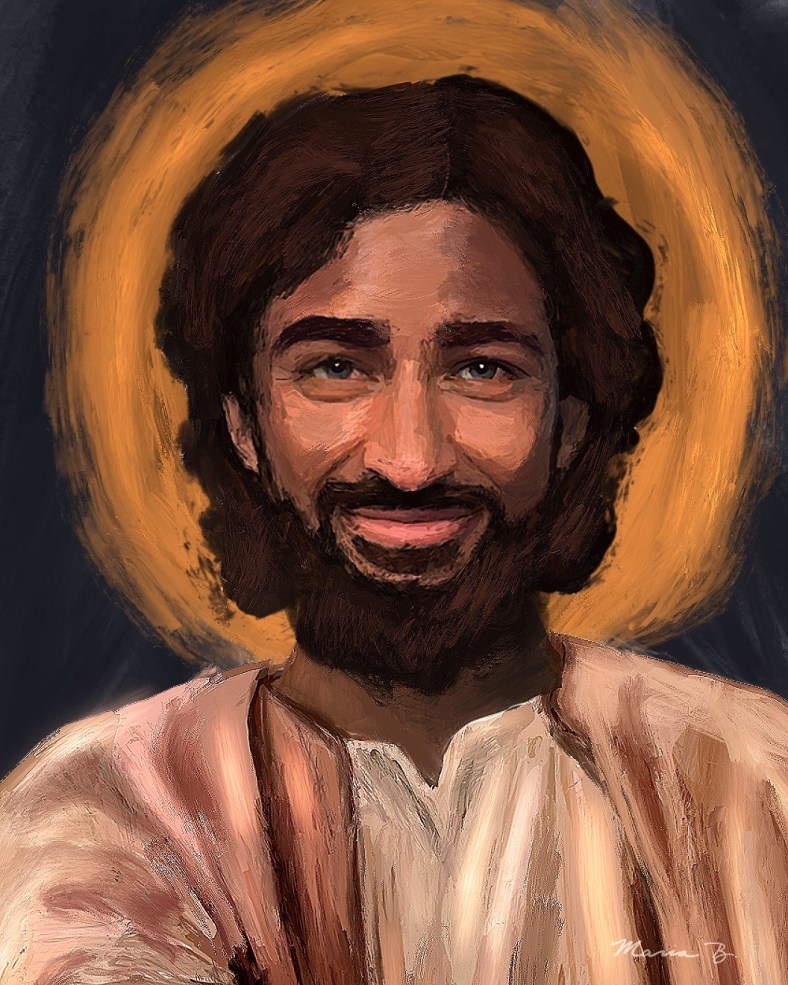
Let me give you an example.  As I was preparing this sermon, I had done my research and gathered all the bits and pieces in my notes, and prayed, so that the only thing left to do was to start writing.  And that’s where I was stuck.  My brain needed more time to percolate all the things I had been reading and thinking.  I guess I was still in sermon-avoidance mode.  So I went online to Facebook just to get the synapses firing and blow out the cobwebs.  As I scrolled through different posts, I came upon a painting of Jesus.  It was an arresting and well done picture, and there were two things I liked about it immediately.  First, in this painting Jesus looks like a Palestinian.  There’s an authenticity about it that makes it easy to say, “Yeah.  Jesus could very well look like that.”  But the thing that was really striking was that in this picture, Jesus is smiling.  He looks warm and friendly and understanding.  And loving. 

Staring at this marvelous picture of Jesus, I found myself thinking about our gospel text for today from John 14.  This passage is part of the Last Supper Discourse, also called the Farewell Discourse.  John pictures Jesus gathered with his disciple on the night of his betrayal, taking advantage of their short time together to prepare them for what is to come.  I have always imagined him being very somber throughout this whole discourse, after all, he’s sharing some very serious things with his disciples.  But looking at this picture where he’s smiling, where he looks so loving, I began to think, “What if this was his expression as he said all these difficult and necessary things?  What if he was looking at them with love and gentleness and patient understanding?”  As I looked at that painting, I began to hear his words differently.  The tone of voice changed and the words of Jesus came alive for me in a new way.  I could hear Jesus saying with that gentle smile, “Do not let your hearts be troubled and do not let them be afraid,” and those words went to my heart in a deeper way than ever before.

That, I believe, was a Holy Spirit moment.   Finding that picture.  Reimagining that scene of the text.  Opening to the words of Christ in a new way.  That’s the kind of thing the Holy Spirit does for us much more often, I think, than tongues of fire and speaking in unfamiliar languages.

It was not a happy or festive night when Jesus gathered his disciples to give them the new commandment to love each other and to promise them the gift of the Spirit.  They were anxious and afraid.  They had so many unanswered questions.  Jesus had told them that he would be departing from them and it had begun to sink in that soon they would be on their own.  The needed some kind of reassurance.  

“The promise of the Spirit,” wrote Meda Stamper, “does not come to completely faithful, courageous people, already loving one another and the world boldly, already worshiping in spirit and truth.  It comes in the midst of confusion and fear, which has made them unable to grasp what he is saying, and it is the answer to that.  Jesus makes the promise of the Spirit, emerging from the mutual love of the Father and Son for one another and for us, into which they and we are invited, at the very moment when such grace seems most beyond their grasp and ours.”[1]  

Jesus tells them and us that simply in our love for one another we open our hearts to the Holy Spirit, the presence of God in us and with us, to guide us and make us bold enough love a world which is both threatening and beloved.

Jesus promises that when loving the world and each other feels like a trial, when it seems to be beyond our ability to find one more drop of grace and understanding in what Johannes Buetler called our “lawsuit with the world,”[2] when life, itself, feels like an ordeal, Jesus promises that we will have an Advocate.  The Spirit comes alongside us and abides in us in the same way that the Father abides in the Son and Jesus dwelled in the world.  “When the physical presence of Jesus is no longer available, still the way, the truth, and the life are in us.”[3]

This is what the Spirit does.  She comes into us like a breath and carries us forward like a powerful wind.  She reminds us of all the things that Jesus has taught us.  She gives us courage to witness, to give our testimony, to convict or convince the world of the presence of Christ and the power of love.  She gives us the energy and the courage to do in our time what Jesus did in his own time—to love each other and the world.  

“Jesus in John shows us what living love looks like in his own life of making God’s love for the world known,” said Meda Stamper. “He enacts love… in words and works: in dangerously truthful testimony to political and religious authorities; in a ministry of boundary-breaking healing and of feeding the physically and spiritually hungry; and in a life of humility,… friendship, and prayer. He tells us that we are to follow his example…”

Jesus enacts love and tells us to do the same.  Jesus makes his own life an example of God’s love in the world and tells us to do the same.

This is the quieter Pentecost, the alternative Pentecost, a Pentecost centered in love. This is the Pentecost that empowers us to love God and to love our neighbors as ourselves. The Spirit is breathed into us, dwells in us, advocates for us, and flows through us as a witness to God’s love in a hurting world.  Jesus calls us to live into the fullness of life in this Holy Spirit to bring light and love and restoration to all of creation.

Jesus breathes the Spirit into us to give us comfort and courage and peace.  “Peace I leave with you,” he says. “My peace I give to you,” and the peace that Jesus give us is the breath of the Spirit.  It is the very presence of God in us.   Do not let your hearts be troubled, and do not let them be afraid.  God is with you and in you.

Whether it’s with tongues of fire and a loud rush of wind, or with a whisper, a breath, or a breeze, may this Pentecost renew the power of the Spirit within you.

May the Spirit of God make you bold to love the world.  May this Holy Spirit, the breath of Christ within you, empower you to be kind, to speak truth, and to stand for justice and fairness.  May your life be centered in love.  And may the peace of Christ, which passes all understanding, keep your hearts and minds in Christ Jesus.


[1] Meda Stamper, Commentary on John 14:8-17, 25-27

[2] Johannes Buetler, Paraclete, The New Interpreters Dictionary of the Bible

[3] Meda Stamper, Commentary on John 14:8-17, 25-27

Painting by Maria B., http://www.magnificatprints.com, used by permission

What the Numbers Don’t Tell Us

A voice is heard in Ramah, lamentation and bitter weeping.  Rachel is weeping for her children; she refuses to be comforted for her children, because they are no more. –Jeremiah 31:15

I am writing this the day after a teenager walked into Robb Elementary School in Uvalde, Texas and killed nineteen children and two teachers, and wounded 16 others.  Before going to the school, he had also shot his grandmother.  This was just 10 days after a young white racist killed 10 people and wounded 3 at a supermarket in a Black neighborhood of Buffalo, New York.  Nine days ago, another gunman killed 1 and wounded 5 people at a church in Laguna Woods, just down the freeway from here.  In the past 10 days, there have been 17 mass shootings across the United States, resulting in the deaths of 44 people and leaving 89 wounded.  This is just a small 10-day sample of the 213 mass shootings which have already occurred in 2022.  By the time you read this, that number will be higher.  I guarantee it, because there were a total of 693 mass shootings in 2021 and we’re already on pace to match or exceed that.  You can see all the numbers at www.gunviolence.org.

There have been a total of 119 school shootings since 2018.  There were 34 school shootings in 2021, and the shooting at Robb Elementary was the 27th so far this year. 

There are 393 million guns in private hands in the United States, the equivalent of 120 guns for every 100 citizens.  Fifty-three people a day on average are killed by firearms in the US.  79% of all homicides in our country are caused by guns.  

According to Pew Research, 53% of the people in this country favor stricter gun laws, including universal background checks.  NPR and Forbes place that number at 60%.  Gallup breaks that down, finding that 91% of Democrats favor stricter gun control but only 24% of Republicans and 45% of independent voters.  77% are in favor of “red flag” laws that would remove firearms from the hands of persons in a mental health crisis, spousal abusers, and persons who threaten violence.  All in all, the takeaway is that a clear majority want stricter gun laws.  Two major gun control measures were passed by the House of Representatives last year: the Enhanced Background Checks Act of 2021 and the Bipartisan Background Checks Act of 2021.  Both bills are stalled in the Senate.  Think about that for a moment.  Fifty Senators are blocking legislation that the majority of the people in the country want to see passed.

All of that is just numbers.  Those numbers describe a country that is addicted to personal weaponry far beyond all need or reason, a country where life is cheap.  Those numbers tell a story of a country that is so sick in its soul that significant numbers of its people are so turned inward on their own fantasies or pain that they can’t see the other people around them as, well, people.  Not even children.

Those numbers tell us a lot.  But they don’t tell us anything about the pain of bereaved families.  They don’t tell us anything about the heartbreak.  They don’t tell us anything about the fear that scars the survivors of gun violence for life.

Nineteen kids in the 4th grade didn’t make it home from school yesterday.  That breaks my heart.  But my heartbreak is nothing compared to the devastation the families and friends of those 19 children are experiencing.

Nineteen 4th graders.  That hits so close to home that I can’t stop the tears as I write it.  Two of my three grandsons, the twins, are in 4th grade.  Their mother, my daughter, Brooke, is a former School Psychologist.  My son-in-law, P.A., is an elementary school principal.  Here’s what my daughter wrote on Facebook earlier today:

“This morning I talked to the twins about the Texas school shooting before school.  I remembered my school psych training, where we had to practice how to discuss this exact topic with different age groups.  We were taught to emphasize how rare it is for this to happen.

But…I just couldn’t say those words without feeling like a complete liar.  Instead, I reassured them that it is very unlikely that something like this would happen at their school and we discussed the safety measures in place.

And then I left them at school.  And I couldn’t stop worrying.

What if someone starts shooting at recess?  What if they’re in the bathroom?  Where are the most likely entry points?

If they come through the office this might buy enough time for the children and teachers to get into their locked classrooms.  But then, what will happen to the people in the front office, like P.A.?

What will happen to all my friends who are administrators, school psychs, counselors, speech pathologists, administrative assistants, parent volunteers?  What will happen to the teachers? WHAT WILL HAPPEN TO THE CHILDREN?

What if one fourth grader comes out of the school, but not two?  What if three kids come home, buy my husband doesn’t?”

The trauma from these incidents isn’t limited to the victims and their immediate families.  It spreads out in ripples and damages all of us.  I am heartbroken.  But I am also furious.  I am furious with a culture that lionizes violence.  I’m angry at a culture that makes life so cheap.  I’m furious with a country that puts profit above health and safety.  I am particularly angry at the politics that greases the wheels of all this.  I’m incensed by 50 Senators holding the country hostage to this violence while their campaign chests are being stuffed by the gun lobby.  And, quite frankly, I am also angry with all the people who wring their hands and say we’re helpless, that nothing can be done.  I am furious with all those people who work to oppose common-sense legislation to curtail the damage done by an overbroad interpretation of the 2nd Amendment.  The words “well-regulated” are in that amendment.  Let’s start there.

We long ago crossed any imaginary threshold of an acceptable number of deaths.  We are way past the threshold of patience.  We have spent too much blood on the altar of alleged “rights” and not nearly enough sweat on the sacred ground of responsibility.

And yes, we need to pray.  We need to hold the victims of our violent culture in our thoughts and prayers.  We need to ask God for help.  But we also need to ask God for the courage, the wisdom, the will, and the vision to be part of the solution as we try to find a way to disarm this country and to address the alienation and dysfunction that’s at the heart of these incidents.

Finally, I know that some people who read this will not like what I am saying here.  I offer no apologies.  My ordination vows obligate me to speak for justice and to stand with victims.  But beyond that, I want to live in a country that loves its children more than it loves guns.

Pro Gloria Dei,

Pastor Steve

Seeing Jesus

“In a little while, the world will no longer see me,” said Jesus, “but you will see me.”[1]

My friend, Pastor David Nagler, who was just elected as bishop of the Pacifica Synod on Friday, told the synod assembly a story about seeing Jesus when he was serving as the Director of the Central City Lutheran Mission (CCLM) in San Bernardino.  CCLM has been helping to provide a variety of services and assistance to the county’s most vulnerable people since 1994 and in 2015 they became part of Lutheran Social Services.  I don’t know if they still do this, but when Dave was the director they would have a morning worship service, then after the service, people were invited into the fellowship hall for lunch.

There was a kid from the neighborhood named Rudy who had been born in a very small town in Mexico.  He was born with bowed legs and since his town was very poor, there wasn’t any medical help to provide braces or surgically straighten them.  Rudy loved to hang out at the church, and he followed Pastor Dave around like an eager puppy, running everywhere on his little, bowed legs as he tried to keep up with Dave’s long stride.  He was fascinated by the worship service and was always asking Dave if he could help out.  “Pastor Dave, can I collect the money?”  “Pastor Dave, can I hold the cup at communion?”  “Pastor Dave, can I wash the cup after communion?”    

One Sunday, right after worship when everyone else had filed into the fellowship hall for lunch, Dave was still up at the altar putting away the communion elements when a homeless man wandered into the church through the side door.  The man was disheveled and obviously a little disoriented, and didn’t seem to be quite aware of where he was.  Dave didn’t think much about it because people like that drifted in all the time.  He figured he would go talk to the man when he finished what he was doing.  Rudy, however, hustled over to the man, took his arm, and led him over to the baptismal font and said,  “Bend over the water,” and without questioning, the man did.  Before anyone could say or do anything, Rudy poured a handful of water onto the man’s head.  Then Rudy led the man up to the altar and said, “Pastor Dave, can he have communion?”  It was one of those moments when time stands still and the angels hold their breath to see what you’re going to do.  Dave gave the man communion then walked with him over to the fellowship hall to make sure he got some lunch.

Most pastors will tell you that there are times in life, in ministry, when you will see Jesus.  If your mind and your heart are open, you will see Jesus so, so clearly.  There are times when you will undeniably feel the breath of the Spirit filling your sails.  “That day,” said Pastor Dave, “Rudy showed me Jesus.”  

“You will see me,” said Jesus, “because I am alive.  And because I am alive, you will be alive.  The day that you realize that my life is your life and your life is my life, that’s the day you will begin to see that I am in the Father, and you are in me and I am in you.  You who love me will be loved by my Father, and I will love you and make myself plain to you.”  And here’s the thing we need to remember as we hear this:  every time Jesus says “you” here, it’s plural.  All y’all.  His life is ourlife.  He lives in us, collectively and connectedly.  We who love him are the ones who make him visible in the world.  We are the ones who show God’s love to the world.  Our arms are the arms Jesus uses to embrace the world.  And our eyes are the eyes that get to see his presence.

Bishop Andy Taylor said that the main thing is to keep the main thing the main thing, and the main thing is the Gospel—the announcement of God’s love and presence in the world through Jesus.  We are not called just to just preach about God’s love or teach about God’s love, we are called to live into it and let it be alive in us.   

Richard Rohr once said, “The only way I know how to love God is to love what God loves.”  Jesus said, “Those who love me will keep my word.”  Keeping his word means that we get to show people in clear and tangible ways that they are loved.  That means that when someone is oppressed, we stand up for them, even when it’s scary.  When someone is excluded, we welcome them to the table.  When someone is wounded, we make a safe space for them to be healed.  When someone is beaten down, we lift them up.  That’s what it means to love one another as Jesus has loved us.  That’s what it means to follow Jesus.  And sometimes that means we have to put our bodies on the line.

It was two years ago this week, May 25, 2020, that George Floyd was killed by police on the streets of Minneapolis.   In the wake of his death and the death of Brionna Taylor and others, Black Lives Matter organized protests all across the country.  I was part of a group of clergy and other faith leaders who were asked to attend the Black Lives Matter Rally at the Civic Center in Los Angeles.  We were asked to wear our clerical collars and our stoles—symbols of our office, clear and visible signs that we were there representing our various faith communities and traditions.  We weren’t there to share any words.  We were there to witness.  We were asked to perform one simple task, to stand shoulder to shoulder with each other in a line, a kind of human boundary line between the law enforcement officers and the protesters.  We were there to help create a safe space where black people and other persons of color gathered in community could speak their grievances and share their grief.  We were there to help assure both sides that things would remain peaceful.

It was scary to stand there in that line.  It was still early days in the Pandemic and even though we were all masked, we knew that Covid was in the air.  But the really scary part was to stand just a few yards away from a line of fully armed Sheriff’s deputies in riot gear, watching them watching us, and knowing that my stole and my clerical collar wouldn’t help one bit if they suddenly decided to move in on the demonstrators.  

As you might expect, my thoughts were racing.  But then I decided that I was going to love those deputies.  I was going to love them because Jesus loves them.  I realized that they were in a difficult position, too, and probably didn’t want to be there.  As I stood there across from those deputies with their hands resting on their batons or their holsters, I just kept repeating one thought in my mind over and over:  “God loves you.  God loves everyone here.  We are all children of God.”  And then these words of Jesus came to me: “Peace I leave with you.  My peace I give you.  Do not let your hearts be troubled and do not be afraid.”  Those words of Jesus became my prayer that day—my prayer not just for me but for the deputies and the protestors, too.  Peace.  Do not let your hearts be troubled and do not be afraid.”  

There is so much in our country and in our world that has become oppositional.  There is a real struggle between those who believe that peace and prosperity will come through progressive ideas and those who think it will come through conformity to imposed systems of hierarchy and order.  Those positions have boiled themselves down to hardened political polarities and ideologies.  People just aren’t listening to each other.  No one is seeking middle ground.  There is no real exchange of ideas, no conversation, just entrenched positions.  

Jesus is calling his followers to step into the front lines of this tension.  We are being called to create a space of grace where people can be heard and their fears addressed, where conversation can begin and the seeds of God’s transforming love can be planted.  

We called to build a Beloved community, a  people who are living into the Gospel, a companionship enlivened by the vibrant love of God.  That’s what church is supposed to be about.  We are called to create a welcoming space where God can love us into something new.  We are called to create a community where people can see Jesus.

There is a beautiful vision at the end of the Book of Revelation, a vision of the New Jerusalem coming down out of the heavens from God.  Some people think this is a description of what heaven will be like.  Some think it is a literal description of what God is going to do at the end of time.  Personally, I think it’s a wonderful metaphor for what the church of Jesus Christ can be and should be now when we’re at our best.  

The river of life flows in that city[2] and I believe that this river of life in all its fullness can flow in and through us when we immerse ourselves in God’s life and love and grace. 

The tree of life grows in that city with its leaves that are for the healing of the nations[3]—healing for all the different peoples of the world, healing for all the wounds we have inflicted on each other simply because we are different from each other.  I think we can be that tree when we are rooted in the love of Christ.  

Revelation tells us that the people will bring all the splendor and richness of their cultures and ethnicities into that city.[4]  Imagine how vibrant and powerful our worship and ministries would be if we opened our doors and our hearts to all that splendor and richness here and now.

God has given us a vision, a revelation, of the Beloved Community as a loving and healing place where everyone is welcome at the table, a place where the splendor and richness of all peoples is cherished and celebrated.  A place where people are transformed and renewed.  

May the Spirit empower us to make that vision a reality on earth as it is in heaven.  May this church and every church become a place where people can see Jesus.


[1] John 14:19-20

[2] Revelation 22:1

[3] Revelation 22:2

[4] Revelation 21:26

Love Story

I came across the best love story on Facebook this week, and I just had to pass it along to you.  A reporter was interviewing a man who had managed to get himself and his family out of Mariupol during the Russian bombing.  Here’s what he said:

“I left the bomb shelter and saw a car with keys in the ignition near the store.  I watched it for two hours, waited for the owner.  When the owner didn’t show up, I didn’t wait.  I took my family, got in the car and drove to Vinnitsa to stay with relatives.  I found a phone number in the glove compartment and called the owner:

“‘Sorry,’ I said, “I stole your car.  Saved my family.’

‘Thank God!’ he said. ‘Don’t worry, I have four cars.  I took my family out in my Jeep.  The rest of the cars I filled with fuel and left in different places with the keys in the ignition and the number in the glove compartment.  I received calls back now from all the cars.  There will be peace.  See you.  Take care of yourself.’”

As I said, it’s a love story.  Leaving those cars behind, gassed up and ready to go  with the keys in the ignition so that other people, strangers, could escape the hellish bombing of their city—that was an act of love.  That was God made manifest.  

“I give you a new commandment,” said Jesus, “that you love one another.  Just as I have loved you, you also should love one another.  By this everyone will know that you are my disciples, if you have love for one another.”

It isn’t doctrine that marks us as disciples of Jesus.  It isn’t our intellectual assent or understanding of the faith.  It isn’t embracing particular ideas about atonement or grace or the nature of Christ.  It isn’t our righteousness or our moral stance on hot-button issues.  It isn’t even “accepting Jesus into our hearts,” whatever that might mean.  “By this everyone will know you are my disciples,” said Jesus, “—if you have love for one another.” 

When Jesus was asked which of the commandments was the most important, he went straight to love.  “You shall love the Lord your God with all your heart, mind, soul and strength.  And love your neighbor as yourself.  There are no greater commandments.  On these two commandments hang all the law and the prophets. Do this and you will live.”[1]

When some of the people in Corinth got all wrapped up in their charismatic gifts and started to take a kind of overweening pride in their spirituality, St. Paul wrote to them with a word of caution:

“If I speak in the tongues of mortals and of angels, but do not have love, I am a noisy gong or a clanging cymbal.  And if I have prophetic powers, and understand all mysteries and all knowledge—if I have so much faith that I can move mountains, but do not have love, I am nothing.  If I give away all my possessions—even if I give up my body as a martyr—but do not have love, I gain nothing.”

A few years later, Paul said in his letter to the Christians in Rome:

Owe no one anything, except to love one another; for the one who loves another has fulfilled the law.  The commandments, “You shall not commit adultery; You shall not murder; You shall not steal; You shall not covet”; and any other commandment, are summed up in this word.  “Love your neighbor as yourself.”  Love does no wrong to a neighbor; therefore, love is the fulfilling of the law.

Paul’s descriptions of love in 1 Corinthians and Romans are excellent and instructive.  But they’re also rather passive.  When Jesus talked about love, he seems to have had something more active in mind.  Often when he talked about love, he would combine it with action.  “I say to you, love your enemies and pray for those who persecute you.”[2]  “Love your enemies and do good to those who hate you.”[3] When a lawyer tried to find a loophole in the commandment to love your neighbor by asking, “And who is my neighbor?” Jesus responded with a story about a Samaritan who rescues a traveler who had been left for dead after being beaten up by bandits.  Clearly, loving your neighbor involves action.  Love also involves generosity.  The Gospel of John tells us that God so loved the world that God gave God’s unique son to us.  Giving is an act of love.

All people are called to love, not just Christians, but followers of Jesus have been commanded to love so that we can be known as his disciples.   Love is supposed to be the thing that identifies us. Love is what we’re supposed to be all about…but how do you that?  Especially, how do you do that part about loving your enemies—or even just people you don’t particularly like?

You may already know that the ancient Greek language in which the New Testament was written had four different words for love: agape, eros, philia, and storge.  Storge was a word used to describe duty to family and country—think of it as patriotism.   Philia is friendship.  It meant a lot to call someone your friend in the ancient world.  True friendship, then and now, is a kind of love.  Eroswas the most commonly used word for love in the ancient world.  Our word erotic comes from eros, but properly understood there’s a lot more to it than that.  

Agape is the word for love that’s used most often in the New Testament.  Agape is a love that is unconditional.  It has no motive other than to seek the well-being of the beloved.  It can be spontaneous, but usually it is decisional—you simply decide that you are going to love that other person or those other people.  Period.  Agape is indifferent to any kind of reward and it doesn’t seek reciprocity— agape doesn’t ask to be loved in return.  Agape is the simple yet profound recognition that giving of yourself is a worthy and good thing to do.  It is an unconditional willing of good.  Agape loves the beloved for their own sake, whether they are worthy and deserving or not.

Eros, on the other hand, speaks of desire and longing.  Eros seeks to possess what we find valuable but not to covet or desire a person at the expense of overall well-being.  Edward Vacek defined erosas “loving the beloved for our own sake.”[4]  Plato thought that eros was the pathway to God.  His reasoning went like this:  I see a beautiful person or thing and I desire them or it, but if I look beyond the person or thing I find that what I am really desiring is beauty.  But beauty is truth, so if I look beyond beauty, I find that what I really desire is truth.  But truth comes from God, so what I am really desiring is God.  

Ilia Delio reaffirms that the heart of eros is passion or desire.  “Eros,” she writes,  “is that ineffable longing that stretches beyond oneself for the sake of oneself.”  She goes on to suggest that eros and agape aren’t so much in contrast with each other as related to each other and that philia—friendship—is the thread between them.  In philia a person gives themselves over to the relationship.  Philia is expressed in camaraderie and companionship, in life together in community.  Edward Vacek says that philia “may be the most cosmic form of love because it is based on mutuality, reciprocity, and cooperation—with the purpose of promoting overall well-being.”  That’s how the Quakers understood it, which is why they officially called themselves The Society of Friends.

Agape is the word for love that’s used most frequently in the New Testament, but there are moments when philia comes into the text to give love a meaning that is broader and deeper.  Jesus brings agape and philia together in John 15:13 when he says, “No one has greater love than this, to lay down one’s life for one’s friends.”  No one has greater agape than to lay down one’s life for one’s philon—those who are loved with the deep bond of philia.  He goes on to say, “You are my friends (philia/philon) if you do what I command you.”  And what did Jesus command?—that we should love one another with agape love as he has loved us.  

So how do you love—how do you obey the command to love?  Well to start with, it helps to realize that the kind of love Jesus commands doesn’t have to involve any warm, fuzzy emotions.  You can decide that you will unconditionally will and work for goodness for others without expecting anything to come back to you.  You can decide to love with agape.  That’s the starting point.

But agape can be a poor kind of love if it doesn’t bloom into something more than just a decision.  If it remains simply a decisional kind of love, it can become rote, individualistic, non-mutual, and even task-oriented.  Yes, agape is patient and kind, it’s not envious or boastful or arrogant or rude, it does not insist on its own way, it rejoices in truth, it bears all things, believes all things, hopes all things, endures all things, and doesn’t quit—agape has all those qualities that St. Paul pointed out to the Corinthians.  But agape can be all that and a bag of chips and still not be warm enough to bloom into a real relationship.  Love, complete and healthy love at work in a community of faith, starts with a good base of agape, but mixes in a good dose of philia, friendship, and even a dash of eros, to keep us longing for God, for each other, and for the beauty of our relationships.

From the beginning of creation, God has been pouring love into the universe and calling us into relationship.  Love is the force that brings quantum waves together to form hydrogen atoms and hydrogen atoms together to form stars.  Love is the force that drives evolution, overcoming entropy to continually transform biological life into higher, more complex, more aware forms of life—forms capable of loving.  We are commanded to love because it is intentional love that identifies us as followers of Jesus, but even more importantly, because love is what God has been using throughout all time to transform the all of creation.  When we reflect that love back to God and to each other, we participate in God’s formative and transformative work.  

Pierre Teilhard de Chardin wrote, “The day will come when, after harnessing the ether, the winds, the tides, gravitation, we shall harness for God the energies of love.  And on that day, for the second time in the history of the world, humanity  will have discovered fire.”

Love is patient and kind.  Love does bear all things and believe all things and hope all things, and endure all things.  But love goes beyond that.  Love puts gas in the car and leaves the keys in the ignition so that beloved strangers can escape to new life.  Love promises there will be peace.  

May the Spirit ignite in all of us the bright flame of God’s transforming love.


[1] Mark 12:28-34; Matthew 22:36-40; Luke 10:25-28

[2] Matthew 5:43

[3] Luke 6:27

[4] Edward Collins Vacek, Love, Human and Divine: The Heat of Christian Ethics, 1994, pp. 157-158; as quoted by Ilia Delio, The Unbearable Wholeness of Being, Orbis Books, 2013, p.42

Of Mothers and Vineyards

It’s Mother’s Day today, so naturally, I’ve been thinking about my mom.  My mom told me once that I’d never amount to much because I procrastinate too much.  I said, “Oh yeah?  Well just you wait.”  

I’ll never forget one Mother’s Day—we had a big family meal at Mom and Dad’s house but right after dinner Mom kind of disappeared.  I found her in the kitchen getting ready to wash a sink full of dirty dishes.  I said, “Mom, it’s Mother’s Day!  Go sit down and relax.  You can do the dishes tomorrow.”

I bought my mom a mug that said, “Happy Mother’s Day from the World’s Worst Son.”  I forgot to give it to her.  

Mothers often put their own needs last.  You know you’re a mom when you understand why Mama Bear’s porridge was too cold.

I love the recipe for Iced Coffee that one mom posted on Twitter.  She wrote, “Have kids…Make coffee…Forget you made coffee…Find coffee…Put it in the microwave…Forget you put it in the microwave…Drink it cold.”

Mother’s Day was first proposed by feminist activists after the Civil War.  They originally envisioned it as a day of peace to honor and support mothers who had lost sons and husbands to the carnage of the war.  The most well-known of these women was the abolitionist, Julia Ward Howe, who wrote The Battle Hymn of the Republic. In 1870, she issued a Mothers Day Proclamation calling for mothers of all nationalities to band together to promote the “amicable settlement of international questions.”  She envisioned a day where women from all over the world would meet to discuss ways to achieve world peace.  In that proclamation she wrote:

“Arise, then, women of this day!  Arise all women who have hearts, whether our baptism be that of water or of tears!…We women of one country will be too tender of those of another country to allow our sons to be trained to injure theirs.  From the bosom of the devastated earth a voice goes up with our own.  It says “Disarm, Disarm!  The sword of murder is not the balance of justice.”

Another early proponent of Mothers Day was the education activist and community organizer, Ann Maria Reeves Jarvis.  She was very active in her Methodist congregation and in 1876, during her closing prayer for her Sunday School class,  she said, “I hope and pray that someone, sometime, will found a memorial Mothers Day, commemorating her for the matchless service she renders to humanity in every field of life. She is entitled to it.”  Her daughter, Anna Maria Jarvis, never forgot her mother’s prayer, and on May 10, 1908, three years after her mother’s death, Jarvis held a memorial ceremony to honor her mother and all mothers at Andrews Methodist Episcopal Church in Grafton, West Virginia.  That church is now a historic landmark known as the International Mother’s Day Shrine.

Anna Jarvis continued lobbying to make Mothers Day an official holiday in the United States.  By 1911 Mothers Day was being observed in every state, and in 1914, President Woodrow Wilson signed a proclamation officially designating the second Sunday in May as Mothers Day. 

And here’s an odd but important note:  originally there was no apostrophe in Mother’s Day.  Julia Howe, Ann Reeves Jarvis, and Anna Jarvis all envisioned it as a day to honor all mothers.  Plural.  But the greeting card industry, the florists, and the candy makers quickly individualized it and idealized it, and began promoting it as a day for you to honor your mother.  In their advertising, Mothers Day (plural/all mothers) quickly became Mother’s Day with an apostrophe, as in your mother’s day (singular/possessive).  Needless to say, the idea of it being a day to promote international peace pretty much vanished with the arrival of that apostrophe.

Ann Jarvis, who had worked so hard to make Mother’s Day a national observance, ended up hating it. The holiday became so commercialized, that in 1943 she tried to organize a petition to rescind Mother’s Day, but her efforts went nowhere.  Frustrated, and literally at her wits’ end, Anna Jarvis died in 1948 in a sanitarium, her medical bills paid, ironically, by a consortium of people in the floral and greeting card industries.

Anna Jarvis wasn’t the only one who has problems with Mother’s Day.  Anne Lamott’s column a few days ago began this way: “This is for those of you who may feel a kind of sheet metal loneliness on Sunday, who had an awful mother, or a mother who recently died, or wanted to be a mother but didn’t get to have kids, or had kids who ended up breaking your hearts…”  Lamott goes on to acknowledge many of the ways that this Greeting Card holiday can be painful for many women…and also for many children.

Most pastors I know are ambivalent at best when it comes to Mother’s Day.  It’s something of a minefield for us.  We don’t dare let it go unmentioned, but at the same time we are very aware of those women in our congregations who for one reason or another will be feeling that “sheet metal loneliness” that Anne Lamott describes.

On the plus side, though, Mother’s Day does give us an opportunity to highlight issues that women face in a world and culture that still operates with far too much patriarchal dominance and oppression, often in ways that men don’t even see.

One of the issues that comes up every year around Mother’s Day is the question of whether or not stay-at-home moms should be paid.  This question has been highlighted by the pandemic when so many women found it necessary to become stay-at-home moms and had to take on the extra duties of tutoring or teaching their kids.  CBS News reported that during the pandemic, more that 12 million women lost jobs and more than 2 million voluntarily left the workforce altogether. 

There are some very good arguments for creating a basic income for the stay-at-home mom… or the stay-at-home dad, for that matter.  At its most basic level, such a stipend would remind us that parenting is a valuable job and that the community as a whole benefits from it being done well.  The question then becomes how much should the stay-at-home mom be paid, and the answers to that are all over the lot.  One economist totted up the “jobs” that a stay-at-home mom does, multiplied by the minimum wage and came up with $18,000 per year.  Insure.com did the same math for the 18 or so jobs a mom takes on during the day, used a more livable hourly rate, and came up with $126,000 per year.  Salary.com’s annual Mom Salary Survey from May of 2021, said that moms should be paid $184,820 per year.   Clearly,  the marketplace recognizes that parenting is valuable.

Parenting is valuable, but one of the problems with Mother’s Day is that it reinforces a cultural expectation that puts the weight of parenting primarily on Mom.  That’s unfair to Mom and limits a child’s experience because even SuperMom can’t really do it alone.  As the old African proverb reminds us, it takes a village to raise a child.  “My main gripe with Mother’s Day,” writes Anne Lamott, “is that it feels incomplete and imprecise.  The main thing that ever helped mothers was other people mothering [their children], including aunties and brothers; a chain of mothering that keeps the whole shebang afloat. I am the woman I grew to be partly in spite of my mother, who unconsciously raised me to self-destruct; and partly because of the extraordinary love of her best friends, my own best friends’ mothers, and from surrogates, many of whom were not women at all but gay men. I have loved them my entire life, including my mom, even after their passing.”

Raising children is a community affair.   It should be done with an eye on what’s best for the community.  We lose sight of that too often.  We think good parenting means raising kids who will share our cherished internal family values.  That’s good as far as it goes, but the child really needs to be prepared for the time when they will leave home to enter the world on their own.  They need to be prepared to not just make a valuable contribution to the community, but to be a positive contribution to the community.  Parents need to remember that their children are not just a gift that God gives to them, but a gift that they, in turn, give to the world.  We need to send our children into the world equipped with empathy, wisdom, patience and understanding, and developing those attributes requires more influence than any one parent can provide. 

Jesus told a story in chapter 20 of the Gospel of Matthew about a man who went to the marketplace one morning to hire some workers, and before sending them out to work in his vineyard, he made a verbal contract with them to pay them the basic daily wage of one denarius.  A few hours later, he went to the marketplace again and hired some more workers and said, “I will pay you whatever is right.”  He went to the marketplace three more times during the day to hire more workers, the last time just an hour before sunset, and each time he told those workers that he would pay them “whatever is right.”  At the end of the day when all the workers lined up to receive their pay, he paid the workers who had only been in the field for an hour a denarius, the whole day’s wage.  Naturally, the workers who have been working since sunrise figured they were in for one heck of a bonus, but when it was their turn to be paid, the man paid them, too, a denarius, the daily wage.  They were upset about this and groused about it. “These latecomers only worked an hour and you’ve made them equal to us even though we were out here in the heat all day!”  The landowner responds, “Friend, I am doing you no wrong;  didn’t you agree with me for the usual daily wage? I chose to give the latecomers the same as you.  Am I not allowed to do what I choose with what belongs to me?  Or are you envious because I am generous?”

This parable makes a lot of people squirm, mostly because we tend to feel slighted on behalf of those workers who were out in the hot sun all day.  On the flip side, we tend not to feel any joy on behalf of the one-hour workers who got what amounts to an amazing bonus.  I think we feel all this because we lose sight of what this parable is all about and our focus is in the wrong place.  

This is not just a story about wages—how much should the fieldworker get paid per hour or how much should the stay-at-home mom be paid—this is a story about what’s best for the community.  Jesus starts the story by saying “The kingdom of heaven is like…”  The context is bigger than the owner of the vineyard or the workers.  The owner of the vineyard understands that he is not just paying workers to harvest his grapes on his property, rather, he is providing a means of support for the whole community.  He understands that by paying the one-hour worker the full wage, he is creating one less beggar in the marketplace, preserving that person’s dignity, and helping to feed that worker’s family for days.  He understands that by paying all the workers the same wage he is sending the message that they are all equally vested in the good of the community.  Even the worker who complained noted “you made them equal to us.”  The landowner understands that his wealth, his resources are not just for his own personal benefit or his family’s, but are meant to be used to make the whole community healthier and stronger.  I suppose you could say he’s “mothering” the community.

And that brings us back around to the original intent for Mothers Day.  It was intended to be something to strengthen the community and bring peace to the world.  This Mothers Day, I invite you to do just that.

Water is Life

Two headlines grabbed my attention on Thursday morning.  The first one, in the LA Times said, “With less water, Southland will see browner landscape. Officials are imposing limits that could get even more strict.”  The second headline was from The Week and said, “Ocean animals face potential mass extinction from climate change, according to a new study in the journal Science.”  That headline was followed by a synopsis that said, “Rising temperatures and declining oxygen levels are cooking, starving and suffocating marine life.  Unless humanity takes swift action to curb fossil fuel use and other planet-warming activities, climate-fueled die-offs could rival the demise of the dinosaurs, research shows.”

It was an interesting juxtaposition.  Both stories were about water and climate change.  The first story emphasized how the drought is going to affect the aesthetic preferences of humans in Southern California.  With the new water use restrictions, our green lawns will be fading to brown.  People are not happy about that.  The second story was about how creatures that live in water are threatened with extinction because the emission of greenhouse gases from human industries and transportation has warmed their environment too much.  I would like to think that people aren’t happy about that, either.

Water is life.  That’s true for every living creature on earth.  Somewhere between 20% to 80% of all the earth’s creatures live in water.  The number is uncertain because no one really knows how many species live in the depths of the oceans.  Their need for water is obvious.  It’s their habitat.  But land creatures need water too.  Water is an essential element in all kinds of organic processes.  We have never found any living organism that can flourish in a completely dry environment.

71% of the earth’s surface is covered by water—332.5 million cubic miles of water—but that water only accounts for 0.02% of the planet’s total mass.  97% of the earth’s water is salt water in the oceans.  Only 3% is fresh water.

2.5% of the earth’s fresh water is unavailable because it’s locked up in glaciers, polar ice caps, the atmosphere, or soil.  Or it’s highly polluted.  Or it lies too far below the earth’s surface to be extracted at an affordable cost.  It the end, only 0.5%–one half of one percent—of the earth’s water is available fresh water, the water we drink, the water we use to water our lawns and gardens.  If the world’s total water supply was 100 liters (26 gallons), our usable supply of fresh water would be only about 3 ml (about half a teaspoon).

In ways you probably haven’t thought of, you are a water creature.  The human body—your body—is 60% water on average.[1]  Your brain and heart are 73% water and your lungs are about 83% water.  Your skin is 64% water, your muscles and kidneys are 79% water, your blood is 90% water, and your eyes are 95% water.  Even your bones are 31% water.  You can go a month or more without food, but the average person would die after only 2 to 4 days without water.  

Water is life.  Water is life because it has unique properties that make life possible.  It is the only natural substance where all three physical states—liquid, solid and gas—occur naturally on earth.  Water is the universal solvent. That means that it can carry other elements and compounds.  Your blood is 90% water but that water carries sodium, potassium, iron, and all the other minerals and nutrients your body needs.

Water is life.  And water is holy.   

Water is mentioned 478 times in the Bible:  

The primordial waters of Creation with the Spirit hovering above them.

The waters of the Flood.

The wells where relationships were formed, where Rebekah is brought to Isaac, where Jacob meets Leah and Rachel, where Moses meets Zipporah.

The waters of the Red Sea which Moses parted to reveal a pathway to freedom.

The waters of salvation which Isaiah speaks about and invites everyone to drink: “You will drink from the wells of salvation; Ho, all you who thirst, come to the water.”

The waters of justice that Amos calls us to produce: “Let justice roll down like waters and righteousness like an ever-flowing stream!”

The waters of the Jordan where Jesus was baptized by John, where the Spirit descended upon him like a dove and the voice of God proclaimed “This is my son, the Beloved.”

The waters of Galilee where fishermen were called to follow Jesus and became disciples of the Way, waters that Jesus sailed across and walked upon.

The waters of the well in Samaria where Jesus asked a Samaritan woman for a drink, talked with her about worship and told her that he could give her living water.

The waters of the Mediterranean that Paul sailed across to carry the gospel of Christ to the Gentiles and diaspora Jews in far places. 

The waters of the River of Life in Revelation, bright as crystal, flowing from the throne of God where the Spirit echoes the words of Isaiah and says “Come, let everyone who is thirsty come.  Let anyone who wishes take the water of life as a gift.”

Water is sacred.  

In his baptism, Christ was immersed in the waters of the world.  When we were baptized, the water we were submerged in or sprinkled with was a sign that we are immersed in the love and life of the triune God but also in the waters of Creation, the waters of the world.

What does it say about us when our way of life on this planet leads directly to the death and extinction of our fellow God-created creatures who live within the sacred life-giving waters of the earth?  

What does it say about us when our own trash pollutes the waters we rely on to such a degree that now our own bodies are tainted with microplastics?  

When we are claimed by the waters of baptism, we enter into a Covenant with certain declarations and promises.  We reject sin.  We renounce all the forces that defy God.  We renounce the powers of this world that rebel against God.  We renounce the ways of sin that draw us away from God.  We promise to “serve all people, following the example of Jesus,” and to “strive for justice and peace in all the earth.”  

In the waters of baptism we pledge our allegiance to the Kin-dom of God.  We volunteer to stand against evil and its power in the world and to live in the Way of Christ.  We vow to stand for justice, to be peacemakers working for God’s shalom.  We pledge to reject all types of violence, coercion, domination and oppression,  and to care for and protect all of Creation with fierce love. 

I’m pretty sure he would never claim to be speaking as a follower of Jesus in the Covenant of baptism, but Joaquin Phoenix, interestingly, captured much of what our baptismal covenant is all about in his Academy Award acceptance speech in 2020.  Here’s part of what he said:

“I think the greatest gift is the opportunity to use our voice for the voiceless… I think at times we feel or are made to feel that we champion different causes.  But for me, I see commonality.  I think, whether we’re talking about gender inequality or racism or queer rights or indigenous rights or animal rights, we’re talking about the fight against injustice.

“We’re talking about the fight against the belief that one nation, one people, one race, one gender, one species, has the right to dominate, use and control another with impunity.

“I think we’ve become disconnected from the natural world.  Many of us are guilty of an egocentric world view, and we believe that we’re the center of the universe.  We go into the natural world and we plunder it for its resources…

“We fear the idea of personal change, because we think we need to sacrifice something; to give something up.  But human beings at our best are so creative and inventive, and we can create, develop and implement systems of change that are beneficial to all sentient beings and the environment… I think that’s when we’re at our best: when we support each other.  Not when we cancel each other out for our past mistakes, but when we help each other to grow.  When we educate each other; when we guide each other to redemption.

“When he was 17, my brother [River] wrote this lyric.  He said: “run to the rescue with love and peace will follow.”

In our covenant with God and the earth, we are called, as Joaquin Phoenix said, to be a voice for the voiceless.  Water has many voices—the thunder of a waterfall, the waves that lap against a boat or crash against the shore, the burbling of a stream, the splash of a puddle, the rushing flow from a tap or shower head.  Water has many voices, but the world has forgotten how to listen to them.  We need to speak for the waters.

We need to speak for the waters because the waters have spoken for us.  Every drink of water is a reminder of how God provides for us.  Every time we shower or bathe, Christ is in, with, and under the waters that cleanse us, singing about our baptism, giving us a sign to remind us that we are immersed in the life and love of the Father, Son and Holy Spirit.  When we wade or swim, the waters that embrace us are a sign of our inclusion in this wet and wonderful God-made world.  Water is our intimate connection to the natural world. All the waters of our life tie us to the well-being of the earth and all its creatures.  The waters remind us that we are water creatures, too.  

In the Canticle of Brother Sun and Sister Moon, St. Francis sang, “Praised be you, my Lord, through Sister Water who is so useful, humble, precious, and pure.”

May God teach us to love Sister Water.  May the Spirit that hovered over the waters of Creation, empower us to conserve and care for the water that sustains us and all life.  May Jesus, by the Living Water of his word keep us in harmony with the water that flows in our veins.  May the One who made us continually remind us that we have a kinship with water and all the creatures that live and move and have their being in water.  

We humans have brought distress to the waters of our world.  May we, as people of faith, be inspired to “run to the rescue with love,” trusting that peace will follow.

In Jesus’ name.


[1] The actual number varies from 45% to 75%.  Body composition varies according to gender and fitness level and amount of fatty tissue.