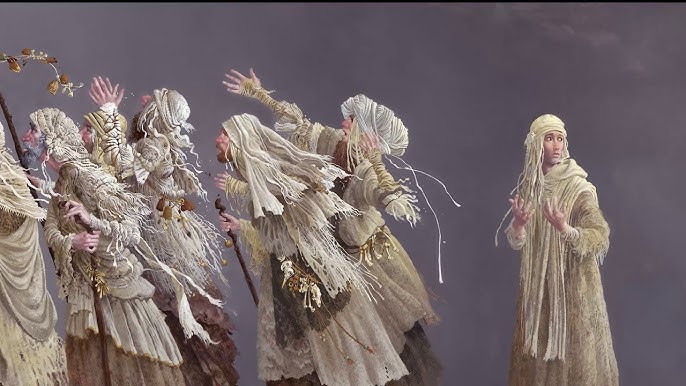
Hope–Alive and In Person

Sometimes you need more than a vision.

Luke 24:36b-48

Since many have undertaken to set down an orderly account of the events that have been fulfilled among us, just as they were handed on to us by those who from the beginning were eyewitnesses and servants of the word,  I too decided, after investigating everything carefully from the very first, to write an orderly account for you, most excellent Theophilus, so that you may know the truth concerning the things about which you have been instructed.[1]

 This is the beginning of the Gospel of Luke.  It is, in the writer’s own words, an orderly account.  He is reporting what has been told to him by those “who from the beginning were eyewitnesses and servants of the word.”  Luke wants you to know that he investigated everything carefully.  So if Luke tells you that shepherds watching their flocks at night heard angels singing and that an angel told them to go to Bethlehem to see a baby in a manger, Luke wants you to know that he is reporting the story exactly as it was told to him by at least one reliable person.

Luke likes details.  Luke locates the story of Jesus in history.  It began when Tiberius was emperor.  When Quirinius was governor of Syria.  When that first census was taken—you know, the one everyone hated so much because it stuck us with that annual tax of one denarius per person.  

Luke keeps things physical and human.  This gospel doesn’t spiritualize practical or justice issues.  For Luke, it’s “Blessed are the poor,” not “blessed are the poor in spirit.”  Yet Luke does emphasize the presence and work of the Holy Spirit—Jesus is conceived by the Spirit (1:35), and anointed with the Spirit (3:22; 4:1, 14, 18), people are filled with the Spirit (1:15, 41, 67) and inspired by the Spirit (2:25–27),  God gives the Holy Spirit to all who ask (11:13), and Jesus promises the disciples that they will be “clothed with power from on high”(24:49), which is clearly a reference to the Holy Spirit who will make a fiery appearance in the Book of Acts, which is really volume 2 of the Gospel of Luke—but for all that, the Spirit usually seems more practical than ethereal in Luke.

And then there’s the eating. 

Luke’s gospel seems to have an unusual interest in food.

In the Magnificat, Mary sings that the poor will be fed and in Luke’s telling of the Beatitudes, Jesus says those who hunger will be fed.  In Luke’s gospel, Jesus talks about table etiquette three times. There are five banquet parables.  Jesus is present at nineteen meals.  Five times he is criticized for eating too much and with the wrong people.  But it is after the resurrection that food plays its most important role in this very earthy gospel.

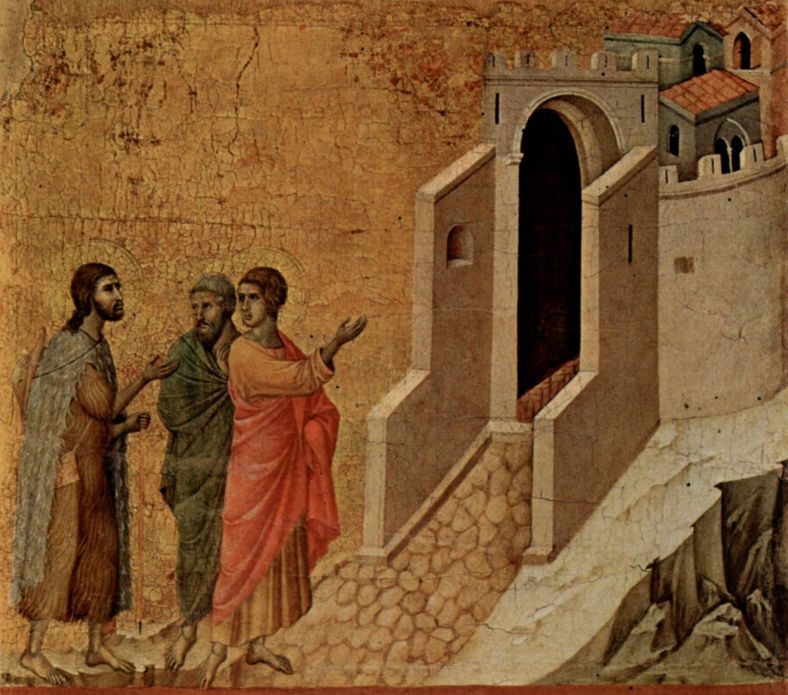
On the afternoon of the resurrection, the risen Jesus joins a couple of heartbroken travelers who are returning from Jerusalem to their home in Emmaus.  These two, let’s call them Mr. and Mrs. Cleopas, are two people who know Jesus well.  In fact, if Cleopas is the same person as Clopas mentioned in John 19 (and most scholars think he is), then these two Emmaus travelers might be Jesus’ uncle and aunt.   Tradition identifies Clopas as the brother of Joseph.  So they know him,  but as he walks with them and talks with them they aren’t aware of who he is.  Luke tells us “their eyes were kept from recognizing him.” It’s not until he sits down with them and breaks bread that they realize who he is.   Breaking bread—food shared at the table—becomes the sign of recognition.

Mr. and Mrs. Cleopas rushed back to Jerusalem to tell the disciples huddled in the upper room about their encounter with Jesus.  But just as they started to tell their story, Jesus himself stood among them and said to them, “Peace be with you.”  

And here is where Luke, the realist, the reporter, is at his best.  He tells us, “They were startled and terrified, and thought that they were seeing a ghost.”  Well you would be, wouldn’t you.  Startled. And terrified.  If you had seen someone killed in a brutal and horrific way and then entombed but suddenly that person was standing right in front of you, you would probably think you were seeing a ghost, too.  Or maybe you would question your own sanity.  

Before their minds could be totally blown or wander too far into the fog of speculation, Jesus brought them sharply to the reality of the moment.  “He said to them, ‘Why are you frightened, and why do doubts arise in your hearts?  Look at my hands and my feet; see that it is I myself. Touch me and see; for a ghost does not have flesh and bones as you see that I have.’ And when he had said this, he showed them his hands and his feet.”  

Once again Luke puts emphasis on the physical.  Touch me and see.  Luke is making a point.  A ghost does not have flesh and bones.  

Naturally the friends of Jesus, when suddenly confronted with his unexpected, risen presence, feel a tangle of emotions.  And once again, Luke is the realistic reporter.  He tells us they were joyful and disbelieving and wondering all at the same time.  So Jesus asks for something to eat and they give him a piece of broiled fish.  This is the physical proof that seals the deal and silences all doubts. Ghosts do not eat.

The realism is important here.  This is not merely a “spiritual” resurrection.  This is not merely a vision.  And this is certainly is not an elaborate mythic metaphor for springtime.  Luke wants to make it absolutely clear that this is flesh and bones Jesus returned to life, Jesus physically, bodily raised from the dead. 

Why does Luke make such a point of this and why does it matter for us?

In the original ending of Mark’s gospel, there are no post-resurrection encounters.  There is an empty tomb and a strange young man clothed in white who gives the startled women the cryptic message that “he has gone ahead of you.”  It has been suggested that the empty tomb in Mark symbolizes that ultimate love in our lives, the love of God, cannot be crucified or killed.  

Well okay.  That’s not a bad message as far as it goes.  It’s an easy idea to carry in your head.  It sounds somewhat sophisticated and enlightened.  But does it move your heart?  Can that symbolic interpretation carry the full weight of your hopes and fears when you’re faced with a crisis?

We are called to share the Good News of Christ risen, Christ alive, Christ with us, Christ at work in the world.   We are called to bring hope—a real hope that speaks to the real needs of the real people who live in real crisis in our real world.  Does “the empty tomb is the triumph of love in the midst of suffering” do that?

And again, that’s not a bad message.  It is part of our message.  But is it enough?

Twelve years ago when I was diagnosed with prostate cancer I found myself confronted by my own mortality.  I was more scared than I cared to admit because both my mom and my dad died of cancer.  Sometimes a diagnosis or a crisis can really sharpen your focus.  Things that had been theoretical either become the life raft you cling to or they get discarded.  I realized during that time that, while I’m willing to entertain and discuss all kinds of ideas and theories about resurrection, for me personally a psychological or philosophical or purely mystical  understanding isn’t enough to carry the weight of my hopes and fears.  I need something with some bones in it, some skin on it.  And I’m not alone in that.

I have seen a lot of death in my decades as a pastor.  I have accompanied people up to death’s door more than a few times and held their hand as they crossed the threshold.  I will tell you right now that, in my experience, those who believe in the resurrection of Jesus have been the ones who have departed most calmly, most readily, and most willingly.

I will also tell you that those I’ve known who can proclaim their faith with quiet conviction have also usually been those who have believed in the physical resurrection of Jesus.  Though I’ve read his words many times, Frederick Buechner’s statement of faith still moves me:

“I can tell you this,” he wrote, “that what I believe happened and what in faith and with great joy I proclaim to you here is that he somehow got up, with life in him again, and the glory upon him. And I speak very plainly here, very un-fancifully, even though I do not understand well my own language. I was not there to see it any more than I was awake to see the sun rise this morning, but I affirm it as surely as I do that by God’s grace the sun did rise this morning because that is why the world is flooded with light.”

The testimony of faithful people is a good and powerful reason to believe in the bodily resurrection of Jesus.  That’s why Luke, at the beginning of his gospel, makes it clear that he is reporting events  just as they were handed on to us by those who from the beginning were eyewitnesses and servants of the word.  

But there is also another good reason to trust the accounts of the physical resurrection of Jesus, a reason that’s both practical and theological:  something transformed the disciples of Jesus.  Something inspired this frightened band of misfits who had been timidly hiding behind locked doors to become apostles who carried an impossible message into an empire that was openly hostile to them.  Something gave them unbreakable courage.

Pinchas Lapide was a Jewish theologian and historian.  He was not a Christian, but he believed that God raised Jesus from the dead.  For him, the proof of the physical resurrection could be found in the changed lives of the disciples.  In his book The Resurrection of Jesus: A Jewish Perspective he wrote: 

“When this scared, frightened band of the apostles which was just about to throw away everything in order to flee in despair to Galilee; when these peasants, shepherds, and fishermen, who betrayed and denied their master and then failed him miserably, suddenly could be changed overnight into a confident mission society, convinced of salvation and able to work with much more success after Easter than before Easter, then no vision or hallucination is sufficient to explain such a revolutionary transformation.” [p. 125]

Jesus was a real physical person who was tortured to death in a first-century lynching.  The state and the religious authority colluded to crucify him, to physically destroy him and in so doing to destroy his opposition to their power.  His crucifixion was a political statement.  What they failed to see and understand, though, was that there was a power and authority in him that dwarfed any power and authority they imagined they had over him.  

For that reason,  nothing less than a bodily resurrection would do to nullify their violence and call their power into question.  It was his physical body they killed.  It would have to be his physical body that would proclaim their work undone.  

The power and authority of Jesus was rooted in his deeply loving relationship with the God he called Father, the God who raised him out of death into new life.  His resurrection was a victory of God’s dominion of love and life over the death-dealing oppression of empire.

The resurrection of Jesus was God’s way of saying that violence will not have the last word.  Pain will not have the last word.  Fear will not have the last word.  Anger will not have the last word. Disease will not have the last word.  Suffering will not have the last word.  Death will not have the last word.

The resurrection of Jesus was God’s way of saying that grace, forgiveness, faith, hope and love—these things will have the last word.  The resurrection was God affirming that Life will have the last word.  

Through Jesus Christ, our Lord.

[1] Luke 1:1-4 NRSV

Withdrawing to Galilee

Matthew 4:12-23

“Now when Jesus heard that John had been arrested, he withdrew to Galilee.” 

In Matthew’s telling of the life and work of Jesus, the arrest of John is the trigger that launches Jesus into his ministry of proclamation, teaching, healing and non-violent resistance.   John’s arrest sets him on a path that will eventually lead him to his death in Jerusalem.

When Jesus launches his ministry, the timing is political.  The arrest of John the Baptist is the catalyst that sets him in motion.  Herod Antipas had John arrested because John had been speaking out forcefully against Herod’s abuses of power and other moral failings, including his adulterous marriage to his sister-in-law which was forbidden under Jewish law.  As he railed against Herod, John had been attracting hundreds of followers, which made him dangerous.  So Herod did what authoritarianism always does.  He silenced the inconvenient voice of truth and criticism.  He disappeared the leader of the potential resistance.

When Jesus heard that John had been arrested, he withdrew to Galilee.   “Withdrew” is an interesting word choice here.  It’s an accurate translation, but one that’s apt to give us the wrong idea.  Jesus isn’t retreating.  He’s pivoting.  He is intentionally relocating to a more strategic position.

Why Galilee?  Matthew saw Jesus fulfilling a prophecy from the 9th chapter of Isaiah, but there were other very good reasons for Jesus to begin his work in Galilee. 

Historically, Galilee had been a hotbed of anti-Roman and anti-Herodian sentiment.  Long before Jesus arrived, Galilee had given rise to episodes of armed resistance and tax revolts.  In 37 BCE Hasmonean insurgents from Galilee waged a 2-year guerilla war against Herod and his Roman  overlords, hiding out in caves in Galilean hills between engagements.  In 6 BCE, Judas of Galilee led a revolt against the Quirinius census.   The city of Gamla, near the Sea of Galilee, had become a stronghold for Zealot extremists who had no qualms about using violence in their ongoing fight against the empire.  Galileans even practiced economic resistance when, beginning around 4 BCE, they initiated a 70-year boycott against mass produced clay lamps and red-slip pottery tableware which was used everywhere in the empire and taxed to help support the Roman military machine.

“Galilee of the Gentiles” had an ethnically diverse population.  Jews were the dominant group, but in an attempt to subvert Jewish resistance, the Romans had offered economic incentives for people from other parts of the empire to settle there.  Matthew tells us that Jesus made his home in Capernaum, a bustling, multi-ethnic hub from which other Galilean towns and villages could easily be reached either by boat or by road.  Because it was a garrison town and customs station, Capernaum had a highly visible Roman presence which meant that it would also give Jesus more opportunities to encounter travelers and settlers from other parts of Palestine, Syria, Greece, Egypt, Gaul and elsewhere.

“From that time Jesus began to proclaim, ‘Repent, for the kingdom of heaven has come near.’” (4:17).   That’s the good news, the gospel, that Jesus proclaims from his strategic base in Capernaum. 

“Repent” really is not a good translation.  “Repent,” in English, has overtones of penance and sorrow and regret, but the Greek word Metanoia means a change of heart, a change of thinking, a change of direction, a change of behavior.  Metanoieteis the word Jesus speaks in the Greek text.  It’s a command.  An imperative.  From that time Jesus began to proclaim, “Time for a change.  The commonwealth of God’s justice and kindness has come near.  It’s in reach.  Change your heart.  Change your thinking.  Change the way you do things.”  

When Jesus proclaims that the kingdom of God is in reach, he is not speaking metaphorically.  He is calling for a spiritual transformation, yes, but that is just the beginning.  He’s also calling for social, political and economic transformation because the commonwealth of God’s justice and mercy does not operate by the same rules as the empire.

As he walks by the Sea of Galilee, Jesus sees Peter, Andrew, James and John casting their nets into the sea.  He calls out to these Galilean fishermen and says, “Follow me, and I will make you become (literally) fishers of people.”  The translation here is a little tricky because the preposition is implied.  It could be “I will make you become fishers of people,” or “fishers for people,” or even “fishers on behalf ofpeople.”  But any way you translate it, Jesus is issuing a not-so-subtle invitation to Peter and Andrew and James and John to throw off the yoke of Rome.

In The Galilean Fishing Economy and the Jesus Tradition, K.C. Hanson explained that Simon, Andrew, James and John were only semi-independent.  The Galilean fishing industry was very tightly controlled by the Roman Empire.  Caesar owned every body of water in the empire.  Fishing was state-regulated.  Fishermen had to pay a hefty fee to join a syndicate.  Most of what was caught in the Sea of Galilee was dried and exported at a regulated price and heavily taxed, and it was illegal to catch even one fish outside this system.

So how does it sound now… “Follow me and I will make you Fishers for people.”?  Especially when you remember that this is in the context of Jesus proclaiming that the Basilea, the commonwealth of God’s mercy and justice is happening now?  

“I will make you Fishers for People.  For your fellow human beings.  Not just for the empire.  Not just for the elite, the wealthy, the powerful, the 1%, the people who reap all the profits but do none of the work.”

And of course Jesus uses a fishing metaphor to issue this commanding invitation because he’s talking to fishermen.  

Follow me, said Jesus.

Follow me and I will make you the you that you were meant to be

for the good of all God’s people.

Barbara Brown Taylor reminds us that this is a miracle story.  These Galilean fishermen don’t drop everything and “immediately” follow Jesus because of their extraordinary courage.  They do it because of who it is that calls them.

Jesus makes it possible for them.  Jesus captivates them with his vision and his presence and his words…and the Holy Spirit.  In the same way Jesus can make it possible for us.

Last week we took time to remember Dr. Martin Luther King, Jr, a man who clearly followed Jesus as he led and inspired others to keep reaching for that better reality called the kingdom of God—the commonwealth of God’s kindness and justice.  In a speech at Riverside Church in New York City, exactly one year before he was assassinated, he said this:

“Our only hope today lies in our ability to recapture the revolutionary spirit and go out into a sometimes hostile world declaring eternal hostility to poverty, racism, and militarism. With this powerful commitment we shall boldly challenge the status quo and unjust mores and thereby speed the day when every valley shall be exalted, and every mountain and hill shall be made low, and the crooked shall be made straight and the rough places plain . . .Now let us begin. Now let us rededicate ourselves to the long and bitter — but beautiful — struggle for a new world.”

“When Jesus heard that John had been arrested, he withdrew to Galilee.”  That sentence at the beginning of today’s gospel reading sits heavy in my heart.  It would be easy to write off John’s arrest as just one more authoritarian act of oppression in a land where authoritarian oppression was the norm.  It would be easy to skim past it and go straight to the calling of the fishermen, a story we can easily spiritualize if we don’t think too much about what it is that they gave up to follow Jesus and what it cost them and their families.  It would be easy, even, to just not see it.  But it is the thing that sets the work of Christ in motion.  

It would be easy to think, well that was then and this is now—that’s just how things were.  But this week, this month, while the streets of our cities are filled with armed and masked federal agents who are kidnapping and killing our neighbors, while resistance to authoritarian thuggery in Minneapolis and elsewhere is met with violence it is simply not possible to ignore that sentence.  Where do we withdraw to?  Where is our Galilee, our place of resistance? Where do we go to stand up with Jesus and say, “Time for change.  The Commonwealth of God’s justice and mercy is at hand.”

When Jesus heard that Rene Nicole Good, a 37-year-old mother of three had been shot and killed, he withdrew to Galilee.  

When Jesus heard that Liam Conejo Ramos, a 5-year-old preschooler in a blue bunny hat had been abducted outside his home, he withdrew to Galilee.  

When Jesus heard that Alex Jeffrey Pretti, an ICU nurse was shot and killed by government agents who are long on hostility but short on training, he withdrew to Galilee.  

When Jesus heard that 100 clergy had been arrested at the Minneapolis airport while protesting the presence and tactics that government agents are using to oppress our neighbors, he withdrew to Galilee.  And stood with them.

Minneapolis is our Galilee.

Chicago is our Galilee.

Portland is our Galilee.

Wherever our neighbors are being assaulted and oppressed, that is our Galilee.  That is where we hear Jesus calling us to follow him, even if it means stepping away from life as we’ve always known it.  

Jesus is telling us it’s time for a change.  The kingdom of heaven, the commonwealth of God’s justice and mercy is in reach.  “Now let us begin. Now let us rededicate ourselves to the long and bitter — but beautiful — struggle for a new world.”  

Taking the Plunge

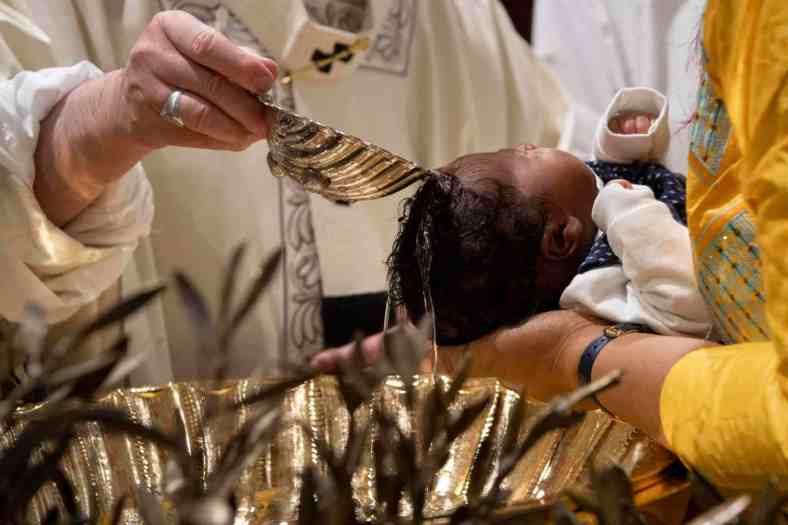
One Sunday morning when a newborn baby was being baptized during the worship service, there was a little five-year-old girl who was watching everything very intently from the front pew.  She was utterly fascinated by the baptism ceremony, but didn’t really understand what it was all about, and as pastor began to scoop water from the font and pour it onto the baby’s head, she turned to her father and in a very loud voice asked, “Daddy, why is he brainwashing the baby??”

Baptism isn’t brainwashing, of course, but over a lifetime it is supposed to change the way you think, the way you see the world, and the way you interact with the world.  We baptize people, including babies, as a sign that they are included in God’s grace and in God’s mission to transform the world.  We baptize because Jesus told us to baptize.[1]  And we baptize because Jesus, himself, was baptized.

The baptism of Jesus is covered in all four gospels.  Sort of.  John’s gospel has a scene where Jesus is at the river while John is baptizing, and  John says he saw the Spirit descend on Jesus like a dove, but the Gospel of John never actually describes Jesus being baptized.  

My favorite version of the Baptism of Jesus is in the Gospel of Matthew because it starts out with John and Jesus arguing.  Can you imagine it?  There they are, hip deep in the water, and Jesus says to John, “Do you have to dunk me all the way under?  Can’t you just scoop up a handful of water and pour it over my head?” And John says, “Dude!  No!  Are you crazy?  I’m John the Baptist, not John the Episcopalian!” (rim shot)

Actually, what they were arguing about was that John didn’t want to baptize Jesus—at least according to Matthew’s account.  Jesus came to John to be baptized, and Matthew tells us that John would have prevented him.  It didn’t feel right to John.  It didn’t feel appropriate to him because he knew that Jesus was more important than he was.  For him to baptize Jesus seemed upside down and backwards.  “I need to be baptized by you!” he told Jesus.  

need to be baptized by you.  That’s an interesting choice of words.  The wording in Greek implies that John felt he was lacking something that he thought Jesus could give him.  What could that be?

Jesus finally persuaded John to go ahead and baptize him when he said, “Let it be so now; for it is proper for us in this way to fulfill all righteousness.”  Today’s English Version translates that as “Let it be so for now. For in this way we shall do all that God requires.”  The Contemporary English Bible says, “For now this is how it should be, because we must do all God wants us to do.”

Basically, Jesus was saying to John, “let’s go ahead with this because it’s the right thing to do.”

So there’s another reason we baptize:  it’s the right thing to do.  It’s what God wants us to do.

The word “baptism” comes from the Greek verb baptizein which means “to dip,” or “to dip frequently or intensively, to plunge or to immerse.”[2]  It’s also the verb that’s used to describe putting dressing on a salad, though, so you could say it also means “to sprinkle.”  

Because early Christian baptisms were usually by immersion, some have insisted that you have to be fully immersed or it’s not a real baptism.  But The Didache, a manual for good church practice written in the late 1st or very early 2nd century said, “If you have not living water (running water, such as a stream or river), baptize into other water; and if you cannot in cold, in warm. But if you have not either, pour out water three times upon the head into the name of Father and Son and Holy Spirit.”  

That practice of pouring out water on the head is called afflusion, by the way, and as The Didache attests, it has been one of the ways the church has baptized people since its earliest days.

Yes, our word baptism does come from the Greek verb which means to immerse.  But what is it that we are immersed into?   The water is an important sign.  It speaks to us physically, spiritually and psychologically in a powerful way.  But even if there is only a little water poured onto our heads, we are being immersed, plunged into the life and love of the Triune God, the vision and mission of Christ.

Martin Luther said that the amount of water is never an issue.  Water is the physical sign of what God is doing in baptism; it is the Word of God that makes baptism effective.  One drop of water is enough because it’s the  Word of God that has all the power.  The water and the Word together become a sign of what Christ has done and is doing for us.  

Luther described baptism as one of the means of grace through which God creates and strengthens “saving faith.”  He borrowed language from Titus 3:5 to depict baptism as a “washing of regeneration” in which infants and adults are reborn.  In that rebirth, said Luther, we are clothed with the righteousness of Christ. 

“Baptism, then,” he went on to say, “signifies two things—death and resurrection, that is, full and complete justification. When the minister immerses the child in the water it signifies death, and when he draws it forth again it signifies life. Thus Paul expounds it in Romans 6: ‘We were buried therefore with Christ by baptism into death, so that as Christ was raised from the dead by the glory of the Father, we too might walk in newness of life.’ This death and resurrection we call the new creation, regeneration, and spiritual birth. This should not be understood only allegorically as the death of sin and the life of grace, as many understand it, but as actual death and resurrection. For baptism is not a false sign.”

In other words, as Luther describes it, we actually die and are resurrected in our baptism.  Life—baptized life—is a brand new life.

Baptism is not a sign of my decision for Christ, it is a sign of Christ’s decision for me.  It is a sign of God’s grace—the grace that gives us life, the grace that sustains our life.  By the presence of Christ, the living Word, and by the power of the Holy Spirit who lives in us and works through us, that one drop of water can make all the difference in the world.

Baptism isn’t an event, it’s a way of life.  But if our baptism makes one drop of difference in our lives, then we nurture that new life so it can grow and mature. That’s what church is for. That’s what education is for. That’s what prayer and contemplation are for.  But church, prayer, education—these things are not our mission—they are things that prepare us for and empower us for our mission.  

The late Thomas Troeger who taught preaching at Yale Divinity School once said,  “When we follow Jesus into the waters of baptism, we are making a statement, a witness to our desire not only for a new life for our individual selves, but a new life for the whole world. We are renouncing Herod’s action of shutting up John, of shutting up hope, of shutting up the transformation of this world. We are affirming the opening of heaven, the opening of hope, the releasing of God’s renewing power into the world. 

“Every time we have a baptism in our churches, we are making a statement of the same good news that John preached. It is not good news to the Herods of the earth. It is not good news to those who want to shut up the transforming power of God, including those who do it in the name of narrowly doctrinaire religion. But it is good news for everyone who yearns and hungers for a new world, a new creation. When we follow Jesus into the baptismal waters or when we reaffirm our baptismal vows, we are giving testimony that the opening of heaven is greater than any human effort to shut up the power of God.”

What happened for Jesus in his baptism also happens for us in our baptism.  The heavens are opened to us so there is no barrier between us and the presence of God, no barrier between us and each other.  We are told that we are loved.  We are named as children of God in a world that wants to call us all kinds of other names, a world that encourages us to label ourselves in ways that alienate us from each other and to name others in a way that alienates them from us.  But baptism reminds us that we are all God’s children.  We are all in this together.

In a world full of bad news, baptism makes us the Good News people.  In our baptism we are called beloved.  In our baptism we are named children of God.  The Spirit of God descends on us and into us to empower us and to open our minds and hearts.  And our ears. In baptism we are given a new identity; we hear God proclaim You are my child.  I am pleased with you.  I like you!  Now…let’s go out and heal the world!


[1] Matthew 28:19

[2] Anchor Yale Bible Dictionary

The Shadow That Hangs Over Christmas

Matthew 2.13-23

There is a shadow that hangs over Christmas, a shadow that has dimmed the joy and wonder of the Incarnation since Christ was born.  It is the shadow of King Herod and all the Herods since Herod.  It is the shadow of all the authoritarians, past and present, who in their greed and their lust for power and their violent fear of losing power have sometimes made God’s great gift of life almost unlivable for some and distressingly unstable for the rest of us who simply want to live and let live—or, better than that, live and help others live.

Let’s talk about Herod the Great.  He is known for his massive building projects that transformed ancient Judea.  He expanded the temple mount and began an ambitious renovation of the temple in Jerusalem.  He also built the Antonia Fortress on the temple mount to garrison troops and quell dissent.  He fortified the port city of Caesarea Maritima and he built almost impregnable fortresses at Masada, Machaerus, Cypros, Alexandrium and Herodium—a city he named for himself by the way.  He also built for himself a lavish palace in Jerusalem and a winter palace in Jericho.  

Herod was quite the real estate developer.  But he was also violent, self-centered, deeply paranoid and he ruled with an iron fist.  At the beginning of his reign he secured his position as Rome’s client king of Judea by having his chief rival assassinated.  He sent his first wife, Doris, and their young son into exile so he could marry Mariamne I, the Hasmonean princess whose brother he had just assassinated.  He used secret police to spy on opponents and dissidents and used his private bodyguard of 2,000 soldiers to remove his enemies from the country—and sometimes from the land of the living.  He replaced the Sadducee priests of the temple with outsiders from Babylonia and Alexandria so he could have greater control over the temple’s operations and treasury.  He accused his sons Alexander and Aristobulus of treason and executed them.  And he accused his wife, Mariamne, of adultery and executed her because she stopped sleeping with him.

Herod’s ambition, greed and paranoia cast a shadow over all of Judea.  And now, in our gospel text for this first Sunday in the Season of Christmas the shadow of Herod’s insecurity falls across the small town of Bethlehem, six miles south of Jerusalem.  

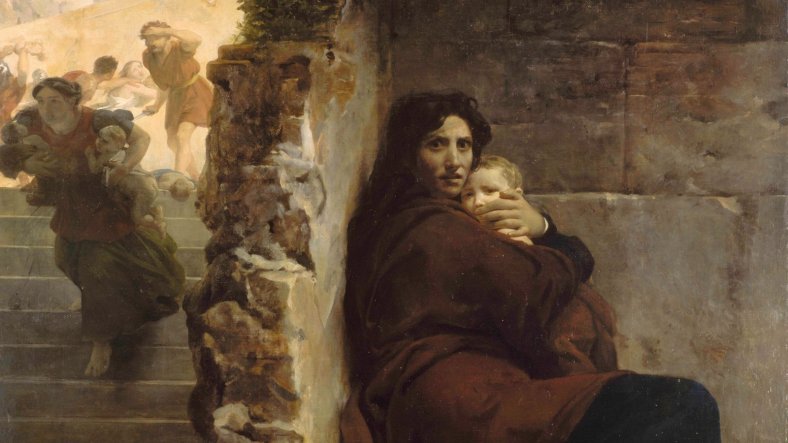
The Magi, who may have been Zoroastrian Astrologers from Persia, had followed a star to Jerusalem looking for the newly born King of the Jews but they made the mistake of stopping by Herod’s palace to ask for directions.  Herod asked them to report back on their way home and tell him where the child was “so I may go and pay him homage.”  But the Magi were warned in a dream that Herod’s intentions were anything but benevolent, so they “left for their own country by another road.”  When Herod saw that he had been tricked by the magi, he was so furious and fearful of being usurped by a baby that he killed all the children in and around Bethlehem who were two years old or under.

How deranged do you have to be, how fearful and insecure do you have to be to murder every single infant and toddler in a small town?    

Fortunately, an angel had warned Joseph about Herod in a dream and the holy family escaped to Egypt.  Jesus, Mary and Joseph became refugees.

Think about that for a minute.  Jesus was a refugee.  

Jesus, Emmanuel, God With Us, Jesus, the Word made flesh through whom all things came into being, Jesus in whom the fullness of God was pleased to dwell… became a refugee fleeing from political violence.

United Nations Statistics[1] tell us that as of the end of June this year, 117.3 million people in our world had been forced to flee their homes due to persecution, conflict, violence, or human rights violations.  Among those, 42.5 million are classified as refugees, meaning they fled to another country.  Another 67.8 million people were displaced within the borders of their own countries.  There are 8.42 million seeking asylum and another 4.4 million stateless people—persons with no nationality and no access to basic rights such as education, health care, employment  and freedom of movement.  What it all boils down to is that right now 1 in every 70 people on Earth has been forced to flee their home.

 According to Refugee Council USA[2], more than 100,000 refugees were resettled in the United States in 2024.  Almost 30% of those refugees, 29,483, were Christians from the 50 countries on the Open Doors World Watch List[3] which are noted for severe persecution of Christians.   Since January of this year, by Executive Order of the President, refugees and immigrants from most of those 50 countries are severely restricted or banned entirely from entering the United States and the Administration is planning to review the status of more than 200,000 who are already here.

Once again, a reminder:  Jesus was a refugee.  And since Bethlehem is a Palestinian city, we in this so-called Christian nation have to face the awkward fact that Jesus, Mary and Joseph would not be allowed to take refuge here in the United States under our current administration’s policies.

Clearly the shadow of Herod and all the Herods since Herod is still hanging over Christmas.  

This story of the magi, foreigners who traveled a great distance to find the child heralded by the stars, and Herod, the despotic king who felt so threatened that he murdered all the toddlers and infants in Bethlehem—this story only appears in the Gospel of Matthew.  The four gospels speak to each other and inform each other, but only Matthew has this story of star-guided faith juxtaposed with murderous malevolence.  

Only Matthew has the story of the holy family fleeing to Egypt as refugees, and I can’t help but think about why Matthew made a point of including this story in his narrative of the birth of Messiah.   I suspect it might be because Matthew is written for a community living in diaspora, a community of Jewish Jesus followers living far from their homeland.  I think we can safely assume that some in that community, maybe most, were refugees who had fled from the violence of the Romans when the legions of Titus destroyed Jerusalem and the temple, the heart of their homeland and the center of their religion.  These displaced people in this refugee community of faith would have found comfort in hearing that Jesus had also been a refugee whose family fled from political violence.  They would have felt an additional bond of common experience with their messiah.

Only Matthew tells us the story of Jesus becoming refugee shortly after his birth.  And, not coincidentally, only Matthew has Jesus, not long before his death, telling us the criteria for the last judgment.  

In Matthew 25[4], Jesus tells us, “When the Son of Man comes in his glory, and all the angels with him, then he will sit on the throne of his glory. All the nations will be gathered before him, and he will separate them one from another as a shepherd separates the sheep from the goats, and he will put the sheep at his right hand and the goats at the left.”   It’s important to note, here, that it is nations being judged.  Not individual persons—at least not in this passage.

Jesus tells us up front the criteria by which our nations are being judged.  The final test, it turns out, is a practicum. “I was hungry and you gave me food.  I was thirsty and you gave me something to drink.  I was a stranger and you welcomed me.  I was naked and you gave me clothing.  I was sick and you took care of me.  I was in prison and you visited me…Truly I tell you, just as you did it (or did not do it) to the least of these who are members of my family, you did it to me.”  The nations that have fed the hungry and brought water to the thirsty, clothing to the naked, health care to the sick, the nations that have welcomed the stranger—these nations inherit the kingdom.  The nations that did not practice these basic caregiving duties of our common humanity are accursed and relegated to the eternal fire prepared for the devil and all his angels.

So, what will be the judgment for a nation that cuts off medical aid to people around the world and even makes it unaffordable for its own citizens?   What will be the judgment for a nation that stops food aid to dependent people in other lands and curtails food assistance for its own citizens?   What will be the judgment for a nation that fills its streets with masked and armed agents who kidnap immigrants and deport them without a hearing or a trial?  What will be the judgment for a nation that closes its doors to refugees who are fleeing from violence and oppression?

I was a stranger and you welcomed me.  Or not.

This jarring story of Herod’s violence contrasts so starkly with the promise of Christmas but it is a reminder that Jesus was born into a world where the only peace was the coercive peace of oppression and violence.  It is a reminder that the fears of Herod and all the Herods since Herod still cast a shadow over the world, a reminder that the authoritarians of the world still use fear and violence to intimidate us into compliance and to deafen us to the voices of our better angels.  

There is a shadow that hangs over Christmas but there is also a light that pierces through that shadow, a light that shines through the darkness of our fears, even though the darkness has never understood it.   Christmas means that hope is born and reborn always and everywhere.  The refugee child fleeing to Egypt carries that hope in his very name.  “You shall name him Jesus,” the angel said to Joseph, “for he will save his people from their sins.”[5]   

May Jesus save us from our sins    and from our fears, which is much the same thing.

May hope, peace, joy and love united in the light of Christ’s love and forgiveness carry us through all the shadows that fall across our days and remind us that, in all things, God is with us.  May we remember that when we welcome the stranger we are welcoming Christ…in Jesus’ name.


[1] https://www.unhcr.org/us/about-unhcr/overview/figures-glance

[2] RCUSA.org

[3] https://www.opendoorsus.org/en-US/persecution/countries/?gad_source=1&gad_campaignid=22299634978&gbraid=0AAAAAqQP2OoSNK2Y9Hy6YyEtzNPjZFa0n&gclid=Cj0KCQiAr5nKBhCpARIsACa_NiM6yxnM8W84_SmibZdQg8KOkMZJDXGSwuA1fjT2DDA4JZNmQQhb9M0aAvVXEALw_wcB

[4] Matthew 25:31-45

[5] Matthew 1:21

The Light of Hope

Isaiah 2:1-5; Romans 13:8-14; Matthew 24:36-44

“When the end of the world comes,” said Mark Twain, “I want to be in Kentucky.  They’re twenty years behind on everything.”

Our Gospel text for this first Sunday in Advent, the first Sunday of a new church year, comes from a section near the end of the Gospel of Matthew that centers on the coming of the Son of Man. The fragment we read this morning comes hard on the heels of Jesus predicting the destruction of the temple with the implication that this will be the beginning of the “end times.”  The disciples, of course, want to know more.  “Tell us, when will this be,” they ask, “and what will be the sign of your coming and of the end of the age?”

The answer Jesus gives to “when will this be?” is “God only knows.” 

This section of Matthew and its parallels in Mark and Luke are sometimes called “the little apocalypse.”  The word apocalypse comes directly from Greek and only drops one small syllable on its way into English.  Apokalypsis  in Greek becomes Apocalypse in English.  The literal meaning is “an uncovering” or “unveiling.”  It originally meant a disclosure, a revelation.  

The word can also describe a particular kind of literature.  That’s the first meanings in Merriam Webster’s dictionary:

one of the Jewish and Christian writings of 200 b.c. to a.d. 150 marked by pseudonymity, symbolic imagery, and the expectation of an imminent cosmic cataclysm in which God destroys the ruling powers of evil and raises the righteous to life in a messianic kingdom.

Webster also gives what it calls the “Essential Meaning”:

a great disaster a sudden and very bad event that causes much fear, loss, or destruction.

In more common usage, apocalypse is often used as shorthand for “the end of the world.”

From disclosure to disaster.  That’s quite a shift in meaning—although it makes sense.  When things that are covered up are suddenly revealed it often creates a lot of anger and instability.  

I’ve often wondered why we are so fascinated with the idea of The Apocalypse, the End of the World.  What is it about the human psyche that wants to immerse itself in “end of the world” thinking and stories?  And why has our interest in this topic been growing? 

If you take a look at Wikipedia’s list of Apocalyptic films, it paints an interesting picture.  Before 1950, there were only 4 apocalypse movies.  The first one was a Danish film made in 1916 called, prosaically enough, The End of the World.  And then we went fifteen years before anyone made another apocalyptic movie.  That one was a French film made in 1931, also titled The End of the World.  American filmmakers got into the Apocalypse business in 1933 with Deluge from RKO Pictures, and then the Brits took a turn in 1936 with a United Artists picture called Things to Come, written by H.G. Wells.  So in the whole first half of the 20th century, only 4 apocalyptic movies are listed.  Four.  

And then they stopped.  That’s probably because the whole world was at war in the 1940s.  People were living through an apocalypse, and they wanted their movies to give them hope, to tell them there was a brighter day coming, that there would be a time of rebuilding.  

Apocalyptic films reappeared in the 1950s, but they were still sporadic enough that it would be stretching things at that point to call them a genre.  From 1950 to 1959 there are eleven apocalypse movies on Wikipedia’s list, but things would pick up significantly in the 1960s.  

From 1960 to now there have been 378 apocalyptic movies. That’s 378 films about the end of the world in a period of 65 years.

So back to the original question: why are people so fascinated by apocalypse?  Why is there such a big market for dystopia and humanity’s grand finale? 

I don’t know what the social psychologists would say about that, but I do know what Biblical scholars and theologians say.  They tell us that apocalyptic literature appears—and movies are a form that—when a people is oppressed, under great stress, and experiencing persecution, or when the world in general becomes so dystopian that problems seem unsolvable.  

The Book of Ezekiel, with its strange visions and imagery, appears during the time of the Babylonian conquest of Judah to give hope and courage to captive and enslaved people who had seen their nation not just defeated but destroyed.  The Book of Daniel was written to give hope and courage to the Jewish rebels fighting against Antiochus IV Epiphanes, the cruel Greek Seleucid ruler who desecrated Yahweh’s temple by setting up an altar to Zeus and sacrificing a pig on it.  John’s Apocalypse, which we call the Book of Revelation, was written to give hope and courage to followers of Jesus in Asia Minor who were being oppressed and persecuted by Rome.

Hope and courage for people in dire straits.  That’s what all the ancient apocalypses are really all about when you wade through all the fascinating imagery.  They use imagery as a kind of code because the people writing them and reading them are living in dangerous circumstances.  If the empire is breathing down your neck, it’s not safe to say “The Emperor is a gluttonous, greedy, selfish pig who bullies the people and forces nations to hand over the best of everything while the rest of us are sucked dry.”  So instead you write about a harlot who sits on seven hills.  You can’t say that the emperor is a monster, so you write about a monster, a dragon with seven heads, and trust that people will read between the lines.

The writers of the apocalyptic works in the Bible, and the Holy Spirit who guided them, never intended to be giving a coded timeline of the end of all things.  That’s not why they were written.  They were written to give a simple clear message:  “Hang in there.  Yes, these are scary times.  But God is on your side. Nasty empires and oppressive regimes don’t last forever.  They either exhaust themselves, or somebody conquers them, like when Darius the Mede brought new management to Babylon; or enough people finally get tired of their rubbish and rise up to throw them out on their ear, like the Maccabees did with Antiochus Epiphanes; or they overindulge themselves to death and collapse from internal squabbling and rot.  That’s what happened to Rome.  Once more for emphasis: Hold on to hope.  Have courage. God is on your side.  And God wins in the end.

This “little apocalypse” from Jesus in the Synoptic Gospels is radically different from other apocalyptic writings in one major point.  Other apocalyptic writings—those included in the Bible like Daniel and Revelation, extra-biblical books like 1 Enoch and 4 Ezra, and the apocalyptic pamphlets that circulated throughout Palestine during the Jewish war—all focused on the basic universal apocalyptic message: hang tough, God is with you, hope and courage, fight the good fight.  But this homily from Jesus has one important departure from the formula.  Ched Myers and other scholars suggest that Jesus is telling his followers to abandon the temple.  He is telling his followers to resist, but not to join in the rebellion.  He urges them not to be led astray from their path of nonviolent resistance by charismatic leaders with messianic claims, and patriotic swords and spears.

Jesus calls us to a different pathway of apocalypse.  This is not the pathway of Judas Maccabeus picking up his sword to fight the Greeks.  This is not the pathway of Simon bar Giora, claiming to be the new King David as he leads guerilla bands in surprise attacks.  This is not Mad Max with a sawed-off shotgun.  

Jesus is telling his followers that armed rebellion is not the pathway to the kingdom of God.

 The pathway of Jesus is the Way of nonviolence.  The way of critiquing the bad by doing the better.  The rebellion is not the kingdom. But the kingdom is a rebellion…done a different Way.

In the gospels, the kingdom of God, as it is embodied by Jesus, is revealed to us as a nonviolent rebellion against business as usual, economics as usual, politics as usual, government as usual, and religion as usual.  It is also very much a rebellion against rebellion as usual.  The entire mission of Jesus in the gospels is, in its way, an apocalypse.  A revealing.  It pulls back the veil to show us the serious flaws in our ways of doing things.  It critiques the bad by giving us a vision of the better.  

It reminds us that the day will come in God’s own good time when, as Isaiah promised…

Out of Zion shall go forth instruction,

                  and the word of the LORD from Jerusalem.

He shall judge between the nations,

                  and shall arbitrate for many peoples;

         they shall beat their swords into plowshares,

                  and their spears into pruning hooks;

         nation shall not lift up sword against nation,

                  neither shall they learn war any more.

O house of Jacob,

                  come, let us walk

                  in the light of the LORD!

Yes, in a way Jesus does predict the end of the world.  The world as it is  ends when it is gradually, nonviolently reimagined and replaced heart by heart, mind by mind, one person at a time until the commonwealth of God’s justice and kindness becomes our everyday reality on earth as it is in heaven.  How’s that for an apocalypse?

Advent is the time when we remember that Isaiah’s hope, that ancient hope, is our hope.  Advent is a time when we light the candle of hope to remind us that Jesus has called all of us to walk in the light of the Lord.  It is a time when we remember that just as Jesus came to teach us the Way of love and truth, the Way of cooperation and companionship, the Way of kindness and justice, he will come again when the time is right to remake and renew the world.  

When will that be—the Second Coming of Christ?  God only knows.  The only thing we can know for certain is that each day brings us one day closer.  As St. Paul says, “You know what time it is.  Now is the moment for you to wake up.  For salvation is nearer to us now than when we became believers;  the night is far gone, the day is near.”  

Salvation—our remaking as a whole and healthy world—is  closer to us now that it was when we got up this morning.  So watch.  And hope.  And be ready.  In the meantime, O house of Jacob, O house of Jesus, come, let us walk in the light of the Lord.  

What Kind of Kingdom?

Luke 23:33-43

Today is the last Sunday of the church year, Christ the King Sunday or Reign of Christ Sunday.  This is a fairly new addition to the church calendar—it was added only 100 years ago—and frankly, not everyone is happy about it.  

In 1925, the world was trying desperately to put itself back together in the aftermath of World War I and it wasn’t going well.  Pope Pius XI was gravely concerned by the growing tide of secularism and ultra-nationalism in Germany, Italy and elsewhere, and, of course, the rise of Communism in Russia.  In response he issued an encyclical called Quas Primas—“That Which is First.” Interestingly, it can also be read as a question, “What is First?”.  In this encyclical, he established The Solemnity of Our Lord Jesus Christ, King of the Universe or, as it came to be commonly known, the Feast of Christ the King.  

Pope Pius was trying to restate and reinforce the idea of the sovereignty of Christ over, well, everything.  He wanted to make it clear that our deepest and most profound allegiance should be to Jesus Christ above and beyond every other allegiance.  But in doing it in this way, was he, maybe, missing the point of what Jesus was actually saying when he talked about the kingdom of God?

The image of Christ as King is problematic for us in a number of ways.  First of all, it’s hard for us to relate to even the idea of a king.  There aren’t very many real monarchs left in the world, and most of the ones who are still here wield a power that is primarily symbolic or ceremonial.  As a case in point, King Charles III ascended to the throne of Great Britain three years ago after the long reign of his mother, Queen Elizabeth, but neither the world nor Great Britain have seen any significant changes in the governance of the United Kingdom as a result.  That’s because whatever power the throne still has is very strictly circumscribed by a democratic parliament. 

Another problem with the imagery of Christ the King is that, unfortunately, Christianity doesn’t have a very good track record with kings.  Too often in history Christianity has found itself either colluding with or coopted by the oppressive forces of empire instead of the liberating and restorative teaching of Jesus and the movement of the Holy Spirit.

In her book A Beautiful Year: 52 Meditations on Faith, Wisdom and Perseverance,  Diana Butler Bass said, “The word king is so problematic.  It is wedded to social privilege and pyramids of wealth and power and invested with centuries of inequities and fairy-tale fantasies.”[1]  Our experience of kings stands in stark contrast to the egalitarian vision Jesus was describing when he announced that the basilea of God was within reach.

Basilea.  That’s the Greek word in the gospels that we translate as kingdom.  It’s a word that the empire used to describe the domain of Caesar and also the territory governed by Herod and other client kings.  And even as Jesus was proclaiming the arrival of the basileaof God, it was a word that was both too small and too loaded to really capture the new reality that Jesus was describing.

The word Kingdom implies boundaries. Boundaries imply limitations and location.  You are either inside or outside.  Even the synonyms for kingdom make it sound territorial. 

The word Kingdom also implies power, usually and especially coercive power. Constantine and later Christian emperors and kings readily embraced the concept of the Kingdom of Christ because it was an image they could use in exercising their own power.  They could claim that they were appointed by Christ and were ruling under his authority, which meant that they could spin just about anything they did as justifiable because they were acting on Christ’s behalf.  Convert people at the point of the sword or by torture?  No problem.  We’re doing it for Jesus.  

Today, Christian Nationalism and other authoritarian movements appropriate the language of Christ the King to imagine Jesus as a muscular monarch, kicking tail and taking names.  Under the auspices of Christ the King, they want to establish a restrictive theocracy, but in embracing that idea they completely miss the new reality that Jesus was calling us to embrace.

Kingdom, realm, reign, sovereignty—none of these terms are really a good fit for what Jesus was describing when he announced that the basilea tou theou –which we translate as The Kingdom of God—is arriving, is at hand, is within reach. 

George Orwell was a guy who knew a thing or two about language and how we use, abuse, twist and misuse it.  Orwell said, “There is a huge dump of worn-out metaphors which have lost all evocative power and are merely used because they save people the trouble of inventing phrases for themselves.”[2]

Christ the King is one of those worn-out metaphors.  We keep using it because we haven’t come up with a better phrase to describe the vision of God’s all-pervading influence that Jesus was proclaiming or a way to describe our belief that God in Christ is the ultimate power that moves the universe through love, compassion, creativity, grace and cooperation.  

On the plus side, Christ the King does make us ask ourselves some important questions. What do we mean when we say that Christ is sovereign?  How do we understand the kingdom of God, the reign of God?  How do we understand the power of God?  How do we understand power in general?  How do we use power?  Do our values reflect the values of empire or the values of Jesus?  What kind of kingdom do we belong to?  And what do we do when our allegiance to Christ and the values of Jesus are in conflict with the values and practices of the other powers that hold sway in our lives?

The kingdom of God, as Jesus described it, was and is a resistance movement.  To say that Christ is king is a resistance claim.  It is a challenge to the way power is coercively used most of the time in our world.  Jesus is a different kind of king.  The crucifixion is his coronation.  He surrenders to the coercive power of empire to show us its naked violence, but also to show us the greater power of love and nonviolence.

Pontius Pilate understood that Jesus was all about resisting the empire’s coercive power but also the empire’s imagery.  When Pilate asked Jesus straight out, “Are you the king of the Jews?” Jesus simply replied, “You say so.  Those are your words.”[3]  The soldiers crucifying Jesus mocked him saying, “If you are the king of the Jews, save yourself!” Pilate mocked both Jesus and the Jewish people by having a board nailed above his head with the inscription, “This is the King of the Jews.”  These were people who understood power in only one way.  Control.  Coercion.  Power over.

But the reign of God that Jesus was describing is a cooperative world.  The reign of God doesn’t force itself on anyone or try to control anyone.  Christ, as king, pervades, persuades, encourages, nudges and asks us to live up to a vision of our better selves. 

 The commonwealth of God’s justice and kindness is a world where generosity, grace, compassion and mercy prevail.  It is a world driven by and governed by love.  It is a world where everyone’s needs are met and no one goes hungry.  It is a kingdom that opens pathways through every kind of border, boundary and barrier.  It is a world where the only control is self-control.  Its central values are to do justice, to love kindness, and to walk humbly with God. Its only law is love: love God, and love your neighbor as yourself.  

The kingdom that Jesus was describing is a world moving toward the vision of Isaiah when we will beat our swords into plowshares and our spears into pruning hooks, when nation shall not lift up sword against nation nor shall they study war anymore.[4]  The kingdom that Jesus proclaimed is the world where God walks with us as Ezekiel envisioned, a world where God shepherds us, where Christ seeks out the lost and brings back the strays, where through us, Jesus binds up the injured and strengthens the weak and feeds us all with justice.[5]

The reign of God is a realm in which the poor are blessed and the hungry are filled and those who mourn are comforted.  It is the world Mary envisioned in the Magnificat when she sang, “He has shown strength with his arm; he has scattered the proud in the thoughts of their hearts. He has brought down the powerful from their thrones, and lifted up the lowly; he has filled the hungry with good things, and sent the rich away empty.”[6]

Yes, God exercises power.  But not the way we usually think of power. God’s power is all about empowering you.  God is about giving power rather than holding onto it.  God gives power to us so that we can love and care for the world more fully and effectively. Together.  “The greatest manifestation of the power of God,” said Bishop Yvette Flunder, “comes when we work together to find ways to be together and do justice together and love together and stand together.”  

The kingdom of God is all of us together.

 “Jesus did not establish an institution,” wrote Bishop Michael Curry, “though institutions can serve his cause. He did not organize a political party, though his teachings have a profound impact on politics. Jesus did not even found a religion. No, Jesus began a movement, fueled by his Spirit, a movement whose purpose was and is to change the face of the earth from the nightmare it often is into the dream that God intends.”

Today is Christ the King Sunday.  It is a day when we use the “worn out metaphor” of kingly power to try to open the doors and windows of our hearts, minds and souls to the empowering love of God through Jesus Christ.  It is a day when we acknowledge both that God in Christ is the ultimate power and that we need to redefine how we understand and use power.  It is a day when we are asked to declare that our deepest and most profound allegiance is to Jesus Christ above and beyond every other allegiance.  It is a day that challenges us to walk in the Way of Jesus so that we can help to bring God’s vision of a whole, healthy, loving and cooperative world into reality on earth as it is in heaven.

Today is the day we volunteer to change the face of the earth from the nightmare it so often is into the dream that God intends.  In the name of Christ the King.


[1] Diana Butler Bass; “Christ the King”; A Beautiful Year: 52 Meditations on Faith, Wisdom, and Perseverance

[2] Politics and the English Language, 1946. 

[3] Luke 23:3

[4] Isaiah 2:4; Micah 4:3

[5] Ezekiel 34:15-16

[6] Luke 1:46-55

The Space Between

Luke 17:11-19

You know how you can read something a hundred times and on the one hundred and first time something will pop out at you that you never really saw before?  I don’t know how many times I’ve read this passage from Luke over the years.  It’s pretty familiar, but this week, something in the opening line really jumped out at me:

On his way to Jerusalem, Jesus passed through between Samaria and Galilee. 

That is such a curious way for this story to begin.  Where, exactly, is this space between Samaria and Galilee?   On the map Samaria and Galilee butt right up against each other.  There is and was a border that separated the two territories.  There was also a very pronounced social, cultural and religious line in the sand separating the Jews of Galilee from the Samaritans of Samaria, a line of intense historical animosity.  So what is the writer of Luke trying to tell us when he says that Jesus was passing between Samaria and Galilee?

As he entered a certain village, ten men with leprosy approached him but kept their distance and shouted, “Jesus, Master, have mercy on us!”  Jesus looked at them and said, “Go show yourselves to the priests.” And as they went, they were cleansed of their skin disease.

In Biblical times, leprosy was a catch-all term for a variety of skin conditions, especially those that created whitish patches of scaly skin such as atopic dermatitis or plaque psoriasis.  White, scaly skin can also, however, be one of the first symptoms of true leprosy, what we now call Hansen’s disease, so in an age before microscopes,  diagnostic tests and bloodwork, it made some sense to assume the worst when those scaly patches appeared.  

The book of Leviticus dictated that persons with such as skin disease had to live outside the town.  The leper laws in Leviticus required them to tear their clothes and mess up their hair to make themselves more easily identifiable, and they were required to wear a cloth mask or veil that covered from the upper lip to the chin.  They were also required to carry a bell or wooden clapper and to cry out “unclean, unclean” to warn people not to get too close, because the law required them to keep a safe distance from everyone else.  The Talmud said that the minimum safe distance on a normal day was two cubits, about six feet, but if it was windy 150 feet was the recommended safe distance.

These men with a skin disease stood at a distance and begged Jesus for mercy .  Their plea had to be loud enough to travel across the space between them and Jesus.

Jesus healed them, but he didn’t lay hands on them.  He didn’t put them in the awkward position of violating both religious and civil laws that required them to keep their distance, which meant that in this particular instance, Jesus observed those laws, too.   So he didn’t lay hands on them, and the text doesn’t say anything about him praying for them, either.  He simply said, “Go show yourselves to the priests,”  which is what Torah required if they were healed.  Their healing happened in the space between them and Jesus.

On the face of it, this looks like a simple, if somewhat unusual, story about healing.  There is also the noteworthy gratitude of the one man who returns to thank Jesus and prostrates himself before him in an act of worship, so it can also a story about gratitude.  But when we look closer, I think there is more to it than that.  

Clearly this is a story that reminds us of God’s power to heal.  It also shows us yet another example of Jesus’ compassion.  And yes, it even makes a point about taking a moment to be grateful when God has done something extraordinary for you.  But I think maybe Luke is also trying to tell us something about the power and importance of between places, those places and times when we are in neither one place or the other but on the edge or verge of both.

Luke tells us that Jesus was passing through between Samaria and Galilee.  Jesus is in a borderland, an in-between space that is both Galilee and Samaria, and at the same time really neither one.

The ten men with the skin disease were also in a between space.  They were husbands, fathers, brothers living at a distance from those they loved most in order to keep their loved ones safe.  They were living on the outskirts of the village, living on the margins of the community in that space where the village ended and the wilderness began.  More poignantly, they were also living in that thin space between life and death.  

Because their disease had excluded them from all other society, they formed their own small community, Jews and Samaritans bound together by their common affliction in a space where the cultural animosity and antagonism of Jew versus Samaritan was not only irrelevant but could threaten their survival. 

Every border, every territorial boundary, no matter where it is, is a testament to conflict.  It is a reminder that at some point in history one group of people behaved aggressively against another group of people.  Every border is a monument to our human failure to make peace with our differences, a testimony that the space between us is often filled with anger and fear.

Anxiety, said Saint Augustine, is the garden in which sin grows.

When borders are rigidly drawn and vigorously enforced, they sharpen the divide and highlight the differences between the people on one side or the other.  They intensify the “otherness” of those who are not from our side of the line, and that, in turn, can stimulate anxiety, suspicion and fear, which all too often leads to scapegoating and violence. 

On the other hand, when borders are porous and less strictly enforced, they become zones of cross-pollination and fusion between cultures, places where ideas and feelings are shared,  places where transformation is possible.

The borderlands, the between spaces, are places where meaningful change is not only more possible but more apt to happen.  

Twenty years ago, Stuart Kauffman, a researcher in theoretical biology and complex systems, proposed a new theory to explain how organisms and systems adapt and become more complex.  He called his theory Adjacent Possible Theory or “APT-ness,” and he has suggested that the “adjacent possible” is such a powerful dynamic that it could be considered the fourth general law of physics.  

Adjacent Possible Theory suggests that at any given moment there is a space of untapped potential around every complex system—around every organism, around every person, around every institution.  That field of untapped potential in the adjacent possible is actually a new field of energy that powers change and transformation. 

In other words, you are surrounded by an energizing halo of possibility.

Think about your living room. Most of us have the same furniture, sitting in the same spots for years at a time. When the house gets crowded on game days or holidays, you know where people are going to end up, what the traffic flow is going to be like, where there are going to be “traffic jams,” where the favorite spot to hang out always is.

Kauffmann’s law of the “adjacent possible” says real change takes place when you re-arrange the current configuration of things, opening up a new possibility for movement and matter.  Rearrange your living room furniture, and see what happens.  Without adding even one new chair or table, the whole feeling of the room is changed. People move about the room differently. They interact with others in new groups. The energy in the room flows in a new configuration. All that just by moving the furniture.

The Adjacent Possible, that halo of possibility is particularly potent in between spaces because the between space is adjacent to two or more differing realities or paradigms and draws energy from both.  The “furniture” tends to be in flux.

In many ways the Church is in an in between space.  We are in a time, a space, where we are no longer what we were but what we will be has not yet been revealed.  The culture has been moving us to the margins.  We are in a space of transformation, the realm of the Adjacent Possible.  The good news is that there is energy in that space, the energy to be made new.

In the original Greek text of Luke’s story of the healing of the ten men with the skin condition, there are three different words for the healing that takes place.  The first word is katharizo.  It means “to be cleansed.”  Catharsis.  This is what the 10 men experience as they leave Jesus to go to the priests.

The second word is iathei.  It means “to be changed to an earlier, correct, or appropriate state.”  To be restored.  This is what the one grateful Samaritan experienced.  He saw that he was restored.

The third word is sesoken, the active indicative form of sozo.  It is often translated as saved, but it also means to be made well or whole.  This is the word Jesus speaks to the Samaritan who bows before him in praise and gratitude when he says, “Your faith has made you whole.”  

As a church and as a nation, we are standing in an in-between place.  We are in the borderland of the Adjacent Possible, surrounded by a halo of possibility for transformation.  The shape of that transformation depends on the choices we make. 

If we open our eyes, our minds, our hearts to encounter Jesus in this in-between space, if we ask Christ for his healing mercy and guidance, then we, too, can experience cleansing, restoration, and positive transformation.   We, too, can be made whole.

Our task, our calling, is to step past the hard lines of the borders we’ve drawn, the lines that divide into us versus them.  If we want to be made whole again, we need to step into the in-between places.  That’s where we can encounter each other.  That’s where we can form a new sense of community.  That’s where we can stand in a halo of possibility. That’s where we can encounter Jesus.  That’s where God is doing a new thing… in Jesus’ name.

Image: Ten Lepers by James Christensen

Faith Without B.S. (Bogus Stuff)

Isaiah 1:1, 10-20; Genesis 15:1-6; Hebrews 11:1-4, 8-16; Luke 12:32-40

A pastor was just about to begin his sermon one Sunday when he was handed a note.  He unfolded the paper, looked at it a moment, then said to the congregation, “This says there will be no B.S. tomorrow.”  He paused for a long moment then said, “I’m pretty sure that means Bible Study, but I have to confess that for just a moment there I thought, ‘Oh, that would be nice.’”

Wouldn’t it be nice to have a day scheduled for no B.S.—no Bogus Stuff?  

In the alternate first reading for this morning from chapter one of Isaiah, Isaiah takes the people to task for their Bogus Stuff.  He tells the people quite plainly, “God doesn’t want your bull.”  Well, what he actually says is:  

10 Hear the word of the LORD, you rulers of Sodom!

Listen to the teaching of our God, you people of Gomorrah!

11 What to me is the multitude of your sacrifices? says the LORD;  I have had enough of burnt offerings of rams and the fat of fed beasts; I do not delight in the blood of bulls, or of lambs, or of goats. 

12   When you come to appear before me,  who asked this from your hand? Trample my courts no more.

13 Bringing offerings is futile; incense is an abomination to me. New moon and sabbath and calling of convocation— I cannot endure solemn assemblies with iniquity.

14 Your new moons and your appointed festivals my soul hates; they have become a burden to me, I am weary of bearing them.

15 When you stretch out your hands, I will hide my eyes from you; even though you make many prayers, I will not listen; your hands are full of blood.

Somewhere along the way, the people had substituted the practice of their religion for the ethics of their faith.  They had fallen into the habit of thinking that as long as they performed the right rituals and offered the right sacrifices, as long as they celebrated certain festivals and observed certain holy days in the calendar, then everything would be okay between them and God.  

But Isaiah tells them in plain language, “No.  God thinks all of that is B.S.  Bogus Stuff.  God doesn’t want your bull…or your ram or your goat.”  So what does God want?

Wash yourselves;” says Isaiah, “make yourselves clean; remove the evil of your doings from before my eyes; cease to do evil, learn to do good; seek justice, rescue the oppressed, defend the orphan, plead for the widow.”[1]

The texts assigned for today are all about faith.  They tell us what faith is and what it is not.  

Isaiah makes it clear that faith is not simply worship.  It is not liturgical worship or praise worship or any other form of worship.  Faith may move you to worship God.  Worship is one way to express your faith.  But it is not a substitute for faith.  And worship without faith is meaningless.

Faith is not mere belief.  Faith does not mean you accept or give your intellectual assent to certain propositions or truths about God, about Jesus, about the Holy Spirit.  Faith is not creeds or doctrine or dogma.  Those are tools that may help guide our faith in the same way a map can help you get somewhere you want to go.  But the map is not the journey.  It’s a depiction of the path others have traveled before you.   

So what is faith?

“Faith,” said Martin Luther, “is God’s work in us, that changes us and gives new birth from God… It kills the Old Adam and makes us completely different people.  It changes our hearts, our spirits, our thoughts and all our powers. It brings the Holy Spirit with it. Yes, it is a living, creative, active and powerful thing, this faith… Faith is a living, bold trust in God’s grace, so certain of God’s favor that it would risk death a thousand times trusting in it.”[2]

Faith is trusting God.  That’s Martin Luther’s definition. And that’s not always as easy as it sounds because God’s ways are not our ways and God’s timetable is certainly not our timetable.

Abram trusted God, but that didn’t stop him from complaining.  He had left his home in Ur to find a new homeland that God had promised.   Everywhere he went in the new land he prospered.  He acquired vast parcels of property.  His flocks increased.  Local kings respected and feared him so much that they tried to recruit him as an ally in their territorial wars.  He could have built his own city, but Abram continued to live in a tent because God had told him to keep moving.  But when  long years had passed and he and Sarah had not been blessed with children, Abram complained.

So God took Abram outside to look up into the night sky.  “Look up into the sky and count the stars if you can,” said God.  “If I can make that, do you really think giving you descendants will be a problem?”

Genesis tells us that Abram trusted God, and God regarded Abram as righteous because of his faith.

Faith is trust in God.  

When Jesus was on the road with his disciples announcing that the reign of God, the kin-dom of God is in reach, his followers started to worry about all the things one worries about in daily life.  Jesus turned to them and said, “A person is a fool to store up earthly wealth but not have a rich relationship with God.  That is why I tell you not to worry about everyday life—whether you have enough food to eat or enough clothes to wear. For life is more than food, and your body more than clothing.  Look at the ravens. They don’t plant or harvest or store food in barns, for God feeds them. And you are far more valuable to God than any birds!  Can all your worries add a single moment to your life?  And if worry can’t accomplish a little thing like that, what’s the use of worrying over bigger things?

    “Look at the lilies and how they grow. They don’t work or make their clothing, yet Solomon in all his glory was not dressed as beautifully as they are.  And if God cares so wonderfully for flowers that are here today and thrown into the fire tomorrow, he will certainly care for you. Why do you have so little faith?

   “So don’t be afraid, little flock.  For it gives your Father great happiness to give you the kingdom.”[3]

Faith is trusting God as we follow the Spirit-driven yearning of our hearts toward the better world that Jesus described for us.  It is trust that carries us through this in-between life—living between what life and the world are now and what we hope and dream life and the world will be as we work to transform them.  Faith is a holy restlessness.  A longing.  A hunger.  A desire.  Faith is not a destination, it is the road, the journey.

“Faith,” wrote Debi Thomas, “is the audacity to undertake a perilous journey simply because God asks us to — not because we know ahead of time where we’re going.  Faith is the itch and the ache that turns our faces towards the distant stars even on the cloudiest of nights.  Faith is the willingness to stretch out our imaginations and see new birth, new life, new joy — even when we feel withered and dead inside.  Faith is the urgency of the homeless for a true and lasting home — a home whose architect and builder is God.”[4]

Faith is a holy dissatisfaction with the world as it is.   Faith wants to tear down walls and build bigger tables.  Faith wants to open the doors wider so more can come to the feast.  Faith trusts that there will always be enough for everyone.  Faith trusts that Love is not diminished but multiplied when it’s shared.  Faith shows the reality of what we hope for; it is the evidence of things we cannot see except in our Spirit-inspired imaginations.

When we stand to recite the Creed on Sunday mornings, we begin with the words, “I believe, ” which is the common English translation of the Latin word Credo.  In his book The Heart of Christianity, the late Marcus Borg reminded us that Credo has a richer, deeper meaning than what we are typically thinking when we say, “I believe.” 

Credo does not mean ‘I hereby agree to the literal-factual truth of the following statements.’  Rather, its Latin roots combine to mean ‘I give my heart to.’ . . .As the giving of one’s heart, credo means ‘I commit my loyalty to,’ ‘I commit my allegiance to.’

  “Thus, when we say credo at the beginning of the Creed, we are saying, ‘I give my heart to God.’  And who is that?  Who is the God to whom we commit our loyalty and allegiance?  The rest of the creed tells the story of the one to whom we give our hearts: God as the maker of heaven and earth, God as known in Jesus, God as present in the Spirit. . . 

  “Most simply, ‘to believe’ means ‘to love.’  Indeed, the English words ‘believe’ and ‘belove’ are related.  What we believe is what we belove.  Faith is about beloving God.”

Faith is about trusting God, but more than that, faith is about loving God.  “The only way I know how to love God,” said Richard Rohr, “is to love what God loves.”

Jesus tells us to trust God, to love God, and to travel light.  He tells us to free ourselves from excess everything and give to those in need.  Where your treasure is, he says, that’s where your heart will be.  So, let your heart go out to all those other children of God in the world around you.  Love God.  And love your neighbor as you love yourself.  Be dressed for service.  Keep your lamps burning.  And be ready.  The kin-dom of God is so close…and we don’t want to let Bogus Stuff keep us from getting there.

Have no fear, little flock.  It is your Father’s great pleasure to give you the Kingdom.


[1] Isaiah 1:16-17

[2] An excerpt from “An Introduction to St. Paul’s Letter to the Romans,” Luther’s German Bible of 1522 by Martin Luther, 1483-1546

Translated by Rev. Robert E. Smith from DR. MARTIN LUTHER’S VERMISCHTE DEUTSCHE SCHRIFTEN. Johann K. Irmischer, ed. Vol. 63 Erlangen: Heyder and Zimmer, 1854), pp.124-125. [EA 63:124-125]

[3] Luke 12:22-32 (NLT)

[4] Debi Thomas, Called to Restlessness, Journey With JesusAugust 7, 2022

How Much Is Enough?

Luke 12:13-31

There is an odd little detail at the beginning of chapter twelve in the Gospel of Luke that’s easy to overlook.  It could be utterly insignificant.  But, maybe it’s not.  Jesus had been invited to dinner by one of the Pharisees but it turned out to be a pretty unpleasant time with lots of verbal sparring between Jesus and the Pharisees and scribes.  When Jesus left the Pharisee’s house he discovered that, “the crowd had gathered by the thousands, so that they trampled on one another.”[1]

That’s the odd little detail.  They trampled on each other.   I think this peculiar little note is Luke’s metaphorical way of setting the stage for what Jesus is going to say about greed and hoarding and selfishness.  And fear.  

Someone in the crowd yelled out, “Teacher, tell my brother to give me my share of what our father left us when he died.”  Jesus replied, “Man, who made me your probate judge?” Well, words to that effect. Then he turned to the crowd and said, “Don’t be greedy!  Owning a lot of stuff won’t make your life safe.”  And to illustrate his point, he told them a little parable.

A rich man’s farm produced a huge crop, and he said to himself, “What am I gonna do? I don’t have a place large enough to store everything.”  But then he thought, “Hey, I know! I’ll tear down my barns and build bigger ones, where I can store all my grain and all my other stuff. Then I’ll say to myself, ‘Self, y ou have stored up enough good things to last for years to come. Live it up! Eat, drink, and enjoy yourself.’” But God said to him, “You fool! Tonight you’re going to die. Then who will get all your stuff?” 

Jesus paused for a moment to let that sink in then said, “This is what happens to people who store up everything for themselves, but are poor in the sight of God.” 

So what did this man do wrong, this rich fool in the parable?  Is Jesus saying that we shouldn’t save up for retirement or stash some cash for a rainy day when we get a bit ahead of the game?  

I don’t think Jesus is saying that it’s wrong to be rich, and I don’t think he’s opposed to saving for retirement.  But he’s also not a fan of hoarding wealth and surplus and thinking only about ourselves.  

The rich man talks to himself like he’s the center of the universe.  His surplus is all about himself.  In the culture of the people who originally heard this Jesus story, that kind of attitude would be frowned upon… to put it mildly.  Torah, the Jewish law, had some pretty clear things to say about sharing the wealth.  You didn’t harvest to the edge of your field, you left the margins for the poor.  You didn’t pick up windfall fruit in your vineyard or orchard, you left it for the poor.  And when you did harvest, you gave a minimum of 10% in a tithe for supporting the Levites and the poor.  The rich fool in this parable doesn’t even mention these things.  He only thinks of himself.  And he never asks himself, “How much is enough?”

Kurt Vonnegut, the author of Slaughterhouse 5 was good friends with Joseph Heller, who wrote Catch 22.  When Heller died, Vonnegut remembered a conversation they had once had at a party.  He recorded that conversation as a poem and read the poem at Heller’s funeral.  Here’s what he said:

True story, Word of Honor:

Joseph Heller, an important and funny writer

now dead,

and I were at a party given by a billionaire

on Shelter Island.

I said, “Joe, how does it make you feel

to know that our host only yesterday

may have made more money

than your novel ‘Catch-22’

has earned in its entire history?”

And Joe said, “I’ve got something he can never have.”

And I said, “What on earth could that be, Joe?”

And Joe said, “The knowledge that I’ve got enough.”

Not bad! Rest in peace!”

How much is enough?  

I’ve been asking myself that question for years.  How much is enough?  I like to tell myself that my needs are simple, that I don’t need a lot of stuff, but then I look around my office, my dresser, my closet, my garage and, honestly, I am inundated with stuff.  And a lot of it is stuff I don’t need or even much want anymore.  How did that happen?  

How did I end up with so much stuff?  And it’s not just my stuff.  I have stuff that belonged to my parents and grandparents and my in-laws.  My Beloved Spouse texted me two articles on Thursday on how to declutter.  So I guess we’ll be doing that soon. . . 

On the Sermon Brainwave podcast this week, Professor Rolf Jacobson told us that his grandmother used to say, “Possessions are their own punishment.”  Yep.  Possessions are their own punishment.

We cling to our stuff, and, it seems like our stuff clings to us.  Back in 1981 the late George Carlin had a whole standup routine about all our stuff.

“I bought a house,” said Carlin. “I needed a place to keep all my stuff.  That’s all your house is, a place to keep your stuff. If you didn’t have so much stuff, you wouldn’t need a house. You could just walk around all the time. A house is just a pile of stuff with a cover on it. You can see that when you’re taking off in an airplane. You look down, you see everybody’s got a little pile of stuff.  All the little piles of stuff.  And when you leave your house, you gotta lock it up. Wouldn’t want somebody to come by and take some of your stuff. They always take the good stuff… All they want is the shiny stuff. That’s what your house is, a place to keep your stuff while you go out and get…more stuff!”

What George Carlin said in 1981 is just as true today.  Maybe even more so.  Many people don’t have enough room in their houses for all their stuff, so one in 20 households rent extra space for their stuff!  Last year there were 52,301 self-storage facilities in the U.S. according to the Self-Storage Almanac.  That’s right, the stuff storage industry has its own publication.  The Almanac is projecting that in the U.S. alone, the market is expected to grow from $44.37 billion to $49.88 billion by 2029.  We can’t seem to create enough affordable housing for all our people, but we’re going to make sure we take care of all our stuff.  And it’s weird when you think about it because eventually you’re going to die.  And then who’s going to get all your stuff?  And do they even want it?    

How much is enough?  

As a culture, it seems like there’s no end to our desire for more stuff. . .or more money.  Which is really just a more portable kind of stuff.  Congress just recently passed what they called the One Big Beautiful Bill which will give the country’s estimated 900 billionaires a tax break of $60 billion dollars in federal taxes over the next two years.[2]  That averages out to more than $66 million per billionaire!  Nice.  If you’re a billionaire.  But the Congressional Budget Office also estimates that those tax breaks will add $3.4 trillion to the federal deficit by 2034.  And, of course, the bill gutted Medicaid and SNAP benefits to pay for all this largess to wealthiest among us which means that millions of the poorest among us will be without medical coverage or adequate food.

Mahatma Gandhi said that the world provides enough for all our need, but not for all our greed.

Thomas Hendricks, a psychologist who writes for Psychology Today said, “Most people, I believe, would agree that selfishness is not the basis for a healthy, sustainable society.”[3]  He’s got a point.

Stephen Hawking, the physicist, said, “We are in danger of destroying ourselves by our greed and stupidity.” 

You want to try a fun little exercise?  Put the words “Greed and Fear” in the Google or whatever search engine you use.  Ninety percent of the results will talk about financial markets, and a lot of them will refer to the Greed and Fear index, a graph they use to tell us if Greed or Fear is driving the stock market right now.  But here’s the thing—what they don’t tell you is that Greed is rooted in fear. 

Greed is rooted in a fear of scarcity, loss, or not having enough, a fear that can drive us in a relentless pursuit of wealth or material possessions.  Greed is driven by a subconscious belief that our worth as persons is somehow tied to how much we have, and if we don’t have much, then we’re not worth much.  That is a story our culture often tells us in many not-so-subtle ways.  Some go so far as to say, “Greed is good.”  That was the unforgettable message of Gordon Gekko, played by Michael Douglas in the 1987 movie Wall Street.  But the idea that greed is good doesn’t only appear in fiction.  More than a few politicians and financial commentators, Milton Friedman for instance, have talked about greed as a necessary and driving force in the economy.  

Maybe.  But one thing that is for certain is that greed is one of the ways we trample on each other.

“Take care!,” said Jesus. “Be on your guard against all kinds of greed for one’s life does not consist in the abundance of possessions.”  The Contemporary English Version simplifies it this way: “Don’t be greedy. Owning a lot of things won’t make your life safer.”[4]  It doesn’t get much clearer than that.

The letter to the Colossians tells us that greed is a kind of idolatry.[5]  It’s worship of a false god.  Martin Luther would whole-heartedly agree. “Show me what you trust,” said Luther, “what your heart clings to, and I will show you your god.”[6]

So. . .what do you trust?  What does your heart cling to?  How much is enough?  These are “come to Jesus” questions, are they not?

“I tell you not to worry about your life!” said Jesus. “Don’t worry about having something to eat or wear.  Look at the crows!  They don’t plant or harvest, and they don’t have storehouses or barns.  But God takes care of them!  You are more important than any birds.  Can worry make you live longer?  If you don’t have power over small things, why worry about everything else?”[7]

I hear Jesus say these things and I think, “Yeah, Jesus, I hear you.  I get what you’re saying.  That would be a nice way to live.  But the cost of living keeps going up.  And Elon Musk monkeyed around with the IRS so I haven’t got my tax refund yet.  And we’re still paying for our last vacation. . . And what if one of the cars needs new tires or the water heater blows or the dishwasher floods the kitchen or one of us gets sick or any one of a dozen other expensive things happens?

And then Jesus says this:  “Only people who don’t know God are always worrying about such things.  Your Father knows what you need.  So put God’s work first, and these things will be yours as well.”

Only people who don’t know God are always worrying about such things.  

So I guess that means that if I’m worrying about such things then I don’t know God as well as I think I do.  I guess that means that I need to get to know God better.  To spend more time with God.  To listen to God more carefully. To trust God more.  To love God more fully and freely.

“Do not be afraid, little flock,” said Jesus, “for it is your Father’s good pleasure to give you the kingdom.”  

So, I guess what it all boils down to is we need to trust God.  We need to trust that God will see to it that we have enough.  Maybe we could simplify our lives.  Maybe we could make do with less and learn that that’s enough.  And, of course, we should try not to trample on each other.


[1] Luke 12:1

[2] What The Big Beautiful Bill Really Means for Billionaires; Martina Di Licosa; Forbes,  July 9, 2025

[3] Hendricks, Thomas, Ph.D.; Greed and Fear; Psychology Today, August 3, 2017

[4] Luke 12:15 (Contemporary English Version)

[5] Colossians 3:5

[6] Luther’s Large Catechism

[7] Luke 12:22-26 (CEV)

A Prayer for Us

A Prayer for Us

Luke 11:1-13

How do you pray?  How do you talk to God?  What name or practice opens your heart to deep communication with the Maker of all things, the heart of Life and Love?    

Once, when Jesus was praying, one of his disciples said, “Lord, teach us to pray as John taught his disciples.”  John the Baptizer had apparently taught his disciples a special prayer for their community.  Jesus responded to this request by teaching his disciples the prayer that we’ve come to know as The Lord’s Prayer, or, if you’re Catholic, the Our Father, but I can’t help thinking Jesus would prefer for us to think of it as Our Prayer.  He gave it to all of us, after all.

The Lord’s Prayer was originally taught and transmitted orally, so it would naturally be remembered with some slight variations from community to community.  That’s probably why the version in Luke differs slightly from the version in Matthew, and both of them differ from the version in the Didache, the late first-century manual on how to do church.  

The most common version used today in English speaking communities is based on the wording that first appeared in The Book of Common Prayer in 1549.  That version was based on William Tyndale’s translation of the Gospel of Matthew from 1526 which is the only translation, by the way, where you’ll find “forgive us our trespasses” in Matthew 6:12 instead of “forgive us our debts.”[1]

I could talk all day about difficulties and variations in translation and transmission of the prayer.  It has even been a centerpiece of controversy a time or two in church history, but for now let’s use Luke’s version to take a deeper look at the meaning of this amazing prayer that Jesus has given to us.

“When you pray,” said Jesus—and the “you” is plural here—so, “when all y’all pray, say: Father, may your name be revered as holy. Your kingdom come.  Give us each day our daily bread.  And forgive us our sins, for we ourselves forgive everyone indebted to us.  And do not bring us to the time of trial.”  

We usually start a conversation by getting the other person’s attention. We often do that by simply by saying their name or title.  For example, my grandsons call me Pono.  When I hear one of the say, “Pono,” I know they want to talk to me about something or ask me something or sometimes just come sit with me—which is one of my favorite things in life.  It’s the same when we begin the Lord’s Prayer saying, “Father…”  We’re letting God know we would like to have a conversation.  Or that we’re ready to listen.

The word “Father” acknowledges that we have a personal relationship with God.  It’s supposed to help us feel like we’re sharing our hearts with a warm, nurturing, loving parent.  That’s the kind of relationship Jesus had with God and that’s what he would like for us to have, too.  

But the Father image, or for that matter the Mother image doesn’t work for everybody.  Some people have experienced abuse or conflict with their father or mother or both, so parent imagery isn’t inviting for them.  When that’s the case, it’s perfectly okay to address God in some other way.

In her book Help, Thanks, Wow: The Three Essential Prayers, Anne Lamott wrote, “Nothing could matter less than what we call [God].  I know some ironic believers who call God Howard, as in ‘Our Father, who art in Heaven, Howard by thy name.’  

“Let’s not get bogged down on whom or what we pray to.  Let’s just say prayer is communication from our hearts to the great mystery, or Goodness, or Howard; to the animating energy of love we are sometimes bold enough to believe in; to something unimaginably big, and not us.  We could call this force Not Me. . .  Or for convenience we could just say ‘God.’”

Anne Lamott’s advice to call on God with whatever name opens your heart and draws you closer to God might seem contradictory to what comes next in the Lord’s Prayer: “may your name be revered as holy,” or to translate it directly from the Greek, “Let it be sacred, the name of you.”  So, are we treating God’s name as sacred if we call on God as Howard or some other name?  Well, I think that depends entirely on your attitude when you use that name. 

Devout Jews often address God as Hashem in their prayers.  Hashemmeans “the name,” and addressing God as Hashem gives them a way to address God by name, sort of, without actually saying God’s name, which they believe is too holy to be spoken.  In effect, Hashem becomes a name they use for God in much the same way that Pono is the name my grandsons use for me.  

Devout Jews avoid speaking God’s name, the name God spoke to Moses from the burning bush, as a way to ensure that they don’t break the commandment against taking God’s name in vain.  Taking God’s name in vain means a lot more than just saying God’s name at the wrong time or in the wrong way or saying “Oh my God” as an expletive.  

Taking God’s name in vain means using the name or authority of God in a way that draws ridicule.  It can mean claiming the authority of God for purposes that have nothing to do with God’s sovereignty or God’s desires.  It can mean using God’s name or authority to further your own ideas or agenda, to reinforce your own authority, or simply using God’s name or authority for show.  

When we say “hallowed by your name,” we’re saying, “Let it be sacred, Hashem, let it be sacred, the name of you.” When we pray this, it’s a way of saying, “Keep us humble in your presence and keep us honest, God.”

And now we come to the part of the prayer that is truly the most challenging if we really think about what we’re saying.

“Your kingdom come.”  I think sometimes that if we took this petition seriously our knees would buckle.  When we pray “your kingdom come,” we are volunteering to help build a civilization grounded in justice, kindness and love.  

This petition is where the Lord’s Prayer becomes subversive in the best possible way.  When we pray “your kingdom come,” the Lord’s Prayer can no longer be regarded as merely a nice religious artifact or a litany of devotion.  And if anyone wants to suggest that Jesus is telling us to pray for the establishment of God’s heavenly kingdom at the end of time, then I would suggest that they haven’t really read the gospels or understood the teaching of Jesus.  Jesus was not crucified because he talked about heaven; he was executed for proclaiming that the dominion of God was within reach and, in fact, had already begun. 

Your kingdom come is a declaration that we are in favor of radical changes in the way the world operates.  When we pray your kingdom come, we are asking God to work through us to make significant changes in economics, politics, religion and society in order to bring the justice and shalom of God to our everyday lives.  When we pray your kingdom come we are volunteering to live here and now in God’s shalomand also to do whatever we can to bring God’s shalom to others and to all of creation.

Shalom is what the Lord’s Prayer is all about.  Shalom is a Hebrew word that means peace, but it’s not merely a peace based on the absence or suppression of hostility.  The word Shalom comes from the Hebrew root shalam, which literally means “make it good.”  It is a word used to describe completeness and wholeness.  And, while it’s good for us to seek our own inner shalom, the real shalom of God’s dominion happens in community.  The Shalom of God’s kin-dom is a peace that recognizes that we are all interconnected and interdependent.  Shalom is built on justice and fairness and desires peace and well-being for everyone, not just for ourselves.  

Cherokee theologian Randy S. Woodley describes it this way:  “Shalom is communal, holistic, and tangible. There is no private or partial shalom. The whole community must have shalom or no one has shalom. As long as there are hungry people in a community that is well fed, there can be no shalom. . . . Shalom is not for the many, while a few suffer; nor is it for the few while many suffer. It must be available for everyone.”[2] 

When we pray Your kingdom come, we are praying for shalom in our homes, in our towns, in our churches, in our nation and throughout the whole world.  We are praying for peace and justice and fairness for everyone.  And that brings us naturally to Give us each day our daily bread, because in the commonwealth of God’s justice and kindness, in God’s shalom, everyone is fed and no one goes hungry. 

Give us each day our daily bread.  There are some variations in the ancient Greek manuscripts here.  Many of them have this petition exactly the way we’re used to hearing it or saying it: give us today our daily bread.  However, the insightful Jewish New Testament scholar Amy-Jill Levine, suggests that a more useful understanding comes from the manuscripts that say give us today our bread for tomorrow.  

In most households in Jesus’s day, the dough for the next day’s bread was prepared the evening before and allowed to rise during the night.  If you were going to have bread tomorrow, you needed to have the ingredients today.  So, “give us today our bread for tomorrow” is a way of asking for something very practical.  We’re asking God to save us from at least a little anxiety by giving us today what we will need tomorrow.  

This part of the prayer reaches beyond our family table.  It echoes a traditional Jewish table prayer called the motzi: “Blessed are you, Lord our God, ruler of the universe, who brings forth bread from the earth.”  It reminds us that God doesn’t just magically put bread on the table. God uses the generosity of the earth and the labor of the whole community to put bread on the table.  

When we pray give us today our bread for tomorrow, we are asking God to care for the land where the grain grows.  We’re asking for clean and gentle rains so the crops can grow.  We are asking God to guard and protect the farmers who plant and care for and harvest the crops.  We are asking God to care for those who transport the grain and mill it into flour.  We are asking God to care for the hands that make the dough and knead it.  We are asking for fuel for the fire in the ovens that bake the bread.  

Bread on the table depends entirely on the well-being of the community and on our relationships within the community.  God brings forth bread from the earth, but it is a team effort.  When we pray for both today’s bread and tomorrow’s we are once again praying for the shalom of God’s kin-domThe next time you hold a piece of bread in your hand, or any piece of food for that matter, think of all the hands that labored to bring it to your hand.

Shalom is what makes it possible for us to have our daily bread.  But sometimes things we do or say disrupt our peace and fracture the cooperation and mutuality of shalom.  Sometimes our sins or the sins of others rupture relationships and forgiveness is needed to restore those relationships.  And that’s why Jesus taught us to pray Forgive us our sins, for we ourselves forgive everyone indebted to us.  

Luke says “forgive us our sins.”  Matthew says, “forgive us our debts.”  In both Aramaic and Hebrew, “debt” was another way to talk about sin. This petition reminds us that there is a reciprocity involved in forgiveness.  As Jesus said in Luke 6:37, “Do not judge, and you will not be judged; do not condemn, and you will not be condemned. Forgive, and you will be forgiven.”  Once again it’s about relationships all the way down, which means that this petition is also about God’s shalom.

But let’s go back to the language about debts and forgiving debts. Remember that Jesus was a Jew and he was teaching this prayer to his Jewish disciples.  This language about debts would have been a reminder to them of everything the Torah and the prophets had to say about economic justice.  Jesus is reminding them and us that we are called to live in an economically ethical way.  When we don’t, it’s a sin.  We accrue a spiritual debt.

Living a life of faith as a follower of Jesus means that sometimes we face difficult questions. Sometimes it feels almost as if we’re being tested. And so we pray do not bring us to the time of trial.  

When the Book of Common Prayer was revised in 1604, the phrase “lead us not into temptation” in that version of the Lord’s Prayer caused a huge controversy. The Puritans were quick to point out that the Book of James says, “No one, when tempted, should say, ‘I am being tempted by God’; for God cannot be tempted by evil and he himself tempts no one.” (James 1:13)  This was only one of several complaints they had about the Book of Common Prayer, but it was one they were not willing to compromise.

They had a point.  What the Greek says in both Luke and Matthew is “do not bring us into a peirasmon.  Peirasmon is a time or place of testing, trial or examination.  Temptation may be a kind of test, but not every test is a temptation.  In this petition, we are asking to be spared from any kind of catastrophe or stress, or any situation that would put our faith to the test. 

The Lord’s Prayer, Our Prayer, this prayer that Jesus gave us, is not only one of the great treasures of our faith, it’s also, in its way, a call to radical discipleship.  In this prayer we are asking God to empower us, guide us, and walk with us as we embrace a new way of life with new values and a new vision of what the world can be.  It really is, in six simple lines, a kind of manifesto for life as a follower of Jesus.

In this prayer we are asking for peace, health, and  wholeness for ourselves and for our community.  We are asking God to help us live in the shalom of the commonwealth of God’s justice and kindness here and now.  We are asking God to help us live in the Way of Love.  When we say “Amen,” we are not only saying “Make it so,” we are saying we will do whatever we can to live in that vision and make it a reality for others.  In Jesus’ name.


[1] I’m very grateful to Brian Stoffregen for this bit of history and other insights in his weekly Exegetical Notes.

[2] Shalom and the Community of Creation; Randy S. Woodley